History of CALL: The 60s   Betzayda Lara Castillo
The 60’s: “The Pioneering Wilderness” featuring PLATO.
The 60’s were characterized by… Pedagogy  Audiolingualism Psychology Behaviorism  Linguistics  Structuralism  P rogrammed  L ogic for A utomatic T eaching O perations  Started by Don Bitzer, Professor of Electrical Engineering.  Designed to deliver learning packaged to large number of Ss’ Communication system > “note files”:  Tutor and learner. Learner groups
Sentence Judger   Three main functions:  Looked for synonyms and key words in Ss’ answer.  Misspelling Word order
Advantages of PLATO: Displayed different alphabets on same screen. “Plato was able to provide a highly coordinated and sophisticated site management system.” (Hart, 1995 at Levy 1997:16). Easy to use. Tutor:  authoring language. Didn’t have flexibility of object-oriented programming.
Adding text to Speech Synthesis mechanism with PLATO.  Development of PLATO guided by practical concerns.  Range of languages:  English, Esperanto, French, German, Hindi, Latin, Modern Hebrew, Modern Greek, Norwegian, Russian and Swedish.
Hart (1995:30) Plato laboratory featured 50,000 hours of language instruction per semester. Plus another 50,000 hours in other curricula.  Twelve different languages.
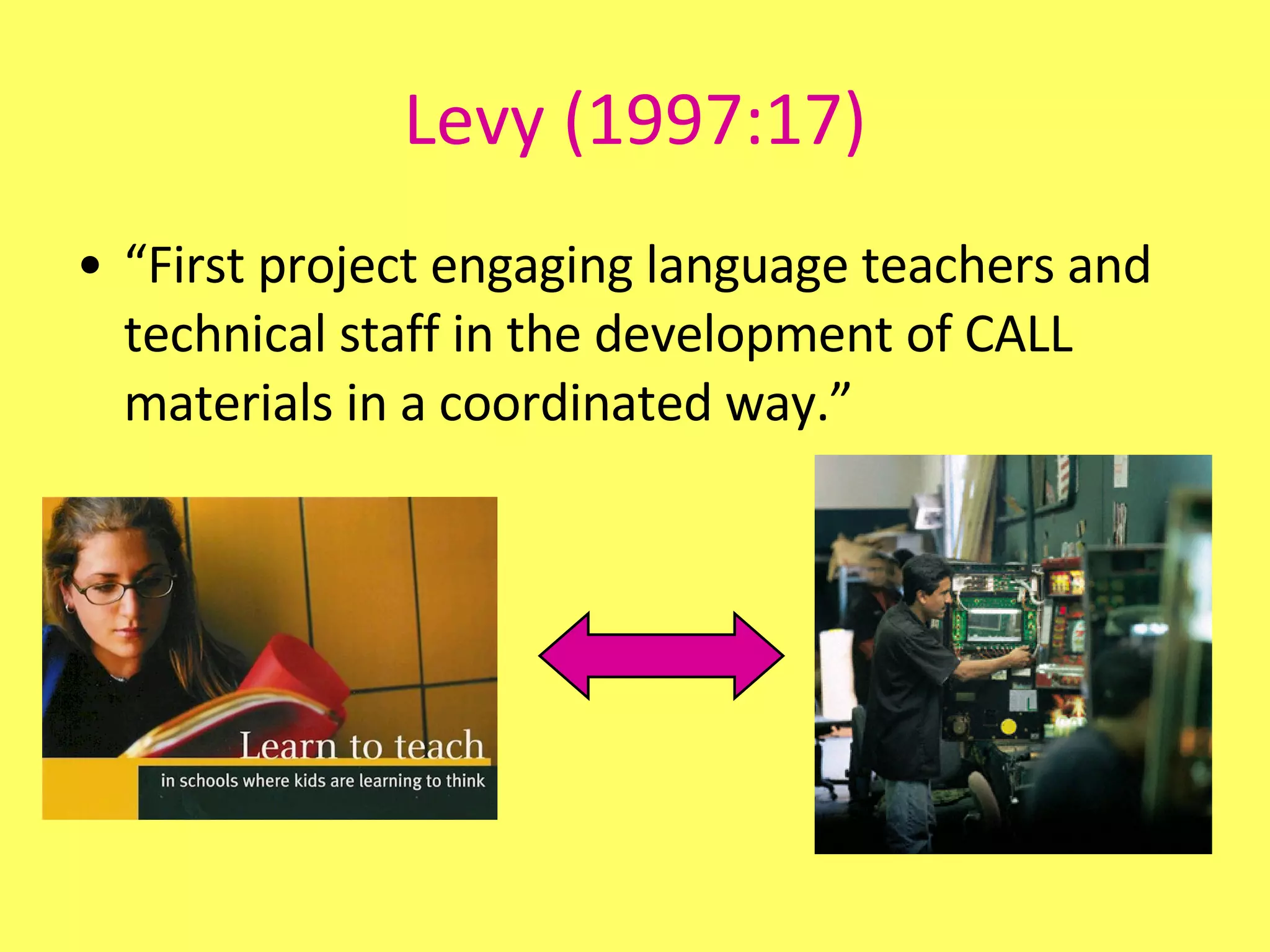
Levy (1997:17) “ First project engaging language teachers and technical staff in the development of CALL materials in a coordinated way.”
The 60s: “The pioneering wilderness”, back to BASIC 1960  – Project TIP (Technical Information Project), first prototype of documentary server.  1961  – Paul Baran, “Packet switching network”, first Network model in military communication.  1963  – “A conceptual framework for the argumentation of Man’s intelligence” by Engelbart, the beginning of H-LAM/T (Human using Language Artifacts, and Methodolofy, in which he is Trained)(oN-Line System)
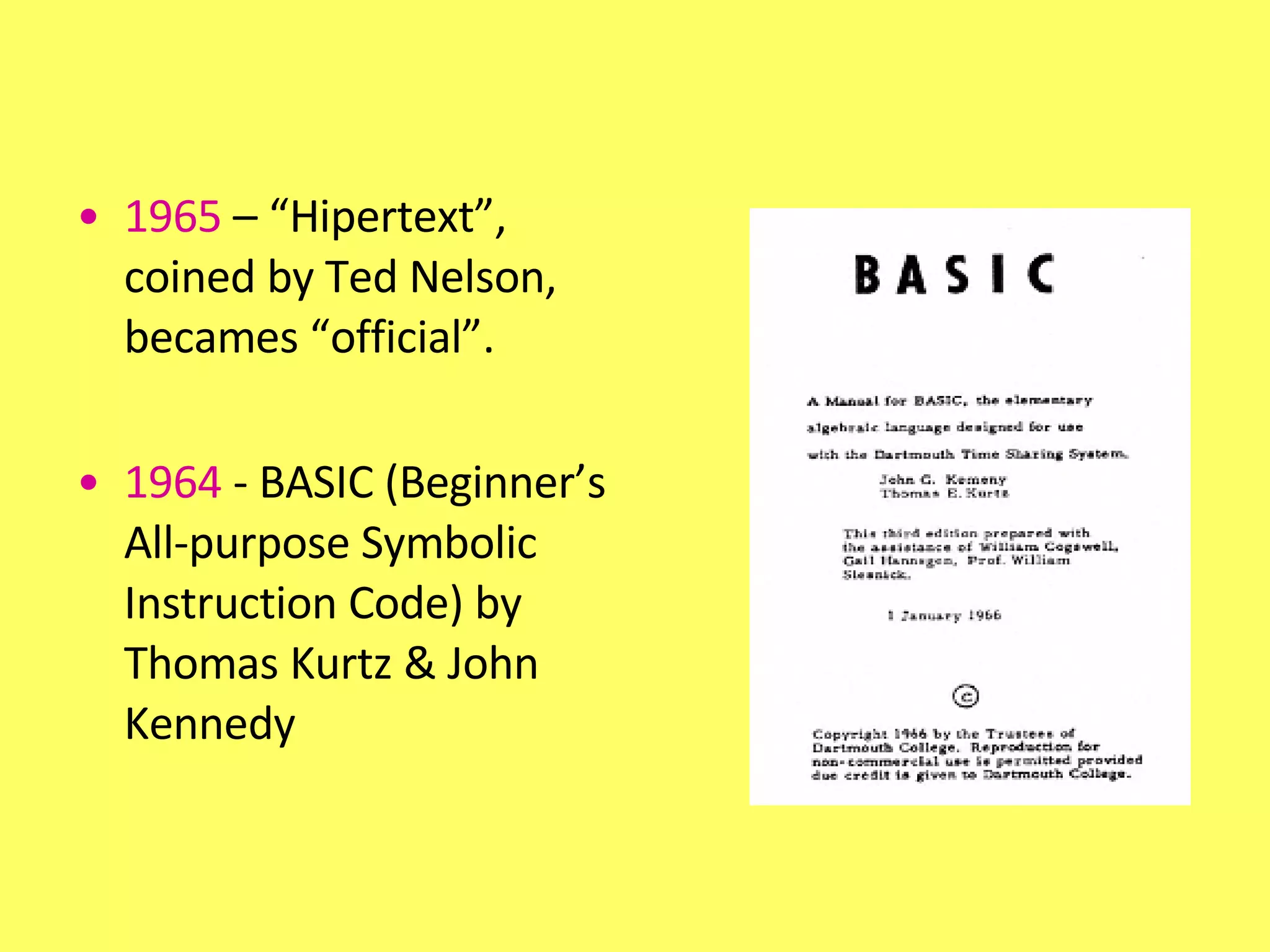
1965  – “Hipertext”, coined by Ted Nelson, becames “official”.  1964  - BASIC (Beginner’s All-purpose Symbolic Instruction Code) by Thomas Kurtz & John Kennedy
Computers: 1960  – DEC´s (Digital Equipment Corp.)PDP-1 sold for $120,000.  It was included with a cathode ray tube graphic display, needed no air conditioning and required  only one operator. 1961  – IBM introduces the 1400 Series, which  replaced the vacuum tube with smaller, more reliable transistors and used a magnetic core memory. 1964  – Seymour Cray invents the supercomputer CDC 6600
Some other advances… First videodisk is invented by D. Cregg  Project APARNET  (ARPA): an extension of packet switching (ancestor of internet).  Jean-Claude Gardin, SYNTOL (Syntagmatic Organization Language) General Model. The Stony Brook Experiment
Mid to late 60’s: Stony Brooks. “ Hypertext Editing System” by Ted Nelson and et Andries van Dam at Brown University.  Then changes to FRESS  F ile R etrieval and E diting S ystem  “ Big Blue”, early commercial founders of CALL development”.
Mid to Late 60’s: Stony Brook Better performances using the computer in writing and also in reading.  Use of teletypes, disadvantage, they were too noisy.  People involved:  William Morris (IBM)  Stony Brook (psychologist) German and French used for the experiments.
“ The late 60s and erly 70s are of particular historical importance to CALL”  (Ahmad et al,1985:28) Collaboration project.  Develop a programmed learning approach to language instruction.  This project connected teletype machines to a mainframe computer system.  Students enjoyed the use of technology Written and reading skills improved.
Is the Hippy era a Happy era? “ CALL's origins can be  traced back to the 1960s.”  (Davies, 2002)
The late 60s PILOT UNIX (machine independent) The IBM 1500 appears  The Scientific Language Project at Univeristy of Essex (read Russian articles)  First concordancing program  Mini computers were about to be born
Late 60’s. Is the Hippy Era a Happy era:? 1996:  Invention of the “mouse” by Douglas Engelbart.  PASCAL (language) is invented by Niklaus Wirth.  First cheap micro-computer: PDP8 (Programmed Data Process) by Digital Equipment Corporation).  LOGO (language) by Seymour Papert.
References  URL: www.computerhistory.org/timeline Davies, G. (2002). CALL (computer assisted language learning). Retrieved on 29.09.08 from: URL:http://www.llas.ac.uk/resources/goodpractice. aspx?resourceid=61 URL:http://students.ou.edu/W/Katherine.C.Woodson-1/NEWSSITE.htm

The History Of Call The 60s

  • 1.
    History of CALL:The 60s Betzayda Lara Castillo
  • 2.
    The 60’s: “ThePioneering Wilderness” featuring PLATO.
  • 3.
    The 60’s werecharacterized by… Pedagogy Audiolingualism Psychology Behaviorism Linguistics Structuralism P rogrammed L ogic for A utomatic T eaching O perations Started by Don Bitzer, Professor of Electrical Engineering. Designed to deliver learning packaged to large number of Ss’ Communication system > “note files”: Tutor and learner. Learner groups
  • 4.
    Sentence Judger Three main functions: Looked for synonyms and key words in Ss’ answer. Misspelling Word order
  • 5.
    Advantages of PLATO:Displayed different alphabets on same screen. “Plato was able to provide a highly coordinated and sophisticated site management system.” (Hart, 1995 at Levy 1997:16). Easy to use. Tutor: authoring language. Didn’t have flexibility of object-oriented programming.
  • 6.
    Adding text toSpeech Synthesis mechanism with PLATO. Development of PLATO guided by practical concerns. Range of languages: English, Esperanto, French, German, Hindi, Latin, Modern Hebrew, Modern Greek, Norwegian, Russian and Swedish.
  • 7.
    Hart (1995:30) Platolaboratory featured 50,000 hours of language instruction per semester. Plus another 50,000 hours in other curricula. Twelve different languages.
  • 8.
    Levy (1997:17) “First project engaging language teachers and technical staff in the development of CALL materials in a coordinated way.”
  • 9.
    The 60s: “Thepioneering wilderness”, back to BASIC 1960 – Project TIP (Technical Information Project), first prototype of documentary server. 1961 – Paul Baran, “Packet switching network”, first Network model in military communication. 1963 – “A conceptual framework for the argumentation of Man’s intelligence” by Engelbart, the beginning of H-LAM/T (Human using Language Artifacts, and Methodolofy, in which he is Trained)(oN-Line System)
  • 10.
    1965 –“Hipertext”, coined by Ted Nelson, becames “official”. 1964 - BASIC (Beginner’s All-purpose Symbolic Instruction Code) by Thomas Kurtz & John Kennedy
  • 11.
    Computers: 1960 – DEC´s (Digital Equipment Corp.)PDP-1 sold for $120,000. It was included with a cathode ray tube graphic display, needed no air conditioning and required only one operator. 1961 – IBM introduces the 1400 Series, which replaced the vacuum tube with smaller, more reliable transistors and used a magnetic core memory. 1964 – Seymour Cray invents the supercomputer CDC 6600
  • 12.
    Some other advances…First videodisk is invented by D. Cregg Project APARNET (ARPA): an extension of packet switching (ancestor of internet). Jean-Claude Gardin, SYNTOL (Syntagmatic Organization Language) General Model. The Stony Brook Experiment
  • 13.
    Mid to late60’s: Stony Brooks. “ Hypertext Editing System” by Ted Nelson and et Andries van Dam at Brown University. Then changes to FRESS F ile R etrieval and E diting S ystem “ Big Blue”, early commercial founders of CALL development”.
  • 14.
    Mid to Late60’s: Stony Brook Better performances using the computer in writing and also in reading. Use of teletypes, disadvantage, they were too noisy. People involved: William Morris (IBM) Stony Brook (psychologist) German and French used for the experiments.
  • 15.
    “ The late60s and erly 70s are of particular historical importance to CALL” (Ahmad et al,1985:28) Collaboration project. Develop a programmed learning approach to language instruction. This project connected teletype machines to a mainframe computer system. Students enjoyed the use of technology Written and reading skills improved.
  • 16.
    Is the Hippyera a Happy era? “ CALL's origins can be traced back to the 1960s.” (Davies, 2002)
  • 17.
    The late 60sPILOT UNIX (machine independent) The IBM 1500 appears The Scientific Language Project at Univeristy of Essex (read Russian articles) First concordancing program Mini computers were about to be born
  • 18.
    Late 60’s. Isthe Hippy Era a Happy era:? 1996: Invention of the “mouse” by Douglas Engelbart. PASCAL (language) is invented by Niklaus Wirth. First cheap micro-computer: PDP8 (Programmed Data Process) by Digital Equipment Corporation). LOGO (language) by Seymour Papert.
  • 19.
    References URL:www.computerhistory.org/timeline Davies, G. (2002). CALL (computer assisted language learning). Retrieved on 29.09.08 from: URL:http://www.llas.ac.uk/resources/goodpractice. aspx?resourceid=61 URL:http://students.ou.edu/W/Katherine.C.Woodson-1/NEWSSITE.htm