High-Performance JDBC
VLAD MIHALCEA
About me
• @Hibernate Developer
• vladmihalcea.com
• @vlad_mihalcea
• vladmihalcea
Performance Facts
“More than half of application performance
bottlenecks originate in the database”
AppDynamics - http://www.appdynamics.com/database/
Data access layers
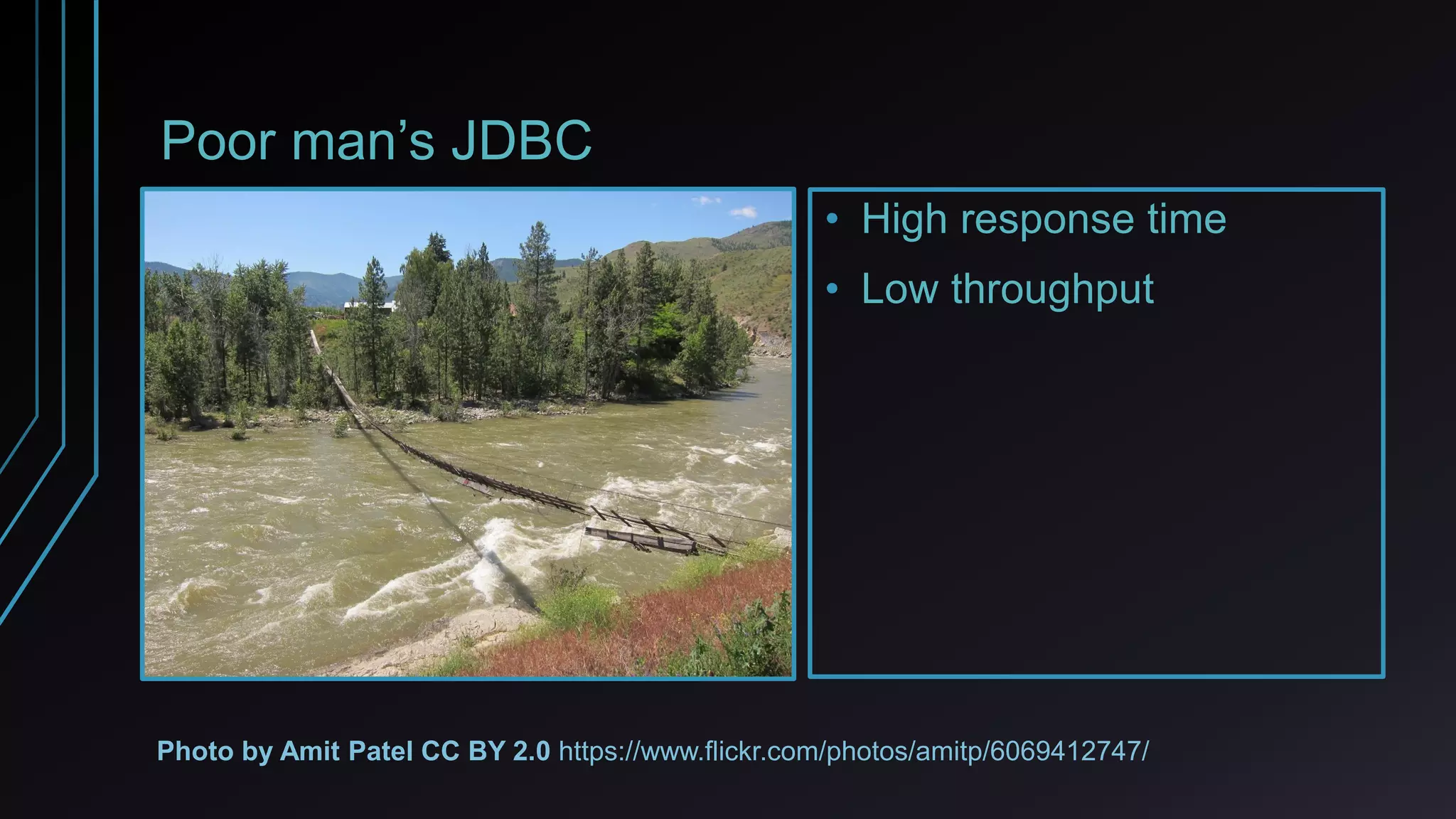
Poor man’s JDBC
• High response time
• Low throughput
Photo by Amit Patel CC BY 2.0 https://www.flickr.com/photos/amitp/6069412747/
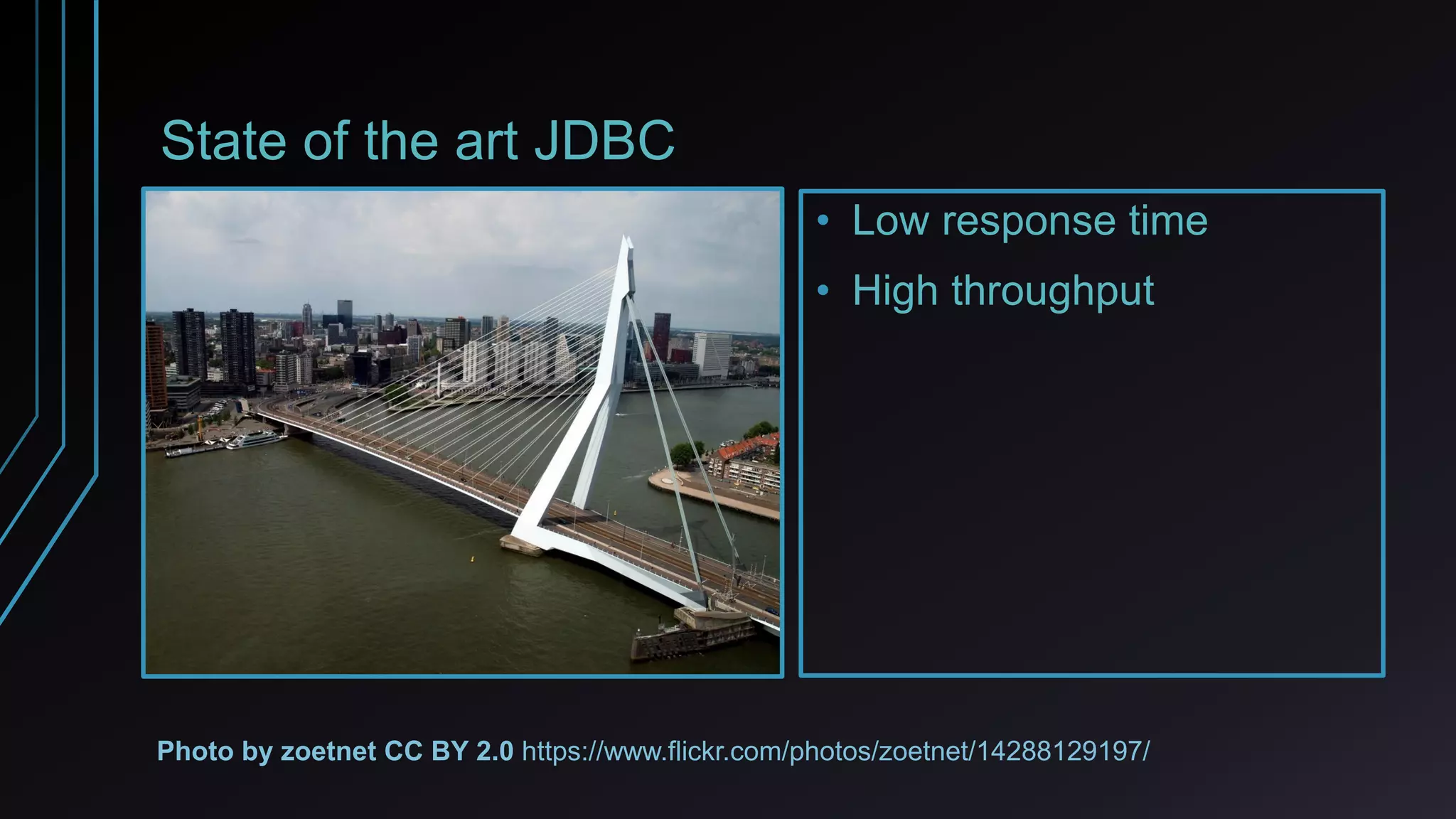
State of the art JDBC
• Low response time
• High throughput
Photo by zoetnet CC BY 2.0 https://www.flickr.com/photos/zoetnet/14288129197/
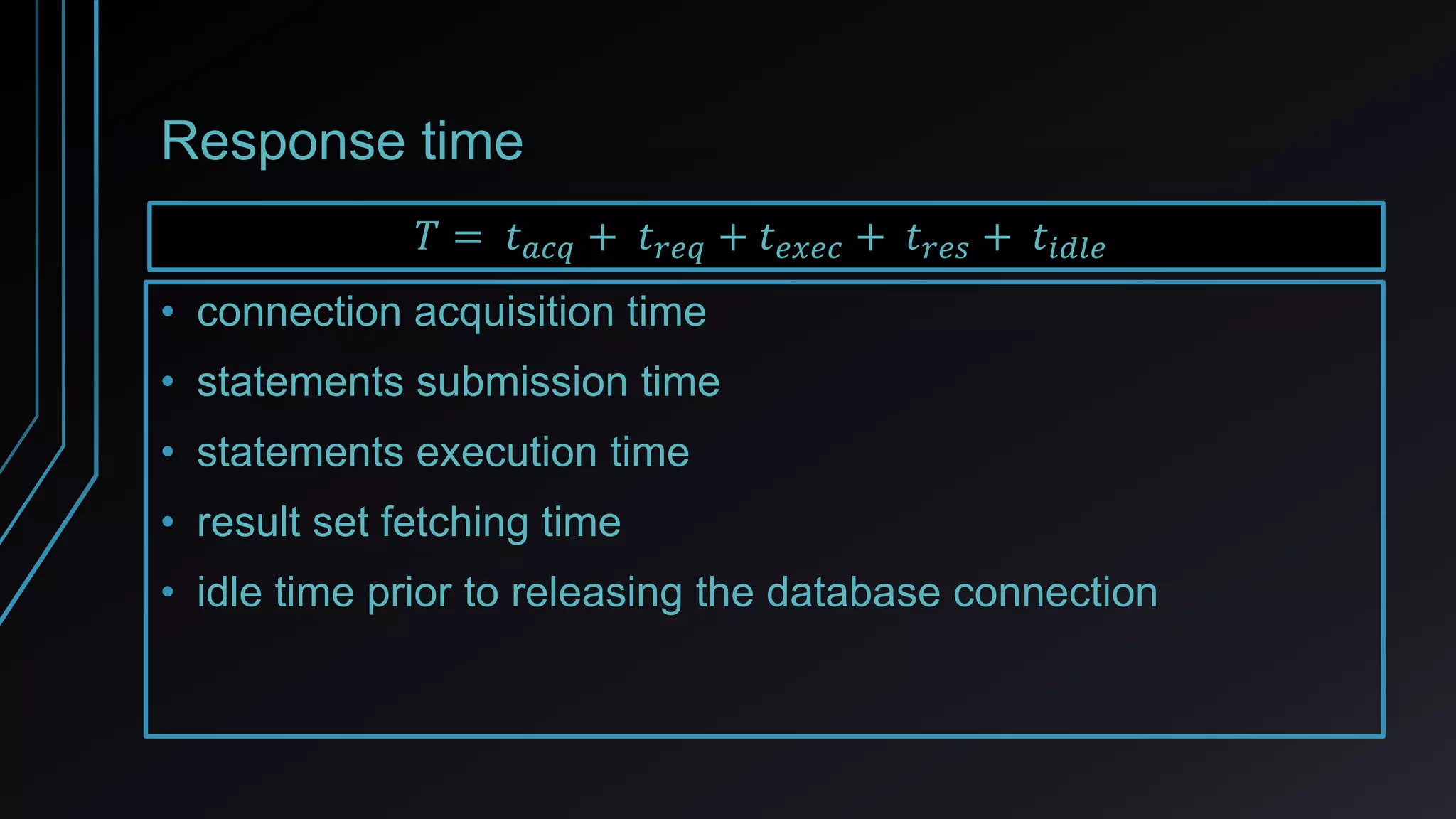
Response time
• connection acquisition time
• statements submission time
• statements execution time
• result set fetching time
• idle time prior to releasing the database connection
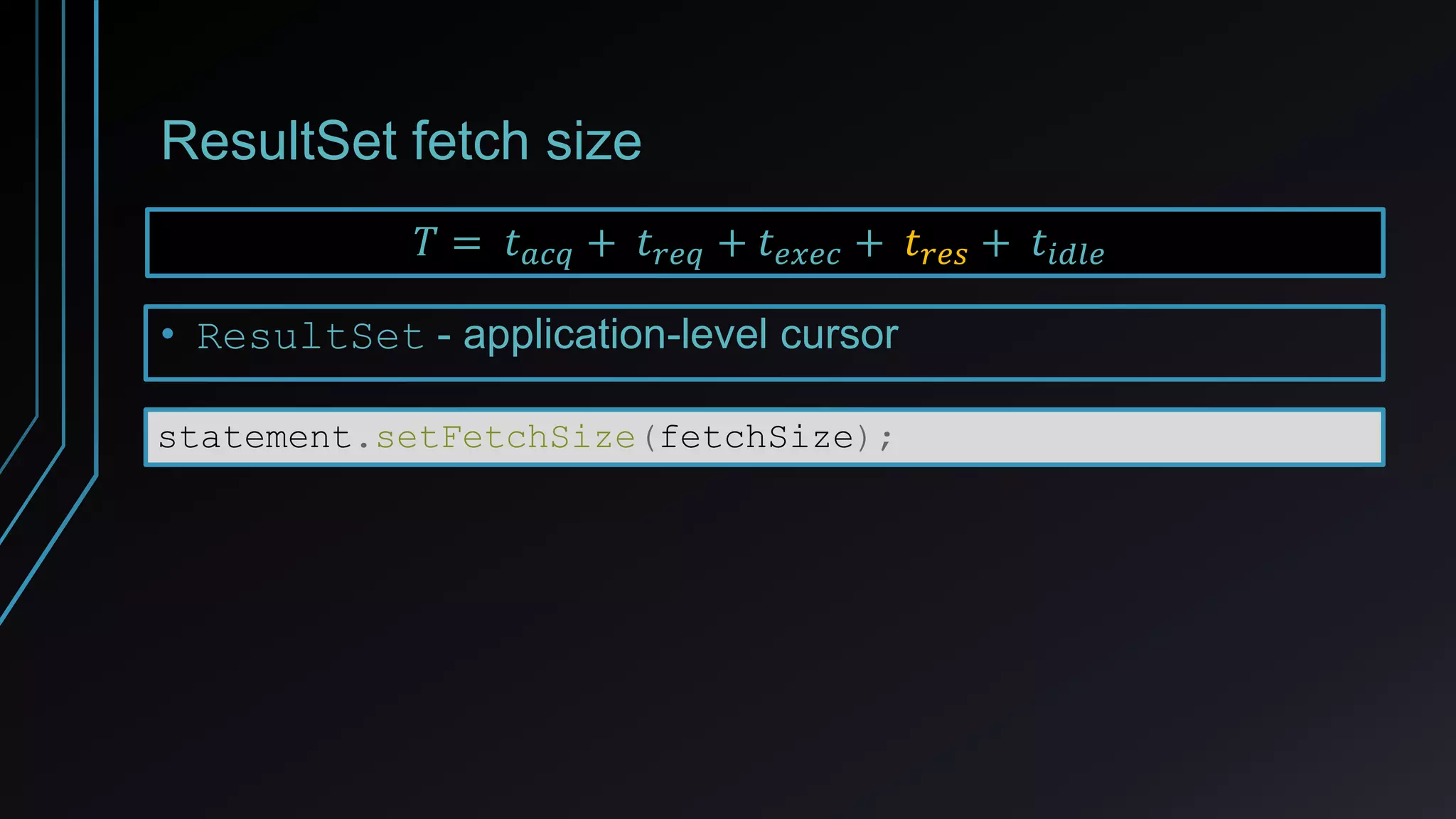
𝑇 = 𝑡 𝑎𝑐𝑞 + 𝑡 𝑟𝑒𝑞 + 𝑡 𝑒𝑥𝑒𝑐 + 𝑡 𝑟𝑒𝑠 + 𝑡𝑖𝑑𝑙𝑒
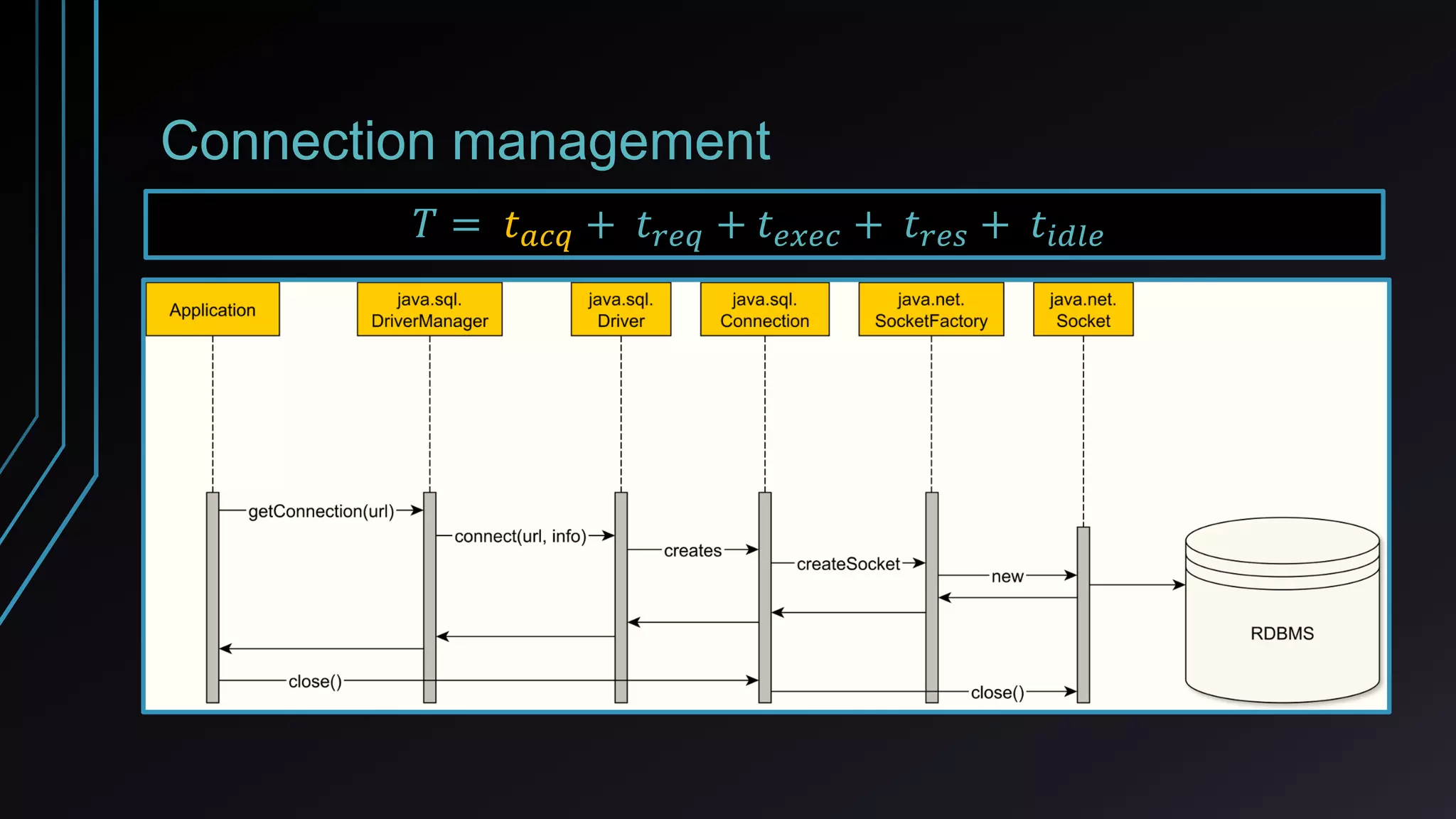
Connection management
𝑇 = 𝑡 𝑎𝑐𝑞 + 𝑡 𝑟𝑒𝑞 + 𝑡 𝑒𝑥𝑒𝑐 + 𝑡 𝑟𝑒𝑠 + 𝑡𝑖𝑑𝑙𝑒
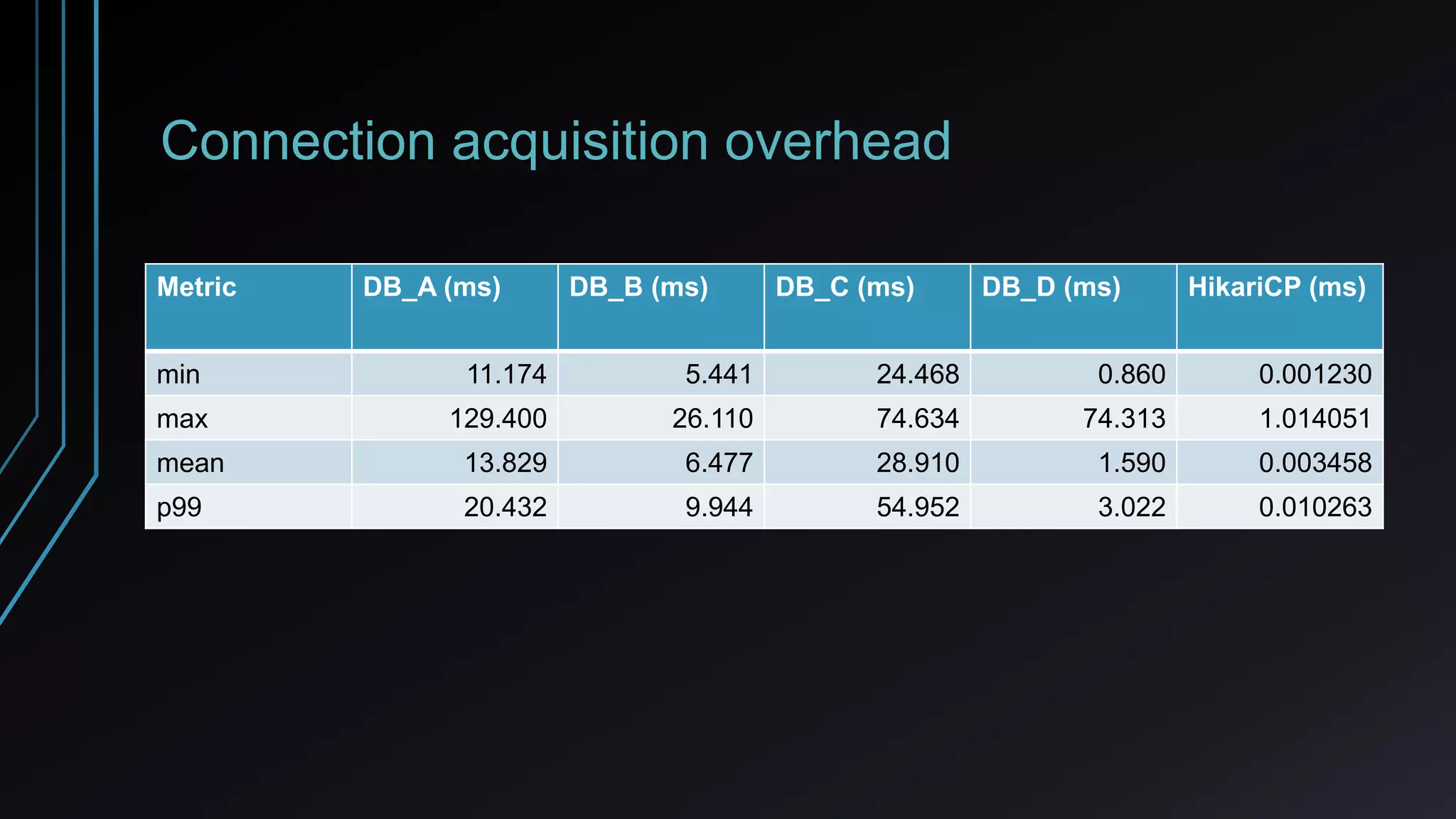
Connection acquisition overhead
Metric DB_A (ms) DB_B (ms) DB_C (ms) DB_D (ms) HikariCP (ms)
min 11.174 5.441 24.468 0.860 0.001230
max 129.400 26.110 74.634 74.313 1.014051
mean 13.829 6.477 28.910 1.590 0.003458
p99 20.432 9.944 54.952 3.022 0.010263
Connection pooling
• Logical vs physical connections
• Lease vs create
• Release vs close
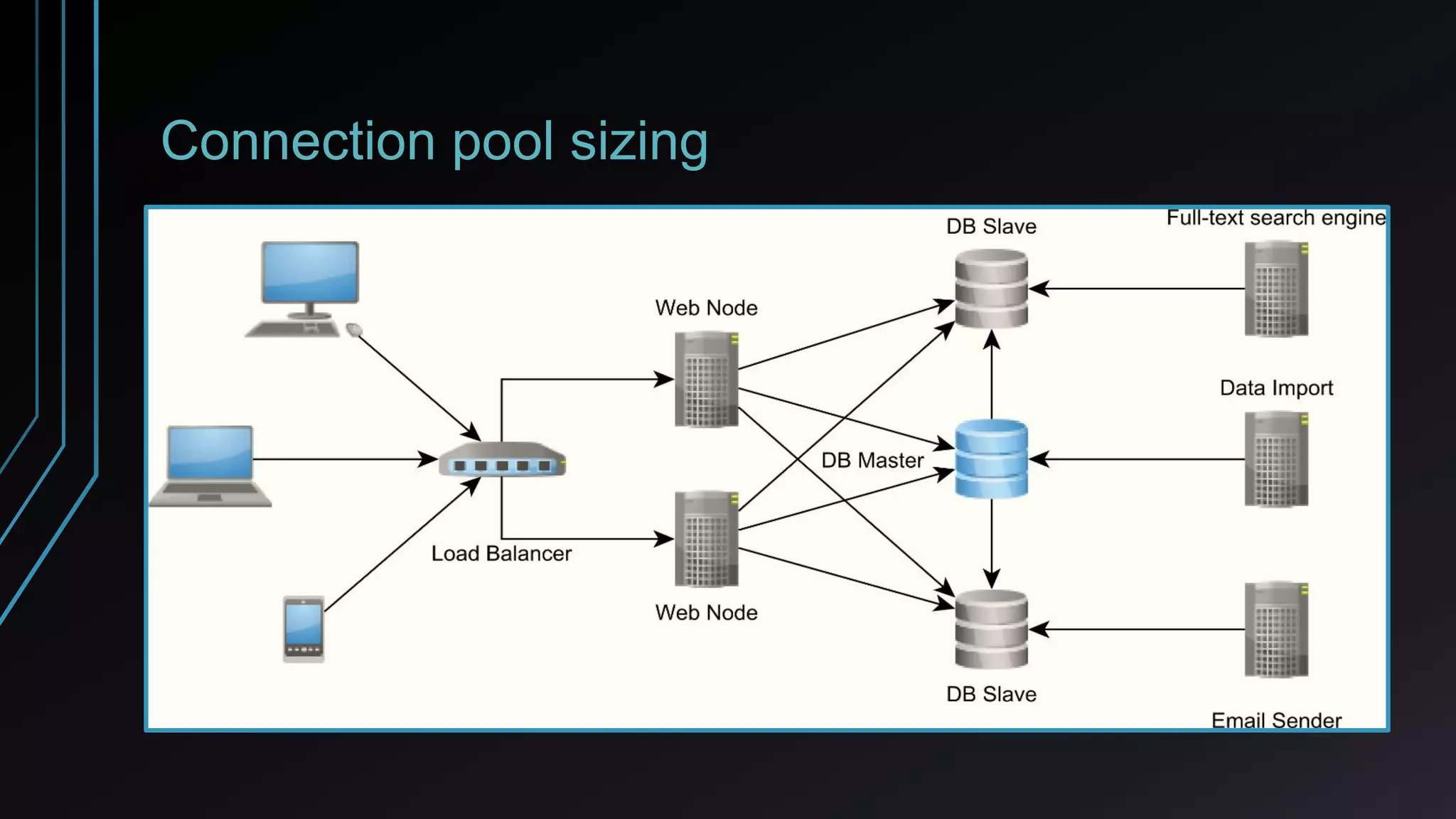
Connection pool sizing
FlexyPool
• Java EE
• Bitronix / Atomikos
• Apache DBCP / DBCP2
• C3P0
• HikariCP
• Tomcat CP
• Vibur DBCP
https://github.com/vladmihalcea/flexy-pool
FlexyPool
• concurrent connections histogram
• concurrent connection requests histogram
• connection acquisition time histogram
• connection lease time histogram
• maximum pool size histogram
• retry attempts histogram
https://github.com/vladmihalcea/flexy-pool
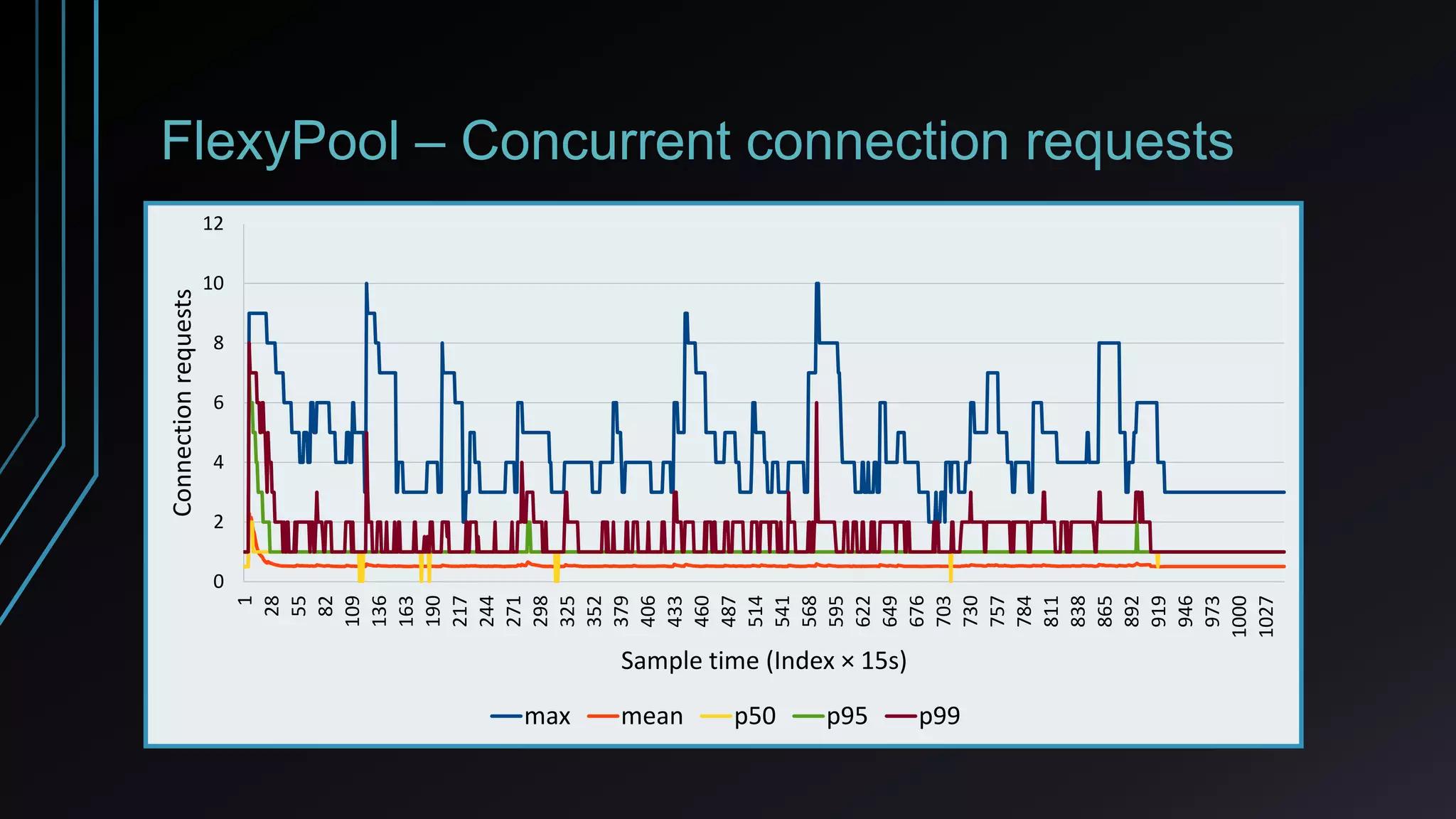
FlexyPool – Concurrent connection requests
1
28
55
82
109
136
163
190
217
244
271
298
325
352
379
406
433
460
487
514
541
568
595
622
649
676
703
730
757
784
811
838
865
892
919
946
973
1000
1027
0
2
4
6
8
10
12
Sample time (Index × 15s)
Connectionrequests
max mean p50 p95 p99
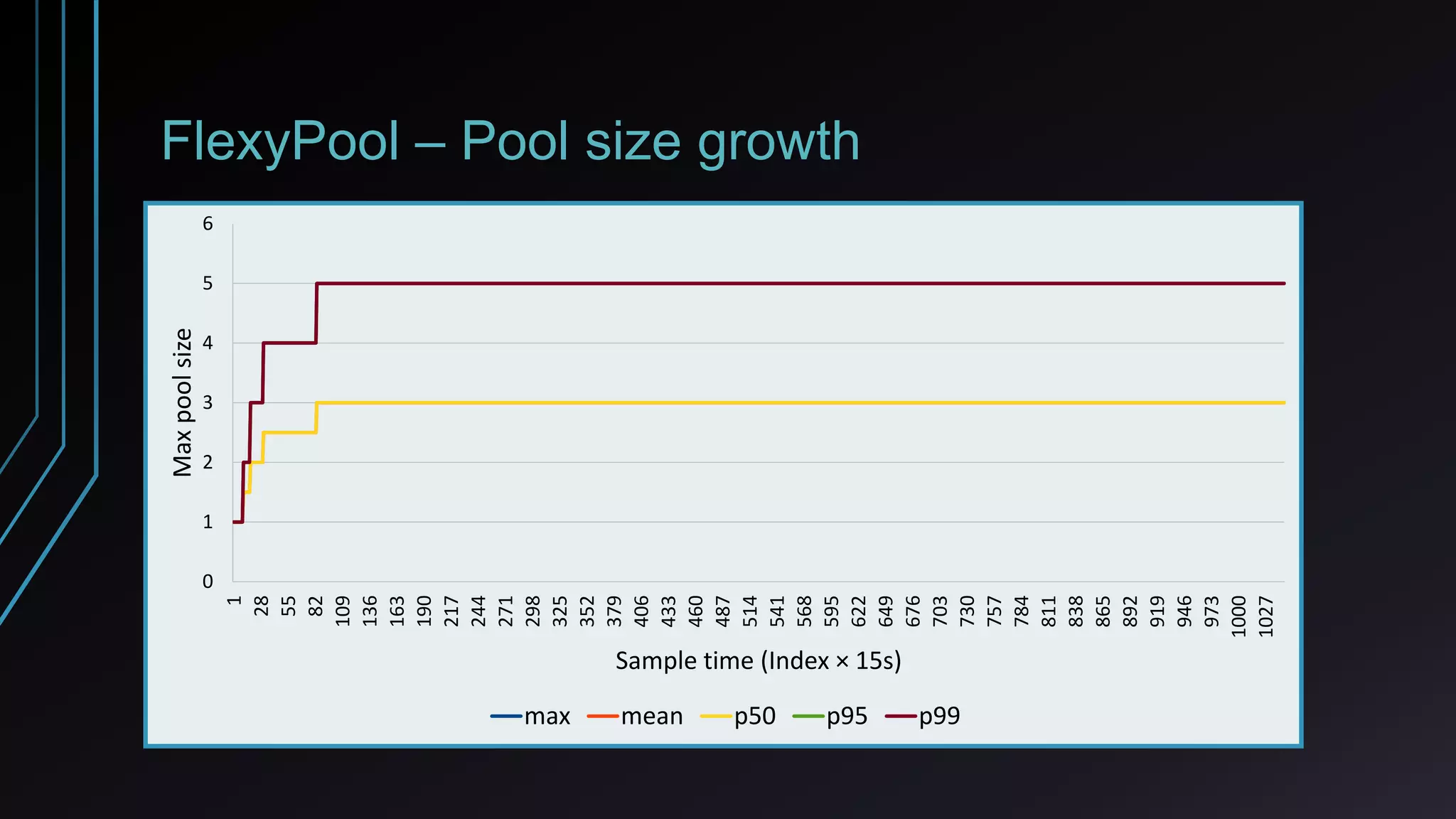
FlexyPool – Pool size growth
1
28
55
82
109
136
163
190
217
244
271
298
325
352
379
406
433
460
487
514
541
568
595
622
649
676
703
730
757
784
811
838
865
892
919
946
973
1000
1027
0
1
2
3
4
5
6
Sample time (Index × 15s)
Maxpoolsize
max mean p50 p95 p99
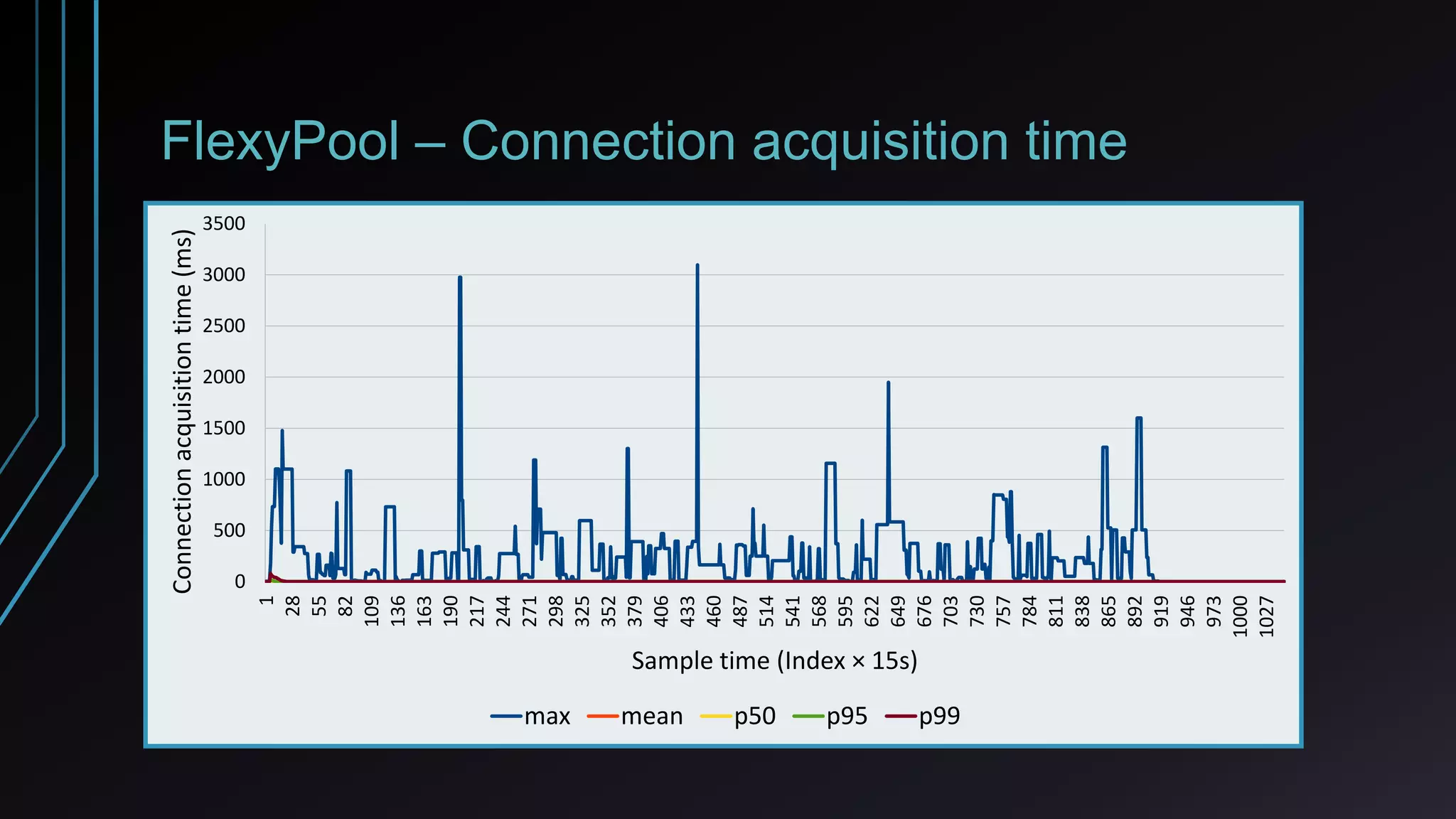
FlexyPool – Connection acquisition time
1
28
55
82
109
136
163
190
217
244
271
298
325
352
379
406
433
460
487
514
541
568
595
622
649
676
703
730
757
784
811
838
865
892
919
946
973
1000
1027
0
500
1000
1500
2000
2500
3000
3500
Sample time (Index × 15s)
Connectionacquisitiontime(ms)
max mean p50 p95 p99
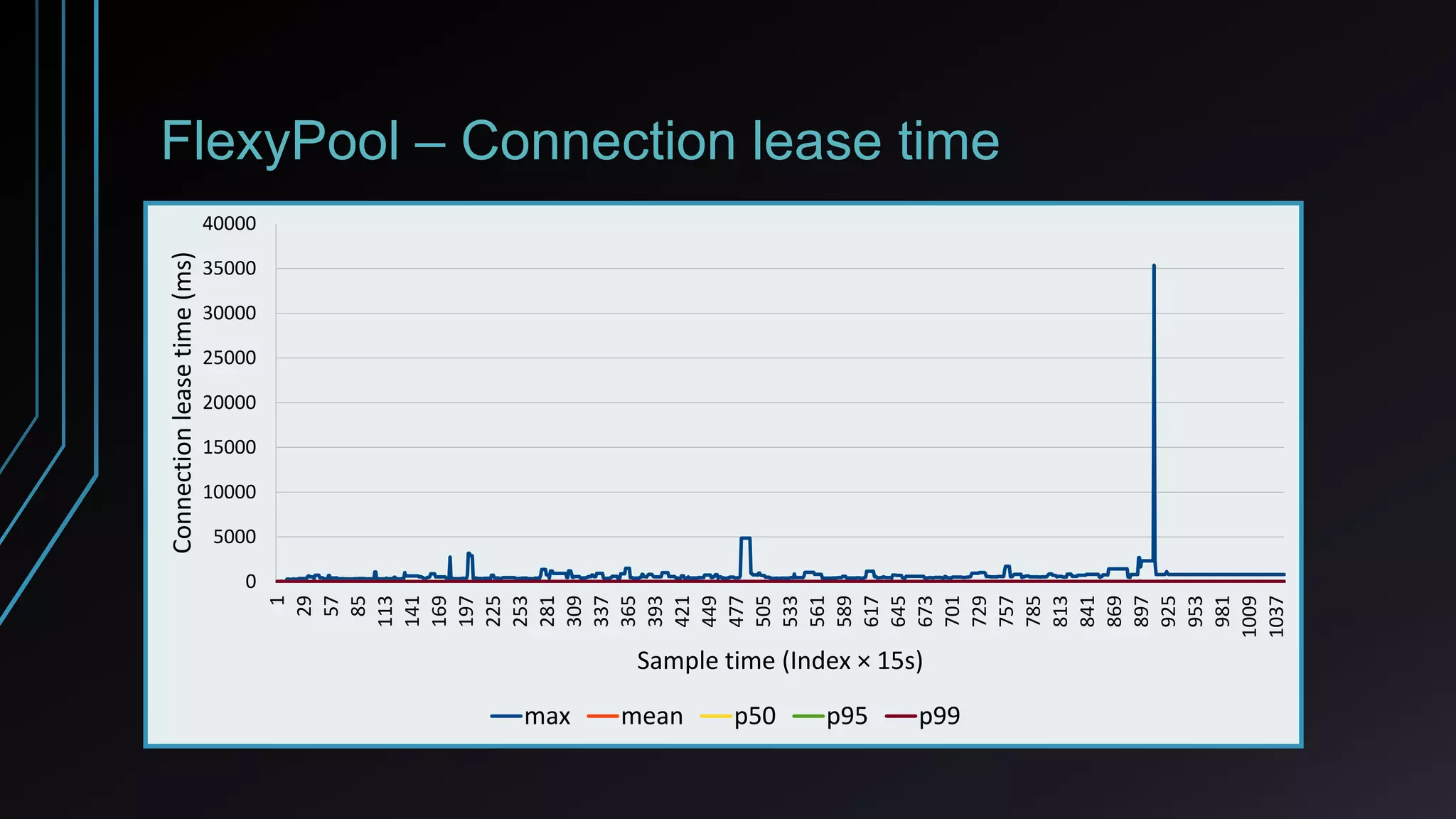
FlexyPool – Connection lease time
1
29
57
85
113
141
169
197
225
253
281
309
337
365
393
421
449
477
505
533
561
589
617
645
673
701
729
757
785
813
841
869
897
925
953
981
1009
1037
0
5000
10000
15000
20000
25000
30000
35000
40000
Sample time (Index × 15s)
Connectionleasetime(ms)
max mean p50 p95 p99
Statement Batching
statement.addBatch(
"INSERT INTO post "(title, version, id) " +
"VALUES ('Post no. 1', 0, 1)");
statement.addBatch(
"INSERT INTO post_comment (post_id, review, version, id) " +
"VALUES (1, 'Post comment 1.1', 0, 1)");
int[] updateCounts = statement.executeBatch();
𝑇 = 𝑡 𝑎𝑐𝑞 + 𝑡 𝑟𝑒𝑞 + 𝑡 𝑒𝑥𝑒𝑐 + 𝑡 𝑟𝑒𝑠 + 𝑡𝑖𝑑𝑙𝑒
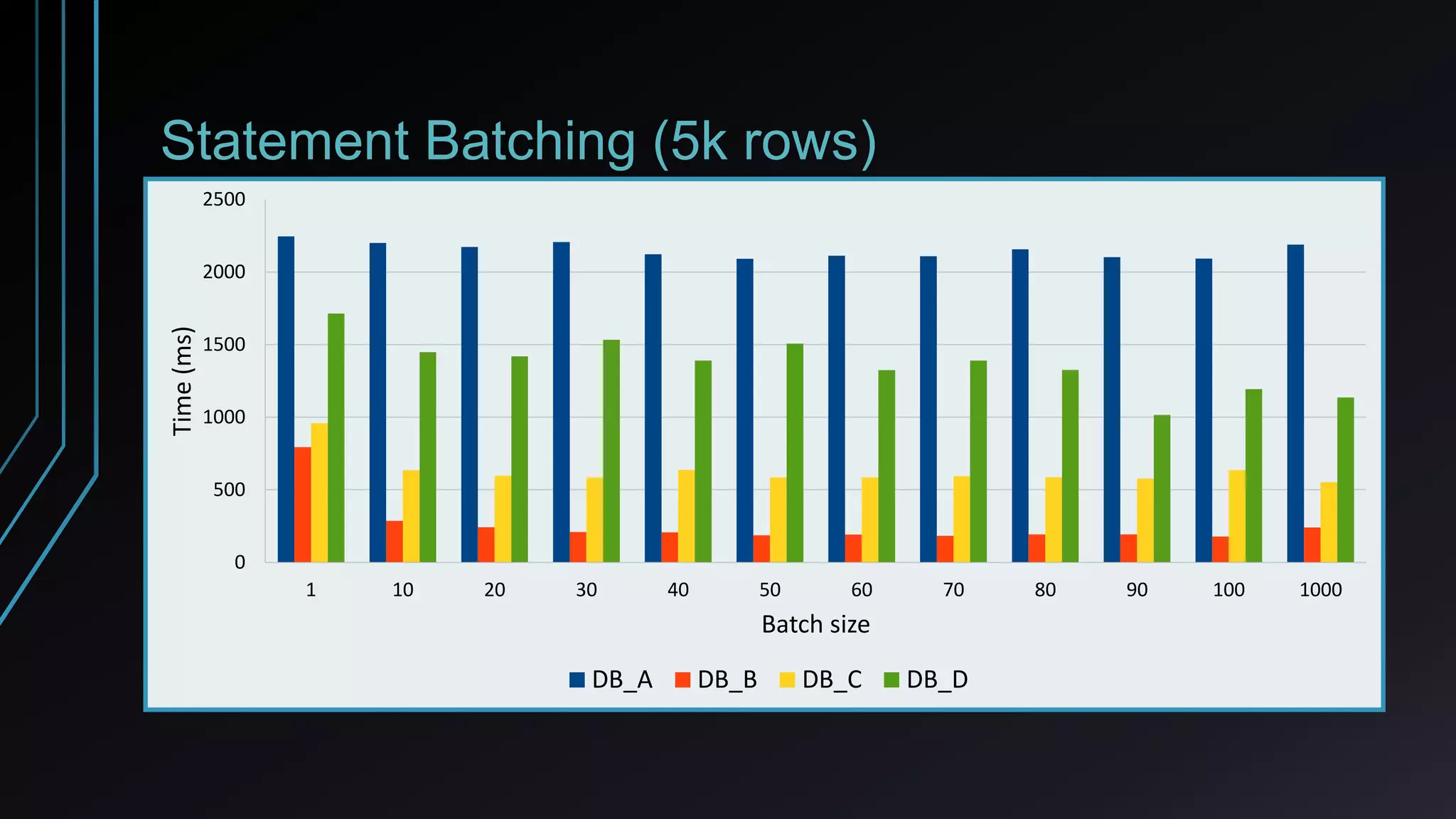
Statement Batching (5k rows)
1 10 20 30 40 50 60 70 80 90 100 1000
0
500
1000
1500
2000
2500
Batch size
Time(ms)
DB_A DB_B DB_C DB_D
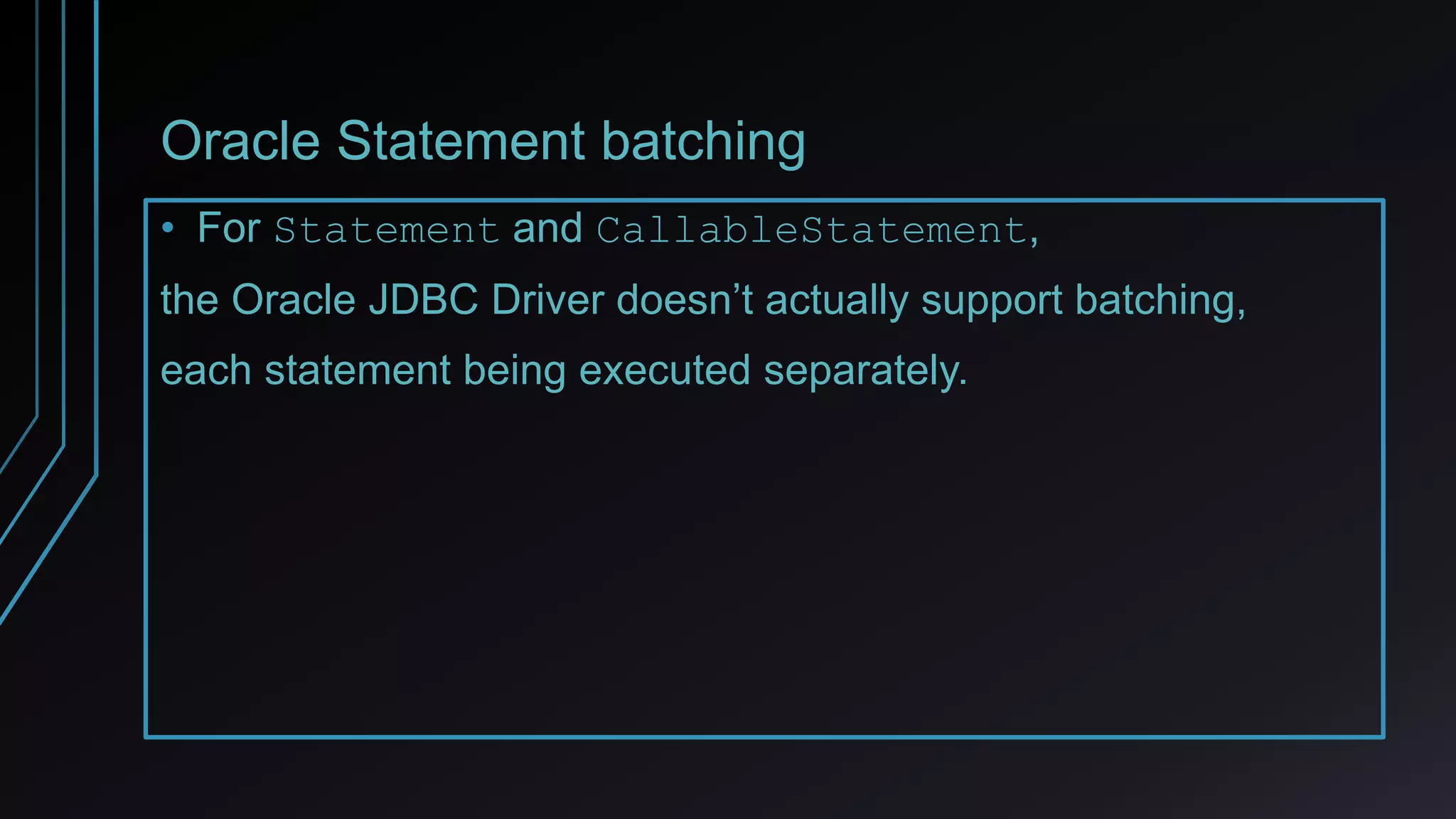
Oracle Statement batching
• For Statement and CallableStatement,
the Oracle JDBC Driver doesn’t actually support batching,
each statement being executed separately.
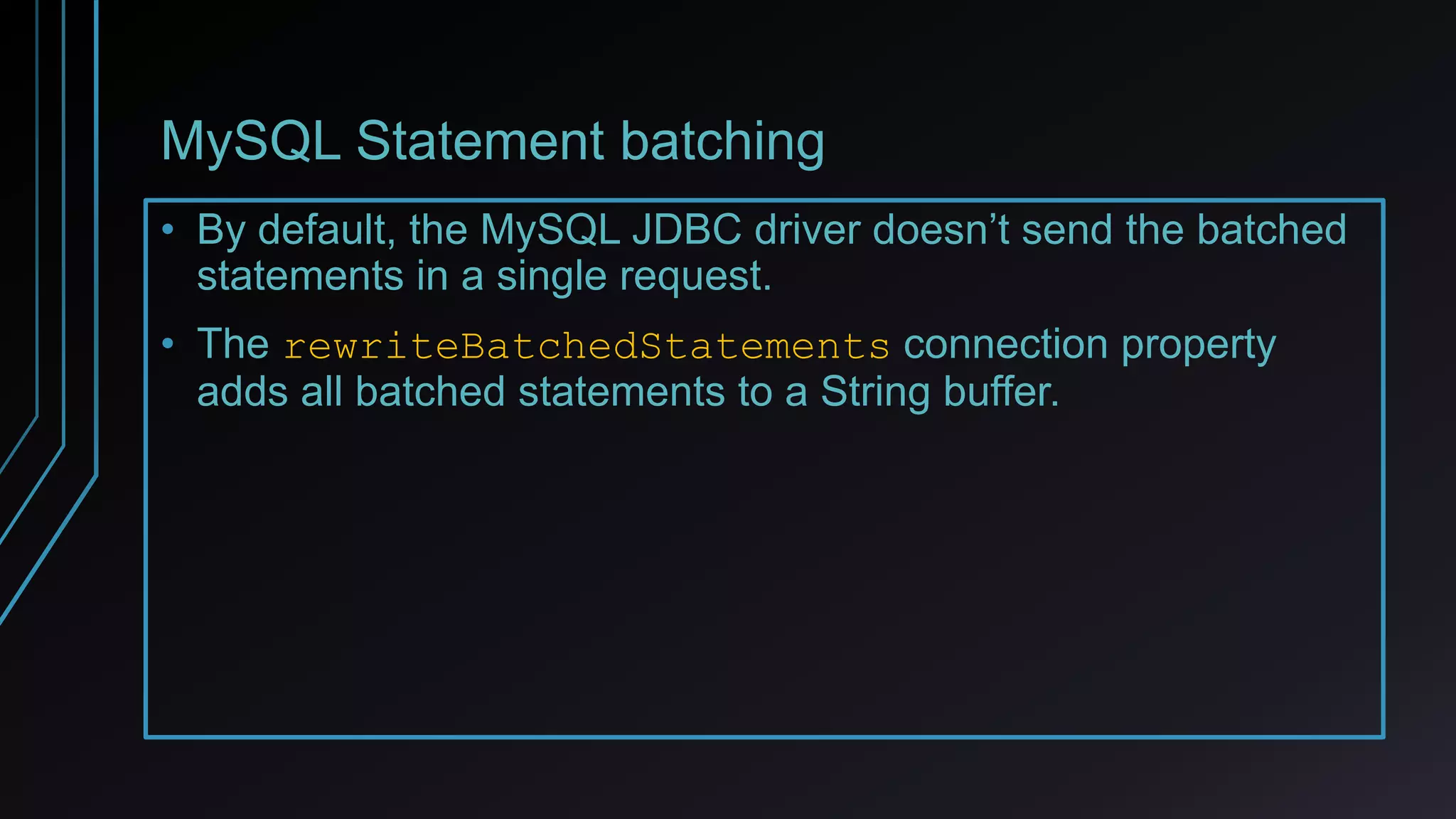
MySQL Statement batching
• By default, the MySQL JDBC driver doesn’t send the batched
statements in a single request.
• The rewriteBatchedStatements connection property
adds all batched statements to a String buffer.
Batch PreparedStatements
PreparedStatement postStatement = connection.prepareStatement(
"INSERT INTO Post (title, version, id) VALUES (?, ?, ?)");
postStatement.setString(1, String.format("Post no. %1$d", 1));
postStatement.setInt(2, 0);
postStatement.setLong(3, 1);
postStatement.addBatch();
postStatement.setString(1, String.format("Post no. %1$d", 2));
postStatement.setInt(2, 0);
postStatement.setLong(3, 2);
postStatement.addBatch();
int[] updateCounts = postStatement.executeBatch();
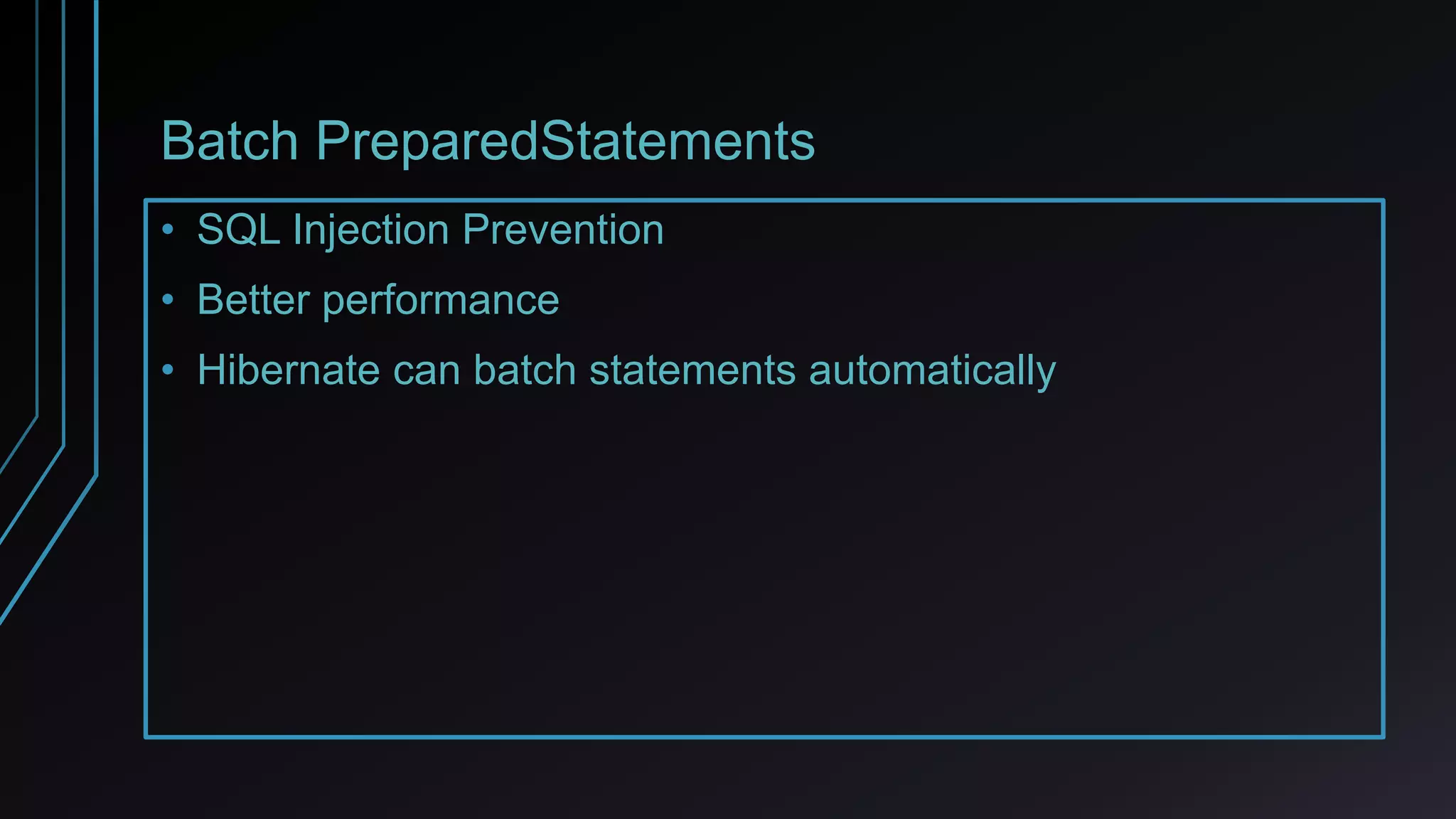
Batch PreparedStatements
• SQL Injection Prevention
• Better performance
• Hibernate can batch statements automatically
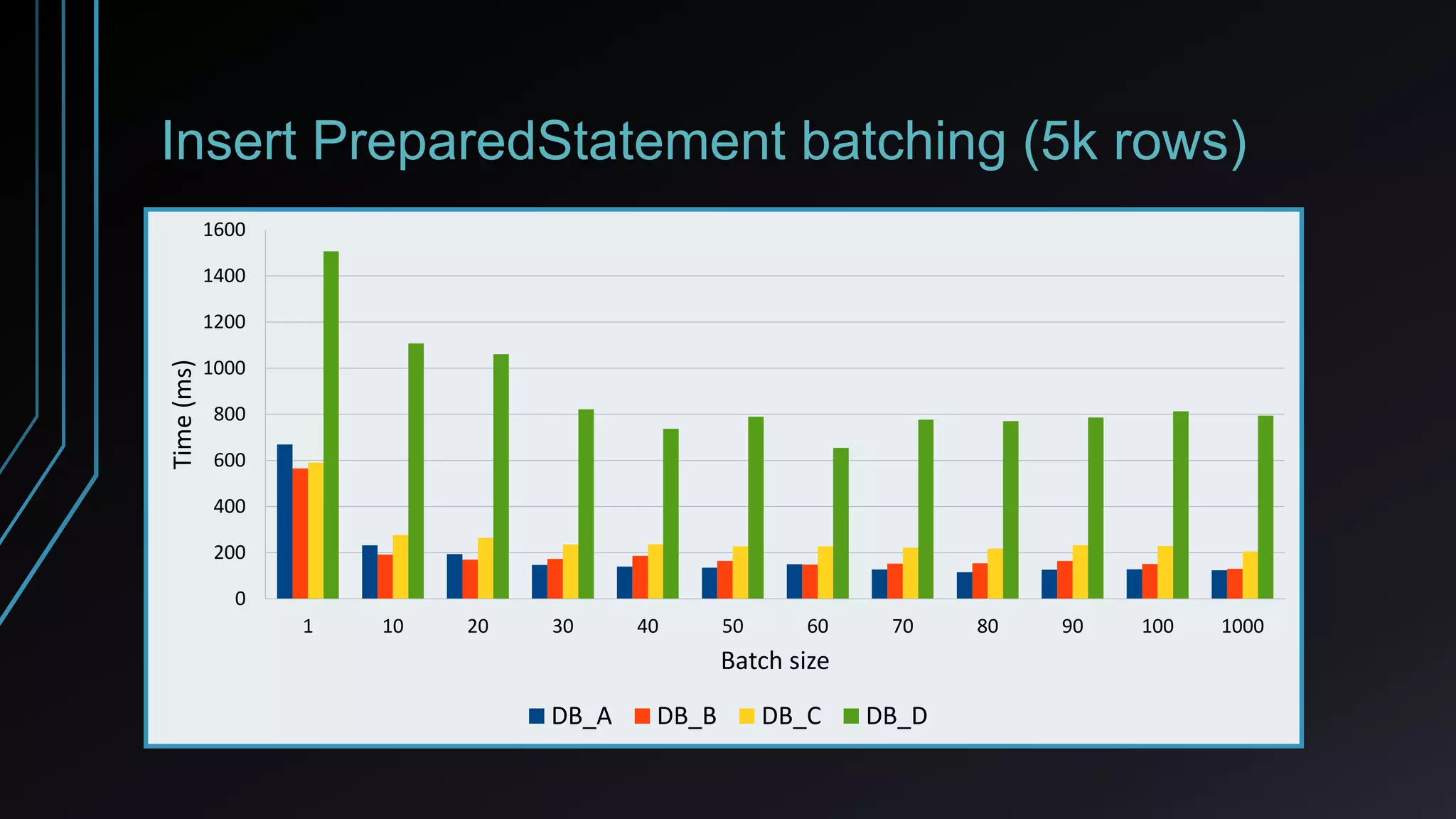
Insert PreparedStatement batching (5k rows)
1 10 20 30 40 50 60 70 80 90 100 1000
0
200
400
600
800
1000
1200
1400
1600
Batch size
Time(ms)
DB_A DB_B DB_C DB_D
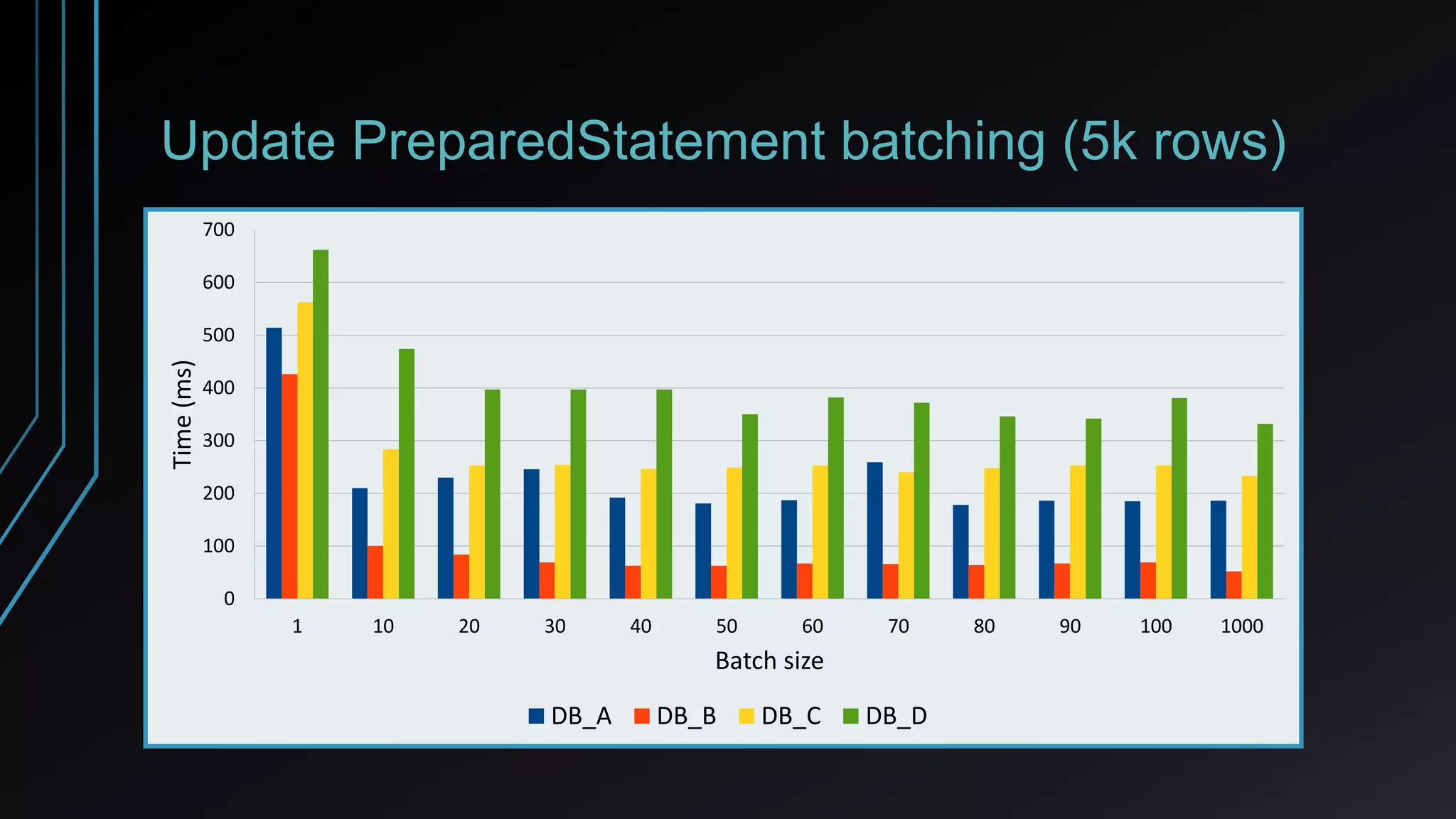
Update PreparedStatement batching (5k rows)
1 10 20 30 40 50 60 70 80 90 100 1000
0
100
200
300
400
500
600
700
Batch size
Time(ms)
DB_A DB_B DB_C DB_D
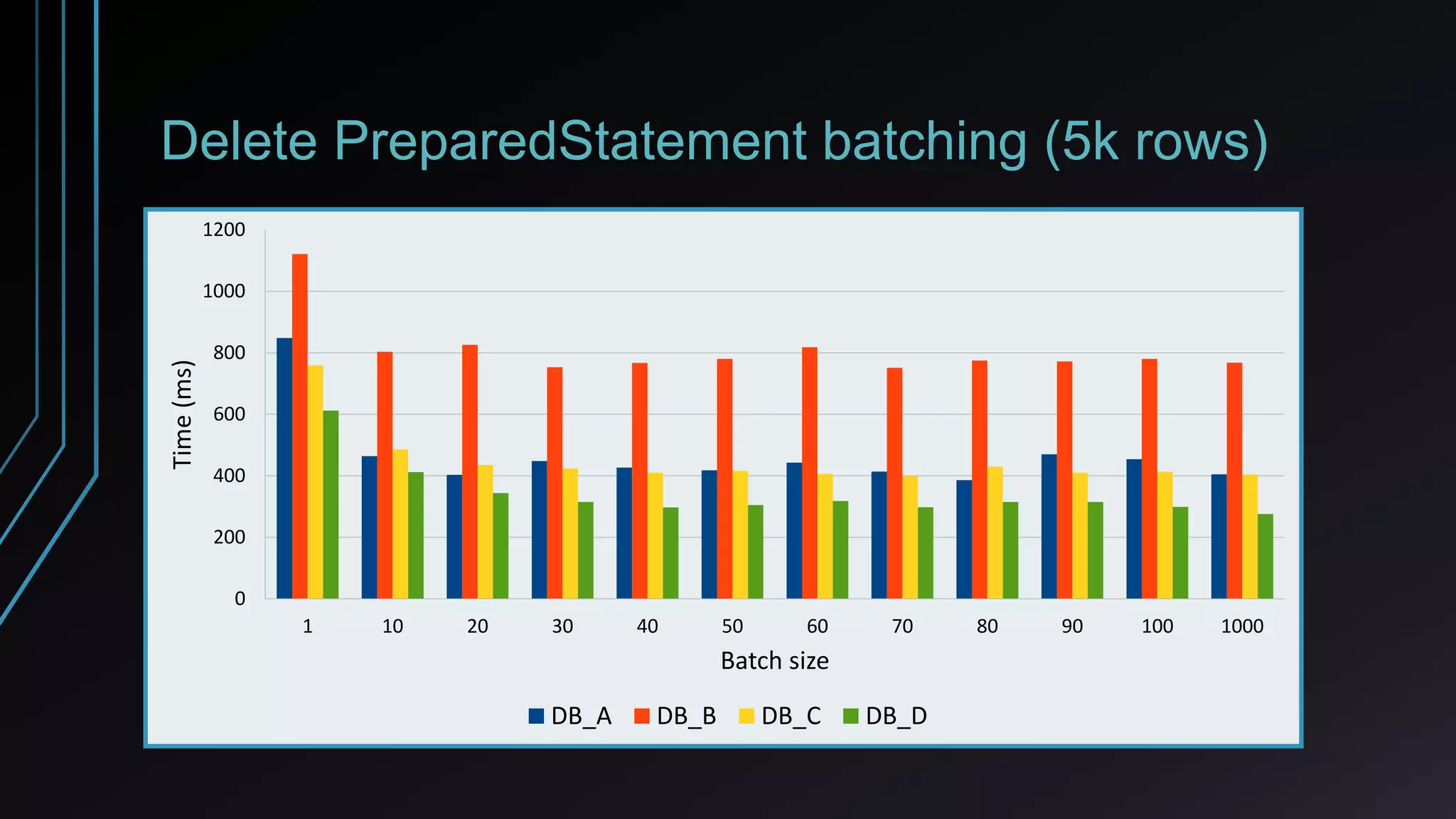
Delete PreparedStatement batching (5k rows)
1 10 20 30 40 50 60 70 80 90 100 1000
0
200
400
600
800
1000
1200
Batch size
Time(ms)
DB_A DB_B DB_C DB_D
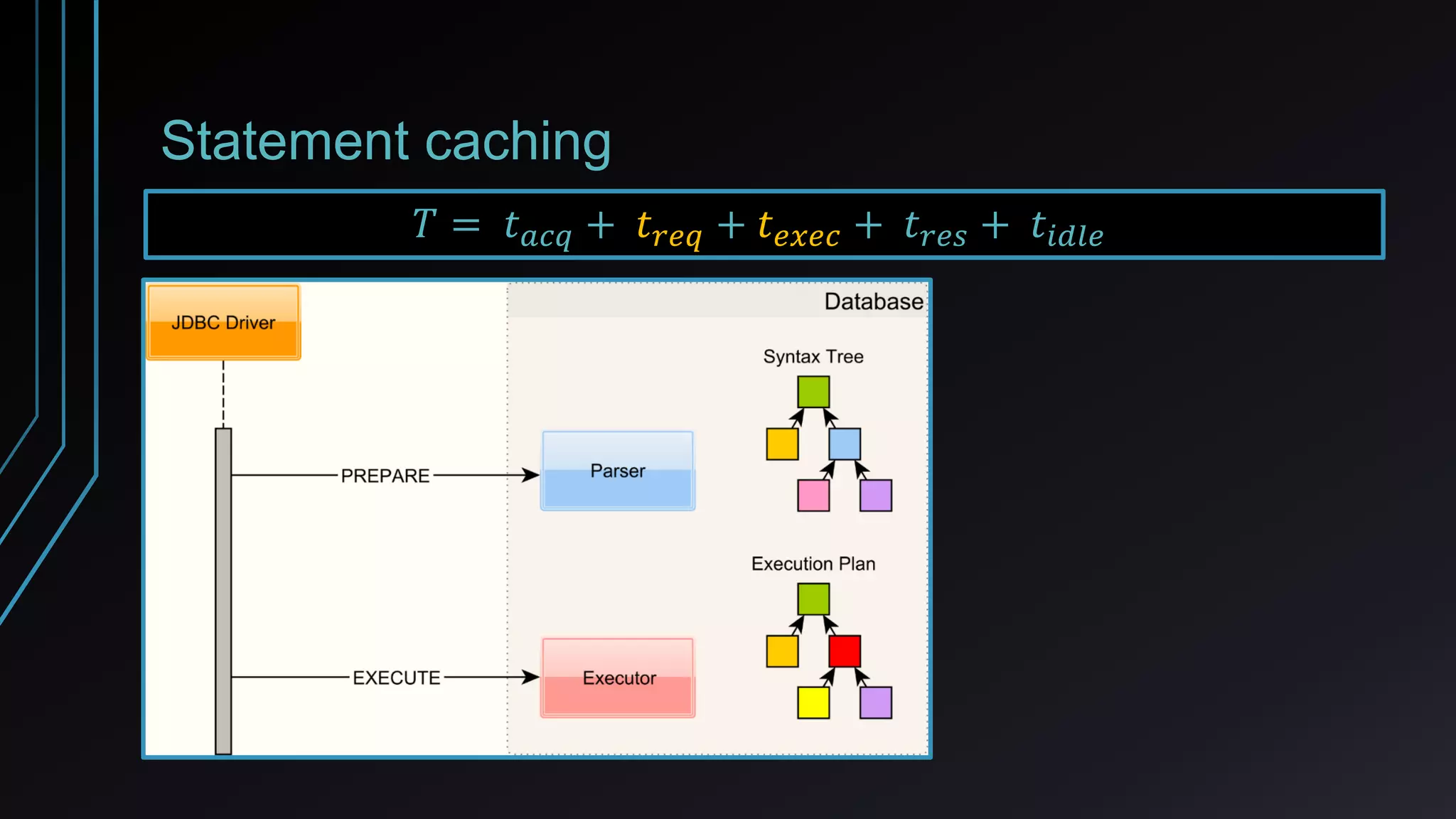
Statement caching
𝑇 = 𝑡 𝑎𝑐𝑞 + 𝑡 𝑟𝑒𝑞 + 𝑡 𝑒𝑥𝑒𝑐 + 𝑡 𝑟𝑒𝑠 + 𝑡𝑖𝑑𝑙𝑒
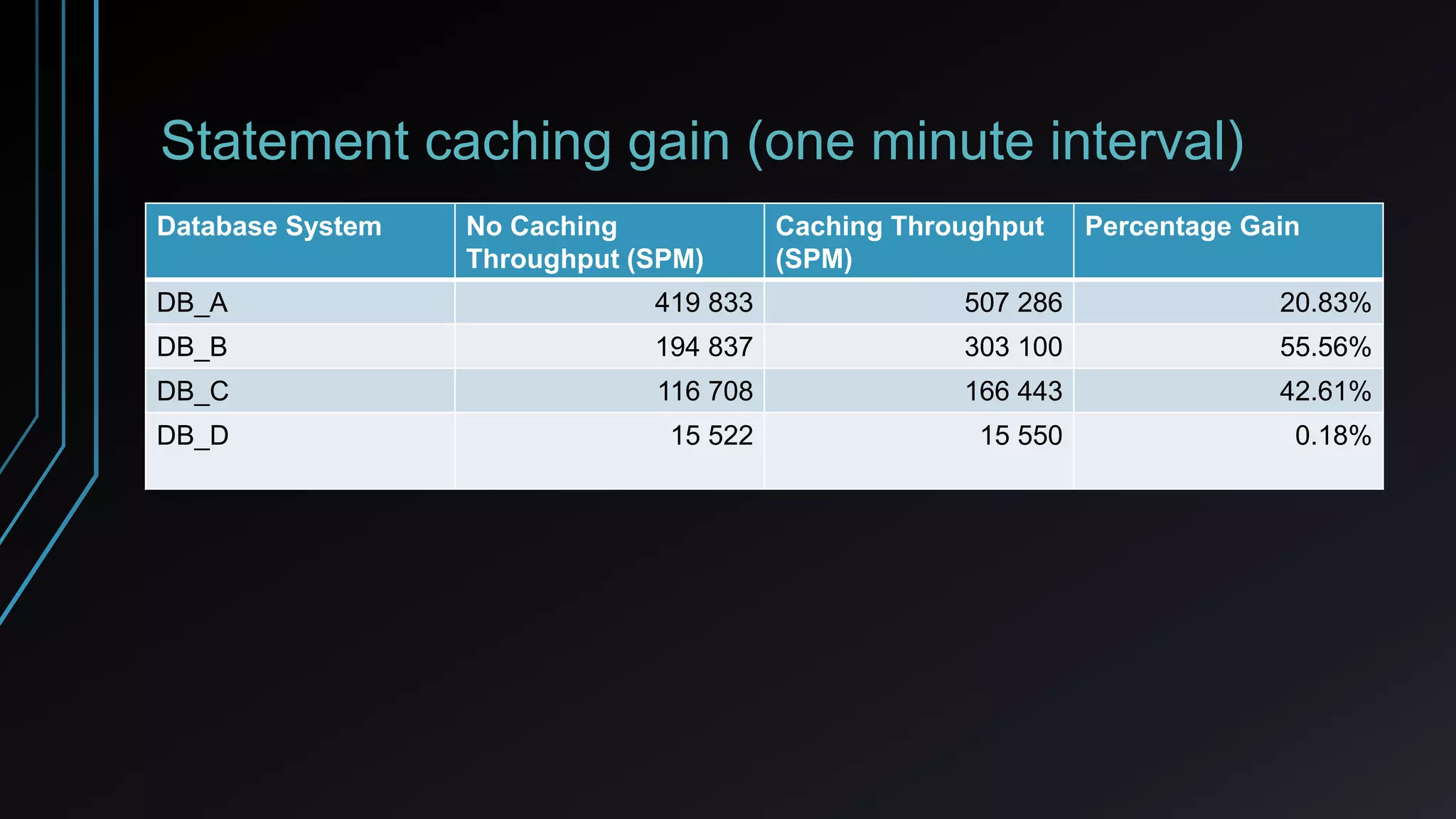
Statement caching gain (one minute interval)
Database System No Caching
Throughput (SPM)
Caching Throughput
(SPM)
Percentage Gain
DB_A 419 833 507 286 20.83%
DB_B 194 837 303 100 55.56%
DB_C 116 708 166 443 42.61%
DB_D 15 522 15 550 0.18%
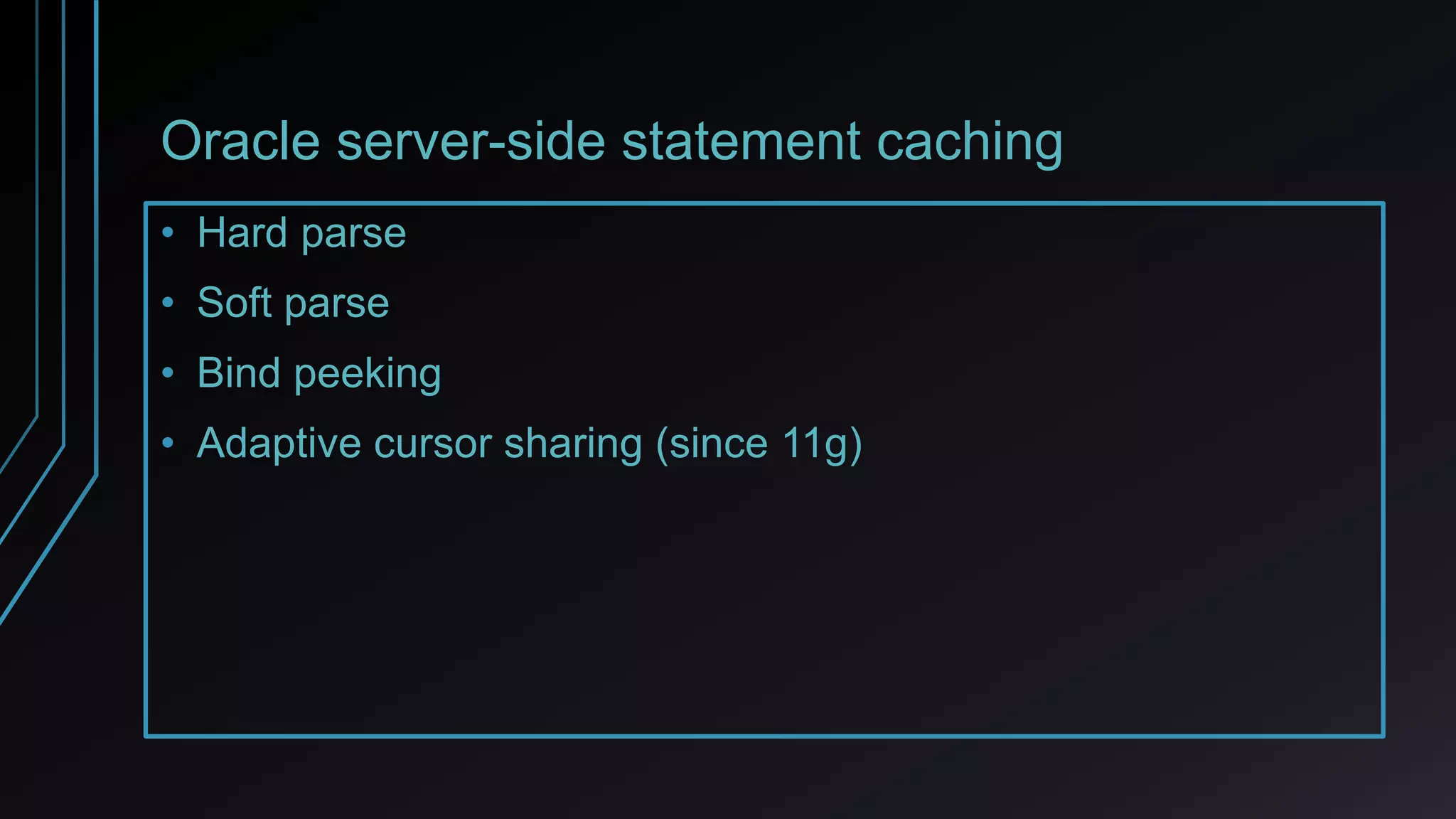
Oracle server-side statement caching
• Hard parse
• Soft parse
• Bind peeking
• Adaptive cursor sharing (since 11g)
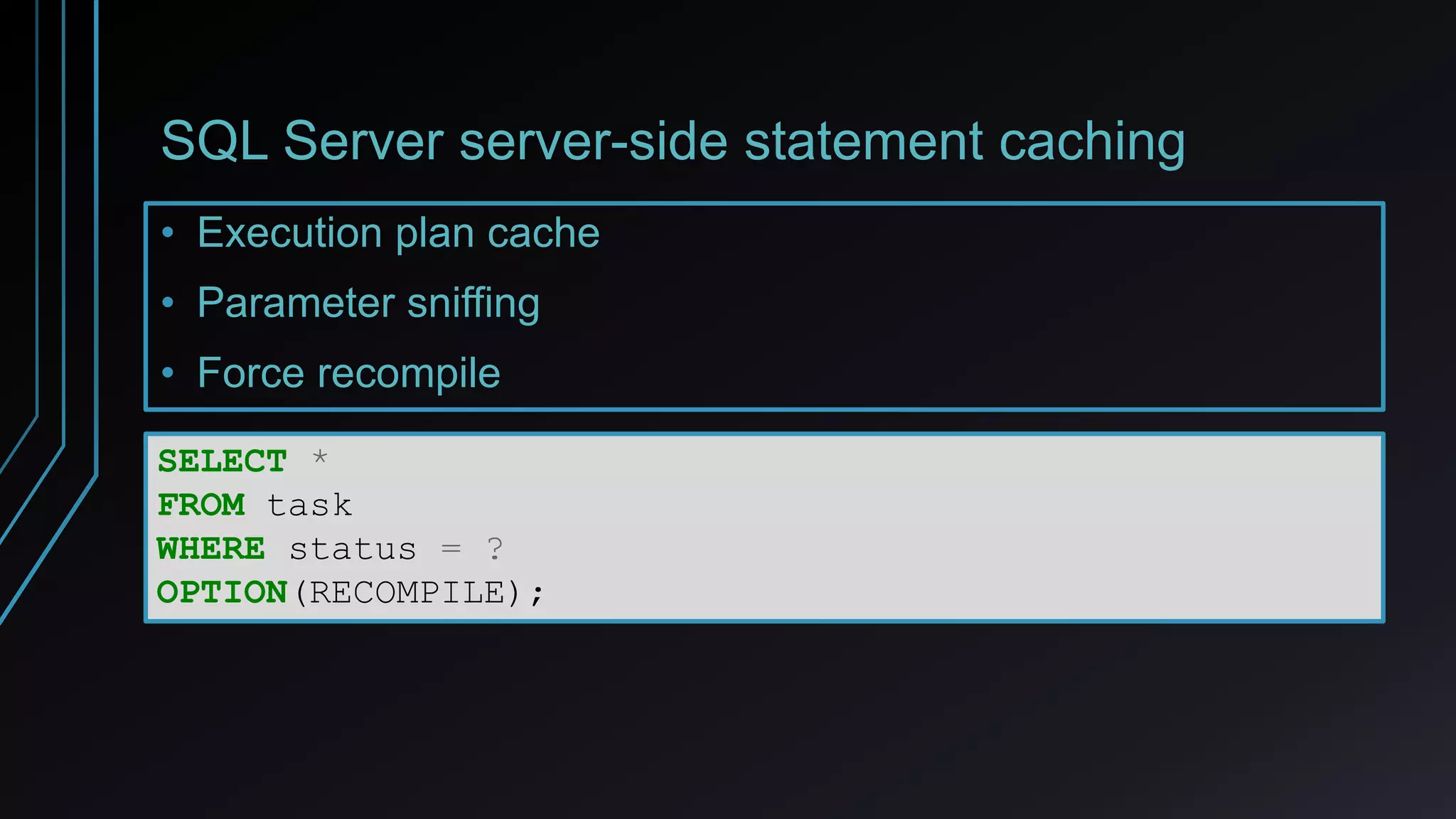
SQL Server server-side statement caching
• Execution plan cache
• Parameter sniffing
• Force recompile
SELECT *
FROM task
WHERE status = ?
OPTION(RECOMPILE);
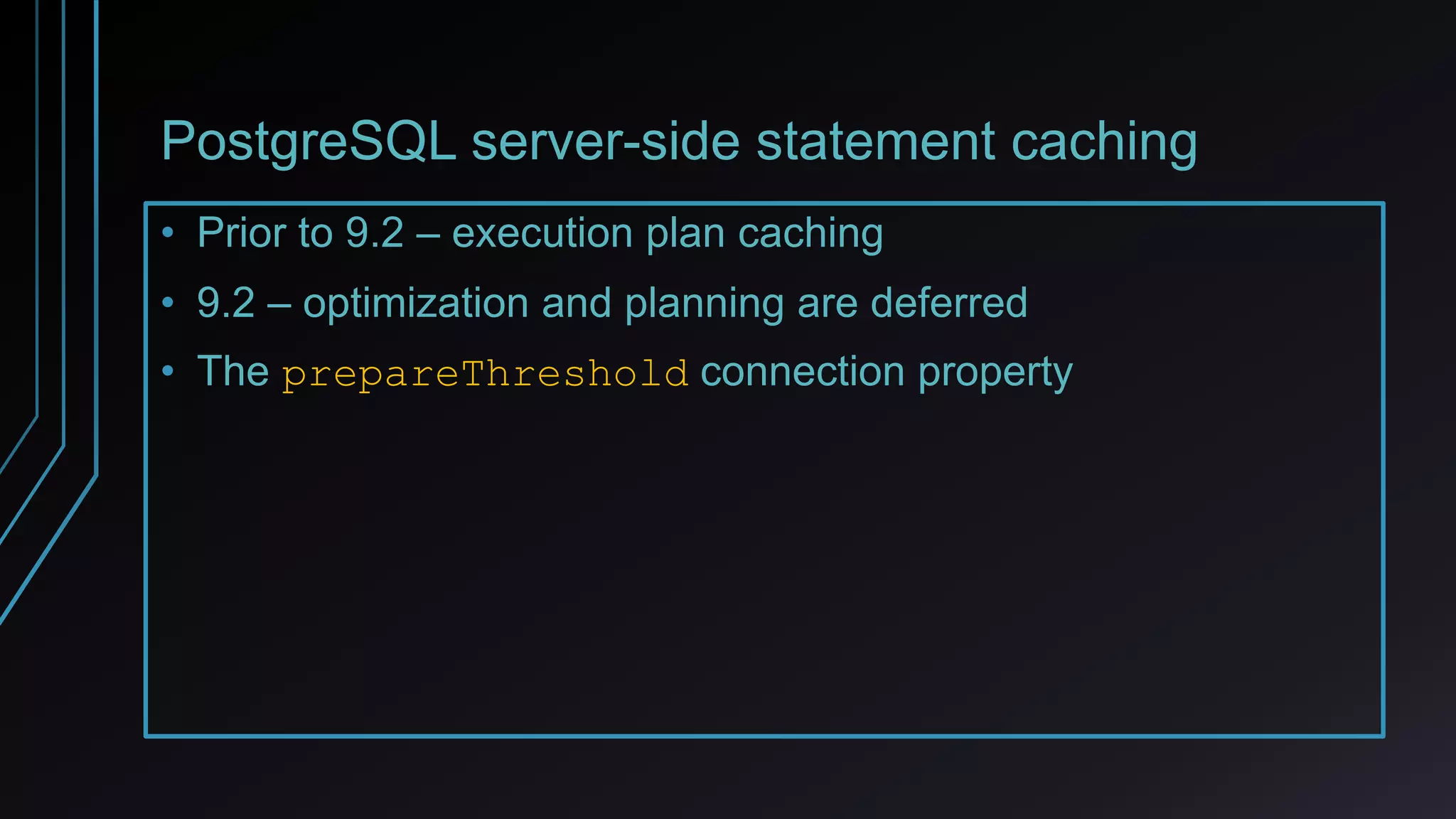
PostgreSQL server-side statement caching
• Prior to 9.2 – execution plan caching
• 9.2 – optimization and planning are deferred
• The prepareThreshold connection property
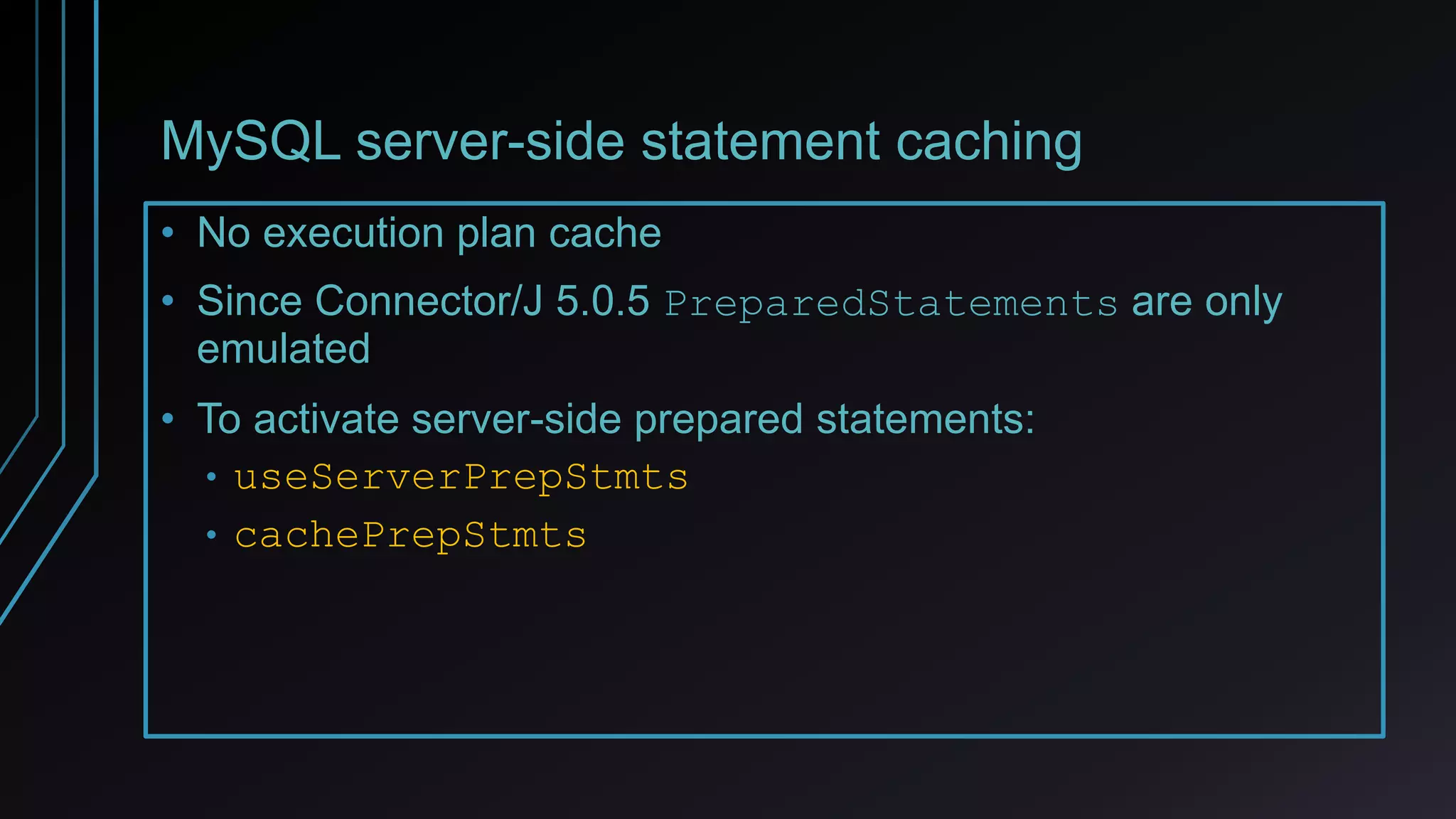
MySQL server-side statement caching
• No execution plan cache
• Since Connector/J 5.0.5 PreparedStatements are only
emulated
• To activate server-side prepared statements:
• useServerPrepStmts
• cachePrepStmts
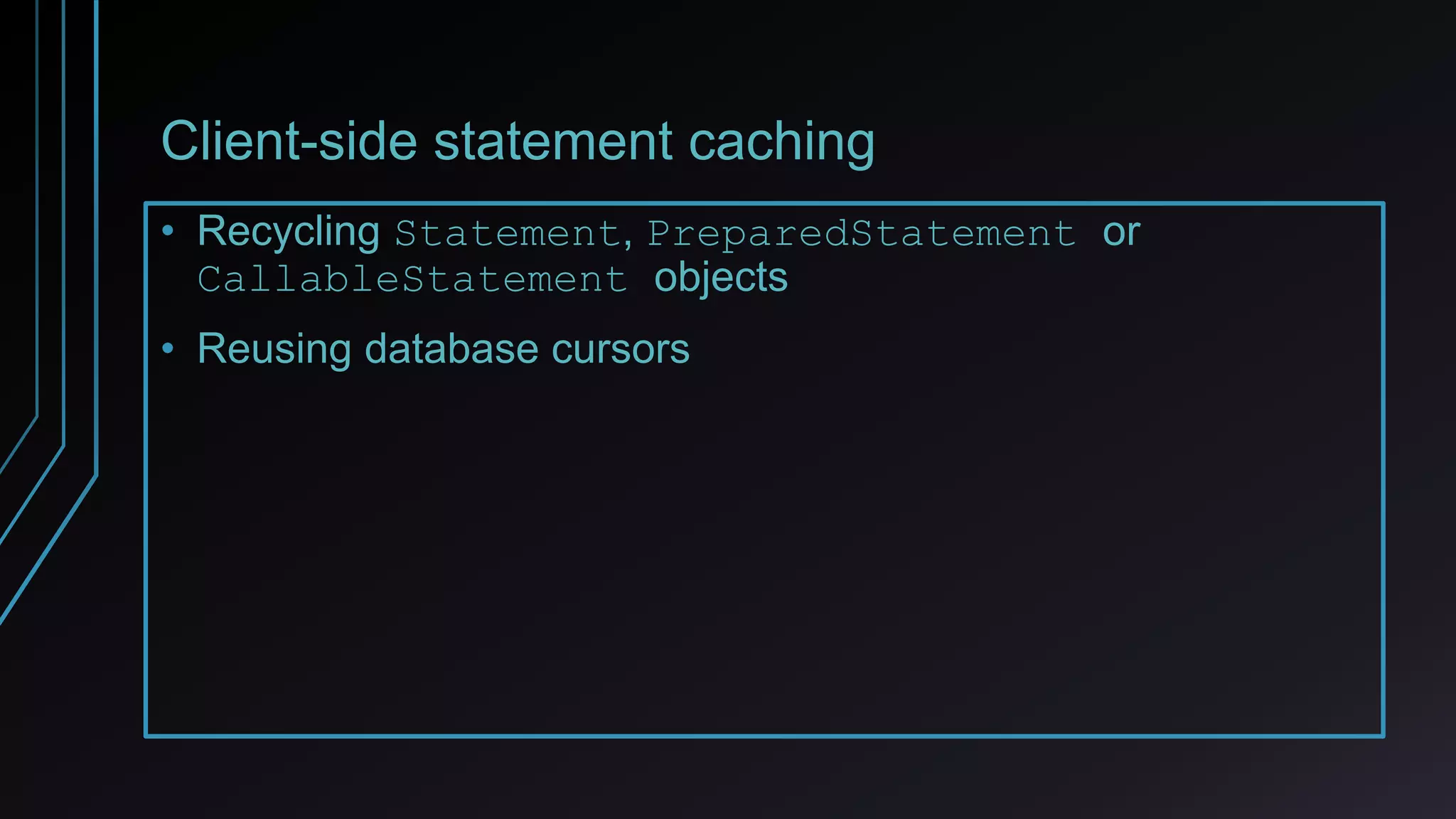
Client-side statement caching
• Recycling Statement, PreparedStatement or
CallableStatement objects
• Reusing database cursors
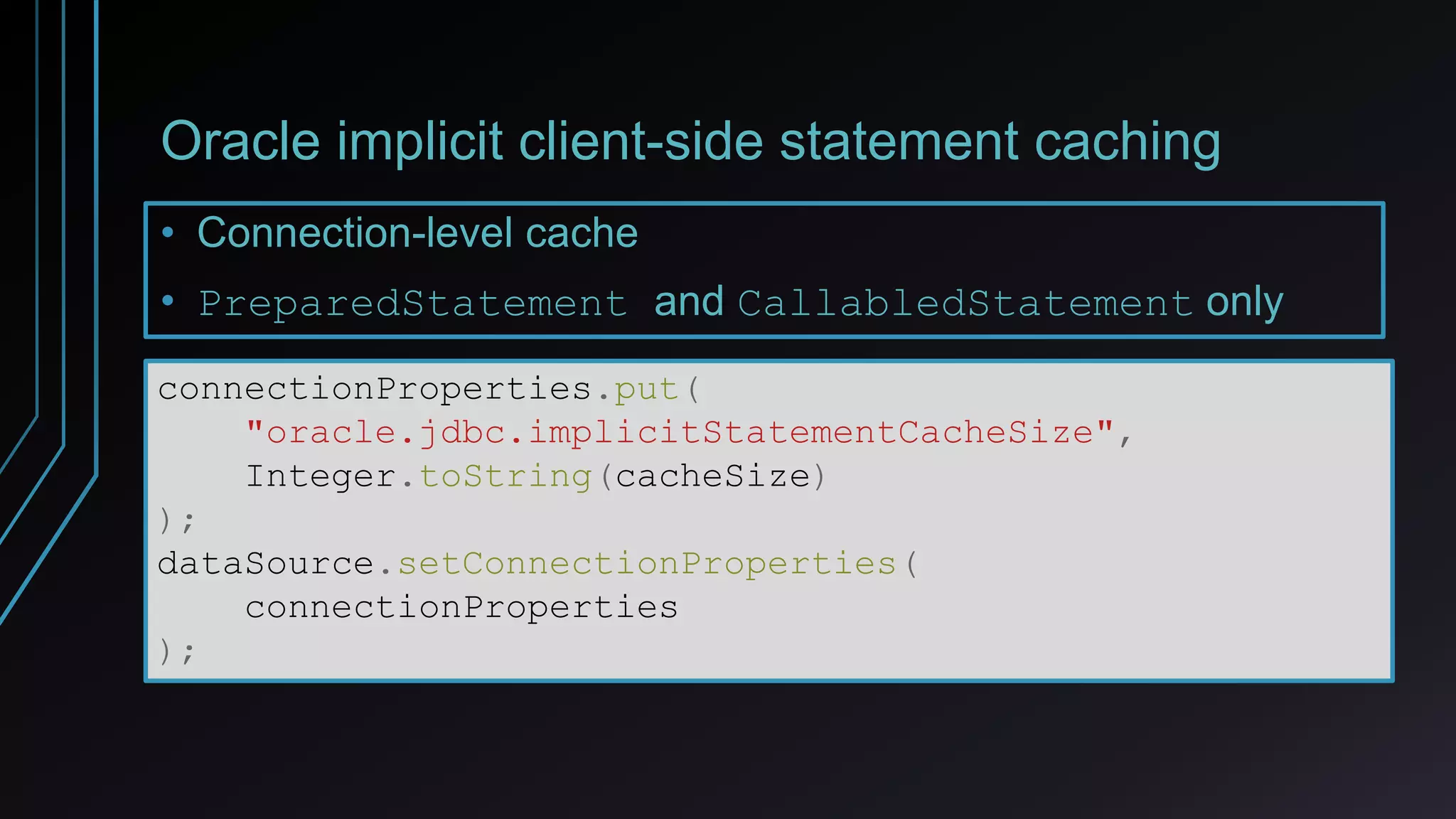
Oracle implicit client-side statement caching
• Connection-level cache
• PreparedStatement and CallabledStatement only
connectionProperties.put(
"oracle.jdbc.implicitStatementCacheSize",
Integer.toString(cacheSize)
);
dataSource.setConnectionProperties(
connectionProperties
);
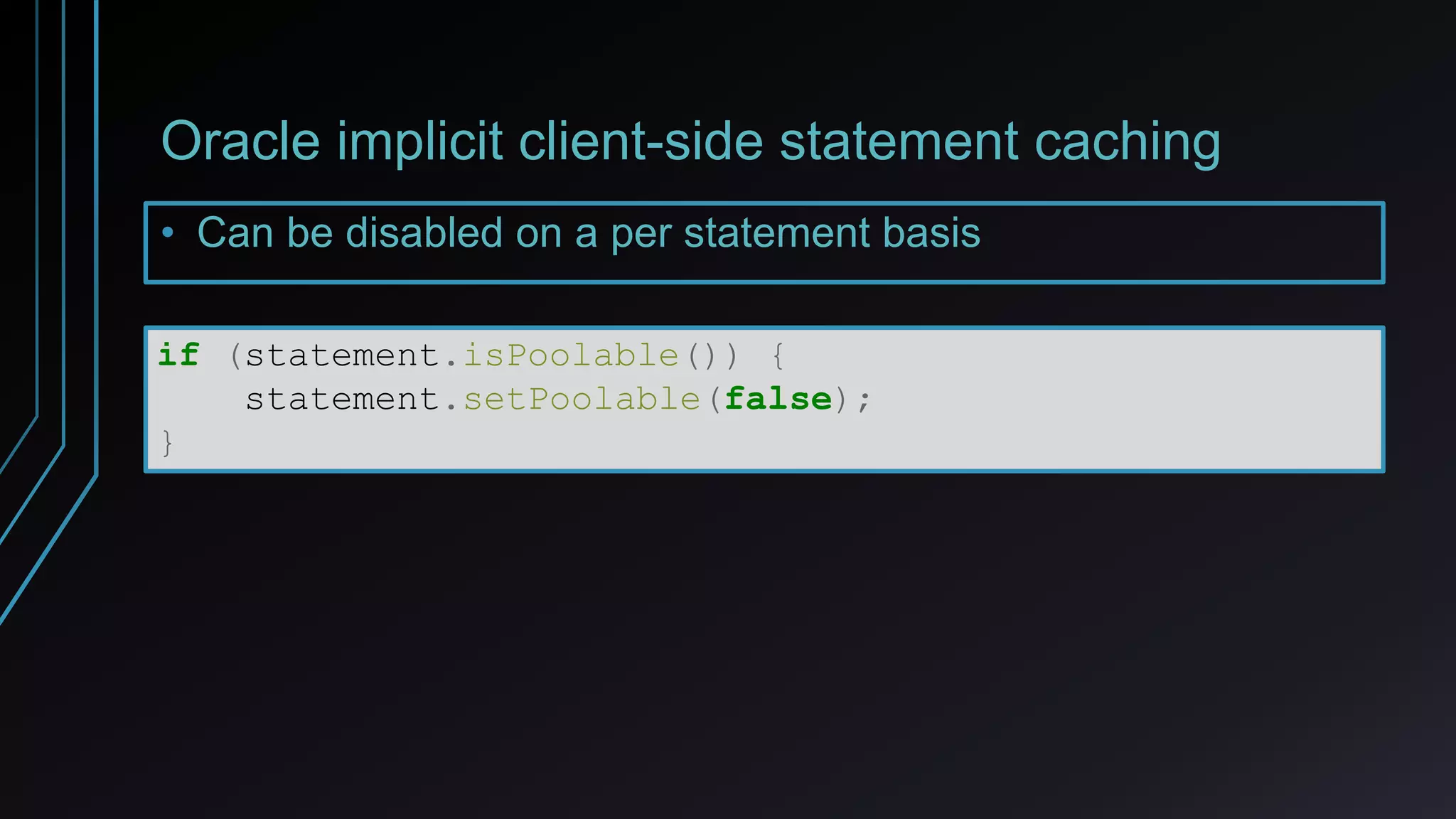
Oracle implicit client-side statement caching
• Can be disabled on a per statement basis
if (statement.isPoolable()) {
statement.setPoolable(false);
}
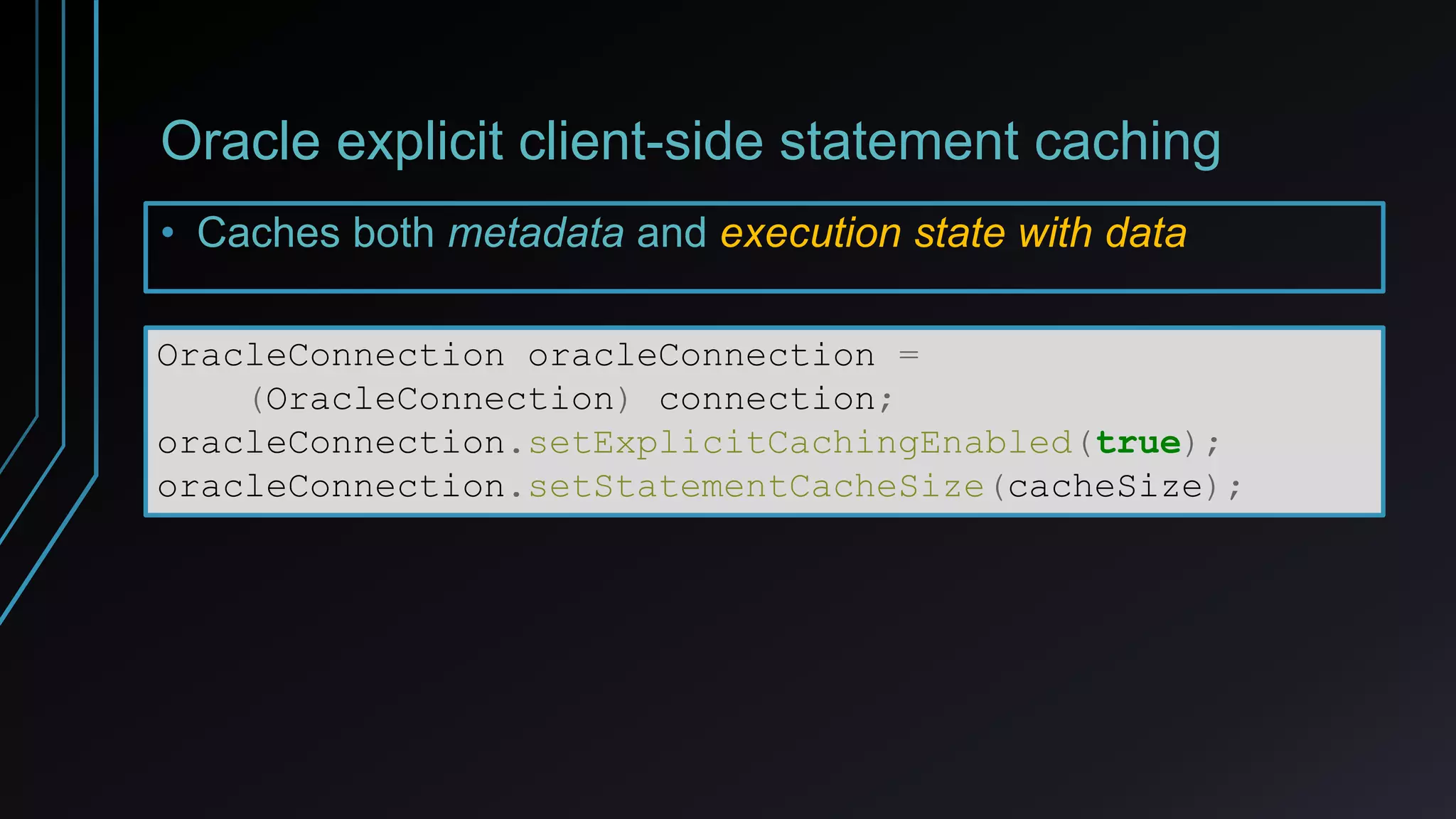
Oracle explicit client-side statement caching
• Caches both metadata and execution state with data
OracleConnection oracleConnection =
(OracleConnection) connection;
oracleConnection.setExplicitCachingEnabled(true);
oracleConnection.setStatementCacheSize(cacheSize);
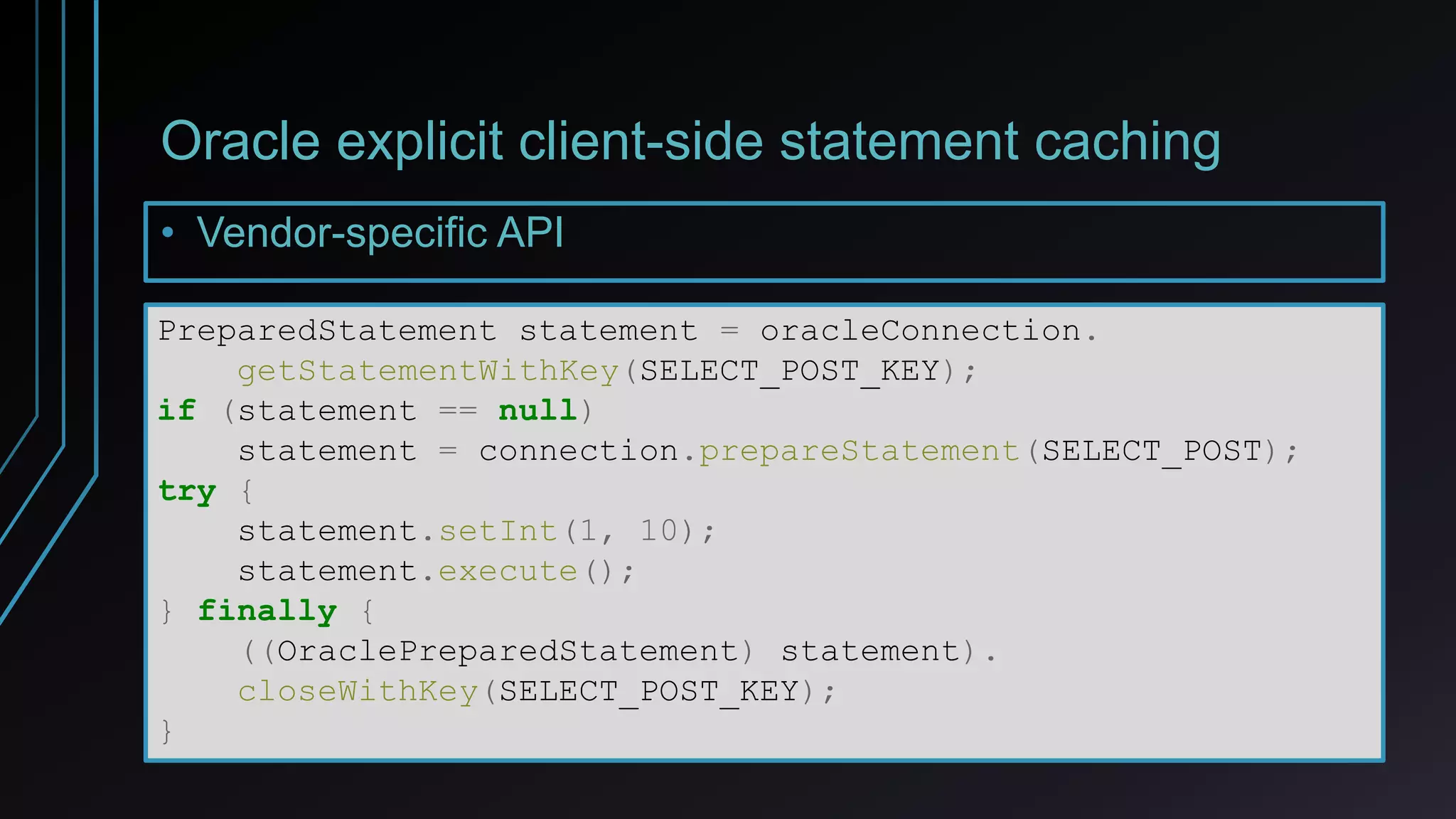
Oracle explicit client-side statement caching
• Vendor-specific API
PreparedStatement statement = oracleConnection.
getStatementWithKey(SELECT_POST_KEY);
if (statement == null)
statement = connection.prepareStatement(SELECT_POST);
try {
statement.setInt(1, 10);
statement.execute();
} finally {
((OraclePreparedStatement) statement).
closeWithKey(SELECT_POST_KEY);
}
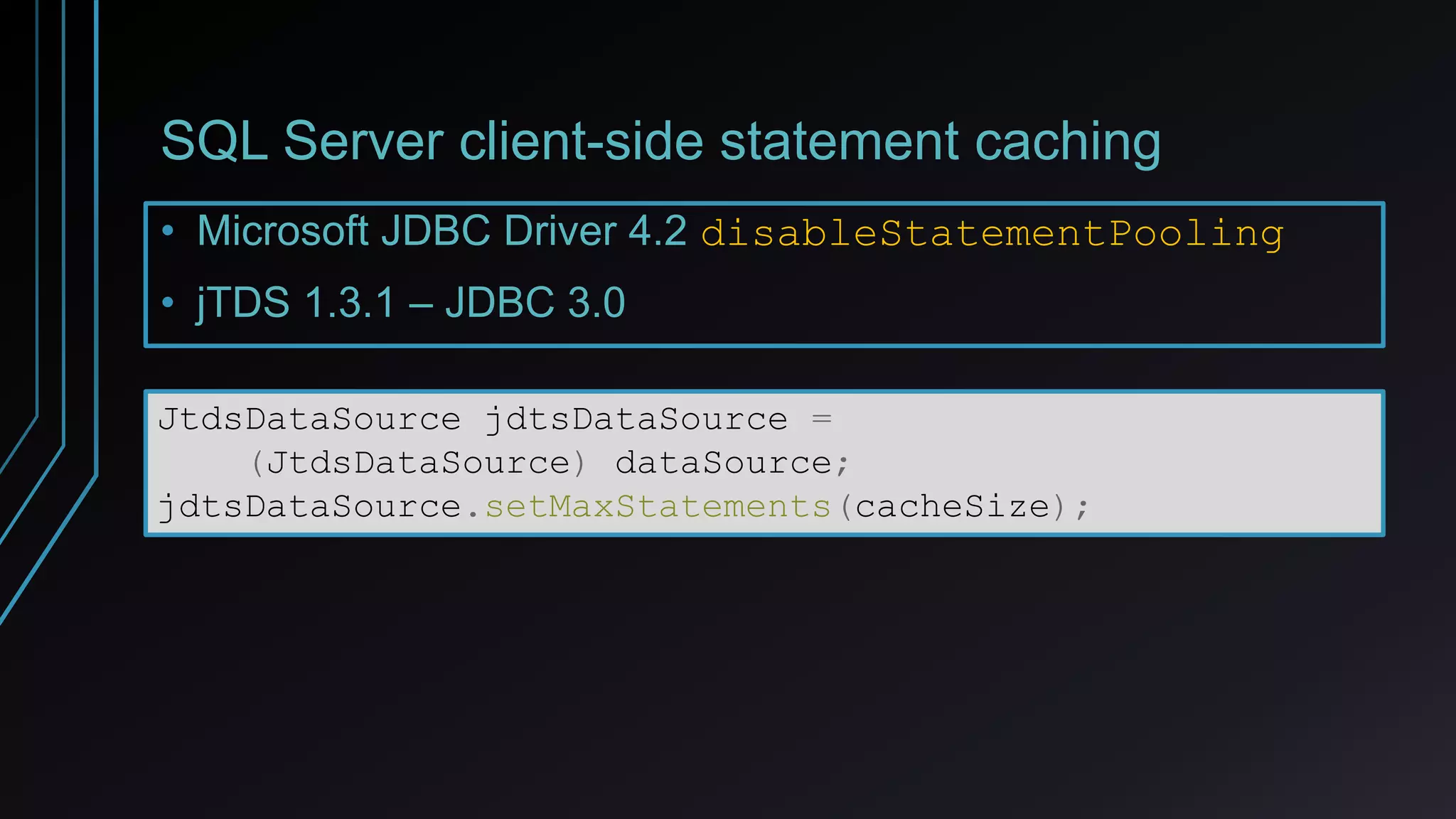
SQL Server client-side statement caching
• Microsoft JDBC Driver 4.2 disableStatementPooling
• jTDS 1.3.1 – JDBC 3.0
JtdsDataSource jdtsDataSource =
(JtdsDataSource) dataSource;
jdtsDataSource.setMaxStatements(cacheSize);
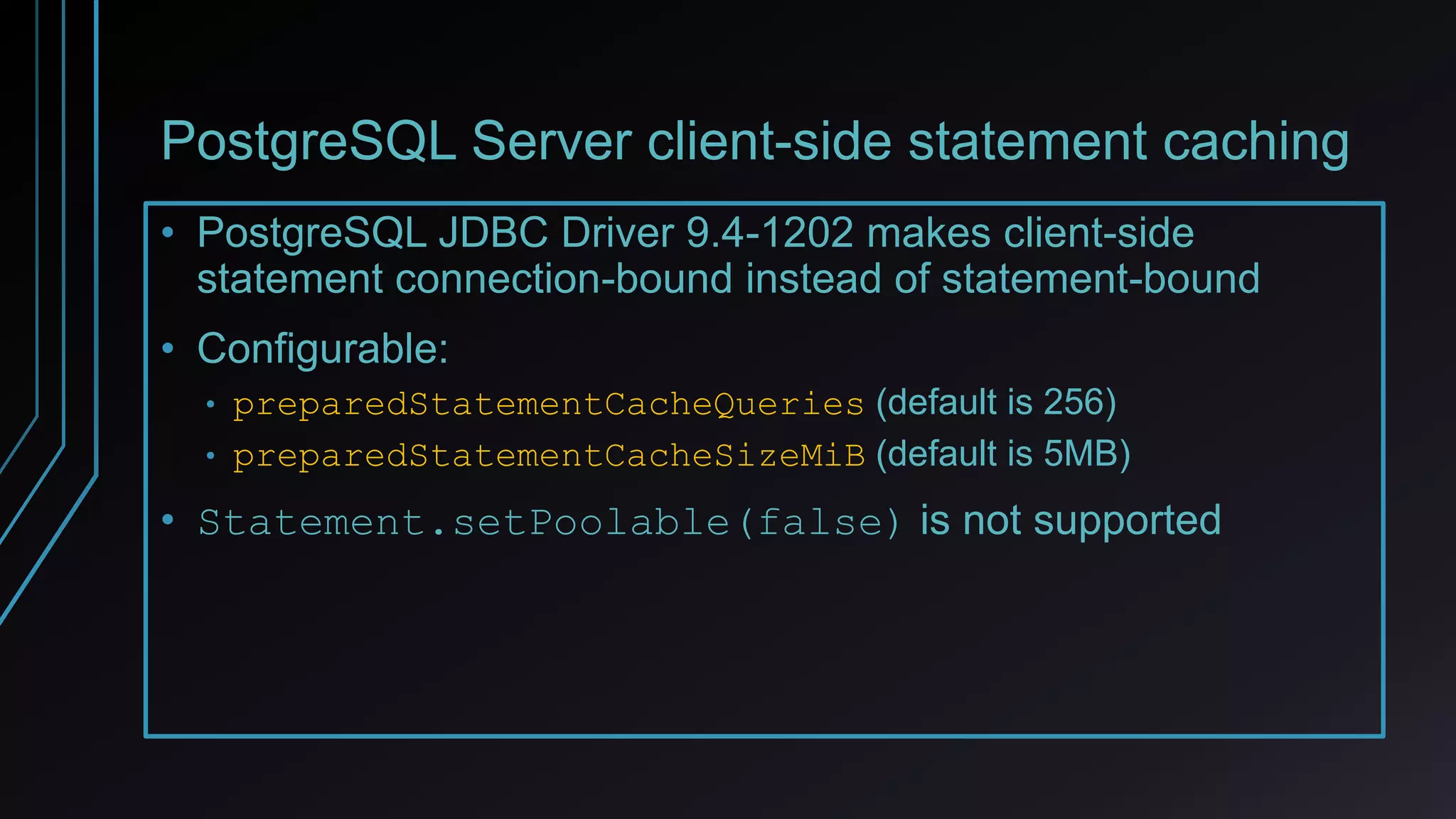
PostgreSQL Server client-side statement caching
• PostgreSQL JDBC Driver 9.4-1202 makes client-side
statement connection-bound instead of statement-bound
• Configurable:
• preparedStatementCacheQueries (default is 256)
• preparedStatementCacheSizeMiB (default is 5MB)
• Statement.setPoolable(false) is not supported
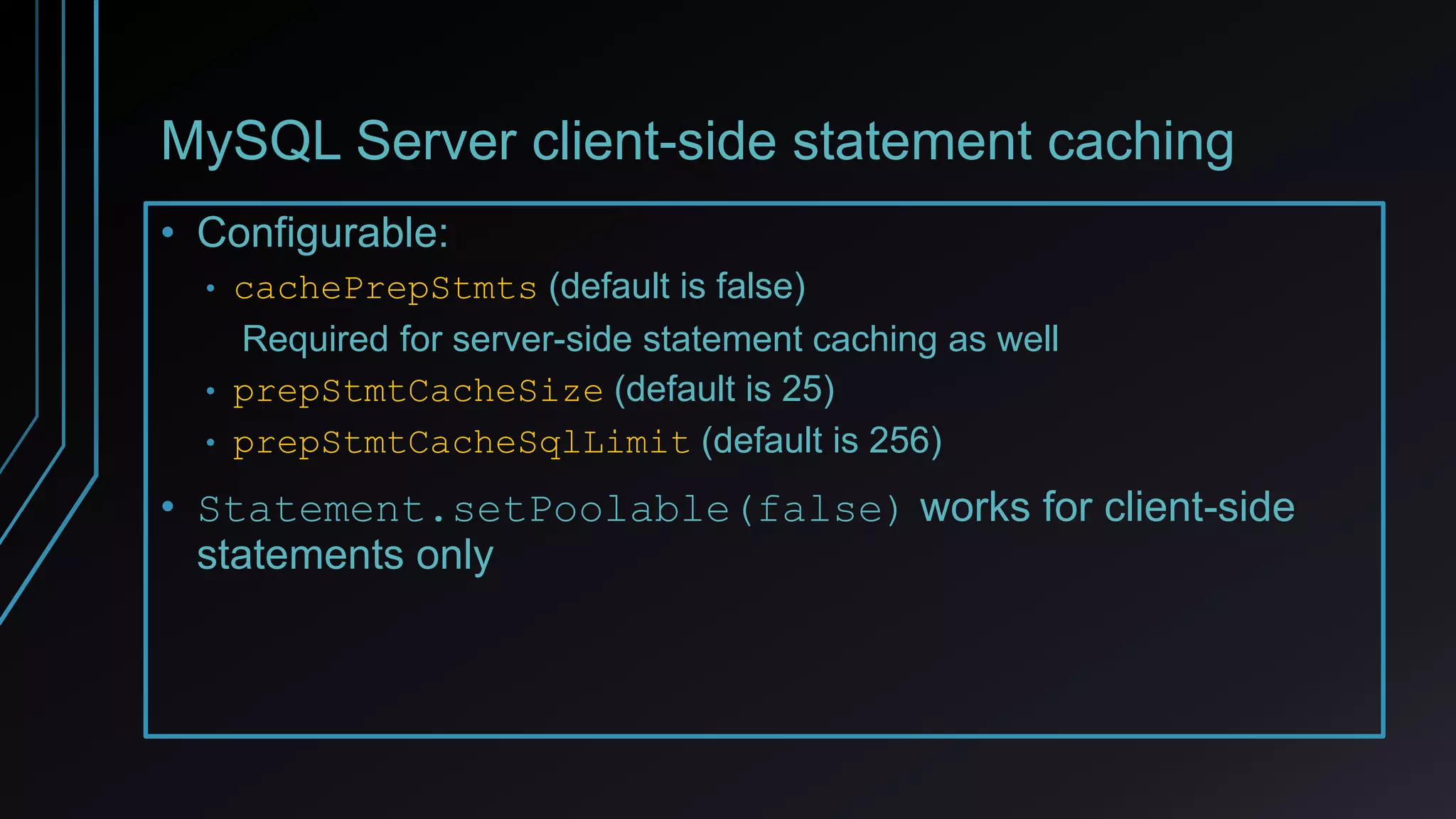
MySQL Server client-side statement caching
• Configurable:
• cachePrepStmts (default is false)
Required for server-side statement caching as well
• prepStmtCacheSize (default is 25)
• prepStmtCacheSqlLimit (default is 256)
• Statement.setPoolable(false) works for client-side
statements only
ResultSet fetch size
• ResultSet - application-level cursor
𝑇 = 𝑡 𝑎𝑐𝑞 + 𝑡 𝑟𝑒𝑞 + 𝑡 𝑒𝑥𝑒𝑐 + 𝑡 𝑟𝑒𝑠 + 𝑡𝑖𝑑𝑙𝑒
statement.setFetchSize(fetchSize);
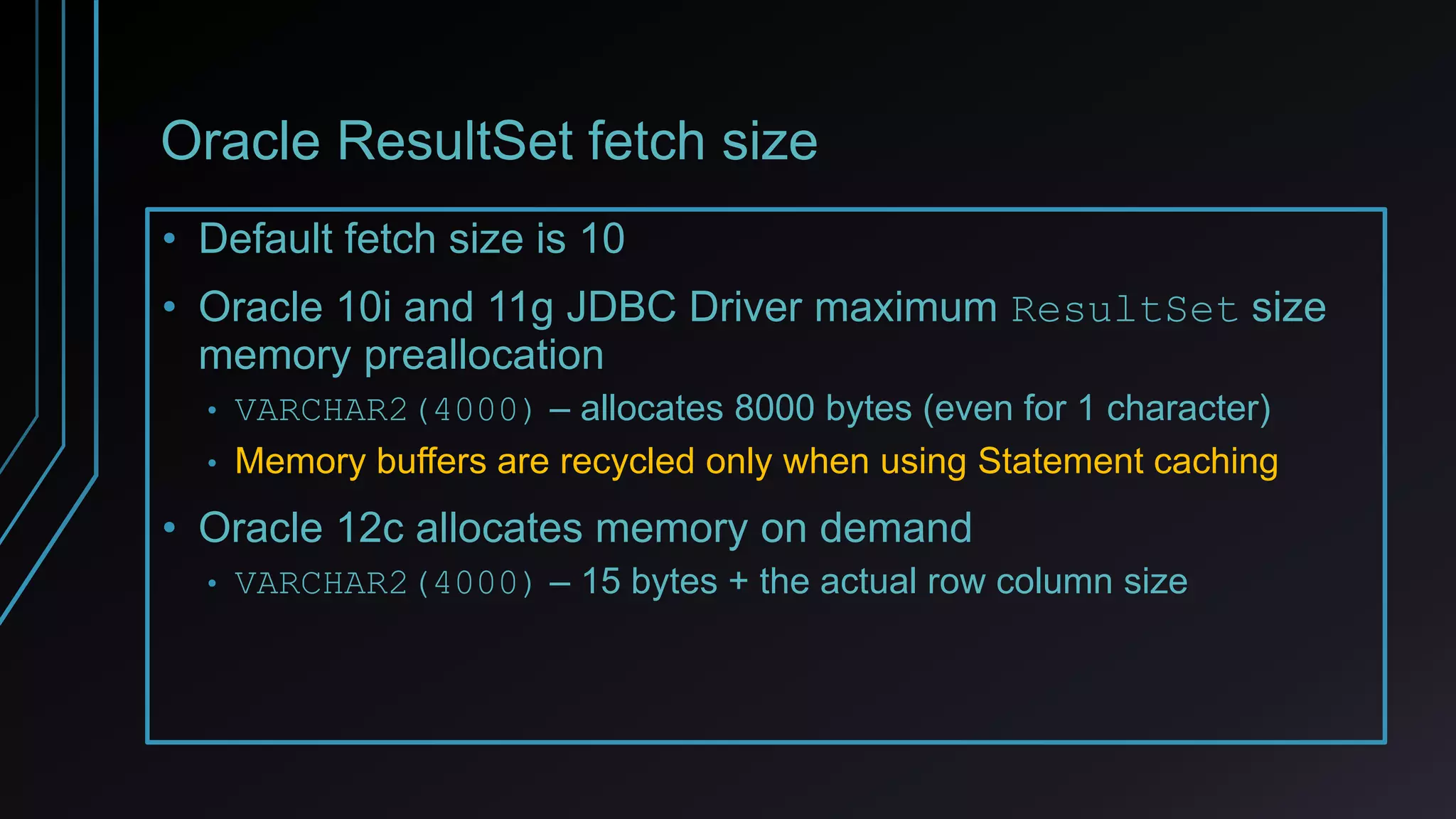
Oracle ResultSet fetch size
• Default fetch size is 10
• Oracle 10i and 11g JDBC Driver maximum ResultSet size
memory preallocation
• VARCHAR2(4000) – allocates 8000 bytes (even for 1 character)
• Memory buffers are recycled only when using Statement caching
• Oracle 12c allocates memory on demand
• VARCHAR2(4000) – 15 bytes + the actual row column size
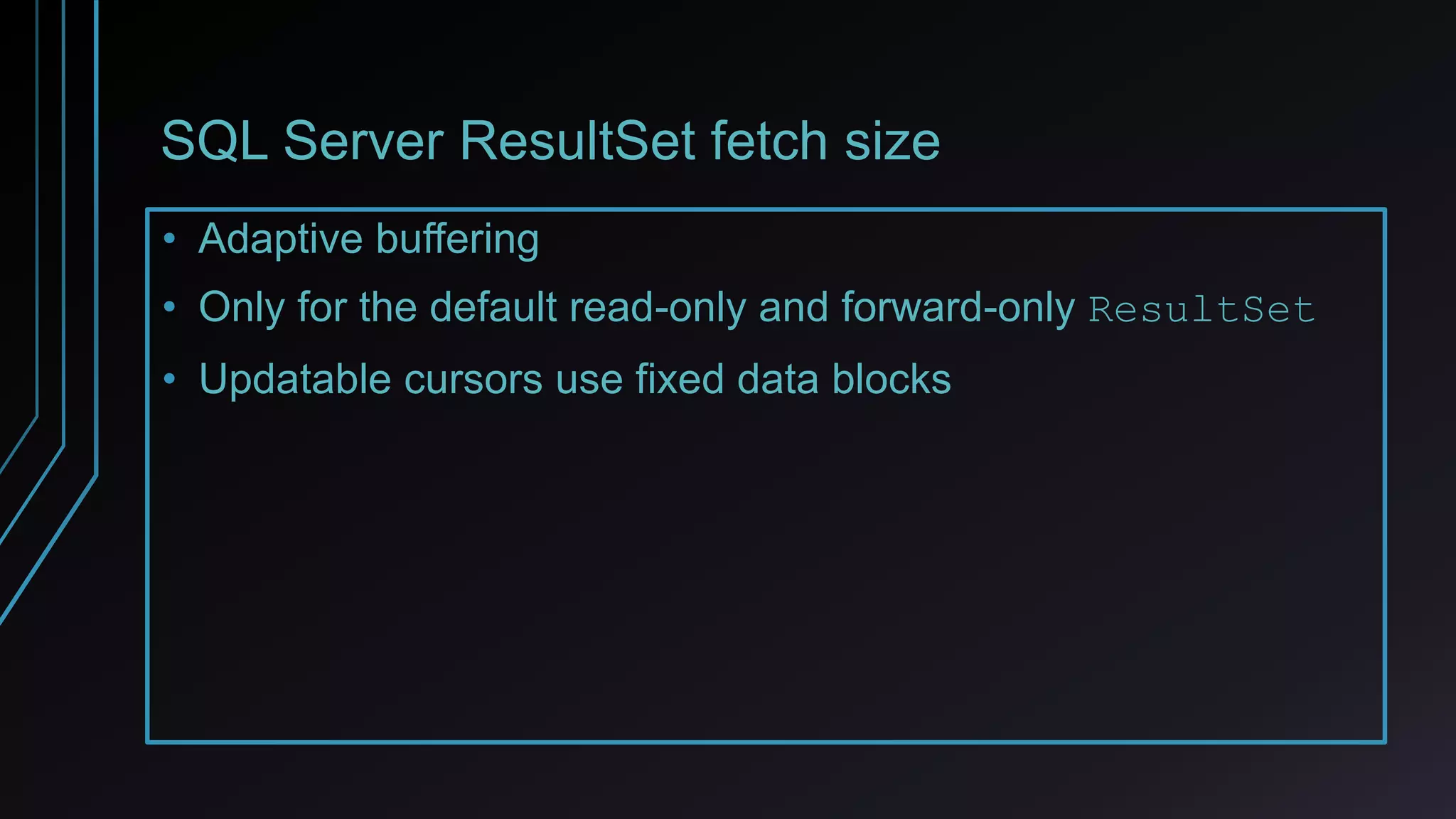
SQL Server ResultSet fetch size
• Adaptive buffering
• Only for the default read-only and forward-only ResultSet
• Updatable cursors use fixed data blocks
PostgreSQL ResultSet fetch size
• Fetch all – one database roundtrip
• Custom fetch size – database cursor
MySQL ResultSet fetch size
• Fetch all – one database roundtrip
• Streaming – only one record at a time
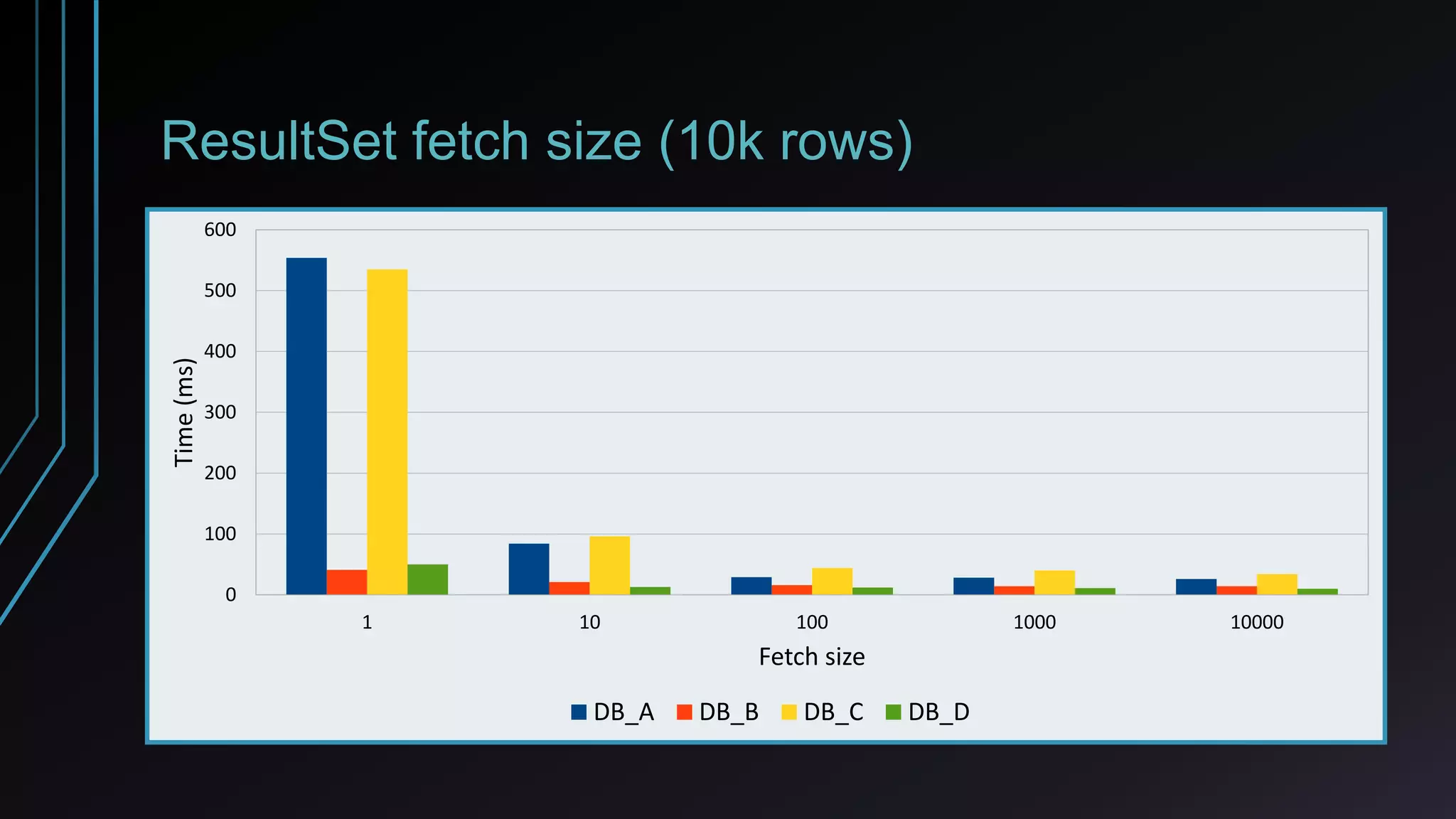
ResultSet fetch size (10k rows)
1 10 100 1000 10000
0
100
200
300
400
500
600
Fetch size
Time(ms)
DB_A DB_B DB_C DB_D
ResultSet size
• Avoid fetching data that is not required
• Hibernate addresses the max-size vendor-specific SQL
statement syntax
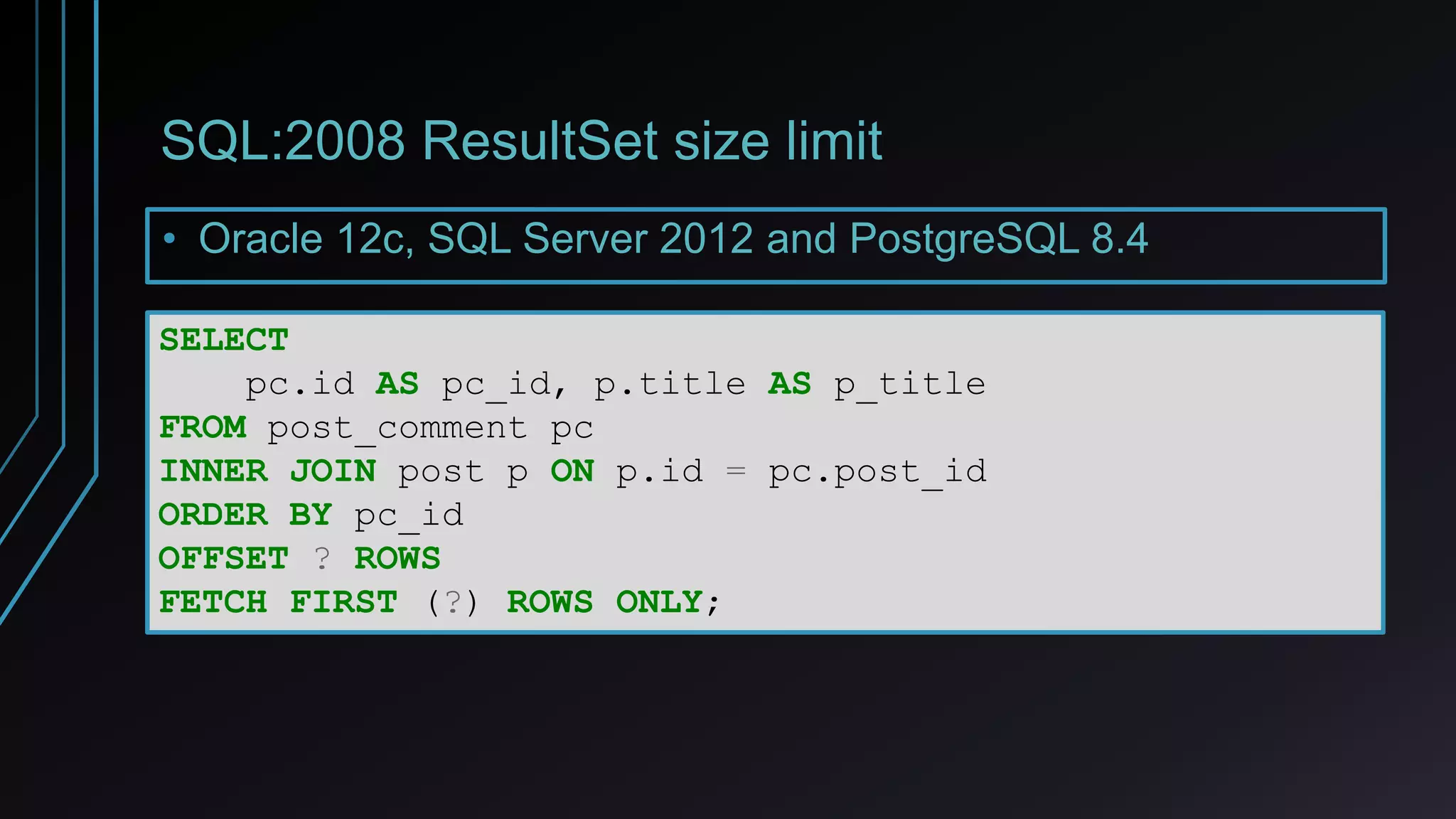
SQL:2008 ResultSet size limit
• Oracle 12c, SQL Server 2012 and PostgreSQL 8.4
SELECT
pc.id AS pc_id, p.title AS p_title
FROM post_comment pc
INNER JOIN post p ON p.id = pc.post_id
ORDER BY pc_id
OFFSET ? ROWS
FETCH FIRST (?) ROWS ONLY;
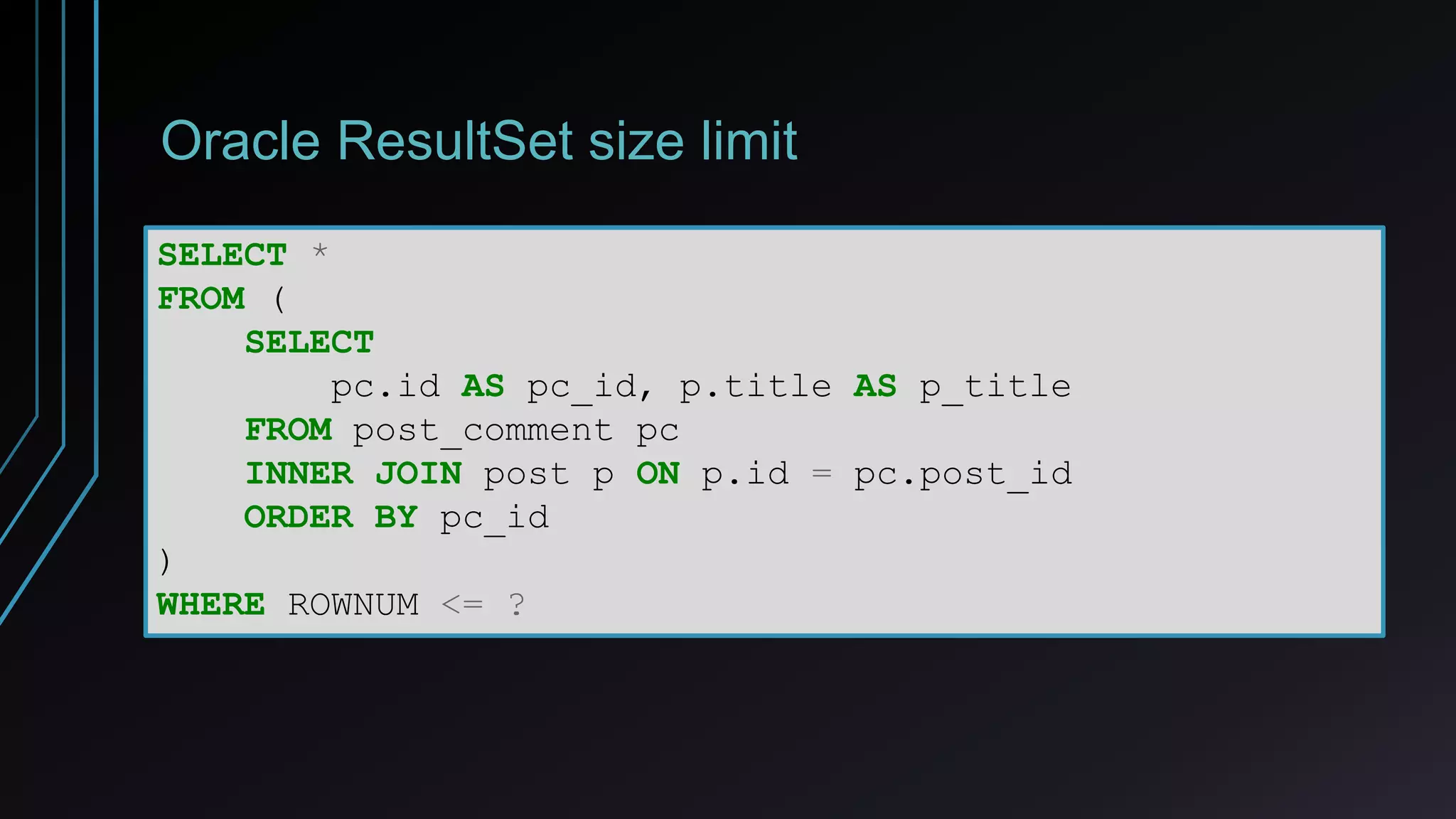
Oracle ResultSet size limit
SELECT *
FROM (
SELECT
pc.id AS pc_id, p.title AS p_title
FROM post_comment pc
INNER JOIN post p ON p.id = pc.post_id
ORDER BY pc_id
)
WHERE ROWNUM <= ?
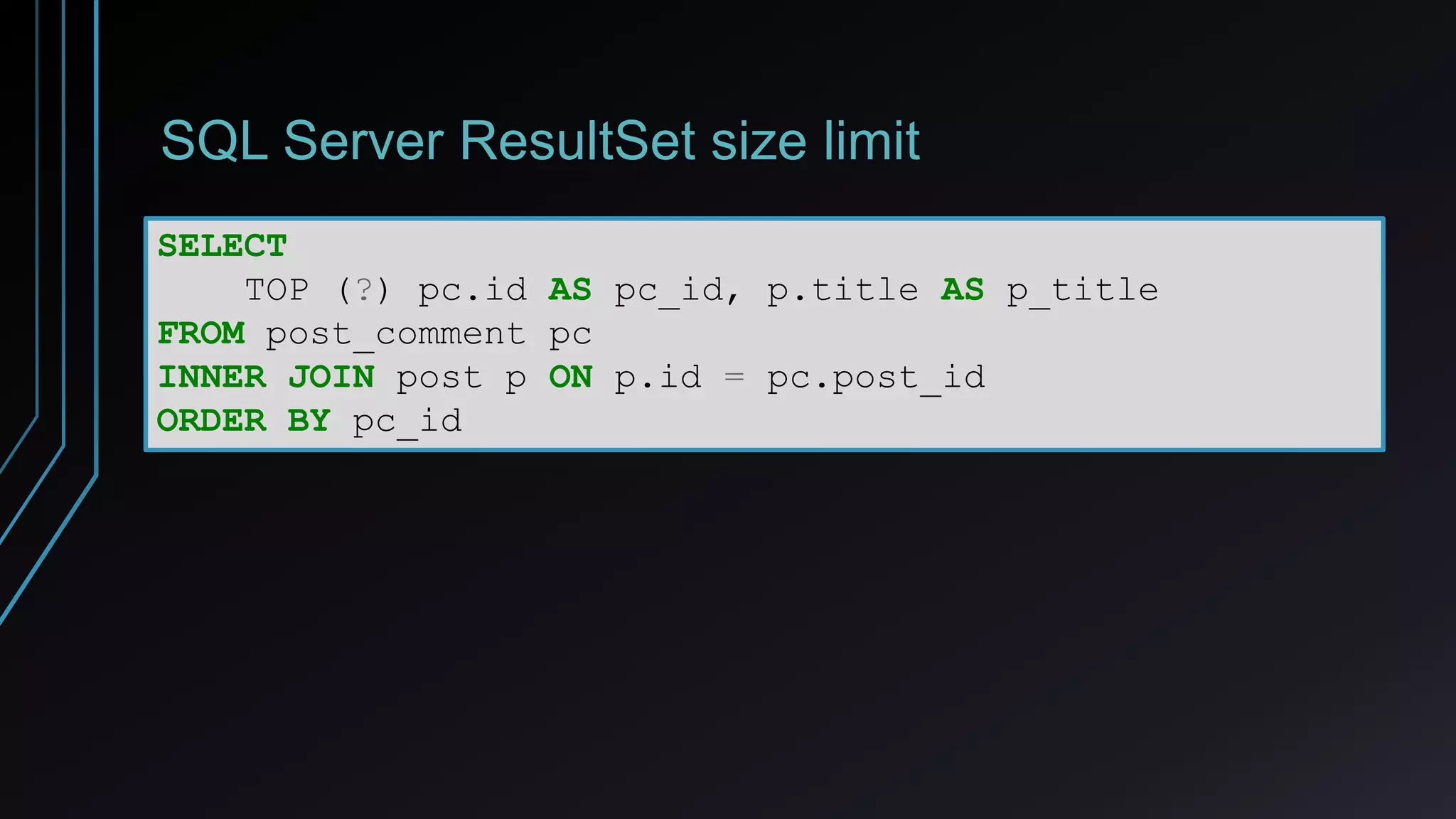
SQL Server ResultSet size limit
SELECT
TOP (?) pc.id AS pc_id, p.title AS p_title
FROM post_comment pc
INNER JOIN post p ON p.id = pc.post_id
ORDER BY pc_id
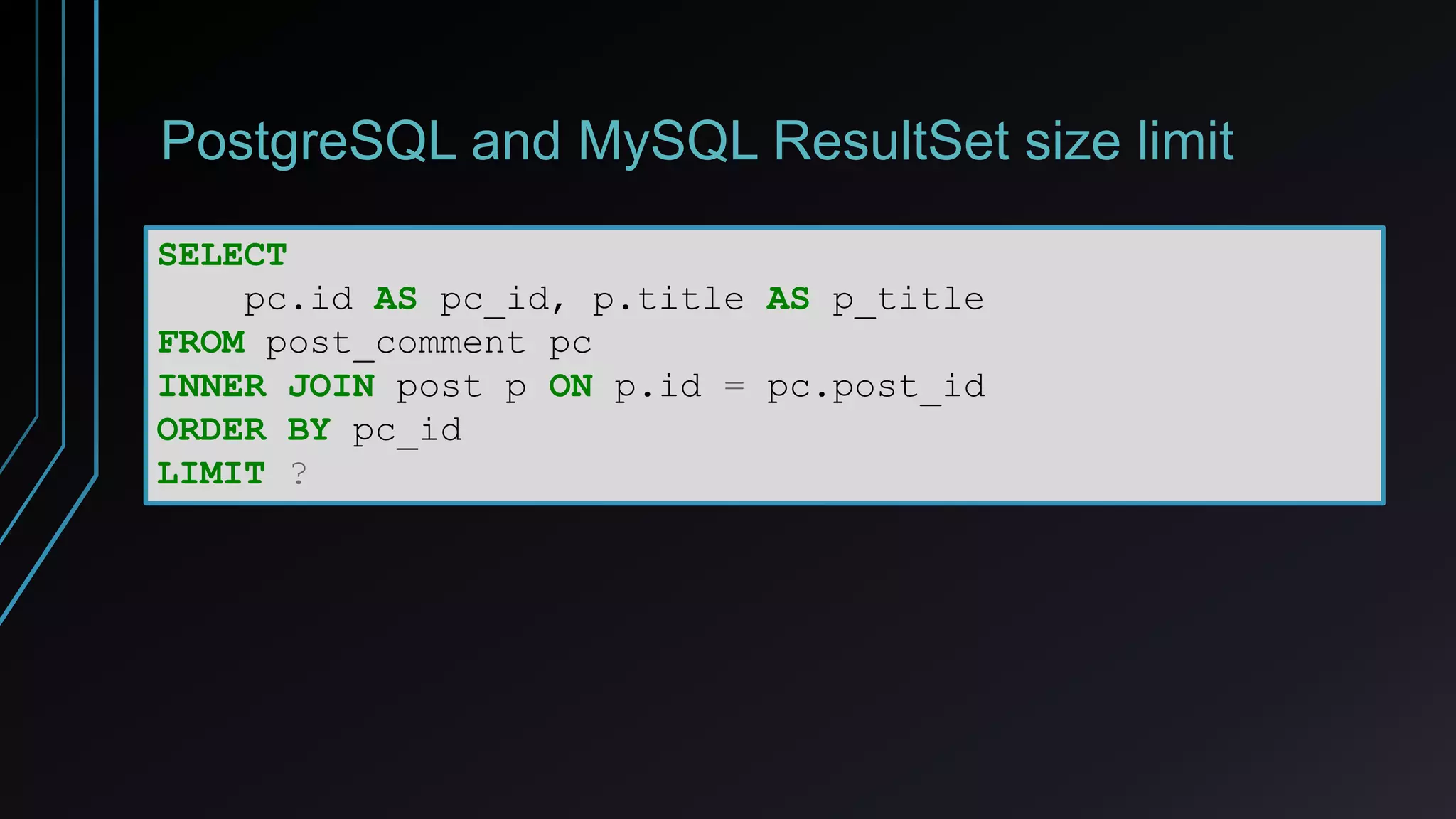
PostgreSQL and MySQL ResultSet size limit
SELECT
pc.id AS pc_id, p.title AS p_title
FROM post_comment pc
INNER JOIN post p ON p.id = pc.post_id
ORDER BY pc_id
LIMIT ?
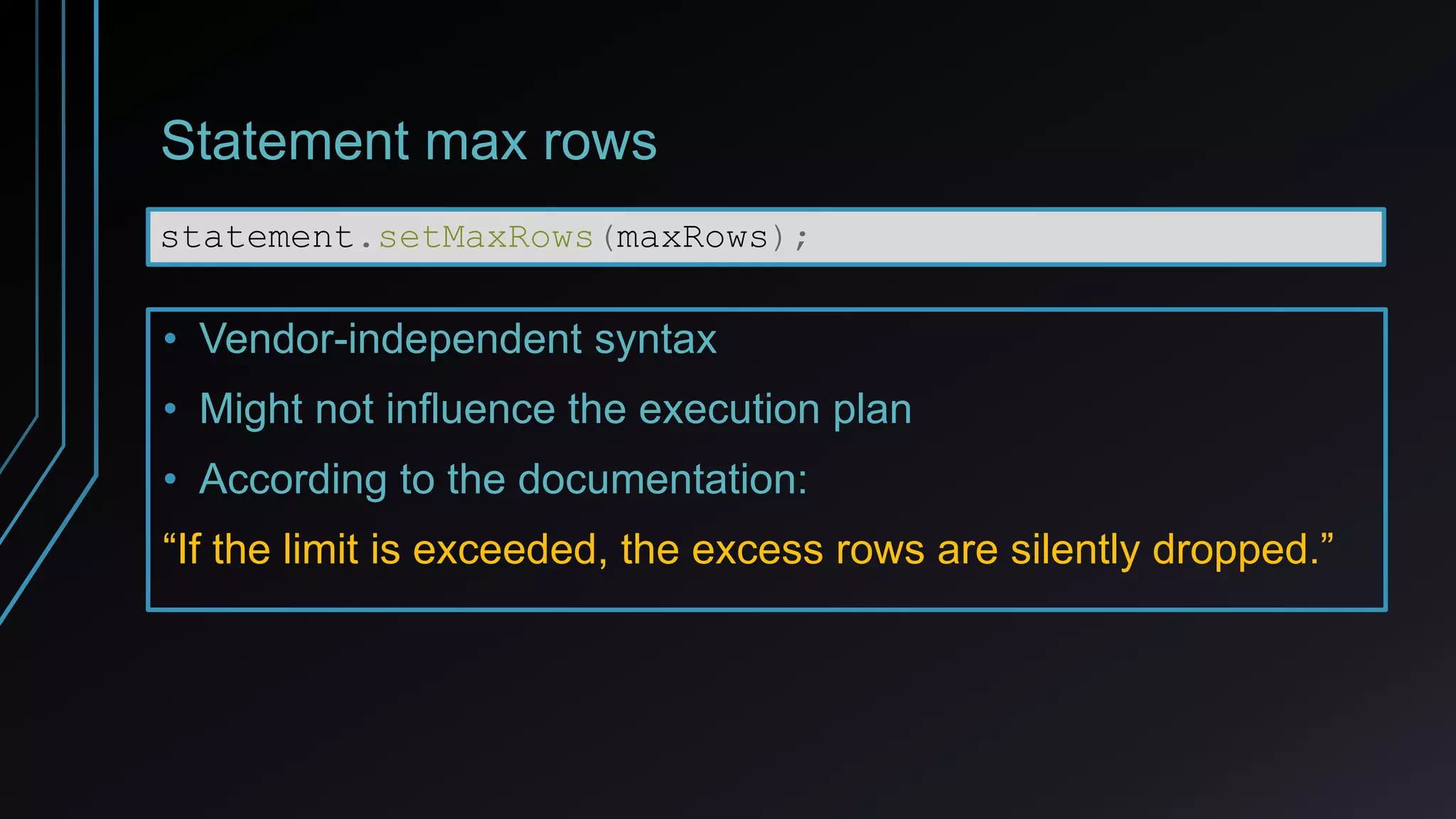
Statement max rows
• Vendor-independent syntax
• Might not influence the execution plan
• According to the documentation:
“If the limit is exceeded, the excess rows are silently dropped.”
statement.setMaxRows(maxRows);
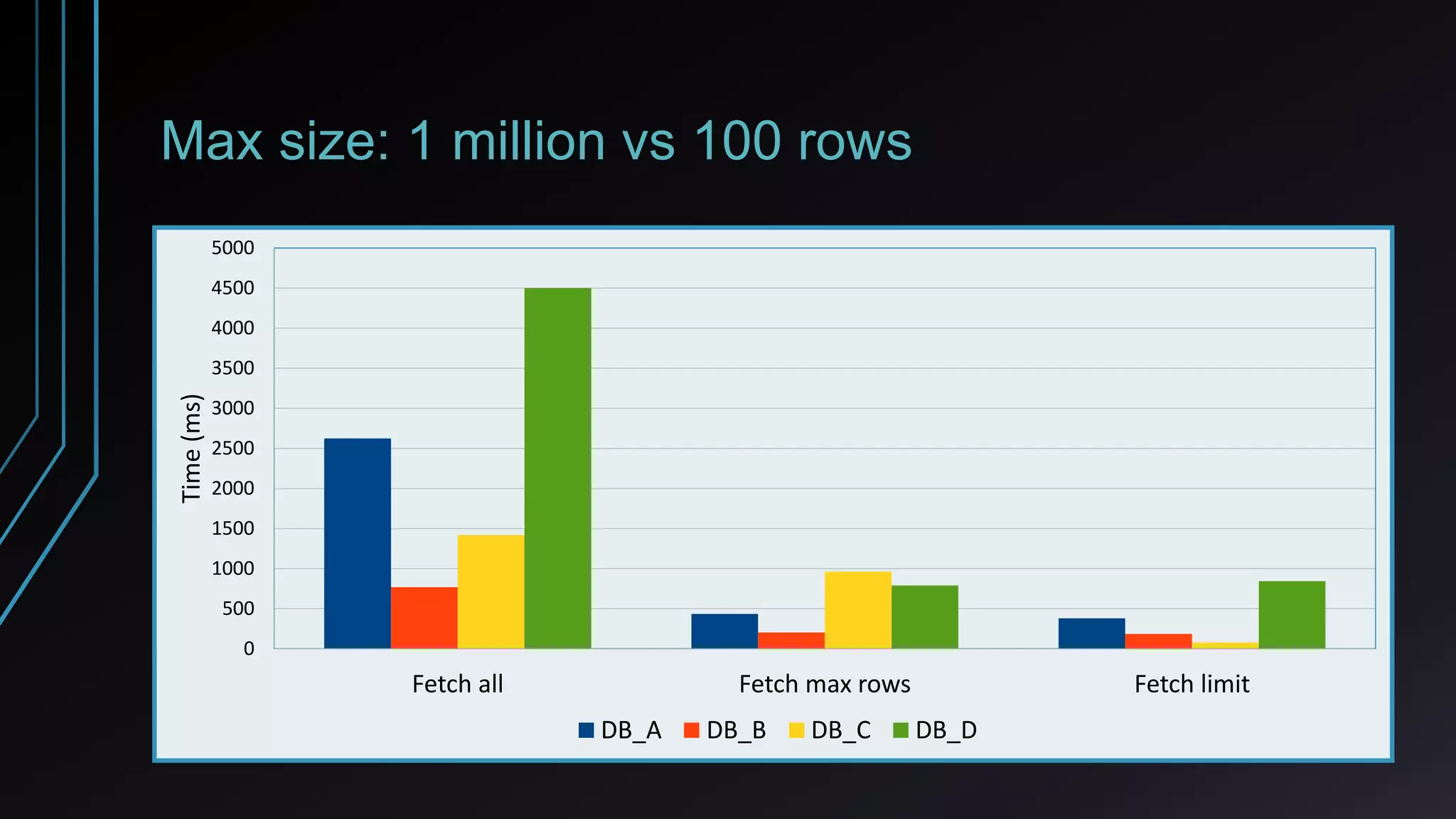
Max size: 1 million vs 100 rows
Fetch all Fetch max rows Fetch limit
0
500
1000
1500
2000
2500
3000
3500
4000
4500
5000
Time(ms)
DB_A DB_B DB_C DB_D
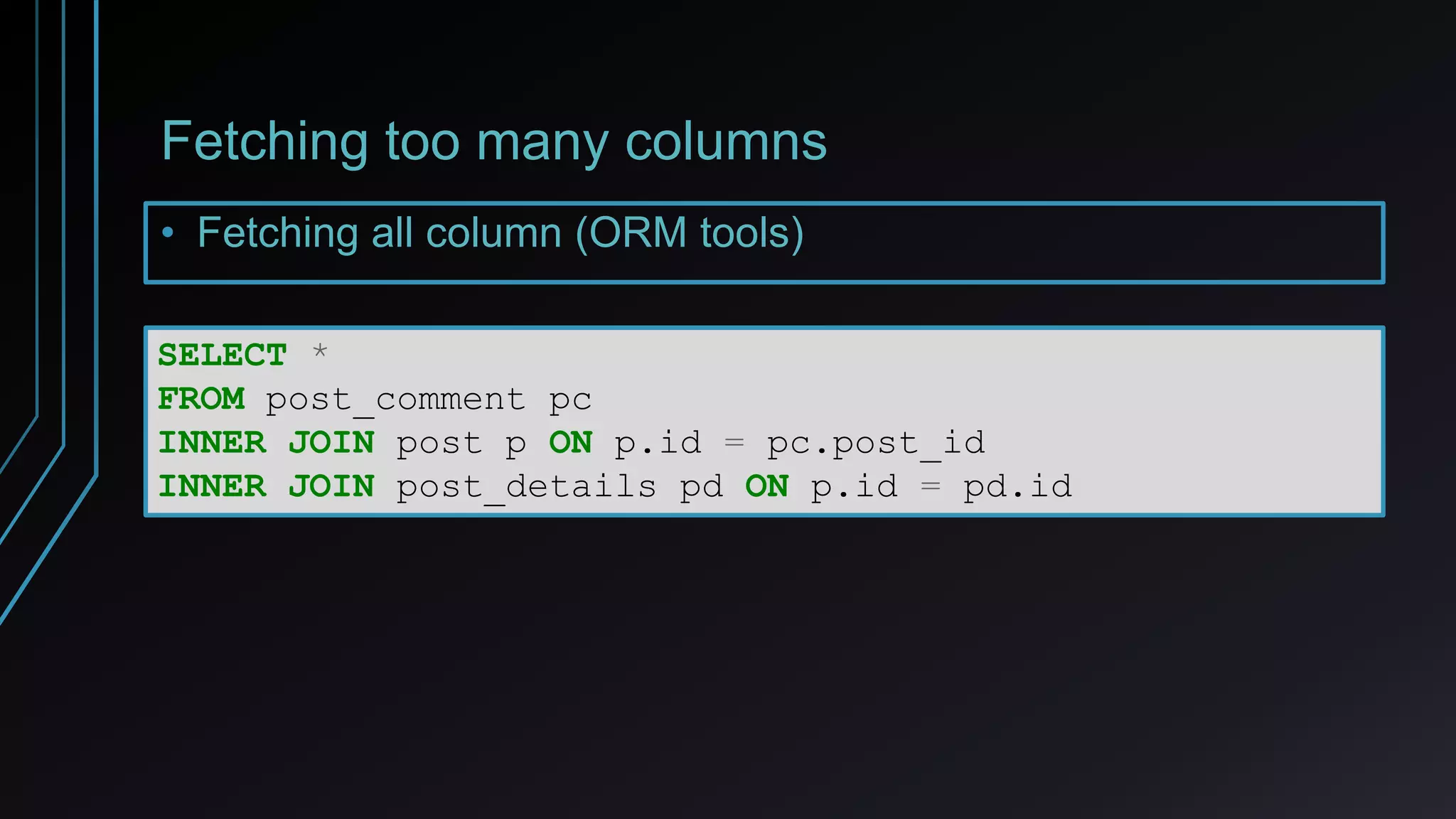
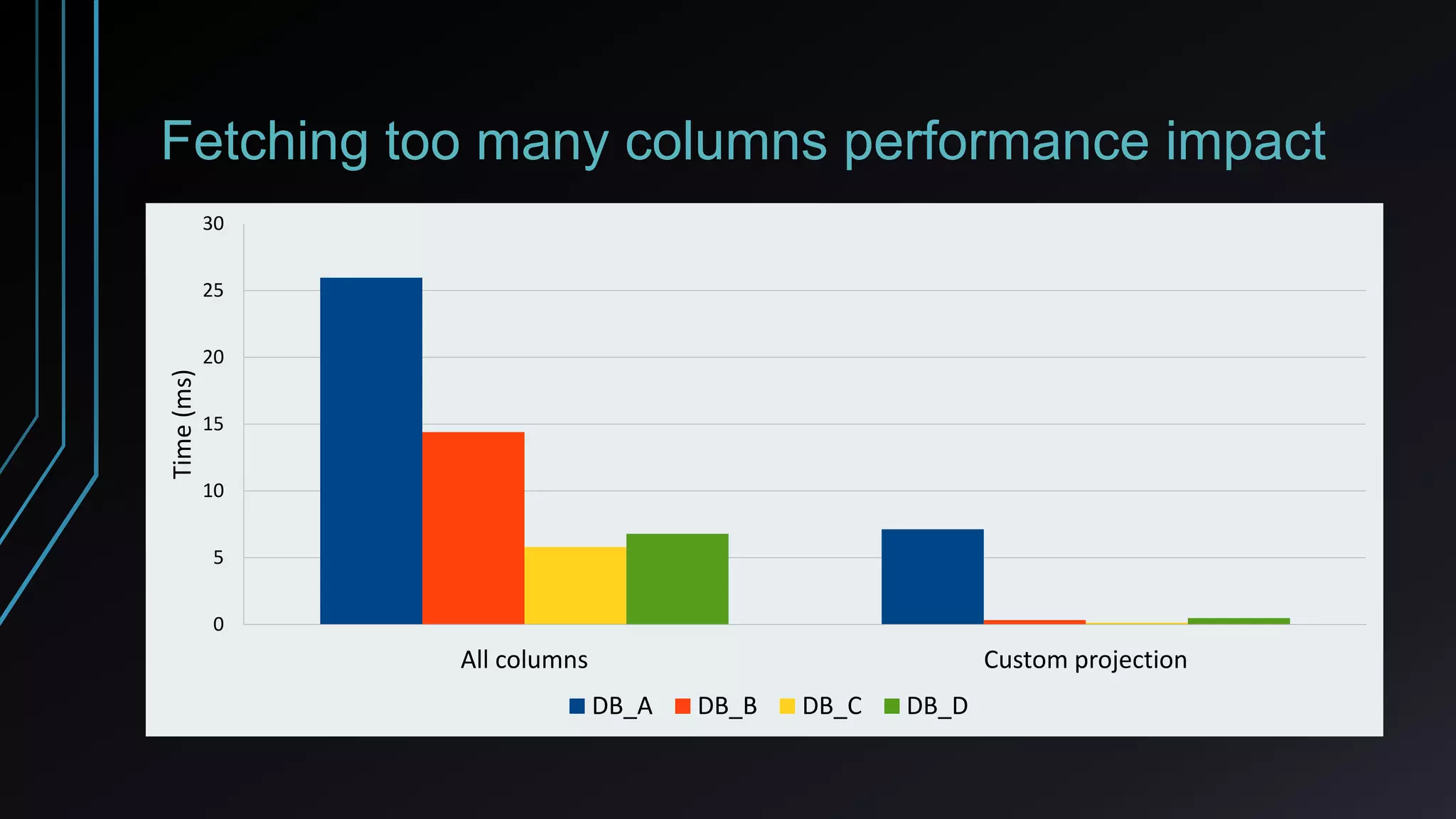
Fetching too many columns
• Fetching all column (ORM tools)
SELECT *
FROM post_comment pc
INNER JOIN post p ON p.id = pc.post_id
INNER JOIN post_details pd ON p.id = pd.id
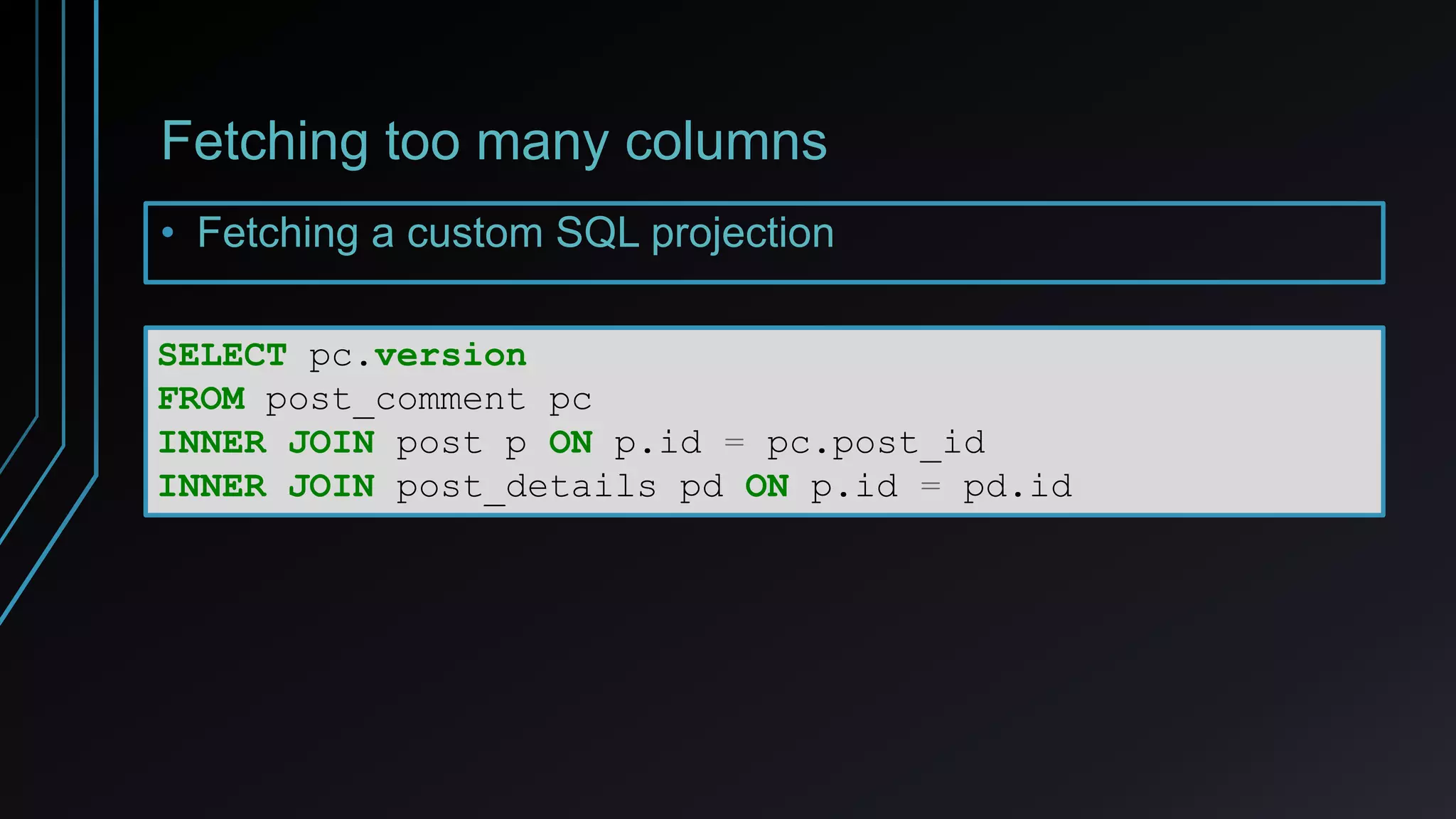
Fetching too many columns
• Fetching a custom SQL projection
SELECT pc.version
FROM post_comment pc
INNER JOIN post p ON p.id = pc.post_id
INNER JOIN post_details pd ON p.id = pd.id
Fetching too many columns performance impact
All columns Custom projection
0
5
10
15
20
25
30
Time(ms)
DB_A DB_B DB_C DB_D
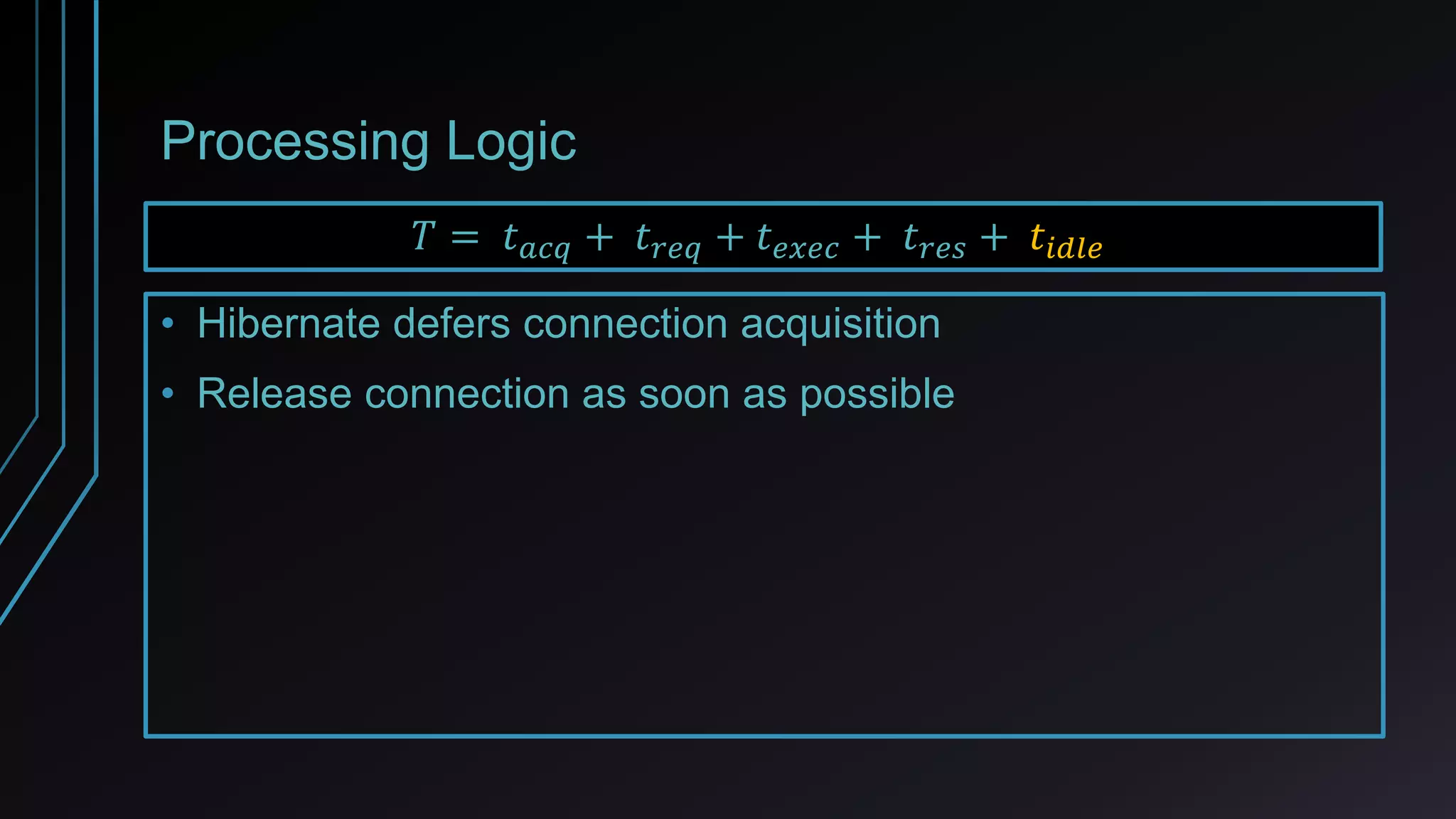
Processing Logic
• Hibernate defers connection acquisition
• Release connection as soon as possible
𝑇 = 𝑡 𝑎𝑐𝑞 + 𝑡 𝑟𝑒𝑞 + 𝑡 𝑒𝑥𝑒𝑐 + 𝑡 𝑟𝑒𝑠 + 𝑡𝑖𝑑𝑙𝑒
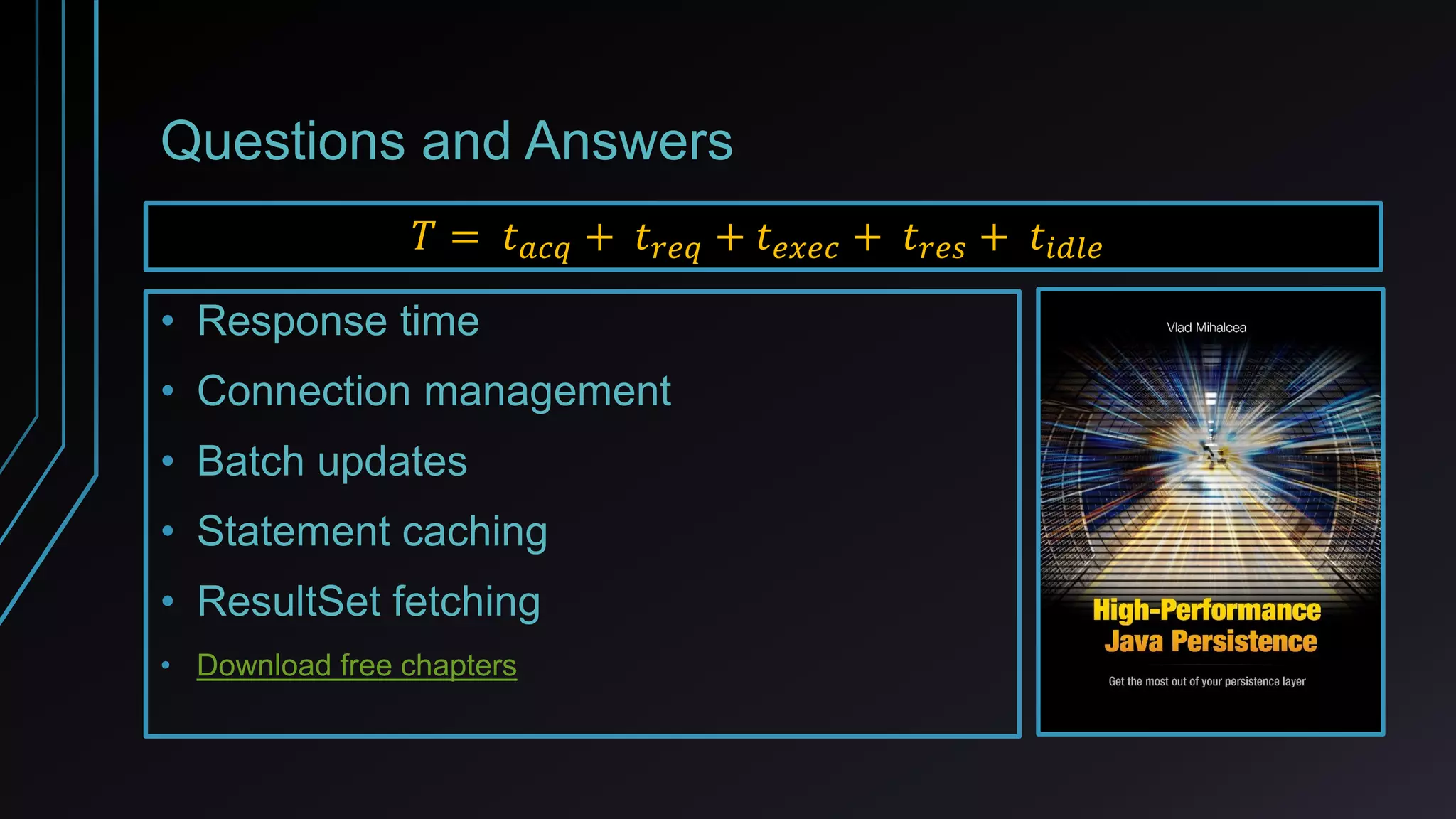
Questions and Answers
𝑇 = 𝑡 𝑎𝑐𝑞 + 𝑡 𝑟𝑒𝑞 + 𝑡 𝑒𝑥𝑒𝑐 + 𝑡 𝑟𝑒𝑠 + 𝑡𝑖𝑑𝑙𝑒
• Response time
• Connection management
• Batch updates
• Statement caching
• ResultSet fetching
• https://leanpub.com/high-performance-java-persistence

High-Performance JDBC Voxxed Bucharest 2016

  • 1.
  • 2.
    About me • @HibernateDeveloper • vladmihalcea.com • @vlad_mihalcea • vladmihalcea
  • 3.
    Performance Facts “More thanhalf of application performance bottlenecks originate in the database” AppDynamics - http://www.appdynamics.com/database/
  • 4.
  • 5.
    Poor man’s JDBC •High response time • Low throughput Photo by Amit Patel CC BY 2.0 https://www.flickr.com/photos/amitp/6069412747/
  • 6.
    State of theart JDBC • Low response time • High throughput Photo by zoetnet CC BY 2.0 https://www.flickr.com/photos/zoetnet/14288129197/
  • 7.
    Response time • connectionacquisition time • statements submission time • statements execution time • result set fetching time • idle time prior to releasing the database connection 𝑇 = 𝑡 𝑎𝑐𝑞 + 𝑡 𝑟𝑒𝑞 + 𝑡 𝑒𝑥𝑒𝑐 + 𝑡 𝑟𝑒𝑠 + 𝑡𝑖𝑑𝑙𝑒
  • 8.
    Connection management 𝑇 =𝑡 𝑎𝑐𝑞 + 𝑡 𝑟𝑒𝑞 + 𝑡 𝑒𝑥𝑒𝑐 + 𝑡 𝑟𝑒𝑠 + 𝑡𝑖𝑑𝑙𝑒
  • 9.
    Connection acquisition overhead MetricDB_A (ms) DB_B (ms) DB_C (ms) DB_D (ms) HikariCP (ms) min 11.174 5.441 24.468 0.860 0.001230 max 129.400 26.110 74.634 74.313 1.014051 mean 13.829 6.477 28.910 1.590 0.003458 p99 20.432 9.944 54.952 3.022 0.010263
  • 10.
    Connection pooling • Logicalvs physical connections • Lease vs create • Release vs close
  • 11.
  • 12.
    FlexyPool • Java EE •Bitronix / Atomikos • Apache DBCP / DBCP2 • C3P0 • HikariCP • Tomcat CP • Vibur DBCP https://github.com/vladmihalcea/flexy-pool
  • 13.
    FlexyPool • concurrent connectionshistogram • concurrent connection requests histogram • connection acquisition time histogram • connection lease time histogram • maximum pool size histogram • retry attempts histogram https://github.com/vladmihalcea/flexy-pool
  • 14.
    FlexyPool – Concurrentconnection requests 1 28 55 82 109 136 163 190 217 244 271 298 325 352 379 406 433 460 487 514 541 568 595 622 649 676 703 730 757 784 811 838 865 892 919 946 973 1000 1027 0 2 4 6 8 10 12 Sample time (Index × 15s) Connectionrequests max mean p50 p95 p99
  • 15.
    FlexyPool – Poolsize growth 1 28 55 82 109 136 163 190 217 244 271 298 325 352 379 406 433 460 487 514 541 568 595 622 649 676 703 730 757 784 811 838 865 892 919 946 973 1000 1027 0 1 2 3 4 5 6 Sample time (Index × 15s) Maxpoolsize max mean p50 p95 p99
  • 16.
    FlexyPool – Connectionacquisition time 1 28 55 82 109 136 163 190 217 244 271 298 325 352 379 406 433 460 487 514 541 568 595 622 649 676 703 730 757 784 811 838 865 892 919 946 973 1000 1027 0 500 1000 1500 2000 2500 3000 3500 Sample time (Index × 15s) Connectionacquisitiontime(ms) max mean p50 p95 p99
  • 17.
    FlexyPool – Connectionlease time 1 29 57 85 113 141 169 197 225 253 281 309 337 365 393 421 449 477 505 533 561 589 617 645 673 701 729 757 785 813 841 869 897 925 953 981 1009 1037 0 5000 10000 15000 20000 25000 30000 35000 40000 Sample time (Index × 15s) Connectionleasetime(ms) max mean p50 p95 p99
  • 18.
    Statement Batching statement.addBatch( "INSERT INTOpost "(title, version, id) " + "VALUES ('Post no. 1', 0, 1)"); statement.addBatch( "INSERT INTO post_comment (post_id, review, version, id) " + "VALUES (1, 'Post comment 1.1', 0, 1)"); int[] updateCounts = statement.executeBatch(); 𝑇 = 𝑡 𝑎𝑐𝑞 + 𝑡 𝑟𝑒𝑞 + 𝑡 𝑒𝑥𝑒𝑐 + 𝑡 𝑟𝑒𝑠 + 𝑡𝑖𝑑𝑙𝑒
  • 19.
    Statement Batching (5krows) 1 10 20 30 40 50 60 70 80 90 100 1000 0 500 1000 1500 2000 2500 Batch size Time(ms) DB_A DB_B DB_C DB_D
  • 20.
    Oracle Statement batching •For Statement and CallableStatement, the Oracle JDBC Driver doesn’t actually support batching, each statement being executed separately.
  • 21.
    MySQL Statement batching •By default, the MySQL JDBC driver doesn’t send the batched statements in a single request. • The rewriteBatchedStatements connection property adds all batched statements to a String buffer.
  • 22.
    Batch PreparedStatements PreparedStatement postStatement= connection.prepareStatement( "INSERT INTO Post (title, version, id) VALUES (?, ?, ?)"); postStatement.setString(1, String.format("Post no. %1$d", 1)); postStatement.setInt(2, 0); postStatement.setLong(3, 1); postStatement.addBatch(); postStatement.setString(1, String.format("Post no. %1$d", 2)); postStatement.setInt(2, 0); postStatement.setLong(3, 2); postStatement.addBatch(); int[] updateCounts = postStatement.executeBatch();
  • 23.
    Batch PreparedStatements • SQLInjection Prevention • Better performance • Hibernate can batch statements automatically
  • 24.
    Insert PreparedStatement batching(5k rows) 1 10 20 30 40 50 60 70 80 90 100 1000 0 200 400 600 800 1000 1200 1400 1600 Batch size Time(ms) DB_A DB_B DB_C DB_D
  • 25.
    Update PreparedStatement batching(5k rows) 1 10 20 30 40 50 60 70 80 90 100 1000 0 100 200 300 400 500 600 700 Batch size Time(ms) DB_A DB_B DB_C DB_D
  • 26.
    Delete PreparedStatement batching(5k rows) 1 10 20 30 40 50 60 70 80 90 100 1000 0 200 400 600 800 1000 1200 Batch size Time(ms) DB_A DB_B DB_C DB_D
  • 27.
    Statement caching 𝑇 =𝑡 𝑎𝑐𝑞 + 𝑡 𝑟𝑒𝑞 + 𝑡 𝑒𝑥𝑒𝑐 + 𝑡 𝑟𝑒𝑠 + 𝑡𝑖𝑑𝑙𝑒
  • 28.
    Statement caching gain(one minute interval) Database System No Caching Throughput (SPM) Caching Throughput (SPM) Percentage Gain DB_A 419 833 507 286 20.83% DB_B 194 837 303 100 55.56% DB_C 116 708 166 443 42.61% DB_D 15 522 15 550 0.18%
  • 29.
    Oracle server-side statementcaching • Hard parse • Soft parse • Bind peeking • Adaptive cursor sharing (since 11g)
  • 30.
    SQL Server server-sidestatement caching • Execution plan cache • Parameter sniffing • Force recompile SELECT * FROM task WHERE status = ? OPTION(RECOMPILE);
  • 31.
    PostgreSQL server-side statementcaching • Prior to 9.2 – execution plan caching • 9.2 – optimization and planning are deferred • The prepareThreshold connection property
  • 32.
    MySQL server-side statementcaching • No execution plan cache • Since Connector/J 5.0.5 PreparedStatements are only emulated • To activate server-side prepared statements: • useServerPrepStmts • cachePrepStmts
  • 33.
    Client-side statement caching •Recycling Statement, PreparedStatement or CallableStatement objects • Reusing database cursors
  • 34.
    Oracle implicit client-sidestatement caching • Connection-level cache • PreparedStatement and CallabledStatement only connectionProperties.put( "oracle.jdbc.implicitStatementCacheSize", Integer.toString(cacheSize) ); dataSource.setConnectionProperties( connectionProperties );
  • 35.
    Oracle implicit client-sidestatement caching • Can be disabled on a per statement basis if (statement.isPoolable()) { statement.setPoolable(false); }
  • 36.
    Oracle explicit client-sidestatement caching • Caches both metadata and execution state with data OracleConnection oracleConnection = (OracleConnection) connection; oracleConnection.setExplicitCachingEnabled(true); oracleConnection.setStatementCacheSize(cacheSize);
  • 37.
    Oracle explicit client-sidestatement caching • Vendor-specific API PreparedStatement statement = oracleConnection. getStatementWithKey(SELECT_POST_KEY); if (statement == null) statement = connection.prepareStatement(SELECT_POST); try { statement.setInt(1, 10); statement.execute(); } finally { ((OraclePreparedStatement) statement). closeWithKey(SELECT_POST_KEY); }
  • 38.
    SQL Server client-sidestatement caching • Microsoft JDBC Driver 4.2 disableStatementPooling • jTDS 1.3.1 – JDBC 3.0 JtdsDataSource jdtsDataSource = (JtdsDataSource) dataSource; jdtsDataSource.setMaxStatements(cacheSize);
  • 39.
    PostgreSQL Server client-sidestatement caching • PostgreSQL JDBC Driver 9.4-1202 makes client-side statement connection-bound instead of statement-bound • Configurable: • preparedStatementCacheQueries (default is 256) • preparedStatementCacheSizeMiB (default is 5MB) • Statement.setPoolable(false) is not supported
  • 40.
    MySQL Server client-sidestatement caching • Configurable: • cachePrepStmts (default is false) Required for server-side statement caching as well • prepStmtCacheSize (default is 25) • prepStmtCacheSqlLimit (default is 256) • Statement.setPoolable(false) works for client-side statements only
  • 41.
    ResultSet fetch size •ResultSet - application-level cursor 𝑇 = 𝑡 𝑎𝑐𝑞 + 𝑡 𝑟𝑒𝑞 + 𝑡 𝑒𝑥𝑒𝑐 + 𝑡 𝑟𝑒𝑠 + 𝑡𝑖𝑑𝑙𝑒 statement.setFetchSize(fetchSize);
  • 42.
    Oracle ResultSet fetchsize • Default fetch size is 10 • Oracle 10i and 11g JDBC Driver maximum ResultSet size memory preallocation • VARCHAR2(4000) – allocates 8000 bytes (even for 1 character) • Memory buffers are recycled only when using Statement caching • Oracle 12c allocates memory on demand • VARCHAR2(4000) – 15 bytes + the actual row column size
  • 43.
    SQL Server ResultSetfetch size • Adaptive buffering • Only for the default read-only and forward-only ResultSet • Updatable cursors use fixed data blocks
  • 44.
    PostgreSQL ResultSet fetchsize • Fetch all – one database roundtrip • Custom fetch size – database cursor
  • 45.
    MySQL ResultSet fetchsize • Fetch all – one database roundtrip • Streaming – only one record at a time
  • 46.
    ResultSet fetch size(10k rows) 1 10 100 1000 10000 0 100 200 300 400 500 600 Fetch size Time(ms) DB_A DB_B DB_C DB_D
  • 47.
    ResultSet size • Avoidfetching data that is not required • Hibernate addresses the max-size vendor-specific SQL statement syntax
  • 48.
    SQL:2008 ResultSet sizelimit • Oracle 12c, SQL Server 2012 and PostgreSQL 8.4 SELECT pc.id AS pc_id, p.title AS p_title FROM post_comment pc INNER JOIN post p ON p.id = pc.post_id ORDER BY pc_id OFFSET ? ROWS FETCH FIRST (?) ROWS ONLY;
  • 49.
    Oracle ResultSet sizelimit SELECT * FROM ( SELECT pc.id AS pc_id, p.title AS p_title FROM post_comment pc INNER JOIN post p ON p.id = pc.post_id ORDER BY pc_id ) WHERE ROWNUM <= ?
  • 50.
    SQL Server ResultSetsize limit SELECT TOP (?) pc.id AS pc_id, p.title AS p_title FROM post_comment pc INNER JOIN post p ON p.id = pc.post_id ORDER BY pc_id
  • 51.
    PostgreSQL and MySQLResultSet size limit SELECT pc.id AS pc_id, p.title AS p_title FROM post_comment pc INNER JOIN post p ON p.id = pc.post_id ORDER BY pc_id LIMIT ?
  • 52.
    Statement max rows •Vendor-independent syntax • Might not influence the execution plan • According to the documentation: “If the limit is exceeded, the excess rows are silently dropped.” statement.setMaxRows(maxRows);
  • 53.
    Max size: 1million vs 100 rows Fetch all Fetch max rows Fetch limit 0 500 1000 1500 2000 2500 3000 3500 4000 4500 5000 Time(ms) DB_A DB_B DB_C DB_D
  • 54.
    Fetching too manycolumns • Fetching all column (ORM tools) SELECT * FROM post_comment pc INNER JOIN post p ON p.id = pc.post_id INNER JOIN post_details pd ON p.id = pd.id
  • 55.
    Fetching too manycolumns • Fetching a custom SQL projection SELECT pc.version FROM post_comment pc INNER JOIN post p ON p.id = pc.post_id INNER JOIN post_details pd ON p.id = pd.id
  • 56.
    Fetching too manycolumns performance impact All columns Custom projection 0 5 10 15 20 25 30 Time(ms) DB_A DB_B DB_C DB_D
  • 57.
    Processing Logic • Hibernatedefers connection acquisition • Release connection as soon as possible 𝑇 = 𝑡 𝑎𝑐𝑞 + 𝑡 𝑟𝑒𝑞 + 𝑡 𝑒𝑥𝑒𝑐 + 𝑡 𝑟𝑒𝑠 + 𝑡𝑖𝑑𝑙𝑒
  • 58.
    Questions and Answers 𝑇= 𝑡 𝑎𝑐𝑞 + 𝑡 𝑟𝑒𝑞 + 𝑡 𝑒𝑥𝑒𝑐 + 𝑡 𝑟𝑒𝑠 + 𝑡𝑖𝑑𝑙𝑒 • Response time • Connection management • Batch updates • Statement caching • ResultSet fetching • https://leanpub.com/high-performance-java-persistence