Parenting and HIV 
Lorraine Sherr 
UCL London
The Global AIDS Response phases 
“APE” 
Almost entirely 
overlooked/ 
ignored parenting 
Pitted children 
against parents 
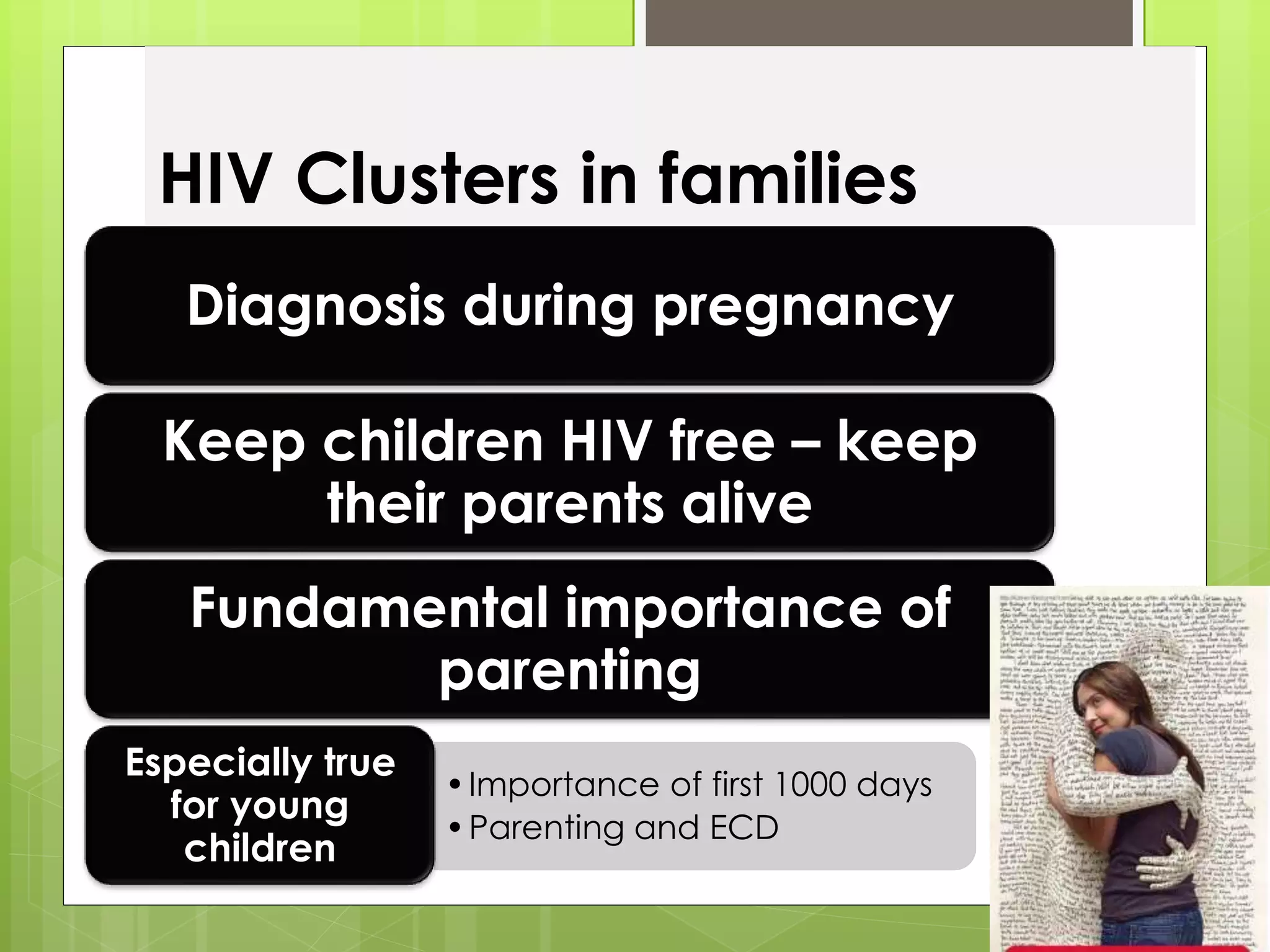
Emerging 
importance of 
parenting 
• To prevent vertical transmission 
• To care for children 
• To enhance treatment 
• For its own sake
HIV Clusters in families 
Diagnosis during pregnancy 
Keep children HIV free – keep 
their parents alive 
Fundamental importance of 
parenting 
• Importance of first 1000 days 
•Parenting and ECD 
Especially true 
for young 
children
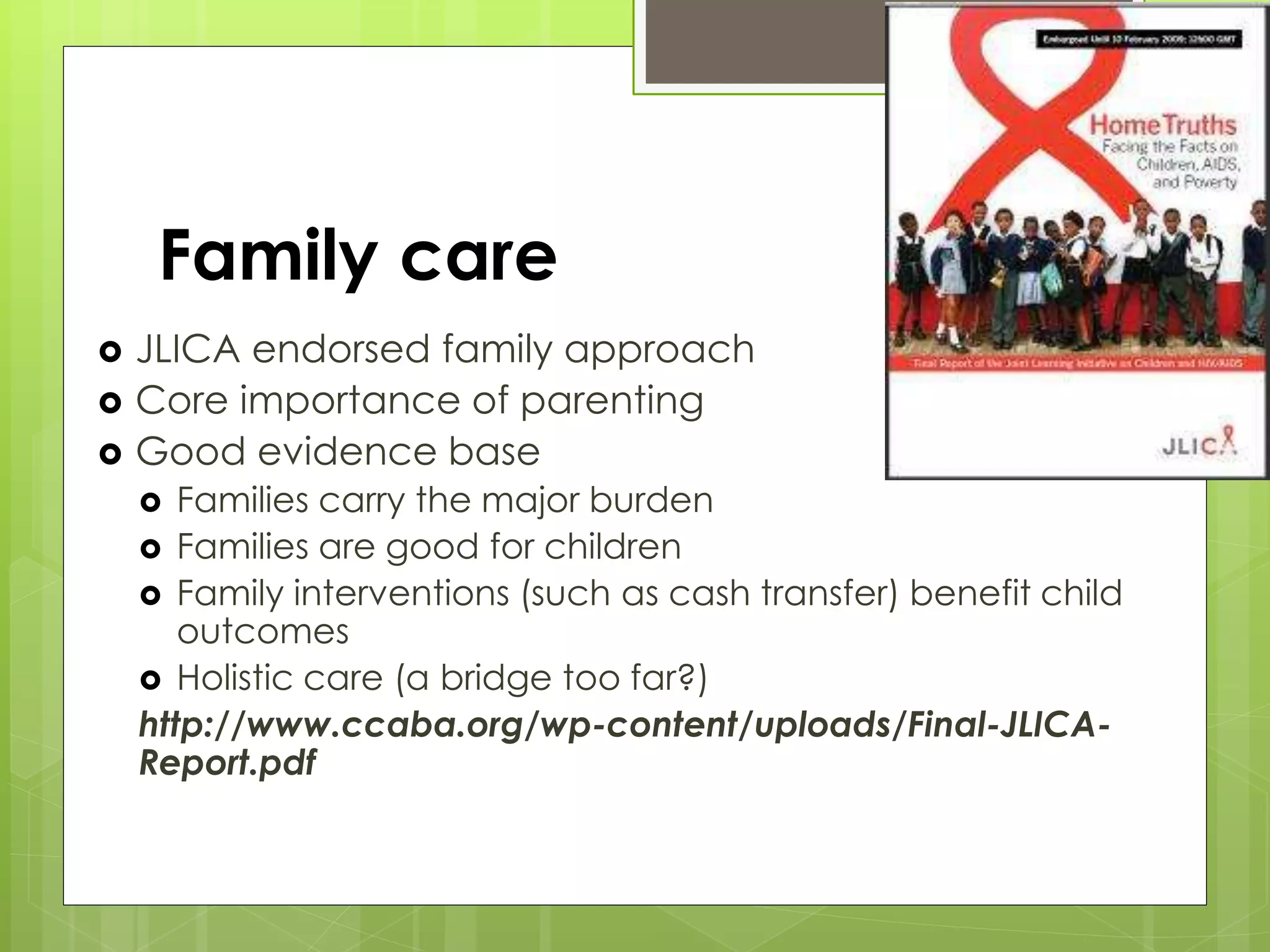
Family care 
 JLICA endorsed family approach 
 Core importance of parenting 
 Good evidence base 
 Families carry the major burden 
 Families are good for children 
 Family interventions (such as cash transfer) benefit child 
outcomes 
 Holistic care (a bridge too far?) 
http://www.ccaba.org/wp-content/uploads/Final-JLICA-Report. 
pdf
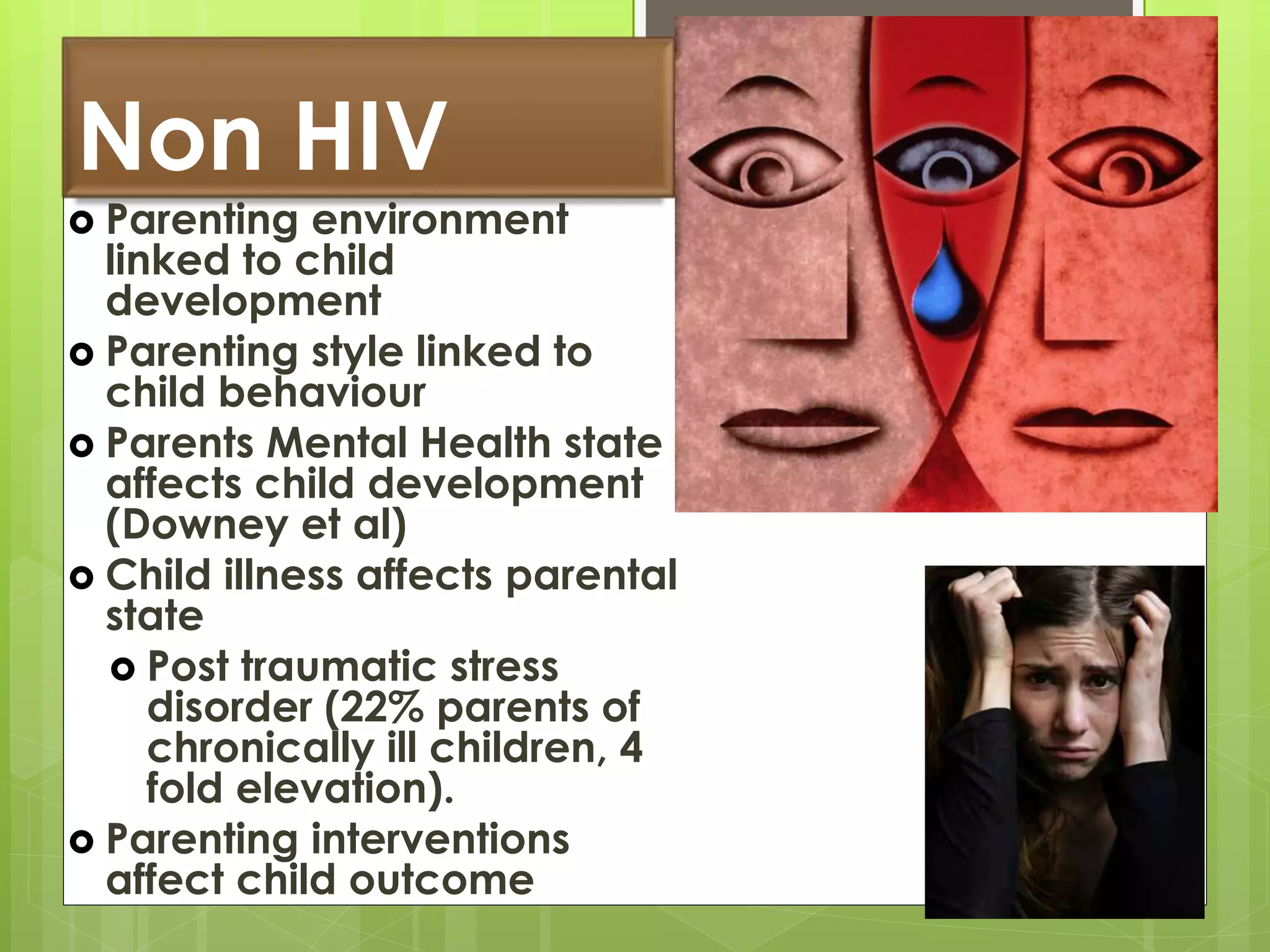
Non HIV 
 Parenting environment 
linked to child 
development 
 Parenting style linked to 
child behaviour 
 Parents Mental Health state 
affects child development 
(Downey et al) 
 Child illness affects parental 
state 
 Post traumatic stress 
disorder (22% parents of 
chronically ill children, 4 
fold elevation). 
 Parenting interventions 
affect child outcome
Quality of parenting 
 Early child development 
 Child stimulation 
 Parenting in the presence of HIV infection
Parenting Interventions can 
improve child outcomes 
 Systematic review (Gunlicks 2008) 
 Interventions to ameliorate parental 
mood can benefit child outcomes 
 Parenting (Kuo et al) 
 Mentoring 
 Physical and mental health benefits 
 Support groups 
 USAID Initiative 
 Parenting and HIV 
 Parenting 
 Modelling
HIV associated with parenting 
disruptions 
 Parental illness 
 Importance of Families 
 Mental and physical effects of HIV in 
parents 
 Parental death 
 Child caring for ill parent 
Child caring for other children 
 Parenting arrangements 
 Alternative care arrangements 
 Fathers 
 Grandparents 
 Kin 
 Parental death (Orphanhood) 
 Institutionalised care
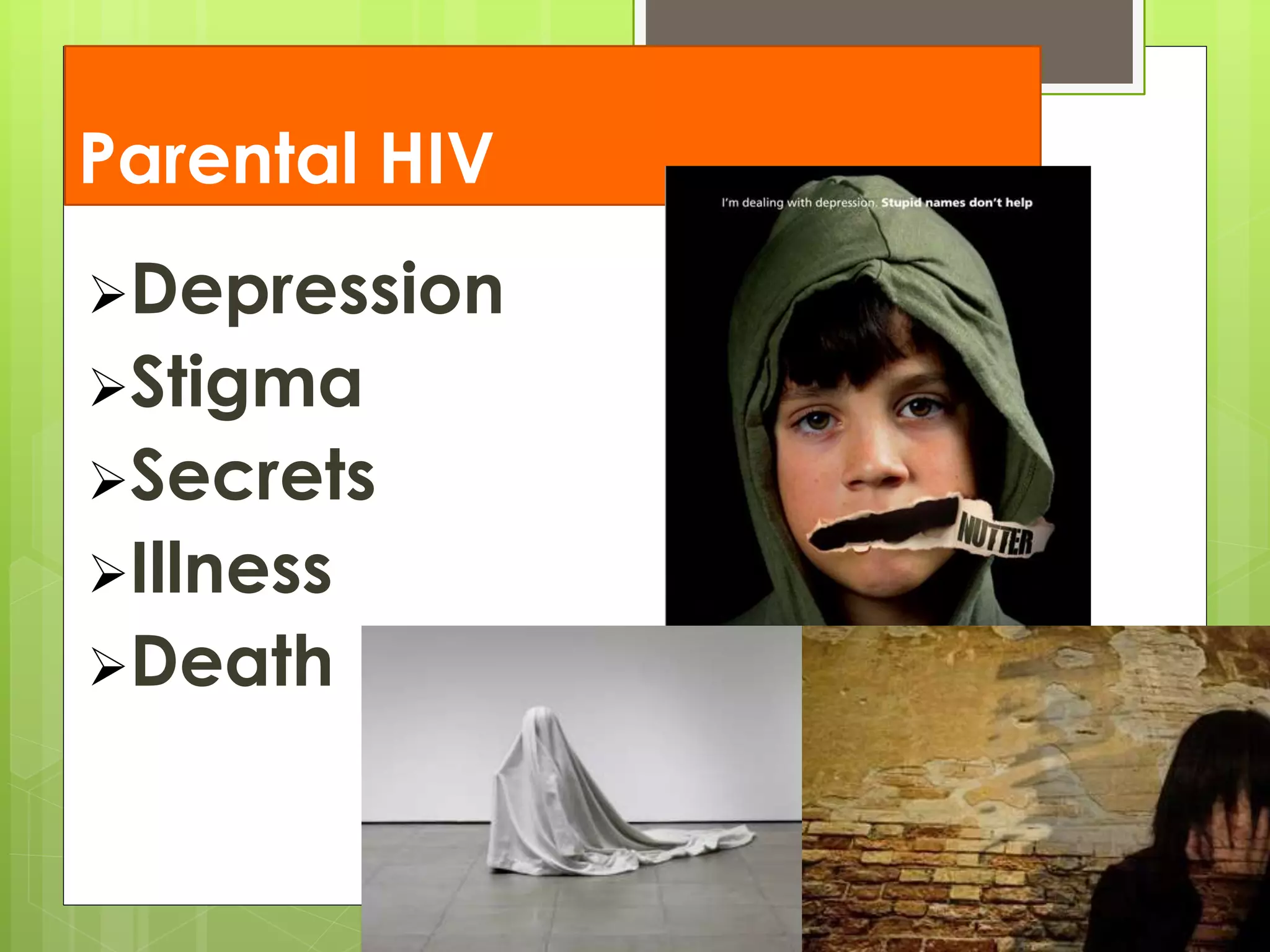
Parental HIV 
Depression 
Stigma 
Secrets 
Illness 
Death
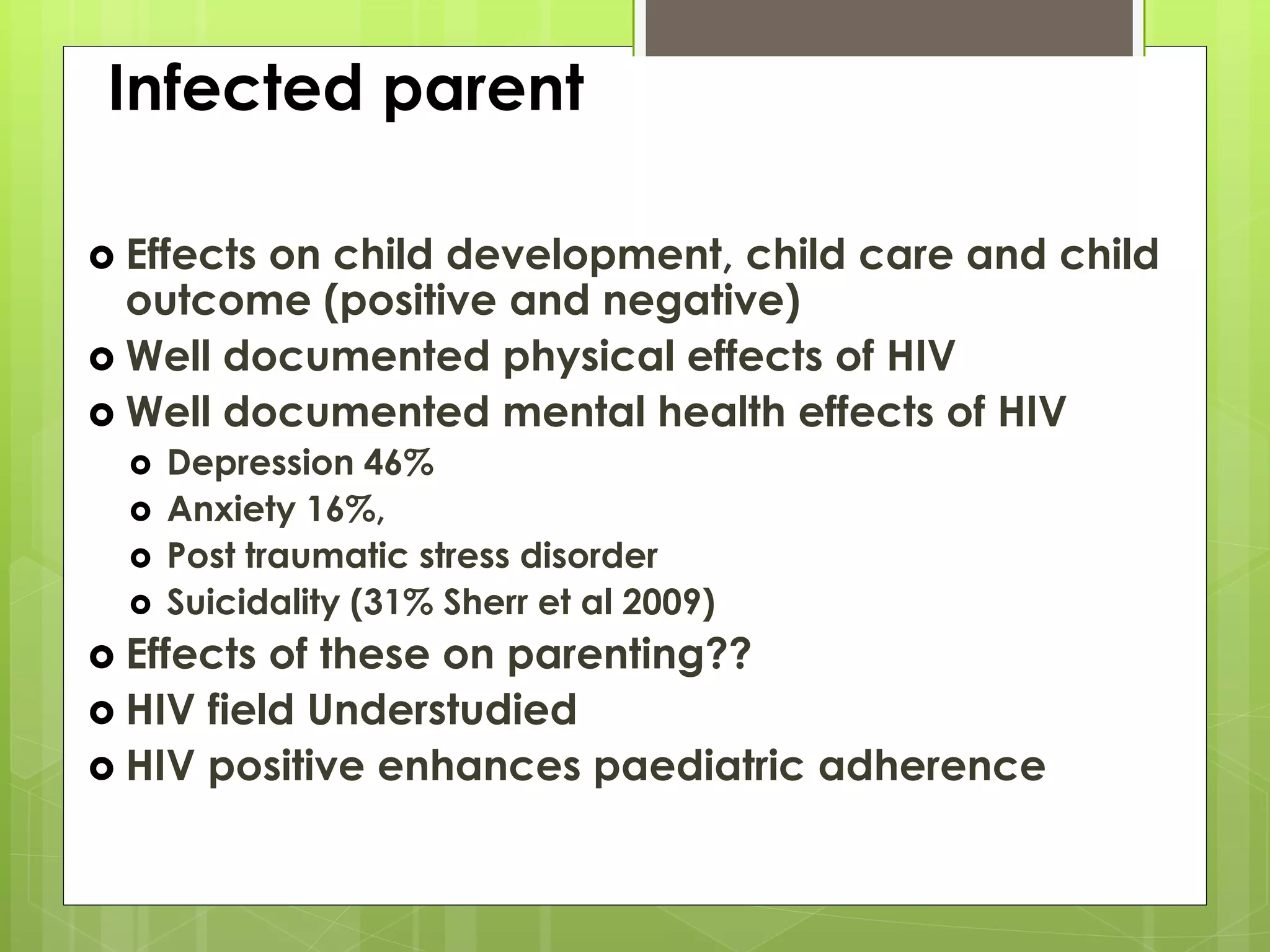
Infected parent 
 Effects on child development, child care and child 
outcome (positive and negative) 
 Well documented physical effects of HIV 
 Well documented mental health effects of HIV 
 Depression 46% 
 Anxiety 16%, 
 Post traumatic stress disorder 
 Suicidality (31% Sherr et al 2009) 
 Effects of these on parenting?? 
 HIV field Understudied 
 HIV positive enhances paediatric adherence
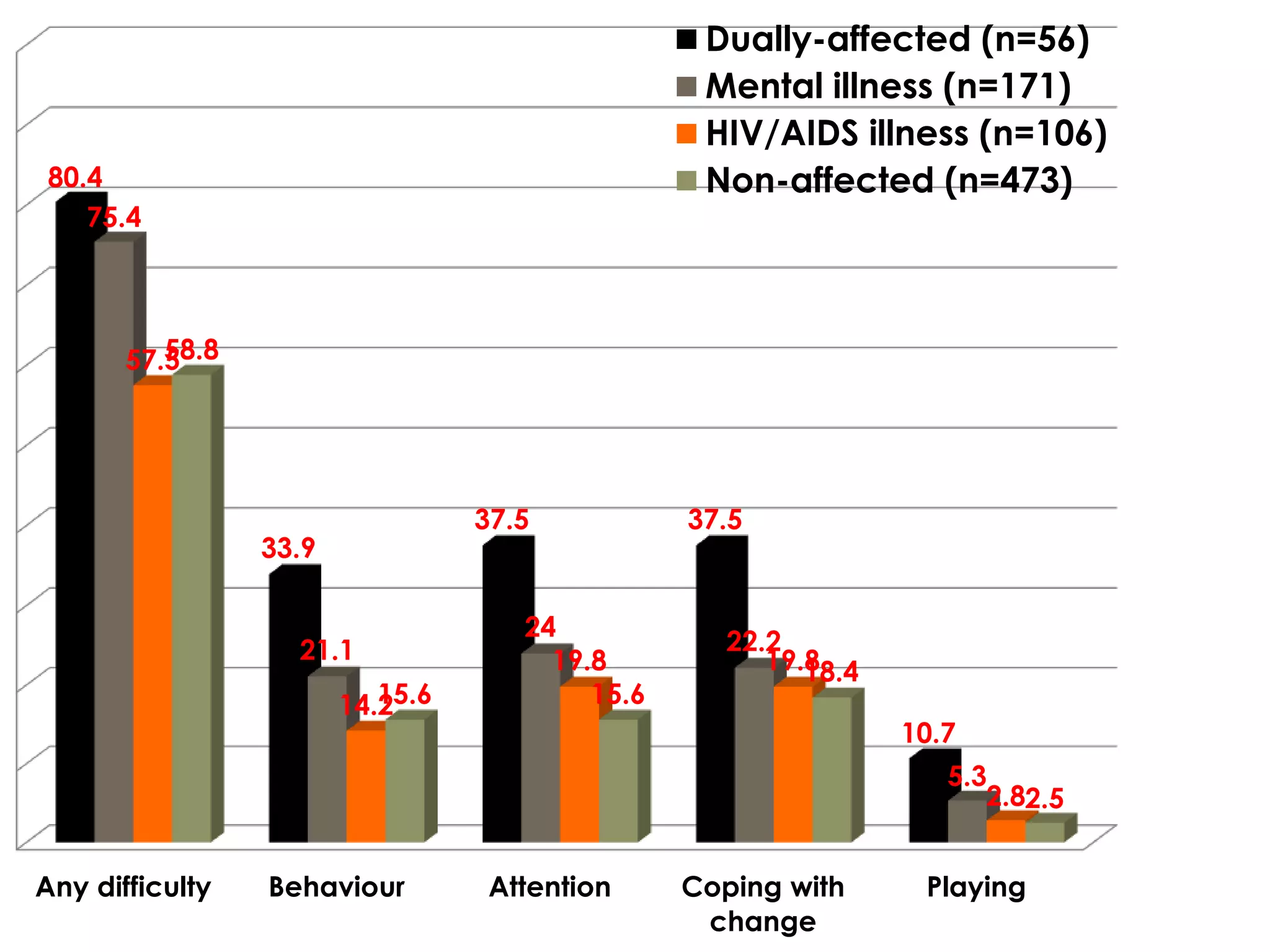
Dually-affected (n=56) 
Mental illness (n=171) 
HIV/AIDS illness (n=106) 
Non-affected (n=473) 
Any difficulty Behaviour Attention Coping with 
change 
Playing 
80.4 
33.9 
37.5 37.5 
10.7 
75.4 
21.1 
24 
22.2 
5.3 
57.5 
14.2 
19.8 19.8 
2.8 
58.8 
15.6 15.6 
18.4 
2.5
Tasks of parenting 
Feeding and nurturing 
Love attention, stimulation, 
protection and support 
Deciding an HIV free infant 
Disclosure 
Preparation for illness, treatment 
(and death)
Fascination with the unusual 
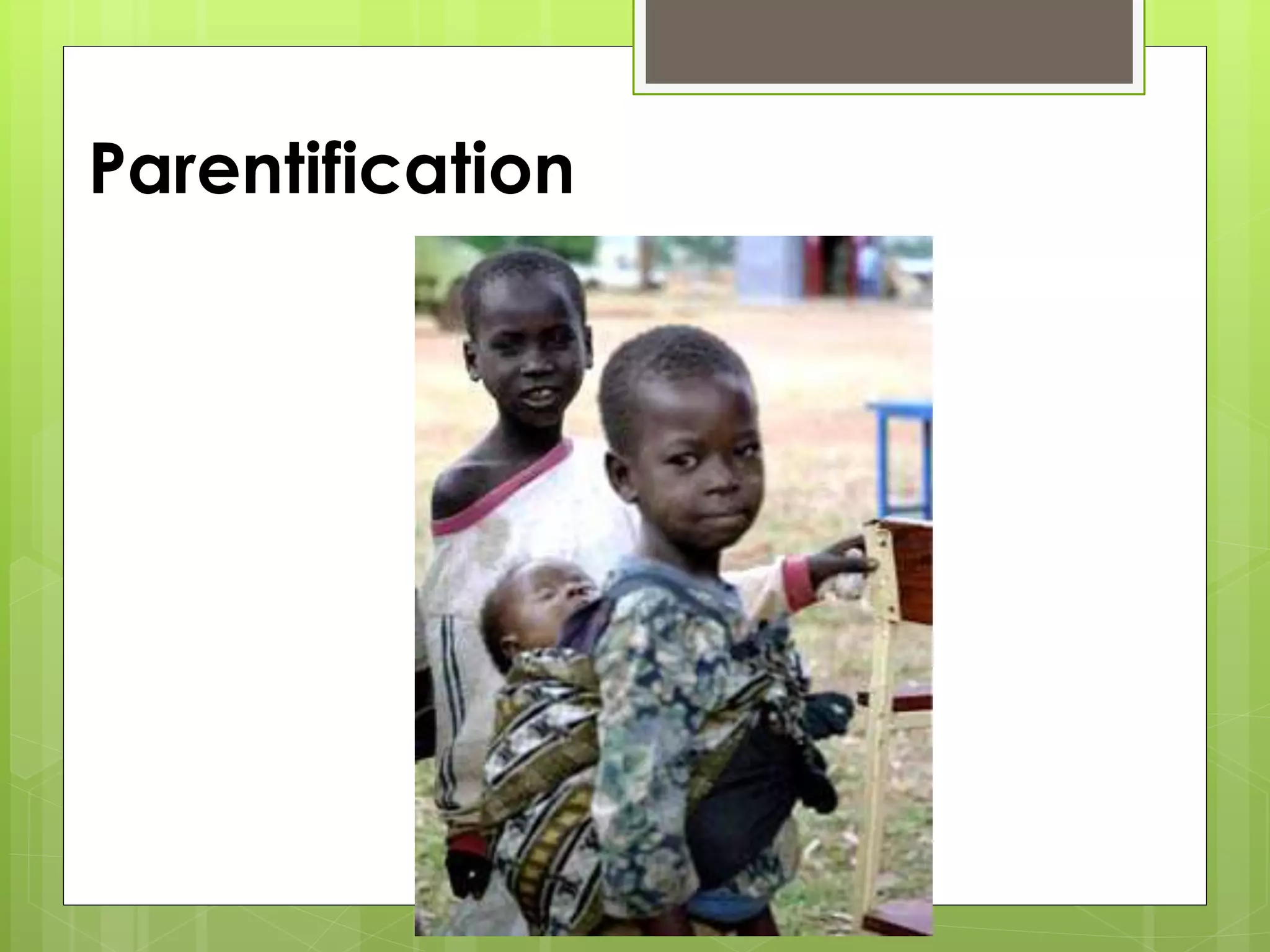
 Parentification 
 Child headed households 
 Grandparent headed households 
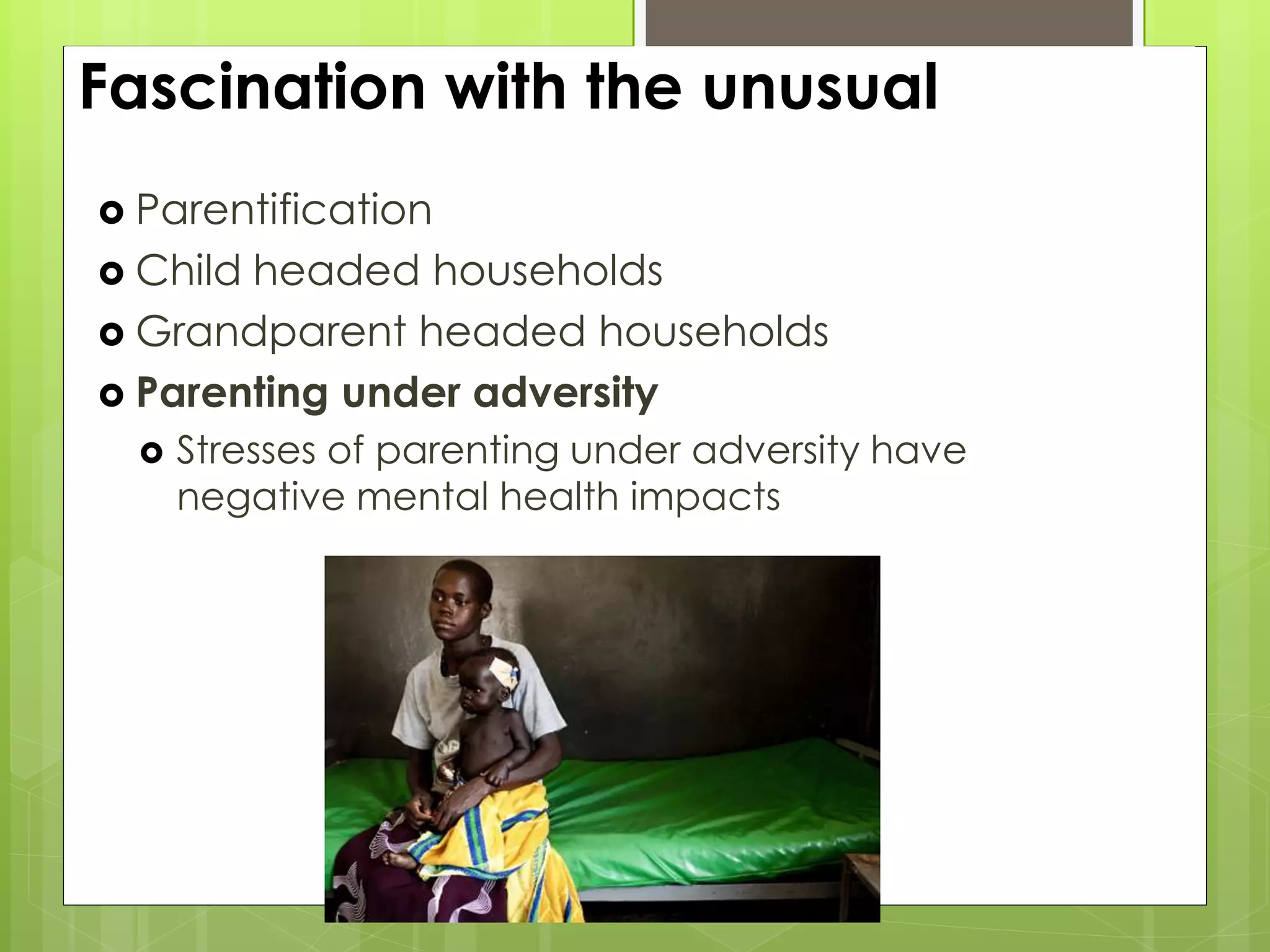
 Parenting under adversity 
 Stresses of parenting under adversity have 
negative mental health impacts
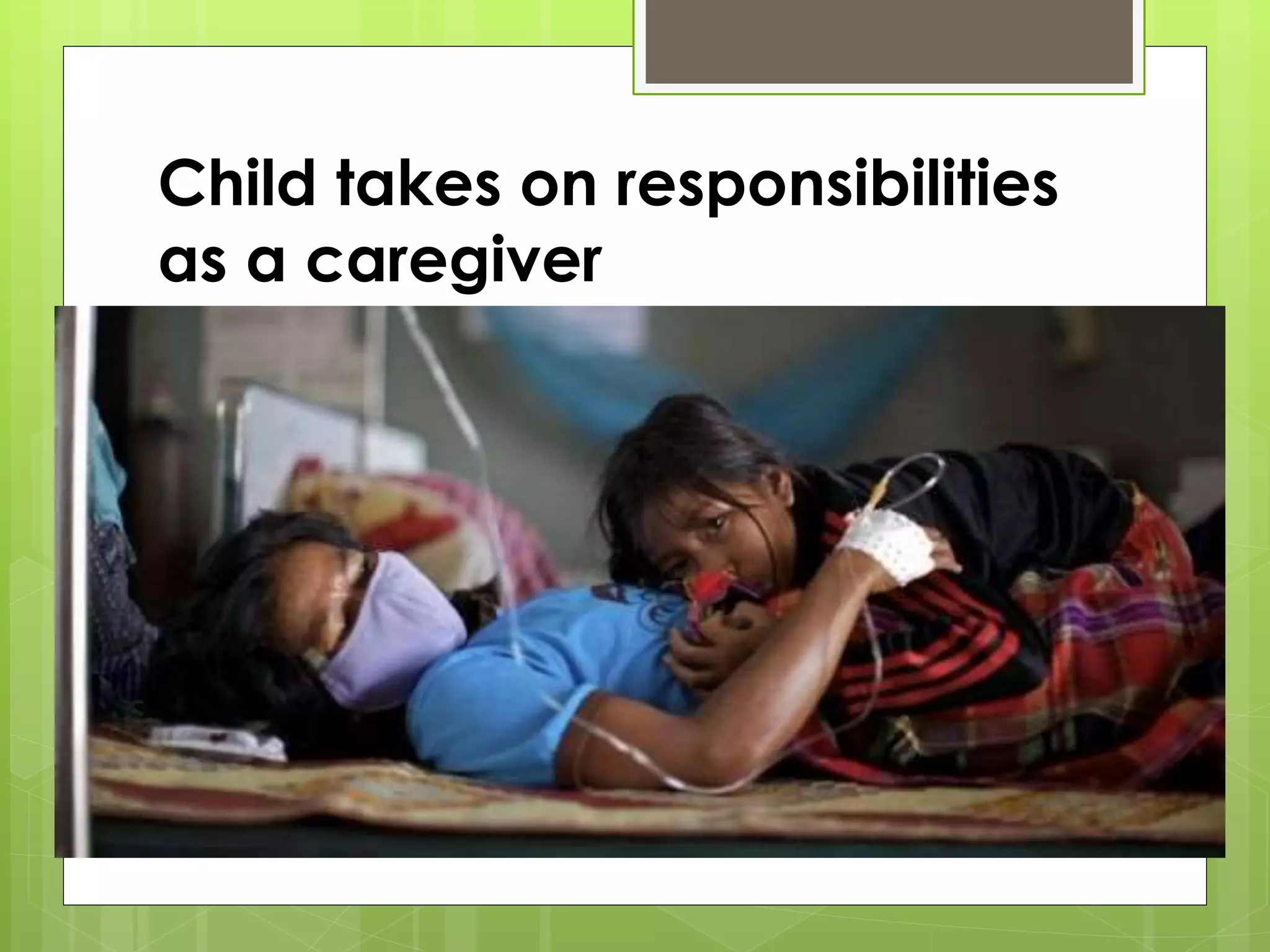
Child takes on responsibilities 
as a caregiver
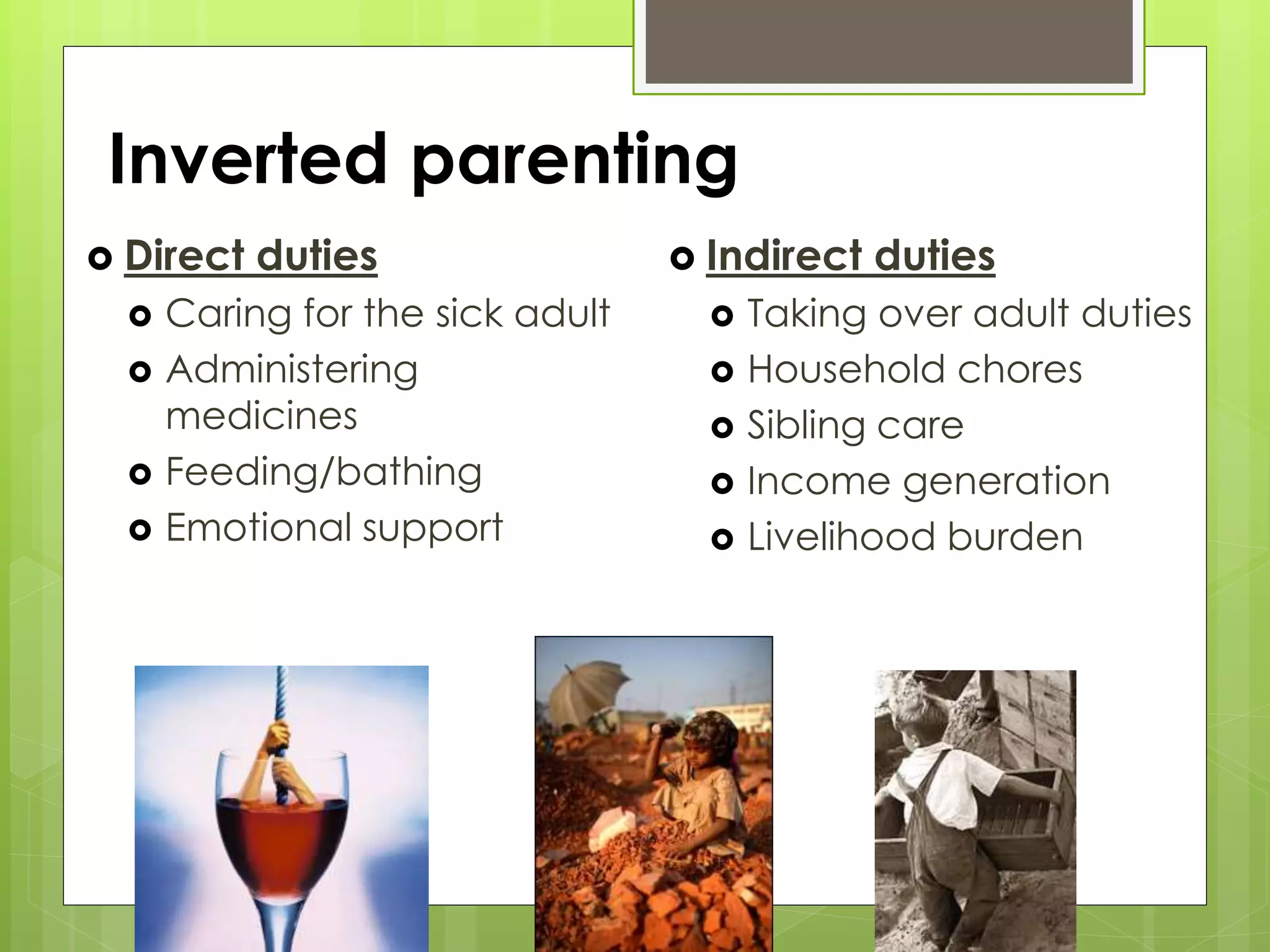
Inverted parenting 
 Direct duties 
 Caring for the sick adult 
 Administering 
medicines 
 Feeding/bathing 
 Emotional support 
 Indirect duties 
 Taking over adult duties 
 Household chores 
 Sibling care 
 Income generation 
 Livelihood burden
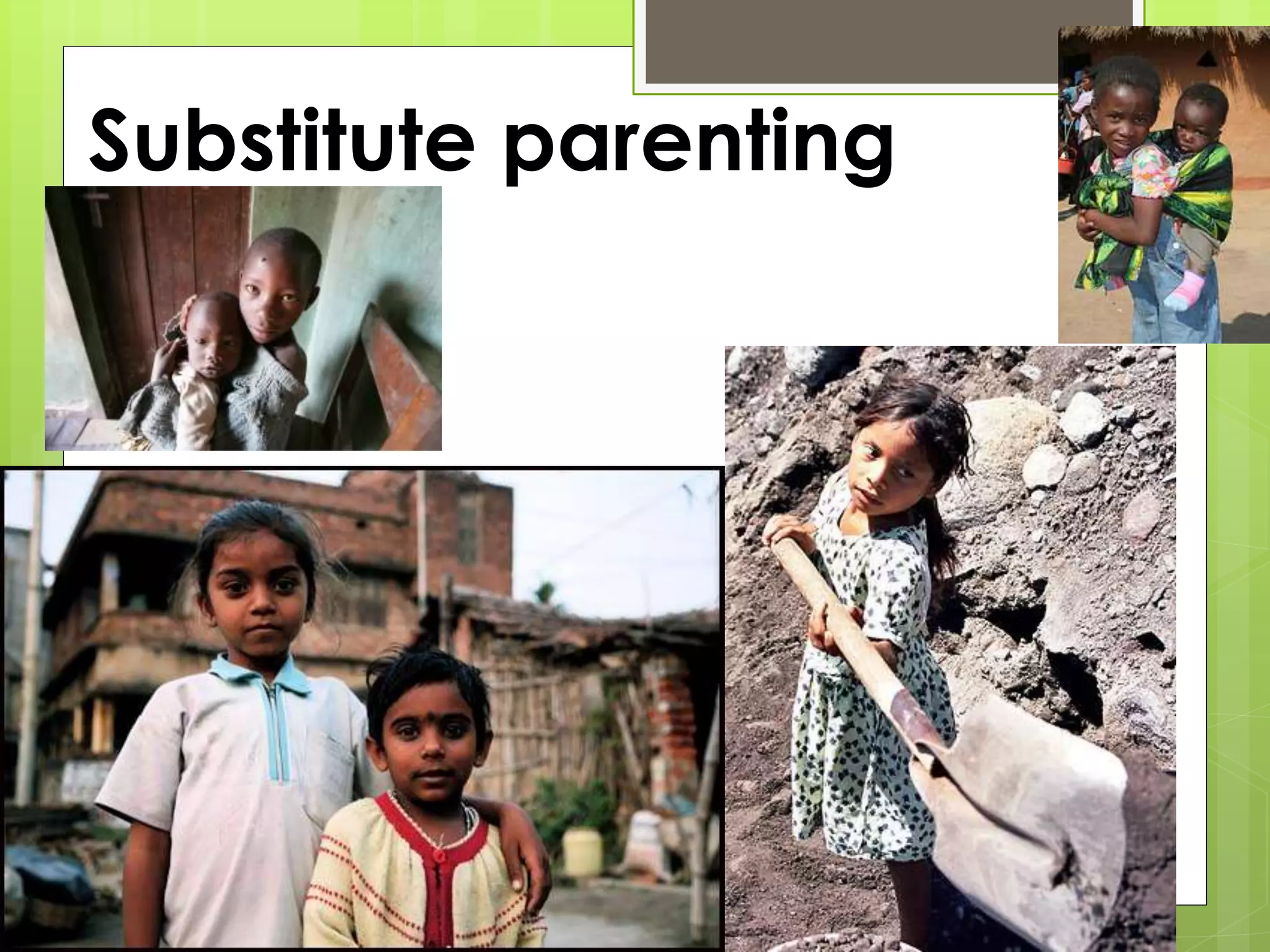
Substitute parenting
Parentification
Alternative parenting arrangements 
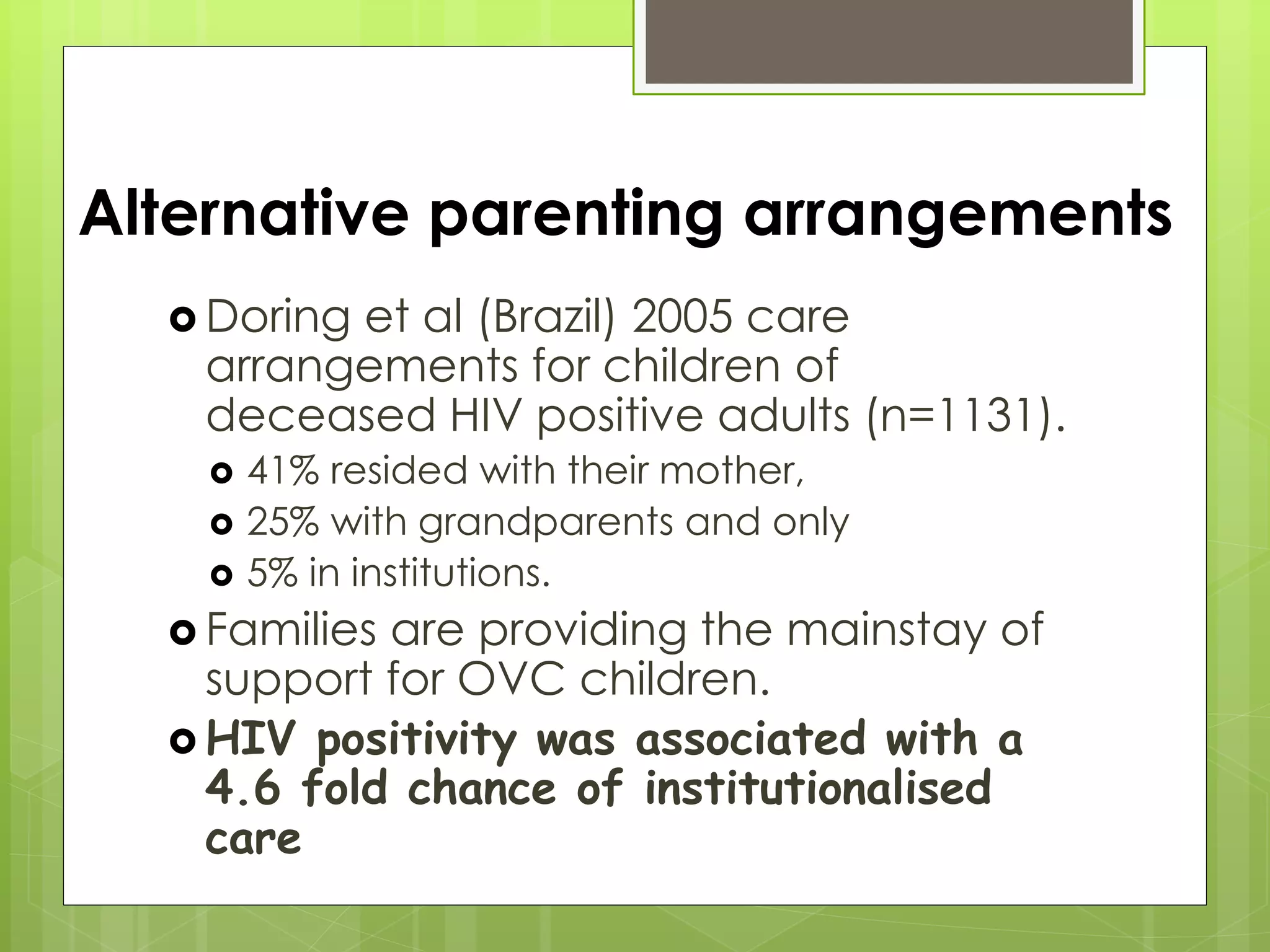
 Doring et al (Brazil) 2005 care 
arrangements for children of 
deceased HIV positive adults (n=1131). 
 41% resided with their mother, 
 25% with grandparents and only 
 5% in institutions. 
 Families are providing the mainstay of 
support for OVC children. 
HIV positivity was associated with a 
4.6 fold chance of institutionalised 
care
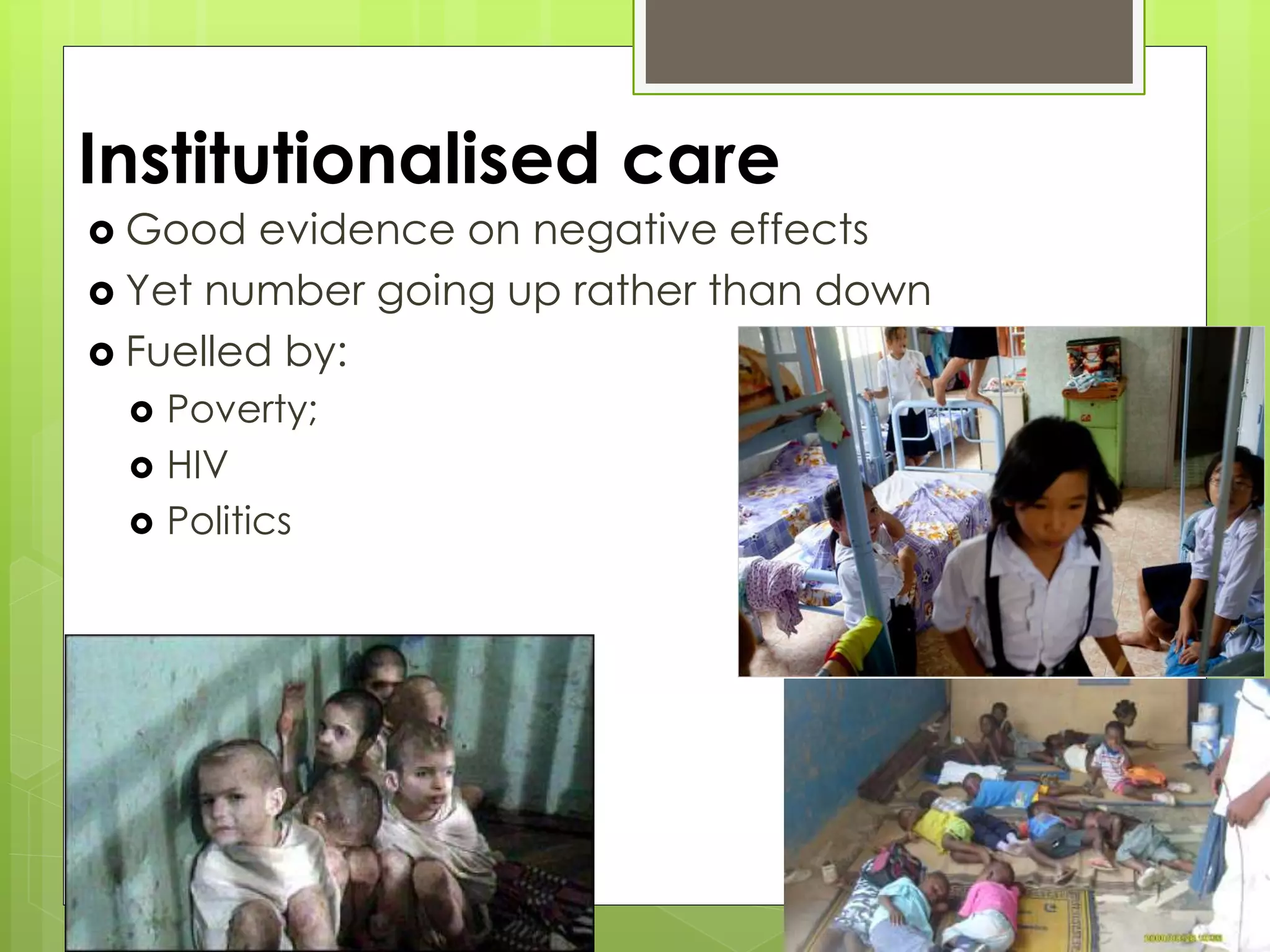
Institutionalised care 
 Good evidence on negative effects 
 Yet number going up rather than down 
 Fuelled by: 
 Poverty; 
 HIV 
 Politics
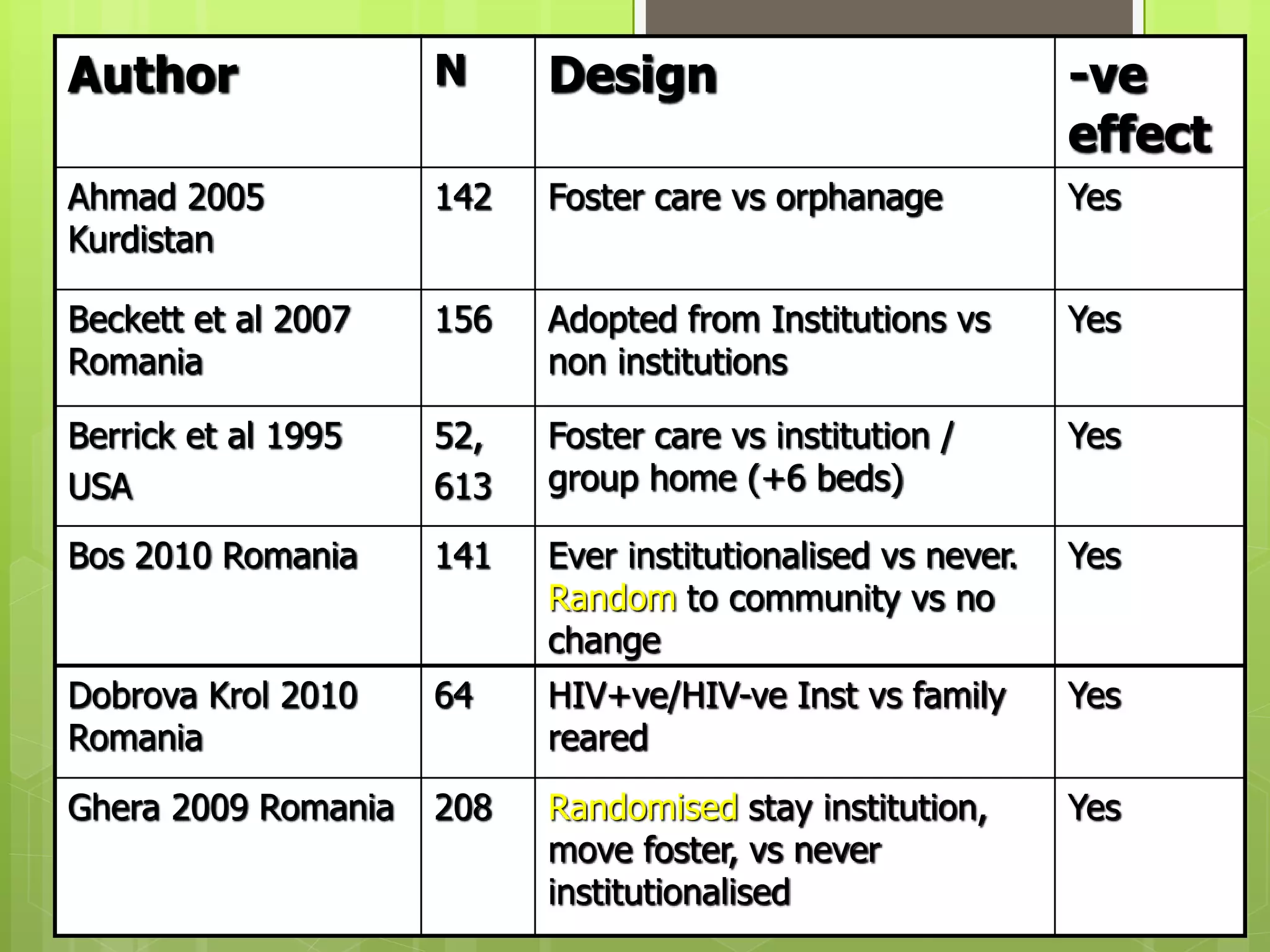
Author N Design -ve 
effect 
Ahmad 2005 
Kurdistan 
142 Foster care vs orphanage Yes 
Beckett et al 2007 
Romania 
156 Adopted from Institutions vs 
non institutions 
Yes 
Berrick et al 1995 
USA 
52, 
613 
Foster care vs institution / 
group home (+6 beds) 
Yes 
Bos 2010 Romania 141 Ever institutionalised vs never. 
Random to community vs no 
change 
Yes 
Dobrova Krol 2010 
Romania 
64 HIV+ve/HIV-ve Inst vs family 
reared 
Yes 
Ghera 2009 Romania 208 Randomised stay institution, 
move foster, vs never 
institutionalised 
Yes
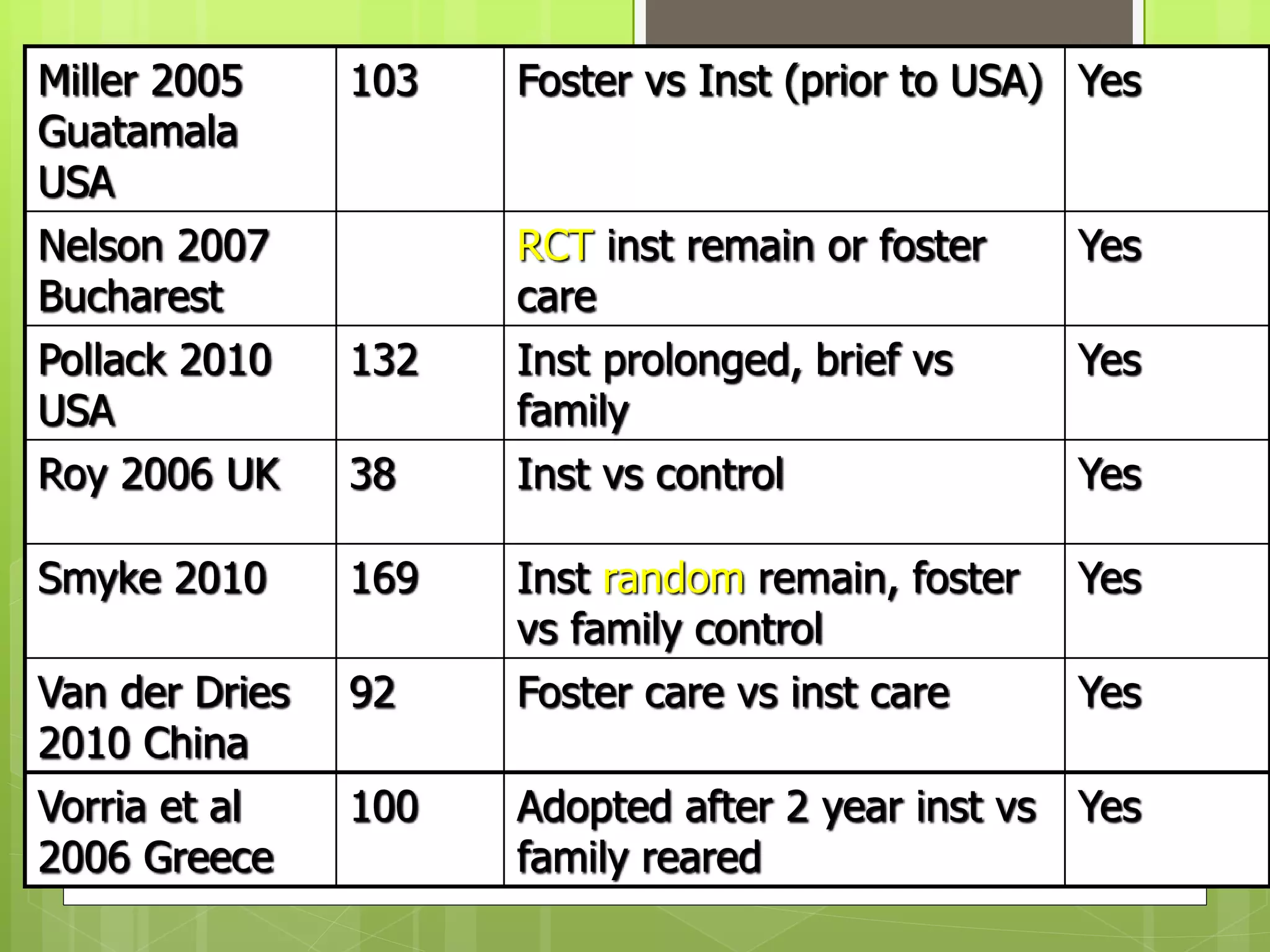
Miller 2005 
Guatamala 
USA 
103 Foster vs Inst (prior to USA) Yes 
Nelson 2007 
Bucharest 
RCT inst remain or foster 
care 
Yes 
Pollack 2010 
USA 
132 Inst prolonged, brief vs 
family 
Yes 
Roy 2006 UK 38 Inst vs control Yes 
Smyke 2010 169 Inst random remain, foster 
vs family control 
Yes 
Van der Dries 
2010 China 
92 Foster care vs inst care Yes 
Vorria et al 
2006 Greece 
100 Adopted after 2 year inst vs 
family reared 
Yes
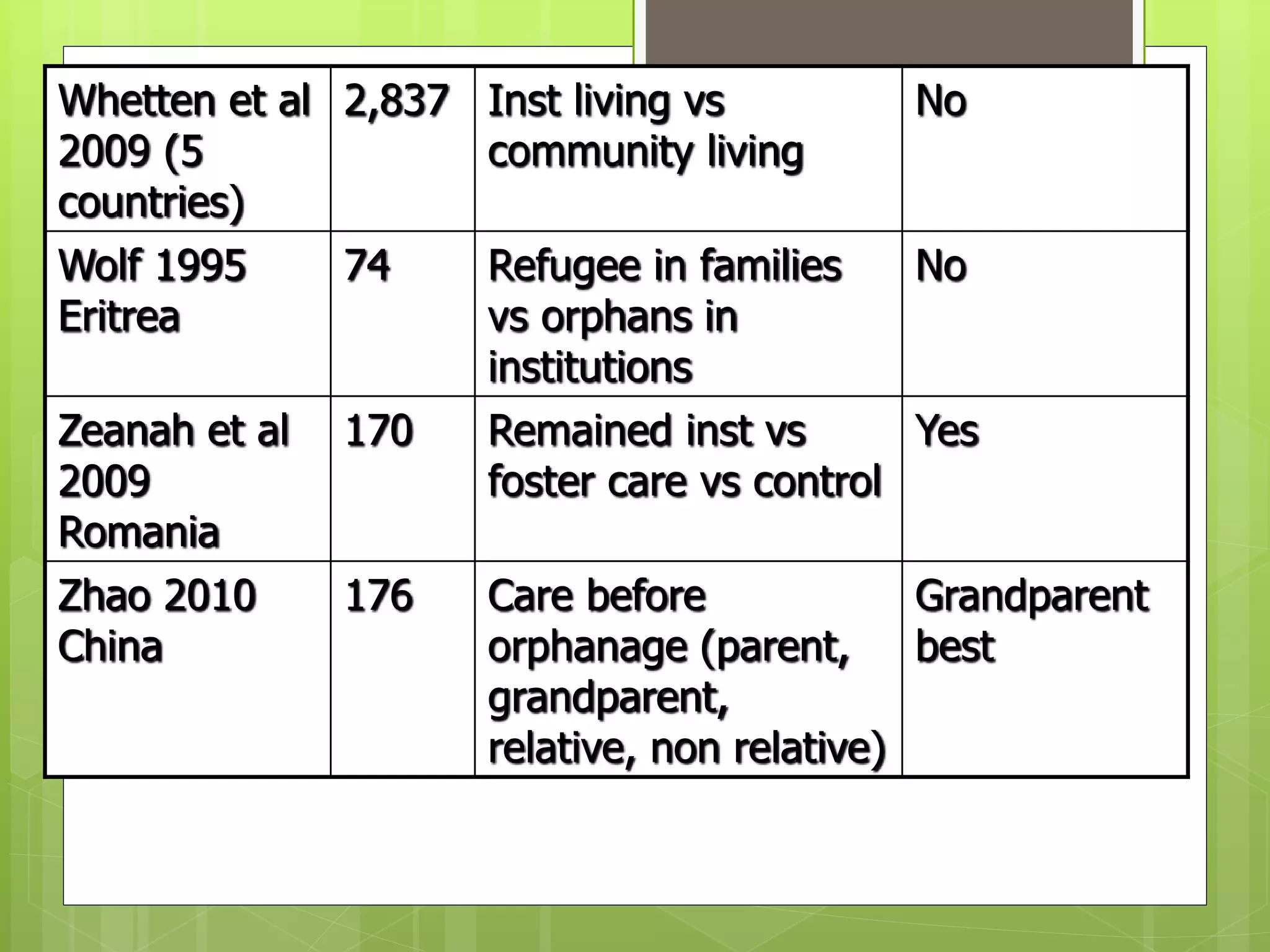
Whetten et al 
2009 (5 
countries) 
2,837 Inst living vs 
community living 
No 
Wolf 1995 
Eritrea 
74 Refugee in families 
vs orphans in 
institutions 
No 
Zeanah et al 
2009 
Romania 
170 Remained inst vs 
foster care vs control 
Yes 
Zhao 2010 
China 
176 Care before 
orphanage (parent, 
grandparent, 
relative, non relative) 
Grandparent 
best
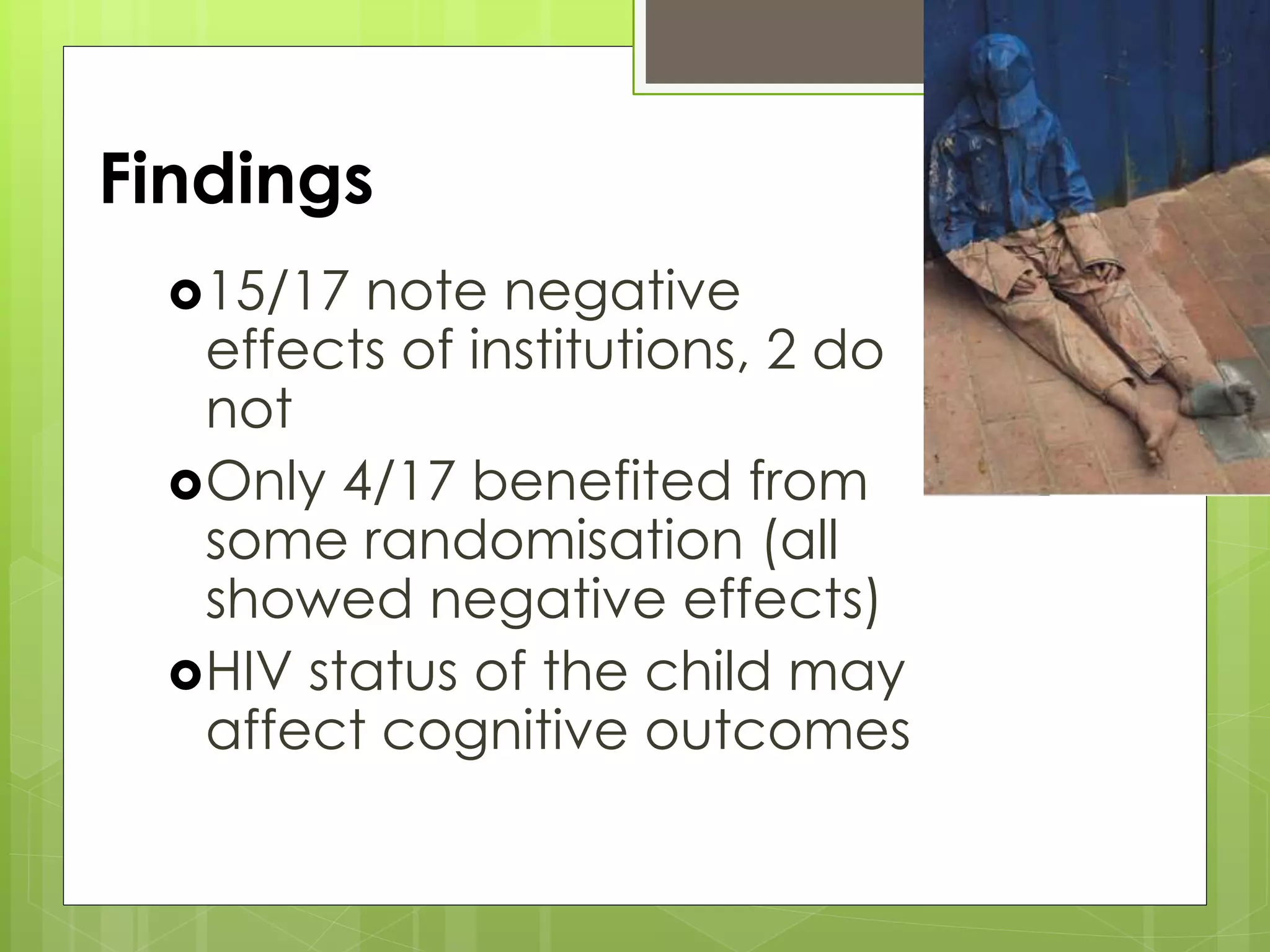
Findings 
15/17 note negative 
effects of institutions, 2 do 
not 
Only 4/17 benefited from 
some randomisation (all 
showed negative effects) 
HIV status of the child may 
affect cognitive outcomes
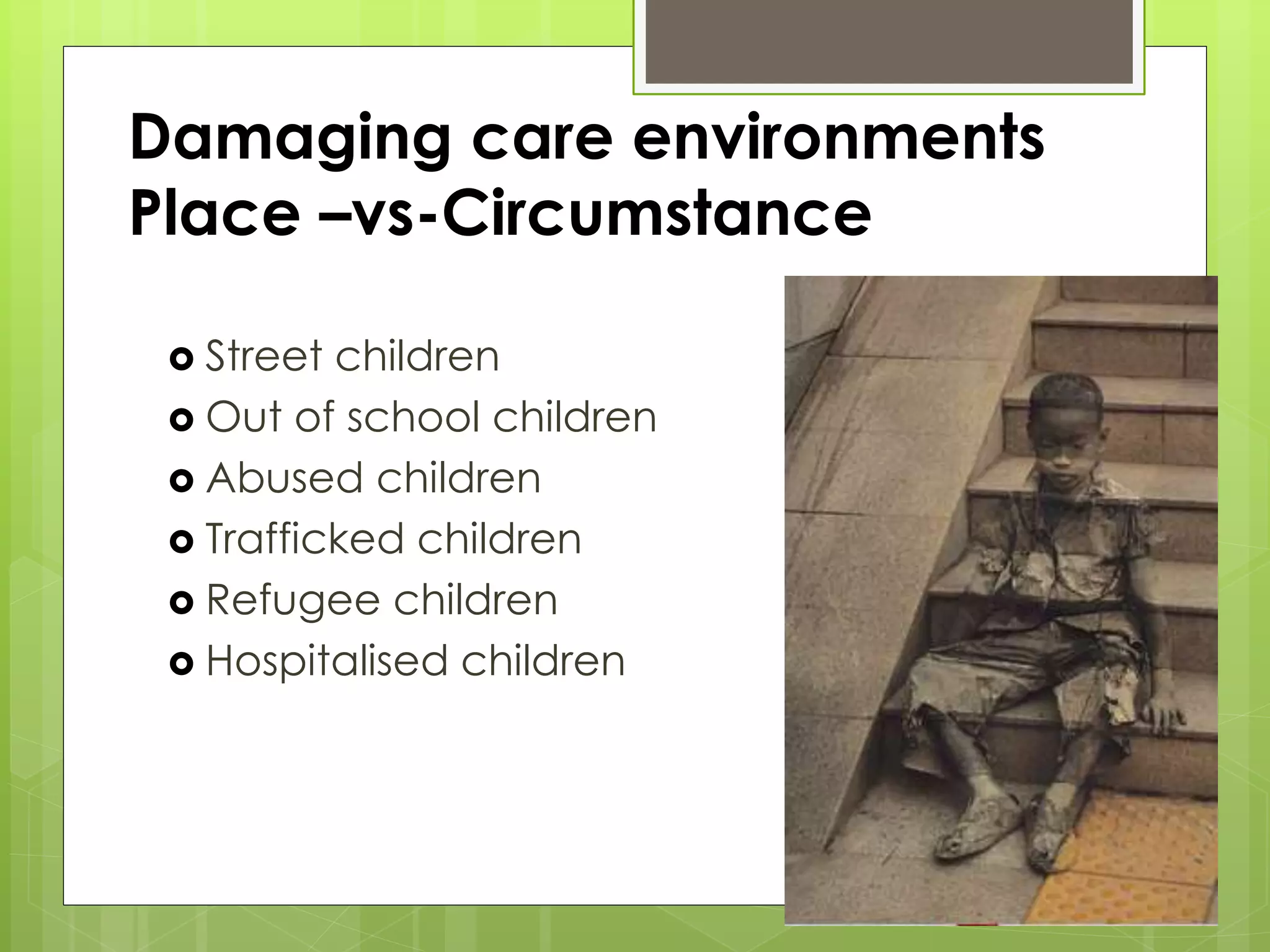
Damaging care environments 
Place –vs-Circumstance 
 Street children 
 Out of school children 
 Abused children 
 Trafficked children 
 Refugee children 
 Hospitalised children
Dangers 
 Orphan tourism (Richter et al 2010) 
 Cost effective
Fathers
Parenting Seen 
as “woman’s 
business” 
 Systematic review (Nattabi 2009) 
identified 29 studies – 20 women, 7 
couples (only 2 on men reported) 
 Systematic review (Sherr 2010) 
– Pregnancy Intention = 1122 
– + HIV = 66 
– + Father (Male) = 28 
– 13 relevant (9 quantitative, 4 
qualitative)
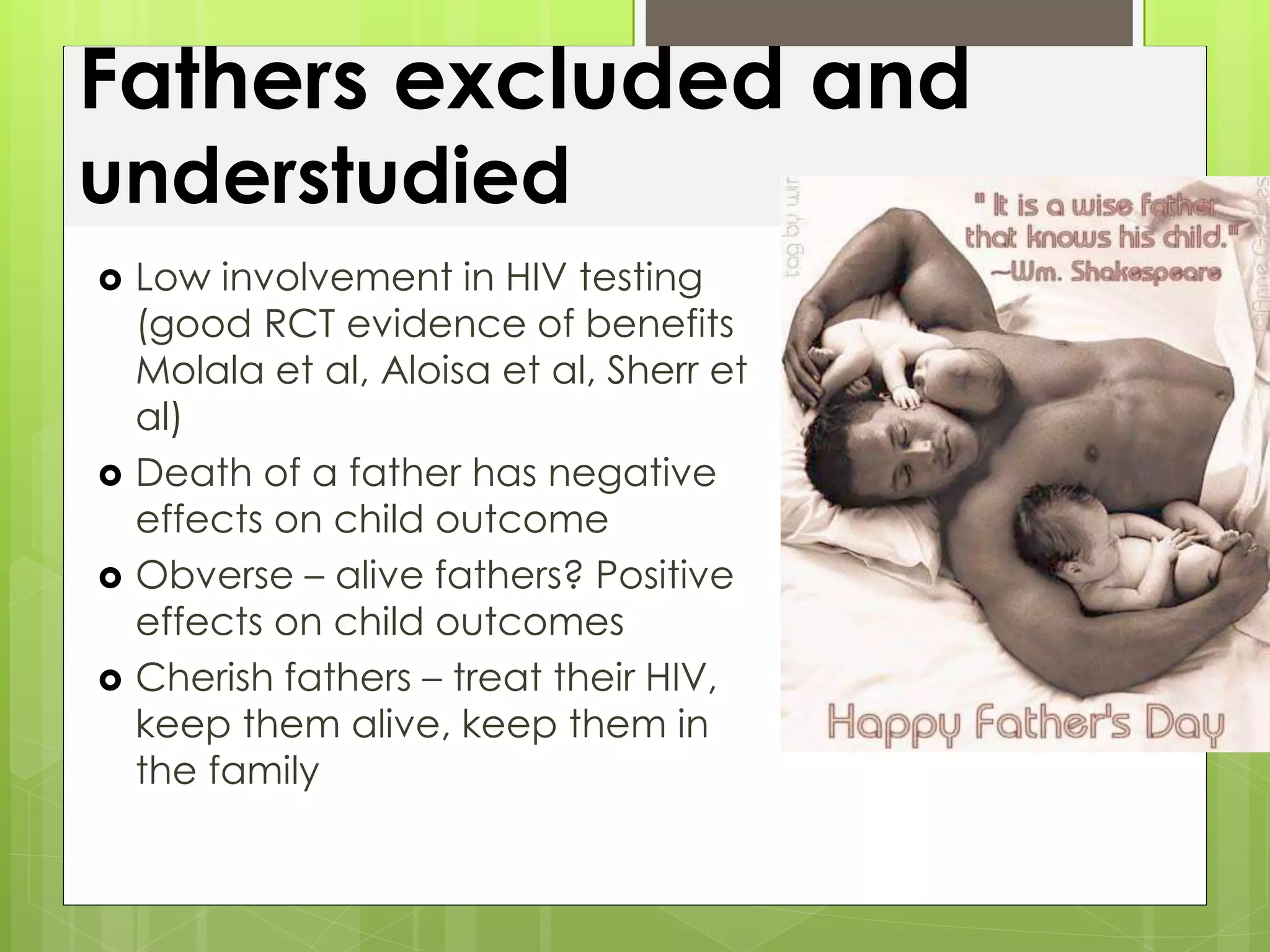
Fathers excluded and 
understudied 
 Low involvement in HIV testing 
(good RCT evidence of benefits 
Molala et al, Aloisa et al, Sherr et 
al) 
 Death of a father has negative 
effects on child outcome 
 Obverse – alive fathers? Positive 
effects on child outcomes 
 Cherish fathers – treat their HIV, 
keep them alive, keep them in 
the family
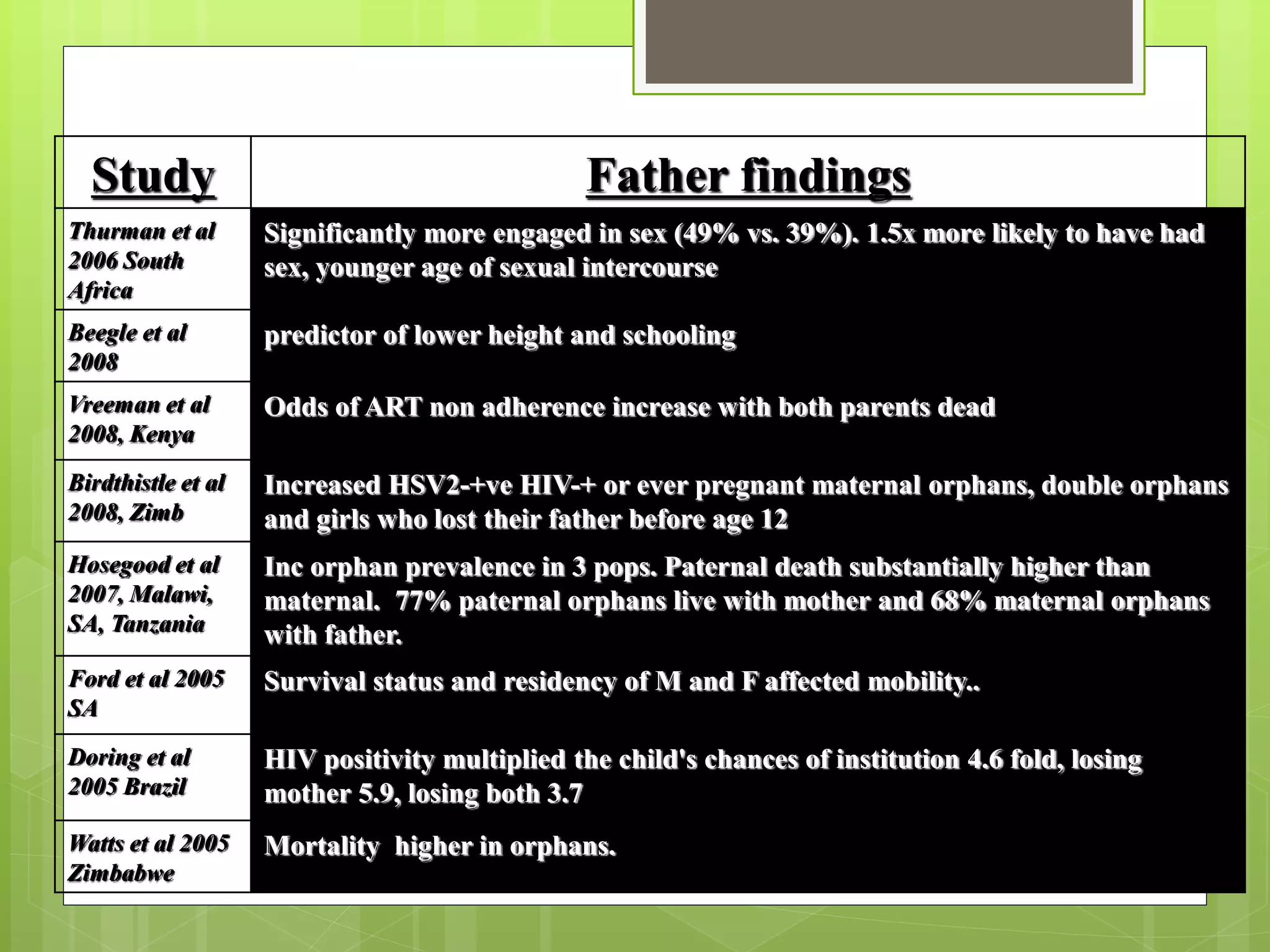
Study Father findings 
Thurman et al 
2006 South 
Africa 
Significantly more engaged in sex (49% vs. 39%). 1.5x more likely to have had 
sex, younger age of sexual intercourse 
Beegle et al 
2008 
predictor of lower height and schooling 
Vreeman et al 
2008, Kenya 
Odds of ART non adherence increase with both parents dead 
Birdthistle et al 
2008, Zimb 
Increased HSV2-+ve HIV-+ or ever pregnant maternal orphans, double orphans 
and girls who lost their father before age 12 
Hosegood et al 
2007, Malawi, 
SA, Tanzania 
Inc orphan prevalence in 3 pops. Paternal death substantially higher than 
maternal. 77% paternal orphans live with mother and 68% maternal orphans 
with father. 
Ford et al 2005 
SA 
Survival status and residency of M and F affected mobility.. 
Doring et al 
2005 Brazil 
HIV positivity multiplied the child's chances of institution 4.6 fold, losing 
mother 5.9, losing both 3.7 
Watts et al 2005 
Zimbabwe 
Mortality higher in orphans.
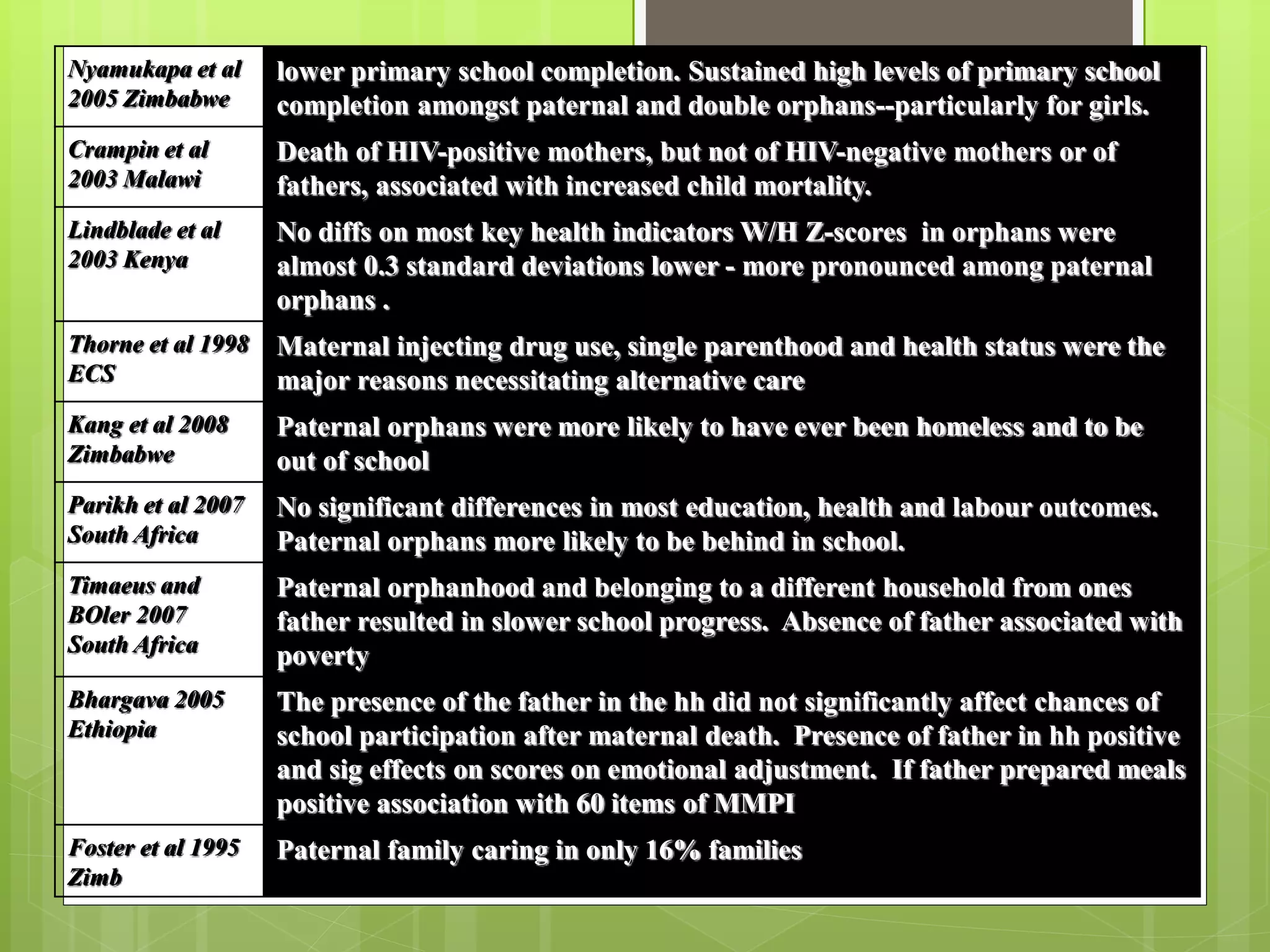
Nyamukapa et al 
2005 Zimbabwe 
lower primary school completion. Sustained high levels of primary school 
completion amongst paternal and double orphans--particularly for girls. 
Crampin et al 
2003 Malawi 
Death of HIV-positive mothers, but not of HIV-negative mothers or of 
fathers, associated with increased child mortality. 
Lindblade et al 
2003 Kenya 
No diffs on most key health indicators W/H Z-scores in orphans were 
almost 0.3 standard deviations lower - more pronounced among paternal 
orphans . 
Thorne et al 1998 
ECS 
Maternal injecting drug use, single parenthood and health status were the 
major reasons necessitating alternative care 
Kang et al 2008 
Zimbabwe 
Paternal orphans were more likely to have ever been homeless and to be 
out of school 
Parikh et al 2007 
South Africa 
No significant differences in most education, health and labour outcomes. 
Paternal orphans more likely to be behind in school. 
Timaeus and 
BOler 2007 
South Africa 
Paternal orphanhood and belonging to a different household from ones 
father resulted in slower school progress. Absence of father associated with 
poverty 
Bhargava 2005 
Ethiopia 
The presence of the father in the hh did not significantly affect chances of 
school participation after maternal death. Presence of father in hh positive 
and sig effects on scores on emotional adjustment. If father prepared meals 
positive association with 60 items of MMPI 
Foster et al 1995 
Zimb 
Paternal family caring in only 16% families
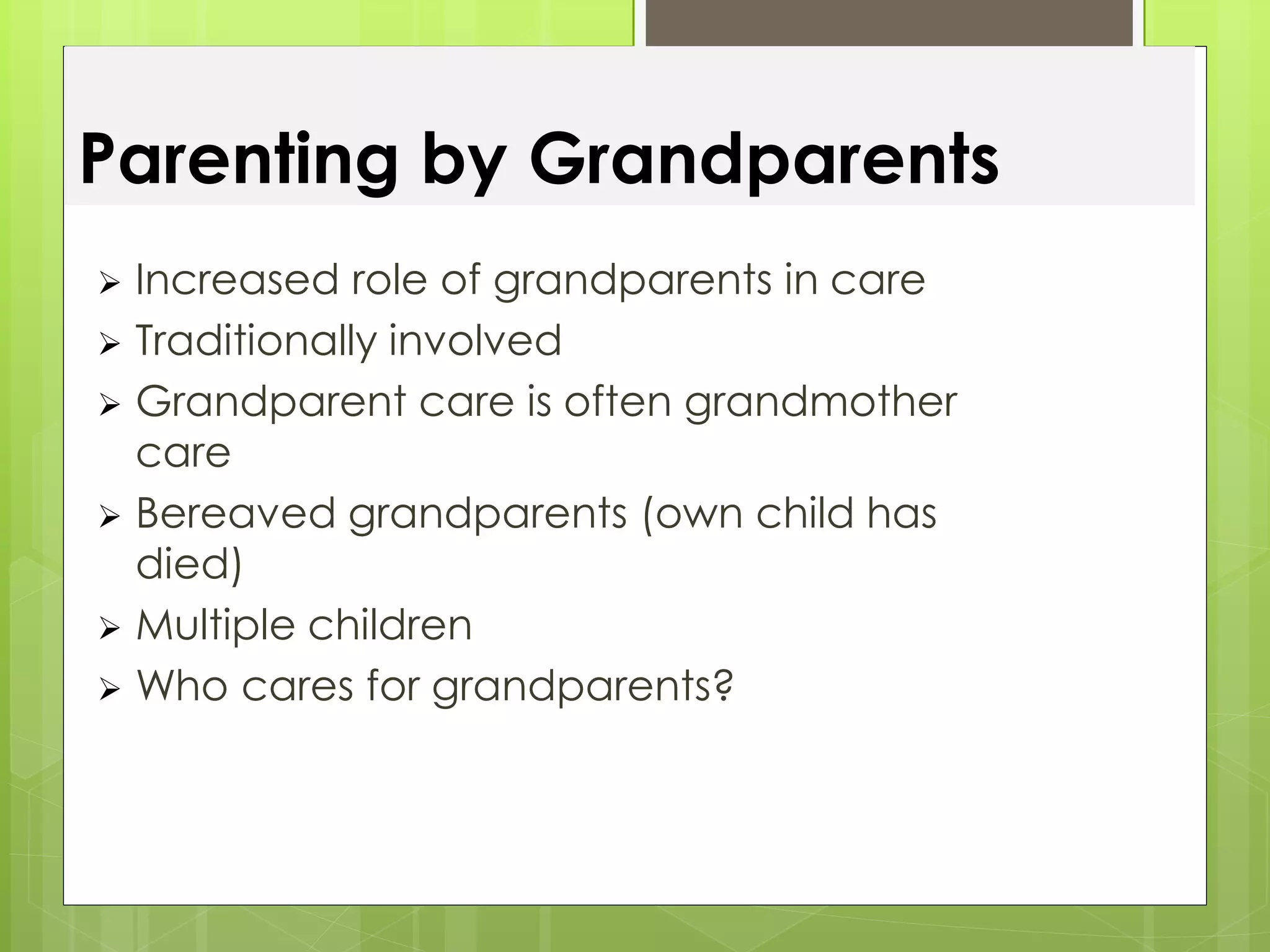
Parenting by Grandparents 
 Increased role of grandparents in care 
 Traditionally involved 
 Grandparent care is often grandmother 
care 
 Bereaved grandparents (own child has 
died) 
 Multiple children 
 Who cares for grandparents?
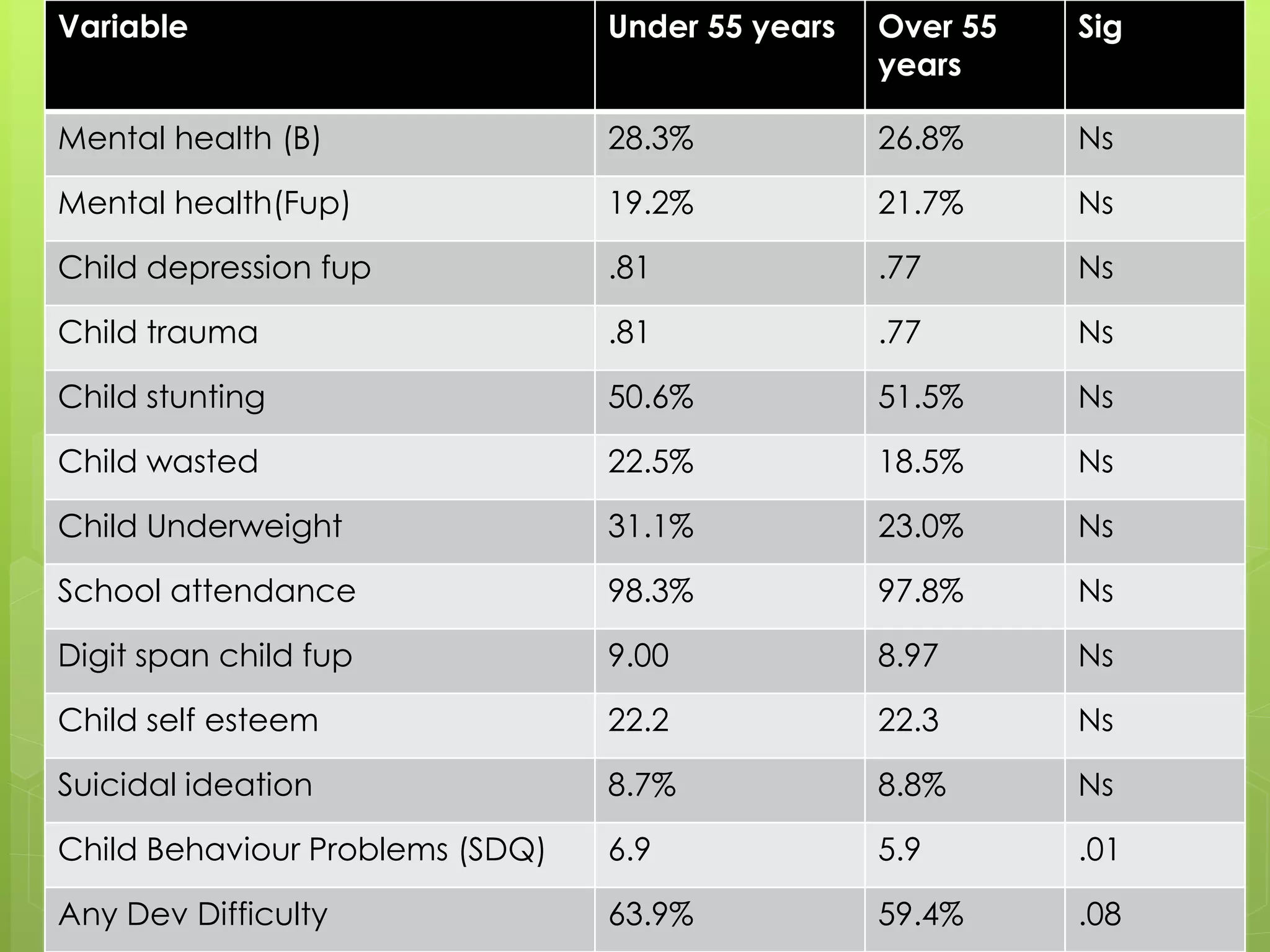
Variable Under 55 years Over 55 
years 
Sig 
Mental health (B) 28.3% 26.8% Ns 
Mental health(Fup) 19.2% 21.7% Ns 
Child depression fup .81 .77 Ns 
Child trauma .81 .77 Ns 
Child stunting 50.6% 51.5% Ns 
Child wasted 22.5% 18.5% Ns 
Child Underweight 31.1% 23.0% Ns 
School attendance 98.3% 97.8% Ns 
Digit span child fup 9.00 8.97 Ns 
Child self esteem 22.2 22.3 Ns 
Suicidal ideation 8.7% 8.8% Ns 
Child Behaviour Problems (SDQ) 6.9 5.9 .01 
Any Dev Difficulty 63.9% 59.4% .08
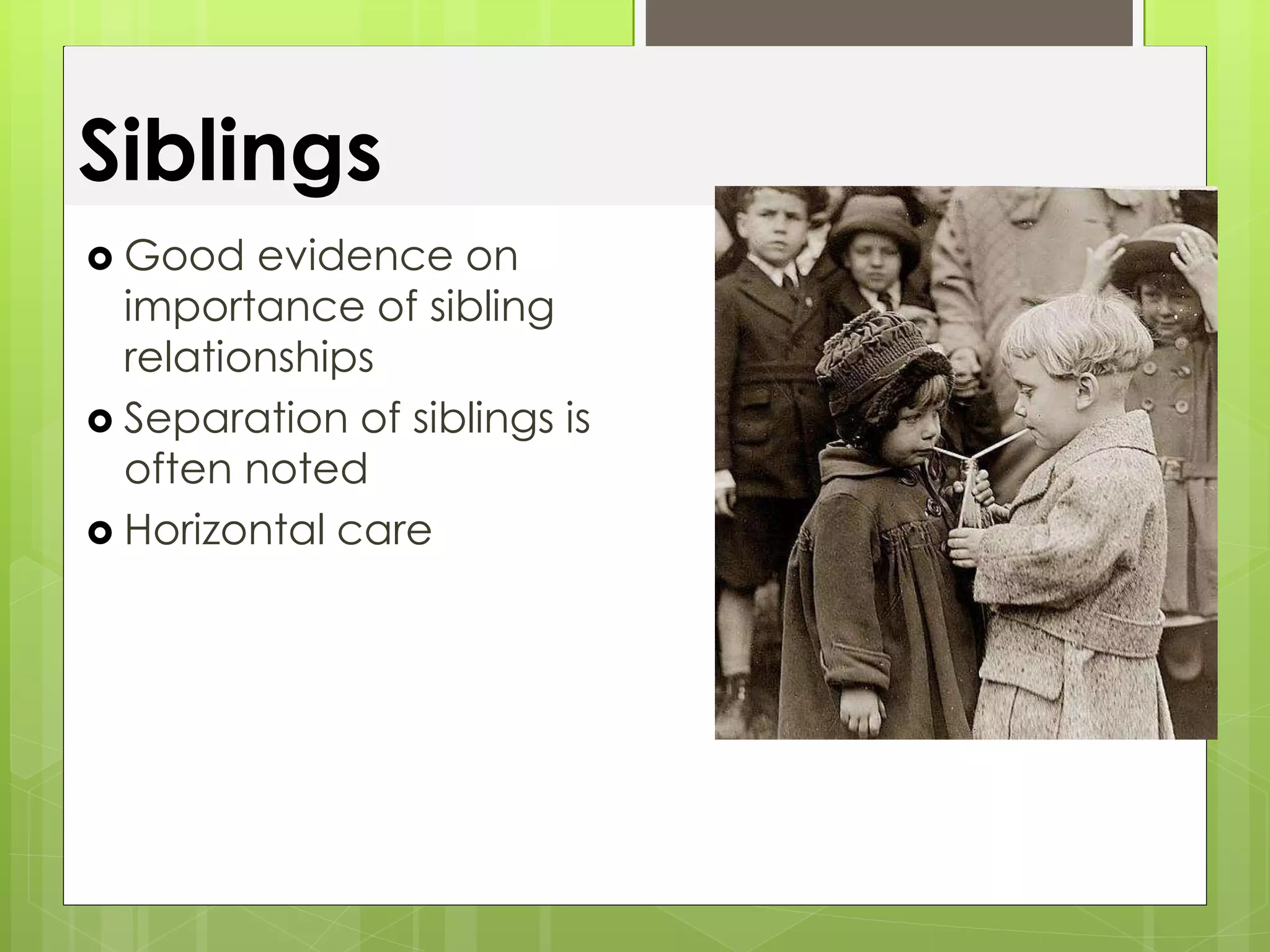
Siblings 
 Good evidence on 
importance of sibling 
relationships 
 Separation of siblings is 
often noted 
 Horizontal care
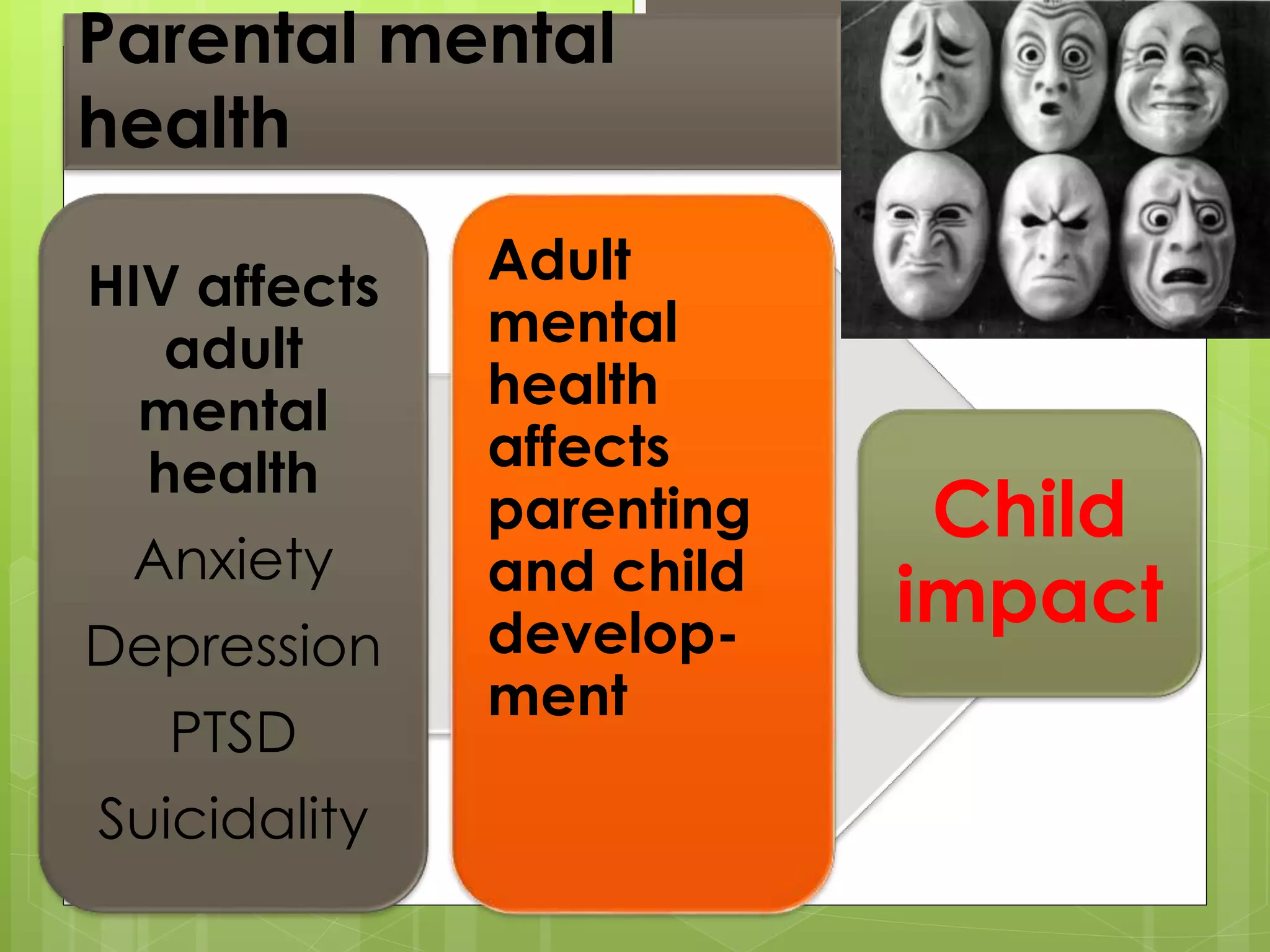
HIV affects 
adult 
mental 
health 
Anxiety 
Depression 
PTSD 
Suicidality 
Adult 
mental 
health 
affects 
parenting 
and child 
develop-ment 
Child 
impact 
Parental mental 
health
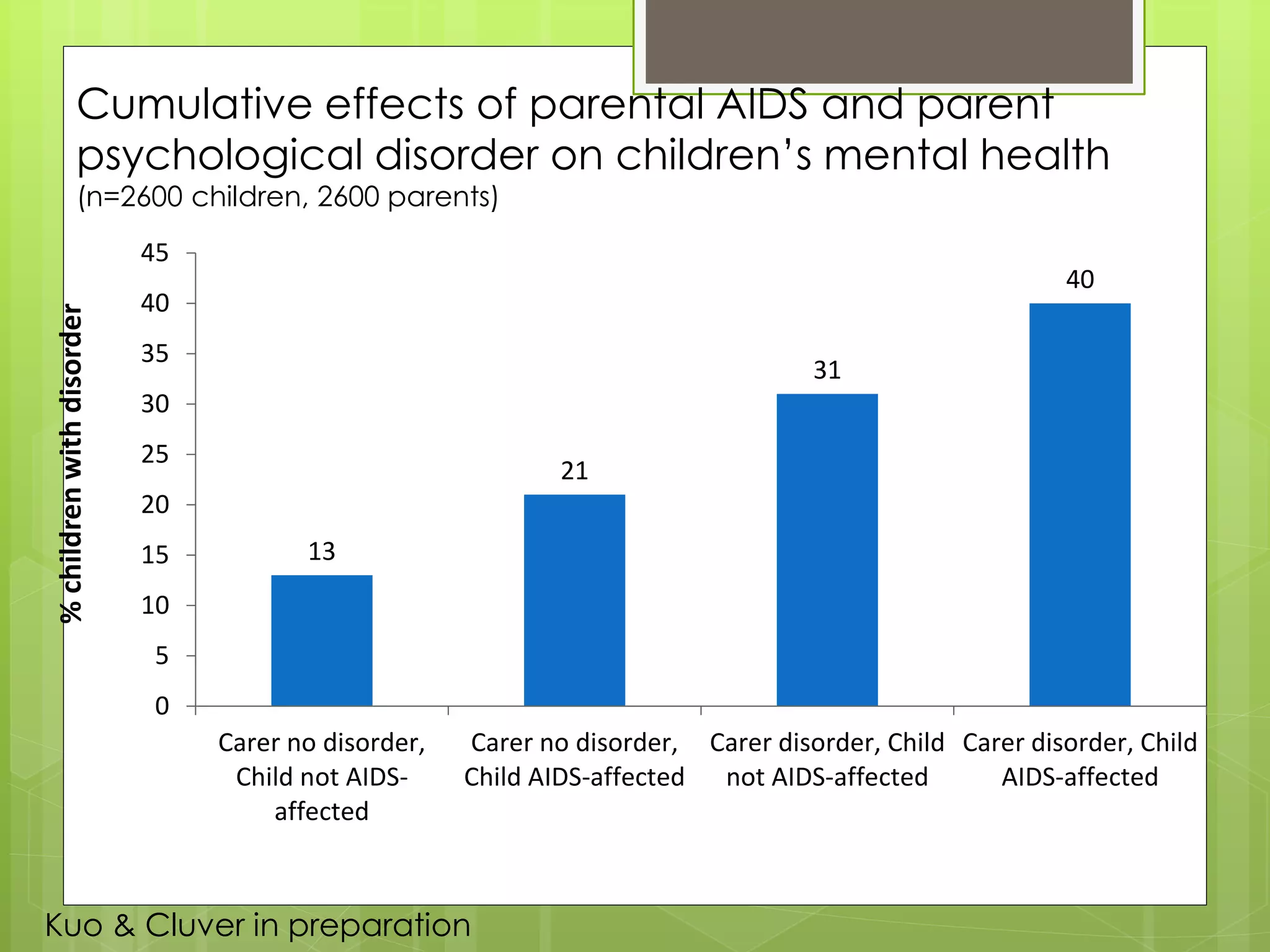
Cumulative effects of parental AIDS and parent 
psychological disorder on children’s mental health 
(n=2600 children, 2600 parents) 
13 
21 
31 
40 
45 
40 
35 
30 
25 
20 
15 
10 
5 
0 
Carer no disorder, 
Child not AIDS-affected 
Carer no disorder, 
Child AIDS-affected 
Carer disorder, Child 
not AIDS-affected 
Carer disorder, Child 
AIDS-affected 
% children with disorder 
Kuo & Cluver in preparation
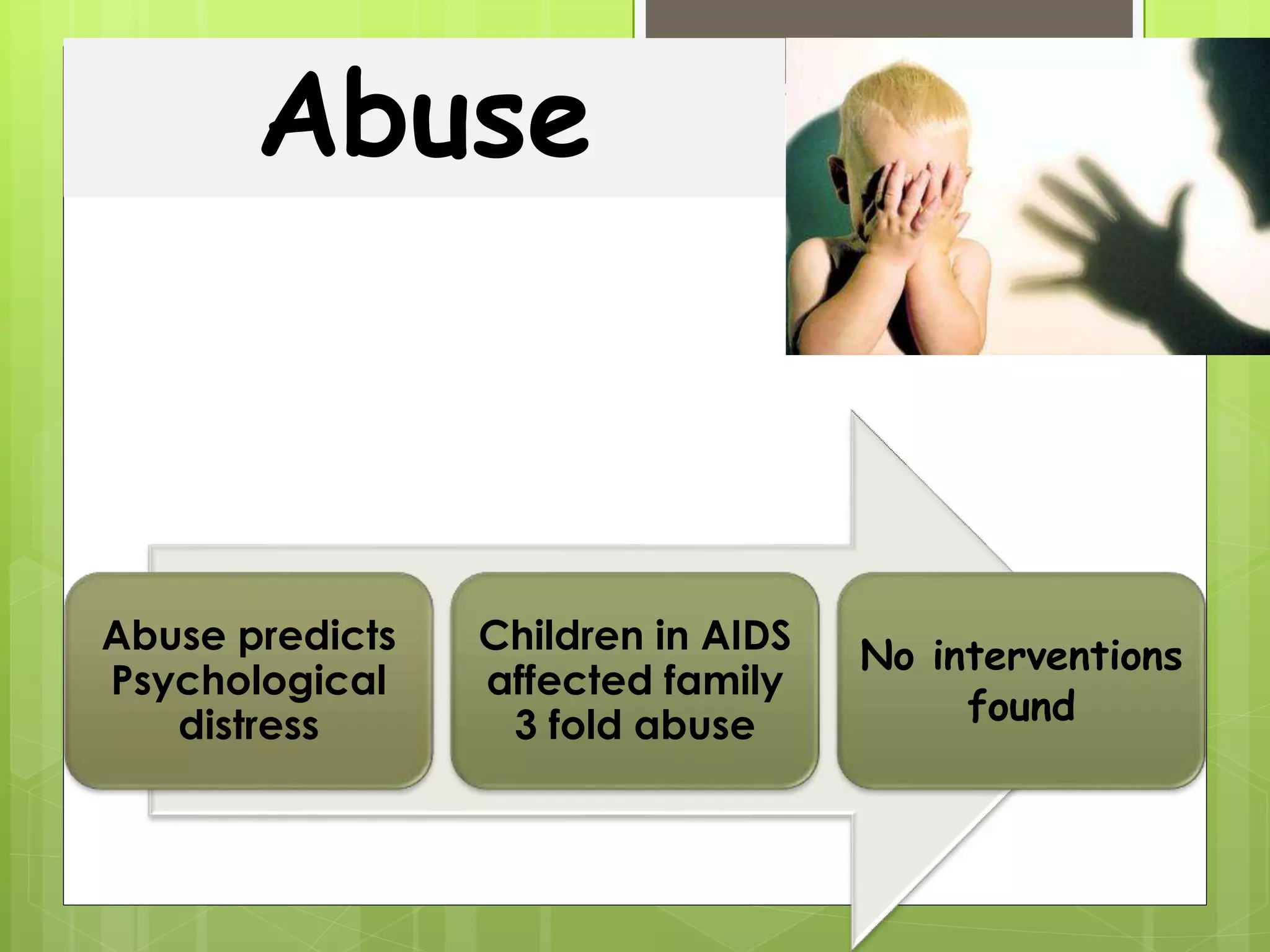
Abuse 
Abuse predicts 
Psychological 
distress 
Children in AIDS 
affected family 
3 fold abuse 
No interventions 
found
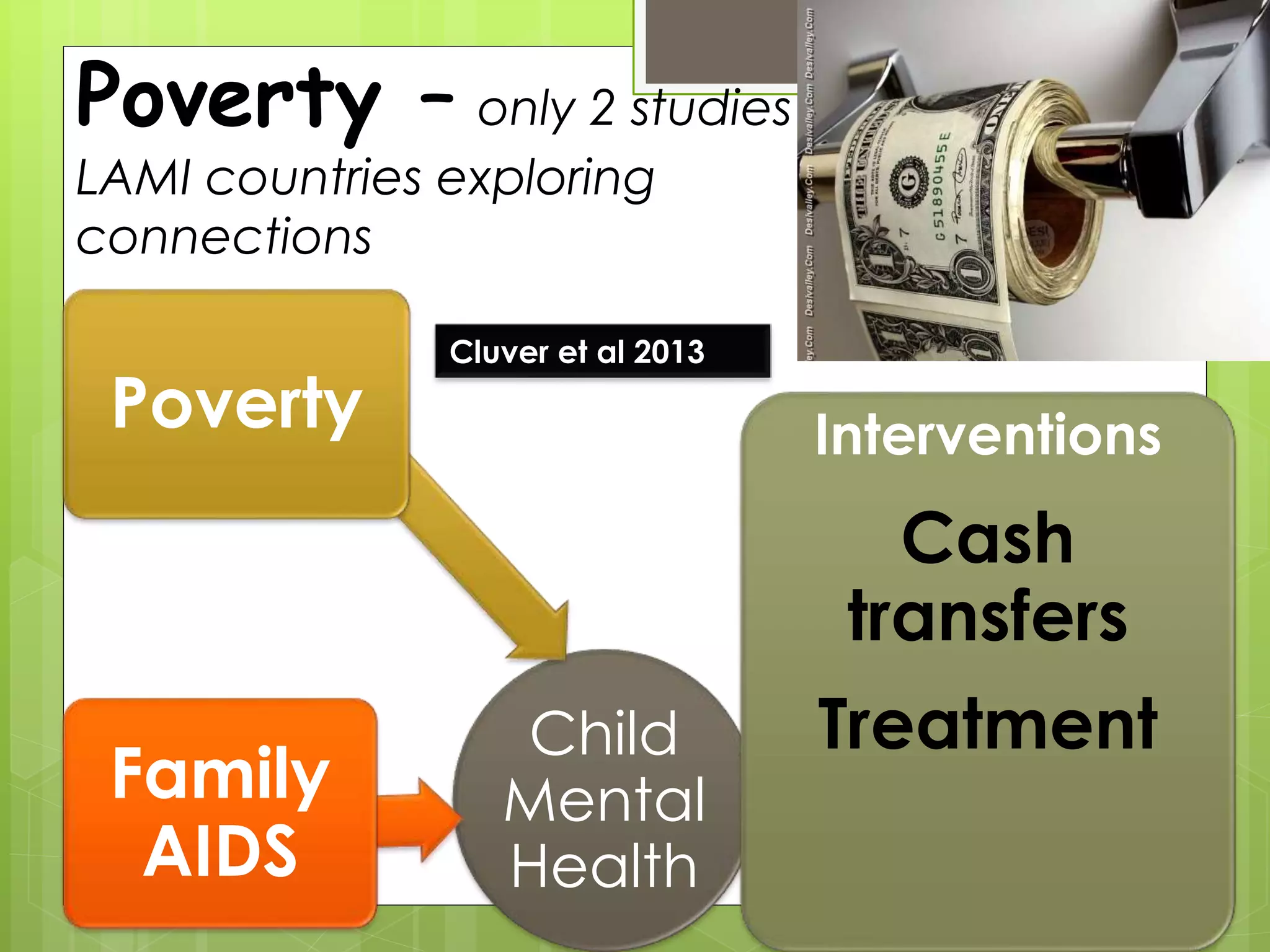
Poverty – only 2 studies in 
LAMI countries exploring 
connections 
Poverty Interventions 
Child 
Mental 
Health 
Family 
AIDS 
Cash 
transfers 
Treatment 
Cluver et al 2013
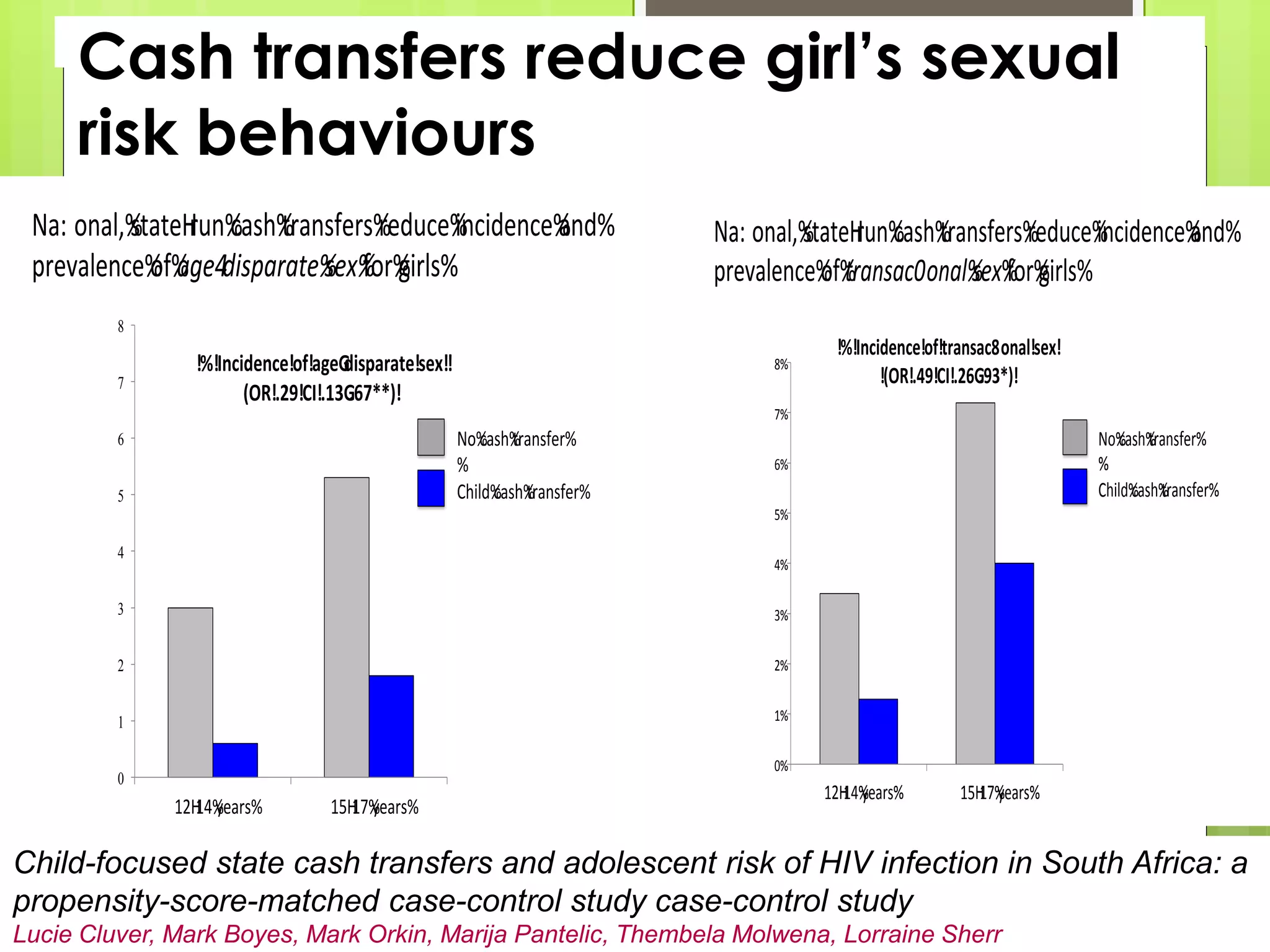
Cash transfers reduce girl’s sexual 
risk behaviours 
Na: onal,%stateHrun%cash%transfers%reduce%incidence%and% 
prevalence%of%age4disparate%sex%for%girls% 
8 
7 
6 
5 
4 
3 
2 
1 
0 
!%!Incidence!of!ageGdisparate!sex!! 
(OR!.29!CI!.13G.67**)! 
12H14%years% 15H17%years% 
No%cash%transfer% 
% 
Child%cash%transfer% 
Na: onal,%stateHrun%cash%transfers%reduce%incidence%and% 
prevalence%of%transac0onal%sex%for%girls% 
8% 
7% 
6% 
5% 
4% 
3% 
2% 
1% 
0% 
!%!Incidence!of!transac8onal!sex! 
!(OR!.49!CI!.26G.93*)! 
12H14%years% 15H17%years% 
No%cash%transfer% 
% 
Child%cash%transfer% 
Child-focused state cash transfers and adolescent risk of HIV infection in South Africa: a 
propensity-score-matched case-control study case-control study 
Lucie Cluver, Mark Boyes, Mark Orkin, Marija Pantelic, Thembela Molwena, Lorraine Sherr
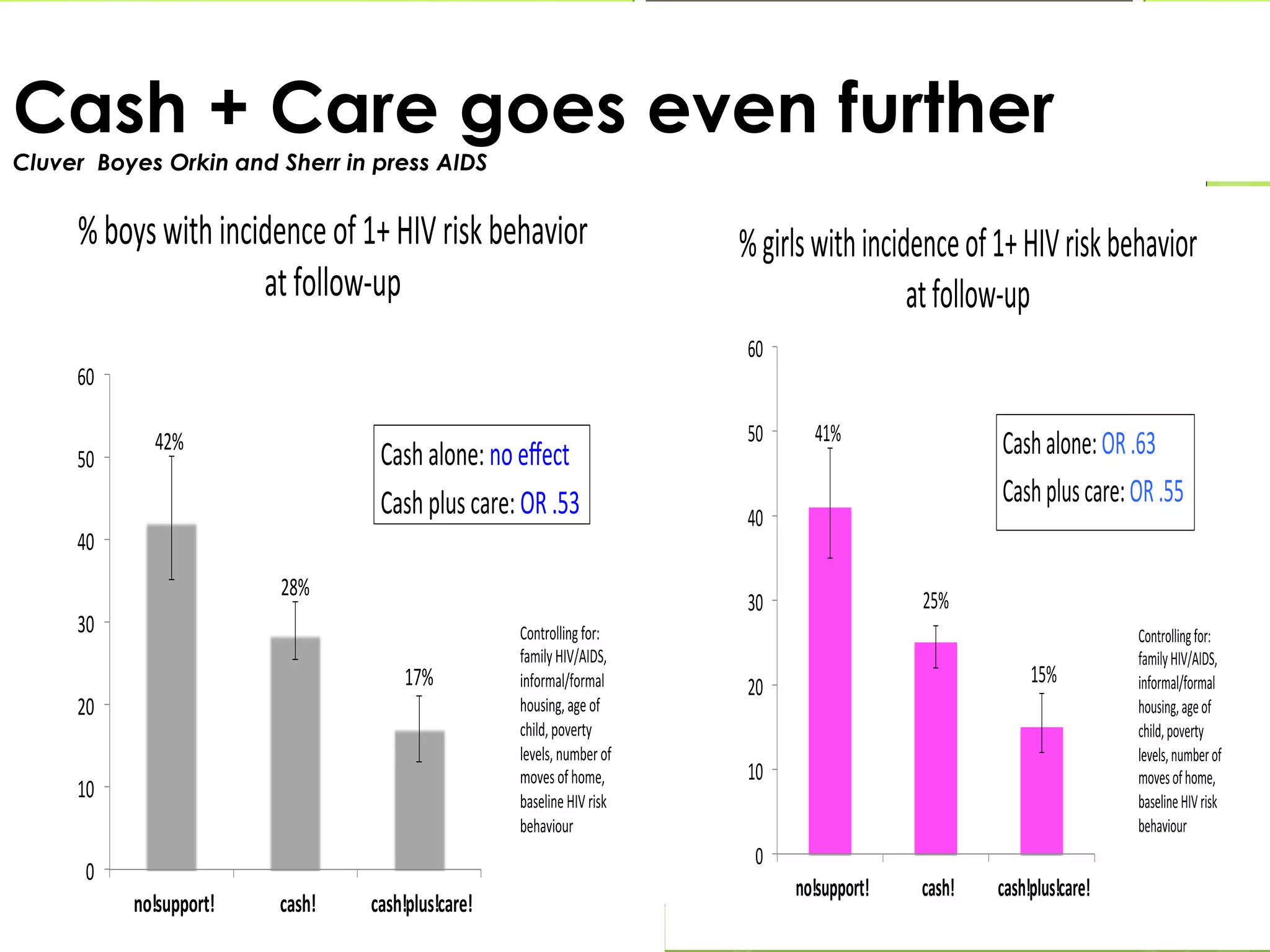
Cash + Care goes even further 
Cluver Boyes Orkin and Sherr in press AIDS 
no!support! cash! cash!plus!care! 
no!support! cash! cash!plus!care!
Parenting support in the context of HIV

Parenting support in the context of HIV

  • 1.
    Parenting and HIV Lorraine Sherr UCL London
  • 2.
    The Global AIDSResponse phases “APE” Almost entirely overlooked/ ignored parenting Pitted children against parents Emerging importance of parenting • To prevent vertical transmission • To care for children • To enhance treatment • For its own sake
  • 3.
    HIV Clusters infamilies Diagnosis during pregnancy Keep children HIV free – keep their parents alive Fundamental importance of parenting • Importance of first 1000 days •Parenting and ECD Especially true for young children
  • 4.
    Family care JLICA endorsed family approach  Core importance of parenting  Good evidence base  Families carry the major burden  Families are good for children  Family interventions (such as cash transfer) benefit child outcomes  Holistic care (a bridge too far?) http://www.ccaba.org/wp-content/uploads/Final-JLICA-Report. pdf
  • 5.
    Non HIV Parenting environment linked to child development  Parenting style linked to child behaviour  Parents Mental Health state affects child development (Downey et al)  Child illness affects parental state  Post traumatic stress disorder (22% parents of chronically ill children, 4 fold elevation).  Parenting interventions affect child outcome
  • 6.
    Quality of parenting  Early child development  Child stimulation  Parenting in the presence of HIV infection
  • 7.
    Parenting Interventions can improve child outcomes  Systematic review (Gunlicks 2008)  Interventions to ameliorate parental mood can benefit child outcomes  Parenting (Kuo et al)  Mentoring  Physical and mental health benefits  Support groups  USAID Initiative  Parenting and HIV  Parenting  Modelling
  • 8.
    HIV associated withparenting disruptions  Parental illness  Importance of Families  Mental and physical effects of HIV in parents  Parental death  Child caring for ill parent Child caring for other children  Parenting arrangements  Alternative care arrangements  Fathers  Grandparents  Kin  Parental death (Orphanhood)  Institutionalised care
  • 9.
    Parental HIV Depression Stigma Secrets Illness Death
  • 10.
    Infected parent Effects on child development, child care and child outcome (positive and negative)  Well documented physical effects of HIV  Well documented mental health effects of HIV  Depression 46%  Anxiety 16%,  Post traumatic stress disorder  Suicidality (31% Sherr et al 2009)  Effects of these on parenting??  HIV field Understudied  HIV positive enhances paediatric adherence
  • 11.
    Dually-affected (n=56) Mentalillness (n=171) HIV/AIDS illness (n=106) Non-affected (n=473) Any difficulty Behaviour Attention Coping with change Playing 80.4 33.9 37.5 37.5 10.7 75.4 21.1 24 22.2 5.3 57.5 14.2 19.8 19.8 2.8 58.8 15.6 15.6 18.4 2.5
  • 12.
    Tasks of parenting Feeding and nurturing Love attention, stimulation, protection and support Deciding an HIV free infant Disclosure Preparation for illness, treatment (and death)
  • 13.
    Fascination with theunusual  Parentification  Child headed households  Grandparent headed households  Parenting under adversity  Stresses of parenting under adversity have negative mental health impacts
  • 14.
    Child takes onresponsibilities as a caregiver
  • 15.
    Inverted parenting Direct duties  Caring for the sick adult  Administering medicines  Feeding/bathing  Emotional support  Indirect duties  Taking over adult duties  Household chores  Sibling care  Income generation  Livelihood burden
  • 16.
  • 17.
  • 18.
    Alternative parenting arrangements  Doring et al (Brazil) 2005 care arrangements for children of deceased HIV positive adults (n=1131).  41% resided with their mother,  25% with grandparents and only  5% in institutions.  Families are providing the mainstay of support for OVC children. HIV positivity was associated with a 4.6 fold chance of institutionalised care
  • 19.
    Institutionalised care Good evidence on negative effects  Yet number going up rather than down  Fuelled by:  Poverty;  HIV  Politics
  • 20.
    Author N Design-ve effect Ahmad 2005 Kurdistan 142 Foster care vs orphanage Yes Beckett et al 2007 Romania 156 Adopted from Institutions vs non institutions Yes Berrick et al 1995 USA 52, 613 Foster care vs institution / group home (+6 beds) Yes Bos 2010 Romania 141 Ever institutionalised vs never. Random to community vs no change Yes Dobrova Krol 2010 Romania 64 HIV+ve/HIV-ve Inst vs family reared Yes Ghera 2009 Romania 208 Randomised stay institution, move foster, vs never institutionalised Yes
  • 21.
    Miller 2005 Guatamala USA 103 Foster vs Inst (prior to USA) Yes Nelson 2007 Bucharest RCT inst remain or foster care Yes Pollack 2010 USA 132 Inst prolonged, brief vs family Yes Roy 2006 UK 38 Inst vs control Yes Smyke 2010 169 Inst random remain, foster vs family control Yes Van der Dries 2010 China 92 Foster care vs inst care Yes Vorria et al 2006 Greece 100 Adopted after 2 year inst vs family reared Yes
  • 22.
    Whetten et al 2009 (5 countries) 2,837 Inst living vs community living No Wolf 1995 Eritrea 74 Refugee in families vs orphans in institutions No Zeanah et al 2009 Romania 170 Remained inst vs foster care vs control Yes Zhao 2010 China 176 Care before orphanage (parent, grandparent, relative, non relative) Grandparent best
  • 23.
    Findings 15/17 notenegative effects of institutions, 2 do not Only 4/17 benefited from some randomisation (all showed negative effects) HIV status of the child may affect cognitive outcomes
  • 24.
    Damaging care environments Place –vs-Circumstance  Street children  Out of school children  Abused children  Trafficked children  Refugee children  Hospitalised children
  • 25.
    Dangers  Orphantourism (Richter et al 2010)  Cost effective
  • 26.
  • 27.
    Parenting Seen as“woman’s business”  Systematic review (Nattabi 2009) identified 29 studies – 20 women, 7 couples (only 2 on men reported)  Systematic review (Sherr 2010) – Pregnancy Intention = 1122 – + HIV = 66 – + Father (Male) = 28 – 13 relevant (9 quantitative, 4 qualitative)
  • 28.
    Fathers excluded and understudied  Low involvement in HIV testing (good RCT evidence of benefits Molala et al, Aloisa et al, Sherr et al)  Death of a father has negative effects on child outcome  Obverse – alive fathers? Positive effects on child outcomes  Cherish fathers – treat their HIV, keep them alive, keep them in the family
  • 29.
    Study Father findings Thurman et al 2006 South Africa Significantly more engaged in sex (49% vs. 39%). 1.5x more likely to have had sex, younger age of sexual intercourse Beegle et al 2008 predictor of lower height and schooling Vreeman et al 2008, Kenya Odds of ART non adherence increase with both parents dead Birdthistle et al 2008, Zimb Increased HSV2-+ve HIV-+ or ever pregnant maternal orphans, double orphans and girls who lost their father before age 12 Hosegood et al 2007, Malawi, SA, Tanzania Inc orphan prevalence in 3 pops. Paternal death substantially higher than maternal. 77% paternal orphans live with mother and 68% maternal orphans with father. Ford et al 2005 SA Survival status and residency of M and F affected mobility.. Doring et al 2005 Brazil HIV positivity multiplied the child's chances of institution 4.6 fold, losing mother 5.9, losing both 3.7 Watts et al 2005 Zimbabwe Mortality higher in orphans.
  • 30.
    Nyamukapa et al 2005 Zimbabwe lower primary school completion. Sustained high levels of primary school completion amongst paternal and double orphans--particularly for girls. Crampin et al 2003 Malawi Death of HIV-positive mothers, but not of HIV-negative mothers or of fathers, associated with increased child mortality. Lindblade et al 2003 Kenya No diffs on most key health indicators W/H Z-scores in orphans were almost 0.3 standard deviations lower - more pronounced among paternal orphans . Thorne et al 1998 ECS Maternal injecting drug use, single parenthood and health status were the major reasons necessitating alternative care Kang et al 2008 Zimbabwe Paternal orphans were more likely to have ever been homeless and to be out of school Parikh et al 2007 South Africa No significant differences in most education, health and labour outcomes. Paternal orphans more likely to be behind in school. Timaeus and BOler 2007 South Africa Paternal orphanhood and belonging to a different household from ones father resulted in slower school progress. Absence of father associated with poverty Bhargava 2005 Ethiopia The presence of the father in the hh did not significantly affect chances of school participation after maternal death. Presence of father in hh positive and sig effects on scores on emotional adjustment. If father prepared meals positive association with 60 items of MMPI Foster et al 1995 Zimb Paternal family caring in only 16% families
  • 31.
    Parenting by Grandparents  Increased role of grandparents in care  Traditionally involved  Grandparent care is often grandmother care  Bereaved grandparents (own child has died)  Multiple children  Who cares for grandparents?
  • 32.
    Variable Under 55years Over 55 years Sig Mental health (B) 28.3% 26.8% Ns Mental health(Fup) 19.2% 21.7% Ns Child depression fup .81 .77 Ns Child trauma .81 .77 Ns Child stunting 50.6% 51.5% Ns Child wasted 22.5% 18.5% Ns Child Underweight 31.1% 23.0% Ns School attendance 98.3% 97.8% Ns Digit span child fup 9.00 8.97 Ns Child self esteem 22.2 22.3 Ns Suicidal ideation 8.7% 8.8% Ns Child Behaviour Problems (SDQ) 6.9 5.9 .01 Any Dev Difficulty 63.9% 59.4% .08
  • 33.
    Siblings  Goodevidence on importance of sibling relationships  Separation of siblings is often noted  Horizontal care
  • 34.
    HIV affects adult mental health Anxiety Depression PTSD Suicidality Adult mental health affects parenting and child develop-ment Child impact Parental mental health
  • 35.
    Cumulative effects ofparental AIDS and parent psychological disorder on children’s mental health (n=2600 children, 2600 parents) 13 21 31 40 45 40 35 30 25 20 15 10 5 0 Carer no disorder, Child not AIDS-affected Carer no disorder, Child AIDS-affected Carer disorder, Child not AIDS-affected Carer disorder, Child AIDS-affected % children with disorder Kuo & Cluver in preparation
  • 36.
    Abuse Abuse predicts Psychological distress Children in AIDS affected family 3 fold abuse No interventions found
  • 37.
    Poverty – only2 studies in LAMI countries exploring connections Poverty Interventions Child Mental Health Family AIDS Cash transfers Treatment Cluver et al 2013
  • 38.
    Cash transfers reducegirl’s sexual risk behaviours Na: onal,%stateHrun%cash%transfers%reduce%incidence%and% prevalence%of%age4disparate%sex%for%girls% 8 7 6 5 4 3 2 1 0 !%!Incidence!of!ageGdisparate!sex!! (OR!.29!CI!.13G.67**)! 12H14%years% 15H17%years% No%cash%transfer% % Child%cash%transfer% Na: onal,%stateHrun%cash%transfers%reduce%incidence%and% prevalence%of%transac0onal%sex%for%girls% 8% 7% 6% 5% 4% 3% 2% 1% 0% !%!Incidence!of!transac8onal!sex! !(OR!.49!CI!.26G.93*)! 12H14%years% 15H17%years% No%cash%transfer% % Child%cash%transfer% Child-focused state cash transfers and adolescent risk of HIV infection in South Africa: a propensity-score-matched case-control study case-control study Lucie Cluver, Mark Boyes, Mark Orkin, Marija Pantelic, Thembela Molwena, Lorraine Sherr
  • 39.
    Cash + Caregoes even further Cluver Boyes Orkin and Sherr in press AIDS no!support! cash! cash!plus!care! no!support! cash! cash!plus!care!