
 Background to Policy Development 
› Research 
› State Initiatives 
› Existing Laws and Policies 
 National Approach to Parenting 
- National Parenting Support Policy 
- National Parenting Strategy 
- National Parent Support Commission 
 Lessons Learnt
 Pre-Independent Jamaica 
 Arose from concerns about children and 
families of lower socio-economic status 
 Illegitimacy and Concubinage considered 
a problem 
 “My Mother who Fathered Me” by Edith 
Clarke
Independent Jamaica 
Young University 
Focussed on early childhood group and lower 
SES 
 Health Concerns: Malnutrition 
 Education: Early Childhood Movement 
 Social : Ethnographic Studies on families
 Limited parent-child interaction 
 Limited father involvement 
 Inadequate resources to provide 
stimulation in the home 
 Gender differences in expectations for 
boys and girls.
 Large sample size 
 Quantitative analysis 
 Comprehensive in scope: Multiple factors investigated e.g. 
family structure, family function, parenting stress 
 Outcome measures included: Parenting able to be linked to 
child academic and behaviour outcomes 
 Population based methodology led to inclusion of parents of 
all socio-economic groups 
 Longitudinal methodology allowed for tracking of parenting 
across time and in children of different ages
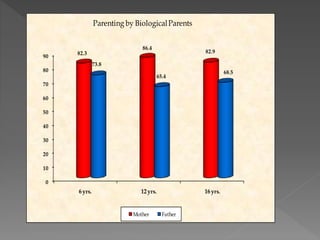
90 
80 
70 
60 
50 
40 
30 
20 
10 
0 
82.3 
86.4 
82.9 
73.8 
65.4 
6 yrs. 12 yrs. 16 yrs. 
68.5 
Parenting by Biological Parents 
Mother Father
70 
60 
50 
40 
30 
20 
10 
0 
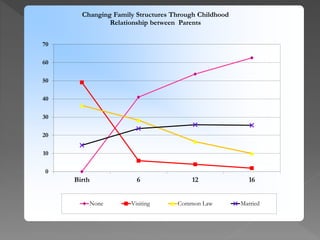
Changing Family Structures Through Childhood 
Relationship between Parents 
Birth 6 12 16 
None Visiting Common Law Married
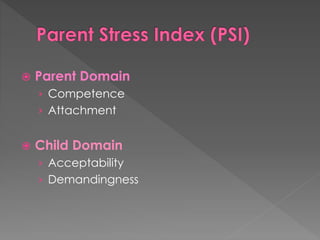
 Parent Domain 
› Competence 
› Attachment 
 Child Domain 
› Acceptability 
› Demandingness
 2004: First National Survey on Parenting. Special module in the 
annual household survey, the Jamaica Survey of Living Conditions 
 Quantitative analysis 
 Comprehensive in scope: Multiple factors investigated e.g. family 
structure, family function, parenting stress 
 Population based methodology led to inclusion of parents of all 
socio-economic groups 
 Included children of all ages 
 No capacity for inclusion of outcome measures 
 No capacity for Longitudinal methodology
 Arose from the Ministry of Education in 1991 
 Attempt to strengthen the MoE’s efforts to 
improve parenting through PTAs 
 Coalition for Better Parenting, an umbrella 
group of NGOs supporting parenting formed 
 Initially supported by UNICEF and MoE 
 Sustainability challenges
 Early Childhood Commission (ECC) 
established by the Government of Jamaica 
in 2003 to advance ECD 
 Governed by a multi-sectoral, multi-disciplinary 
board. Policies and 
programmes implemented by operational 
arm
 Acknowledged the importance of parenting in 
young children’s development 
 Recommended the following: 
› Professional representing parenting interests be 
appointed to ECC Board (2004) 
› Development of a National Parenting Support Policy 
› Parenting and Community Intervention Sub- 
Committee of the ECC Board established (2005) 
› Parenting added to Community Intervention Co-ordinator 
title (2005)
 ECC National Strategic Plan for ECD used ife cyce 
approach 
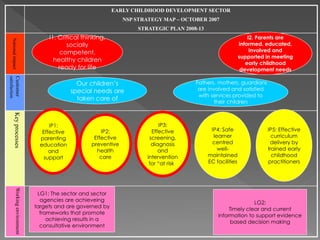
 Included parenting as first key strategic objective 
 Also included identification and support for families at risk 
as Strategic Objective 3 
 Objective: To provide parents with accessible and high 
quality parent education and support allowing for optimal 
development of children
EARLY CHILDHOOD DEVELOPMENT SECTOR 
NSP STRATEGY MAP – OCTOBER 2007 
STRATEGIC PLAN 2008-13 
National impact 
Customer 
satisfaction 
Key processes Working environment 
I1. Critical thinking, 
socially 
competent, 
healthy children 
ready for life 
I2. Parents are 
informed, educated, 
Fathers, mothers, guardians 
are involved and satisfied 
with services provided to 
their children 
involved and 
supported in meeting 
early childhood 
development needs 
Our children’s 
special needs are 
taken care of 
IP1: 
Effective 
parenting 
education 
and 
support 
IP2: 
Effective 
preventive 
health 
care 
IP3: 
Effective 
screening, 
diagnosis 
and 
intervention 
for “at risk” 
IP4: Safe 
learner 
centred 
well-maintained 
EC facilities 
LG1: The sector and sector 
agencies are achieveing 
targets and are governed by 
frameworks that promote 
achieving results in a 
consultative environment 
LG2: 
IP5: Effective 
curriculum 
delivery by 
trained early 
childhood 
practitioners 
Timely clear and current 
information to support evidence 
based decision making
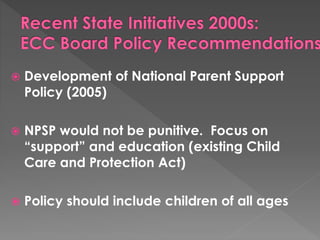
 Development of National Parent Support 
Policy (2005) 
 NPSP would not be punitive. Focus on 
“support” and education (existing Child 
Care and Protection Act) 
 Policy should include children of all ages
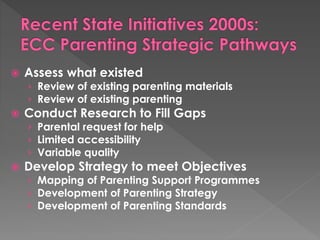
 Assess what existed 
› Review of existing parenting materials 
› Review of existing parenting 
 Conduct Research to Fill Gaps 
› Parental request for help 
› Limited accessibility 
› Variable quality 
 Develop Strategy to meet Objectives 
› Mapping of Parenting Support Programmes 
› Development of Parenting Strategy 
› Development of Parenting Standards
 Child Care and Protection Act (2004) 
 Office of Children’s Advocate (2006) 
› Commission of Parliament mandated to enforce and 
protect child rights 
 Conditional Cash Transfer Programme (2002) (Ministry 
of Labour and Social Security) 
› Children: from birth to completion of secondary 
education 
› Elderly: 60 years or over, and not in receipt of a 
pension 
› Persons with Disabilities 
› Pregnant and Lactating Women 
› Poor Adults 18-59 years
 National Parent Support Policy 
 National Parent Support Commission 
 National Parenting Strategy 
 National Parenting Standards
 First attempt by GOJ to codify a broad national 
understanding of parenting issues, and at stating its 
commitment to strengthen and improve parent 
support services 
 Provides an enabling environment to support 
parents in execution of their responsibilities 
 Defines the institutional framework required to 
support national programming 
 Identifies and defines the role of stakeholders : GOJ, 
NGOs, FBOs, academia, media, IDP etc
 All parents in Jamaica, -whether by virtue of 
having given birth, adopting or serving as 
guardians- recognise and accept their duty 
to ensure that the rights of children are 
always upheld, the best interests of children 
are always promoted and their children are 
always loved and provided with 
opportunities and resources to achieve their 
full potential and ultimate fulfilment within 
safe, caring and nurturing environments
 All Jamaicans make wise choices about 
becoming parents and make parenting a 
priority 
 All Jamaican children are loved, nurtured 
and protected instinctively and 
unconditionally by their parents 
 Each parent understands and utilises / 
applies positive practices in effective 
parenting
 An enabling institutional framework exists 
to support parenting 
 Ensuring that the principles and implications 
of effective parenting are communicated to 
the public in user friendly ways that enable 
comprehension of the material 
Policy includes Parent Charter outlining 
parental responsibilities
 Effected through the National Parent 
Support Commission Act (2012) 
 Established to implement National Parent 
Support Policy 
 Structure similar to that of ECC
 Advise the Minister on policy matters 
relating to parenting and family matters 
in Jamaica, including initiatives to 
achieve the goals of the NPP and to 
strengthen the partnerships between 
home and school 
 Act as a co-ordinating agency to 
streamline GOJ activities relating to 
parent support
 Monitor and evaluate the implementation of the NPP 
 Make recommendations to the Minister with respect 
to plans and programming concerning parenting 
support and home –school relationships 
 Convene consultations with relevant stakeholders 
 Analyse resource needs and make 
recommendations for budgetary allocations for 
parenting support programmes 
 Identify alternative sources of financing through 
negotiations with donor and non-donor agencies
 Identify, collect and disseminate information 
and best practices on relevant to parenting 
practices and outcome in Jamaica 
 Develop a national standards and 
accreditation system for the delivery of 
parenting support services 
 Collaborate with NGOs programmes to ensure 
effective co-ordination of activities, utilisation 
of resourcesand implementation of the NPSP 
and plans and programmes relating thereto.
 Management Board of 16-21 members 
 Reports directly to Minister of Education 
through the Chairman 
 Cross Sectoral 
 Representatives of GOJ MDA as well as 
individuals 
 Operational Arm, managed by ED
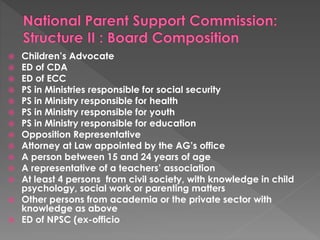
 Children’s Advocate 
 ED of CDA 
 ED of ECC 
 PS in Ministries responsible for social security 
 PS in Ministry responsible for health 
 PS in Ministry responsible for youth 
 PS in Ministry responsible for education 
 Opposition Representative 
 Attorney at Law appointed by the AG’s office 
 A person between 15 and 24 years of age 
 A representative of a teachers’ association 
 At least 4 persons from civil society, with knowledge in child 
psychology, social work or parenting matters 
 Other persons from academia or the private sector with 
knowledge as above 
 ED of NPSC (ex-officio
 Developed by the ECC through 
consultation with stakeholders
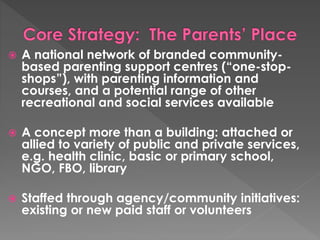
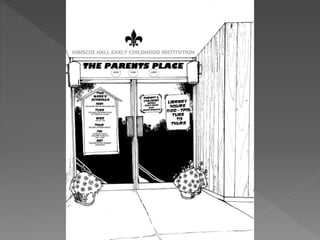
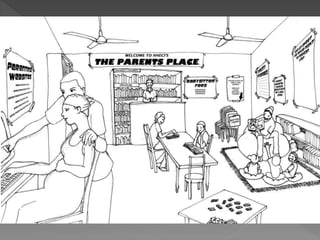
 A national network of branded community-based 
parenting support centres (“one-stop-shops”), 
with parenting information and 
courses, and a potential range of other 
recreational and social services available 
 A concept more than a building: attached or 
allied to variety of public and private services, 
e.g. health clinic, basic or primary school, 
NGO, FBO, library 
 Staffed through agency/community initiatives: 
existing or new paid staff or volunteers
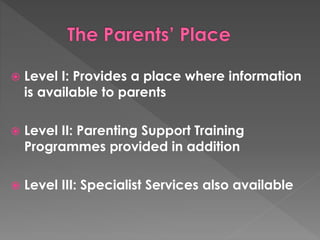
 Level I: Provides a place where information 
is available to parents 
 Level II: Parenting Support Training 
Programmes provided in addition 
 Level III: Specialist Services also available
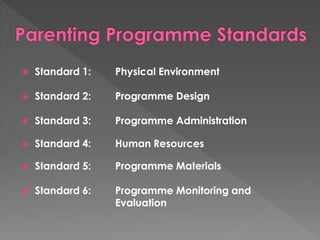
 Standard 1: Physical Environment 
 Standard 2: Programme Design 
 Standard 3: Programme Administration 
 Standard 4: Human Resources 
 Standard 5: Programme Materials 
 Standard 6: Programme Monitoring and 
Evaluation
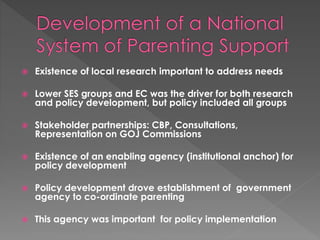
 Existence of local research important to address needs 
 Lower SES groups and EC was the driver for both research 
and policy development, but policy included all groups 
 Stakeholder partnerships: CBP, Consultations, 
Representation on GOJ Commissions 
 Existence of an enabling agency (institutional anchor) for 
policy development 
 Policy development drove establishment of government 
agency to co-ordinate parenting 
 This agency was important for policy implementation
 Parents Places being established 
primarily in primary schools (NPSC) and 
early childhood centres (ECC) where 
GOJ staff exists 
 Limited establishment by communities; 
limited human resources as parent 
facilitators

The Development and Implementation of a National Parent Support Policy in Jamaica

  • 2.
     Background toPolicy Development › Research › State Initiatives › Existing Laws and Policies  National Approach to Parenting - National Parenting Support Policy - National Parenting Strategy - National Parent Support Commission  Lessons Learnt
  • 4.
     Pre-Independent Jamaica  Arose from concerns about children and families of lower socio-economic status  Illegitimacy and Concubinage considered a problem  “My Mother who Fathered Me” by Edith Clarke
  • 5.
    Independent Jamaica YoungUniversity Focussed on early childhood group and lower SES  Health Concerns: Malnutrition  Education: Early Childhood Movement  Social : Ethnographic Studies on families
  • 6.
     Limited parent-childinteraction  Limited father involvement  Inadequate resources to provide stimulation in the home  Gender differences in expectations for boys and girls.
  • 7.
     Large samplesize  Quantitative analysis  Comprehensive in scope: Multiple factors investigated e.g. family structure, family function, parenting stress  Outcome measures included: Parenting able to be linked to child academic and behaviour outcomes  Population based methodology led to inclusion of parents of all socio-economic groups  Longitudinal methodology allowed for tracking of parenting across time and in children of different ages
  • 8.
    90 80 70 60 50 40 30 20 10 0 82.3 86.4 82.9 73.8 65.4 6 yrs. 12 yrs. 16 yrs. 68.5 Parenting by Biological Parents Mother Father
  • 9.
    70 60 50 40 30 20 10 0 Changing Family Structures Through Childhood Relationship between Parents Birth 6 12 16 None Visiting Common Law Married
  • 10.
     Parent Domain › Competence › Attachment  Child Domain › Acceptability › Demandingness
  • 11.
     2004: FirstNational Survey on Parenting. Special module in the annual household survey, the Jamaica Survey of Living Conditions  Quantitative analysis  Comprehensive in scope: Multiple factors investigated e.g. family structure, family function, parenting stress  Population based methodology led to inclusion of parents of all socio-economic groups  Included children of all ages  No capacity for inclusion of outcome measures  No capacity for Longitudinal methodology
  • 13.
     Arose fromthe Ministry of Education in 1991  Attempt to strengthen the MoE’s efforts to improve parenting through PTAs  Coalition for Better Parenting, an umbrella group of NGOs supporting parenting formed  Initially supported by UNICEF and MoE  Sustainability challenges
  • 14.
     Early ChildhoodCommission (ECC) established by the Government of Jamaica in 2003 to advance ECD  Governed by a multi-sectoral, multi-disciplinary board. Policies and programmes implemented by operational arm
  • 15.
     Acknowledged theimportance of parenting in young children’s development  Recommended the following: › Professional representing parenting interests be appointed to ECC Board (2004) › Development of a National Parenting Support Policy › Parenting and Community Intervention Sub- Committee of the ECC Board established (2005) › Parenting added to Community Intervention Co-ordinator title (2005)
  • 16.
     ECC NationalStrategic Plan for ECD used ife cyce approach  Included parenting as first key strategic objective  Also included identification and support for families at risk as Strategic Objective 3  Objective: To provide parents with accessible and high quality parent education and support allowing for optimal development of children
  • 17.
    EARLY CHILDHOOD DEVELOPMENTSECTOR NSP STRATEGY MAP – OCTOBER 2007 STRATEGIC PLAN 2008-13 National impact Customer satisfaction Key processes Working environment I1. Critical thinking, socially competent, healthy children ready for life I2. Parents are informed, educated, Fathers, mothers, guardians are involved and satisfied with services provided to their children involved and supported in meeting early childhood development needs Our children’s special needs are taken care of IP1: Effective parenting education and support IP2: Effective preventive health care IP3: Effective screening, diagnosis and intervention for “at risk” IP4: Safe learner centred well-maintained EC facilities LG1: The sector and sector agencies are achieveing targets and are governed by frameworks that promote achieving results in a consultative environment LG2: IP5: Effective curriculum delivery by trained early childhood practitioners Timely clear and current information to support evidence based decision making
  • 19.
     Development ofNational Parent Support Policy (2005)  NPSP would not be punitive. Focus on “support” and education (existing Child Care and Protection Act)  Policy should include children of all ages
  • 20.
     Assess whatexisted › Review of existing parenting materials › Review of existing parenting  Conduct Research to Fill Gaps › Parental request for help › Limited accessibility › Variable quality  Develop Strategy to meet Objectives › Mapping of Parenting Support Programmes › Development of Parenting Strategy › Development of Parenting Standards
  • 22.
     Child Careand Protection Act (2004)  Office of Children’s Advocate (2006) › Commission of Parliament mandated to enforce and protect child rights  Conditional Cash Transfer Programme (2002) (Ministry of Labour and Social Security) › Children: from birth to completion of secondary education › Elderly: 60 years or over, and not in receipt of a pension › Persons with Disabilities › Pregnant and Lactating Women › Poor Adults 18-59 years
  • 24.
     National ParentSupport Policy  National Parent Support Commission  National Parenting Strategy  National Parenting Standards
  • 25.
     First attemptby GOJ to codify a broad national understanding of parenting issues, and at stating its commitment to strengthen and improve parent support services  Provides an enabling environment to support parents in execution of their responsibilities  Defines the institutional framework required to support national programming  Identifies and defines the role of stakeholders : GOJ, NGOs, FBOs, academia, media, IDP etc
  • 26.
     All parentsin Jamaica, -whether by virtue of having given birth, adopting or serving as guardians- recognise and accept their duty to ensure that the rights of children are always upheld, the best interests of children are always promoted and their children are always loved and provided with opportunities and resources to achieve their full potential and ultimate fulfilment within safe, caring and nurturing environments
  • 27.
     All Jamaicansmake wise choices about becoming parents and make parenting a priority  All Jamaican children are loved, nurtured and protected instinctively and unconditionally by their parents  Each parent understands and utilises / applies positive practices in effective parenting
  • 28.
     An enablinginstitutional framework exists to support parenting  Ensuring that the principles and implications of effective parenting are communicated to the public in user friendly ways that enable comprehension of the material Policy includes Parent Charter outlining parental responsibilities
  • 29.
     Effected throughthe National Parent Support Commission Act (2012)  Established to implement National Parent Support Policy  Structure similar to that of ECC
  • 30.
     Advise theMinister on policy matters relating to parenting and family matters in Jamaica, including initiatives to achieve the goals of the NPP and to strengthen the partnerships between home and school  Act as a co-ordinating agency to streamline GOJ activities relating to parent support
  • 31.
     Monitor andevaluate the implementation of the NPP  Make recommendations to the Minister with respect to plans and programming concerning parenting support and home –school relationships  Convene consultations with relevant stakeholders  Analyse resource needs and make recommendations for budgetary allocations for parenting support programmes  Identify alternative sources of financing through negotiations with donor and non-donor agencies
  • 32.
     Identify, collectand disseminate information and best practices on relevant to parenting practices and outcome in Jamaica  Develop a national standards and accreditation system for the delivery of parenting support services  Collaborate with NGOs programmes to ensure effective co-ordination of activities, utilisation of resourcesand implementation of the NPSP and plans and programmes relating thereto.
  • 33.
     Management Boardof 16-21 members  Reports directly to Minister of Education through the Chairman  Cross Sectoral  Representatives of GOJ MDA as well as individuals  Operational Arm, managed by ED
  • 34.
     Children’s Advocate  ED of CDA  ED of ECC  PS in Ministries responsible for social security  PS in Ministry responsible for health  PS in Ministry responsible for youth  PS in Ministry responsible for education  Opposition Representative  Attorney at Law appointed by the AG’s office  A person between 15 and 24 years of age  A representative of a teachers’ association  At least 4 persons from civil society, with knowledge in child psychology, social work or parenting matters  Other persons from academia or the private sector with knowledge as above  ED of NPSC (ex-officio
  • 35.
     Developed bythe ECC through consultation with stakeholders
  • 36.
     A nationalnetwork of branded community-based parenting support centres (“one-stop-shops”), with parenting information and courses, and a potential range of other recreational and social services available  A concept more than a building: attached or allied to variety of public and private services, e.g. health clinic, basic or primary school, NGO, FBO, library  Staffed through agency/community initiatives: existing or new paid staff or volunteers
  • 37.
     Level I:Provides a place where information is available to parents  Level II: Parenting Support Training Programmes provided in addition  Level III: Specialist Services also available
  • 40.
     Standard 1:Physical Environment  Standard 2: Programme Design  Standard 3: Programme Administration  Standard 4: Human Resources  Standard 5: Programme Materials  Standard 6: Programme Monitoring and Evaluation
  • 42.
     Existence oflocal research important to address needs  Lower SES groups and EC was the driver for both research and policy development, but policy included all groups  Stakeholder partnerships: CBP, Consultations, Representation on GOJ Commissions  Existence of an enabling agency (institutional anchor) for policy development  Policy development drove establishment of government agency to co-ordinate parenting  This agency was important for policy implementation
  • 43.
     Parents Placesbeing established primarily in primary schools (NPSC) and early childhood centres (ECC) where GOJ staff exists  Limited establishment by communities; limited human resources as parent facilitators