Open Data
Licensing, Law
and Best Practice
Ian Henshaw
Registered ODI Trainer
ian.henshaw@gmail.com
@ihenshaw
Outcome
●
Explain open data licenses
●
Know two different certification processes for
open data best practice
How to minimize risks by
understanding licensing and
certificates
Please note, I am not a lawyer and this
should not be treated as legal advice.
Law and licensing
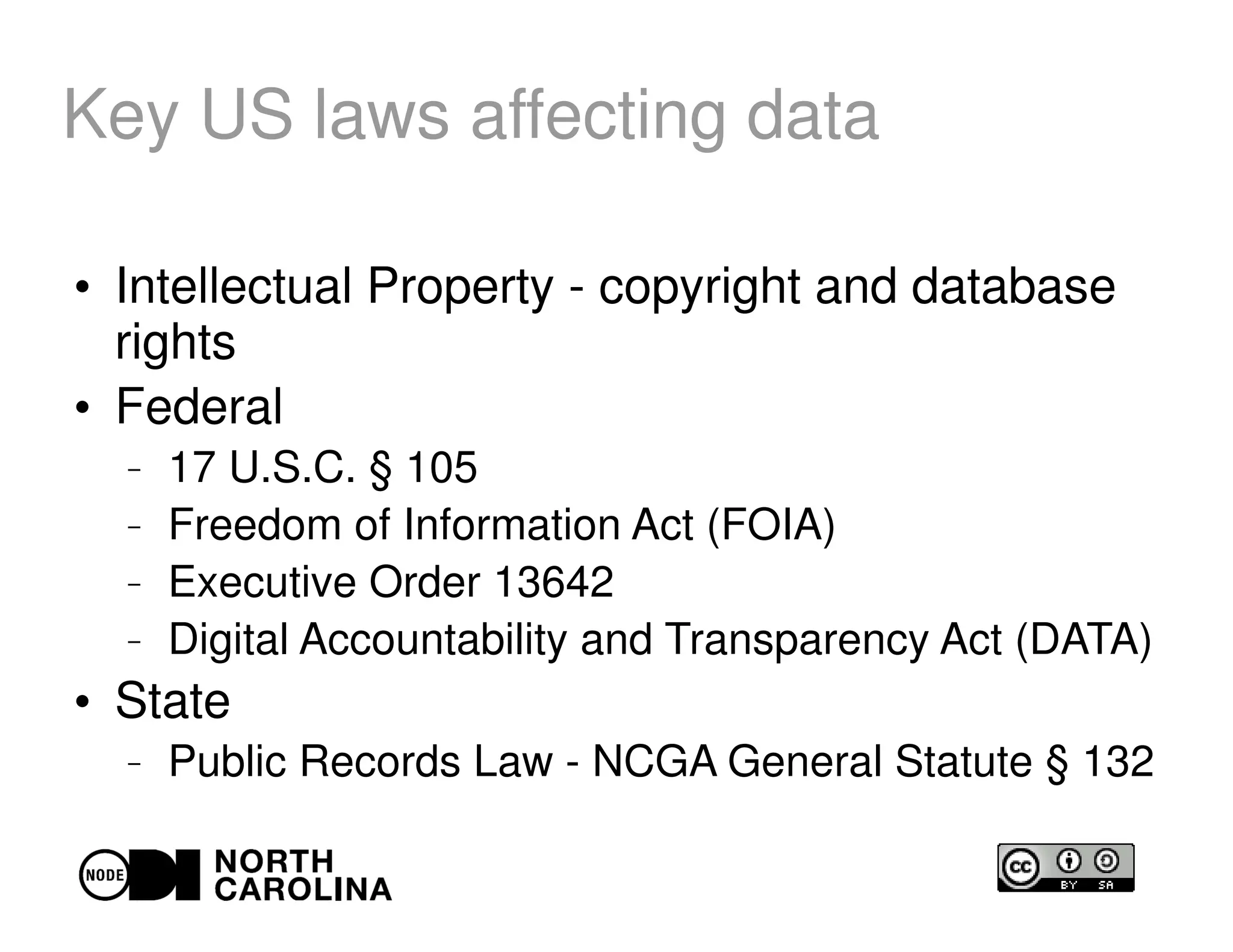
Key US laws affecting data
●
Intellectual Property - copyright and database
rights
●
Federal
– 17 U.S.C. § 105
– Freedom of Information Act (FOIA)
– Executive Order 13642
– Digital Accountability and Transparency Act (DATA)
●
State
– Public Records Law - NCGA General Statute § 132
What are intellectual property rights?
Rights which are given which allow ownership of
creations
●
Patents
●
Trade marks
●
Design rights
●
Copyright
●
Database rights
●
Many creations are a bundle of rights – protected by
more than one or all of the above
US Copyright Law
The US Constitution explicitly grants Congress
the power to create copyright law.
●
Article 1, Section 8, Clause 8, (the Copyright Clause)
– To promote the Progress of Science and useful
Arts, by securing for limited Times to Authors and
Inventors the exclusive Right to their respective
Writings and Discoveries.
US Copyright law is governed by the federal
Copyright Act of 1976.
US Copyright
●
Protects "original works of authorship" (published and
unpublished)
●
Gives exclusive rights to the author of the work
allowing the author to control the copying and
exploitation of it
●
Arises automatically
●
Protects the expression of an idea, not the idea itself.
●
Beware “public domain” assumption and myth
●
Fair Use exemptions
Database definition
“A collection of independent works, data or other
materials which are arranged in a systematic or
methodical way and are individually accessible
by electronic or other means”
Database definition
“A collection of independent works, data or other
materials which are arranged in a systematic or
methodical way and are individually accessible
by electronic or other means”
●
Facts are considered "ideas" or "discoveries", they
are not copyrightable
●
The Copyright Act, allows copyright protection for
"compilations", limited to the selection and
arrangement of facts, not to the facts themselves.
No License?
●
If no license is mentioned (even public domain) then
like most other websites it becomes a case for the
courts.
●
Most curated content is not specifically licensed and
this is why copyright (all rights reserved)
automatically applies to creative works.
●
This means without a license then it could be
assumed that what is meant to be open data, in fact
isn’t.
Information from Dr David Tarrant, Senior Trainer for the
Open Data Institute UK. @davetaz
Open Data Licenses
●
Creative Commons
●
Open Data Commons
Creative Commons
A Creative Commons (CC) license
is one of several public copyright
licenses that enable the free
distribution of an otherwise
copyrighted work. A CC license is
used when an author wants to give
people the right to share, use and
build upon a work that they have
created. Information in this section is from Creative
Commons: http://creativecommons.org/
Creative Commons
Public Domain Mark
●
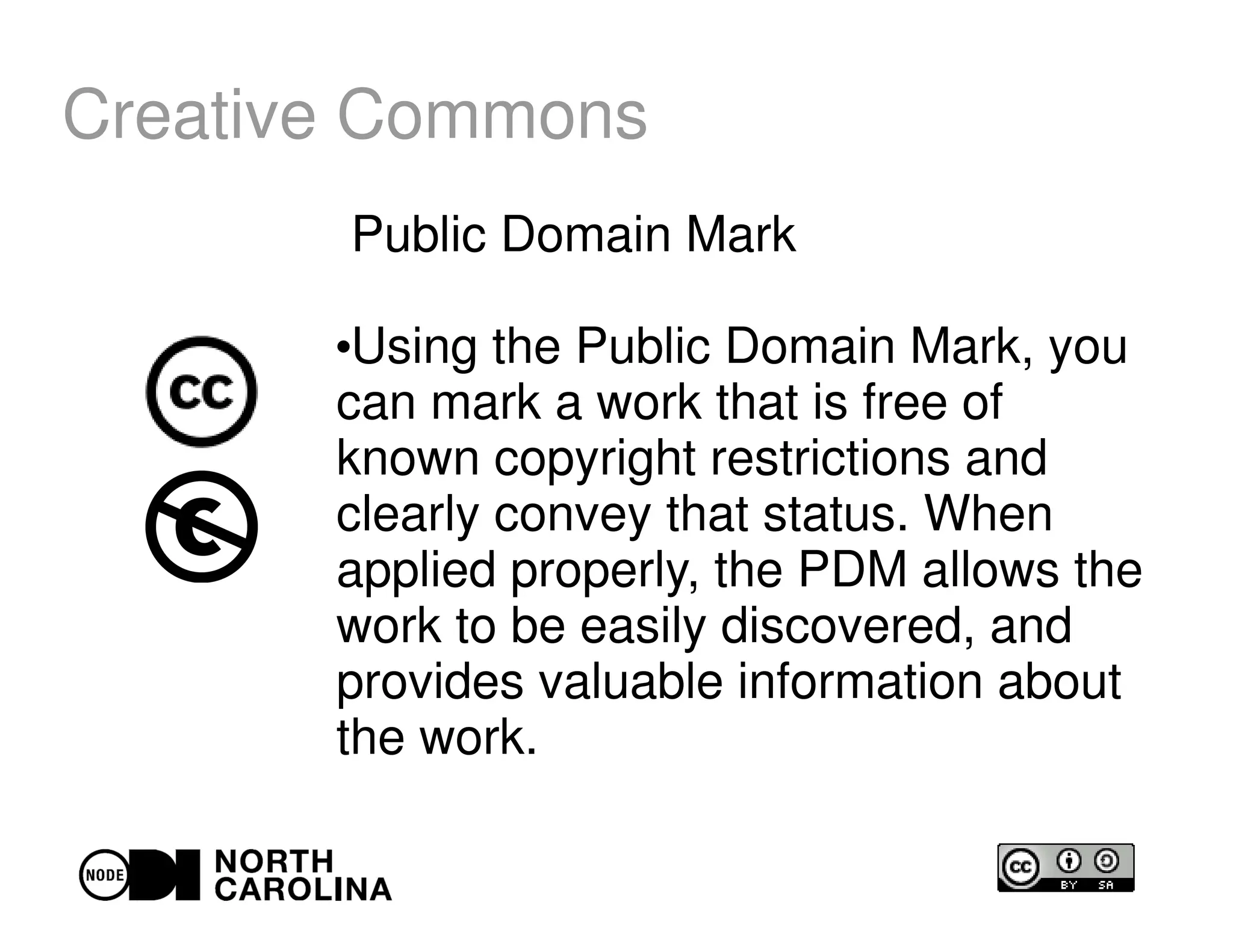
Using the Public Domain Mark, you
can mark a work that is free of
known copyright restrictions and
clearly convey that status. When
applied properly, the PDM allows the
work to be easily discovered, and
provides valuable information about
the work.
Creative Commons
Attribution (BY)
●
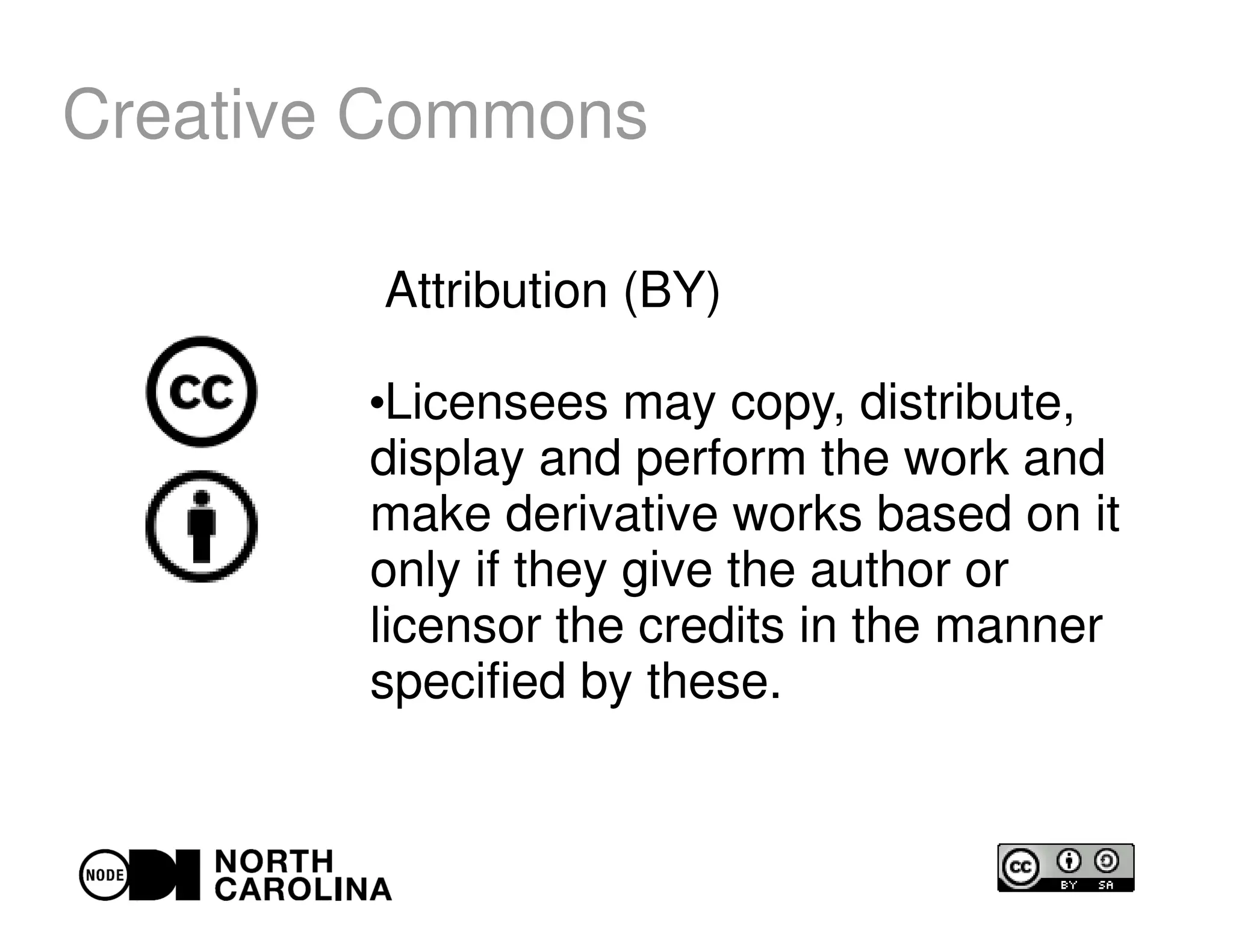
Licensees may copy, distribute,
display and perform the work and
make derivative works based on it
only if they give the author or
licensor the credits in the manner
specified by these.
Creative Commons
Share-alike (SA)
●
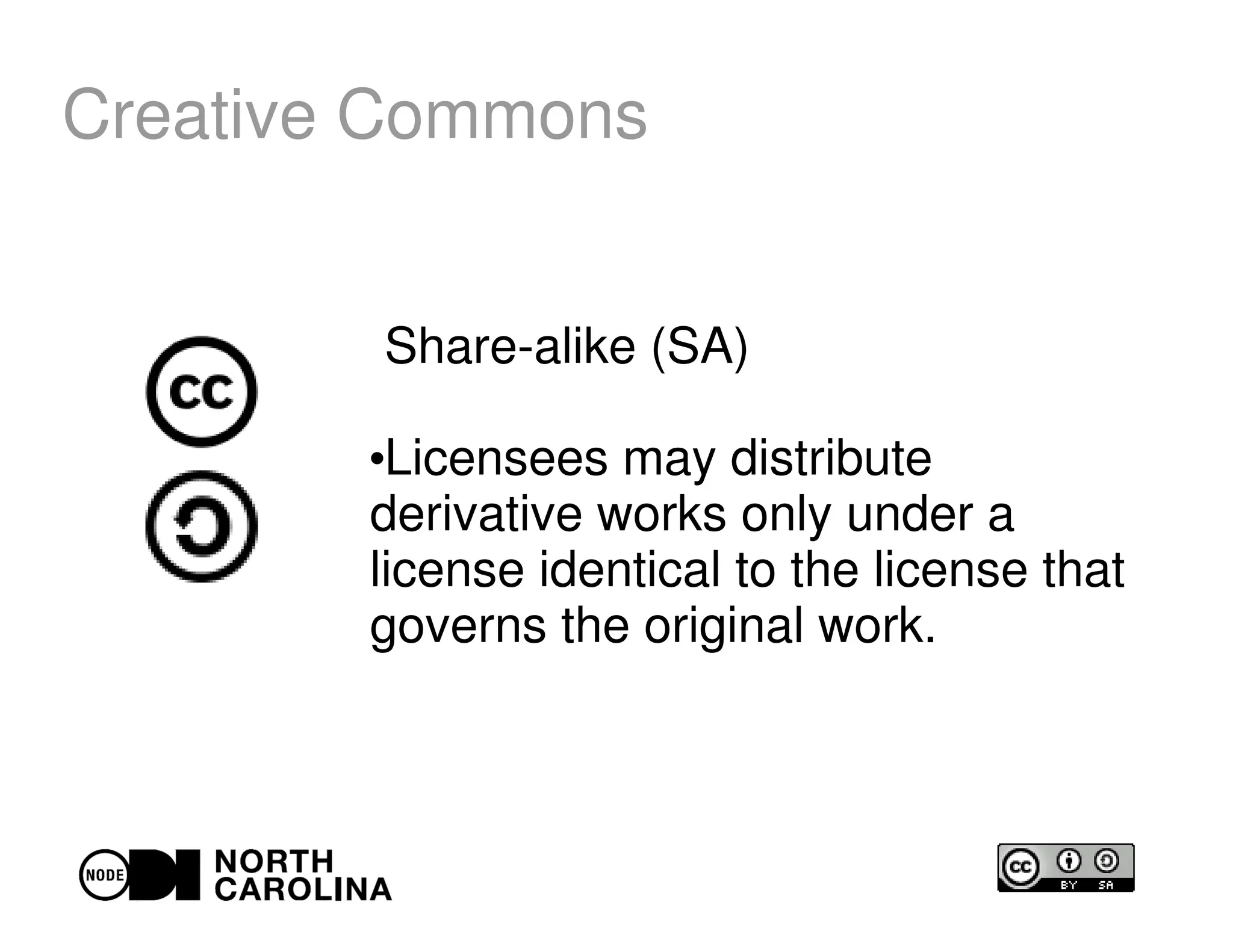
Licensees may distribute
derivative works only under a
license identical to the license that
governs the original work.
Creative Commons
Non-commercial (NC)
●
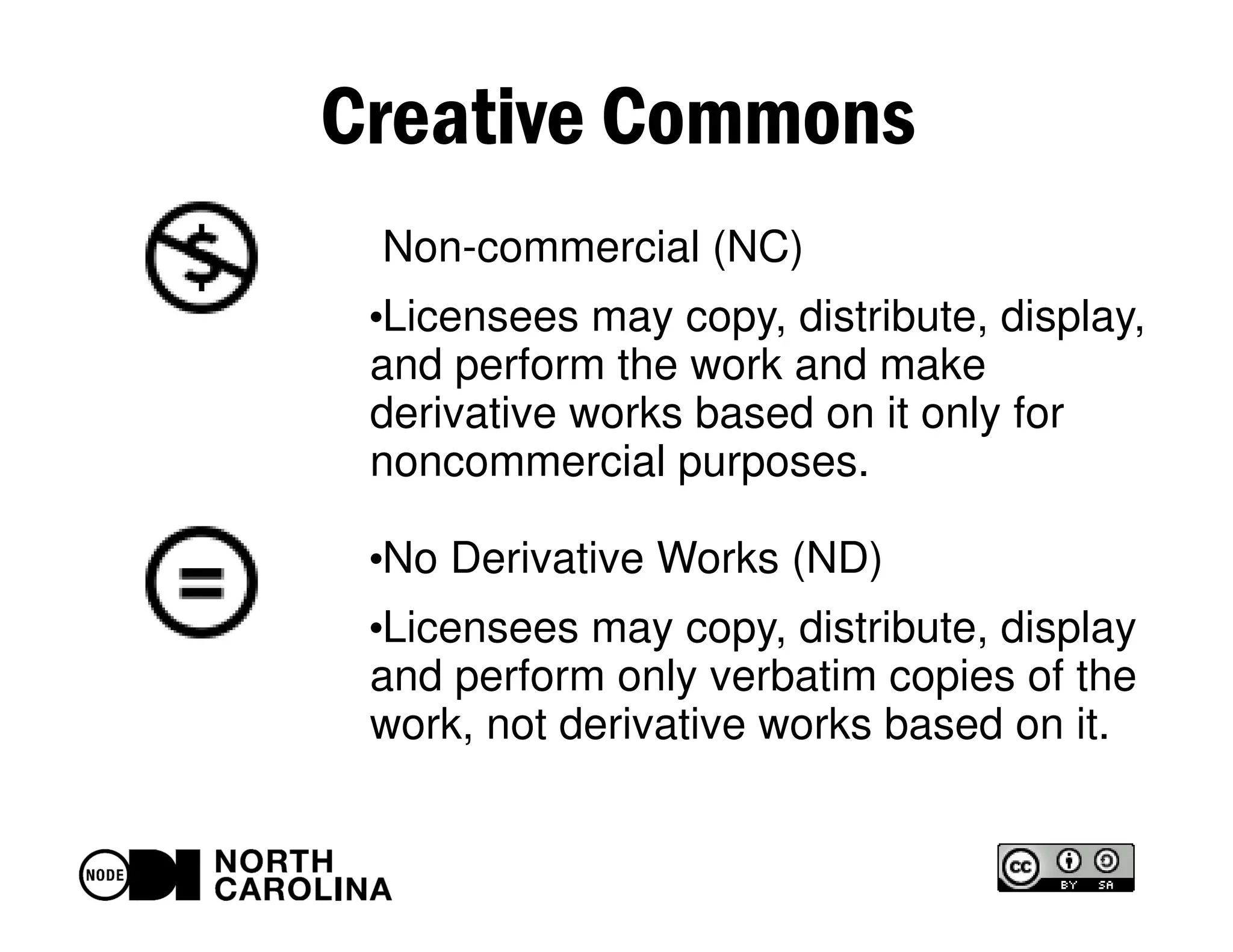
Licensees may copy, distribute, display,
and perform the work and make
derivative works based on it only for
noncommercial purposes.
●
No Derivative Works (ND)
●
Licensees may copy, distribute, display
and perform only verbatim copies of the
work, not derivative works based on it.
Creative Commons
CC0 - “No rights reserved”
●
In contrast to CC’s licenses that allow copyright
holders to choose from a range of permissions while
retaining their copyright, CC0 empowers yet another
choice altogether – the choice to opt out of copyright
and database protection, and the exclusive rights
automatically granted to creators – the “no rights
reserved” alternative to our licenses.
●
CC0 waives any and all domestic and foreign
copyright protections and related rights over a work
to whatever extent that they can be waived.
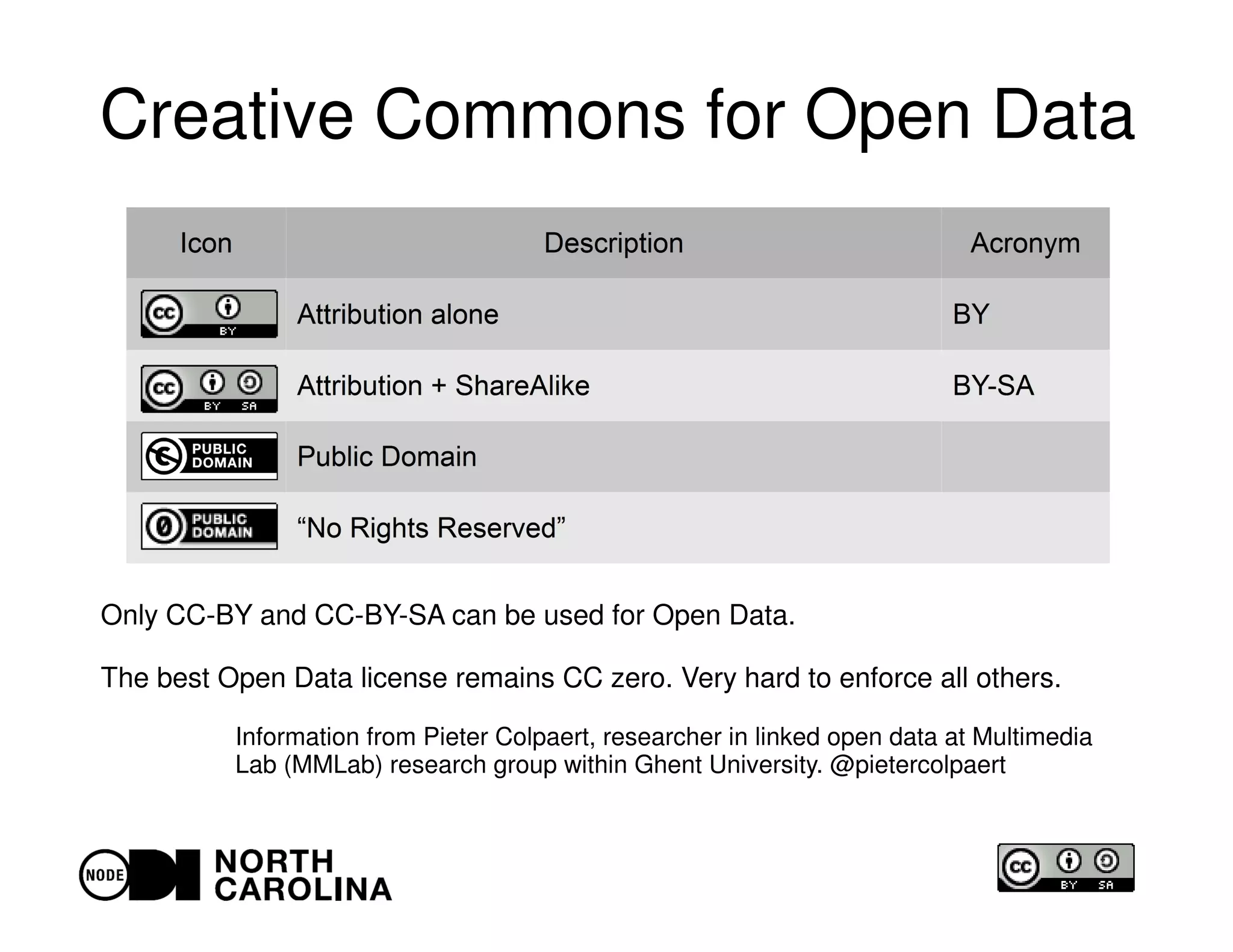
Creative Commons for Open Data
Only CC-BY and CC-BY-SA can be used for Open Data.
The best Open Data license remains CC zero. Very hard to enforce all others.
Information from Pieter Colpaert, researcher in linked open data at Multimedia
Lab (MMLab) research group within Ghent University. @pietercolpaert
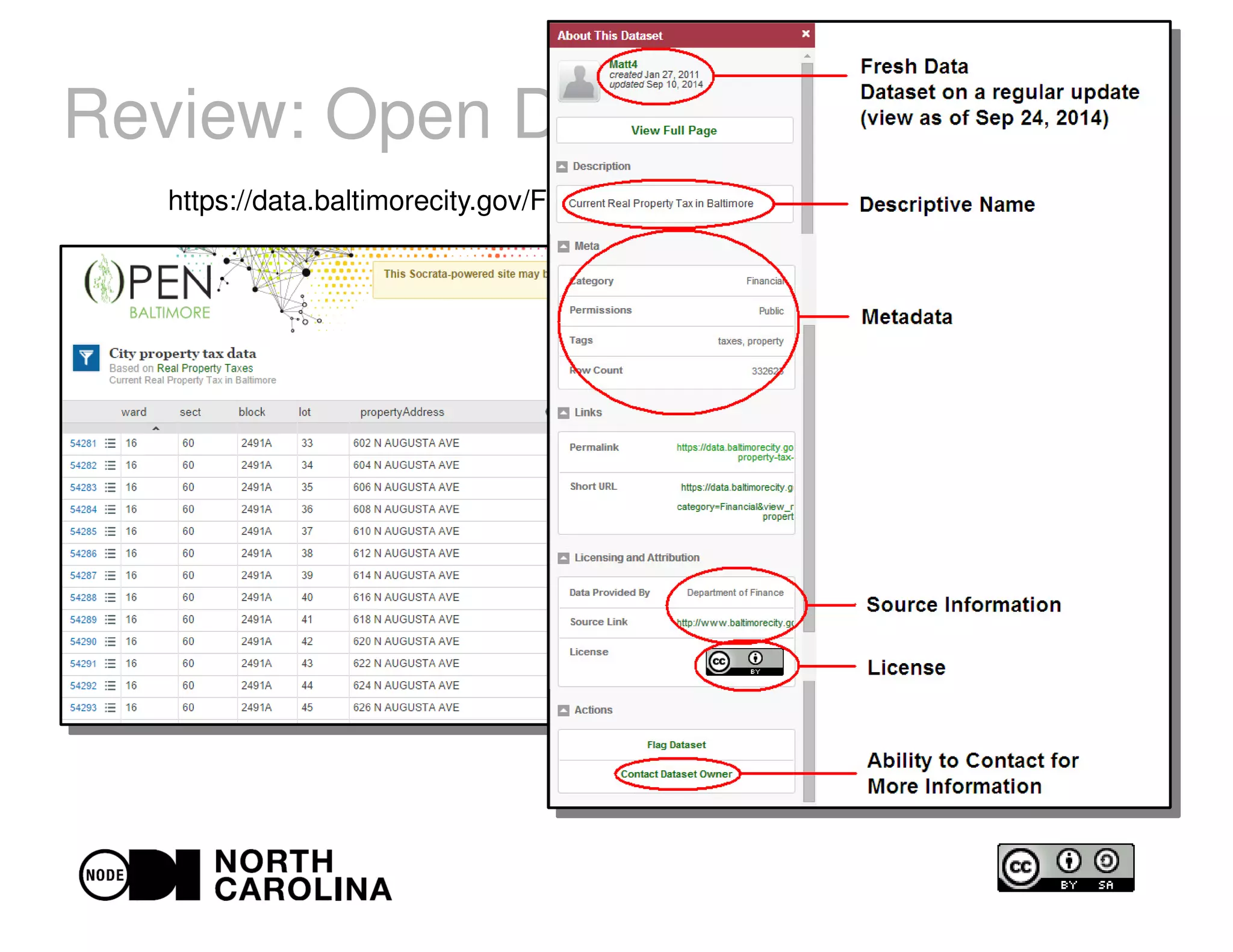
Review: Open Data?
https://data.baltimorecity.gov/Financial/City-property-tax-data/axxk-zyb9
Open Data Commons
●
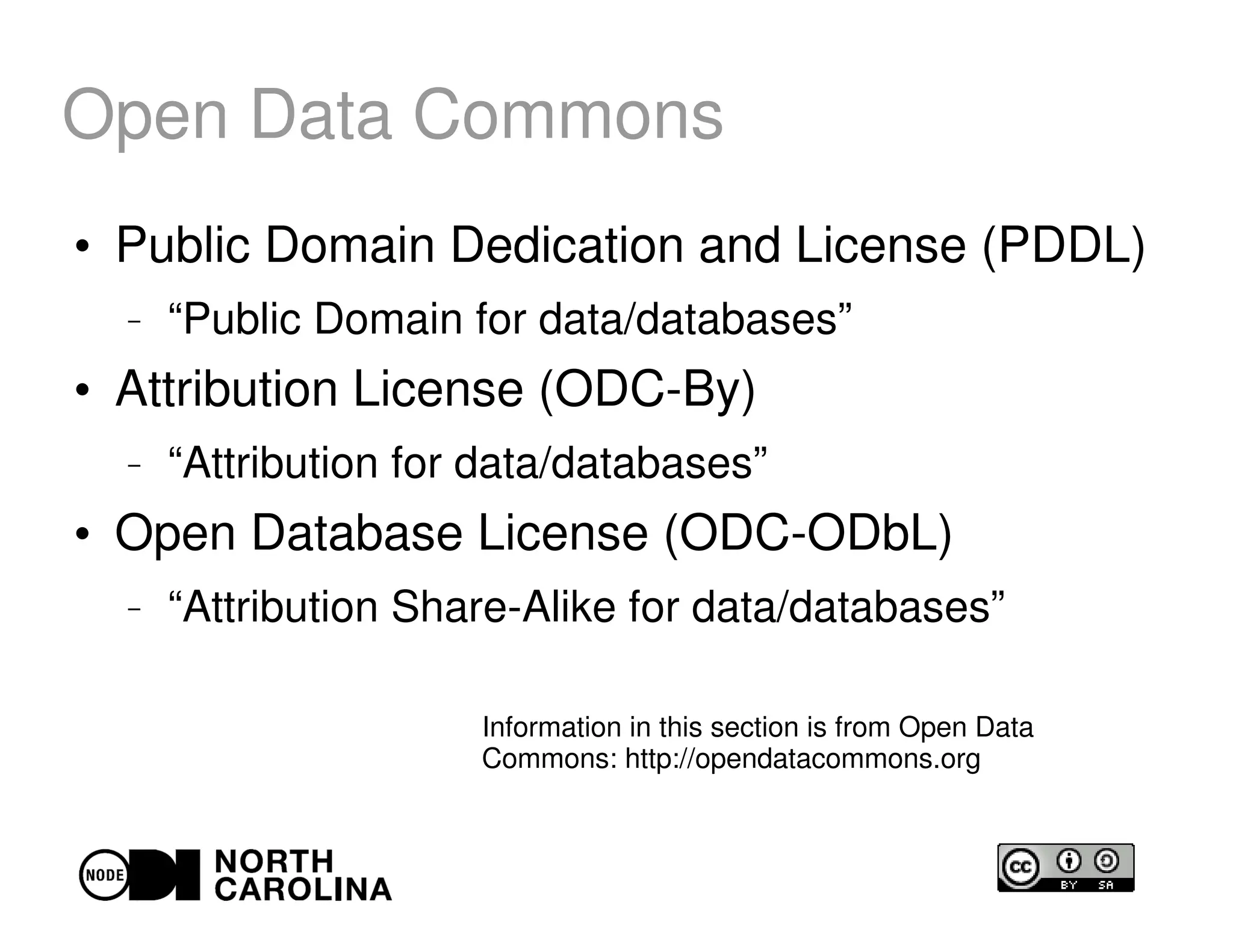
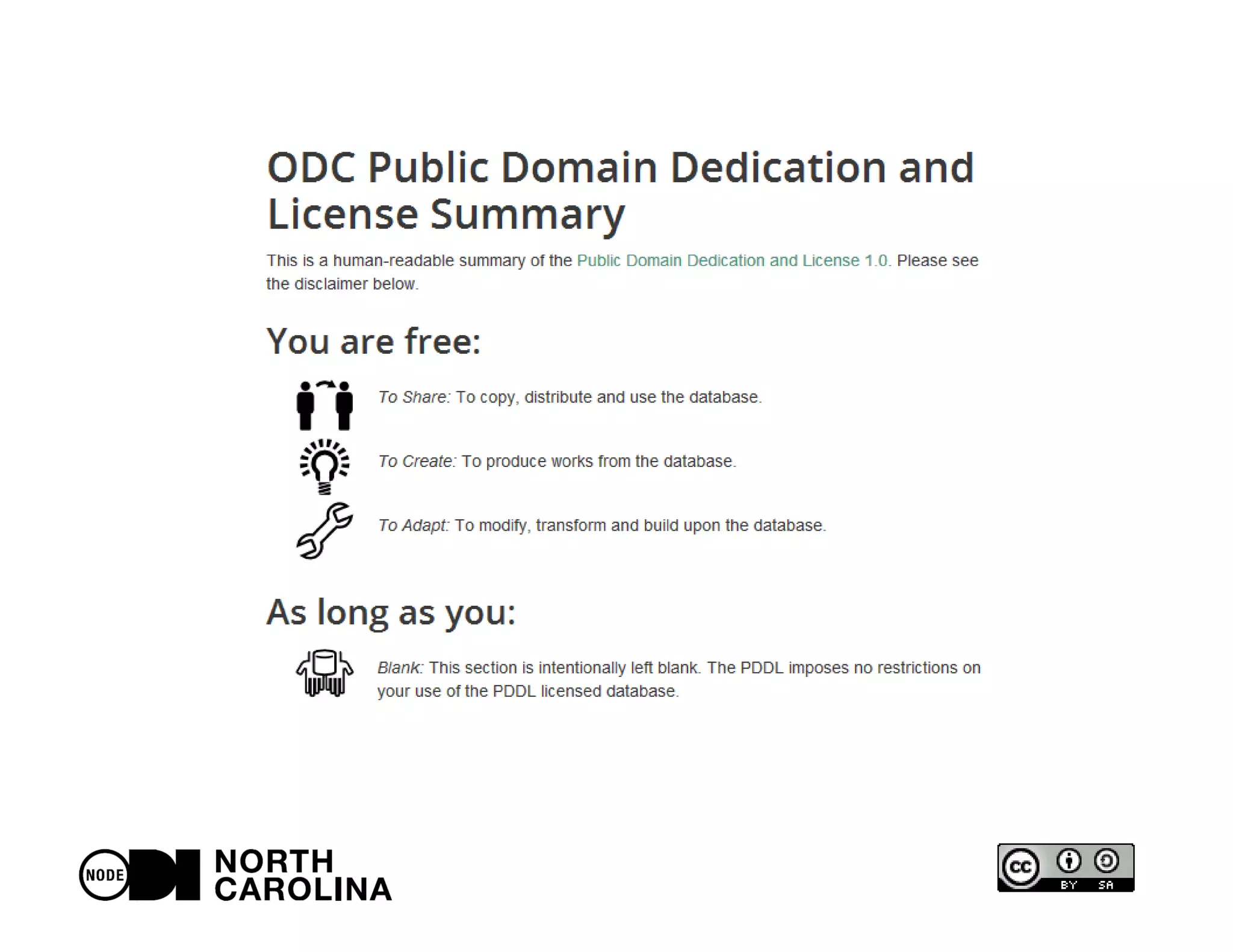
Public Domain Dedication and License (PDDL)
– “Public Domain for data/databases”
●
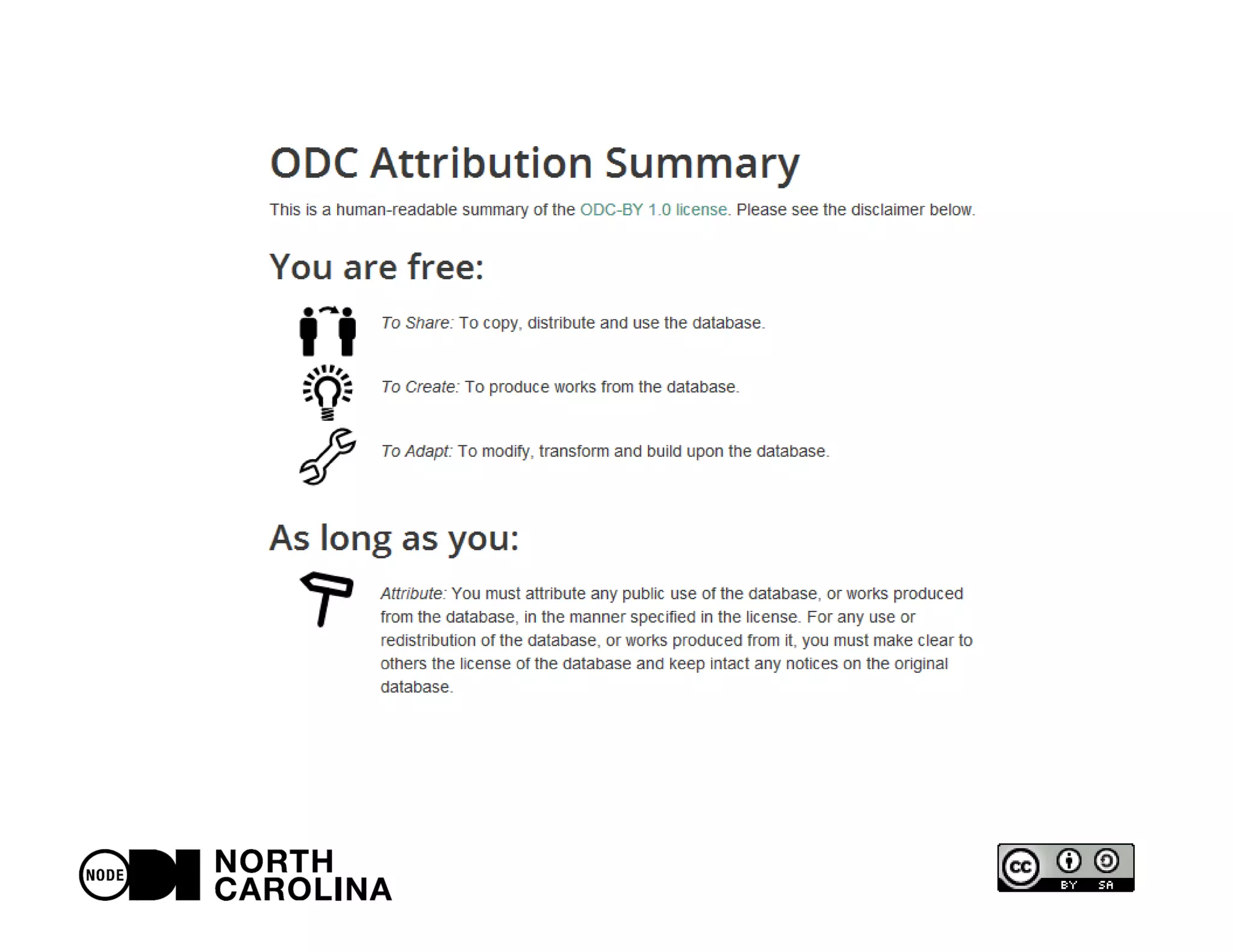
Attribution License (ODC-By)
– “Attribution for data/databases”
●
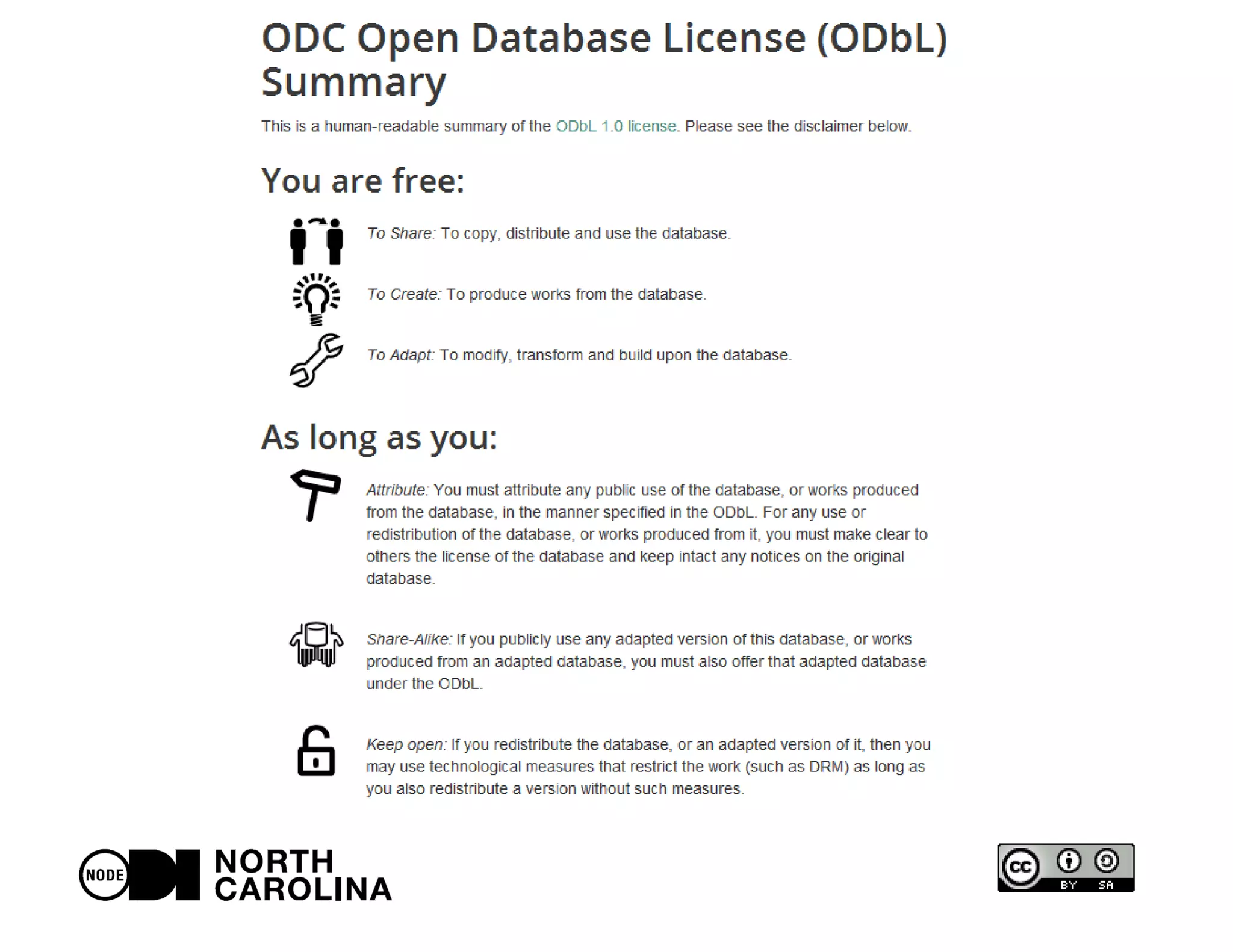
Open Database License (ODC-ODbL)
– “Attribution Share-Alike for data/databases”
Information in this section is from Open Data
Commons: http://opendatacommons.org
Open Data Commons
●
Distinguish Between the “Database” and its
“Contents”?
– They may have separate rights
– For example, consider a database of photographs. Here
there are the rights in the database and quite separate
individual copyrights in the photographs.
– Or consider the example of Freebase which contains
textual material and images from Wikipedia as well as user
contributed material. While Freebase controls the database
the individual items of contents need to have their own
separate license
Foreign Copyright?
“Foreign copyright may apply to any government
data. A waiver of foreign copyright protections is
suggested, especially if foreign use of the data is
important.”
Best-Practices Language for Making Data
“License-Free”
http://theunitedstates.io/licensing/
Open Data Certifications
●
5 Star Open Data Scheme
●
ODI Open Data Certificates
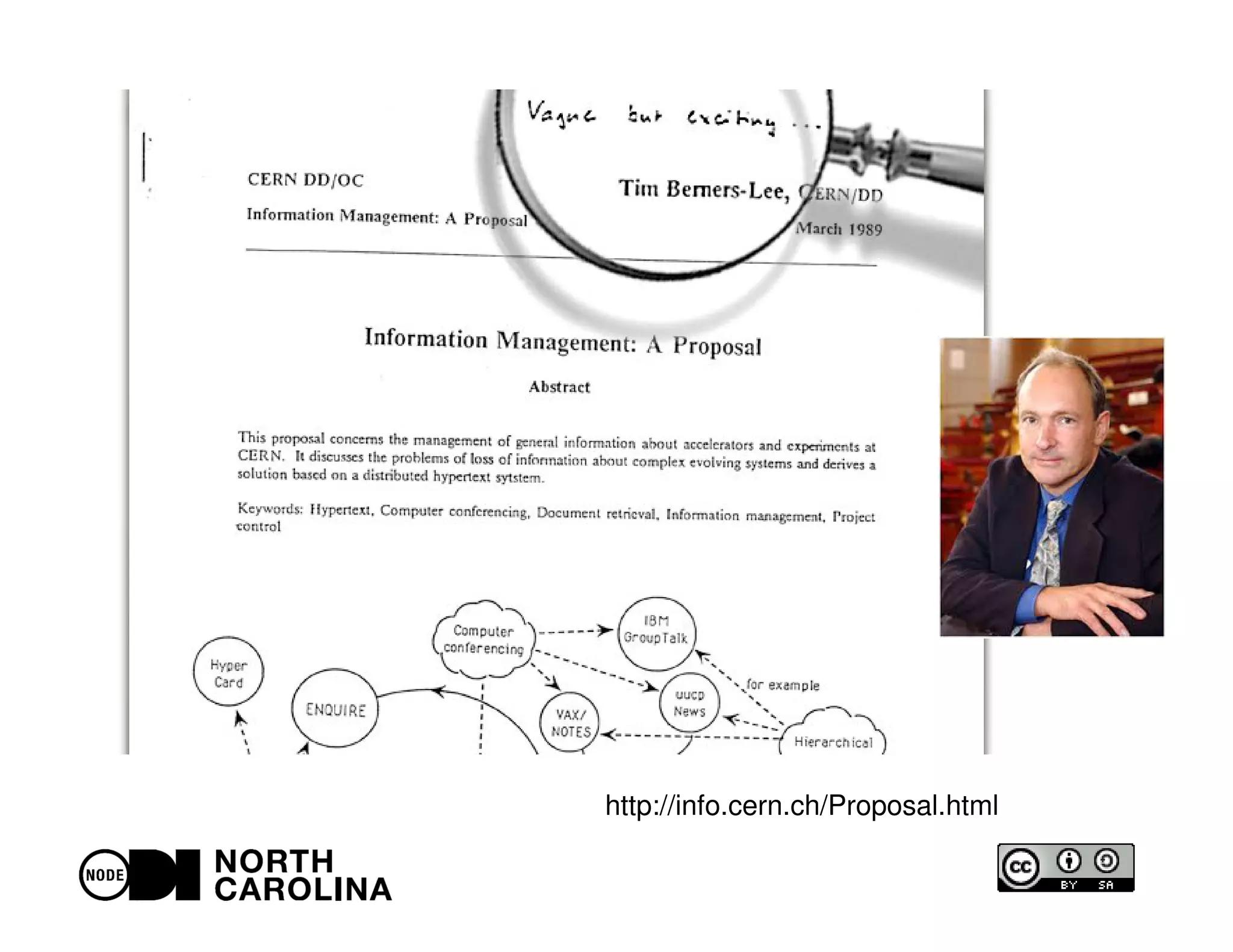
http://info.cern.ch/Proposal.html
Semantic Web / Linked Data
http://www.w3.org/DesignIssues/LinkedData.html
●
The Semantic Web isn't just about putting data
on the web.
●
It is about making links, so that a person or
machine can explore the web of data.
●
With linked data, when you have some of it,
you can find other, related, data.
- 2006
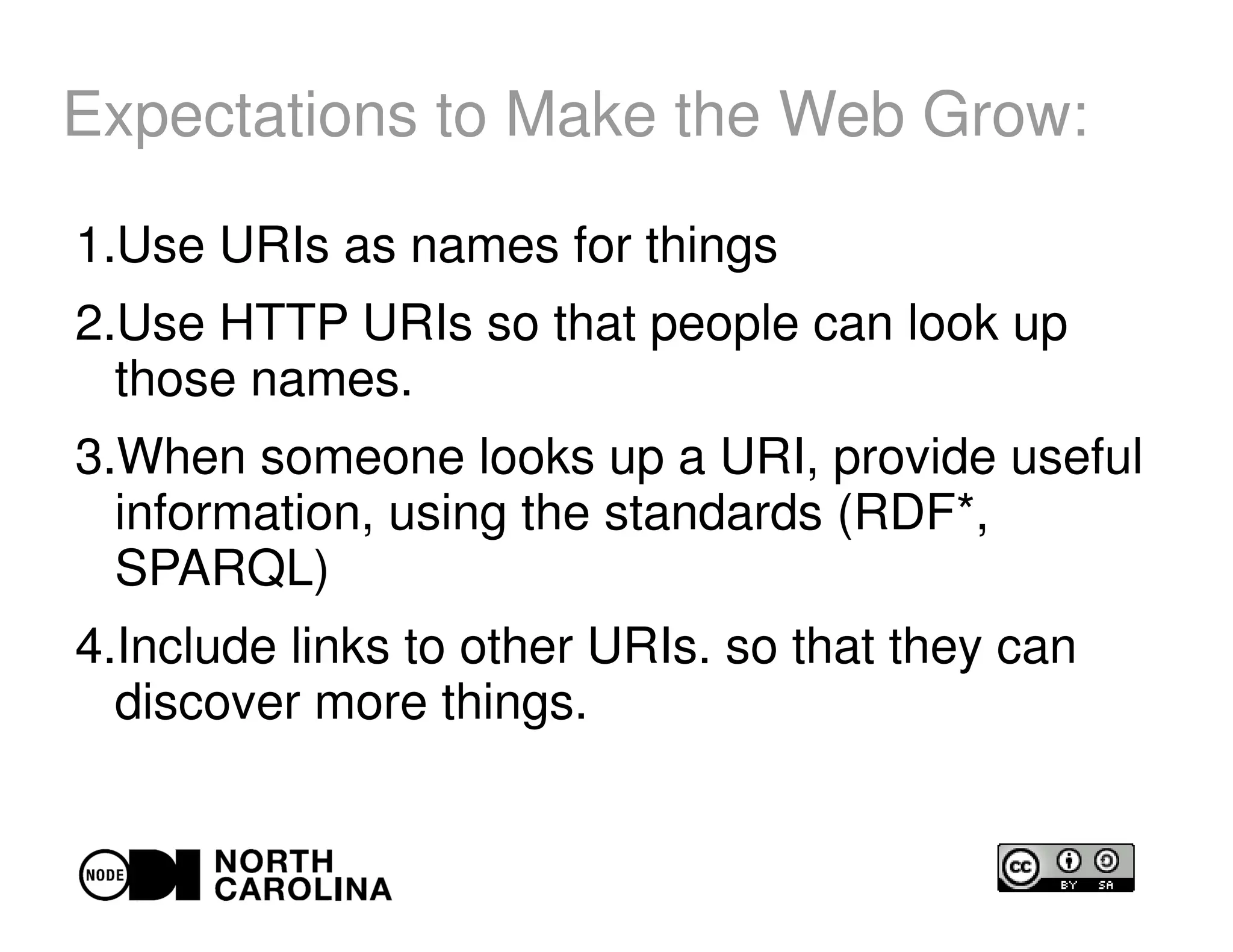
Expectations to Make the Web Grow:
1.Use URIs as names for things
2.Use HTTP URIs so that people can look up
those names.
3.When someone looks up a URI, provide useful
information, using the standards (RDF*,
SPARQL)
4.Include links to other URIs. so that they can
discover more things.
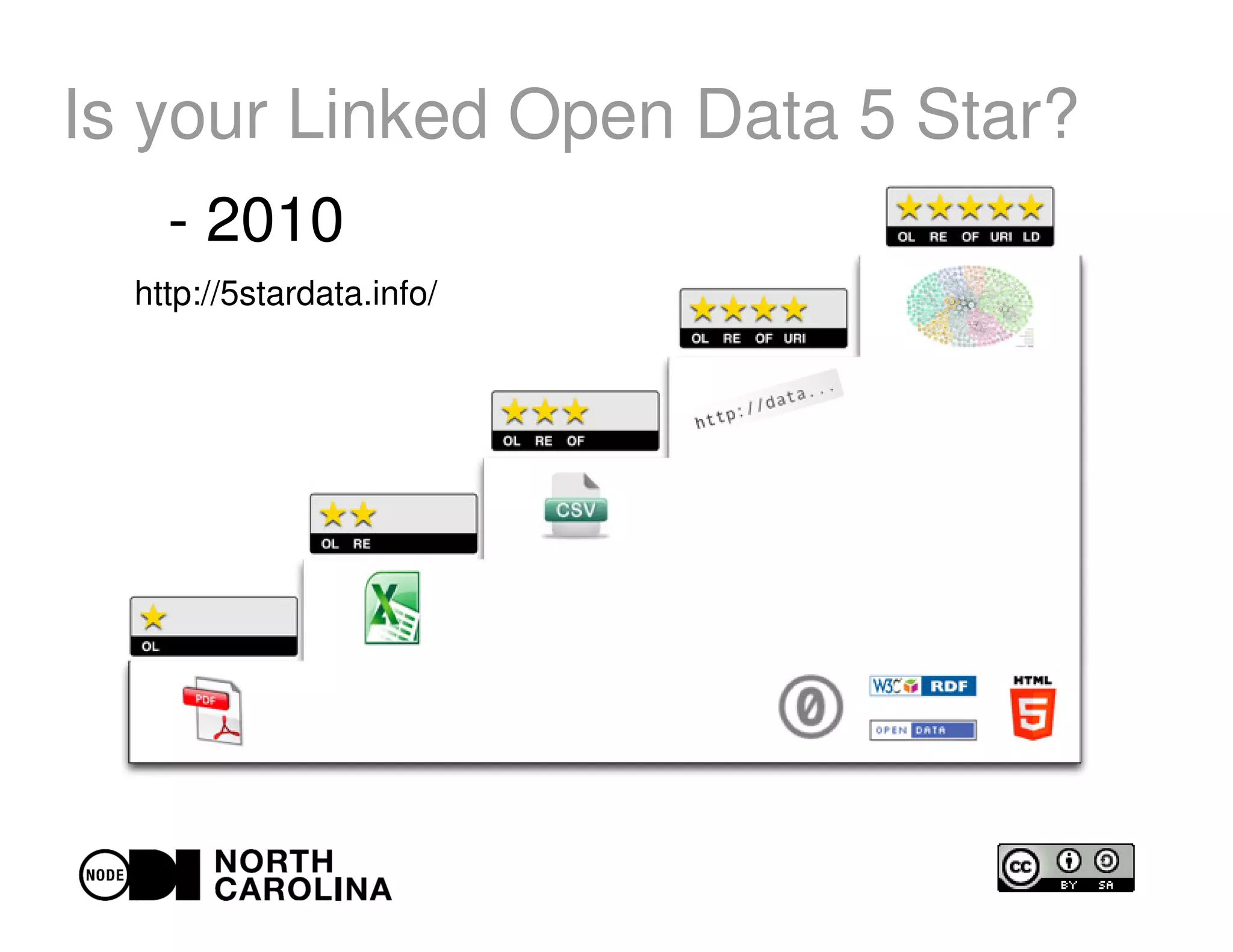
Is your Linked Open Data 5 Star?
- 2010
http://5stardata.info/
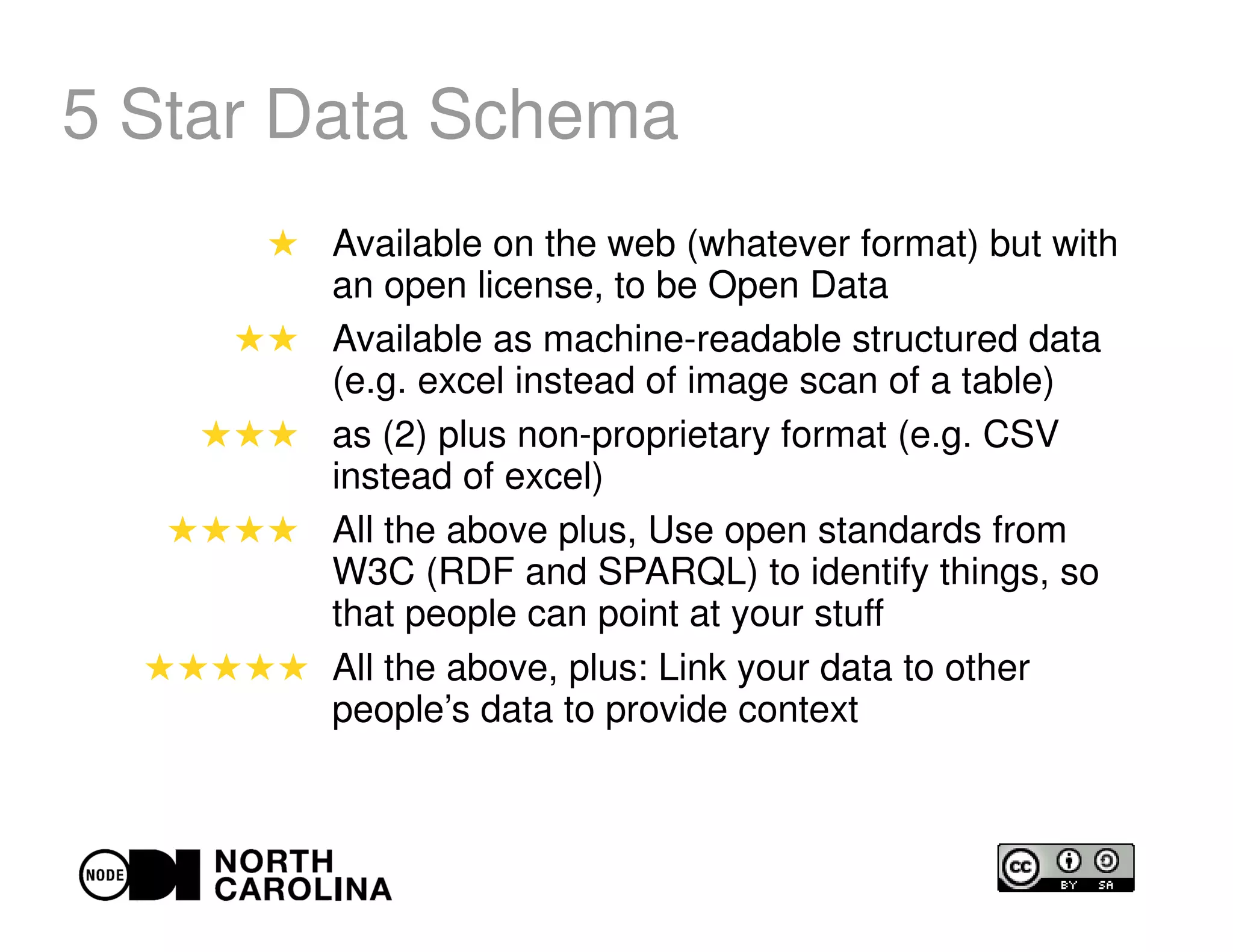
5 Star Data Schema
★ Available on the web (whatever format) but with
an open license, to be Open Data
★★ Available as machine-readable structured data
(e.g. excel instead of image scan of a table)
★★★ as (2) plus non-proprietary format (e.g. CSV
instead of excel)
★★★★ All the above plus, Use open standards from
W3C (RDF and SPARQL) to identify things, so
that people can point at your stuff
★★★★★ All the above, plus: Link your data to other
people’s data to provide context
5 Star Data Schema
●
Legal and Technical aspects only
●
No Context
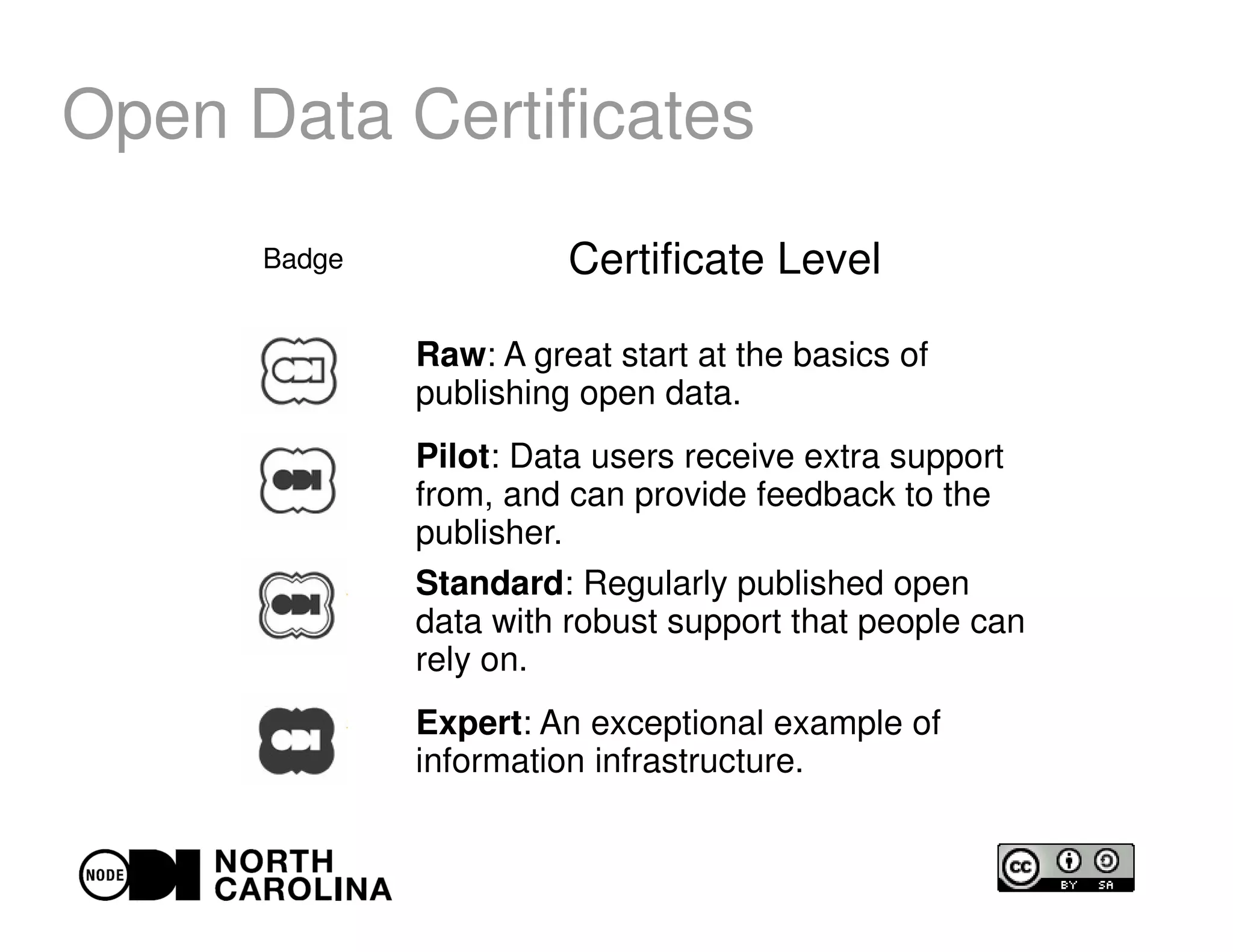
Badge Certificate Level
Raw: A great start at the basics of
publishing open data.
Pilot: Data users receive extra support
from, and can provide feedback to the
publisher.
Standard: Regularly published open
data with robust support that people can
rely on.
Expert: An exceptional example of
information infrastructure.
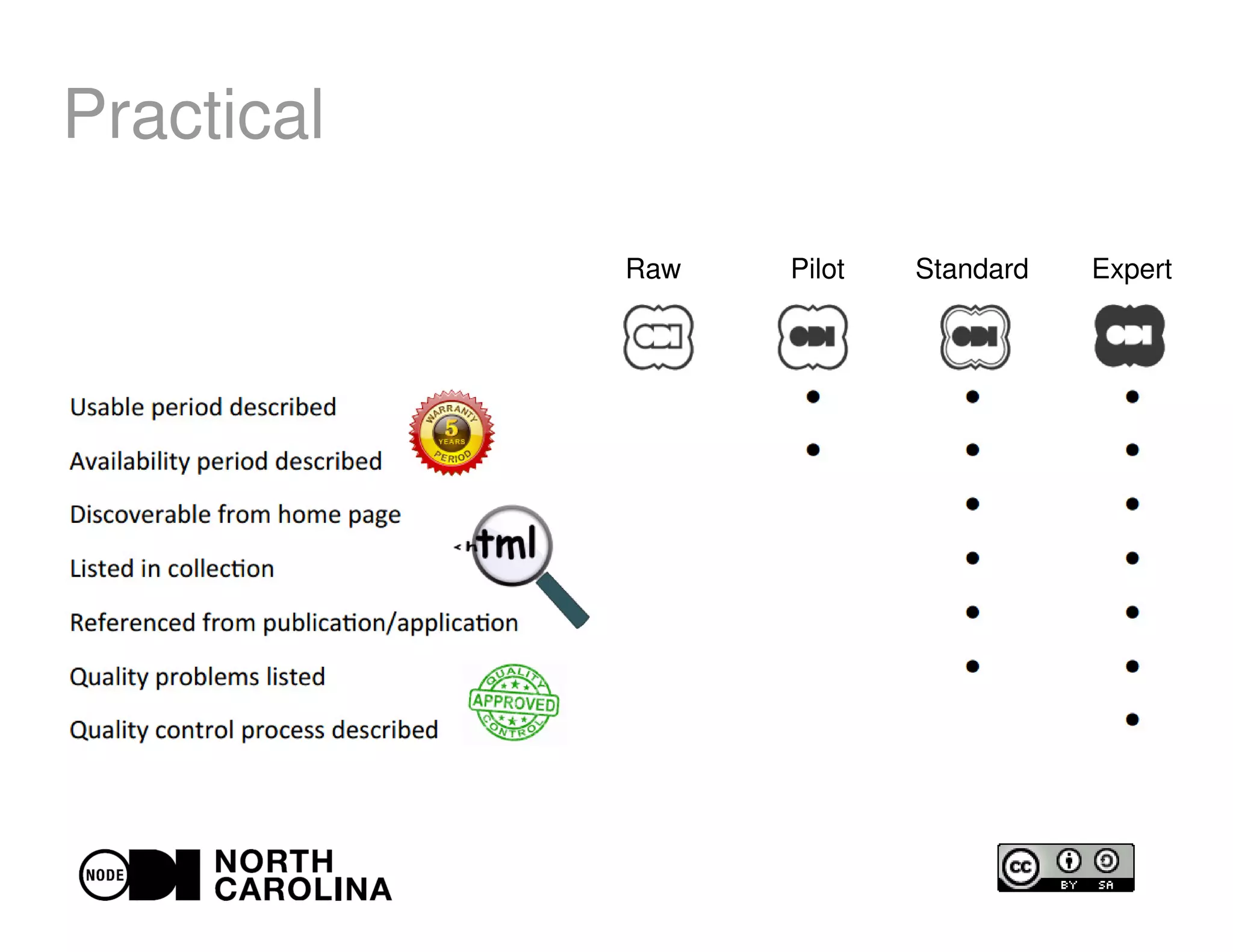
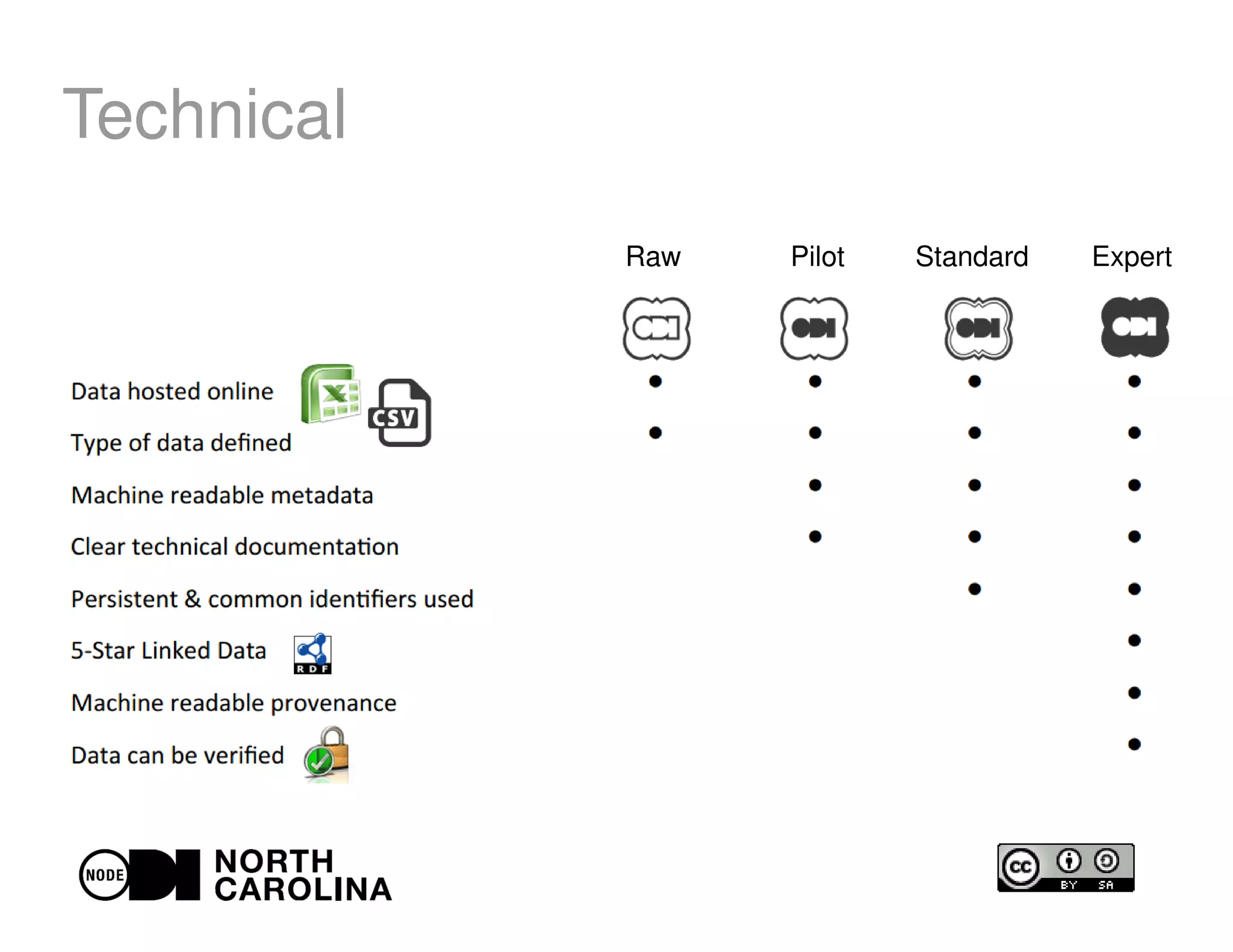
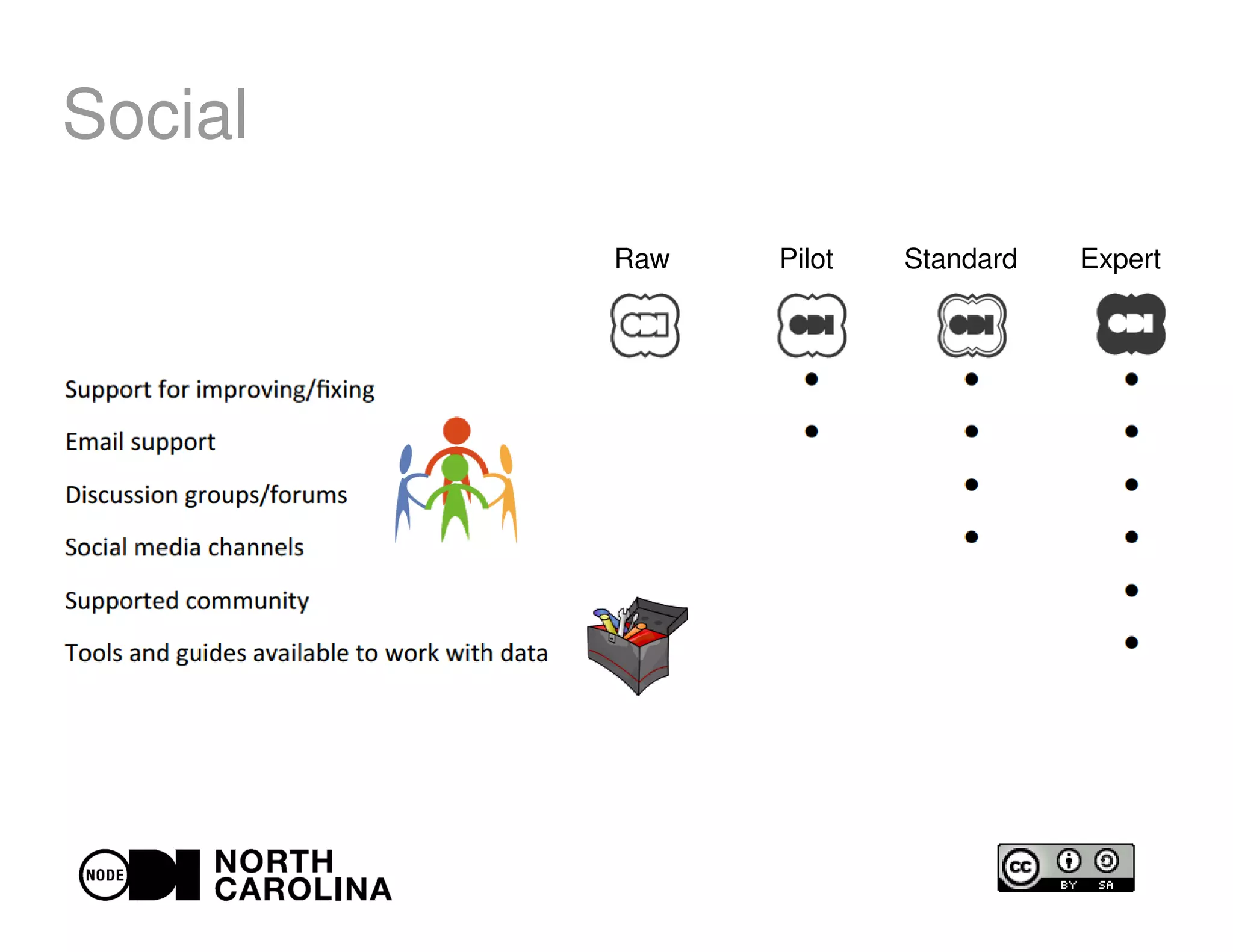
Open Data Certificates
●
Adds Context
●
Not just Legal and Technical
●
General, Practical and Social
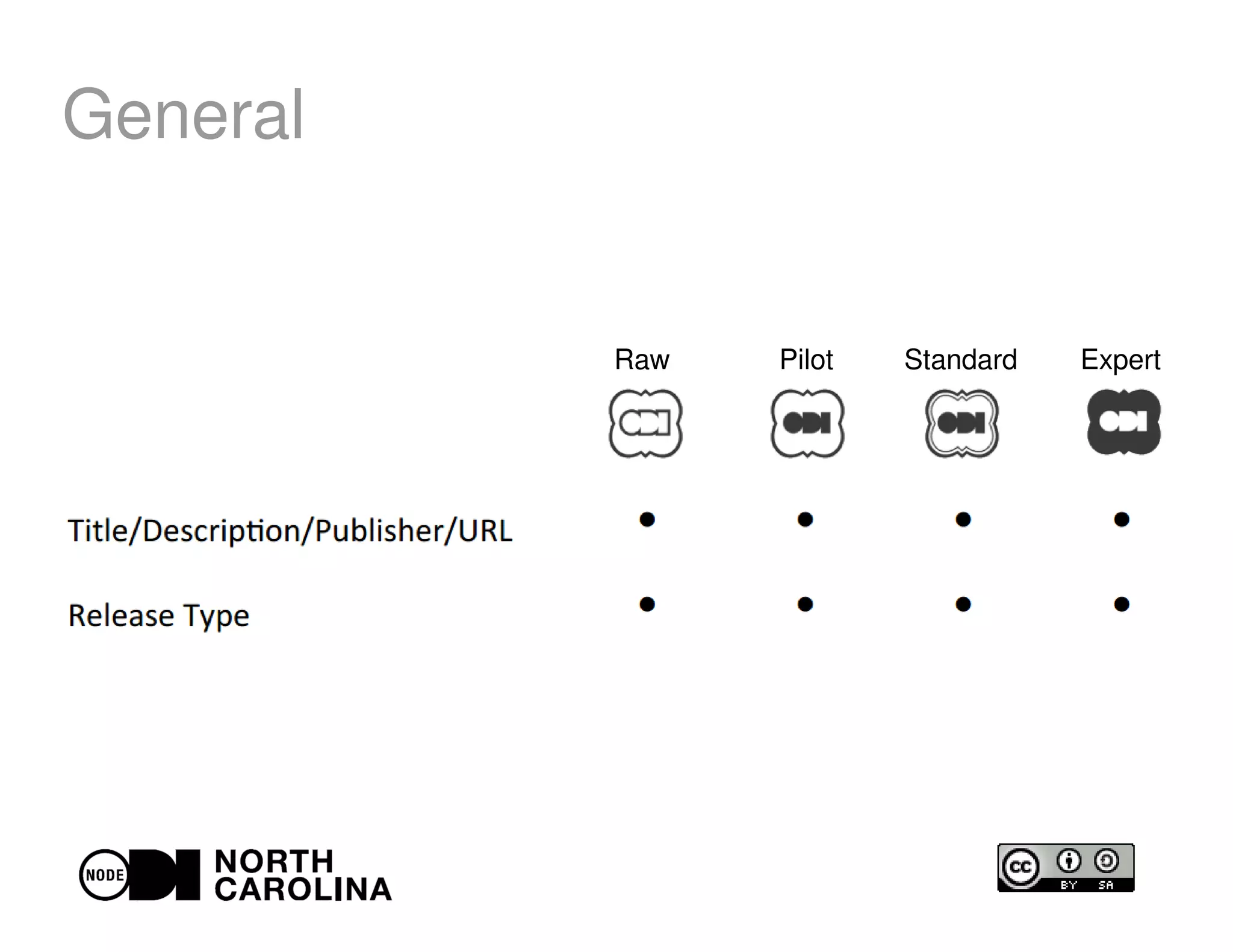
General
Raw Pilot Standard Expert
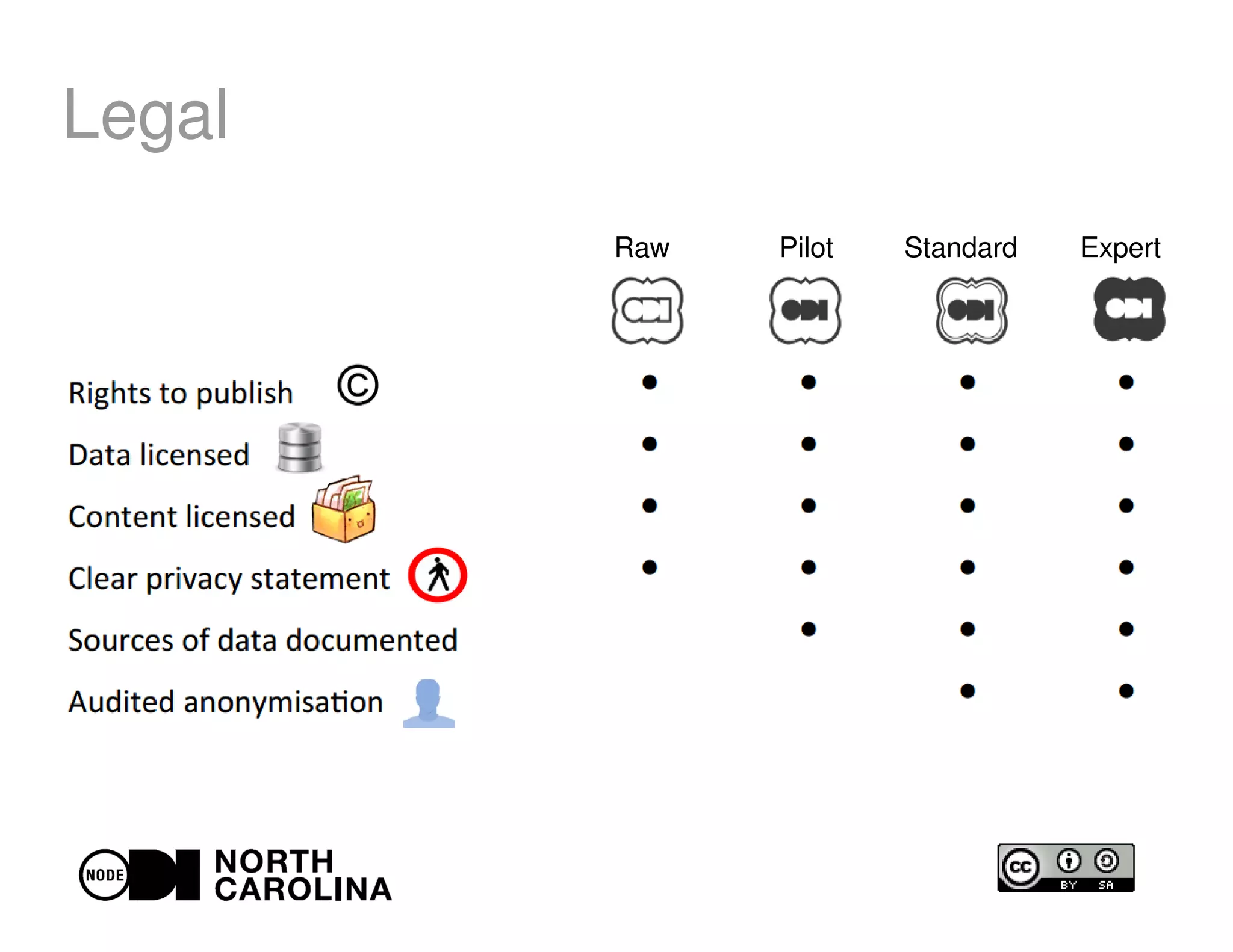
Legal
Raw Pilot Standard Expert
Practical
Raw Pilot Standard Expert
Technical
Raw Pilot Standard Expert
Social
Raw Pilot Standard Expert
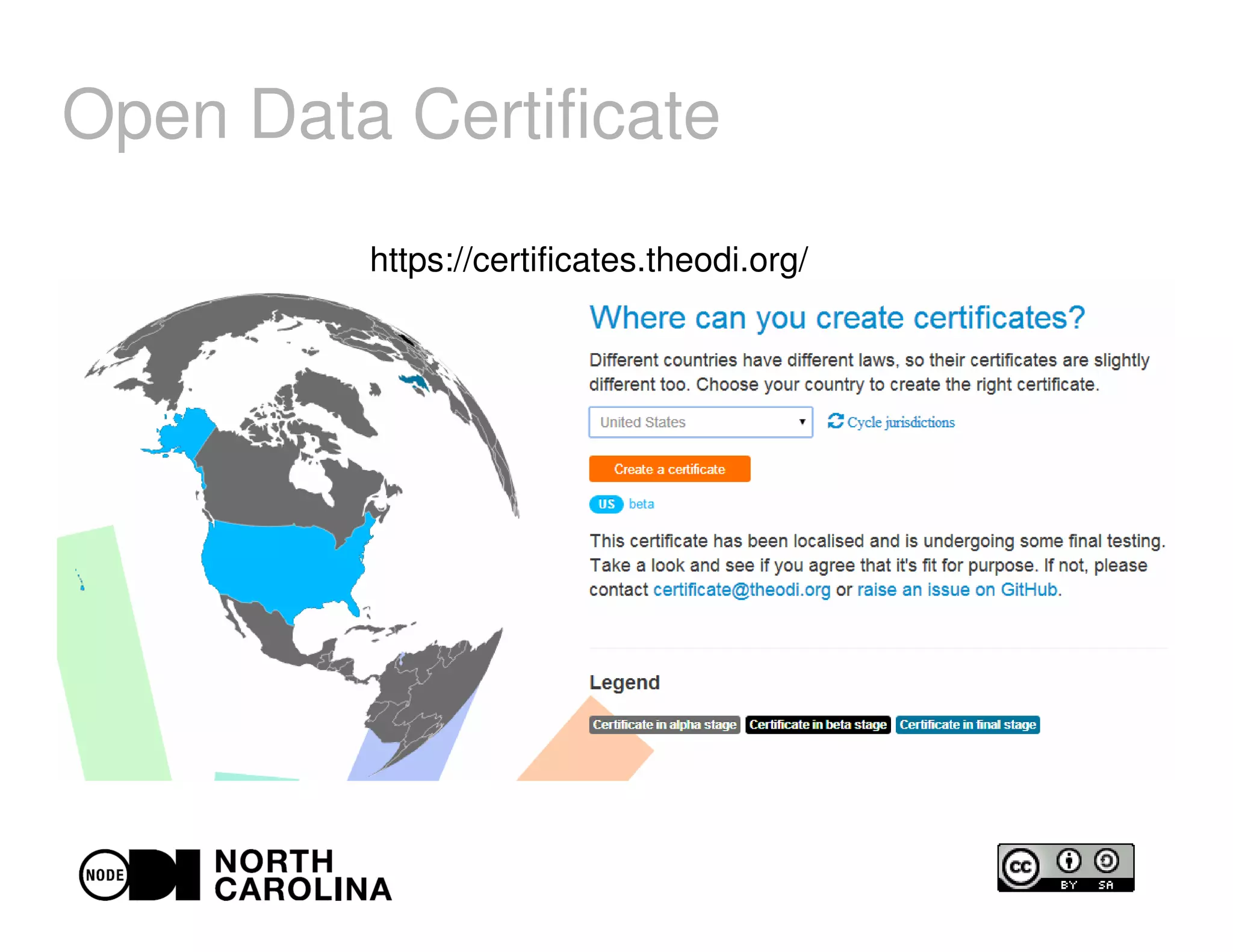
Open Data Certificate
https://certificates.theodi.org/
One Objective
●
Minimum Requirement
– 3-Star Data
– Standard Level Open Data
Certificate
★★★
Review
●
Explain open data licenses
●
Know two different certification processes for
open data best practice
How to minimize risks by
understanding licensing and
certificates
Questions?

Open Data in a Day - Licensing, Law and Best Practice

  • 1.
    Open Data Licensing, Law andBest Practice Ian Henshaw Registered ODI Trainer ian.henshaw@gmail.com @ihenshaw
  • 2.
    Outcome ● Explain open datalicenses ● Know two different certification processes for open data best practice How to minimize risks by understanding licensing and certificates
  • 3.
    Please note, Iam not a lawyer and this should not be treated as legal advice. Law and licensing
  • 4.
    Key US lawsaffecting data ● Intellectual Property - copyright and database rights ● Federal – 17 U.S.C. § 105 – Freedom of Information Act (FOIA) – Executive Order 13642 – Digital Accountability and Transparency Act (DATA) ● State – Public Records Law - NCGA General Statute § 132
  • 5.
    What are intellectualproperty rights? Rights which are given which allow ownership of creations ● Patents ● Trade marks ● Design rights ● Copyright ● Database rights ● Many creations are a bundle of rights – protected by more than one or all of the above
  • 6.
    US Copyright Law TheUS Constitution explicitly grants Congress the power to create copyright law. ● Article 1, Section 8, Clause 8, (the Copyright Clause) – To promote the Progress of Science and useful Arts, by securing for limited Times to Authors and Inventors the exclusive Right to their respective Writings and Discoveries. US Copyright law is governed by the federal Copyright Act of 1976.
  • 7.
    US Copyright ● Protects "originalworks of authorship" (published and unpublished) ● Gives exclusive rights to the author of the work allowing the author to control the copying and exploitation of it ● Arises automatically ● Protects the expression of an idea, not the idea itself. ● Beware “public domain” assumption and myth ● Fair Use exemptions
  • 8.
    Database definition “A collectionof independent works, data or other materials which are arranged in a systematic or methodical way and are individually accessible by electronic or other means”
  • 9.
    Database definition “A collectionof independent works, data or other materials which are arranged in a systematic or methodical way and are individually accessible by electronic or other means” ● Facts are considered "ideas" or "discoveries", they are not copyrightable ● The Copyright Act, allows copyright protection for "compilations", limited to the selection and arrangement of facts, not to the facts themselves.
  • 10.
    No License? ● If nolicense is mentioned (even public domain) then like most other websites it becomes a case for the courts. ● Most curated content is not specifically licensed and this is why copyright (all rights reserved) automatically applies to creative works. ● This means without a license then it could be assumed that what is meant to be open data, in fact isn’t. Information from Dr David Tarrant, Senior Trainer for the Open Data Institute UK. @davetaz
  • 11.
    Open Data Licenses ● CreativeCommons ● Open Data Commons
  • 12.
    Creative Commons A CreativeCommons (CC) license is one of several public copyright licenses that enable the free distribution of an otherwise copyrighted work. A CC license is used when an author wants to give people the right to share, use and build upon a work that they have created. Information in this section is from Creative Commons: http://creativecommons.org/
  • 13.
    Creative Commons Public DomainMark ● Using the Public Domain Mark, you can mark a work that is free of known copyright restrictions and clearly convey that status. When applied properly, the PDM allows the work to be easily discovered, and provides valuable information about the work.
  • 14.
    Creative Commons Attribution (BY) ● Licenseesmay copy, distribute, display and perform the work and make derivative works based on it only if they give the author or licensor the credits in the manner specified by these.
  • 15.
    Creative Commons Share-alike (SA) ● Licenseesmay distribute derivative works only under a license identical to the license that governs the original work.
  • 16.
    Creative Commons Non-commercial (NC) ● Licenseesmay copy, distribute, display, and perform the work and make derivative works based on it only for noncommercial purposes. ● No Derivative Works (ND) ● Licensees may copy, distribute, display and perform only verbatim copies of the work, not derivative works based on it.
  • 17.
    Creative Commons CC0 -“No rights reserved” ● In contrast to CC’s licenses that allow copyright holders to choose from a range of permissions while retaining their copyright, CC0 empowers yet another choice altogether – the choice to opt out of copyright and database protection, and the exclusive rights automatically granted to creators – the “no rights reserved” alternative to our licenses. ● CC0 waives any and all domestic and foreign copyright protections and related rights over a work to whatever extent that they can be waived.
  • 18.
    Creative Commons forOpen Data Only CC-BY and CC-BY-SA can be used for Open Data. The best Open Data license remains CC zero. Very hard to enforce all others. Information from Pieter Colpaert, researcher in linked open data at Multimedia Lab (MMLab) research group within Ghent University. @pietercolpaert
  • 19.
  • 20.
    Open Data Commons ● PublicDomain Dedication and License (PDDL) – “Public Domain for data/databases” ● Attribution License (ODC-By) – “Attribution for data/databases” ● Open Database License (ODC-ODbL) – “Attribution Share-Alike for data/databases” Information in this section is from Open Data Commons: http://opendatacommons.org
  • 24.
    Open Data Commons ● DistinguishBetween the “Database” and its “Contents”? – They may have separate rights – For example, consider a database of photographs. Here there are the rights in the database and quite separate individual copyrights in the photographs. – Or consider the example of Freebase which contains textual material and images from Wikipedia as well as user contributed material. While Freebase controls the database the individual items of contents need to have their own separate license
  • 25.
    Foreign Copyright? “Foreign copyrightmay apply to any government data. A waiver of foreign copyright protections is suggested, especially if foreign use of the data is important.” Best-Practices Language for Making Data “License-Free” http://theunitedstates.io/licensing/
  • 26.
    Open Data Certifications ● 5Star Open Data Scheme ● ODI Open Data Certificates
  • 27.
  • 28.
    Semantic Web /Linked Data http://www.w3.org/DesignIssues/LinkedData.html ● The Semantic Web isn't just about putting data on the web. ● It is about making links, so that a person or machine can explore the web of data. ● With linked data, when you have some of it, you can find other, related, data. - 2006
  • 29.
    Expectations to Makethe Web Grow: 1.Use URIs as names for things 2.Use HTTP URIs so that people can look up those names. 3.When someone looks up a URI, provide useful information, using the standards (RDF*, SPARQL) 4.Include links to other URIs. so that they can discover more things.
  • 30.
    Is your LinkedOpen Data 5 Star? - 2010 http://5stardata.info/
  • 31.
    5 Star DataSchema ★ Available on the web (whatever format) but with an open license, to be Open Data ★★ Available as machine-readable structured data (e.g. excel instead of image scan of a table) ★★★ as (2) plus non-proprietary format (e.g. CSV instead of excel) ★★★★ All the above plus, Use open standards from W3C (RDF and SPARQL) to identify things, so that people can point at your stuff ★★★★★ All the above, plus: Link your data to other people’s data to provide context
  • 32.
    5 Star DataSchema ● Legal and Technical aspects only ● No Context
  • 33.
    Badge Certificate Level Raw:A great start at the basics of publishing open data. Pilot: Data users receive extra support from, and can provide feedback to the publisher. Standard: Regularly published open data with robust support that people can rely on. Expert: An exceptional example of information infrastructure. Open Data Certificates
  • 34.
    Open Data Certificates ● AddsContext ● Not just Legal and Technical ● General, Practical and Social
  • 35.
  • 36.
  • 37.
  • 38.
  • 39.
  • 40.
  • 41.
    One Objective ● Minimum Requirement –3-Star Data – Standard Level Open Data Certificate ★★★
  • 42.
    Review ● Explain open datalicenses ● Know two different certification processes for open data best practice How to minimize risks by understanding licensing and certificates
  • 43.