Hourglass Interfaces 
for C++ APIs 
Stefanus Du Toit 
Thalmic Labs 
@stefanusdutoit 
Image © Erik Fitzpatrick, CC BY 2.0
Motivation and 
Introduction
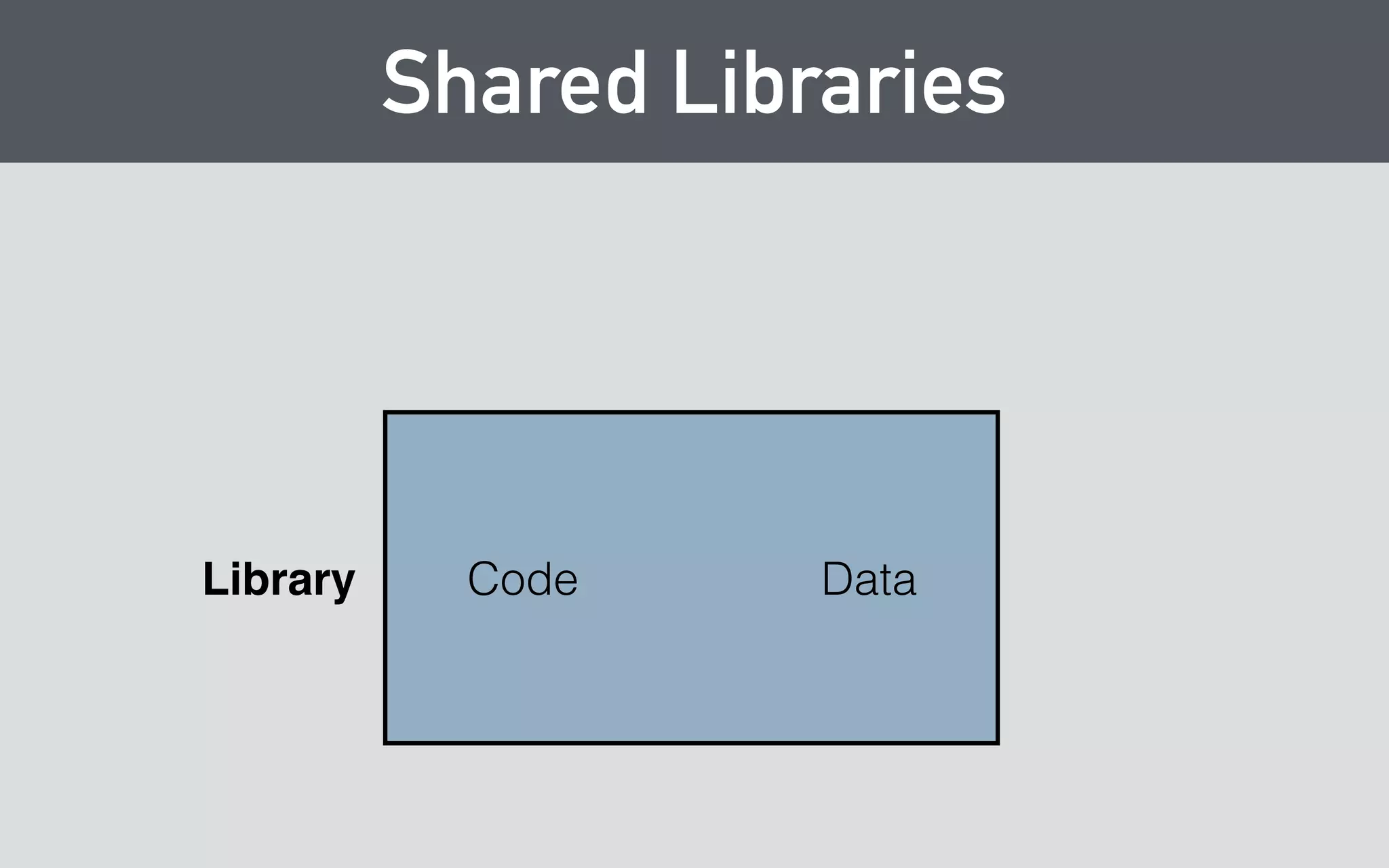
Shared Libraries 
Library Code Data
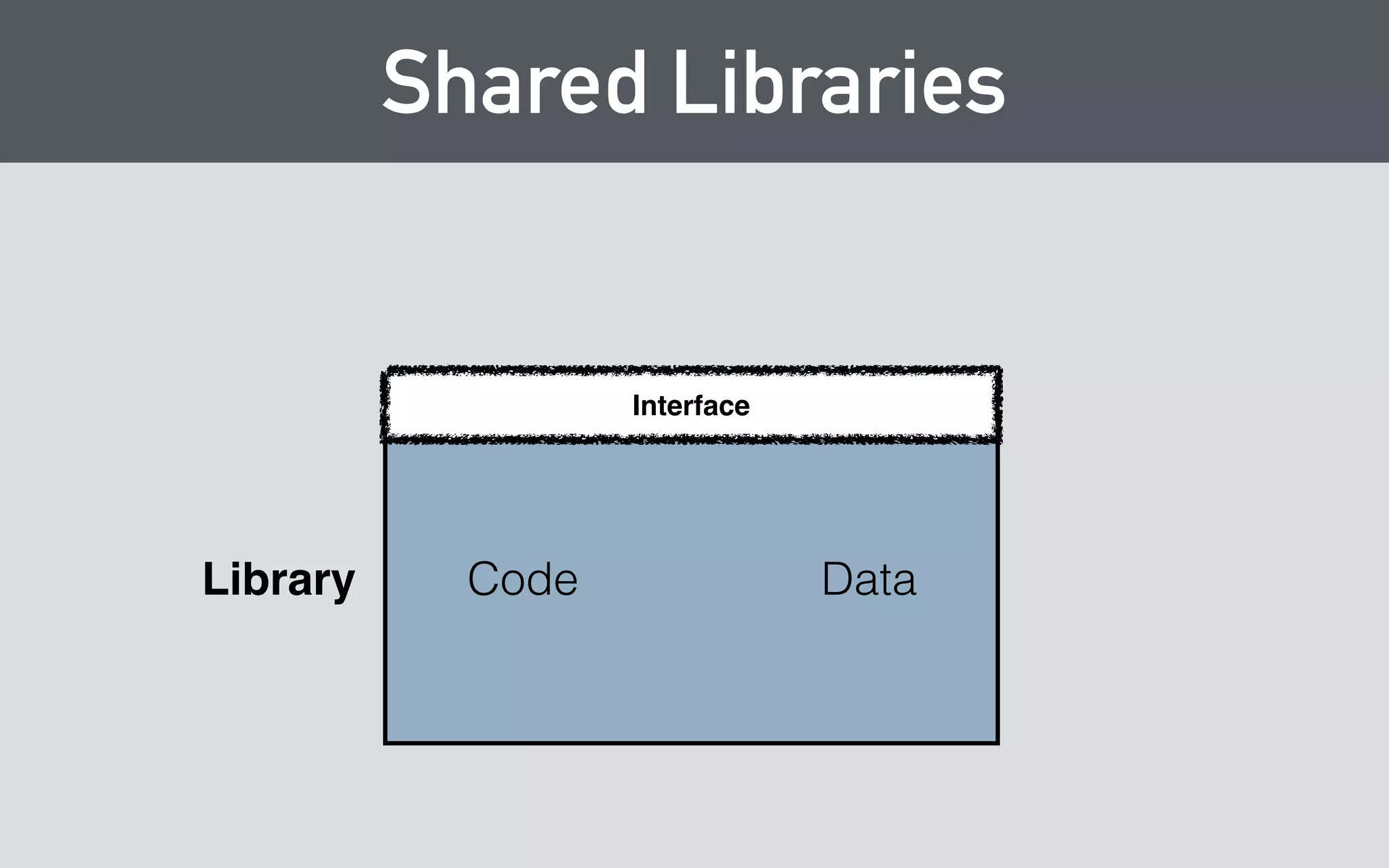
Shared Libraries 
Interface 
Code Data 
Library
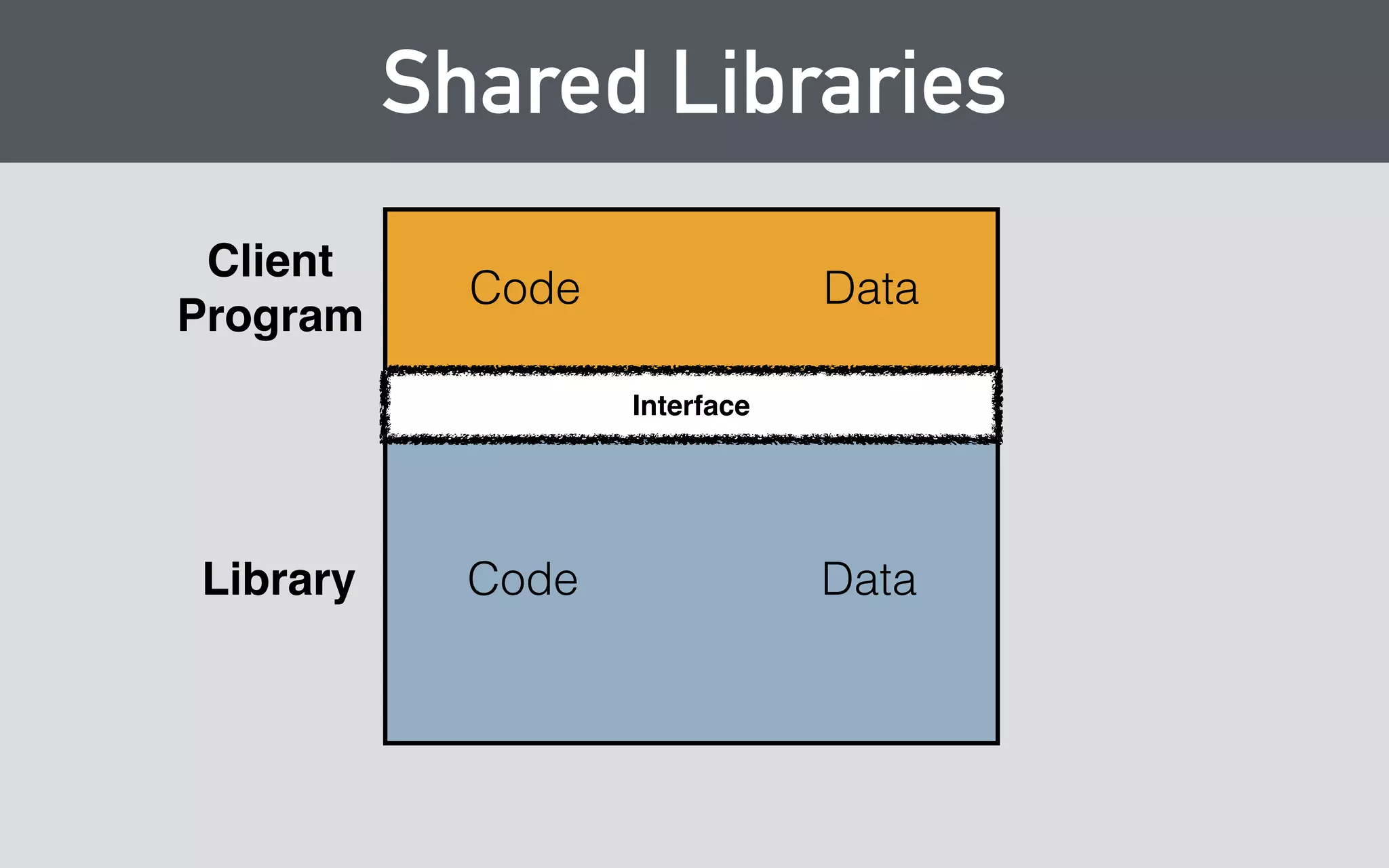
Shared Libraries 
Interface 
Code Data 
Client! 
Program 
Library 
Code Data
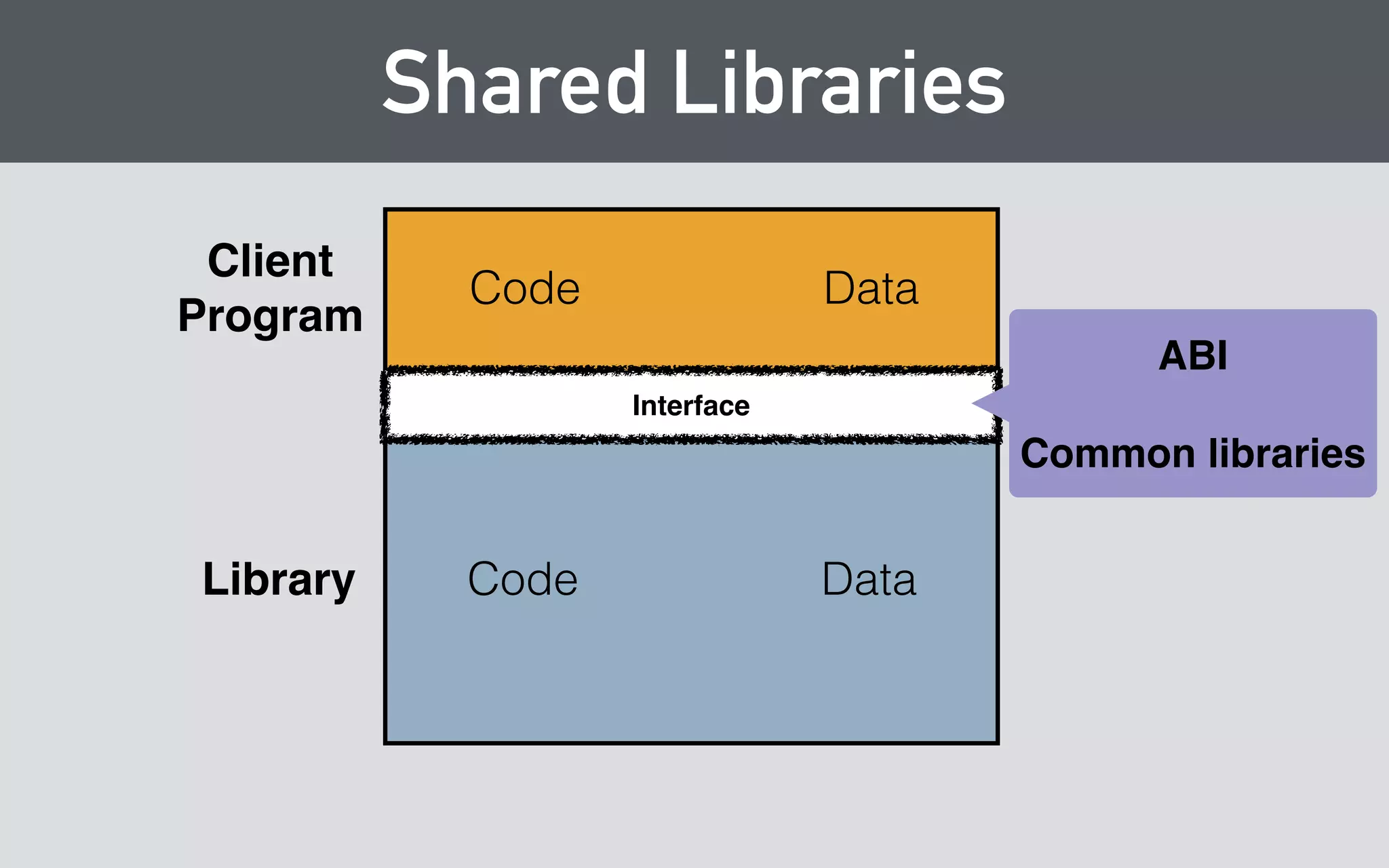
Shared Libraries 
Interface 
Code Data 
Client! 
Program 
Library 
Code Data 
ABI! 
! 
Common libraries
Different ABIs? Subtle problems… 
Class A 
Class B
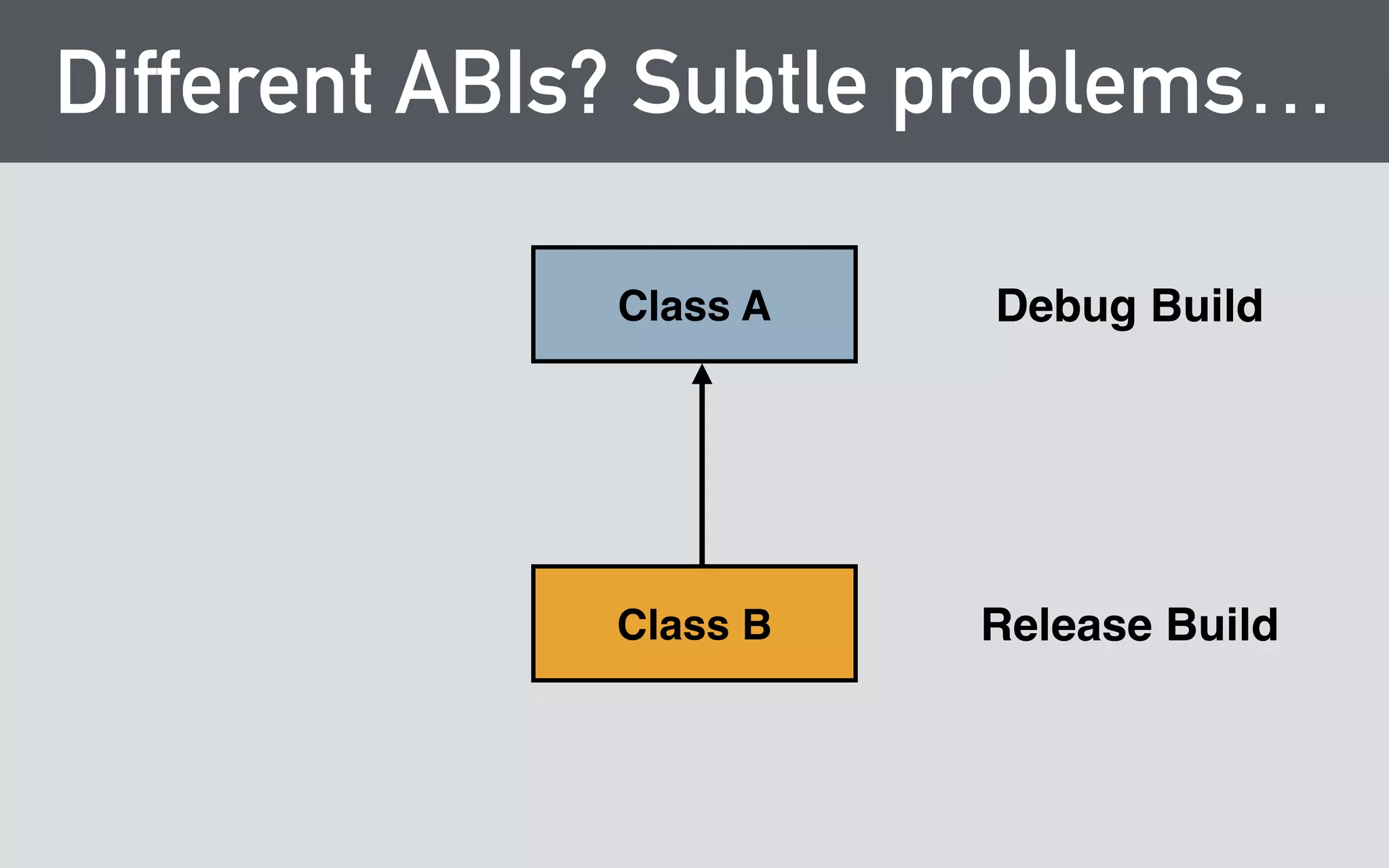
Different ABIs? Subtle problems… 
Class A 
Class B 
Debug Build 
Release Build
My Goal for Libraries 
Get out of the client’s way.
My Goal for Libraries 
Don’t make my clients: 
• build my code if they don’t want to 
• change how they build their code 
• rebuild their code because I shipped a fix in mine 
• learn a new language if they don’t want to
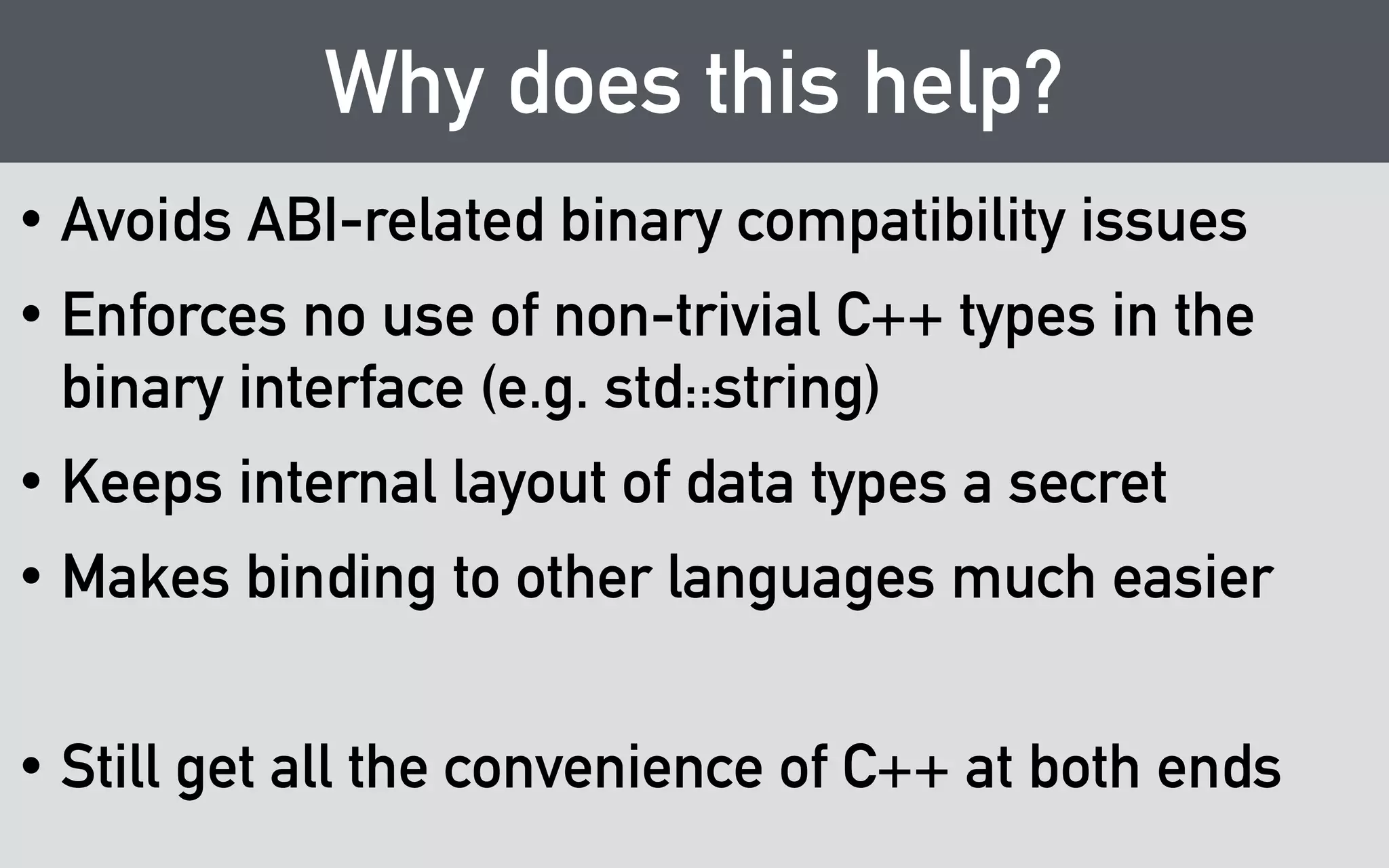
Why does this help? 
• Avoids ABI-related binary compatibility issues 
• Enforces no use of non-trivial C++ types in the 
binary interface (e.g. std::string) 
• Keeps internal layout of data types a secret 
• Makes binding to other languages much easier 
! 
• Still get all the convenience of C++ at both ends
Example: libhairpoll 
• A library for creating hair-related polls, taking 
votes, and tallying the results
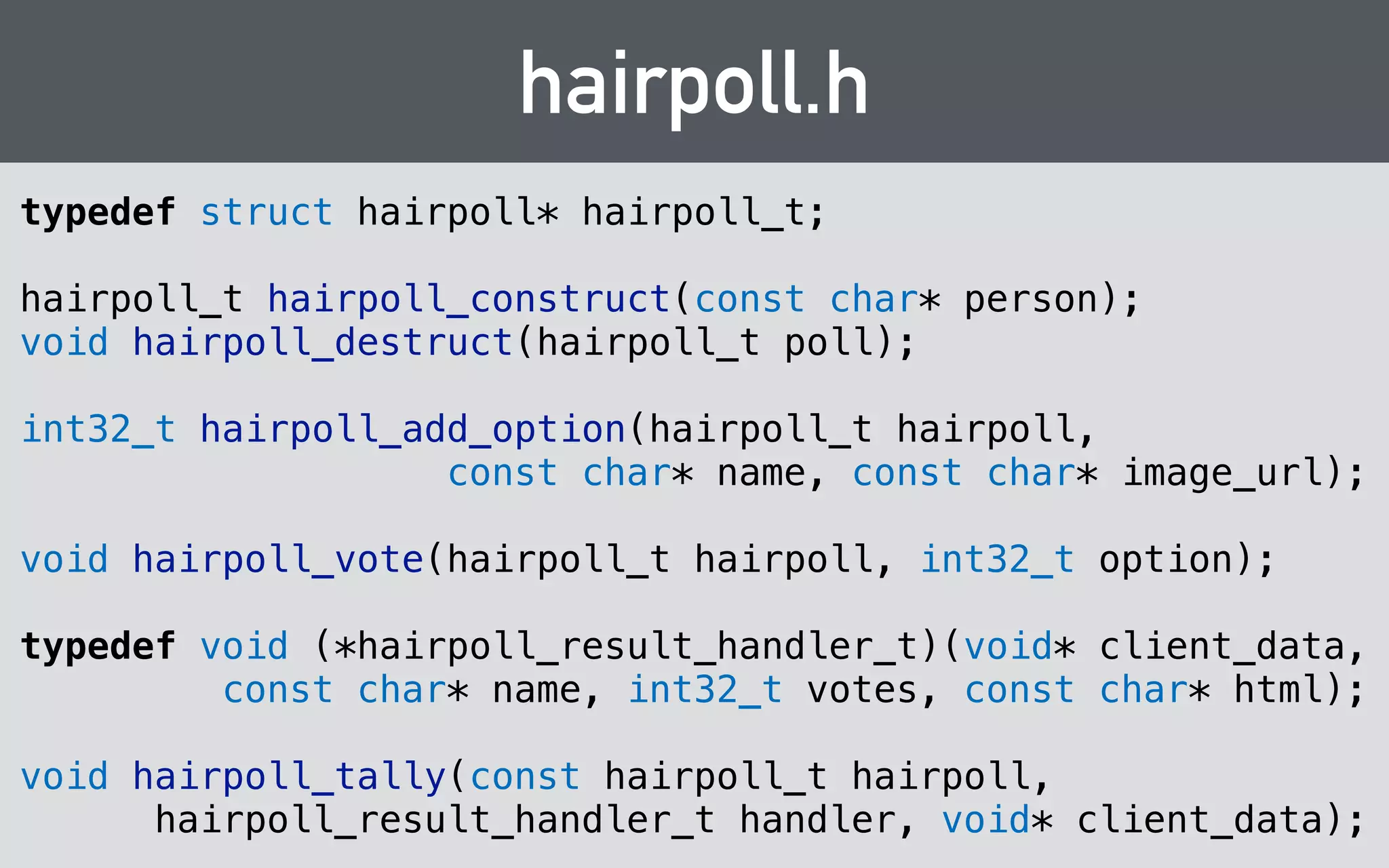
hairpoll.h 
typedef struct hairpoll* hairpoll_t; 
! 
hairpoll_t hairpoll_construct(const char* person); 
void hairpoll_destruct(hairpoll_t poll); 
! 
int32_t hairpoll_add_option(hairpoll_t hairpoll, 
const char* name, const char* image_url); 
! 
void hairpoll_vote(hairpoll_t hairpoll, int32_t option); 
! 
typedef void (*hairpoll_result_handler_t)(void* client_data, 
const char* name, int32_t votes, const char* html); 
! 
void hairpoll_tally(const hairpoll_t hairpoll, 
hairpoll_result_handler_t handler, void* client_data);
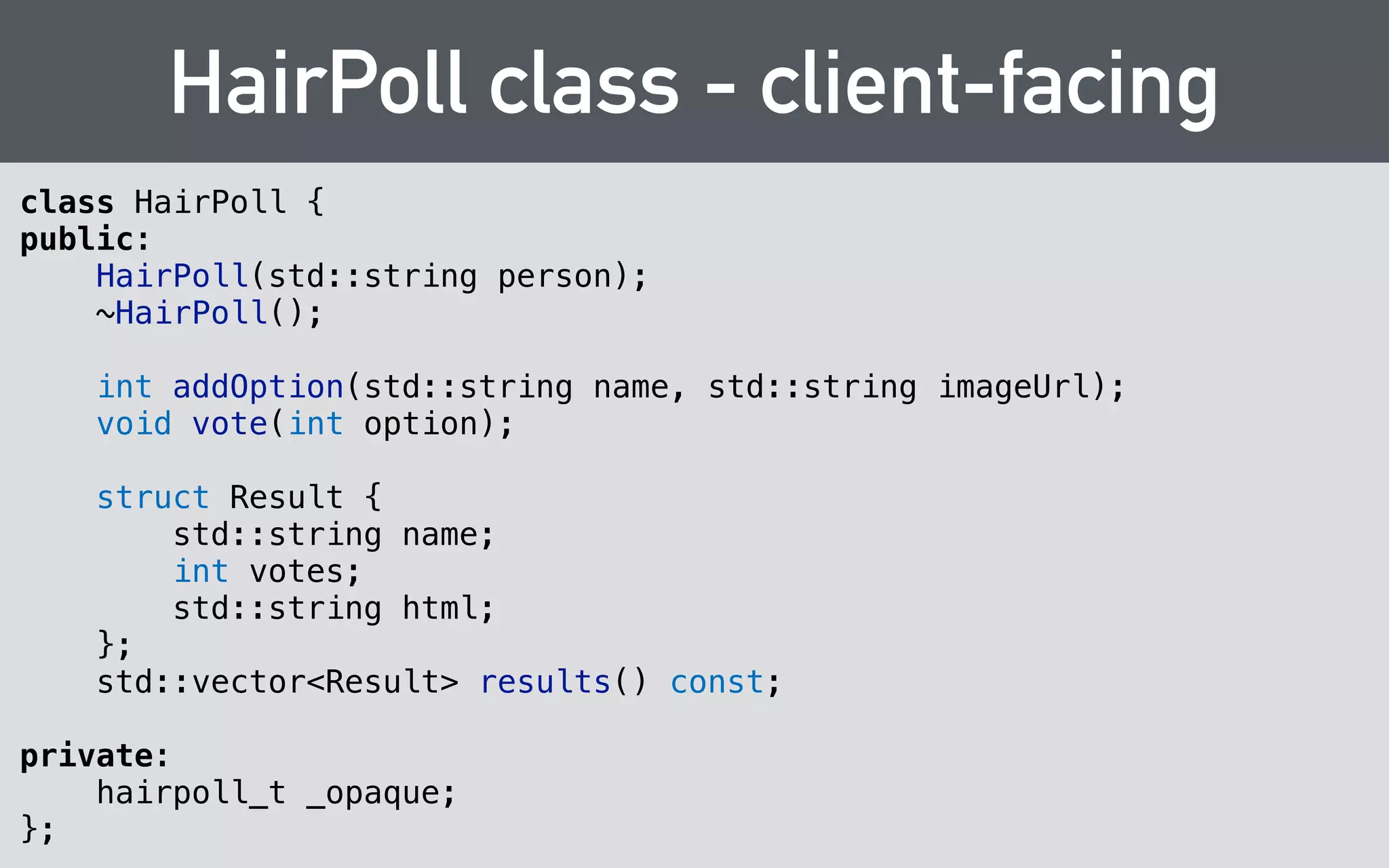
HairPoll class - client-facing 
class HairPoll { 
public: 
HairPoll(std::string person); 
~HairPoll(); 
! 
int addOption(std::string name, std::string imageUrl); 
void vote(int option); 
! 
struct Result { 
std::string name; 
int votes; 
std::string html; 
}; 
std::vector<Result> results() const; 
! 
private: 
hairpoll_t _opaque; 
};
Best Practices
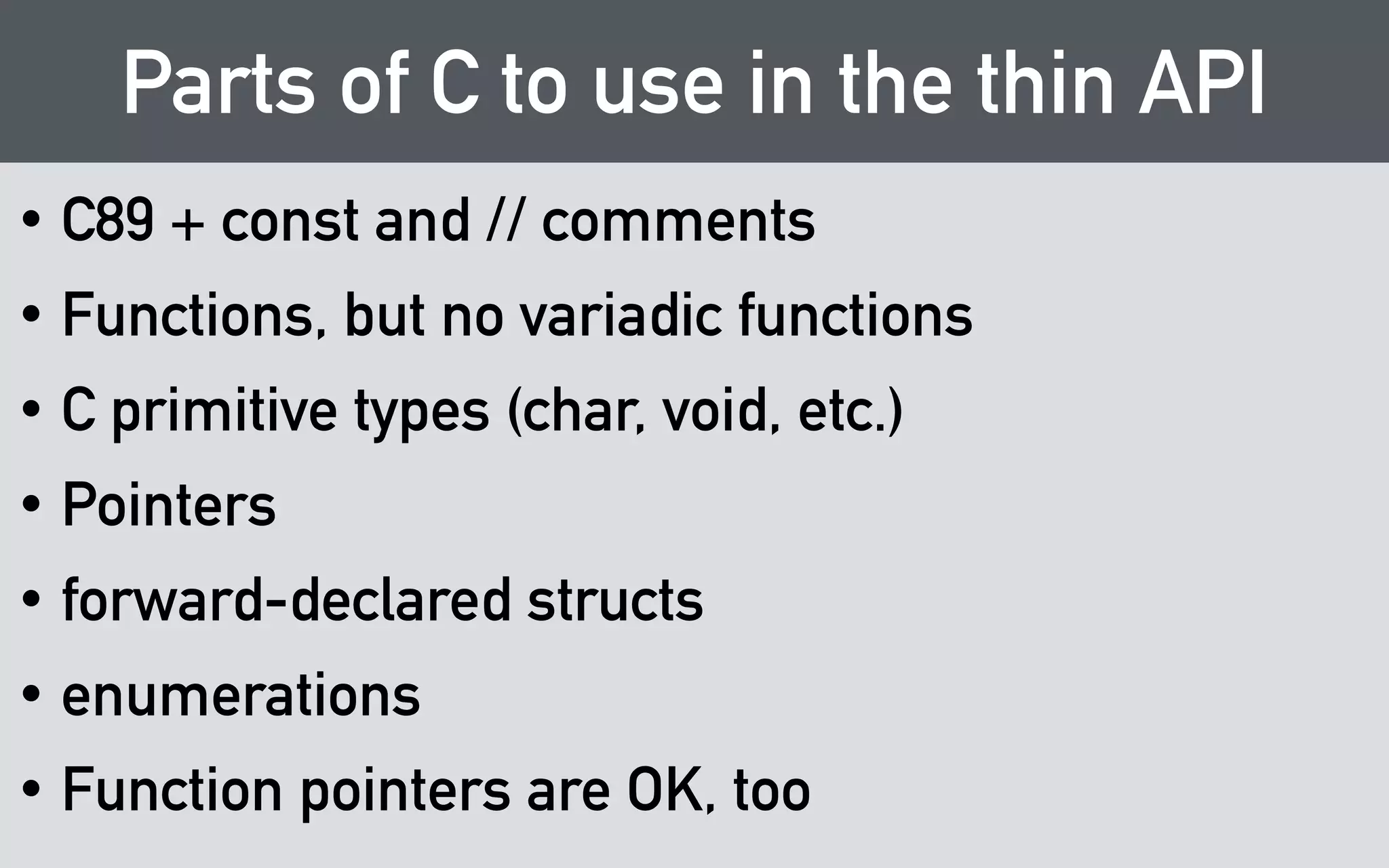
Parts of C to use in the thin API 
• C89 + const and // comments 
• Functions, but no variadic functions 
• C primitive types (char, void, etc.) 
• Pointers 
• forward-declared structs 
• enumerations 
• Function pointers are OK, too
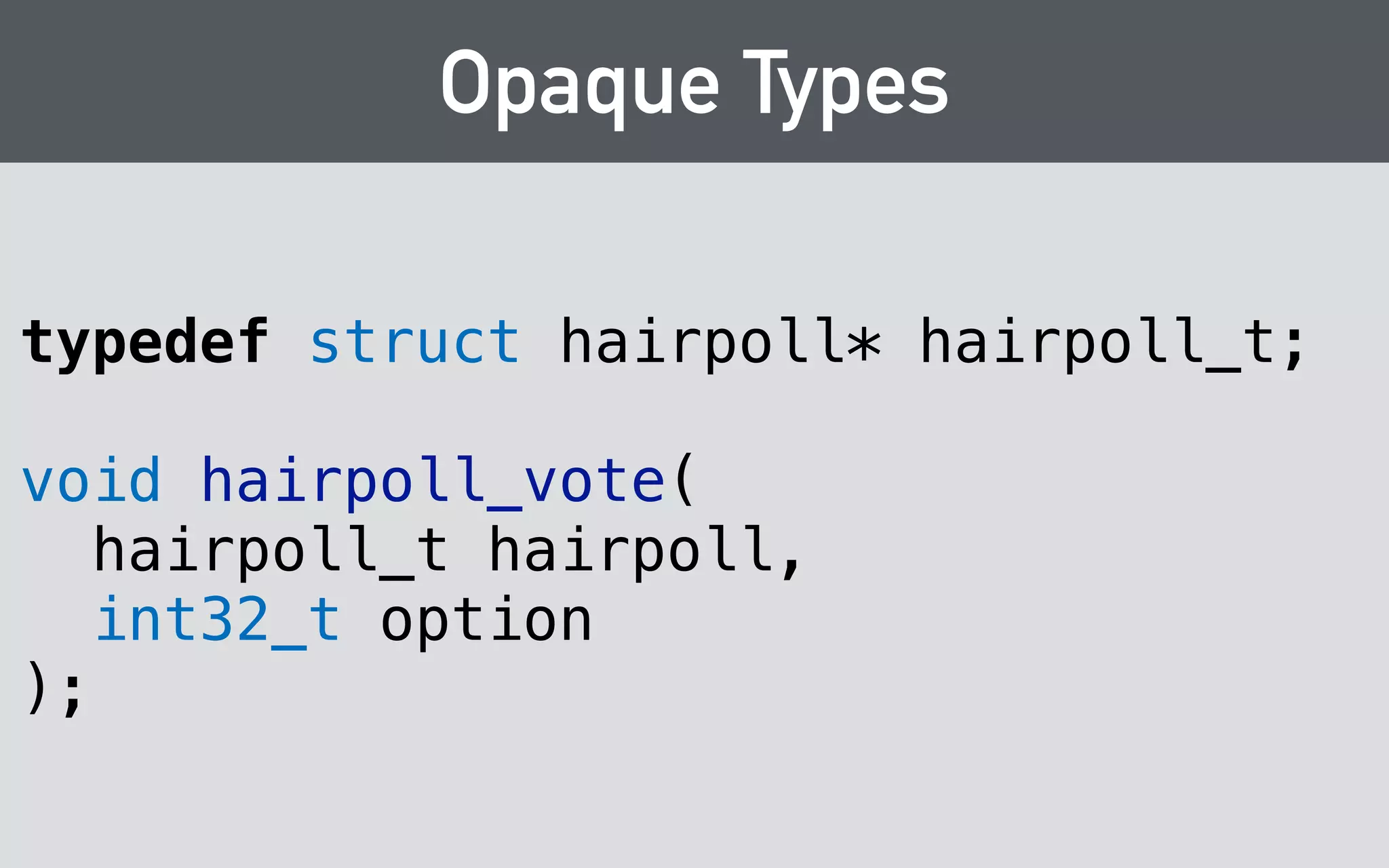
Opaque Types 
typedef struct hairpoll* hairpoll_t; 
! 
void hairpoll_vote( 
hairpoll_t hairpoll, 
int32_t option 
);
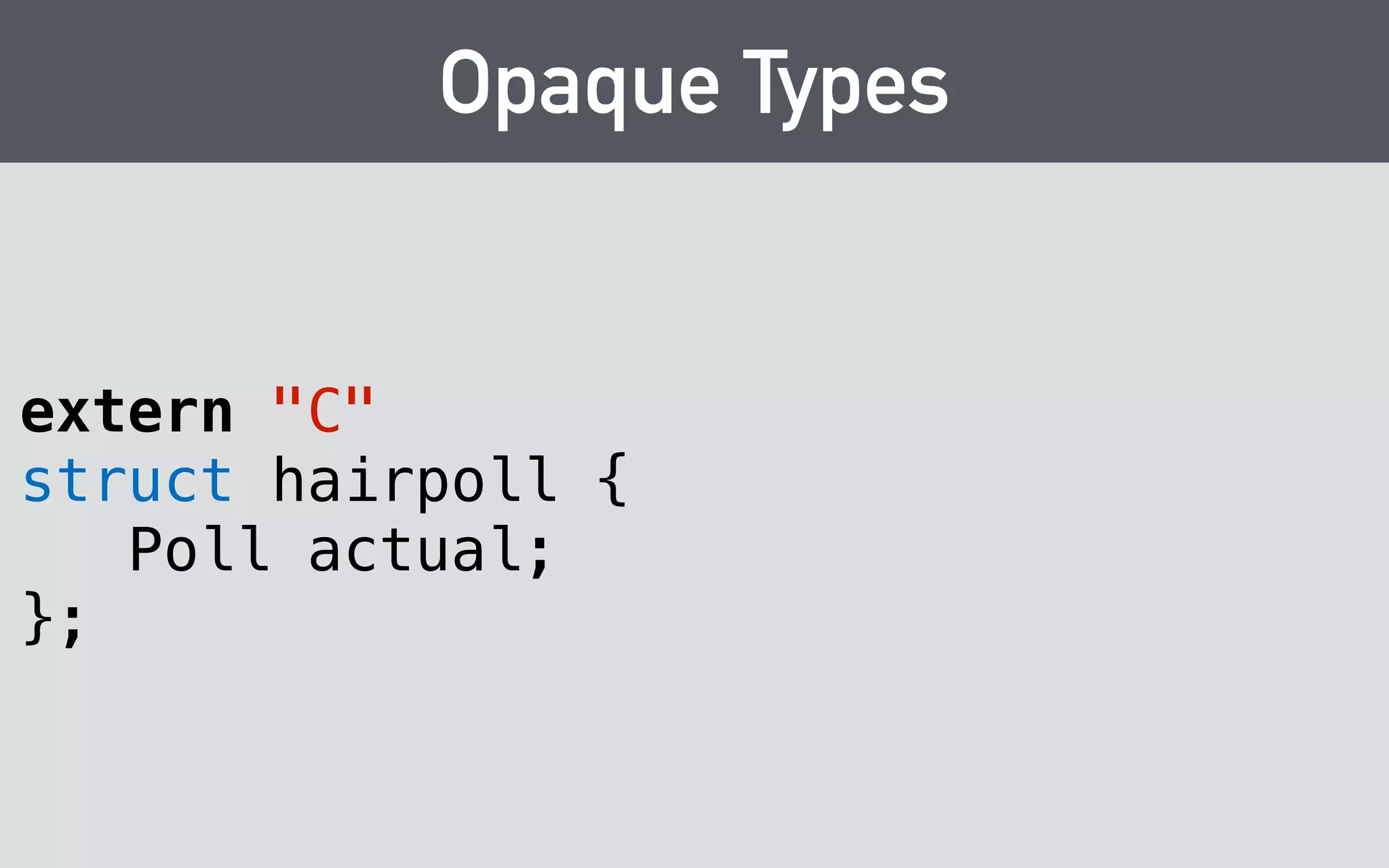
Opaque Types 
extern "C" 
struct hairpoll { 
Poll actual; 
};
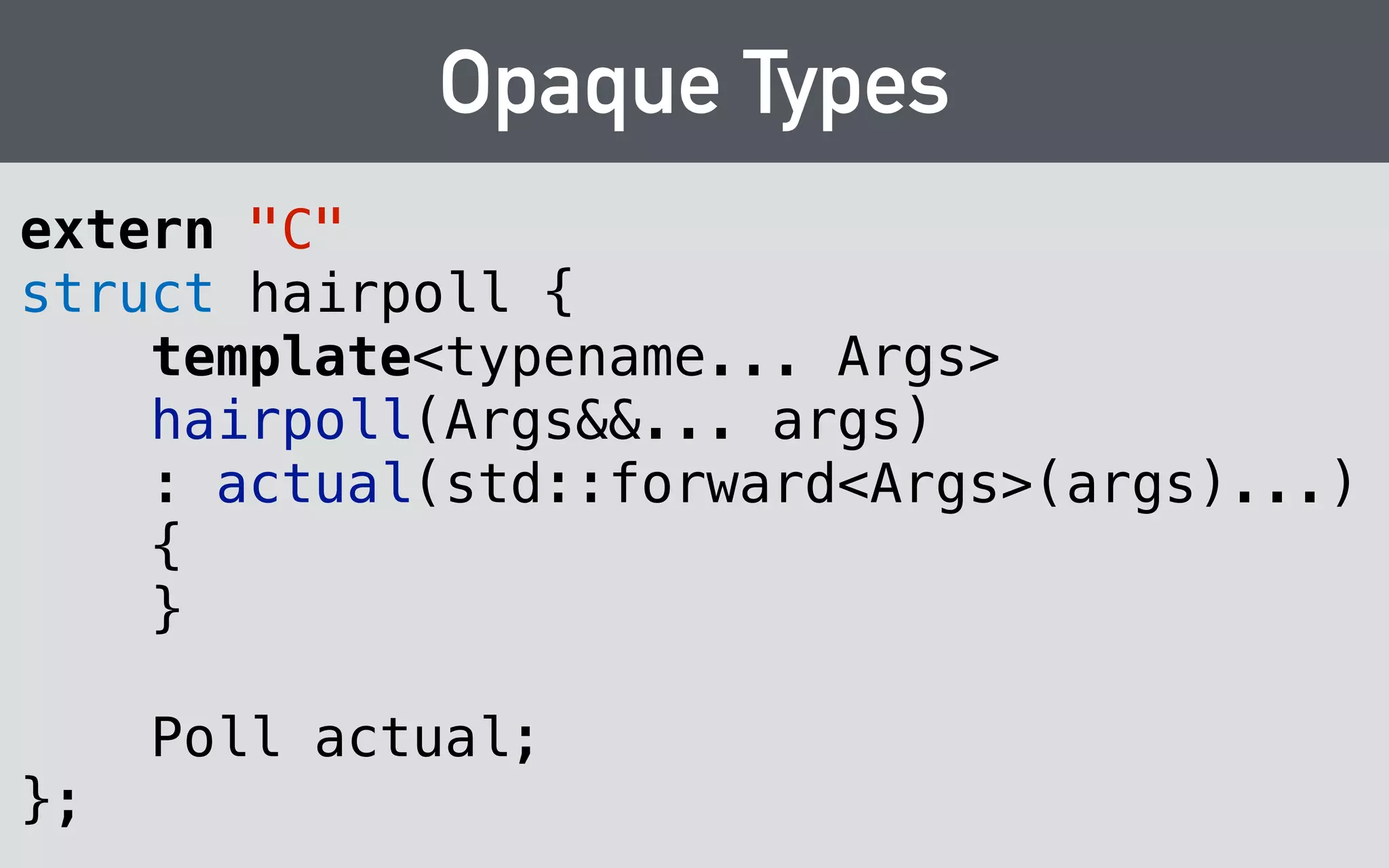
Opaque Types 
extern "C" 
struct hairpoll { 
template<typename... Args> 
hairpoll(Args&&... args) 
: actual(std::forward<Args>(args)...) 
{ 
} 
! 
Poll actual; 
};
Opaque Types 
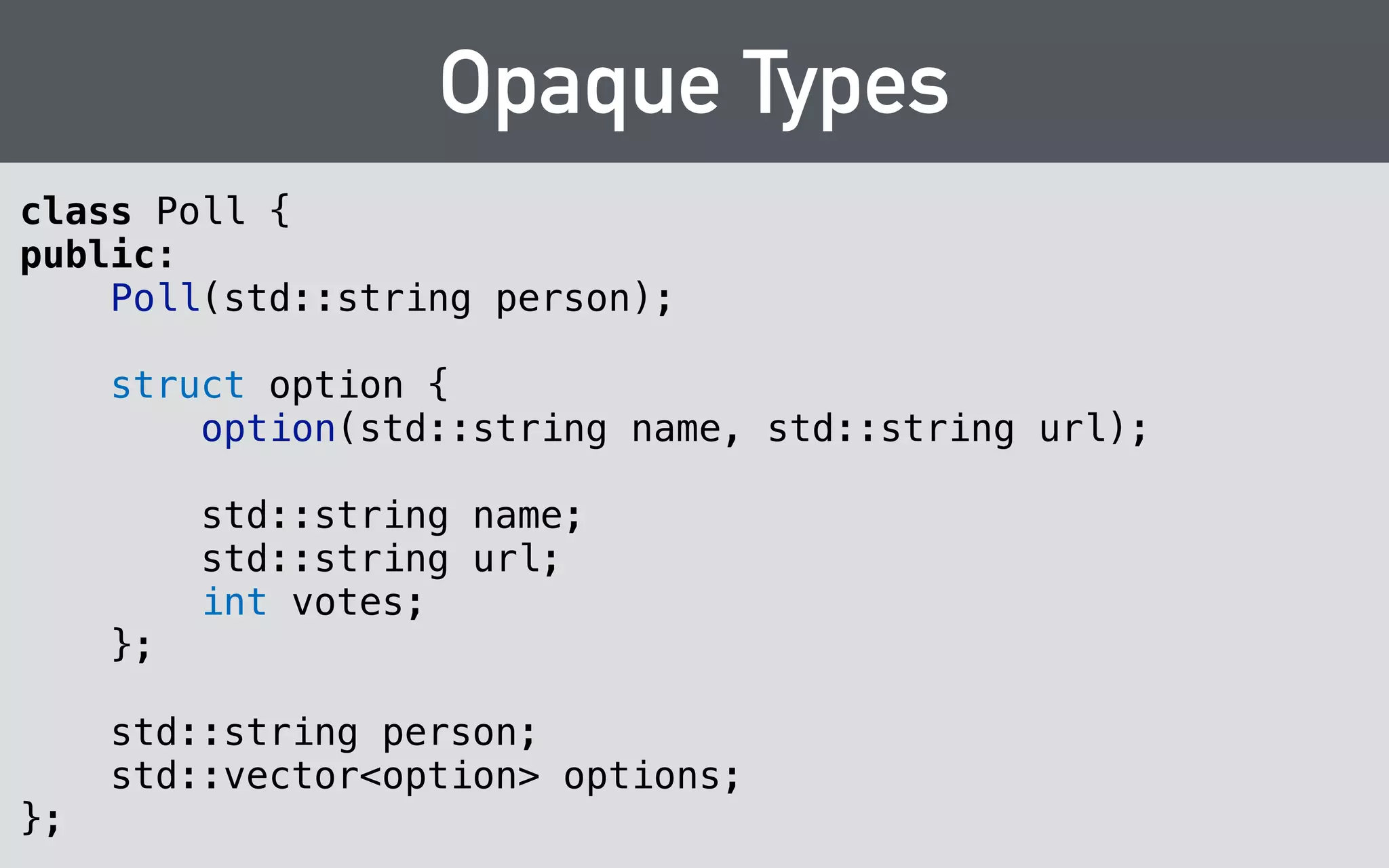
class Poll { 
public: 
Poll(std::string person); 
! 
struct option { 
option(std::string name, std::string url); 
! 
std::string name; 
std::string url; 
int votes; 
}; 
! 
std::string person; 
std::vector<option> options; 
};
Opaque Types 
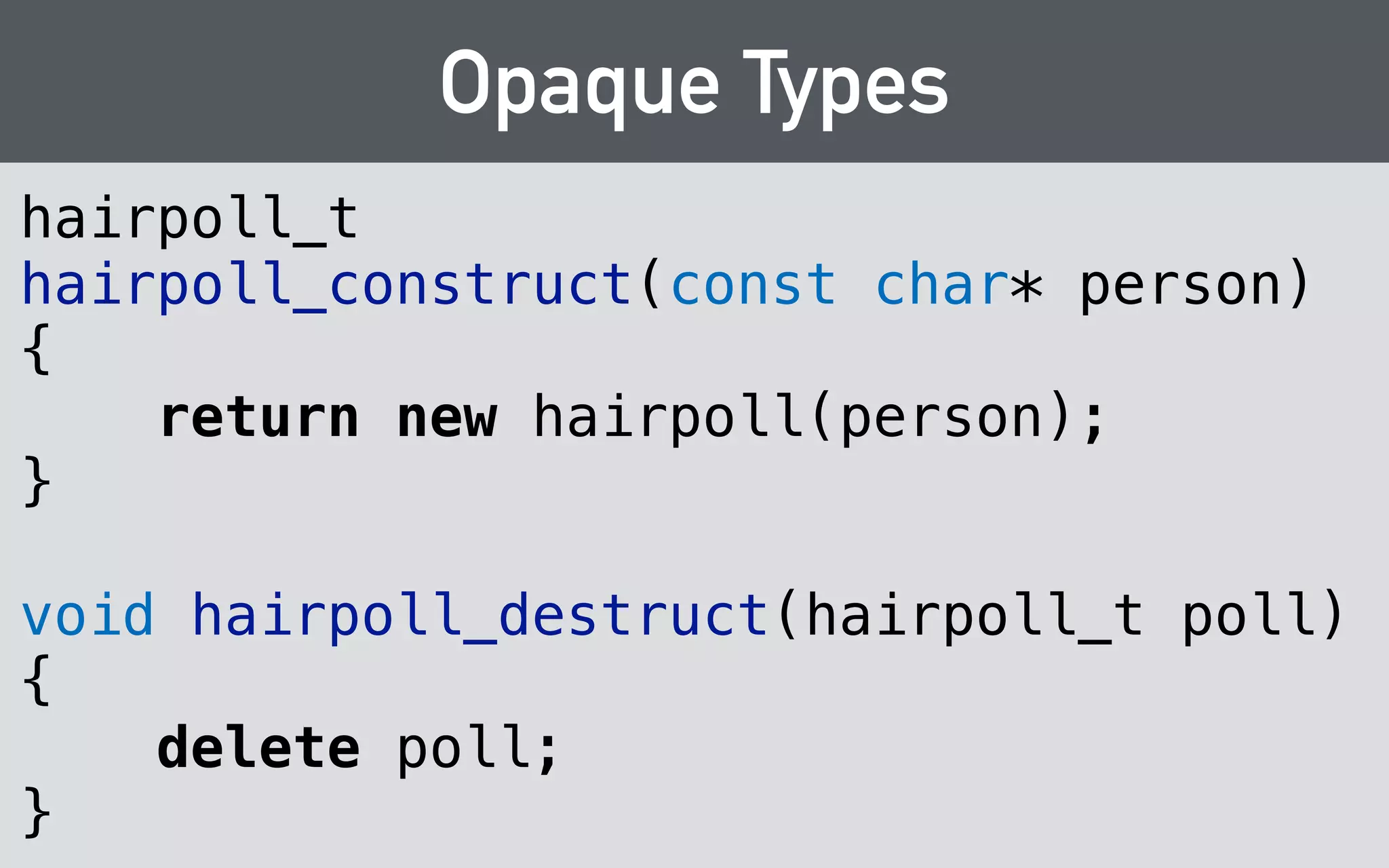
hairpoll_t 
hairpoll_construct(const char* person) 
{ 
return new hairpoll(person); 
} 
! 
void hairpoll_destruct(hairpoll_t poll) 
{ 
delete poll; 
}
Integral types 
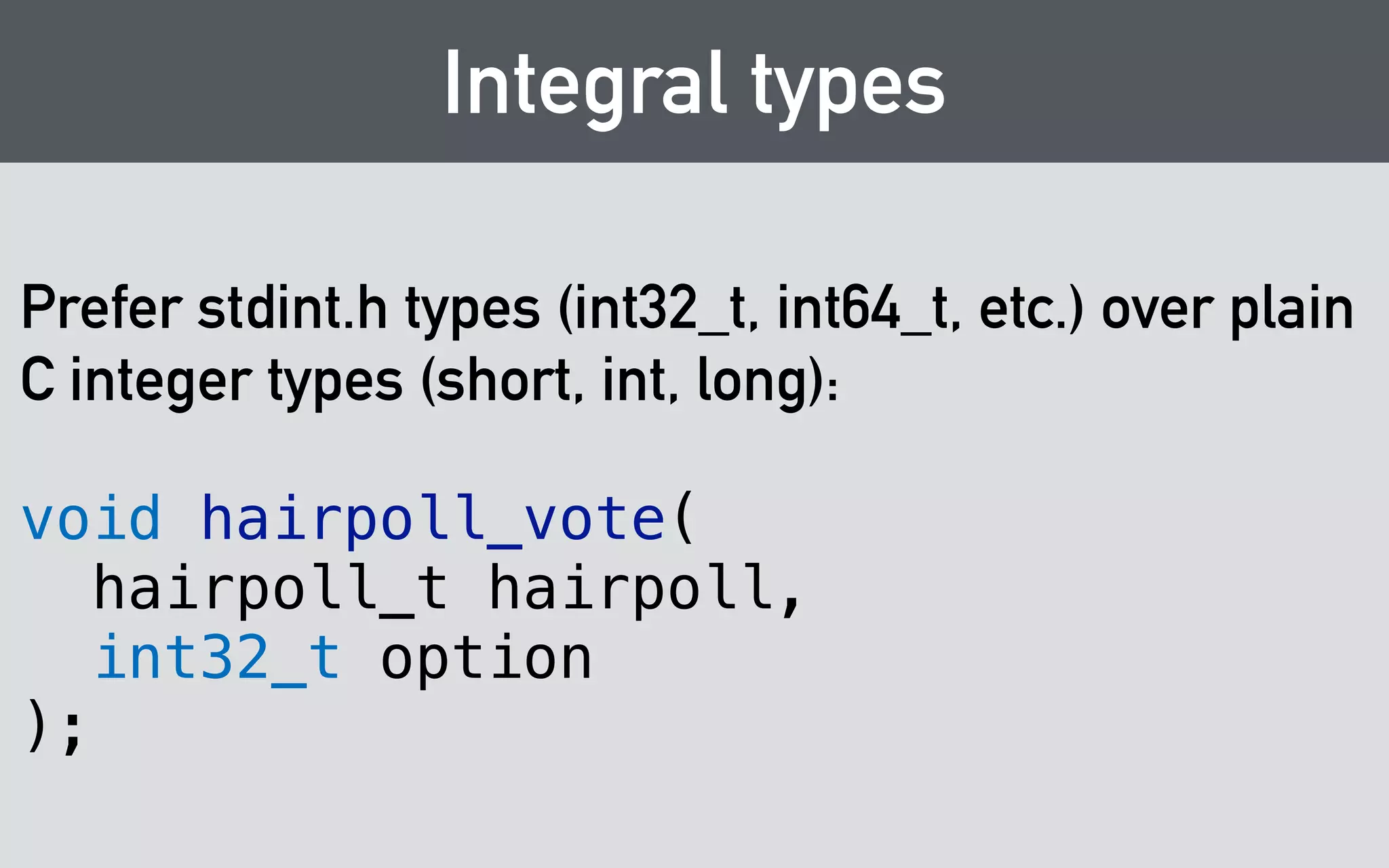
Prefer stdint.h types (int32_t, int64_t, etc.) over plain 
C integer types (short, int, long): 
! 
void hairpoll_vote( 
hairpoll_t hairpoll, 
int32_t option 
);
Integral types 
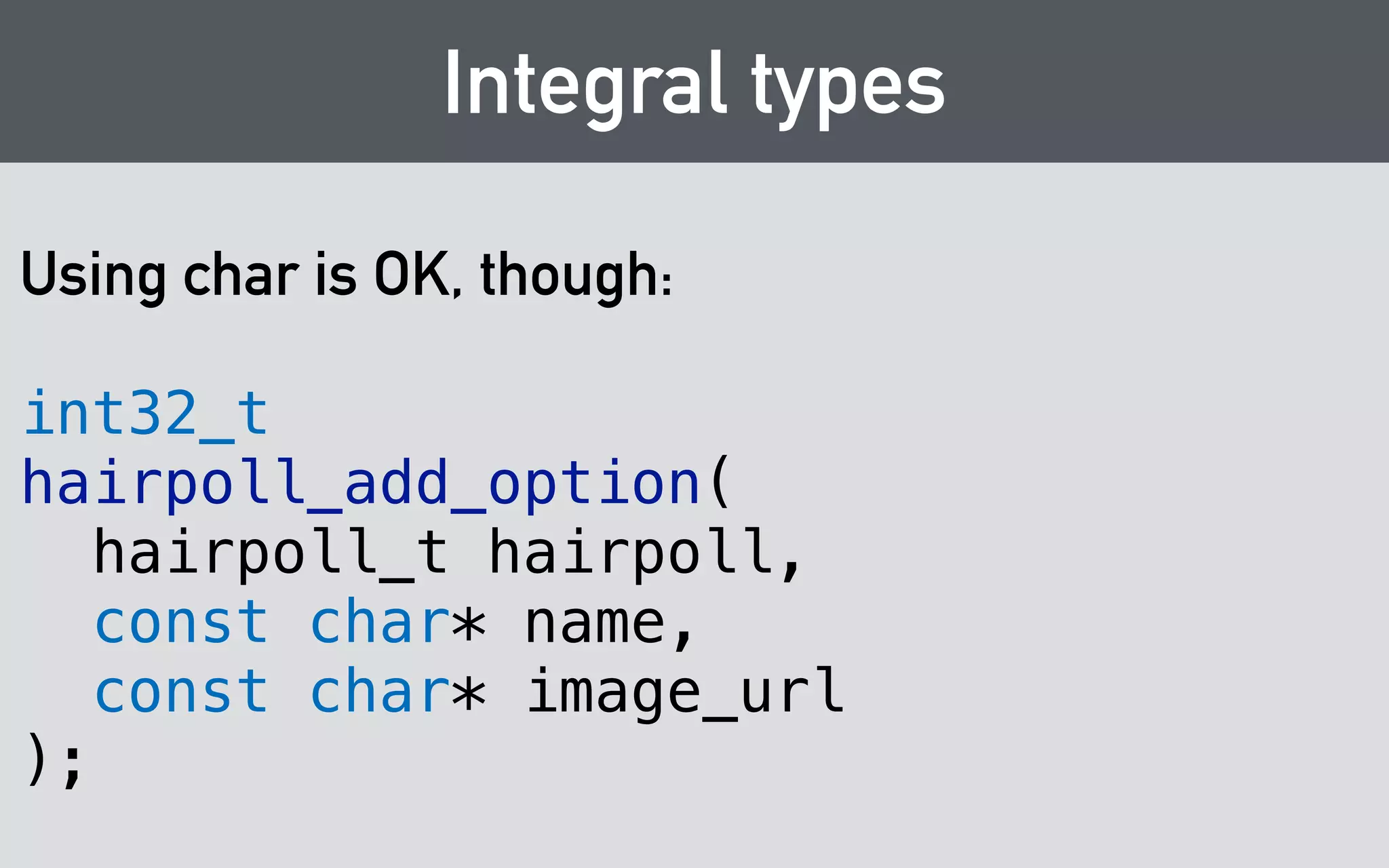
Using char is OK, though: 
! 
int32_t 
hairpoll_add_option( 
hairpoll_t hairpoll, 
const char* name, 
const char* image_url 
);
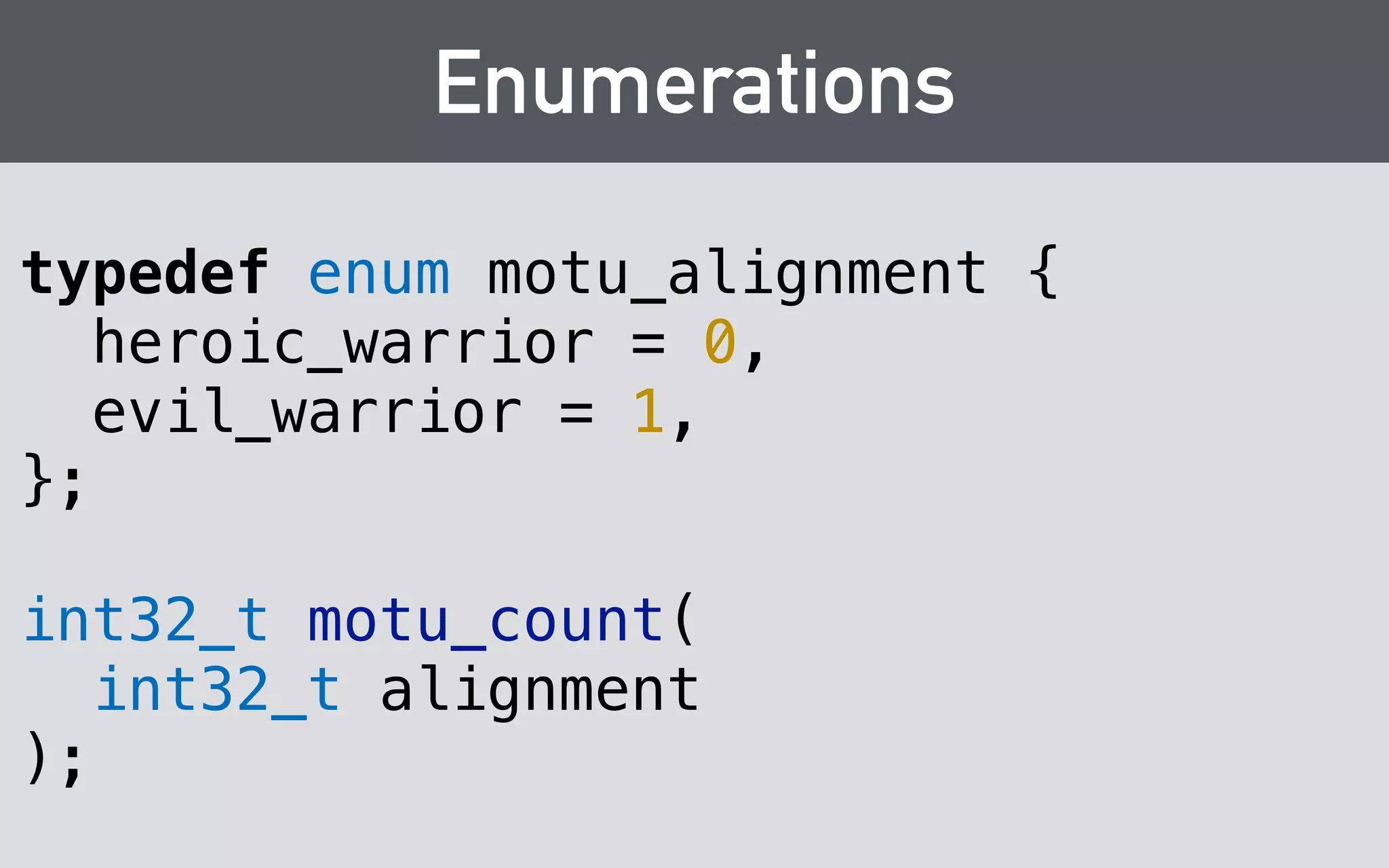
Enumerations 
typedef enum motu_alignment { 
heroic_warrior = 0, 
evil_warrior = 1, 
}; 
! 
int32_t motu_count( 
int32_t alignment 
);
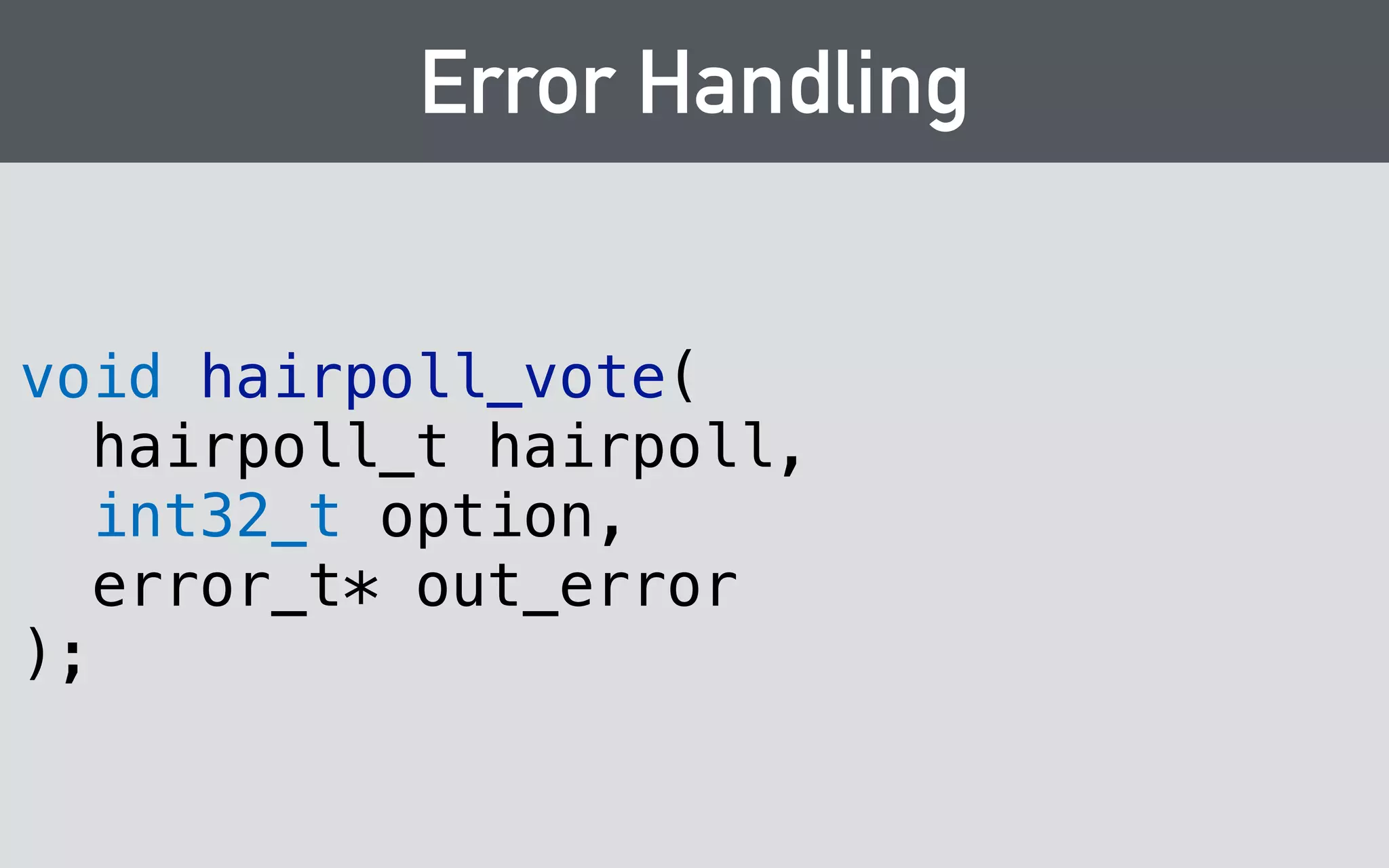
Error Handling 
void hairpoll_vote( 
hairpoll_t hairpoll, 
int32_t option, 
error_t* out_error 
);
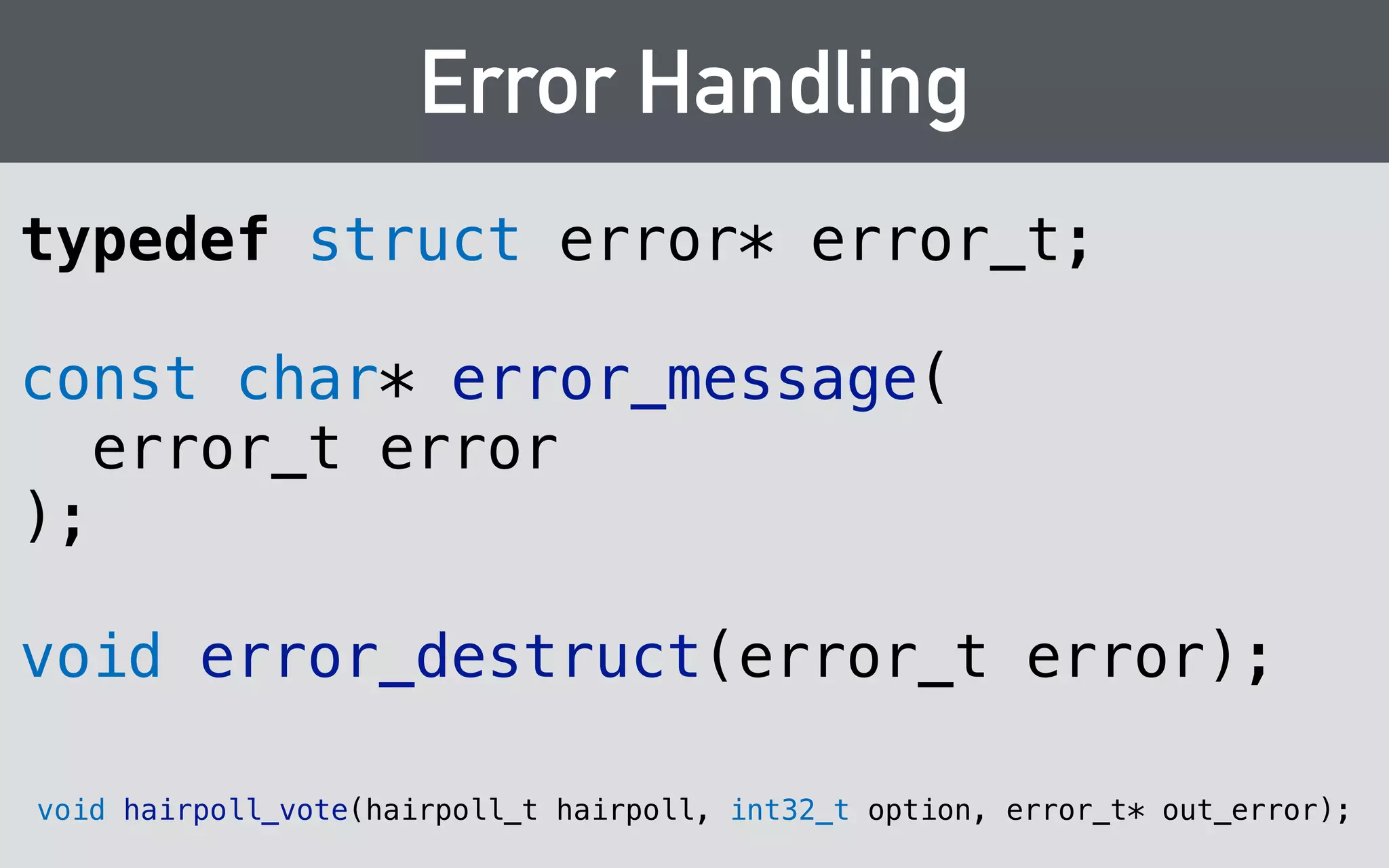
Error Handling 
typedef struct error* error_t; 
! 
const char* error_message( 
error_t error 
); 
! 
void error_destruct(error_t error); 
! 
! 
void hairpoll_vote(hairpoll_t hairpoll, int32_t option, error_t* out_error);
Errors → Exceptions 
struct Error { 
Error() : opaque(nullptr) {} 
~Error() { if (opaque) { error_destruct(opaque); } } 
error_t opaque; 
}; 
! 
class ThrowOnError { 
public: 
~ThrowOnError() noexcept(false) { 
if (_error.opaque) { 
throw std::runtime_error(error_message(_error.opaque)); 
} 
} 
! 
operator error_t*() { return &_error.opaque; } 
! 
private: 
Error _error; 
};
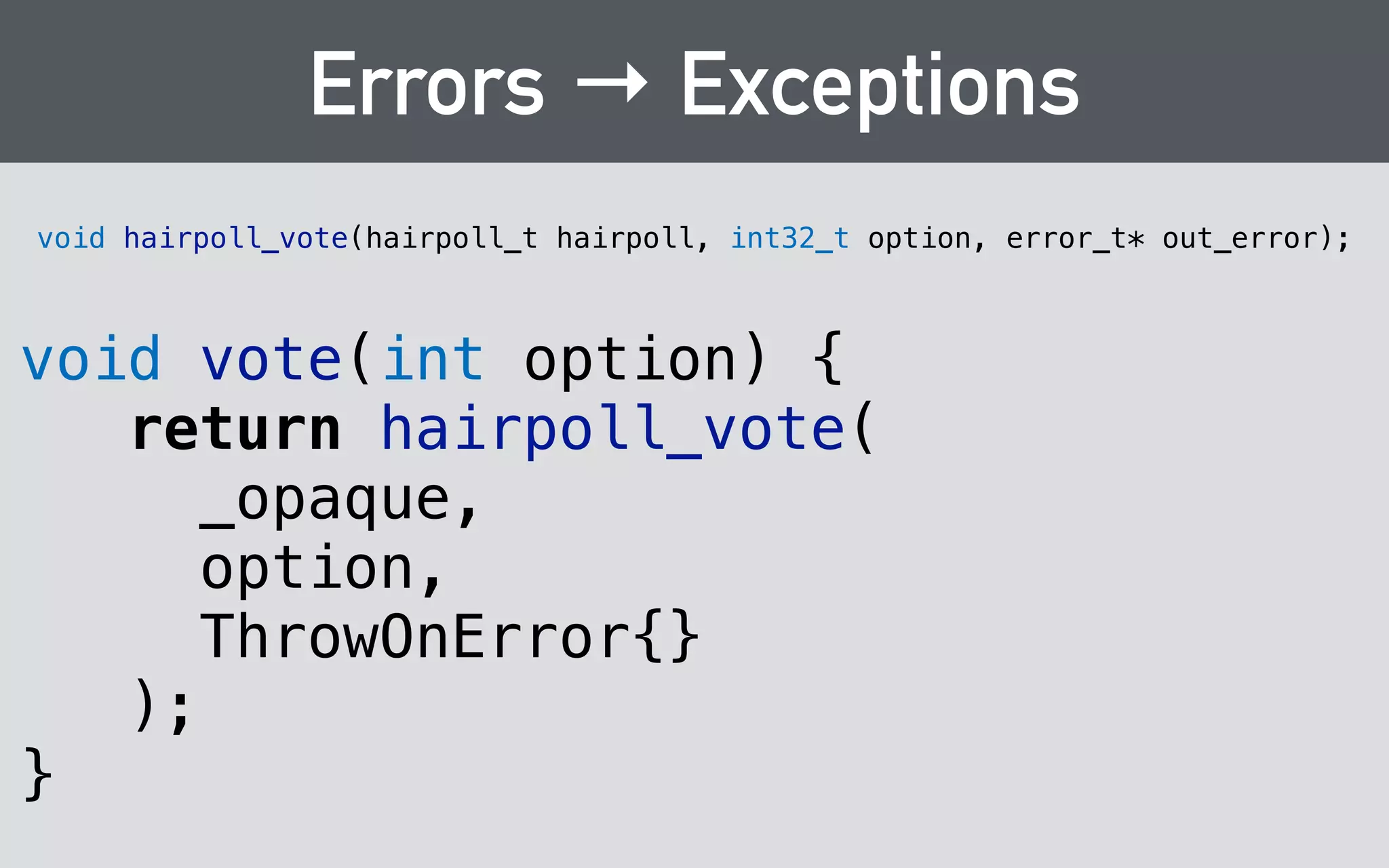
Errors → Exceptions 
void hairpoll_vote(hairpoll_t hairpoll, int32_t option, error_t* out_error); 
! 
void vote(int option) { 
return hairpoll_vote( 
_opaque, 
option, 
ThrowOnError{} 
); 
}
Exceptions → Errors 
template<typename Fn> 
bool translateExceptions(error_t* out_error, Fn&& fn) 
{ 
try { 
fn(); 
} catch (const std::exception& e) { 
*out_error = new error{e.what()}; 
return false; 
} catch (...) { 
*out_error = new error{"Unknown internal error"}; 
return false; 
} 
return true; 
}
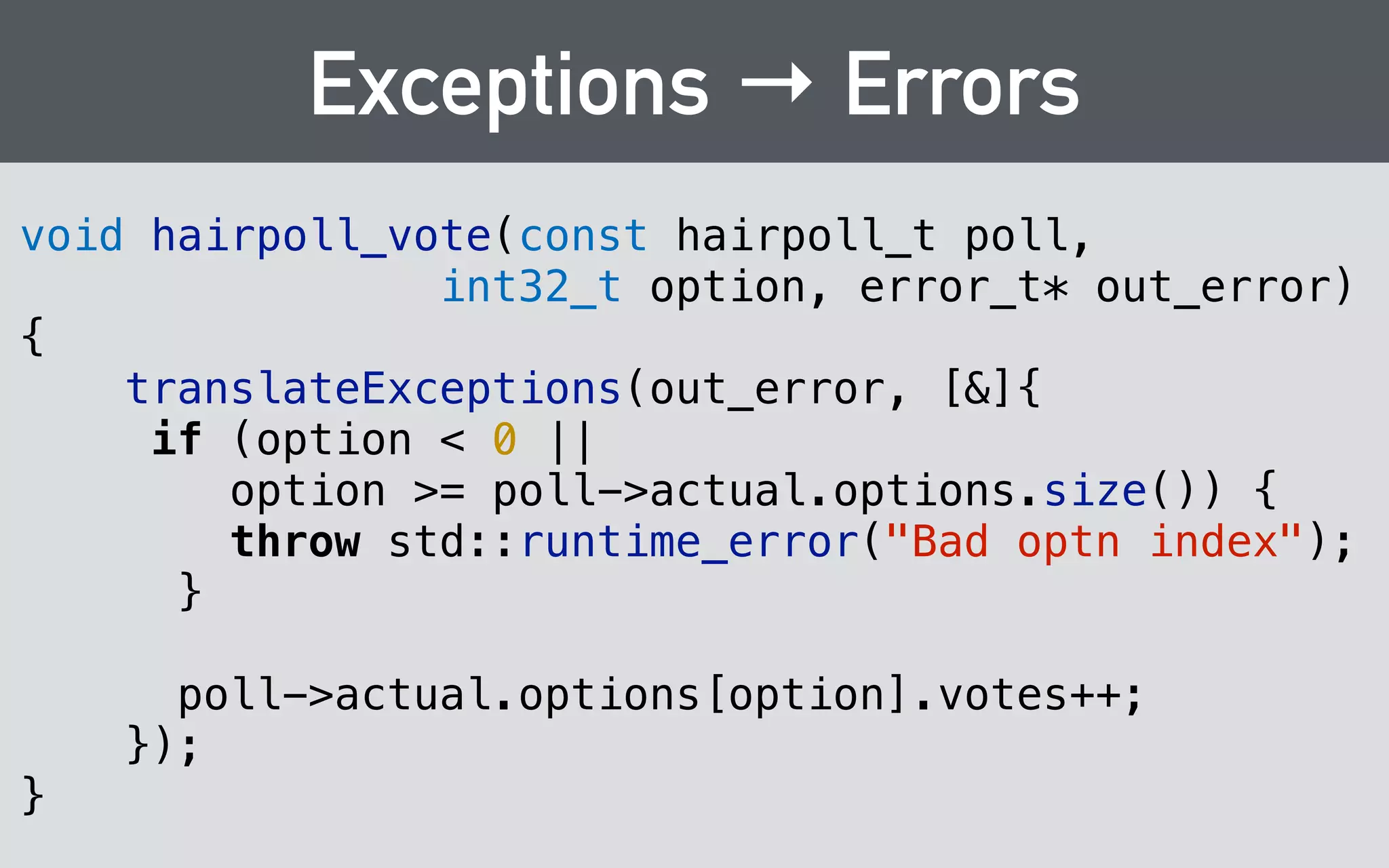
Exceptions → Errors 
void hairpoll_vote(const hairpoll_t poll, 
int32_t option, error_t* out_error) 
{ 
translateExceptions(out_error, [&]{ 
if (option < 0 || 
option >= poll->actual.options.size()) { 
throw std::runtime_error("Bad optn index"); 
} 
! 
poll->actual.options[option].votes++; 
}); 
}
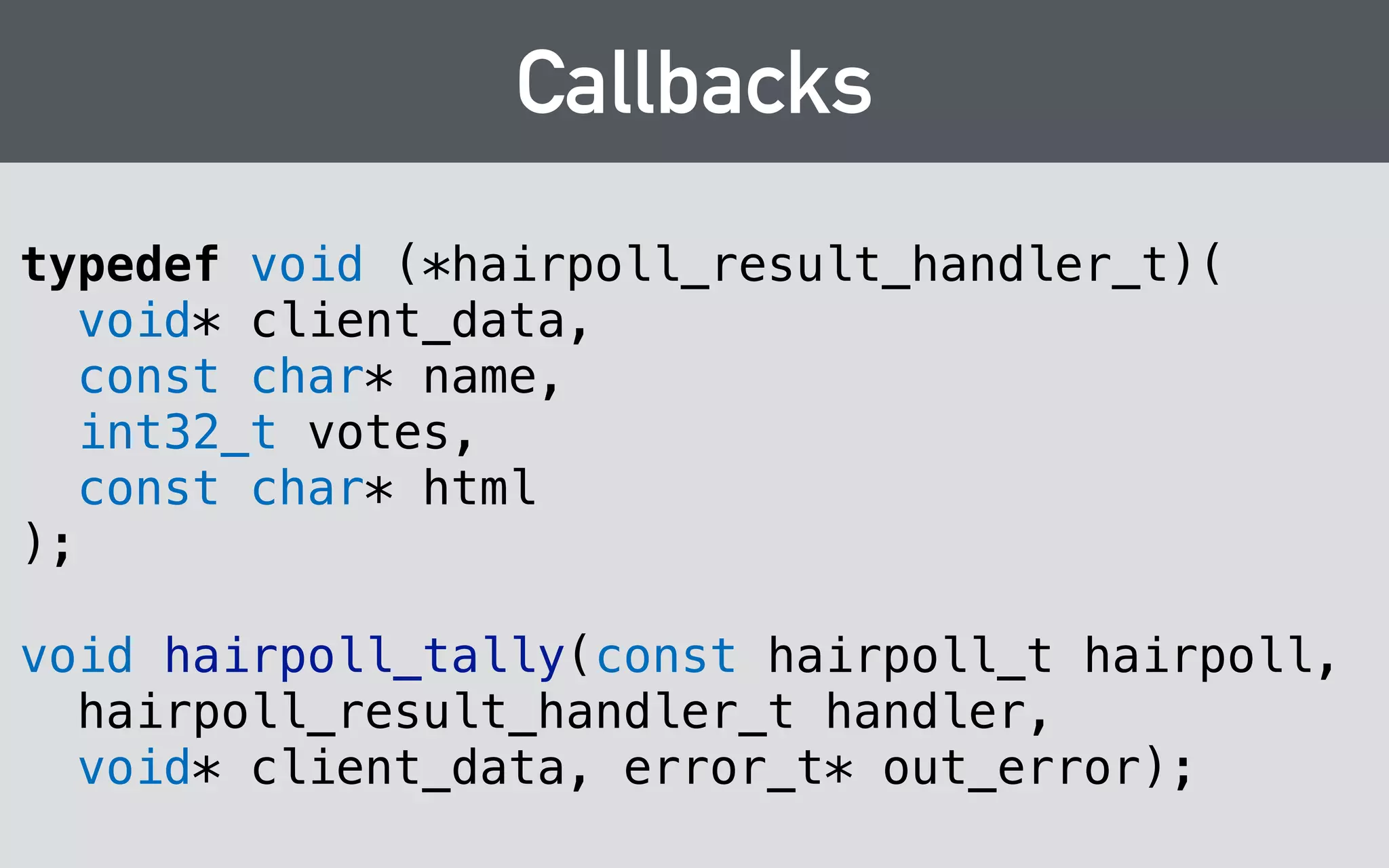
Callbacks 
typedef void (*hairpoll_result_handler_t)( 
void* client_data, 
const char* name, 
int32_t votes, 
const char* html 
); 
! 
void hairpoll_tally(const hairpoll_t hairpoll, 
hairpoll_result_handler_t handler, 
void* client_data, error_t* out_error);
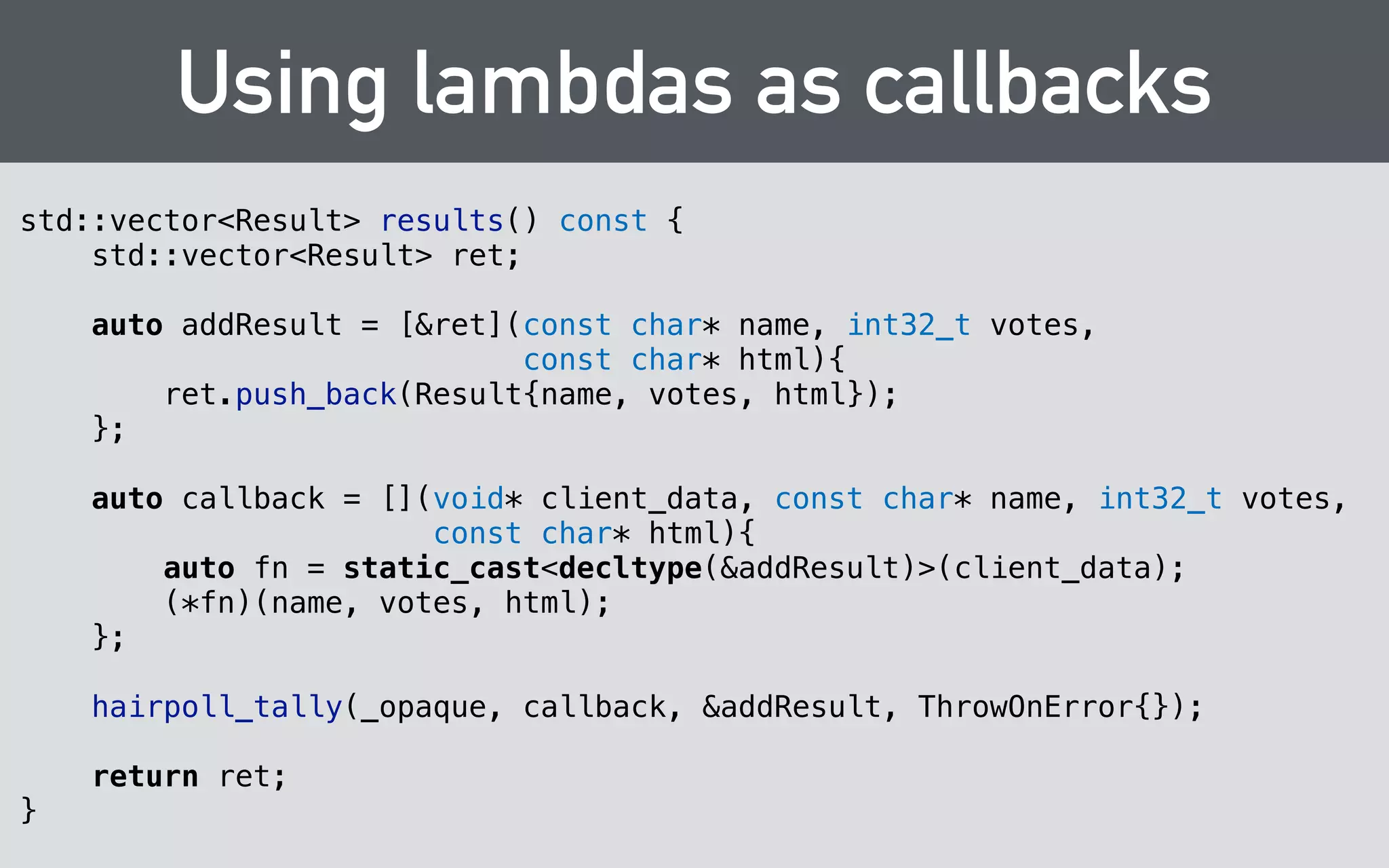
Using lambdas as callbacks 
std::vector<Result> results() const { 
std::vector<Result> ret; 
! 
auto addResult = [&ret](const char* name, int32_t votes, 
const char* html){ 
ret.push_back(Result{name, votes, html}); 
}; 
! 
auto callback = [](void* client_data, const char* name, int32_t votes, 
const char* html){ 
auto fn = static_cast<decltype(&addResult)>(client_data); 
(*fn)(name, votes, html); 
}; 
! 
hairpoll_tally(_opaque, callback, &addResult, ThrowOnError{}); 
! 
return ret; 
}
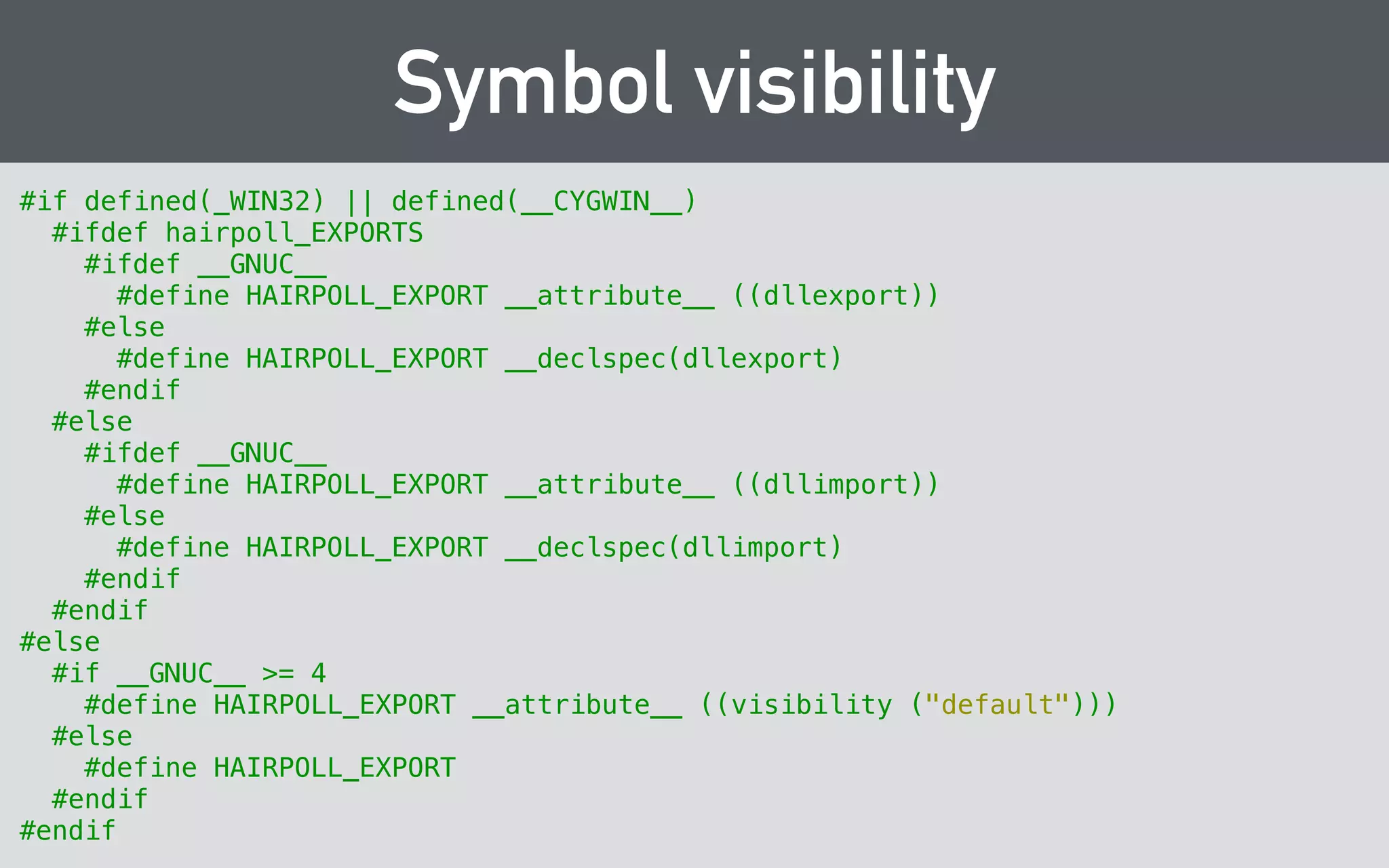
Symbol visibility 
#if defined(_WIN32) || defined(__CYGWIN__) 
#ifdef hairpoll_EXPORTS 
#ifdef __GNUC__ 
#define HAIRPOLL_EXPORT __attribute__ ((dllexport)) 
#else 
#define HAIRPOLL_EXPORT __declspec(dllexport) 
#endif 
#else 
#ifdef __GNUC__ 
#define HAIRPOLL_EXPORT __attribute__ ((dllimport)) 
#else 
#define HAIRPOLL_EXPORT __declspec(dllimport) 
#endif 
#endif 
#else 
#if __GNUC__ >= 4 
#define HAIRPOLL_EXPORT __attribute__ ((visibility ("default"))) 
#else 
#define HAIRPOLL_EXPORT 
#endif 
#endif
Symbol visibility 
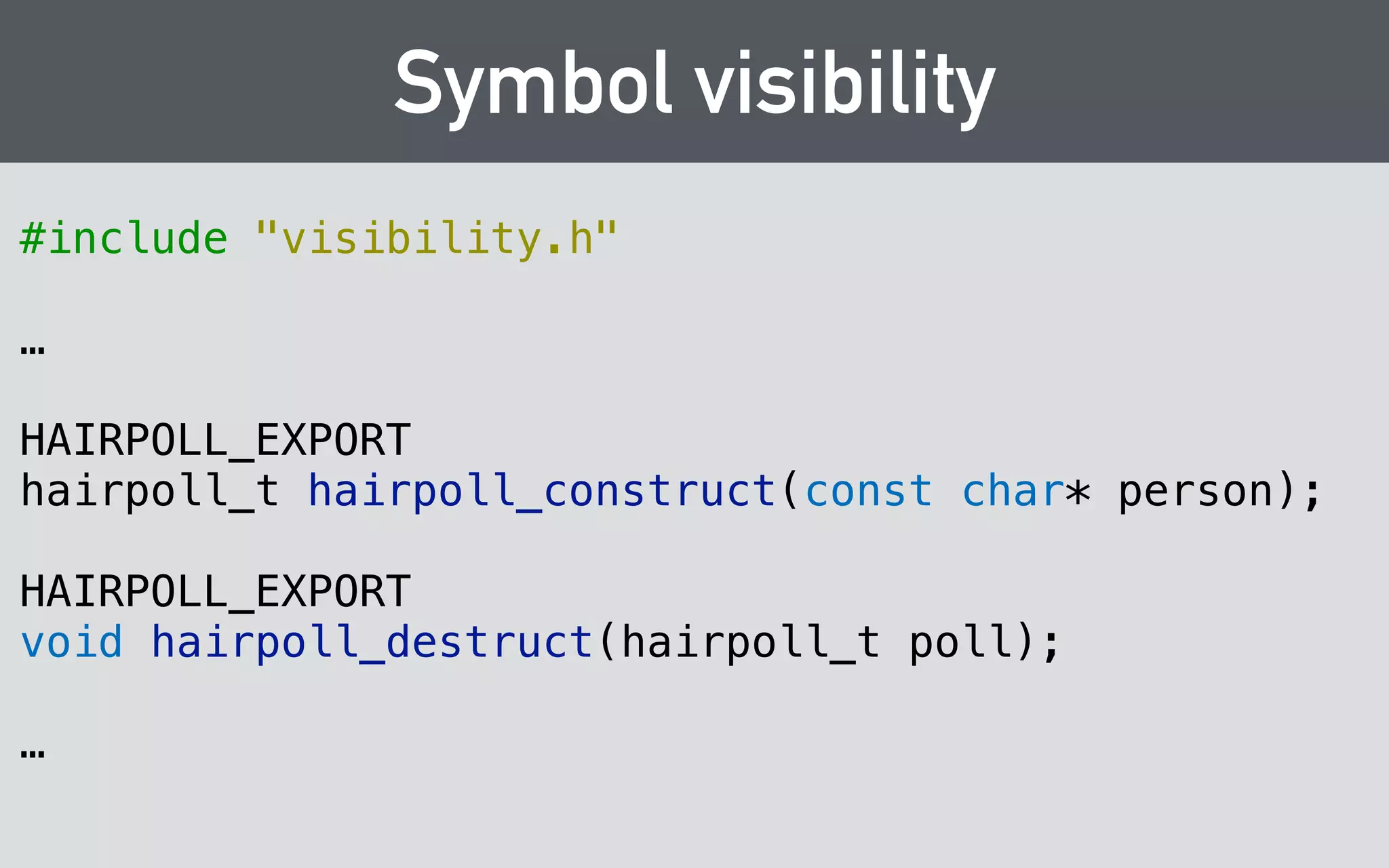
#include "visibility.h" 
! 
… 
! 
HAIRPOLL_EXPORT 
hairpoll_t hairpoll_construct(const char* person); 
! 
HAIRPOLL_EXPORT 
void hairpoll_destruct(hairpoll_t poll); 
! 
…
Symbol visibility 
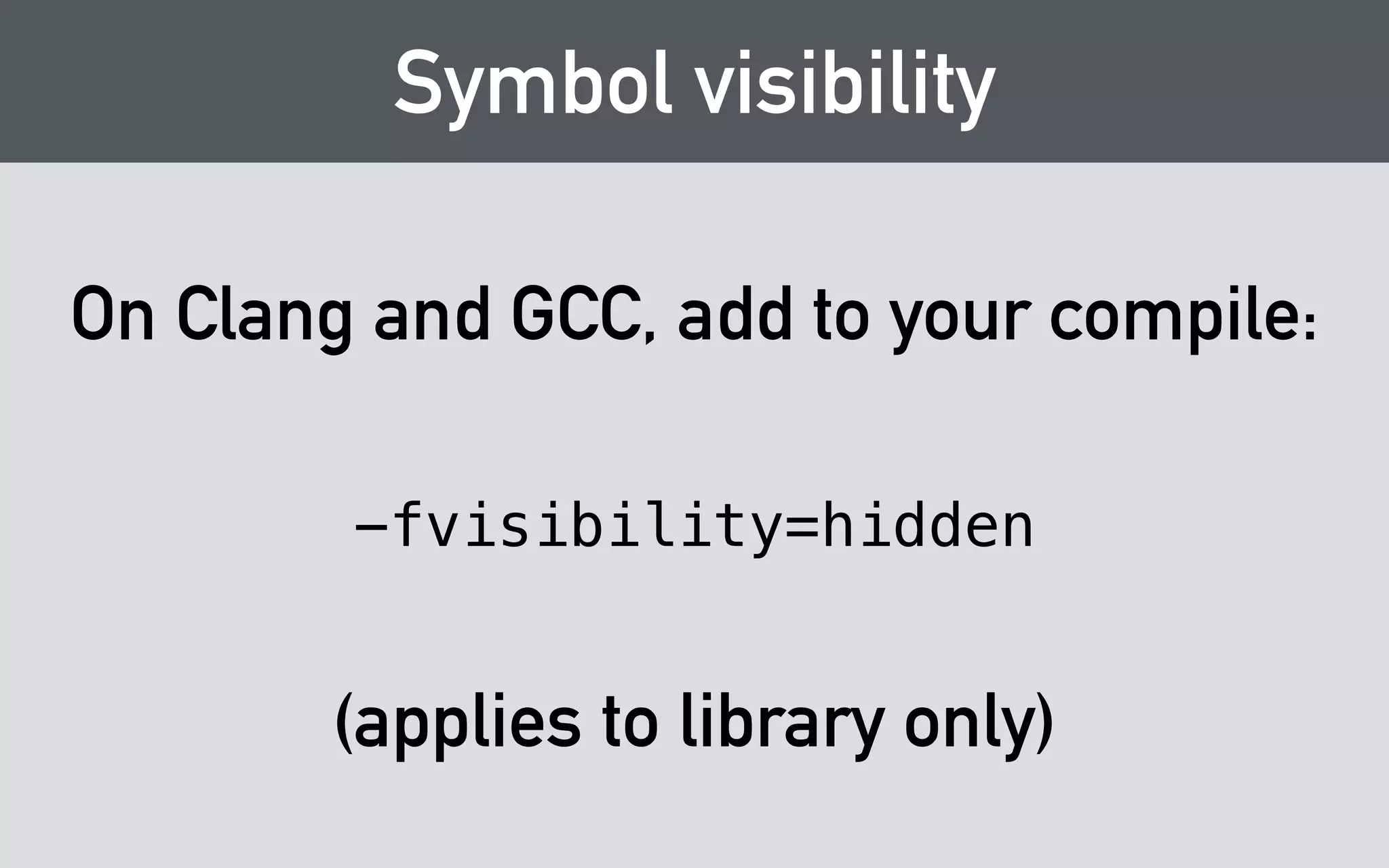
On Clang and GCC, add to your compile: 
! 
-fvisibility=hidden 
! 
(applies to library only)
Remember to extern “C”! 
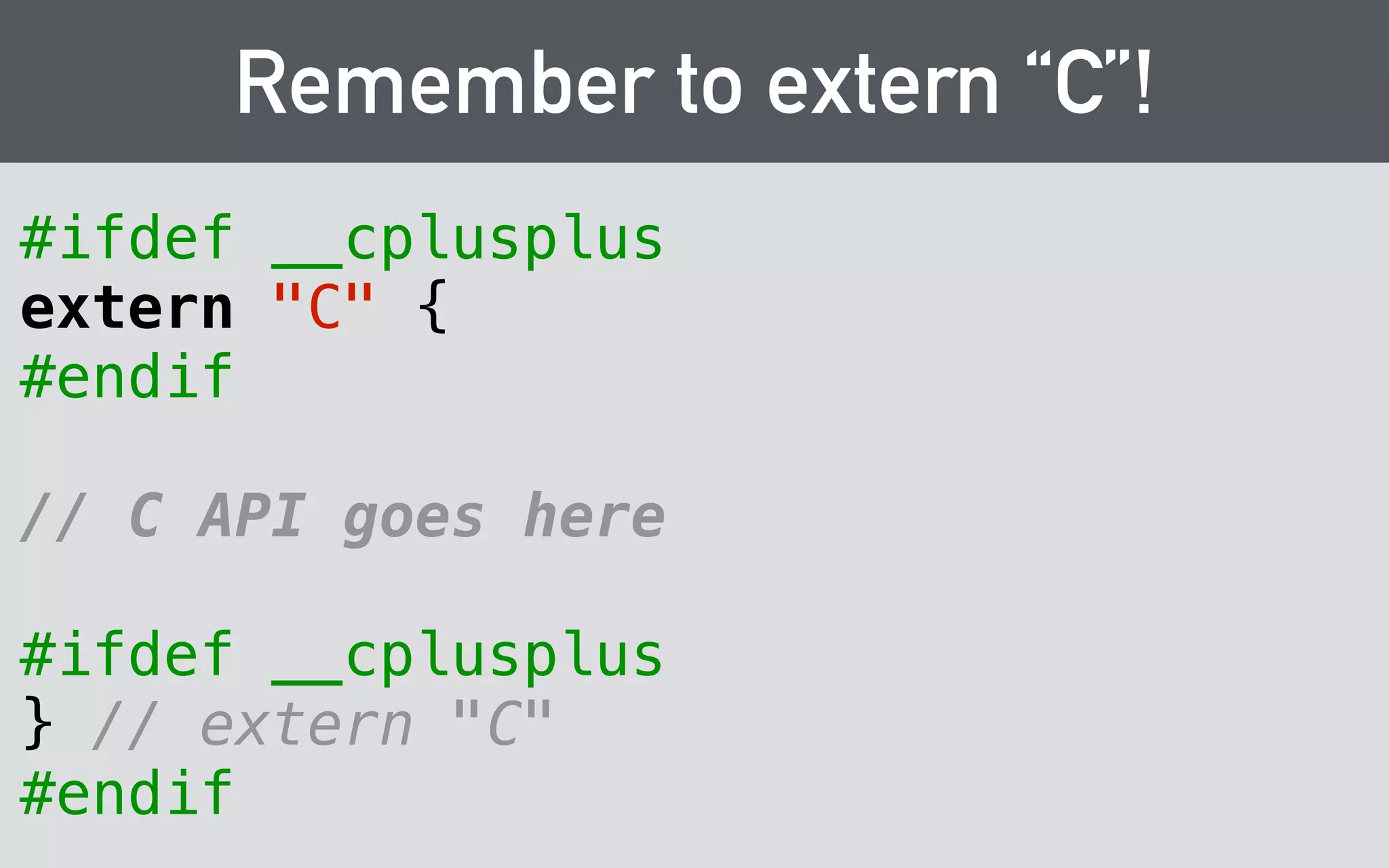
#ifdef __cplusplus 
extern "C" { 
#endif 
! 
// C API goes here 
! 
#ifdef __cplusplus 
} // extern "C" 
#endif
Lifetime and Ownership 
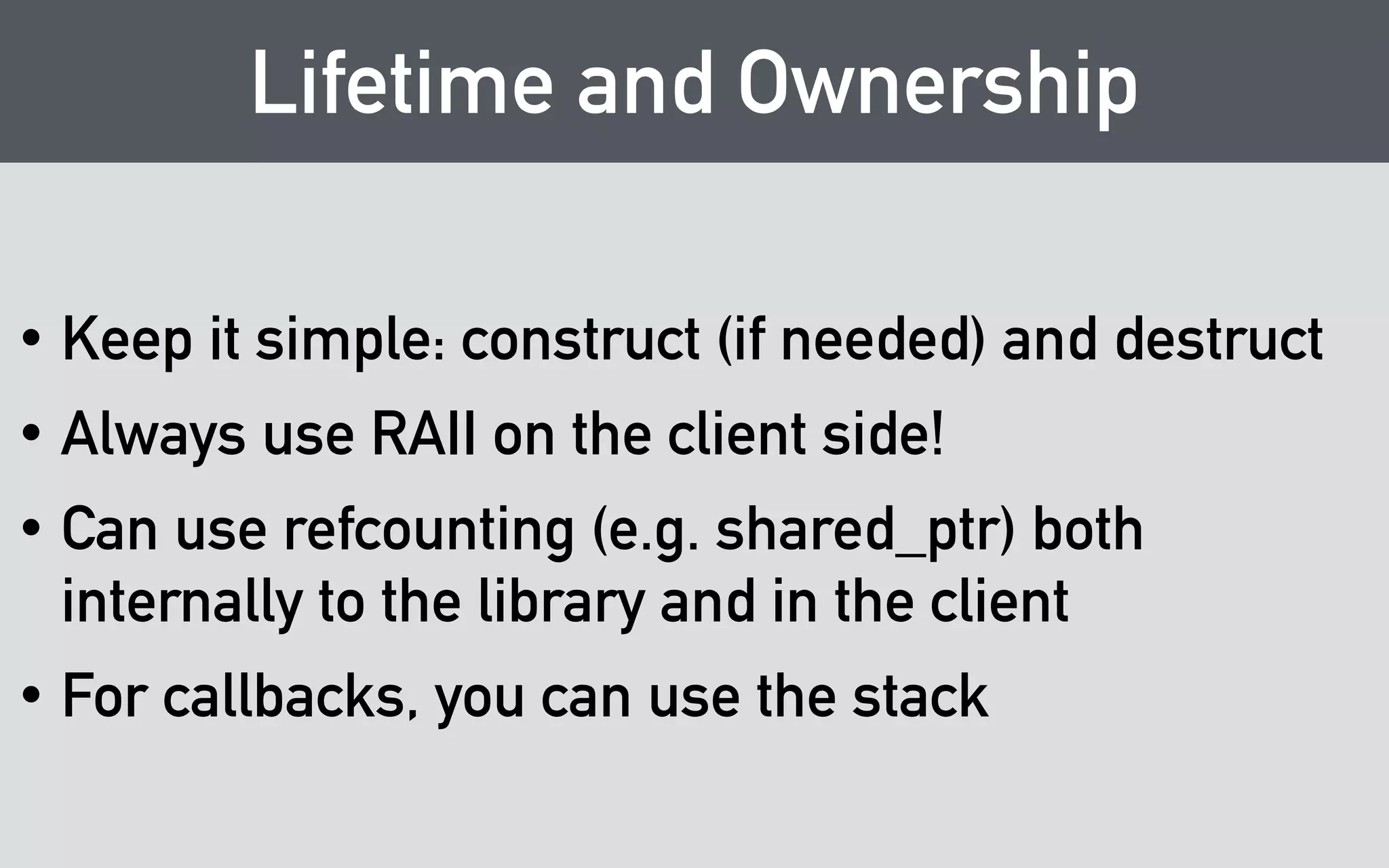
• Keep it simple: construct (if needed) and destruct 
• Always use RAII on the client side! 
• Can use refcounting (e.g. shared_ptr) both 
internally to the library and in the client 
• For callbacks, you can use the stack
Interfacing with those 
“other” languages
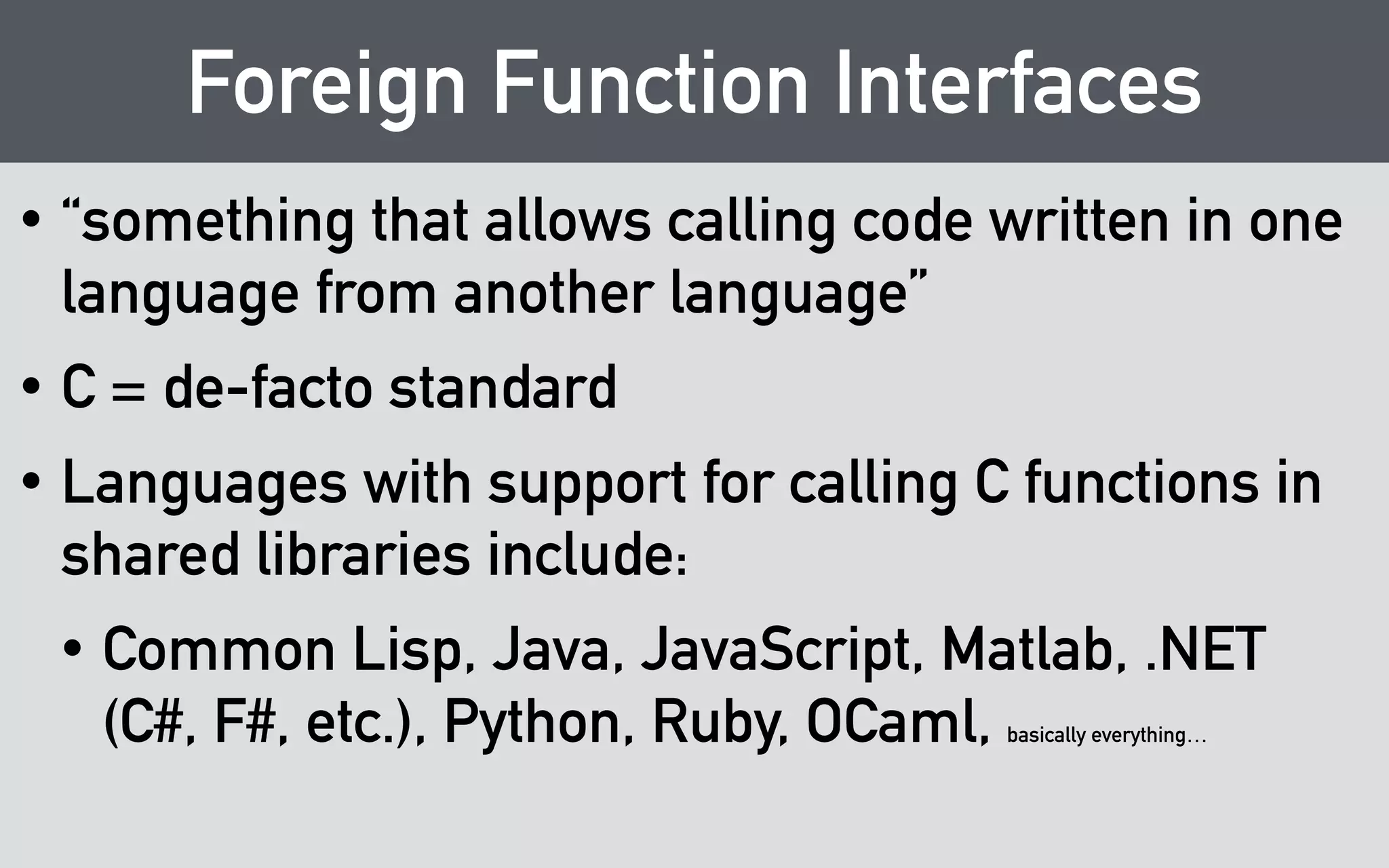
Foreign Function Interfaces 
• “something that allows calling code written in one 
language from another language” 
• C = de-facto standard 
• Languages with support for calling C functions in 
shared libraries include: 
• Common Lisp, Java, JavaScript, Matlab, .NET 
(C#, F#, etc.), Python, Ruby, OCaml, basically everything…
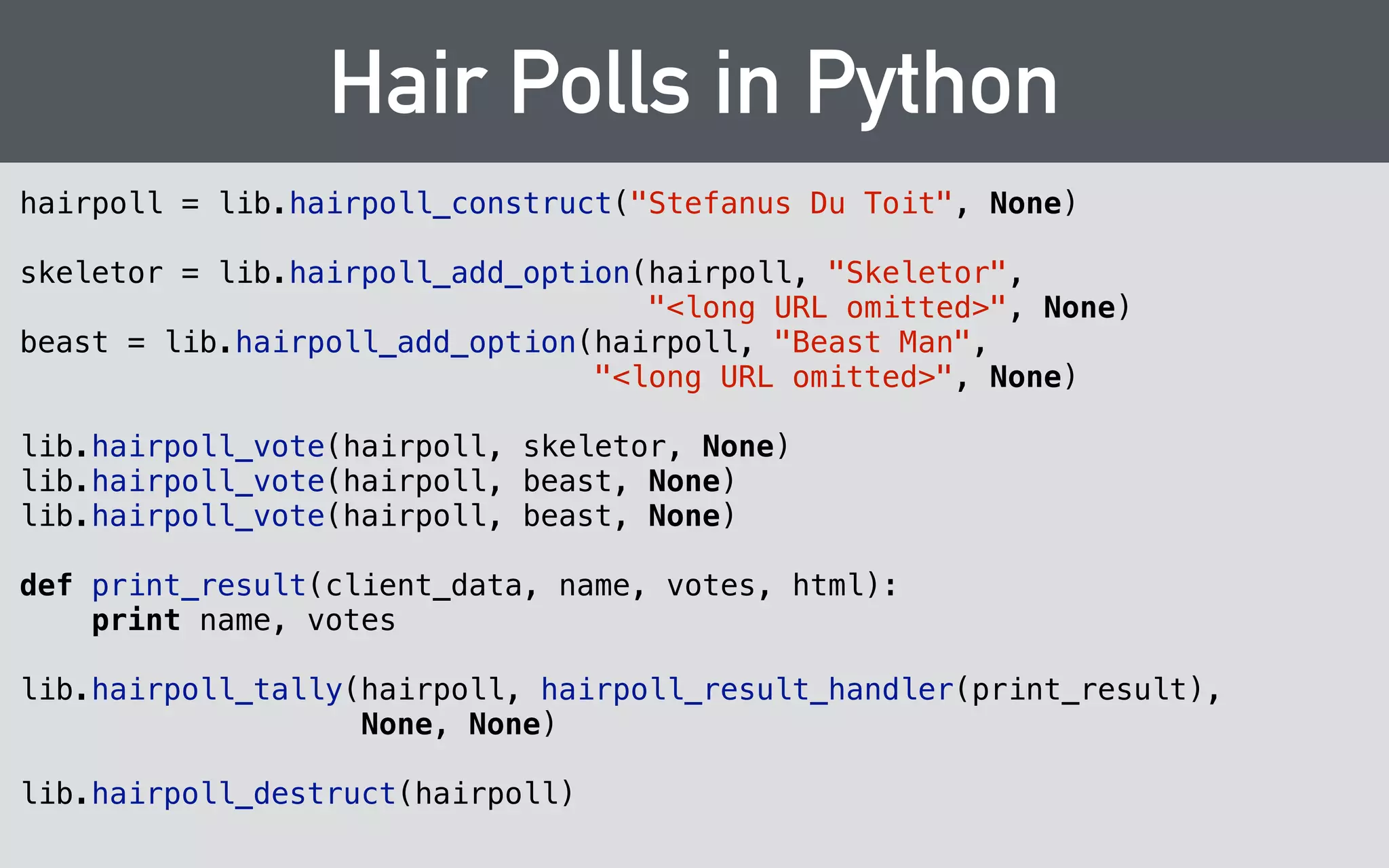
Hair Polls in Python 
hairpoll = lib.hairpoll_construct("Stefanus Du Toit", None) 
! 
skeletor = lib.hairpoll_add_option(hairpoll, "Skeletor", 
"<long URL omitted>", None) 
beast = lib.hairpoll_add_option(hairpoll, "Beast Man", 
"<long URL omitted>", None) 
! 
lib.hairpoll_vote(hairpoll, skeletor, None) 
lib.hairpoll_vote(hairpoll, beast, None) 
! 
def print_result(client_data, name, votes, html): 
print name, votes 
! 
lib.hairpoll_tally(hairpoll, hairpoll_result_handler(print_result), 
None, None) 
! 
lib.hairpoll_destruct(hairpoll)
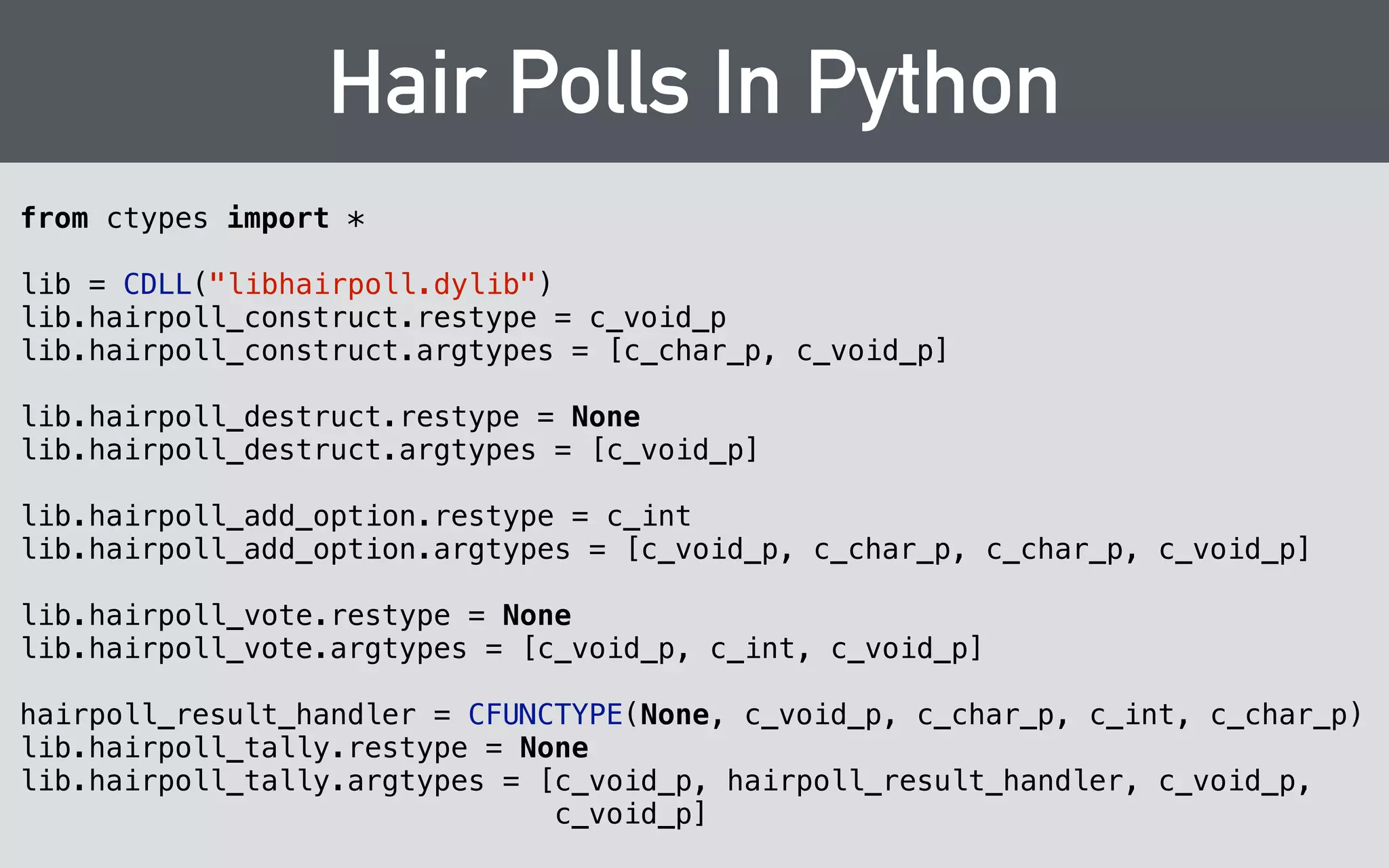
Hair Polls In Python 
from ctypes import * 
! 
lib = CDLL("libhairpoll.dylib") 
lib.hairpoll_construct.restype = c_void_p 
lib.hairpoll_construct.argtypes = [c_char_p, c_void_p] 
! 
lib.hairpoll_destruct.restype = None 
lib.hairpoll_destruct.argtypes = [c_void_p] 
! 
lib.hairpoll_add_option.restype = c_int 
lib.hairpoll_add_option.argtypes = [c_void_p, c_char_p, c_char_p, c_void_p] 
! 
lib.hairpoll_vote.restype = None 
lib.hairpoll_vote.argtypes = [c_void_p, c_int, c_void_p] 
! 
hairpoll_result_handler = CFUNCTYPE(None, c_void_p, c_char_p, c_int, c_char_p) 
lib.hairpoll_tally.restype = None 
lib.hairpoll_tally.argtypes = [c_void_p, hairpoll_result_handler, c_void_p, 
c_void_p]
Summary 
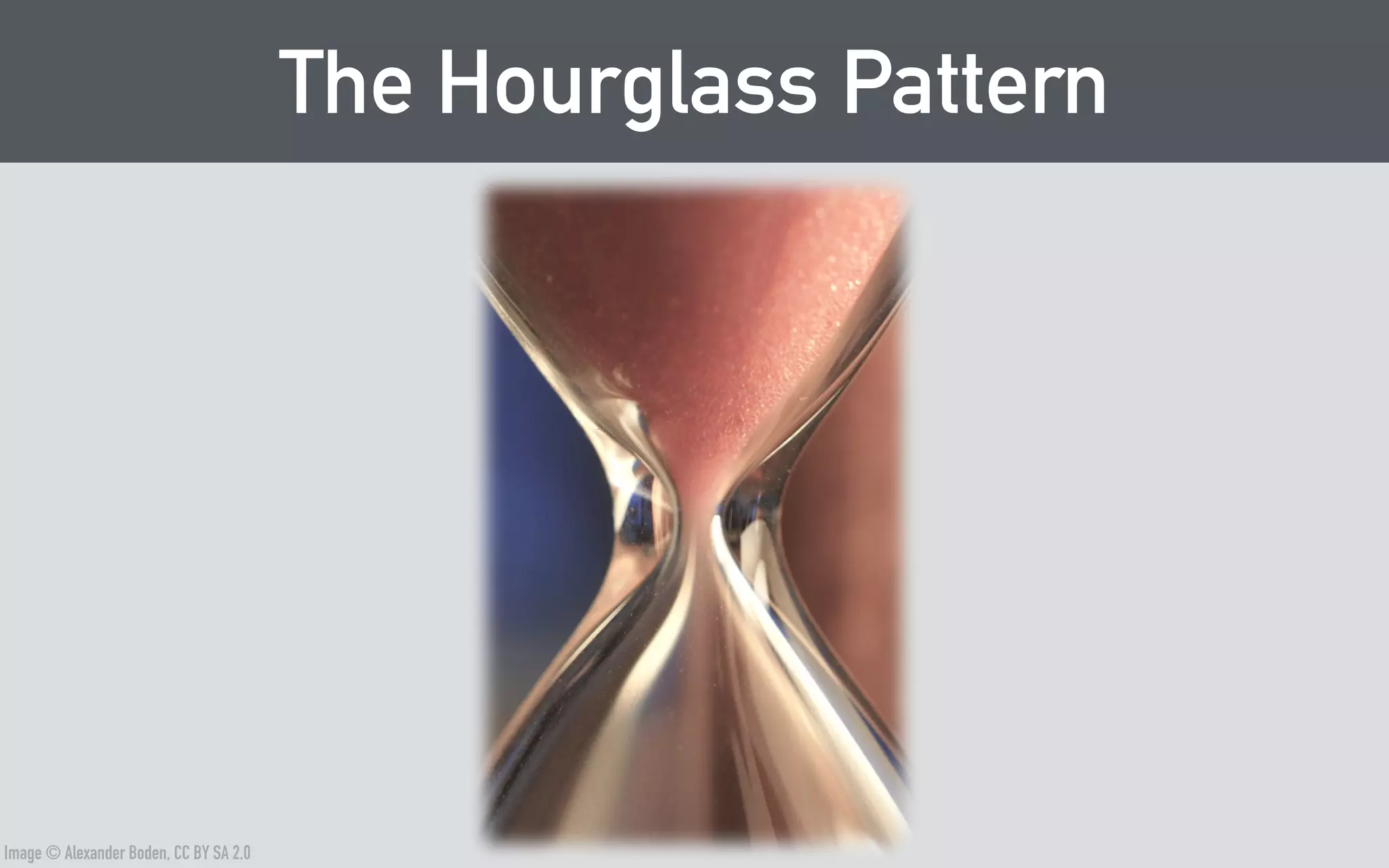
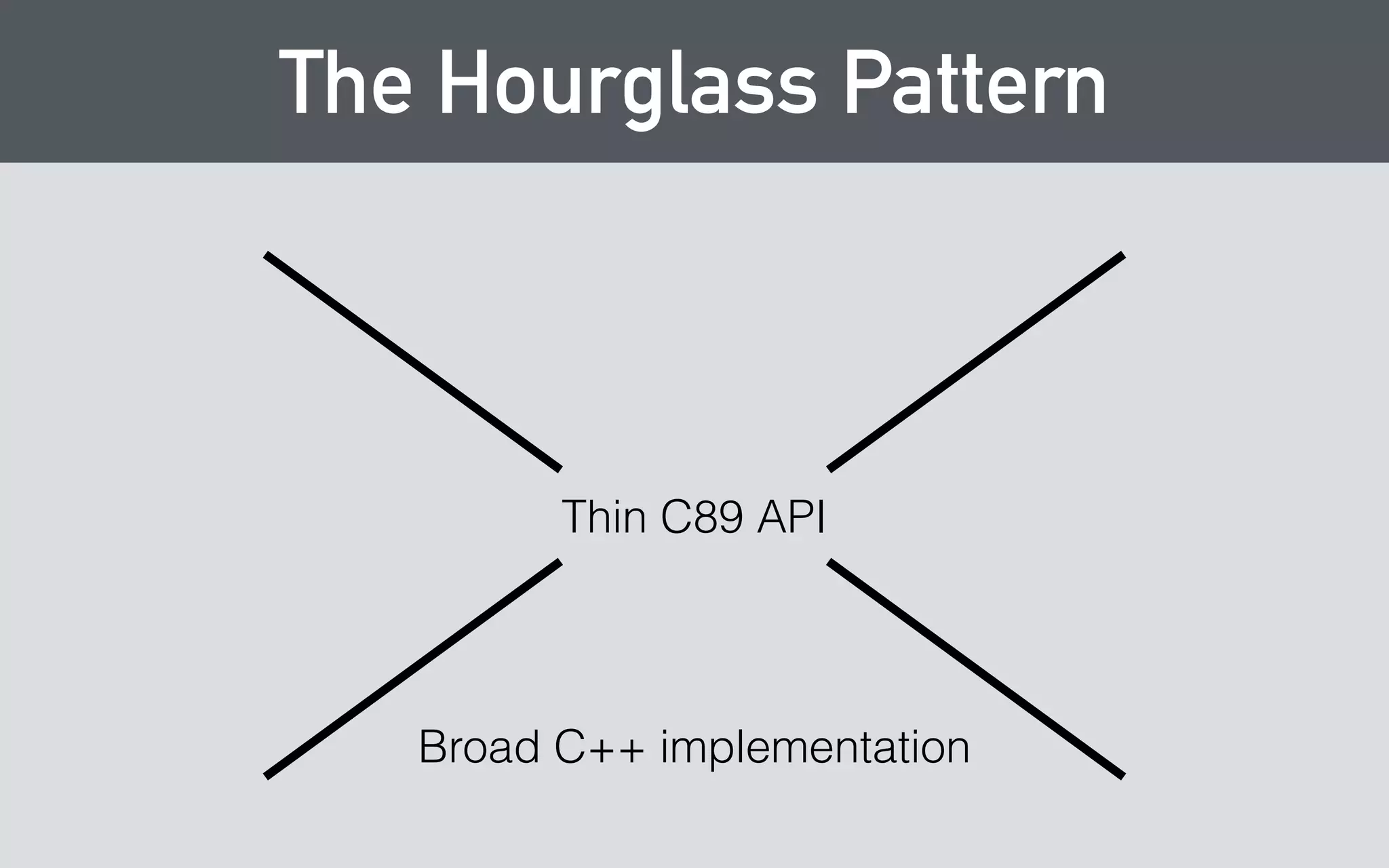
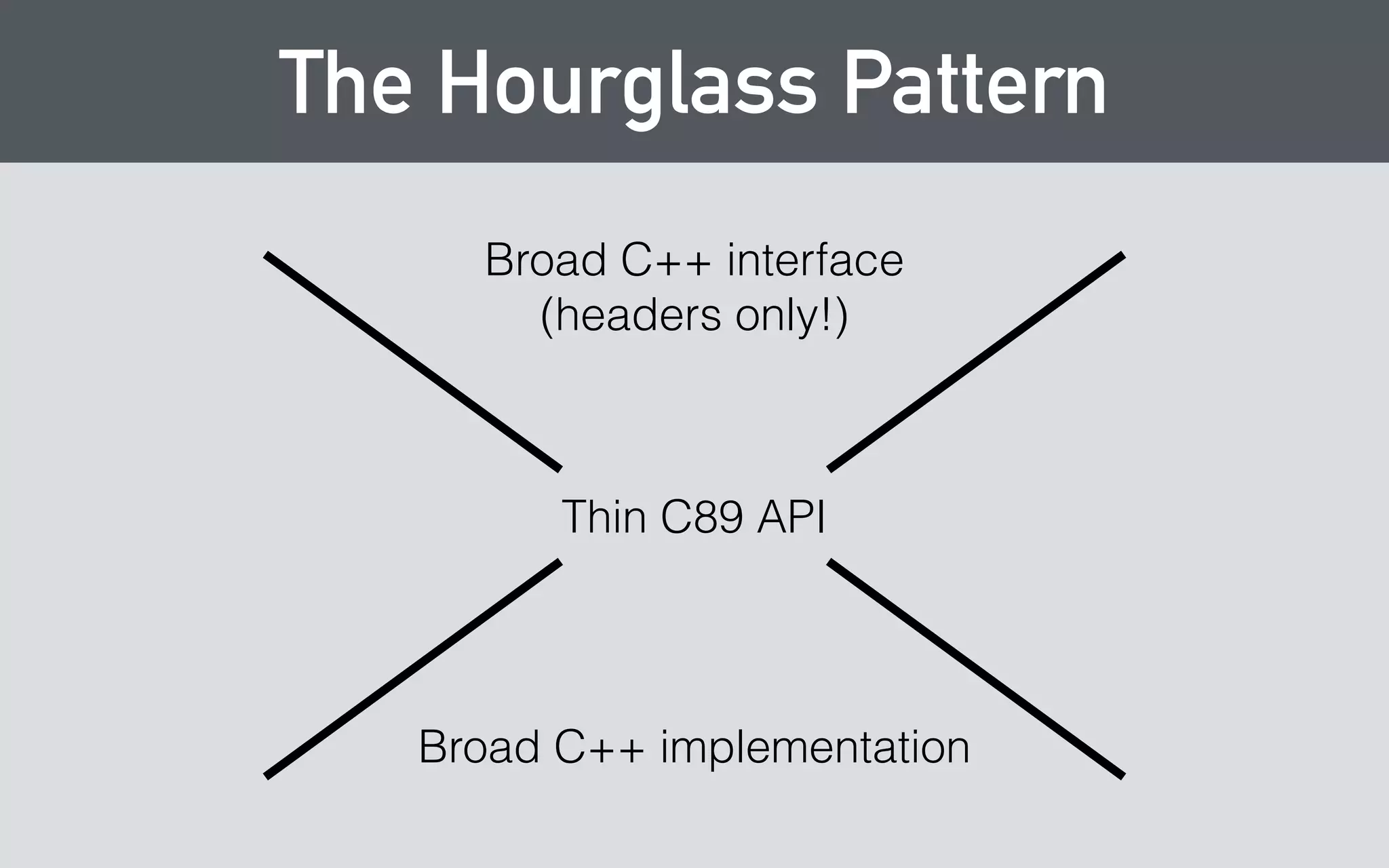
• Hourglass = C++ on top of C89 on top of C++ 
• Avoids ABI issues, sneaky dependencies, etc. 
• Hides object layout and other implementation 
details 
• Makes FFI bindings easy
Q&A 
http://blog.sduto.it/ @stefanusdutoit

Hourglass Interfaces for C++ APIs - CppCon 2014

  • 1.
    Hourglass Interfaces forC++ APIs Stefanus Du Toit Thalmic Labs @stefanusdutoit Image © Erik Fitzpatrick, CC BY 2.0
  • 2.
  • 3.
  • 4.
    Shared Libraries Interface Code Data Library
  • 5.
    Shared Libraries Interface Code Data Client! Program Library Code Data
  • 6.
    Shared Libraries Interface Code Data Client! Program Library Code Data ABI! ! Common libraries
  • 7.
    Different ABIs? Subtleproblems… Class A Class B
  • 8.
    Different ABIs? Subtleproblems… Class A Class B Debug Build Release Build
  • 9.
    My Goal forLibraries Get out of the client’s way.
  • 10.
    My Goal forLibraries Don’t make my clients: • build my code if they don’t want to • change how they build their code • rebuild their code because I shipped a fix in mine • learn a new language if they don’t want to
  • 13.
    Why does thishelp? • Avoids ABI-related binary compatibility issues • Enforces no use of non-trivial C++ types in the binary interface (e.g. std::string) • Keeps internal layout of data types a secret • Makes binding to other languages much easier ! • Still get all the convenience of C++ at both ends
  • 14.
    Example: libhairpoll •A library for creating hair-related polls, taking votes, and tallying the results
  • 15.
    hairpoll.h typedef structhairpoll* hairpoll_t; ! hairpoll_t hairpoll_construct(const char* person); void hairpoll_destruct(hairpoll_t poll); ! int32_t hairpoll_add_option(hairpoll_t hairpoll, const char* name, const char* image_url); ! void hairpoll_vote(hairpoll_t hairpoll, int32_t option); ! typedef void (*hairpoll_result_handler_t)(void* client_data, const char* name, int32_t votes, const char* html); ! void hairpoll_tally(const hairpoll_t hairpoll, hairpoll_result_handler_t handler, void* client_data);
  • 16.
    HairPoll class -client-facing class HairPoll { public: HairPoll(std::string person); ~HairPoll(); ! int addOption(std::string name, std::string imageUrl); void vote(int option); ! struct Result { std::string name; int votes; std::string html; }; std::vector<Result> results() const; ! private: hairpoll_t _opaque; };
  • 17.
  • 18.
    Parts of Cto use in the thin API • C89 + const and // comments • Functions, but no variadic functions • C primitive types (char, void, etc.) • Pointers • forward-declared structs • enumerations • Function pointers are OK, too
  • 19.
    Opaque Types typedefstruct hairpoll* hairpoll_t; ! void hairpoll_vote( hairpoll_t hairpoll, int32_t option );
  • 20.
    Opaque Types extern"C" struct hairpoll { Poll actual; };
  • 21.
    Opaque Types extern"C" struct hairpoll { template<typename... Args> hairpoll(Args&&... args) : actual(std::forward<Args>(args)...) { } ! Poll actual; };
  • 22.
    Opaque Types classPoll { public: Poll(std::string person); ! struct option { option(std::string name, std::string url); ! std::string name; std::string url; int votes; }; ! std::string person; std::vector<option> options; };
  • 23.
    Opaque Types hairpoll_t hairpoll_construct(const char* person) { return new hairpoll(person); } ! void hairpoll_destruct(hairpoll_t poll) { delete poll; }
  • 24.
    Integral types Preferstdint.h types (int32_t, int64_t, etc.) over plain C integer types (short, int, long): ! void hairpoll_vote( hairpoll_t hairpoll, int32_t option );
  • 25.
    Integral types Usingchar is OK, though: ! int32_t hairpoll_add_option( hairpoll_t hairpoll, const char* name, const char* image_url );
  • 26.
    Enumerations typedef enummotu_alignment { heroic_warrior = 0, evil_warrior = 1, }; ! int32_t motu_count( int32_t alignment );
  • 27.
    Error Handling voidhairpoll_vote( hairpoll_t hairpoll, int32_t option, error_t* out_error );
  • 28.
    Error Handling typedefstruct error* error_t; ! const char* error_message( error_t error ); ! void error_destruct(error_t error); ! ! void hairpoll_vote(hairpoll_t hairpoll, int32_t option, error_t* out_error);
  • 29.
    Errors → Exceptions struct Error { Error() : opaque(nullptr) {} ~Error() { if (opaque) { error_destruct(opaque); } } error_t opaque; }; ! class ThrowOnError { public: ~ThrowOnError() noexcept(false) { if (_error.opaque) { throw std::runtime_error(error_message(_error.opaque)); } } ! operator error_t*() { return &_error.opaque; } ! private: Error _error; };
  • 30.
    Errors → Exceptions void hairpoll_vote(hairpoll_t hairpoll, int32_t option, error_t* out_error); ! void vote(int option) { return hairpoll_vote( _opaque, option, ThrowOnError{} ); }
  • 31.
    Exceptions → Errors template<typename Fn> bool translateExceptions(error_t* out_error, Fn&& fn) { try { fn(); } catch (const std::exception& e) { *out_error = new error{e.what()}; return false; } catch (...) { *out_error = new error{"Unknown internal error"}; return false; } return true; }
  • 32.
    Exceptions → Errors void hairpoll_vote(const hairpoll_t poll, int32_t option, error_t* out_error) { translateExceptions(out_error, [&]{ if (option < 0 || option >= poll->actual.options.size()) { throw std::runtime_error("Bad optn index"); } ! poll->actual.options[option].votes++; }); }
  • 33.
    Callbacks typedef void(*hairpoll_result_handler_t)( void* client_data, const char* name, int32_t votes, const char* html ); ! void hairpoll_tally(const hairpoll_t hairpoll, hairpoll_result_handler_t handler, void* client_data, error_t* out_error);
  • 34.
    Using lambdas ascallbacks std::vector<Result> results() const { std::vector<Result> ret; ! auto addResult = [&ret](const char* name, int32_t votes, const char* html){ ret.push_back(Result{name, votes, html}); }; ! auto callback = [](void* client_data, const char* name, int32_t votes, const char* html){ auto fn = static_cast<decltype(&addResult)>(client_data); (*fn)(name, votes, html); }; ! hairpoll_tally(_opaque, callback, &addResult, ThrowOnError{}); ! return ret; }
  • 35.
    Symbol visibility #ifdefined(_WIN32) || defined(__CYGWIN__) #ifdef hairpoll_EXPORTS #ifdef __GNUC__ #define HAIRPOLL_EXPORT __attribute__ ((dllexport)) #else #define HAIRPOLL_EXPORT __declspec(dllexport) #endif #else #ifdef __GNUC__ #define HAIRPOLL_EXPORT __attribute__ ((dllimport)) #else #define HAIRPOLL_EXPORT __declspec(dllimport) #endif #endif #else #if __GNUC__ >= 4 #define HAIRPOLL_EXPORT __attribute__ ((visibility ("default"))) #else #define HAIRPOLL_EXPORT #endif #endif
  • 36.
    Symbol visibility #include"visibility.h" ! … ! HAIRPOLL_EXPORT hairpoll_t hairpoll_construct(const char* person); ! HAIRPOLL_EXPORT void hairpoll_destruct(hairpoll_t poll); ! …
  • 37.
    Symbol visibility OnClang and GCC, add to your compile: ! -fvisibility=hidden ! (applies to library only)
  • 38.
    Remember to extern“C”! #ifdef __cplusplus extern "C" { #endif ! // C API goes here ! #ifdef __cplusplus } // extern "C" #endif
  • 39.
    Lifetime and Ownership • Keep it simple: construct (if needed) and destruct • Always use RAII on the client side! • Can use refcounting (e.g. shared_ptr) both internally to the library and in the client • For callbacks, you can use the stack
  • 40.
    Interfacing with those “other” languages
  • 41.
    Foreign Function Interfaces • “something that allows calling code written in one language from another language” • C = de-facto standard • Languages with support for calling C functions in shared libraries include: • Common Lisp, Java, JavaScript, Matlab, .NET (C#, F#, etc.), Python, Ruby, OCaml, basically everything…
  • 42.
    Hair Polls inPython hairpoll = lib.hairpoll_construct("Stefanus Du Toit", None) ! skeletor = lib.hairpoll_add_option(hairpoll, "Skeletor", "<long URL omitted>", None) beast = lib.hairpoll_add_option(hairpoll, "Beast Man", "<long URL omitted>", None) ! lib.hairpoll_vote(hairpoll, skeletor, None) lib.hairpoll_vote(hairpoll, beast, None) lib.hairpoll_vote(hairpoll, beast, None) ! def print_result(client_data, name, votes, html): print name, votes ! lib.hairpoll_tally(hairpoll, hairpoll_result_handler(print_result), None, None) ! lib.hairpoll_destruct(hairpoll)
  • 43.
    Hair Polls InPython from ctypes import * ! lib = CDLL("libhairpoll.dylib") lib.hairpoll_construct.restype = c_void_p lib.hairpoll_construct.argtypes = [c_char_p, c_void_p] ! lib.hairpoll_destruct.restype = None lib.hairpoll_destruct.argtypes = [c_void_p] ! lib.hairpoll_add_option.restype = c_int lib.hairpoll_add_option.argtypes = [c_void_p, c_char_p, c_char_p, c_void_p] ! lib.hairpoll_vote.restype = None lib.hairpoll_vote.argtypes = [c_void_p, c_int, c_void_p] ! hairpoll_result_handler = CFUNCTYPE(None, c_void_p, c_char_p, c_int, c_char_p) lib.hairpoll_tally.restype = None lib.hairpoll_tally.argtypes = [c_void_p, hairpoll_result_handler, c_void_p, c_void_p]
  • 44.
    Summary • Hourglass= C++ on top of C89 on top of C++ • Avoids ABI issues, sneaky dependencies, etc. • Hides object layout and other implementation details • Makes FFI bindings easy
  • 46.