Chapter 8restoring the earth
For goods, ranging from building materials to seafoodServices, ranging from flood control to crop pollinationWe are in trouble – Croplands are erodingHarvests are shrinkingWater tables are falling Wells are going dryGrasslands are turning to desert Livestock are dyingIf civilization's environmental support systems continue to decline, eventually civilization itself will followWe are dependent on the earth's natural systems
Where we’re headedThe benefits of resource conservation— at the most basic level—are still out of reach for many. Ecological and social collapses have reinforced each other in a downward spiral into poverty, environmental degradation, social injustice, disease, and violence." Unfortunately, the situation cox describes is what lies ahead for more and more countries if we do not restore the earth's health.
Restoring the earth - effort, far larger and demanding than the Marshall plan Must be undertaken at wartime speed Lest environmental deterioration translate into economic decline and state failure, Just as it did for earlier civilizations that violated nature's thresholds and ignored its deadlines
Protecting and restoring forests4 billion hectares of remaining forests And replanting those lost are both essential for restoring the earth's healthAn important foundation for the new economy. All depends on simultaneously reducing pressure on forests and on reforestationReducing rainfall runoff and the associated flooding and soil erosion, Recycling rainfall inland, and Restoring aquifer recharge depend on simultaneously reducing pressure on forests and on reforestation
Reducing wood useA vast unrealized potential in all countries to lessen the demands that are shrinking the earth's forest cover –Industrial nations the greatest opportunity lies in reducing the quantity of wood used to make paperAnd in developing countries it depends on reducing fuel wood use
Rates of paper recycling in the top 10 paper-producing countries range widelyChina and Finland on the low end, recycling 33 and 38 percent of the paper they useSouth Korea and Germany on the high end, at 77 and 66 percent. Us 50 percent in 2005If every country recycled as much of its paper as south Korea does, the amount of wood pulp used to produce paper worldwide would drop by one third.Paper recycling
Paper epitomizes the throw-away mentalityAn enormous possibility for reducing paper use simply by replacing facial tissues, paper napkins, disposable diapers, and paper shopping bags with reusable cloth alternativesThe largest single demand on trees—the need for fuel— accounts for just over half of all wood removed from forests
U.S. Agency for international development (AID - more promising projects is the distribution of 780,000 highly efficient wood cook stoves in Kenya that not only Use far less wood than a traditional stove but Also pollute less.Also the site of a solar cooker project sponsored by solar cookers internationalMade from cardboard and aluminum foil and costing $10 each, cook slowly, much like a crockpot. Requiring less than two hours of sunshine to cook a complete meal, they can greatly reduce firewood use at little cost. They can also be used to pasteurize water, thus saving lives.Kenya
Developing alternative energy sources Key to reducing forest pressure in developing countries. Replacing firewood with solar thermal cookersOr even with electric hotplates fed by wind-generated electricity Lighten the load on forests
Despite the high value to society of intact forests, Only about 290 million hectares of global forest area are legally protected from loggingAn additional 1.4 billion hectares are economically unavailable for harvesting because of geographic inaccessibility or low-value woodOf the remaining area available for exploitation, 665 million hectares are undisturbed by humans and nearly 900 million hectares are semi-natural and not in plantations
Banned logging in most remaining old-growth and virgin forests Largely because the country has become so vulnerable to flooding, erosion, and landslidesOnce covered by rich stands of tropical hardwood forests,Years of massive clear-cuttingLost the forest's products as well as its services and Became a net importer of forest products.The Philippines, for example
Sustainable forestry Another way to protect forestsIf only mature trees are felled, and on a selective basisA forest and its productivity can be maintained in perpetuity
1997 alliance for forest conservation and sustainable useIn mid-2005, the alliance announced a goal of reducing global net deforestation to zero by 2020
Additional forest product certification programsInform environmentally conscious consumers Sustainable management of the forest where wood products originateThe most rigorous international program, certified by a group of NGOs, is the forest stewardship council (FSC).
Reconstituted wood Substituting for natural wood as the world lumber and construction industries adapt to a shrinking supply of large logs from natural forests
Where wood comes fromProduction of roundwood (logs) on plantations is estimated at 432 million cubic meters per year, accounting for 12 percent of world wood production. This means that the lion's share, some 88 percent of the world timber harvest, comes from natural forest stands.
Six countries account for 60 percent of tree plantationsChina, which has little original forest remaining, is by far the largest, with 54 million hectares of plantations. India and the United States follow, at 17 million hectares each. Russia, Canada, and Sweden are close behind
It is shifting geographically to the moist tropicsGrain yields tend to rise with distance from the equator and the longer summer growing daysTree plantation yields rise with proximity to the equator and year-round growing conditionsIn eastern Canada, the average hectare of forest plantation produces 4 cubic meters of wood per yearIn the southeastern United States, where U.S. Plantations are concentrated, the yield is 10 cubic metersBut in Brazil, newer plantations may be getting close to 40 cubic metersTree plantations moving toward equator
Tree plantations moving toward equatorWhile corn yields in the United States are nearly triple those in Brazil, timber yields are the reverse, favoring Brazil by nearly 4 to 1To satisfy a given demand for wood, Brazil requires only one fourth as much land as the United States, which helps explain why growth in pulp capacity is now concentrated in equatorial regions.
Plantations can sometimes be profitably established on already deforested, often degraded, land. Can also come at the expense of existing forestsThere is competition with agriculture as well, since land that is suitable for crops is also good for growing treesWater scarcity is yet another constraint. Fast-growing plantations require abundant moisturePlantations
Plantation projectionsU.N. Food and agriculture organization (FAO) projects that as plantation area expands and yields rise, the harvest could more than double during the next three decadesIt is entirely conceivable that plantations could one day satisfy most of the world's demand for industrial wood, thus helping to protect the world's remaining forests
Deforested land Vast areas of deforested land can be used to grow trillions of trees bred for food (mostly nuts), fuel, and other purposesNuts used to supplement meat as a source of high-quality protein in developing-country dietsTrees grown on this deforested land being converted into ethanol for automotive fuel
Some highly erodible agricultural land in industrial countries has been reforested by natural regrowthNew England in the United StatesNew England's forest cover has increased from a low of roughly one third two centuries ago to four fifths today, slowly regaining its original health and diversitySimilar situation exists now in parts of the former soviet union and in several east European countries. Millions of hectares of farmland are now returning to forest.Reforesting highly erodible land
When the Korean war ended, half a century ago, the mountainous country was largely deforestedBeginning around 1960 the south Korean government launched a national reforestation effortRelying on the formation of village cooperatives, hundreds of thousands of people were mobilized to dig trenches and to create terraces for supporting trees on barren mountainsToday forests cover 65 percent of the country, an area of roughly 6 million hectaresSouth Korea – model for rest of world
Conserving and rebuilding soils
Preserving the biological productivity of highly erodible cropland depends on planting it in grass or trees before it becomes wastelandThe 1930s dust bowl that threatened to turn the U.S. Great plains into a vast desert was a traumatic experience that led to revolutionary changes in American agricultural practices, including the Planting of tree shelterbelts (rows of trees planted beside fields to slow wind and thus reduce wind erosion) and Strip-cropping, the planting of wheat on alternate strips with fallowed land each year. Strip-cropping permits soil moisture to accumulate on the fallowed strips, while the alternating planted strips reduce wind speed and hence erosion on the idled landConserving and rebuilding soils
In 1985, the U.S. Congress, with strong support from the environmental community, created the conservation reserve program (CRP) to reduce soil erosion and control overproduction of basic commodities. By 1990 there were some 14 million hectares (35 million acres) of highly erodible land with permanent vegetative cover under 10-year contracts. Under this program, Farmers were paid to plant fragile cropland to grass or trees. The retirement of 14 million hectares under the CRP, together with the use of conservation practices on 37 percent of all cropland, Reduced U.S. Soil erosion from 3.1 billion tons to 1.9 billion tons during the 15 years between 1982 and 1997. The U.S. Approach offers a model for the rest of the world.US soil conservation
Both no- till and minimum-tillageFarmers simply drill seeds directly through crop residues into undisturbed soil, controlling weeds with herbicidesLeaving the remainder of the soil undisturbed, covered by crop residues and thus resistant to both water and wind erosion. In addition to Reducing erosion, this practice helps Retain water, Raises soil carbon content, and Reduces energy useConservation tillage
1990’s soil conservation plan requiredNo-till area went from 7 million hectares in 1990 to 25 million hectares in 2004Now widely used in the production of corn and soybeansNo-till has spread rapidly in the western hemisphere
Desert moving southward all across the Sahel, from Senegal on the west coast to Djibouti on the east coastGrowing displacement of people as grasslands and croplands turn to desertAfrican union has launched the green wall Sahara initiativeCalls for the planting of 300 million trees on 3 million hectares of landIn a long band stretching across AfricaSub-Saharan Africa
China is likewise planting a belt of trees to protect land from the expanding Gobi desertProjected to reach some 4,480 kilometers (2,800 miles) in length, stretching from outer Beijing through inner MongoliaChina is paying farmers in the threatened provinces to plant their cropland in treesThe goal is to plant trees on 10 million hectares of grain land, easily one tenth of China's current grain land areaChina
The Helin county (inner Mongolia) strategy centers on Replacing the large number of sheep and goats With dairy cattle, increasing the number of dairy animals from 30,000 in 2002 to 150,000 by 2007. The cattle are kept within restricted areas, feeding on cornstalks, wheat straw, and the harvest from a drought-tolerant forage crop resembling alfalfa, which is grown on reclaimed land. Local officials estimate that this program will double incomes within the county during this decade.China
The only viable way to eliminate overgrazing on the two fifths of the earth's land surface classified as rangelands is to reduce the size of flocks and herds. Not only do the excessive numbers of cattle, and particularly sheep and goats, remove the vegetation, but their hoofs pulverize the protective crust of soil that is formed by rainfall and that naturally checks wind erosion. In some situations, the only viable option is to keep the animals in restricted areas, bringing the forage to them. India, which has successfully adopted this practice for its thriving dairy industry, is the model for other countries.Bringing the forage to them
In favor of selective harvestingWith each clear-cut there are heavy soil losses until the forest regeneratesThus with each subsequent cutting, productivity declines furtherRestoring the earth's tree and grass cover, as well as practicing conservation agriculture, Protects soil from erosion, Reduces flooding, and Sequesters carbon. It is one way we can restore the earth so that it can support the next generations.Need a worldwide ban on the clear-cutting of forests
Reserves that covered 30 percent of the world's oceans Would cost $12-14 billion a year. This did not take into account the likely additional income from recovering fisheries, which would reduce the actual cost.Would create more than 1 million jobsAnnual oceanic fish catch worth $70-80 billion"Our study suggests that we could afford to conserve the seas and their resources in perpetuity, and for less than we are now spending on subsidies to exploit them unsustainably.“If you put areas off limits to fishing, there is no more effective way of allowing things to live longer, grow larger, and produce more offspringRegenerating fisheries
Snapper fishery off the coast of new England Local population of snapper increase 40-foldGulf of MaineAll fishing methods that put ground fish at risk were banned within three marine reserves totaling 17,000 square kilometersScallops flourished in this undisturbed environment, and their populations increased by up to 14-fold within five yearsGreatly increased the scallop population outside the reserves. Within a year or two of establishing a marine reserve, population densities Increased 91 percent, Average fish size went up 31 percent, and Species diversity rose 20-40 percent.Case studies
Reduce fertilizer runoff and untreated sewageCreates the world's 200 or so dead zones
Eliminate fishery subsidiesNow so many fishing trawlers that their catch potential is nearly double any yield the oceans can sustainManaging a network of marine reserves governing 30 percent of the oceans would cost only $12-14 billion—less than the $22 billion in harmful subsidies that governments dole out today to fishers
Protecting plant and animal diversity
Two steps essential to protecting the earth's extraordinary biological diversity are the Stabilization of both the human population and the Earth's climateIf the world's population increases to 9 billion by mid-century as projected, countless more plant and animal species may simply be crowded off the planet. If carbon dioxide levels and temperatures continue to rise, every ecosystem will changeProtecting plant and animal diversity
Protecting plant and animal diversityAs it becomes more difficult to raise land productivity, continuing population growth will force farmers to clear ever more tropical forests in the amazon and Congo basins and the outer islands of Indonesia
Water managementAt a time of growing water shortagesKey to protecting fresh water and marine speciesWhen rivers are drained dry to satisfy growing human needs for irrigation and for urban water, fish species cannot survive
Parks and reservesSome 13 percent of the earth's land area is now included in parks and nature preservesMany exist only on paperBiodiversity "hotspots” - especially rich biologically The 34 hotspots identified once covered nearly 16 percent of the earth's land surface but, largely because of habitat destruction, they now cover less than 3 percent
Prohibited any activities, such as clearingnew land for agriculture and housing developments or draining wetlands, that would threaten an endangered speciesPotential leverage point in battling global warming because of the need to protect species particularly threatened by warmer temperatures, including coral and polar bears.If we cannot stabilize human numbers and stabilize the climate, there is not an ecosystem on earth that we can save1973 the United States  endangered species act
Planting trees to sequester carbon
Planting trees to sequester carbonAs of 2007, the shrinking forests in the tropical regions were releasing 2.2 billion tons of carbon per yearMeanwhile, expanding forests in the temperate regions were absorbing 0.7 billion tons of carbon annuallyOn balance, a net of some 1.5 billion tons of carbon were being released into the atmosphere each year, contributing to global warming
Asia is driven primarily by the fast-growing demand for timberLatin America, by contrast, it is the growing demand for soybeans and beef that is deforesting the amazonAfrica, it is mostly the gathering of fuel- wood and the clearing of new land for agriculture as existing cropland is degraded and abandonedTwo countries, Indonesia and Brazil, account for more than half of all deforestationTropical deforestation
End net deforestation worldwideSequester carbon through a variety of tree planting initiativesAdoption of improved agricultural land management practicesToday, because the earth's forests are shrinking, they are a major source of CO2The goal is to expand the earth's tree cover, growing more trees to soak up CO2Plan B goals
Thailand, the Philippines, and ChinaAll three bans were imposed following devastating floods and mudslides resulting from the loss of forest coverRecord losses from several weeks of nonstop flooding in the Yangtze river basinThrough those of society as a whole, it simply did not make economic sense to continue deforestingThe flood control service of trees standing, they said, was three times as valuable as the timber from trees cut.Beijing then took the unusual step of paying the loggers to become tree planters—to reforest instead of deforestEnvironmental reasons have pushed bans
If it continues to shrink, it will also continue to dry out, becoming vulnerable to fireIf the amazon rainforest disappears, it would be replaced largely by desert and scrub forestlandThe capacity of the rainforest to cycle water to the interior, including to the agricultural areas to the south, would be lostAt this point, a fast-unfolding local environmental calamity would become an economic disaster, and because the burning amazon would release billions of tons of carbon into the atmosphere, it would accelerate global warmingBrazil's amazon rainforest
Deforestation a global concern nowNo longer just a matter of local flooding, But also rising seas worldwide and the Many other effects of climate change. Nature has just raised the ante on protecting forests.
Will require Reducing the pressures to deforest that come From population growth, Rising affluence, The construction of ethanol distilleries and biodiesel refineries, and the Fast-growing use of paper.Halting population growth as soon as possible, and, For the earth's affluent residents who are responsible for the growing demand for beef and soybeans that is deforesting the amazon basin, it means moving down the food chainMay require a ban on the construction of additional biodiesel refineries and ethanol distilleriesReaching zero net deforestation
Potential for foresting wasteland to sequester carbonThere are 1.86 billion hectares of degraded land in the worldHalf of this, or 930 million hectares, has a decent chance of being profitably reclaimed840 million hectares of this total are in the tropical regions, where reclamation would mean much higher rates (4X) of carbon sequestrationMaximum technical potential of these 930 million hectares is to absorb roughly 21.6 billion tons of CO2 per year
Potential for foresting wasteland to sequester carbonIf carbon sequestration were valued at $210 per ton of carbonAn estimated 18 percent of this technical potential could be realizedThis would mean planting 171 million hectares of land to treesWould sequester 3.5 billion tons of CO2 per year, or over 950 million tons of carbon
Potential for foresting wasteland to sequester carbonThe total cost of sequestering carbon at $210 per ton would be $200 billion. Spread over a decade, this would mean investing $20 billion a year to give climate stabilization a large and potentially decisive boost. This plan to remove atmospheric co2, most of it put there by industrial countries, would be funded by them
Inspired by Kenyan Nobel laureate winger Matthau - had earlier organized women in Kenya and several nearby countries to plant 30 million treesAs of October 2007 that it had received pledges to plant a total of 1.2 billion trees by year end431 million already had been plantedMexico pledged to plant 250 million treesEthiopia promised to plant 60 million trees Senegal signed up for 20 million treesBillion tree campaign
Study of Cheyenne, Wyoming, to Berkeley, CaliforniaFor every dollar spent on planting and caring for trees, the benefits to the community exceeded two dollarsA mature tree canopy in a city shades buildings and Can reduce air temperatures by 5-10 degrees fahrenheit, thus reducing the energy needed for air conditioning. In cities with severe winters like Cheyenne, the reduction of winter wind speed by evergreen trees cuts heating costs. Real estate values on tree-lined streets are typically 3-6 percent higher than where there are few or no trees
The earth restoration budget
The earth restoration budgetReforest the earth, Protect top- soil, Restore rangelands and fisheries, Stabilize water tables, and Protect biological diversityNote - forested area is already expanding in the northern hemisphere's industrial countries
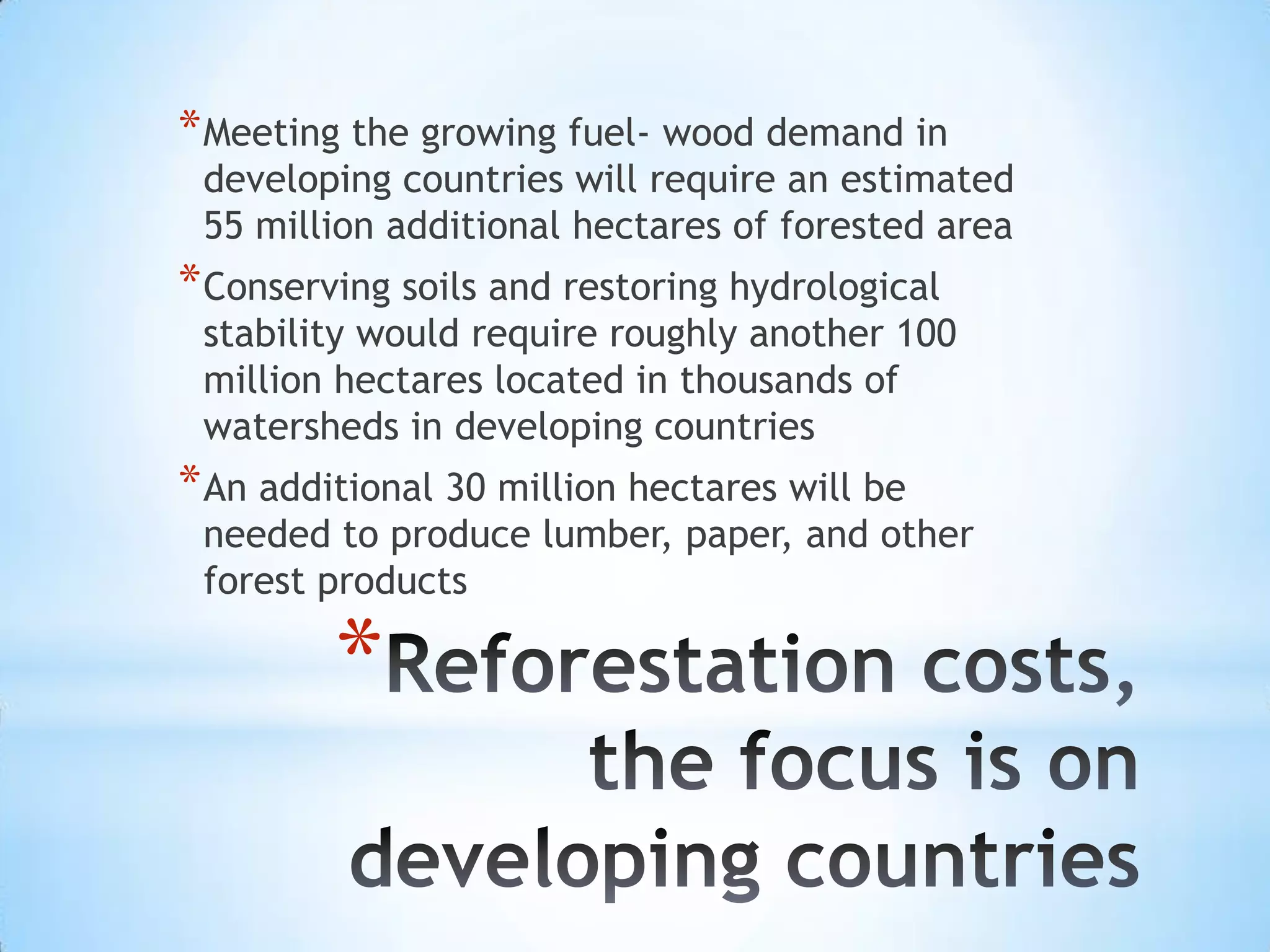
Reforestation costs, the focus is on developing countriesMeeting the growing fuel- wood demand in developing countries will require an estimated 55 million additional hectares of forested areaConserving soils and restoring hydrological stability would require roughly another 100 million hectares located in thousands of watersheds in developing countriesAn additional 30 million hectares will be needed to produce lumber, paper, and other forest products
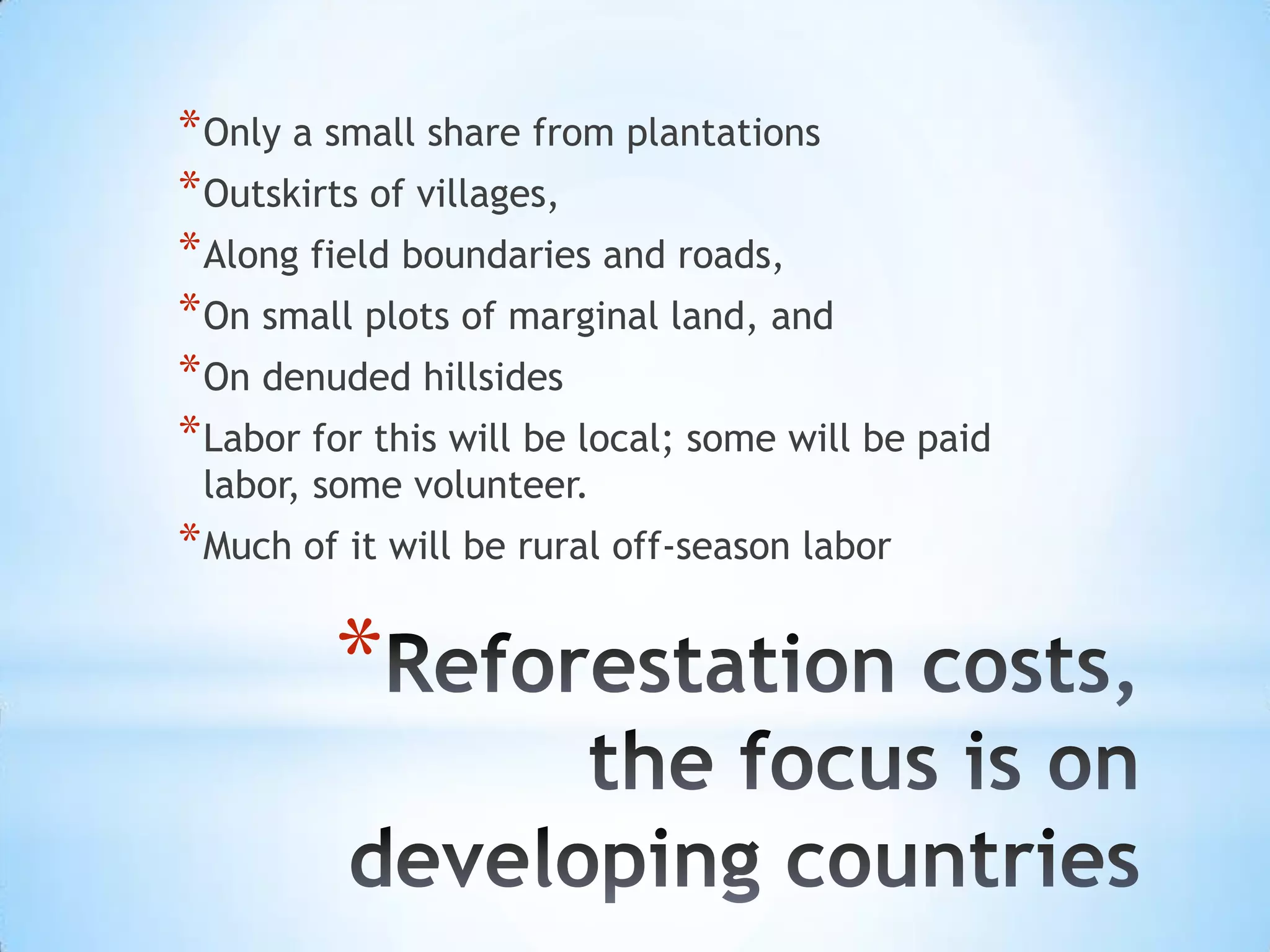
Reforestation costs, the focus is on developing countriesOnly a small share from plantationsOutskirts of villages, Along field boundaries and roads, On small plots of marginal land, and On denuded hillsidesLabor for this will be local; some will be paid labor, some volunteer. Much of it will be rural off-season labor
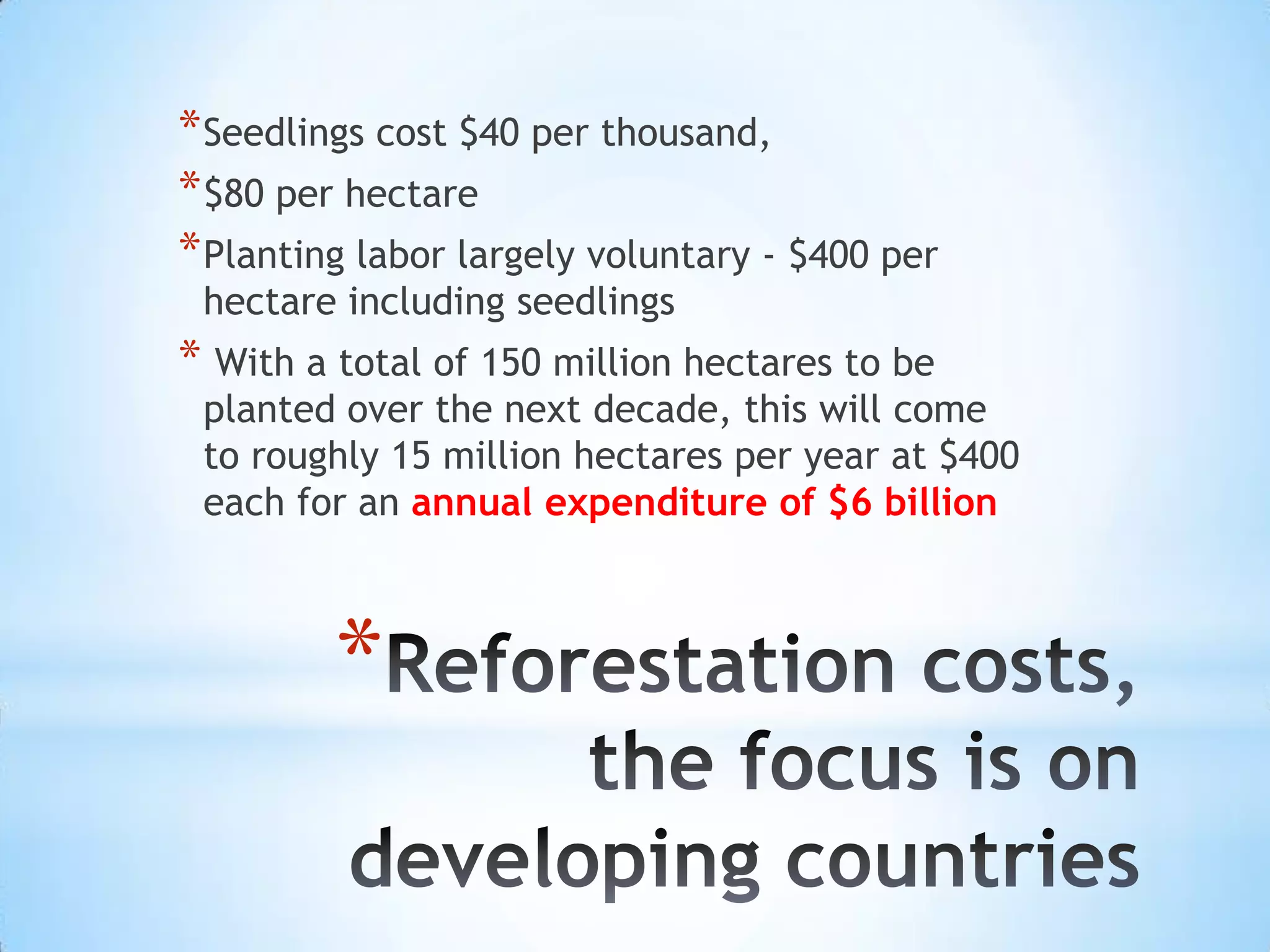
Reforestation costs, the focus is on developing countriesSeedlings cost $40 per thousand,$80 per hectarePlanting labor largely voluntary - $400 per hectare including seedlings With a total of 150 million hectares to be planted over the next decade, this will come to roughly 15 million hectares per year at $400 each for an annual expenditure of $6 billion
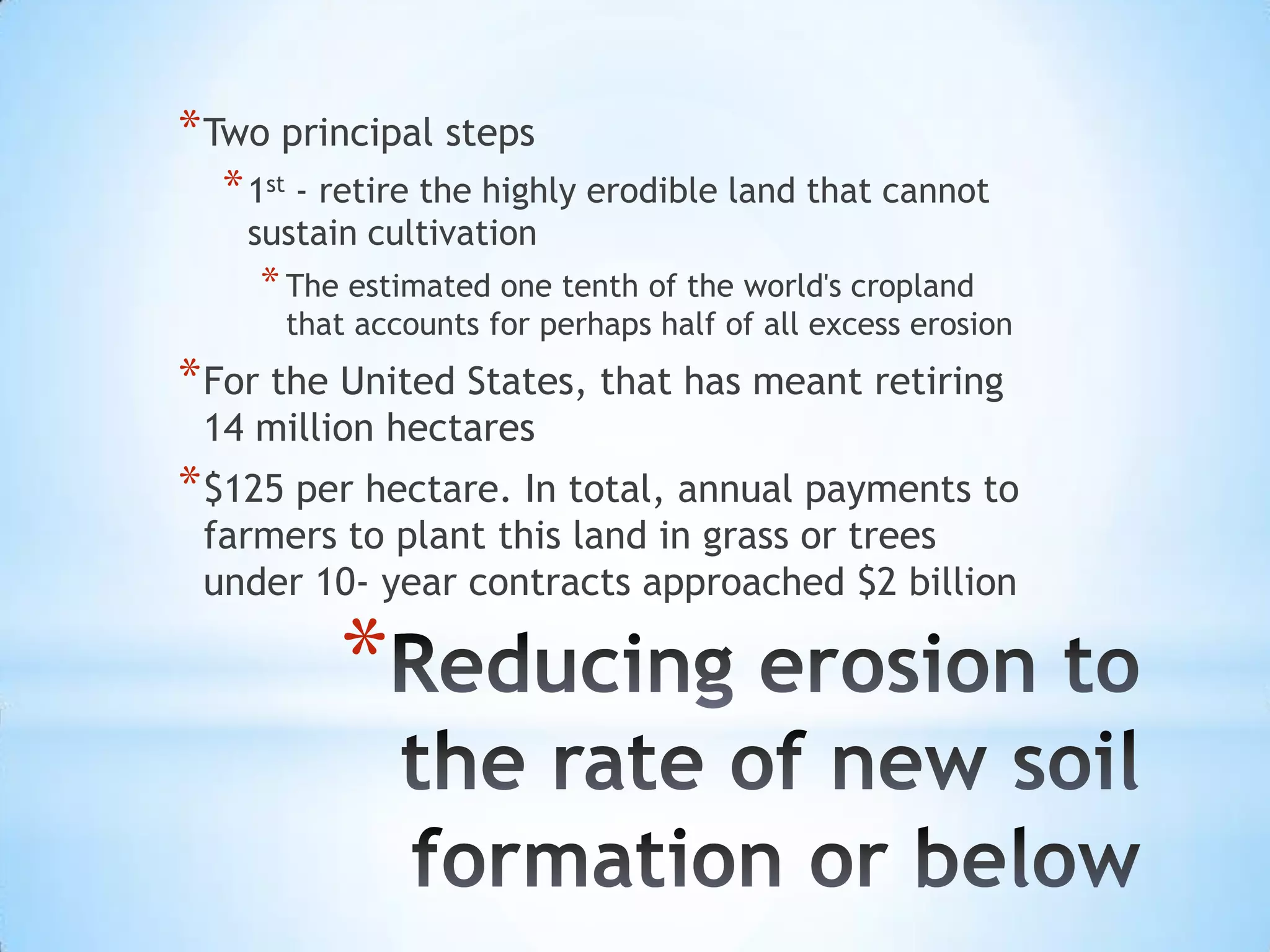
Reducing erosion to the rate of new soil formation or below Two principal steps1st - retire the highly erodible land that cannot sustain cultivationThe estimated one tenth of the world's cropland that accounts for perhaps half of all excess erosionFor the United States, that has meant retiring 14 million hectares $125 per hectare. In total, annual payments to farmers to plant this land in grass or trees under 10- year contracts approached $2 billion
Land that is subject to excessive erosion— that is, erosion that exceeds the natural rate of new soil formationIncentives to encourage farmers to adopt conservation practices such as Contour farming, Strip cropping, and, increasingly, Minimum-till or no-till farmingIn the United States total roughly $1 billion per yearThe total for the world to retire vulnerable land  would be roughly $16 billion annually2nd - conservation practices on vulnerable land
UN estimates that it would cost roughly $183 billion over a 20-year restoration period—or $9 billion per yearImproved rangeland management, Financial incentives to eliminate overstocking, and Revegetation with appropriate rest periods, when grazing would be banned.Every dollar invested in rangeland restoration yields a return of $2.50 in income fromthe increased productivity of the rangeland ecosystemRangeland protection and restoration
Restoring rangelandsCountries with large pastoral populations, where the rangeland deterioration is concentrated, are invariably among the world's poorestIgnoring the deterioration—brings a loss not only of land productivity but of livelihood, and ultimately leads to millions of refugees
Restoration of oceanic fisheries Establishment of a worldwide network of marine reserves, which would cover roughly 30 percent of the ocean's surfaceEstimated range of expenditures centers on $13 billion per year
Wildlife protectionShortfall in funding needed to manage and to protect existing areas designated as parks comes to roughly $25 billion a yearAdditional areas needed, including those encompassing the biologically diverse hotspots not yet included in designated parks, would cost perhaps another $6 billion a year, Yielding a total of $31 billion
The key to stabilizing water tables is raising water productivityResearch to develop more water-efficient irrigation practices and technologiesDissemination of these research findings to farmersEconomic incentives that encourage farmers to adopt and use these improved irrigation practices and technologiesOnly about one fifth of the world's cropland is irrigated. Stabilizing water tables
Disseminating the results Work through agricultural extension servicesWork through the water users Requires knowledge of the amount of water being pumped and aquifer recharge ratesIn most countries this information is simply not available. May mean installing meters on irrigation well pumps, As has been done in Jordan and MexicoRemoving subsidies will effectively raise the price of water, thus encouraging its more efficient use. It will take additional expenditures of $10 billionStabilizing water tables
Restoring the earthRestoring the earth will require additional expenditures of $113 billion per year. Many will ask, can the world afford this? But the only appropriate question is, can the world afford to not make these investments?

Chapter 8 restoring the earth

  • 1.
  • 2.
    For goods, rangingfrom building materials to seafoodServices, ranging from flood control to crop pollinationWe are in trouble – Croplands are erodingHarvests are shrinkingWater tables are falling Wells are going dryGrasslands are turning to desert Livestock are dyingIf civilization's environmental support systems continue to decline, eventually civilization itself will followWe are dependent on the earth's natural systems
  • 3.
    Where we’re headedThebenefits of resource conservation— at the most basic level—are still out of reach for many. Ecological and social collapses have reinforced each other in a downward spiral into poverty, environmental degradation, social injustice, disease, and violence." Unfortunately, the situation cox describes is what lies ahead for more and more countries if we do not restore the earth's health.
  • 4.
    Restoring the earth- effort, far larger and demanding than the Marshall plan Must be undertaken at wartime speed Lest environmental deterioration translate into economic decline and state failure, Just as it did for earlier civilizations that violated nature's thresholds and ignored its deadlines
  • 5.
    Protecting and restoringforests4 billion hectares of remaining forests And replanting those lost are both essential for restoring the earth's healthAn important foundation for the new economy. All depends on simultaneously reducing pressure on forests and on reforestationReducing rainfall runoff and the associated flooding and soil erosion, Recycling rainfall inland, and Restoring aquifer recharge depend on simultaneously reducing pressure on forests and on reforestation
  • 6.
    Reducing wood useAvast unrealized potential in all countries to lessen the demands that are shrinking the earth's forest cover –Industrial nations the greatest opportunity lies in reducing the quantity of wood used to make paperAnd in developing countries it depends on reducing fuel wood use
  • 7.
    Rates of paperrecycling in the top 10 paper-producing countries range widelyChina and Finland on the low end, recycling 33 and 38 percent of the paper they useSouth Korea and Germany on the high end, at 77 and 66 percent. Us 50 percent in 2005If every country recycled as much of its paper as south Korea does, the amount of wood pulp used to produce paper worldwide would drop by one third.Paper recycling
  • 8.
    Paper epitomizes thethrow-away mentalityAn enormous possibility for reducing paper use simply by replacing facial tissues, paper napkins, disposable diapers, and paper shopping bags with reusable cloth alternativesThe largest single demand on trees—the need for fuel— accounts for just over half of all wood removed from forests
  • 9.
    U.S. Agency forinternational development (AID - more promising projects is the distribution of 780,000 highly efficient wood cook stoves in Kenya that not only Use far less wood than a traditional stove but Also pollute less.Also the site of a solar cooker project sponsored by solar cookers internationalMade from cardboard and aluminum foil and costing $10 each, cook slowly, much like a crockpot. Requiring less than two hours of sunshine to cook a complete meal, they can greatly reduce firewood use at little cost. They can also be used to pasteurize water, thus saving lives.Kenya
  • 10.
    Developing alternative energysources Key to reducing forest pressure in developing countries. Replacing firewood with solar thermal cookersOr even with electric hotplates fed by wind-generated electricity Lighten the load on forests
  • 11.
    Despite the highvalue to society of intact forests, Only about 290 million hectares of global forest area are legally protected from loggingAn additional 1.4 billion hectares are economically unavailable for harvesting because of geographic inaccessibility or low-value woodOf the remaining area available for exploitation, 665 million hectares are undisturbed by humans and nearly 900 million hectares are semi-natural and not in plantations
  • 12.
    Banned logging inmost remaining old-growth and virgin forests Largely because the country has become so vulnerable to flooding, erosion, and landslidesOnce covered by rich stands of tropical hardwood forests,Years of massive clear-cuttingLost the forest's products as well as its services and Became a net importer of forest products.The Philippines, for example
  • 13.
    Sustainable forestry Anotherway to protect forestsIf only mature trees are felled, and on a selective basisA forest and its productivity can be maintained in perpetuity
  • 14.
    1997 alliance forforest conservation and sustainable useIn mid-2005, the alliance announced a goal of reducing global net deforestation to zero by 2020
  • 15.
    Additional forest productcertification programsInform environmentally conscious consumers Sustainable management of the forest where wood products originateThe most rigorous international program, certified by a group of NGOs, is the forest stewardship council (FSC).
  • 16.
    Reconstituted wood Substitutingfor natural wood as the world lumber and construction industries adapt to a shrinking supply of large logs from natural forests
  • 17.
    Where wood comesfromProduction of roundwood (logs) on plantations is estimated at 432 million cubic meters per year, accounting for 12 percent of world wood production. This means that the lion's share, some 88 percent of the world timber harvest, comes from natural forest stands.
  • 18.
    Six countries accountfor 60 percent of tree plantationsChina, which has little original forest remaining, is by far the largest, with 54 million hectares of plantations. India and the United States follow, at 17 million hectares each. Russia, Canada, and Sweden are close behind
  • 19.
    It is shiftinggeographically to the moist tropicsGrain yields tend to rise with distance from the equator and the longer summer growing daysTree plantation yields rise with proximity to the equator and year-round growing conditionsIn eastern Canada, the average hectare of forest plantation produces 4 cubic meters of wood per yearIn the southeastern United States, where U.S. Plantations are concentrated, the yield is 10 cubic metersBut in Brazil, newer plantations may be getting close to 40 cubic metersTree plantations moving toward equator
  • 20.
    Tree plantations movingtoward equatorWhile corn yields in the United States are nearly triple those in Brazil, timber yields are the reverse, favoring Brazil by nearly 4 to 1To satisfy a given demand for wood, Brazil requires only one fourth as much land as the United States, which helps explain why growth in pulp capacity is now concentrated in equatorial regions.
  • 21.
    Plantations can sometimesbe profitably established on already deforested, often degraded, land. Can also come at the expense of existing forestsThere is competition with agriculture as well, since land that is suitable for crops is also good for growing treesWater scarcity is yet another constraint. Fast-growing plantations require abundant moisturePlantations
  • 22.
    Plantation projectionsU.N. Foodand agriculture organization (FAO) projects that as plantation area expands and yields rise, the harvest could more than double during the next three decadesIt is entirely conceivable that plantations could one day satisfy most of the world's demand for industrial wood, thus helping to protect the world's remaining forests
  • 23.
    Deforested land Vastareas of deforested land can be used to grow trillions of trees bred for food (mostly nuts), fuel, and other purposesNuts used to supplement meat as a source of high-quality protein in developing-country dietsTrees grown on this deforested land being converted into ethanol for automotive fuel
  • 24.
    Some highly erodibleagricultural land in industrial countries has been reforested by natural regrowthNew England in the United StatesNew England's forest cover has increased from a low of roughly one third two centuries ago to four fifths today, slowly regaining its original health and diversitySimilar situation exists now in parts of the former soviet union and in several east European countries. Millions of hectares of farmland are now returning to forest.Reforesting highly erodible land
  • 25.
    When the Koreanwar ended, half a century ago, the mountainous country was largely deforestedBeginning around 1960 the south Korean government launched a national reforestation effortRelying on the formation of village cooperatives, hundreds of thousands of people were mobilized to dig trenches and to create terraces for supporting trees on barren mountainsToday forests cover 65 percent of the country, an area of roughly 6 million hectaresSouth Korea – model for rest of world
  • 26.
  • 27.
    Preserving the biologicalproductivity of highly erodible cropland depends on planting it in grass or trees before it becomes wastelandThe 1930s dust bowl that threatened to turn the U.S. Great plains into a vast desert was a traumatic experience that led to revolutionary changes in American agricultural practices, including the Planting of tree shelterbelts (rows of trees planted beside fields to slow wind and thus reduce wind erosion) and Strip-cropping, the planting of wheat on alternate strips with fallowed land each year. Strip-cropping permits soil moisture to accumulate on the fallowed strips, while the alternating planted strips reduce wind speed and hence erosion on the idled landConserving and rebuilding soils
  • 28.
    In 1985, theU.S. Congress, with strong support from the environmental community, created the conservation reserve program (CRP) to reduce soil erosion and control overproduction of basic commodities. By 1990 there were some 14 million hectares (35 million acres) of highly erodible land with permanent vegetative cover under 10-year contracts. Under this program, Farmers were paid to plant fragile cropland to grass or trees. The retirement of 14 million hectares under the CRP, together with the use of conservation practices on 37 percent of all cropland, Reduced U.S. Soil erosion from 3.1 billion tons to 1.9 billion tons during the 15 years between 1982 and 1997. The U.S. Approach offers a model for the rest of the world.US soil conservation
  • 29.
    Both no- tilland minimum-tillageFarmers simply drill seeds directly through crop residues into undisturbed soil, controlling weeds with herbicidesLeaving the remainder of the soil undisturbed, covered by crop residues and thus resistant to both water and wind erosion. In addition to Reducing erosion, this practice helps Retain water, Raises soil carbon content, and Reduces energy useConservation tillage
  • 30.
    1990’s soil conservationplan requiredNo-till area went from 7 million hectares in 1990 to 25 million hectares in 2004Now widely used in the production of corn and soybeansNo-till has spread rapidly in the western hemisphere
  • 31.
    Desert moving southwardall across the Sahel, from Senegal on the west coast to Djibouti on the east coastGrowing displacement of people as grasslands and croplands turn to desertAfrican union has launched the green wall Sahara initiativeCalls for the planting of 300 million trees on 3 million hectares of landIn a long band stretching across AfricaSub-Saharan Africa
  • 32.
    China is likewiseplanting a belt of trees to protect land from the expanding Gobi desertProjected to reach some 4,480 kilometers (2,800 miles) in length, stretching from outer Beijing through inner MongoliaChina is paying farmers in the threatened provinces to plant their cropland in treesThe goal is to plant trees on 10 million hectares of grain land, easily one tenth of China's current grain land areaChina
  • 33.
    The Helin county(inner Mongolia) strategy centers on Replacing the large number of sheep and goats With dairy cattle, increasing the number of dairy animals from 30,000 in 2002 to 150,000 by 2007. The cattle are kept within restricted areas, feeding on cornstalks, wheat straw, and the harvest from a drought-tolerant forage crop resembling alfalfa, which is grown on reclaimed land. Local officials estimate that this program will double incomes within the county during this decade.China
  • 34.
    The only viableway to eliminate overgrazing on the two fifths of the earth's land surface classified as rangelands is to reduce the size of flocks and herds. Not only do the excessive numbers of cattle, and particularly sheep and goats, remove the vegetation, but their hoofs pulverize the protective crust of soil that is formed by rainfall and that naturally checks wind erosion. In some situations, the only viable option is to keep the animals in restricted areas, bringing the forage to them. India, which has successfully adopted this practice for its thriving dairy industry, is the model for other countries.Bringing the forage to them
  • 35.
    In favor ofselective harvestingWith each clear-cut there are heavy soil losses until the forest regeneratesThus with each subsequent cutting, productivity declines furtherRestoring the earth's tree and grass cover, as well as practicing conservation agriculture, Protects soil from erosion, Reduces flooding, and Sequesters carbon. It is one way we can restore the earth so that it can support the next generations.Need a worldwide ban on the clear-cutting of forests
  • 36.
    Reserves that covered30 percent of the world's oceans Would cost $12-14 billion a year. This did not take into account the likely additional income from recovering fisheries, which would reduce the actual cost.Would create more than 1 million jobsAnnual oceanic fish catch worth $70-80 billion"Our study suggests that we could afford to conserve the seas and their resources in perpetuity, and for less than we are now spending on subsidies to exploit them unsustainably.“If you put areas off limits to fishing, there is no more effective way of allowing things to live longer, grow larger, and produce more offspringRegenerating fisheries
  • 37.
    Snapper fishery offthe coast of new England Local population of snapper increase 40-foldGulf of MaineAll fishing methods that put ground fish at risk were banned within three marine reserves totaling 17,000 square kilometersScallops flourished in this undisturbed environment, and their populations increased by up to 14-fold within five yearsGreatly increased the scallop population outside the reserves. Within a year or two of establishing a marine reserve, population densities Increased 91 percent, Average fish size went up 31 percent, and Species diversity rose 20-40 percent.Case studies
  • 38.
    Reduce fertilizer runoffand untreated sewageCreates the world's 200 or so dead zones
  • 39.
    Eliminate fishery subsidiesNowso many fishing trawlers that their catch potential is nearly double any yield the oceans can sustainManaging a network of marine reserves governing 30 percent of the oceans would cost only $12-14 billion—less than the $22 billion in harmful subsidies that governments dole out today to fishers
  • 40.
    Protecting plant andanimal diversity
  • 41.
    Two steps essentialto protecting the earth's extraordinary biological diversity are the Stabilization of both the human population and the Earth's climateIf the world's population increases to 9 billion by mid-century as projected, countless more plant and animal species may simply be crowded off the planet. If carbon dioxide levels and temperatures continue to rise, every ecosystem will changeProtecting plant and animal diversity
  • 42.
    Protecting plant andanimal diversityAs it becomes more difficult to raise land productivity, continuing population growth will force farmers to clear ever more tropical forests in the amazon and Congo basins and the outer islands of Indonesia
  • 43.
    Water managementAt atime of growing water shortagesKey to protecting fresh water and marine speciesWhen rivers are drained dry to satisfy growing human needs for irrigation and for urban water, fish species cannot survive
  • 44.
    Parks and reservesSome13 percent of the earth's land area is now included in parks and nature preservesMany exist only on paperBiodiversity "hotspots” - especially rich biologically The 34 hotspots identified once covered nearly 16 percent of the earth's land surface but, largely because of habitat destruction, they now cover less than 3 percent
  • 45.
    Prohibited any activities,such as clearingnew land for agriculture and housing developments or draining wetlands, that would threaten an endangered speciesPotential leverage point in battling global warming because of the need to protect species particularly threatened by warmer temperatures, including coral and polar bears.If we cannot stabilize human numbers and stabilize the climate, there is not an ecosystem on earth that we can save1973 the United States endangered species act
  • 46.
    Planting trees tosequester carbon
  • 47.
    Planting trees tosequester carbonAs of 2007, the shrinking forests in the tropical regions were releasing 2.2 billion tons of carbon per yearMeanwhile, expanding forests in the temperate regions were absorbing 0.7 billion tons of carbon annuallyOn balance, a net of some 1.5 billion tons of carbon were being released into the atmosphere each year, contributing to global warming
  • 48.
    Asia is drivenprimarily by the fast-growing demand for timberLatin America, by contrast, it is the growing demand for soybeans and beef that is deforesting the amazonAfrica, it is mostly the gathering of fuel- wood and the clearing of new land for agriculture as existing cropland is degraded and abandonedTwo countries, Indonesia and Brazil, account for more than half of all deforestationTropical deforestation
  • 49.
    End net deforestationworldwideSequester carbon through a variety of tree planting initiativesAdoption of improved agricultural land management practicesToday, because the earth's forests are shrinking, they are a major source of CO2The goal is to expand the earth's tree cover, growing more trees to soak up CO2Plan B goals
  • 50.
    Thailand, the Philippines,and ChinaAll three bans were imposed following devastating floods and mudslides resulting from the loss of forest coverRecord losses from several weeks of nonstop flooding in the Yangtze river basinThrough those of society as a whole, it simply did not make economic sense to continue deforestingThe flood control service of trees standing, they said, was three times as valuable as the timber from trees cut.Beijing then took the unusual step of paying the loggers to become tree planters—to reforest instead of deforestEnvironmental reasons have pushed bans
  • 51.
    If it continuesto shrink, it will also continue to dry out, becoming vulnerable to fireIf the amazon rainforest disappears, it would be replaced largely by desert and scrub forestlandThe capacity of the rainforest to cycle water to the interior, including to the agricultural areas to the south, would be lostAt this point, a fast-unfolding local environmental calamity would become an economic disaster, and because the burning amazon would release billions of tons of carbon into the atmosphere, it would accelerate global warmingBrazil's amazon rainforest
  • 52.
    Deforestation a globalconcern nowNo longer just a matter of local flooding, But also rising seas worldwide and the Many other effects of climate change. Nature has just raised the ante on protecting forests.
  • 53.
    Will require Reducingthe pressures to deforest that come From population growth, Rising affluence, The construction of ethanol distilleries and biodiesel refineries, and the Fast-growing use of paper.Halting population growth as soon as possible, and, For the earth's affluent residents who are responsible for the growing demand for beef and soybeans that is deforesting the amazon basin, it means moving down the food chainMay require a ban on the construction of additional biodiesel refineries and ethanol distilleriesReaching zero net deforestation
  • 54.
    Potential for forestingwasteland to sequester carbonThere are 1.86 billion hectares of degraded land in the worldHalf of this, or 930 million hectares, has a decent chance of being profitably reclaimed840 million hectares of this total are in the tropical regions, where reclamation would mean much higher rates (4X) of carbon sequestrationMaximum technical potential of these 930 million hectares is to absorb roughly 21.6 billion tons of CO2 per year
  • 55.
    Potential for forestingwasteland to sequester carbonIf carbon sequestration were valued at $210 per ton of carbonAn estimated 18 percent of this technical potential could be realizedThis would mean planting 171 million hectares of land to treesWould sequester 3.5 billion tons of CO2 per year, or over 950 million tons of carbon
  • 56.
    Potential for forestingwasteland to sequester carbonThe total cost of sequestering carbon at $210 per ton would be $200 billion. Spread over a decade, this would mean investing $20 billion a year to give climate stabilization a large and potentially decisive boost. This plan to remove atmospheric co2, most of it put there by industrial countries, would be funded by them
  • 57.
    Inspired by KenyanNobel laureate winger Matthau - had earlier organized women in Kenya and several nearby countries to plant 30 million treesAs of October 2007 that it had received pledges to plant a total of 1.2 billion trees by year end431 million already had been plantedMexico pledged to plant 250 million treesEthiopia promised to plant 60 million trees Senegal signed up for 20 million treesBillion tree campaign
  • 58.
    Study of Cheyenne,Wyoming, to Berkeley, CaliforniaFor every dollar spent on planting and caring for trees, the benefits to the community exceeded two dollarsA mature tree canopy in a city shades buildings and Can reduce air temperatures by 5-10 degrees fahrenheit, thus reducing the energy needed for air conditioning. In cities with severe winters like Cheyenne, the reduction of winter wind speed by evergreen trees cuts heating costs. Real estate values on tree-lined streets are typically 3-6 percent higher than where there are few or no trees
  • 59.
  • 60.
    The earth restorationbudgetReforest the earth, Protect top- soil, Restore rangelands and fisheries, Stabilize water tables, and Protect biological diversityNote - forested area is already expanding in the northern hemisphere's industrial countries
  • 61.
    Reforestation costs, thefocus is on developing countriesMeeting the growing fuel- wood demand in developing countries will require an estimated 55 million additional hectares of forested areaConserving soils and restoring hydrological stability would require roughly another 100 million hectares located in thousands of watersheds in developing countriesAn additional 30 million hectares will be needed to produce lumber, paper, and other forest products
  • 62.
    Reforestation costs, thefocus is on developing countriesOnly a small share from plantationsOutskirts of villages, Along field boundaries and roads, On small plots of marginal land, and On denuded hillsidesLabor for this will be local; some will be paid labor, some volunteer. Much of it will be rural off-season labor
  • 63.
    Reforestation costs, thefocus is on developing countriesSeedlings cost $40 per thousand,$80 per hectarePlanting labor largely voluntary - $400 per hectare including seedlings With a total of 150 million hectares to be planted over the next decade, this will come to roughly 15 million hectares per year at $400 each for an annual expenditure of $6 billion
  • 64.
    Reducing erosion tothe rate of new soil formation or below Two principal steps1st - retire the highly erodible land that cannot sustain cultivationThe estimated one tenth of the world's cropland that accounts for perhaps half of all excess erosionFor the United States, that has meant retiring 14 million hectares $125 per hectare. In total, annual payments to farmers to plant this land in grass or trees under 10- year contracts approached $2 billion
  • 65.
    Land that issubject to excessive erosion— that is, erosion that exceeds the natural rate of new soil formationIncentives to encourage farmers to adopt conservation practices such as Contour farming, Strip cropping, and, increasingly, Minimum-till or no-till farmingIn the United States total roughly $1 billion per yearThe total for the world to retire vulnerable land would be roughly $16 billion annually2nd - conservation practices on vulnerable land
  • 66.
    UN estimates thatit would cost roughly $183 billion over a 20-year restoration period—or $9 billion per yearImproved rangeland management, Financial incentives to eliminate overstocking, and Revegetation with appropriate rest periods, when grazing would be banned.Every dollar invested in rangeland restoration yields a return of $2.50 in income fromthe increased productivity of the rangeland ecosystemRangeland protection and restoration
  • 67.
    Restoring rangelandsCountries withlarge pastoral populations, where the rangeland deterioration is concentrated, are invariably among the world's poorestIgnoring the deterioration—brings a loss not only of land productivity but of livelihood, and ultimately leads to millions of refugees
  • 68.
    Restoration of oceanicfisheries Establishment of a worldwide network of marine reserves, which would cover roughly 30 percent of the ocean's surfaceEstimated range of expenditures centers on $13 billion per year
  • 69.
    Wildlife protectionShortfall infunding needed to manage and to protect existing areas designated as parks comes to roughly $25 billion a yearAdditional areas needed, including those encompassing the biologically diverse hotspots not yet included in designated parks, would cost perhaps another $6 billion a year, Yielding a total of $31 billion
  • 70.
    The key tostabilizing water tables is raising water productivityResearch to develop more water-efficient irrigation practices and technologiesDissemination of these research findings to farmersEconomic incentives that encourage farmers to adopt and use these improved irrigation practices and technologiesOnly about one fifth of the world's cropland is irrigated. Stabilizing water tables
  • 71.
    Disseminating the resultsWork through agricultural extension servicesWork through the water users Requires knowledge of the amount of water being pumped and aquifer recharge ratesIn most countries this information is simply not available. May mean installing meters on irrigation well pumps, As has been done in Jordan and MexicoRemoving subsidies will effectively raise the price of water, thus encouraging its more efficient use. It will take additional expenditures of $10 billionStabilizing water tables
  • 72.
    Restoring the earthRestoringthe earth will require additional expenditures of $113 billion per year. Many will ask, can the world afford this? But the only appropriate question is, can the world afford to not make these investments?