Teens, Games and Civics Amanda Lenhart Games, Learning and Libraries November 2, 2008 Oak Brook, IL
Road Map Methods Main Findings Basics about game play Gaming as a social experience Parents and games Games and civics Takeaways
Research Questions What are the game playing habits of American youth? Who plays video games? What do they play? What experiences do they have while playing? If we care about young people we must ask how games are impacting their lives Do games isolate young people? Are games creating a generation of civically disengaged youth? Can games provide civic learning opportunities?
Methods RDD national telephone survey 1,102 youth ages 12-17 and a parent in their home Margin of error +/- 3 percentage points Survey conducted November 1, 2007 – February 5, 2008
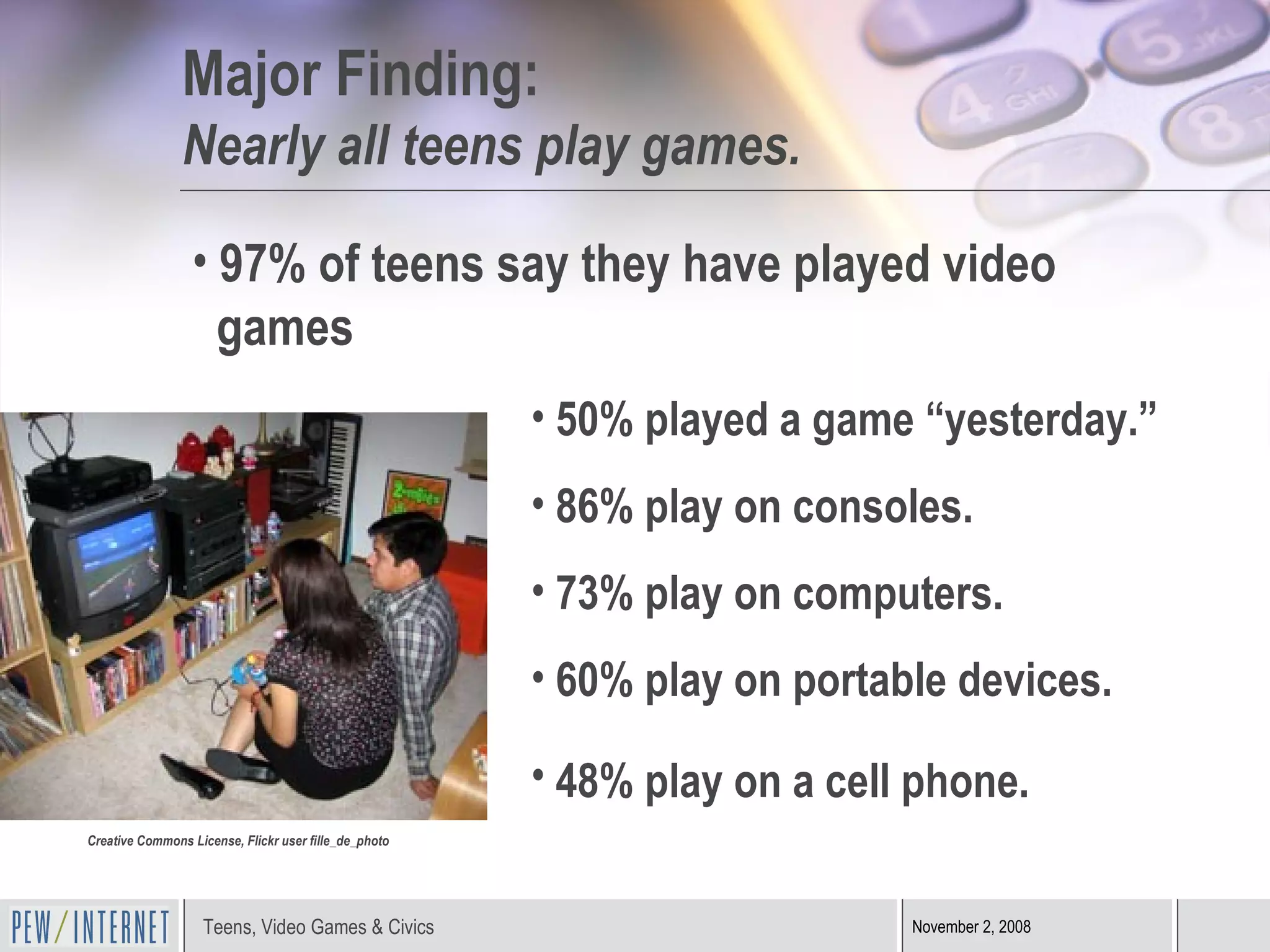
Major Finding:  Nearly all teens play games. 97% of teens say they have played video    games Creative Commons License, Flickr user fille_de_photo 50% played a game “yesterday.” 86% play on consoles. 73% play on computers. 60% play on portable devices. 48% play on a cell phone.
Who plays games? 99% of boys, 94% of girls Boys play more often and for longer duration 39% of boys play daily; 22% of girls do 34% of boys play 2+ hours a day; 18% of girls do Younger teens play more frequently than older 54% of 12-14 year-olds play on any given day 46% of 15-17 year-olds Broadband users play more frequently 28% of bbd users played “yesterday” 20% of dial up users did so
The Daily Gamer 31% of teens play daily More boys than girls (65% boys; 35% girls) More younger teens (57% 12-14; 43% 15-17) More likely to use portable gaming devices… …But just as likely as everyone else to use computer, console or cell phone Daily gamers more likely to play with others online (20% vs. 12%) Daily gamers are more likely to play games as a part of a guild or group (50% vs. 38%) Just as likely to spend time f2f and communicating with friends
Major Finding:  Teens play a wide variety of games 80% of teens play five or more different game genres, and 40% play eight or more types of games.  Girls play an average of 6 different game genres; boys average 8 different types.
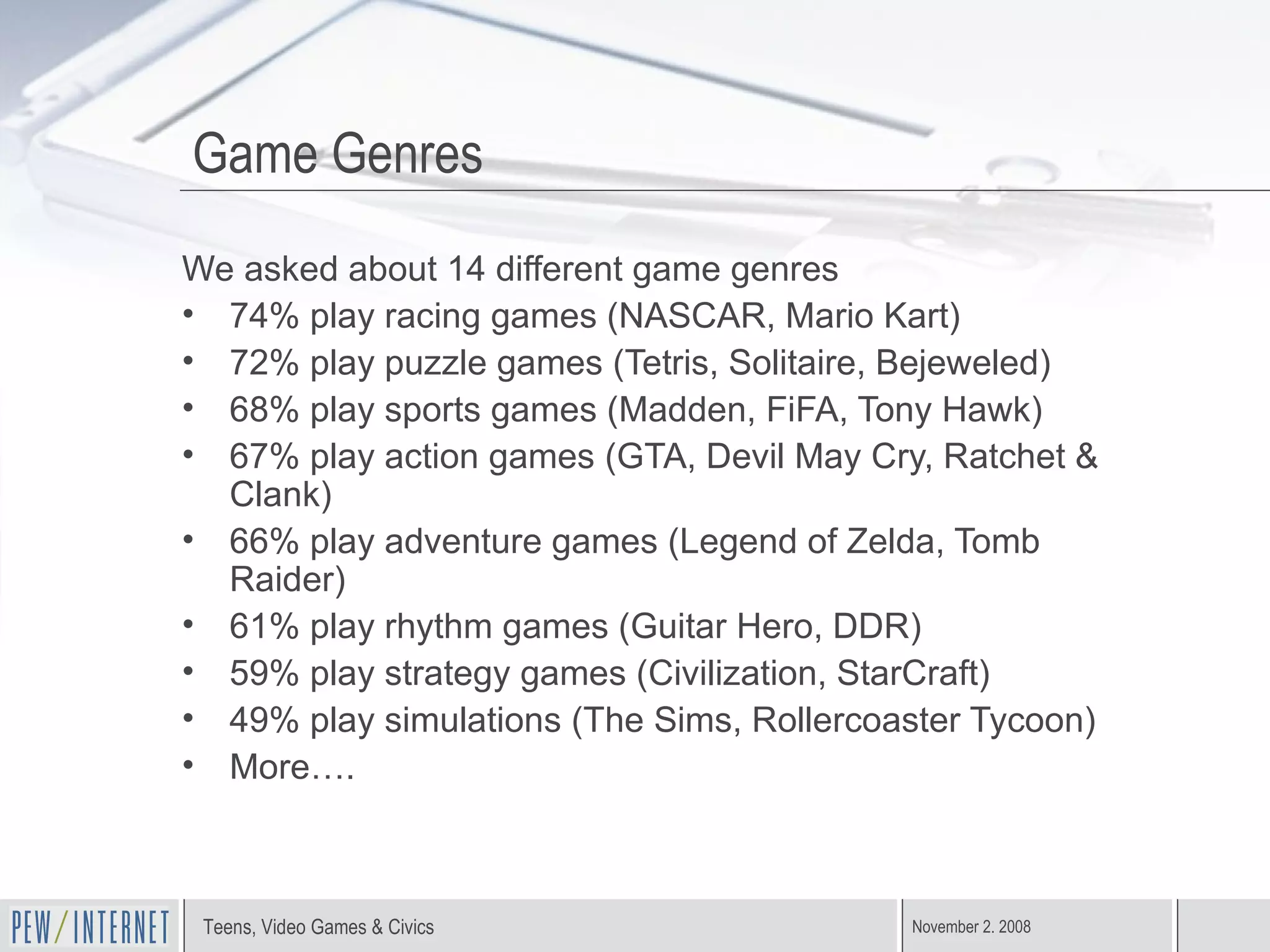
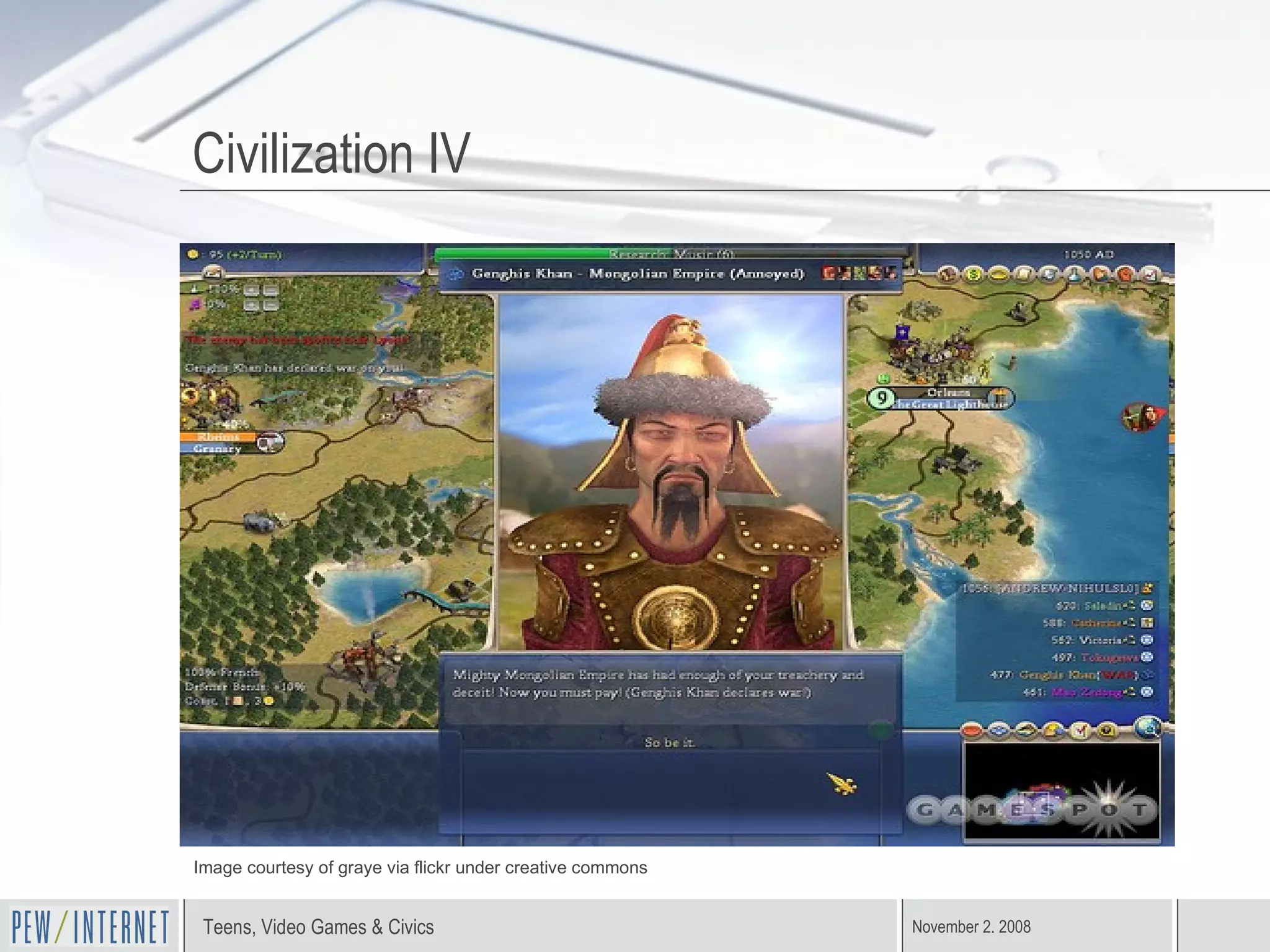
Game Genres We asked about 14 different game genres 74% play racing games (NASCAR, Mario Kart) 72% play puzzle games (Tetris, Solitaire, Bejeweled) 68% play sports games (Madden, FiFA, Tony Hawk) 67% play action games (GTA, Devil May Cry, Ratchet & Clank) 66% play adventure games (Legend of Zelda, Tomb Raider) 61% play rhythm games (Guitar Hero, DDR) 59% play strategy games (Civilization, StarCraft) 49% play simulations (The Sims, Rollercoaster Tycoon) More….
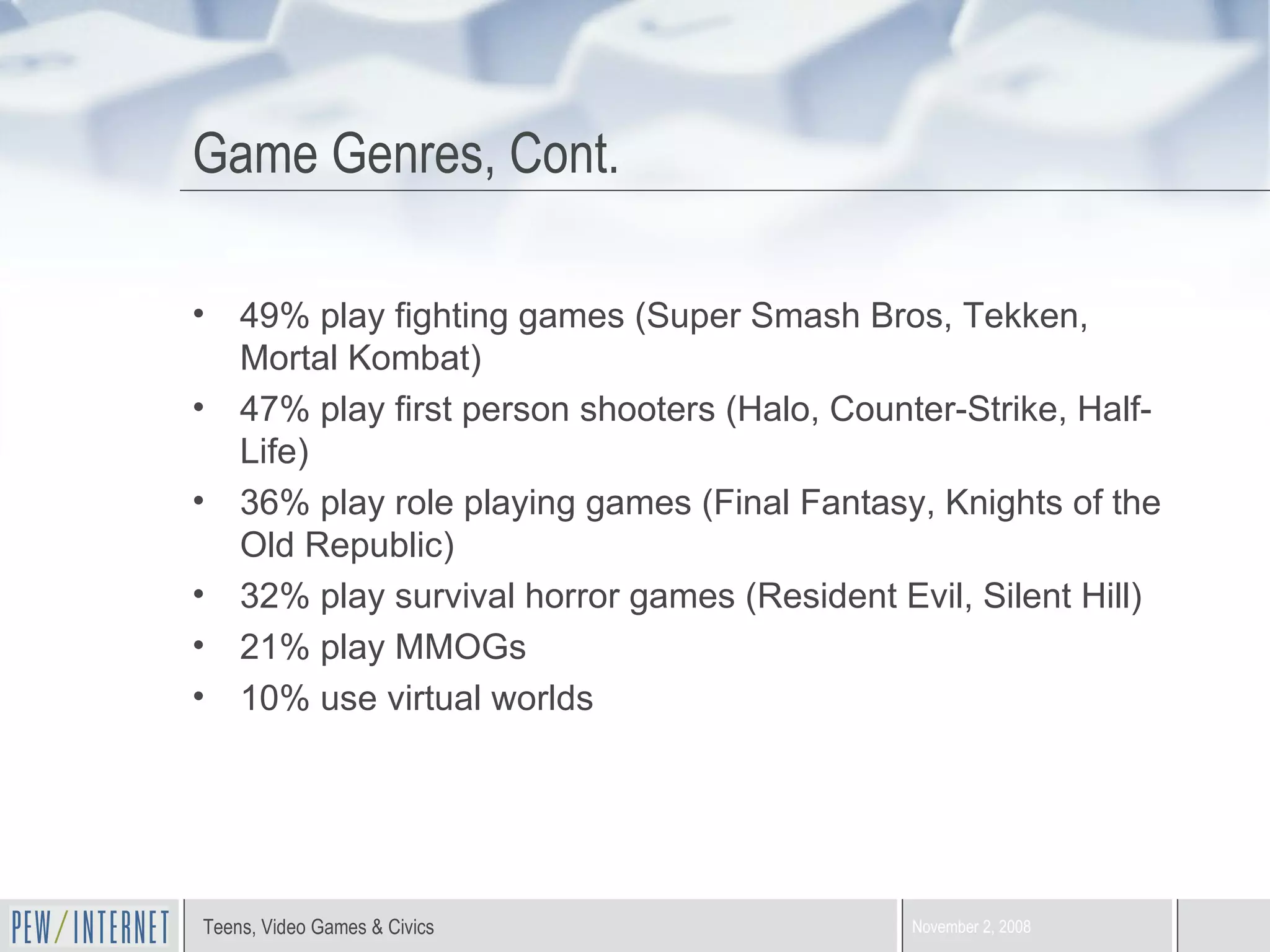
Game Genres, Cont. 49% play fighting games (Super Smash Bros, Tekken, Mortal Kombat) 47% play first person shooters (Halo, Counter-Strike, Half-Life) 36% play role playing games (Final Fantasy, Knights of the Old Republic) 32% play survival horror games (Resident Evil, Silent Hill) 21% play MMOGs 10% use virtual worlds
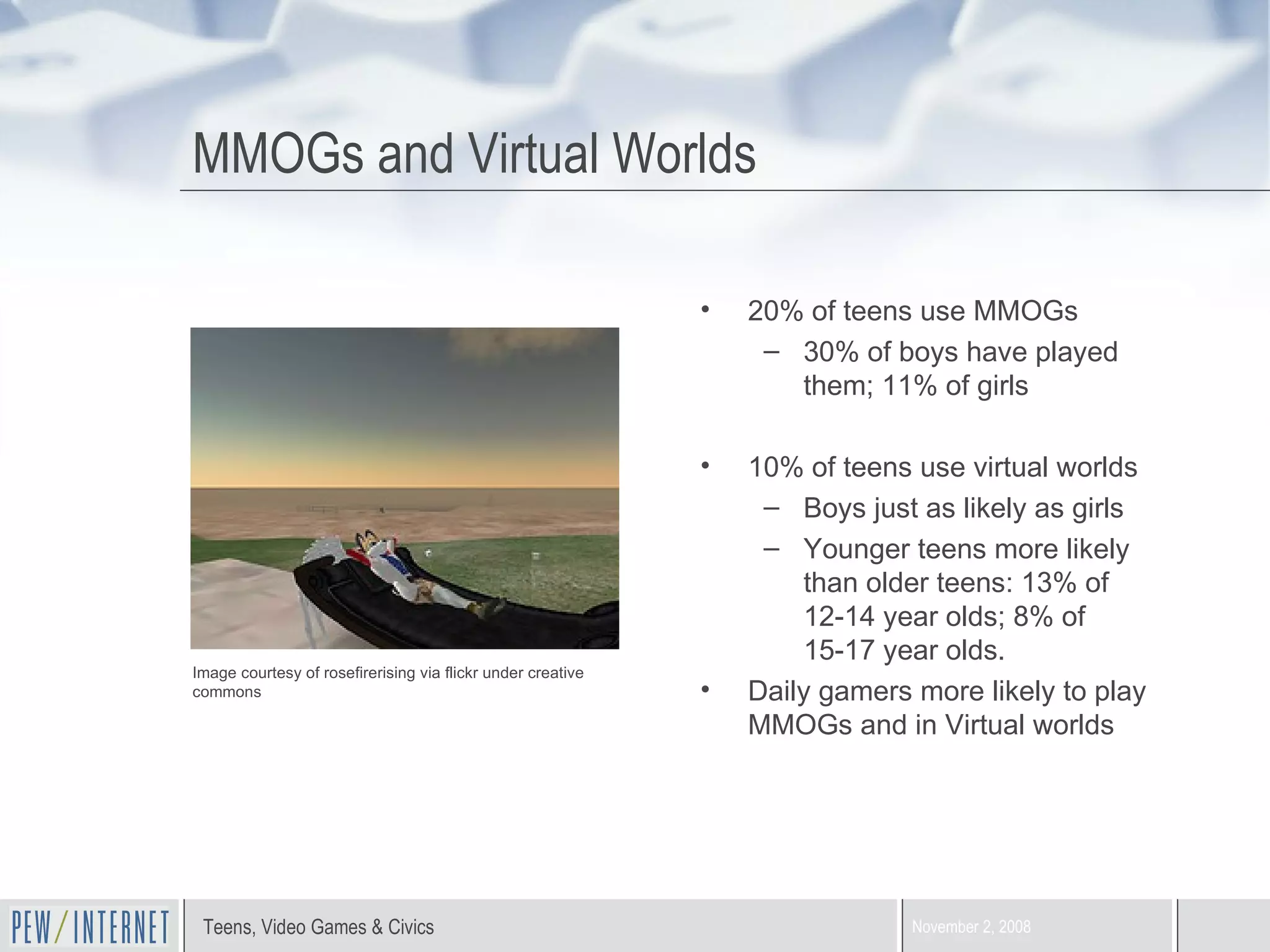
MMOGs and Virtual Worlds 20% of teens use MMOGs 30% of boys have played them; 11% of girls 10% of teens use virtual worlds Boys just as likely as girls Younger teens more likely than older teens: 13% of 12-14 year olds; 8% of 15-17 year olds. Daily gamers more likely to play MMOGs and in Virtual worlds Image courtesy of rosefirerising via flickr under creative commons
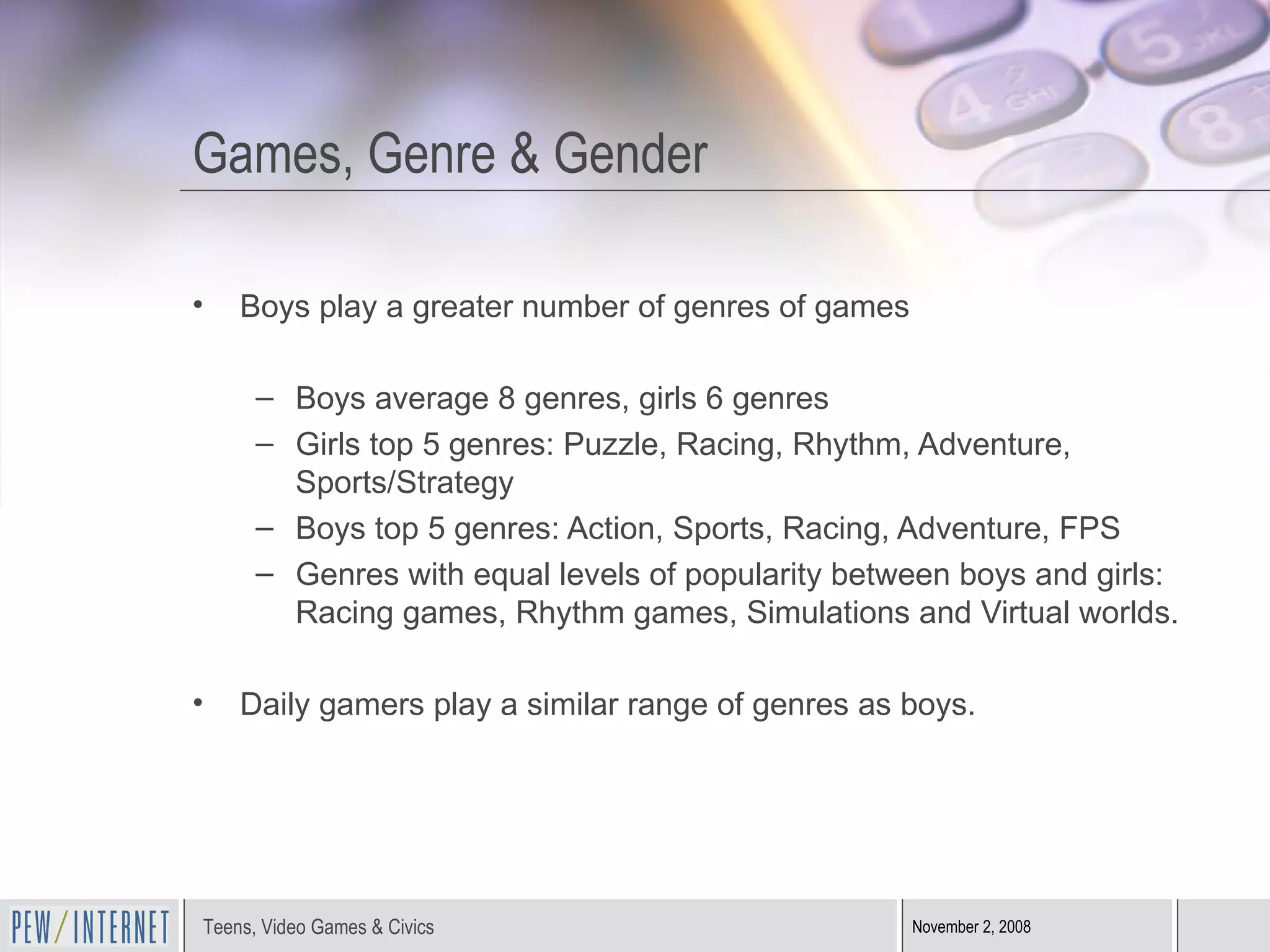
Games, Genre & Gender Boys play a greater number of genres of games Boys average 8 genres, girls 6 genres Girls top 5 genres: Puzzle, Racing, Rhythm, Adventure, Sports/Strategy Boys top 5 genres: Action, Sports, Racing, Adventure, FPS Genres with equal levels of popularity between boys and girls: Racing games, Rhythm games, Simulations and Virtual worlds. Daily gamers play a similar range of genres as boys.
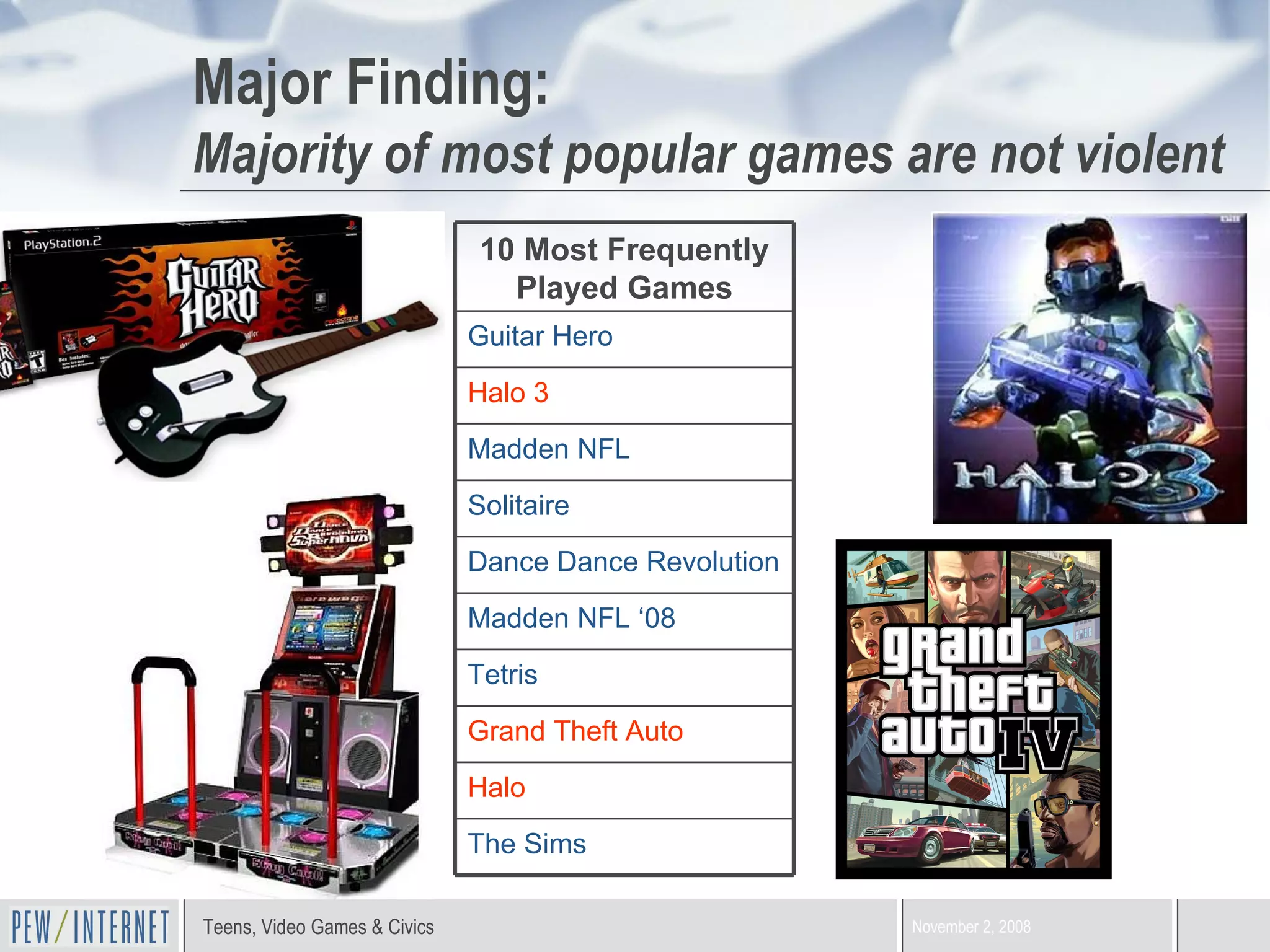
Major Finding:  Majority of most popular games are not violent The Sims Halo  Grand Theft Auto Tetris Madden NFL ‘08 Dance Dance Revolution Solitaire Madden NFL Halo 3 Guitar Hero   10 Most Frequently Played Games
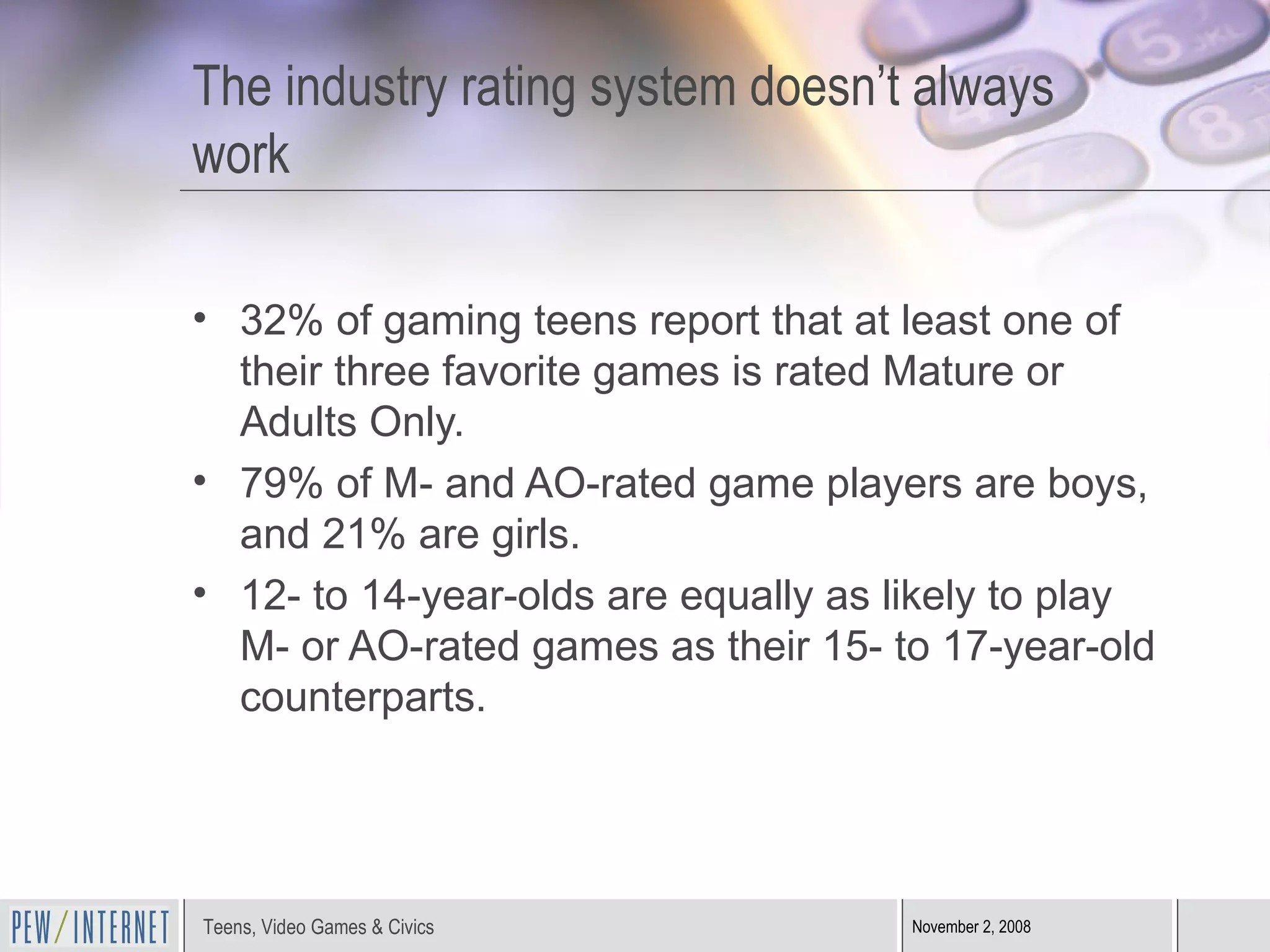
The industry rating system doesn’t always work 32% of gaming teens report that at least one of their three favorite games is rated Mature or Adults Only. 79% of M- and AO-rated game players are boys, and 21% are girls.  12- to 14-year-olds are equally as likely to play M- or AO-rated games as their 15- to 17-year-old counterparts.
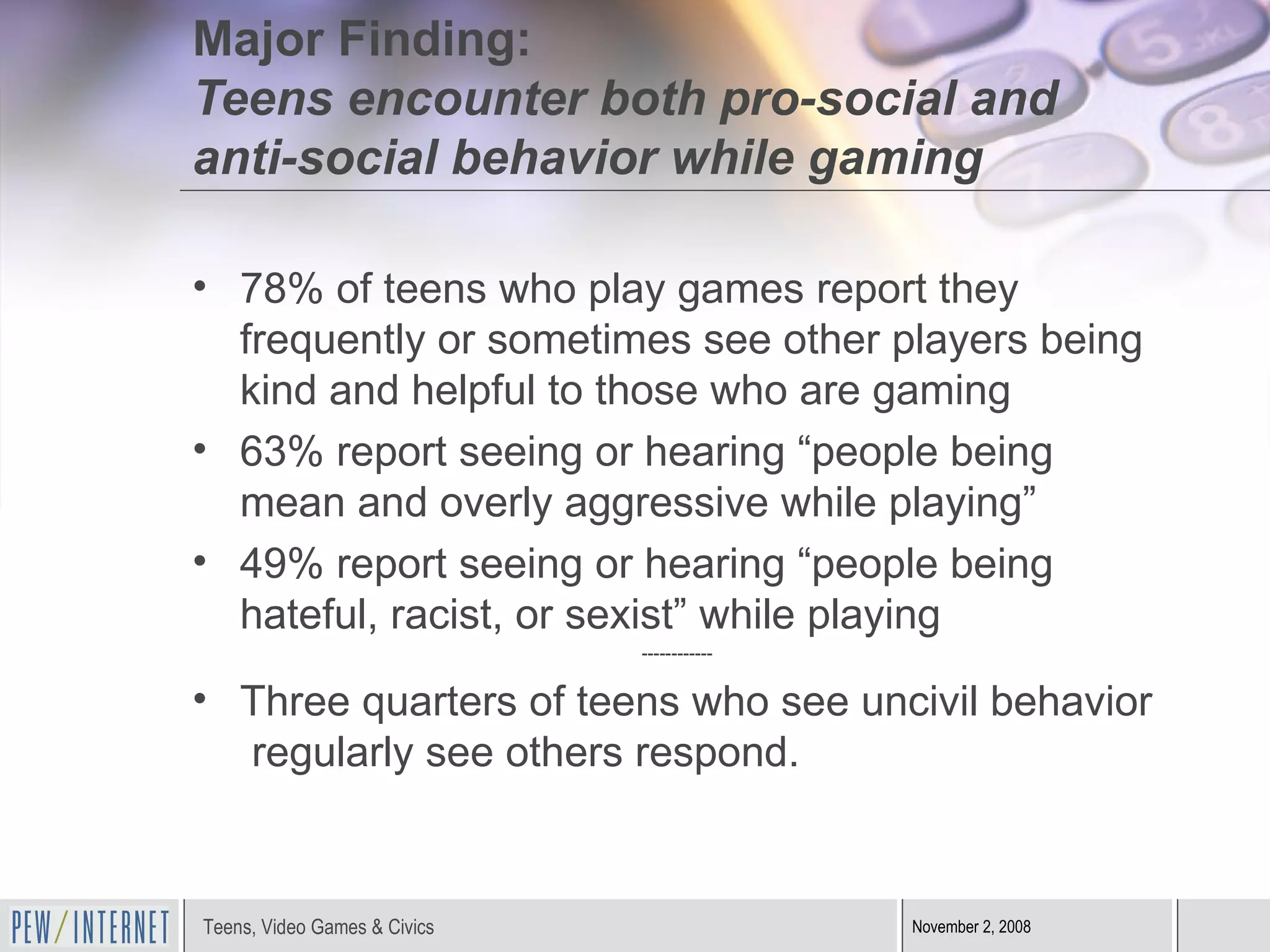
Major Finding:  Teens encounter both pro-social and anti-social behavior while gaming 78% of teens who play games report they frequently or sometimes see other players being kind and helpful to those who are gaming  63% report seeing or hearing “people being mean and overly aggressive while playing”  49% report seeing or hearing “people being hateful, racist, or sexist” while playing ------------ Three quarters of teens who see uncivil behavior  regularly see others respond.
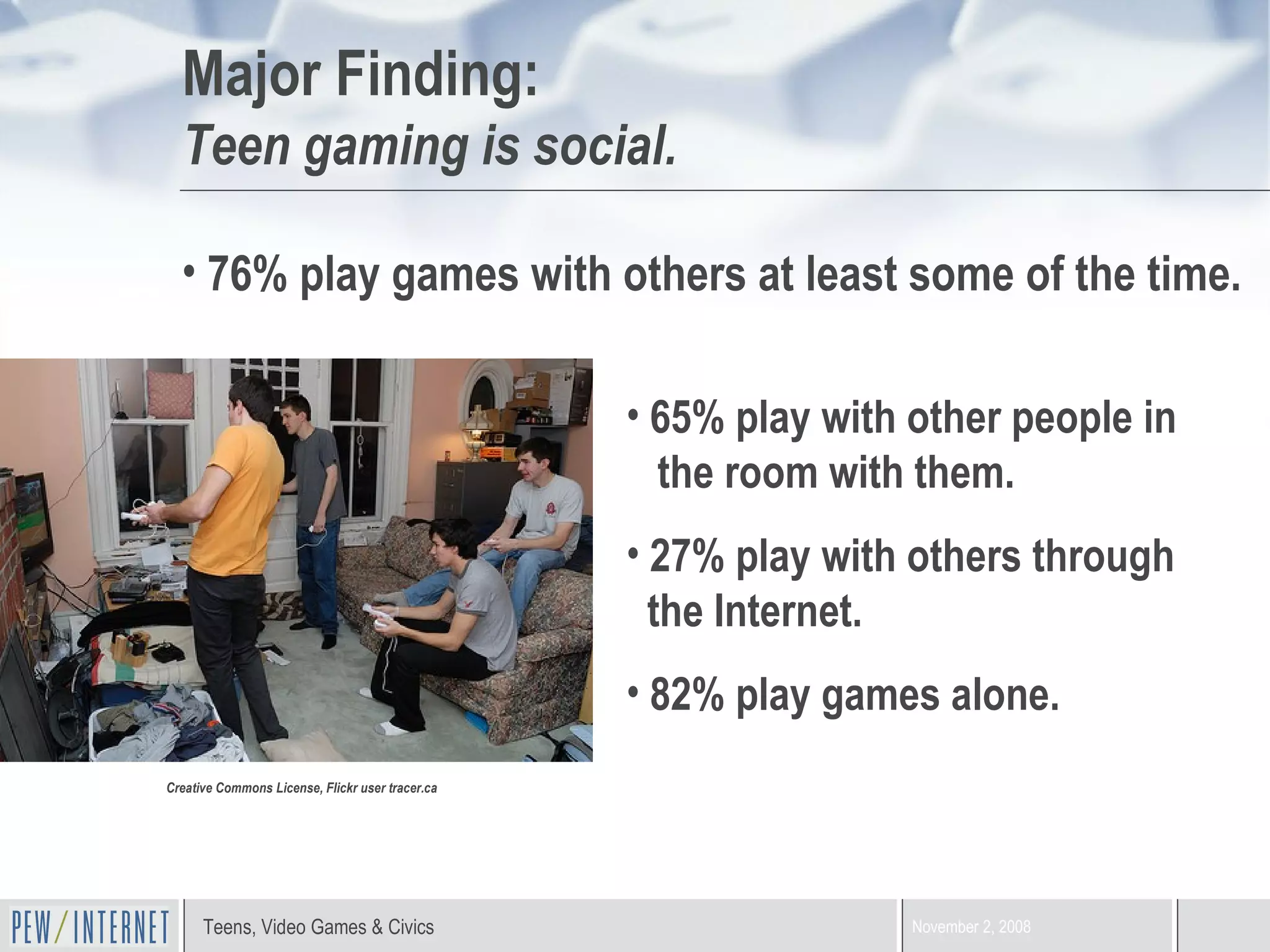
Major Finding:   Teen gaming is social. Creative Commons License, Flickr user tracer.ca 76% play games with others at least some of the time. 65% play with other people in    the room with them. 27% play with others through    the Internet.  82% play games alone.
Games are social (2) 59% of games play in multiple ways 42% most often play with friends in person 15% most often play with friends online 42% most often play alone Dial up users less likely to play with friends online (6% vs. 19% of bbd users)
Games are social (3) 47% of online gamers play mostly with people they know from their community & offline friends 27% of online gamers only play with people they met online 23% of online gamers play with a mix of people they met online and people they met offline Online gamers are more likely to play in groups – 43% game in a group or guild Girls are more likely to play exclusively with people they know from their offline lives. MMOG players much more likely to play with others they met online, and play in groups.
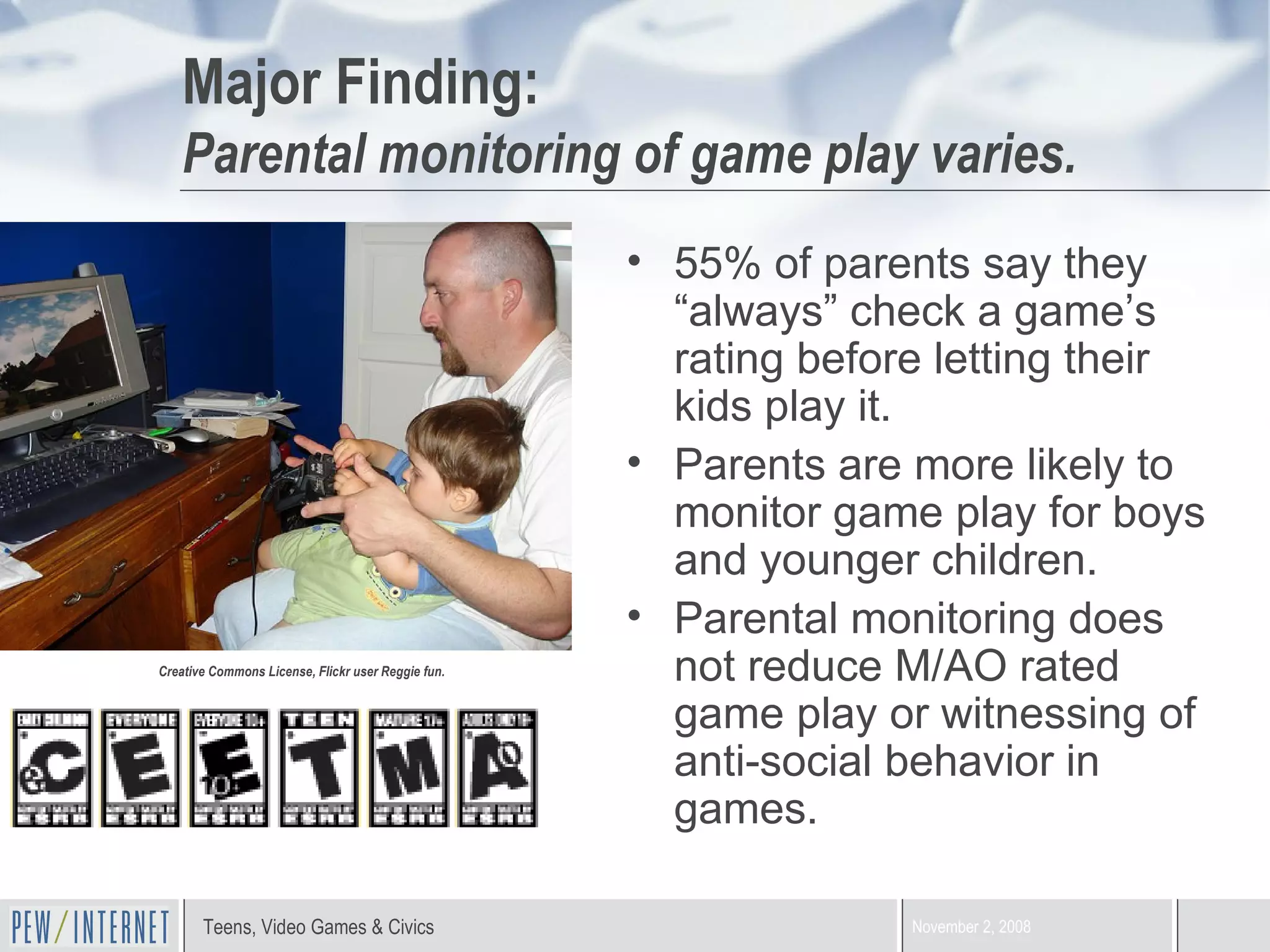
Major Finding:  Parental monitoring of game play varies. 55% of parents say they “always” check a game’s rating before letting their kids play it. Parents are more likely to monitor game play for boys and younger children. Parental monitoring does not reduce M/AO rated game play or witnessing of anti-social behavior in games. Octoer≈10, 2008 Creative Commons License, Flickr user Reggie fun.
Parental monitoring of game playing varies (2) 90% of parents say they always or sometimes know what games their children play. 72% say they always or sometimes check the ratings before their children are allowed to play a game. 46% of parents say they always or sometimes stop their kids from playing a game. 31% of parents say they always or sometimes play games with their children.
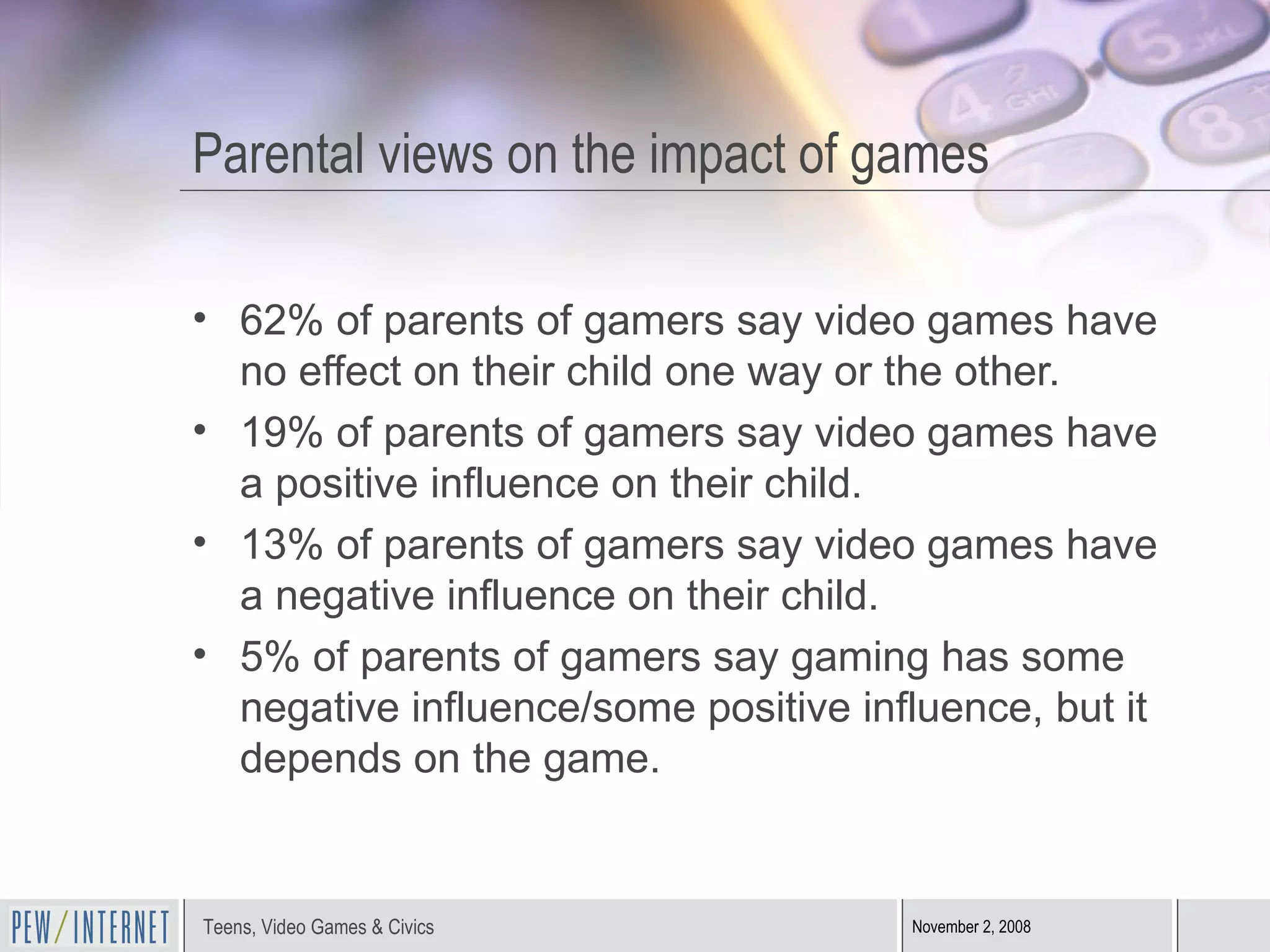
Parental views on the impact of games 62% of parents of gamers say video games have no effect on their child one way or the other. 19% of parents of gamers say video games have a positive influence on their child. 13% of parents of gamers say video games have a negative influence on their child.  5% of parents of gamers say gaming has some negative influence/some positive influence, but it depends on the game.
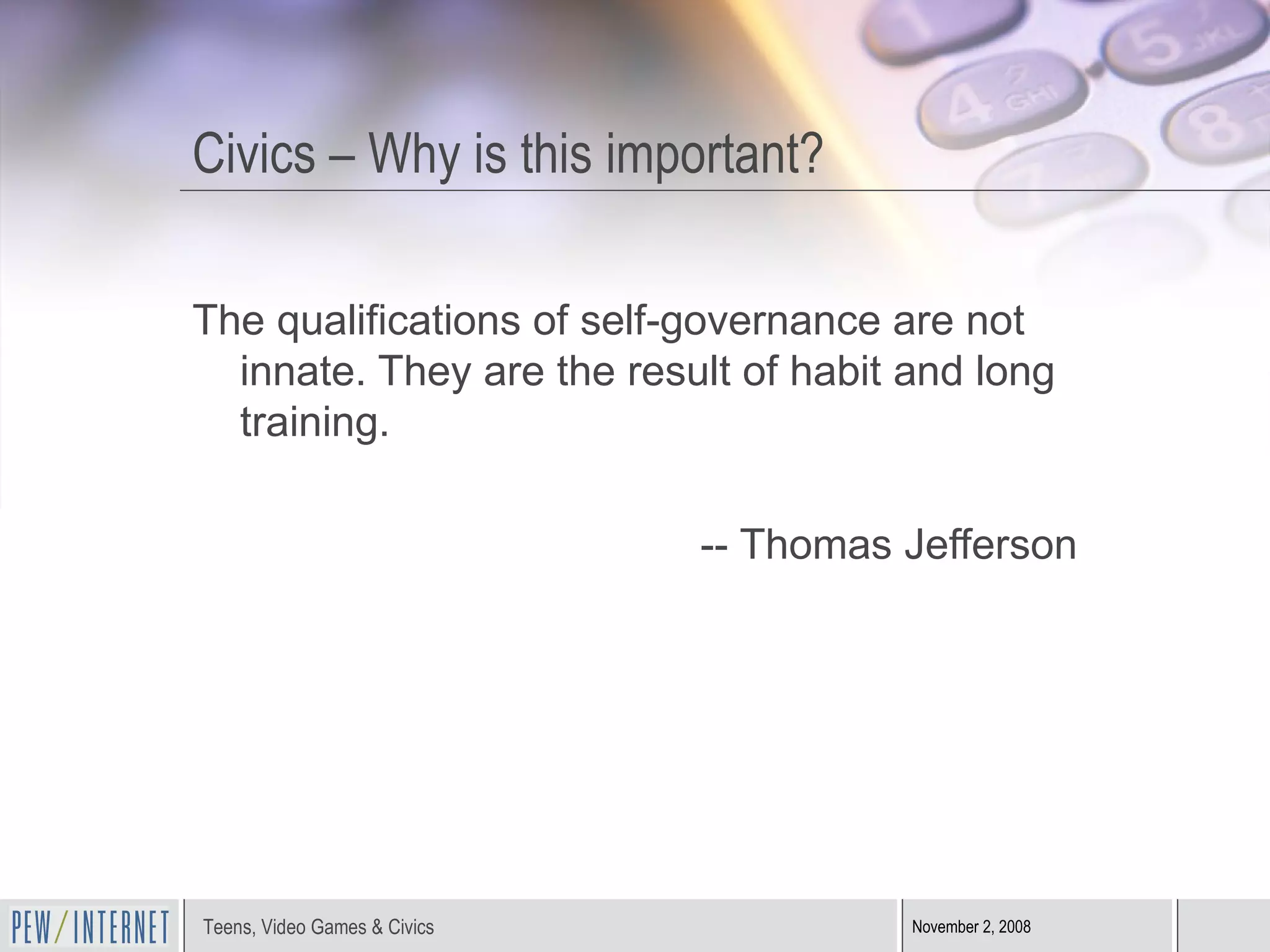
Civics – Why is this important? The qualifications of self-governance are not innate. They are the result of habit and long training. -- Thomas Jefferson
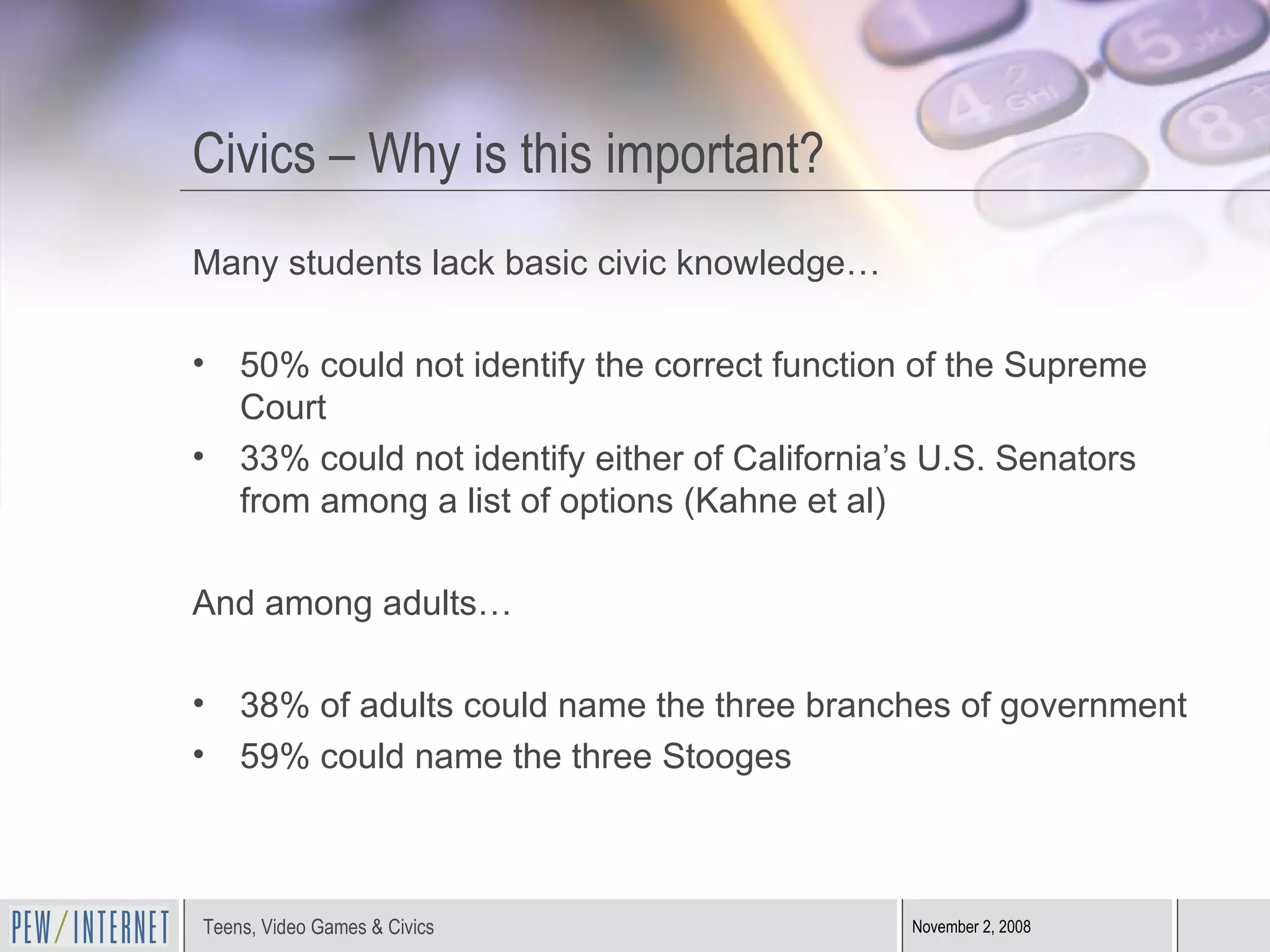
Civics – Why is this important? Many students lack basic civic knowledge… 50% could not identify the correct function of the Supreme Court 33% could not identify either of California’s U.S. Senators from among a list of options (Kahne et al) And among adults… 38% of adults could name the three branches of government 59% could name the three Stooges
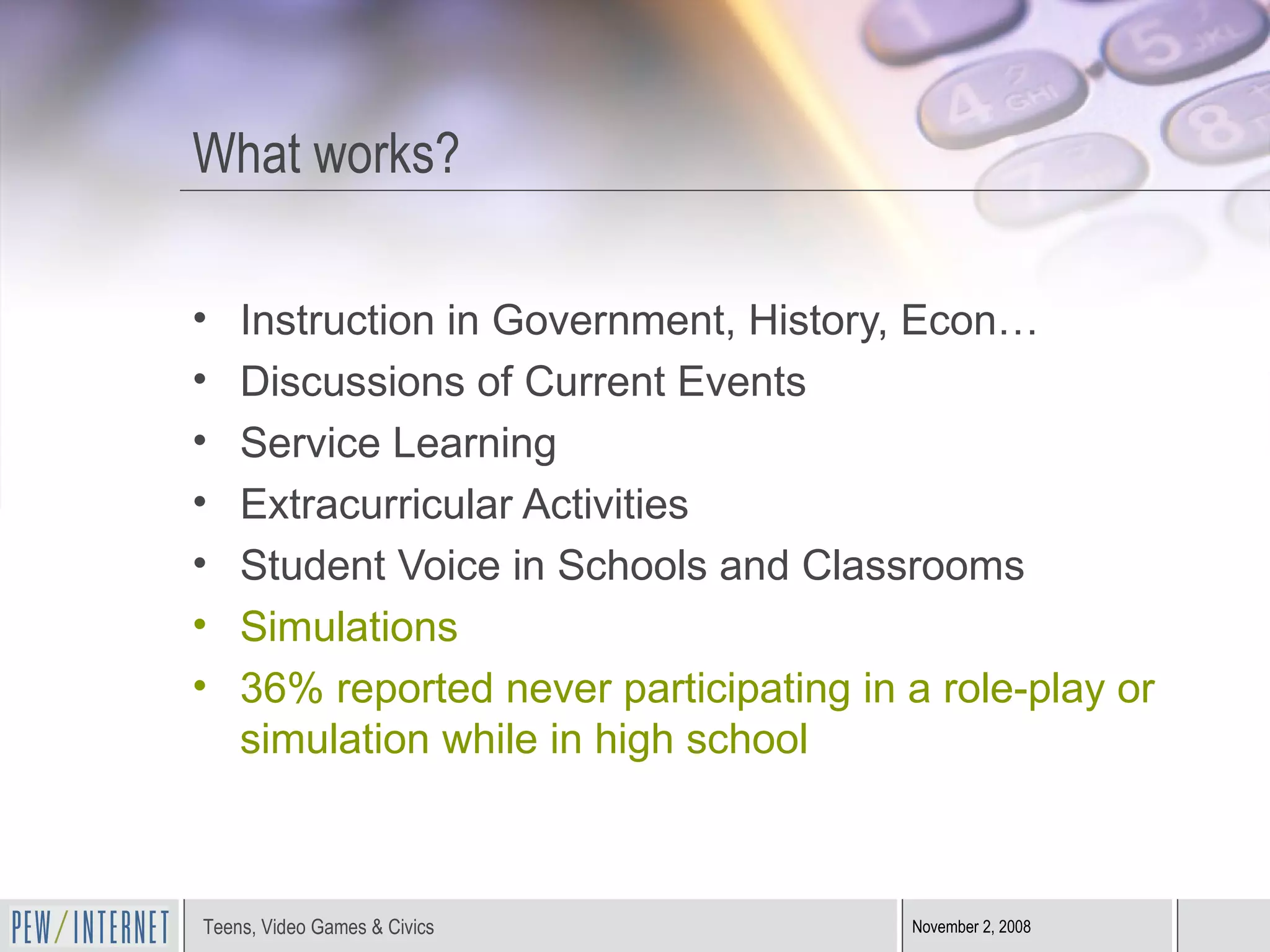
What works? Instruction in Government, History, Econ… Discussions of Current Events Service Learning Extracurricular Activities Student Voice in Schools and Classrooms Simulations 36% reported never participating in a role-play or simulation while in high school
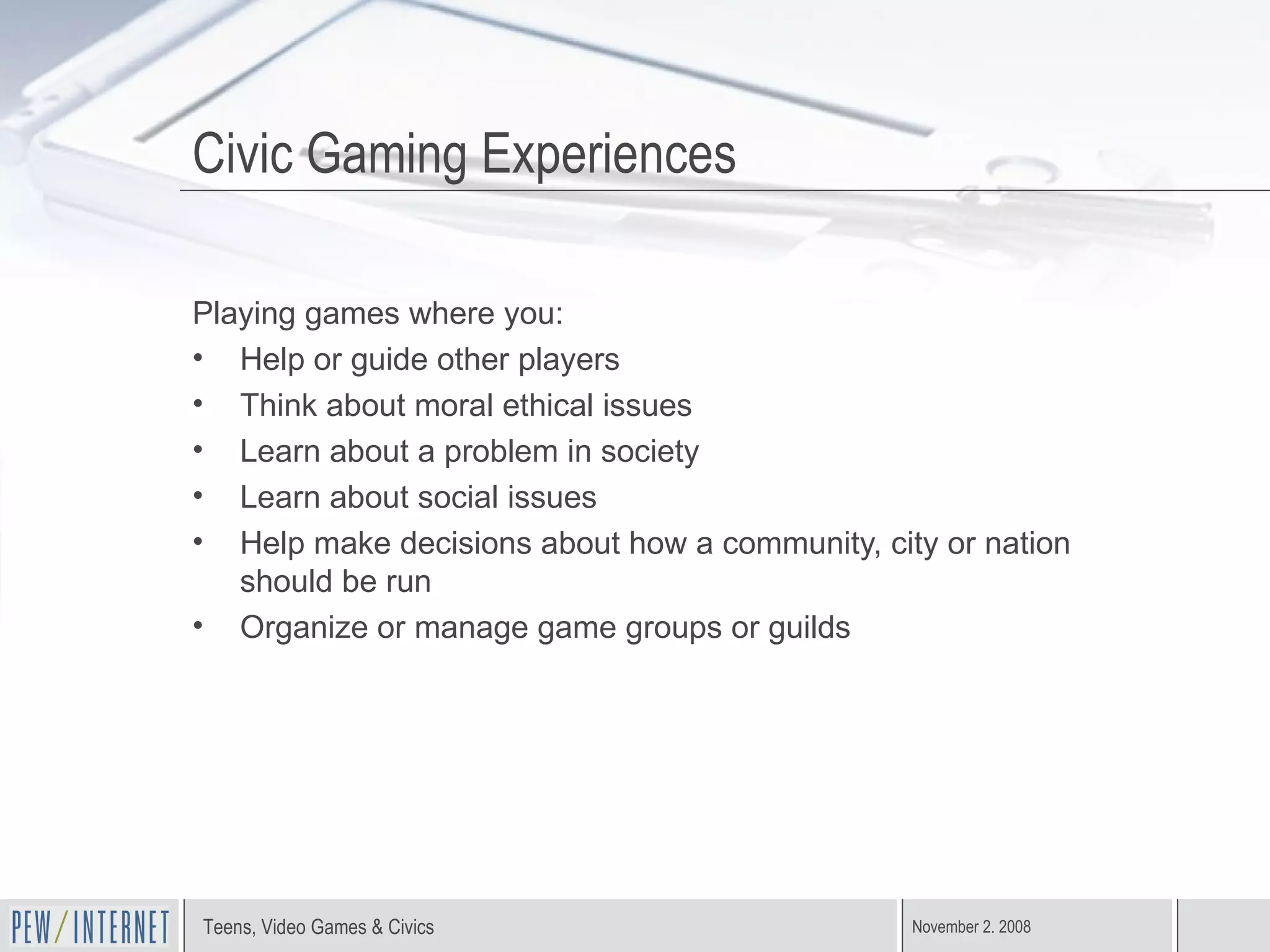
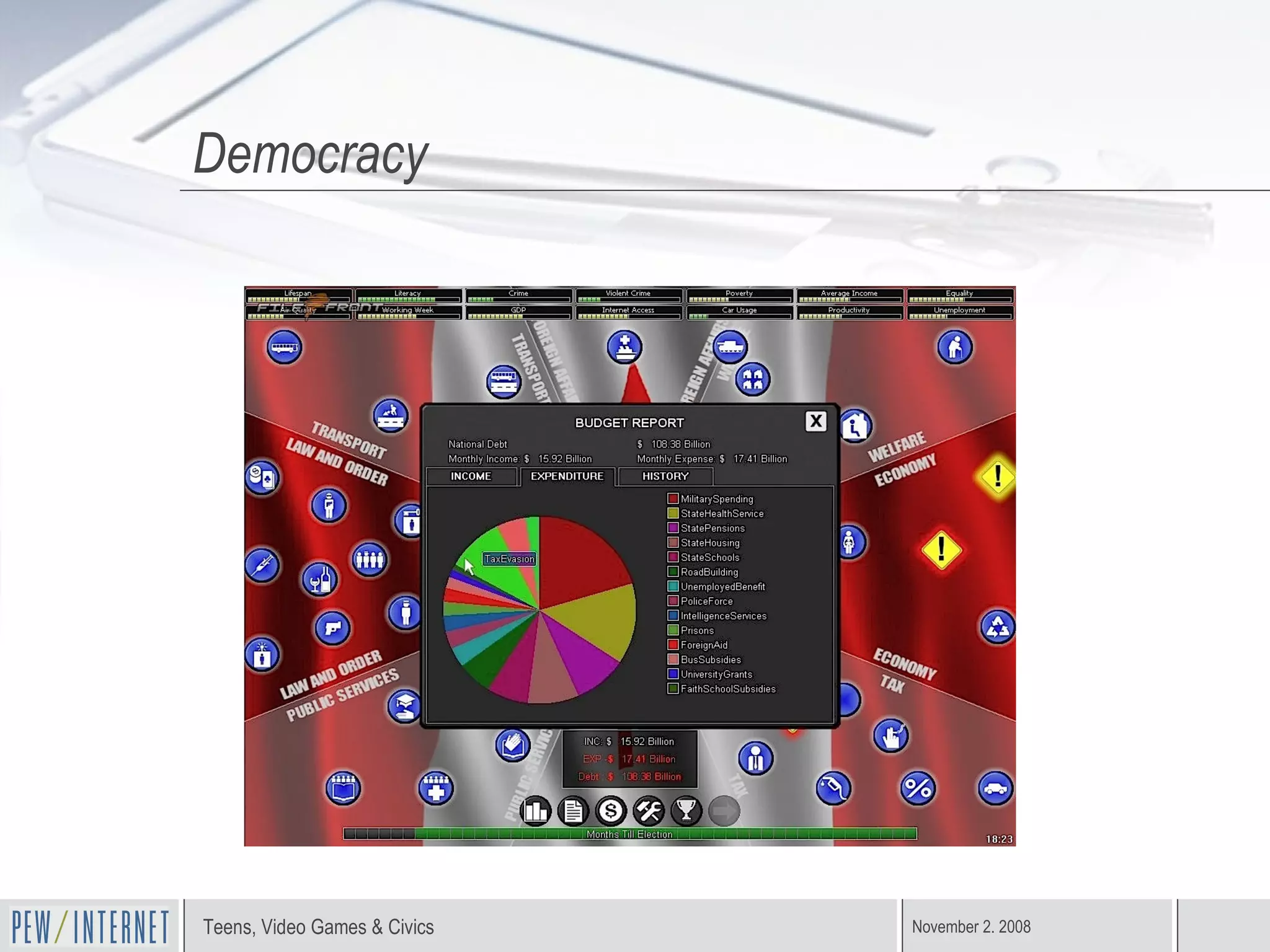
Civic Gaming Experiences Playing games where you: Help or guide other players Think about moral ethical issues Learn about a problem in society Learn about social issues Help make decisions about how a community, city or nation should be run Organize or manage game groups or guilds
Democracy
Civilization IV Image courtesy of graye via flickr under creative commons
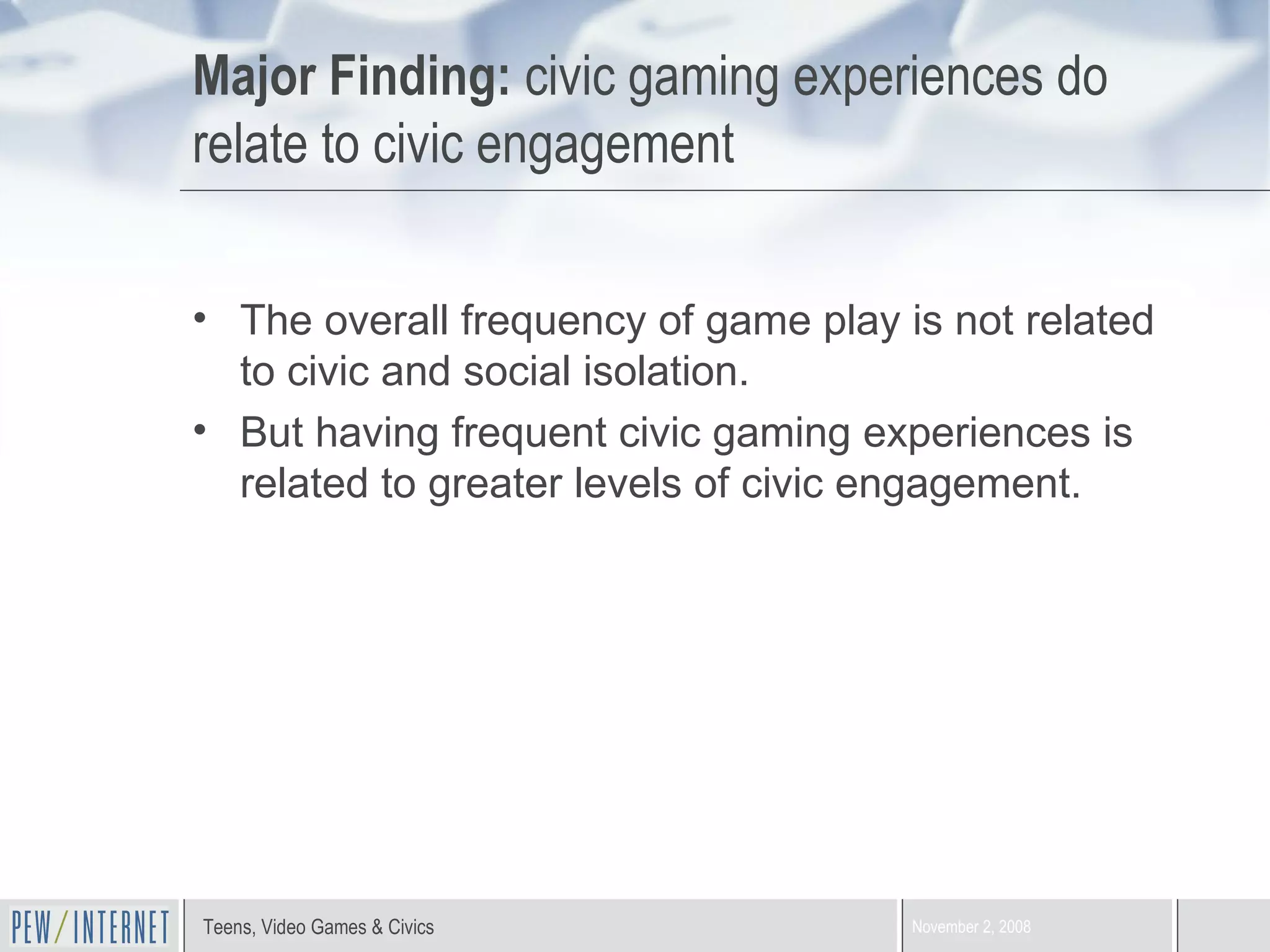
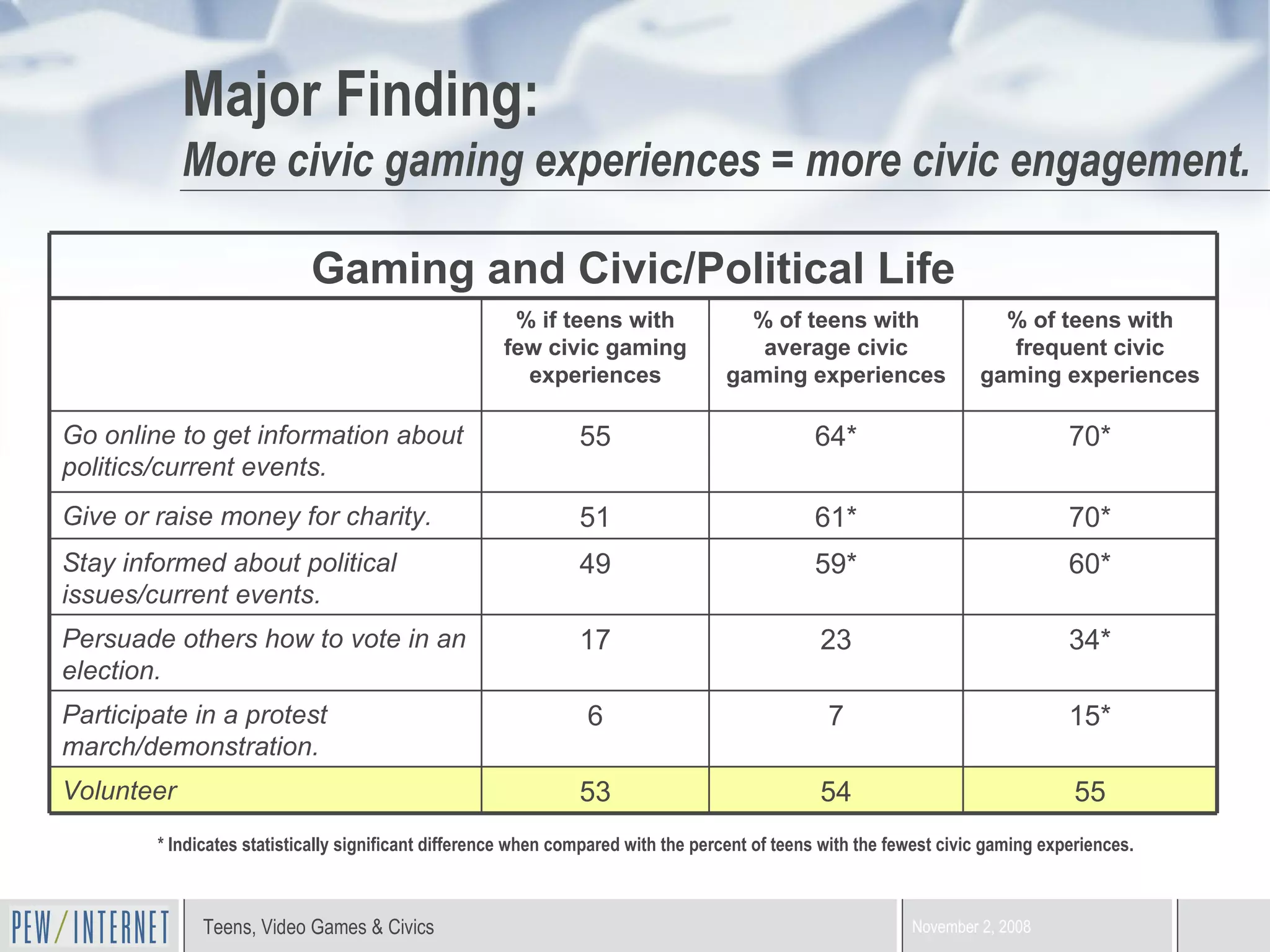
Major Finding:  civic gaming experiences do relate to civic engagement The overall frequency of game play is not related to civic and social isolation. But having frequent civic gaming experiences is related to greater levels of civic engagement.
Major Finding: More civic gaming experiences = more civic engagement. * Indicates statistically significant difference when compared with the percent of teens with the fewest civic gaming experiences. Gaming and Civic/Political Life 55 54 53 Volunteer  15* 7 6 Participate in a protest march/demonstration. 34* 23 17 Persuade others how to vote in an election. 60* 59* 49 Stay informed about political issues/current events. 70* 61* 51 Give or raise money for charity.  70* 64* 55 Go online to get information about politics/current events. % of teens with frequent civic gaming experiences % of teens with average civic gaming experiences % if teens with few civic gaming experiences
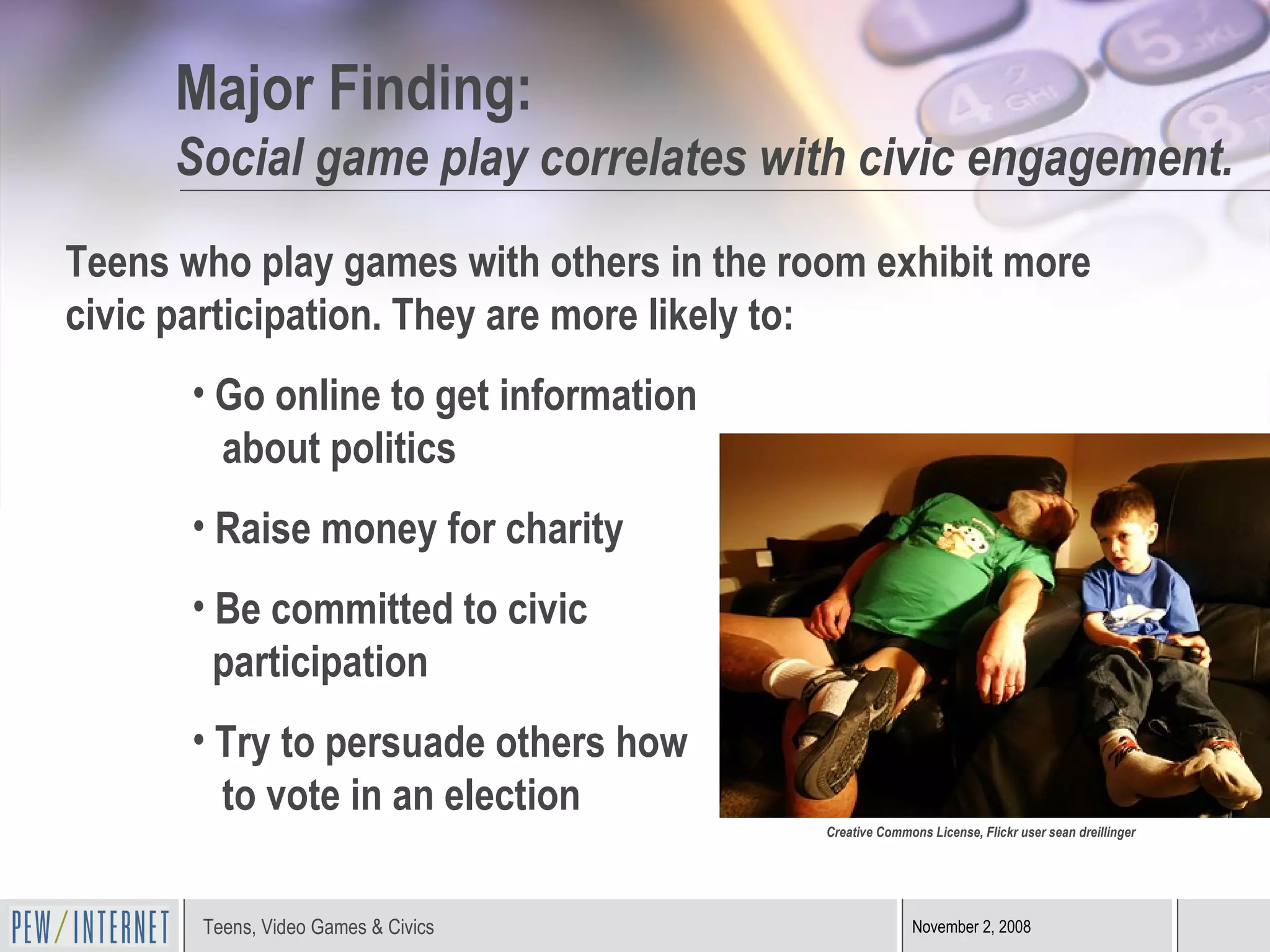
Major Finding: Social game play correlates with civic engagement. Teens who play games with others in the room exhibit more civic participation. They are more likely to: Go online to get information    about politics Raise money for charity Be committed to civic    participation Try to persuade others how    to vote in an election Creative Commons License, Flickr user sean dreillinger
Major Finding: Social interaction related to games increases engagement. Game players who post to gaming websites or  discussion boards are more likely to report they: Are committed to civic participation Go online to get information about politics    or current events Have raised money for charity Stay informed about current events Are interested in politics Have tried to persuade others how to    vote in an election Have attended a march or protest.
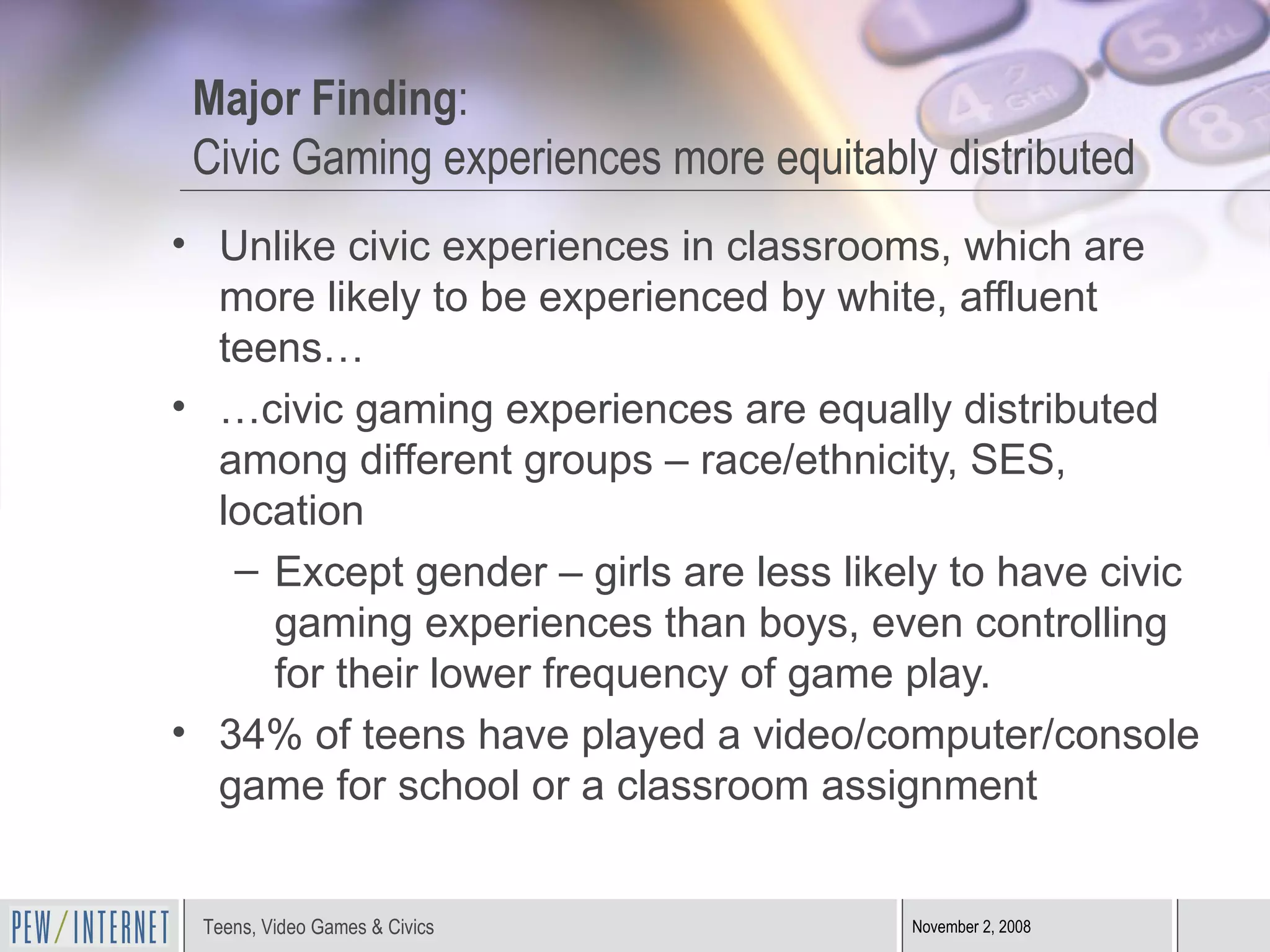
Major Finding : Civic Gaming experiences more equitably distributed Unlike civic experiences in classrooms, which are more likely to be experienced by white, affluent teens… … civic gaming experiences are equally distributed among different groups – race/ethnicity, SES, location Except gender – girls are less likely to have civic gaming experiences than boys, even controlling for their lower frequency of game play. 34% of teens have played a video/computer/console game for school or a classroom assignment
Other ways to think about games and learning Not just about game play, but about using games as an engine of creativity, narrative Modding Machinima (Machinima = Machine + Cinema) 37% of teens have used cheats or game hacks 28% of teens have used mods to alter a game http://www.youtube.com/watch?v=S1pnYeJgrsc
Takeaways Gaming is nearly universal among teens Teens play a wide variety of games that offer many different types of experiences Games are a social space for teens There are genres of games that are more broadly popular than others, some of which lend themselves to group play. Games offer promise for civic teaching and learning Playing games with certain mechanics and civic opportunities relates to a greater involvement and engagement with community and politics Playing games in certain ways (with others, in person) and being engaged in materials and discussion about games also relates to greater levels of civic engagement CAVEAT: Findings Not Causal
Full Report @  http://www.pewinternet.org   Civics White Paper @  http://www.civicsurvey.org/ Amanda Lenhart Pew Internet & American Life Project [email_address] http://www.pewinternet.org

Teens, Games and Civics

  • 1.
    Teens, Games andCivics Amanda Lenhart Games, Learning and Libraries November 2, 2008 Oak Brook, IL
  • 2.
    Road Map MethodsMain Findings Basics about game play Gaming as a social experience Parents and games Games and civics Takeaways
  • 3.
    Research Questions Whatare the game playing habits of American youth? Who plays video games? What do they play? What experiences do they have while playing? If we care about young people we must ask how games are impacting their lives Do games isolate young people? Are games creating a generation of civically disengaged youth? Can games provide civic learning opportunities?
  • 4.
    Methods RDD nationaltelephone survey 1,102 youth ages 12-17 and a parent in their home Margin of error +/- 3 percentage points Survey conducted November 1, 2007 – February 5, 2008
  • 5.
    Major Finding: Nearly all teens play games. 97% of teens say they have played video games Creative Commons License, Flickr user fille_de_photo 50% played a game “yesterday.” 86% play on consoles. 73% play on computers. 60% play on portable devices. 48% play on a cell phone.
  • 6.
    Who plays games?99% of boys, 94% of girls Boys play more often and for longer duration 39% of boys play daily; 22% of girls do 34% of boys play 2+ hours a day; 18% of girls do Younger teens play more frequently than older 54% of 12-14 year-olds play on any given day 46% of 15-17 year-olds Broadband users play more frequently 28% of bbd users played “yesterday” 20% of dial up users did so
  • 7.
    The Daily Gamer31% of teens play daily More boys than girls (65% boys; 35% girls) More younger teens (57% 12-14; 43% 15-17) More likely to use portable gaming devices… …But just as likely as everyone else to use computer, console or cell phone Daily gamers more likely to play with others online (20% vs. 12%) Daily gamers are more likely to play games as a part of a guild or group (50% vs. 38%) Just as likely to spend time f2f and communicating with friends
  • 8.
    Major Finding: Teens play a wide variety of games 80% of teens play five or more different game genres, and 40% play eight or more types of games. Girls play an average of 6 different game genres; boys average 8 different types.
  • 9.
    Game Genres Weasked about 14 different game genres 74% play racing games (NASCAR, Mario Kart) 72% play puzzle games (Tetris, Solitaire, Bejeweled) 68% play sports games (Madden, FiFA, Tony Hawk) 67% play action games (GTA, Devil May Cry, Ratchet & Clank) 66% play adventure games (Legend of Zelda, Tomb Raider) 61% play rhythm games (Guitar Hero, DDR) 59% play strategy games (Civilization, StarCraft) 49% play simulations (The Sims, Rollercoaster Tycoon) More….
  • 10.
    Game Genres, Cont.49% play fighting games (Super Smash Bros, Tekken, Mortal Kombat) 47% play first person shooters (Halo, Counter-Strike, Half-Life) 36% play role playing games (Final Fantasy, Knights of the Old Republic) 32% play survival horror games (Resident Evil, Silent Hill) 21% play MMOGs 10% use virtual worlds
  • 11.
    MMOGs and VirtualWorlds 20% of teens use MMOGs 30% of boys have played them; 11% of girls 10% of teens use virtual worlds Boys just as likely as girls Younger teens more likely than older teens: 13% of 12-14 year olds; 8% of 15-17 year olds. Daily gamers more likely to play MMOGs and in Virtual worlds Image courtesy of rosefirerising via flickr under creative commons
  • 12.
    Games, Genre &Gender Boys play a greater number of genres of games Boys average 8 genres, girls 6 genres Girls top 5 genres: Puzzle, Racing, Rhythm, Adventure, Sports/Strategy Boys top 5 genres: Action, Sports, Racing, Adventure, FPS Genres with equal levels of popularity between boys and girls: Racing games, Rhythm games, Simulations and Virtual worlds. Daily gamers play a similar range of genres as boys.
  • 13.
    Major Finding: Majority of most popular games are not violent The Sims Halo Grand Theft Auto Tetris Madden NFL ‘08 Dance Dance Revolution Solitaire Madden NFL Halo 3 Guitar Hero 10 Most Frequently Played Games
  • 14.
    The industry ratingsystem doesn’t always work 32% of gaming teens report that at least one of their three favorite games is rated Mature or Adults Only. 79% of M- and AO-rated game players are boys, and 21% are girls. 12- to 14-year-olds are equally as likely to play M- or AO-rated games as their 15- to 17-year-old counterparts.
  • 15.
    Major Finding: Teens encounter both pro-social and anti-social behavior while gaming 78% of teens who play games report they frequently or sometimes see other players being kind and helpful to those who are gaming 63% report seeing or hearing “people being mean and overly aggressive while playing” 49% report seeing or hearing “people being hateful, racist, or sexist” while playing ------------ Three quarters of teens who see uncivil behavior regularly see others respond.
  • 16.
    Major Finding: Teen gaming is social. Creative Commons License, Flickr user tracer.ca 76% play games with others at least some of the time. 65% play with other people in the room with them. 27% play with others through the Internet. 82% play games alone.
  • 17.
    Games are social(2) 59% of games play in multiple ways 42% most often play with friends in person 15% most often play with friends online 42% most often play alone Dial up users less likely to play with friends online (6% vs. 19% of bbd users)
  • 18.
    Games are social(3) 47% of online gamers play mostly with people they know from their community & offline friends 27% of online gamers only play with people they met online 23% of online gamers play with a mix of people they met online and people they met offline Online gamers are more likely to play in groups – 43% game in a group or guild Girls are more likely to play exclusively with people they know from their offline lives. MMOG players much more likely to play with others they met online, and play in groups.
  • 19.
    Major Finding: Parental monitoring of game play varies. 55% of parents say they “always” check a game’s rating before letting their kids play it. Parents are more likely to monitor game play for boys and younger children. Parental monitoring does not reduce M/AO rated game play or witnessing of anti-social behavior in games. Octoer≈10, 2008 Creative Commons License, Flickr user Reggie fun.
  • 20.
    Parental monitoring ofgame playing varies (2) 90% of parents say they always or sometimes know what games their children play. 72% say they always or sometimes check the ratings before their children are allowed to play a game. 46% of parents say they always or sometimes stop their kids from playing a game. 31% of parents say they always or sometimes play games with their children.
  • 21.
    Parental views onthe impact of games 62% of parents of gamers say video games have no effect on their child one way or the other. 19% of parents of gamers say video games have a positive influence on their child. 13% of parents of gamers say video games have a negative influence on their child. 5% of parents of gamers say gaming has some negative influence/some positive influence, but it depends on the game.
  • 22.
    Civics – Whyis this important? The qualifications of self-governance are not innate. They are the result of habit and long training. -- Thomas Jefferson
  • 23.
    Civics – Whyis this important? Many students lack basic civic knowledge… 50% could not identify the correct function of the Supreme Court 33% could not identify either of California’s U.S. Senators from among a list of options (Kahne et al) And among adults… 38% of adults could name the three branches of government 59% could name the three Stooges
  • 24.
    What works? Instructionin Government, History, Econ… Discussions of Current Events Service Learning Extracurricular Activities Student Voice in Schools and Classrooms Simulations 36% reported never participating in a role-play or simulation while in high school
  • 25.
    Civic Gaming ExperiencesPlaying games where you: Help or guide other players Think about moral ethical issues Learn about a problem in society Learn about social issues Help make decisions about how a community, city or nation should be run Organize or manage game groups or guilds
  • 26.
  • 27.
    Civilization IV Imagecourtesy of graye via flickr under creative commons
  • 28.
    Major Finding: civic gaming experiences do relate to civic engagement The overall frequency of game play is not related to civic and social isolation. But having frequent civic gaming experiences is related to greater levels of civic engagement.
  • 29.
    Major Finding: Morecivic gaming experiences = more civic engagement. * Indicates statistically significant difference when compared with the percent of teens with the fewest civic gaming experiences. Gaming and Civic/Political Life 55 54 53 Volunteer 15* 7 6 Participate in a protest march/demonstration. 34* 23 17 Persuade others how to vote in an election. 60* 59* 49 Stay informed about political issues/current events. 70* 61* 51 Give or raise money for charity. 70* 64* 55 Go online to get information about politics/current events. % of teens with frequent civic gaming experiences % of teens with average civic gaming experiences % if teens with few civic gaming experiences
  • 30.
    Major Finding: Socialgame play correlates with civic engagement. Teens who play games with others in the room exhibit more civic participation. They are more likely to: Go online to get information about politics Raise money for charity Be committed to civic participation Try to persuade others how to vote in an election Creative Commons License, Flickr user sean dreillinger
  • 31.
    Major Finding: Socialinteraction related to games increases engagement. Game players who post to gaming websites or discussion boards are more likely to report they: Are committed to civic participation Go online to get information about politics or current events Have raised money for charity Stay informed about current events Are interested in politics Have tried to persuade others how to vote in an election Have attended a march or protest.
  • 32.
    Major Finding :Civic Gaming experiences more equitably distributed Unlike civic experiences in classrooms, which are more likely to be experienced by white, affluent teens… … civic gaming experiences are equally distributed among different groups – race/ethnicity, SES, location Except gender – girls are less likely to have civic gaming experiences than boys, even controlling for their lower frequency of game play. 34% of teens have played a video/computer/console game for school or a classroom assignment
  • 33.
    Other ways tothink about games and learning Not just about game play, but about using games as an engine of creativity, narrative Modding Machinima (Machinima = Machine + Cinema) 37% of teens have used cheats or game hacks 28% of teens have used mods to alter a game http://www.youtube.com/watch?v=S1pnYeJgrsc
  • 34.
    Takeaways Gaming isnearly universal among teens Teens play a wide variety of games that offer many different types of experiences Games are a social space for teens There are genres of games that are more broadly popular than others, some of which lend themselves to group play. Games offer promise for civic teaching and learning Playing games with certain mechanics and civic opportunities relates to a greater involvement and engagement with community and politics Playing games in certain ways (with others, in person) and being engaged in materials and discussion about games also relates to greater levels of civic engagement CAVEAT: Findings Not Causal
  • 35.
    Full Report @ http://www.pewinternet.org Civics White Paper @ http://www.civicsurvey.org/ Amanda Lenhart Pew Internet & American Life Project [email_address] http://www.pewinternet.org