Google+
What is it and should we take
notice?
What is Google Plus?

  • A new social networking service from Google

  • Much like Facebook, it allows people to share and discuss status updates,
  photos and links but with different groups of people.


“In real life, we have walls and windows and I can speak to you knowing who’s in the
room, but in the online world, you get to a ‘Share’ box and you share with the whole world.
We have a new model.” (Bradley Horowitz, vice president for product management at
Google)


  http://www.nytimes.com/2011/06/29/technology/29google.html?_r=1
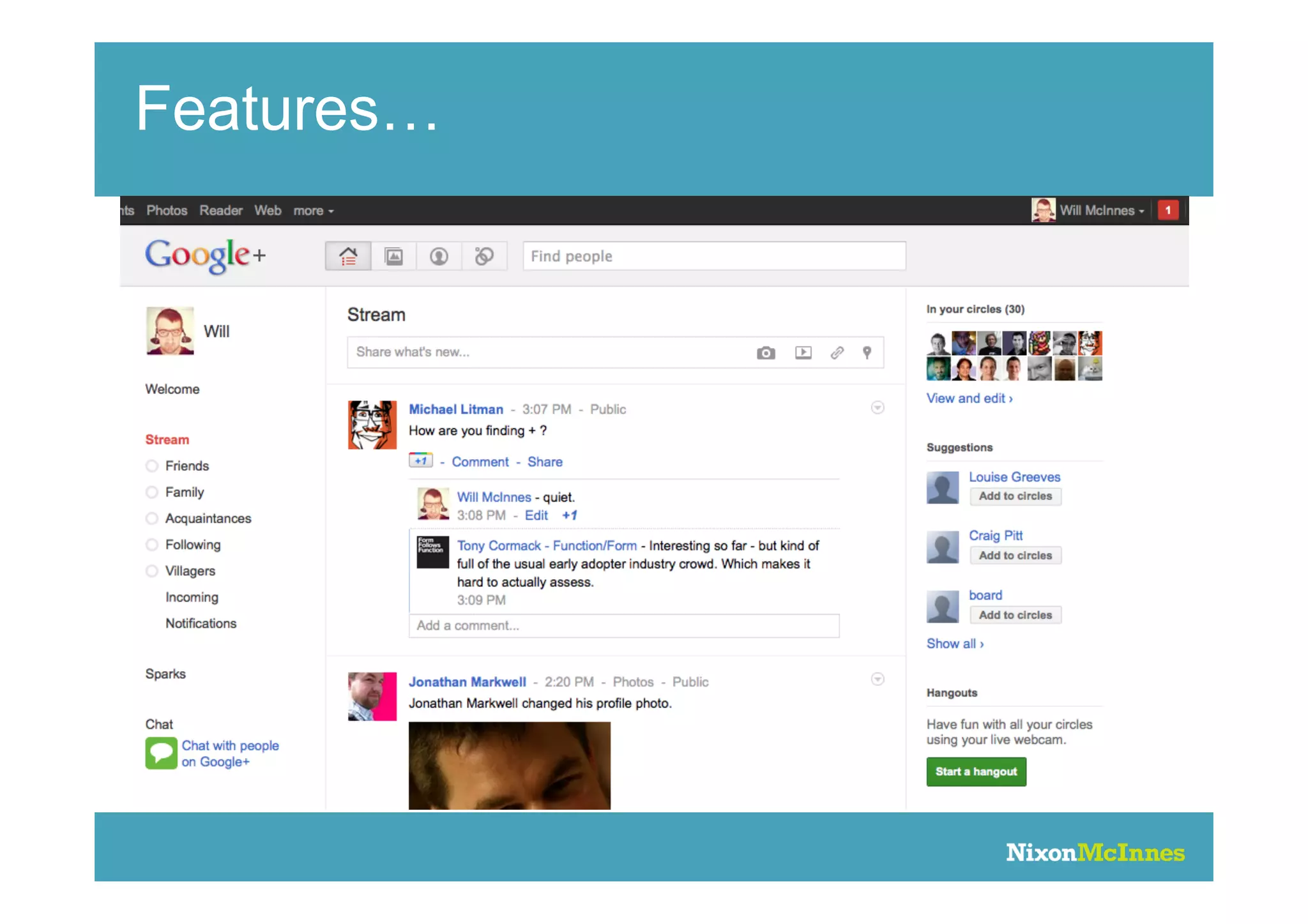
Features…
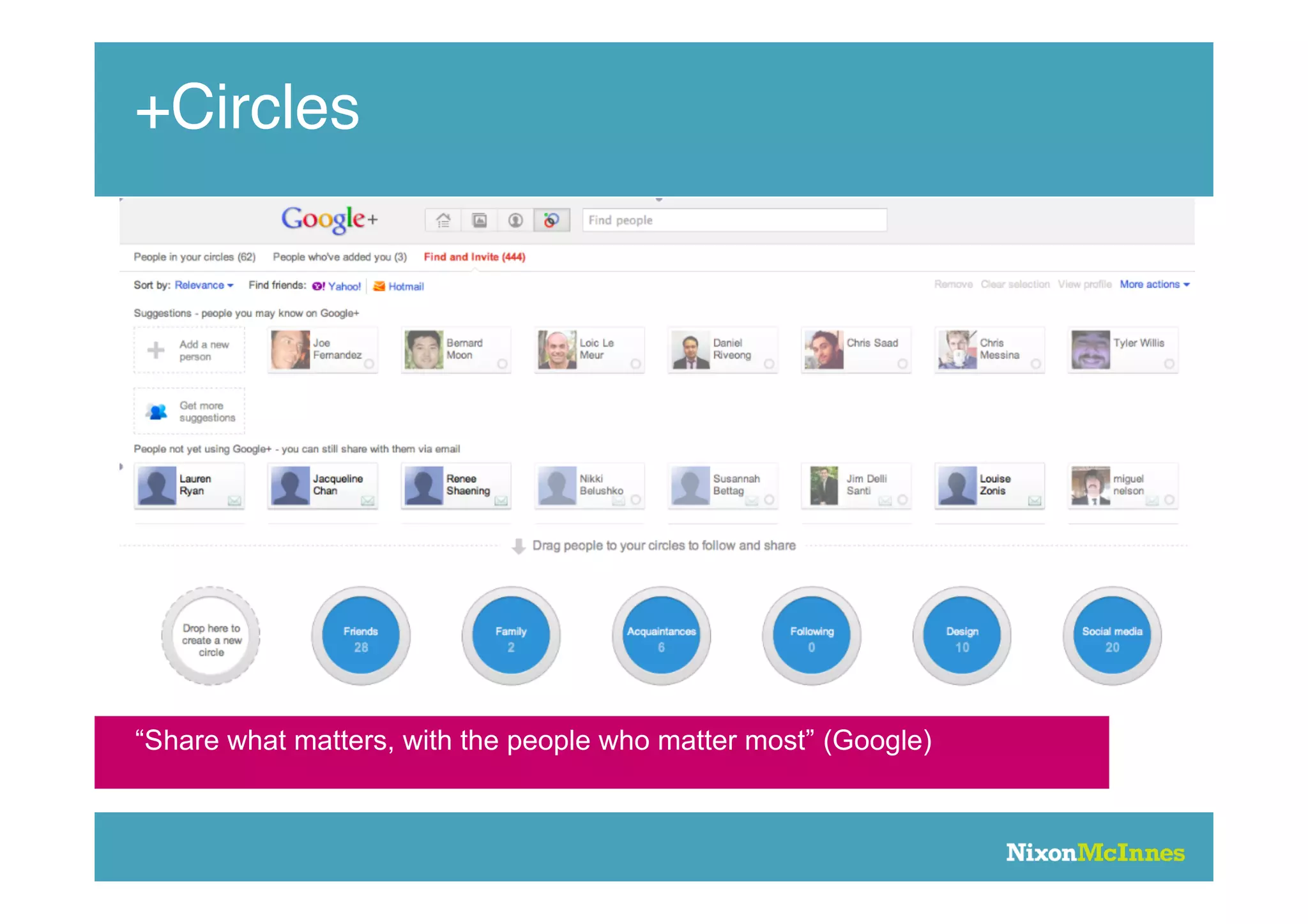
+Circles


“Share what matters, with the people who matter most” (Google)
+Circles

 • ‘Circles’ enable users to share different things with different groups of people.

 • Users can create different ‘Circles’ for different groups for example, one for
 family, one for friends, for work colleagues and for cyclists etc.


“If there is anything that will make people want to manually organize their contacts, this could
be it. This is really important because as I've argued for several years, groups are the secret
weapon of the social web. Anything that can increase the percentage of social software users
who are actively curating dynamic, topical sources is a net win for the web and for the people
who use it. List creation on competing services has been a mixed bag. It's undervalued at
Twitter and suffocated on Facebook.” (ReadWriteWeb)
The benefits (according to Google)
Circles…

• Enable people to connect with certain people at certain times

• Encourage more sharing because according to Google every online conversation is
usually a “public performance” which means we often share less because of “stage
fright”.

• Are sensitive in the way that a creator can put people in different circles without
that person knowing which circle they are in because Google believes that “we all
define “friend” and “family” differently—in our own way, on our own terms—but we
lose this nuance online.”
+Sparks


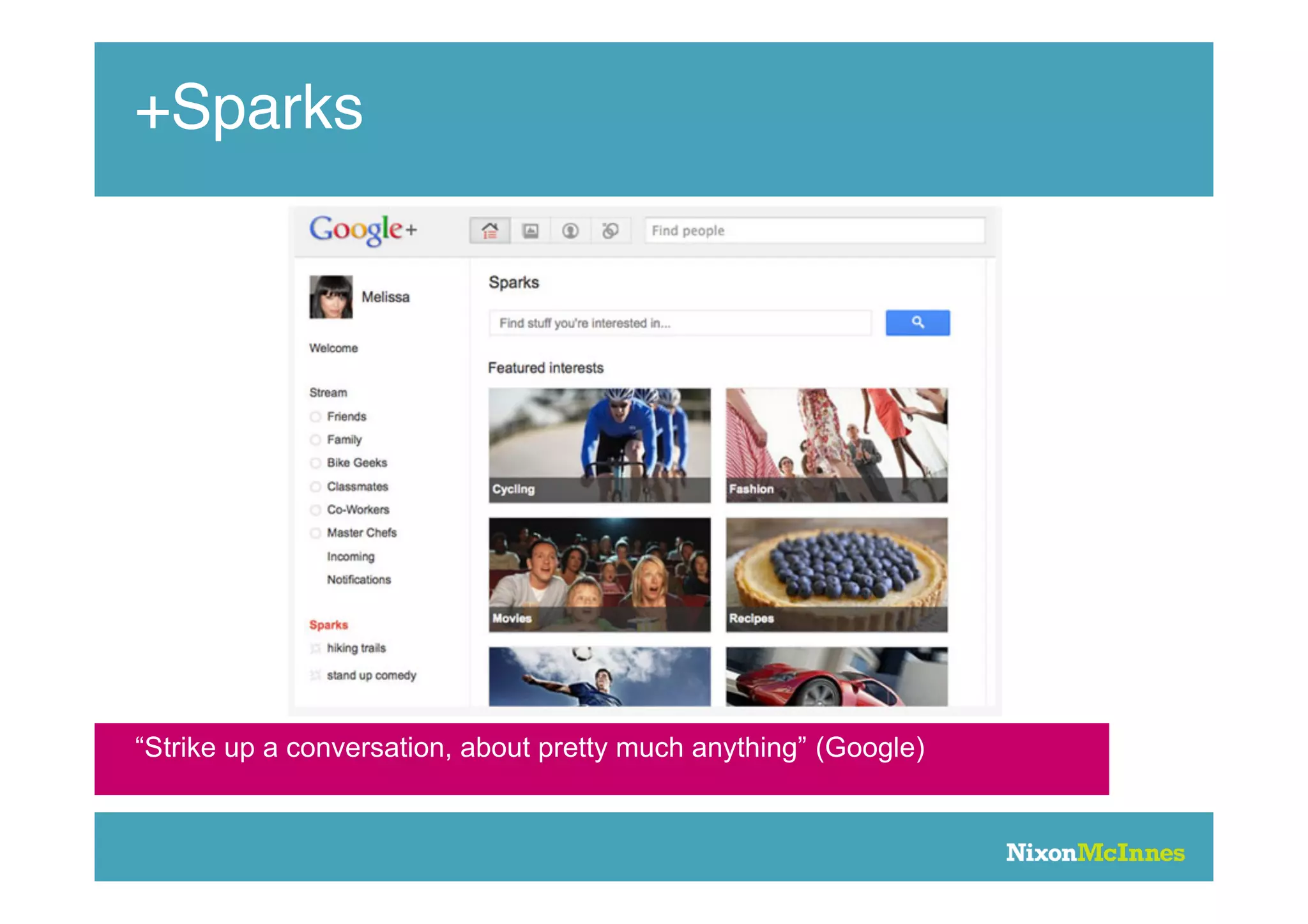
“Strike up a conversation, about pretty much anything” (Google)
+Sparks

• ‘Sparks’ functions just like a search engine but makes recommendations for
content which could be suitable for you, according to the interests you enter.

• Content includes blog posts, articles and videos from across the web.


“Sparks may end up being Google+’s most underrated feature. The company has
essentially created a recommendation engine without calling it one. It’s designed to
augment Google+, and if it works as Google designed it, it will create winners and losers in
the publishing world, making Google +1 buttons actually matter. Before that becomes a
reality though, it needs traction and it should consider acquiring advanced content
recommendation technology from a company like Trapit or my6sense.” (Mashable)
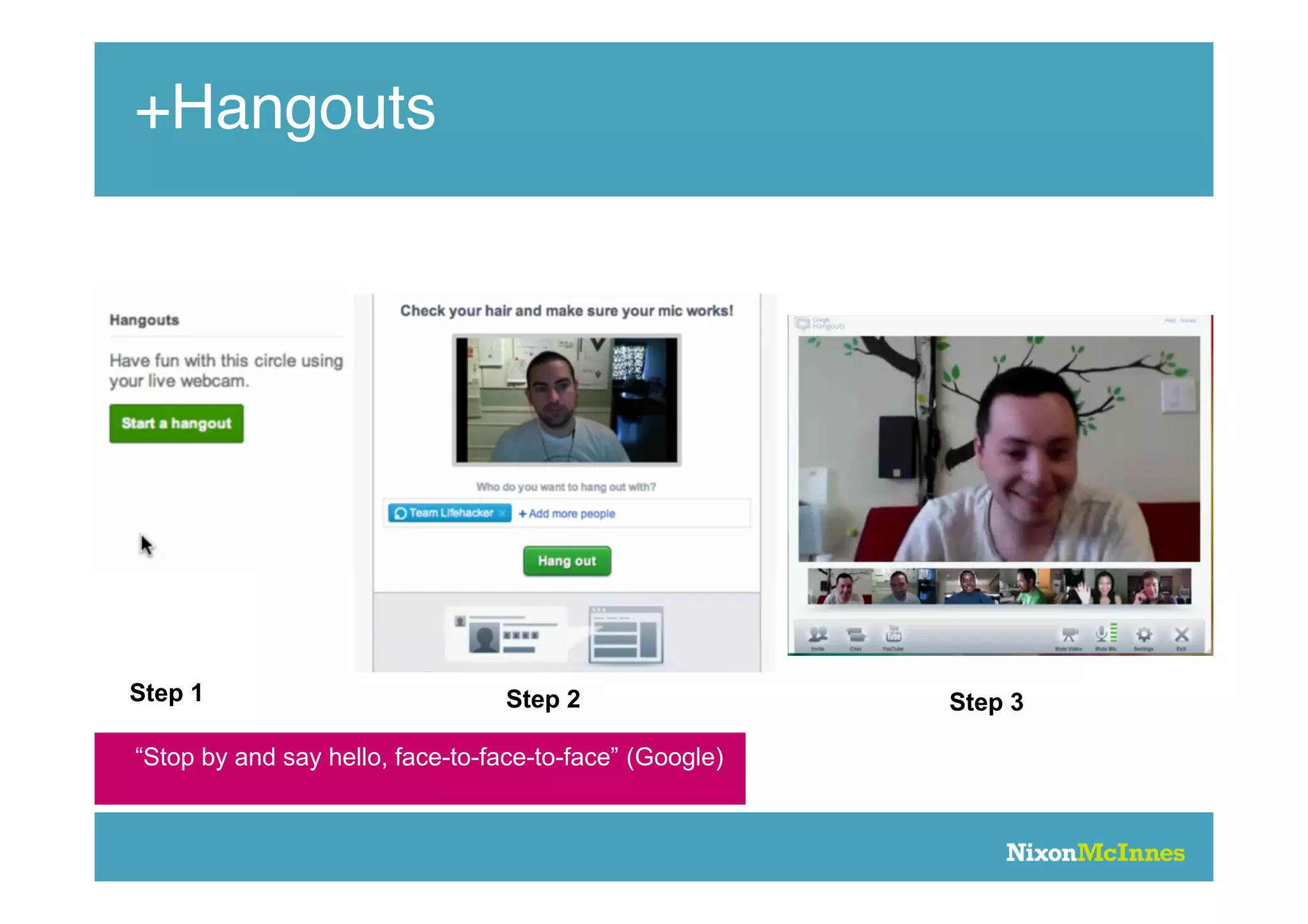
+Hangouts


Step 1                            Step 2                 Step 3

“Stop by and say hello, face-to-face-to-face” (Google)
+Hangouts
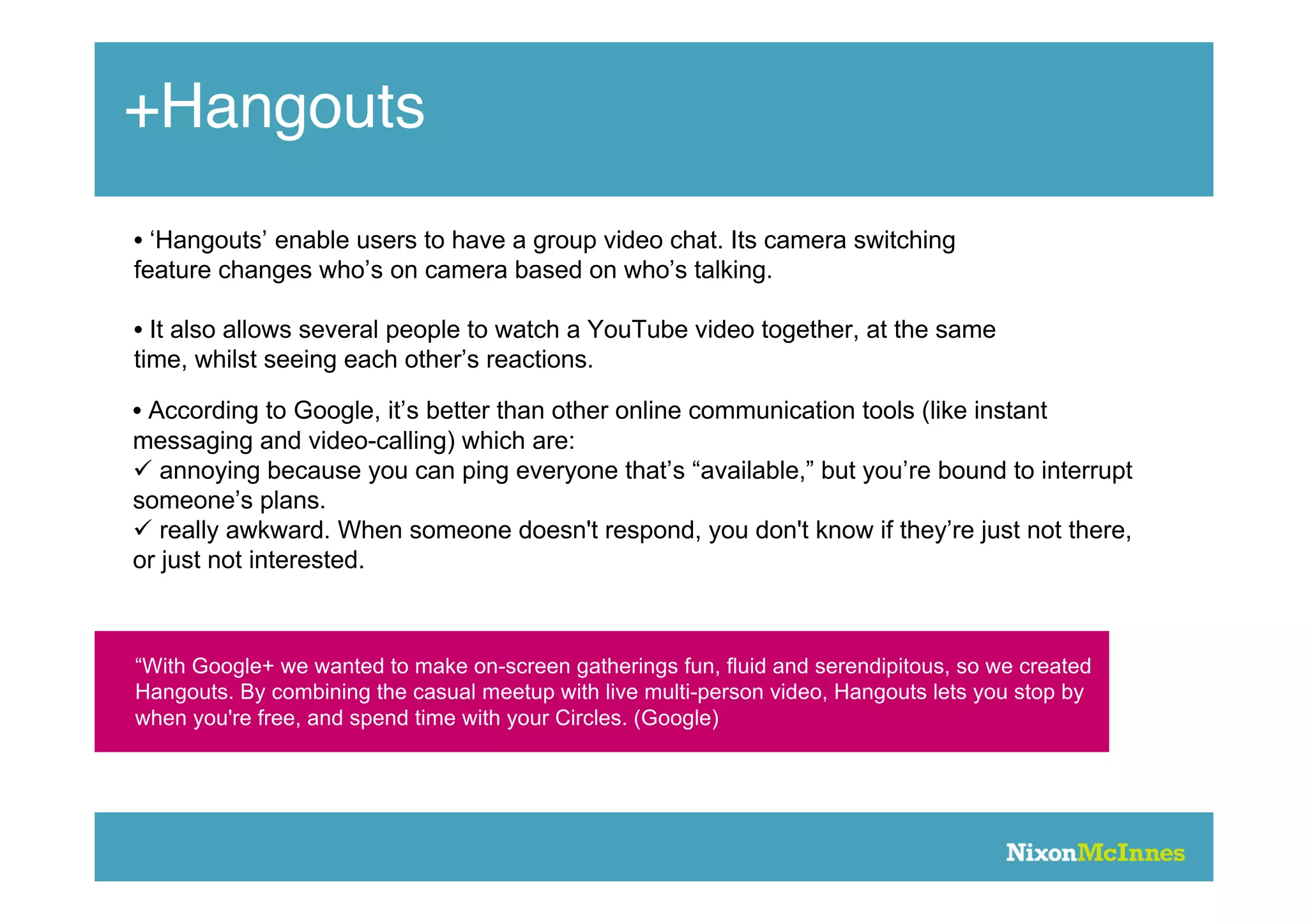
• ‘Hangouts’ enable users to have a group video chat. Its camera switching
feature changes who’s on camera based on who’s talking.

• It also allows several people to watch a YouTube video together, at the same
time, whilst seeing each other’s reactions.

• According to Google, it’s better than other online communication tools (like instant
messaging and video-calling) which are:
 annoying because you can ping everyone that’s “available,” but you’re bound to interrupt
someone’s plans.
 really awkward. When someone doesn't respond, you don't know if they’re just not there,
or just not interested.


“With Google+ we wanted to make on-screen gatherings fun, fluid and serendipitous, so we created
Hangouts. By combining the casual meetup with live multi-person video, Hangouts lets you stop by
when you're free, and spend time with your Circles. (Google)
+Mobile
   Currently, there are two unique features (although this is likely to develop in the near-
   future):

   • Instant photo uploads

   “We created Instant Upload to help you never leave a photo behind. While you're snapping
   pictures, and with your permission, Google+ adds your photos to a private album in the
   cloud. This way they're always available across your devices—ready to share as you see
   fit.” (Google)


   • Google+ Huddle (a group-texting feature for Circles)

            “Coordinating with friends and family in real-time is really hard in real life. After all,
            everyone's on different schedules, in different places, and plans can change at any
            moment. Phone calls and text messages can work in a pinch, but they're not quite right for
            getting the gang together. So Google+ includes Huddle, a group messaging experience
            that lets everyone inside the circle know what's going on, right this second.” (Google)


http://googleblog.blogspot.com/2011/06/introducing-google-project-real-life.html
Google+ vs. Facebook

   • Unlike on Facebook, people do not have to agree to be friends with one another.
   They can receive someone’s updates without sharing their own.

   • Facebook has also recognised people’s desire to share with smaller groups, and
   last year introduced Groups to make that possible. It has been one of Facebook’s
   fastest-growing products, with users creating 50 million groups in the first six
   months, according to Facebook.

   • When users visit their Google+ home page, they see three columns and a stream
   of status updates in the middle that looks similar to Facebook.

   • When people post on Facebook, which is mostly off-limits to search engines,
   Google loses valuable information that could benefit its Web search, advertising
   and other products.


http://techcrunch.com/2011/06/29/does-the-google-interface-remind-you-of-facebook-youre-not-the-only-one/
What the bloggersphere think

   “Google+ may already be too late. In May, 180 million people visited Google sites, including
   YouTube, compared with 157.2 million on Facebook, according to comScore. But Facebook
   users looked at 103 billion pages and spent an average of 375 minutes on the site, while
   Google users viewed 46.3 billion pages and spent 231 minutes.” (ReadWriteWeb)


                           “When it comes to social networking, Google finds itself in an unusual position,
                           one that its competitors in Web search know all too well: playing catch-up with
                           a service that dominates the market.” (NYT)


   “Google+ is a bold and dramatic attempt at social. There’s a reason why Google calls this a
   “project” rather than a “product” — they don’t want people to think of this as the final product,
   but as a constantly-evolving entity that permeates every corner of the Google empire.”
   (Mashable)


http://www.nytimes.com/2011/06/29/technology/29google.html?_r=1
What everybody else thinks

                   “Google+ certainly looks interesting. It's slick UI and feature set are appealing
                   and the scope for what it could be is huge. It'll live or die on the userbase
                   though, but Facebook may well have some competition, albeit from a slightly
                   different angle.” David Howard, founder of Mediakick.org


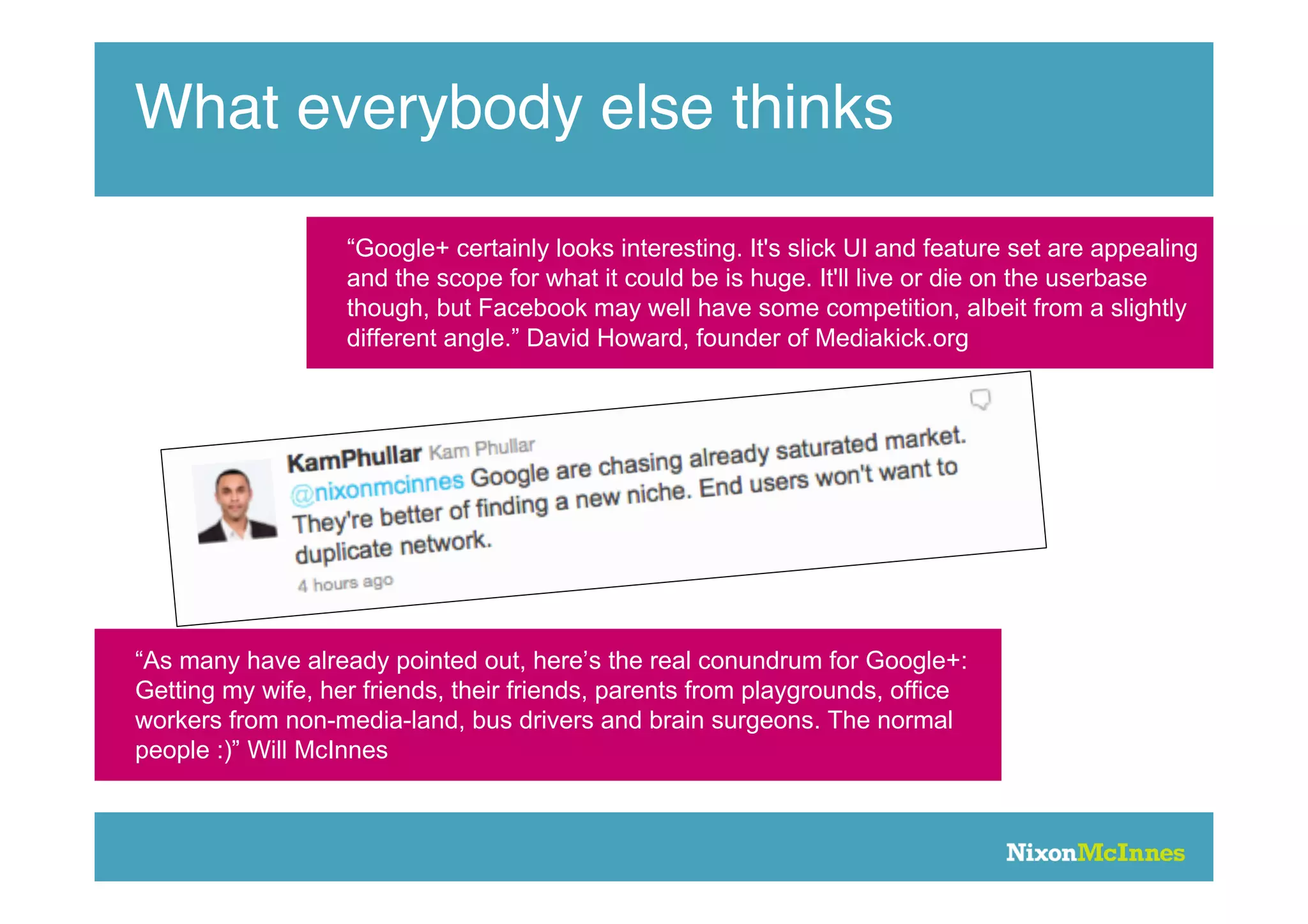
“As many have already pointed out, here’s the real conundrum for Google+:
Getting my wife, her friends, their friends, parents from playgrounds, office
workers from non-media-land, bus drivers and brain surgeons. The normal
people :)” Will McInnes
So should we take notice?
    • If more ‘normal’ users start using it, it is unlikely that it will compete with
    Facebook in terms of size this year.

                 “If Google can persuade users to come back every day, it has a winner. But the
                 company will have to do even more to provide a truly compelling alternative to
                 Facebook. At the moment, Google+ cannot compete with the king of social, but
                 Google doesn’t seem to be in a hurry to take on Mark Zuckerberg’s giant quite yet.”
                 (Mashable)

    • However, there is a lot of buzz around Google+ at the moment and although it is
    early stages, there is a lot of potential for growth and room for further
    development.

   Overall, at the moment, there is no obvious way for businesses to use Google+
   and the array of mixed reviews across the web suggests it is unknown how
   successful it will be. Therefore, for the time being, it is probably best to watch
   and learn.

http://www.prnewsonline.com/watercooler/Beyond-the-Buzz-What-Google+-Means-for-PR-Pros_15084.html
Some news from NixonMcInnes…


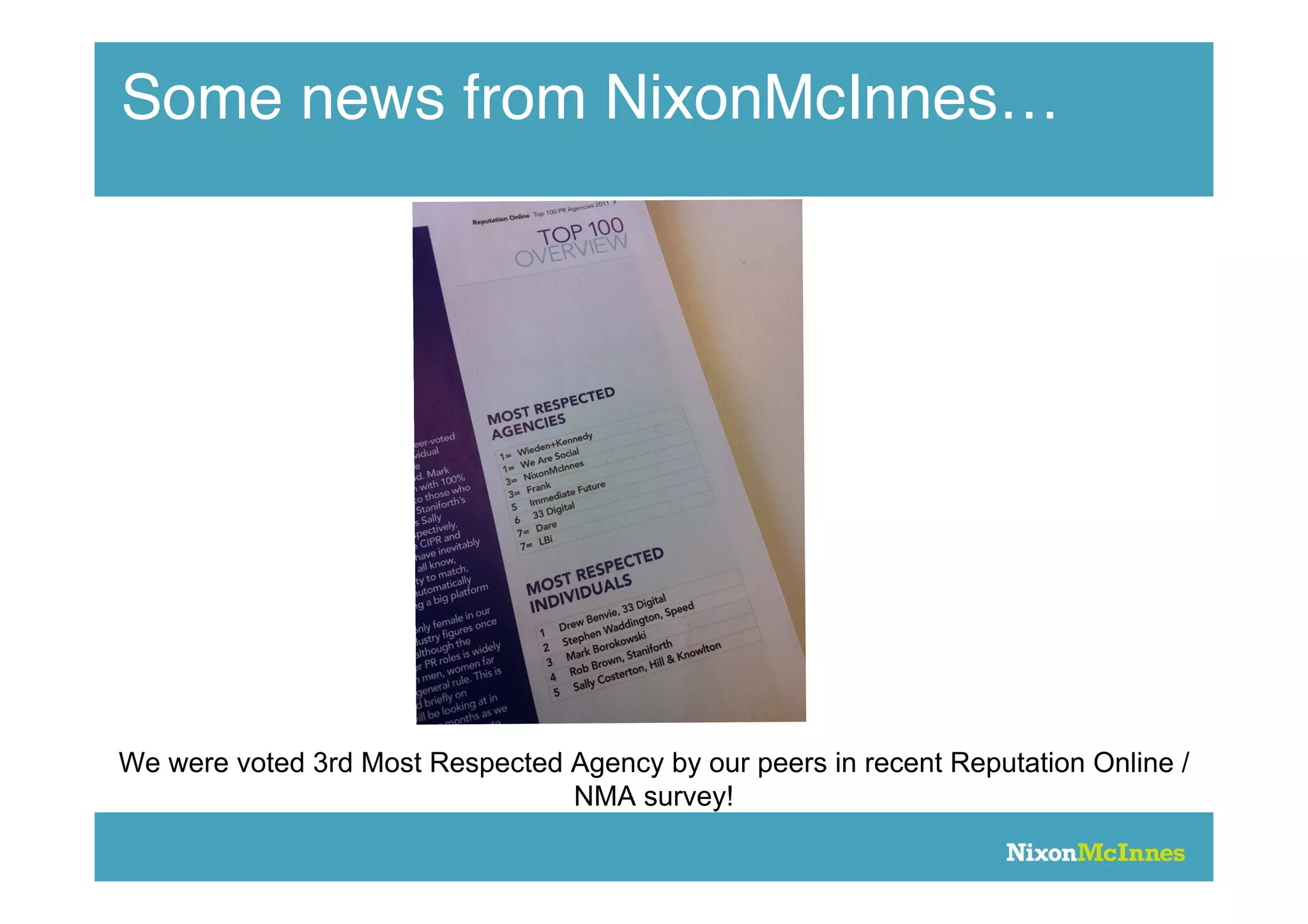
We were voted 3rd Most Respected Agency by our peers in recent Reputation Online /
                                 NMA survey!

Google Plus briefing notes

  • 1.
    Google+ What is itand should we take notice?
  • 2.
    What is GooglePlus? • A new social networking service from Google • Much like Facebook, it allows people to share and discuss status updates, photos and links but with different groups of people. “In real life, we have walls and windows and I can speak to you knowing who’s in the room, but in the online world, you get to a ‘Share’ box and you share with the whole world. We have a new model.” (Bradley Horowitz, vice president for product management at Google) http://www.nytimes.com/2011/06/29/technology/29google.html?_r=1
  • 3.
  • 4.
    +Circles “Share what matters,with the people who matter most” (Google)
  • 5.
    +Circles • ‘Circles’enable users to share different things with different groups of people. • Users can create different ‘Circles’ for different groups for example, one for family, one for friends, for work colleagues and for cyclists etc. “If there is anything that will make people want to manually organize their contacts, this could be it. This is really important because as I've argued for several years, groups are the secret weapon of the social web. Anything that can increase the percentage of social software users who are actively curating dynamic, topical sources is a net win for the web and for the people who use it. List creation on competing services has been a mixed bag. It's undervalued at Twitter and suffocated on Facebook.” (ReadWriteWeb)
  • 6.
    The benefits (accordingto Google) Circles… • Enable people to connect with certain people at certain times • Encourage more sharing because according to Google every online conversation is usually a “public performance” which means we often share less because of “stage fright”. • Are sensitive in the way that a creator can put people in different circles without that person knowing which circle they are in because Google believes that “we all define “friend” and “family” differently—in our own way, on our own terms—but we lose this nuance online.”
  • 7.
    +Sparks “Strike up aconversation, about pretty much anything” (Google)
  • 8.
    +Sparks • ‘Sparks’ functionsjust like a search engine but makes recommendations for content which could be suitable for you, according to the interests you enter. • Content includes blog posts, articles and videos from across the web. “Sparks may end up being Google+’s most underrated feature. The company has essentially created a recommendation engine without calling it one. It’s designed to augment Google+, and if it works as Google designed it, it will create winners and losers in the publishing world, making Google +1 buttons actually matter. Before that becomes a reality though, it needs traction and it should consider acquiring advanced content recommendation technology from a company like Trapit or my6sense.” (Mashable)
  • 9.
    +Hangouts Step 1 Step 2 Step 3 “Stop by and say hello, face-to-face-to-face” (Google)
  • 10.
    +Hangouts • ‘Hangouts’ enableusers to have a group video chat. Its camera switching feature changes who’s on camera based on who’s talking. • It also allows several people to watch a YouTube video together, at the same time, whilst seeing each other’s reactions. • According to Google, it’s better than other online communication tools (like instant messaging and video-calling) which are:  annoying because you can ping everyone that’s “available,” but you’re bound to interrupt someone’s plans.  really awkward. When someone doesn't respond, you don't know if they’re just not there, or just not interested. “With Google+ we wanted to make on-screen gatherings fun, fluid and serendipitous, so we created Hangouts. By combining the casual meetup with live multi-person video, Hangouts lets you stop by when you're free, and spend time with your Circles. (Google)
  • 11.
    +Mobile Currently, there are two unique features (although this is likely to develop in the near- future): • Instant photo uploads “We created Instant Upload to help you never leave a photo behind. While you're snapping pictures, and with your permission, Google+ adds your photos to a private album in the cloud. This way they're always available across your devices—ready to share as you see fit.” (Google) • Google+ Huddle (a group-texting feature for Circles) “Coordinating with friends and family in real-time is really hard in real life. After all, everyone's on different schedules, in different places, and plans can change at any moment. Phone calls and text messages can work in a pinch, but they're not quite right for getting the gang together. So Google+ includes Huddle, a group messaging experience that lets everyone inside the circle know what's going on, right this second.” (Google) http://googleblog.blogspot.com/2011/06/introducing-google-project-real-life.html
  • 12.
    Google+ vs. Facebook • Unlike on Facebook, people do not have to agree to be friends with one another. They can receive someone’s updates without sharing their own. • Facebook has also recognised people’s desire to share with smaller groups, and last year introduced Groups to make that possible. It has been one of Facebook’s fastest-growing products, with users creating 50 million groups in the first six months, according to Facebook. • When users visit their Google+ home page, they see three columns and a stream of status updates in the middle that looks similar to Facebook. • When people post on Facebook, which is mostly off-limits to search engines, Google loses valuable information that could benefit its Web search, advertising and other products. http://techcrunch.com/2011/06/29/does-the-google-interface-remind-you-of-facebook-youre-not-the-only-one/
  • 13.
    What the bloggerspherethink “Google+ may already be too late. In May, 180 million people visited Google sites, including YouTube, compared with 157.2 million on Facebook, according to comScore. But Facebook users looked at 103 billion pages and spent an average of 375 minutes on the site, while Google users viewed 46.3 billion pages and spent 231 minutes.” (ReadWriteWeb) “When it comes to social networking, Google finds itself in an unusual position, one that its competitors in Web search know all too well: playing catch-up with a service that dominates the market.” (NYT) “Google+ is a bold and dramatic attempt at social. There’s a reason why Google calls this a “project” rather than a “product” — they don’t want people to think of this as the final product, but as a constantly-evolving entity that permeates every corner of the Google empire.” (Mashable) http://www.nytimes.com/2011/06/29/technology/29google.html?_r=1
  • 14.
    What everybody elsethinks “Google+ certainly looks interesting. It's slick UI and feature set are appealing and the scope for what it could be is huge. It'll live or die on the userbase though, but Facebook may well have some competition, albeit from a slightly different angle.” David Howard, founder of Mediakick.org “As many have already pointed out, here’s the real conundrum for Google+: Getting my wife, her friends, their friends, parents from playgrounds, office workers from non-media-land, bus drivers and brain surgeons. The normal people :)” Will McInnes
  • 15.
    So should wetake notice? • If more ‘normal’ users start using it, it is unlikely that it will compete with Facebook in terms of size this year. “If Google can persuade users to come back every day, it has a winner. But the company will have to do even more to provide a truly compelling alternative to Facebook. At the moment, Google+ cannot compete with the king of social, but Google doesn’t seem to be in a hurry to take on Mark Zuckerberg’s giant quite yet.” (Mashable) • However, there is a lot of buzz around Google+ at the moment and although it is early stages, there is a lot of potential for growth and room for further development. Overall, at the moment, there is no obvious way for businesses to use Google+ and the array of mixed reviews across the web suggests it is unknown how successful it will be. Therefore, for the time being, it is probably best to watch and learn. http://www.prnewsonline.com/watercooler/Beyond-the-Buzz-What-Google+-Means-for-PR-Pros_15084.html
  • 16.
    Some news fromNixonMcInnes… We were voted 3rd Most Respected Agency by our peers in recent Reputation Online / NMA survey!