Issues and Challenges in Drug Discovery and Development Discovering and Developing Medicines Mike Sumner
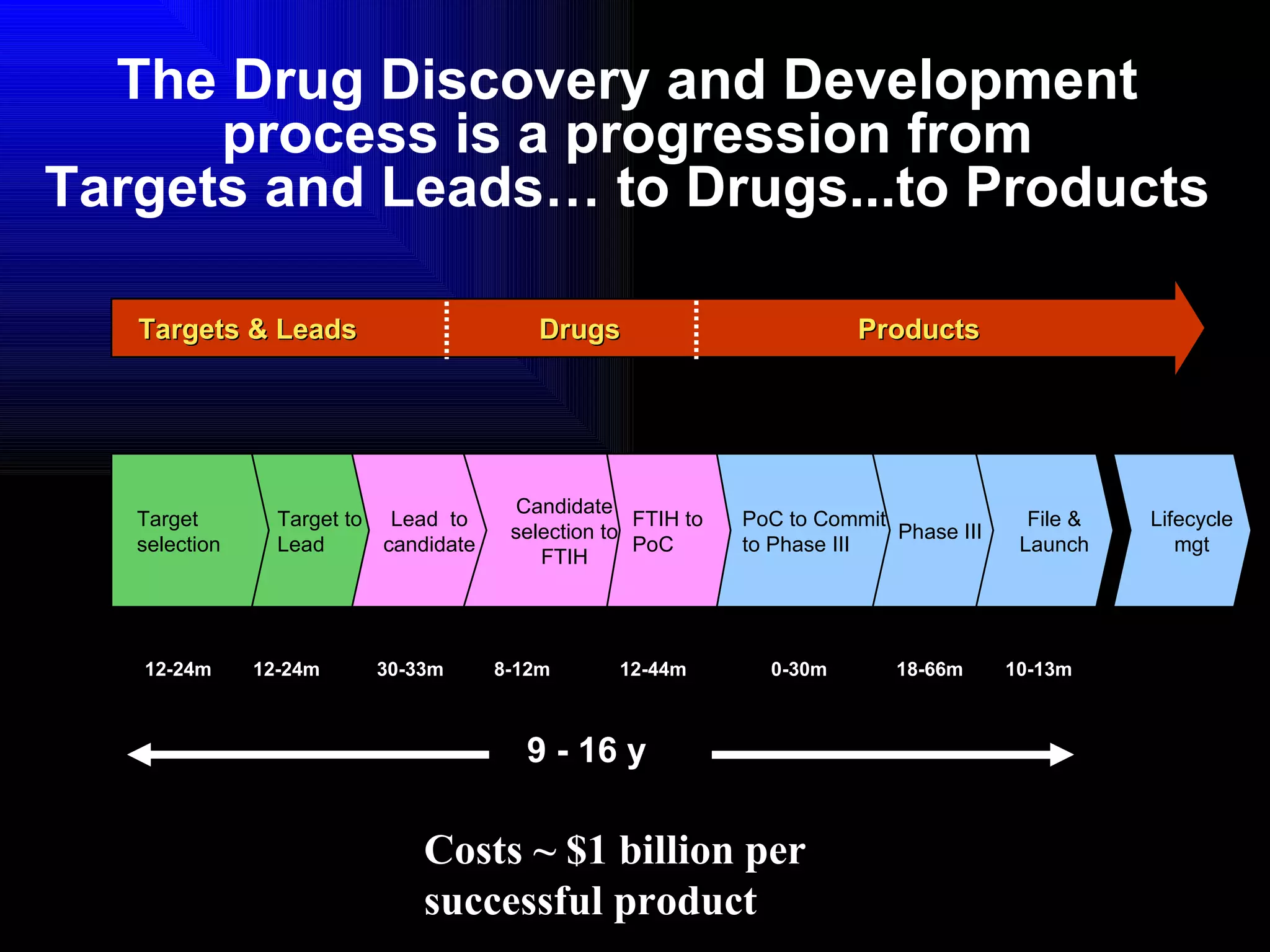
The Drug Discovery and Development process is a progression from Targets and Leads… to Drugs...to Products Products Drugs Targets & Leads Target selection Target to Lead Lead  to candidate Candidate selection to FTIH FTIH to  PoC PoC to Commit  to Phase III Phase III   File & Launch Lifecycle mgt 12-24m 12-24m 30-33m 8-12m 12-44m 0-30m 18-66m 10-13m Costs ~ $1 billion per successful product 9 - 16 y
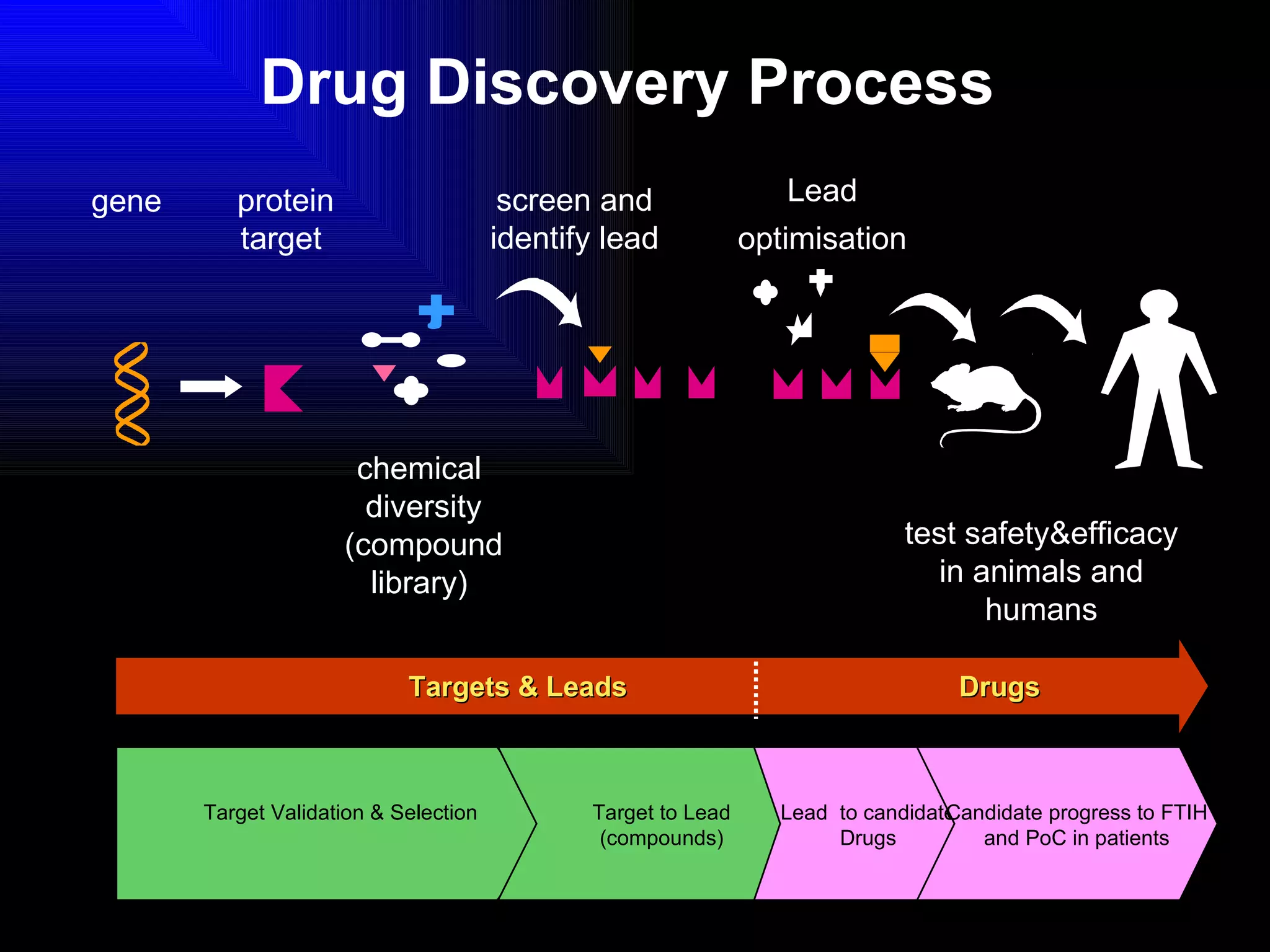
Drug Discovery Process chemical  diversity (compound library)   test safety&efficacy in animals and humans gene   screen and identify lead Lead optimisation protein target   Drugs Targets & Leads Target Validation & Selection  Target to Lead (compounds) Lead  to candidate Drugs Candidate progress to FTIH and PoC in patients
Part 1: Target Selection & Compound Screening Topics Target selection & Validation Compound Screening Hit optimisation
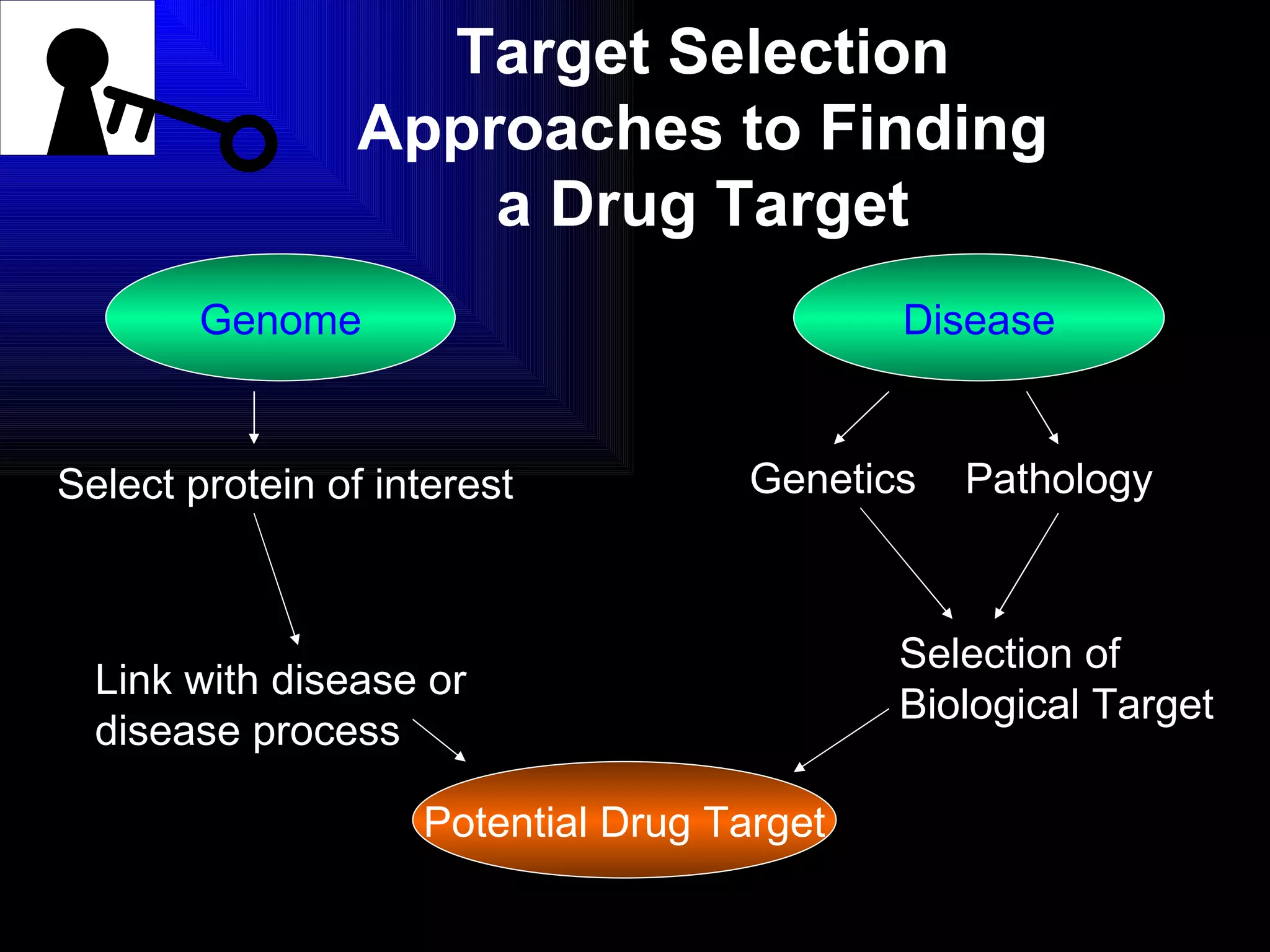
Genome Disease Potential Drug Target Select protein of interest Pathology Link with disease or disease process Selection of Biological Target Genetics Target Selection Approaches to Finding a Drug Target
Target Validation - Linking Targets to Diseases and Treatments Target validation is a series of activities, which aim to build confidence that a drug which acts by modifying  the function of the  target will deliver the efficacy and safety required Degree of target validation varies, depending upon the nature of the disease, type of target etc. A target is never fully validated until a drug acting on it works in patients!
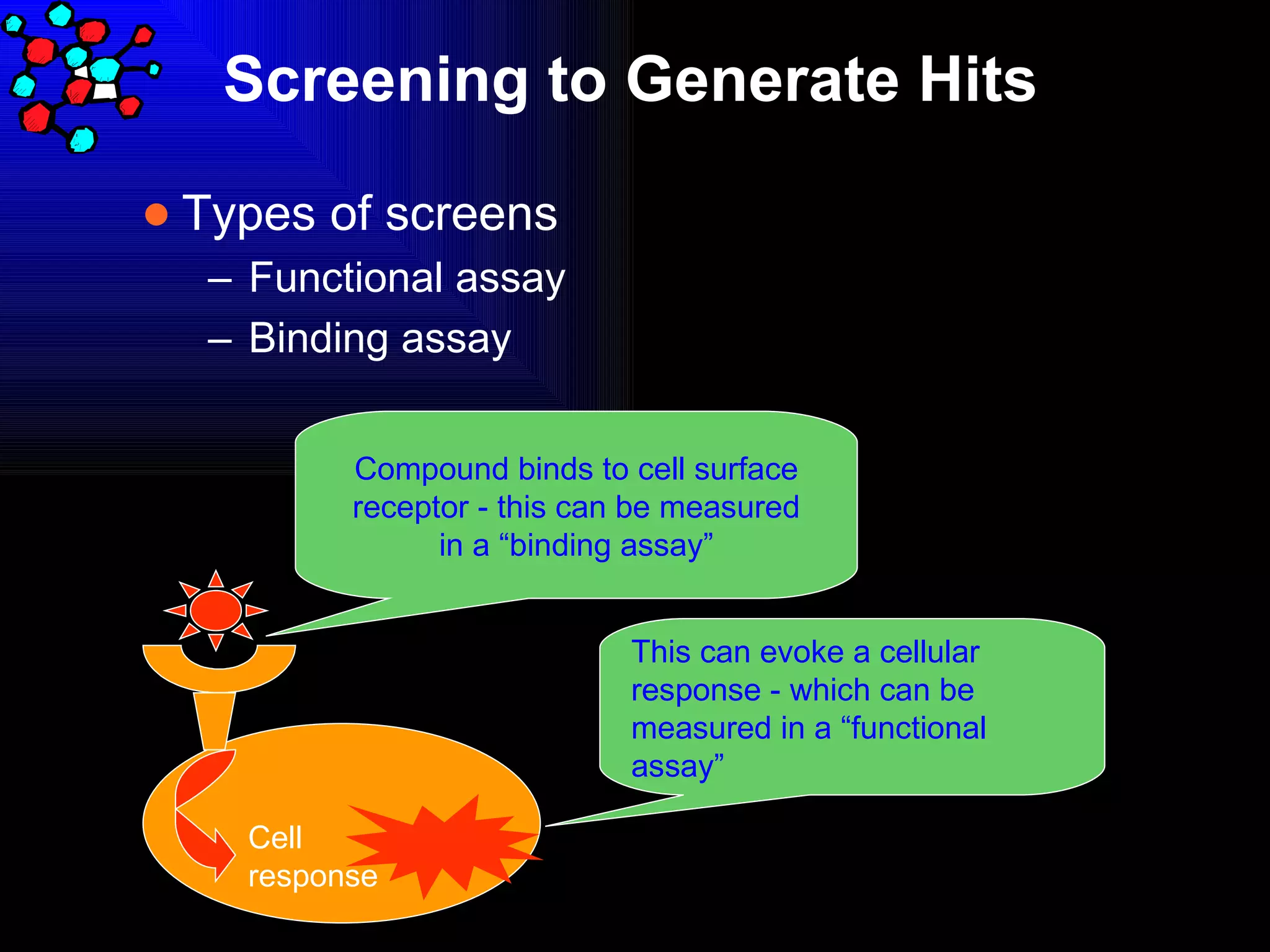
Screening to Generate Hits Types of screens Functional assay Binding assay Cell response Compound binds to cell surface receptor   - this can be measured  in a “binding assay” This can evoke a cellular response - which can be measured in a “functional assay”
Screening to Generate Hits -  where do the hits come from? High throughput screening  (millions of compounds) Multi-well plates (384, 1536) Automated - advanced robotics Knowledge-based rational design Computer modelling Structural knowledge, eg X-ray crystallography Cheminformatics
Hit Optimisation  Hits from initial screening are rarely adequate for further progression as they stand, so they are further optimised How is this done? Through an iterative cycle of Chemistry (automated arrays) Biological testing  in-vitro   Key lead criteria: - Potency (“strength” of interaction with target protein) - Selectivity for target (panel of selectivity tests) - Enablers (facilitate further progression of leads)
What is meant by “Enablers”? Properties which are desirable but not essential at this stage, e.g.  Confirmed mode of action (e.g., competitive inhibitor) Demonstrable structure-activity-relationships (SAR) Physicochemical properties (solubility, lipophilicity, stability, purity, chemical complexity) No difficulties with species differences Acceptable intellectual property situation (no major concerns about patents related to leads) No obvious anticipated safety liabilities (Predictive Toxicology)
Summary The starting point for Drug discovery is picking the right target and the right compound(s) “ Picking the winners” It may be 12-16 years and cost >£500M before you find out if you were right ! To reach this point will have taken 3-4 years and cost £1-2M per successful lead!
Part 2: Selecting a Drug Candidate Topics Lead optimisation – addition of extra properties (ADME) Safety testing Molecules into Medicines Testing in Humans
Objective of this Phase This is a major challenge!!!!! Aiming to combine all desired properties into one molecule – like “winning the lottery” Back-up Program(s) Follow-up Program(s) To optimise lead molecules to identify a  single  compound with potential to reach the clinic with: - right properties – potency, selectivity, PK etc. - low probability of failure in development
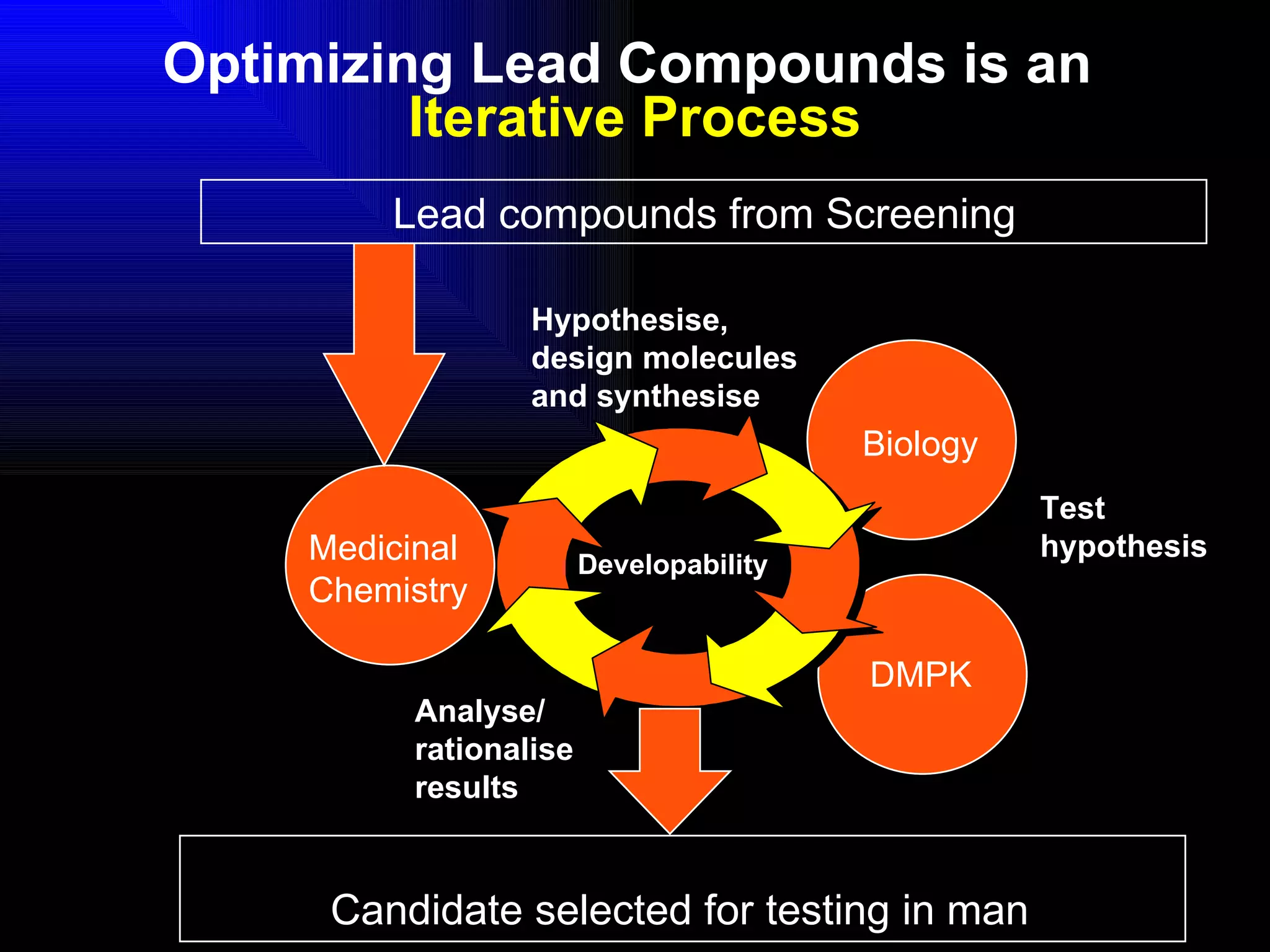
Optimizing Lead Compounds is an  Iterative Process Medicinal Chemistry Biology Lead compounds from Screening Candidate selected for testing in man Developability DMPK Hypothesise,  design molecules  and synthesise Analyse/ rationalise results Test  hypothesis
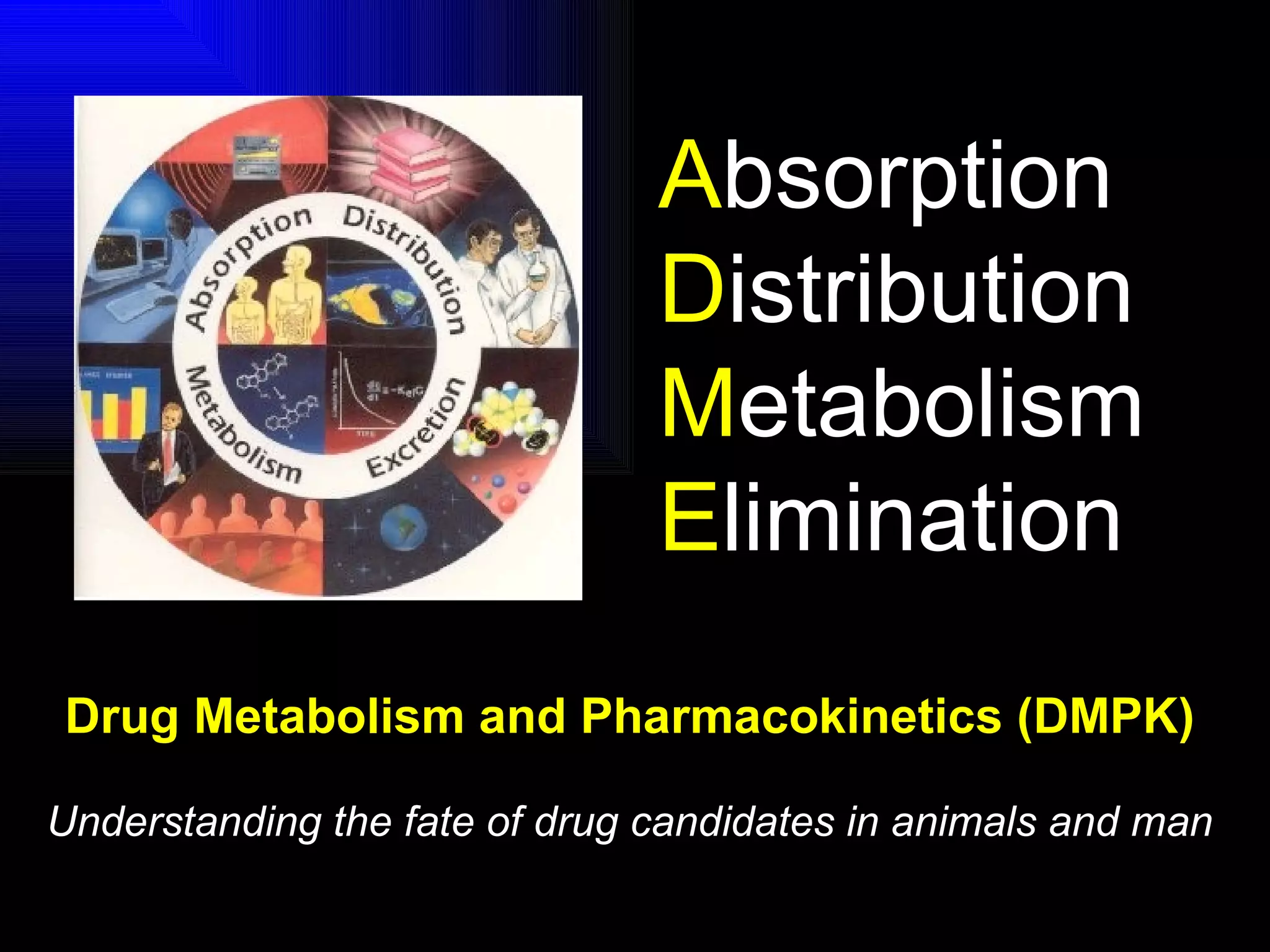
A bsorption D istribution M etabolism E limination Drug Metabolism and Pharmacokinetics (DMPK) Understanding the fate of drug candidates in animals and man
Animals to Humans Characteristics of the drug candidate………. DMPK studies aim to answer some key questions: What is the relationship between exposure and dose? Is it readily excreted or retained with potential to accumulate? How is the drug metabolised? Are the toxicology species adequate models to make a human safety assessment? What are the safety margins for clinical trials?
Challenges to support First Time in Humans? DMPK   Assays may need very low limits of quantification (<1ng/mL) especially for inhaled drugs and for the human assay to support FTIH Compounds selected to have low metabolism  in vitro  so  in vitro  metabolism studies often generate very small quantities of metabolites Low levels of radioactivity in plasma samples often makes metabolite profiling difficult SENSITIVITY
The Bridge Between Animals and Humans   Are the toxicology species good models for humans in terms of… Systemic exposure to the drug? Routes of metabolism? Systemic exposure to metabolites? DMPK provides vital data to assess ‘developability’
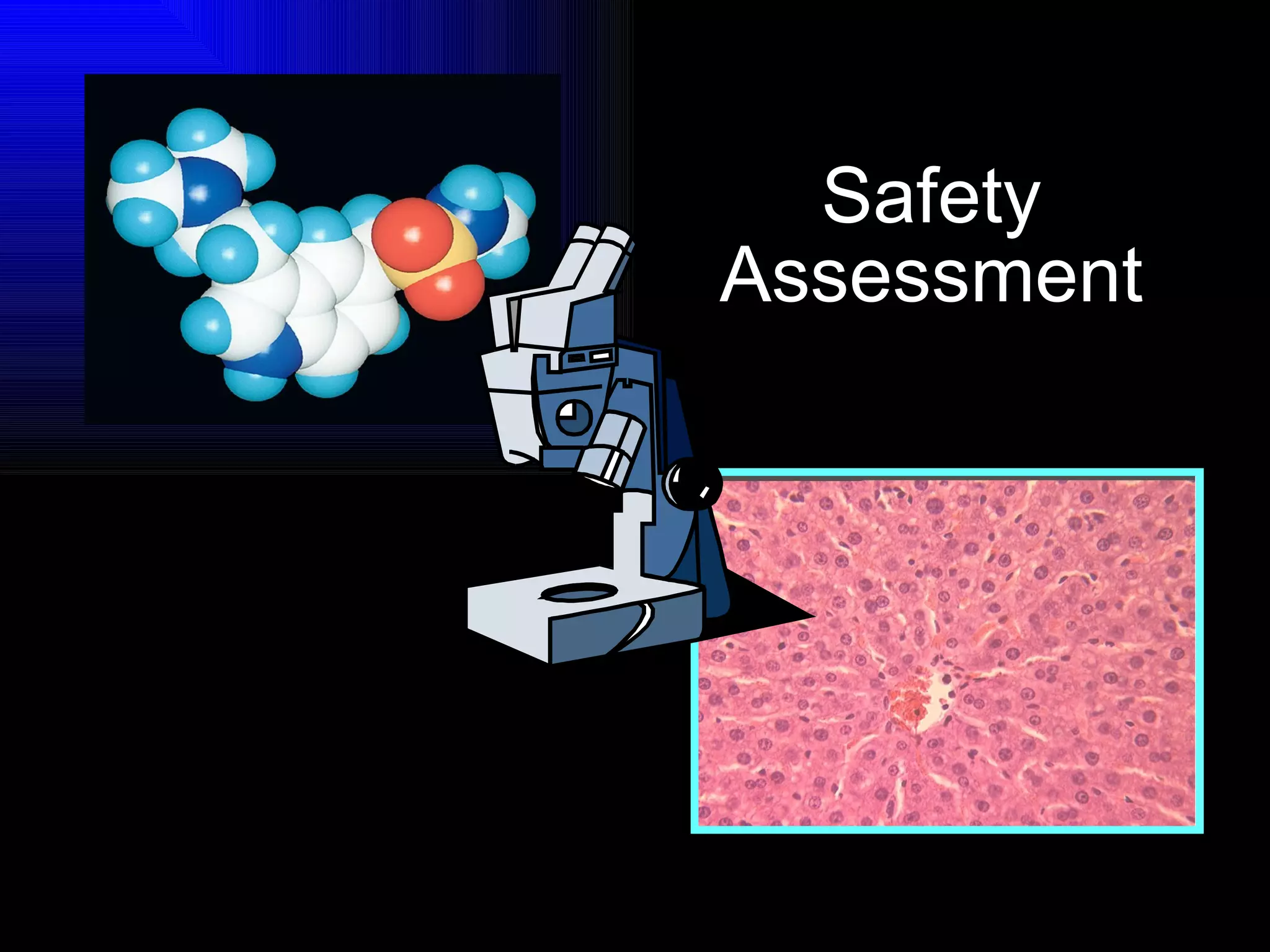
Safety Assessment
Animals to Man Conduct  initial non-clinical safety studies  to assess developability and potential risks for first administration to humans Conduct  additional studies  to build confidence that longer term clinical trials can be conducted safely, and the medicine can be approved for use To complete safety evaluation and assist in dose selection for first clinical trials, Safety Assessment has to:
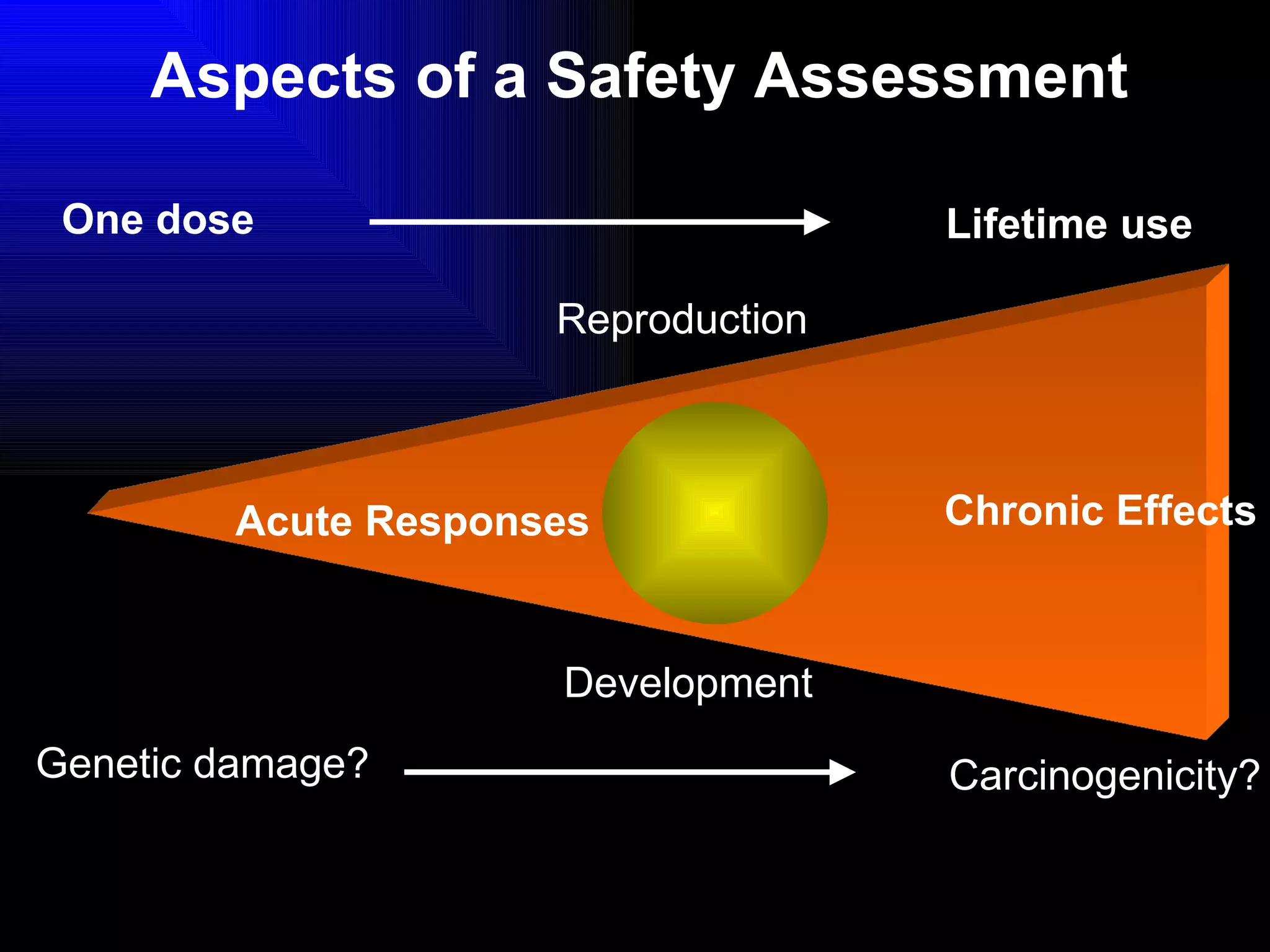
Aspects of a Safety Assessment Acute Responses Chronic Effects Genetic damage? Carcinogenicity? One dose Lifetime use Reproduction Development
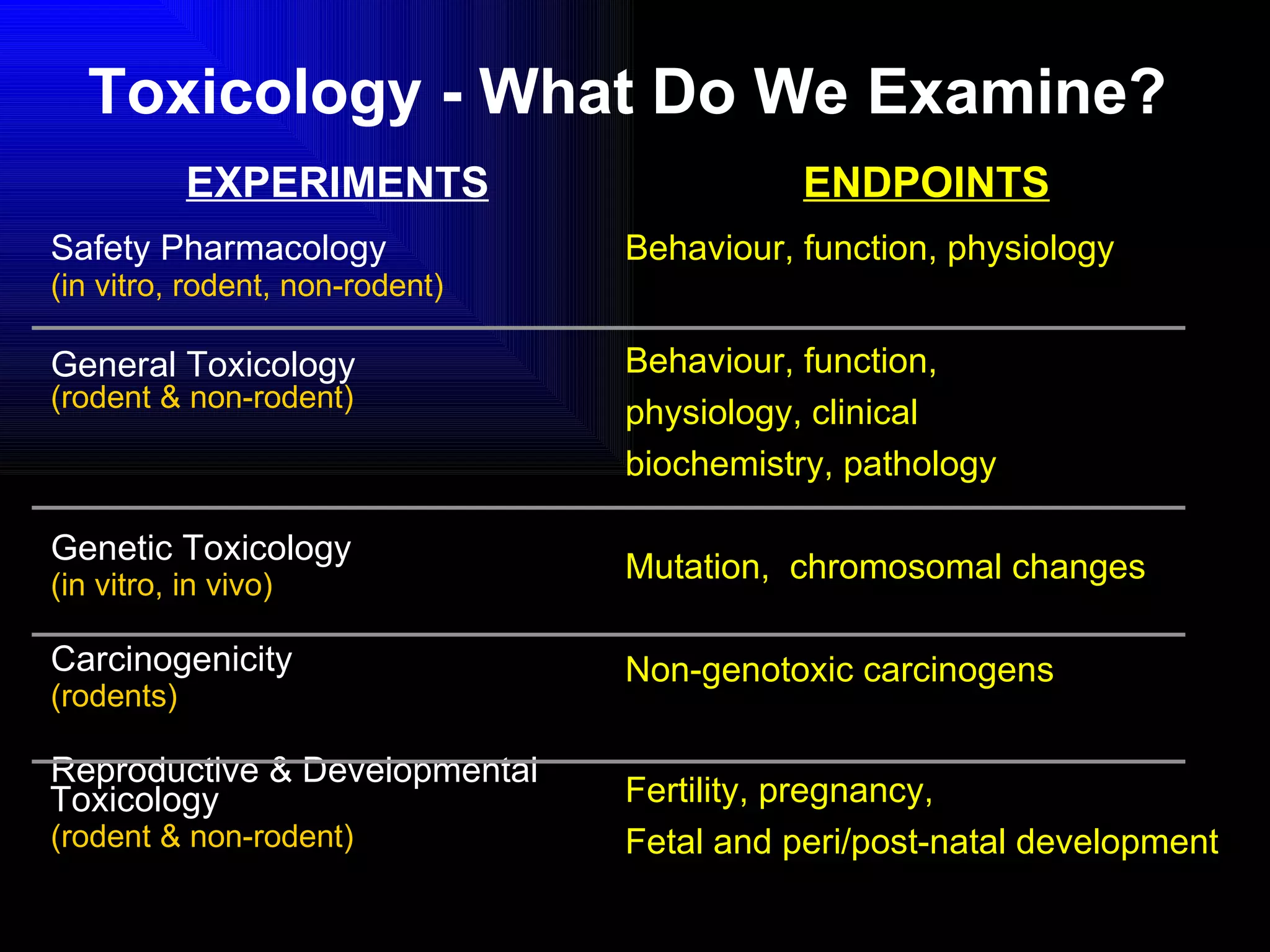
Toxicology - What Do We Examine? EXPERIMENTS Safety Pharmacology (in vitro, rodent, non-rodent) General Toxicology (rodent & non-rodent) Genetic Toxicology (in vitro, in vivo) Carcinogenicity (rodents) Reproductive & Developmental Toxicology (rodent & non-rodent) ENDPOINTS Behaviour, function, physiology Behaviour, function,  physiology, clinical biochemistry, pathology Mutation,  chromosomal changes Non-genotoxic carcinogens Fertility, pregnancy, Fetal and peri/post-natal development
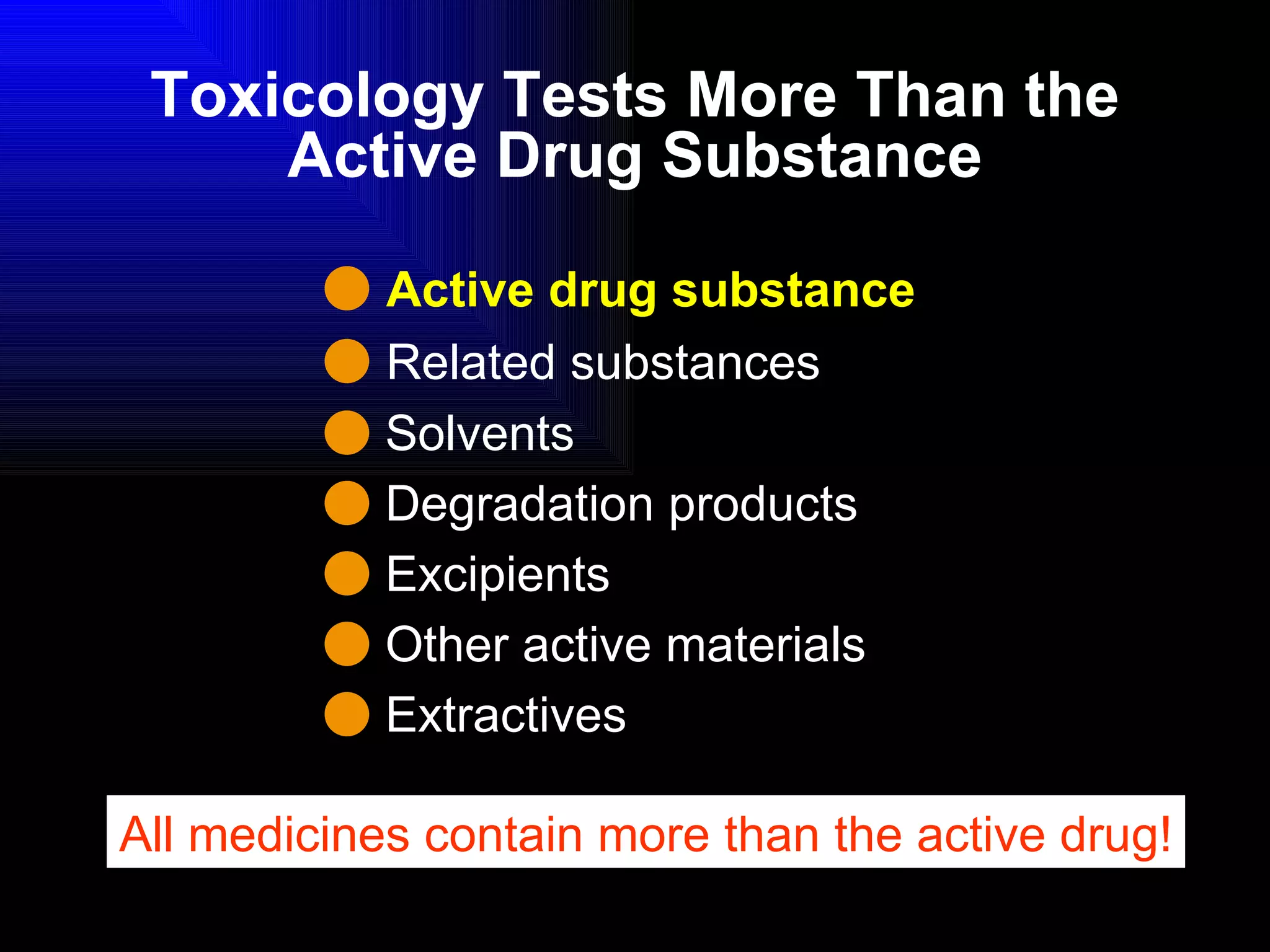
Toxicology Tests More Than the Active Drug Substance Active drug substance Related substances Solvents Degradation products Excipients Other active materials Extractives All medicines contain more than the active drug!
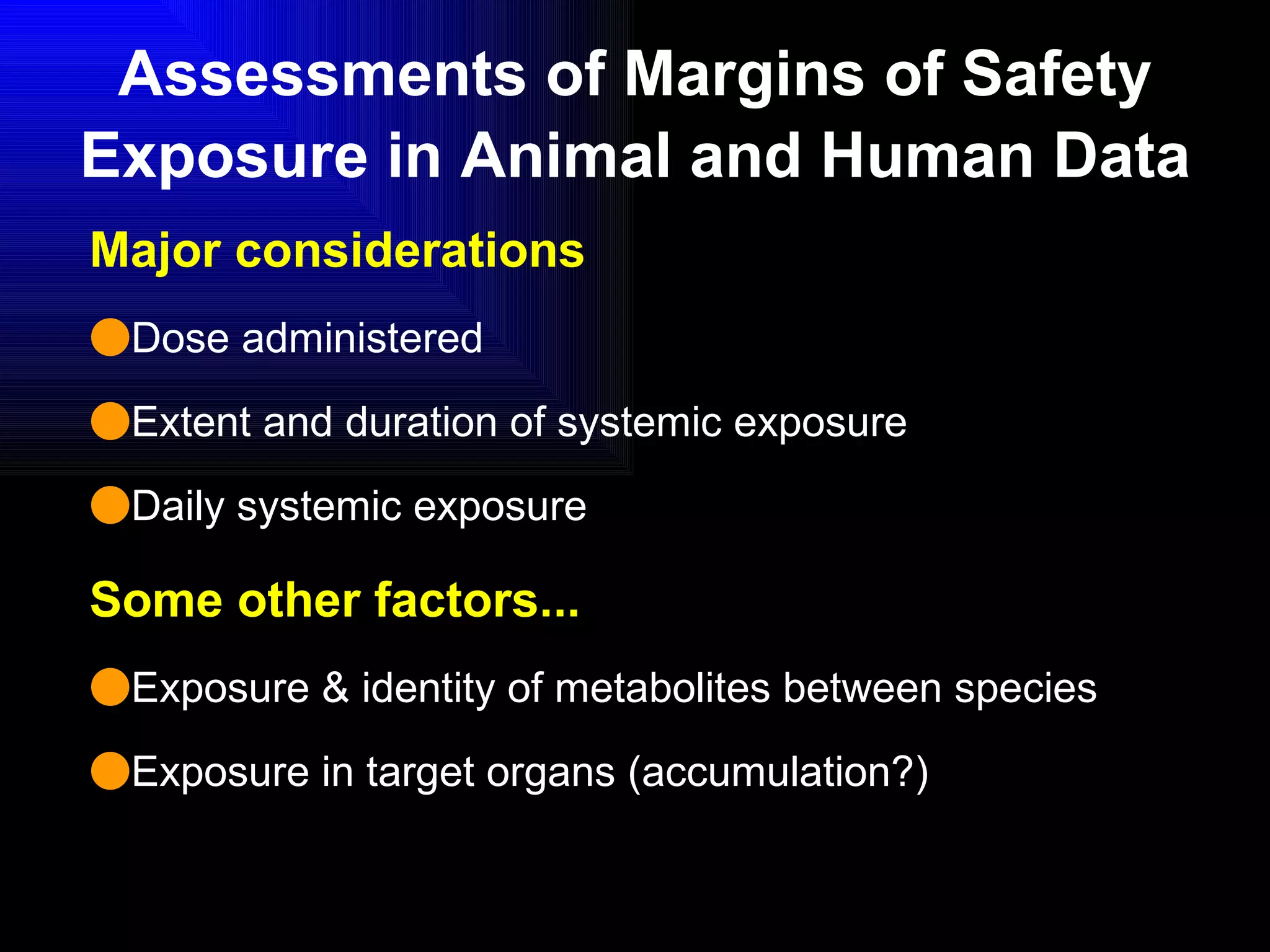
Assessments of Margins of Safety Exposure in Animal and Human Data Major considerations Dose administered Extent and duration of systemic exposure Daily systemic exposure Some other factors... Exposure & identity of metabolites between species Exposure in target organs (accumulation?)
Preclinical safety studies will … Explore the response at up to maximum achievable doses Primarily designed to  detect  potential hazards Generate data to enable a  risk assessment  to be made Assist in dose-selection for initial clinical studies Suggest ‘markers’ to monitor safety in humans Provide a foundation for targeted specialist investigations Preclinical safety studies  cannot  necessarily… Guarantee safety in humans Predict the human response Define a  mechanism  for the changes Summary
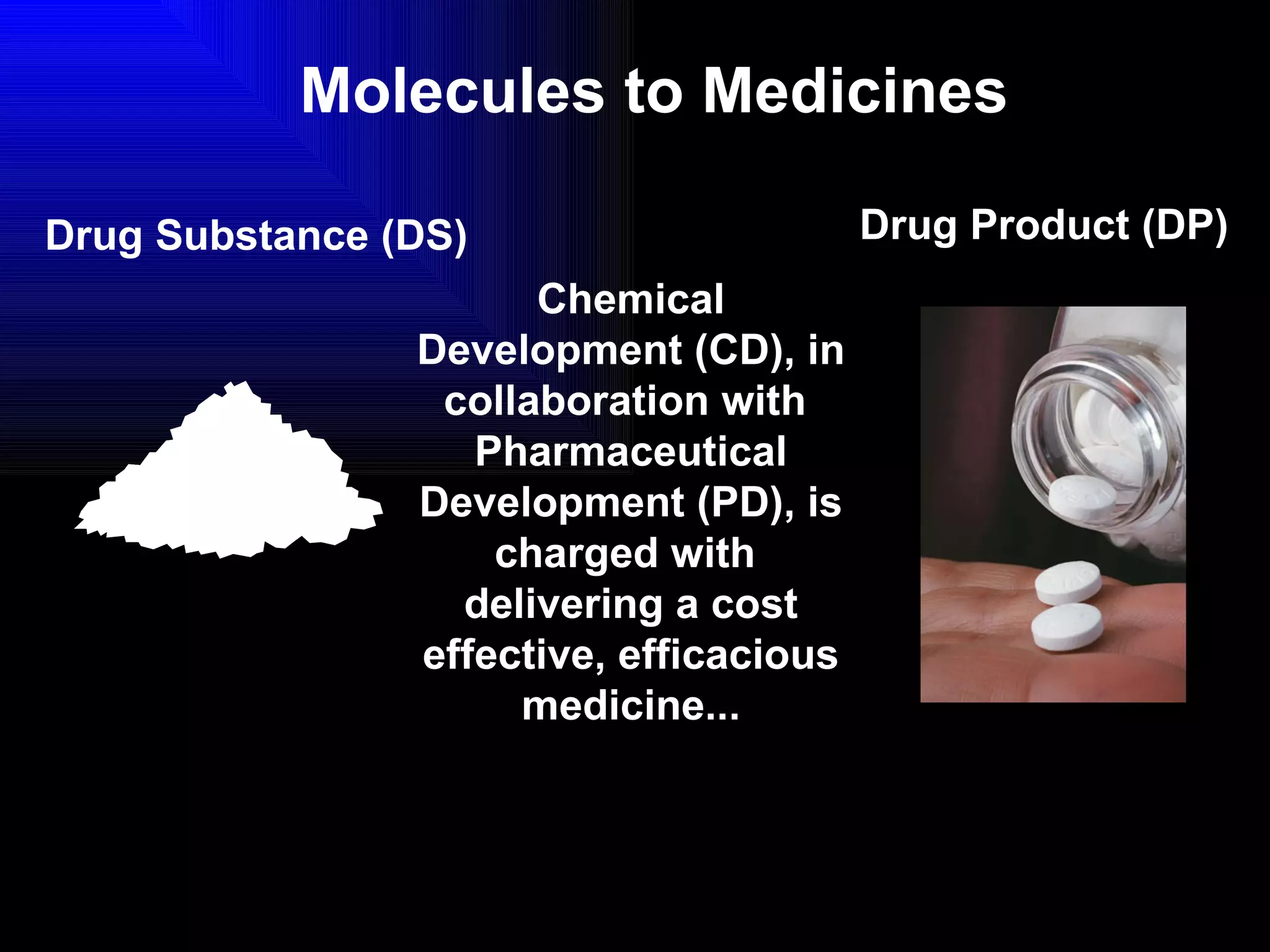
Chemical Development (CD), in collaboration with  Pharmaceutical Development (PD), is charged with  delivering a cost effective, efficacious medicine... Drug Substance (DS) Drug Product (DP) Molecules to Medicines
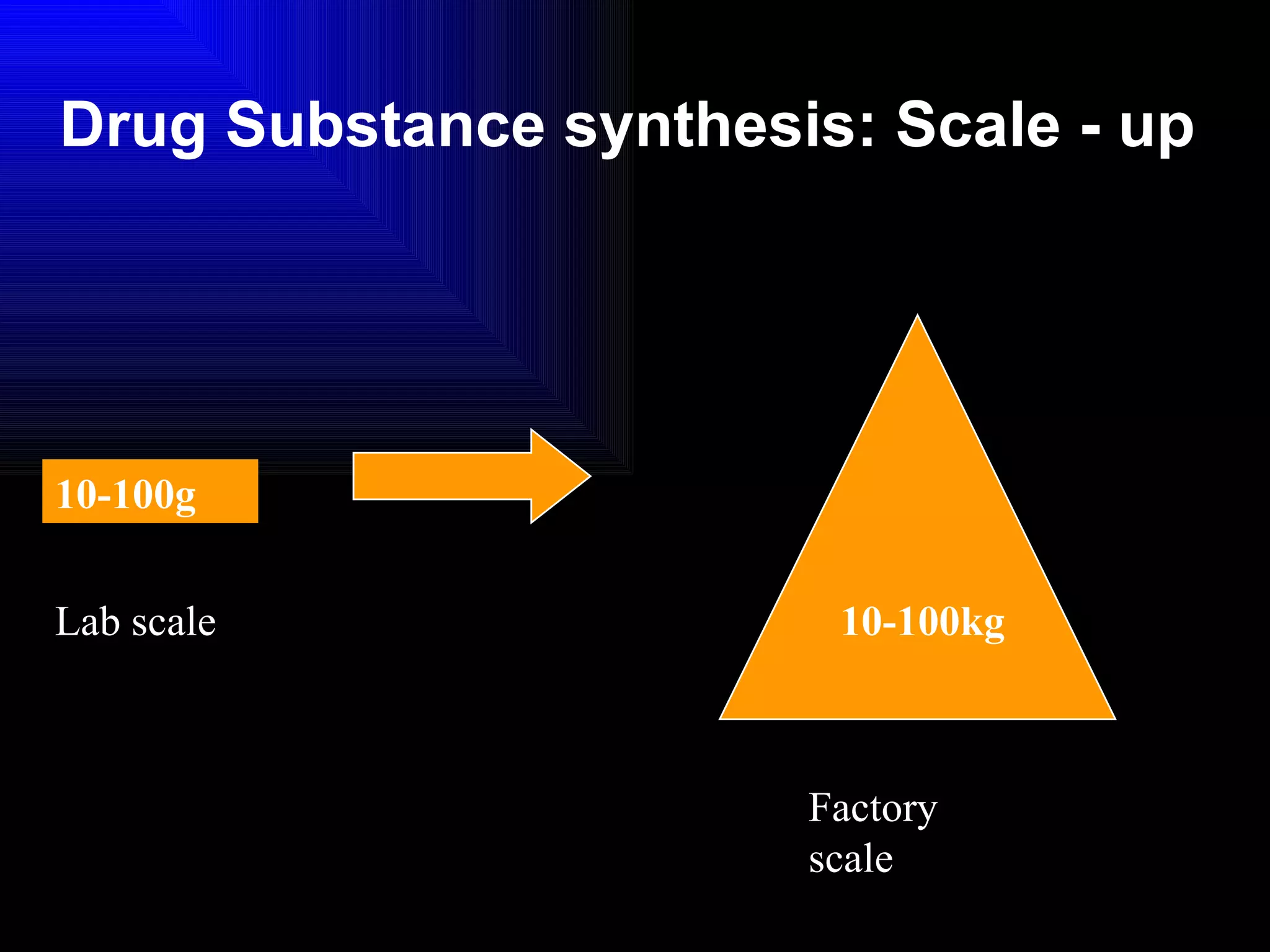
Drug Substance synthesis: Scale - up 10-100g  10-100kg Lab scale Factory scale
Testing in Humans - Key Messages Entry into man is a major milestone Major ethical and safety reviews before approval There are no absolutes in designing a clinical plan - but subject safety is always paramount Initial studies are usually undertaken with healthy male volunteers and at very low doses, with intensive monitoring Verified surrogate or early clinical markers make  all the difference – is the drug getting to the right target at the required levels Initial goal is to establish safety & tolerability in man Only then will the drug move into patients and “proof of concept”
Part 3: Product development Topics Proof of Concept in Patients Large scale clinical studies  Registration & Approval Launch & Life cycle managment
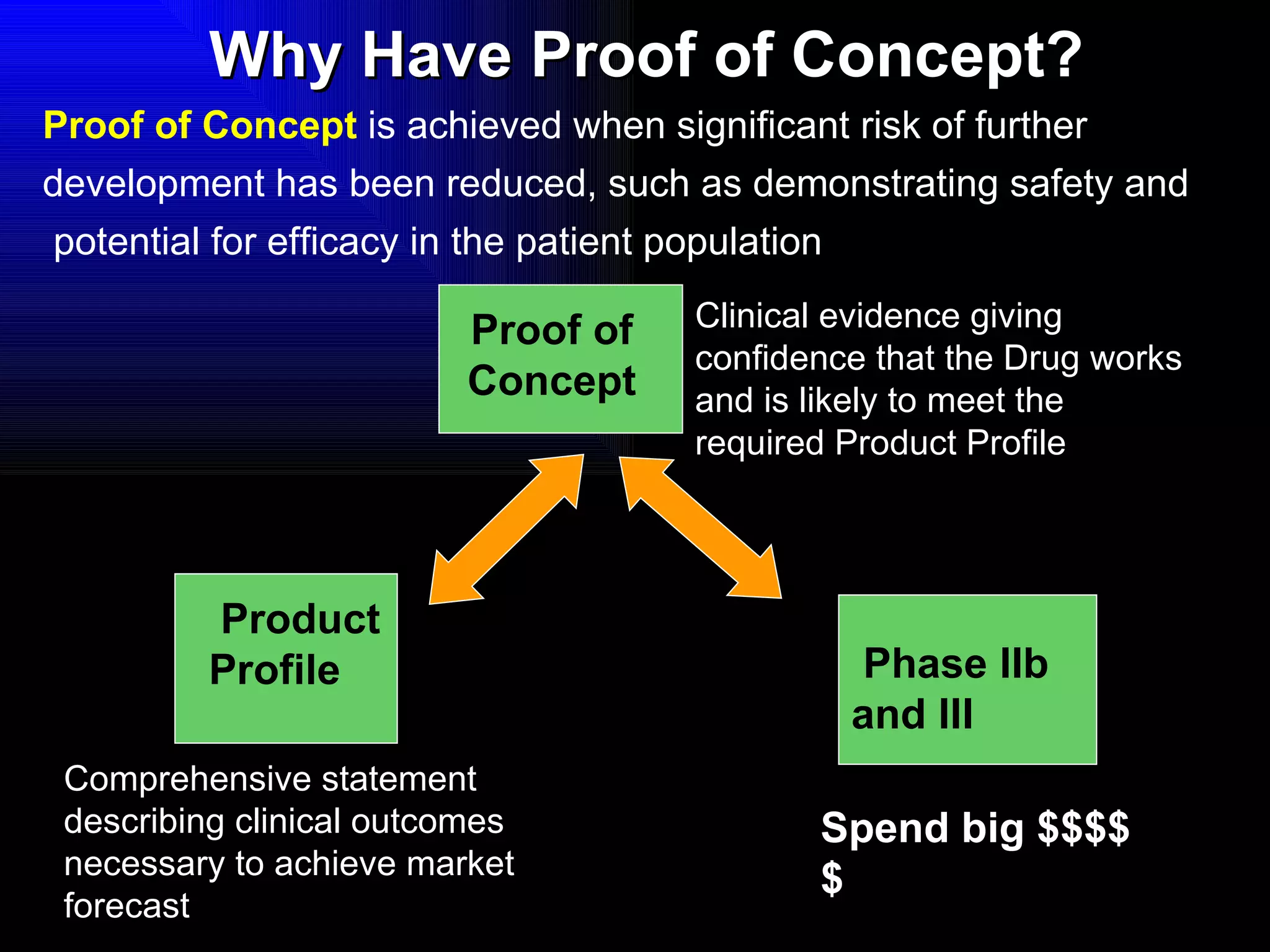
Why Have Proof of Concept? Comprehensive statement describing clinical outcomes necessary to achieve market forecast Product Profile Proof of Concept Clinical evidence giving  confidence that the Drug works and is likely to meet the required Product Profile Proof of Concept  is achieved when significant risk of further development has been reduced, such as demonstrating safety and  potential for efficacy in the patient population Phase IIb and III Spend big $$$$$
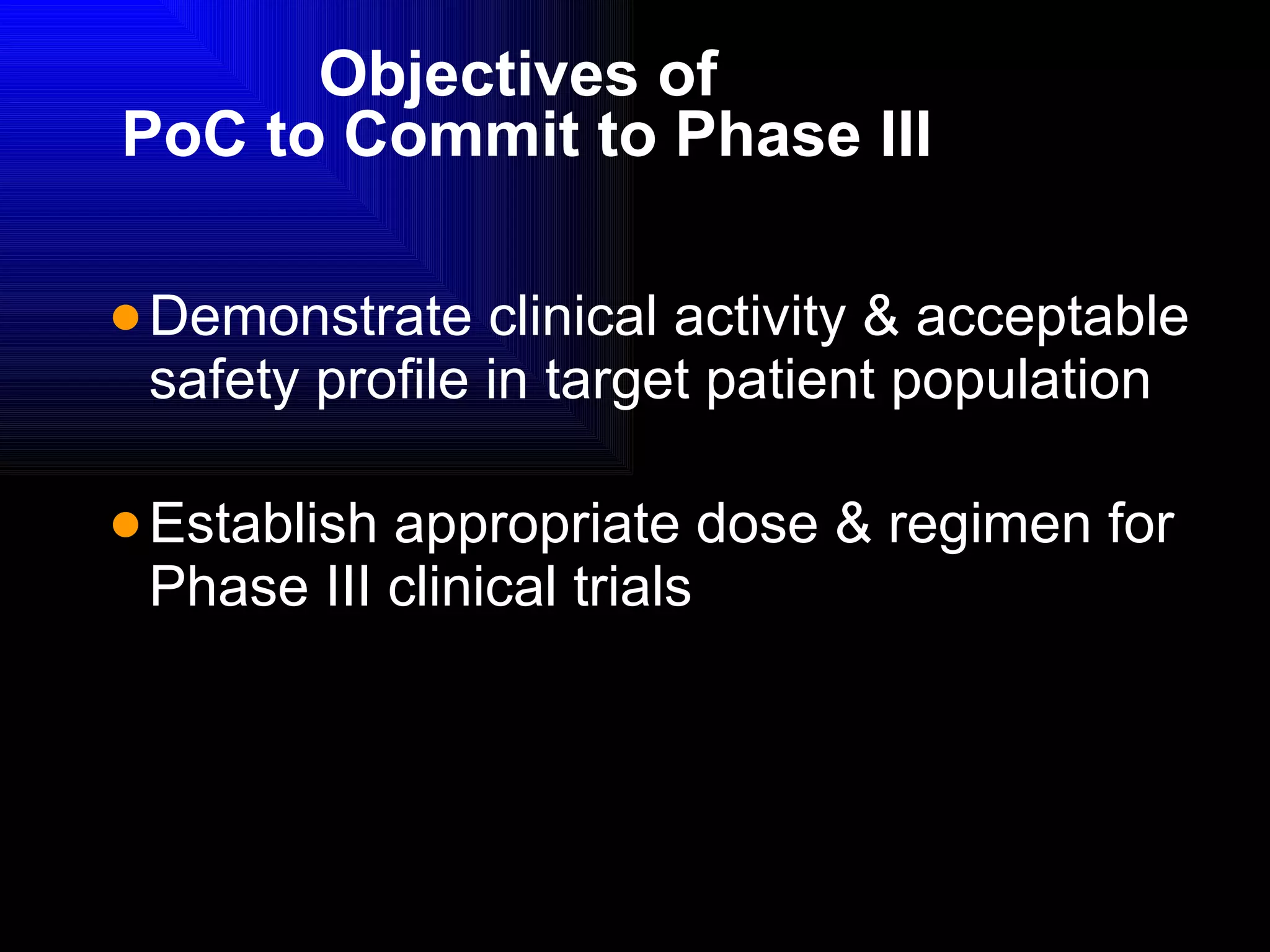
Objectives of  PoC to Commit to Phase III Demonstrate clinical activity & acceptable safety profile in target patient population Establish appropriate dose & regimen for Phase III clinical trials
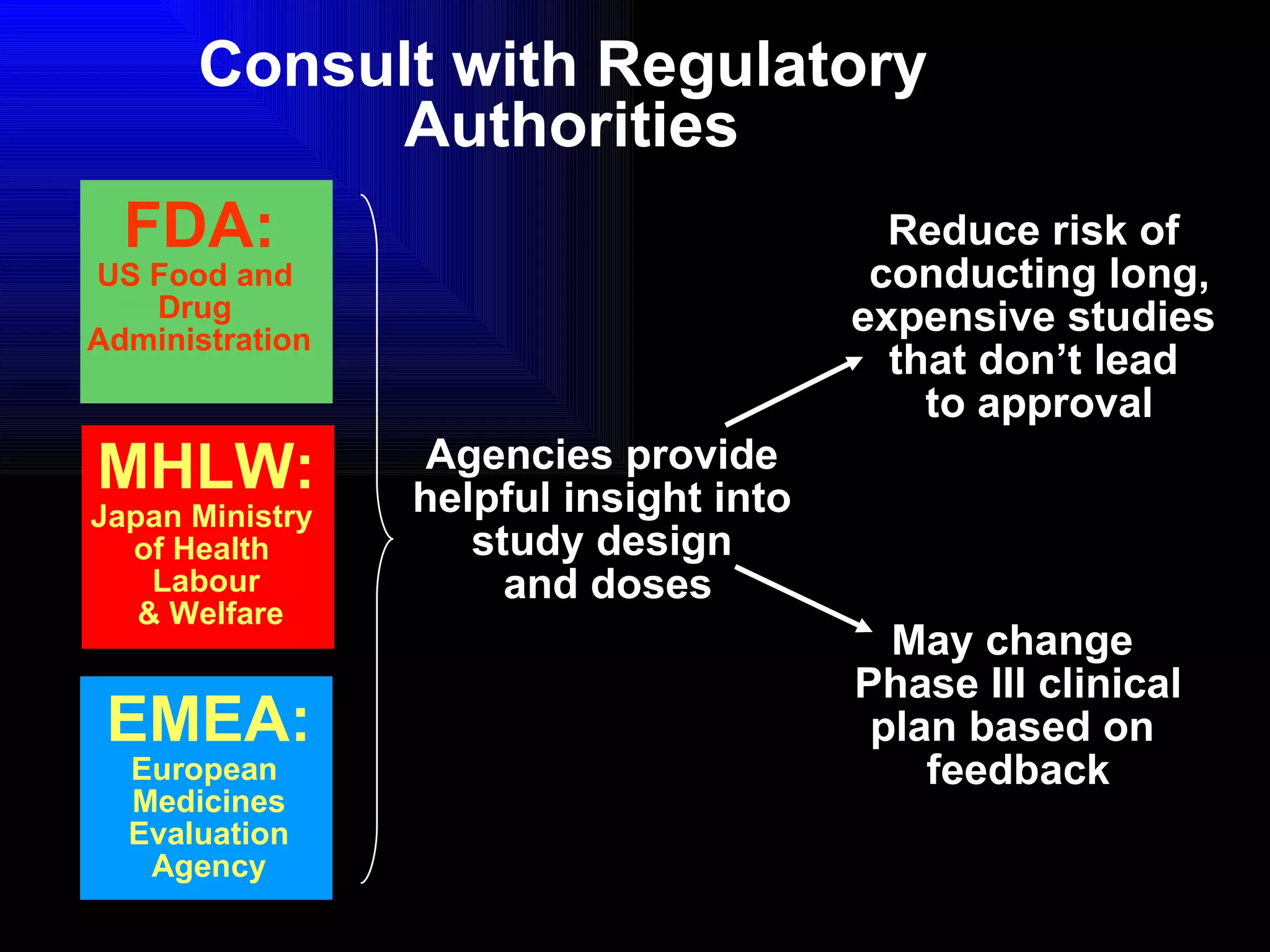
Consult with Regulatory  Authorities FDA: US Food and  Drug  Administration EMEA: European  Medicines Evaluation  Agency MHLW: Japan Ministry  of Health  Labour & Welfare Agencies provide helpful insight into study design  and doses Reduce risk of  conducting long, expensive studies  that don’t lead  to approval May change  Phase III clinical plan based on  feedback
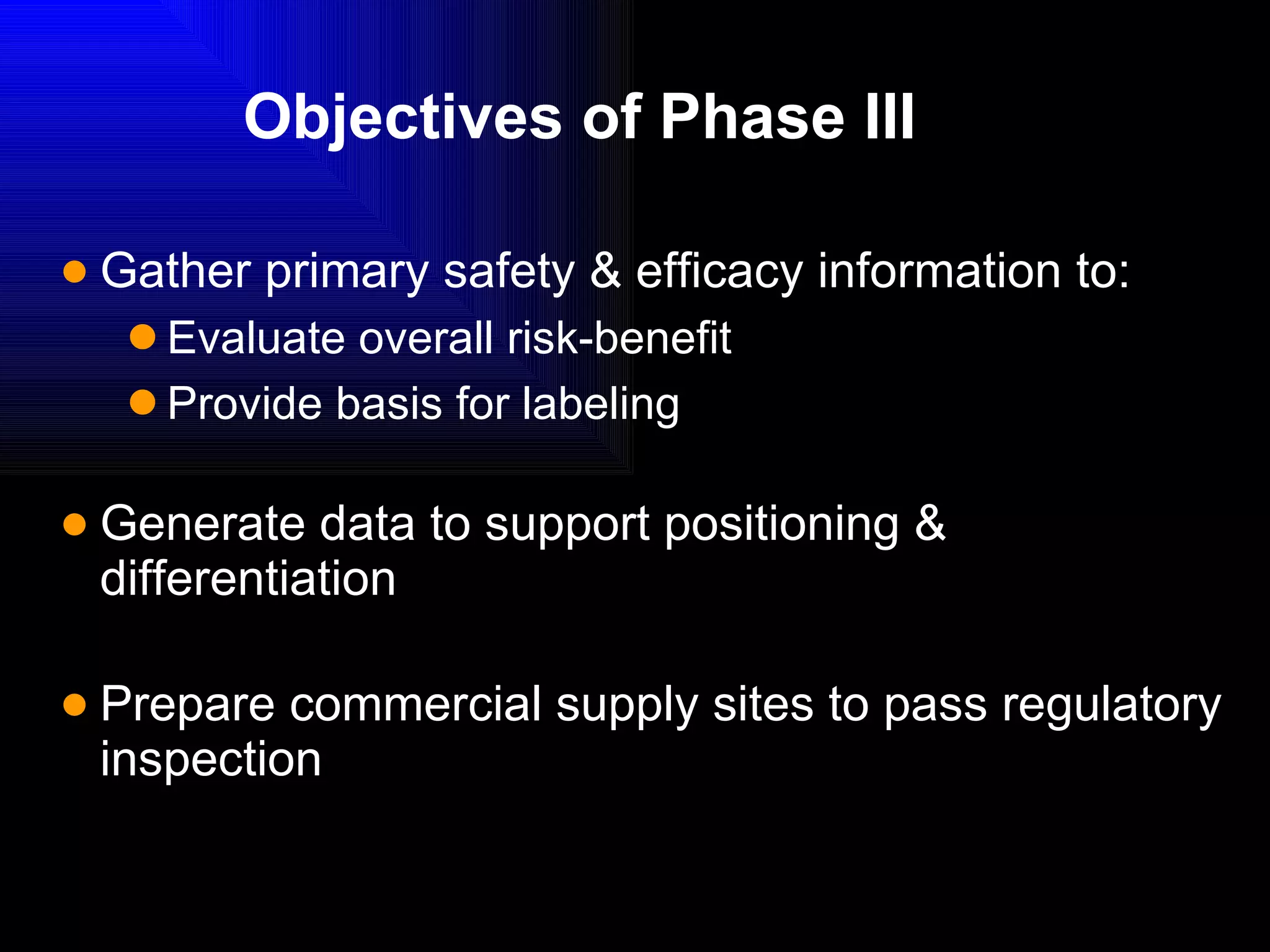
Objectives of Phase III Gather  primary  safety & efficacy information to: Evaluate overall risk-benefit  Provide basis for labeling Generate data to support positioning & differentiation Prepare commercial supply sites to pass regulatory inspection
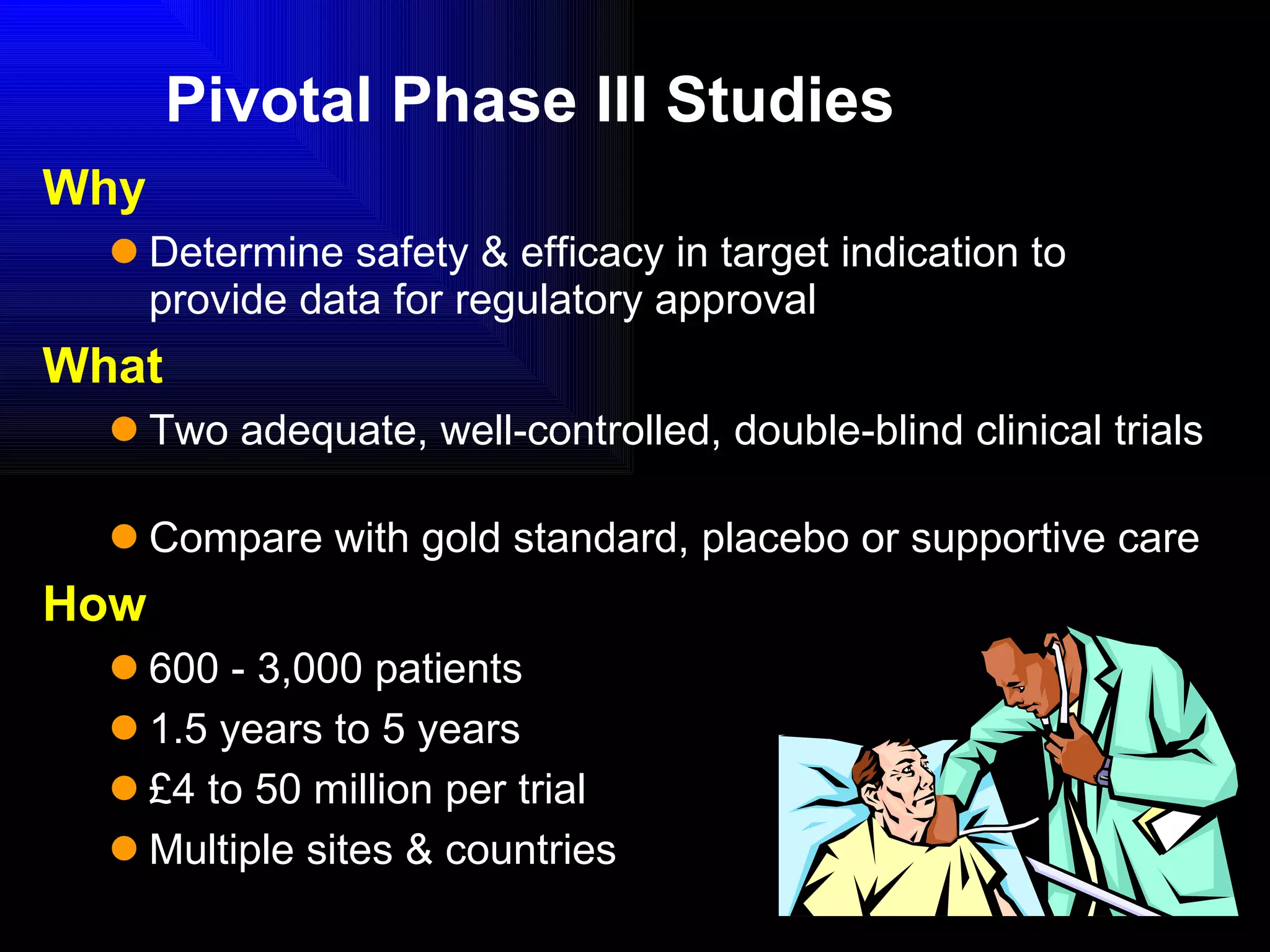
Pivotal Phase III Studies Why   Determine safety & efficacy in target indication to provide data for regulatory approval What Two adequate, well-controlled, double-blind clinical trials  Compare with gold standard, placebo or supportive care How 600 - 3,000 patients 1.5 years to 5 years £4 to 50 million per trial Multiple sites & countries
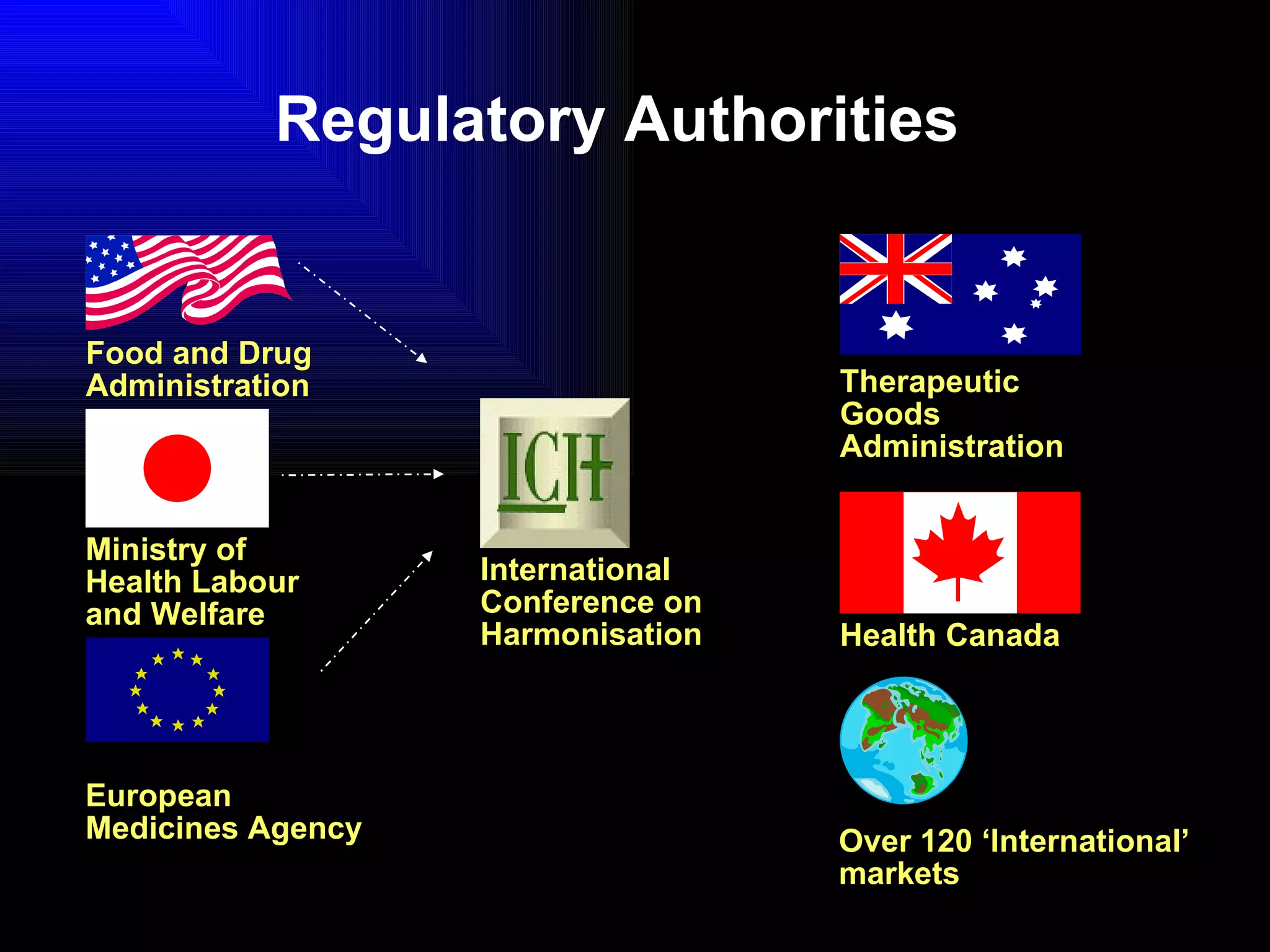
Regulatory Authorities Food and Drug Administration European Medicines Agency Ministry of Health Labour and Welfare Therapeutic Goods Administration Health Canada International Conference on Harmonisation Over 120 ‘International’ markets
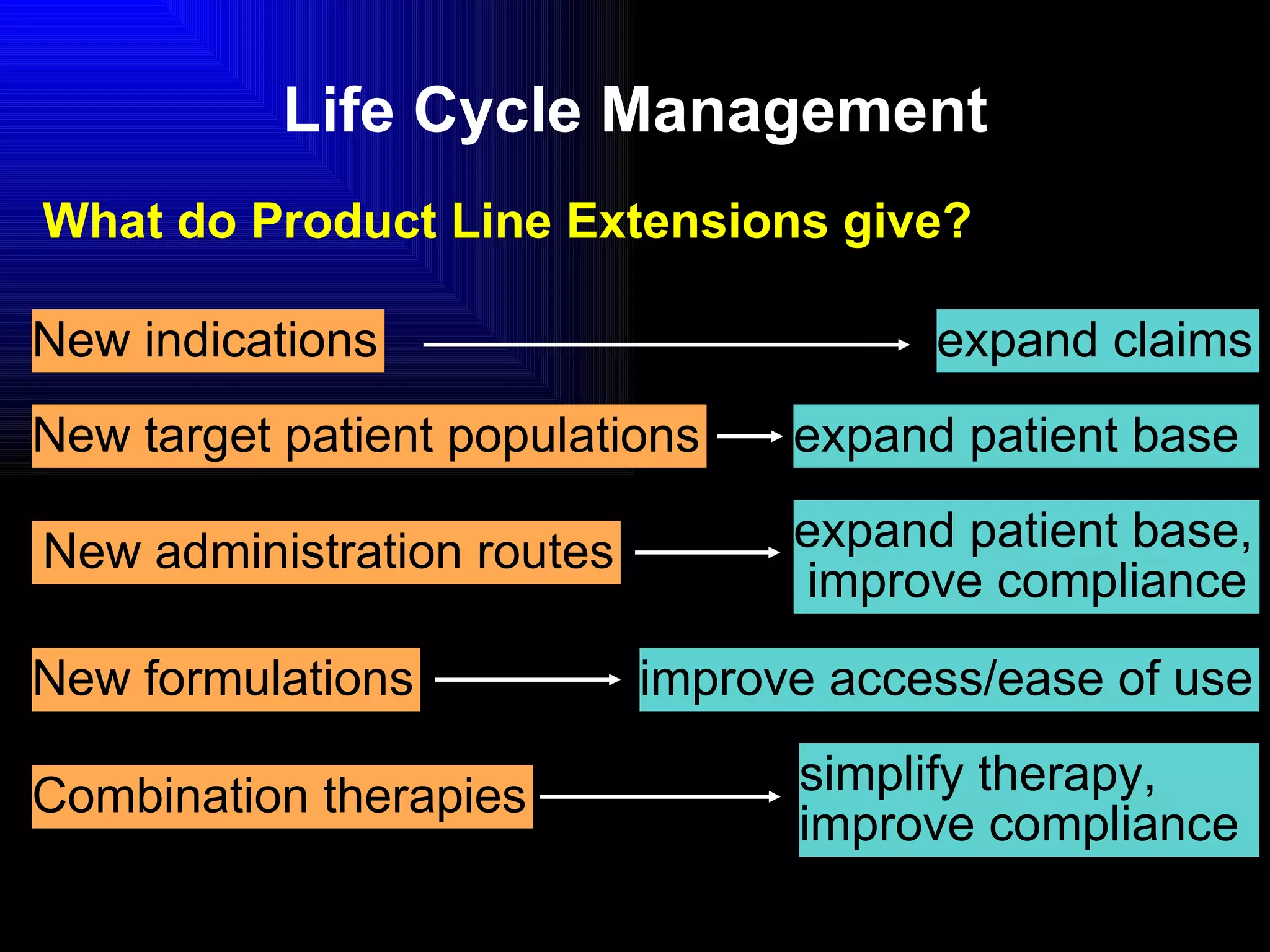
Life Cycle Management What do Product Line Extensions give? New indications expand claims New target patient populations expand patient base   New administration routes New formulations Combination therapies expand patient base,  improve compliance improve access/ease of use simplify therapy,  improve compliance

Drug Discovery & Development Overview

  • 1.
    Issues and Challengesin Drug Discovery and Development Discovering and Developing Medicines Mike Sumner
  • 2.
    The Drug Discoveryand Development process is a progression from Targets and Leads… to Drugs...to Products Products Drugs Targets & Leads Target selection Target to Lead Lead to candidate Candidate selection to FTIH FTIH to PoC PoC to Commit to Phase III Phase III File & Launch Lifecycle mgt 12-24m 12-24m 30-33m 8-12m 12-44m 0-30m 18-66m 10-13m Costs ~ $1 billion per successful product 9 - 16 y
  • 3.
    Drug Discovery Processchemical diversity (compound library) test safety&efficacy in animals and humans gene screen and identify lead Lead optimisation protein target Drugs Targets & Leads Target Validation & Selection Target to Lead (compounds) Lead to candidate Drugs Candidate progress to FTIH and PoC in patients
  • 4.
    Part 1: TargetSelection & Compound Screening Topics Target selection & Validation Compound Screening Hit optimisation
  • 5.
    Genome Disease PotentialDrug Target Select protein of interest Pathology Link with disease or disease process Selection of Biological Target Genetics Target Selection Approaches to Finding a Drug Target
  • 6.
    Target Validation -Linking Targets to Diseases and Treatments Target validation is a series of activities, which aim to build confidence that a drug which acts by modifying the function of the target will deliver the efficacy and safety required Degree of target validation varies, depending upon the nature of the disease, type of target etc. A target is never fully validated until a drug acting on it works in patients!
  • 7.
    Screening to GenerateHits Types of screens Functional assay Binding assay Cell response Compound binds to cell surface receptor - this can be measured in a “binding assay” This can evoke a cellular response - which can be measured in a “functional assay”
  • 8.
    Screening to GenerateHits - where do the hits come from? High throughput screening (millions of compounds) Multi-well plates (384, 1536) Automated - advanced robotics Knowledge-based rational design Computer modelling Structural knowledge, eg X-ray crystallography Cheminformatics
  • 9.
    Hit Optimisation Hits from initial screening are rarely adequate for further progression as they stand, so they are further optimised How is this done? Through an iterative cycle of Chemistry (automated arrays) Biological testing in-vitro Key lead criteria: - Potency (“strength” of interaction with target protein) - Selectivity for target (panel of selectivity tests) - Enablers (facilitate further progression of leads)
  • 10.
    What is meantby “Enablers”? Properties which are desirable but not essential at this stage, e.g. Confirmed mode of action (e.g., competitive inhibitor) Demonstrable structure-activity-relationships (SAR) Physicochemical properties (solubility, lipophilicity, stability, purity, chemical complexity) No difficulties with species differences Acceptable intellectual property situation (no major concerns about patents related to leads) No obvious anticipated safety liabilities (Predictive Toxicology)
  • 11.
    Summary The startingpoint for Drug discovery is picking the right target and the right compound(s) “ Picking the winners” It may be 12-16 years and cost >£500M before you find out if you were right ! To reach this point will have taken 3-4 years and cost £1-2M per successful lead!
  • 12.
    Part 2: Selectinga Drug Candidate Topics Lead optimisation – addition of extra properties (ADME) Safety testing Molecules into Medicines Testing in Humans
  • 13.
    Objective of thisPhase This is a major challenge!!!!! Aiming to combine all desired properties into one molecule – like “winning the lottery” Back-up Program(s) Follow-up Program(s) To optimise lead molecules to identify a single compound with potential to reach the clinic with: - right properties – potency, selectivity, PK etc. - low probability of failure in development
  • 14.
    Optimizing Lead Compoundsis an Iterative Process Medicinal Chemistry Biology Lead compounds from Screening Candidate selected for testing in man Developability DMPK Hypothesise, design molecules and synthesise Analyse/ rationalise results Test hypothesis
  • 15.
    A bsorption Distribution M etabolism E limination Drug Metabolism and Pharmacokinetics (DMPK) Understanding the fate of drug candidates in animals and man
  • 16.
    Animals to HumansCharacteristics of the drug candidate………. DMPK studies aim to answer some key questions: What is the relationship between exposure and dose? Is it readily excreted or retained with potential to accumulate? How is the drug metabolised? Are the toxicology species adequate models to make a human safety assessment? What are the safety margins for clinical trials?
  • 17.
    Challenges to supportFirst Time in Humans? DMPK Assays may need very low limits of quantification (<1ng/mL) especially for inhaled drugs and for the human assay to support FTIH Compounds selected to have low metabolism in vitro so in vitro metabolism studies often generate very small quantities of metabolites Low levels of radioactivity in plasma samples often makes metabolite profiling difficult SENSITIVITY
  • 18.
    The Bridge BetweenAnimals and Humans Are the toxicology species good models for humans in terms of… Systemic exposure to the drug? Routes of metabolism? Systemic exposure to metabolites? DMPK provides vital data to assess ‘developability’
  • 19.
  • 20.
    Animals to ManConduct initial non-clinical safety studies to assess developability and potential risks for first administration to humans Conduct additional studies to build confidence that longer term clinical trials can be conducted safely, and the medicine can be approved for use To complete safety evaluation and assist in dose selection for first clinical trials, Safety Assessment has to:
  • 21.
    Aspects of aSafety Assessment Acute Responses Chronic Effects Genetic damage? Carcinogenicity? One dose Lifetime use Reproduction Development
  • 22.
    Toxicology - WhatDo We Examine? EXPERIMENTS Safety Pharmacology (in vitro, rodent, non-rodent) General Toxicology (rodent & non-rodent) Genetic Toxicology (in vitro, in vivo) Carcinogenicity (rodents) Reproductive & Developmental Toxicology (rodent & non-rodent) ENDPOINTS Behaviour, function, physiology Behaviour, function, physiology, clinical biochemistry, pathology Mutation, chromosomal changes Non-genotoxic carcinogens Fertility, pregnancy, Fetal and peri/post-natal development
  • 23.
    Toxicology Tests MoreThan the Active Drug Substance Active drug substance Related substances Solvents Degradation products Excipients Other active materials Extractives All medicines contain more than the active drug!
  • 24.
    Assessments of Marginsof Safety Exposure in Animal and Human Data Major considerations Dose administered Extent and duration of systemic exposure Daily systemic exposure Some other factors... Exposure & identity of metabolites between species Exposure in target organs (accumulation?)
  • 25.
    Preclinical safety studieswill … Explore the response at up to maximum achievable doses Primarily designed to detect potential hazards Generate data to enable a risk assessment to be made Assist in dose-selection for initial clinical studies Suggest ‘markers’ to monitor safety in humans Provide a foundation for targeted specialist investigations Preclinical safety studies cannot necessarily… Guarantee safety in humans Predict the human response Define a mechanism for the changes Summary
  • 26.
    Chemical Development (CD),in collaboration with Pharmaceutical Development (PD), is charged with delivering a cost effective, efficacious medicine... Drug Substance (DS) Drug Product (DP) Molecules to Medicines
  • 27.
    Drug Substance synthesis:Scale - up 10-100g 10-100kg Lab scale Factory scale
  • 28.
    Testing in Humans- Key Messages Entry into man is a major milestone Major ethical and safety reviews before approval There are no absolutes in designing a clinical plan - but subject safety is always paramount Initial studies are usually undertaken with healthy male volunteers and at very low doses, with intensive monitoring Verified surrogate or early clinical markers make all the difference – is the drug getting to the right target at the required levels Initial goal is to establish safety & tolerability in man Only then will the drug move into patients and “proof of concept”
  • 29.
    Part 3: Productdevelopment Topics Proof of Concept in Patients Large scale clinical studies Registration & Approval Launch & Life cycle managment
  • 30.
    Why Have Proofof Concept? Comprehensive statement describing clinical outcomes necessary to achieve market forecast Product Profile Proof of Concept Clinical evidence giving confidence that the Drug works and is likely to meet the required Product Profile Proof of Concept is achieved when significant risk of further development has been reduced, such as demonstrating safety and potential for efficacy in the patient population Phase IIb and III Spend big $$$$$
  • 31.
    Objectives of PoC to Commit to Phase III Demonstrate clinical activity & acceptable safety profile in target patient population Establish appropriate dose & regimen for Phase III clinical trials
  • 32.
    Consult with Regulatory Authorities FDA: US Food and Drug Administration EMEA: European Medicines Evaluation Agency MHLW: Japan Ministry of Health Labour & Welfare Agencies provide helpful insight into study design and doses Reduce risk of conducting long, expensive studies that don’t lead to approval May change Phase III clinical plan based on feedback
  • 33.
    Objectives of PhaseIII Gather primary safety & efficacy information to: Evaluate overall risk-benefit Provide basis for labeling Generate data to support positioning & differentiation Prepare commercial supply sites to pass regulatory inspection
  • 34.
    Pivotal Phase IIIStudies Why Determine safety & efficacy in target indication to provide data for regulatory approval What Two adequate, well-controlled, double-blind clinical trials Compare with gold standard, placebo or supportive care How 600 - 3,000 patients 1.5 years to 5 years £4 to 50 million per trial Multiple sites & countries
  • 35.
    Regulatory Authorities Foodand Drug Administration European Medicines Agency Ministry of Health Labour and Welfare Therapeutic Goods Administration Health Canada International Conference on Harmonisation Over 120 ‘International’ markets
  • 36.
    Life Cycle ManagementWhat do Product Line Extensions give? New indications expand claims New target patient populations expand patient base New administration routes New formulations Combination therapies expand patient base, improve compliance improve access/ease of use simplify therapy, improve compliance