Satu Öystilä & Matleena Laakso 2015
The Principles of Problem-based Learning
and the Phases of the PBL Cycle
Eduta Oy
Puh. +35850 564 4887
info@eduta.fi
www.eduta.fi
PBL as a strategy of
the pedagogical development process
• Curriculum
development
• Collaborative learning
process
• New learning culture
• The change of the
teacher’s role
PBL as an educational strategy
• PBL currculum is organized according to the subject
frame or a defined interdisciplinary
• The aims are:
– Learning in small groups (tutorials)
– Self-directed learning
– Critical thinking
– Life-long learning
– Self and peer assessment
– Inquiry-based learning
PBL as an educational strategy
• Student-centred learning environment
• Individual and collaborative learning processes in
the PBL curriculum
• Less contact teaching and more facilitation
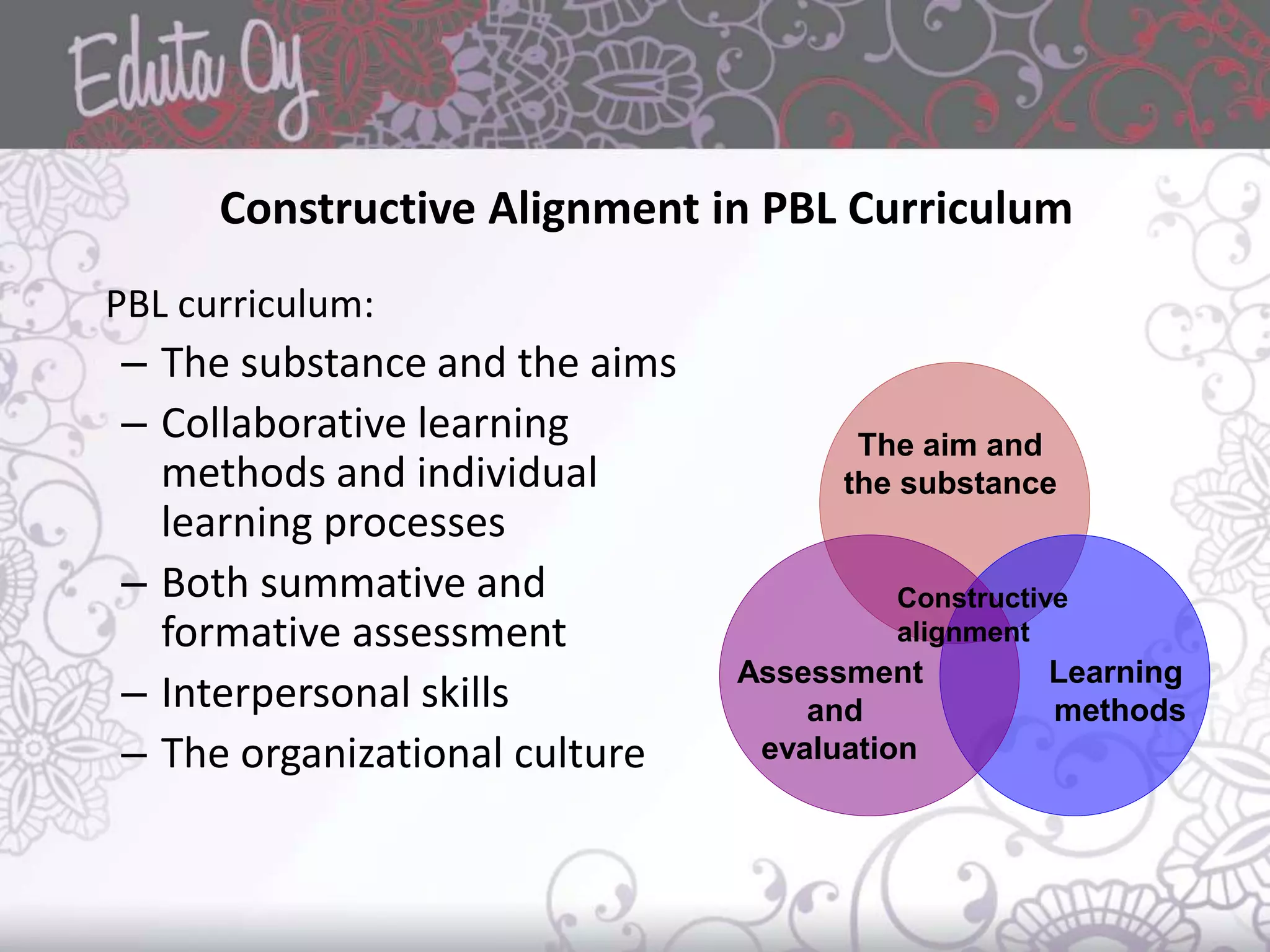
Constructive Alignment in PBL Curriculum
PBL curriculum:
– The substance and the aims
– Collaborative learning
methods and individual
learning processes
– Both summative and
formative assessment
– Interpersonal skills
– The organizational culture
The aim and
the substance
Learning
methods
Assessment
and
evaluation
Constructive
alignment
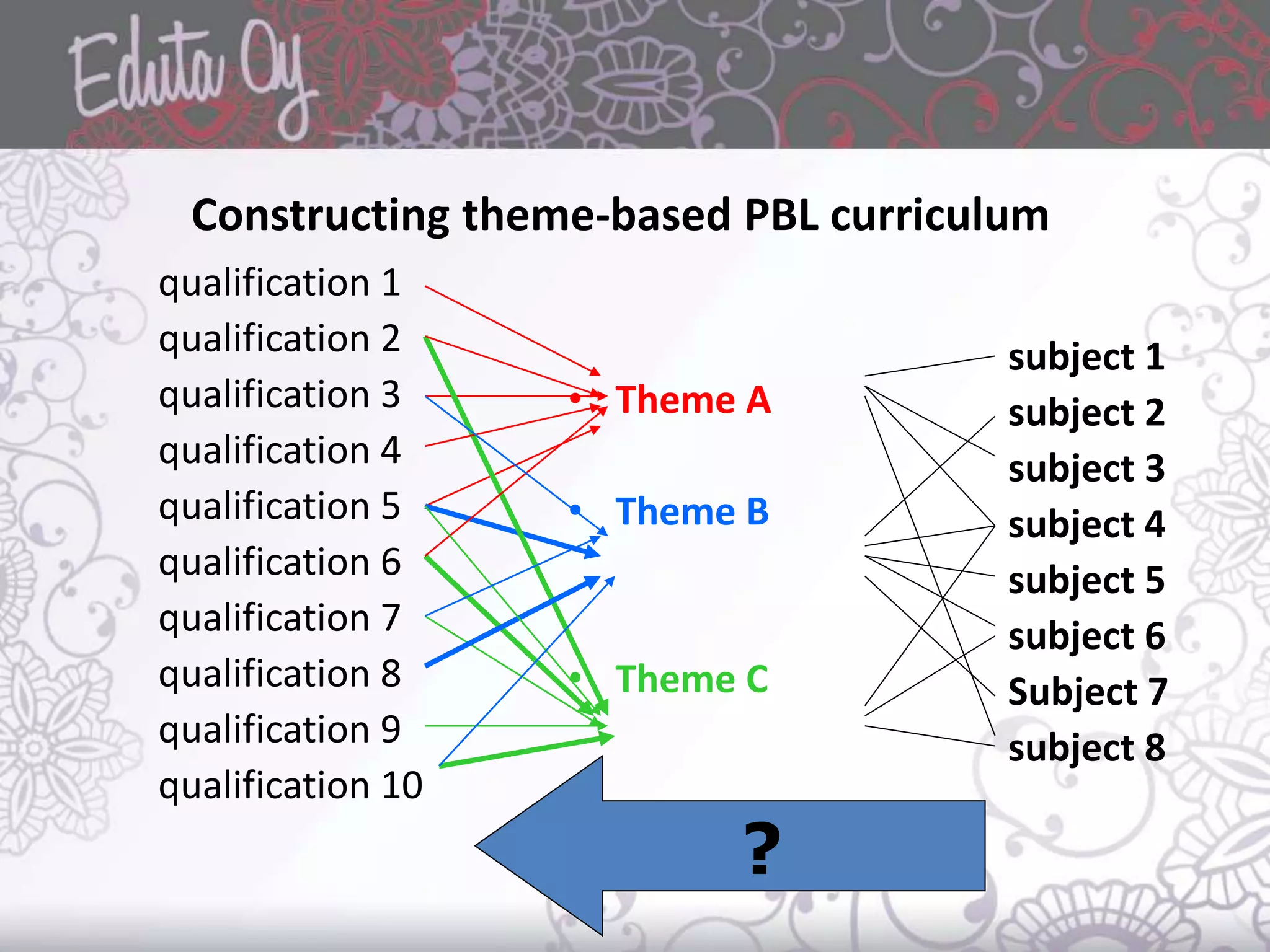
Constructing theme-based PBL curriculum
qualification 1
qualification 2
qualification 3
qualification 4
qualification 5
qualification 6
qualification 7
qualification 8
qualification 9
qualification 10
• Theme A
• Theme B
• Theme C
subject 1
subject 2
subject 3
subject 4
subject 5
subject 6
Subject 7
subject 8
?
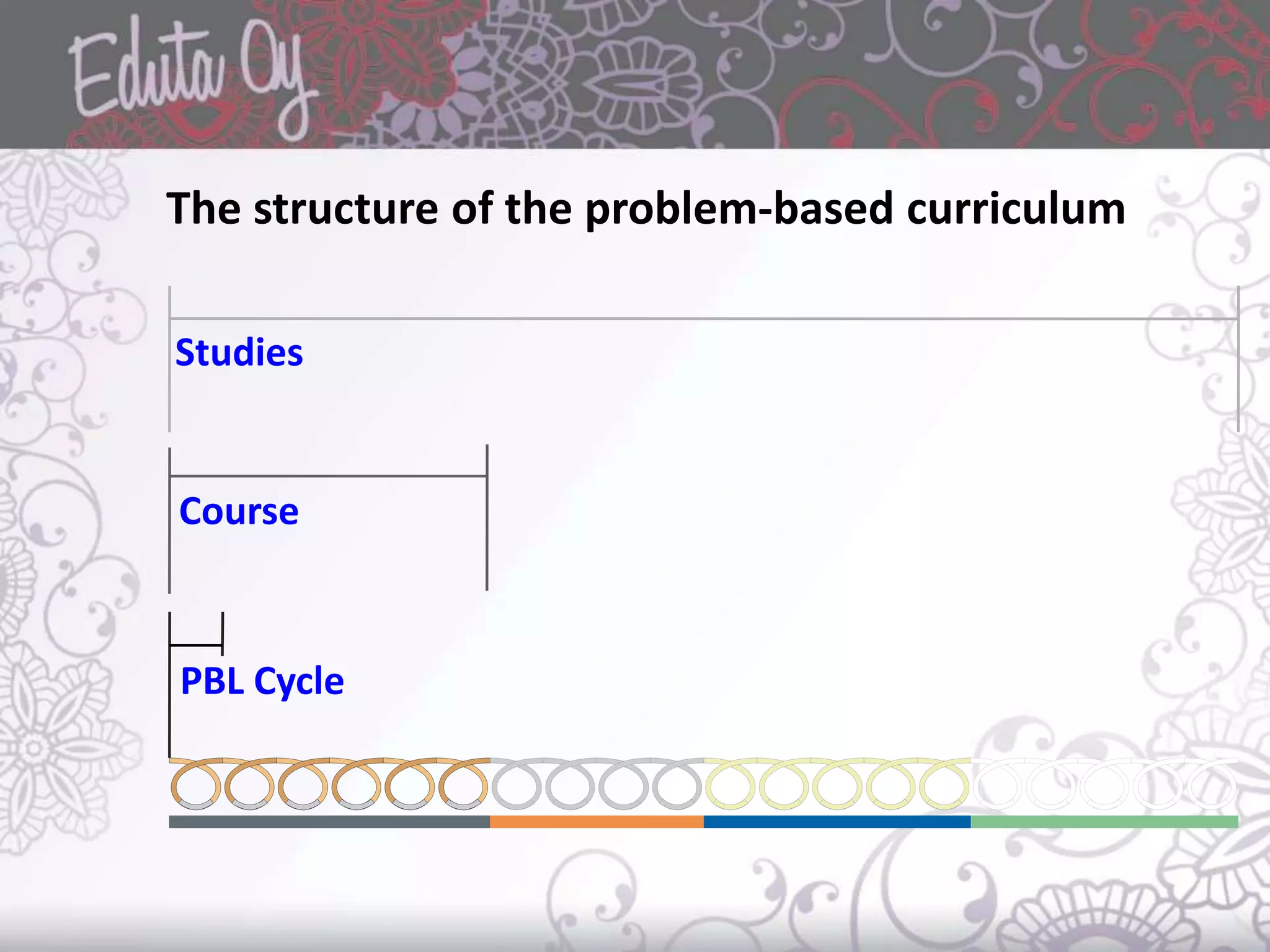
Studies
Course
PBL Cycle
The structure of the problem-based curriculum
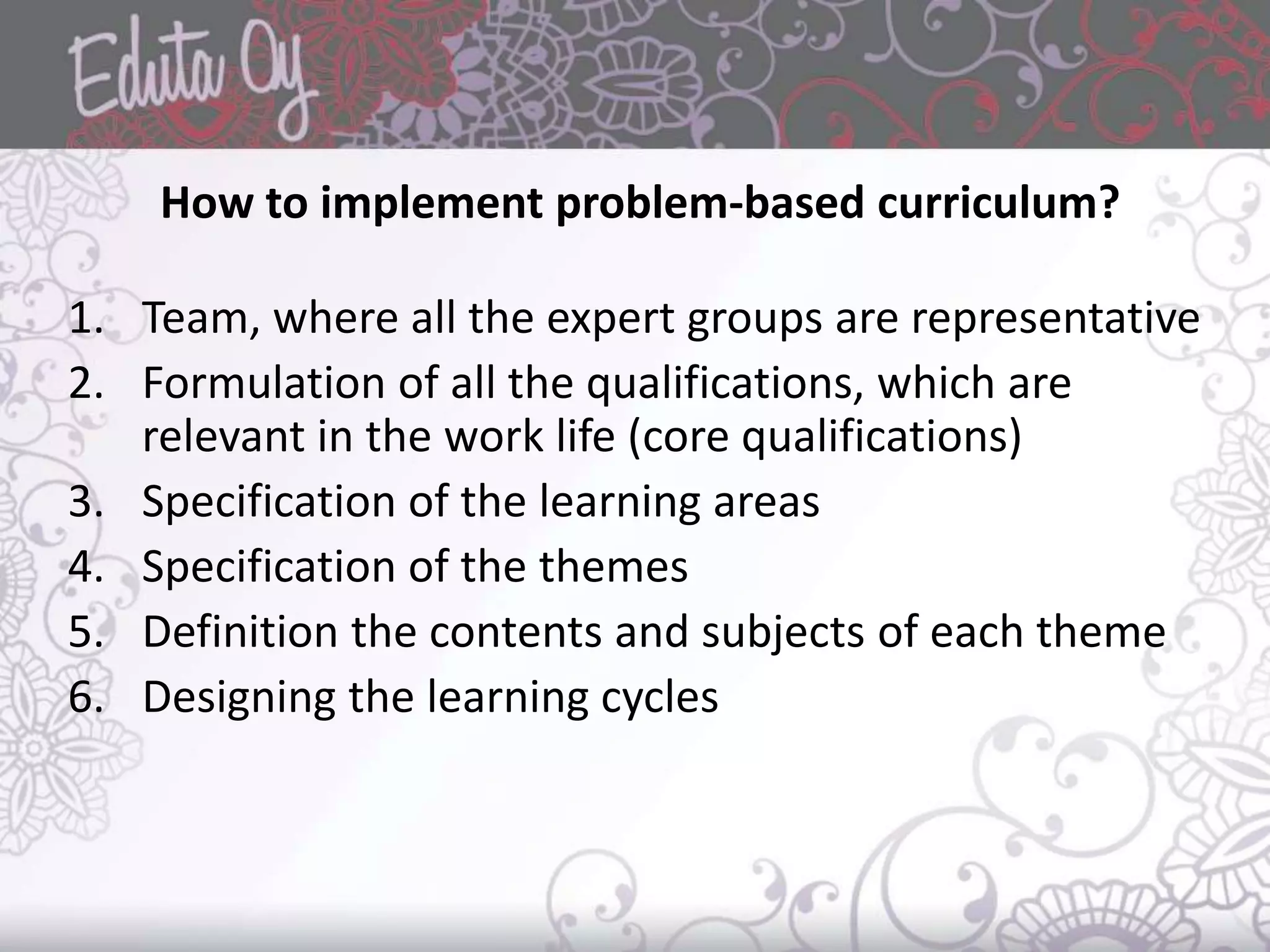
How to implement problem-based curriculum?
1. Team, where all the expert groups are representative
2. Formulation of all the qualifications, which are
relevant in the work life (core qualifications)
3. Specification of the learning areas
4. Specification of the themes
5. Definition the contents and subjects of each theme
6. Designing the learning cycles
PBL is inquiry-based learning I
1. The learners are responsible for their own learning
and the group work - the ownership of the learning
2. Using problems (cases, scenarios, triggers) as
starting points for learning
PBL is inquiry-based learning II
3. Integrating different knowledge areas and themes
4. Collaboration is essential part of learning and
assessment
5. Shared knowledge construction and independent
knowledge acquisition are chronologically separated
PBL is inquiry-based learning III
6. Shared knowledge construction produces shared
understanding and meaning negotiation
7. The self and peer assessment are included in the
process
PBL is inquiry-based learning IV
9.PBL curriculum improves interpersonal skills and
work life competencies of learners
10. PBL is a strategy, not only a learning method
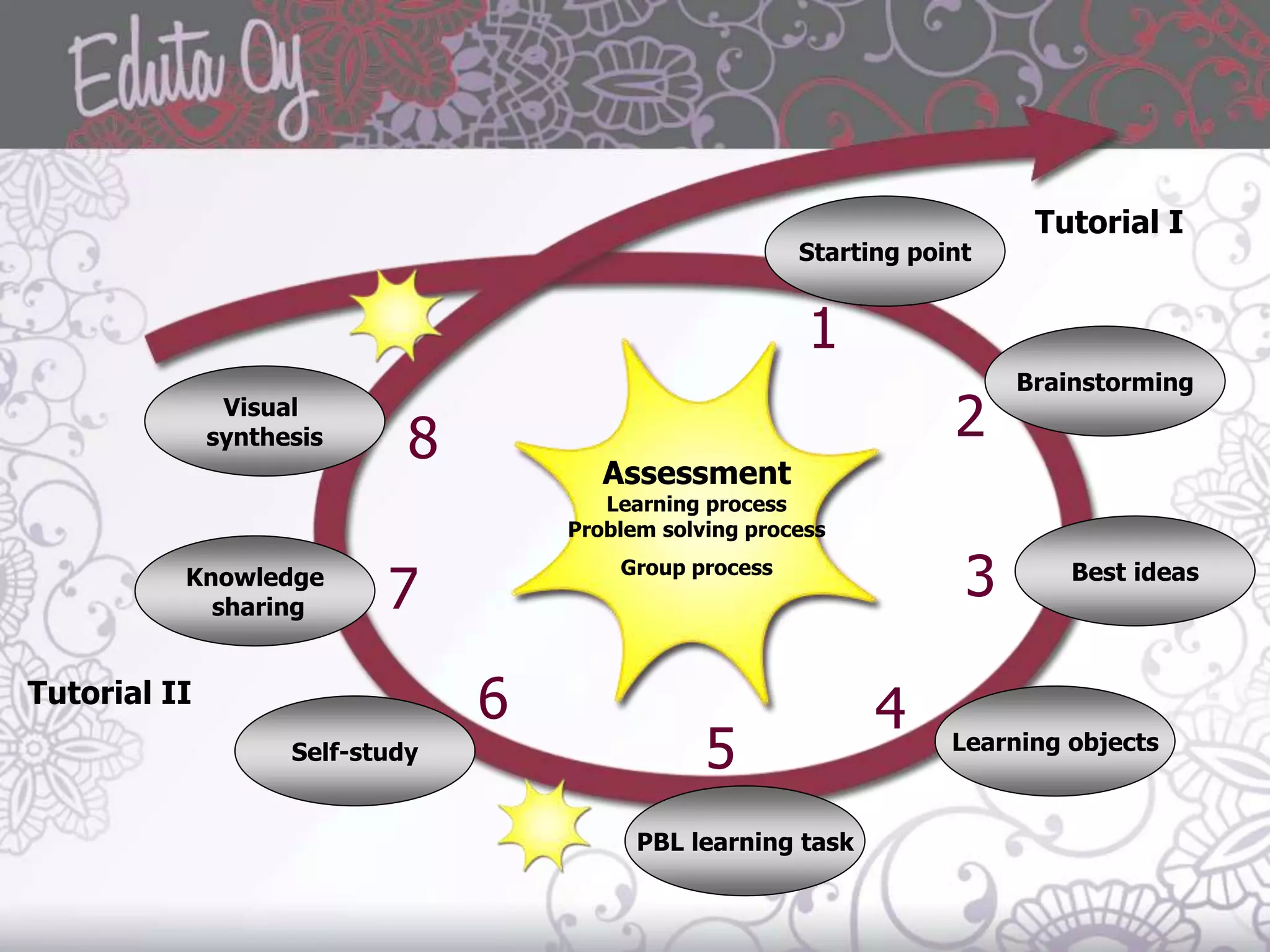
Assessment
Learning process
Problem solving process
Group process
Starting point
Brainstorming
Best ideas
Learning objects
Knowledge
sharing
Visual
synthesis
Self-study
PBL learning task
1
2
3
4
5
6
7
8
Tutorial I
Tutorial II
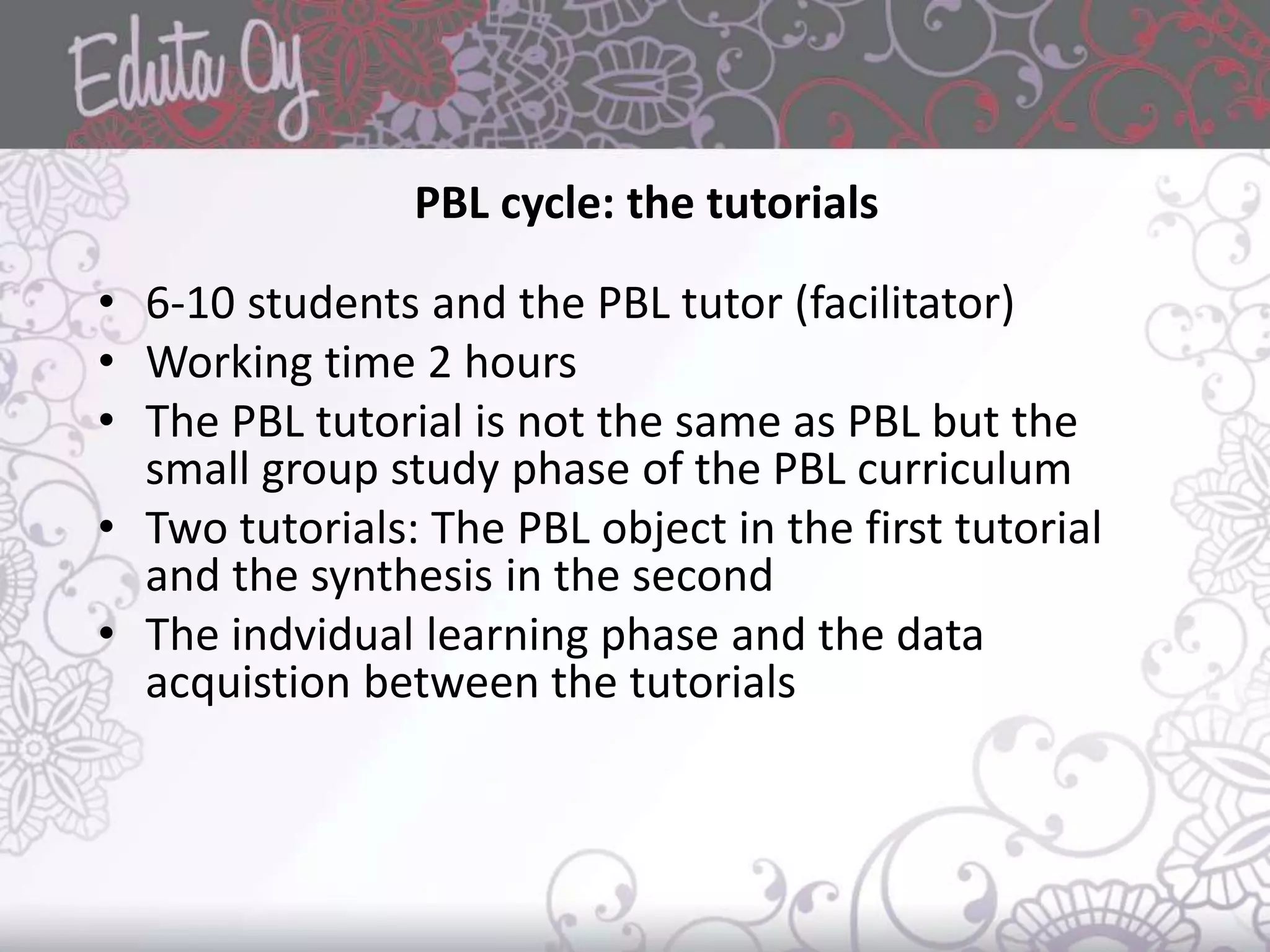
PBL cycle: the tutorials
• 6-10 students and the PBL tutor (facilitator)
• Working time 2 hours
• The PBL tutorial is not the same as PBL but the
small group study phase of the PBL curriculum
• Two tutorials: The PBL object in the first tutorial
and the synthesis in the second
• The indvidual learning phase and the data
acquistion between the tutorials
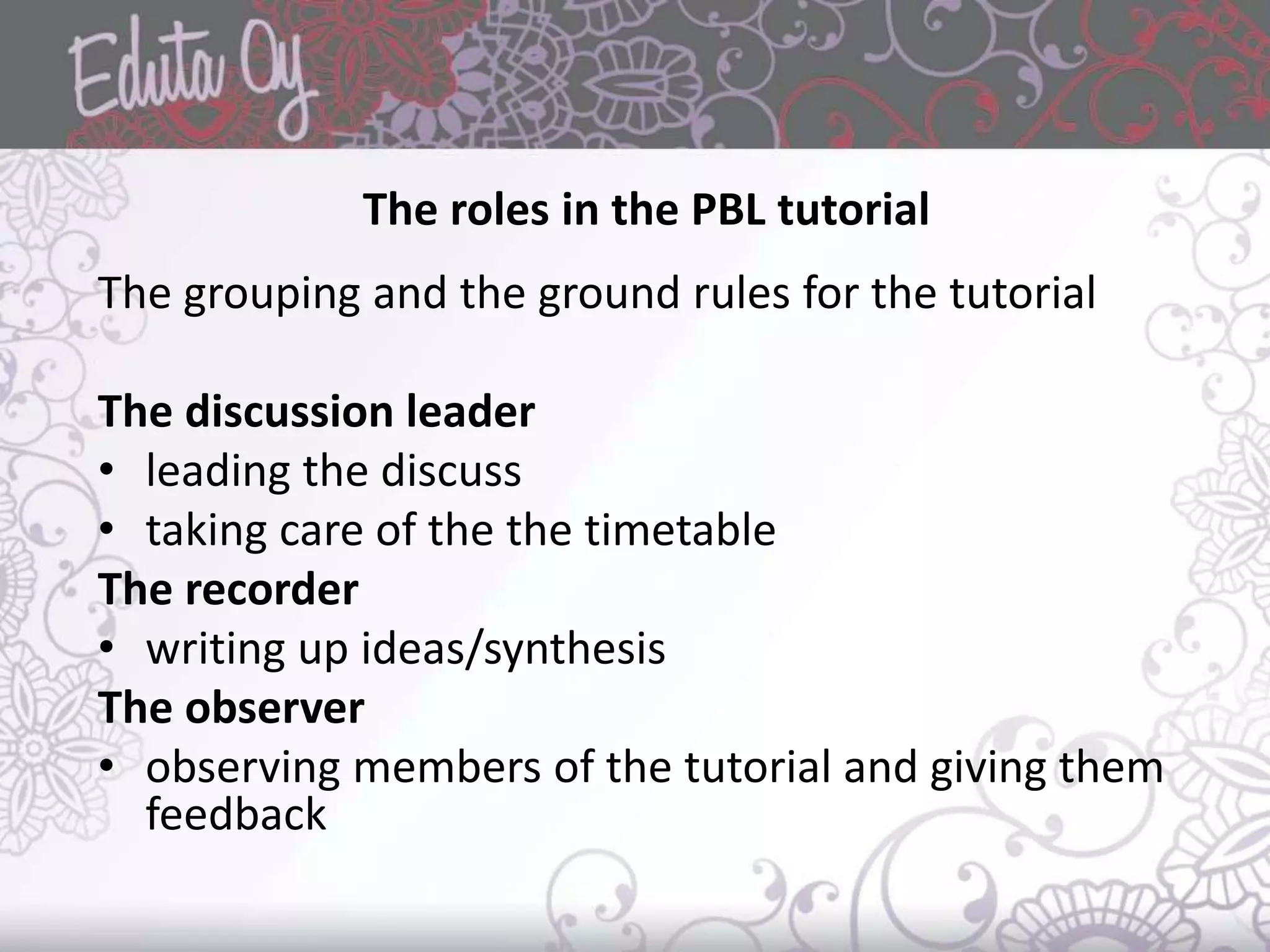
The roles in the PBL tutorial
The grouping and the ground rules for the tutorial
The discussion leader
• leading the discuss
• taking care of the the timetable
The recorder
• writing up ideas/synthesis
The observer
• observing members of the tutorial and giving them
feedback
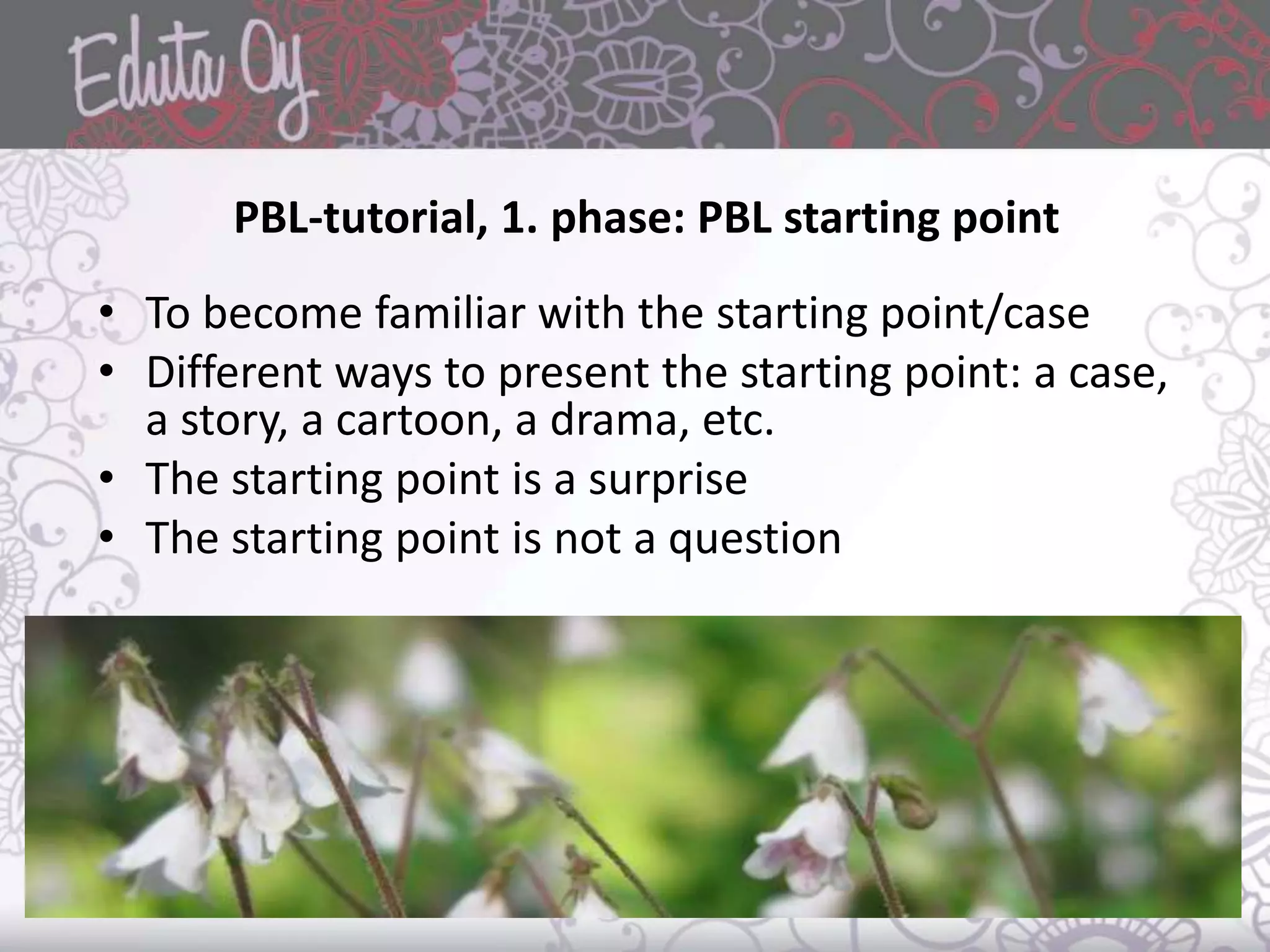
PBL-tutorial, 1. phase: PBL starting point
• To become familiar with the starting point/case
• Different ways to present the starting point: a case,
a story, a cartoon, a drama, etc.
• The starting point is a surprise
• The starting point is not a question
Different types of starting points
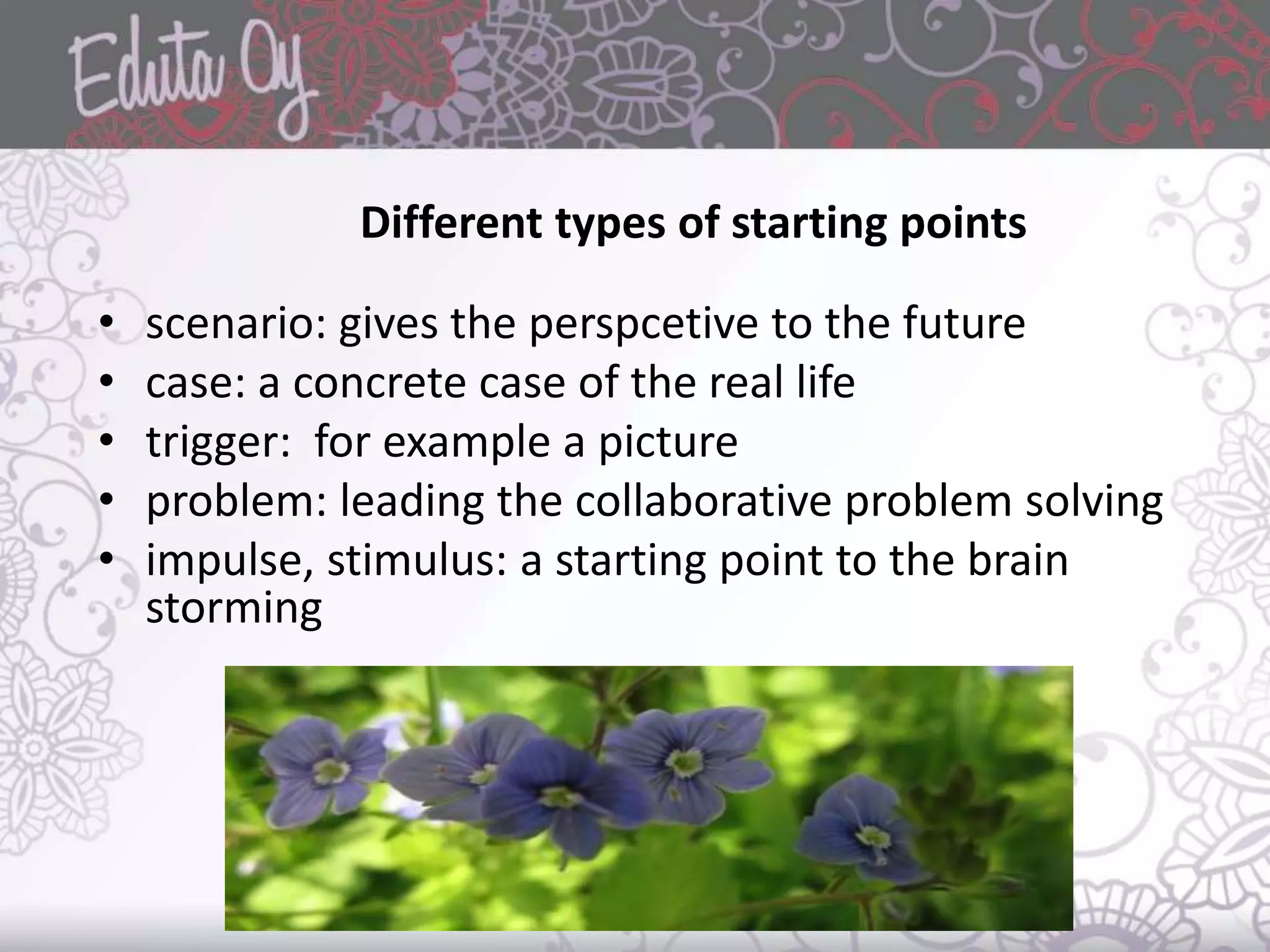
• scenario: gives the perspcetive to the future
• case: a concrete case of the real life
• trigger: for example a picture
• problem: leading the collaborative problem solving
• impulse, stimulus: a starting point to the brain
storming
PBL tutorial, 2. phase: Brainstorming
• Producing new ideas
• Connecting the knowledge achieved earlier
• Activating
• Innovative connections
• No critisism
• No long explanations
• No analysing
PBL tutorial, 3. phase: Choosing the ideas
Everyone has 5 points in order to choose
the best ideas.
PBL tutorial, 4. phase: Defining the learning object
Picking up the ideas which have most points and
defining the learning object together
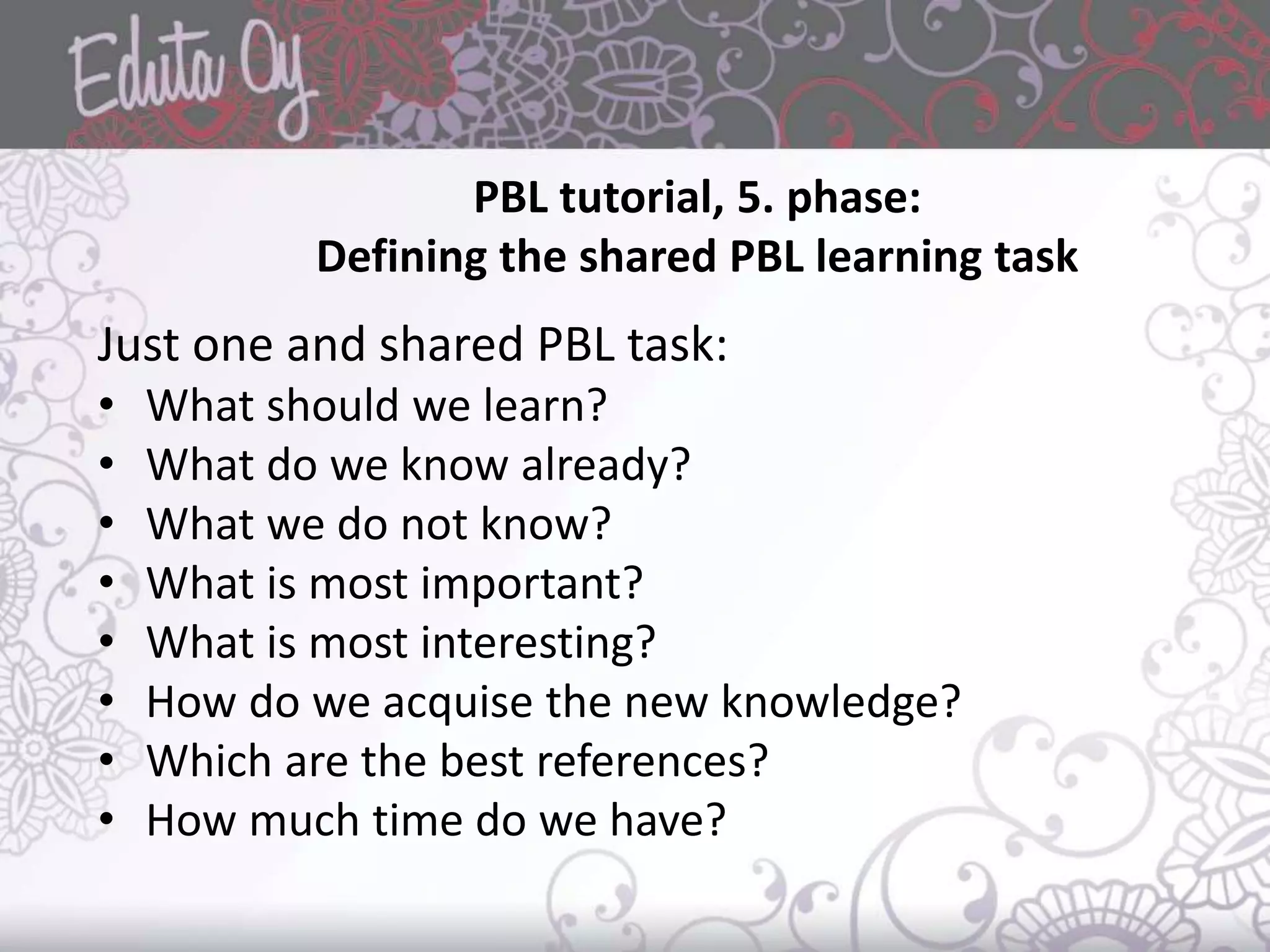
PBL tutorial, 5. phase:
Defining the shared PBL learning task
Just one and shared PBL task:
• What should we learn?
• What do we know already?
• What we do not know?
• What is most important?
• What is most interesting?
• How do we acquise the new knowledge?
• Which are the best references?
• How much time do we have?
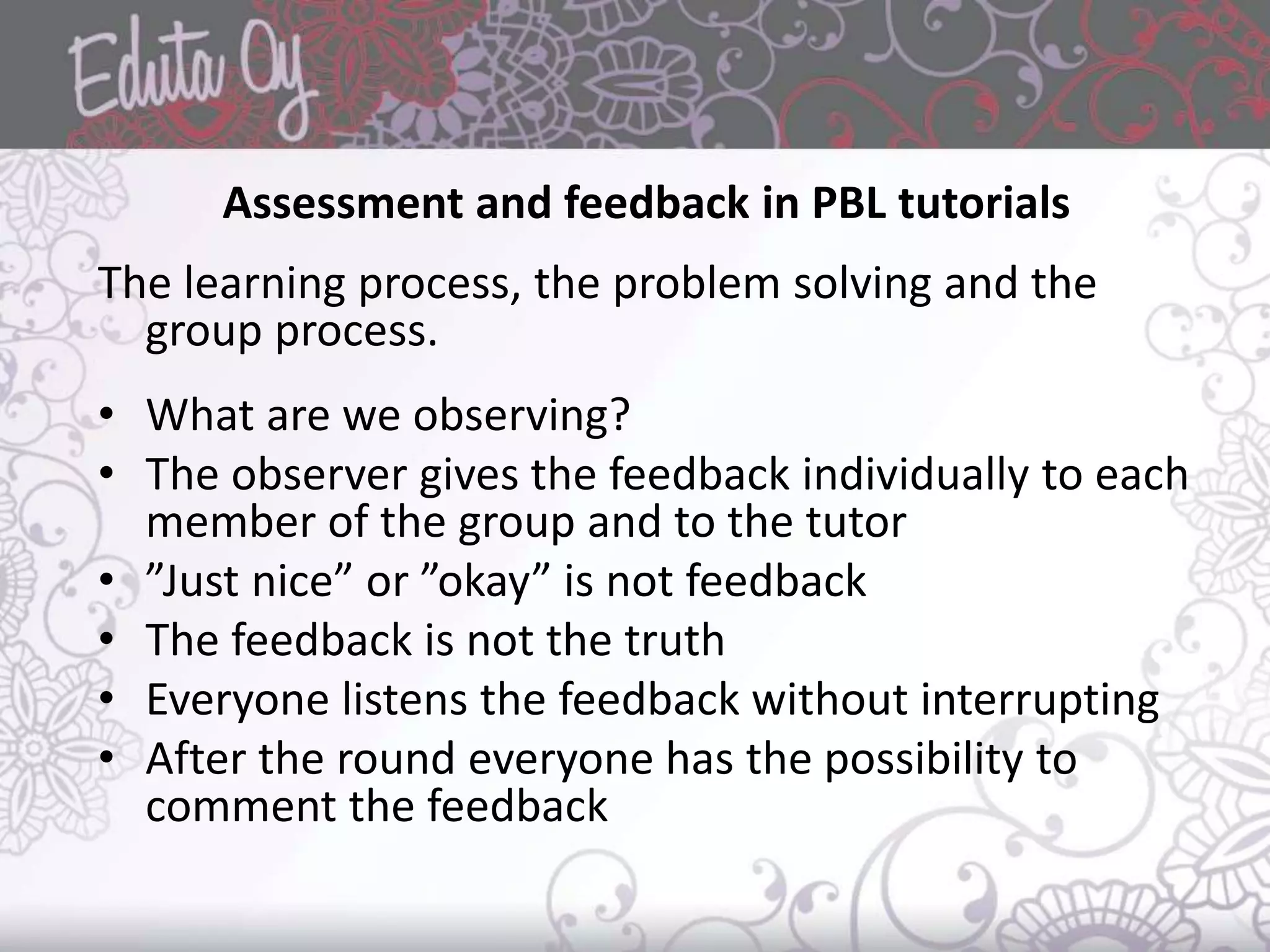
Assessment and feedback in PBL tutorials
The learning process, the problem solving and the
group process.
• What are we observing?
• The observer gives the feedback individually to each
member of the group and to the tutor
• ”Just nice” or ”okay” is not feedback
• The feedback is not the truth
• Everyone listens the feedback without interrupting
• After the round everyone has the possibility to
comment the feedback
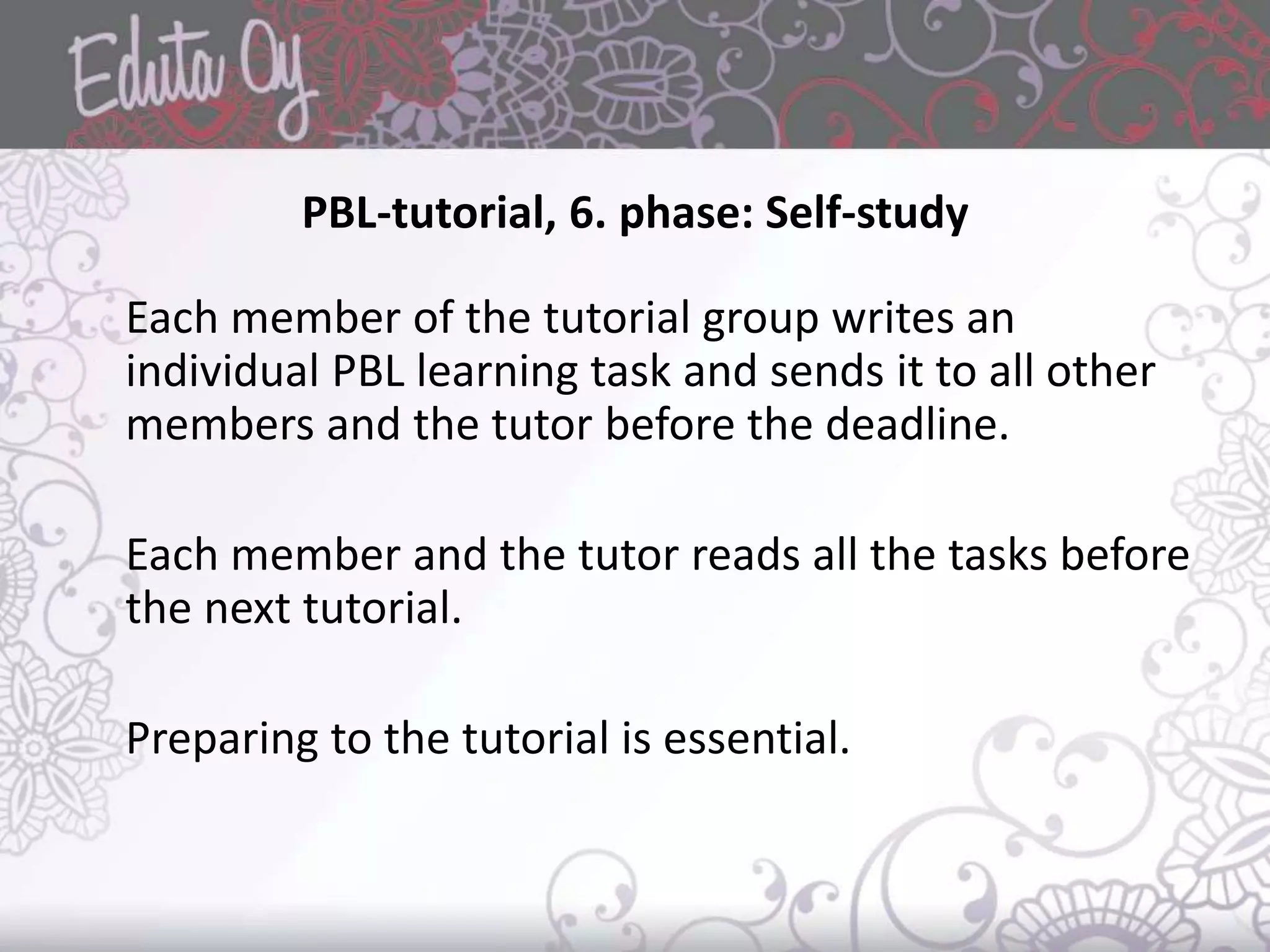
PBL-tutorial, 6. phase: Self-study
Each member of the tutorial group writes an
individual PBL learning task and sends it to all other
members and the tutor before the deadline.
Each member and the tutor reads all the tasks before
the next tutorial.
Preparing to the tutorial is essential.
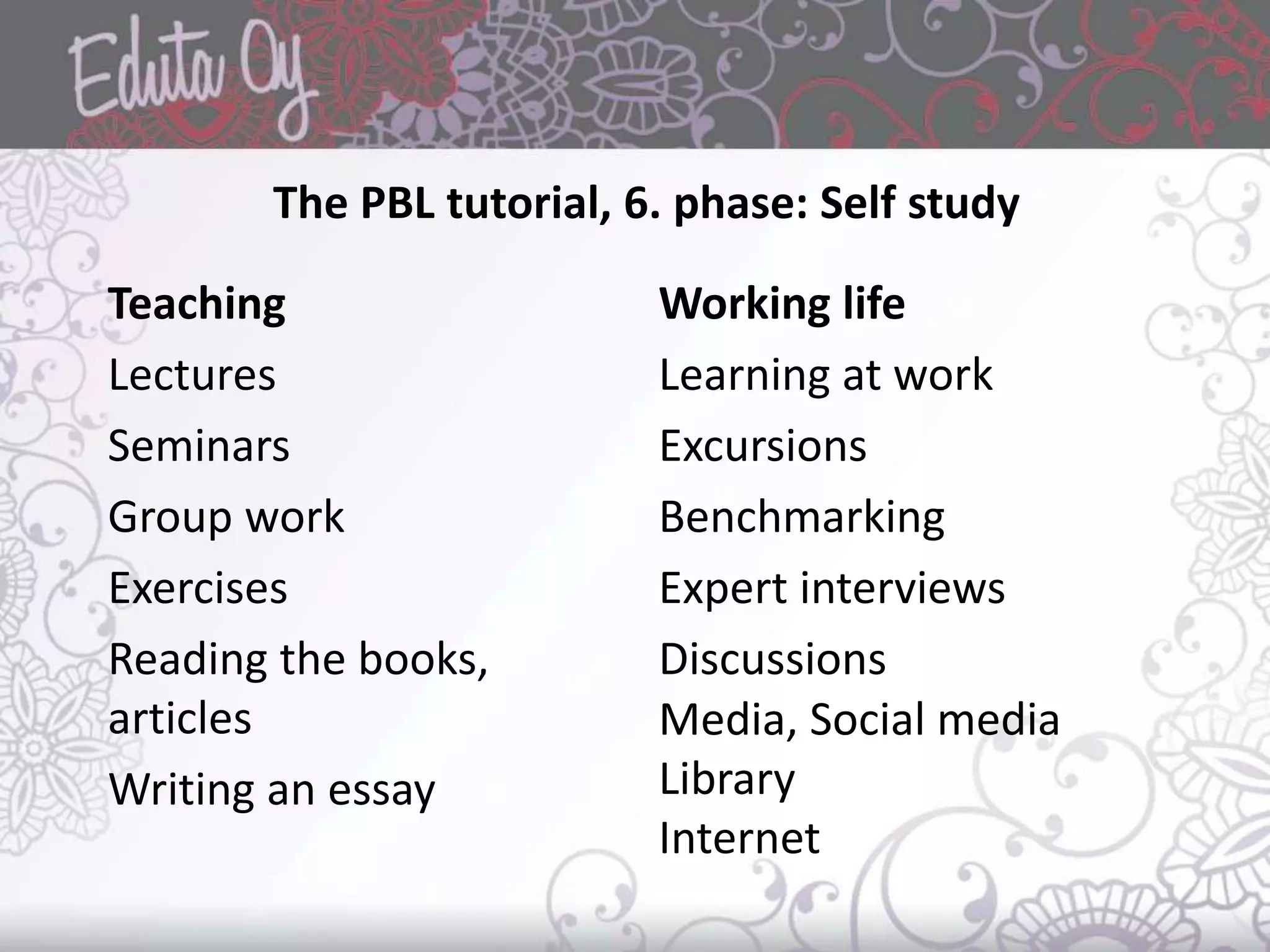
The PBL tutorial, 6. phase: Self study
Teaching
Lectures
Seminars
Group work
Exercises
Reading the books,
articles
Writing an essay
Working life
Learning at work
Excursions
Benchmarking
Expert interviews
Discussions
Media, Social media
Library
Internet
PBL tutorial, 7. phase: Knowledge sharing
• New roles
• The short starting round (star ideas,
1 minute/member)
• Dialogic reflections
• Argumenting
• It is important that everyone has orientated
and learned the task
• The recorder writes up the core points
PBL tutorial, 8. phase: the visual synthesis
• Modelling shared learning
• Problem solving and learning process becomes
evident
• The summary and the comparison with the starting
point
• Visualising gives the shared symbol to the common
process
• It is also possible to make a theoretised modell
The observer´s feedback and self assessment
1. tutorial
• How did you give new perspectives to the group
work?
• How did you continue the others´ ideas?
• Did you present innovative ideas?
2. tutorial
• How did you question?
• How did you support others?
• How did you learn from others?
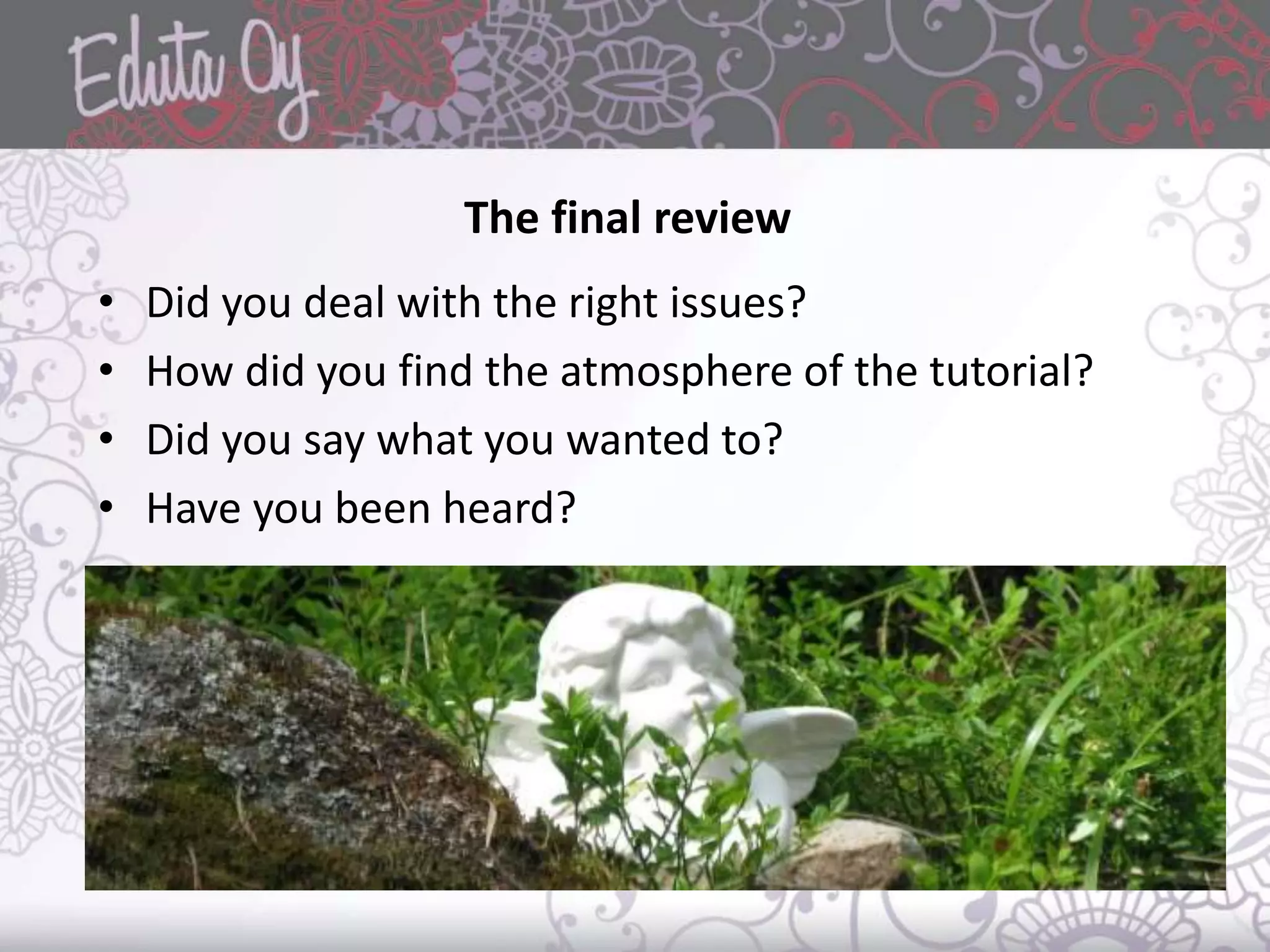
The final review
• Did you deal with the right issues?
• How did you find the atmosphere of the tutorial?
• Did you say what you wanted to?
• Have you been heard?
CC-licensies: creativecommons.org
CC BY-SA (these slides): creativecommons.org/licenses/by-sa/4.0
You can also contact us to get more rights
• Satu Öystilä: www.eduta.fi
• Matleena Laakso: www.matleenalaakso.fi
Licensed under Creative Commons Attribution-
ShareAlike 4.0 International License (CC BY-SA 4.0)

The Principles and the Cycle of Problem-based Learning

  • 1.
    Satu Öystilä &Matleena Laakso 2015 The Principles of Problem-based Learning and the Phases of the PBL Cycle Eduta Oy Puh. +35850 564 4887 info@eduta.fi www.eduta.fi
  • 2.
    PBL as astrategy of the pedagogical development process • Curriculum development • Collaborative learning process • New learning culture • The change of the teacher’s role
  • 3.
    PBL as aneducational strategy • PBL currculum is organized according to the subject frame or a defined interdisciplinary • The aims are: – Learning in small groups (tutorials) – Self-directed learning – Critical thinking – Life-long learning – Self and peer assessment – Inquiry-based learning
  • 4.
    PBL as aneducational strategy • Student-centred learning environment • Individual and collaborative learning processes in the PBL curriculum • Less contact teaching and more facilitation
  • 5.
    Constructive Alignment inPBL Curriculum PBL curriculum: – The substance and the aims – Collaborative learning methods and individual learning processes – Both summative and formative assessment – Interpersonal skills – The organizational culture The aim and the substance Learning methods Assessment and evaluation Constructive alignment
  • 6.
    Constructing theme-based PBLcurriculum qualification 1 qualification 2 qualification 3 qualification 4 qualification 5 qualification 6 qualification 7 qualification 8 qualification 9 qualification 10 • Theme A • Theme B • Theme C subject 1 subject 2 subject 3 subject 4 subject 5 subject 6 Subject 7 subject 8 ?
  • 7.
    Studies Course PBL Cycle The structureof the problem-based curriculum
  • 8.
    How to implementproblem-based curriculum? 1. Team, where all the expert groups are representative 2. Formulation of all the qualifications, which are relevant in the work life (core qualifications) 3. Specification of the learning areas 4. Specification of the themes 5. Definition the contents and subjects of each theme 6. Designing the learning cycles
  • 9.
    PBL is inquiry-basedlearning I 1. The learners are responsible for their own learning and the group work - the ownership of the learning 2. Using problems (cases, scenarios, triggers) as starting points for learning
  • 10.
    PBL is inquiry-basedlearning II 3. Integrating different knowledge areas and themes 4. Collaboration is essential part of learning and assessment 5. Shared knowledge construction and independent knowledge acquisition are chronologically separated
  • 11.
    PBL is inquiry-basedlearning III 6. Shared knowledge construction produces shared understanding and meaning negotiation 7. The self and peer assessment are included in the process
  • 12.
    PBL is inquiry-basedlearning IV 9.PBL curriculum improves interpersonal skills and work life competencies of learners 10. PBL is a strategy, not only a learning method
  • 13.
    Assessment Learning process Problem solvingprocess Group process Starting point Brainstorming Best ideas Learning objects Knowledge sharing Visual synthesis Self-study PBL learning task 1 2 3 4 5 6 7 8 Tutorial I Tutorial II
  • 14.
    PBL cycle: thetutorials • 6-10 students and the PBL tutor (facilitator) • Working time 2 hours • The PBL tutorial is not the same as PBL but the small group study phase of the PBL curriculum • Two tutorials: The PBL object in the first tutorial and the synthesis in the second • The indvidual learning phase and the data acquistion between the tutorials
  • 15.
    The roles inthe PBL tutorial The grouping and the ground rules for the tutorial The discussion leader • leading the discuss • taking care of the the timetable The recorder • writing up ideas/synthesis The observer • observing members of the tutorial and giving them feedback
  • 16.
    PBL-tutorial, 1. phase:PBL starting point • To become familiar with the starting point/case • Different ways to present the starting point: a case, a story, a cartoon, a drama, etc. • The starting point is a surprise • The starting point is not a question
  • 17.
    Different types ofstarting points • scenario: gives the perspcetive to the future • case: a concrete case of the real life • trigger: for example a picture • problem: leading the collaborative problem solving • impulse, stimulus: a starting point to the brain storming
  • 18.
    PBL tutorial, 2.phase: Brainstorming • Producing new ideas • Connecting the knowledge achieved earlier • Activating • Innovative connections • No critisism • No long explanations • No analysing
  • 19.
    PBL tutorial, 3.phase: Choosing the ideas Everyone has 5 points in order to choose the best ideas.
  • 20.
    PBL tutorial, 4.phase: Defining the learning object Picking up the ideas which have most points and defining the learning object together
  • 21.
    PBL tutorial, 5.phase: Defining the shared PBL learning task Just one and shared PBL task: • What should we learn? • What do we know already? • What we do not know? • What is most important? • What is most interesting? • How do we acquise the new knowledge? • Which are the best references? • How much time do we have?
  • 22.
    Assessment and feedbackin PBL tutorials The learning process, the problem solving and the group process. • What are we observing? • The observer gives the feedback individually to each member of the group and to the tutor • ”Just nice” or ”okay” is not feedback • The feedback is not the truth • Everyone listens the feedback without interrupting • After the round everyone has the possibility to comment the feedback
  • 23.
    PBL-tutorial, 6. phase:Self-study Each member of the tutorial group writes an individual PBL learning task and sends it to all other members and the tutor before the deadline. Each member and the tutor reads all the tasks before the next tutorial. Preparing to the tutorial is essential.
  • 24.
    The PBL tutorial,6. phase: Self study Teaching Lectures Seminars Group work Exercises Reading the books, articles Writing an essay Working life Learning at work Excursions Benchmarking Expert interviews Discussions Media, Social media Library Internet
  • 25.
    PBL tutorial, 7.phase: Knowledge sharing • New roles • The short starting round (star ideas, 1 minute/member) • Dialogic reflections • Argumenting • It is important that everyone has orientated and learned the task • The recorder writes up the core points
  • 26.
    PBL tutorial, 8.phase: the visual synthesis • Modelling shared learning • Problem solving and learning process becomes evident • The summary and the comparison with the starting point • Visualising gives the shared symbol to the common process • It is also possible to make a theoretised modell
  • 27.
    The observer´s feedbackand self assessment 1. tutorial • How did you give new perspectives to the group work? • How did you continue the others´ ideas? • Did you present innovative ideas? 2. tutorial • How did you question? • How did you support others? • How did you learn from others?
  • 28.
    The final review •Did you deal with the right issues? • How did you find the atmosphere of the tutorial? • Did you say what you wanted to? • Have you been heard?
  • 29.
    CC-licensies: creativecommons.org CC BY-SA(these slides): creativecommons.org/licenses/by-sa/4.0 You can also contact us to get more rights • Satu Öystilä: www.eduta.fi • Matleena Laakso: www.matleenalaakso.fi Licensed under Creative Commons Attribution- ShareAlike 4.0 International License (CC BY-SA 4.0)