Manufacturing Process and Design
By
Prof Hemalata Jena PhD
Manufacturing Process and Design
 Text Books :
 Manufacturing Processes by J. P. Koushish
 Or
 Manufacturing Technology by P.N.Rao (TMH), Part – II
 Reference Books :
 Manufacturing Science by A.Ghosh and A.K.Mallik
 Text Book of Production Engineering by P.C.Sharma
 Workshop Technology-II by Hazra Chaudhury
Chip less manufacturing processes
Chip manufacturing
Casting, forming, Sheet metal
operations, powder metallurgy
Material removal
processes
Conventional Machining Processes
Non-Traditional Manufacturing Processes
Manufacturing processes
Material removal processes
Defination of Machine tool
• It is a power driven metal cutting machine
• It changes the shape of the material or job by
producing chips
• The lathe, the shaper, the planer, the drilling,
machine and the milling machine are few
example of commonly used machine tools.
Machine Tool
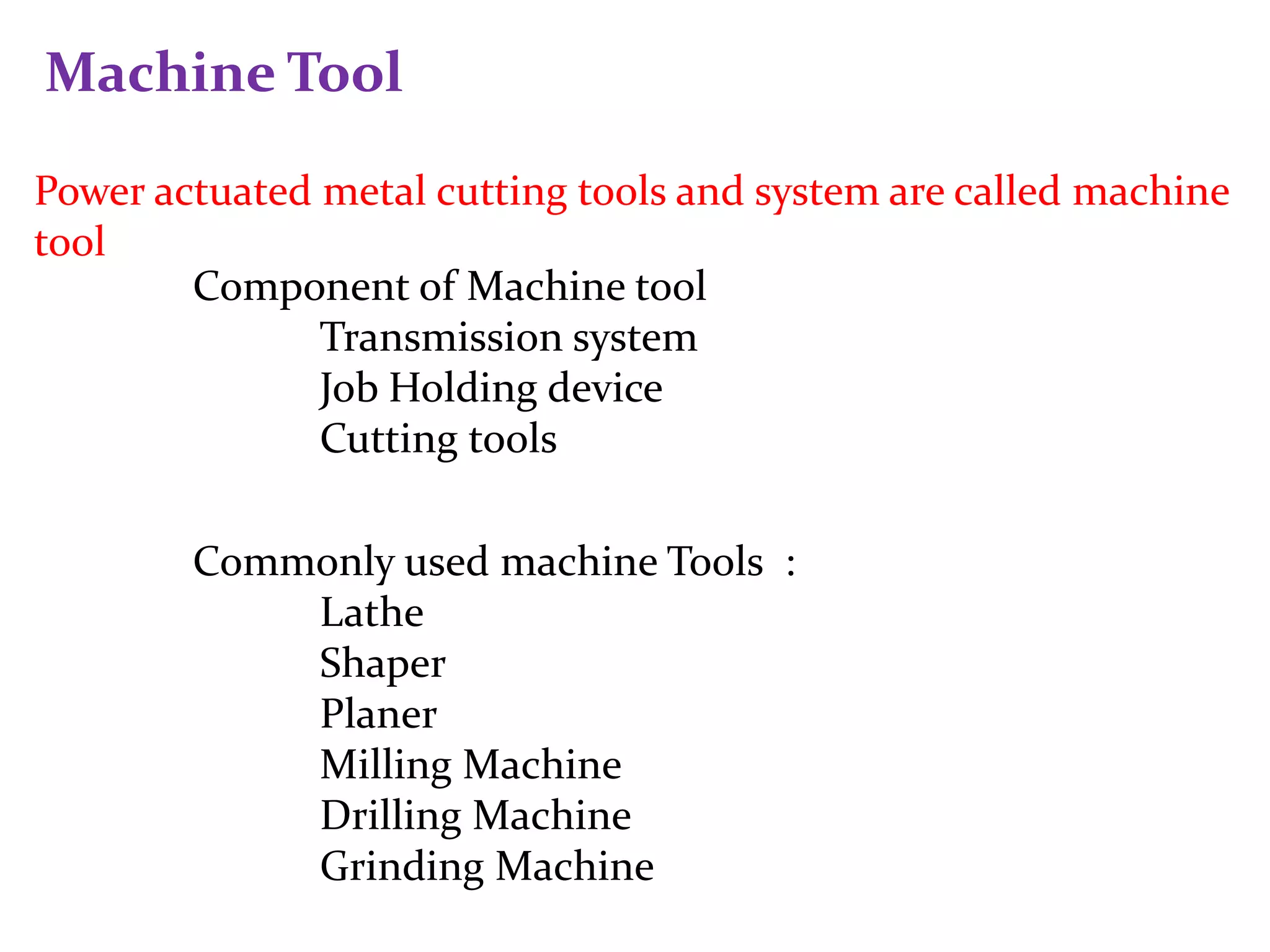
Power actuated metal cutting tools and system are called machine
tool
Component of Machine tool
Transmission system
Job Holding device
Cutting tools
Commonly used machine Tools :
Lathe
Shaper
Planer
Milling Machine
Drilling Machine
Grinding Machine
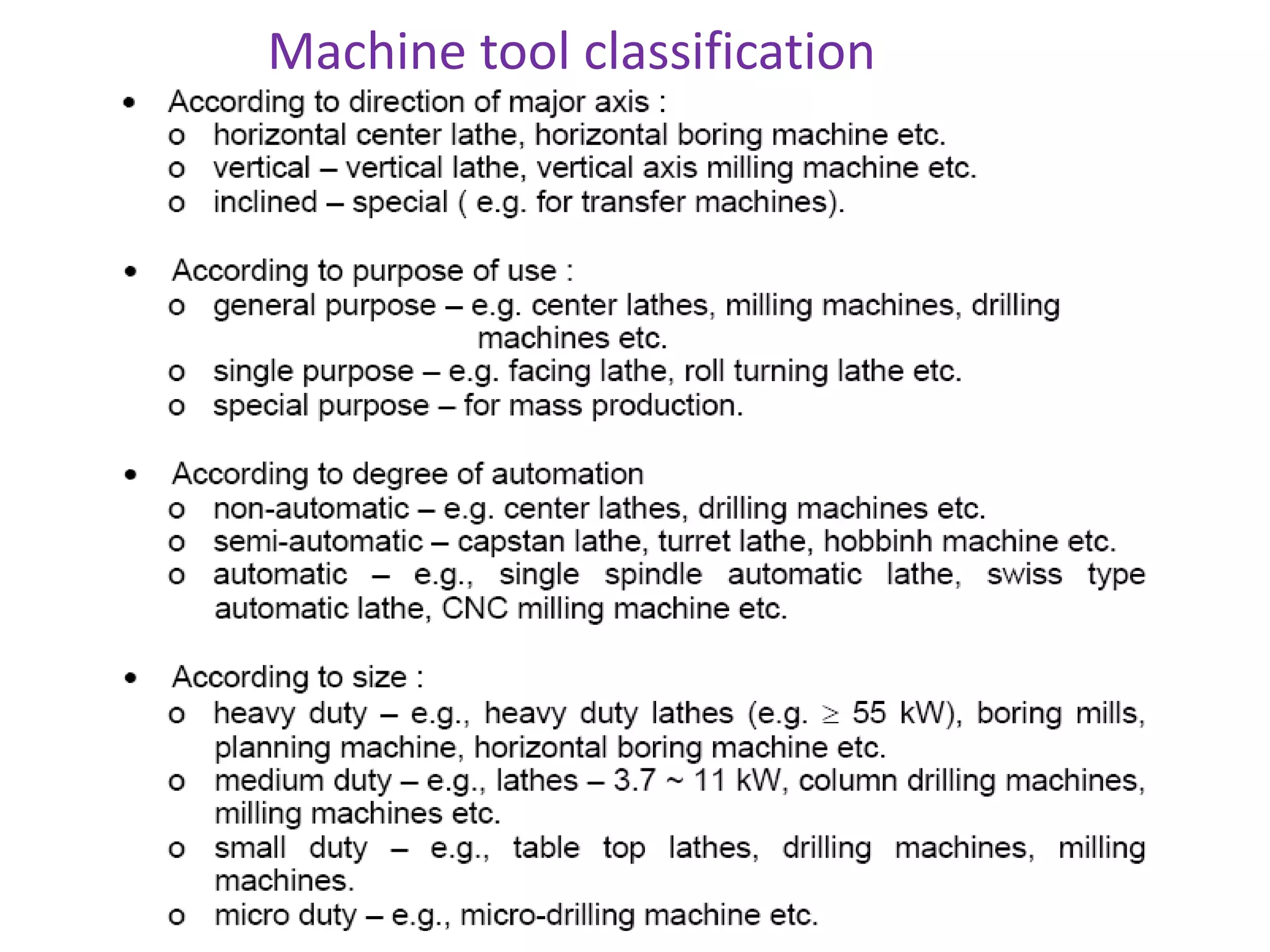
Machine tool classification
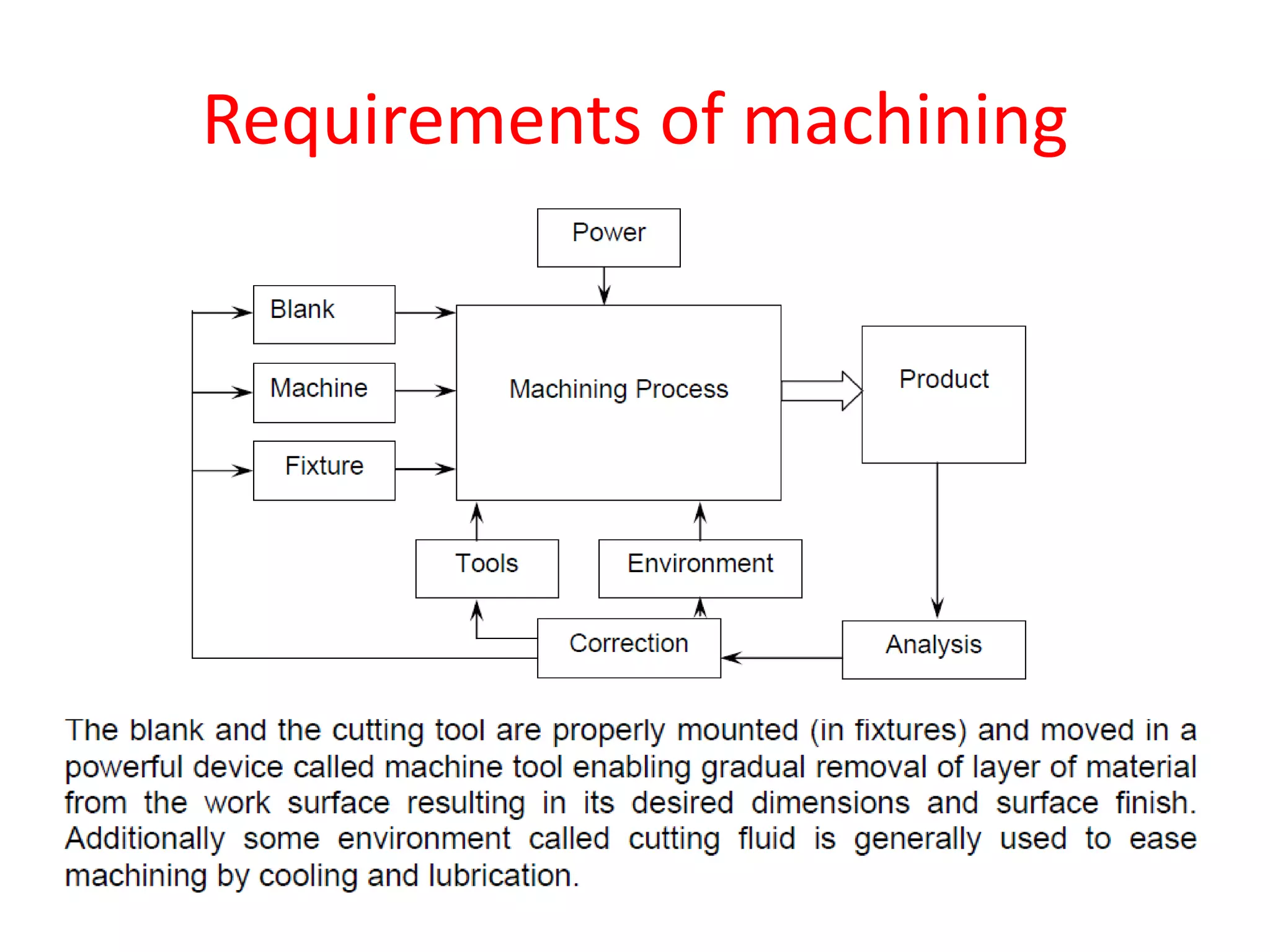
Machining is an essential process of
finishing by which jobs are produced to the
desired dimensions and surface finish by
gradually removing the excess material
from the work piece in the form of chips
with the help of cutting tool moved past
the work surface.
Machining
Requirements of machining
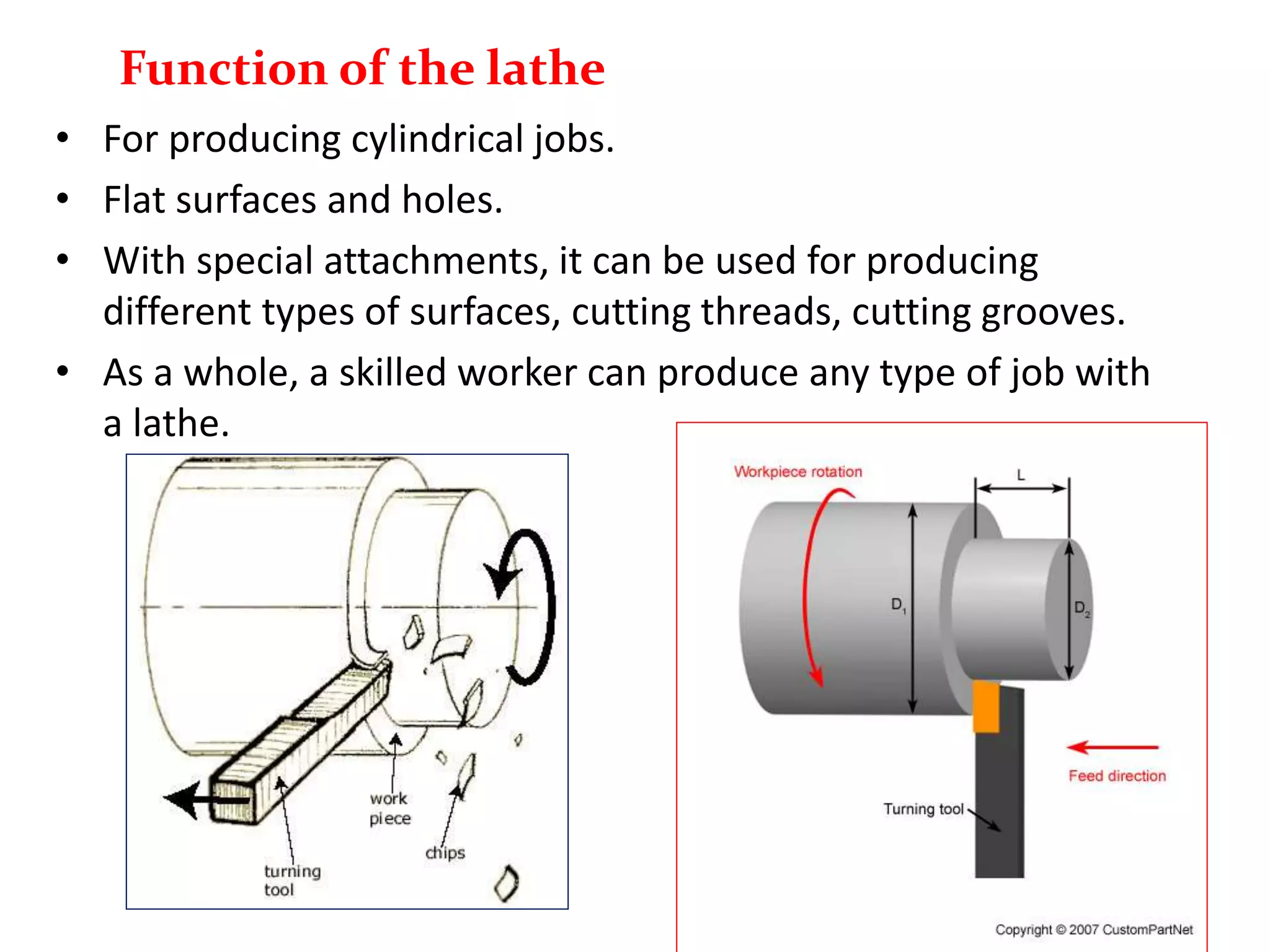
• For producing cylindrical jobs.
• Flat surfaces and holes.
• With special attachments, it can be used for producing
different types of surfaces, cutting threads, cutting grooves.
• As a whole, a skilled worker can produce any type of job with
a lathe.
Function of the lathe
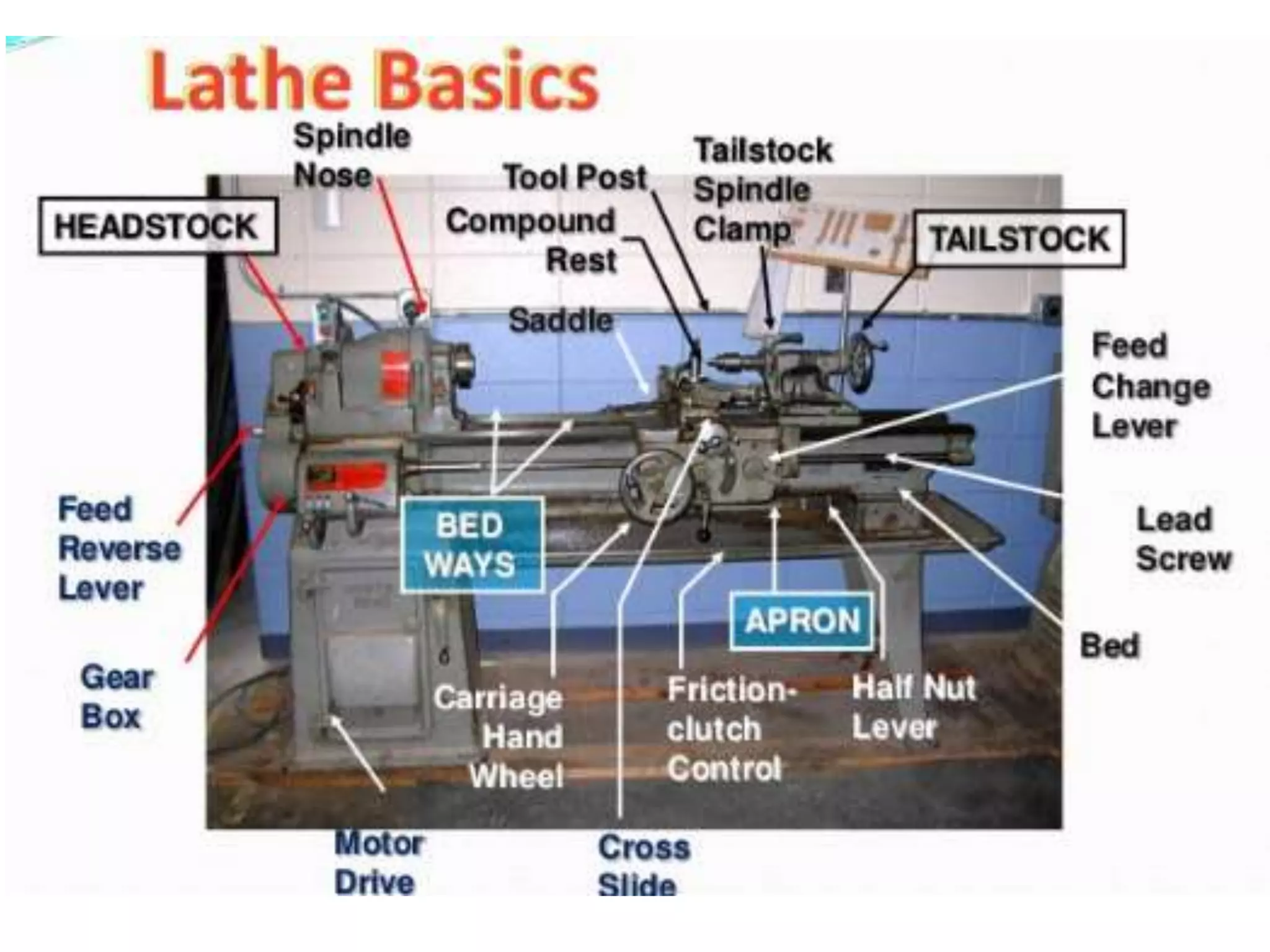
• Bed is mainly support the whole machine
• Carriage is assembly that moves the tool post and cutting tool
along the ways
• Carriage Hand wheel is a wheel with a handle used to move
the carriage by hand by means of a rack and ponion drive
• A chuck is a clamping device for holding work in the lathe
• Apron is the front part of the carriage assembly on which
carriage hand wheel is mounted
• Cross slide is a platform that moves perpendicular to the lathe
axis under control of the cross slide hand wheel
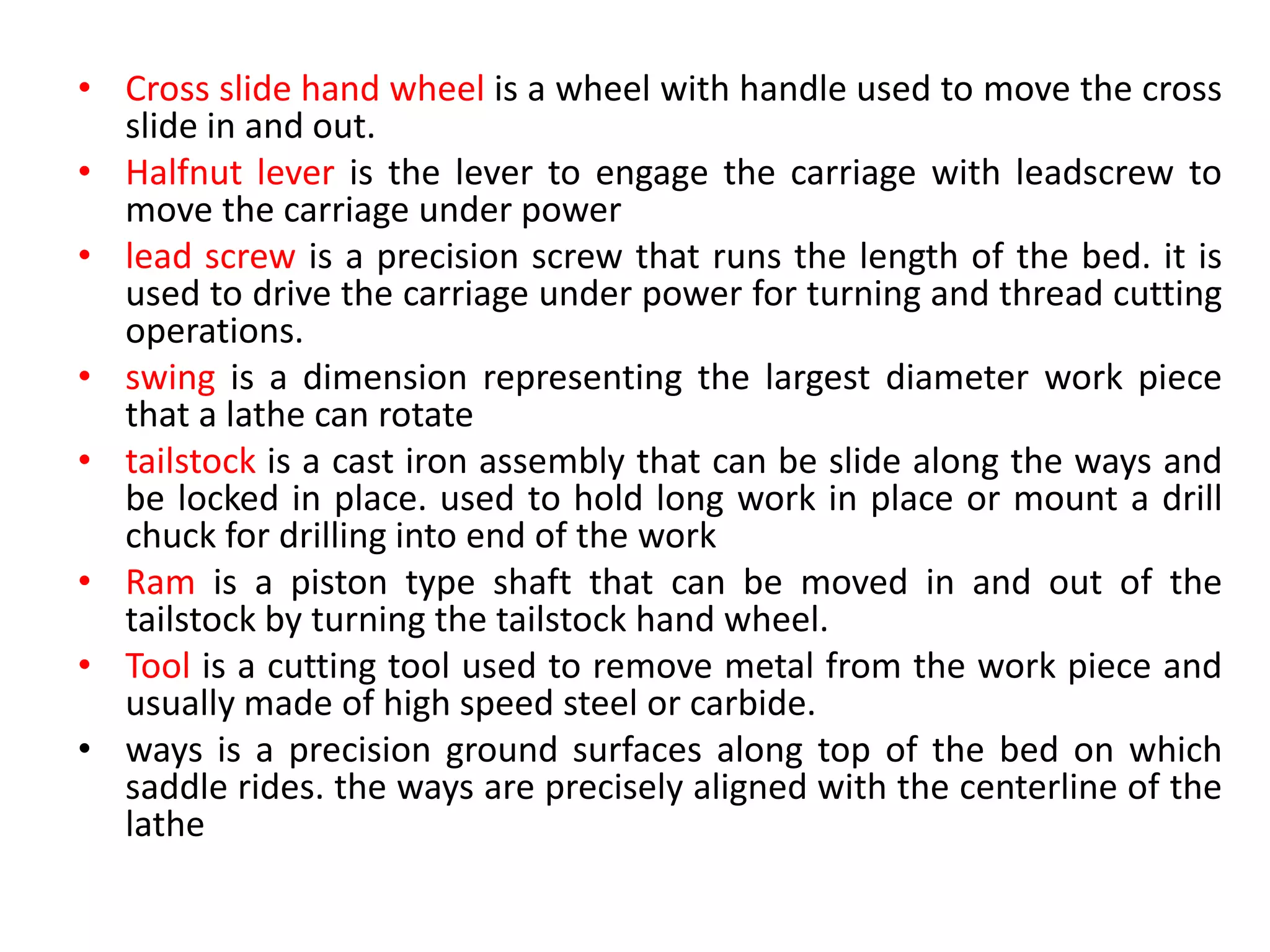
• Cross slide hand wheel is a wheel with handle used to move the cross
slide in and out.
• Halfnut lever is the lever to engage the carriage with leadscrew to
move the carriage under power
• lead screw is a precision screw that runs the length of the bed. it is
used to drive the carriage under power for turning and thread cutting
operations.
• swing is a dimension representing the largest diameter work piece
that a lathe can rotate
• tailstock is a cast iron assembly that can be slide along the ways and
be locked in place. used to hold long work in place or mount a drill
chuck for drilling into end of the work
• Ram is a piston type shaft that can be moved in and out of the
tailstock by turning the tailstock hand wheel.
• Tool is a cutting tool used to remove metal from the work piece and
usually made of high speed steel or carbide.
• ways is a precision ground surfaces along top of the bed on which
saddle rides. the ways are precisely aligned with the centerline of the
lathe
Types of Lathe
• Engine lathes. These are probably the most popular among the lathe
machines. In fact, no machine shop is seen without this type of lathe. The
good thing about engine lathes is that it can be used in various materials,
aside from metal. Moreover, the set-up of these machines is so simple that
they are easier to use. Its main components include the bed, headstock, and
tailstock. These engine lathes can be adjusted to variable speeds for the
accommodation of a wide scope of work. In addition, these lathes come in
various sizes.
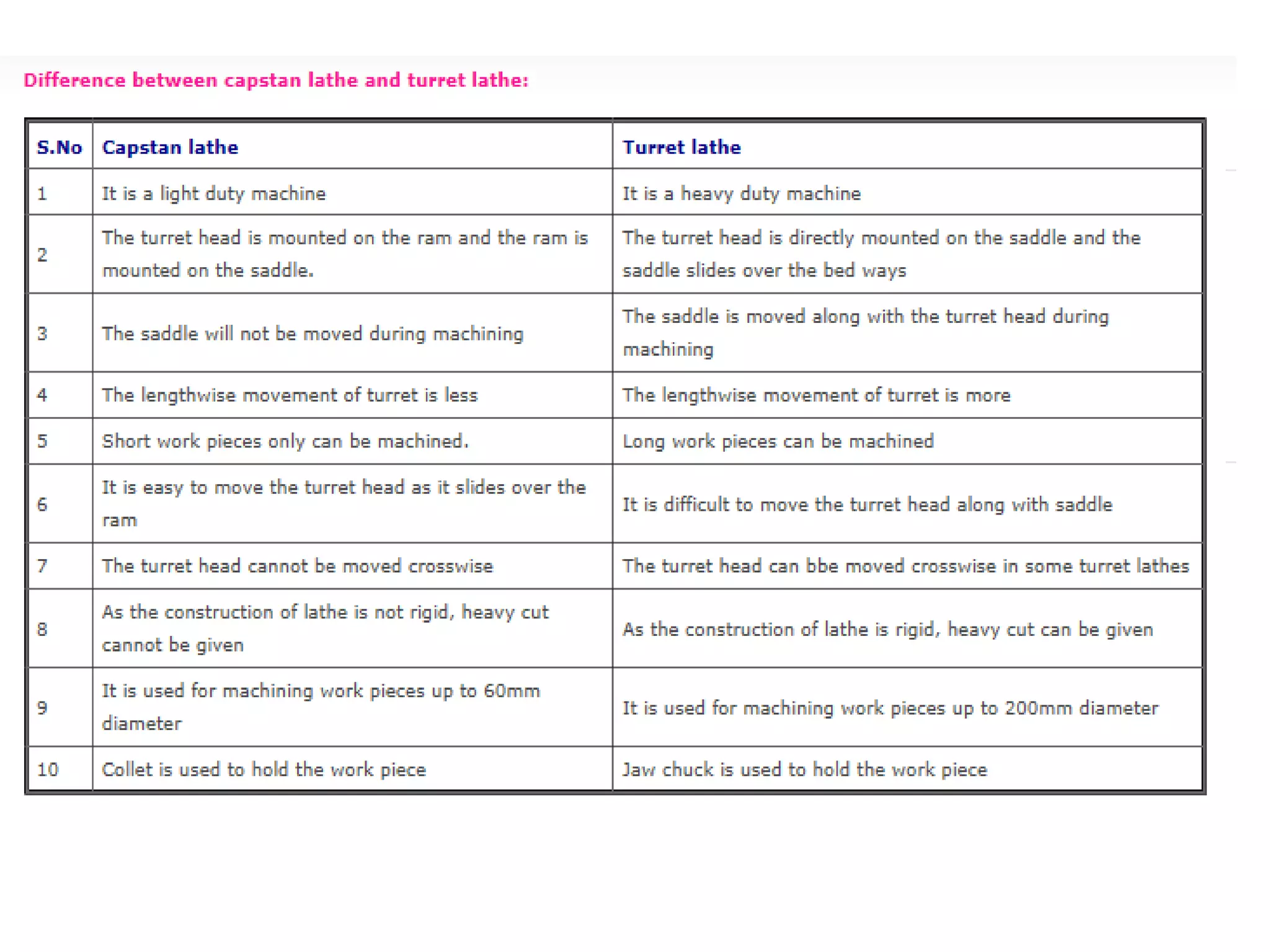
• Turret Lathes. These types of lathes are used for machining single
workpieces sequentially. This means that several operations are needed to
be performed on a single work piece. With the turret lathes, sequential
operations can be done on the work piece, eliminating errors in work
alignment. With this set-up, machining is done more efficiently.
Correspondingly, time is saved because there is no need to remove and
transfer the work piece to another machine anymore.
• Special Purpose Lathes. As the name implies, these lathes are used for
special purposes such as heavy-duty production of identical parts. In
addition, these lathes also perform specific functions that cannot be
performed by the standard lathes. Some examples of special purpose lathes
include the bench-type jewelers’ lathes, automatic lathes, crankshaft
lathes, duplicating lathes, multispindle lathes, brakedrum lathes, and
production lathes among others.
Engine Lathe (centre lathe)
The most common form of lathe, motor driven
and comes in large variety of sizes and shapes.
found in floor shops, tool rooms, and job shops
Primarily for single piece or short runs
Manually operated
Types of Lathe
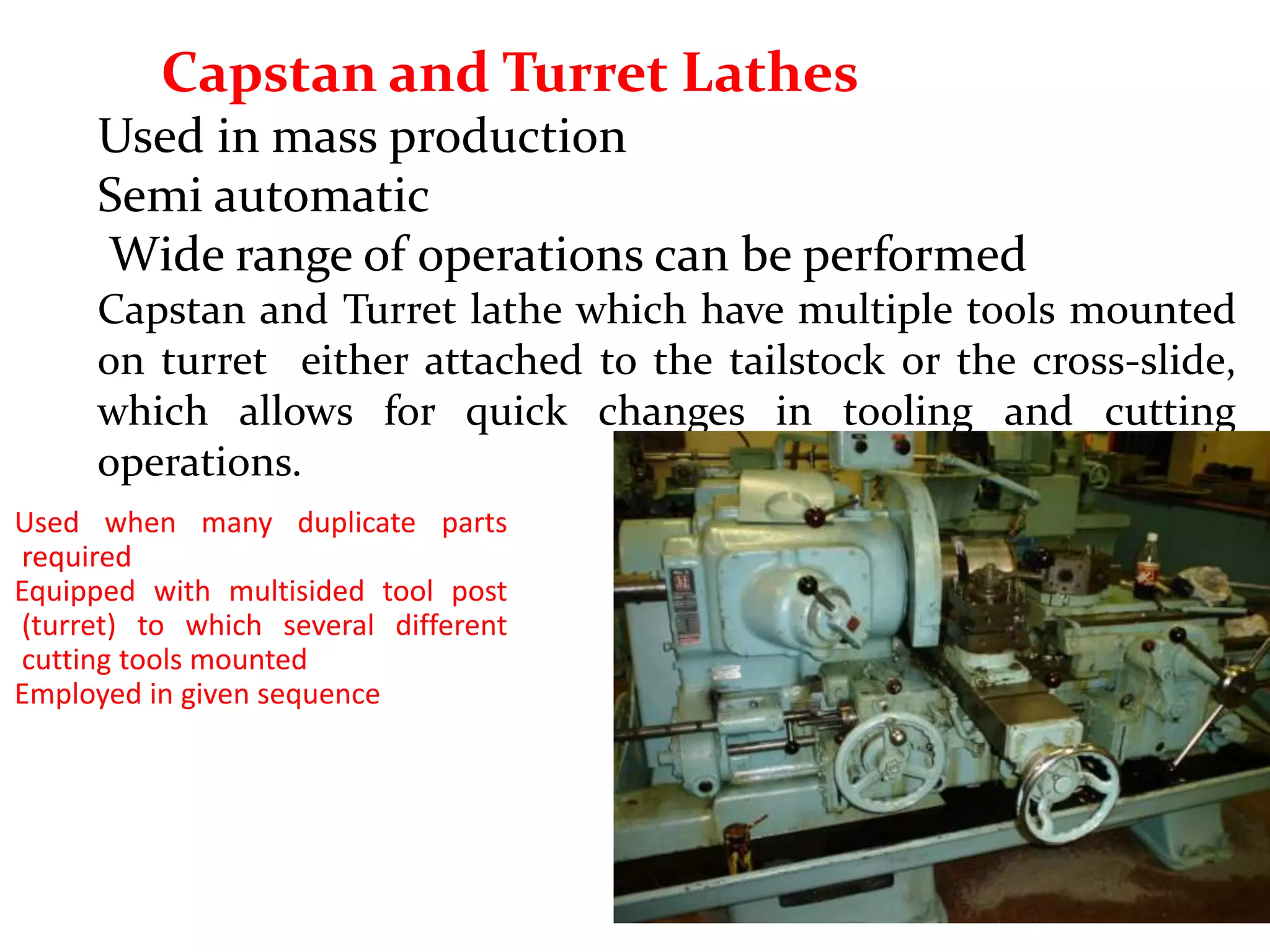
Capstan and Turret Lathes
Used in mass production
Semi automatic
Wide range of operations can be performed
Capstan and Turret lathe which have multiple tools mounted
on turret either attached to the tailstock or the cross-slide,
which allows for quick changes in tooling and cutting
operations.
Used when many duplicate parts
required
Equipped with multisided tool post
(turret) to which several different
cutting tools mounted
Employed in given sequence
Component Description
Tail stock
Speed
gearbox
Head stock
Feed
rod
Lead screw
Half nut Apron box
Lathe
bed
rac
k
Feed gear
box
Dead centre
ram
carriage
clamp
Main driving
pulley
Tool post
• Bed
• Headstock
• Tailstock
• Carriage
Lathe parts
Lathe parts contd.
Bed-
• Base of the lathe
 Supports all major
components of the lathe machine.
 Large mass and made from
gray cast iron
 Three main parts of the lathe
–headstock, tailstock and carriage
are mounted on the bed of the
lathe.
 Top of the bed has two guide
ways or slide ways to provide
support and sliding surfaces for the
carriage and for the tailstock.
Secured permanently at the left
hand end of the lathe bed.
It supports the spindle and is
equipped with the power
driving mechanism for the
spindle. The spindle speed can
be set through speed selector
knobs. The spindle is hollow to
facilitate holding of long work
pieces.
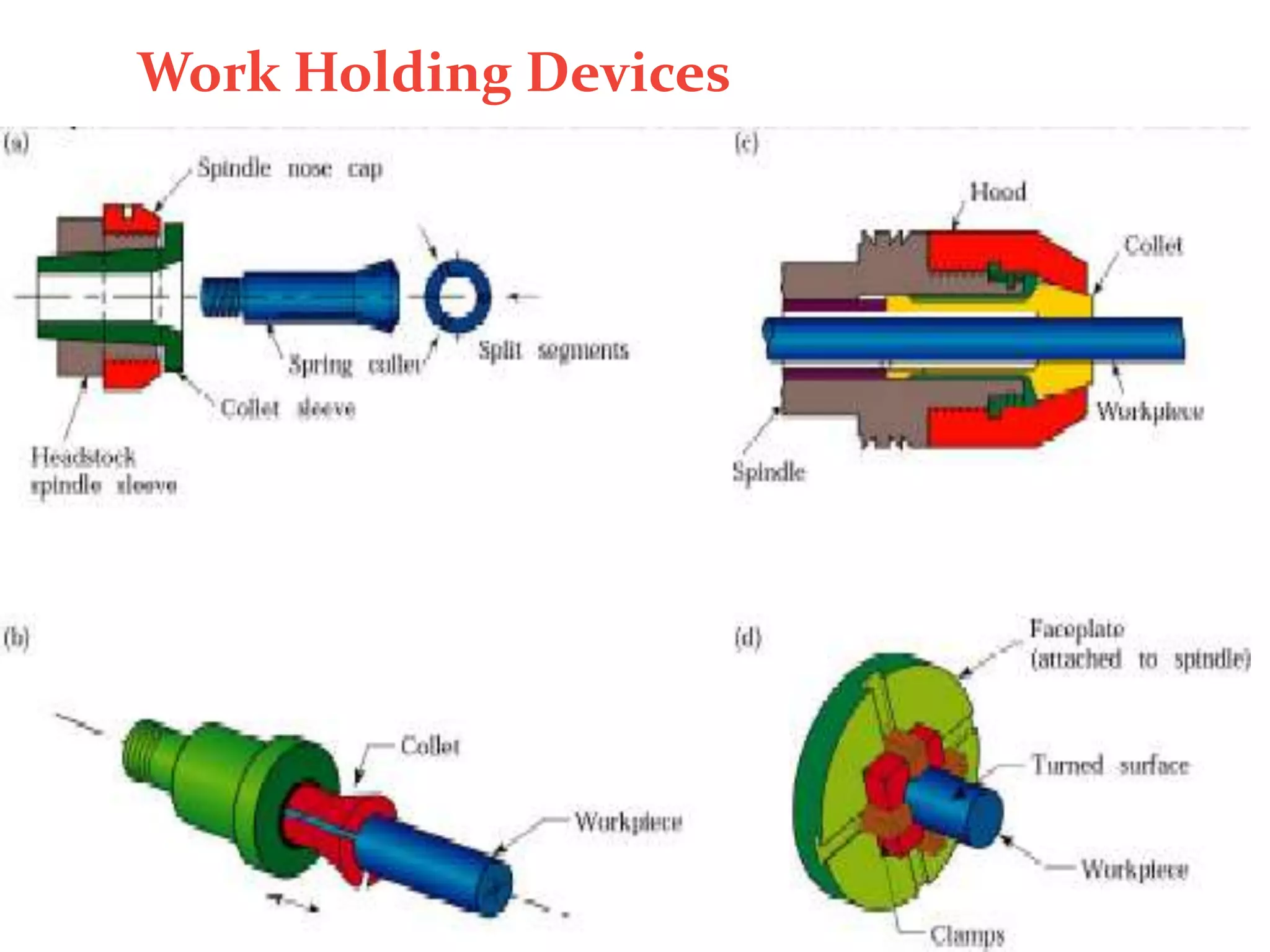
The work holding devices such
as chucks,centres and collets
are attached to the spindle.
Headstock
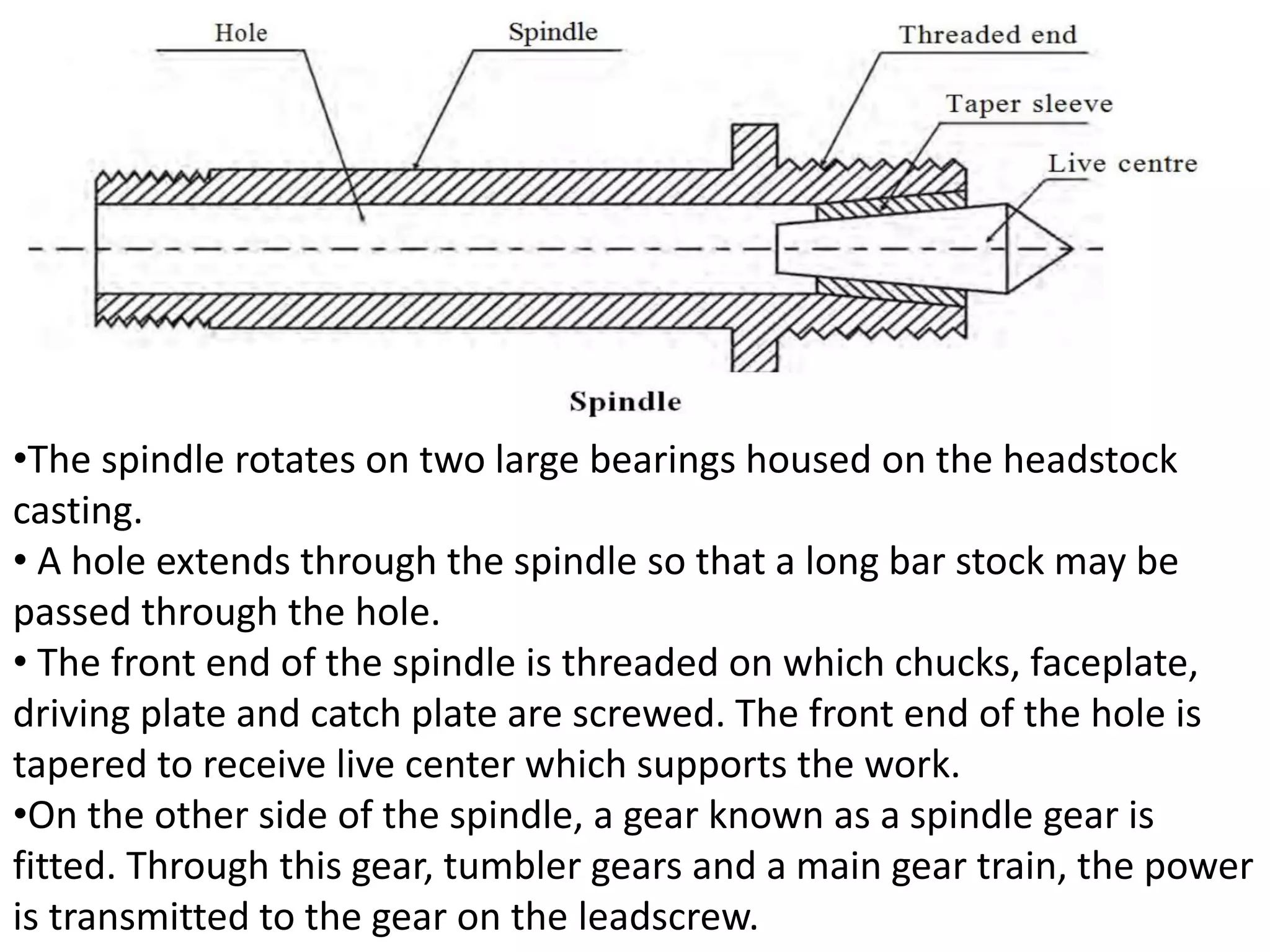
•The spindle rotates on two large bearings housed on the headstock
casting.
• A hole extends through the spindle so that a long bar stock may be
passed through the hole.
• The front end of the spindle is threaded on which chucks, faceplate,
driving plate and catch plate are screwed. The front end of the hole is
tapered to receive live center which supports the work.
•On the other side of the spindle, a gear known as a spindle gear is
fitted. Through this gear, tumbler gears and a main gear train, the power
is transmitted to the gear on the leadscrew.
Located at the right hand end of the bed
Can be moved along the guide ways and can be
clamped in any position on the bed.
Also called loose headstock
Main purpose is to hold the dead centre and to
support the long work pieces during machining.
It has a quill, into which the
deadcentre,drills,reamers can be fixed.
The quill can move in and out with the help of
hand wheel.
Tail stock
• Tailstock is located on the inner guideways at the right side of the
bed opposite to the headstock. The body of the tailstock is bored
and houses the tailstock spindle or ram. The spindle moves front
and back inside the hole. The spindle has a taper hole to receive
the dead centre or shanks of tools like drill or reamer. If the
tailstock handwheel is rotated in the clockwise direction, the
spindle advances. The spindle will be withdrawn inside the hole, if
the handwheel is rotated in anti-clockwise direction.
• To remove the dead centre or any other tool from the spindle, the
handwheel is rotated in anticlockwise direction further. The
movement of the spindle inside the hole may be locked by
operating the spindle clamp located on top of the tailstock. In
order to hold workpieces of different lengths, the tailstock can be
locked at any desired position on the lathe bed. Tailstock clamping
bolts are used for this purpose.
• Tailstock is designed to function as two units-the base and the
body. The base of the tailstock is clamped to the bed. The body is
placed on the base and can be made to slide sidewards-
perpendicular to the bed guideways upto a certain distance.
The uses of tailstock
• It supports the other end of the long workpiece
when it is machined between
• It is useful in holding tools like drills, reamers when
performing drilling, reaming
• The dead centre is off set by a small distance from
the axis of the lathe to turn tapers by set over
• It is useful in setting the cutting tool at correct
height aligning the cutting edge with lathe
Carriage
The carriage slides along the guide ways between headstock and
tailstock and consists of an assembly of the cross-slide, tool post,
the compound rest and the apron.
Main function is to hold the cutting tool and move it to give
longitudinal and cross feed to it. The cross-slide moves radially in
and out, thus controlling the radial position of the cutting tool.
The compound rest, also called compound slide is mounted on the
top of the cross slide and has circular base graduated in degrees. It
is used for obtaining angular cuts and short tapers. Compound rest
swivels the tool for positioning and adjustment. The tool post is
located at the top of the compound rest to hold the tool and to
enable it to be adjusted to a convenient working position. The
apron is equipped with mechanisms for both manual and
mechanized movements of the carriage and the cross-slide , by
means of a lead screw and feed rod.
Saddle:
• It is an “H” shaped casting. It connects the pair of bed guideways like a
bridge. It fits over the bed and slides along the bed between headstock and
tailstock. The saddle or the entire carriage can be moved by providing hand
feed or automatic feed.
Cross slide:
• Cross-slide is situated on the saddle and slides on the dovetail guideways at
right angles to the bed guideways. It carries compound rest, compound
slide and tool post. Cross slide handwheel is rotated to move it at right
angles to the lathe axis. It can also be power driven. The cross slide hand
wheel is graduated on its rim to enable to give known amount of feed as
accurate as 0.05mm.
Compound rest:
• Compound rest is a part which connects cross slide and compound slide. It
is mounted on the cross-slide by tongue and groove joint. It has a circular
base on which angular graduations are marked. The compound rest can be
swiveled to the required angle while turning tapers. A top slide known as
compound slide is attached to the compound rest by dove tail joint. The
tool post is situated on the compound slide.
Tool post:
• This is located on top of the compound slide. It is used to hold the tools
rigidly. Tools are selected according to the type of operation and mounted
on the tool post and adjusted to a convenient working position
Apron
• The apron is bolted to the front of the saddle .
The apron houses the gears and control for
the carriage and the feed mechanism.
Feed rod and lead screw
 The feed rod is powered by a set of gears from the head stock.
It rotates during the operation of the lathe and provides
mechanized movement to the carriage by means of gears, a
friction clutch, and a keyways along the length of the feed rod.
 The lead screw is also powered by the gears from the
headstock and is used for providing specific accurate
mechanized movement to the carriage for cutting threads on
the work piece. The lead screw has a definite pitch.
 A split nut in the apron is used to engage the lead screw with
the carriage. In some lathes, the lead screw performs the
functions of feed rod and there is no separate feed rod.
Similarly a lathe not meant for thread cutting will not have a
lead screw.
 (Speed of the lead screw/Speed of the work)=(Pitch of the
screw to be cut/Pitch of the lead screw)
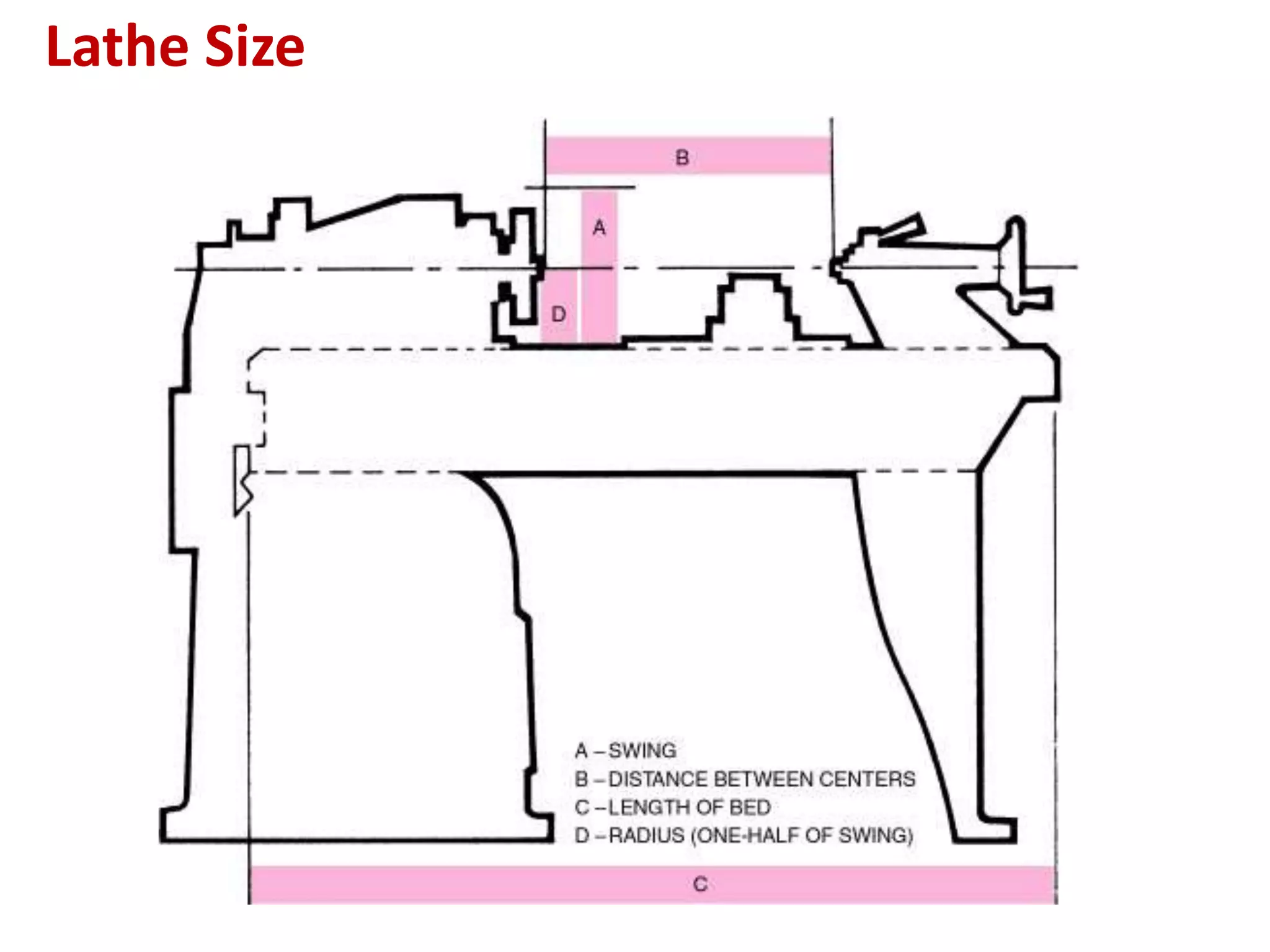
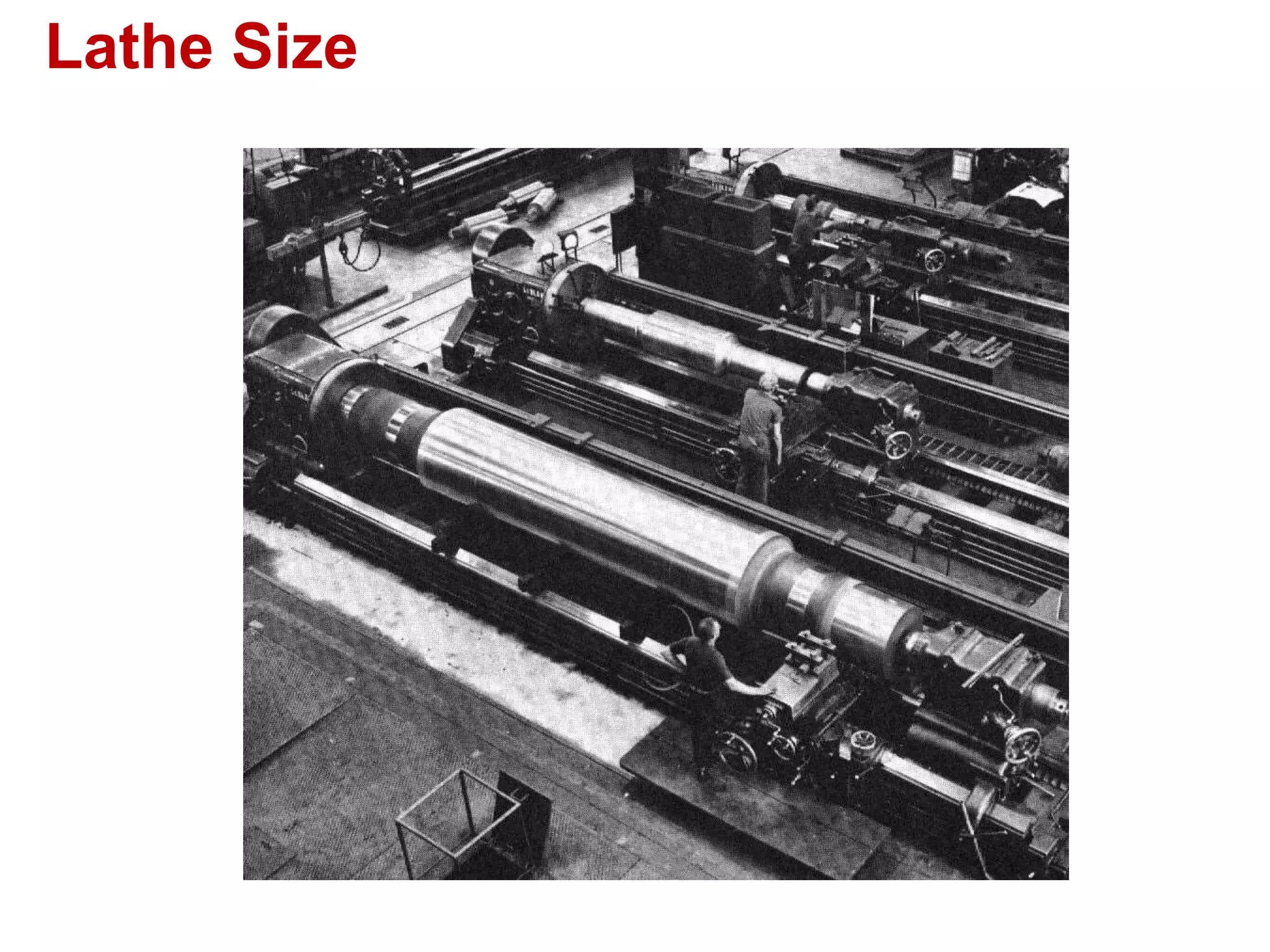
Size of a lathe
• The size of a lathe is expressed or specified by the
maximum size that can be handled by the lathe
• The swing diameter over bed.(This is the largest
diameter of work that will revolve without touching the
bed and is twice the height of the centre measured from
the bed of the lathe.)
• The swing diameter over carriage.(This is the largest
diameter of work that will revolve over the lathe saddle
and is always less than the swing diameter over bed.)
• The distance between centers.(This is the maximum
length of work that can be mounted between the lathe
centers.
• The maximum bar diameter(This is the maximum
diameter of bar stock that will pass through the hole of
the head stock spindle).
• The length of bed.(This indicates the approximate floor
space occupied by the lathe)
Lathe Size
Lathe Size
Lathe Size
Lathe Size
Operating condition in a lathe
 Cutting speed
 Feed
 Depth of cut
1-Cutting speed
In a lathe, for the turning operation, cutting speed is the
peripheral speed of the work piece past the cutting tool.
Expressed in meters/minute.
Cutting speed= m/min
Where D= diameter of the work piece in mm.
N=rpm of the work
Depth of Cut
Perpendicular distance between machined surface and
uncut surface of the Work-piece
d = (D1 – D2)/2 (mm)
d Depth
of Cut
DD 21
Feed
f – the distance the tool advances for every rotation
of workpiece (mm/rev)
f
Feed
DD 21
Feed
 The feed of a cutting tool in a lathe work is the distance the
tool advances for each revolution of the work.
 Feed is expressed as mm/revolution.
 Increased feed reduces cutting time. But increased feed
greatly reduces the tool life.
 The feed depends on factors such as size, shape, strength
of the work material and method of holding the
component, the tool shape, the rigidity of the machine,
depth of cut, power available etc. Coarser feeds are used for
roughing and finer feeds for finishing cuts.
Machining time
The time required to machine a component is called
MACHINING TIME.
Machining time depends upon
• Size of the work piece
• Amount of material removed
• The operating condition(speed, feed, depth of cut)
• Consider the feed and speed(f×N)
• the feed rate in mm/min. It gives the distance that the
tool moves (f×N) in mm in one minute.
• Hence , for a distance L , the time required for one
complete cut, “t” in minute is given by
t= minute
Problem -1
A mild steel rod having 50 mm diameter and 500 mm length is to be turned
on a lathe. Determine the machining time to reduce the rod to 45 mm in one
pass when cutting speed is 30 m/min and a feed of 0.7 mm/rev is used.
Solution
Given data:
D = 50 mm,
Lj = 500 mm
v = 30 m/min,
f= 0.7 mm/rev
Substituting the values of v and D in
V = ΠDN/1000 m/min
Required spindle speed as: N = 191 rpm
A cylindrical stainless steel rod with length L=150 mm,
diameter D0 = 12 mm is being reduced in diameter to
Df =11 mm by turning on a lathe. The spindle rotates
at N = 400 rpm, and the tool is travelling at an axial
speed of υ=200 mm/min
Calculate:
a. The cutting speed V (maximum and minimum)
b. The depth of cut and the cutting time t
a. The maximum cutting speed is at the outer diameterD0, and
is obtained from the expression
V = π D0N
Thus,
Vmax = (π) (12) (400) = 15072 mm/min
The cutting speed at the inner diameter Df is
Vmin = (π) (11) (400) = 13816 mm/min
b. From the information given, the depth of cut
is
d = (12 – 11) / 2 = 0.5 mm
and the feed is
f = υ / Ν
f = 200 / 400 = 0.5 mm/rev
The cutting time is
t = l / (f. N) = (150) / (0.5) (400) = 0.75 min
Manufacturing time
• Total manufacturing time = machining time + set
up time + moving and waiting time+ inspection
time
• Time required for setting the tool , work piece
and machine is known as set up time.
• Movement time is the time when component has
to move from machine to machine and may wait
before the machines getting processed, that time
is called waiting time
• During and after machining , components are
inspected that time is called inspection time
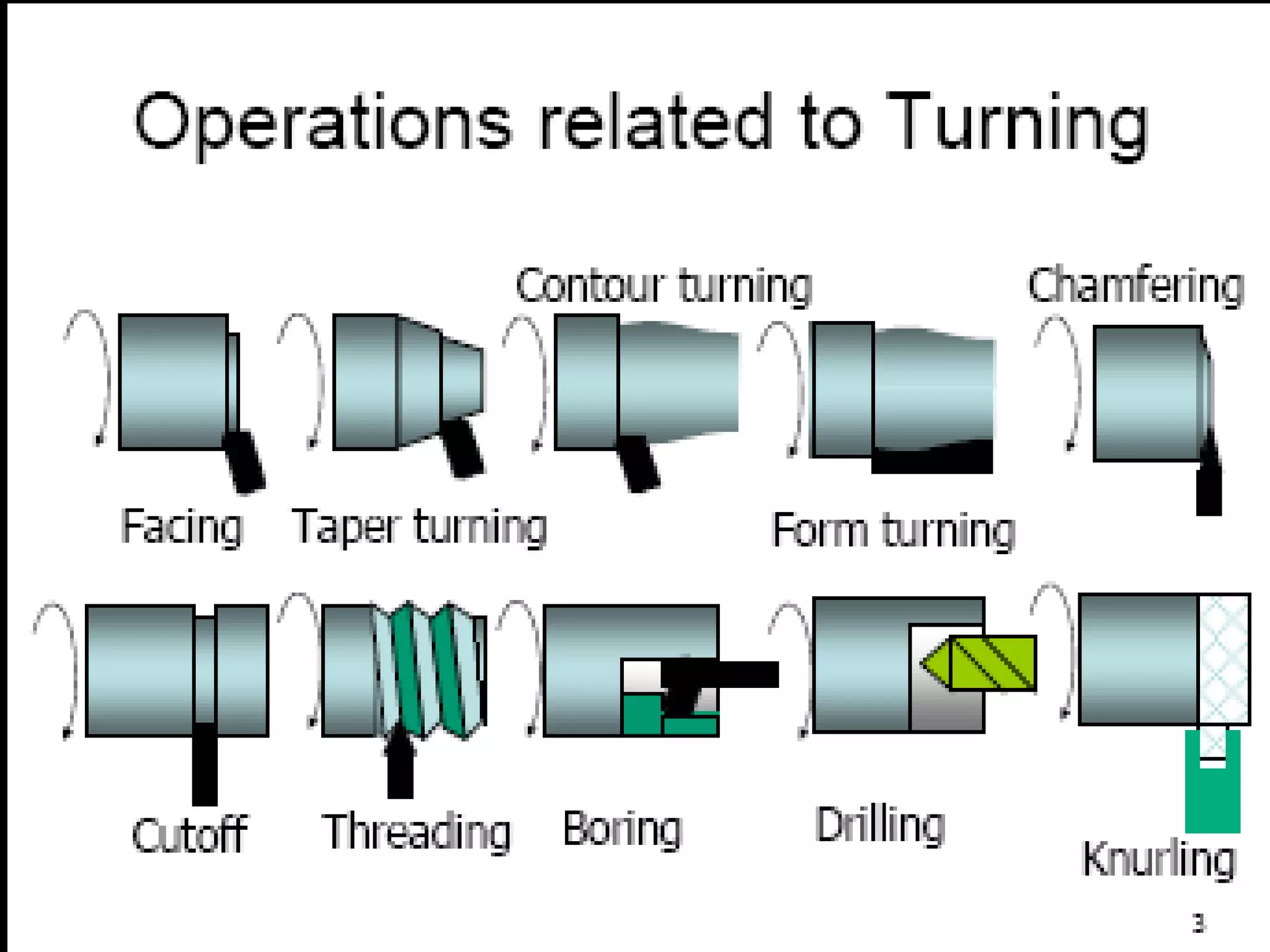
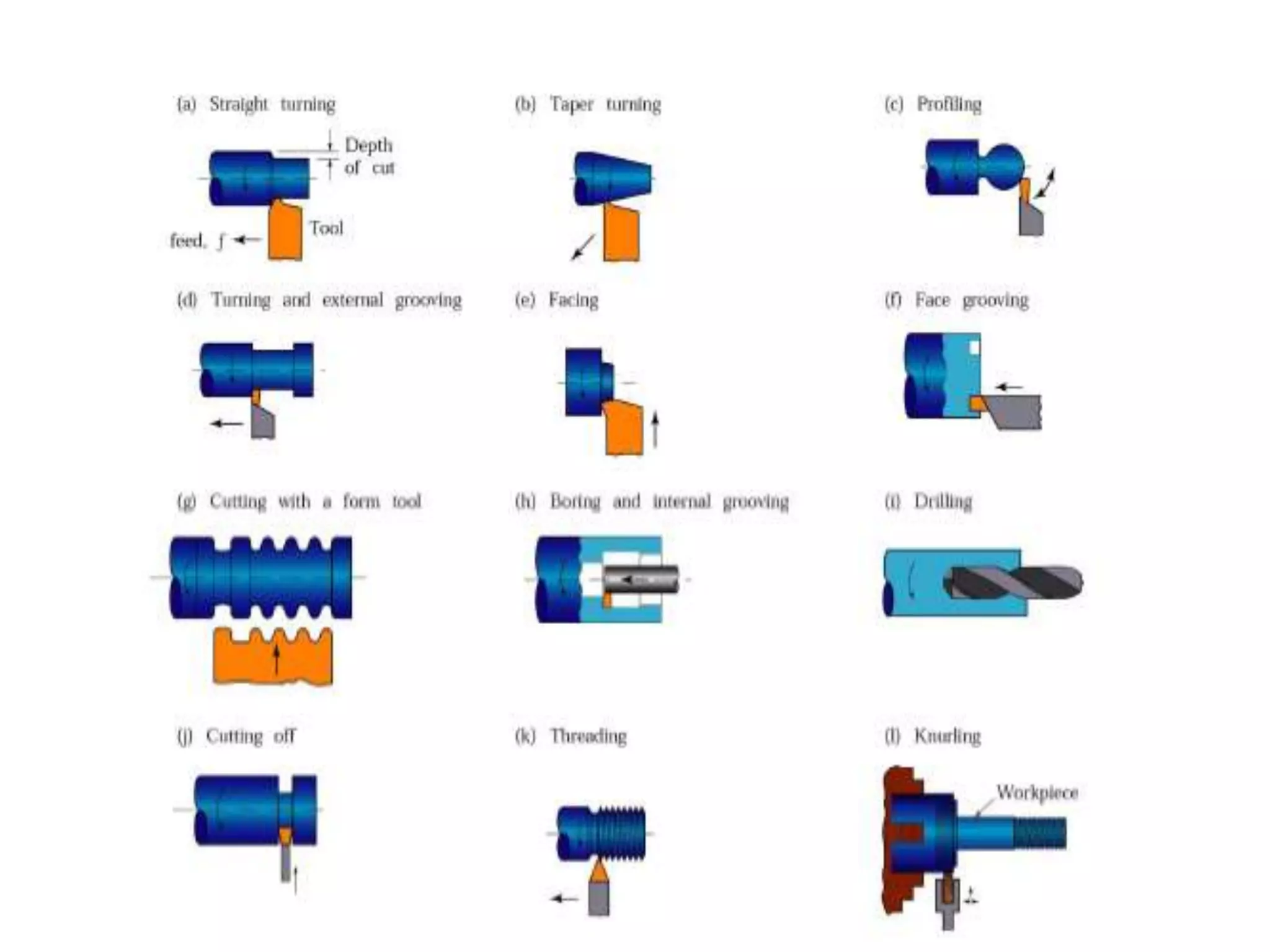
Machining operation done in lathe
• Straight turning
• Taper turning
• Chamfering
• Drilling
• Reaming
• Boring
• Counter boring
• Taper boring
• Internal thread cutting
• Tapping
•Parting off
•Thread cutting
•Facing
•Knurling
•Filing
•Polishing
•Grooving
•Forming
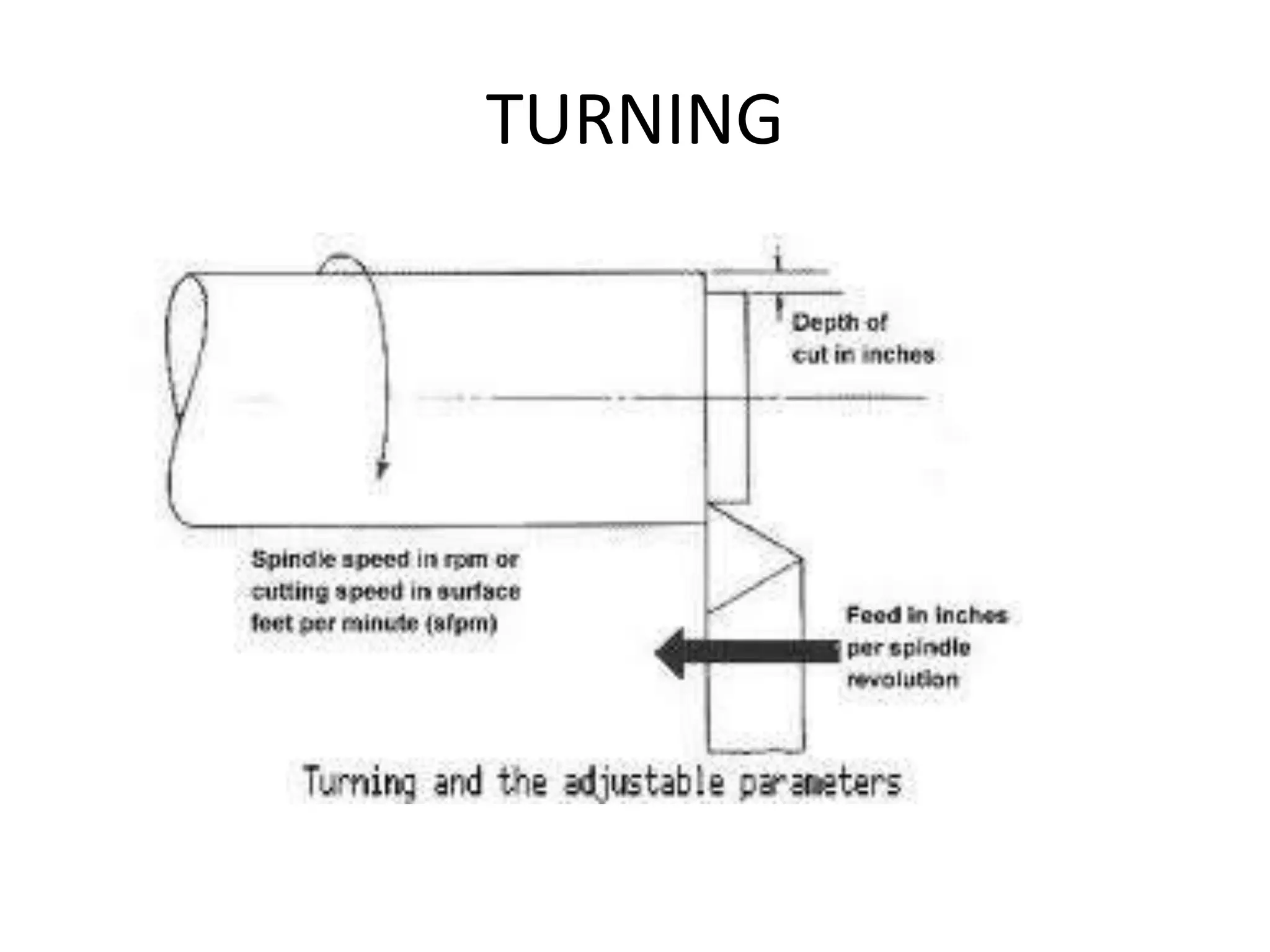
Turning ..
• Excess Material is removed to reduce
Diameter
• ROUGH TURNING: is the term used for
the process of heavy stock removal in
order to save machining time.
• FINISH TURNING operation in the order
to bring the job to a correct size and
provide a fine finish on it.
• Cutting Tool: Turning Tool
a depth of cut of 1 mm will reduce
diameter by 2 mm
TURNING
Facing
Flat Surface/Reduce length
Depth of
cut
Feed
WorkpieceChuck
Cutting
speed
Tool
d
Machined
Face
Facing ..
• Machining at the end of job  Flat surface
or to Reduce Length of Job
• Turning Tool
• Feed: in direction perpendicular to work-piece
axis
• Length of Tool Travel = radius of work-piece
• Depth of Cut: in direction parallel to work-piece
axis
• Rough facing: Cross feed-0.5-0.7mm & DOC- up
to 5mm
• Fine facing: C.F-0.1-0.3mm & DOC-0.5mm.
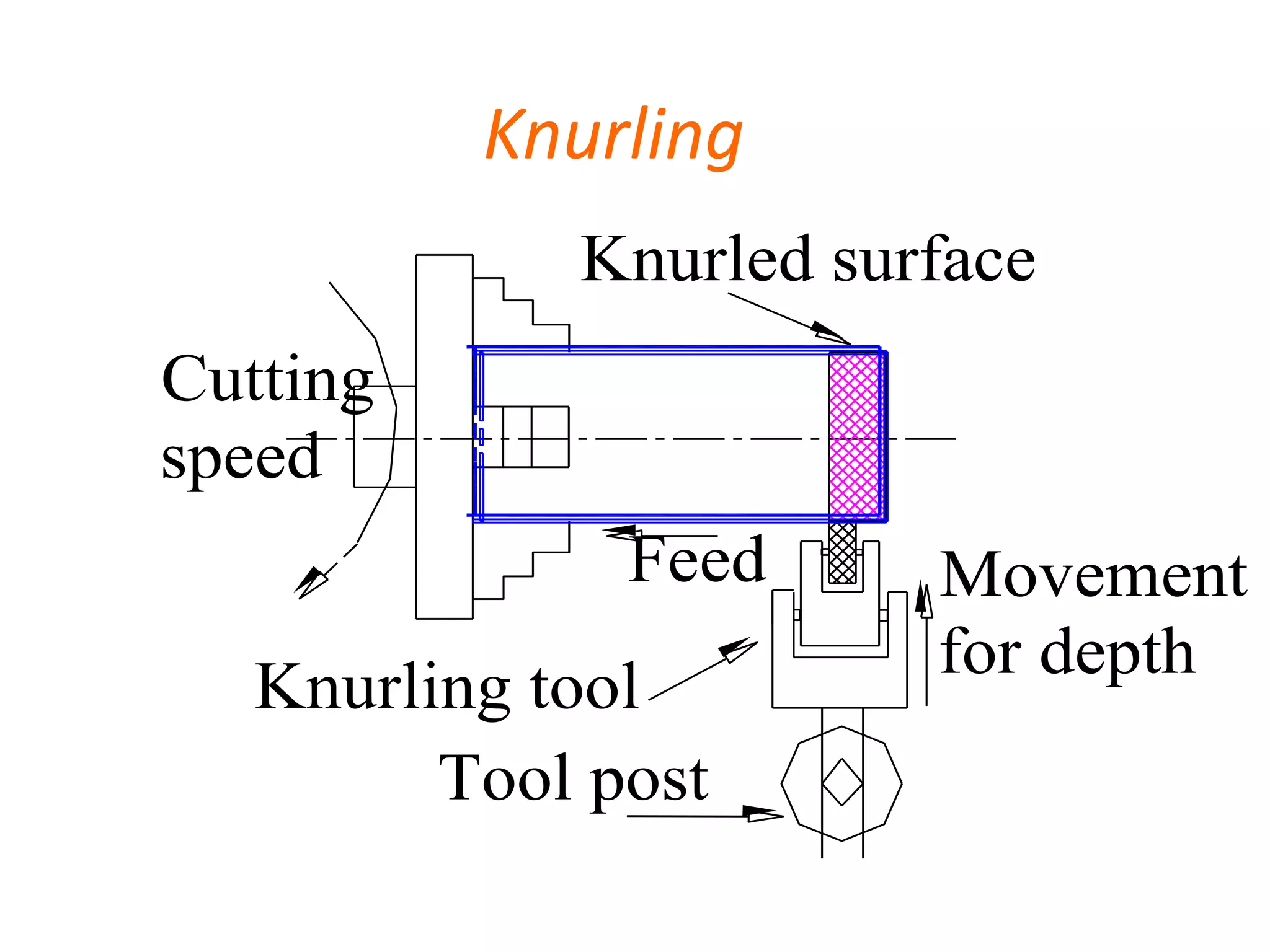
Knurling
• Produce rough textured surface
– For Decorative and/or Functional Purpose
• Knurling Tool
• Handles of many components, instruments and
tools, gauges and heads of small screws etc.,
are usually provided with rolled depressions on
them to provide a better grip in comparison to
a smooth surface.
• The indentation –KNURLS
• Surface – KNURLED
• The operation performing these knurls-
KNURLING
Knurling
Knurling tool
Tool post
Feed
Cutting
speed
Movement
for depth
Knurled surface
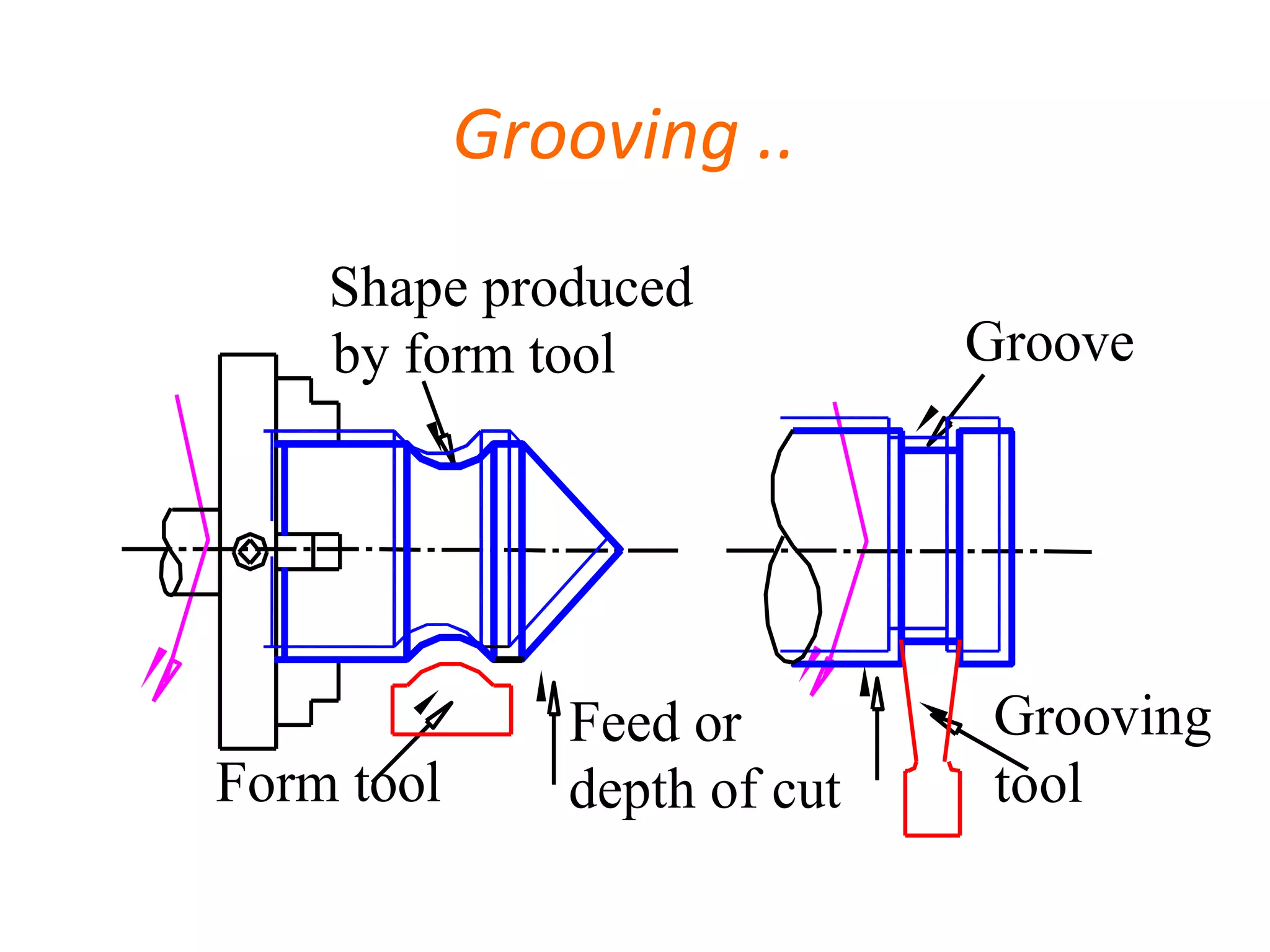
Grooving
• Produces a Groove on
workpiece
• Shape of tool  shape of
groove
• Carried out using Grooving Tool
 A form tool
• Also called Form Turning
Grooving ..
Shape produced
by form tool Groove
Grooving
tool
Feed or
depth of cutForm tool
Parting off or cutting off
• It is the operation employed for cutting away
a desired length from the bar stock.
• Parting Tool – similar to square grooving tool
but have a longer point(to reach the center of
the job)
• Feed- Cross feed
Parting ..
FeedParting tool
Chamfering
 Beveling sharp machined edges
 Similar to form turning
 Chamfering tool – 45°
• Avoid Sharp Edges
• Make Assembly Easier
• Improve Aesthetics
Drilling
* Work is held in a suitable device, such as a
chuck or face plate and the drill is held in the
sleeve or barrel of the tail stock.
* In the case of blind holes, the required depth
is marked on the drill.
Feed
Drill
Quill
clamp moving
quill
Tail stock clamp
Tail stock
Tapers and taper turning
A taper may be defined as a uniform increase
or decrease in diameter of a piece of work
measured along its length.
In a lathe taper turning means to produce a
conical surface by gradual reduction in
diameter from a cylindrical work piece.
• Taper:
 C
B
A L
D
90°
 2D1
L
DD
2
tan 21 

D= larger diameter of taper in mm
d= smaller diameter of tapered in mm
L= length of tapered part in mm
2α= full taper angle
α=angle of taper or half taper angle
The common methods of expressing the taper are.
1.Taper per foot: the difference in inches of
end diameters per foot length of the job.
2. Taper per inch: the difference in inches of
end diameter per inch length of the job
3. Taper 1 in X: For this units should be
uniform, such as a taper 1 in 20 means either
a taper of I inch on 20 inches or a taper of 1
Foot over a 20 feet length.
• From the geometry
tanα=
The amount of taper in a work piece is usually
specified by the ratio of the difference in
diameters of the taper to its length.
This is termed as the CONICITY and it is
designated by the letter K.
K=
Taper Turning..
Methods
 Form Tool
 Swiveling Compound Rest
 Simultaneous Longitudinal and Cross
Feeds
Taper Turning Attachment
Tailstock set over
Conicity
L
DD
K 21 

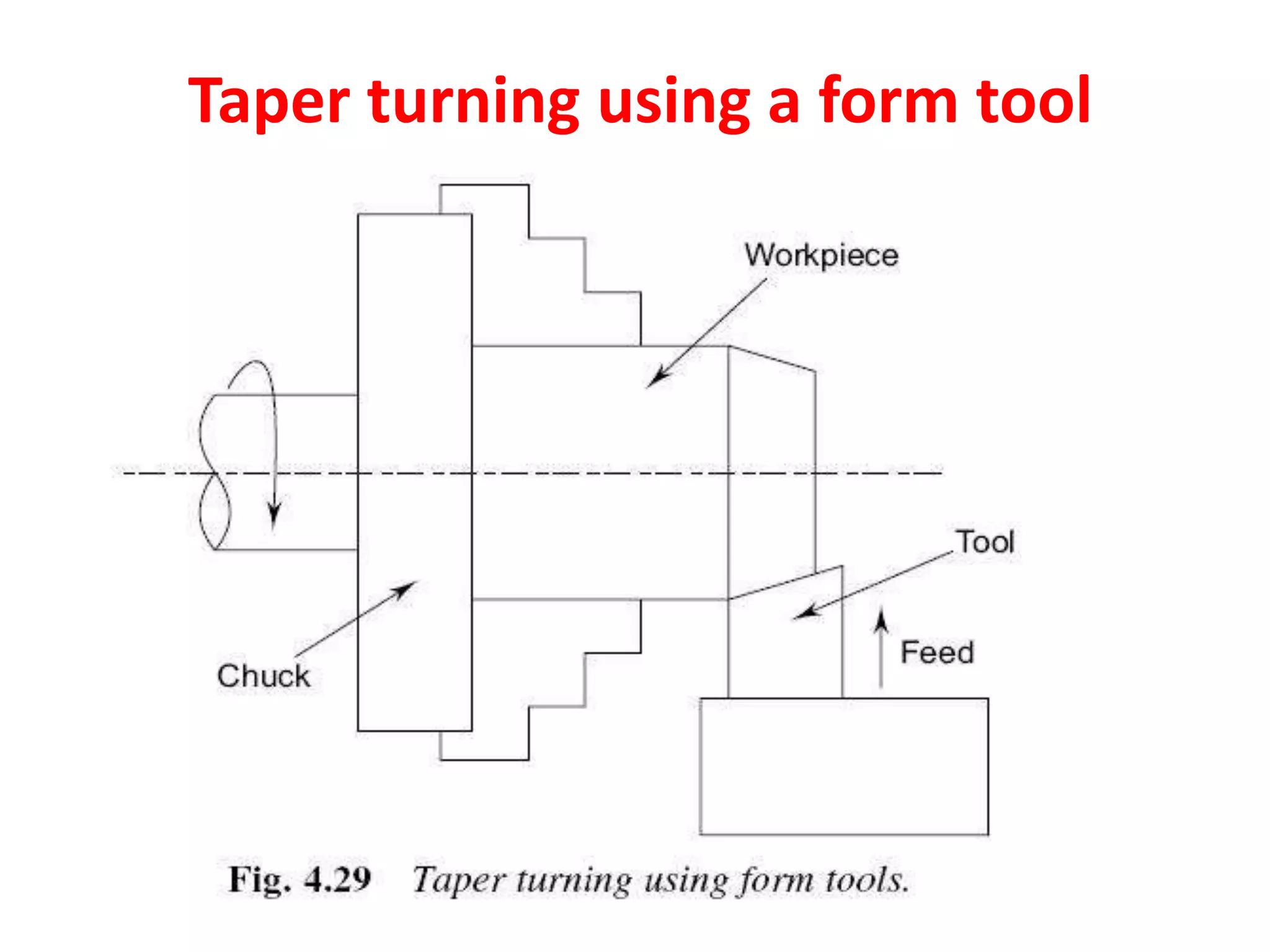
Taper turning using a form tool
 Shape of the tool is remain same as the shape of
the component to be produced.
 Accuracy of taper produce depends on accuracy of
taper present on tool
 Width of tool must be greater than or equal to the
length of workpiece to be taper turned.
 Maximum length of component which can be
taper turned is 20 mm( small lengths) only
 Only external taper turning is possible.
• Limitation-
This method is limited only for short length
taper. Because the metal is removed by the
entire cutting edge, and only increase in the
length of the taper will necessitate the use of a
wider cutting edge. This will require excessive
cutting pressure, which may distort the work due
to vibration and spoil the work piece.
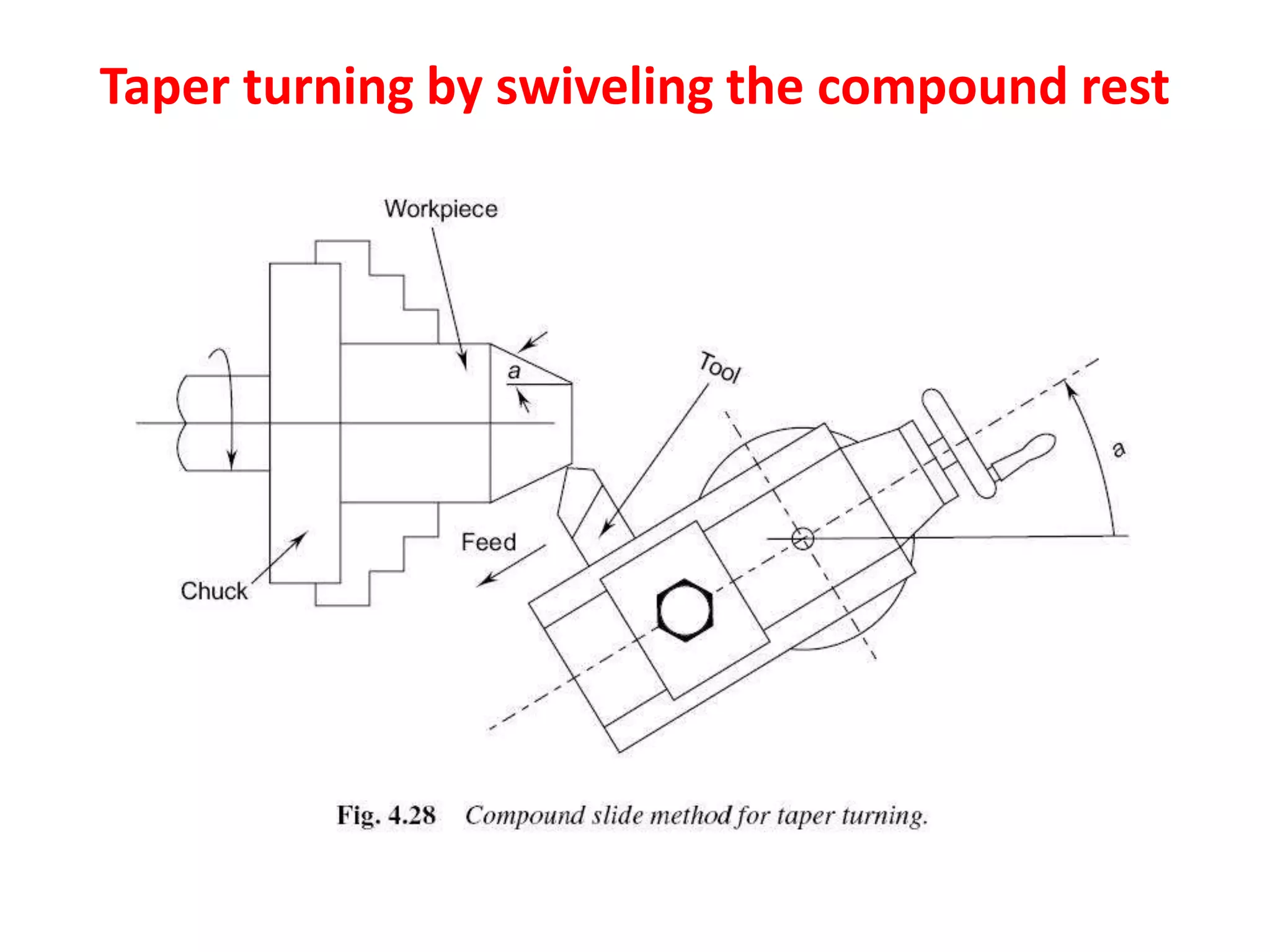
Taper turning by swiveling the compound rest
• The compound rest has a circular base graduated in
degrees, which can be swiveled at any angle.
• While turning a taper, the base of compound rest is
swiveled through an angle equal to the half taper angle.
The tool is then fed by hand.
• Once the compound rest is set at the desired half taper
angle, rotation of the compound slide screw will cause
the tool to be fed at that angle and generate a
corresponding taper.
• The movement of the tool in this method being purely
controlled by hand, this gives a low production capacity
and poorer surface finish. The setting of the compound
rest is done by swiveling the rest at the half taper
angle, if this is already known. If the diameter of the
small and large end and length of taper are known, the
half taper angle can be calculated.
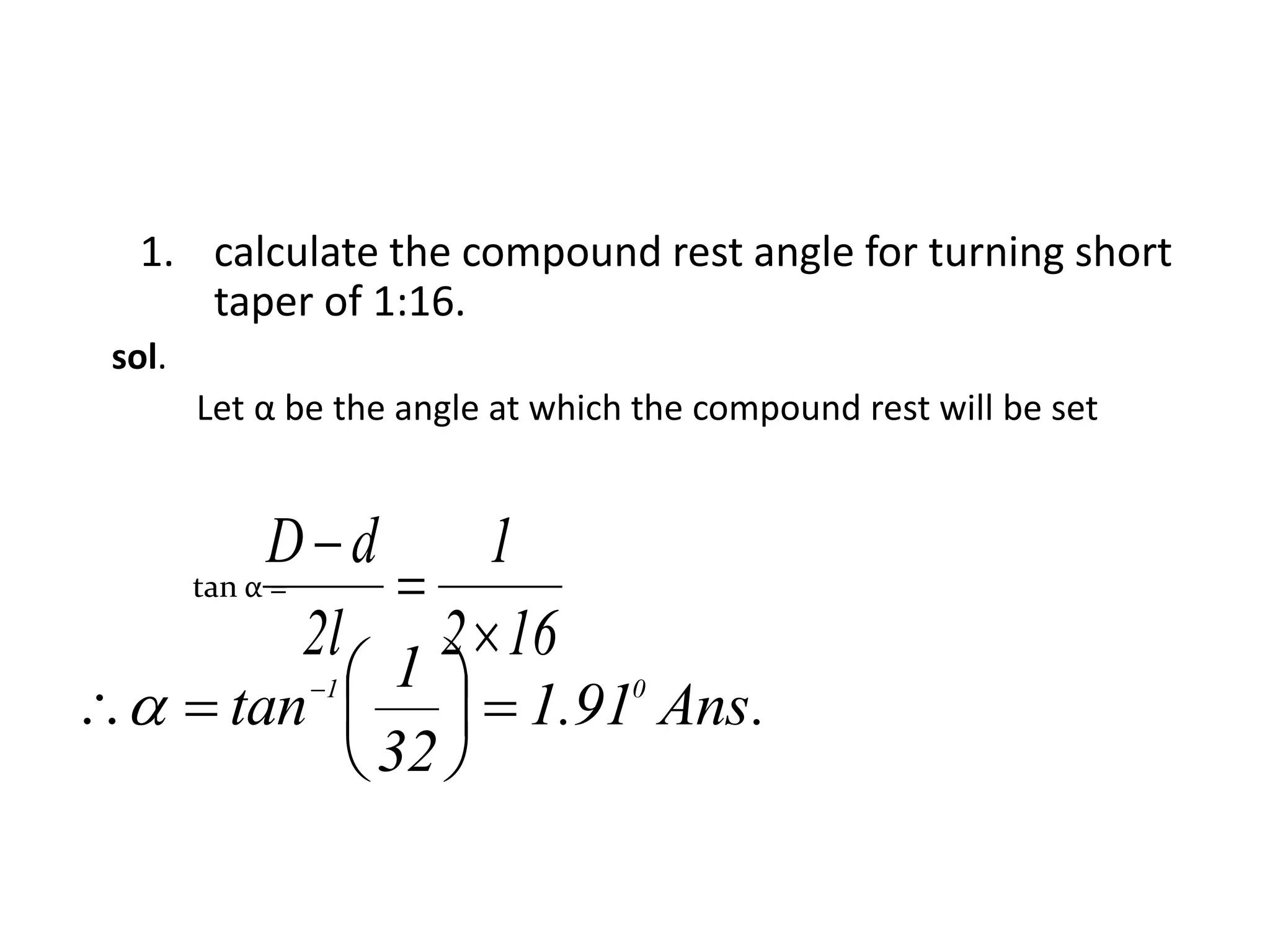
1. calculate the compound rest angle for turning short
taper of 1:16.
sol.
Let α be the angle at which the compound rest will be set
tan α =
162
1
l2
dD



.Ans91.1
32
1
tan 01






 

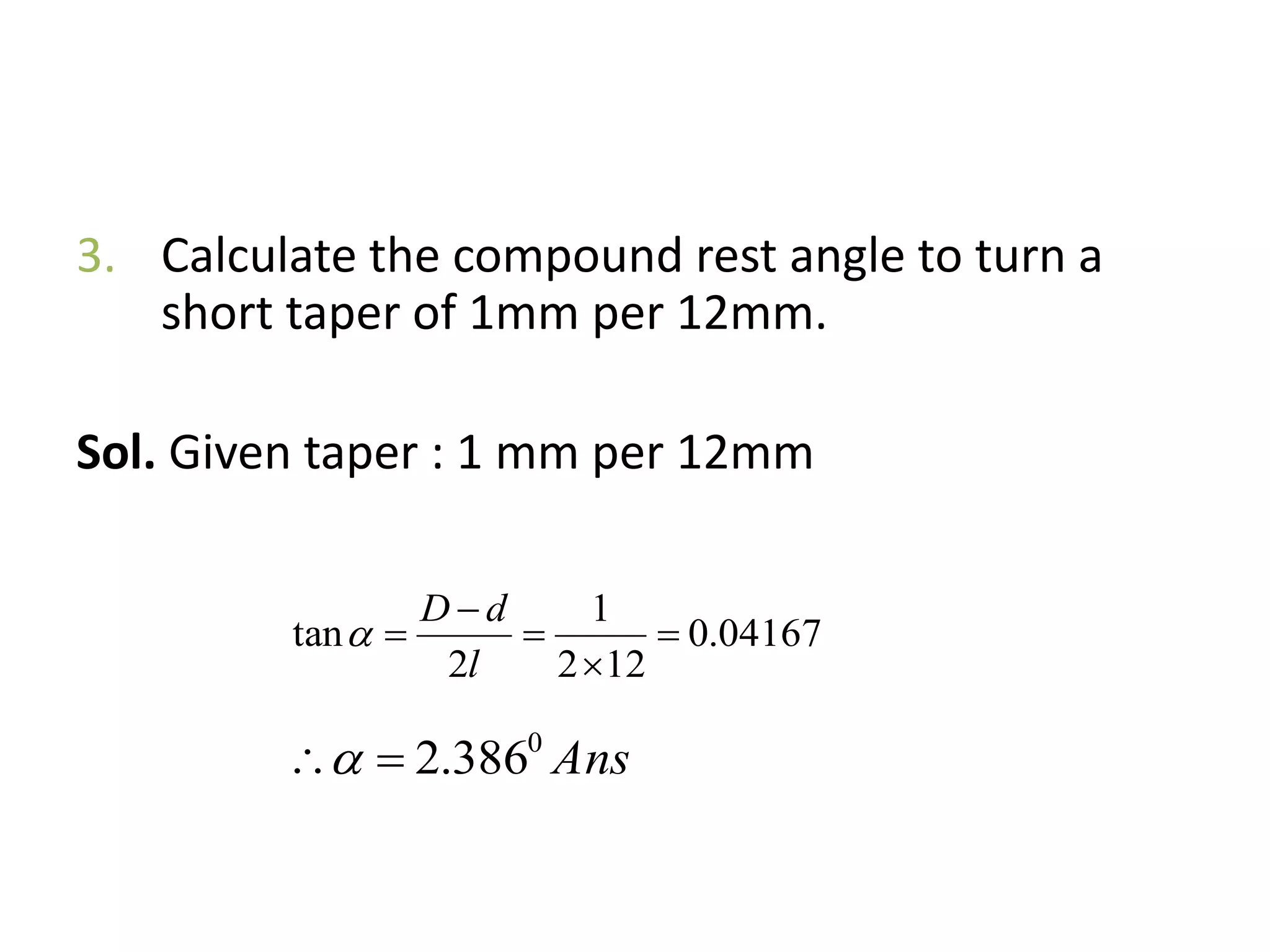
3. Calculate the compound rest angle to turn a
short taper of 1mm per 12mm.
Sol. Given taper : 1 mm per 12mm
04167.0
122
1
2
tan 




l
dD

Ans0
386.2
4. Determine the angle at which the compound rest would be
swiveled for cutting a taper on a work piece having a length of 150
mm and outside diameter 80 mm. The smallest diameter on the
tapered end of the rod should be 50 mm and the required length of
the tapered portion is 80 mm.
Solution
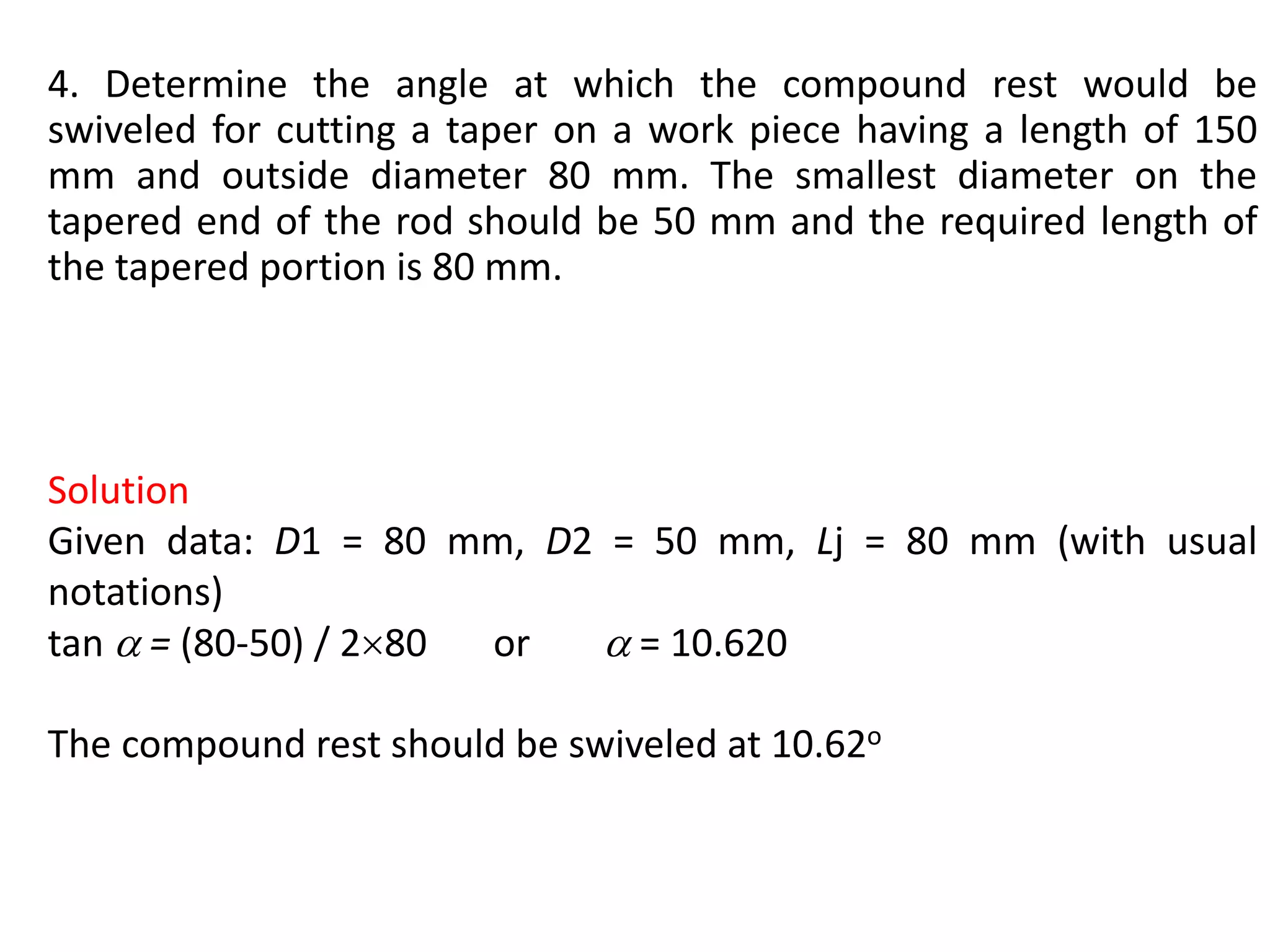
Given data: D1 = 80 mm, D2 = 50 mm, Lj = 80 mm (with usual
notations)
tan  = (80-50) / 280 or  = 10.620
The compound rest should be swiveled at 10.62o
Taper turning by combining feeds
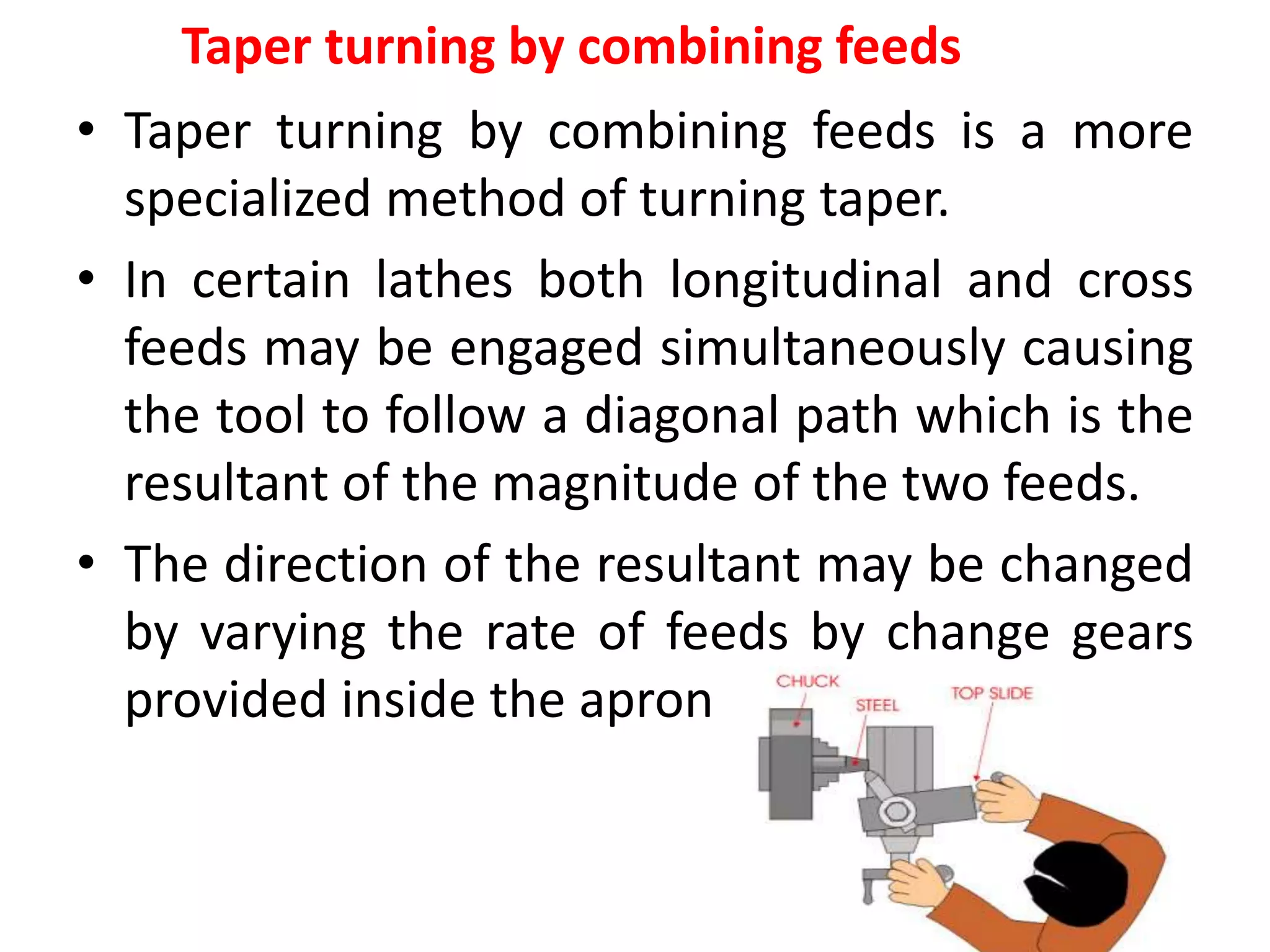
• Taper turning by combining feeds is a more
specialized method of turning taper.
• In certain lathes both longitudinal and cross
feeds may be engaged simultaneously causing
the tool to follow a diagonal path which is the
resultant of the magnitude of the two feeds.
• The direction of the resultant may be changed
by varying the rate of feeds by change gears
provided inside the apron.
Tail stock off-set
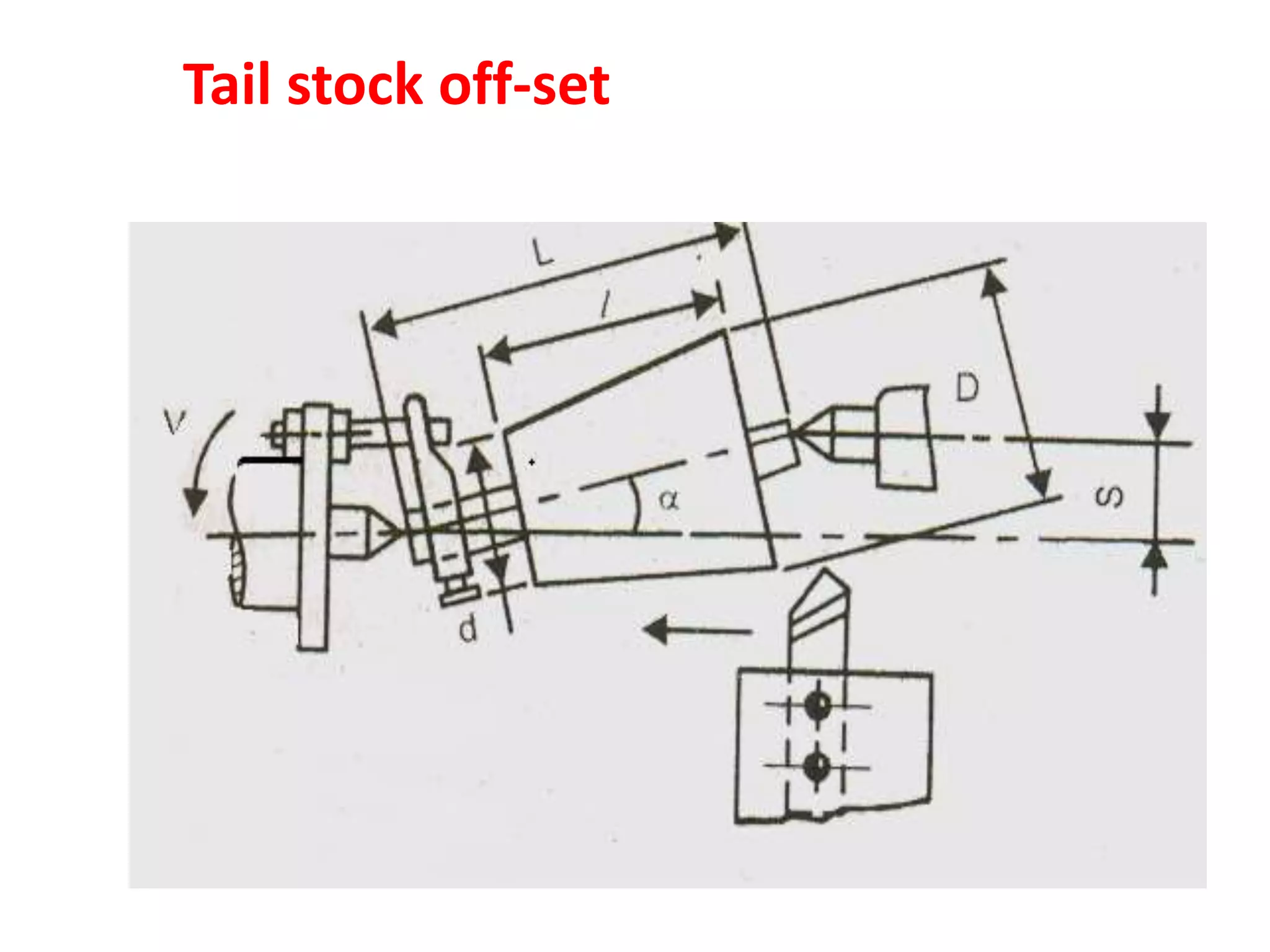
There are 2 methods for tapering on the job.
1.The job revolves in position: Perfect
alignment with the head stock spindle and
the two centres, while tool moves along a
straight line which is inclined at an angle
(taper angle ALPHA) to the centre line of
the job.
2.An alternative method can be to shift the
centre line of the work at an angle ALPHA
from the original position and move the
tool parallel to the axis of the spindle.
• Of the above 2, it is the second condition which is
accomplished by setting over the tail stock.
• The nut of the clamping bolt of the tail stock is
loosened.
• The dead centre is shifted from the original
position by a predetermined amount of set over.
• Graduations provided on the flat surface of the
tailstock ,facing the head stock, help in adjusting
the required set over.
Tail stock off-set
AB
BCsin α =
From fig.
In Δ le ABC ,
For small angles sin α ≈ tan α ;
BC = amount of set over and
AB = overall length of work
piece
set over , S = BC = AB tan α
S = L tan α = L (BC/l) = L(D-d)/2l
The length of work is 300 mm, the amount of taper is
1 : 25. Find the tail stock set over required
50
1
252
1
tan 


set over, S = L
tanα
mm6
50
1
300 
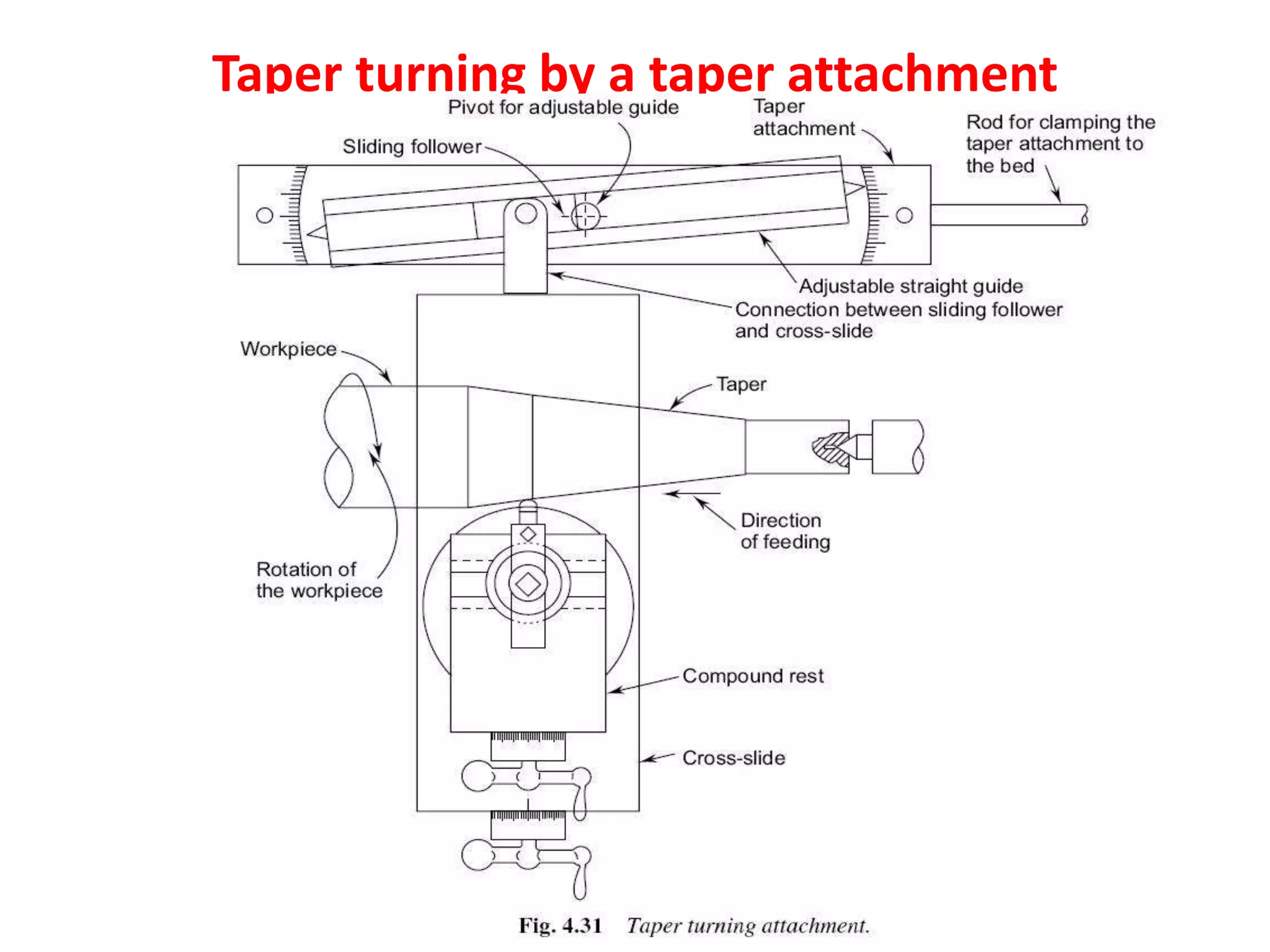
Taper turning by a taper attachment
• The principle of turning taper by a taper
attachment is to guide the tool in a straight path
set at an angle to the axis of rotation of the work
piece, while the work is being revolved between
centers or by a chuck aligned to the lathe axis.
• A taper turning attachment consists essentially of
a bracket or frame which is attached to the rear
end of the lathe bed and supports a guide bar
pivoted at the centers. The bar having
graduations in degrees may be swiveled on either
side of the zero graduation and is set at the
desired angle with the lathe axis.
• When the taper turning attachment is used, the
cross slide is first made free from the lead screw
by removing the binder screw. The rear end the
cross slide is then tightened with the guide block
by means of a bolt.
• When the longitudinal feed is engaged, the tool
mounted on the cross slide will follow the angular
path, as the guide block will slide on the gear bar
at an angle to the lathe axis.
• The required depth of cut is given by the
compound slide which is placed at right angles to
the lathe axis.
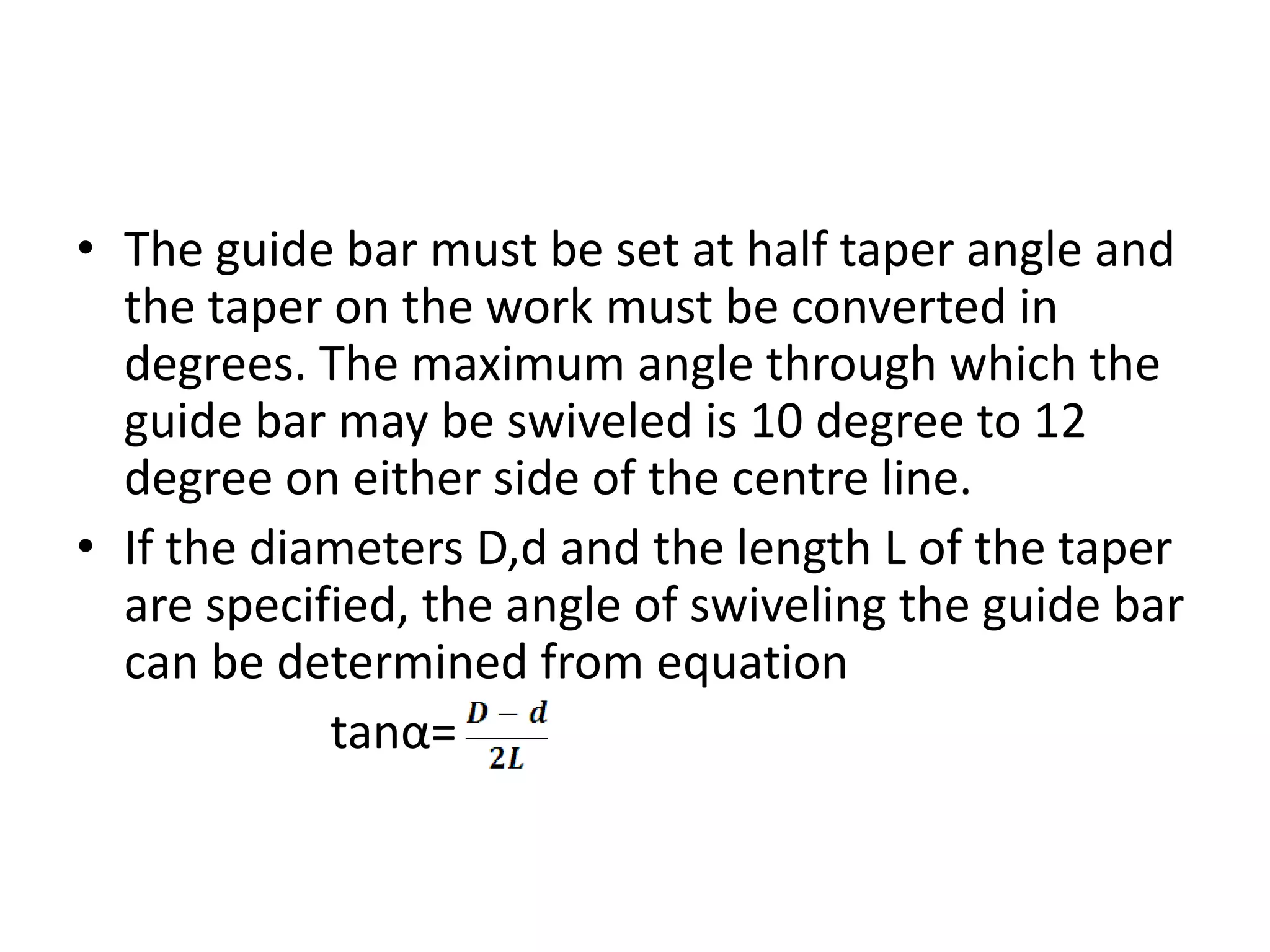
• The guide bar must be set at half taper angle and
the taper on the work must be converted in
degrees. The maximum angle through which the
guide bar may be swiveled is 10 degree to 12
degree on either side of the centre line.
• If the diameters D,d and the length L of the taper
are specified, the angle of swiveling the guide bar
can be determined from equation
tanα=
 The advantage of using a taper turning attachment
are-
1-The alignment of live and dead centers being not
disturbed, both straight and taper turning may be
performed on a work piece in one setting without much
loss of time.
2-once the taper is set, any length of a piece of work may
be turned with in its limit.
3-very steep taper on a long work piece may be turned,
which cannot be done by any other method.
4-accurate taper on a large number of work pieces may
be turned.
5-internal tapers can be turned with ease.
Q. A component having 400 mm length in which
central 150 mm length of component can be
taper turned to an angle of 4 Degree. Which of
the Taper turning Method is used for this ?
Ans: Compound and taper attachment method
offsets
s


28
400
4tan
Maximum offset will produced on tailstock is 10 mm
The length of taper part is 150 mm but by form tool
method we can produce taper up to 20 mm length only
Thread cutting
• Cutting screw threads on a centre lathe is
known as screw-cutting.
• Thread cutting consits in producing a helical
form or thread on the revolving workpiece.
• Thread cutting can be considered as turning
only since the path to be travelled by the
cutting tool is helical
• Treads can be produced by means of taps and dies
also, but the commonly used method on the lathe is
to cut the threads by means of the CUTTING TOOL.
• Irrespective of the shapes and sizes, etc., there is one
common factor in all the threads that is the basis of
generation of all threads is HELIX.
• Another pre requisite of thread cutting is the tip or
cutting edge of the tool should have an included
angle corresponding to the included angle of the
particular type of the thread.
,
ELEMENTS OF THREDS
• PITCH(P): It is the distance from one point on the thread to
the corresponding point on the adjacent thread.
• Major Diameter(D): It is the largest diameter of a
screwed part, measured at right angle to the axis of the
piece.
• Minor Diameter(d):It is the smallest diameter of a
screwed part, measured normal to the axis of the piece.
• Pitch Diameter(Pd): It is the Diameter of the imaginary
cylinder of which the surface will intersect the threads at
such points where the widths of the threads is equal to
the adjacent widths of the spaces between them.
• Depth of threads(t): It is the distance, measured normal
to the axis of part , between the crest and root of the
thread.
t=(D-d)/2
•Lead is the axial distance a point moves along the helix in
one revolution.
•In a single start helix, lead=pitch.
•In a multistart helix, lead=pitch x number of starts.
Thread cutting in a Lathe
• For cutting treads – For every revolution of the
spindle(work) the tool should move parallel to the axis of
the job by a distance equal to the LEAD of the screw.
• There will be a definite ratio between longitudinal feed of
the tool and the speed of the spindle.
• The desired ratio is obtained with the help of lead screw
by connecting it to the spindle through a train of gears.
• On engaging the split half nut the movement of the
carriage, and hence the tool is guided by the lead screw.
• Gear ratio= (Driver teeth/ Driven teeth)=(Speed of the
Lead screw)/(Speed of Work )=(Pitch of the screw to
be cut)/(pitch of the lead screw)
Calulate the gears for cutting the following threads on a lathe with a
lead screw of 6mm pitch.
(a) 4mm pitch
(b) 1.25 mm pitch
Ans-(a)Driver/Driven=Pitch to be cut/ Pitch of lead screw=4/6=40/60
(b) a)Driver/Driven=Pitch to be cut/ Pitch of lead screw=1.25/6
=125/600=25/120
Calculate the gears for cutting an 0.8 mm pitch screw
on a lathe with lead screw of 6 mm pitch.
Ans-a)Driver/Driven=Pitch to be cut/ Pitch of lead
screw= 0.8/6=8/60
A simple gear cant be made as no gear with 8T or
16T will normally available.
Therefore, one may exxpress:
8/60=(4x2)/(10x6)=(40/100)/(20/60)
Acompound train with 40T and 20T as drivers and
100T and 60T as driven will work.
Lathe Accessories
• Divided into two categories
– Work-holding, -supporting, and –driving
devices
• Lathe centers, chucks, faceplates
• Mandrels, steady and follower rests
• Lathe dogs, drive plates
– Cutting-tool-holding devices
• Straight and offset toolholders
• Threading toolholders, boring bars
• Turret-type toolposts
102
Lathe Centers
• Work to be turned between centers must
have center hole drilled in each end
– Provides bearing surface
• Support during cutting
• Most common have
solid Morse taper shank
60º centers, steel with carbide tips
• Care to adjust and lubricate occasionally
103
Lathe Centers
104
Revolving Tailstock Centers
• Replaced solid dead centers for most
machining operations
• Used to support work held in chuck or
when work is being machined between
centers
• Contains antifriction bearings which allow
center to revolve with workpiece
– No lubrication required between center and
work
105
Revolving Tailstock Centers
106
Work Holding Devices
For holding cylindrical stock centered.
For facing/center drilling the end of your
aluminum stock
Four-Jaw Chuck
This is independent chuck generally has
four jaws, which are adjusted individually
on the chuck face by means of adjusting
screws
Three jaw chuck
• Used to hold round, square,
hexagonal, and irregularly shaped
workpieces
• Has four jaws
– Each can be adjusted independently by
chuck wrench
• Jaws can be reversed to hold work by
inside diameter
109
Four-Jaw Independent Chuck
• Thin jobs can be held by means of
magnetic chucks.
Collet Chuck
Magnetic Chuck
Collet chuck is used to hold
small workpieces
Thin jobs can be held by
means of magnetic chucks.
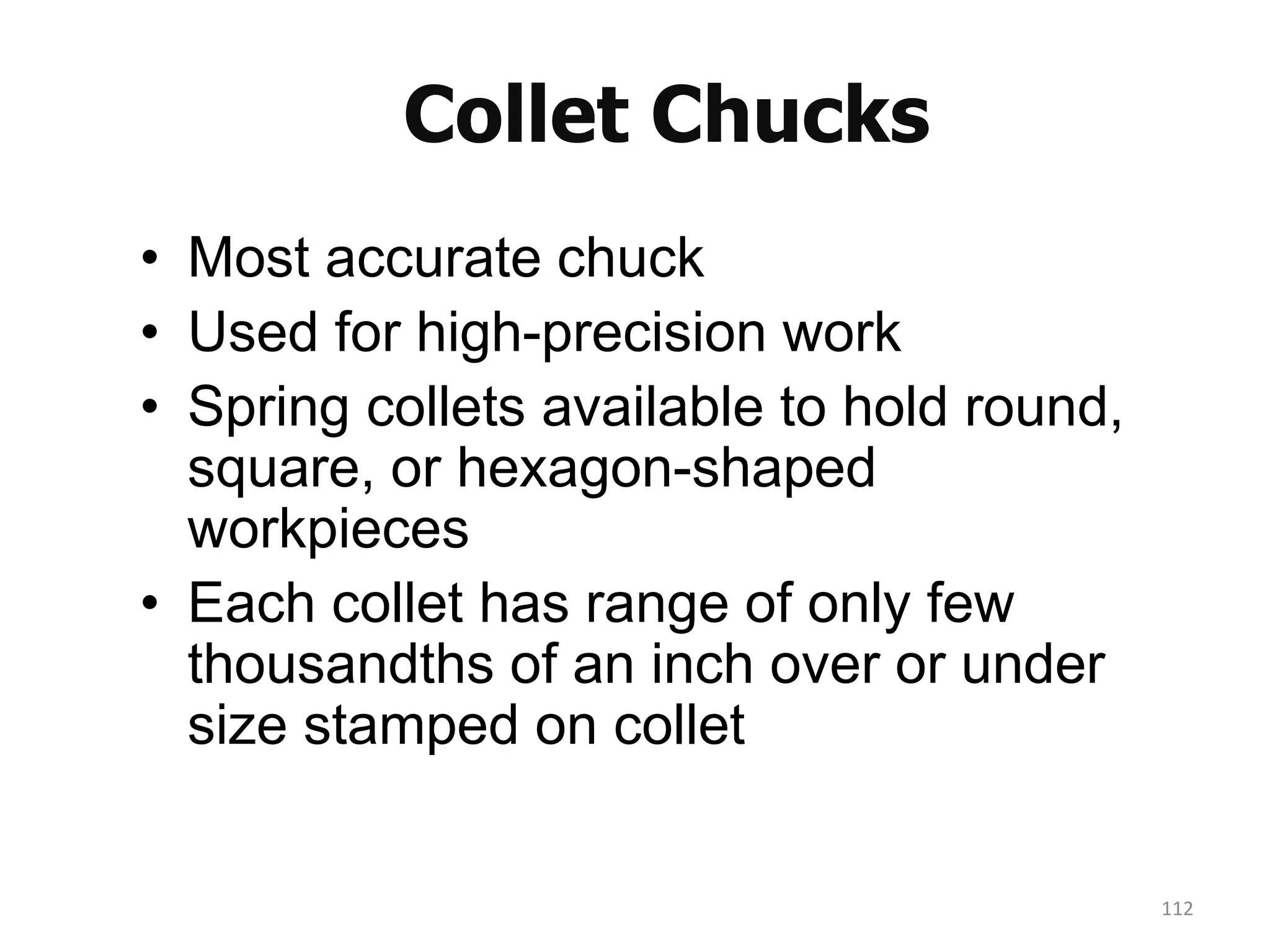
Collet Chucks
• Most accurate chuck
• Used for high-precision work
• Spring collets available to hold round,
square, or hexagon-shaped
workpieces
• Each collet has range of only few
thousandths of an inch over or under
size stamped on collet
112
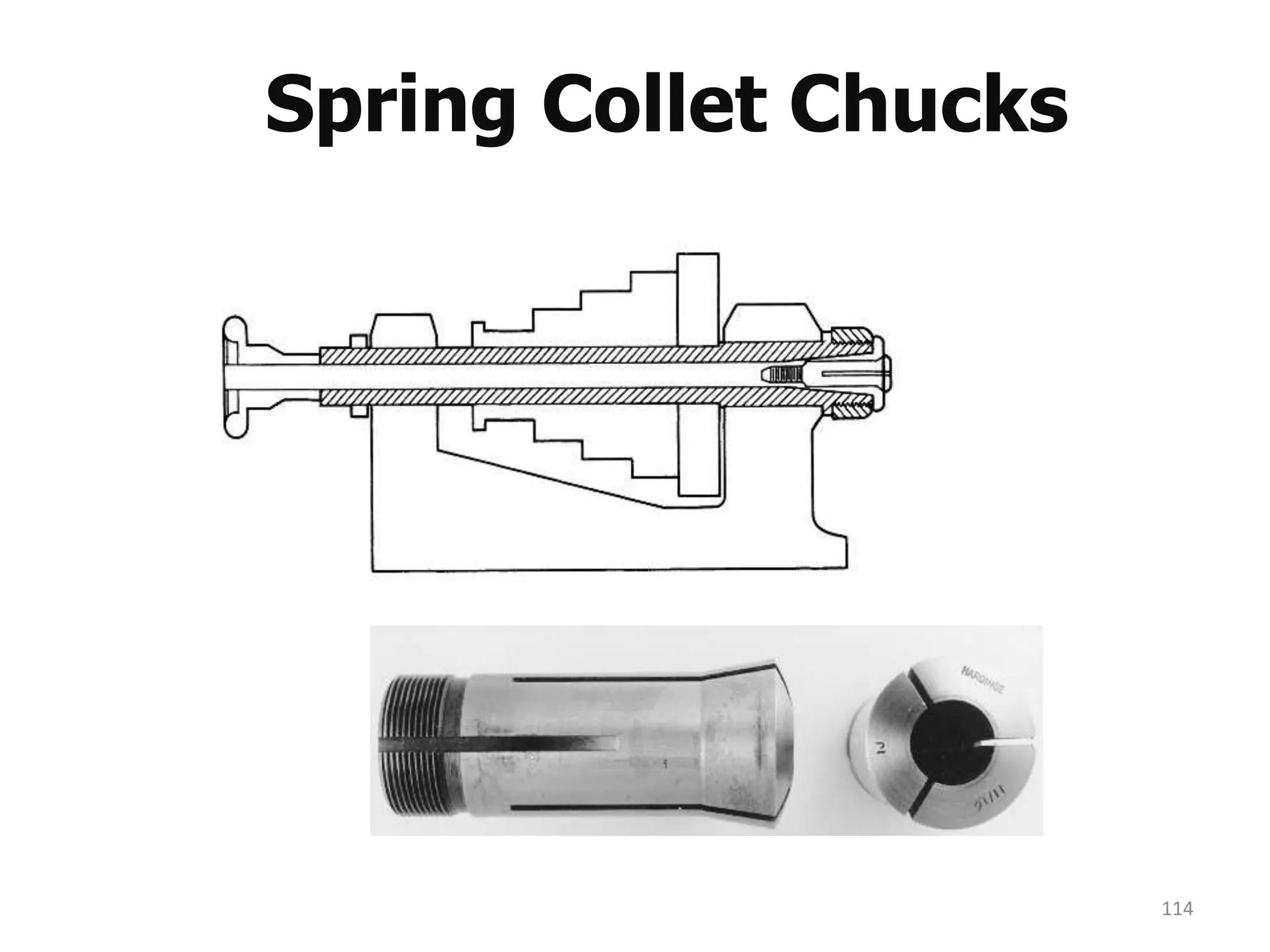
Spring Collet Chucks
• Spring-collet chuck
– One form: Handwheel draws collet into
tapered adapter
– Another form: Uses chuck wrench to
tighten collet on workpiece
• Can hold larger work than draw-in type
113
Spring Collet Chucks
114
Jacobs Collet Chuck
• Jacobs collet chuck
– Utilizes impact-tightening handwheel to
close collets
– Wider range than spring-collet chuck
115
Jacobs Collet Chuck
116
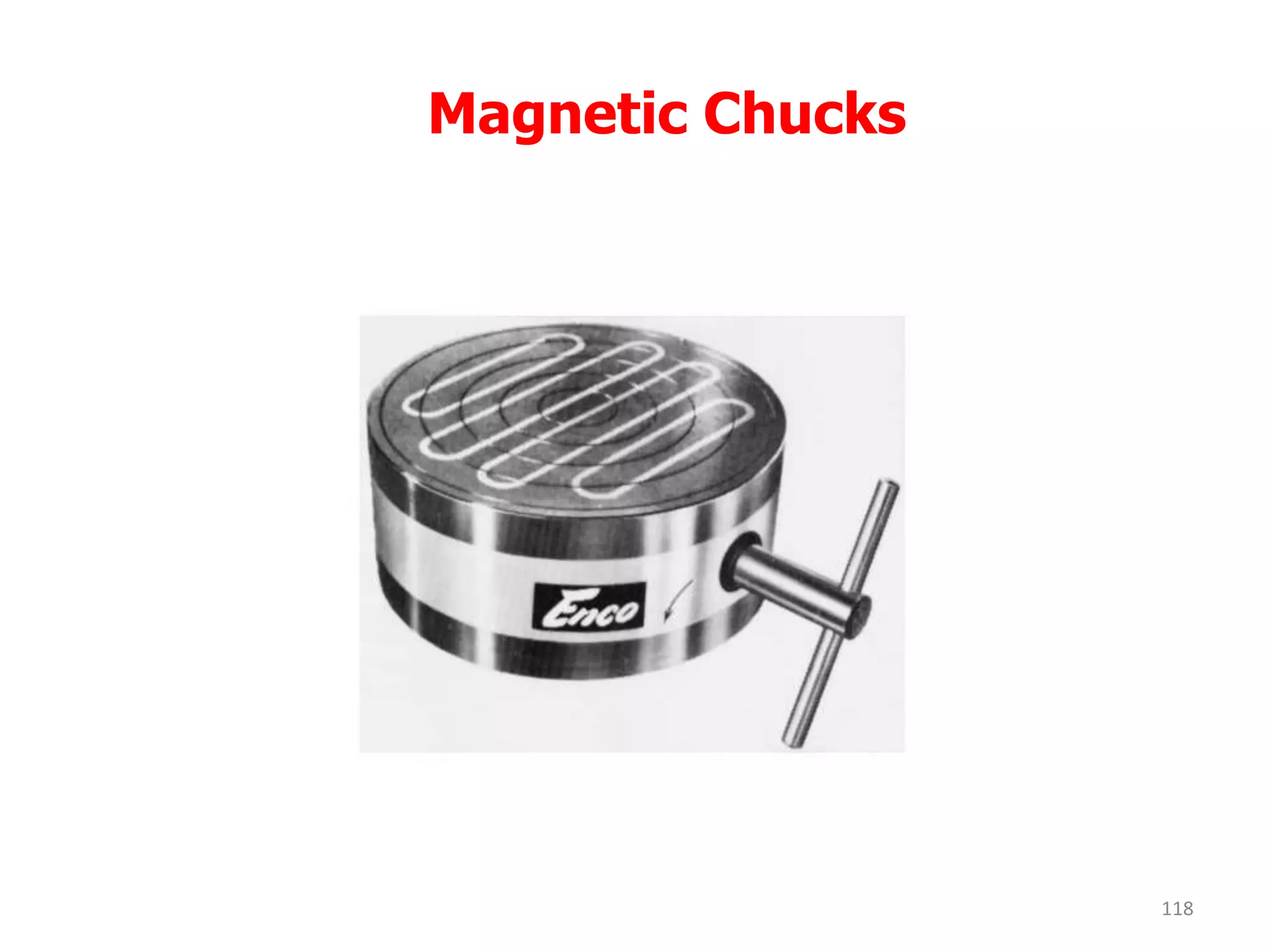
Magnetic Chucks
• Used to hold iron or steel parts that are
too thin or may be damaged if held in
conventional chuck
• Fitted to an adapter mounted on
headstock spindle
• Used only for light cuts and for special
grinding applications
117
Magnetic Chucks
118
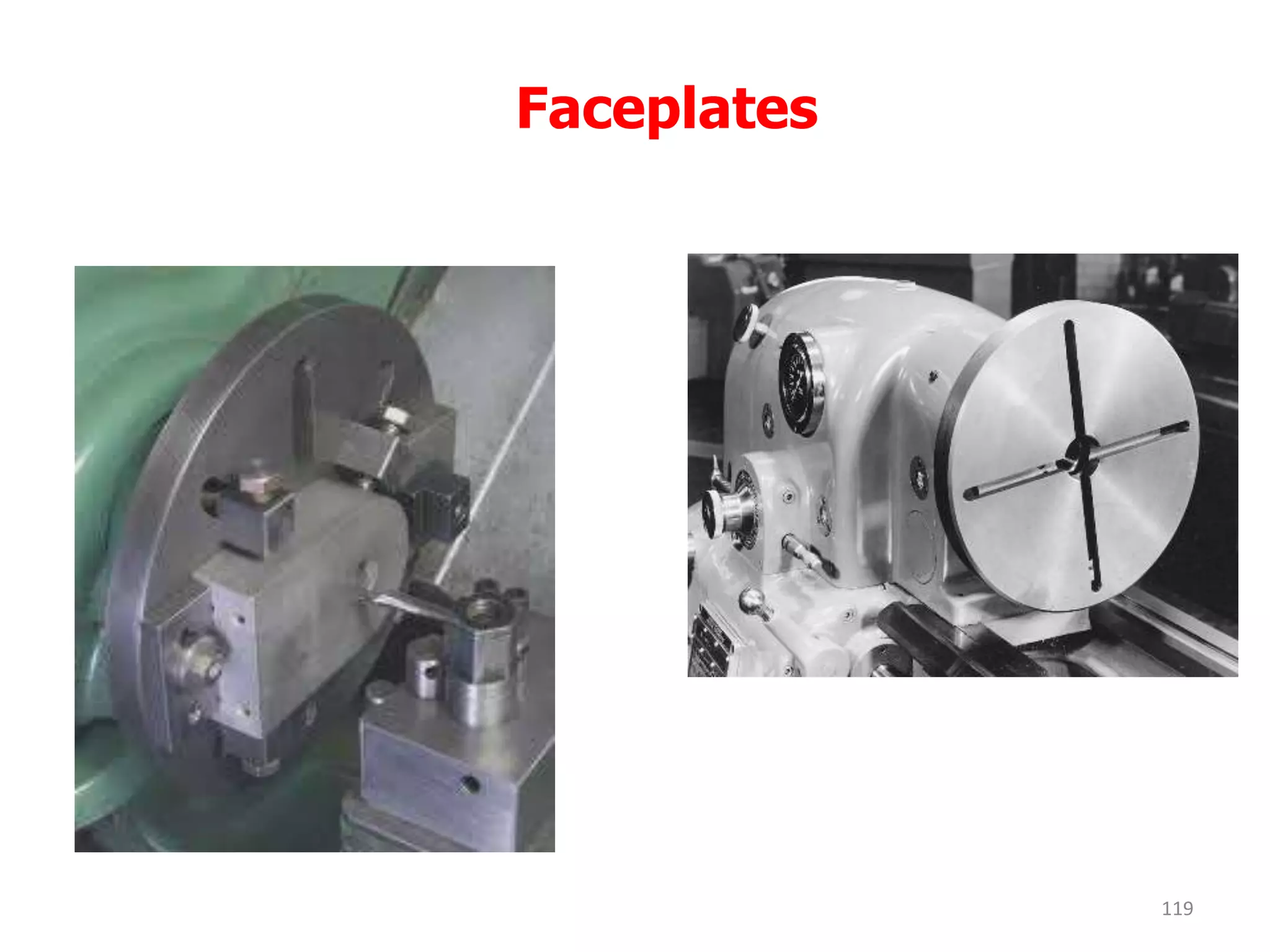
Faceplates
119
Faceplates
120
• It is usually a cast iron disc, having a threaded
hole at its centre so that it can be screwed to
the head stock spindle.
• It consists of number of holes and slots to
hold the work piece.
• A number of other things like bolts, nuts,
washers and clamping plates are for holding
the job.
Steadyrest
• Used to support long work held in chuck
or between lathe centers
– Prevent springing
• Located on and aligned by ways of the
lathe
• Positioned at any point along lathe bed
• Three jaws tipped with plastic, bronze or
rollers may be adjusted to support any
work diameter with steadyrest capacity
122
Steadyrest
123
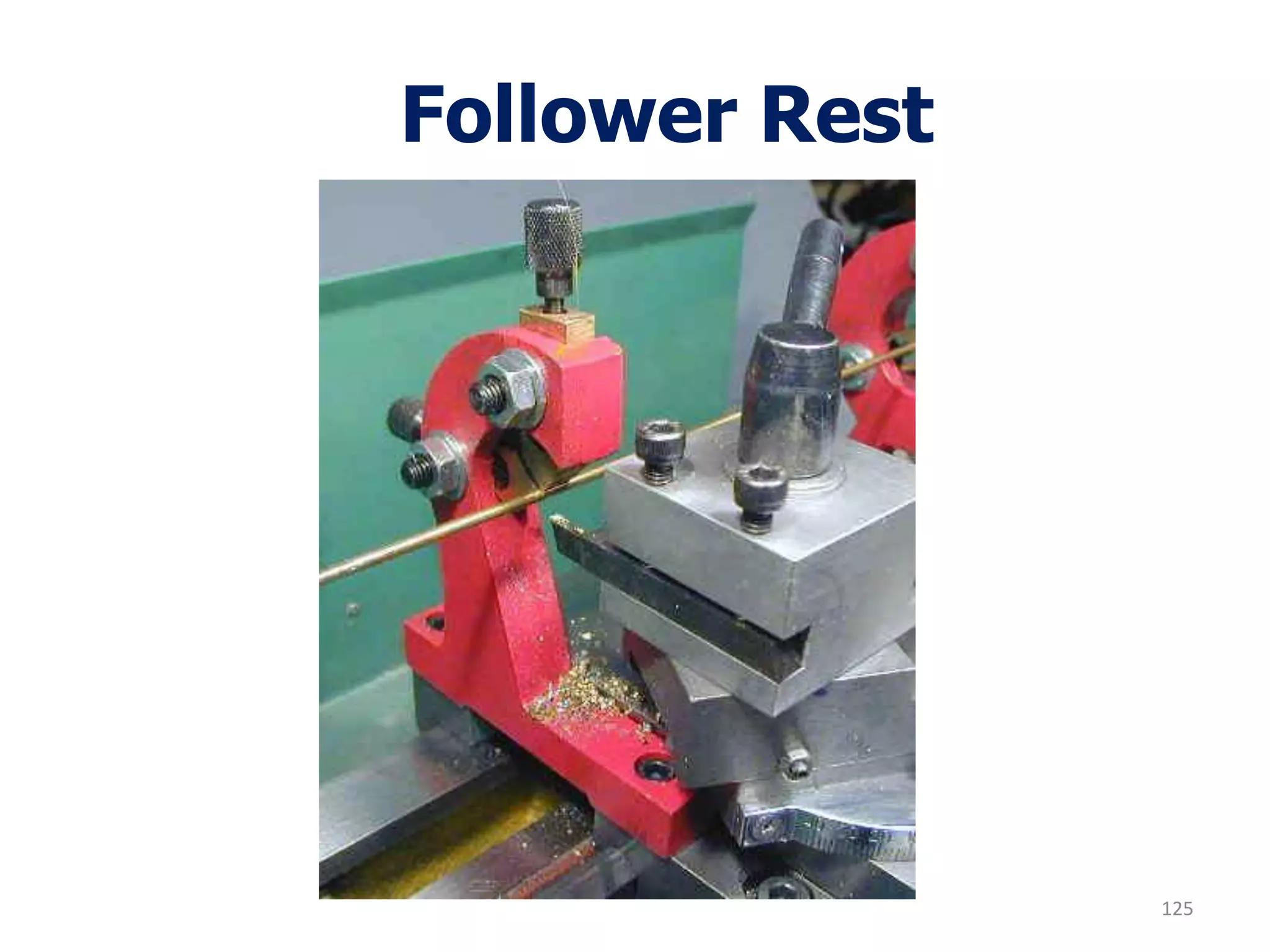
Follower Rest
• Mounted on saddle
• Travels with carriage to prevent work
from springing up and away from
cutting tool
– Cutting tool generally positioned just
ahead of follower rest
– Provide smooth bearing surface for two
jaws of follower rest
124
Follower Rest
125
Lathe Dogs
• Drives work machined between
centers
• Has opening to receive work and
setscrew to fasten the dog to work
• Tail of dog fits into slot on driveplate
and provides drive to workpiece
• Made in variety of sizes and types to
suit various workpieces
126
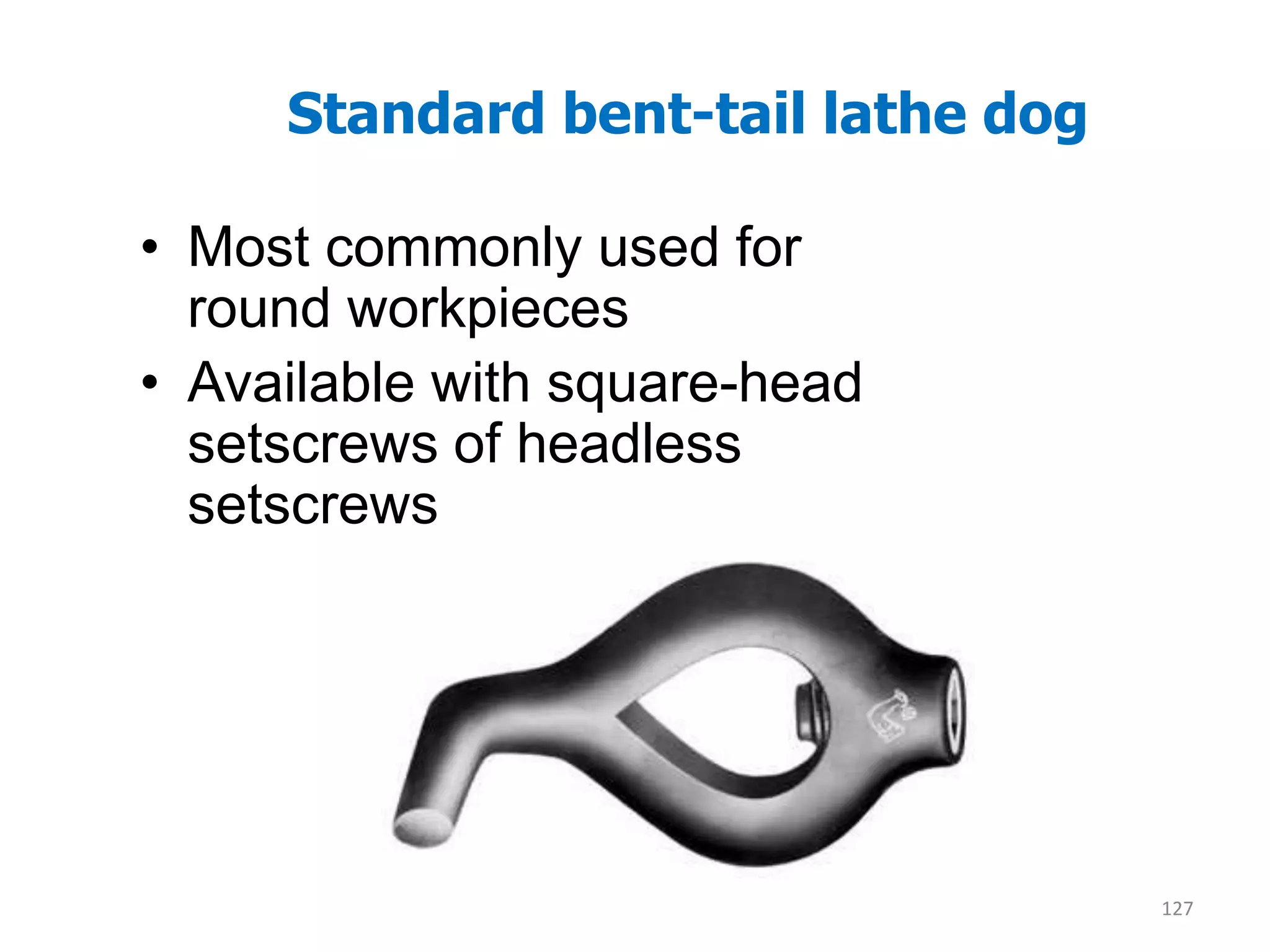
Standard bent-tail lathe dog
• Most commonly used for
round workpieces
• Available with square-head
setscrews of headless
setscrews
127
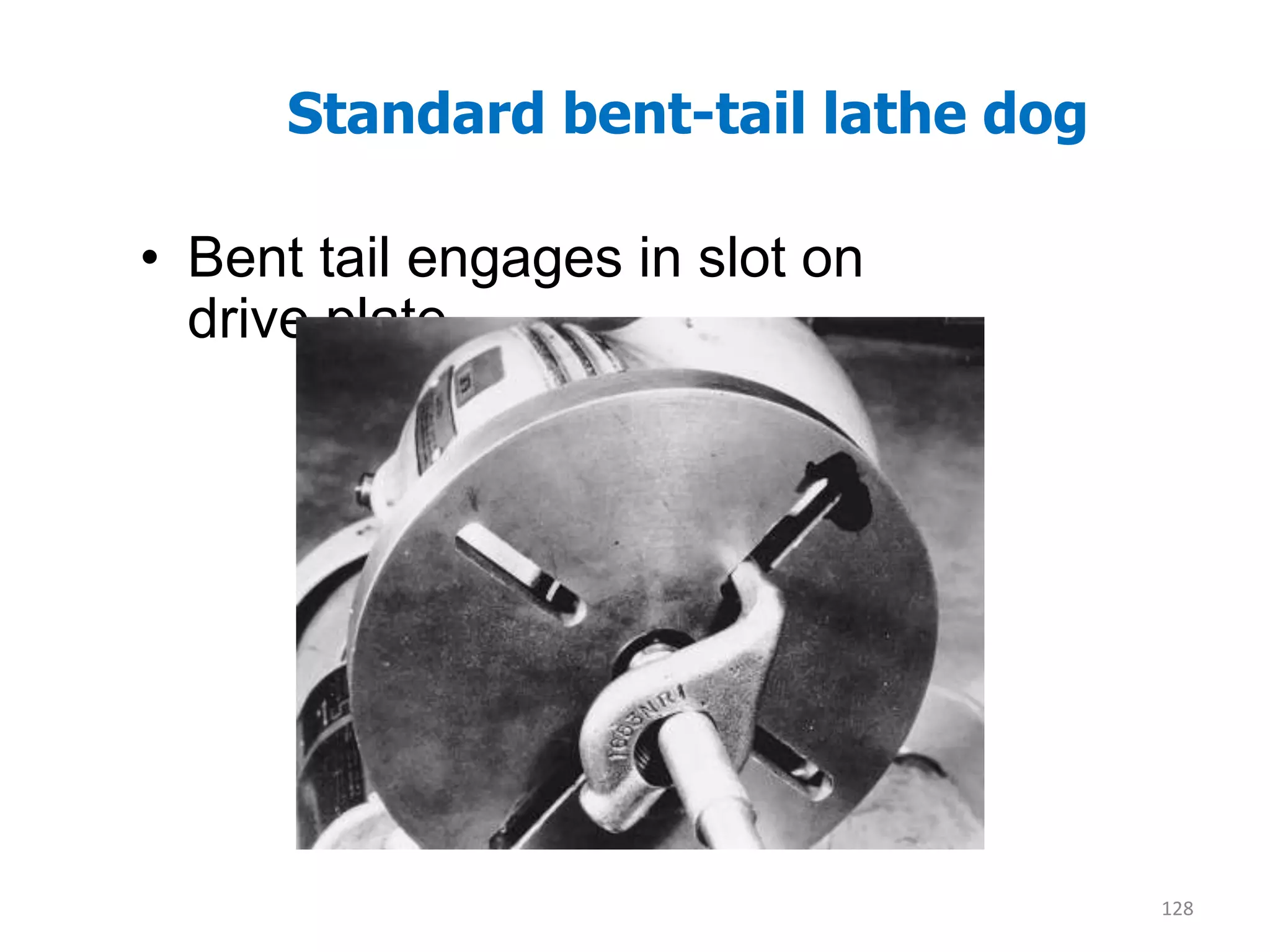
Standard bent-tail lathe dog
• Bent tail engages in slot on
drive plate
128
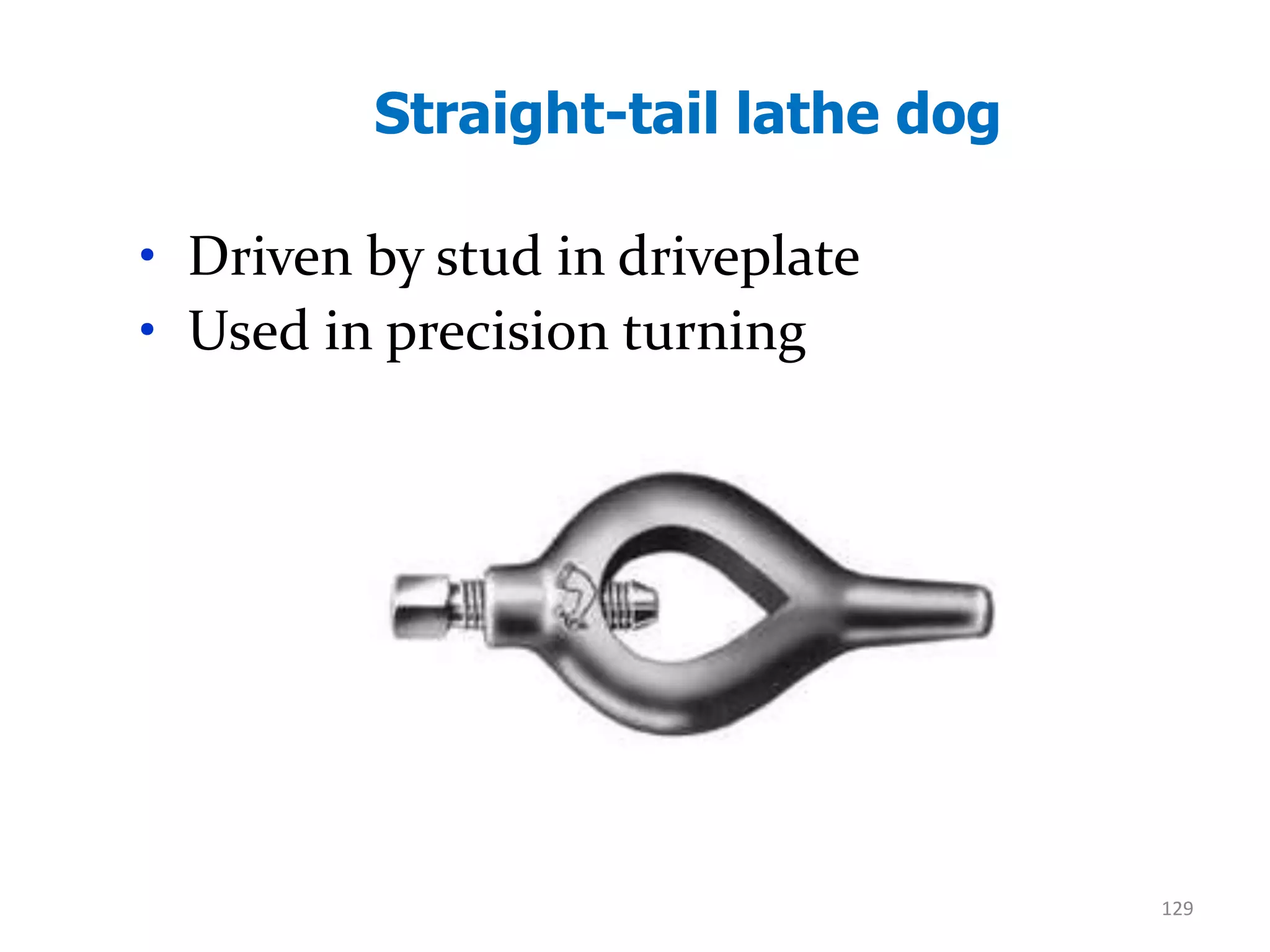
Straight-tail lathe dog
129
• Driven by stud in driveplate
• Used in precision turning
Safety clamp lathe dog
• Used to hold variety of work
• Wide range of adjustment
130
Heavy Duty Lathe Dog
131
• Wider range than others
• Used on all shapes
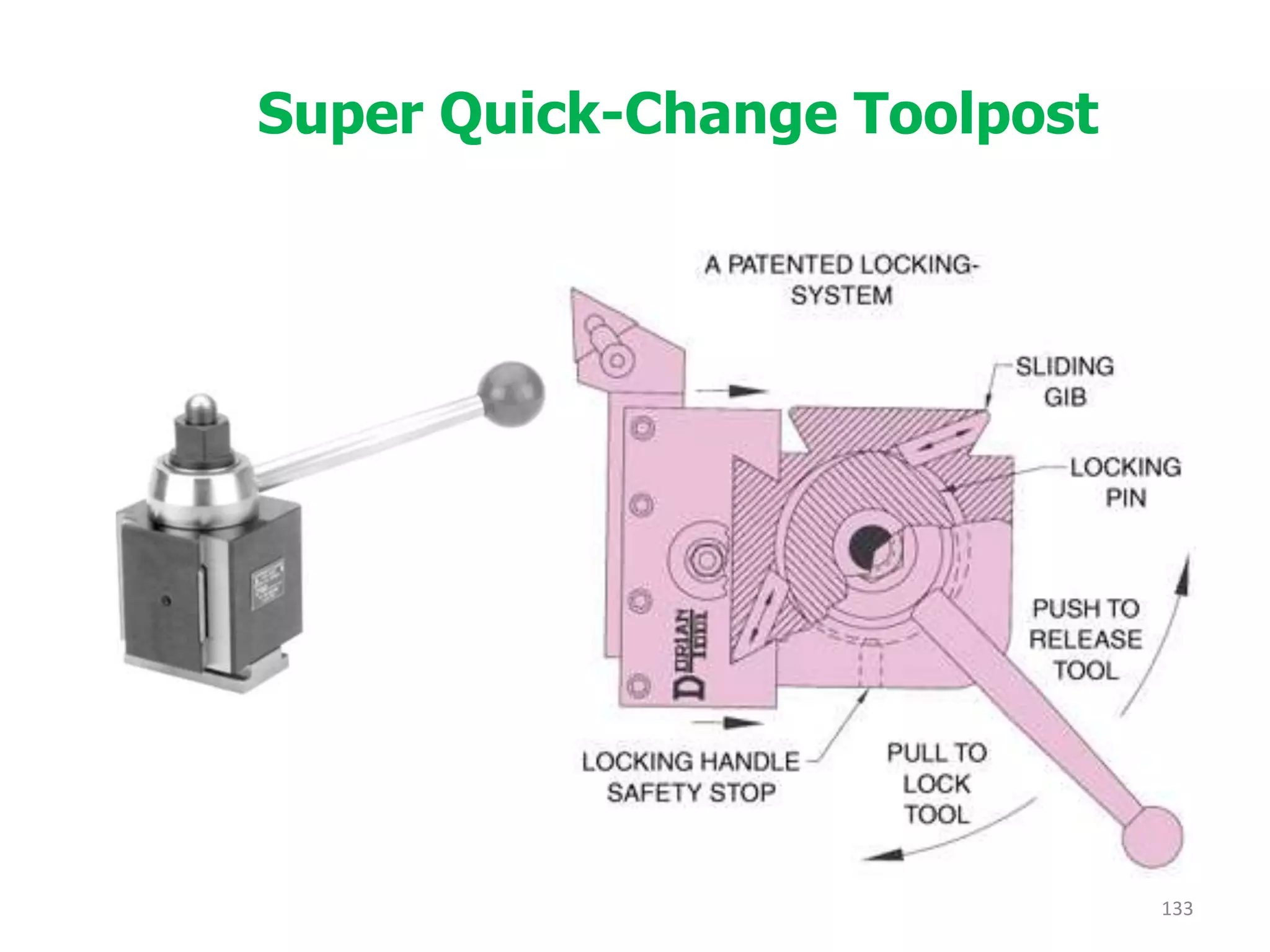
Super Quick-Change Toolpost
• Provides fast, accurate, and reliable
method of quickly changing and setting
various toolholders for different
operations
• Locking system has two sliding gibs
forced out against toolholder
– Handle pulled into lock position
– Provides rigid, positive lock with zero
backlash
132
Super Quick-Change Toolpost
133
summary
 Lathe is the most important and common machine tool
found in practically all machine shops.
 A large variety of lathes have been developed to cater
for different processing requirements.
 A lathe consists of a bed, headstock, tailstock and a
carriage as major components along with a few other
items that provide the necessary support and motions.
summary
 A variety of chucks such as universal 3-jaw, independent 4-
jaw, and faceplate, are used to locate and support work
pieces in a lathe for common machining applications.
 There are a variety of tools available depending upon the
type of surface that needs to be generated.
 There are a large variety of operations such as turning,
facing, knurling, contouring, etc. that can be carried out in a
lathe. In fact practically all types of surfaces can be
generated in a lathe.
summary
 Taper turning is a special type of operation that
requires the tool to be moved in two different direction
simultaneously to generate the surface.
 For this purpose, a variety of methods are used in a
lathe such as compound slide, tailstock offset or a
special attachment.
 Precision threads can be cut in a lathe using the lead
screw and special methods
• There are various special attachments such as
milling attachment, grinding attachment, etc.
have been developed that enhance the range
of surfaces that can be generated in a lathe.
• Machining time for different operations can
be estimated using the cutting process
parameters and the geometry of the part
summary

Lathe machine tool

  • 1.
    Manufacturing Process andDesign By Prof Hemalata Jena PhD
  • 2.
    Manufacturing Process andDesign  Text Books :  Manufacturing Processes by J. P. Koushish  Or  Manufacturing Technology by P.N.Rao (TMH), Part – II  Reference Books :  Manufacturing Science by A.Ghosh and A.K.Mallik  Text Book of Production Engineering by P.C.Sharma  Workshop Technology-II by Hazra Chaudhury
  • 3.
    Chip less manufacturingprocesses Chip manufacturing Casting, forming, Sheet metal operations, powder metallurgy Material removal processes Conventional Machining Processes Non-Traditional Manufacturing Processes Manufacturing processes Material removal processes
  • 4.
    Defination of Machinetool • It is a power driven metal cutting machine • It changes the shape of the material or job by producing chips • The lathe, the shaper, the planer, the drilling, machine and the milling machine are few example of commonly used machine tools.
  • 5.
    Machine Tool Power actuatedmetal cutting tools and system are called machine tool Component of Machine tool Transmission system Job Holding device Cutting tools Commonly used machine Tools : Lathe Shaper Planer Milling Machine Drilling Machine Grinding Machine
  • 6.
  • 7.
    Machining is anessential process of finishing by which jobs are produced to the desired dimensions and surface finish by gradually removing the excess material from the work piece in the form of chips with the help of cutting tool moved past the work surface. Machining
  • 8.
  • 9.
    • For producingcylindrical jobs. • Flat surfaces and holes. • With special attachments, it can be used for producing different types of surfaces, cutting threads, cutting grooves. • As a whole, a skilled worker can produce any type of job with a lathe. Function of the lathe
  • 11.
    • Bed ismainly support the whole machine • Carriage is assembly that moves the tool post and cutting tool along the ways • Carriage Hand wheel is a wheel with a handle used to move the carriage by hand by means of a rack and ponion drive • A chuck is a clamping device for holding work in the lathe • Apron is the front part of the carriage assembly on which carriage hand wheel is mounted • Cross slide is a platform that moves perpendicular to the lathe axis under control of the cross slide hand wheel
  • 12.
    • Cross slidehand wheel is a wheel with handle used to move the cross slide in and out. • Halfnut lever is the lever to engage the carriage with leadscrew to move the carriage under power • lead screw is a precision screw that runs the length of the bed. it is used to drive the carriage under power for turning and thread cutting operations. • swing is a dimension representing the largest diameter work piece that a lathe can rotate • tailstock is a cast iron assembly that can be slide along the ways and be locked in place. used to hold long work in place or mount a drill chuck for drilling into end of the work • Ram is a piston type shaft that can be moved in and out of the tailstock by turning the tailstock hand wheel. • Tool is a cutting tool used to remove metal from the work piece and usually made of high speed steel or carbide. • ways is a precision ground surfaces along top of the bed on which saddle rides. the ways are precisely aligned with the centerline of the lathe
  • 13.
    Types of Lathe •Engine lathes. These are probably the most popular among the lathe machines. In fact, no machine shop is seen without this type of lathe. The good thing about engine lathes is that it can be used in various materials, aside from metal. Moreover, the set-up of these machines is so simple that they are easier to use. Its main components include the bed, headstock, and tailstock. These engine lathes can be adjusted to variable speeds for the accommodation of a wide scope of work. In addition, these lathes come in various sizes. • Turret Lathes. These types of lathes are used for machining single workpieces sequentially. This means that several operations are needed to be performed on a single work piece. With the turret lathes, sequential operations can be done on the work piece, eliminating errors in work alignment. With this set-up, machining is done more efficiently. Correspondingly, time is saved because there is no need to remove and transfer the work piece to another machine anymore. • Special Purpose Lathes. As the name implies, these lathes are used for special purposes such as heavy-duty production of identical parts. In addition, these lathes also perform specific functions that cannot be performed by the standard lathes. Some examples of special purpose lathes include the bench-type jewelers’ lathes, automatic lathes, crankshaft lathes, duplicating lathes, multispindle lathes, brakedrum lathes, and production lathes among others.
  • 14.
    Engine Lathe (centrelathe) The most common form of lathe, motor driven and comes in large variety of sizes and shapes. found in floor shops, tool rooms, and job shops Primarily for single piece or short runs Manually operated Types of Lathe
  • 15.
    Capstan and TurretLathes Used in mass production Semi automatic Wide range of operations can be performed Capstan and Turret lathe which have multiple tools mounted on turret either attached to the tailstock or the cross-slide, which allows for quick changes in tooling and cutting operations. Used when many duplicate parts required Equipped with multisided tool post (turret) to which several different cutting tools mounted Employed in given sequence
  • 19.
  • 20.
    Tail stock Speed gearbox Head stock Feed rod Leadscrew Half nut Apron box Lathe bed rac k Feed gear box Dead centre ram carriage clamp Main driving pulley Tool post
  • 21.
    • Bed • Headstock •Tailstock • Carriage Lathe parts
  • 22.
    Lathe parts contd. Bed- •Base of the lathe  Supports all major components of the lathe machine.  Large mass and made from gray cast iron  Three main parts of the lathe –headstock, tailstock and carriage are mounted on the bed of the lathe.  Top of the bed has two guide ways or slide ways to provide support and sliding surfaces for the carriage and for the tailstock.
  • 23.
    Secured permanently atthe left hand end of the lathe bed. It supports the spindle and is equipped with the power driving mechanism for the spindle. The spindle speed can be set through speed selector knobs. The spindle is hollow to facilitate holding of long work pieces. The work holding devices such as chucks,centres and collets are attached to the spindle. Headstock
  • 24.
    •The spindle rotateson two large bearings housed on the headstock casting. • A hole extends through the spindle so that a long bar stock may be passed through the hole. • The front end of the spindle is threaded on which chucks, faceplate, driving plate and catch plate are screwed. The front end of the hole is tapered to receive live center which supports the work. •On the other side of the spindle, a gear known as a spindle gear is fitted. Through this gear, tumbler gears and a main gear train, the power is transmitted to the gear on the leadscrew.
  • 25.
    Located at theright hand end of the bed Can be moved along the guide ways and can be clamped in any position on the bed. Also called loose headstock Main purpose is to hold the dead centre and to support the long work pieces during machining. It has a quill, into which the deadcentre,drills,reamers can be fixed. The quill can move in and out with the help of hand wheel. Tail stock
  • 27.
    • Tailstock islocated on the inner guideways at the right side of the bed opposite to the headstock. The body of the tailstock is bored and houses the tailstock spindle or ram. The spindle moves front and back inside the hole. The spindle has a taper hole to receive the dead centre or shanks of tools like drill or reamer. If the tailstock handwheel is rotated in the clockwise direction, the spindle advances. The spindle will be withdrawn inside the hole, if the handwheel is rotated in anti-clockwise direction. • To remove the dead centre or any other tool from the spindle, the handwheel is rotated in anticlockwise direction further. The movement of the spindle inside the hole may be locked by operating the spindle clamp located on top of the tailstock. In order to hold workpieces of different lengths, the tailstock can be locked at any desired position on the lathe bed. Tailstock clamping bolts are used for this purpose. • Tailstock is designed to function as two units-the base and the body. The base of the tailstock is clamped to the bed. The body is placed on the base and can be made to slide sidewards- perpendicular to the bed guideways upto a certain distance.
  • 28.
    The uses oftailstock • It supports the other end of the long workpiece when it is machined between • It is useful in holding tools like drills, reamers when performing drilling, reaming • The dead centre is off set by a small distance from the axis of the lathe to turn tapers by set over • It is useful in setting the cutting tool at correct height aligning the cutting edge with lathe
  • 29.
    Carriage The carriage slidesalong the guide ways between headstock and tailstock and consists of an assembly of the cross-slide, tool post, the compound rest and the apron. Main function is to hold the cutting tool and move it to give longitudinal and cross feed to it. The cross-slide moves radially in and out, thus controlling the radial position of the cutting tool. The compound rest, also called compound slide is mounted on the top of the cross slide and has circular base graduated in degrees. It is used for obtaining angular cuts and short tapers. Compound rest swivels the tool for positioning and adjustment. The tool post is located at the top of the compound rest to hold the tool and to enable it to be adjusted to a convenient working position. The apron is equipped with mechanisms for both manual and mechanized movements of the carriage and the cross-slide , by means of a lead screw and feed rod.
  • 31.
    Saddle: • It isan “H” shaped casting. It connects the pair of bed guideways like a bridge. It fits over the bed and slides along the bed between headstock and tailstock. The saddle or the entire carriage can be moved by providing hand feed or automatic feed. Cross slide: • Cross-slide is situated on the saddle and slides on the dovetail guideways at right angles to the bed guideways. It carries compound rest, compound slide and tool post. Cross slide handwheel is rotated to move it at right angles to the lathe axis. It can also be power driven. The cross slide hand wheel is graduated on its rim to enable to give known amount of feed as accurate as 0.05mm. Compound rest: • Compound rest is a part which connects cross slide and compound slide. It is mounted on the cross-slide by tongue and groove joint. It has a circular base on which angular graduations are marked. The compound rest can be swiveled to the required angle while turning tapers. A top slide known as compound slide is attached to the compound rest by dove tail joint. The tool post is situated on the compound slide. Tool post: • This is located on top of the compound slide. It is used to hold the tools rigidly. Tools are selected according to the type of operation and mounted on the tool post and adjusted to a convenient working position
  • 32.
    Apron • The apronis bolted to the front of the saddle . The apron houses the gears and control for the carriage and the feed mechanism.
  • 33.
    Feed rod andlead screw  The feed rod is powered by a set of gears from the head stock. It rotates during the operation of the lathe and provides mechanized movement to the carriage by means of gears, a friction clutch, and a keyways along the length of the feed rod.  The lead screw is also powered by the gears from the headstock and is used for providing specific accurate mechanized movement to the carriage for cutting threads on the work piece. The lead screw has a definite pitch.  A split nut in the apron is used to engage the lead screw with the carriage. In some lathes, the lead screw performs the functions of feed rod and there is no separate feed rod. Similarly a lathe not meant for thread cutting will not have a lead screw.  (Speed of the lead screw/Speed of the work)=(Pitch of the screw to be cut/Pitch of the lead screw)
  • 34.
    Size of alathe • The size of a lathe is expressed or specified by the maximum size that can be handled by the lathe • The swing diameter over bed.(This is the largest diameter of work that will revolve without touching the bed and is twice the height of the centre measured from the bed of the lathe.) • The swing diameter over carriage.(This is the largest diameter of work that will revolve over the lathe saddle and is always less than the swing diameter over bed.) • The distance between centers.(This is the maximum length of work that can be mounted between the lathe centers. • The maximum bar diameter(This is the maximum diameter of bar stock that will pass through the hole of the head stock spindle). • The length of bed.(This indicates the approximate floor space occupied by the lathe)
  • 35.
  • 36.
  • 37.
  • 38.
  • 39.
    Operating condition ina lathe  Cutting speed  Feed  Depth of cut 1-Cutting speed In a lathe, for the turning operation, cutting speed is the peripheral speed of the work piece past the cutting tool. Expressed in meters/minute. Cutting speed= m/min Where D= diameter of the work piece in mm. N=rpm of the work
  • 41.
    Depth of Cut Perpendiculardistance between machined surface and uncut surface of the Work-piece d = (D1 – D2)/2 (mm) d Depth of Cut DD 21
  • 42.
    Feed f – thedistance the tool advances for every rotation of workpiece (mm/rev) f Feed DD 21
  • 43.
    Feed  The feedof a cutting tool in a lathe work is the distance the tool advances for each revolution of the work.  Feed is expressed as mm/revolution.  Increased feed reduces cutting time. But increased feed greatly reduces the tool life.  The feed depends on factors such as size, shape, strength of the work material and method of holding the component, the tool shape, the rigidity of the machine, depth of cut, power available etc. Coarser feeds are used for roughing and finer feeds for finishing cuts.
  • 44.
    Machining time The timerequired to machine a component is called MACHINING TIME. Machining time depends upon • Size of the work piece • Amount of material removed • The operating condition(speed, feed, depth of cut) • Consider the feed and speed(f×N) • the feed rate in mm/min. It gives the distance that the tool moves (f×N) in mm in one minute. • Hence , for a distance L , the time required for one complete cut, “t” in minute is given by t= minute
  • 45.
    Problem -1 A mildsteel rod having 50 mm diameter and 500 mm length is to be turned on a lathe. Determine the machining time to reduce the rod to 45 mm in one pass when cutting speed is 30 m/min and a feed of 0.7 mm/rev is used. Solution Given data: D = 50 mm, Lj = 500 mm v = 30 m/min, f= 0.7 mm/rev Substituting the values of v and D in V = ΠDN/1000 m/min Required spindle speed as: N = 191 rpm
  • 46.
    A cylindrical stainlesssteel rod with length L=150 mm, diameter D0 = 12 mm is being reduced in diameter to Df =11 mm by turning on a lathe. The spindle rotates at N = 400 rpm, and the tool is travelling at an axial speed of υ=200 mm/min Calculate: a. The cutting speed V (maximum and minimum) b. The depth of cut and the cutting time t a. The maximum cutting speed is at the outer diameterD0, and is obtained from the expression V = π D0N Thus, Vmax = (π) (12) (400) = 15072 mm/min The cutting speed at the inner diameter Df is Vmin = (π) (11) (400) = 13816 mm/min
  • 47.
    b. From theinformation given, the depth of cut is d = (12 – 11) / 2 = 0.5 mm and the feed is f = υ / Ν f = 200 / 400 = 0.5 mm/rev The cutting time is t = l / (f. N) = (150) / (0.5) (400) = 0.75 min
  • 48.
    Manufacturing time • Totalmanufacturing time = machining time + set up time + moving and waiting time+ inspection time • Time required for setting the tool , work piece and machine is known as set up time. • Movement time is the time when component has to move from machine to machine and may wait before the machines getting processed, that time is called waiting time • During and after machining , components are inspected that time is called inspection time
  • 49.
    Machining operation donein lathe • Straight turning • Taper turning • Chamfering • Drilling • Reaming • Boring • Counter boring • Taper boring • Internal thread cutting • Tapping •Parting off •Thread cutting •Facing •Knurling •Filing •Polishing •Grooving •Forming
  • 52.
    Turning .. • ExcessMaterial is removed to reduce Diameter • ROUGH TURNING: is the term used for the process of heavy stock removal in order to save machining time. • FINISH TURNING operation in the order to bring the job to a correct size and provide a fine finish on it. • Cutting Tool: Turning Tool a depth of cut of 1 mm will reduce diameter by 2 mm
  • 53.
  • 54.
    Facing Flat Surface/Reduce length Depthof cut Feed WorkpieceChuck Cutting speed Tool d Machined Face
  • 55.
    Facing .. • Machiningat the end of job  Flat surface or to Reduce Length of Job • Turning Tool • Feed: in direction perpendicular to work-piece axis • Length of Tool Travel = radius of work-piece • Depth of Cut: in direction parallel to work-piece axis • Rough facing: Cross feed-0.5-0.7mm & DOC- up to 5mm • Fine facing: C.F-0.1-0.3mm & DOC-0.5mm.
  • 56.
    Knurling • Produce roughtextured surface – For Decorative and/or Functional Purpose • Knurling Tool • Handles of many components, instruments and tools, gauges and heads of small screws etc., are usually provided with rolled depressions on them to provide a better grip in comparison to a smooth surface. • The indentation –KNURLS • Surface – KNURLED • The operation performing these knurls- KNURLING
  • 57.
  • 58.
    Grooving • Produces aGroove on workpiece • Shape of tool  shape of groove • Carried out using Grooving Tool  A form tool • Also called Form Turning
  • 59.
    Grooving .. Shape produced byform tool Groove Grooving tool Feed or depth of cutForm tool
  • 60.
    Parting off orcutting off • It is the operation employed for cutting away a desired length from the bar stock. • Parting Tool – similar to square grooving tool but have a longer point(to reach the center of the job) • Feed- Cross feed
  • 61.
  • 62.
    Chamfering  Beveling sharpmachined edges  Similar to form turning  Chamfering tool – 45° • Avoid Sharp Edges • Make Assembly Easier • Improve Aesthetics
  • 63.
    Drilling * Work isheld in a suitable device, such as a chuck or face plate and the drill is held in the sleeve or barrel of the tail stock. * In the case of blind holes, the required depth is marked on the drill.
  • 64.
  • 65.
    Tapers and taperturning A taper may be defined as a uniform increase or decrease in diameter of a piece of work measured along its length. In a lathe taper turning means to produce a conical surface by gradual reduction in diameter from a cylindrical work piece.
  • 66.
    • Taper:  C B AL D 90°  2D1 L DD 2 tan 21   D= larger diameter of taper in mm d= smaller diameter of tapered in mm L= length of tapered part in mm 2α= full taper angle α=angle of taper or half taper angle
  • 67.
    The common methodsof expressing the taper are. 1.Taper per foot: the difference in inches of end diameters per foot length of the job. 2. Taper per inch: the difference in inches of end diameter per inch length of the job 3. Taper 1 in X: For this units should be uniform, such as a taper 1 in 20 means either a taper of I inch on 20 inches or a taper of 1 Foot over a 20 feet length.
  • 68.
    • From thegeometry tanα= The amount of taper in a work piece is usually specified by the ratio of the difference in diameters of the taper to its length. This is termed as the CONICITY and it is designated by the letter K. K=
  • 69.
    Taper Turning.. Methods  FormTool  Swiveling Compound Rest  Simultaneous Longitudinal and Cross Feeds Taper Turning Attachment Tailstock set over Conicity L DD K 21  
  • 70.
  • 71.
     Shape ofthe tool is remain same as the shape of the component to be produced.  Accuracy of taper produce depends on accuracy of taper present on tool  Width of tool must be greater than or equal to the length of workpiece to be taper turned.  Maximum length of component which can be taper turned is 20 mm( small lengths) only  Only external taper turning is possible.
  • 72.
    • Limitation- This methodis limited only for short length taper. Because the metal is removed by the entire cutting edge, and only increase in the length of the taper will necessitate the use of a wider cutting edge. This will require excessive cutting pressure, which may distort the work due to vibration and spoil the work piece.
  • 73.
    Taper turning byswiveling the compound rest
  • 74.
    • The compoundrest has a circular base graduated in degrees, which can be swiveled at any angle. • While turning a taper, the base of compound rest is swiveled through an angle equal to the half taper angle. The tool is then fed by hand. • Once the compound rest is set at the desired half taper angle, rotation of the compound slide screw will cause the tool to be fed at that angle and generate a corresponding taper. • The movement of the tool in this method being purely controlled by hand, this gives a low production capacity and poorer surface finish. The setting of the compound rest is done by swiveling the rest at the half taper angle, if this is already known. If the diameter of the small and large end and length of taper are known, the half taper angle can be calculated.
  • 75.
    1. calculate thecompound rest angle for turning short taper of 1:16. sol. Let α be the angle at which the compound rest will be set tan α = 162 1 l2 dD    .Ans91.1 32 1 tan 01         
  • 76.
    3. Calculate thecompound rest angle to turn a short taper of 1mm per 12mm. Sol. Given taper : 1 mm per 12mm 04167.0 122 1 2 tan      l dD  Ans0 386.2
  • 77.
    4. Determine theangle at which the compound rest would be swiveled for cutting a taper on a work piece having a length of 150 mm and outside diameter 80 mm. The smallest diameter on the tapered end of the rod should be 50 mm and the required length of the tapered portion is 80 mm. Solution Given data: D1 = 80 mm, D2 = 50 mm, Lj = 80 mm (with usual notations) tan  = (80-50) / 280 or  = 10.620 The compound rest should be swiveled at 10.62o
  • 78.
    Taper turning bycombining feeds • Taper turning by combining feeds is a more specialized method of turning taper. • In certain lathes both longitudinal and cross feeds may be engaged simultaneously causing the tool to follow a diagonal path which is the resultant of the magnitude of the two feeds. • The direction of the resultant may be changed by varying the rate of feeds by change gears provided inside the apron.
  • 79.
    Tail stock off-set Thereare 2 methods for tapering on the job. 1.The job revolves in position: Perfect alignment with the head stock spindle and the two centres, while tool moves along a straight line which is inclined at an angle (taper angle ALPHA) to the centre line of the job. 2.An alternative method can be to shift the centre line of the work at an angle ALPHA from the original position and move the tool parallel to the axis of the spindle.
  • 80.
    • Of theabove 2, it is the second condition which is accomplished by setting over the tail stock. • The nut of the clamping bolt of the tail stock is loosened. • The dead centre is shifted from the original position by a predetermined amount of set over. • Graduations provided on the flat surface of the tailstock ,facing the head stock, help in adjusting the required set over.
  • 81.
  • 82.
    AB BCsin α = Fromfig. In Δ le ABC , For small angles sin α ≈ tan α ; BC = amount of set over and AB = overall length of work piece set over , S = BC = AB tan α S = L tan α = L (BC/l) = L(D-d)/2l
  • 83.
    The length ofwork is 300 mm, the amount of taper is 1 : 25. Find the tail stock set over required 50 1 252 1 tan    set over, S = L tanα mm6 50 1 300 
  • 84.
    Taper turning bya taper attachment
  • 85.
    • The principleof turning taper by a taper attachment is to guide the tool in a straight path set at an angle to the axis of rotation of the work piece, while the work is being revolved between centers or by a chuck aligned to the lathe axis. • A taper turning attachment consists essentially of a bracket or frame which is attached to the rear end of the lathe bed and supports a guide bar pivoted at the centers. The bar having graduations in degrees may be swiveled on either side of the zero graduation and is set at the desired angle with the lathe axis.
  • 86.
    • When thetaper turning attachment is used, the cross slide is first made free from the lead screw by removing the binder screw. The rear end the cross slide is then tightened with the guide block by means of a bolt. • When the longitudinal feed is engaged, the tool mounted on the cross slide will follow the angular path, as the guide block will slide on the gear bar at an angle to the lathe axis. • The required depth of cut is given by the compound slide which is placed at right angles to the lathe axis.
  • 87.
    • The guidebar must be set at half taper angle and the taper on the work must be converted in degrees. The maximum angle through which the guide bar may be swiveled is 10 degree to 12 degree on either side of the centre line. • If the diameters D,d and the length L of the taper are specified, the angle of swiveling the guide bar can be determined from equation tanα=
  • 88.
     The advantageof using a taper turning attachment are- 1-The alignment of live and dead centers being not disturbed, both straight and taper turning may be performed on a work piece in one setting without much loss of time. 2-once the taper is set, any length of a piece of work may be turned with in its limit. 3-very steep taper on a long work piece may be turned, which cannot be done by any other method. 4-accurate taper on a large number of work pieces may be turned. 5-internal tapers can be turned with ease.
  • 89.
    Q. A componenthaving 400 mm length in which central 150 mm length of component can be taper turned to an angle of 4 Degree. Which of the Taper turning Method is used for this ? Ans: Compound and taper attachment method offsets s   28 400 4tan Maximum offset will produced on tailstock is 10 mm The length of taper part is 150 mm but by form tool method we can produce taper up to 20 mm length only
  • 90.
    Thread cutting • Cuttingscrew threads on a centre lathe is known as screw-cutting. • Thread cutting consits in producing a helical form or thread on the revolving workpiece. • Thread cutting can be considered as turning only since the path to be travelled by the cutting tool is helical
  • 91.
    • Treads canbe produced by means of taps and dies also, but the commonly used method on the lathe is to cut the threads by means of the CUTTING TOOL. • Irrespective of the shapes and sizes, etc., there is one common factor in all the threads that is the basis of generation of all threads is HELIX. • Another pre requisite of thread cutting is the tip or cutting edge of the tool should have an included angle corresponding to the included angle of the particular type of the thread. ,
  • 92.
    ELEMENTS OF THREDS •PITCH(P): It is the distance from one point on the thread to the corresponding point on the adjacent thread. • Major Diameter(D): It is the largest diameter of a screwed part, measured at right angle to the axis of the piece. • Minor Diameter(d):It is the smallest diameter of a screwed part, measured normal to the axis of the piece. • Pitch Diameter(Pd): It is the Diameter of the imaginary cylinder of which the surface will intersect the threads at such points where the widths of the threads is equal to the adjacent widths of the spaces between them. • Depth of threads(t): It is the distance, measured normal to the axis of part , between the crest and root of the thread. t=(D-d)/2
  • 93.
    •Lead is theaxial distance a point moves along the helix in one revolution. •In a single start helix, lead=pitch. •In a multistart helix, lead=pitch x number of starts.
  • 95.
    Thread cutting ina Lathe • For cutting treads – For every revolution of the spindle(work) the tool should move parallel to the axis of the job by a distance equal to the LEAD of the screw. • There will be a definite ratio between longitudinal feed of the tool and the speed of the spindle. • The desired ratio is obtained with the help of lead screw by connecting it to the spindle through a train of gears. • On engaging the split half nut the movement of the carriage, and hence the tool is guided by the lead screw. • Gear ratio= (Driver teeth/ Driven teeth)=(Speed of the Lead screw)/(Speed of Work )=(Pitch of the screw to be cut)/(pitch of the lead screw)
  • 96.
    Calulate the gearsfor cutting the following threads on a lathe with a lead screw of 6mm pitch. (a) 4mm pitch (b) 1.25 mm pitch Ans-(a)Driver/Driven=Pitch to be cut/ Pitch of lead screw=4/6=40/60 (b) a)Driver/Driven=Pitch to be cut/ Pitch of lead screw=1.25/6 =125/600=25/120
  • 97.
    Calculate the gearsfor cutting an 0.8 mm pitch screw on a lathe with lead screw of 6 mm pitch. Ans-a)Driver/Driven=Pitch to be cut/ Pitch of lead screw= 0.8/6=8/60 A simple gear cant be made as no gear with 8T or 16T will normally available. Therefore, one may exxpress: 8/60=(4x2)/(10x6)=(40/100)/(20/60) Acompound train with 40T and 20T as drivers and 100T and 60T as driven will work.
  • 102.
    Lathe Accessories • Dividedinto two categories – Work-holding, -supporting, and –driving devices • Lathe centers, chucks, faceplates • Mandrels, steady and follower rests • Lathe dogs, drive plates – Cutting-tool-holding devices • Straight and offset toolholders • Threading toolholders, boring bars • Turret-type toolposts 102
  • 103.
    Lathe Centers • Workto be turned between centers must have center hole drilled in each end – Provides bearing surface • Support during cutting • Most common have solid Morse taper shank 60º centers, steel with carbide tips • Care to adjust and lubricate occasionally 103
  • 104.
  • 105.
    Revolving Tailstock Centers •Replaced solid dead centers for most machining operations • Used to support work held in chuck or when work is being machined between centers • Contains antifriction bearings which allow center to revolve with workpiece – No lubrication required between center and work 105
  • 106.
  • 107.
  • 108.
    For holding cylindricalstock centered. For facing/center drilling the end of your aluminum stock Four-Jaw Chuck This is independent chuck generally has four jaws, which are adjusted individually on the chuck face by means of adjusting screws Three jaw chuck
  • 109.
    • Used tohold round, square, hexagonal, and irregularly shaped workpieces • Has four jaws – Each can be adjusted independently by chuck wrench • Jaws can be reversed to hold work by inside diameter 109 Four-Jaw Independent Chuck
  • 110.
    • Thin jobscan be held by means of magnetic chucks. Collet Chuck Magnetic Chuck Collet chuck is used to hold small workpieces Thin jobs can be held by means of magnetic chucks.
  • 112.
    Collet Chucks • Mostaccurate chuck • Used for high-precision work • Spring collets available to hold round, square, or hexagon-shaped workpieces • Each collet has range of only few thousandths of an inch over or under size stamped on collet 112
  • 113.
    Spring Collet Chucks •Spring-collet chuck – One form: Handwheel draws collet into tapered adapter – Another form: Uses chuck wrench to tighten collet on workpiece • Can hold larger work than draw-in type 113
  • 114.
  • 115.
    Jacobs Collet Chuck •Jacobs collet chuck – Utilizes impact-tightening handwheel to close collets – Wider range than spring-collet chuck 115
  • 116.
  • 117.
    Magnetic Chucks • Usedto hold iron or steel parts that are too thin or may be damaged if held in conventional chuck • Fitted to an adapter mounted on headstock spindle • Used only for light cuts and for special grinding applications 117
  • 118.
  • 119.
  • 120.
  • 121.
    • It isusually a cast iron disc, having a threaded hole at its centre so that it can be screwed to the head stock spindle. • It consists of number of holes and slots to hold the work piece. • A number of other things like bolts, nuts, washers and clamping plates are for holding the job.
  • 122.
    Steadyrest • Used tosupport long work held in chuck or between lathe centers – Prevent springing • Located on and aligned by ways of the lathe • Positioned at any point along lathe bed • Three jaws tipped with plastic, bronze or rollers may be adjusted to support any work diameter with steadyrest capacity 122
  • 123.
  • 124.
    Follower Rest • Mountedon saddle • Travels with carriage to prevent work from springing up and away from cutting tool – Cutting tool generally positioned just ahead of follower rest – Provide smooth bearing surface for two jaws of follower rest 124
  • 125.
  • 126.
    Lathe Dogs • Driveswork machined between centers • Has opening to receive work and setscrew to fasten the dog to work • Tail of dog fits into slot on driveplate and provides drive to workpiece • Made in variety of sizes and types to suit various workpieces 126
  • 127.
    Standard bent-tail lathedog • Most commonly used for round workpieces • Available with square-head setscrews of headless setscrews 127
  • 128.
    Standard bent-tail lathedog • Bent tail engages in slot on drive plate 128
  • 129.
    Straight-tail lathe dog 129 •Driven by stud in driveplate • Used in precision turning
  • 130.
    Safety clamp lathedog • Used to hold variety of work • Wide range of adjustment 130
  • 131.
    Heavy Duty LatheDog 131 • Wider range than others • Used on all shapes
  • 132.
    Super Quick-Change Toolpost •Provides fast, accurate, and reliable method of quickly changing and setting various toolholders for different operations • Locking system has two sliding gibs forced out against toolholder – Handle pulled into lock position – Provides rigid, positive lock with zero backlash 132
  • 133.
  • 134.
    summary  Lathe isthe most important and common machine tool found in practically all machine shops.  A large variety of lathes have been developed to cater for different processing requirements.  A lathe consists of a bed, headstock, tailstock and a carriage as major components along with a few other items that provide the necessary support and motions.
  • 135.
    summary  A varietyof chucks such as universal 3-jaw, independent 4- jaw, and faceplate, are used to locate and support work pieces in a lathe for common machining applications.  There are a variety of tools available depending upon the type of surface that needs to be generated.  There are a large variety of operations such as turning, facing, knurling, contouring, etc. that can be carried out in a lathe. In fact practically all types of surfaces can be generated in a lathe.
  • 136.
    summary  Taper turningis a special type of operation that requires the tool to be moved in two different direction simultaneously to generate the surface.  For this purpose, a variety of methods are used in a lathe such as compound slide, tailstock offset or a special attachment.  Precision threads can be cut in a lathe using the lead screw and special methods
  • 137.
    • There arevarious special attachments such as milling attachment, grinding attachment, etc. have been developed that enhance the range of surfaces that can be generated in a lathe. • Machining time for different operations can be estimated using the cutting process parameters and the geometry of the part summary