Appropriately Addressing Difficult
Parents
and
Avoiding Retaliation Claims
by
Heather Pierson
Udall Shumway PLC
Objectives
• Discuss some tips that can help
minimize conflicts with difficult parents.
• Discuss some options that are available
to you when a parent crosses the line.
• Discuss the elements of unlawful
retaliation and some tips for keeping
school personnel from crossing that
line.
Part I
Tips for Minimizing
Conflict
Tip #1: Be Calm, Respectful
And Professional At All Times.
• No matter how difficult, frustrating or
abusive a parent is, it is important to
remain professional.
• Do not respond in kind or retaliate against
parents.
• Do not make patronizing, demeaning or
negative remarks about the parent or child.
(Be especially careful about what
personnel put in e-mail)
Tip #1: Be Calm, Respectful
And Professional At All Times.
• Try not to get defensive.
• Respond with facts and not emotion.
• Keep the child’s best interest in mind.
• Sarcastic, angry or other unprofessional
remarks or behavior will undoubtedly
come back to haunt the district!
Tip #2: Be a Good Listener
• Parents, naturally, are passionate about their
children and their needs.
• Parents get upset when they think you are
not listening about their child’s needs.
• Sometimes parents just need to vent their
feelings and frustrations.
• Try to understand the parent’s perspective.
• Take notes and ask clarifying questions.
• Repeat concerns back to the parent to make
sure you understood what they said.
Tip #3: Have Alternative Staff Available To
Work With The Parents (When Appropriate)
• Parents may be upset with a particular teacher or
staff member who has been working with their
child or with them.
• Hostile feelings then “spill over” in meetings and
other interactions, creating a very unpleasant
situation.
• Find a “neutral” or new person to meet with the
parents to determine how the situation can be
improved.
• Use this tip only when you think it is appropriate.
Sometimes, parents have to learn to work with the
staff that is assigned to them.
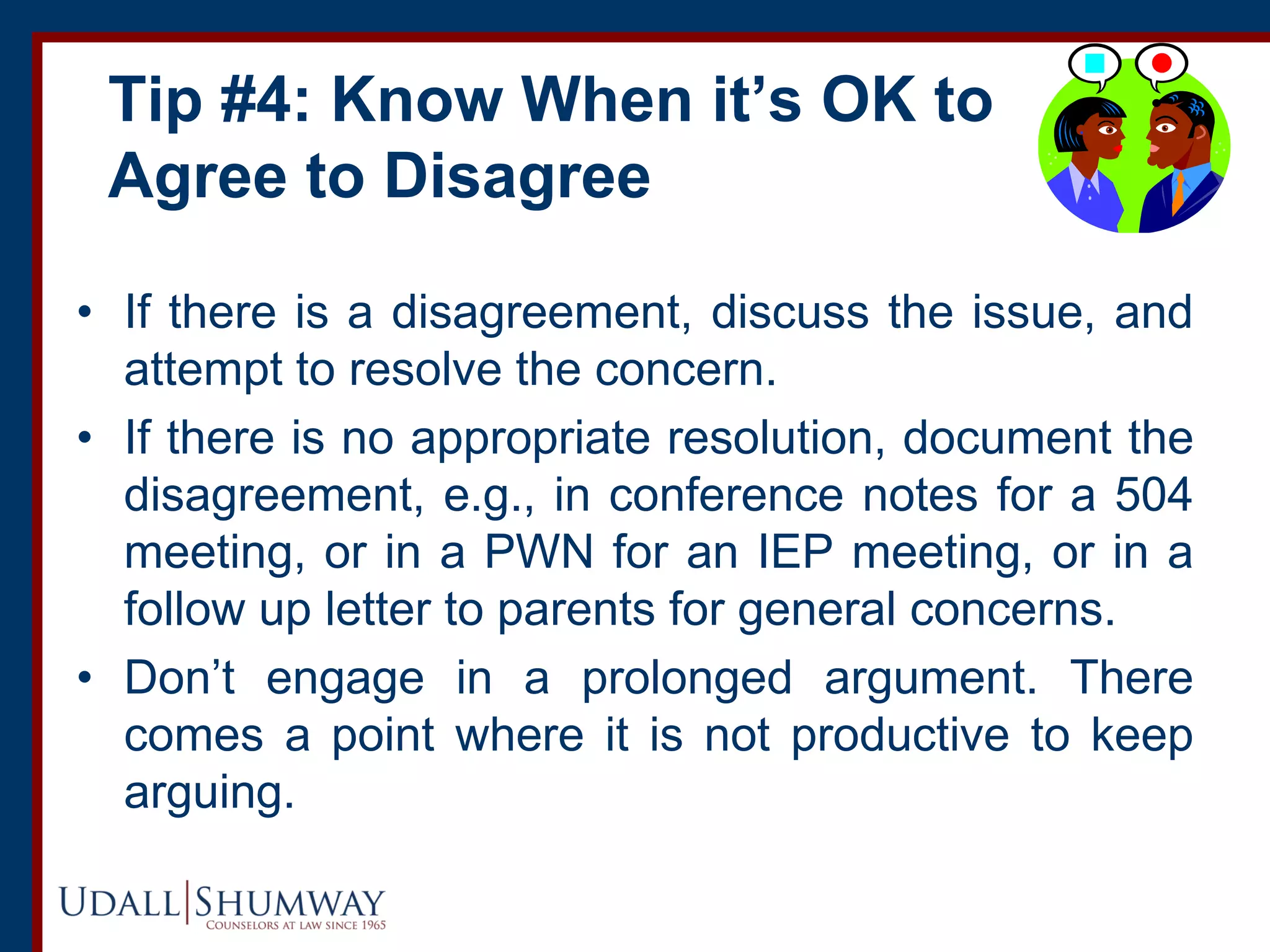
Tip #4: Know When it’s OK to
Agree to Disagree
• If there is a disagreement, discuss the issue, and
attempt to resolve the concern.
• If there is no appropriate resolution, document the
disagreement, e.g., in conference notes for a 504
meeting, or in a PWN for an IEP meeting, or in a
follow up letter to parents for general concerns.
• Don’t engage in a prolonged argument. There
comes a point where it is not productive to keep
arguing.
Tip #5: Notify Appropriate
Administrator of any “Red Flags”
• Make sure that school personnel keep appropriate
administrators in the loop regarding parents who are
particularly difficult or angry, for example:
– Principals should know of any grievances against
personnel;
– All districts must have a contact for reports of
discrimination and retaliation;
• Sometimes the early involvement of your School’s
attorney can help diffuse a “red flag” situation or
minimize the exposure of the School.
Tip #6: Educate Parents About
Policies and Procedures
• Be familiar with your own policy manual
and share and explain relevant policies
and procedures with the parents.
• Point parents to the appropriate
grievance and complaint procedures
and address their concerns promptly.
Tip #6: Educate Parents About
Policies and Procedures
• NOTE: Any complaints that have to do with race,
color, ethnicity, religion, sex, disability, or age
should be immediately addressed via
Policies/Regulations AC/AC-R or JB/JB-R.
• NOTE: Parents are not required to place
concerns or complaints about discrimination or
retaliation in writing. Encourage parents to put
their complaints in writing. If they refuse,
address the complaint with what you understand
their verbal complaint to be.
Part II
Be Assertive When Necessary
Overview
• You must always remain professional
and responsive to parent concerns and
complaints; however, parents do not
have the right to abuse and harass staff.
• Arizona law criminalizes certain
behavior against school personnel and
provides for injunctions against
harassment against individuals who
violate these laws.
You Need Not Tolerate Truly
Abusive Behavior
• Although a school is “public property,” the school has
control over the property.
• The district can limit access to parents who threaten or
abuse school personnel or property, so long as the
district acts reasonably, in good faith, and does not
abuse its discretion.
• Remember, parents have the right to file complaints.
Constant complaints from a parent do not equate to
“harassment” or “abuse.”
• To avoid retaliation claims, don’t limit a parent’s access
to the school for filing or excessive filing of complaints.
You Need Not Tolerate Truly
Abusive Behavior
• Do address behaviors that disrupt the educational process
or the operation of the school (e.g. entering property without
signing in, yelling in the office, arriving unannounced in
classrooms, verbal profanities or threats, etc.)
• Sometimes, a written letter outlining the policies being
violated by the parent, future expectations of the parent’s
behavior, and the consequences for bad behavior is
sufficient to change the parent’s behavior.
• Your school attorney can help you draft a letter to disruptive
parents.
• Contact law enforcement if a parent is truly out of control
and threatening.
It Is A Misdemeanor To Abuse A
Teacher/School Employee.
• A.R.S. § 15-507, “Abuse of teacher or
school employee in school” provides
that: “A person who knowingly abuses
a teacher or other school employee on
school grounds or while the teacher or
employee is engaged in the
performance of his duties is guilty of a
class 3 misdemeanor.”
It Is Misdemeanor To Abuse A
Teacher/School Employee.
• Cursing is not considered to be
“abuse;” however, A.R.S. § 13-2904, “Disorderly
Conduct” makes it a class one misdemeanor to
intend to, or with knowledge of doing so, disturb
the peace or quiet of a neighborhood, family or
person by engaging in fighting, violent or
seriously disruptive behavior; making
unreasonable noise; or using abusive and
offensive language or gestures to any person
present in a manner likely to provoke immediate
physical retaliation by such person.
It Is A Felony To Assault a
Teacher Or School Employee.
A.R.S. § 13-1204 provides that it is a class 6 felony if a
person does the following:
• Intentionally, knowingly or recklessly causes any physical
injury to the teacher or other school employee; or
• Intentionally places the teacher or other school employee
in reasonable apprehension of imminent physical injury;
or
• Knowingly touches the teacher or other school employee
with the intent to injure, insult, or provoke;
• While the teacher or school employee is on school
grounds, grounds adjacent to schools, school vehicles, at
school sponsored activities, or even in a private home if
there while carrying out duties on behalf of the school.
It’s a Felony or Misdemeanor to Interfere
With Or Disrupt an Educational Institution
• According to A.R.S. § 13-2911, a person commits the
crime of interference with or disruption of an
educational institution by doing any of the following:
• Intentionally, knowingly or recklessly interfering with or
disrupting the normal operations of a school by: (a)
Threatening to cause physical injury to any employee
or student or any person on school property; or (b)
Threatening to cause damage to any school, school
property, or the property of employees or
students. (Class 6 felonies).
It’s a Felony or Misdemeanor to Interfere With
Or Disrupt an Educational Institution
(Continued)
• Intentionally or knowingly entering or remaining on
school property for the purpose of interfering with the
lawful use of the property or in any manner as to
deny or interfere with the lawful use of the property by
others. (Class 1 misdemeanor).
• Intentionally or knowingly refusing to obey a lawful
order given by the Superintendent or designee to
maintain order by ordering the person to leave the
property. (Class 1 misdemeanor).
Injunctions Against Harassment
• A.R.S. § 12-1809, “Injunction Against
Harassment...,” permits a person to file a petition
with a magistrate, justice of the peace or superior
court for an injunction prohibiting harassment.
• Some districts/schools have filed such petitions
against abusive parents or patrons.
• "Harassment" means a single threat or act of
physical harm or damage or a series of acts over
any period of time that would cause a reasonable
person to be seriously alarmed or annoyed.
Part III
Avoid Retaliation
Concerns
Retaliation Prohibited
• Retaliation based on race, color, national
origin, religion, sex, age, and disability are
prohibited by a number of federal laws.
• Protection from retaliation does not just apply
to the student, and may also apply to
parents, advocates, and employees.
• “Retaliation” generally includes acts that
intimidate, threaten, coerce or discriminate
against any individual for the purpose of
interfering with any rights he/she has under
the law.
Retaliation Prohibited
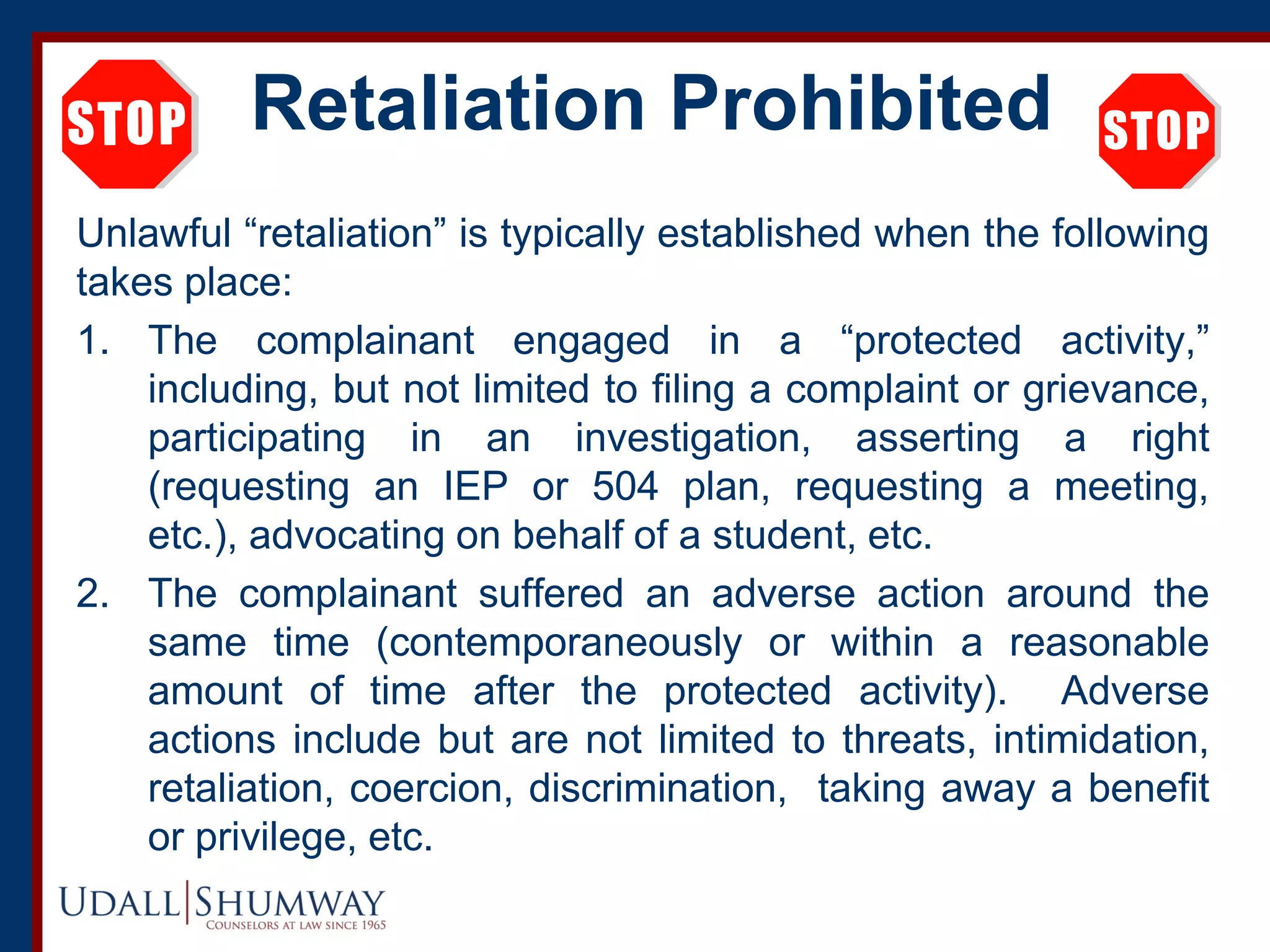
Unlawful “retaliation” is typically established when the following
takes place:
1. The complainant engaged in a “protected activity,”
including, but not limited to filing a complaint or grievance,
participating in an investigation, asserting a right
(requesting an IEP or 504 plan, requesting a meeting,
etc.), advocating on behalf of a student, etc.
2. The complainant suffered an adverse action around the
same time (contemporaneously or within a reasonable
amount of time after the protected activity). Adverse
actions include but are not limited to threats, intimidation,
retaliation, coercion, discrimination, taking away a benefit
or privilege, etc.
Retaliation Prohibited
3. The district/school was aware of the complainant's
protected activity.
4. There is evidence of a causal connection (nexus) between
the protected activity and the adverse action.
Once the steps for “retaliation” are established, the district
will only be exculpated if:
– The district has identified a legitimate, non-
discriminatory reason for taking the adverse action and,
if so,
– The reason asserted is not just a pretext for
discrimination.
Examples of Retaliation Claims
and Decisions
• Albuquerque (NM) Pub. Schs., 50 IDELR 263 (OCR 2007).
• Ruling: A New Mexico district did not retaliate against the
parent of a student with cerebral palsy when it barred her
from school grounds without prior authorization.
• Parent argued that the district’s actions were retaliatory for
her advocacy for her daughter and that the district kept her
from helping her daughter with her backpack and from
exiting the car.
• OCR noted that the parent had engaged in protected
activities (advocacy for certain IEP services), that the district
was aware of these activities, and that the ban from school
grounds happened contemporaneously with the parents
protected activities.
Examples of Retaliation Claims
and Decisions
• OCR found that the district had a legitimate,
nondiscriminatory reason for banning the parent from
campus.
• OCR found that “Ample evidence demonstrates that [the
parent's] behavior actually disrupted school proceedings
on multiple days and that staff members felt personally
threatened by her."
• OCR also noted that the district had a police report of
one incident and a warning letter from the district.
• OCR also noted that the district had banned other
parents who engaged in similar behavior on school
grounds.
Examples of Retaliation Claims
and Decisions
• Canisteo-Greenwood (NY) Sch. Dist., 50
IDELR 232 (OCR 2007).
• Ruling: The district did not retaliate against a
student’s grandparents by reporting them to
child welfare authorities.
• Although the grandparents had complained
about peer harassment, OCR found that the
district acted out of legitimate concern for the
student's health and safety after the student
reported that his medical clamps had been
chewed on by rats in his grandparent’s home.
Examples of Retaliation Claims
and Decisions
• Recent AZ OCR Complaint
• Parent filed 5+ OCR complaints over the last three
schools years.
• Parent was constantly e-mailing teachers, demanding
to know how her child’s IEP is being implemented
and accusing teachers of not providing her child’s
accommodations, or of retaliating against her child.
• Teachers found it exhausting to respond to her e-
mails because as soon as they provided her with an
answer, she accused them of lying or moved on to
her next demand.
Examples of Retaliation Claims
and Decisions
• Parent constantly threatened the teachers that “I will go to
OCR and tell them about your retaliation and
discrimination.”
• Principal was concerned about the stress on her teachers.
• Principal also did not think the constant e-battles were
productive and thought it would be better if she was the
point of contact for the parent and her concerns.
• Principal e-mailed the parent and explained “Because you
continue to threaten my teachers that you will ‘go to
OCR,’ I am requesting that you e-mail me and refrain from
e-mailing the teachers”
Examples of Retaliation Claims
and Decisions
• The scenario is based on an actual OCR Complaint.
• The district ended up settling with OCR, before OCR could
make a finding.
• OCR might have found a legitimate purpose for limiting e-
mail contact with the teachers had the principal not made the
statement “because of the threats to go to OCR.”
• In this circumstance, the principal took an adverse action
(limiting the parents contact with teachers) based on the
Parent’s protected activity (threatening to file an OCR
complaint).
• While the principal had no retaliatory or ill motive, her
language created a good case for parent’s retaliation claim.
Avoiding Retaliation
Complaints
• Remain professional at all times in your
dealings with parents, students and employees!
• Don’t refer to parents as “trouble makers” or
“whiners.”
• Be professional in your e-mails to and about
parents.
• Remember that it is okay to agree to disagree. If
an interaction is no longer productive and
getting heated, hand the parent a copy of the
appropriate grievance procedure.
Avoiding Retaliation
Complaints
• Know and understand your polices regarding
discrimination and retaliation.
• Don’t take any adverse action out of anger or
frustration or to “get back” at an individual.
• Don’t take any adverse action in response to
parent complaints. Remember—they have a
right to complain.
• Avoid becoming defensive and angry and don’t
take complaints personally.
Avoiding Retaliation
Complaints
• Before taking any adverse action, ask yourself why your
are about to take that step. Do you have a legitimate,
non-discriminatory reason for pursuing a particular
course of action? Is your action supported by District
policy and federal law prohibiting retaliation?
• Take adverse action only when necessary to address
truly threatening or abusive behavior, or behavior that is
disruptive to the educational process.
• Obtain the assistance of an administrator or your
school’s attorney if you are unsure how to appropriately
respond to a difficult parent, advocate, employee or
student.
Thank You Very Much!
UDALL SHUMWAY PLC
1138 North Alma School Road, Suite 101
Mesa, Arizona 85201
hrp@udallshumway.com | 480-461-5384
www.udallshumway.com
4202637.1

Addressing Difficult Parents

  • 1.
    Appropriately Addressing Difficult Parents and AvoidingRetaliation Claims by Heather Pierson Udall Shumway PLC
  • 2.
    Objectives • Discuss sometips that can help minimize conflicts with difficult parents. • Discuss some options that are available to you when a parent crosses the line. • Discuss the elements of unlawful retaliation and some tips for keeping school personnel from crossing that line.
  • 3.
    Part I Tips forMinimizing Conflict
  • 4.
    Tip #1: BeCalm, Respectful And Professional At All Times. • No matter how difficult, frustrating or abusive a parent is, it is important to remain professional. • Do not respond in kind or retaliate against parents. • Do not make patronizing, demeaning or negative remarks about the parent or child. (Be especially careful about what personnel put in e-mail)
  • 5.
    Tip #1: BeCalm, Respectful And Professional At All Times. • Try not to get defensive. • Respond with facts and not emotion. • Keep the child’s best interest in mind. • Sarcastic, angry or other unprofessional remarks or behavior will undoubtedly come back to haunt the district!
  • 6.
    Tip #2: Bea Good Listener • Parents, naturally, are passionate about their children and their needs. • Parents get upset when they think you are not listening about their child’s needs. • Sometimes parents just need to vent their feelings and frustrations. • Try to understand the parent’s perspective. • Take notes and ask clarifying questions. • Repeat concerns back to the parent to make sure you understood what they said.
  • 7.
    Tip #3: HaveAlternative Staff Available To Work With The Parents (When Appropriate) • Parents may be upset with a particular teacher or staff member who has been working with their child or with them. • Hostile feelings then “spill over” in meetings and other interactions, creating a very unpleasant situation. • Find a “neutral” or new person to meet with the parents to determine how the situation can be improved. • Use this tip only when you think it is appropriate. Sometimes, parents have to learn to work with the staff that is assigned to them.
  • 8.
    Tip #4: KnowWhen it’s OK to Agree to Disagree • If there is a disagreement, discuss the issue, and attempt to resolve the concern. • If there is no appropriate resolution, document the disagreement, e.g., in conference notes for a 504 meeting, or in a PWN for an IEP meeting, or in a follow up letter to parents for general concerns. • Don’t engage in a prolonged argument. There comes a point where it is not productive to keep arguing.
  • 9.
    Tip #5: NotifyAppropriate Administrator of any “Red Flags” • Make sure that school personnel keep appropriate administrators in the loop regarding parents who are particularly difficult or angry, for example: – Principals should know of any grievances against personnel; – All districts must have a contact for reports of discrimination and retaliation; • Sometimes the early involvement of your School’s attorney can help diffuse a “red flag” situation or minimize the exposure of the School.
  • 10.
    Tip #6: EducateParents About Policies and Procedures • Be familiar with your own policy manual and share and explain relevant policies and procedures with the parents. • Point parents to the appropriate grievance and complaint procedures and address their concerns promptly.
  • 11.
    Tip #6: EducateParents About Policies and Procedures • NOTE: Any complaints that have to do with race, color, ethnicity, religion, sex, disability, or age should be immediately addressed via Policies/Regulations AC/AC-R or JB/JB-R. • NOTE: Parents are not required to place concerns or complaints about discrimination or retaliation in writing. Encourage parents to put their complaints in writing. If they refuse, address the complaint with what you understand their verbal complaint to be.
  • 12.
    Part II Be AssertiveWhen Necessary
  • 13.
    Overview • You mustalways remain professional and responsive to parent concerns and complaints; however, parents do not have the right to abuse and harass staff. • Arizona law criminalizes certain behavior against school personnel and provides for injunctions against harassment against individuals who violate these laws.
  • 14.
    You Need NotTolerate Truly Abusive Behavior • Although a school is “public property,” the school has control over the property. • The district can limit access to parents who threaten or abuse school personnel or property, so long as the district acts reasonably, in good faith, and does not abuse its discretion. • Remember, parents have the right to file complaints. Constant complaints from a parent do not equate to “harassment” or “abuse.” • To avoid retaliation claims, don’t limit a parent’s access to the school for filing or excessive filing of complaints.
  • 15.
    You Need NotTolerate Truly Abusive Behavior • Do address behaviors that disrupt the educational process or the operation of the school (e.g. entering property without signing in, yelling in the office, arriving unannounced in classrooms, verbal profanities or threats, etc.) • Sometimes, a written letter outlining the policies being violated by the parent, future expectations of the parent’s behavior, and the consequences for bad behavior is sufficient to change the parent’s behavior. • Your school attorney can help you draft a letter to disruptive parents. • Contact law enforcement if a parent is truly out of control and threatening.
  • 16.
    It Is AMisdemeanor To Abuse A Teacher/School Employee. • A.R.S. § 15-507, “Abuse of teacher or school employee in school” provides that: “A person who knowingly abuses a teacher or other school employee on school grounds or while the teacher or employee is engaged in the performance of his duties is guilty of a class 3 misdemeanor.”
  • 17.
    It Is MisdemeanorTo Abuse A Teacher/School Employee. • Cursing is not considered to be “abuse;” however, A.R.S. § 13-2904, “Disorderly Conduct” makes it a class one misdemeanor to intend to, or with knowledge of doing so, disturb the peace or quiet of a neighborhood, family or person by engaging in fighting, violent or seriously disruptive behavior; making unreasonable noise; or using abusive and offensive language or gestures to any person present in a manner likely to provoke immediate physical retaliation by such person.
  • 18.
    It Is AFelony To Assault a Teacher Or School Employee. A.R.S. § 13-1204 provides that it is a class 6 felony if a person does the following: • Intentionally, knowingly or recklessly causes any physical injury to the teacher or other school employee; or • Intentionally places the teacher or other school employee in reasonable apprehension of imminent physical injury; or • Knowingly touches the teacher or other school employee with the intent to injure, insult, or provoke; • While the teacher or school employee is on school grounds, grounds adjacent to schools, school vehicles, at school sponsored activities, or even in a private home if there while carrying out duties on behalf of the school.
  • 19.
    It’s a Felonyor Misdemeanor to Interfere With Or Disrupt an Educational Institution • According to A.R.S. § 13-2911, a person commits the crime of interference with or disruption of an educational institution by doing any of the following: • Intentionally, knowingly or recklessly interfering with or disrupting the normal operations of a school by: (a) Threatening to cause physical injury to any employee or student or any person on school property; or (b) Threatening to cause damage to any school, school property, or the property of employees or students. (Class 6 felonies).
  • 20.
    It’s a Felonyor Misdemeanor to Interfere With Or Disrupt an Educational Institution (Continued) • Intentionally or knowingly entering or remaining on school property for the purpose of interfering with the lawful use of the property or in any manner as to deny or interfere with the lawful use of the property by others. (Class 1 misdemeanor). • Intentionally or knowingly refusing to obey a lawful order given by the Superintendent or designee to maintain order by ordering the person to leave the property. (Class 1 misdemeanor).
  • 21.
    Injunctions Against Harassment •A.R.S. § 12-1809, “Injunction Against Harassment...,” permits a person to file a petition with a magistrate, justice of the peace or superior court for an injunction prohibiting harassment. • Some districts/schools have filed such petitions against abusive parents or patrons. • "Harassment" means a single threat or act of physical harm or damage or a series of acts over any period of time that would cause a reasonable person to be seriously alarmed or annoyed.
  • 22.
  • 23.
    Retaliation Prohibited • Retaliationbased on race, color, national origin, religion, sex, age, and disability are prohibited by a number of federal laws. • Protection from retaliation does not just apply to the student, and may also apply to parents, advocates, and employees. • “Retaliation” generally includes acts that intimidate, threaten, coerce or discriminate against any individual for the purpose of interfering with any rights he/she has under the law.
  • 24.
    Retaliation Prohibited Unlawful “retaliation”is typically established when the following takes place: 1. The complainant engaged in a “protected activity,” including, but not limited to filing a complaint or grievance, participating in an investigation, asserting a right (requesting an IEP or 504 plan, requesting a meeting, etc.), advocating on behalf of a student, etc. 2. The complainant suffered an adverse action around the same time (contemporaneously or within a reasonable amount of time after the protected activity). Adverse actions include but are not limited to threats, intimidation, retaliation, coercion, discrimination, taking away a benefit or privilege, etc.
  • 25.
    Retaliation Prohibited 3. Thedistrict/school was aware of the complainant's protected activity. 4. There is evidence of a causal connection (nexus) between the protected activity and the adverse action. Once the steps for “retaliation” are established, the district will only be exculpated if: – The district has identified a legitimate, non- discriminatory reason for taking the adverse action and, if so, – The reason asserted is not just a pretext for discrimination.
  • 26.
    Examples of RetaliationClaims and Decisions • Albuquerque (NM) Pub. Schs., 50 IDELR 263 (OCR 2007). • Ruling: A New Mexico district did not retaliate against the parent of a student with cerebral palsy when it barred her from school grounds without prior authorization. • Parent argued that the district’s actions were retaliatory for her advocacy for her daughter and that the district kept her from helping her daughter with her backpack and from exiting the car. • OCR noted that the parent had engaged in protected activities (advocacy for certain IEP services), that the district was aware of these activities, and that the ban from school grounds happened contemporaneously with the parents protected activities.
  • 27.
    Examples of RetaliationClaims and Decisions • OCR found that the district had a legitimate, nondiscriminatory reason for banning the parent from campus. • OCR found that “Ample evidence demonstrates that [the parent's] behavior actually disrupted school proceedings on multiple days and that staff members felt personally threatened by her." • OCR also noted that the district had a police report of one incident and a warning letter from the district. • OCR also noted that the district had banned other parents who engaged in similar behavior on school grounds.
  • 28.
    Examples of RetaliationClaims and Decisions • Canisteo-Greenwood (NY) Sch. Dist., 50 IDELR 232 (OCR 2007). • Ruling: The district did not retaliate against a student’s grandparents by reporting them to child welfare authorities. • Although the grandparents had complained about peer harassment, OCR found that the district acted out of legitimate concern for the student's health and safety after the student reported that his medical clamps had been chewed on by rats in his grandparent’s home.
  • 29.
    Examples of RetaliationClaims and Decisions • Recent AZ OCR Complaint • Parent filed 5+ OCR complaints over the last three schools years. • Parent was constantly e-mailing teachers, demanding to know how her child’s IEP is being implemented and accusing teachers of not providing her child’s accommodations, or of retaliating against her child. • Teachers found it exhausting to respond to her e- mails because as soon as they provided her with an answer, she accused them of lying or moved on to her next demand.
  • 30.
    Examples of RetaliationClaims and Decisions • Parent constantly threatened the teachers that “I will go to OCR and tell them about your retaliation and discrimination.” • Principal was concerned about the stress on her teachers. • Principal also did not think the constant e-battles were productive and thought it would be better if she was the point of contact for the parent and her concerns. • Principal e-mailed the parent and explained “Because you continue to threaten my teachers that you will ‘go to OCR,’ I am requesting that you e-mail me and refrain from e-mailing the teachers”
  • 31.
    Examples of RetaliationClaims and Decisions • The scenario is based on an actual OCR Complaint. • The district ended up settling with OCR, before OCR could make a finding. • OCR might have found a legitimate purpose for limiting e- mail contact with the teachers had the principal not made the statement “because of the threats to go to OCR.” • In this circumstance, the principal took an adverse action (limiting the parents contact with teachers) based on the Parent’s protected activity (threatening to file an OCR complaint). • While the principal had no retaliatory or ill motive, her language created a good case for parent’s retaliation claim.
  • 32.
    Avoiding Retaliation Complaints • Remainprofessional at all times in your dealings with parents, students and employees! • Don’t refer to parents as “trouble makers” or “whiners.” • Be professional in your e-mails to and about parents. • Remember that it is okay to agree to disagree. If an interaction is no longer productive and getting heated, hand the parent a copy of the appropriate grievance procedure.
  • 33.
    Avoiding Retaliation Complaints • Knowand understand your polices regarding discrimination and retaliation. • Don’t take any adverse action out of anger or frustration or to “get back” at an individual. • Don’t take any adverse action in response to parent complaints. Remember—they have a right to complain. • Avoid becoming defensive and angry and don’t take complaints personally.
  • 34.
    Avoiding Retaliation Complaints • Beforetaking any adverse action, ask yourself why your are about to take that step. Do you have a legitimate, non-discriminatory reason for pursuing a particular course of action? Is your action supported by District policy and federal law prohibiting retaliation? • Take adverse action only when necessary to address truly threatening or abusive behavior, or behavior that is disruptive to the educational process. • Obtain the assistance of an administrator or your school’s attorney if you are unsure how to appropriately respond to a difficult parent, advocate, employee or student.
  • 35.
  • 36.
    UDALL SHUMWAY PLC 1138North Alma School Road, Suite 101 Mesa, Arizona 85201 hrp@udallshumway.com | 480-461-5384 www.udallshumway.com 4202637.1