www.internetsociety.org
Some Internet Topics:
Horizontals, the IETF, and IPv6
Olaf M. Kolkman
Chief Internet Technology Officer
kolkman@isoc.org
Central Asia Internet Symposium - 10 December 2014
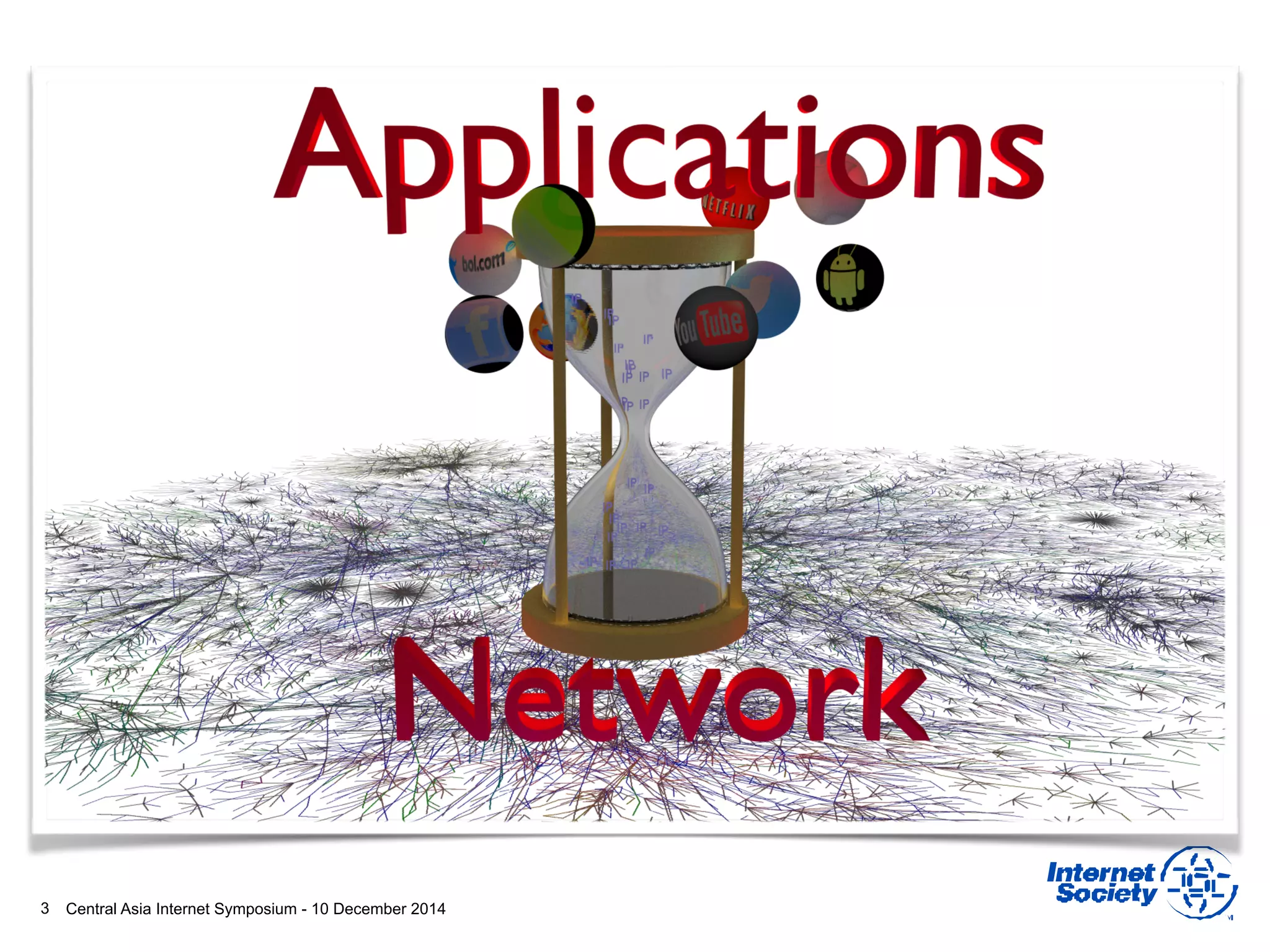
The Internet: Different Players at Different Layers
2
Central Asia Internet Symposium - 10 December 20143
Central Asia Internet Symposium - 10 December 2014
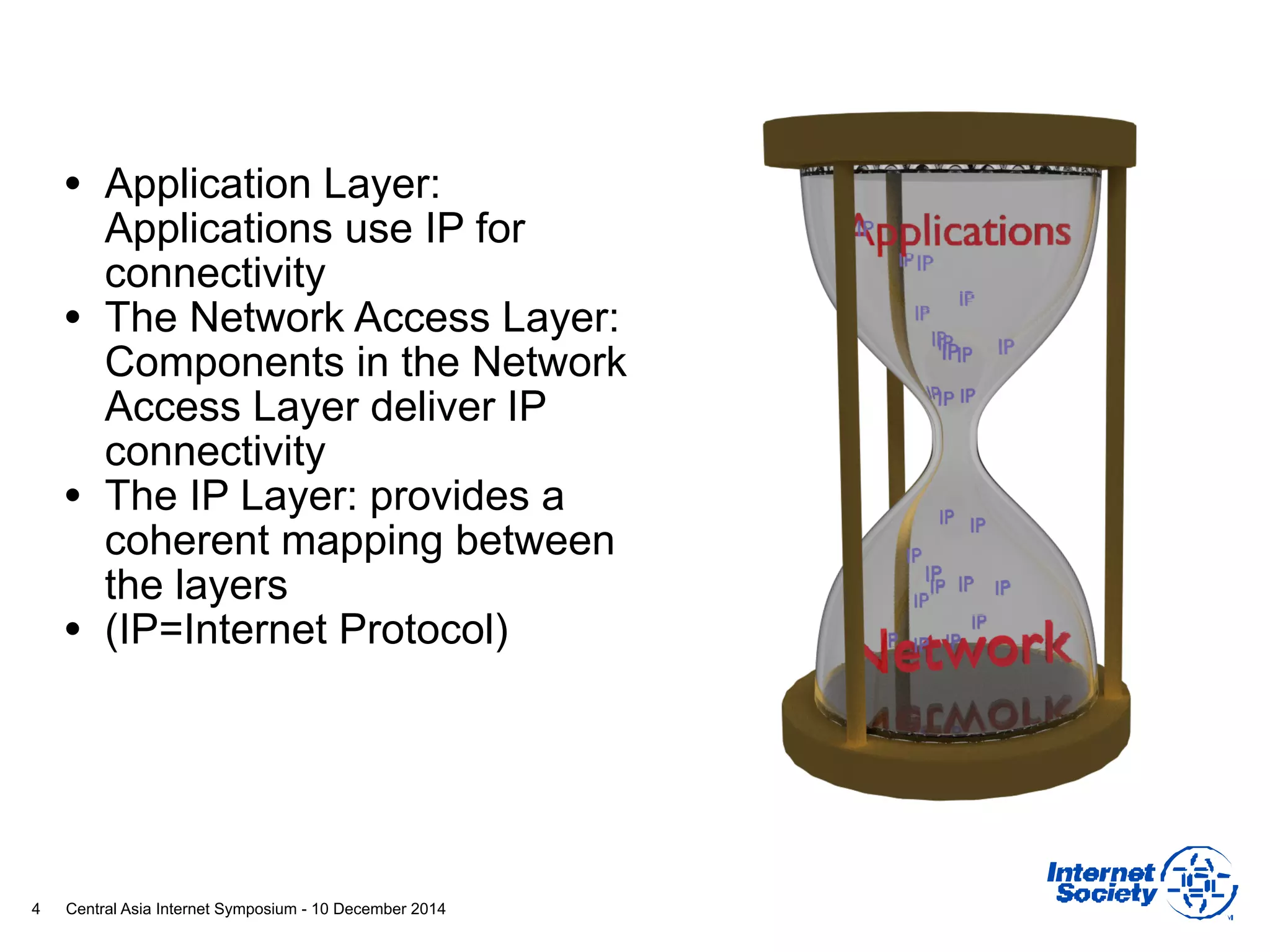
• Application Layer:
Applications use IP for
connectivity
• The Network Access Layer:
Components in the Network
Access Layer deliver IP
connectivity
• The IP Layer: provides a
coherent mapping between
the layers
• (IP=Internet Protocol)
4
Central Asia Internet Symposium - 10 December 2014
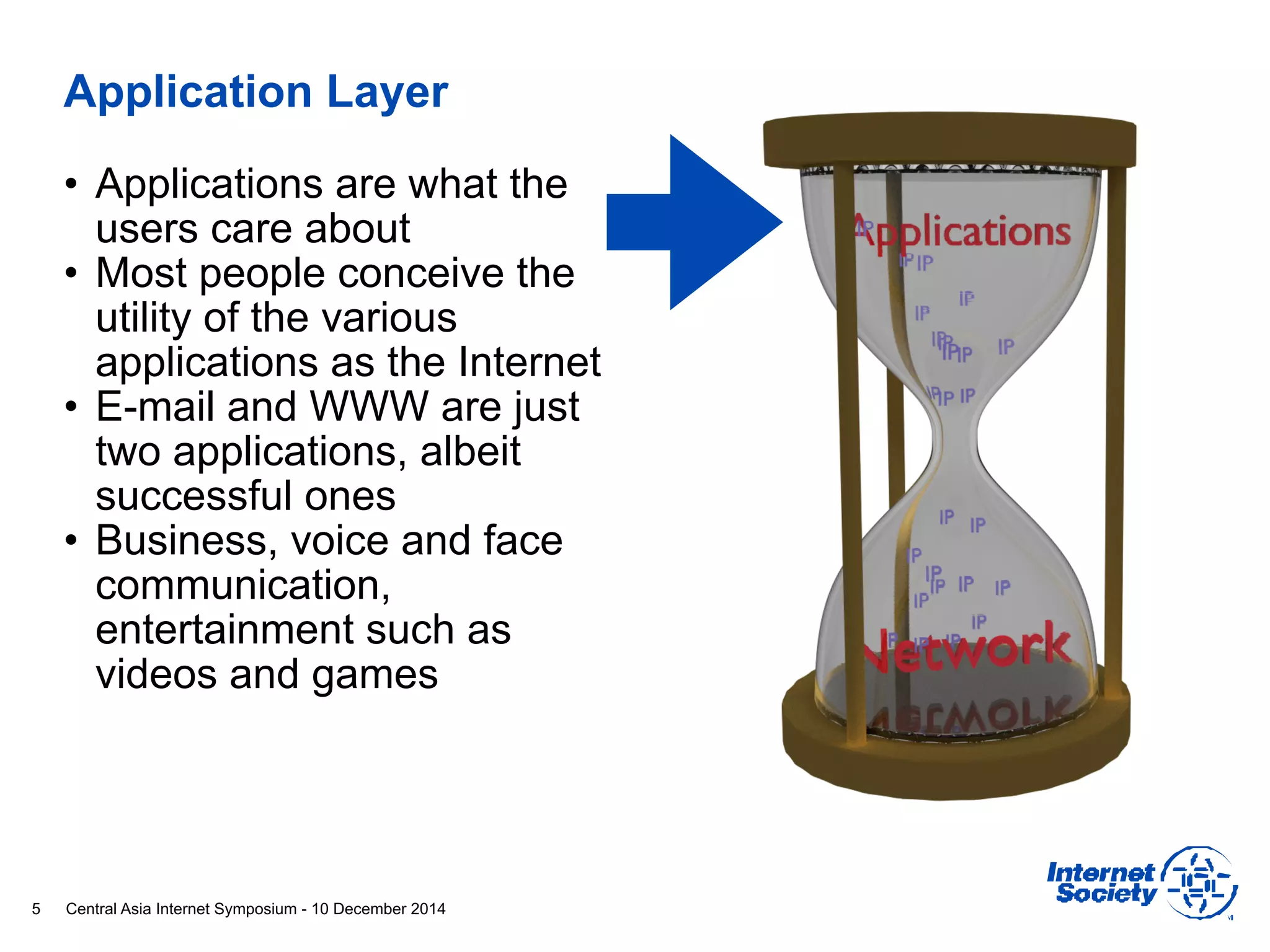
Application Layer
• Applications are what the
users care about
• Most people conceive the
utility of the various
applications as the Internet
• E-mail and WWW are just
two applications, albeit
successful ones
• Business, voice and face
communication,
entertainment such as
videos and games
5
Central Asia Internet Symposium - 10 December 2014
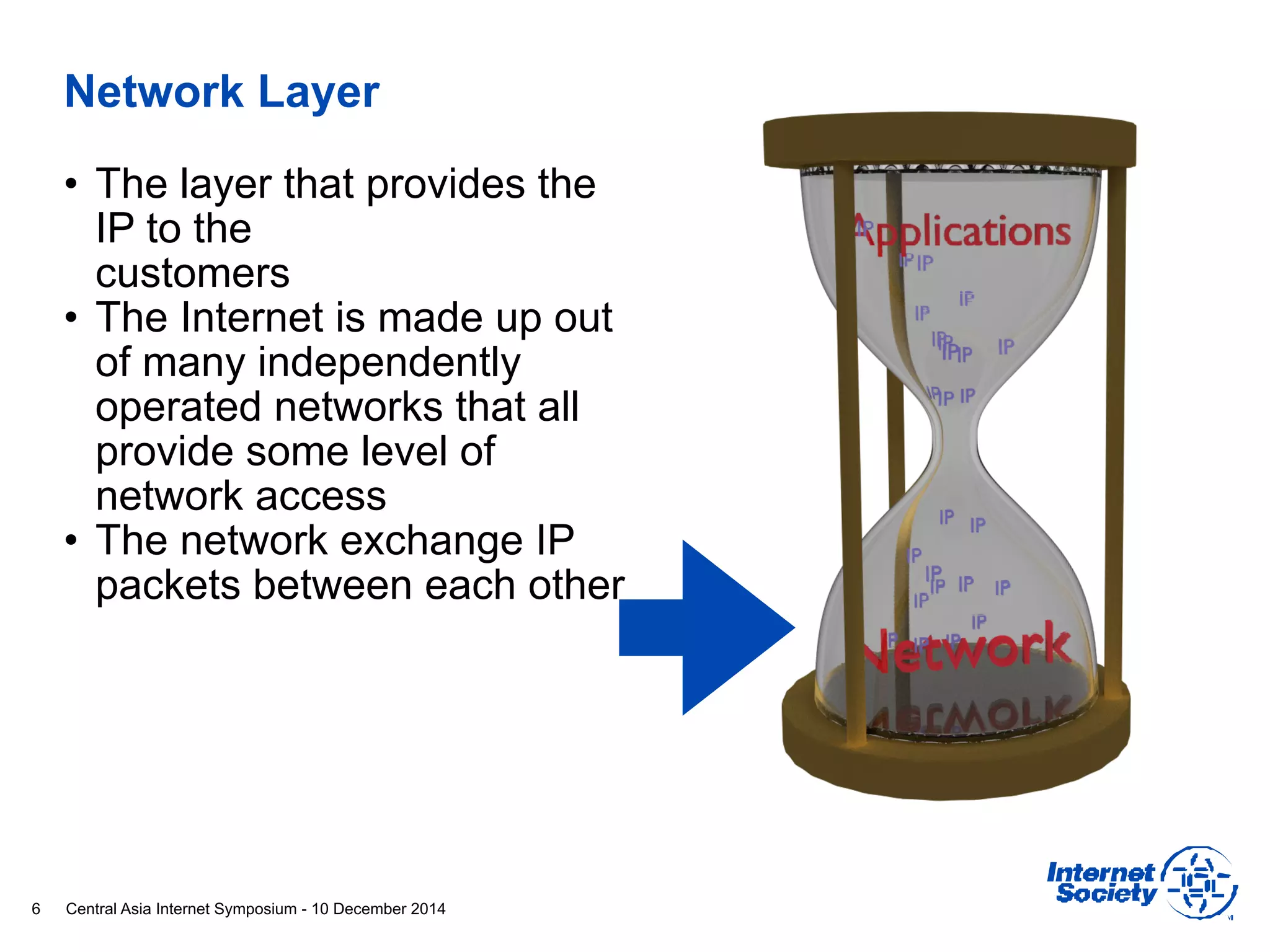
Network Layer
• The layer that provides the
IP to the

customers
• The Internet is made up out
of many independently
operated networks that all
provide some level of
network access
• The network exchange IP
packets between each other
6
Central Asia Internet Symposium - 10 December 2014
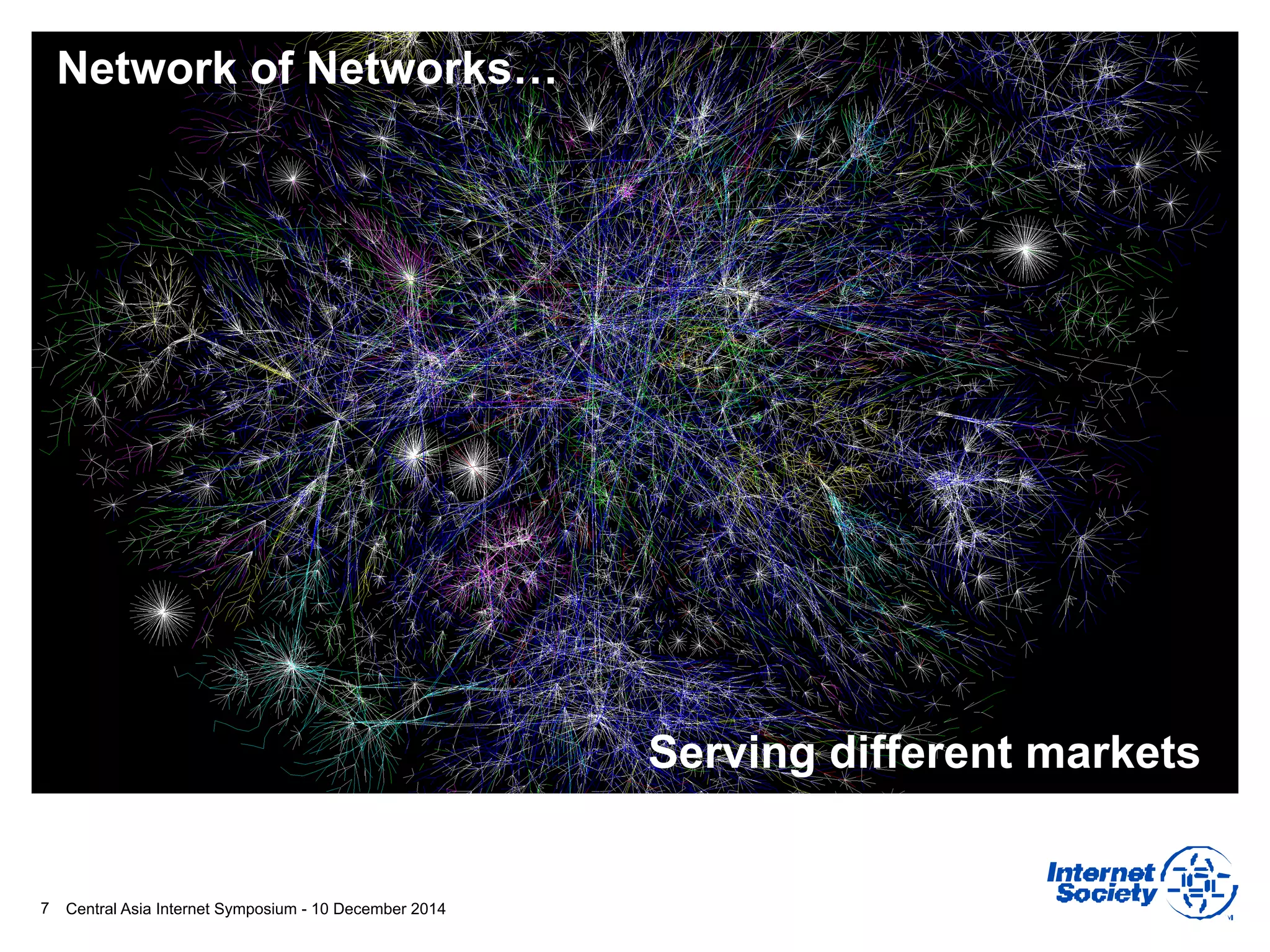
Network of Networks…
7
Serving different markets
Central Asia Internet Symposium - 10 December 2014
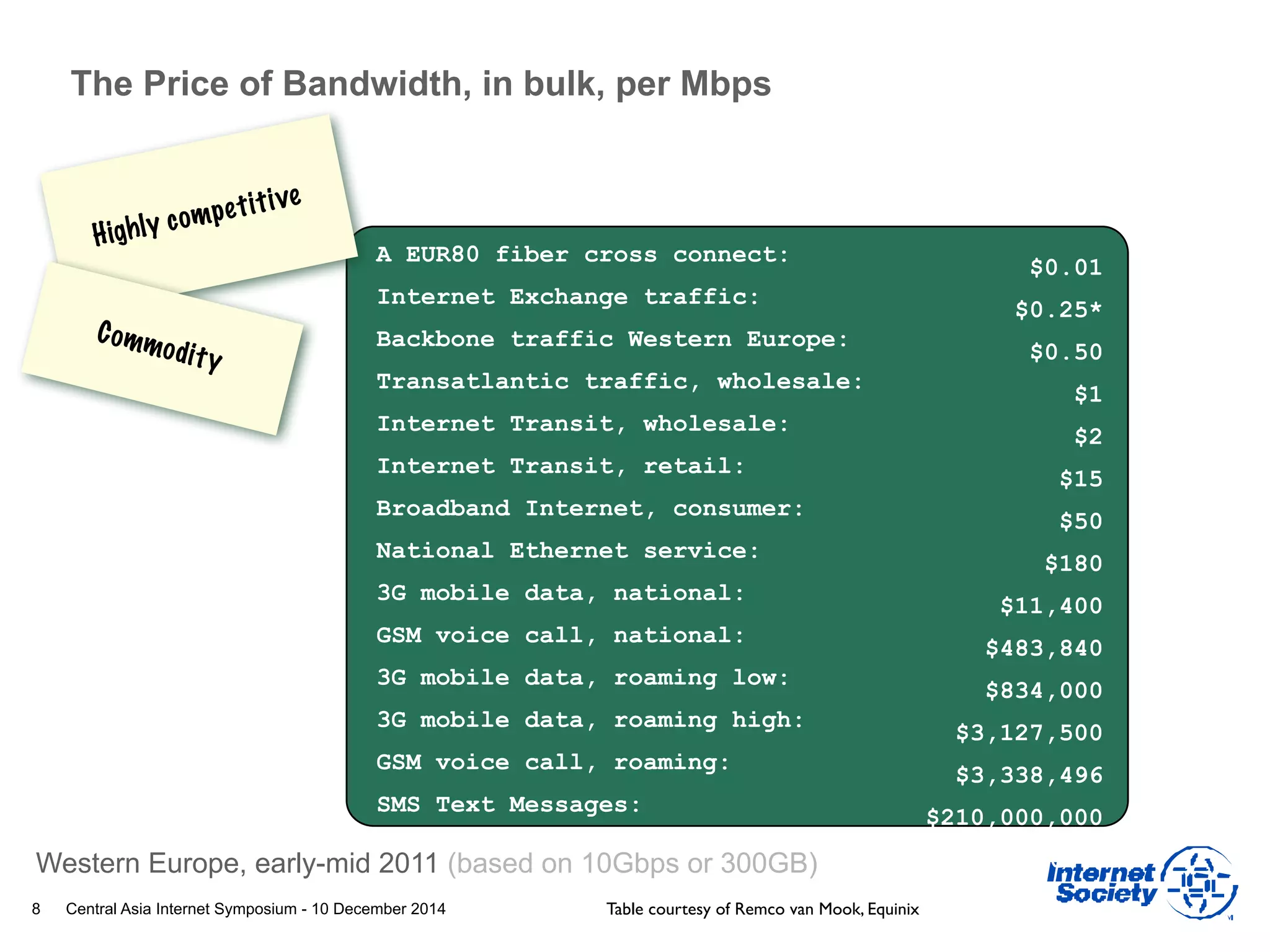
Highly competitive
A EUR80 fiber cross connect:
Internet Exchange traffic:
Backbone traffic Western Europe:
Transatlantic traffic, wholesale:
Internet Transit, wholesale:
Internet Transit, retail:
Broadband Internet, consumer:
National Ethernet service:
3G mobile data, national:
GSM voice call, national:
3G mobile data, roaming low:
3G mobile data, roaming high:
GSM voice call, roaming:
SMS Text Messages:
SMS Text Messages, roaming:
$0.01
$0.25*
$0.50
$1
$2
$15
$50
$180
$11,400
$483,840
$834,000
$3,127,500
$3,338,496
$210,000,000
$1,166,400,000
The Price of Bandwidth, in bulk, per Mbps
8
Commodity
Table courtesy of Remco van Mook, Equinix
Western Europe, early-mid 2011 (based on 10Gbps or 300GB)
Central Asia Internet Symposium - 10 December 2014
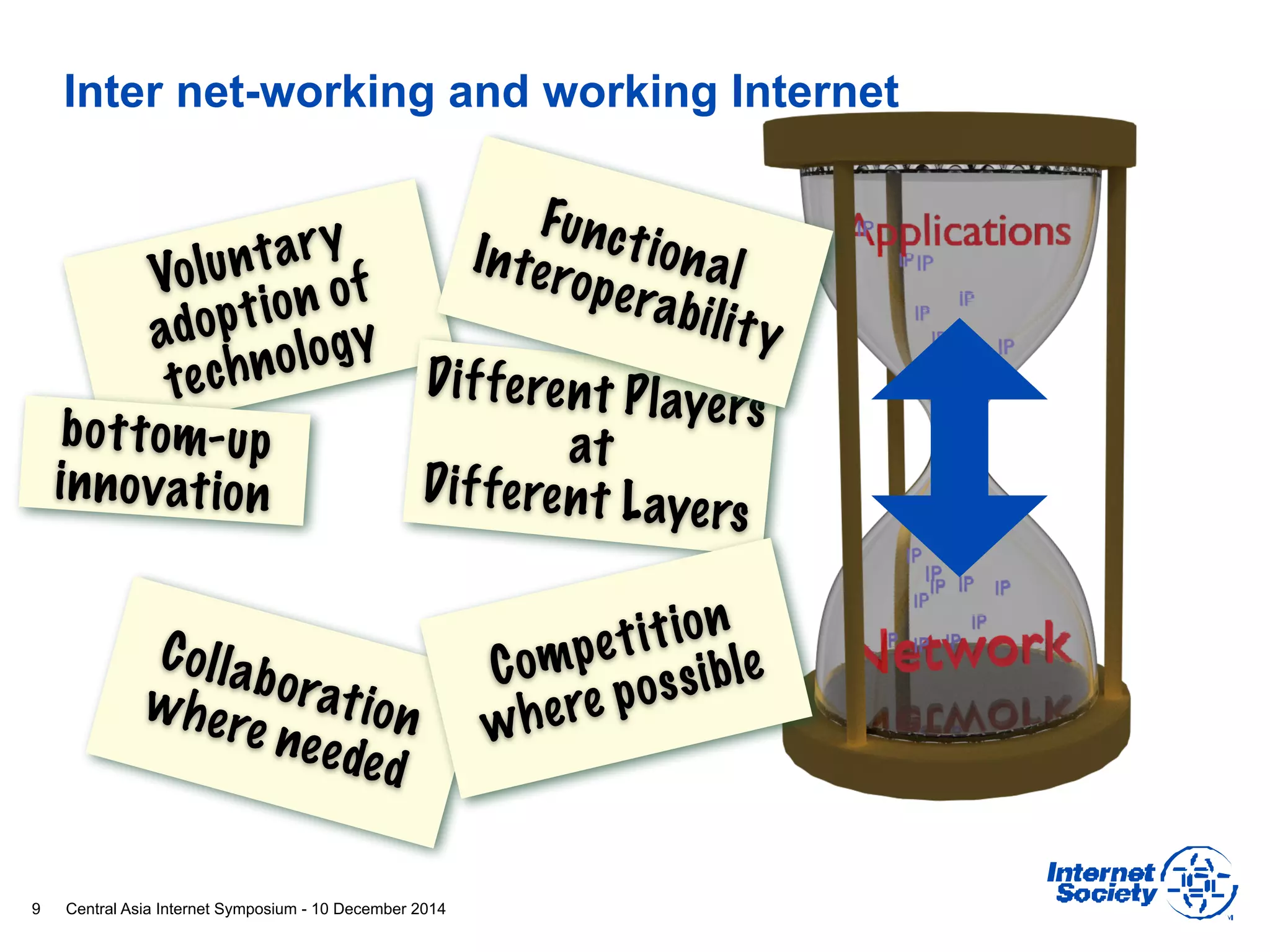
Inter net-working and working Internet
9
Voluntary
adoption of
technology
bottom-up
innovation
Different Players
at
Different Layers
FunctionalInteroperability
Collaborationwhere needed
Competition
where possible
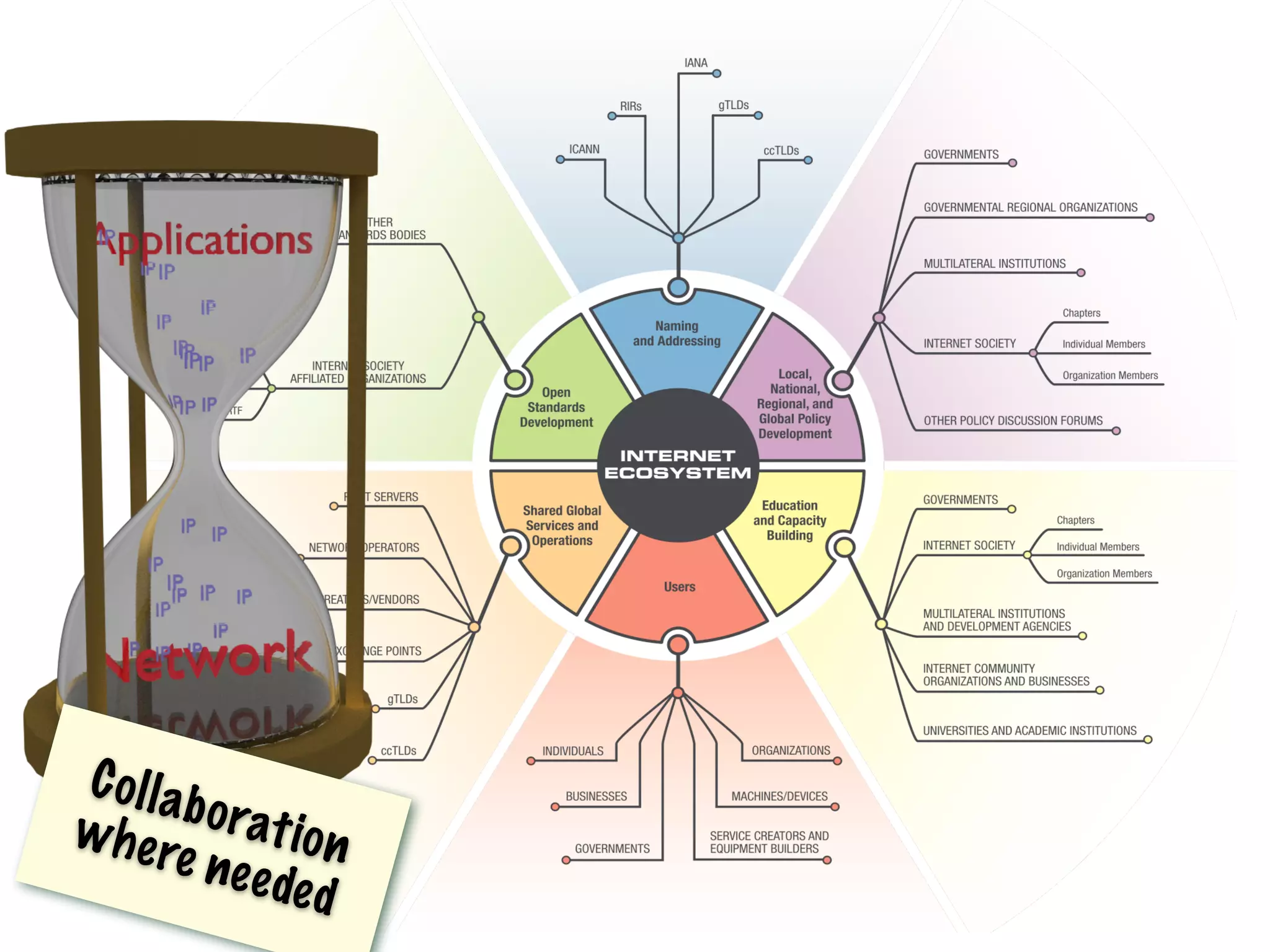
Collaborationwhere needed
Central Asia Internet Symposium - 10 December 2014
The Internet and Standards
11
Central Asia Internet Symposium - 10 December 2014
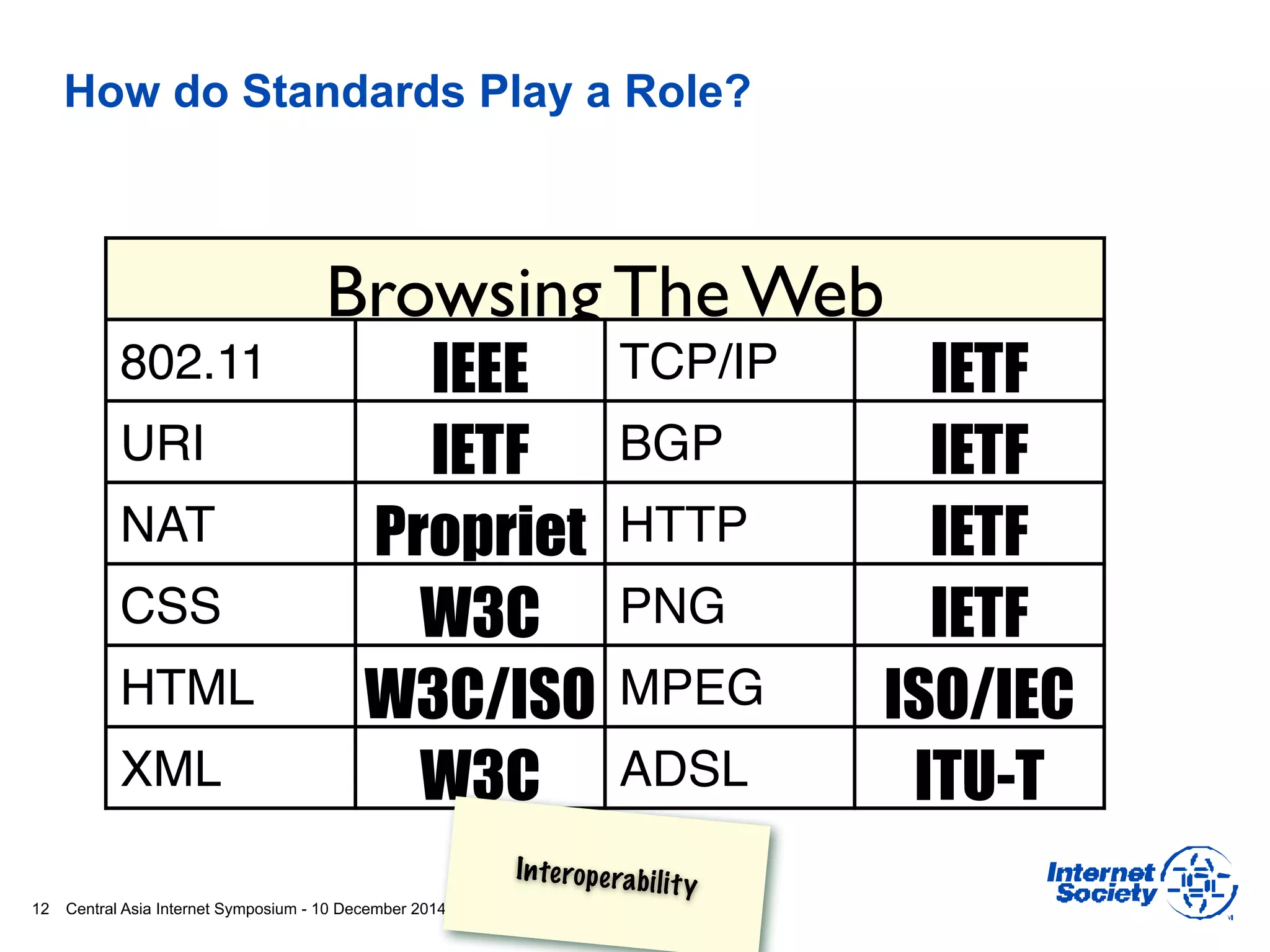
How do Standards Play a Role?
12
Browsing The Web
802.11 IEEE TCP/IP IETF
URI IETF BGP IETF
NAT Propriet HTTP IETF
CSS W3C PNG IETF
HTML W3C/ISO MPEG ISO/IEC
XML W3C ADSL ITU-T
Interoperability
Standardization
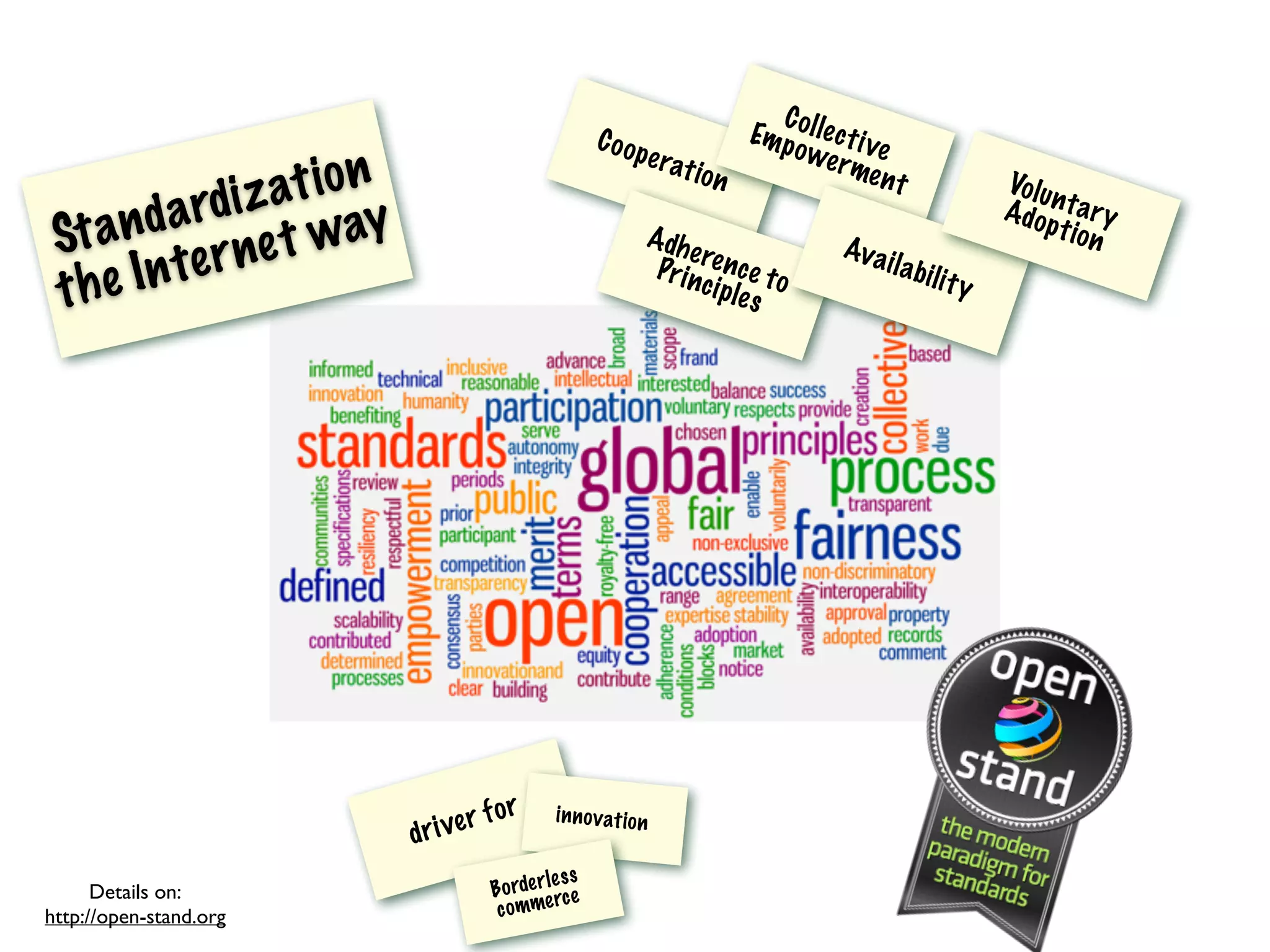
the Internet way
Details on:
http://open-stand.org
Cooperation
Adherence toPrinciples
Collective
Empowerment
Availability
VoluntaryAdoption
driver for innovation
Borderless
commerce
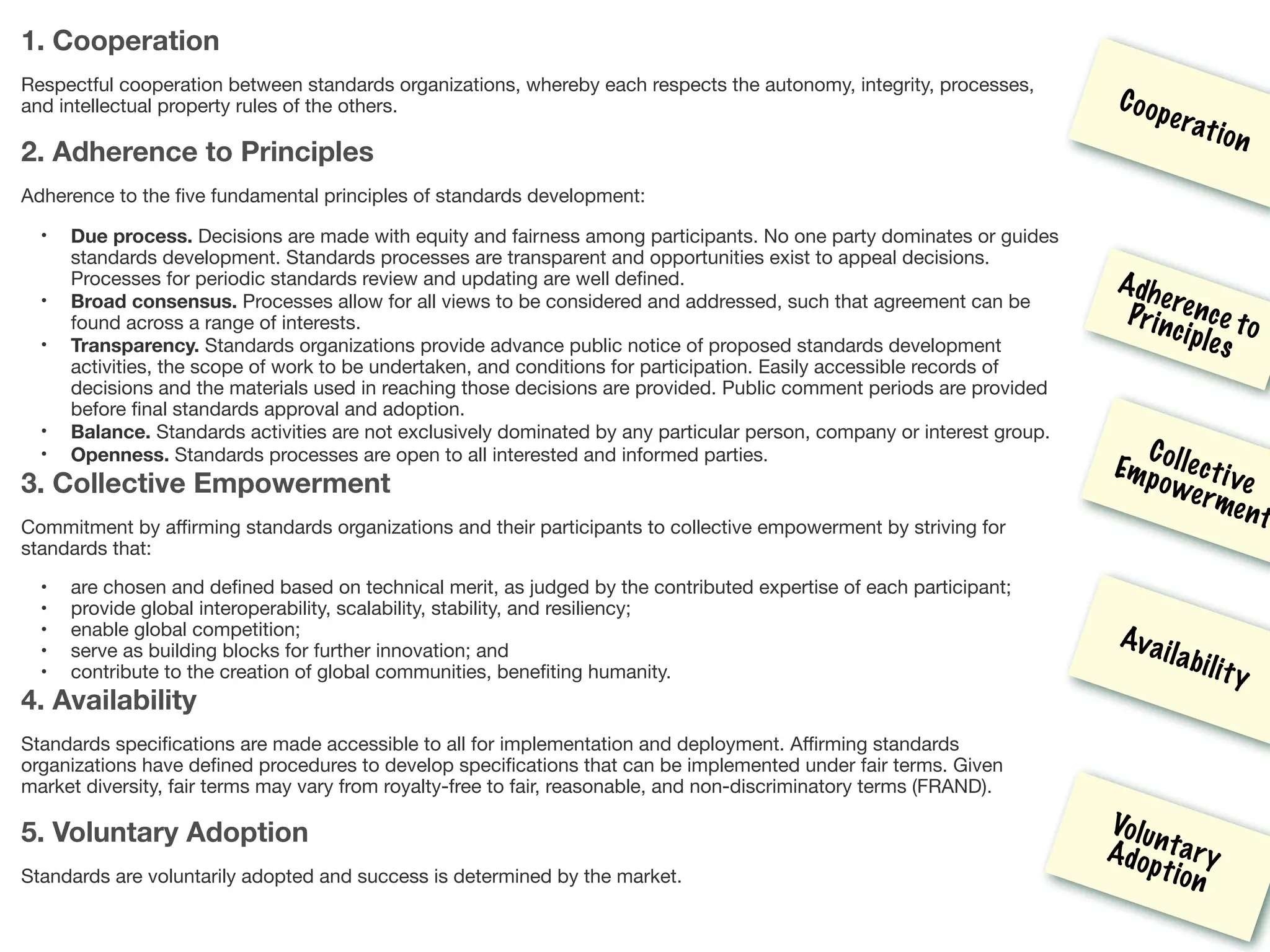
1. Cooperation
Respectful cooperation between standards organizations, whereby each respects the autonomy, integrity, processes,
and intellectual property rules of the others.

2. Adherence to Principles
Adherence to the five fundamental principles of standards development:

• Due process. Decisions are made with equity and fairness among participants. No one party dominates or guides
standards development. Standards processes are transparent and opportunities exist to appeal decisions.
Processes for periodic standards review and updating are well defined.

• Broad consensus. Processes allow for all views to be considered and addressed, such that agreement can be
found across a range of interests.

• Transparency. Standards organizations provide advance public notice of proposed standards development
activities, the scope of work to be undertaken, and conditions for participation. Easily accessible records of
decisions and the materials used in reaching those decisions are provided. Public comment periods are provided
before final standards approval and adoption.

• Balance. Standards activities are not exclusively dominated by any particular person, company or interest group.

• Openness. Standards processes are open to all interested and informed parties.

3. Collective Empowerment
Commitment by affirming standards organizations and their participants to collective empowerment by striving for
standards that:

• are chosen and defined based on technical merit, as judged by the contributed expertise of each participant;

• provide global interoperability, scalability, stability, and resiliency;

• enable global competition;

• serve as building blocks for further innovation; and

• contribute to the creation of global communities, benefiting humanity.

4. Availability
Standards specifications are made accessible to all for implementation and deployment. Affirming standards
organizations have defined procedures to develop specifications that can be implemented under fair terms. Given
market diversity, fair terms may vary from royalty-free to fair, reasonable, and non-discriminatory terms (FRAND).

5. Voluntary Adoption
Standards are voluntarily adopted and success is determined by the market.

Cooperation
Adherence toPrinciples
Collective
Empowerment
Availability
VoluntaryAdoption
Central Asia Internet Symposium - 10 December 2014
The IETF
15
The Internet Engineering Task Force is

a loosely self-organized group of people

who contribute to the engineering and

evolution of Internet technologies.

It is the principal body engaged in the

development of new Internet standard

specifications.

RFC4677
The mission of the IETF is to make the Internet work better by
producing high quality, relevant technical documents that
influence the way people design, use, and manage the Internet.
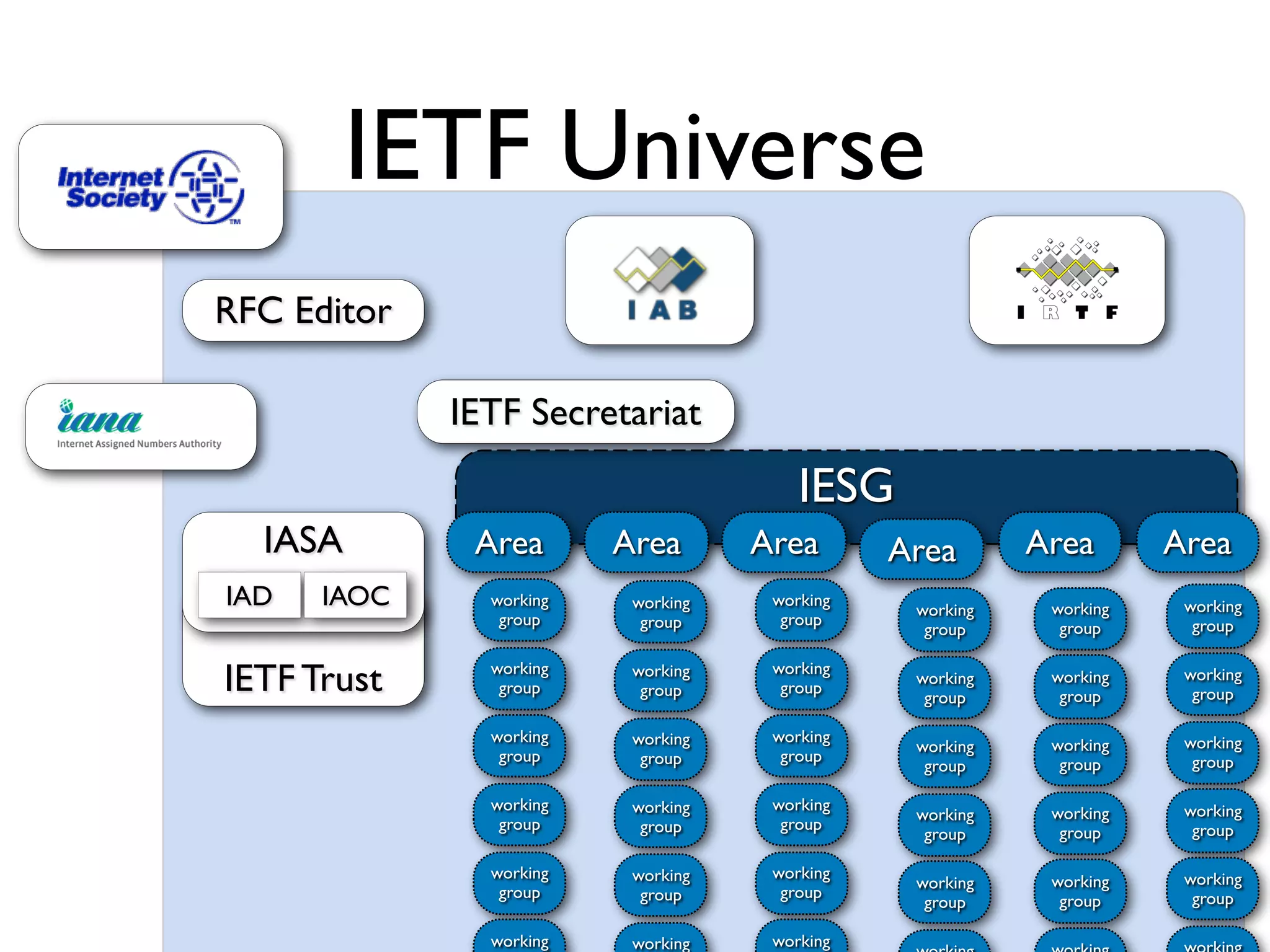
IETF Trust
IETF Universe
RFC Editor
IASA
IAD IAOC
IESG
Area Area Area Area Area Area
working
group
working
group
working
group
working
group
working
group
working
working
group
working
group
working
group
working
group
working
group
working
working
group
working
group
working
group
working
group
working
group
working
working
group
working
group
working
group
working
group
working
group
working
group
working
group
working
group
working
group
working
group
working
group
working
group
working
group
working
group
working
group
IETF Secretariat
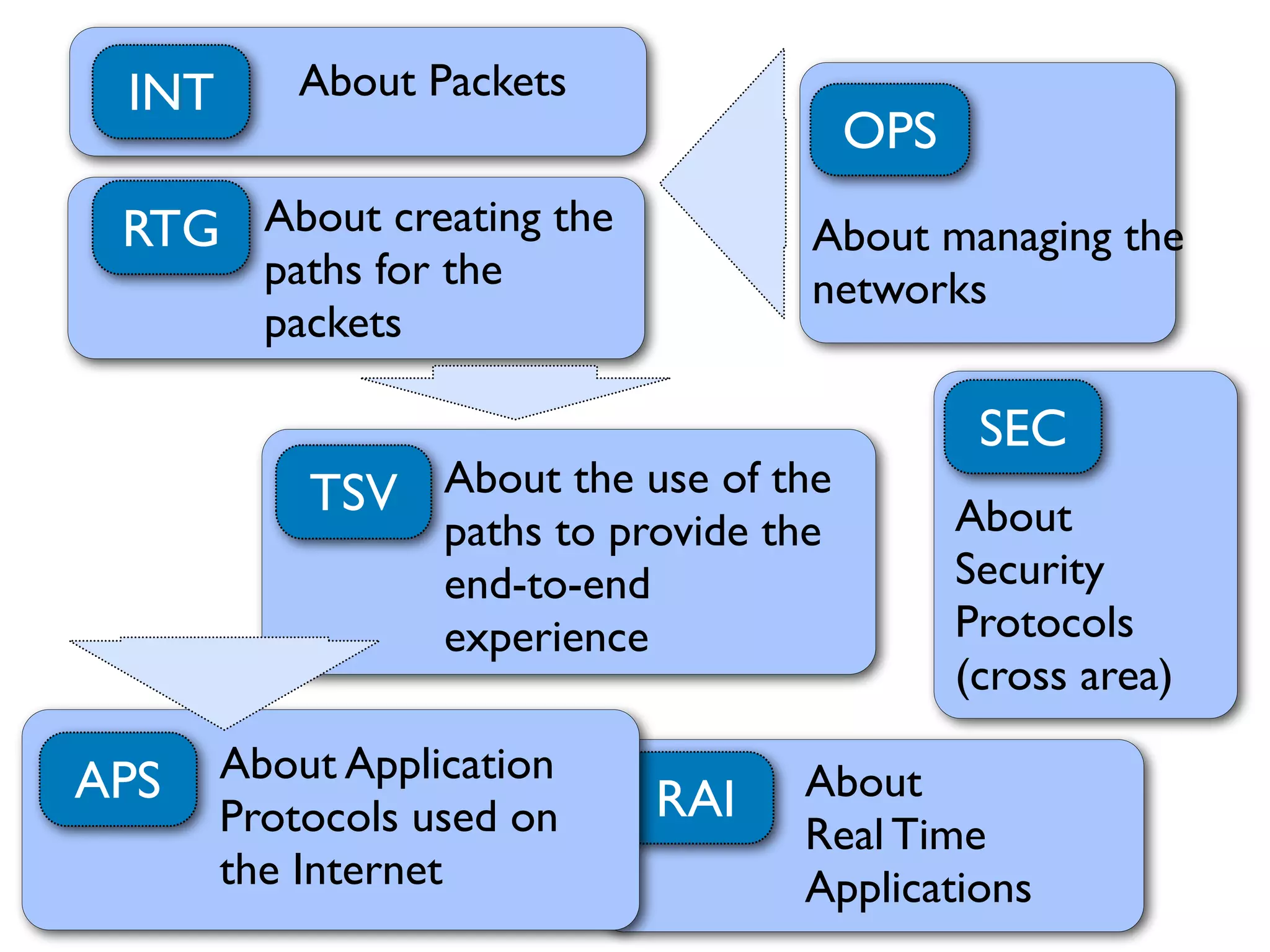
INT
RTG
TSV
OPS
RAI
About Packets
About creating the
paths for the
packets
About managing the
networks
About the use of the
paths to provide the
end-to-end
experience
About

Real Time
Applications
APS About Application
Protocols used on
the Internet
SEC
About
Security
Protocols
(cross area)
Central Asia Internet Symposium - 10 December 2014
IETF Technology and the Internet
20
Central Asia Internet Symposium - 10 December 201421
IPv6
Central Asia Internet Symposium - 10 December 2014
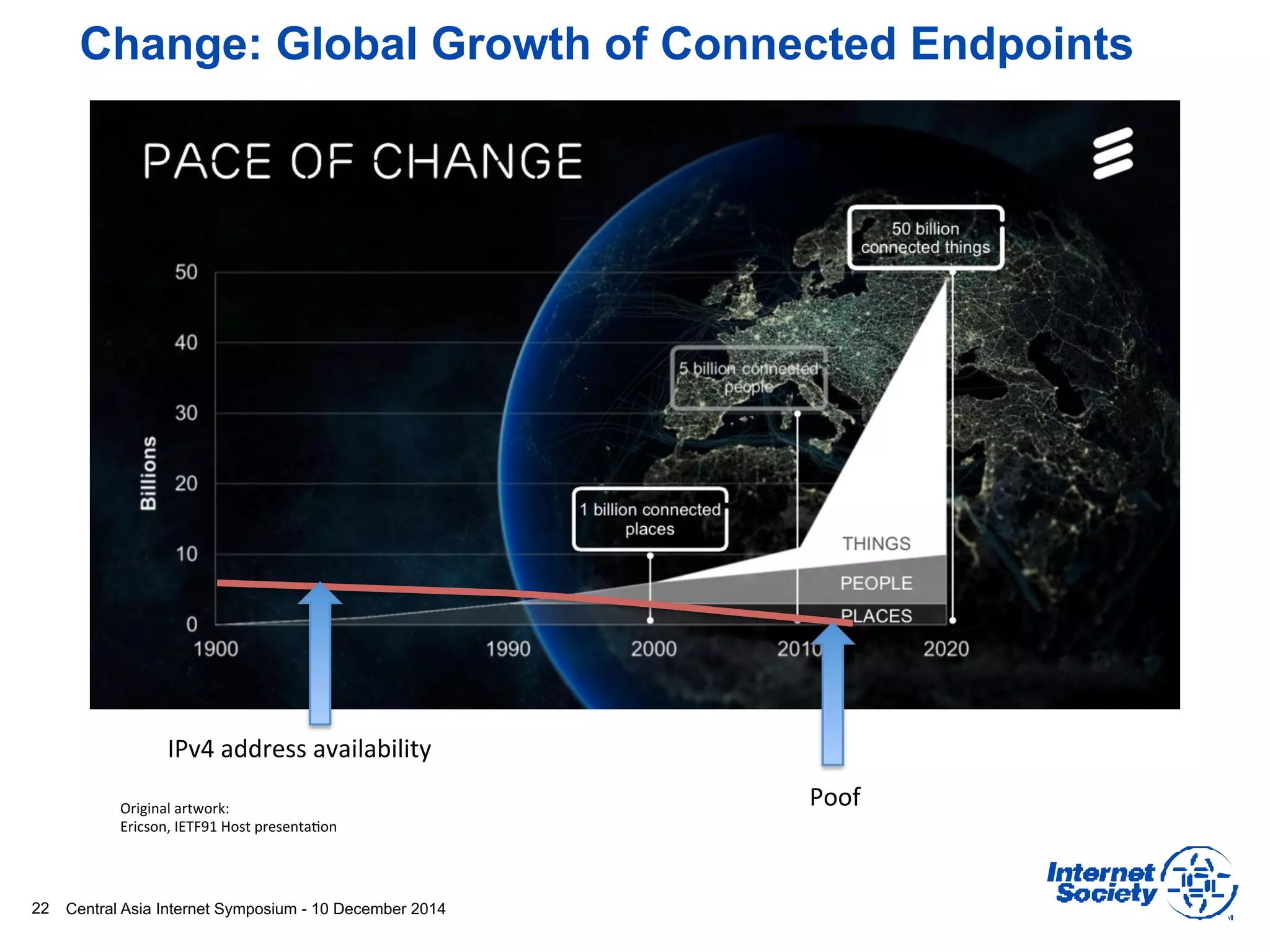
Original(artwork:((
Ericson,(IETF91(Host(presenta:on(
IPv4(address(availability(
Poof(
22
Change: Global Growth of Connected Endpoints
Central Asia Internet Symposium - 10 December 201423
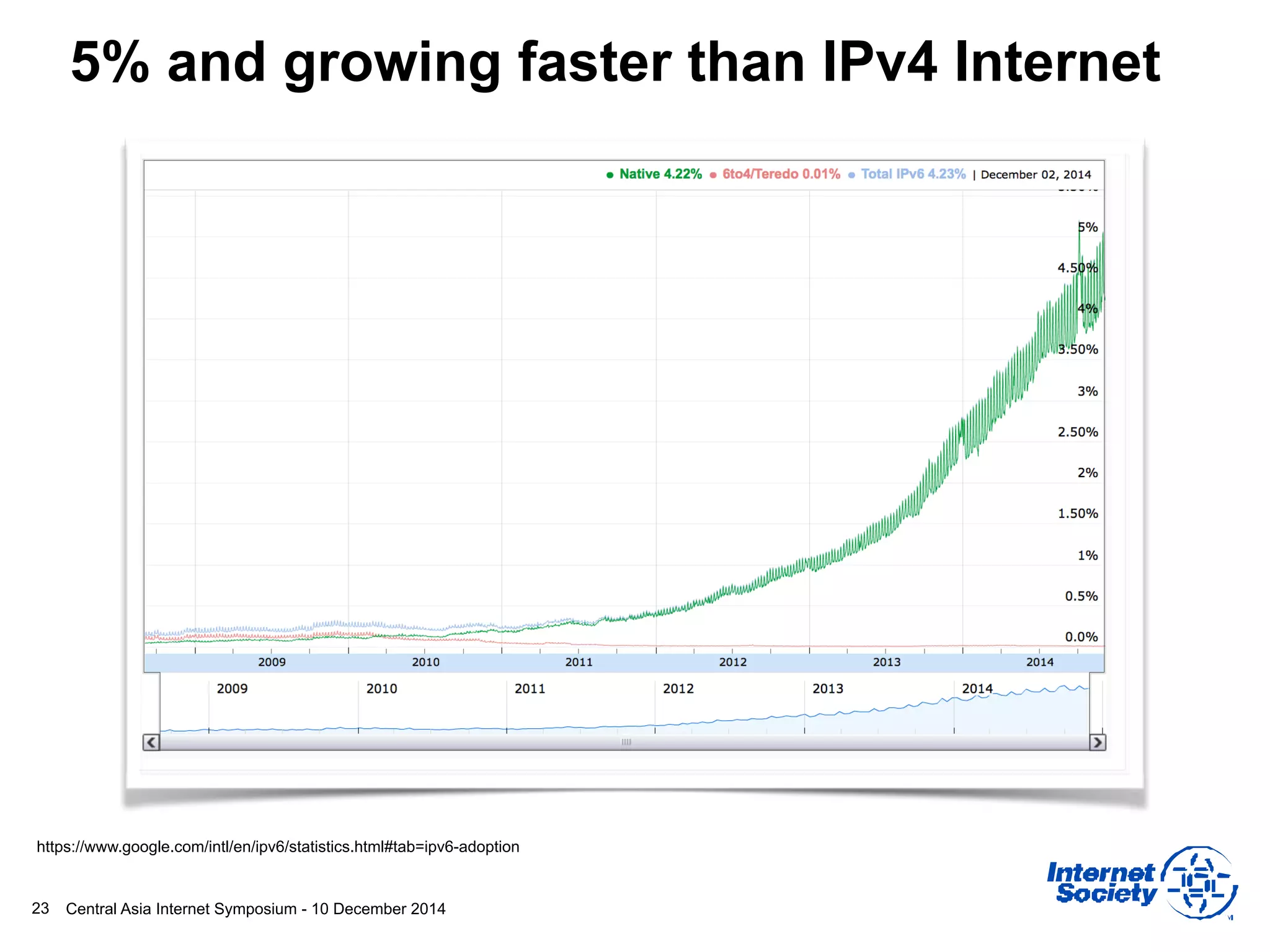
https://www.google.com/intl/en/ipv6/statistics.html#tab=ipv6-adoption
5% and growing faster than IPv4 Internet
Central Asia Internet Symposium - 10 December 201424
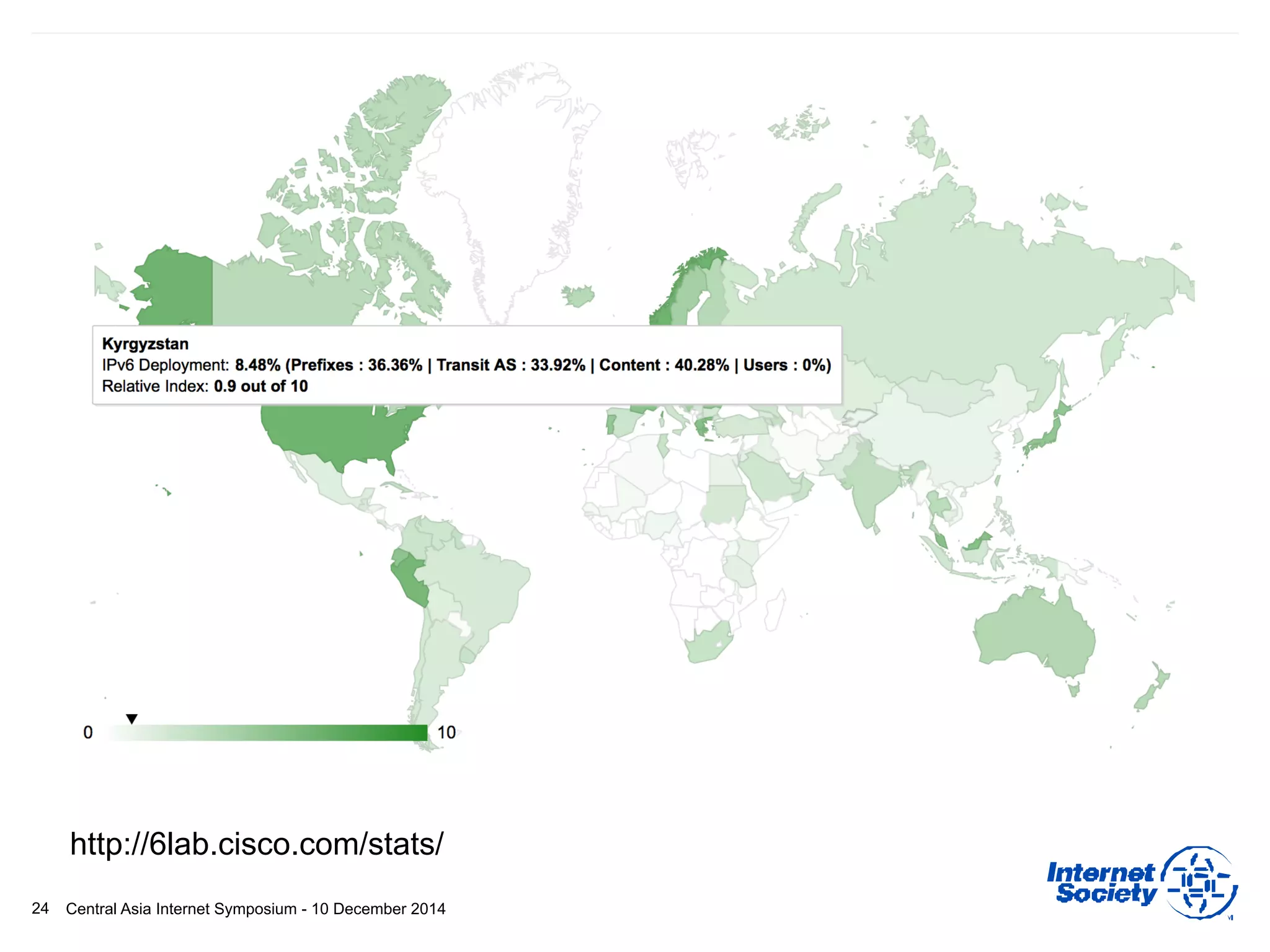
http://6lab.cisco.com/stats/
Central Asia Internet Symposium - 10 December 201425
Encryption
Central Asia Internet Symposium - 10 December 201426
Central Asia Internet Symposium - 10 December 201427
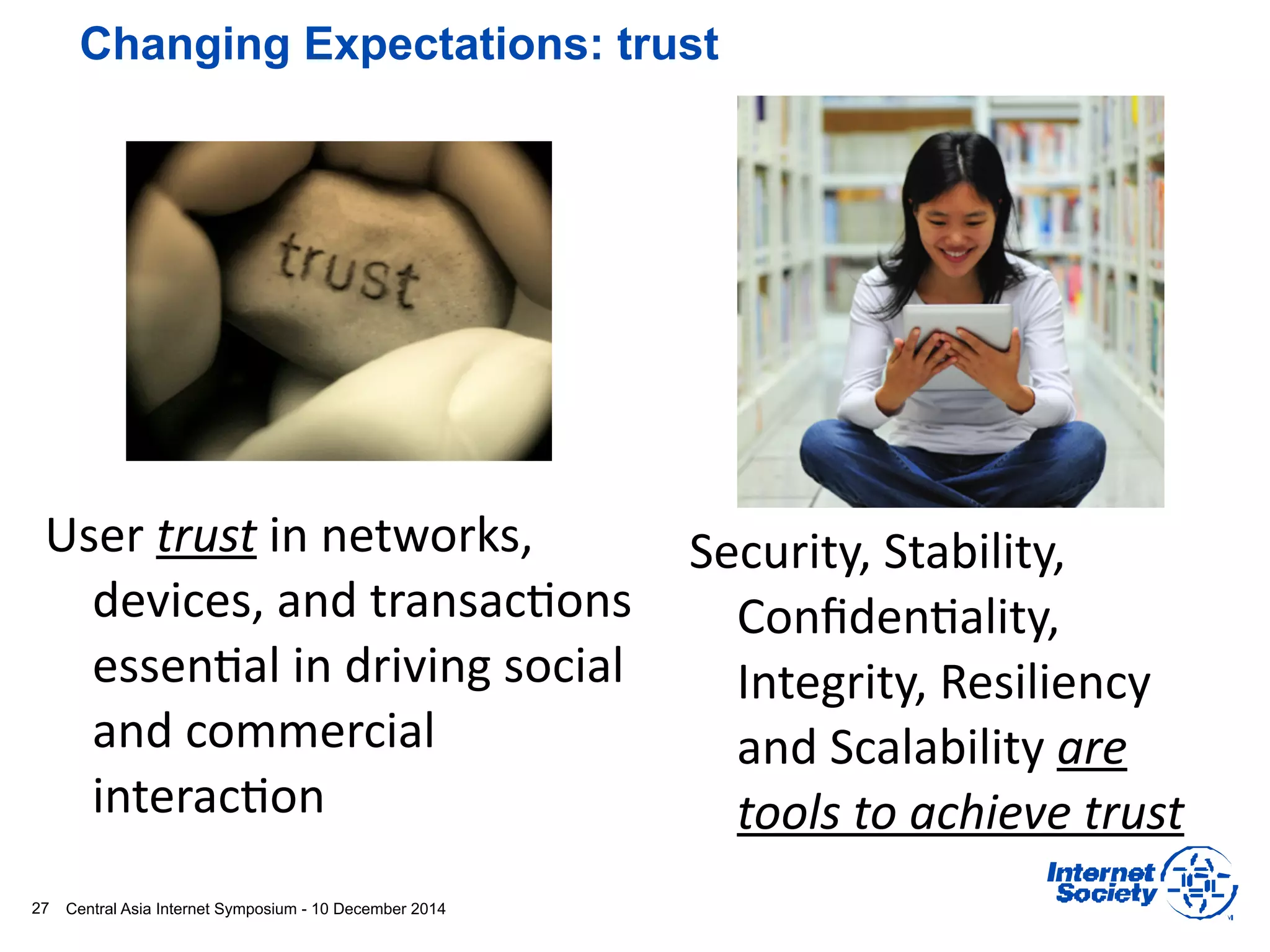
Changing Expectations: trust
User	
  trust	
  in	
  networks,	
  
devices,	
  and	
  transac1ons	
  
essen1al	
  in	
  driving	
  social	
  
and	
  commercial	
  
interac1on
Security,	
  Stability,	
  
Confiden1ality,	
  
Integrity,	
  Resiliency	
  
and	
  Scalability	
  are	
  
tools	
  to	
  achieve	
  trust	
  
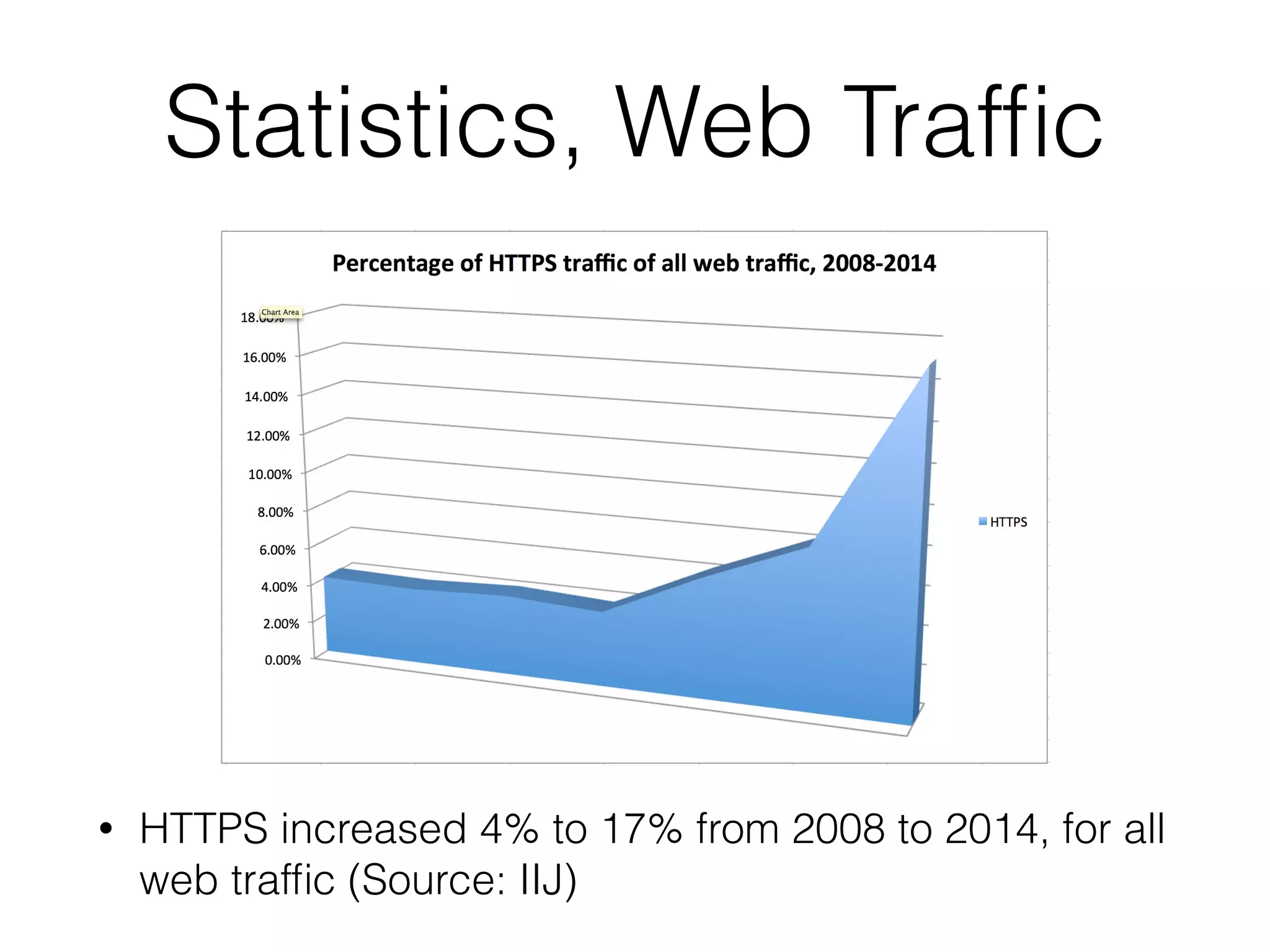
Statistics, Web Traffic
• HTTPS increased 4% to 17% from 2008 to 2014, for all
web traffic (Source: IIJ)
Pain Points and Hot Debates
• There is no single reason behind the increasing use of
encryption, but the change has a real impact on the world
• Operator business models, technical solutions for various
things, censorship will be harder (both good and bad
kind), …
• All this will cause friction
• Motives of players are not fully aligned
Reality Check
• “Everything is in the clear” approach is clearly unworkable
• Encryption will reduce the number of parties that see traffic
• But not eliminate them — content provider, browser vendor, CAs, proxy
provider, corporate IT department, …
• World still moves ahead on a voluntary basis on what technology is
chosen and on what technology a particular party can adopt
• Surveillance shifts, not eliminated
• Useful technical things done in different ways, not eliminated
• Some potential bad outcomes to avoid —- MITMs, regulation limiting
security, fragmentation, device control, …
Central Asia Internet Symposium - 10 December 201431
BGP
SIP
DNSSEC
PKIX
HTTP
TLS
RTP
Central Asia Internet Symposium - 10 December 2014
Questions?
32
Central Asia Internet Symposium - 10 December 2014
Acknowledgement
• Network topology map from ‘The Opte Project’
• Various Hourglass models produced using the Open
Source Blender, ‘Klootindustries’ CC Atribution license
• Jari Arkko for the slides on the use on encryption
• Logos and Trademarks from the respective companies
33
Central Asia Internet Symposium - 10 December 201434
Central Asia Internet Symposium - 10 December 2014
Backup Slides
35

Some Internet Topics: Horizontals, the IETF, and IPv6

  • 1.
    www.internetsociety.org Some Internet Topics: Horizontals,the IETF, and IPv6 Olaf M. Kolkman Chief Internet Technology Officer kolkman@isoc.org
  • 2.
    Central Asia InternetSymposium - 10 December 2014 The Internet: Different Players at Different Layers 2
  • 3.
    Central Asia InternetSymposium - 10 December 20143
  • 4.
    Central Asia InternetSymposium - 10 December 2014 • Application Layer: Applications use IP for connectivity • The Network Access Layer: Components in the Network Access Layer deliver IP connectivity • The IP Layer: provides a coherent mapping between the layers • (IP=Internet Protocol) 4
  • 5.
    Central Asia InternetSymposium - 10 December 2014 Application Layer • Applications are what the users care about • Most people conceive the utility of the various applications as the Internet • E-mail and WWW are just two applications, albeit successful ones • Business, voice and face communication, entertainment such as videos and games 5
  • 6.
    Central Asia InternetSymposium - 10 December 2014 Network Layer • The layer that provides the IP to the
 customers • The Internet is made up out of many independently operated networks that all provide some level of network access • The network exchange IP packets between each other 6
  • 7.
    Central Asia InternetSymposium - 10 December 2014 Network of Networks… 7 Serving different markets
  • 8.
    Central Asia InternetSymposium - 10 December 2014 Highly competitive A EUR80 fiber cross connect: Internet Exchange traffic: Backbone traffic Western Europe: Transatlantic traffic, wholesale: Internet Transit, wholesale: Internet Transit, retail: Broadband Internet, consumer: National Ethernet service: 3G mobile data, national: GSM voice call, national: 3G mobile data, roaming low: 3G mobile data, roaming high: GSM voice call, roaming: SMS Text Messages: SMS Text Messages, roaming: $0.01 $0.25* $0.50 $1 $2 $15 $50 $180 $11,400 $483,840 $834,000 $3,127,500 $3,338,496 $210,000,000 $1,166,400,000 The Price of Bandwidth, in bulk, per Mbps 8 Commodity Table courtesy of Remco van Mook, Equinix Western Europe, early-mid 2011 (based on 10Gbps or 300GB)
  • 9.
    Central Asia InternetSymposium - 10 December 2014 Inter net-working and working Internet 9 Voluntary adoption of technology bottom-up innovation Different Players at Different Layers FunctionalInteroperability Collaborationwhere needed Competition where possible
  • 10.
  • 11.
    Central Asia InternetSymposium - 10 December 2014 The Internet and Standards 11
  • 12.
    Central Asia InternetSymposium - 10 December 2014 How do Standards Play a Role? 12 Browsing The Web 802.11 IEEE TCP/IP IETF URI IETF BGP IETF NAT Propriet HTTP IETF CSS W3C PNG IETF HTML W3C/ISO MPEG ISO/IEC XML W3C ADSL ITU-T Interoperability
  • 13.
    Standardization the Internet way Detailson: http://open-stand.org Cooperation Adherence toPrinciples Collective Empowerment Availability VoluntaryAdoption driver for innovation Borderless commerce
  • 14.
    1. Cooperation Respectful cooperationbetween standards organizations, whereby each respects the autonomy, integrity, processes, and intellectual property rules of the others. 2. Adherence to Principles Adherence to the five fundamental principles of standards development: • Due process. Decisions are made with equity and fairness among participants. No one party dominates or guides standards development. Standards processes are transparent and opportunities exist to appeal decisions. Processes for periodic standards review and updating are well defined. • Broad consensus. Processes allow for all views to be considered and addressed, such that agreement can be found across a range of interests. • Transparency. Standards organizations provide advance public notice of proposed standards development activities, the scope of work to be undertaken, and conditions for participation. Easily accessible records of decisions and the materials used in reaching those decisions are provided. Public comment periods are provided before final standards approval and adoption. • Balance. Standards activities are not exclusively dominated by any particular person, company or interest group. • Openness. Standards processes are open to all interested and informed parties. 3. Collective Empowerment Commitment by affirming standards organizations and their participants to collective empowerment by striving for standards that: • are chosen and defined based on technical merit, as judged by the contributed expertise of each participant; • provide global interoperability, scalability, stability, and resiliency; • enable global competition; • serve as building blocks for further innovation; and • contribute to the creation of global communities, benefiting humanity. 4. Availability Standards specifications are made accessible to all for implementation and deployment. Affirming standards organizations have defined procedures to develop specifications that can be implemented under fair terms. Given market diversity, fair terms may vary from royalty-free to fair, reasonable, and non-discriminatory terms (FRAND). 5. Voluntary Adoption Standards are voluntarily adopted and success is determined by the market. Cooperation Adherence toPrinciples Collective Empowerment Availability VoluntaryAdoption
  • 15.
    Central Asia InternetSymposium - 10 December 2014 The IETF 15
  • 16.
    The Internet EngineeringTask Force is
 a loosely self-organized group of people
 who contribute to the engineering and
 evolution of Internet technologies.
 It is the principal body engaged in the
 development of new Internet standard
 specifications.
 RFC4677
  • 17.
    The mission ofthe IETF is to make the Internet work better by producing high quality, relevant technical documents that influence the way people design, use, and manage the Internet.
  • 18.
    IETF Trust IETF Universe RFCEditor IASA IAD IAOC IESG Area Area Area Area Area Area working group working group working group working group working group working working group working group working group working group working group working working group working group working group working group working group working working group working group working group working group working group working group working group working group working group working group working group working group working group working group working group IETF Secretariat
  • 19.
    INT RTG TSV OPS RAI About Packets About creatingthe paths for the packets About managing the networks About the use of the paths to provide the end-to-end experience About
 Real Time Applications APS About Application Protocols used on the Internet SEC About Security Protocols (cross area)
  • 20.
    Central Asia InternetSymposium - 10 December 2014 IETF Technology and the Internet 20
  • 21.
    Central Asia InternetSymposium - 10 December 201421 IPv6
  • 22.
    Central Asia InternetSymposium - 10 December 2014 Original(artwork:(( Ericson,(IETF91(Host(presenta:on( IPv4(address(availability( Poof( 22 Change: Global Growth of Connected Endpoints
  • 23.
    Central Asia InternetSymposium - 10 December 201423 https://www.google.com/intl/en/ipv6/statistics.html#tab=ipv6-adoption 5% and growing faster than IPv4 Internet
  • 24.
    Central Asia InternetSymposium - 10 December 201424 http://6lab.cisco.com/stats/
  • 25.
    Central Asia InternetSymposium - 10 December 201425 Encryption
  • 26.
    Central Asia InternetSymposium - 10 December 201426
  • 27.
    Central Asia InternetSymposium - 10 December 201427 Changing Expectations: trust User  trust  in  networks,   devices,  and  transac1ons   essen1al  in  driving  social   and  commercial   interac1on Security,  Stability,   Confiden1ality,   Integrity,  Resiliency   and  Scalability  are   tools  to  achieve  trust  
  • 28.
    Statistics, Web Traffic •HTTPS increased 4% to 17% from 2008 to 2014, for all web traffic (Source: IIJ)
  • 29.
    Pain Points andHot Debates • There is no single reason behind the increasing use of encryption, but the change has a real impact on the world • Operator business models, technical solutions for various things, censorship will be harder (both good and bad kind), … • All this will cause friction • Motives of players are not fully aligned
  • 30.
    Reality Check • “Everythingis in the clear” approach is clearly unworkable • Encryption will reduce the number of parties that see traffic • But not eliminate them — content provider, browser vendor, CAs, proxy provider, corporate IT department, … • World still moves ahead on a voluntary basis on what technology is chosen and on what technology a particular party can adopt • Surveillance shifts, not eliminated • Useful technical things done in different ways, not eliminated • Some potential bad outcomes to avoid —- MITMs, regulation limiting security, fragmentation, device control, …
  • 31.
    Central Asia InternetSymposium - 10 December 201431 BGP SIP DNSSEC PKIX HTTP TLS RTP
  • 32.
    Central Asia InternetSymposium - 10 December 2014 Questions? 32
  • 33.
    Central Asia InternetSymposium - 10 December 2014 Acknowledgement • Network topology map from ‘The Opte Project’ • Various Hourglass models produced using the Open Source Blender, ‘Klootindustries’ CC Atribution license • Jari Arkko for the slides on the use on encryption • Logos and Trademarks from the respective companies 33
  • 34.
    Central Asia InternetSymposium - 10 December 201434
  • 35.
    Central Asia InternetSymposium - 10 December 2014 Backup Slides 35