From Research to Internet StandardsLars EggertStandardization WorkshopFuture Internet Conference WeekGhent, Belgium, 2010-12-15
1Who cares?
Researchers, why should you care about standards?If you’re researching Internet-related topics,where do you learn what the real current issues are?Hint: wireless ATM is not one of themYou need to talk to operators, vendors, registrars, policy makers, regulators, etc.(Assuming you are interested in research that could have an actual impact)Where is it easy to meet these folks?Standards bodies + operator fora2
But don’t forget to think for yourselfYou will talk to many folks who aren’t researchersTheir motivations are different than yoursOften very short-term agendasFew can abstract out to principlesWorried about the symptoms, not the causesIf all you have is a hammer, everything starts to look like a nailMany are there to make money(or keep others from taking theirs)Think hard if the “problems” you learn about pass musterc.f. software engineering requirement documents3
Still… go!If you’re interested in what the real problems are,you’ll get a good understanding by attending these foraIf you’re interested in fixing some of them,you’ll need to participatemore regularlyPapers don’t get deployedFor Internet and “Future” Internet stuff– due to SDO change control agreements –that means: participate in the IETF(3GPP, ITU-T, ETSI for special topics)4
IETF participation takes timeStandardization is very different from “fire & forget” academic publication/presentation venuesThe time commitment is substantial, both in terms of email discussion and meeting travelYou will need to convince a diverse set of stakeholdersof the value of your proposalTheoretically optimal ≠ practically optimal Business aspects and deployment incentivesare critical (papers don’t get deployed)Don’t forget about the research arm – the IRTF5
Need additional motivation?If you’re on an academic career path,standardization is unlikely to get you tenureBut it doesn’t often hurt you eitherYou will meet likeminded people to collaborate withAnd some of them have substantial budgetsIf you’re a junior researcher not on the academic career path, getting positively noticed in these fora can lead to an industry career…6
7IETF in a nutshell
Internet standards = IETF standardsThe IETFis an open, diverseandinternationalcommunityNetwork designers, operators, vendors, researchers, etc.Common goal: evolution of the Internet architecture and protocols & smooth operation of the InternetParticipatory culture; open to anyone: people, not companiesProduces Internet Standards(and other documents)It has a research arm – the IRTF8
IETF by numbers1-2000 people at 3 meetings/yearfrom ca. 40-50 different countriesMany, many more on mailing lists~120 working groups (WGs)8 Areas with 15 area directors (ADs)More than 6000 RFCs publishedMore than 50000 Internet-Draft revisions submittedIRTF= ~12 research groups (RGs)9Participants at IETF-75Stockholm, July 20091084 total, 50 countries
IETF standardization considerationsOpen process to produce open Internet standardsGlobal standards for a global InternetAlignment with Internet architectural principles Maximum interoperabilityMaximum scalabilityImproved Internet security and privacy10
11IETF organizational structure
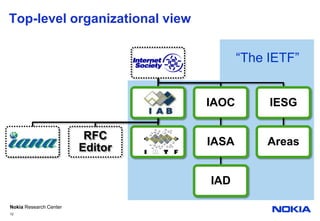
Top-level organizational view12“The IETF”
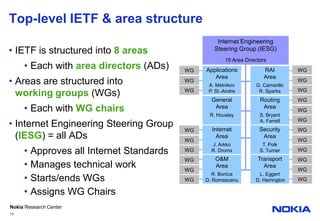
Top-level IETF & area structureIETF is structured into 8 areasEach with area directors (ADs)Areas are structured intoworking groups (WGs)Each with WG chairsInternet Engineering Steering Group (IESG) = all ADsApproves all Internet StandardsManages technical workStarts/ends WGsAssigns WG Chairs13Internet EngineeringSteering Group (IESG)15 Area DirectorsWGWGRAIAreaG. CamarilloR. SparksApplicationsAreaA. MelnikovP. St.-AndreWGWGWGWGWGGeneralAreaR. HousleyRoutingAreaS. BryantA. FarrellWGWGWGWGSecurityAreaT. PolkS. TurnerInternetAreaJ. ArkkoR. DromsWGWGWGWGWGO&MAreaR. BonicaD. RomascanuTransportAreaL. EggertD. HarringtonWGWGWGWGWG
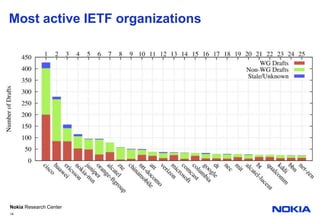
Most active IETF organizations14
15IETF standards & documents
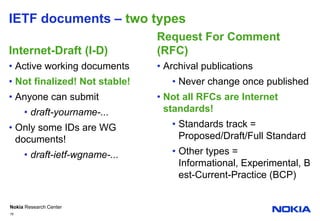
Internet-Draft (I-D)Active working documentsNot finalized! Not stable!Anyone can submitdraft-yourname-...Only some IDs are WG documents!draft-ietf-wgname-...Request For Comment (RFC)Archival publicationsNever change once publishedNot all RFCs are Internet standards!Standards track =Proposed/Draft/Full StandardOther types =Informational, Experimental, Best-Current-Practice (BCP)16IETF documents – two types
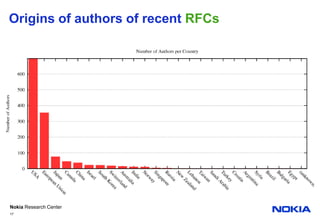
Origins of authors of recent RFCs17
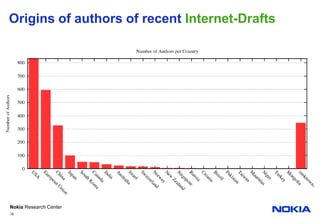
Origins of authors of recent Internet-Drafts18
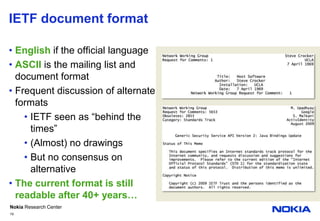
IETF document formatEnglishif the official languageASCII is the mailing list and document formatFrequent discussion of alternate formatsIETF seen as “behind the times”(Almost) no drawingsBut no consensus on alternative The current format is still readable after 40+ years…19
20Bringing new work to the IETF
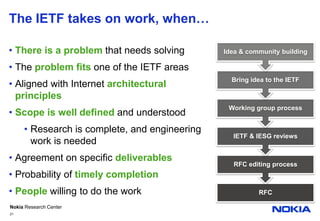
The IETF takes on work, when…There is a problem that needs solvingThe problem fits one of the IETF areasAligned with Internet architectural principles Scope is well defined and understoodResearch is complete, and engineering work is neededAgreement on specific deliverablesProbability of timely completionPeoplewilling to do the work21
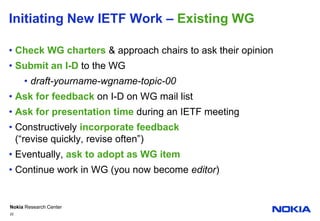
Initiating New IETF Work – Existing WGCheck WG charters & approach chairs to ask their opinionSubmit an I-D to the WGdraft-yourname-wgname-topic-00Ask for feedback on I-D on WG mail listAsk for presentation time during an IETF meetingConstructively incorporate feedback(“revise quickly, revise often”)Eventually, ask to adopt as WG itemContinue work in WG (you now become editor)22
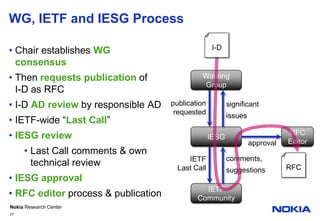
WG, IETF and IESG ProcessChair establishes WG consensusThen requests publication ofI-D as RFC I-D AD review by responsible ADIETF-wide “Last Call”IESG reviewLast Call comments & own technical review IESG approvalRFC editor process & publication23I-DWorkingGrouppublicationrequestedsignificantissuesIESGRFCEditorapprovalcomments,suggestionsIETFLast CallRFCIETFCommunity
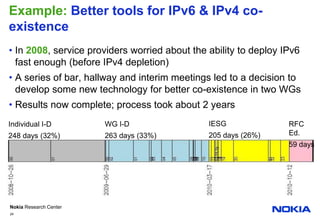
Example: Better tools for IPv6 & IPv4 co-existenceIn 2008, service providers worried about the ability to deploy IPv6 fast enough (before IPv4 depletion)A series of bar, hallway and interim meetings led to a decision to develop some new technology for better co-existence in two WGsResults now complete; process took about 2 years24IESG205 days (26%)WG I-D263 days (33%)RFC Ed.59 daysIndividual I-D248 days (32%)
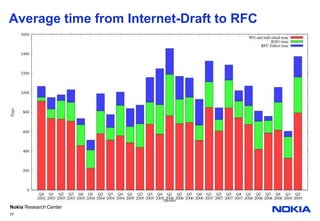
Average time from Internet-Draft to RFC25
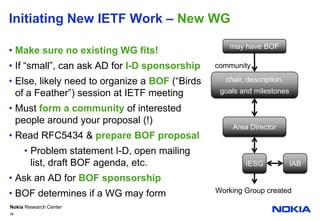
Initiating New IETF Work – New WGMake sure no existing WG fits!If “small”, can ask AD for I-D sponsorshipElse, likely need to organize a BOF(“Birds of a Feather”) session at IETF meetingMust form a community of interested people around your proposal (!)Read RFC5434 & prepare BOF proposalProblem statement I-D, open mailing list, draft BOF agenda, etc.Ask an AD for BOF sponsorshipBOF determines if a WG may form26may have BOFcommunitychair, description,goals and milestonesArea DirectorIABIESGWorking Group created
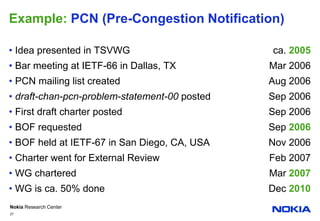
Example: PCN (Pre-Congestion Notification)Idea presented in TSVWG	ca. 2005Bar meeting at IETF-66 in Dallas, TX 	Mar 2006PCN mailing list created	Aug 2006draft-chan-pcn-problem-statement-00 posted	Sep 2006First draft charter posted	Sep 2006BOF requested	Sep 2006BOF held at IETF-67 in San Diego, CA, USA	Nov 2006Charter went for External Review	Feb 2007WG chartered	Mar 2007WG is ca. 50% done	Dec 201027
28Conclusion
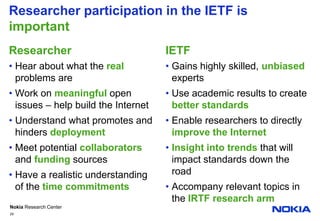
ResearcherHear about what the realproblems areWork on meaningfulopen issues – help build the InternetUnderstand what promotes and hinders deploymentMeet potential collaboratorsand fundingsourcesHave a realistic understanding of the time commitmentsIETFGains highly skilled, unbiasedexpertsUse academic results to create better standardsEnable researchers to directly improve the InternetInsight into trends that will impact standards down the roadAccompany relevant topics in the IRTF research arm29Researcher participation in the IETF is important

Lars Eggert - IETF

  • 1.
    From Research toInternet StandardsLars EggertStandardization WorkshopFuture Internet Conference WeekGhent, Belgium, 2010-12-15
  • 2.
  • 3.
    Researchers, why shouldyou care about standards?If you’re researching Internet-related topics,where do you learn what the real current issues are?Hint: wireless ATM is not one of themYou need to talk to operators, vendors, registrars, policy makers, regulators, etc.(Assuming you are interested in research that could have an actual impact)Where is it easy to meet these folks?Standards bodies + operator fora2
  • 4.
    But don’t forgetto think for yourselfYou will talk to many folks who aren’t researchersTheir motivations are different than yoursOften very short-term agendasFew can abstract out to principlesWorried about the symptoms, not the causesIf all you have is a hammer, everything starts to look like a nailMany are there to make money(or keep others from taking theirs)Think hard if the “problems” you learn about pass musterc.f. software engineering requirement documents3
  • 5.
    Still… go!If you’reinterested in what the real problems are,you’ll get a good understanding by attending these foraIf you’re interested in fixing some of them,you’ll need to participatemore regularlyPapers don’t get deployedFor Internet and “Future” Internet stuff– due to SDO change control agreements –that means: participate in the IETF(3GPP, ITU-T, ETSI for special topics)4
  • 6.
    IETF participation takestimeStandardization is very different from “fire & forget” academic publication/presentation venuesThe time commitment is substantial, both in terms of email discussion and meeting travelYou will need to convince a diverse set of stakeholdersof the value of your proposalTheoretically optimal ≠ practically optimal Business aspects and deployment incentivesare critical (papers don’t get deployed)Don’t forget about the research arm – the IRTF5
  • 7.
    Need additional motivation?Ifyou’re on an academic career path,standardization is unlikely to get you tenureBut it doesn’t often hurt you eitherYou will meet likeminded people to collaborate withAnd some of them have substantial budgetsIf you’re a junior researcher not on the academic career path, getting positively noticed in these fora can lead to an industry career…6
  • 8.
    7IETF in anutshell
  • 9.
    Internet standards =IETF standardsThe IETFis an open, diverseandinternationalcommunityNetwork designers, operators, vendors, researchers, etc.Common goal: evolution of the Internet architecture and protocols & smooth operation of the InternetParticipatory culture; open to anyone: people, not companiesProduces Internet Standards(and other documents)It has a research arm – the IRTF8
  • 10.
    IETF by numbers1-2000people at 3 meetings/yearfrom ca. 40-50 different countriesMany, many more on mailing lists~120 working groups (WGs)8 Areas with 15 area directors (ADs)More than 6000 RFCs publishedMore than 50000 Internet-Draft revisions submittedIRTF= ~12 research groups (RGs)9Participants at IETF-75Stockholm, July 20091084 total, 50 countries
  • 11.
    IETF standardization considerationsOpenprocess to produce open Internet standardsGlobal standards for a global InternetAlignment with Internet architectural principles Maximum interoperabilityMaximum scalabilityImproved Internet security and privacy10
  • 12.
  • 13.
  • 14.
    Top-level IETF &area structureIETF is structured into 8 areasEach with area directors (ADs)Areas are structured intoworking groups (WGs)Each with WG chairsInternet Engineering Steering Group (IESG) = all ADsApproves all Internet StandardsManages technical workStarts/ends WGsAssigns WG Chairs13Internet EngineeringSteering Group (IESG)15 Area DirectorsWGWGRAIAreaG. CamarilloR. SparksApplicationsAreaA. MelnikovP. St.-AndreWGWGWGWGWGGeneralAreaR. HousleyRoutingAreaS. BryantA. FarrellWGWGWGWGSecurityAreaT. PolkS. TurnerInternetAreaJ. ArkkoR. DromsWGWGWGWGWGO&MAreaR. BonicaD. RomascanuTransportAreaL. EggertD. HarringtonWGWGWGWGWG
  • 15.
    Most active IETForganizations14
  • 16.
  • 17.
    Internet-Draft (I-D)Active workingdocumentsNot finalized! Not stable!Anyone can submitdraft-yourname-...Only some IDs are WG documents!draft-ietf-wgname-...Request For Comment (RFC)Archival publicationsNever change once publishedNot all RFCs are Internet standards!Standards track =Proposed/Draft/Full StandardOther types =Informational, Experimental, Best-Current-Practice (BCP)16IETF documents – two types
  • 18.
    Origins of authorsof recent RFCs17
  • 19.
    Origins of authorsof recent Internet-Drafts18
  • 20.
    IETF document formatEnglishifthe official languageASCII is the mailing list and document formatFrequent discussion of alternate formatsIETF seen as “behind the times”(Almost) no drawingsBut no consensus on alternative The current format is still readable after 40+ years…19
  • 21.
  • 22.
    The IETF takeson work, when…There is a problem that needs solvingThe problem fits one of the IETF areasAligned with Internet architectural principles Scope is well defined and understoodResearch is complete, and engineering work is neededAgreement on specific deliverablesProbability of timely completionPeoplewilling to do the work21
  • 23.
    Initiating New IETFWork – Existing WGCheck WG charters & approach chairs to ask their opinionSubmit an I-D to the WGdraft-yourname-wgname-topic-00Ask for feedback on I-D on WG mail listAsk for presentation time during an IETF meetingConstructively incorporate feedback(“revise quickly, revise often”)Eventually, ask to adopt as WG itemContinue work in WG (you now become editor)22
  • 24.
    WG, IETF andIESG ProcessChair establishes WG consensusThen requests publication ofI-D as RFC I-D AD review by responsible ADIETF-wide “Last Call”IESG reviewLast Call comments & own technical review IESG approvalRFC editor process & publication23I-DWorkingGrouppublicationrequestedsignificantissuesIESGRFCEditorapprovalcomments,suggestionsIETFLast CallRFCIETFCommunity
  • 25.
    Example: Better toolsfor IPv6 & IPv4 co-existenceIn 2008, service providers worried about the ability to deploy IPv6 fast enough (before IPv4 depletion)A series of bar, hallway and interim meetings led to a decision to develop some new technology for better co-existence in two WGsResults now complete; process took about 2 years24IESG205 days (26%)WG I-D263 days (33%)RFC Ed.59 daysIndividual I-D248 days (32%)
  • 26.
    Average time fromInternet-Draft to RFC25
  • 27.
    Initiating New IETFWork – New WGMake sure no existing WG fits!If “small”, can ask AD for I-D sponsorshipElse, likely need to organize a BOF(“Birds of a Feather”) session at IETF meetingMust form a community of interested people around your proposal (!)Read RFC5434 & prepare BOF proposalProblem statement I-D, open mailing list, draft BOF agenda, etc.Ask an AD for BOF sponsorshipBOF determines if a WG may form26may have BOFcommunitychair, description,goals and milestonesArea DirectorIABIESGWorking Group created
  • 28.
    Example: PCN (Pre-CongestionNotification)Idea presented in TSVWG ca. 2005Bar meeting at IETF-66 in Dallas, TX Mar 2006PCN mailing list created Aug 2006draft-chan-pcn-problem-statement-00 posted Sep 2006First draft charter posted Sep 2006BOF requested Sep 2006BOF held at IETF-67 in San Diego, CA, USA Nov 2006Charter went for External Review Feb 2007WG chartered Mar 2007WG is ca. 50% done Dec 201027
  • 29.
  • 30.
    ResearcherHear about whatthe realproblems areWork on meaningfulopen issues – help build the InternetUnderstand what promotes and hinders deploymentMeet potential collaboratorsand fundingsourcesHave a realistic understanding of the time commitmentsIETFGains highly skilled, unbiasedexpertsUse academic results to create better standardsEnable researchers to directly improve the InternetInsight into trends that will impact standards down the roadAccompany relevant topics in the IRTF research arm29Researcher participation in the IETF is important