©ZeusNumerix
Defense | Nuclear Power | Aerospace | Infrastructure | Industry
Treatment of compressible flow in CFD
Abhishek Jain
abhishek@zeusnumerix.com
Compressible Flow: Basics
©ZeusNumerix
2
Overview
 Conservation Laws
 Conservation form of equations
 Governing equations: Hyperbolic
 The Wave theory: CFL Condition
 Schemes and their types
 Eigen values
 Boundary conditions
©ZeusNumerix
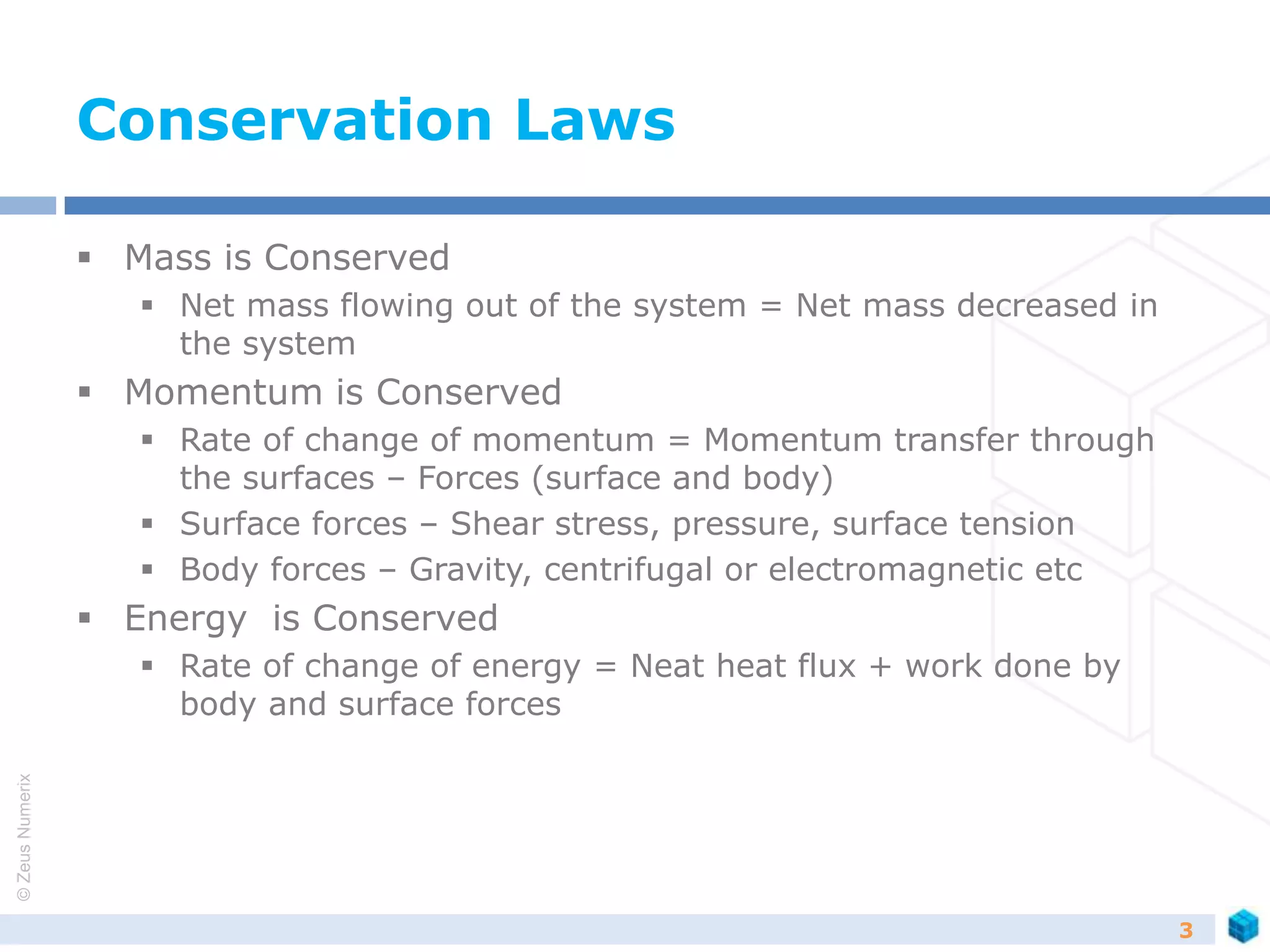
Conservation Laws
 Mass is Conserved
 Net mass flowing out of the system = Net mass decreased in
the system
 Momentum is Conserved
 Rate of change of momentum = Momentum transfer through
the surfaces – Forces (surface and body)
 Surface forces – Shear stress, pressure, surface tension
 Body forces – Gravity, centrifugal or electromagnetic etc
 Energy is Conserved
 Rate of change of energy = Neat heat flux + work done by
body and surface forces
3
©ZeusNumerix
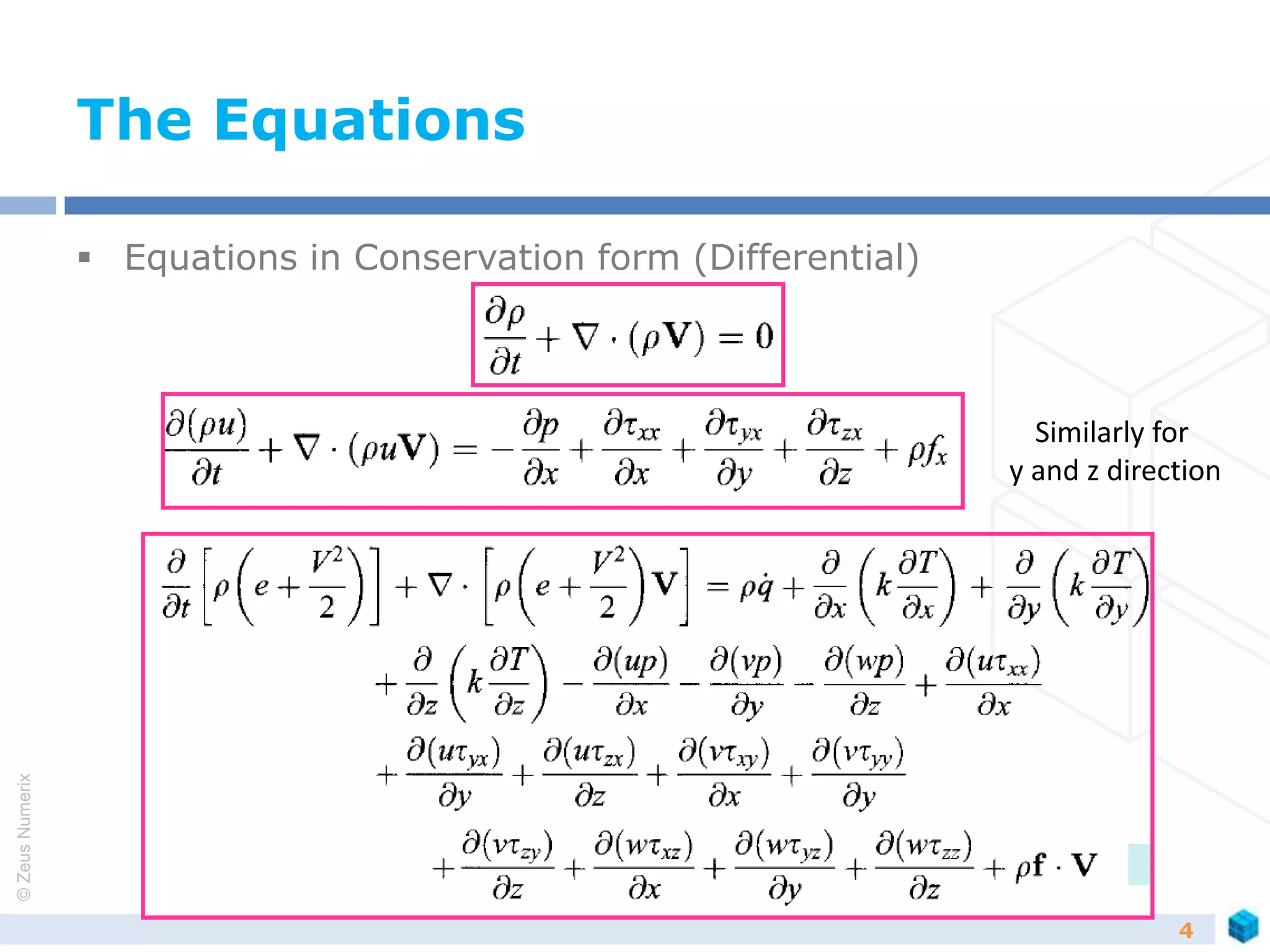
The Equations
 Equations in Conservation form (Differential)
4
Similarly for
y and z direction
©ZeusNumerix
Conservation and Non-
Conservation Forms
 Conservation Form
 Easy to code as all equations look similar
 More physical as “can be simply stated in English”
 Primary variable are calculated from the flux variables
 Captures the shock; (shock produced by solution)
 Non-Conservation Form
 Equation given above are expanded
 Has a shock fitting approach; solution is a forethought i.e.
shock location must be approximately known
 Captures the shock better
 There have been instances where shock fitting and
capturing methods have been used with either forms
5
©ZeusNumerix
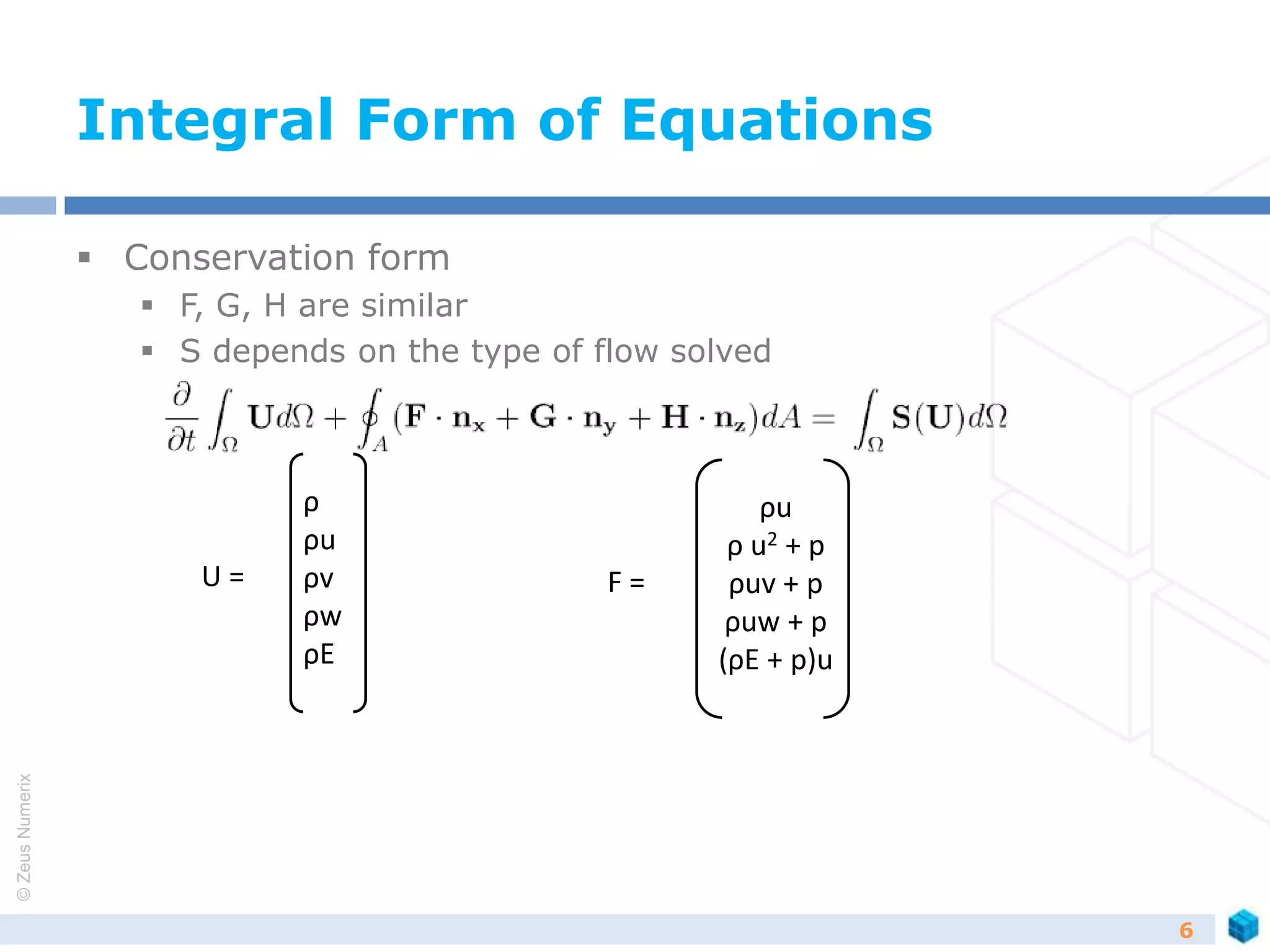
Integral Form of Equations
 Conservation form
 F, G, H are similar
 S depends on the type of flow solved
6
U =
ρ
ρu
ρv
ρw
ρE
F =
ρu
ρ u2 + p
ρuv + p
ρuw + p
(ρE + p)u
©ZeusNumerix
Difference
 Integral form means that if we were to add up the
properties in the whole domain there will be an equilibrium
 Does not assume if quantities are a part of continuous function
or discontinuous
 Differential means the function is continuous
 Not able to capture physical discontinuities like shock wave
 Integral form there is called more fundamental
7
©ZeusNumerix
Completing the Loop
 The number of equations is FIVE
 Assuming calorically perfect gas E=CvT
 Number of unknowns
 ρ, u, v, w, p, T
 Hence the thermal equation of state is used for closure
 p= ρRT
 R is the Gas Constant
 Please remember that the above equation was not used in
incompressible flow
8
©ZeusNumerix
Equation Types
 Eigen values are calculated using the coefficients of the
equations
 In case the Eigen values of the equations are
 Real and distinct – equation is Hyperbolic
 Real and Zero – equation is Parabolic
 Imaginary – equation is elliptic
 Characteristic lines are curves where slope of dependent
variable is indeterminant
 Slope of the characteristic line can be real, zero or
imaginary making the equations Hyperbolic, parabolic or
elliptic
9
©ZeusNumerix
Equations
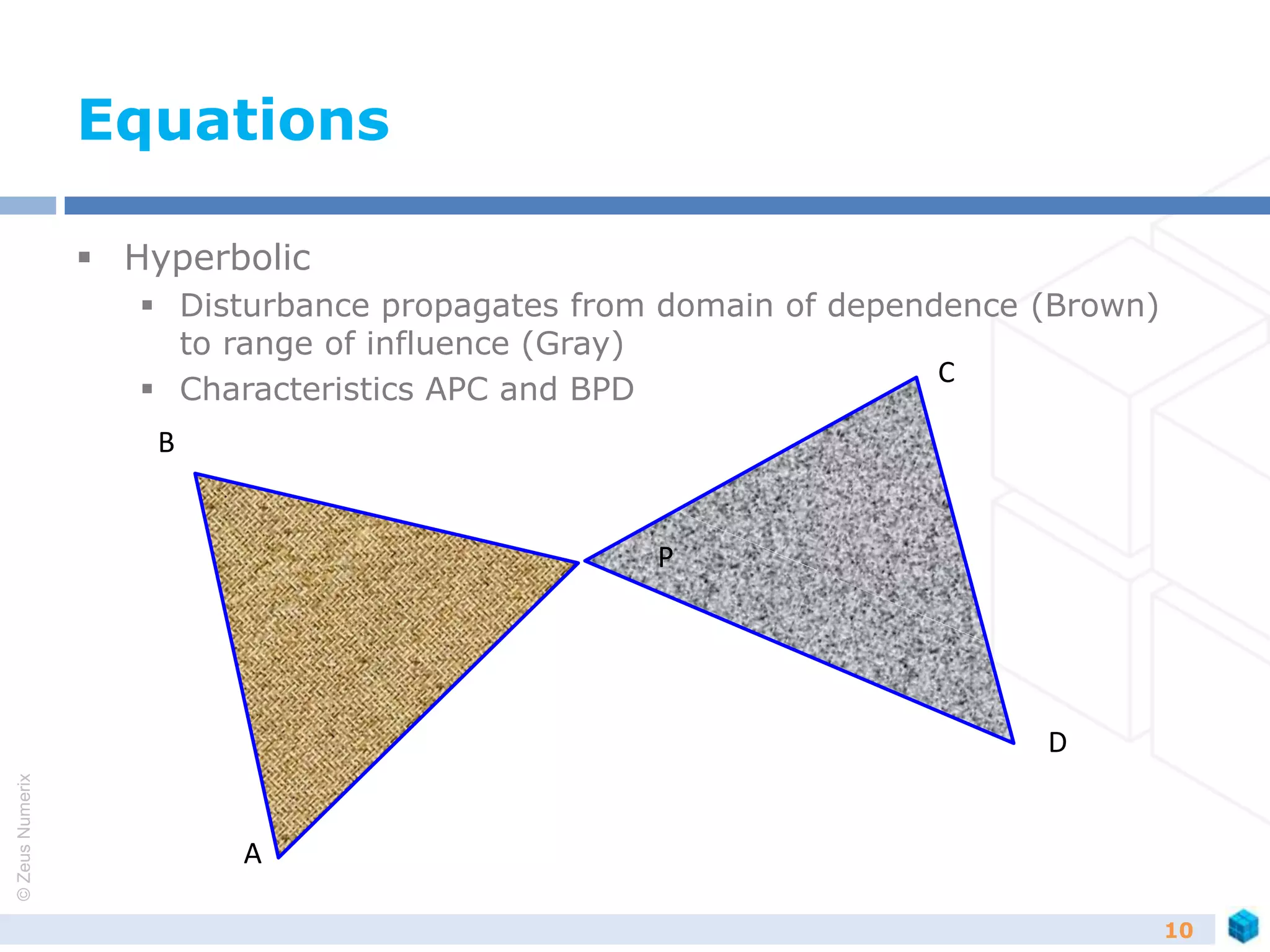
 Hyperbolic
 Disturbance propagates from domain of dependence (Brown)
to range of influence (Gray)
 Characteristics APC and BPD
10
P
C
D
B
A
©ZeusNumerix
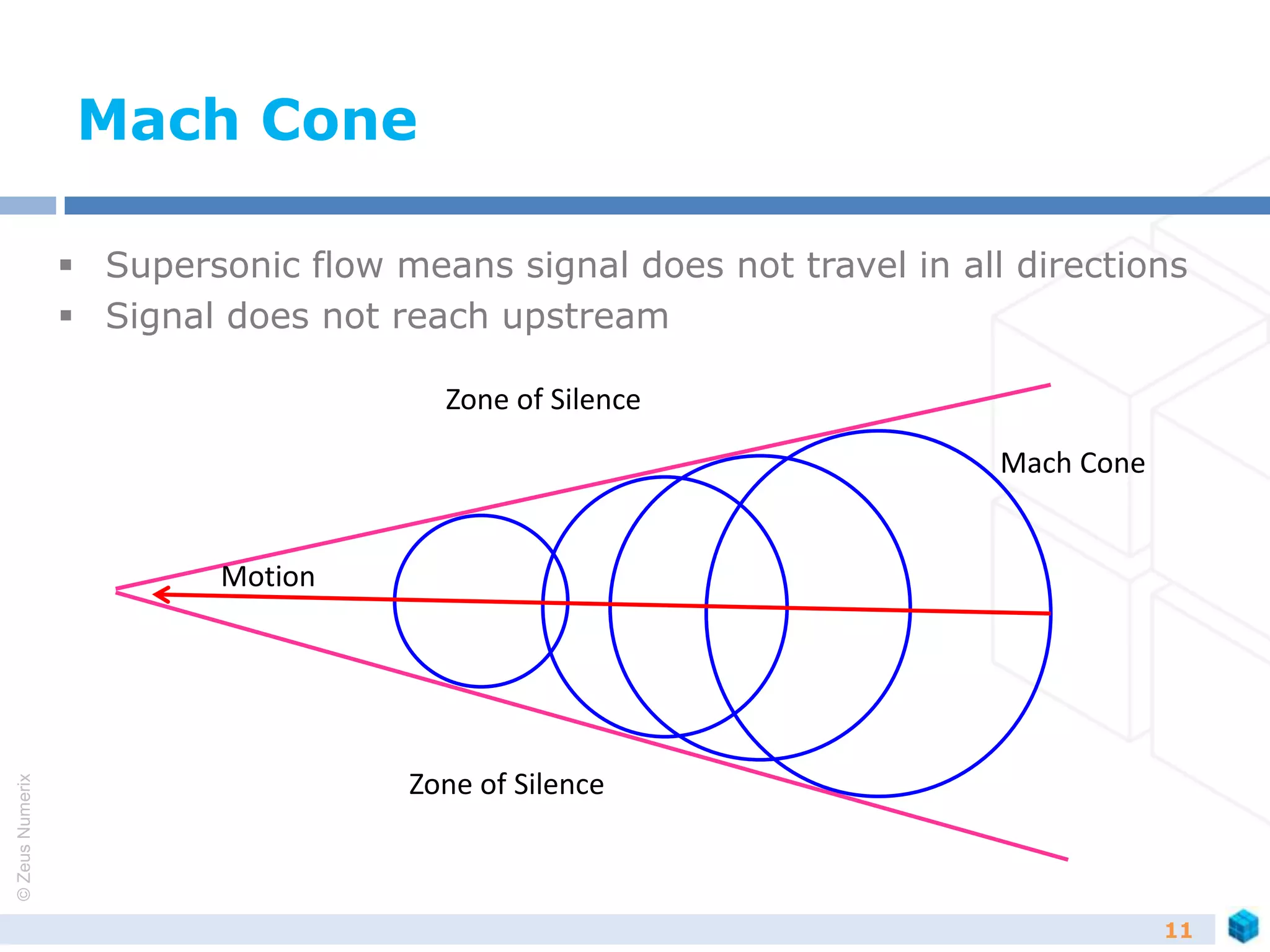
Mach Cone
 Supersonic flow means signal does not travel in all directions
 Signal does not reach upstream
11
Zone of Silence
Mach Cone
Motion
Zone of Silence
©ZeusNumerix
Equations
 Parabolic – Effect travels through one direction only
 Elliptic – Effect travels in all directions
 For complex equations like Navier Stokes the behavior may
be mixed
 Examples
 Supersonic inviscid flow – hyperbolic
 Subsonic inviscid flow – elliptic
 Boundary layer flow – parabolic
 Scheme that works for one set fails for another
12
©ZeusNumerix
The Time Marching
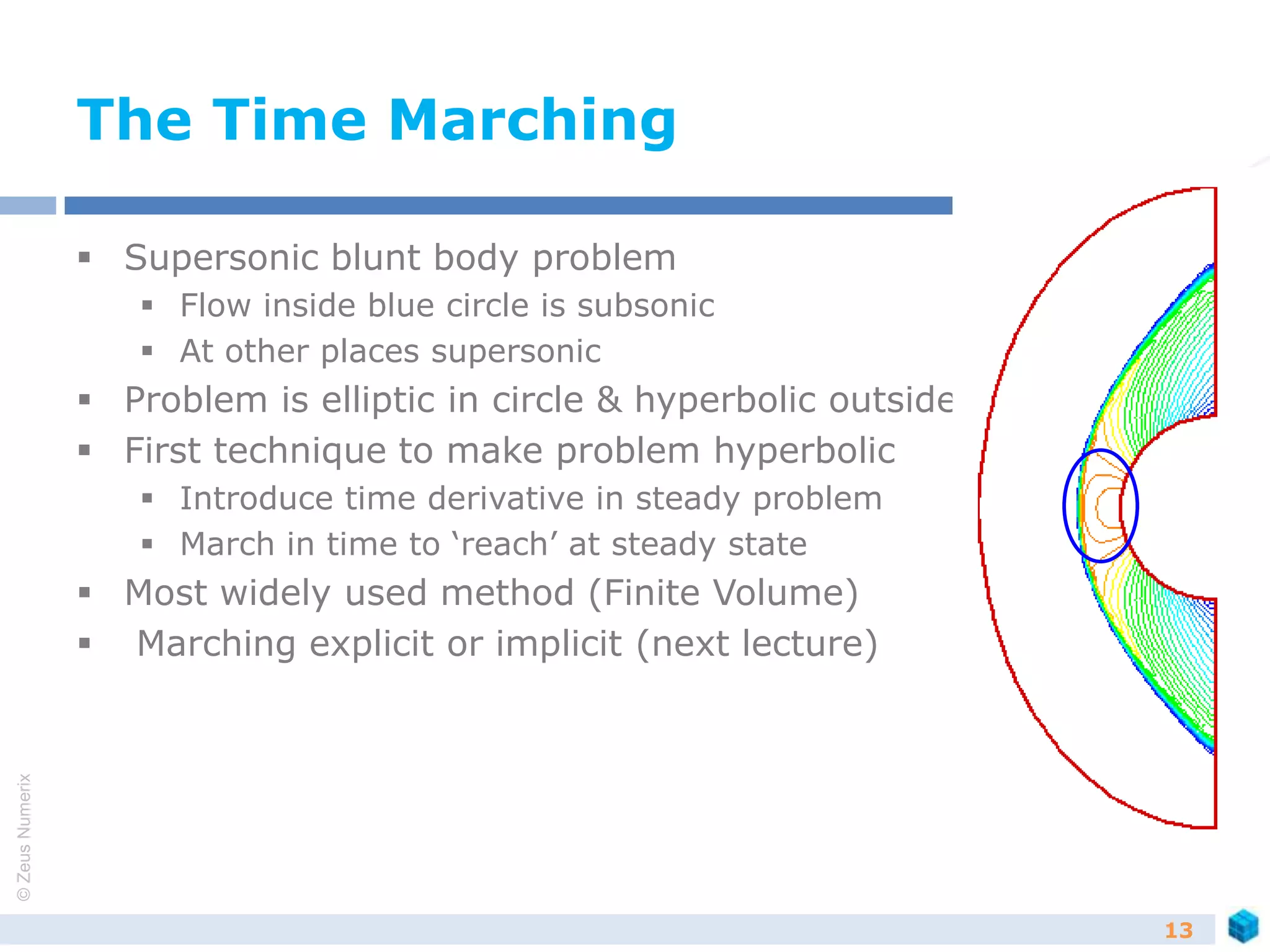
 Supersonic blunt body problem
 Flow inside blue circle is subsonic
 At other places supersonic
 Problem is elliptic in circle & hyperbolic outside
 First technique to make problem hyperbolic
 Introduce time derivative in steady problem
 March in time to ‘reach’ at steady state
 Most widely used method (Finite Volume)
 Marching explicit or implicit (next lecture)
13
©ZeusNumerix
The Wave Theory
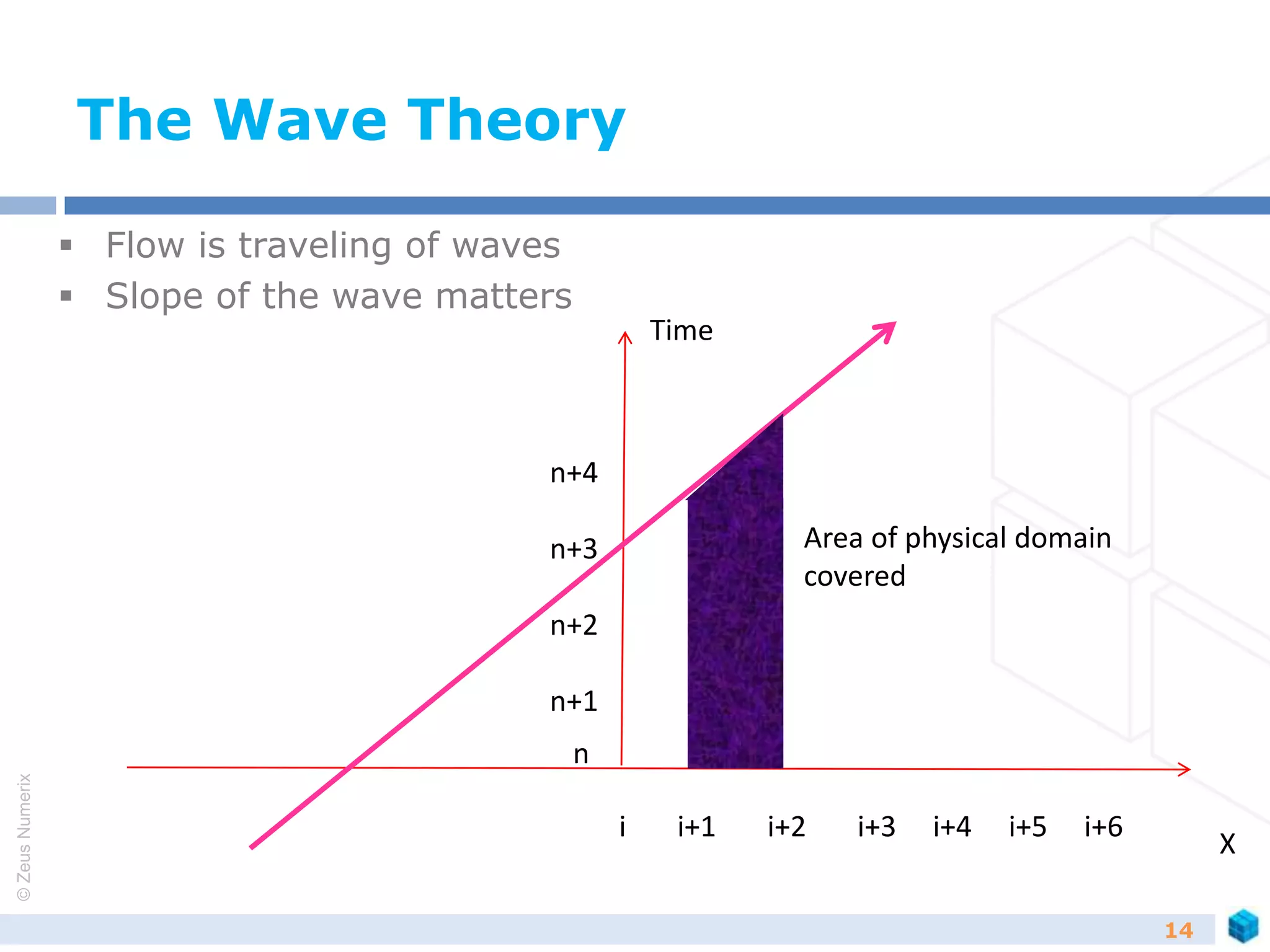
 Flow is traveling of waves
 Slope of the wave matters
14
X
Time
i i+1 i+2 i+3 i+4 i+5 i+6
n+4
n+3
n+2
n+1
n
Area of physical domain
covered
©ZeusNumerix
CFL Condition
 Stencil are the points used for simulation of flow
 In case below it is i(n), i+1(n) and i(n+1)
 For stable simulation Numerical domain must be greater
than physical domain
 Δt = CFL * Δx/Wave speed (CFL acts as a factor of safety)
15
Numerical domain of
dependence
True domain
of dependence
True wave
direction
i i+1
©ZeusNumerix
Schemes
 Problems in CFD can be finally simplified to
 dU/dt +dF/dx = 0
 Method of solving for [F] is called a scheme
 Flux vector splitting schemes
 Equations contains waves that travel in forward and backward
direction
 Flux vector split in such a fashion that waves are split in
forward moving and backward moving
 Solved independently to get solution
 Van Leer scheme – M = M++M-
 Steger Warming Method – Λ = Λ++Λ-
 van Leer better at sonic points as M is second derivative
16
©ZeusNumerix
Schemes
 Flux vector splitting schemes are diffusive and do not
capture boundary layer properly
 Easy to code with faster turn around time
 Roe Averaged – solves a local Reimann problem and give
better result at boundary layer but produces expansion
shock
 Entropy Fix Roe – Forced condition put on such that
Entropy never decreases
 AUSM – Combines the goodness of flux vector splitting
schemes and Roe type schemes
 Has many modifications for time decrease or better
performance
17
©ZeusNumerix
Thank You!
3 November 2014 18

Compressible flow basics

  • 1.
    ©ZeusNumerix Defense | NuclearPower | Aerospace | Infrastructure | Industry Treatment of compressible flow in CFD Abhishek Jain abhishek@zeusnumerix.com Compressible Flow: Basics
  • 2.
    ©ZeusNumerix 2 Overview  Conservation Laws Conservation form of equations  Governing equations: Hyperbolic  The Wave theory: CFL Condition  Schemes and their types  Eigen values  Boundary conditions
  • 3.
    ©ZeusNumerix Conservation Laws  Massis Conserved  Net mass flowing out of the system = Net mass decreased in the system  Momentum is Conserved  Rate of change of momentum = Momentum transfer through the surfaces – Forces (surface and body)  Surface forces – Shear stress, pressure, surface tension  Body forces – Gravity, centrifugal or electromagnetic etc  Energy is Conserved  Rate of change of energy = Neat heat flux + work done by body and surface forces 3
  • 4.
    ©ZeusNumerix The Equations  Equationsin Conservation form (Differential) 4 Similarly for y and z direction
  • 5.
    ©ZeusNumerix Conservation and Non- ConservationForms  Conservation Form  Easy to code as all equations look similar  More physical as “can be simply stated in English”  Primary variable are calculated from the flux variables  Captures the shock; (shock produced by solution)  Non-Conservation Form  Equation given above are expanded  Has a shock fitting approach; solution is a forethought i.e. shock location must be approximately known  Captures the shock better  There have been instances where shock fitting and capturing methods have been used with either forms 5
  • 6.
    ©ZeusNumerix Integral Form ofEquations  Conservation form  F, G, H are similar  S depends on the type of flow solved 6 U = ρ ρu ρv ρw ρE F = ρu ρ u2 + p ρuv + p ρuw + p (ρE + p)u
  • 7.
    ©ZeusNumerix Difference  Integral formmeans that if we were to add up the properties in the whole domain there will be an equilibrium  Does not assume if quantities are a part of continuous function or discontinuous  Differential means the function is continuous  Not able to capture physical discontinuities like shock wave  Integral form there is called more fundamental 7
  • 8.
    ©ZeusNumerix Completing the Loop The number of equations is FIVE  Assuming calorically perfect gas E=CvT  Number of unknowns  ρ, u, v, w, p, T  Hence the thermal equation of state is used for closure  p= ρRT  R is the Gas Constant  Please remember that the above equation was not used in incompressible flow 8
  • 9.
    ©ZeusNumerix Equation Types  Eigenvalues are calculated using the coefficients of the equations  In case the Eigen values of the equations are  Real and distinct – equation is Hyperbolic  Real and Zero – equation is Parabolic  Imaginary – equation is elliptic  Characteristic lines are curves where slope of dependent variable is indeterminant  Slope of the characteristic line can be real, zero or imaginary making the equations Hyperbolic, parabolic or elliptic 9
  • 10.
    ©ZeusNumerix Equations  Hyperbolic  Disturbancepropagates from domain of dependence (Brown) to range of influence (Gray)  Characteristics APC and BPD 10 P C D B A
  • 11.
    ©ZeusNumerix Mach Cone  Supersonicflow means signal does not travel in all directions  Signal does not reach upstream 11 Zone of Silence Mach Cone Motion Zone of Silence
  • 12.
    ©ZeusNumerix Equations  Parabolic –Effect travels through one direction only  Elliptic – Effect travels in all directions  For complex equations like Navier Stokes the behavior may be mixed  Examples  Supersonic inviscid flow – hyperbolic  Subsonic inviscid flow – elliptic  Boundary layer flow – parabolic  Scheme that works for one set fails for another 12
  • 13.
    ©ZeusNumerix The Time Marching Supersonic blunt body problem  Flow inside blue circle is subsonic  At other places supersonic  Problem is elliptic in circle & hyperbolic outside  First technique to make problem hyperbolic  Introduce time derivative in steady problem  March in time to ‘reach’ at steady state  Most widely used method (Finite Volume)  Marching explicit or implicit (next lecture) 13
  • 14.
    ©ZeusNumerix The Wave Theory Flow is traveling of waves  Slope of the wave matters 14 X Time i i+1 i+2 i+3 i+4 i+5 i+6 n+4 n+3 n+2 n+1 n Area of physical domain covered
  • 15.
    ©ZeusNumerix CFL Condition  Stencilare the points used for simulation of flow  In case below it is i(n), i+1(n) and i(n+1)  For stable simulation Numerical domain must be greater than physical domain  Δt = CFL * Δx/Wave speed (CFL acts as a factor of safety) 15 Numerical domain of dependence True domain of dependence True wave direction i i+1
  • 16.
    ©ZeusNumerix Schemes  Problems inCFD can be finally simplified to  dU/dt +dF/dx = 0  Method of solving for [F] is called a scheme  Flux vector splitting schemes  Equations contains waves that travel in forward and backward direction  Flux vector split in such a fashion that waves are split in forward moving and backward moving  Solved independently to get solution  Van Leer scheme – M = M++M-  Steger Warming Method – Λ = Λ++Λ-  van Leer better at sonic points as M is second derivative 16
  • 17.
    ©ZeusNumerix Schemes  Flux vectorsplitting schemes are diffusive and do not capture boundary layer properly  Easy to code with faster turn around time  Roe Averaged – solves a local Reimann problem and give better result at boundary layer but produces expansion shock  Entropy Fix Roe – Forced condition put on such that Entropy never decreases  AUSM – Combines the goodness of flux vector splitting schemes and Roe type schemes  Has many modifications for time decrease or better performance 17
  • 18.