The document discusses five major challenges in interactive rendering over the next 5-10 years, focusing on achieving cinematic image quality, improving illumination, enhancing programmability, managing production costs, and scaling up rendering capabilities. Key issues outlined include aliasing, dynamic global illumination, programmable graphics pipelines, efficient workflows, and handling complex scenes in gaming and visual effects. It highlights the need for advancements to address these challenges and improve the real-time rendering pipeline.
Introduction to the 5 major challenges in interactive rendering for the next decade, focusing on gaming and interactive areas.
Challenge #1 discusses achieving cinematic image quality in real-time rendering, addressing issues like aliasing, motion blur, transparency, and micropolygon rendering.
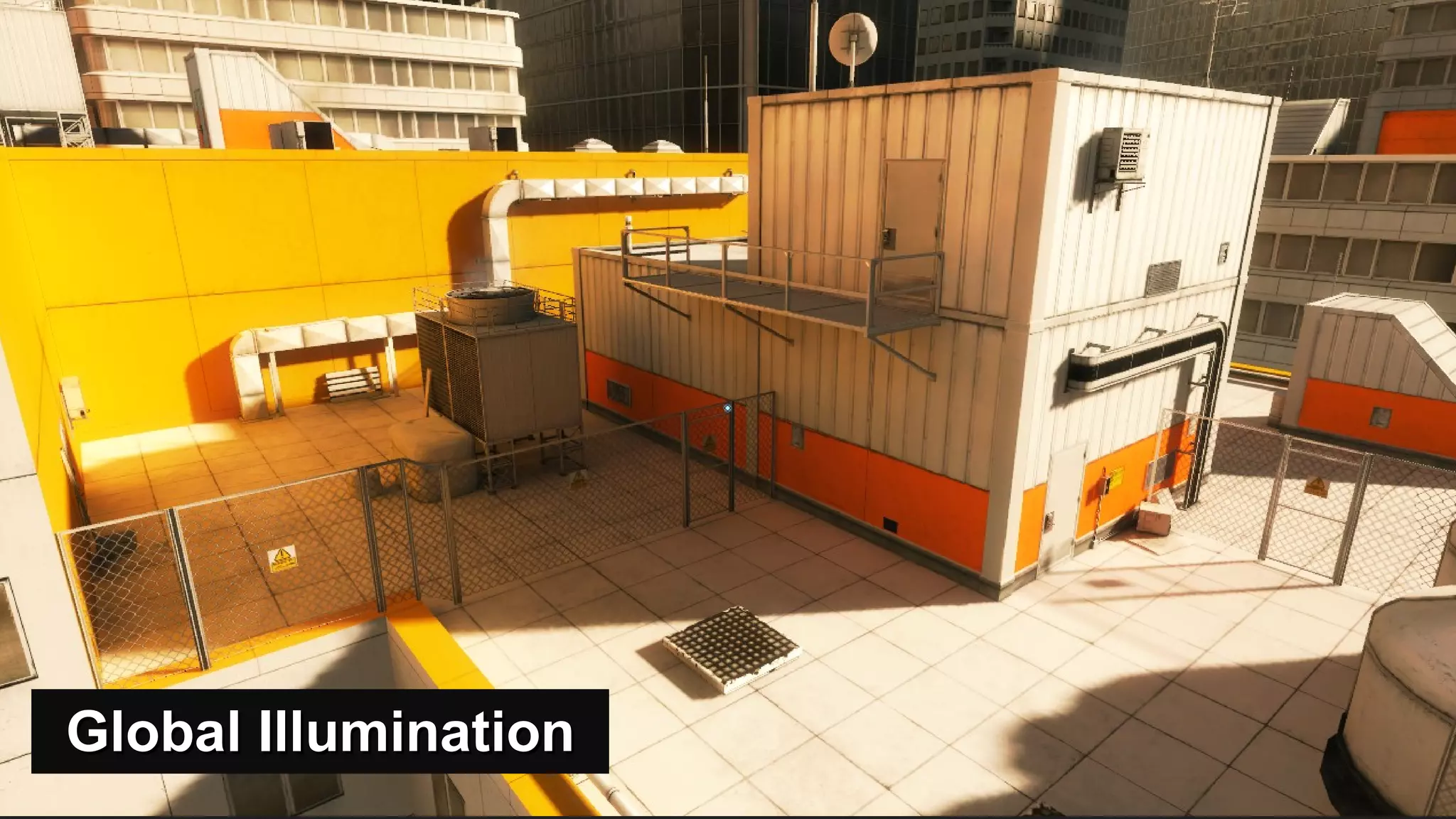
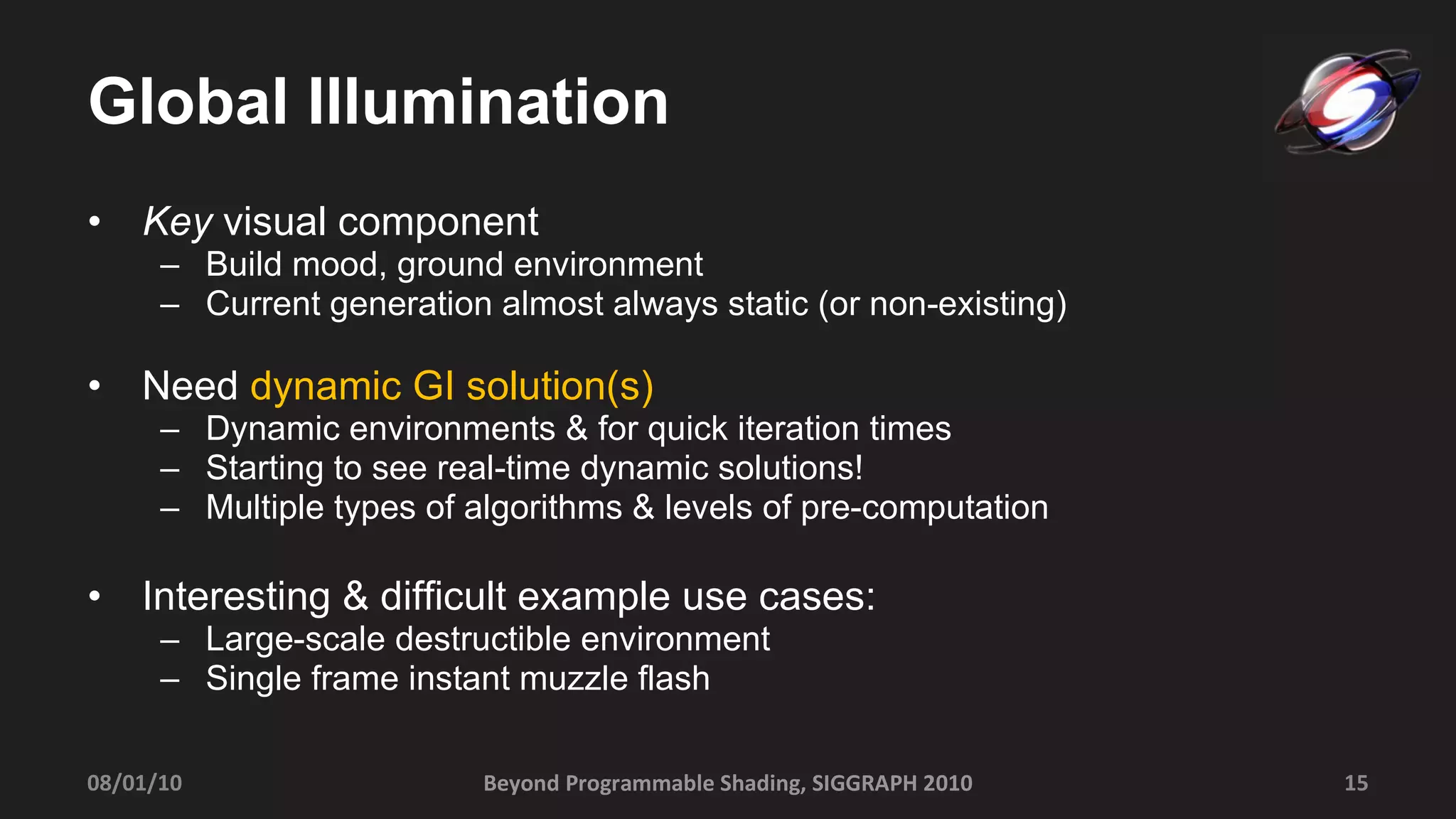
Challenge #2 focuses on illumination aspects including global illumination, shadows, and reflections, emphasizing the need for dynamic solutions.
Challenge #3 highlights the limitations of current graphics pipelines, advocating for hybrid and reconfigurable pipelines to improve programmability.
Challenge #4 addresses the rising production costs in game development while improving quality, stressing the importance of efficient workflows and content reuse.
Challenge #5 concerns scaling up performance and memory in rendering pipelines, focusing on the transition to richly interactive worlds and avoiding performance degradation.
Final thoughts on the complex nature of real-time rendering and the necessity for substantial advancements in rendering technology.
Bonus discussion on advanced surface lighting techniques, including subsurface scattering and generalized BRDFs.
Overview What arethe major challenges for us in the next 5-10 years ? Interactive rendering for games as well as other interactive areas Which problems do we want to solve ? What do we want to achieve & focus on ? Based on own thoughts & feedback from people in the industry 08/01/10 Beyond Programmable Shading, SIGGRAPH 2010
Challenge #1 -Cinematic image quality Want to get to that smooth visual feel CG movies have Consumers are viewing them on same device as they play games on Visual realism of real-time is still far from offline CG 33 ms vs ~60 minutes per frame Areas with big quality difference : Aliasing Motion blur & depth of field Transparency Geometry Beyond Programmable Shading, SIGGRAPH 2010 08/01/10
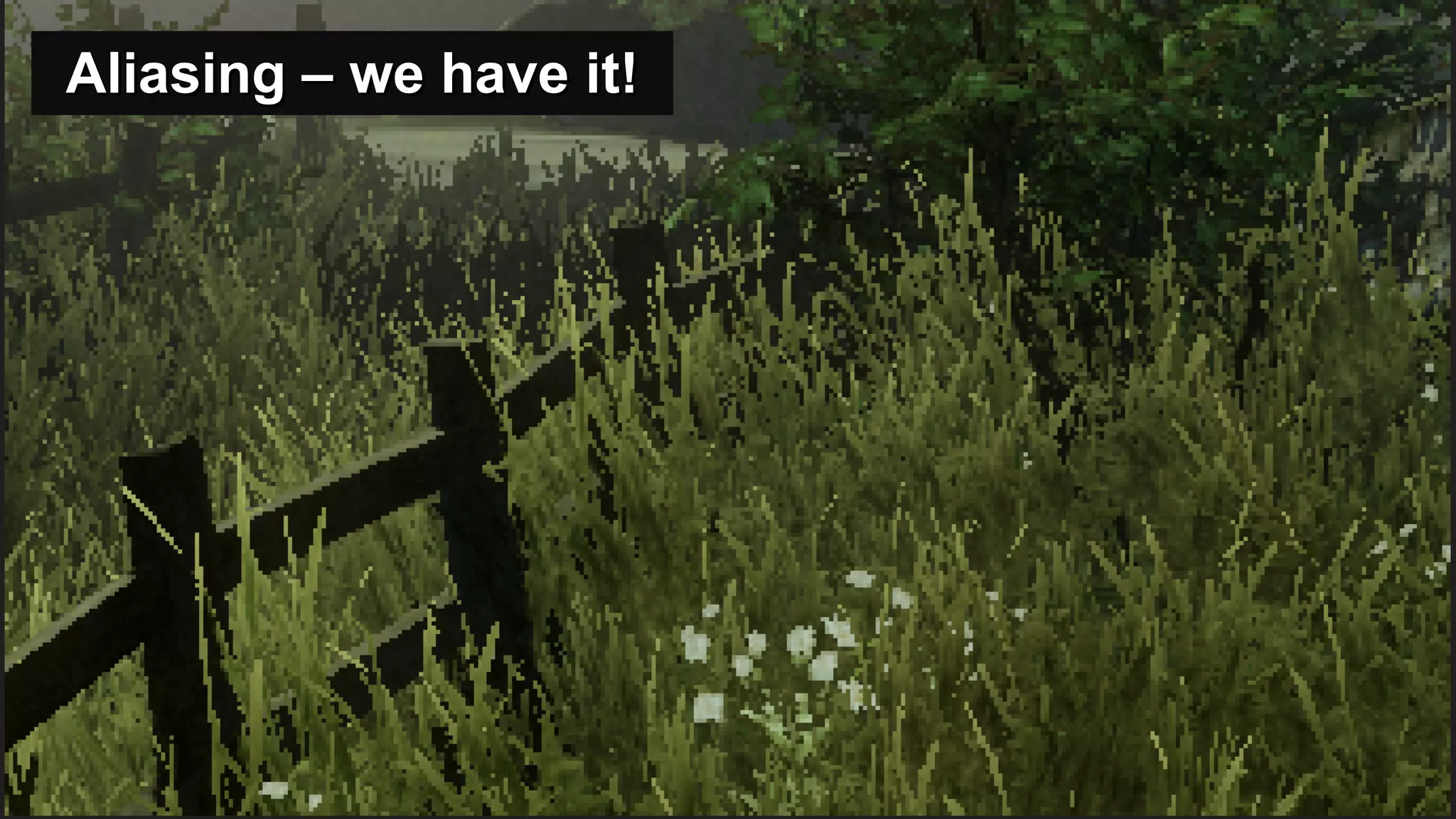
Aliasing Aliasing isone of the biggest visual artifacts Most games have lots of it Eyes distracted by flickering Aliasing within a frame is typically very variable Multiple current antialiasing techniques, but no complete solution yet MSAA does not scale well (storage, bandwidth) Post-effect based techniques only solve part of the aliasing problem How can we get to a pipeline that scales up to much higher quality AA ? Without breaking performance, memory storage or bandwidth Beyond Programmable Shading, SIGGRAPH 2010 08/01/10
Motion blur andDepth of Field Important visual cues to percieve depth, focus & motion! The movie people know this Games only have post-process based versions Lots of artifacts Not possible to implement complete effect as post-process Ideal to have a rendering pipeline that can naturally support motion blur and depth of field Stochastic rasterization? Raytracing? REYES? Other? Beyond Programmable Shading, SIGGRAPH 2010 08/01/10
10.
Transparency Order- dependent transparency has always been a big limitation for content creators & developers Restrictive art pipeline: no glass houses Even windows on cars & buildings can be painful Restrictive interaction between objects & effects Meshes vs particles vs volumetrics Order- independent transparency is must going forward Big challenge! Gradual process Beyond Programmable Shading, SIGGRAPH 2010 08/01/10
11.
Micropolygon rendering Massivelydetailed geometry Render directly instead of simplify to normalmaps True silhouettes & no faceted edges DX11 tessellation is a good step forward But still quite complex full pipeline in practice Shading quad efficiency issues with small triangles We’re getting closer! Beyond Programmable Shading, SIGGRAPH 2010 08/01/10
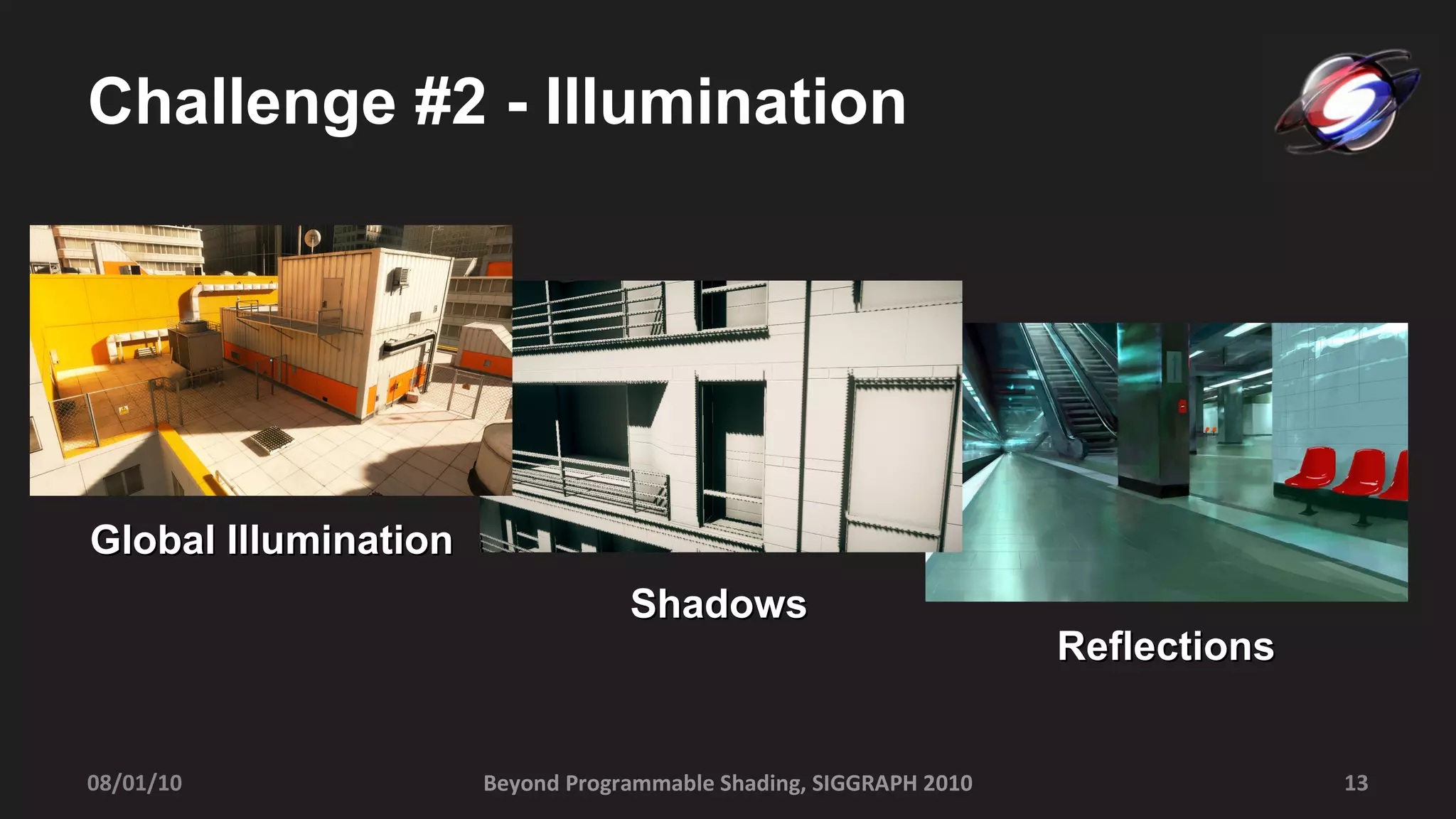
Global Illumination Key visual component Build mood, ground environment Current generation almost always static (or non-existing) Need dynamic GI solution(s) Dynamic environments & for quick iteration times Starting to see real-time dynamic solutions! Multiple types of algorithms & levels of pre-computation Interesting & difficult example use cases: Large-scale destructible environment Single frame instant muzzle flash 08/01/10 Beyond Programmable Shading, SIGGRAPH 2010
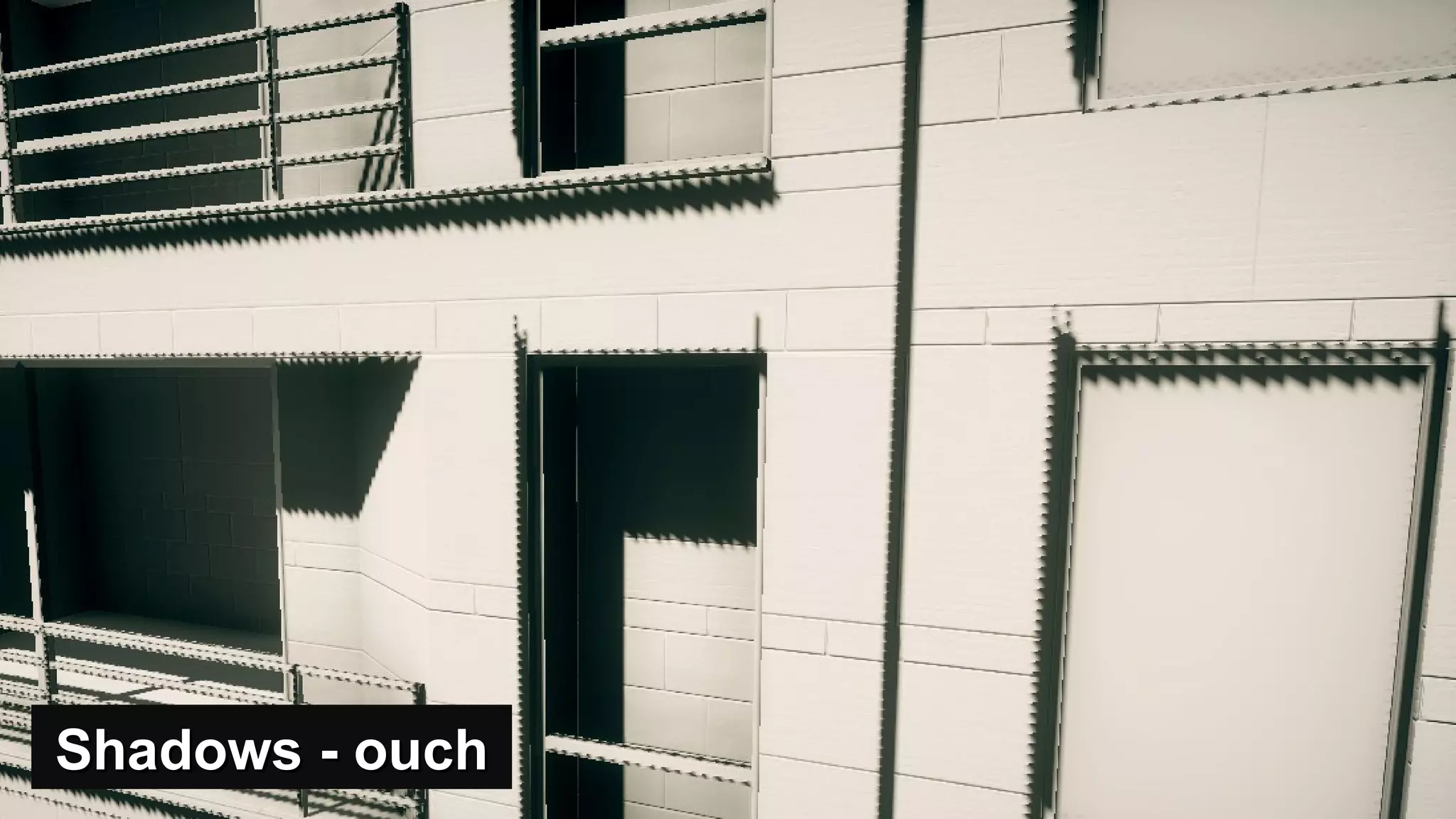
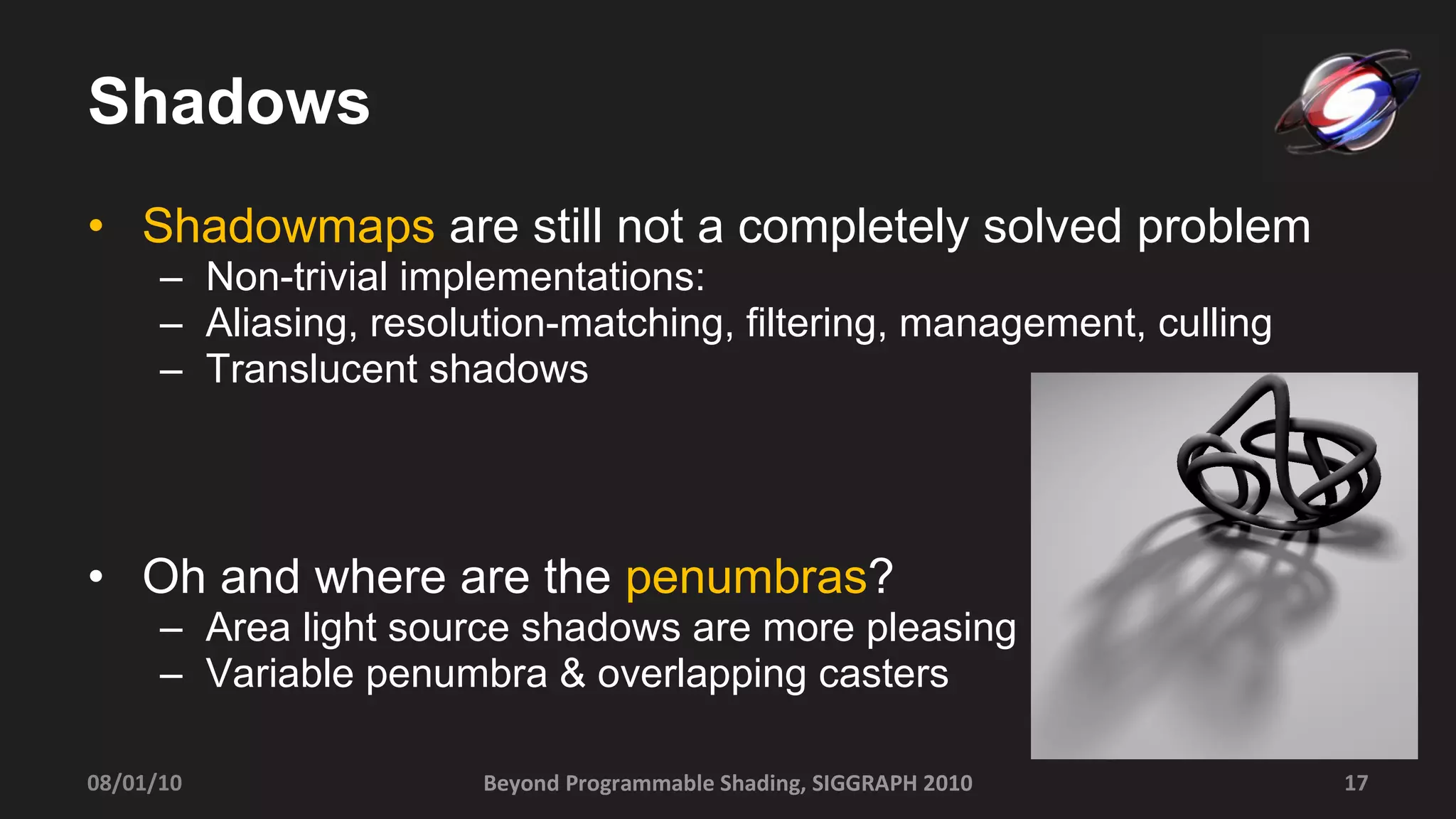
Shadows Shadowmaps are still not a completely solved problem Non-trivial implementations: Aliasing, resolution-matching, filtering, management, culling Translucent shadows Oh and where are the penumbras ? Area light source shadows are more pleasing Variable penumbra & overlapping casters 08/01/10 Beyond Programmable Shading, SIGGRAPH 2010
18.
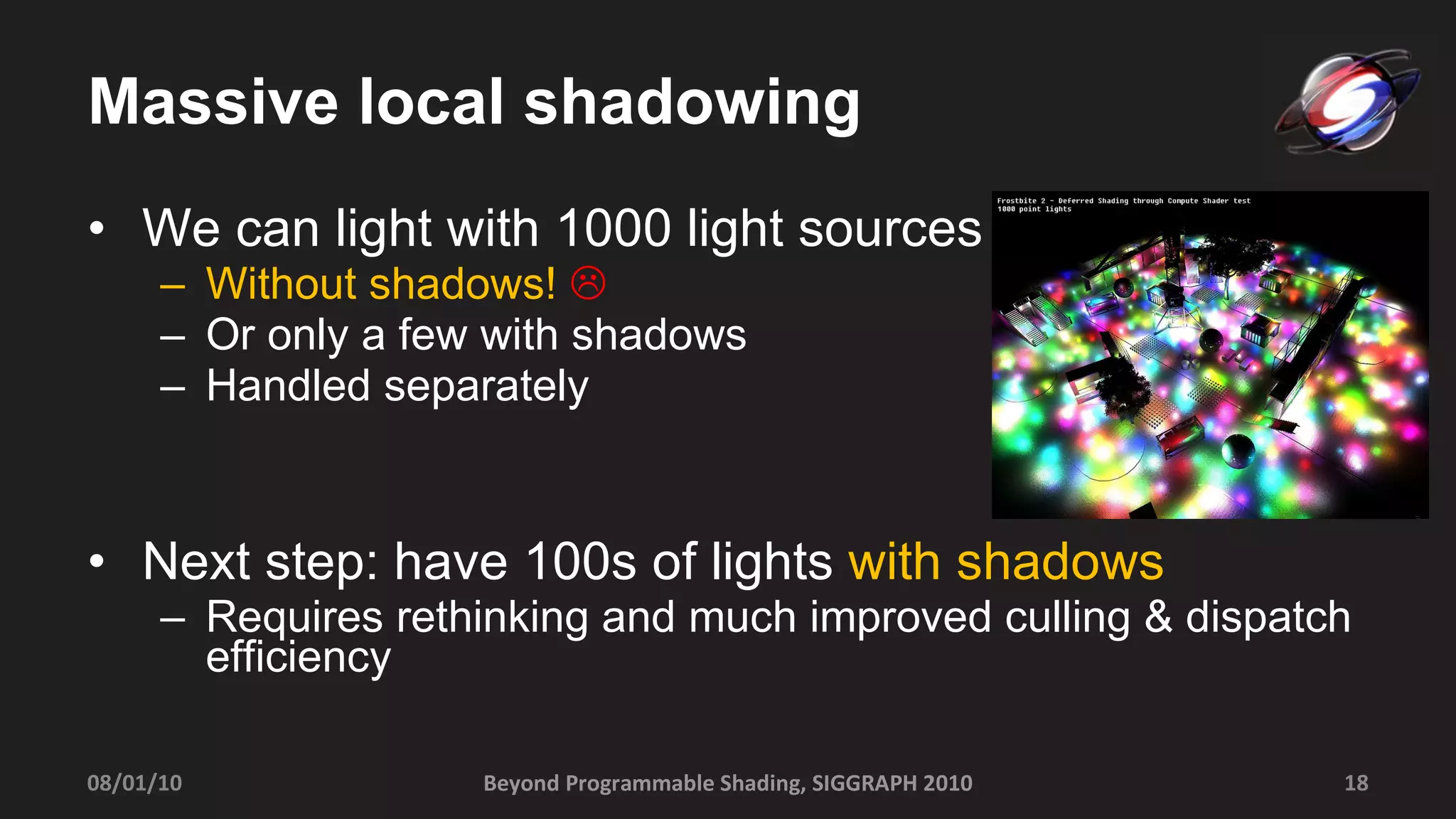
Massive local shadowingWe can light with 1000 light sources Without shadows! Or only a few with shadows Handled separately Next step: have 100s of lights with shadows Requires rethinking and much improved culling & dispatch efficiency Beyond Programmable Shading, SIGGRAPH 2010 08/01/10
Reflections Currently onlyhave 2 methods: Envmaps Scale up to 100s of dynamic envmaps? Similar to point light shadow problem Doesn’t solve concave or large flat surfaces Planar reflections Good for big flat single/few surfaces But restricted to that as well, how to handle slopes & multiple walls/windows? Need solutions for local reflections on arbitrary surfaces Both glossy & perfect reflections Not that much research in this area except with raytracing? Hybrid rasterization/raytracing pipeline? 08/01/10 Beyond Programmable Shading, SIGGRAPH 2010
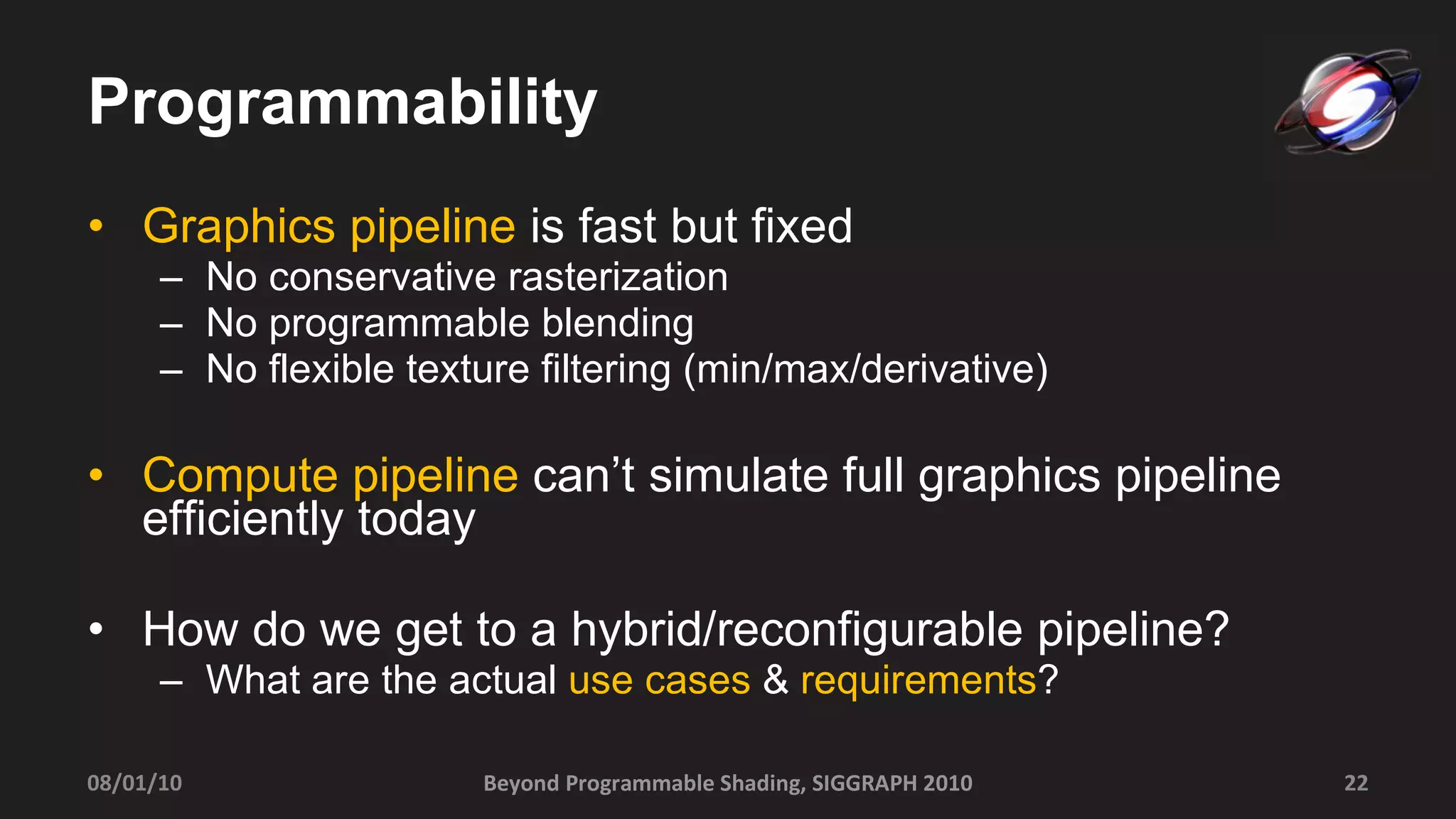
Programmability Graphics pipeline is fast but fixed No conservative rasterization No programmable blending No flexible texture filtering (min/max/derivative) Compute pipeline can’t simulate full graphics pipeline efficiently today How do we get to a hybrid/reconfigurable pipeline? What are the actual use cases & requirements ? Beyond Programmable Shading, SIGGRAPH 2010 08/01/10
23.
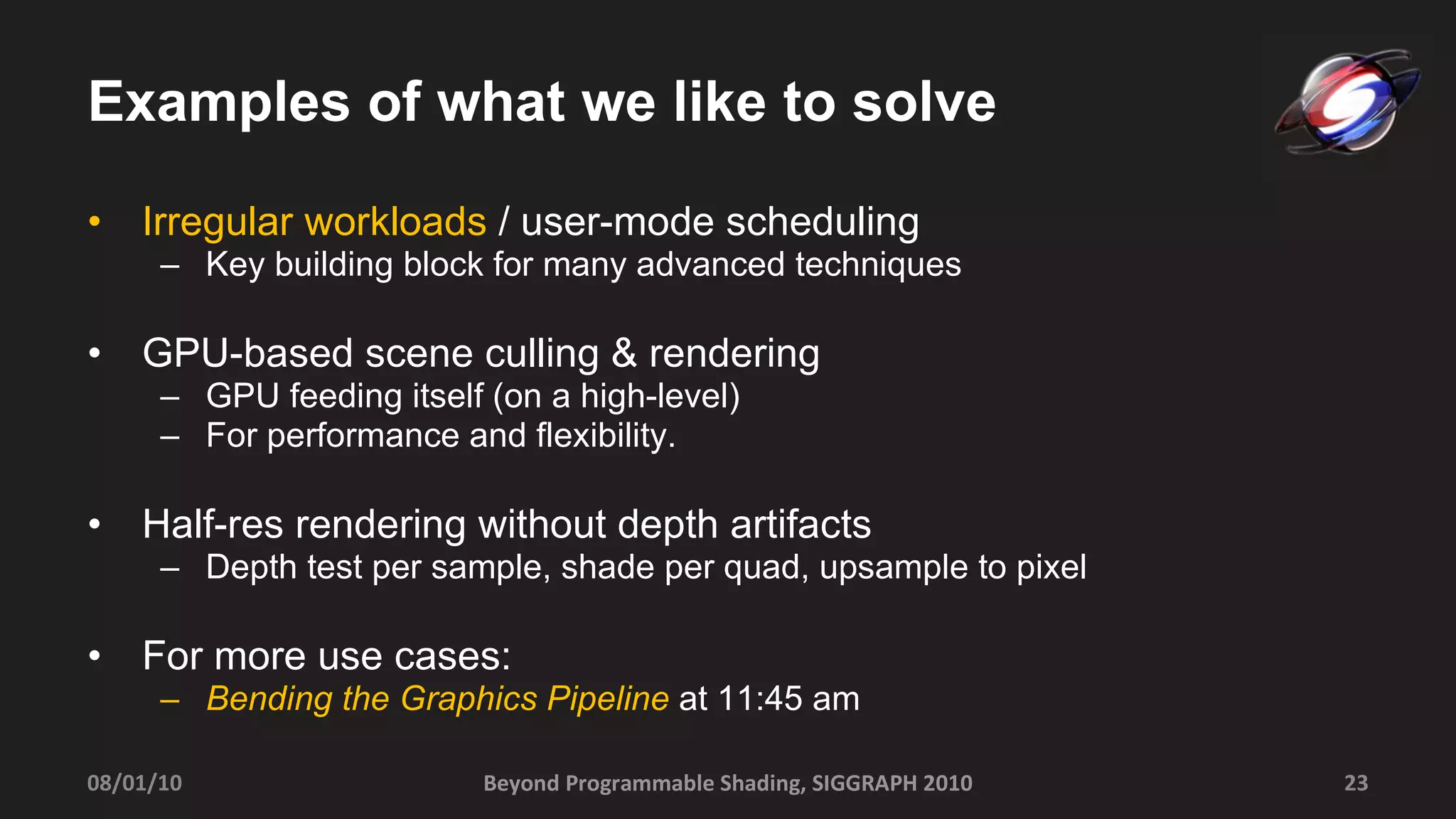
Examples of whatwe like to solve Irregular workloads / user-mode scheduling Key building block for many advanced techniques GPU-based scene culling & rendering GPU feeding itself (on a high-level) For performance and flexibility. Half-res rendering without depth artifacts Depth test per sample, shade per quad, upsample to pixel For more use cases: Bending the Graphics Pipeline at 11:45 am Beyond Programmable Shading, SIGGRAPH 2010 08/01/10
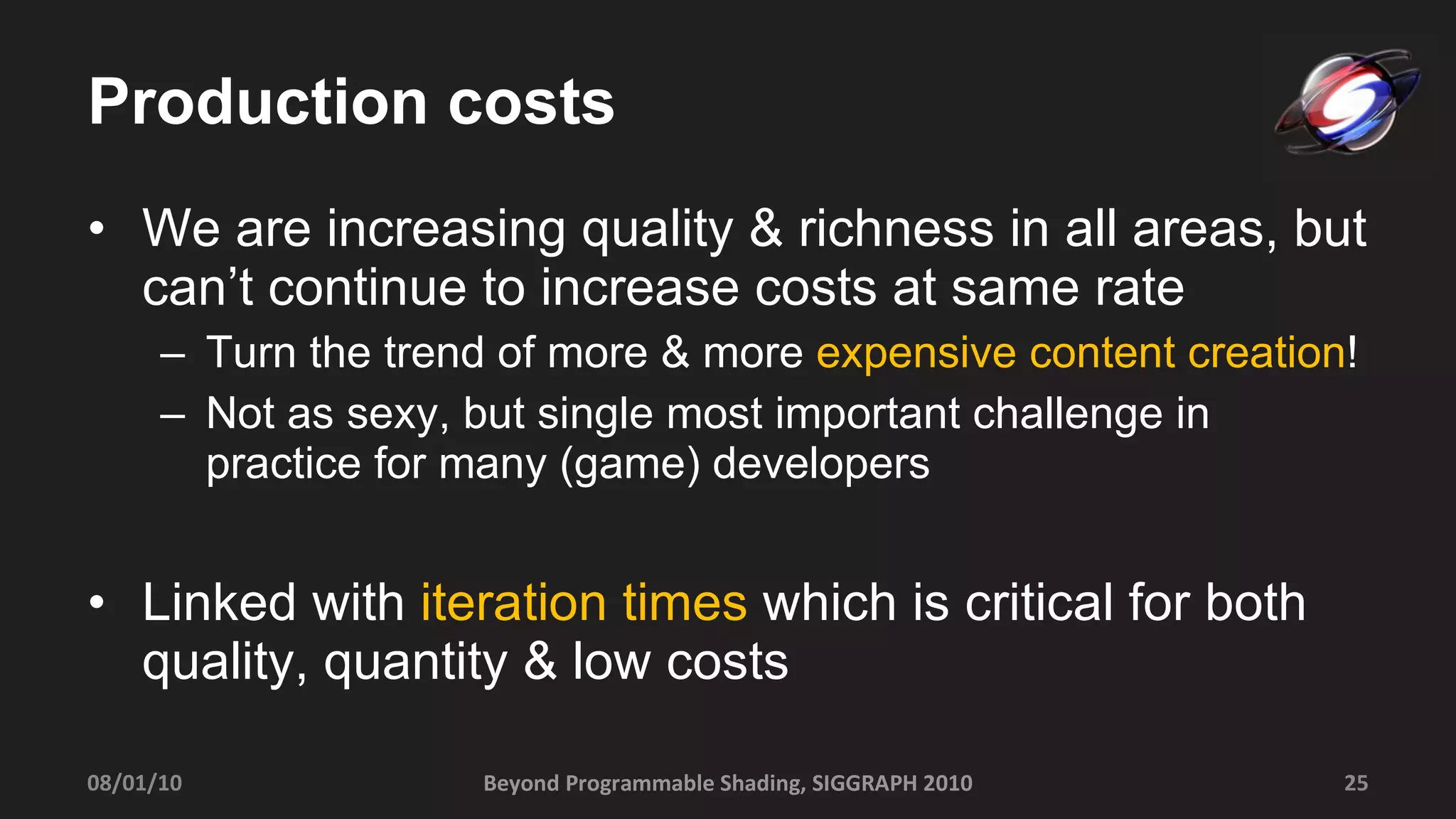
Production costs Weare increasing quality & richness in all areas, but can’t continue to increase costs at same rate Turn the trend of more & more expensive content creation ! Not as sexy, but single most important challenge in practice for many (game) developers Linked with iteration times which is critical for both quality, quantity & low costs 08/01/10 Beyond Programmable Shading, SIGGRAPH 2010
26.
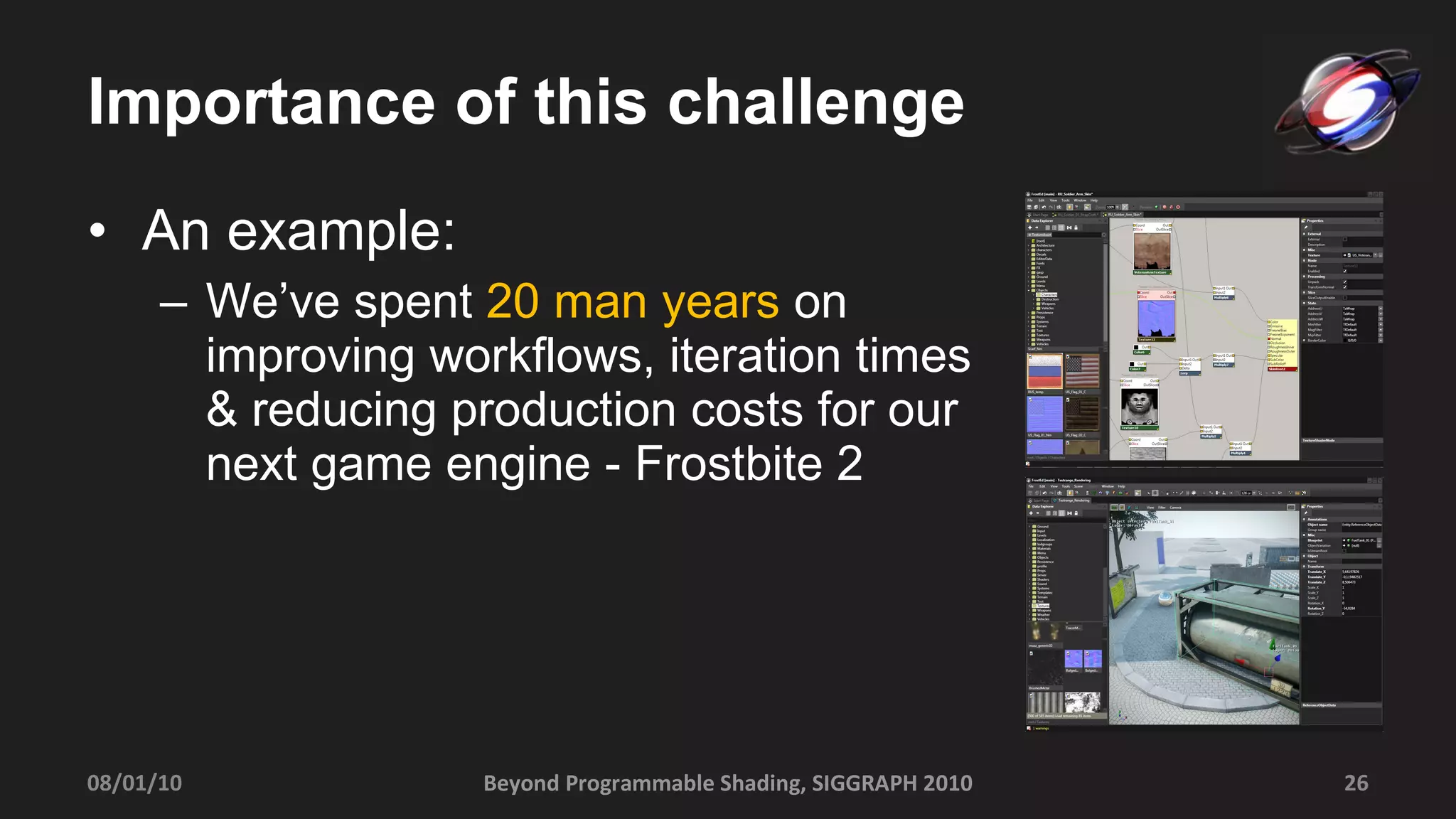
Importance of thischallenge An example: We’ve spent 20 man years on improving workflows, iteration times & reducing production costs for our next game engine - Frostbite 2 08/01/10 Beyond Programmable Shading, SIGGRAPH 2010
27.
Production cost reductionsImprovements: Faster workflows & tools Procedural content amplification / generation Fewer custom pipelines, techniques & solutions More sharing & reuse of content Giant important topic but only something we cover indirectly in the course 08/01/10 Beyond Programmable Shading, SIGGRAPH 2010
Scaling up GPUmodel has become quite flexible Main problem is often not capabilities but performance/bw Want more of everything: Performance, bandwidth & memory Content, detail & quality Scalability without performance cliffs Assumed reasonableness in fixed pipelines Graceful performance degradation strongly preferred 08/01/10 Beyond Programmable Shading, SIGGRAPH 2010
31.
Scaling up -Techniques Some techniques break down when scaling up, for example: Deferred shading with +4x MSAA Quad-based forward shading with ~1 pixel triangles GPU dispatch APIs when doing 100s of small scene renders for shadows & reflections (batch counts) Beyond Programmable Shading, SIGGRAPH 2010 08/01/10
32.
Scaling up -Worlds Move from static worlds to immersive interactive worlds Unique Detailed Changeable / Destructible (Procedural) Massive scenes are a challenge for many industries Movies, Scientific, Games Esp. interaction with memory & performance cliffs 08/01/10 Beyond Programmable Shading, SIGGRAPH 2010
33.
The Challenges Illumination Cinematic Image Quality Programmability Production costs Scaling up 08/01/10 Beyond Programmable Shading Course, ACM SIGGRAPH 2010
34.
Conclusions Real-time renderingis far from a solved problem We need major improvements to the real-time rendering pipeline(s) and programming model 08/01/10 Beyond Programmable Shading, SIGGRAPH 2010
35.
Thanks for allthe feedback! Christina Coffin (@christinacoffin) Colin Barré-Brisebois (@ZigguratVertigo) Daniel Collin (@daniel_collin) Flavius Alecu (@flawe) Sander van Rossen ( @logicalerror) Rob Jones (@bobvodka) Stephen Tovey (@nonchaotic) Colin Riley (@domipheus) Joe Tidmarsh (@mrjovis) Stephen Hill (@self_shadow) Federico B P ( @nocturndragon) Stefan Boberg (@bionicbeagle) Noel Llopis (@snappytouch) Björn Knafla (@bjoernknafla) Andrew Richards (@codeandrew) Juan Manuel Alvarez (@the_naicigam) David Luebke (@davedotluebke) Jonathan Ragan-Kelley (@jrk) Pat Wilson (@pat_wilson) Rachel Blum (@groby) Brian Karis (@briankaris) Matt Collins (@matt_c_) Sam Martin (@palgorithm) Aaron Lefohn Andrew Lauritzen Luca Fascione Steve Anichini Simon Taylor Matt Swoboda Cody Ritchie Mattias Kylen Oscar Carlén Beyond Programmable Shading Course, ACM SIGGRAPH 2010 08/01/10
36.
Contact details email: [email_address] blog: http://repi.se twitter: @repi For more DICE talks: http://publications.dice.se Beyond Programmable Shading, SIGGRAPH 2010 08/01/10
Surface lighting Moreadvanced surface shading & lighting Sub-surface scattering Hair Foliage Arbitrary / generalized BRDFs? How can they work with deferred rendering ? Beyond Programmable Shading, SIGGRAPH 2010 08/01/10
Editor's Notes
#3 Hi, I’m going to talk today a bit about what type of major challenges we have ahead for us in the next 5-10 years, what type of problems we want to solve and things to focus on. Sort of why we want to go Beyond Programable Shading?
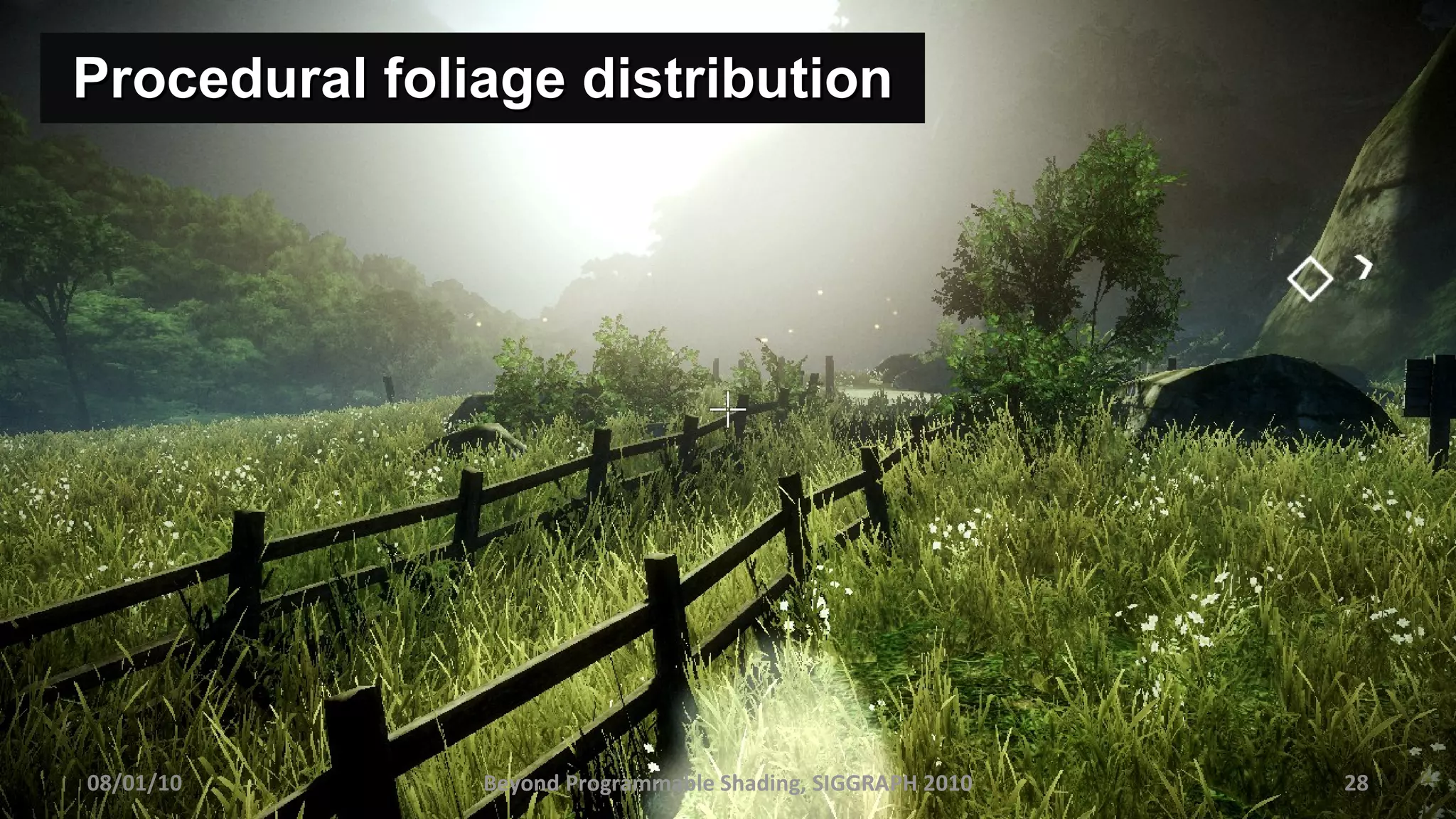
#26 Not the most sexy of topics, but the single most important one for game development Show undergrowth?
#27 For us, that is a lot of time and a lot of money. But the single most important improvement in this new version of the engine. Editor framework, intutitive & fast workflows, features to simplify development
#28 Examples: Automatic LOD solutions or directly rendering giant meshes without LODs Physically based rendering
#29 Not the most sexy of topics, but the single most important one for game development Show undergrowth?
#31 Memory usage is major cliff, render to virtual memory/cache/edram?
#33 PantaRay - Fast Ray Traced Occlusion for Massive Scenes