The Elements of Dance
Dance is a way of knowing and communicating. All societies use dance to communicate on both personal and cultural levels and to meet physical and spiritual needs. Dance, as with all the arts, has its own language. We need to learn this language in order to fully understand and appreciate the world of Dance.
The Language of Dance Elements : Time ,  Space  and  Force Choreographic Forms :  Theme  and  Variations ,  Rondo  and  Narrative Styles:  (characteristics of) Ballet, Tap, Jazz  and  Modern
Elements TIME:   The relationship of one movement or part of a movement to another. Includes pulse, speed (or tempo), duration, rhythm, and phrases.  Pulse :  the ongoing underlying beat Tempo:  The speed with which a movement is performed Rhythm : a flow of sound or movement having regular accented beats; a  movement or activity in which some action repeats regularly;  patterns made by arranging long and short sounds or strong and  light sounds Duration:  the length of time a movement lasts: a long time, short  time or something in between Syncopation:  a temporary accenting of a normally weak beat in music to  vary the rhythm Phrasing:   a grouping and articulation of a group of notes Accent:   a movement or shape performed in such a way as to give     emphasis.
SPACE:  the area of space occupied by the dancer’s body; includes direction, size, pathways, levels and shapes. Direction:  which way a dancer faces or moves; e.g., forward, backward, sideways, up and down Size:  magnitude of a body shape or movement; from small to large movements Pathways:  patterns made as a dancer moves through the air or on the floor (straight, vertical, horizontal, zig-zag); can be made with locomotor or non-locomotor movements, separately or in combination. Levels:  the vertical distance from the floor. Movements take place on three levels: high, middle or low and deep. Shapes:  the form created by the body’s position in space. Aspects of shape are open/closed, symmetrical/asymmetrical, angular and curved.  Elements
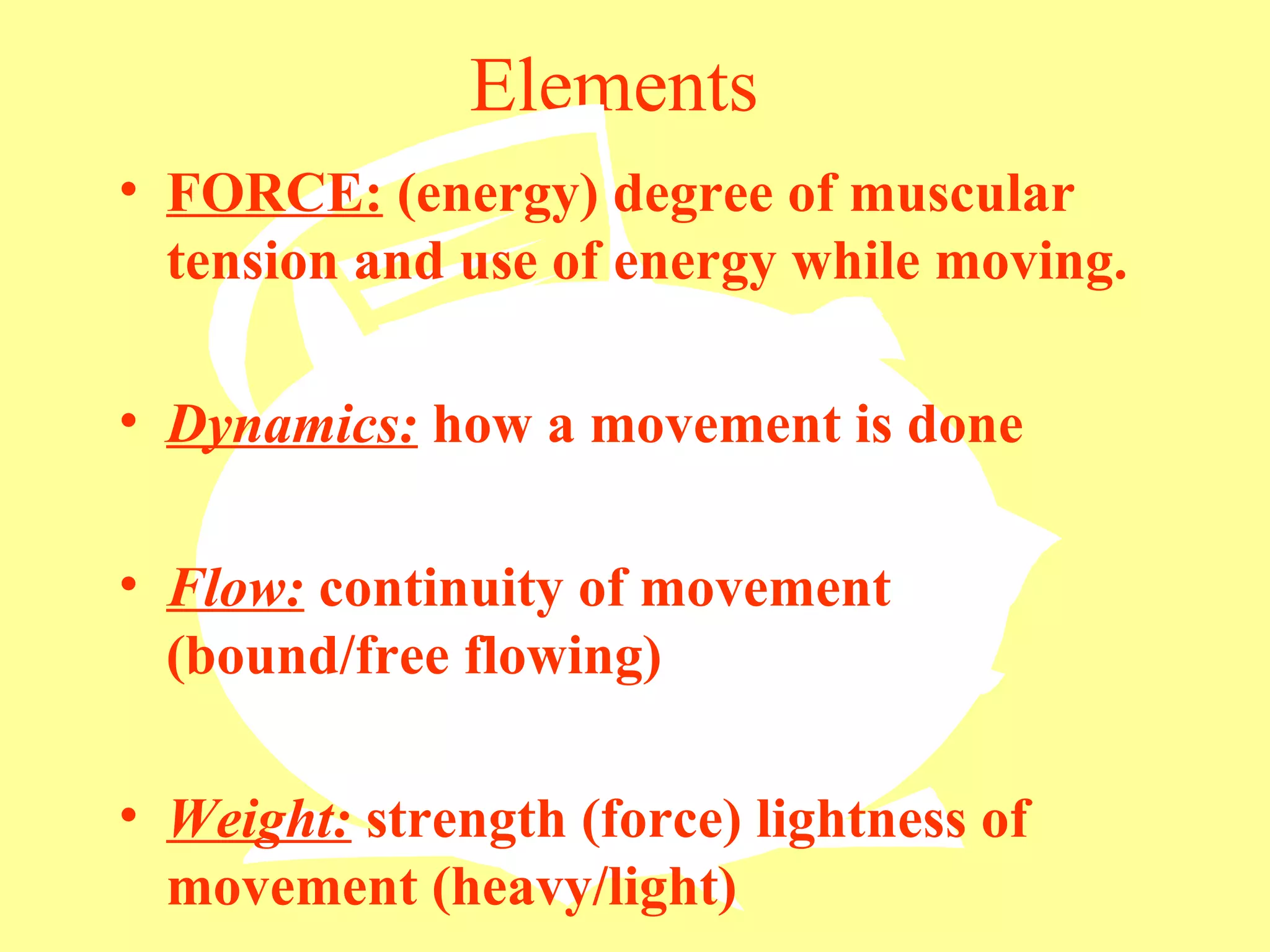
Elements FORCE:  (energy) degree of muscular tension and use of energy while moving. Dynamics:  how a movement is done Flow:  continuity of movement (bound/free flowing) Weight:  strength (force) lightness of movement (heavy/light)
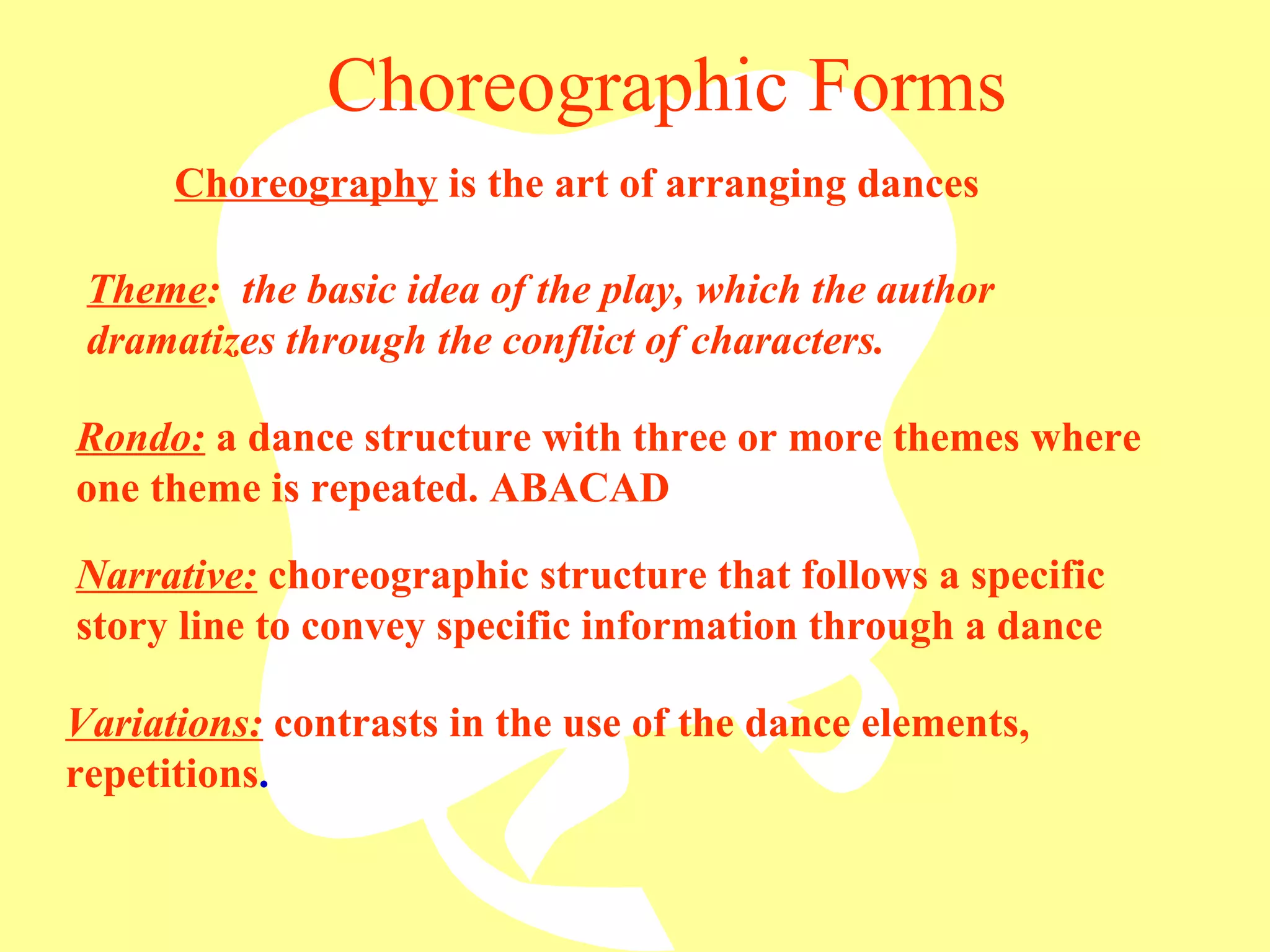
Choreographic Forms Rondo:  a dance structure with three or more themes where one theme is repeated. ABACAD Theme :  the basic idea of the play, which the author dramatizes through the conflict of characters. Narrative:  choreographic structure that follows a specific story line to convey specific information through a dance Variations:  contrasts in the use of the dance elements, repetitions . Choreography  is the art of arranging dances
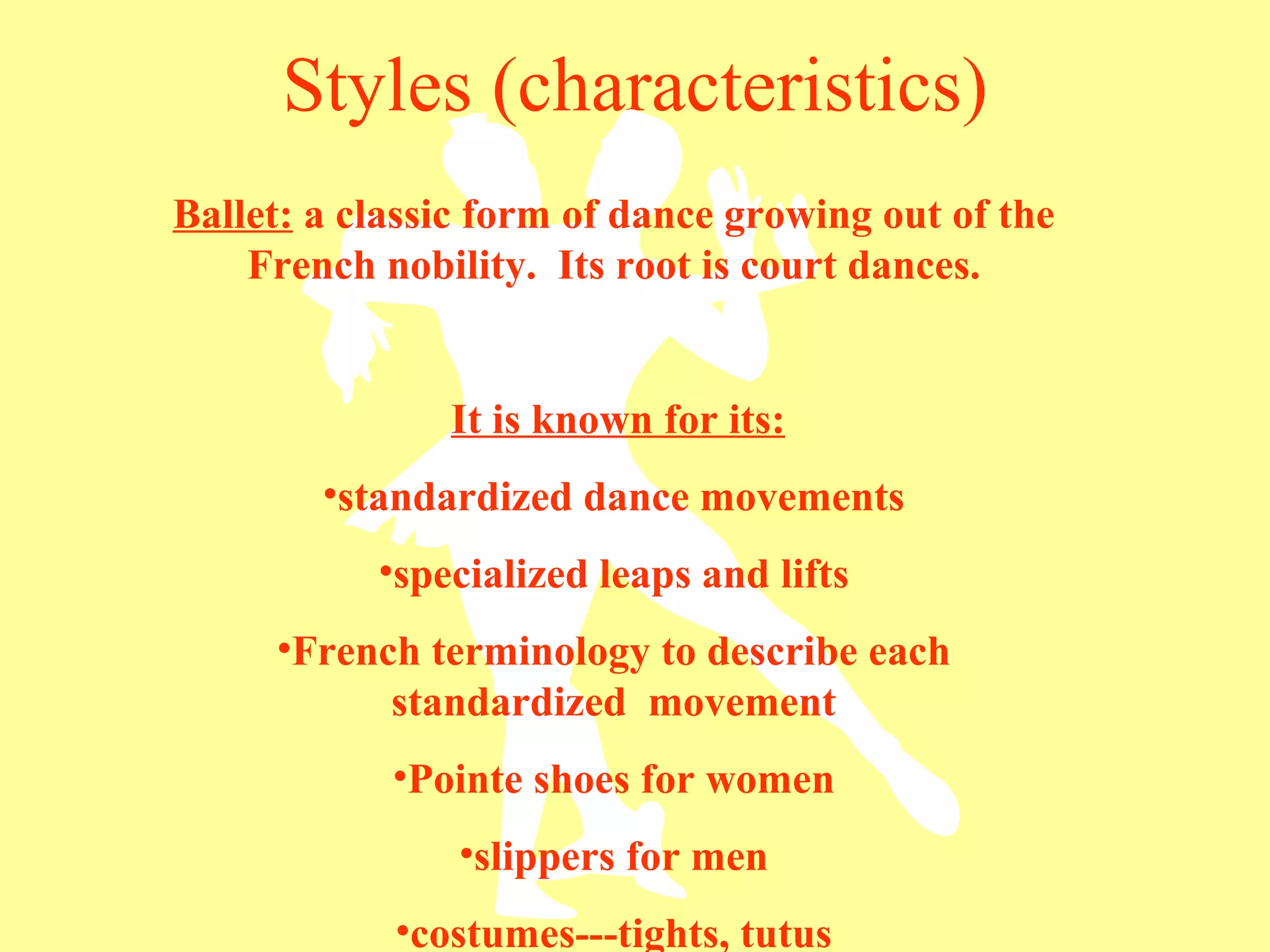
Styles (characteristics) Ballet:  a classic form of dance growing out of the French nobility.  Its root is court dances. It is known for its: standardized dance movements specialized leaps and lifts French terminology to describe each standardized  movement Pointe shoes for women slippers for men costumes---tights, tutus
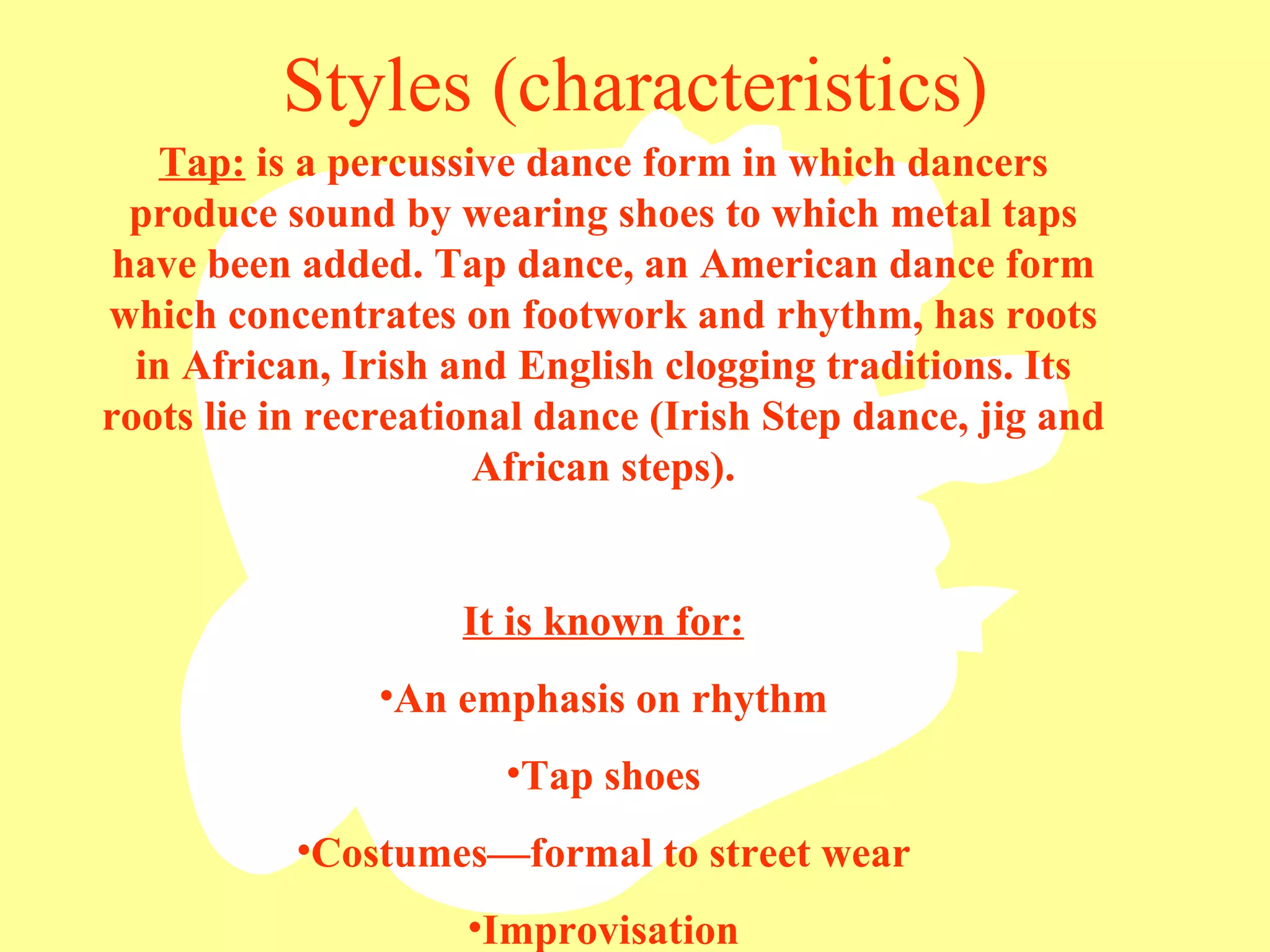
Styles (characteristics) Tap:  is a percussive dance form in which dancers produce sound by wearing shoes to which metal taps have been added. Tap dance, an American dance form which concentrates on footwork and rhythm, has roots in African, Irish and English clogging traditions. Its roots lie in recreational dance (Irish Step dance, jig and African steps). It is known for: An emphasis on rhythm Tap shoes Costumes—formal to street wear Improvisation
Jazz:  American music marked by lively rhythms with unusual accents and often including melodies made up by musicians as they play. It’s roots are in social dances and early musical theatre dance. It’s known for: Stylized movement Accents in hands, head, hips and feet English/French terminology to describe movements Jazz shoes or boots Costume related to theme of dance Improvisation Styles (characteristics)
Styles (characteristics) Modern:  a form of dance developed by dancers interested in breaking from ballet traditions and expressing a more liberating form of movement. It expresses complex emotions and abstract ideas. It is known for: Freedom of movement Usually barefoot but can use shoes based on theme Costume related to dance theme Improvisation used in the development of choreography

Dance elements power point

  • 1.
  • 2.
    Dance is away of knowing and communicating. All societies use dance to communicate on both personal and cultural levels and to meet physical and spiritual needs. Dance, as with all the arts, has its own language. We need to learn this language in order to fully understand and appreciate the world of Dance.
  • 3.
    The Language ofDance Elements : Time , Space and Force Choreographic Forms : Theme and Variations , Rondo and Narrative Styles: (characteristics of) Ballet, Tap, Jazz and Modern
  • 4.
    Elements TIME: The relationship of one movement or part of a movement to another. Includes pulse, speed (or tempo), duration, rhythm, and phrases. Pulse : the ongoing underlying beat Tempo: The speed with which a movement is performed Rhythm : a flow of sound or movement having regular accented beats; a movement or activity in which some action repeats regularly; patterns made by arranging long and short sounds or strong and light sounds Duration: the length of time a movement lasts: a long time, short time or something in between Syncopation: a temporary accenting of a normally weak beat in music to vary the rhythm Phrasing: a grouping and articulation of a group of notes Accent: a movement or shape performed in such a way as to give emphasis.
  • 5.
    SPACE: thearea of space occupied by the dancer’s body; includes direction, size, pathways, levels and shapes. Direction: which way a dancer faces or moves; e.g., forward, backward, sideways, up and down Size: magnitude of a body shape or movement; from small to large movements Pathways: patterns made as a dancer moves through the air or on the floor (straight, vertical, horizontal, zig-zag); can be made with locomotor or non-locomotor movements, separately or in combination. Levels: the vertical distance from the floor. Movements take place on three levels: high, middle or low and deep. Shapes: the form created by the body’s position in space. Aspects of shape are open/closed, symmetrical/asymmetrical, angular and curved. Elements
  • 6.
    Elements FORCE: (energy) degree of muscular tension and use of energy while moving. Dynamics: how a movement is done Flow: continuity of movement (bound/free flowing) Weight: strength (force) lightness of movement (heavy/light)
  • 7.
    Choreographic Forms Rondo: a dance structure with three or more themes where one theme is repeated. ABACAD Theme : the basic idea of the play, which the author dramatizes through the conflict of characters. Narrative: choreographic structure that follows a specific story line to convey specific information through a dance Variations: contrasts in the use of the dance elements, repetitions . Choreography is the art of arranging dances
  • 8.
    Styles (characteristics) Ballet: a classic form of dance growing out of the French nobility. Its root is court dances. It is known for its: standardized dance movements specialized leaps and lifts French terminology to describe each standardized movement Pointe shoes for women slippers for men costumes---tights, tutus
  • 9.
    Styles (characteristics) Tap: is a percussive dance form in which dancers produce sound by wearing shoes to which metal taps have been added. Tap dance, an American dance form which concentrates on footwork and rhythm, has roots in African, Irish and English clogging traditions. Its roots lie in recreational dance (Irish Step dance, jig and African steps). It is known for: An emphasis on rhythm Tap shoes Costumes—formal to street wear Improvisation
  • 10.
    Jazz: Americanmusic marked by lively rhythms with unusual accents and often including melodies made up by musicians as they play. It’s roots are in social dances and early musical theatre dance. It’s known for: Stylized movement Accents in hands, head, hips and feet English/French terminology to describe movements Jazz shoes or boots Costume related to theme of dance Improvisation Styles (characteristics)
  • 11.
    Styles (characteristics) Modern: a form of dance developed by dancers interested in breaking from ballet traditions and expressing a more liberating form of movement. It expresses complex emotions and abstract ideas. It is known for: Freedom of movement Usually barefoot but can use shoes based on theme Costume related to dance theme Improvisation used in the development of choreography