PATH-FIT: Physical ActivityTowards Health and Fitness 3
Schedule & Time: Every Monday- 2hrs
Term: 1ST
SEMESTER – FINALTERM
MODERN DANCES
Learning Objectives:
By the end of this module, students will be able to:
1. Understand the characteristics and history of modern dances.
2. Identify various types of modern dance forms.
3. Perform basic modern dance movements with proper technique and rhythm.
4. Explore self-expression through modern dance routines.
MODERN DANCE is a genre that emphasizes self-expression, freedom of
movement, and innovation. It challenges traditional forms and uses unique
techniques to create emotionally driven and individual performances. Unlike
classical ballet, modern dance often rejects strict structures and encourages
dancers to connect with the music and the message on a personal level.
It provides fitness benefits and cultural sensitivity. Modern dance uses a
variety of movements, such as no boundaries and the use of space to formulate a
unique style. The course introduces the nature of dance and its fitness benefits. It
involves the main styles that include movement skills. Through skills training, drills,
dance participation, and self-directed physical activities will be enhanced.
During the 1900's, European dancers began rebelling against the rigid rules
of classical ballet. Turning against the structured techniques, costumes, and shoes
of ballet, these dancers favored a more relaxed, freestyle form of dancing. For
example, modern dance pioneers often danced in bare feet and revealing
costumes. In the United States, several dance pioneers paved the way for American
modern dance, including the legendary Martha Graham.
HISTORY OF MODERN DANCE
Modern dance primarily arose out of Europe and the United States in the late 19th
and early 20th centuries as a reaction against the rigid constraints of classical ballet.
Pioneers like Isadora Duncan, Martha Graham, and Loie Fuller broke away from
traditional forms, advocating for natural movement and artistic exploration. Over
time, modern dance developed into a wide range of styles, each with its focus on
storytelling, rhythm, and creativity.
.
San Francisco Municipal College
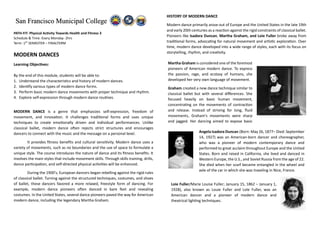
Angela Isadora Duncan (Born: May 26, 1877– Died: September
14, 1927) was an American-born dancer and choreographer,
who was a pioneer of modern contemporary dance and
performed to great acclaim throughout Europe and the United
States. Born and raised in California, she lived and danced in
Western Europe, the U.S., and Soviet Russia from the age of 22.
She died when her scarf became entangled in the wheel and
axle of the car in which she was traveling in Nice, France.
Loie Fuller/Marie Louise Fuller; January 15, 1862 – January 1,
1928), also known as Louie Fuller and Loïe Fuller, was an
American dancer and a pioneer of modern dance and
theatrical lighting techniques.
Martha Graham is considered one of the foremost
pioneers of American modern dance. To express
the passion, rage, and ecstasy of humans, she
developed her very own language of movement.
Graham created a new dance technique similar to
classical ballet but with several differences. She
focused heavily on basic human movement,
concentrating on the movements of contraction
and release. Instead of striving for long, fluid
movements, Graham's movements were sharp
and jagged. Her dancing aimed to expose basic
human emotions through movement, and her
brave vision for modern dance earned her several
awards and honors.
2.
Characteristics of ModernDance
Modern dance is distinct for its:
• Emphasis on self-expression and emotion.
• Use of grounded movements rather than lifted, airy steps.
• Diverse styles, often incorporating improvisation.
• Exploration of social, cultural, or personal themes.
Modern dance is a style of dance that is characterized by many traits, including:
• Freeform: Modern dance is often described as fluid and freeform, with dancers
alternating between long, languid movements and jerky ones.
• Emotional: Modern dance is a way for dancers to express their feelings to music.
• Rejects convention: Modern dance rejects the weightlessness and grace of
ballet, instead using the dancer's body weight to propel themselves across the
floor.
• Dynamic alignment and flexibility: Modern dance emphasizes the core and
pelvis, and uses the dancer's weight and momentum.
• Breath: Breath is a prominent component of modern dance.
• Abstract: Modern dance is abstract, fluid, and free in both movements and
purpose.
• Combines dance forms: Modern dance combines different forms of dance, such
as ballet, tap, and jazz.
• Relaxed costumes: Modern dance costumes are relaxed and produced with
original techniques and a lot of color.
• Expressive gestures: Movements in modern dance are always expressive
gestures, never decorative shapes.
• Groups of dancers: Groups of dancers in modern dance often form sculptural
wholes to represent social or psychological forces.
STYLES OF MODERN DANCE
CONTEMPORARY DANCE
Known for fluid and graceful movements, contemporary dance
combines elements from various dance forms. It focuses on
emotion and flow, allowing for storytelling through movement.
What are the elements of contemporary dance?
Contemporary dance has quite a few elements that make it stand out. However, it
also has the five basic elements every genre has: body, action, space, time, and
energy.
JAZZ DANCE
Jazz is an upbeat, energetic style known for its rhythm
and dynamic footwork. Jazz dance originated from
African-American culture and has evolved to include
various subgenres like Broadway jazz and commercial
jazz.
10 Basic Jazz Dance Steps for Beginners
1. The Jazz Square
At the heart of jazz dance is the classic jazz square. This step involves a sequence of
stepping forward, crossing over, stepping back, and side-stepping, creating a
distinct square pattern. Dancers aim to hit all four corners of the square with their
stepping motion. As dancers become more comfortable with the jazz square, they
can add their own personal style and sass.
2. Chassé
Chassé means to chase as dancers’ feet “chase” one another in this step. Chassé,
which can be stepping, sliding, gliding, or jumping, is often used as a preparation
step for other movements. To perform it dancers will begin by stepping to the side
or to the front, then bring the other foot to meet it, and finally take another step
with the first foot.
3. Pas de Bourrée
Pas de Bourrée consists of three steps with alternating feet, usually in the following
sequence: back, side, font. Pas de Bourrée is normally a transitional or preparatory
step and can be performed as tiny steps or larger strides.
3.
4. Kick BallChange
Kick Ball Change is exactly what it sounds like! You kick one foot then transfer weight
onto the ball of that same foot. Afterwards you take one more step with the
opposite foot, completing the last part of the step: the change. This step is a jazz
dance classic that can be tailored to various routines.
5. Plié
Borrowed from ballet, the plié is a foundational technique involving knee bends
while keeping your heels grounded. It brings depth and control to your jazz dance,
enhancing your balance and posture. To help you remember, plié means to bend.
6. Isolations
Isolations are an integral part of jazz dance and dancers from beginners to advanced
will benefit immensely from practicing isolations. To do an isolation, focus on
moving a single body part while keeping the rest of your body still. This can be your
head, hand, hip or any other part of your body. Isolations can be used as accents
within a jazz dance choreography to create more texture and increase difficulty.
7. Shimmy
Shake things up with the shimmy – a lively movement that involves rapid shoulder
and hip shaking. This step allows you to infuse your dance with personality and
showcase your ability to let loose.
8. Jazz Walks
Feel the beat of the music in your soul with jazz walks. Traditional jazz walks are a
sideways movement. If you’re moving towards the right, you would take a step with
your right foot then cross over with your left. You keep repeating this pattern. The
left would be the other way around. So you would take a step with your left foot
then cross over with your right. Jazz walks give dancers the perfect opportunity to
show off their confidence and personal sparkle.
9. Pivot
Pivots are an essential element of jazz dance. Execute a pivot by stepping forward
with one foot, making sure both feet stay on the ground, and begin to turn from
the front to the back without picking up your feet. Your feet should turn but they
should stay on the floor where you placed them initially.
10. Pirouette
A pirouette is a bit more advanced but still a very foundational jazz dance step. A
pirouette involves spinning on one foot while the other is held close to the knee in
a Passé or Retiré position. Achieving balance and core strength is essential for
mastering this turning step.
HIP-HOP DANCE
Emerging from street culture in the 1970s, hip-hop
includes forms such as breaking, popping, and locking.
It’s known for its high energy and urban vibe and is often
improvised and rhythm-driven. “Standard” techniques
include fast footwork, freezes, powermoves, downrocks, and toprocks.
Fundamental movements and skills of hip-hop dance include:
Popping: Involves quickly contracting and relaxing muscles to create a jerking effect
Locking involves performing a series of movements and holding them for a few
seconds. It can include acrobatics and physically demanding moves like landing on
one's knees or the split.
Breaking: Also known as breakdancing, b-boying, or b-girling, this style is
unstructured and improvisational. It can involve spinning and contorting.
Chest pops: A fundamental move in hip hop
Swinging your arms: A fundamental move in hip hop
Jabs: A fundamental move in hip hop
Stomps: A fundamental move in hip hop
Fast footwork: A standard technique in hip hop
Freezes: A standard technique in hip hop
Powermoves: A standard technique in hip hop
Downrocks: A standard technique in hip hop
Toprocks: A standard technique in hip hop
4.
LYRICAL DANCE
A blendof ballet, jazz, and modern dance, lyrical dance
focuses on conveying deep emotions through smooth
and flowing movements. It’s often performed to slow,
meaningful music. It is a style that combines ballet
technique with the freedom and musicality of jazz and contemporary dance. It's
usually danced at a faster pace than ballet but not as fast as jazz.
Fundamental movement skills in lyrical dance include:
Fluid movements
Lyrical dance is characterized by flowing, graceful movements that are almost
seamless, with little to no pauses.
Emotional expression
Lyrical dance is a style that emphasizes emotional expression, with dancers using
their bodies to interpret the music's lyrics and melodies.
Contractions and releases
Dancers use contractions and releases to create dynamic movements that
punctuate the music's emotional beats.
Lifts and partnering
Lyrical dance often incorporates lifts and partnering to create visually stunning
moments.
Body coordination
Good body coordination is important for lyrical dance.
Fall and recovery
This technique involves intentionally losing balance and then regaining stability.
Dancers use this technique to express vulnerability, resilience, and adaptability.
FUSION DANCE STYLES
Modern dance continually evolves, blending different dance forms like
contemporary and hip-hop or jazz-funk. Fusion styles showcase creativity and allow
dancers to experiment with various elements from other genres.
Basic Techniques and Movements in Modern Dance
• Warm-Up and Stretching: Prepares the body for movement, improving
flexibility and preventing injury.
• Footwork and Body Isolations: Key for coordination, isolations are
controlled movements of specific body parts, often used in hip-hop and
jazz.
• Fundamental Movements:
✓ Contemporary: Rolls, contractions, and floorwork.
✓ Jazz: Turns, leaps, and kicks.
✓ Hip-Hop: Toprock, downrock, popping, and locking.
✓ Lyrical: Extensions, flowing arm movements, and jumps.
Practice and Performance Tips
✓ Listen to the Music: Feel the rhythm and emotion in the song, and let it
guide your movements.
✓ Focus on Expression: Modern dance is about connecting with the music
and expressing yourself. Show emotion through facial expressions and body
language.
✓ Be Confident and Open: Don’t be afraid to try new moves, even if they’re
challenging. Modern dance is about growth and personal expression.
5.
November 11, 2024-ACTIVITY: Modern Dance Video Analysis
Reflection (Pass it on November 18, 2024)
Instructions:
1. Choose a Modern Dance Video on YouTube:
Select a YouTube video of a modern dance performance. You may choose
from popular choreographers, dance groups, or specific modern dance styles.
Here are a few examples of keywords to search:
"Contemporary dance performance"
"Hip-hop dance choreography"
"Lyrical dance routine"
"Freestyle modern dance"
Note: Please copy and paste the YouTube link here so I can review the video.
2. Observe the Performance:
Watch the performance carefully. Pay attention to the dancers' movements,
expressions, formations, and the overall mood and theme of the dance.
3. Take Notes on Key Elements:
Write down observations about the following:
Dance style: What specific style(s) of modern dance are being used?
Choreography: How do the movements, formations, and timing enhance
the performance?
Music and Rhythm: How do the dancers interpret and respond to the
music?
Emotion and Expression: How do the dancers convey emotion through
their movements?
Costume and Setting: How do these elements contribute to the overall
atmosphere of the performance?
4. Reflect on the Performance:
Write a brief reflection (1-2 paragraphs) answering the following questions:
What did you enjoy most about the performance?
How did this dance style differ from traditional dance styles you may be
more familiar with?
What story or message do you think the dance was trying to convey?
5. Share Your Insights:
Write a reflection of at least five (5) sentences about the entire video.
Assessment on this topic: (to follow)
Written Assessment: Quiz
Final Performance: Group presentation of a short modern dance routine.
Self-Assessment: Reflection paper on personal growth and experiences about
your group performance:
What style do you enjoy most, and why?
How does dance help you express yourself?
What challenges did you face, and how did you overcome them?