Dance is away of knowing and
communicating. All societies use dance to
communicate on both personal and
cultural levels and to meet physical and
spiritual needs.
Dance, as with all the arts, has its own
language. We need to learn this language in
order to fully understand and appreciate the
world of dance.
3.
The Language ofDance
Elements: Body, Action, Space,
Time, Energy
Choreographic Forms: Theme and
Variations, Rondo and Narrative
Styles: Ballet, Tap, Jazz and Modern
Action
Action is anyhuman movement included
in the act of dancing.
Action can include dance steps, facial
movements, lifts, carries, and catches,
and even everyday movements such as
walking.
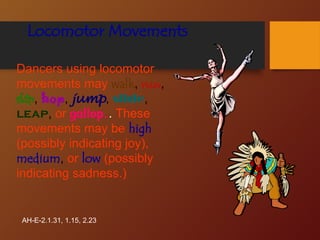
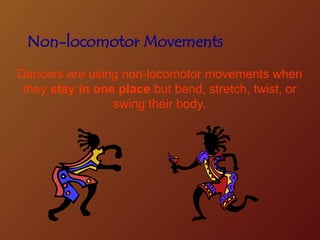
Actions can travel (locomotor) or move
on the spot (non-locomotor).
7.
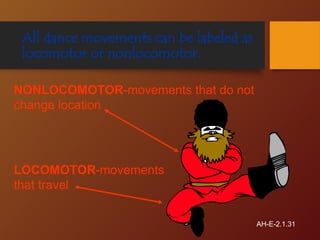
All dance movementscan be labeled as
locomotor or nonlocomotor.
NONLOCOMOTOR-movements that do not
change location
AH-E-2.1.31
LOCOMOTOR-movements
that travel
8.
Locomotor Movements
Dancers usinglocomotor
movements may walk, run,
skip, hop, jump, slide,
leap, or gallop.. These
movements may be high
(possibly indicating joy),
medium, or low (possibly
indicating sadness.)
AH-E-2.1.31, 1.15, 2.23
Space
• SPACE: Iswhere the body moves. It is the area
occupied by the dancer’s body; includes direction, size,
pathways, levels and shapes.
• Direction: which way a dancer faces or moves; e.g.,
forward, backward, sideways, up and down.
• Size: magnitude of a body shape or movement; from
small to large movements
• Pathways: patterns made as a dancer moves through the
air or on the floor (straight, vertical, horizontal, zig-
zag); can be made with locomotor or non-locomotor
movements, separately or in combination.
• Levels: the vertical distance from the floor. Movements
take place on three levels: high, middle or low and
deep.
• Shapes: the form created by the body’s position in
space. Aspects of shape are open/closed,
symmetrical/asymmetrical, angular and curved.
11.
Relationships in Space
•Relationship: Compares where a person is positioned
compared to where other people or things are in the space.
• To what or to whom describes the relationship.
• Relationship is the connection between things, be they
dancers to each other, dancers to objects, or a dancer's body
parts to each other.
• Relationship words: in front, beside, behind, over, under
12.
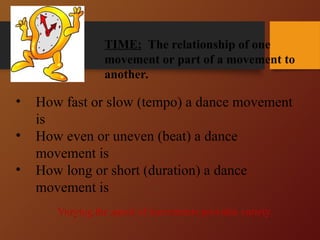
TIME: The relationshipof one
movement or part of a movement to
another.
Time
• How fast or slow (tempo) a dance movement
is
• How even or uneven (beat) a dance
movement is
• How long or short (duration) a dance
movement is
Varying the speed of movements provides variety.
13.
Energy (Force)
• Energy:Degree of muscular tension and
use of energy while moving.
• It refers to the force of an action.
HOW?
•Dynamics: how a movement is done;
how the body moves
•Flow: continuity of movement
(bound/free
flowing/balanced/neutral)
•Weight: strength or lightness of
14.
Rondo: a dancestructure with three or more themes where one
theme is repeated. ABACAD
Theme: the basic idea of the dance, which the
choreographer dramatizes through the conflict of
characters.
Narrative: choreographic structure that follows a specific story
line to convey specific information through a dance
Variations: contrasts in the use of the dance elements, repetitions.
Choreography is the art of arranging dances
Choreographic Forms
15.
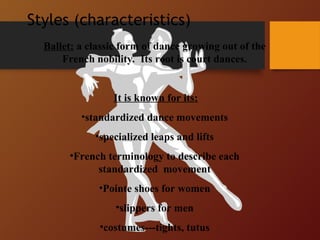
Styles (characteristics)
Ballet: aclassic form of dance growing out of the
French nobility. Its root is court dances.
It is known for its:
•standardized dance movements
•specialized leaps and lifts
•French terminology to describe each
standardized movement
•Pointe shoes for women
•slippers for men
•costumes---tights, tutus
16.
Styles (characteristics)
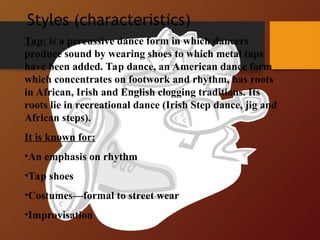
Tap: isa percussive dance form in which dancers
produce sound by wearing shoes to which metal taps
have been added. Tap dance, an American dance form
which concentrates on footwork and rhythm, has roots
in African, Irish and English clogging traditions. Its
roots lie in recreational dance (Irish Step dance, jig and
African steps).
It is known for:
•An emphasis on rhythm
•Tap shoes
•Costumes—formal to street wear
•Improvisation
17.
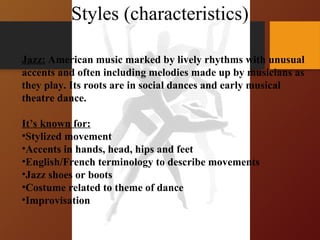
Jazz: American musicmarked by lively rhythms with unusual
accents and often including melodies made up by musicians as
they play. Its roots are in social dances and early musical
theatre dance.
It’s known for:
•Stylized movement
•Accents in hands, head, hips and feet
•English/French terminology to describe movements
•Jazz shoes or boots
•Costume related to theme of dance
•Improvisation
Styles (characteristics)
18.
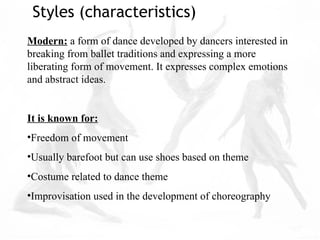
Modern: a formof dance developed by dancers interested in
breaking from ballet traditions and expressing a more
liberating form of movement. It expresses complex emotions
and abstract ideas.
It is known for:
•Freedom of movement
•Usually barefoot but can use shoes based on theme
•Costume related to dance theme
•Improvisation used in the development of choreography
Styles (characteristics)
19.
How is adance created?
Dances are created by combining
locomotor and nonlocomotor
movements.
A dance, like a book,
has a beginning, a middle, and an end.
AH-M-2.1.34
20.
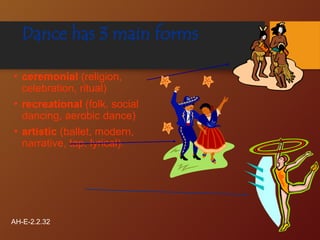
Dance has 3main forms
• ceremonial (religion,
celebration, ritual)
• recreational (folk, social
dancing, aerobic dance)
• artistic (ballet, modern,
narrative, tap, lyrical).
AH-E-2.2.32
21.
Culture and Dance
•Nearly all cultures
incorporate dance in
some way.
• Dance is a major
component of many
cultures.
• Dance is often used
to communicate or
celebrate.
22.
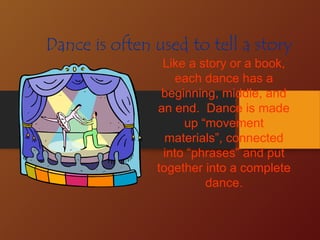
Dance is oftenused to tell a story
Like a story or a book,
each dance has a
beginning, middle, and
an end. Dance is made
up “movement
materials”, connected
into “phrases” and put
together into a complete
dance.