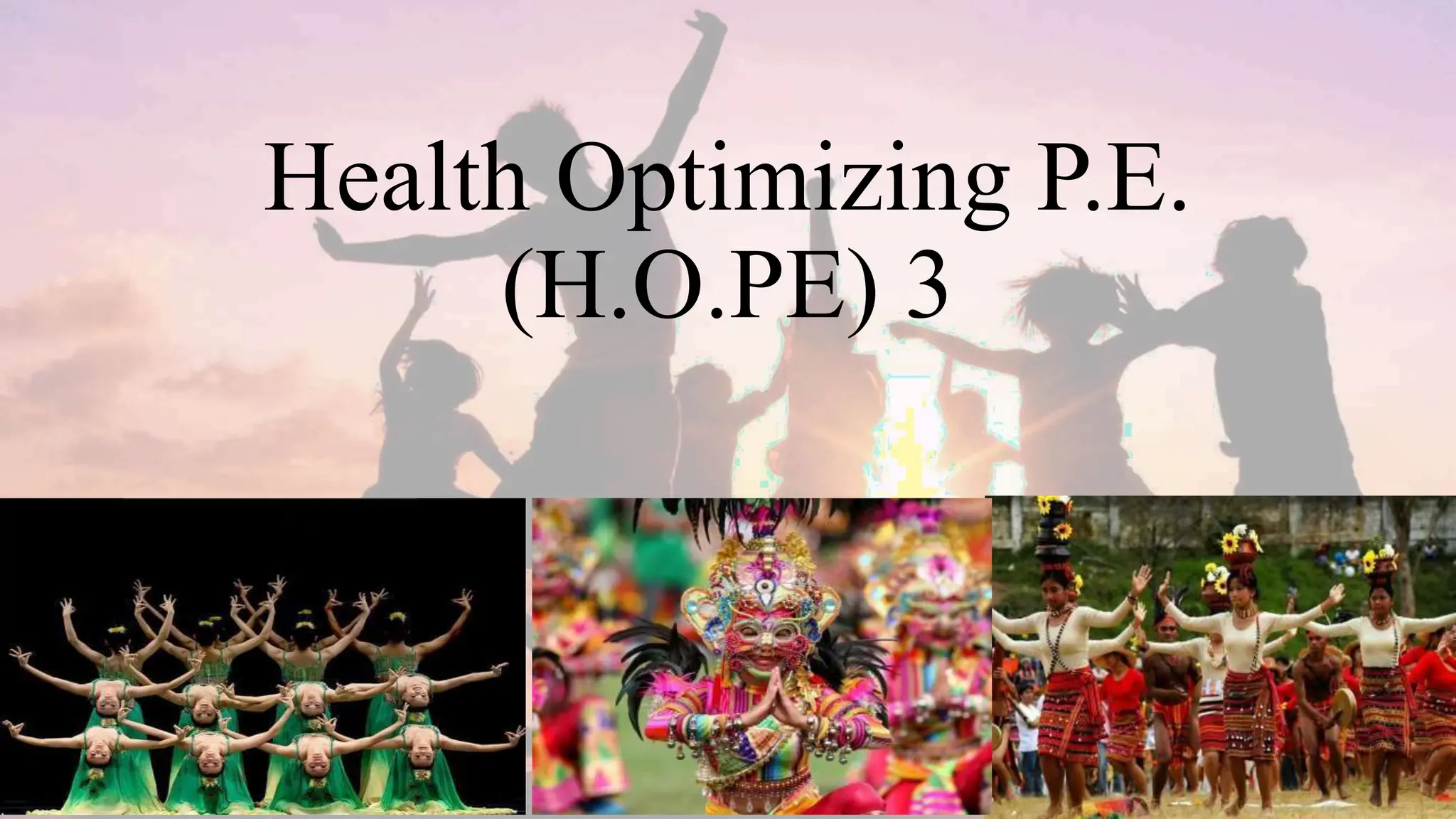
Health Optimizing P.E.
(H.O.PE) 3
Introduction to Dance
• According to Barbara Mettler, 1980,
“Dance is an activity which can take many forms and
fill many different needs. It can be recreation,
entertainment, education, therapy and religion. In its
purest and most basic form, dance is art, the art of
body movement”.
Introduction to Dance
Dance teaches the importance of
movement and fitness in a variety
of ways through a variety of
disciplines. As well, dancers learn
to coordinate muscles to move
through proper positions.
What is Dance?
Dance comes from the German word damson,
which means “to stretch or “to drag”. It
developed as a natural expression of united
feeling and action. Dance is considered the
mirror of the society because it responds to
historical and religious events as well as social
and political statements.
Dance
It is a form of art using rhythmic bodily movements
expressing ideas and emotions and accompanied by
music.
As an art form, it may tell a story, set a mood, or
express an emotion.
It is also a form of recreation.
It is also a form of socialization.
HISTORY
Prehistoric Period
The Egyptians were the first great culture to
infuse its society with the magic of dance; which
evolved from the most simple rituals used by
hunters to find their prey.
Greek Period
Greek dance evolved from basic dramatic form
which incorporated dance, music, spoken words, and
costumes.
Participation in dance and drama festival was a
religious exercise not merely an amusement.
There were more than 200 Greek dances designed
for every mood and purpose.
Roman Period
Rome imported entertainers from Greece to
perform theatrical pieces in honor of the gods and to
amuse a population weary from a plague. Romans were
influenced by Grecian models, putting the most
emphasis on the spectacle and mime to the extent that
dancing itself almost disappeared.
Medieval Period
Originally dance movements were part of
dramatic rituals, the best-known of which is the
Latin Mass. By the middle ages these works moved
from inside the churches to the out-of-doors.
Another important rite of the Middle Ages was
known as the dance of death.
Renaissance Period
This Period saw the birth of the theatre in
dance in the courts of Italian City states, where
such dance was used as a political machinery to
show splendour, wealth and power.
Classic Period
During the middle 17th century, ballet became a
spectacle in every court. Public ballet performances
involved more than just dancing because they were a
mixture of poetry, music, dialogue, and elaborate
dance. Such ballet performance was known as ballets
a entrees.
Modern Period
During the 20th century, jazz and tap dance
became popular as classic ballet continued to
flourish. Social dances such as the fox trot,
two-step, Boston, Charleston, Castle walk,
Castle polka, tango, conga, and rumba.
Health Benefits of
DANCE
Improved
condition of your
heart and lungs.
increased
muscular strength,
endurance and
motor fitness.
improved muscle
tone and
strength.
weight
management.
stronger bones
and reduced risk
of osteoporosis.
better
coordination,
agility and
flexibility.
increased
physical
confidence.
improved mental
functioning.
improved
general and
psychological
greater self-
confidence and
self-esteem.
better social
skills.
TEST PROTOCOLS
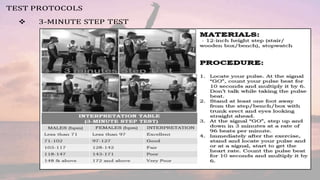
 3-MINUTE STEP TEST
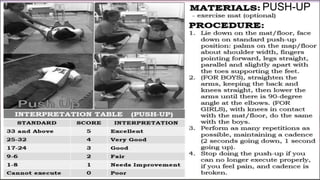
PUSH-UP
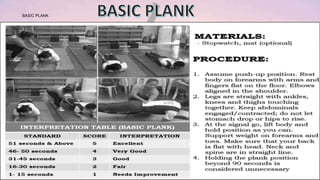
BASIC PLANK
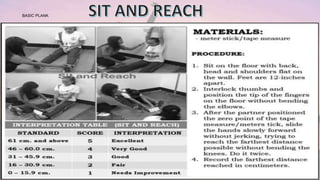
BASIC PLANK
The Elements of Dance
Elements of Dance.
There are
4
The Elements of Dance
SPACE
TIME
FORCE/ ENERGY
BODY
1st Element of Dance
SPACE
Area surrounding a person in
which he/she is able to move.
SPACE
•Shape
•Level
•Direction
•Focus
•Size
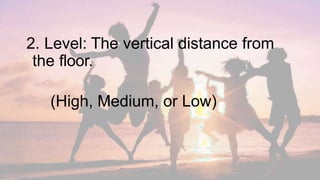
2. Level: The vertical distance from
the floor.
(High, Medium, or Low)
3. Direction: Where the body moves.
(e.g. Forward, backward, up, down,
sideways, diagonally, etc.)
4.Focus: Where the dancer’s eyes
look as he/she is dancing.
5.Size: How large or small
movements.
2nd Element of Dance
TIME
The duration of the movement
•Beat- The on going underlying pulse.
•Tempo- How fast or slow the movements.
•Accent- Strong beats that usually occur at regular
intervals.
•Rhythmic Patterns- arranging long and short
movement or strong and light movement.
•Duration- The length of time the movement lasts.
3rd Element of Dance
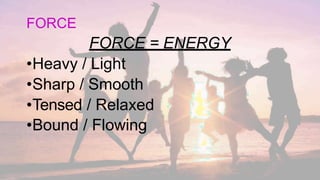
FORCE
How the body uses energy while
moving.
FORCE
FORCE = ENERGY
•Heavy / Light
•Sharp / Smooth
•Tensed / Relaxed
•Bound / Flowing
•Part
•Shape
circles, squares, triangles, etc. made with
parts of the body, the whole body, with
groups of people, or by moving through
space. Symmetrical or Asymmetrical
•Base
4th Element of Dance
BODY
What makes a good dance?
•A good dance display a significant meaning or
conveys a message, it also portrays life
experiences.
•It has a beginning, middle and end/ conclusion.
Form- is the instrument by which ideas and elements are
arranged or combined into a logical sequence.
Phrase- is the smallest unit of form in the whole dance. A
single phrase consists of eight (8) counts. It is easier
for building routines and choreographic combinations
with an 8-count phrase.
Motif- to be able to convey its meaning or intention to
the audience.
CHARACTERISTICS OF A GOOD DANCE
• UNITY- interconnected phrases of the dance are coherent and
flow smoothly together. It attracts and holds the audience’s
attention.
• VARIETY and CONTRAST- add excitement and flavor in the
dance. Changing the direction, use of energy, timing of a
movement phrase and avoiding repeating them in the exact
way are ways to add variety to the dance.
• TRANSITION- also vital because it keeps the unity and
continuity of the dance. It may vary from length and
complexity. They may be long or short, gradual or abrupt.
CHARACTERISTICS OF A GOOD DANCE
• REPETITION- usually when a certain phrase or a section of
choreography is repeated, it is the main message of the dance.
Also the audience can see those movements again and identify
its significance.
• CLIMAX – the apex of energy in the dance is reached.
Choreographic Forms in Dance
AB(two-part) form- the simplest of the sequential forms. This form
is commonly used in many folk dances and songs.
ABA(three-part)- dance theme A followed by a contrasting theme
B, ending with a restatement A which may be a variation of
original A. in songs, chorus (A) a verse (B) and a repetition of
the chorus (A)
Choreographic Forms in Dance
Rondo- (ABACADA)-
Canon- one theme with several voices in succession and overlapping
harmony.
Themes and V
ariations- the motif is a series of movements to which
variations are added throughout the development of the entire
choreography.
Narrative
•A dance that tells a story using only
movement.
•NO WORDS!
Choreographic Forms in Dance
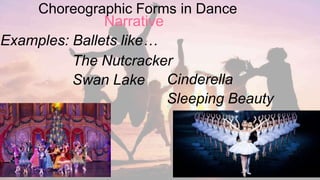
Narrative
Examples: Ballets like…
The Nutcracker
Swan Lake Cinderella
Sleeping Beauty
Choreographic Forms in Dance
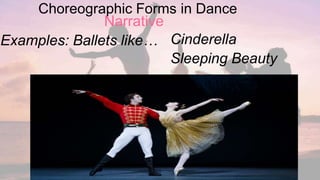
Narrative
Examples: Ballets like… Cinderella
Sleeping Beauty
Evaluating a Good Dance
“the Evaluators roles”
• CHOREOGRAPHERS- they will evaluate a part of an ongoing
process of developing a personal style which is both spontaneous and
organized.
• DANCERS- they will evaluate according to the specific demands that
the performance places on them.
• AUDIENCES- they will evaluate according to the particular context
of the dance.
Stages in Assessing a Dance
( Dance Critique)
•Description is a straightforward recounting of what you see
and hear. It is focused on the individual elements of a dance
rather than on the whole.
•Interpretation involves a personal reading of either the entire
work or aspects of it; this is where the critic’s imagination is
fully involved in finding meaning in the work. Appreciation of
the ideas, content, images and style.
•Evaluation is your considered judgment of the work, which
may be either implicitly or explicitly stated. (elements,
characteristics)
ARE YOU READY?
Take Note!
•Analyzing and evaluating dance does not come out
naturally and does not happen overnight.
•As a beginner evaluators you need guidance and
direction in conceptualizing a dance critique.
•For easier assessment and evaluation, consider the
guide questions that will be provided for you.
Guide Questions in Analyzing and Evaluating
Dance Performance
• What was the title of the dance?
• Who was the choreographer?
• When was it performed? (Date of performance)
• What was the genre / style of the dance?
• What was the accompaniment?
• Who were the dancers/ company?
• Were there specific demands placed on dancers in
the performance? If yes, what were these?
• What are the movements and forms of the dance
• What does the set look like?
• What were the costumes / props used during the
performance?
• How was the lighting of the show / performance?
• Who was the designer of the show/performance?
• What were the context and/or significance of the
dance?
• How will you evaluate the overall dance
performance?
Sample Dance Analysis and Evaluation
Title of the dance:
Choreographer:
Date:
Genre/Style:
Accompaniment:
Dancers/ Company:
Specific demands placed on dancers in
performance:
Movement and form:
Costumes / prop:
Designer name:
Context and significance / evaluation:
•By pair (Fish bowl)
•Search a video of a dance and
critique it. Use the guide questions
and sample evaluation for your
output.
•1. Hip-hop
•2. Festival dance
•3. Modern Dance

HOPE-3.pdf

  • 1.
  • 2.
    Introduction to Dance •According to Barbara Mettler, 1980, “Dance is an activity which can take many forms and fill many different needs. It can be recreation, entertainment, education, therapy and religion. In its purest and most basic form, dance is art, the art of body movement”.
  • 3.
    Introduction to Dance Danceteaches the importance of movement and fitness in a variety of ways through a variety of disciplines. As well, dancers learn to coordinate muscles to move through proper positions.
  • 4.
    What is Dance? Dancecomes from the German word damson, which means “to stretch or “to drag”. It developed as a natural expression of united feeling and action. Dance is considered the mirror of the society because it responds to historical and religious events as well as social and political statements.
  • 5.
    Dance It is aform of art using rhythmic bodily movements expressing ideas and emotions and accompanied by music. As an art form, it may tell a story, set a mood, or express an emotion. It is also a form of recreation. It is also a form of socialization.
  • 6.
    HISTORY Prehistoric Period The Egyptianswere the first great culture to infuse its society with the magic of dance; which evolved from the most simple rituals used by hunters to find their prey.
  • 7.
    Greek Period Greek danceevolved from basic dramatic form which incorporated dance, music, spoken words, and costumes. Participation in dance and drama festival was a religious exercise not merely an amusement. There were more than 200 Greek dances designed for every mood and purpose.
  • 8.
    Roman Period Rome importedentertainers from Greece to perform theatrical pieces in honor of the gods and to amuse a population weary from a plague. Romans were influenced by Grecian models, putting the most emphasis on the spectacle and mime to the extent that dancing itself almost disappeared.
  • 9.
    Medieval Period Originally dancemovements were part of dramatic rituals, the best-known of which is the Latin Mass. By the middle ages these works moved from inside the churches to the out-of-doors. Another important rite of the Middle Ages was known as the dance of death.
  • 10.
    Renaissance Period This Periodsaw the birth of the theatre in dance in the courts of Italian City states, where such dance was used as a political machinery to show splendour, wealth and power.
  • 11.
    Classic Period During themiddle 17th century, ballet became a spectacle in every court. Public ballet performances involved more than just dancing because they were a mixture of poetry, music, dialogue, and elaborate dance. Such ballet performance was known as ballets a entrees.
  • 12.
    Modern Period During the20th century, jazz and tap dance became popular as classic ballet continued to flourish. Social dances such as the fox trot, two-step, Boston, Charleston, Castle walk, Castle polka, tango, conga, and rumba.
  • 13.
  • 14.
  • 15.
  • 16.
  • 17.
  • 18.
    stronger bones and reducedrisk of osteoporosis.
  • 19.
  • 20.
  • 21.
  • 22.
  • 23.
  • 24.
  • 25.
  • 26.
  • 27.
  • 28.
  • 29.
    The Elements ofDance Elements of Dance. There are 4
  • 30.
    The Elements ofDance SPACE TIME FORCE/ ENERGY BODY
  • 31.
    1st Element ofDance SPACE Area surrounding a person in which he/she is able to move.
  • 32.
  • 33.
    2. Level: Thevertical distance from the floor. (High, Medium, or Low)
  • 34.
    3. Direction: Wherethe body moves. (e.g. Forward, backward, up, down, sideways, diagonally, etc.)
  • 35.
    4.Focus: Where thedancer’s eyes look as he/she is dancing. 5.Size: How large or small movements.
  • 36.
    2nd Element ofDance TIME The duration of the movement •Beat- The on going underlying pulse. •Tempo- How fast or slow the movements. •Accent- Strong beats that usually occur at regular intervals. •Rhythmic Patterns- arranging long and short movement or strong and light movement. •Duration- The length of time the movement lasts.
  • 37.
    3rd Element ofDance FORCE How the body uses energy while moving.
  • 38.
    FORCE FORCE = ENERGY •Heavy/ Light •Sharp / Smooth •Tensed / Relaxed •Bound / Flowing
  • 39.
    •Part •Shape circles, squares, triangles,etc. made with parts of the body, the whole body, with groups of people, or by moving through space. Symmetrical or Asymmetrical •Base 4th Element of Dance BODY
  • 40.
    What makes agood dance? •A good dance display a significant meaning or conveys a message, it also portrays life experiences. •It has a beginning, middle and end/ conclusion.
  • 41.
    Form- is theinstrument by which ideas and elements are arranged or combined into a logical sequence. Phrase- is the smallest unit of form in the whole dance. A single phrase consists of eight (8) counts. It is easier for building routines and choreographic combinations with an 8-count phrase. Motif- to be able to convey its meaning or intention to the audience.
  • 42.
    CHARACTERISTICS OF AGOOD DANCE • UNITY- interconnected phrases of the dance are coherent and flow smoothly together. It attracts and holds the audience’s attention. • VARIETY and CONTRAST- add excitement and flavor in the dance. Changing the direction, use of energy, timing of a movement phrase and avoiding repeating them in the exact way are ways to add variety to the dance. • TRANSITION- also vital because it keeps the unity and continuity of the dance. It may vary from length and complexity. They may be long or short, gradual or abrupt.
  • 43.
    CHARACTERISTICS OF AGOOD DANCE • REPETITION- usually when a certain phrase or a section of choreography is repeated, it is the main message of the dance. Also the audience can see those movements again and identify its significance. • CLIMAX – the apex of energy in the dance is reached.
  • 44.
    Choreographic Forms inDance AB(two-part) form- the simplest of the sequential forms. This form is commonly used in many folk dances and songs. ABA(three-part)- dance theme A followed by a contrasting theme B, ending with a restatement A which may be a variation of original A. in songs, chorus (A) a verse (B) and a repetition of the chorus (A)
  • 45.
    Choreographic Forms inDance Rondo- (ABACADA)- Canon- one theme with several voices in succession and overlapping harmony. Themes and V ariations- the motif is a series of movements to which variations are added throughout the development of the entire choreography.
  • 46.
    Narrative •A dance thattells a story using only movement. •NO WORDS! Choreographic Forms in Dance
  • 47.
    Choreographic Forms inDance Narrative Examples: Ballets like… The Nutcracker Swan Lake Cinderella Sleeping Beauty
  • 48.
    Choreographic Forms inDance Narrative Examples: Ballets like… Cinderella Sleeping Beauty
  • 49.
    Evaluating a GoodDance “the Evaluators roles” • CHOREOGRAPHERS- they will evaluate a part of an ongoing process of developing a personal style which is both spontaneous and organized. • DANCERS- they will evaluate according to the specific demands that the performance places on them. • AUDIENCES- they will evaluate according to the particular context of the dance.
  • 50.
    Stages in Assessinga Dance ( Dance Critique) •Description is a straightforward recounting of what you see and hear. It is focused on the individual elements of a dance rather than on the whole. •Interpretation involves a personal reading of either the entire work or aspects of it; this is where the critic’s imagination is fully involved in finding meaning in the work. Appreciation of the ideas, content, images and style. •Evaluation is your considered judgment of the work, which may be either implicitly or explicitly stated. (elements, characteristics)
  • 51.
  • 52.
    Take Note! •Analyzing andevaluating dance does not come out naturally and does not happen overnight. •As a beginner evaluators you need guidance and direction in conceptualizing a dance critique. •For easier assessment and evaluation, consider the guide questions that will be provided for you.
  • 53.
    Guide Questions inAnalyzing and Evaluating Dance Performance • What was the title of the dance? • Who was the choreographer? • When was it performed? (Date of performance) • What was the genre / style of the dance? • What was the accompaniment? • Who were the dancers/ company? • Were there specific demands placed on dancers in the performance? If yes, what were these?
  • 54.
    • What arethe movements and forms of the dance • What does the set look like? • What were the costumes / props used during the performance? • How was the lighting of the show / performance? • Who was the designer of the show/performance? • What were the context and/or significance of the dance? • How will you evaluate the overall dance performance?
  • 55.
    Sample Dance Analysisand Evaluation Title of the dance: Choreographer: Date: Genre/Style: Accompaniment: Dancers/ Company: Specific demands placed on dancers in performance: Movement and form: Costumes / prop: Designer name: Context and significance / evaluation:
  • 56.
    •By pair (Fishbowl) •Search a video of a dance and critique it. Use the guide questions and sample evaluation for your output. •1. Hip-hop •2. Festival dance •3. Modern Dance