
Community needs assessment

      PATTERNS OF RESILIENCE AMONG
    FAMILIES IN THE ADOPTED BARANGAY
         OF COLLEGE OF EDUCATION

Presented By:

Neil Kenneth Agda      Angelique Magsumbol

Cherry Lyn Brusola     Maria Elizabeth Guevarra

Danielle Mae Quiazon   Price Americ Santos
Resilience Theory
Family adaptation is described in the Resiliency
Model for Family Stress, Adjustment, and
Adaptation as the "outcome of the family's efforts
over time to bring a fit at two levels: the
individual to family, and the family to community.
This process ranges on a continuum from optimal
bonadaptation to maladaptation " ( McCubbin,
1993, p. 50).
There were four assumptions within the original family
stress model developed by Rueben Hill in 1949
(Friedman, 1998). These were:

  Unexpected or unplanned events are usually perceived
 as stressful

 Events within the families, such as serious illness, and
defined as stressful, are more disruptive than stressors
that occur outside the family, such as war, flood, or
depression

   Lack of previous experience with stressor events
 leads to increased perceptions of stress.

  Ambiguous stressor events are more stressful
 than non-ambiguous events (Friedman, 1998, p.
 88).
McCubbin and McCubbin expanded on this original family stress model
and created the Resiliency Model of Stress, Adjustment, and
Adaptation in 1989 (Freidman, 1998; McCubbin & McCubbin, 1993).
The expanded model included five propositions that described
relationships within the model itself. These propositions describe that
in family crisis:

    The pileup of family demands
(stressors, strains, transitions) is related to family
adaptation, and this is a negative relationship.

    Family typologies based on specific strengths of the family
system (cohesion, adaptability, family hardiness, family time and
routines) are related to family adaptation, and this is a positive
relationship.

    The family resources are related to family
adaptation, and this is a positive relationship.

     The family's positive appraisal of the situation is related to family
     adaptation, and this is a positive relationship.
Nine aspects of resilient families dealing with a
chronic illness situation have been identified.
These include:

1. Balancing the illness with other family needs

2. Maintaining clear family boundaries

3. Developing communication competence

4. Attributing positive meanings to the situation

5. Maintaining family flexibility

6. Maintaining a commitment to the family as a unit,

7. Engaging in active coping efforts,

8. Maintaining social integration
9. Developing collaborative relationships with
   professionals (Patterson, 1991).
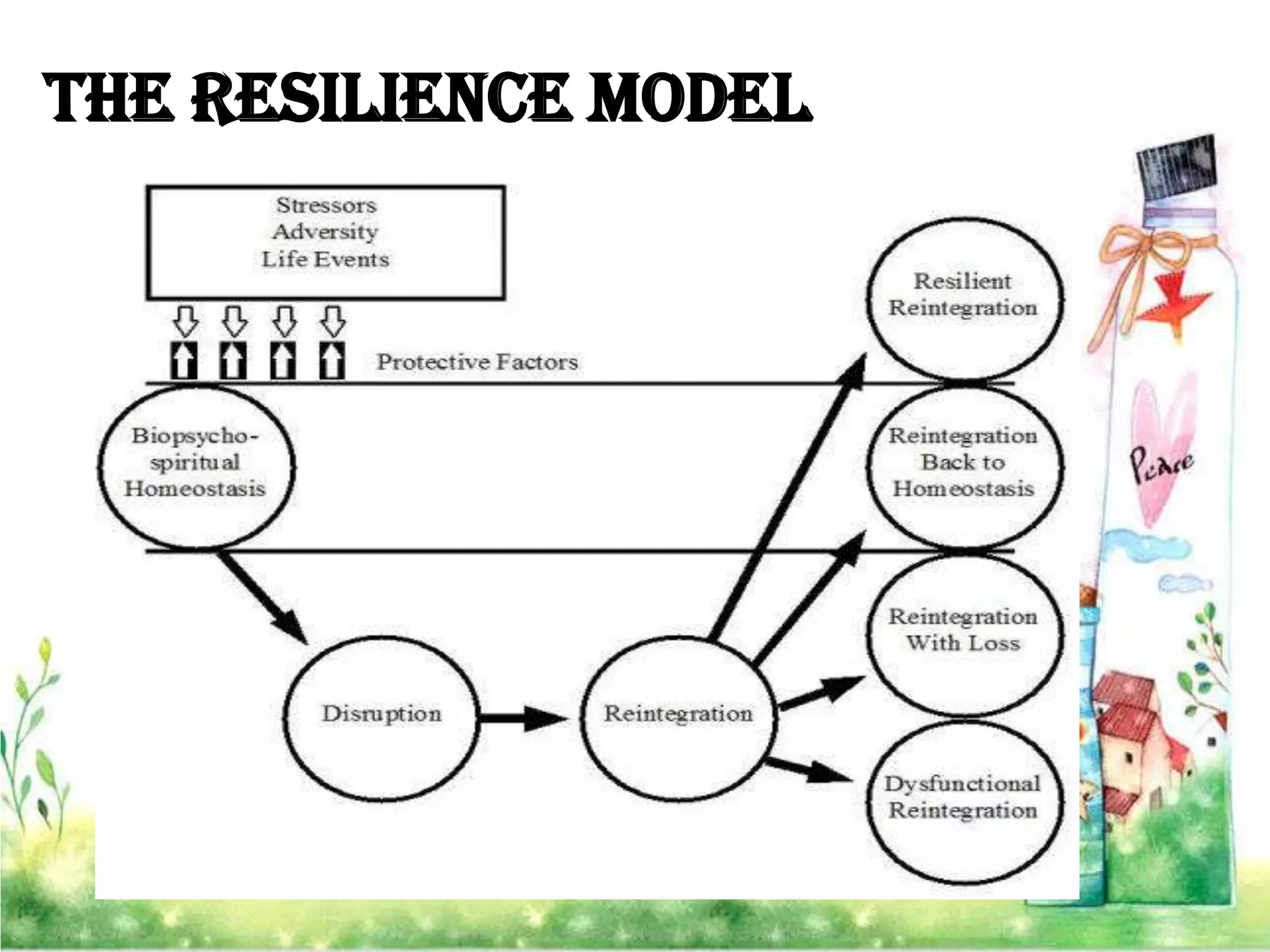
The Resilience Model
Resilience theory

Resilience theory

  • 1.
    Community needs assessment PATTERNS OF RESILIENCE AMONG FAMILIES IN THE ADOPTED BARANGAY OF COLLEGE OF EDUCATION Presented By: Neil Kenneth Agda Angelique Magsumbol Cherry Lyn Brusola Maria Elizabeth Guevarra Danielle Mae Quiazon Price Americ Santos
  • 2.
    Resilience Theory Family adaptationis described in the Resiliency Model for Family Stress, Adjustment, and Adaptation as the "outcome of the family's efforts over time to bring a fit at two levels: the individual to family, and the family to community. This process ranges on a continuum from optimal bonadaptation to maladaptation " ( McCubbin, 1993, p. 50).
  • 3.
    There were fourassumptions within the original family stress model developed by Rueben Hill in 1949 (Friedman, 1998). These were: Unexpected or unplanned events are usually perceived as stressful Events within the families, such as serious illness, and defined as stressful, are more disruptive than stressors that occur outside the family, such as war, flood, or depression Lack of previous experience with stressor events leads to increased perceptions of stress. Ambiguous stressor events are more stressful than non-ambiguous events (Friedman, 1998, p. 88).
  • 4.
    McCubbin and McCubbinexpanded on this original family stress model and created the Resiliency Model of Stress, Adjustment, and Adaptation in 1989 (Freidman, 1998; McCubbin & McCubbin, 1993). The expanded model included five propositions that described relationships within the model itself. These propositions describe that in family crisis: The pileup of family demands (stressors, strains, transitions) is related to family adaptation, and this is a negative relationship. Family typologies based on specific strengths of the family system (cohesion, adaptability, family hardiness, family time and routines) are related to family adaptation, and this is a positive relationship. The family resources are related to family adaptation, and this is a positive relationship. The family's positive appraisal of the situation is related to family adaptation, and this is a positive relationship.
  • 5.
    Nine aspects ofresilient families dealing with a chronic illness situation have been identified. These include: 1. Balancing the illness with other family needs 2. Maintaining clear family boundaries 3. Developing communication competence 4. Attributing positive meanings to the situation 5. Maintaining family flexibility 6. Maintaining a commitment to the family as a unit, 7. Engaging in active coping efforts, 8. Maintaining social integration 9. Developing collaborative relationships with professionals (Patterson, 1991).
  • 6.