Definitions
 Stress = Tension from depleted family resources
- an imbalance that must be corrected.
 Stressors = Drastic life events that change the
family system (death of spouse, financial crisis,
unemployment.
 Distress = extreme psychological pressure from
facing unenjoyable challenges.
 Eustress = Extreme psychological pressure from
facing enjoyable and/or beneficial challenges.
Some facts about Stress
 Stress is normal
 Stress disturbs equilibrium. Coping used to maintain
equilibrium.
 Individuals and families view stressors and resources
according to their own perception
 Individuals and families adapt to stress
 Adaptation is influenced by –
– Perceived stressors
– Perception of the situation
– Resources or coping strategies available
 Important ! …
- Consider the contexts of family stress
- Then understand why & how families are stressed,
and
- how they respond
Stressors?
 Events that cause stress & have potential to affect a
change in a family
 Predictable (…parenthood) &
Unpredictable (illness, unemployment..)
 Are cumulative – Involves simultaneous demands from
work, family & community life
 Too many in a short time
– Can overwhelm family’s ability to cope
- Risk of breakdown / crisis
 Bring about change in life style/ structure
>>>>ADAPTATION
 Family stress comes in many forms
 Normal stressors - Getting married, adjusting to living
in a new group, having babies, unemployment
 Abnormal stressors,- Famine, war, natural disasters,
massive economic collapse, murder, assault, incest
 The individual is prepared by family & society
The Family Stress Theory….
 Explains how families react to
stressful events
 Suggests factors that promote
adaptation to stress
Family stress theory
Accumulation of acute stressors
Family Crises (physical, emotional, or relational)
There is a positive relationship between
illness and stress
 Significant factors to look for - :
 the changes in daily routines,
 the number of changes in daily
routines,
 the length of time since there were
changes in daily routines, (i.e. the
family stressors)
Prudent handling of Stress
STRESS
Look for Stressors
Determine – Distress ?...OR Eustress?
Make appropriate adjustments in Family System
However, not ALL families with multiple
stresses have crises. Why not? What
are the factors which protect a person
or family unit from having a family
crisis.
Reuben Hill's ‘ABCX’ Theory
of Family Stress
 Two complex variables (protective factors) act to -
• Buffer family from acute & multiple stressors
• Continue to competently parent despite Chr/ Ac stressors.
• Relate together with acute & chronic stressors to predict family
crises
• Reduce the direct correlation between multiple stressors & family
crisis.
1. ‘B’ Factor/ variable (Social relationships/ connectedness)-
• Within family variables, e.g. attachment, positive family
bonds, effective communication
• Across family variables: i.e. social isolation vs. informal
and formal social support networks
2. ‘C’ Factor/ variable (Perceptions) –
• Shared family cognitions and attitudes between hope and
personal effectiveness
• Helplessness & despair
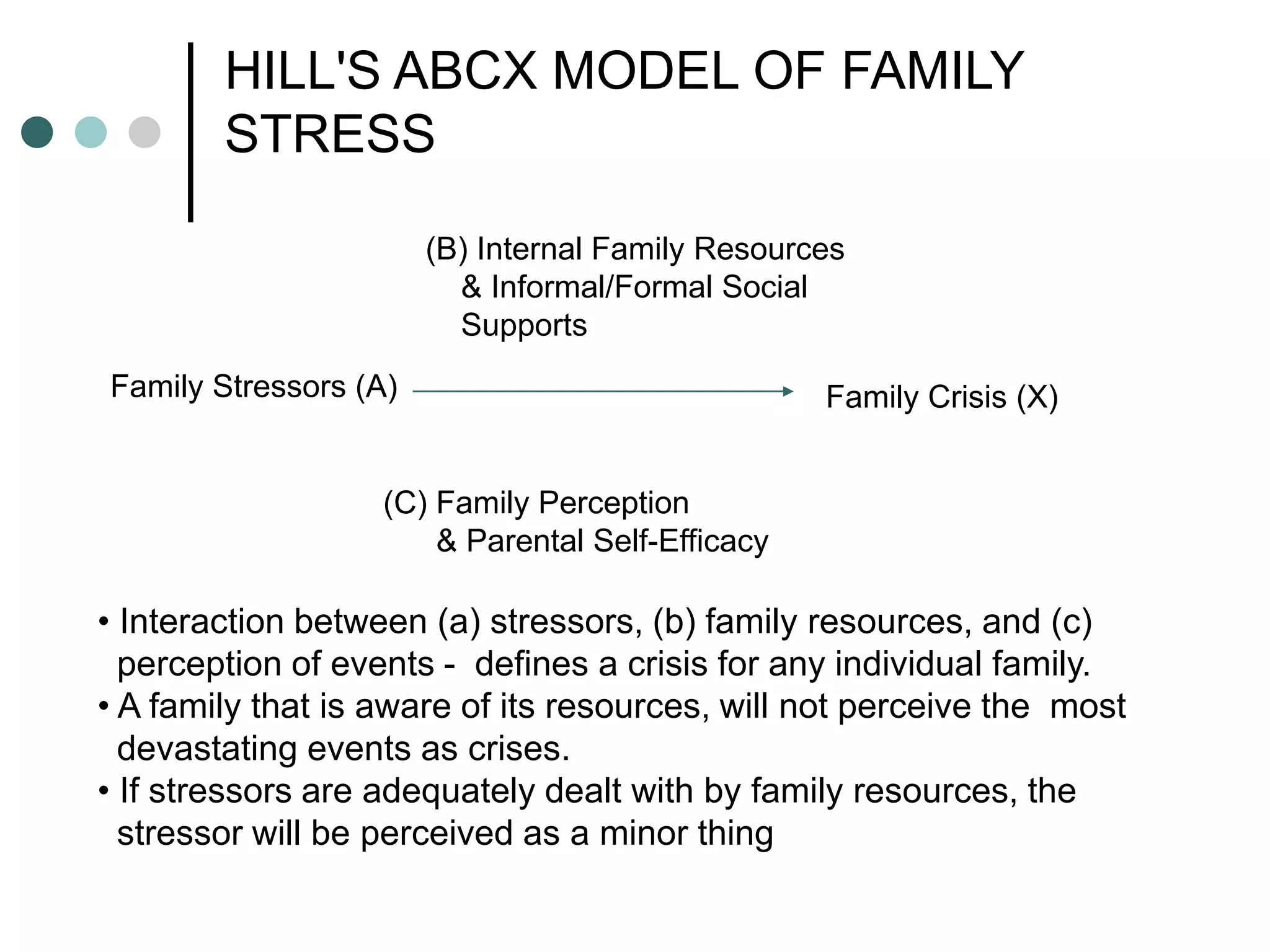
HILL'S ABCX MODEL OF FAMILY
STRESS
(B) Internal Family Resources
& Informal/Formal Social
Supports
Family Stressors (A)
(C) Family Perception
& Parental Self-Efficacy
Family Crisis (X)
• Interaction between (a) stressors, (b) family resources, and (c)
perception of events - defines a crisis for any individual family.
• A family that is aware of its resources, will not perceive the most
devastating events as crises.
• If stressors are adequately dealt with by family resources, the
stressor will be perceived as a minor thing
4 Assumptions in the Family
Stress Model by Rueben Hill
(1949)
 Unexpected or unplanned events are usually
perceived as stressful.
 Events within the families (serious illness) are
more disruptive than stressors that occur
outside the family, such as war, flood, or
depression.
 Lack of previous experience with stressor
events leads to increased perceptions of
stress.
 Ambiguous stressor events are more stressful
than non-ambiguous events
Conceptual Model of Family
Stress
 High stress + social isolation (the "B" variable) for
families >>> dysfunctional family outcomes.
 Lack of "B" and "C" variables --------------> family crisis.
 If a family experiences multiple stressors and
1) they are socially isolated and emotionally
disconnected to one another, and
2) they are depressed, hopeless, and
disempowered, then – >ed risk for illness, accidents,
child abuse and neglect, and substance abuse,
delinquency and school failure .
 If positive cognition, empowered attitude, and active
informal and formal support network, then - Reduction
in likelihood of a stressful life & family crisis.
Recovery of family from stressor events and
return to previous level of functioning
Effect of Stress on Family
Perception of crisis
Temporary disorganization of members
‘The angle of recovery determines
the return to normal
Perception of crisis – acc to the level of
functioning & perceived magnitude
Family with many
resources
Fewer crises,
shorter
disorganization,
steep angle of
recovery & returns
to pre or higher
than pre crises
level of
functioning
More frequent crises,
longer periods of
disorganization, flatter
angles of recovery, and
are less likely to return to
their former functionality.
Family with less
resources
Outcomes of Crises
o The recovery process varies from family to family
o Sometimes families are made stronger and more
resilient due to the realization of talents and abilities
unseen before
o Some find that recovery is beyond their grasp –
- They stagnate at a lower level of functioning, or
- Find themselves dealing with new crises before
repairs on the initial disturbance:
o Crisis pile up - Additional crisis situations further
reduce the family's ability to cope and function.
Adaptation to stress
 Bonadaptation (regenerative power )
 Maladaptation (vulnerability)
Resiliency Model of Stress (Adjustment,
and Adaptation)
- McCubbin and McCubbin
 Emphasizes - Stressful situation is not
necessarily pathologic/ detrimental to
family
 Demonstrates – Need of family to
make fundamental/ structural /
systemic changes to adapt
Domains of Resilience
Family Health defined..
It is the family resilience/ ability
to respond to and eventually
adapt to situations and crises
encountered over the family
life cycle"
Resilience – A characteristic that
families use to achieve that
balance and harmony
Resiliency Model of Family Stress,
Adjustment, and Adaptation
 Outcome of the family's efforts over time to bring a fit
at two levels: the individual to family, and the family to
community.
 This process ranges on a continuum from optimal
bonadaptation to maladaptation "
 The model is comprised of two distinct parts: the
Adjustment Phase and the Adaptation Phase.
 Each phase describes the family's ability to cope with
illness, or stressors looking at family strengths,
resources, and coping/problem-solving abilities.
Resilience of child and
family
 Patterns of resilience can be assessed at the individual and/or
family level.
 Resilience of a child - assessed through responses and behaviors
of the child
 Resilience of family - Through family process, i.e., patterns of
successful coping and adapting, intrafamily relationships, and
family support systems. Nine aspects of resilient families dealing
with a chronic illness situation have been identified. These include:
 balancing the illness with other family needs,
 maintaining clear family boundaries,
 developing communication competence,
 attributing positive meanings to the situation,
 maintaining family flexibility,
 maintaining a commitment to the family as a unit,
 engaging in active coping efforts,
 maintaining social integration, and
 developing collaborative relationships with professionals
Application in Nursing
Practice
 Assess the level of accomplishment of the
families
 Assess the effect of illness on family
development
 Plan means to assist families to achieve the
developmental task for that stage
 Include family in the work plan
 Provide anticipatory guidance
 Crisis intervention
Role of nurse
 Promote family members' health, recovery
from illness, or maximum functioning within
specific health limitations
 Enhance family strengths, assist families in
maintaining linkages with community
supports, and aid families in arriving at a
realistic appraisal of what is the best "fit" for
them in their particular situation.
 Thus, assist families in the process of
adaptation
FAMILY NURSING
INTERVENTIONS
 Behaviour modification
 Case management & coordination
 Collaborative strategies
 Contracting
 Counseling
 Empowering through active participation
 Environmental modification
 Family advocacy
 Family crisis intervention
 Networking (self-help groups, social support)
 Providing information & technical expertise
 Role modeling
 Role supplementation
 Teaching strategies – stress management, lifestyle modification,
anticipatory guidance
Thank You

Family Stress.ppt

  • 3.
    Definitions  Stress =Tension from depleted family resources - an imbalance that must be corrected.  Stressors = Drastic life events that change the family system (death of spouse, financial crisis, unemployment.  Distress = extreme psychological pressure from facing unenjoyable challenges.  Eustress = Extreme psychological pressure from facing enjoyable and/or beneficial challenges.
  • 4.
    Some facts aboutStress  Stress is normal  Stress disturbs equilibrium. Coping used to maintain equilibrium.  Individuals and families view stressors and resources according to their own perception  Individuals and families adapt to stress  Adaptation is influenced by – – Perceived stressors – Perception of the situation – Resources or coping strategies available  Important ! … - Consider the contexts of family stress - Then understand why & how families are stressed, and - how they respond
  • 5.
    Stressors?  Events thatcause stress & have potential to affect a change in a family  Predictable (…parenthood) & Unpredictable (illness, unemployment..)  Are cumulative – Involves simultaneous demands from work, family & community life  Too many in a short time – Can overwhelm family’s ability to cope - Risk of breakdown / crisis  Bring about change in life style/ structure >>>>ADAPTATION
  • 6.
     Family stresscomes in many forms  Normal stressors - Getting married, adjusting to living in a new group, having babies, unemployment  Abnormal stressors,- Famine, war, natural disasters, massive economic collapse, murder, assault, incest  The individual is prepared by family & society
  • 7.
    The Family StressTheory….  Explains how families react to stressful events  Suggests factors that promote adaptation to stress
  • 8.
    Family stress theory Accumulationof acute stressors Family Crises (physical, emotional, or relational) There is a positive relationship between illness and stress
  • 9.
     Significant factorsto look for - :  the changes in daily routines,  the number of changes in daily routines,  the length of time since there were changes in daily routines, (i.e. the family stressors)
  • 10.
    Prudent handling ofStress STRESS Look for Stressors Determine – Distress ?...OR Eustress? Make appropriate adjustments in Family System
  • 11.
    However, not ALLfamilies with multiple stresses have crises. Why not? What are the factors which protect a person or family unit from having a family crisis.
  • 12.
    Reuben Hill's ‘ABCX’Theory of Family Stress  Two complex variables (protective factors) act to - • Buffer family from acute & multiple stressors • Continue to competently parent despite Chr/ Ac stressors. • Relate together with acute & chronic stressors to predict family crises • Reduce the direct correlation between multiple stressors & family crisis. 1. ‘B’ Factor/ variable (Social relationships/ connectedness)- • Within family variables, e.g. attachment, positive family bonds, effective communication • Across family variables: i.e. social isolation vs. informal and formal social support networks 2. ‘C’ Factor/ variable (Perceptions) – • Shared family cognitions and attitudes between hope and personal effectiveness • Helplessness & despair
  • 13.
    HILL'S ABCX MODELOF FAMILY STRESS (B) Internal Family Resources & Informal/Formal Social Supports Family Stressors (A) (C) Family Perception & Parental Self-Efficacy Family Crisis (X) • Interaction between (a) stressors, (b) family resources, and (c) perception of events - defines a crisis for any individual family. • A family that is aware of its resources, will not perceive the most devastating events as crises. • If stressors are adequately dealt with by family resources, the stressor will be perceived as a minor thing
  • 14.
    4 Assumptions inthe Family Stress Model by Rueben Hill (1949)  Unexpected or unplanned events are usually perceived as stressful.  Events within the families (serious illness) are more disruptive than stressors that occur outside the family, such as war, flood, or depression.  Lack of previous experience with stressor events leads to increased perceptions of stress.  Ambiguous stressor events are more stressful than non-ambiguous events
  • 15.
    Conceptual Model ofFamily Stress
  • 16.
     High stress+ social isolation (the "B" variable) for families >>> dysfunctional family outcomes.  Lack of "B" and "C" variables --------------> family crisis.  If a family experiences multiple stressors and 1) they are socially isolated and emotionally disconnected to one another, and 2) they are depressed, hopeless, and disempowered, then – >ed risk for illness, accidents, child abuse and neglect, and substance abuse, delinquency and school failure .  If positive cognition, empowered attitude, and active informal and formal support network, then - Reduction in likelihood of a stressful life & family crisis.
  • 17.
    Recovery of familyfrom stressor events and return to previous level of functioning
  • 18.
    Effect of Stresson Family Perception of crisis Temporary disorganization of members ‘The angle of recovery determines the return to normal Perception of crisis – acc to the level of functioning & perceived magnitude Family with many resources Fewer crises, shorter disorganization, steep angle of recovery & returns to pre or higher than pre crises level of functioning More frequent crises, longer periods of disorganization, flatter angles of recovery, and are less likely to return to their former functionality. Family with less resources
  • 19.
    Outcomes of Crises oThe recovery process varies from family to family o Sometimes families are made stronger and more resilient due to the realization of talents and abilities unseen before o Some find that recovery is beyond their grasp – - They stagnate at a lower level of functioning, or - Find themselves dealing with new crises before repairs on the initial disturbance: o Crisis pile up - Additional crisis situations further reduce the family's ability to cope and function.
  • 20.
    Adaptation to stress Bonadaptation (regenerative power )  Maladaptation (vulnerability)
  • 21.
    Resiliency Model ofStress (Adjustment, and Adaptation) - McCubbin and McCubbin  Emphasizes - Stressful situation is not necessarily pathologic/ detrimental to family  Demonstrates – Need of family to make fundamental/ structural / systemic changes to adapt
  • 22.
  • 23.
    Family Health defined.. Itis the family resilience/ ability to respond to and eventually adapt to situations and crises encountered over the family life cycle" Resilience – A characteristic that families use to achieve that balance and harmony
  • 24.
    Resiliency Model ofFamily Stress, Adjustment, and Adaptation  Outcome of the family's efforts over time to bring a fit at two levels: the individual to family, and the family to community.  This process ranges on a continuum from optimal bonadaptation to maladaptation "  The model is comprised of two distinct parts: the Adjustment Phase and the Adaptation Phase.  Each phase describes the family's ability to cope with illness, or stressors looking at family strengths, resources, and coping/problem-solving abilities.
  • 25.
    Resilience of childand family  Patterns of resilience can be assessed at the individual and/or family level.  Resilience of a child - assessed through responses and behaviors of the child  Resilience of family - Through family process, i.e., patterns of successful coping and adapting, intrafamily relationships, and family support systems. Nine aspects of resilient families dealing with a chronic illness situation have been identified. These include:  balancing the illness with other family needs,  maintaining clear family boundaries,  developing communication competence,  attributing positive meanings to the situation,  maintaining family flexibility,  maintaining a commitment to the family as a unit,  engaging in active coping efforts,  maintaining social integration, and  developing collaborative relationships with professionals
  • 26.
    Application in Nursing Practice Assess the level of accomplishment of the families  Assess the effect of illness on family development  Plan means to assist families to achieve the developmental task for that stage  Include family in the work plan  Provide anticipatory guidance  Crisis intervention
  • 27.
    Role of nurse Promote family members' health, recovery from illness, or maximum functioning within specific health limitations  Enhance family strengths, assist families in maintaining linkages with community supports, and aid families in arriving at a realistic appraisal of what is the best "fit" for them in their particular situation.  Thus, assist families in the process of adaptation
  • 28.
    FAMILY NURSING INTERVENTIONS  Behaviourmodification  Case management & coordination  Collaborative strategies  Contracting  Counseling  Empowering through active participation  Environmental modification  Family advocacy  Family crisis intervention  Networking (self-help groups, social support)  Providing information & technical expertise  Role modeling  Role supplementation  Teaching strategies – stress management, lifestyle modification, anticipatory guidance
  • 29.