FUNCTIONAL MATRIX
THEORY
PRESENTED BY: ZYNUL JOHN
DEPARTMENT OF ORTHODONTICS AND DENTOFACIAL
ORTHOPAEDICS
LEARNING OBJECTIVES
 Various theories of growth
 Functional matrix theory
 Clinical implications
CONTENTS
 Introduction
 Various theories of growth
 Functional matrix theory
 Drawbacks
 Clinical implications
 Summary
 reference
INTRODUCTION
 Growth is strongly influenced by genetic factors, but it
can also be significantly affected by the environment, in
the form of nutritional status, degree of physical activity,
health or illness and a no. of similar factors.
 Since a major part of the need for the orthodontic
treatment is created by disproportionate growth of the
jaws, it is necessary to learn how skeletal growth is
influenced and controlled to understand the etiologic
processes of malocclusion and dentofacial deformity
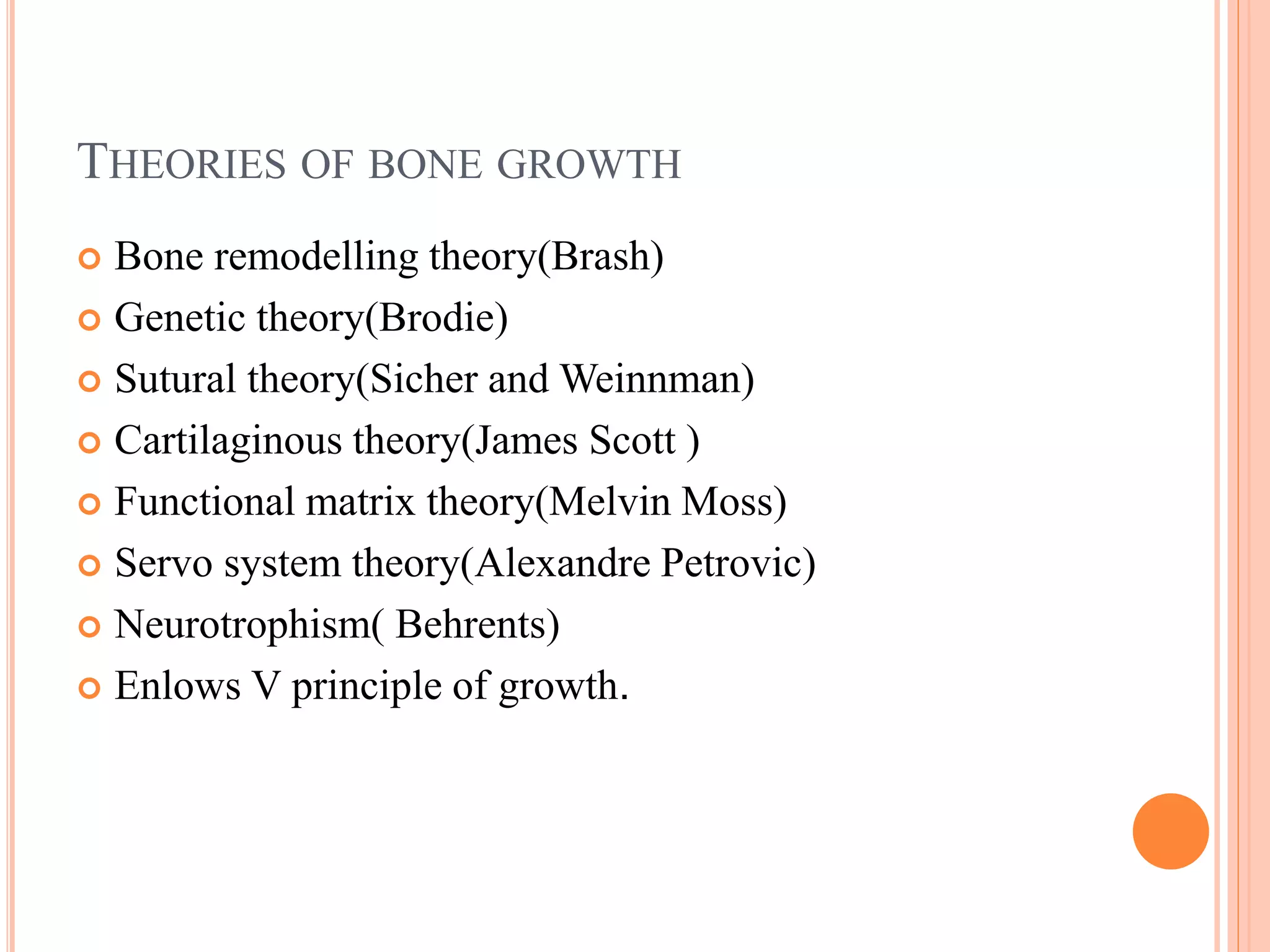
THEORIES OF BONE GROWTH
 Bone remodelling theory(Brash)
 Genetic theory(Brodie)
 Sutural theory(Sicher and Weinnman)
 Cartilaginous theory(James Scott )
 Functional matrix theory(Melvin Moss)
 Servo system theory(Alexandre Petrovic)
 Neurotrophism( Behrents)
 Enlows V principle of growth.
FUNCTIONAL MATRIX HYPOTHESIS
 Van der Klaaw was a professor of descriptive zoology whose
most important contribution is the introduction of new concept-
functional cranial component.
 Influenced by this work, Melvin Moss in 1960s put forward the
Functional Matrix Theory.
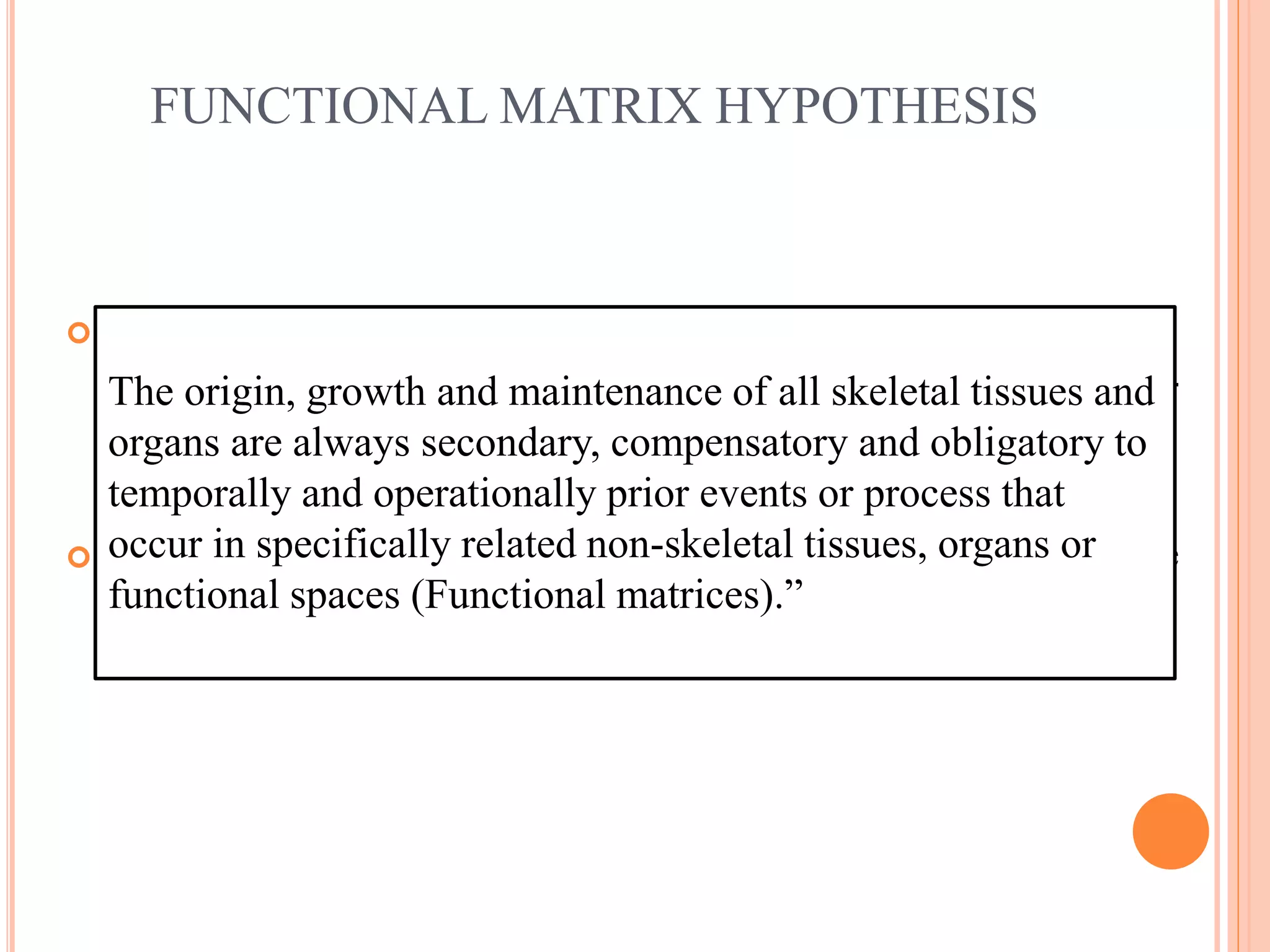
The origin, growth and maintenance of all skeletal tissues and
organs are always secondary, compensatory and obligatory to
temporally and operationally prior events or process that
occur in specifically related non-skeletal tissues, organs or
functional spaces (Functional matrices).”
 He theorizes that growth of the face occurs as a response
to functional needs and is mediated by soft tissues in
which jaws are embedded.
 In this conceptual view- the soft tissues grow and both
bone and cartilage react.
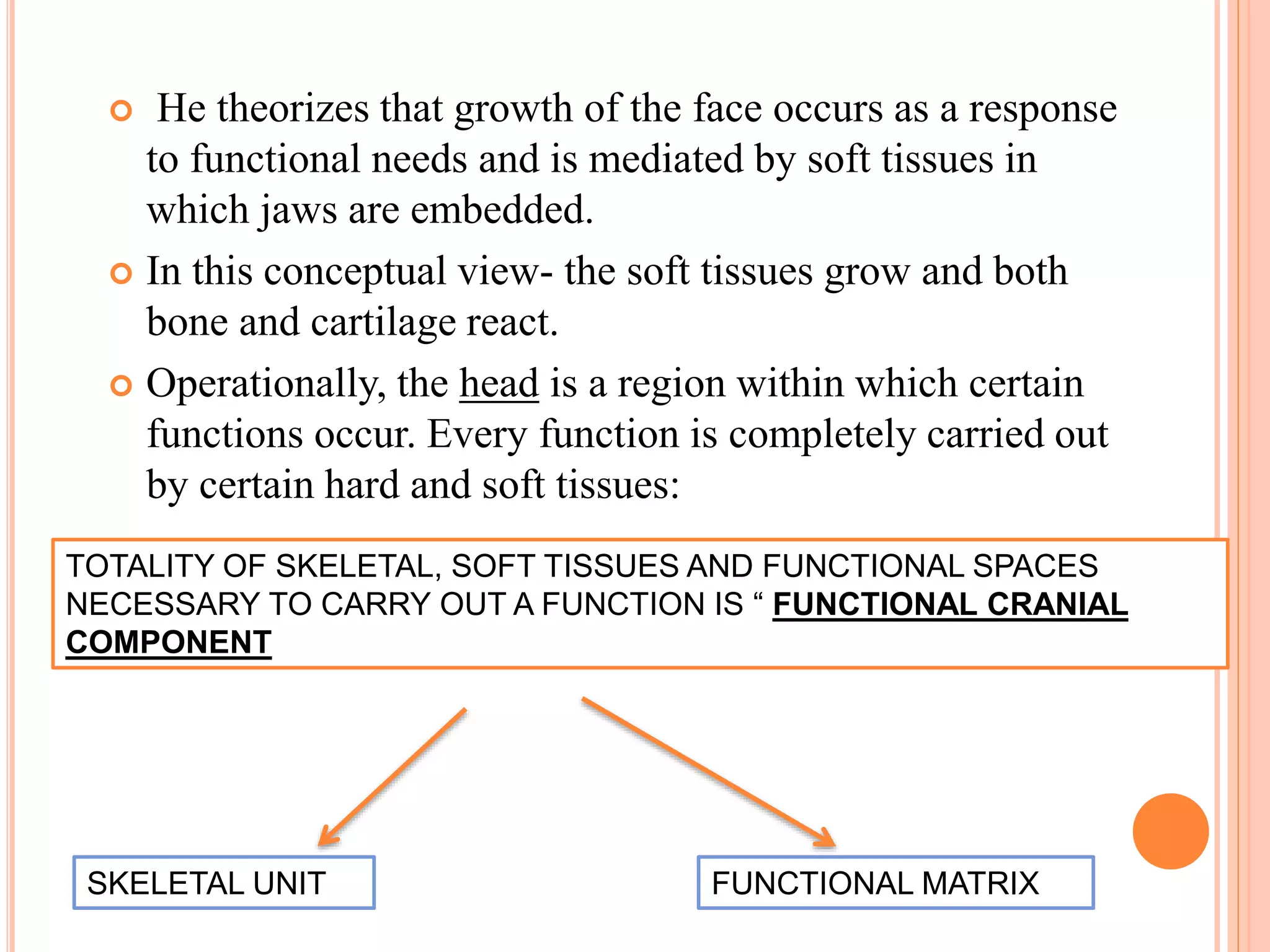
 Operationally, the head is a region within which certain
functions occur. Every function is completely carried out
by certain hard and soft tissues:
SKELETAL UNIT FUNCTIONAL MATRIX
TOTALITY OF SKELETAL, SOFT TISSUES AND FUNCTIONAL SPACES
NECESSARY TO CARRY OUT A FUNCTION IS “ FUNCTIONAL CRANIAL
COMPONENT
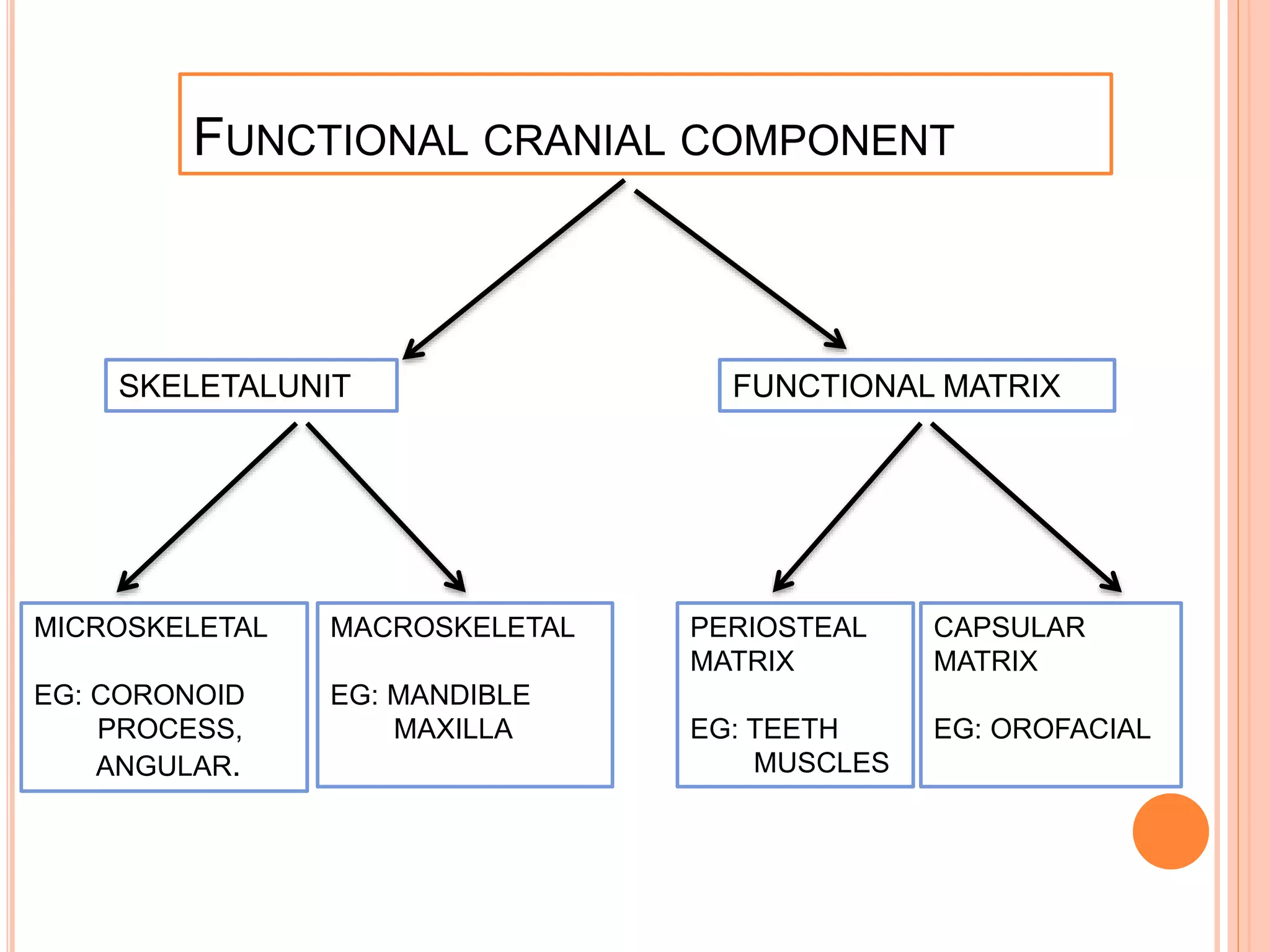
FUNCTIONAL CRANIAL COMPONENT
SKELETALUNIT FUNCTIONAL MATRIX
MICROSKELETAL
EG: CORONOID
PROCESS,
ANGULAR.
MACROSKELETAL
EG: MANDIBLE
MAXILLA
PERIOSTEAL
MATRIX
EG: TEETH
MUSCLES
CAPSULAR
MATRIX
EG: OROFACIAL
SKELETAL UNIT
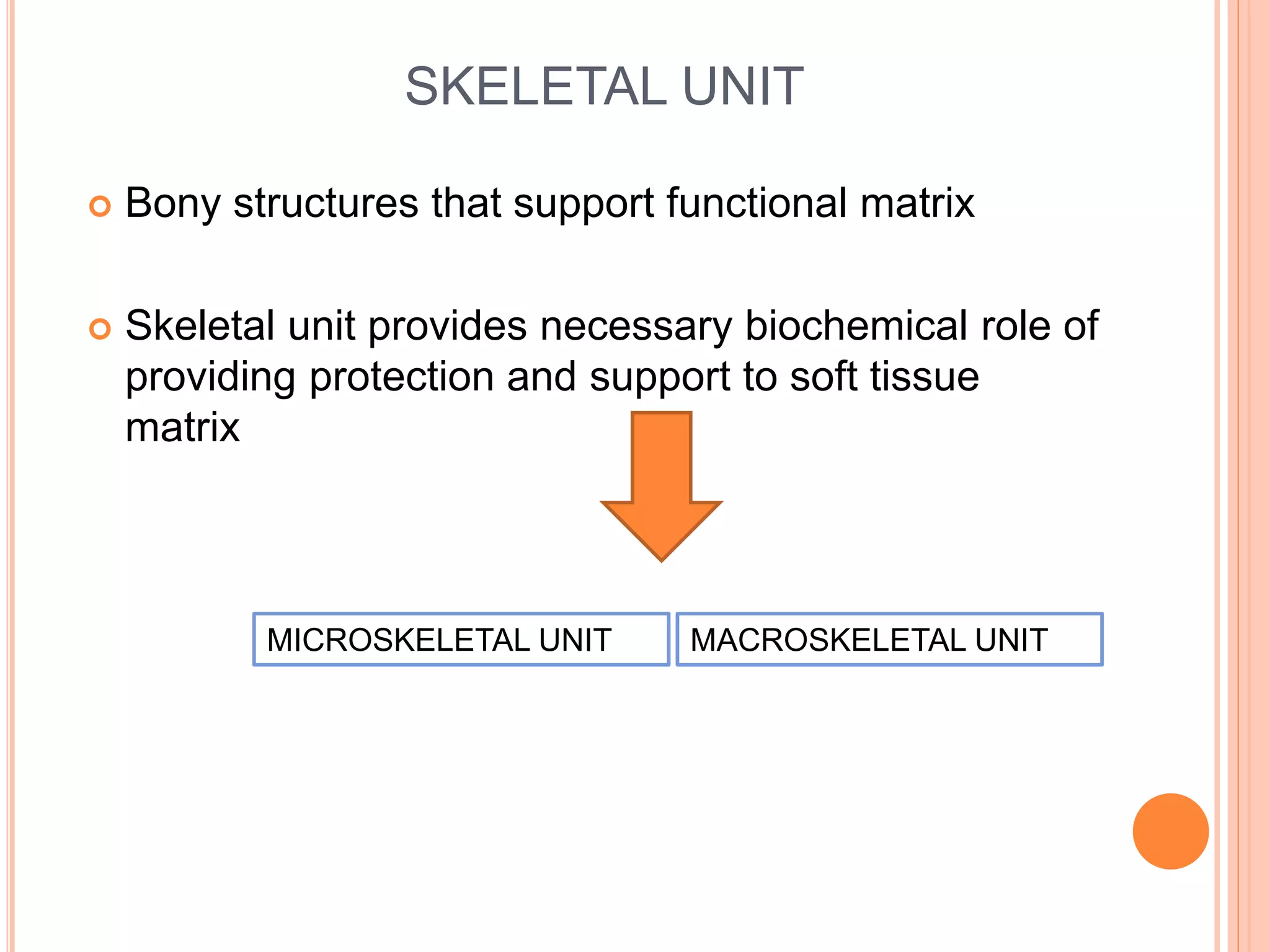
 Bony structures that support functional matrix
 Skeletal unit provides necessary biochemical role of
providing protection and support to soft tissue
matrix
MICROSKELETAL UNIT MACROSKELETAL UNIT
MICROSKELETAL UNIT
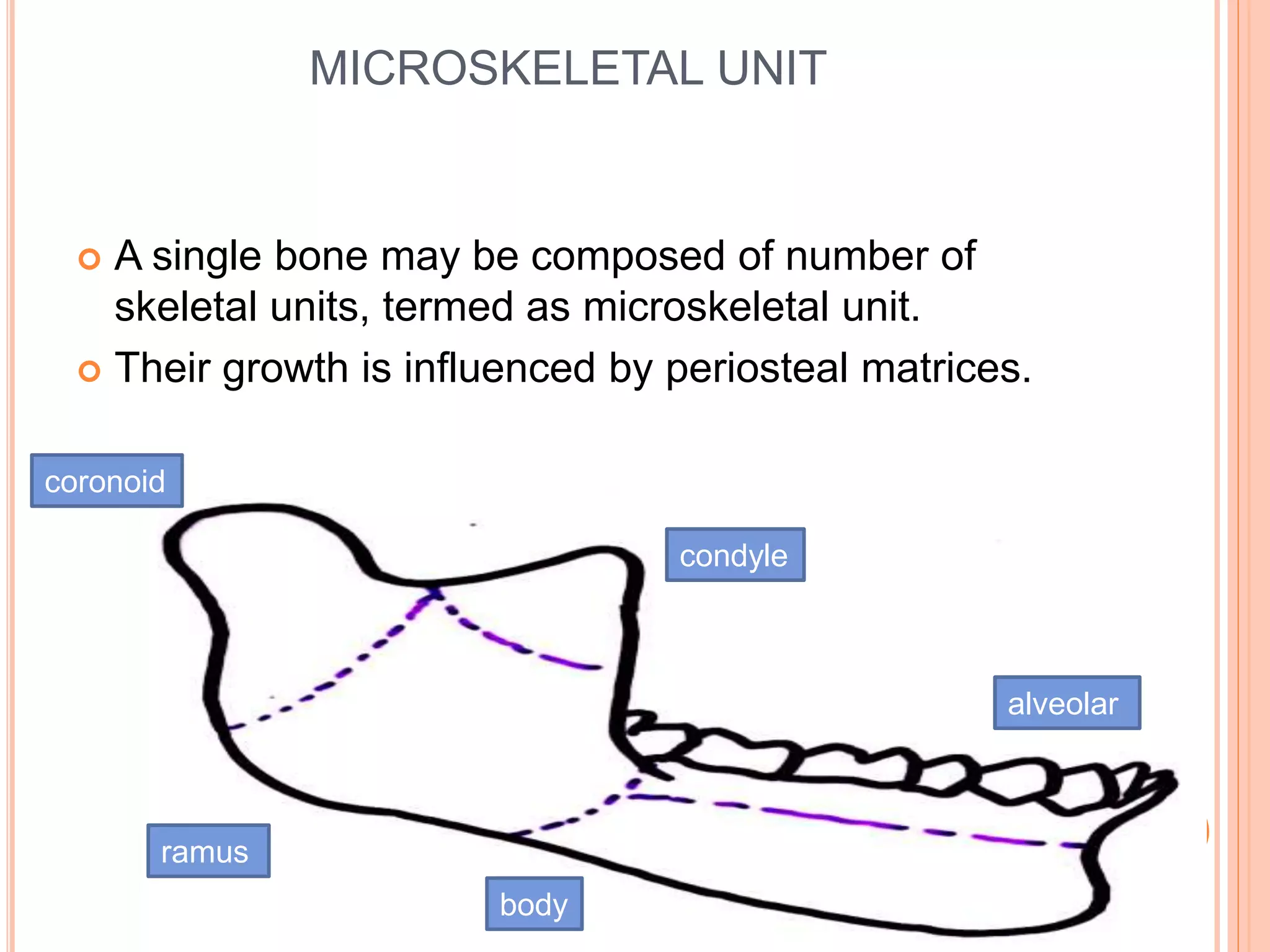
 A single bone may be composed of number of
skeletal units, termed as microskeletal unit.
 Their growth is influenced by periosteal matrices.
coronoid
condyle
ramus
body
alveolar
MACROSKELETAL UNIT
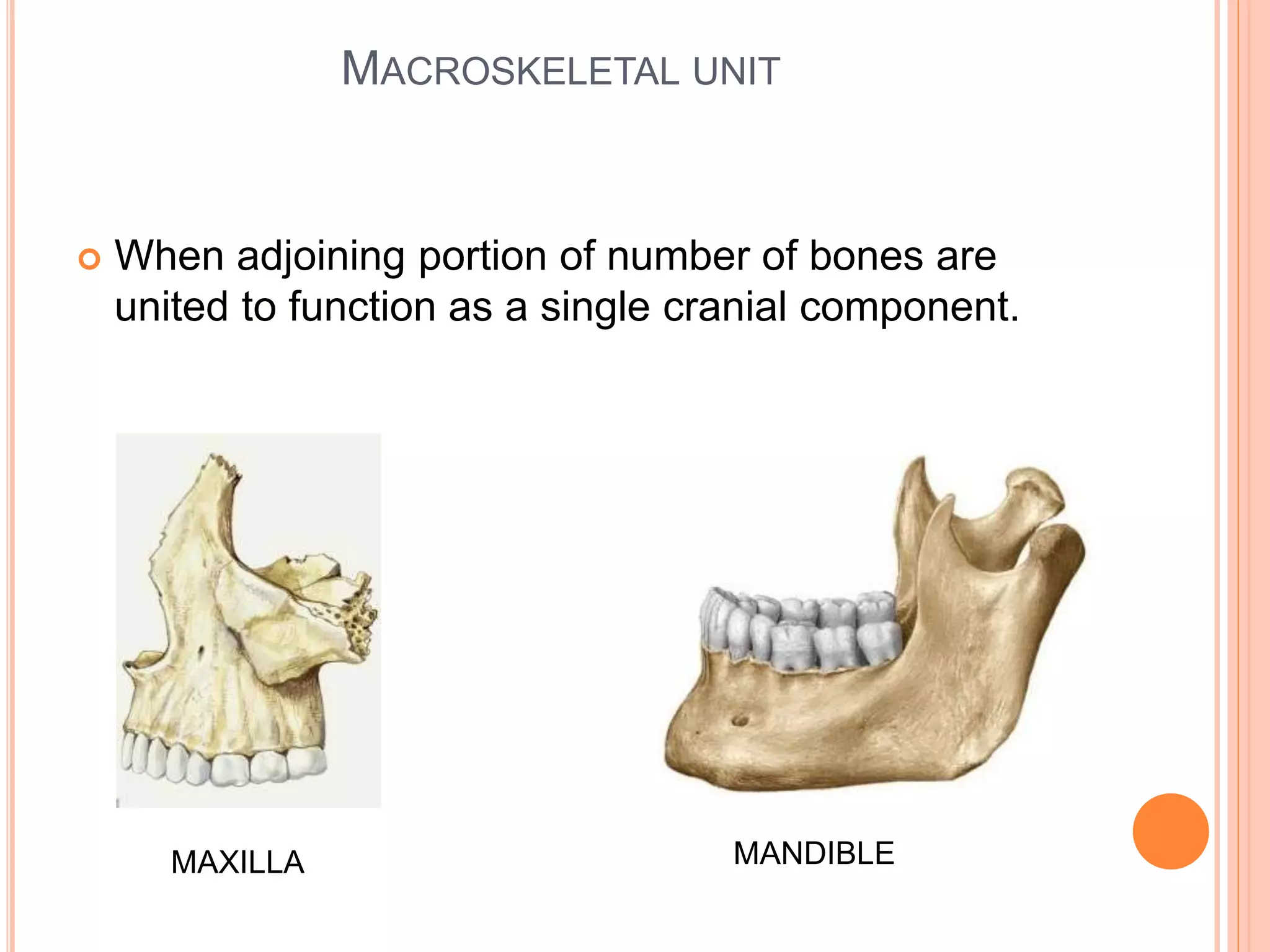
 When adjoining portion of number of bones are
united to function as a single cranial component.
MAXILLA MANDIBLE
FUNCTIONAL MATRICES
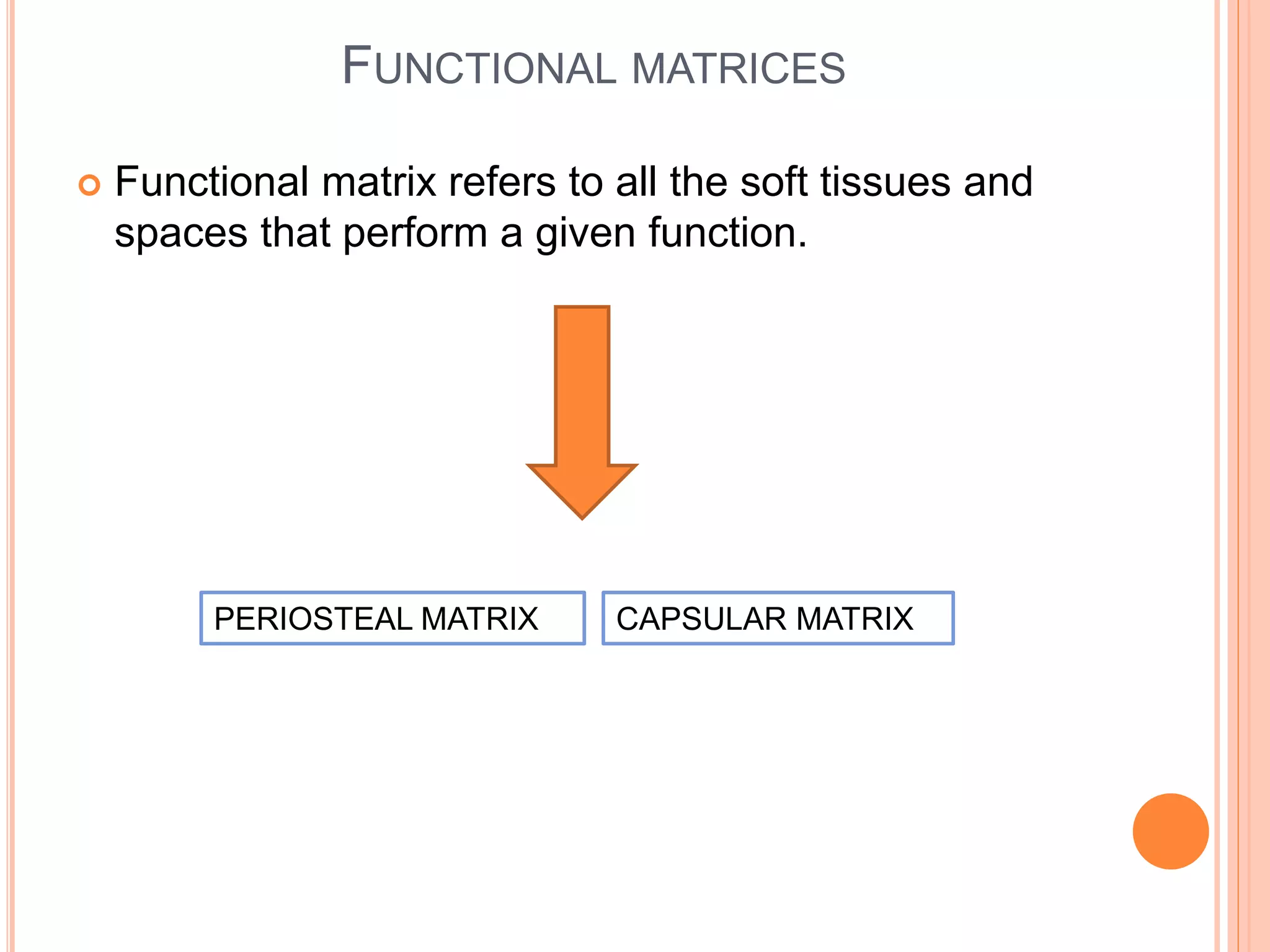
 Functional matrix refers to all the soft tissues and
spaces that perform a given function.
PERIOSTEAL MATRIX CAPSULAR MATRIX
PERIOSTEAL MATRIX
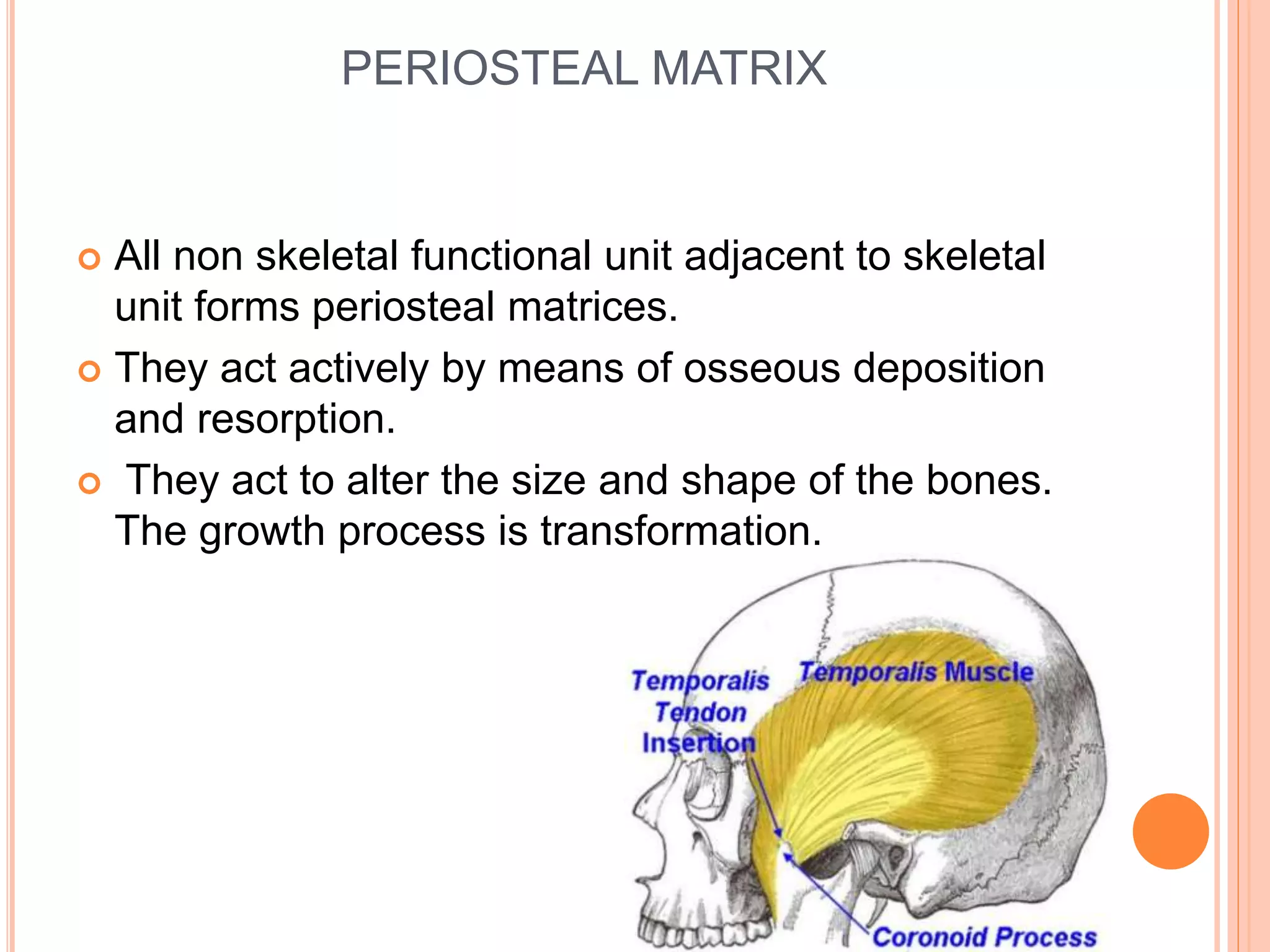
 All non skeletal functional unit adjacent to skeletal
unit forms periosteal matrices.
 They act actively by means of osseous deposition
and resorption.
 They act to alter the size and shape of the bones.
The growth process is transformation.
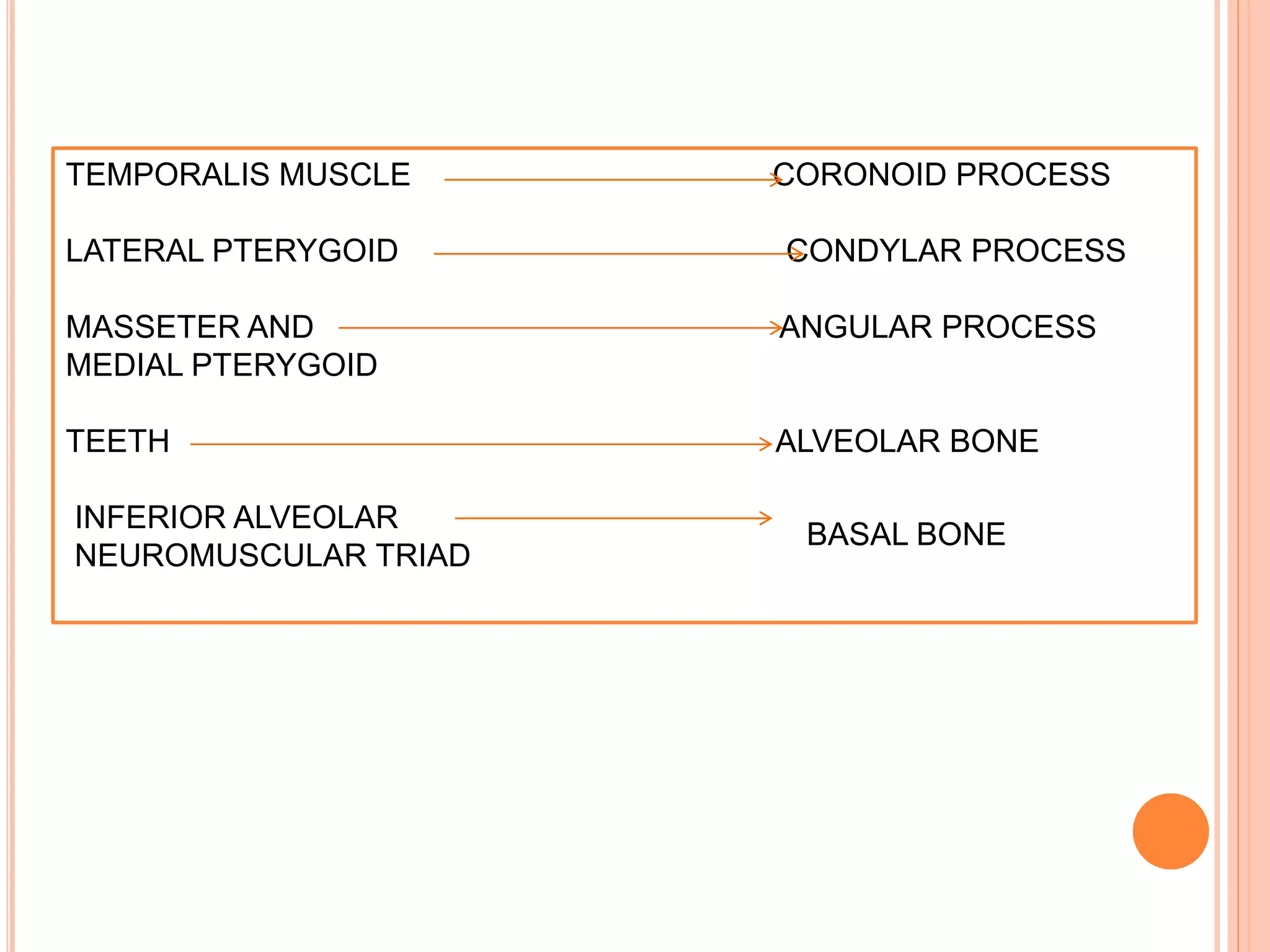
TEMPORALIS MUSCLE CORONOID PROCESS
LATERAL PTERYGOID CONDYLAR PROCESS
MASSETER AND ANGULAR PROCESS
MEDIAL PTERYGOID
TEETH ALVEOLAR BONE
INFERIOR ALVEOLAR
NEUROMUSCULAR TRIAD
BASAL BONE
FUNCTIONAL CRANIAL ANALYSIS OF CORONOID
PROCESS IN RAT
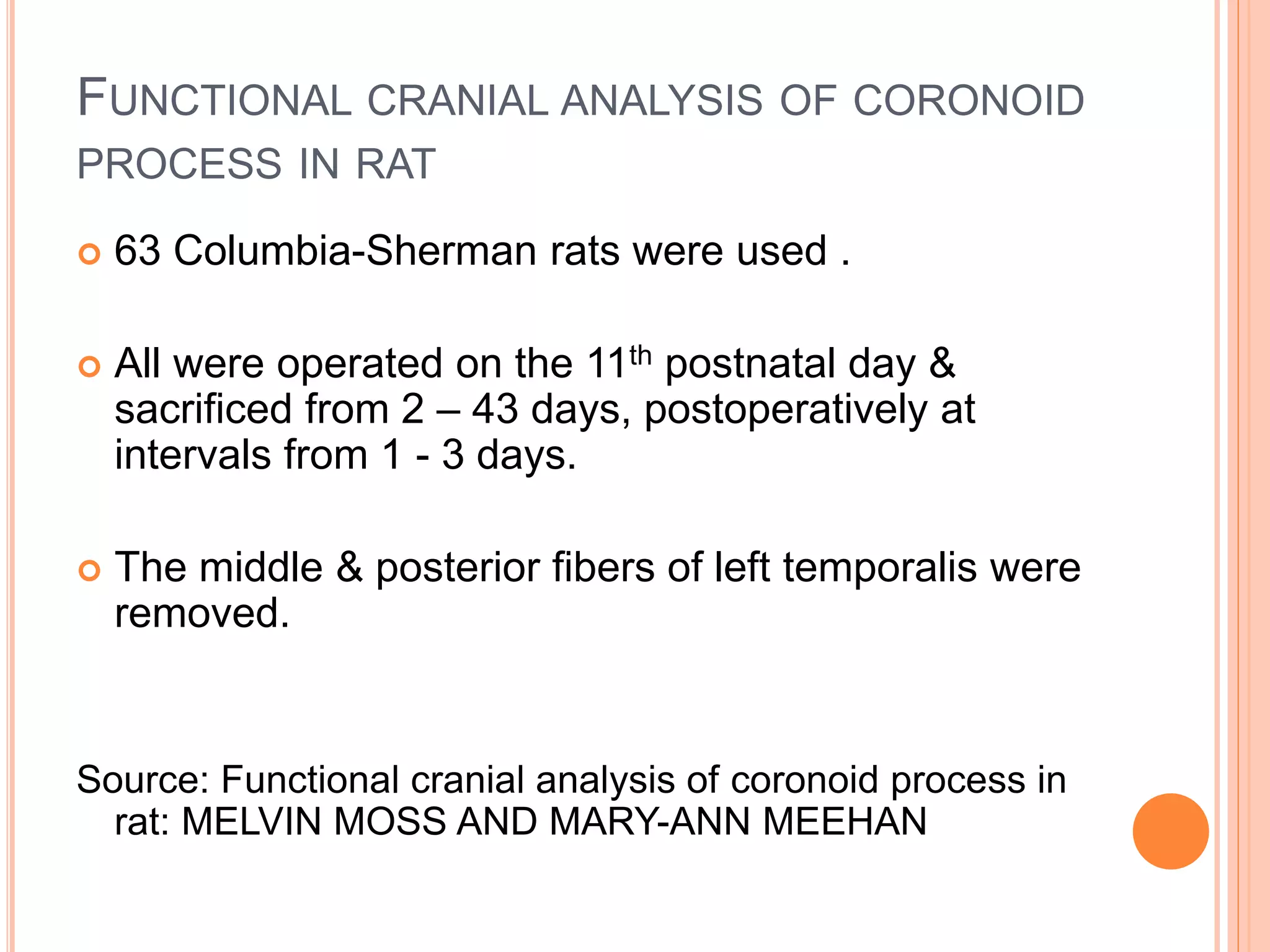
 63 Columbia-Sherman rats were used .
 All were operated on the 11th postnatal day &
sacrificed from 2 – 43 days, postoperatively at
intervals from 1 - 3 days.
 The middle & posterior fibers of left temporalis were
removed.
Source: Functional cranial analysis of coronoid process in
rat: MELVIN MOSS AND MARY-ANN MEEHAN
RESULTS
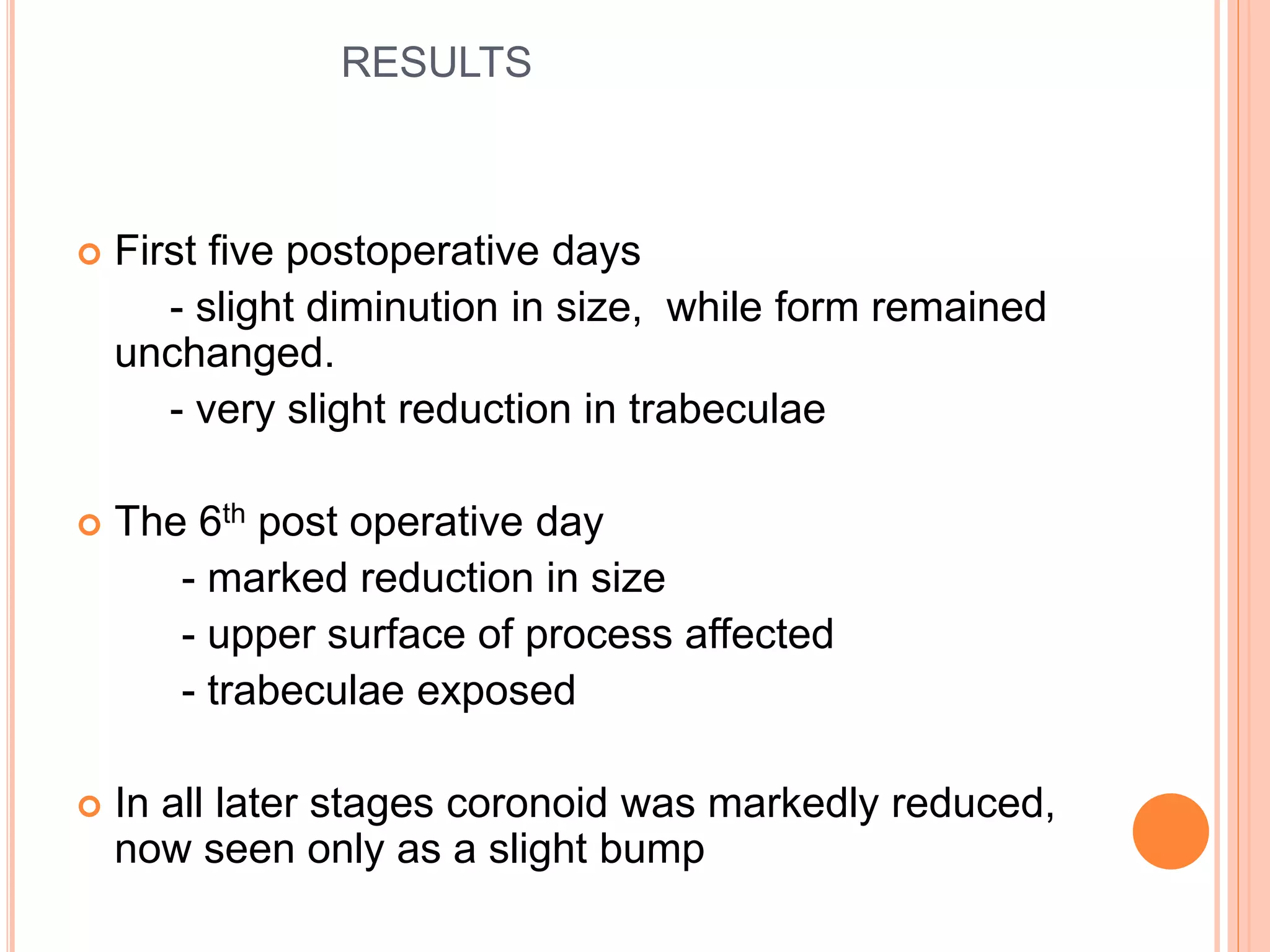
 First five postoperative days
- slight diminution in size, while form remained
unchanged.
- very slight reduction in trabeculae
 The 6th post operative day
- marked reduction in size
- upper surface of process affected
- trabeculae exposed
 In all later stages coronoid was markedly reduced,
now seen only as a slight bump
 In few cases, middle portion of muscle was not
completely removed . Though it showed reduction
in size and shape but it was recognisable.
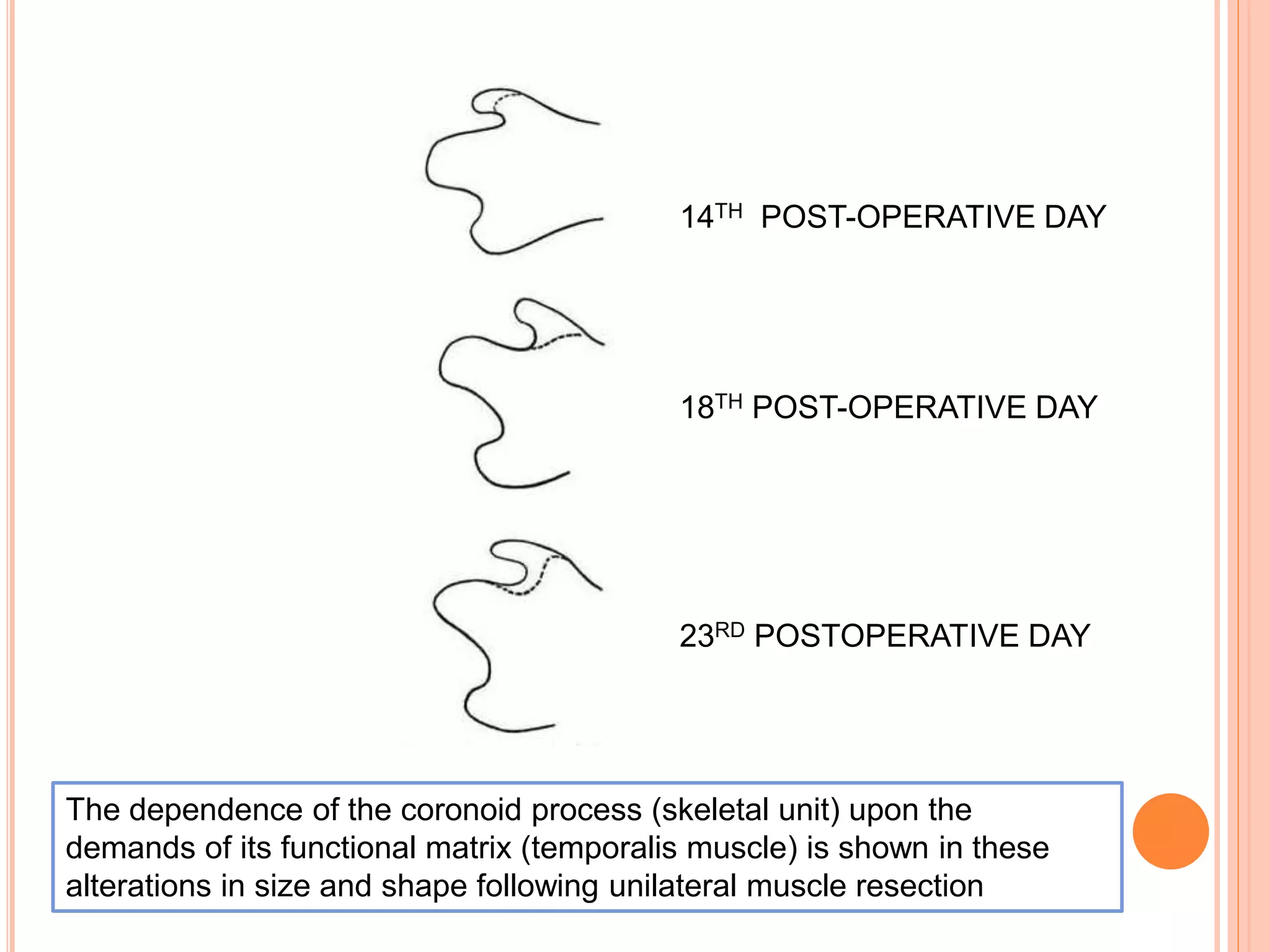
The dependence of the coronoid process (skeletal unit) upon the
demands of its functional matrix (temporalis muscle) is shown in these
alterations in size and shape following unilateral muscle resection
14TH POST-OPERATIVE DAY
18TH POST-OPERATIVE DAY
23RD POSTOPERATIVE DAY
 So, the point is the coronoid process does NOT
grow first and thus provide a "platform" upon which
the temporalis muscle can then alter its functions.
 The total growth changes in all aspects of coronoid
process form (size and shape) are at all times a
direct and compensatory response to the
morphogenetically prior demands of the temporalis
muscle function.
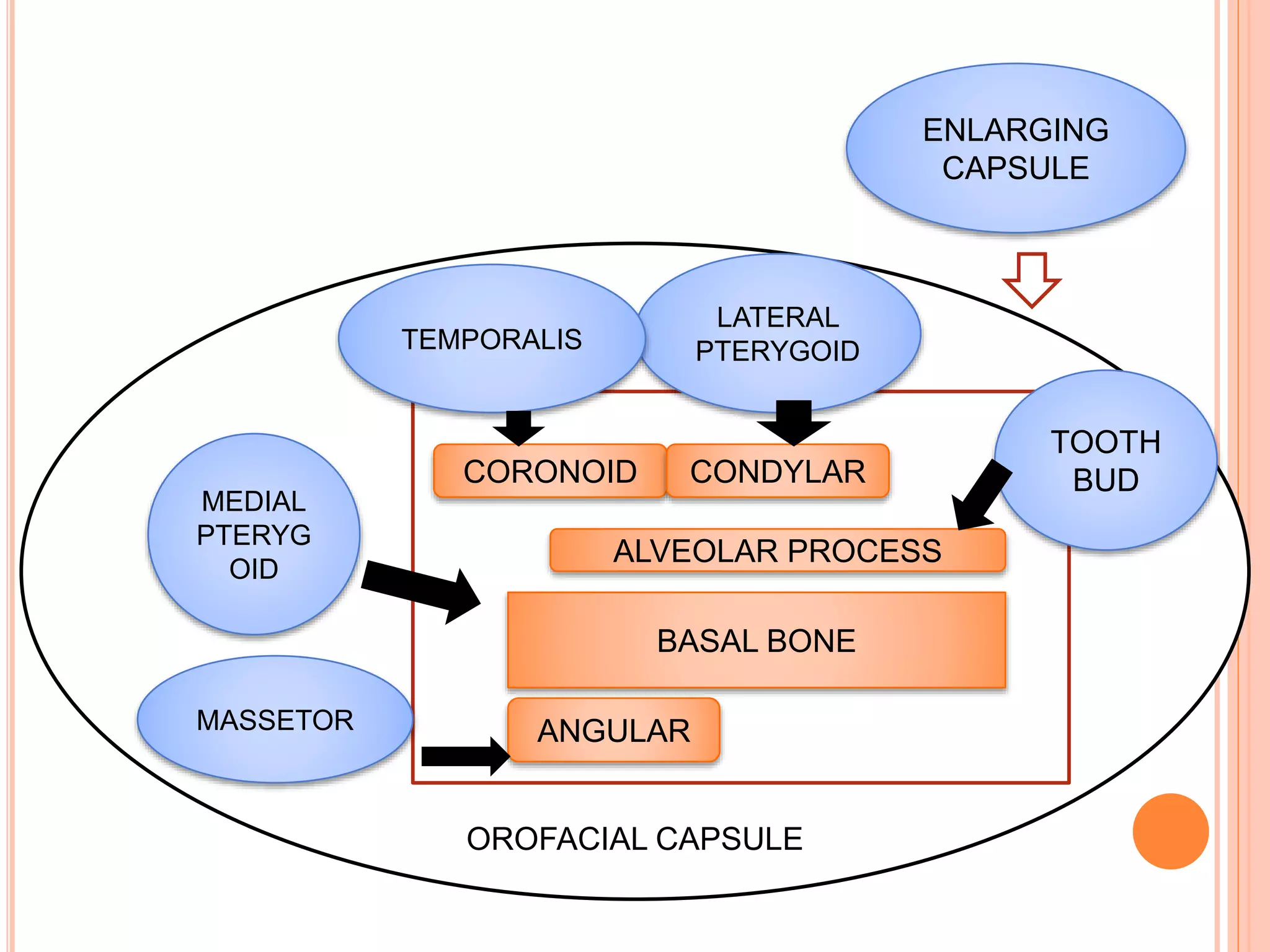
CAPSULAR MATRIX
 Organs and spaces that occupy a broader anatomic
complex.
 Each capsule is an envelope that contains series of
functional cranial component, skeletal unit and their
related functional matrices.
 Capsular matrix do not act by process of active
resorption and deposition.
 They act passively on macroskeletal unit by
producing its secondary translation in space.
Eg: neurocranial space
orofacial space
OROFACIAL CAPSULE
CORONOID CONDYLAR
ALVEOLAR PROCESS
BASAL BONE
ANGULAR
LATERAL
PTERYGOIDTEMPORALIS
MEDIAL
PTERYG
OID
MASSETOR
TOOTH
BUD
ENLARGING
CAPSULE
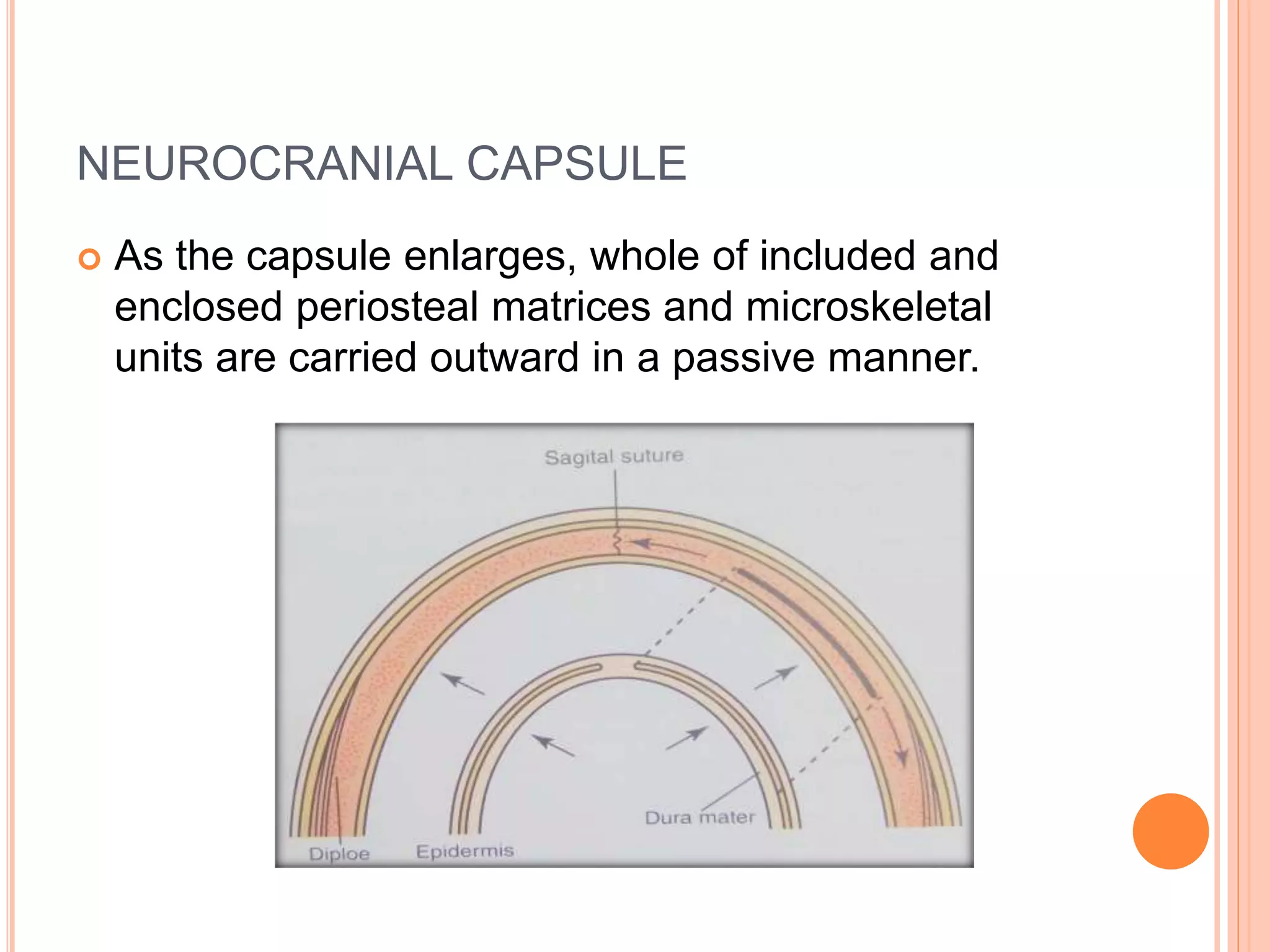
NEUROCRANIAL CAPSULE
 As the capsule enlarges, whole of included and
enclosed periosteal matrices and microskeletal
units are carried outward in a passive manner.
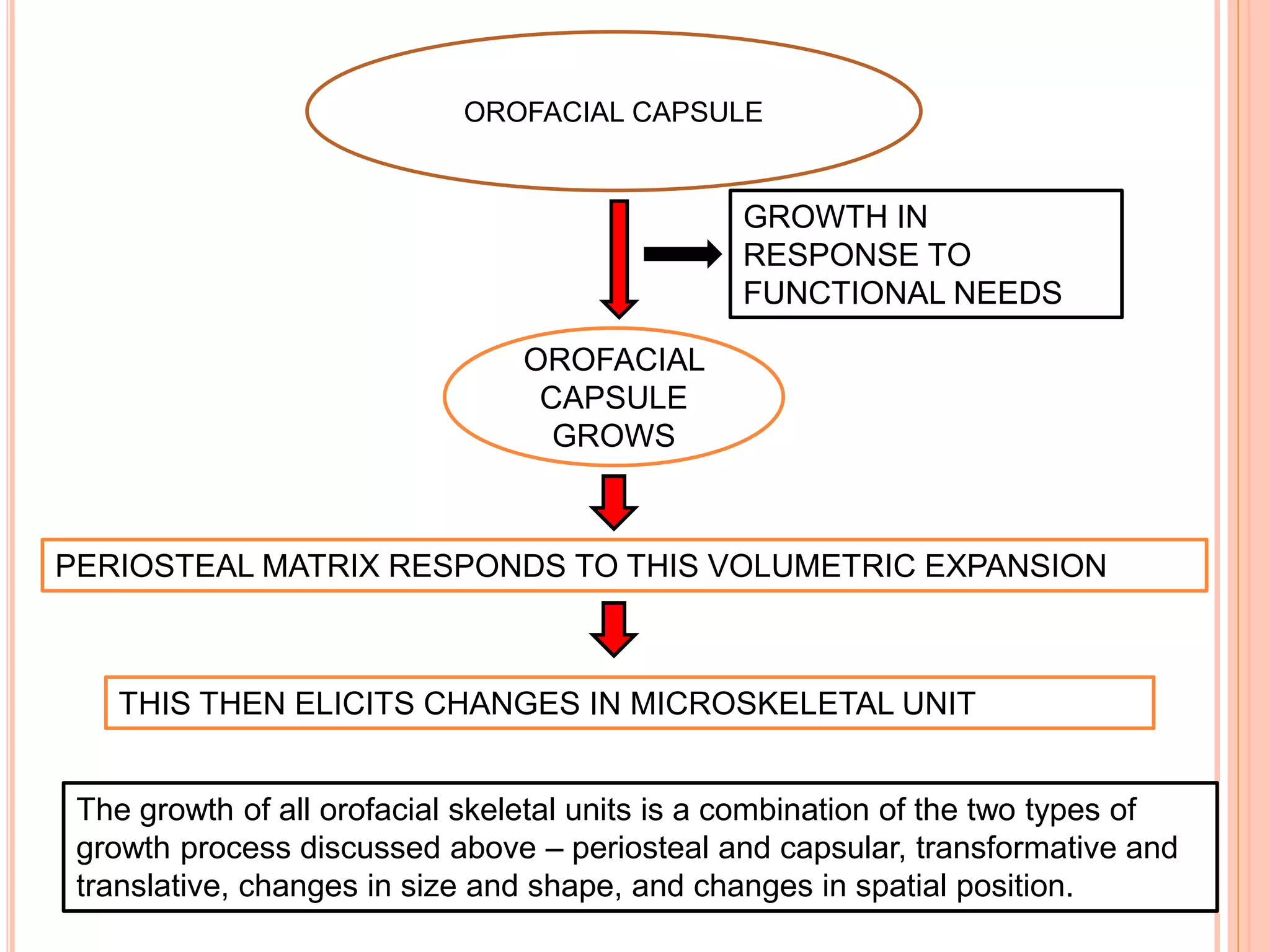
OROFACIAL CAPSULE
OROFACIAL
CAPSULE
GROWS
PERIOSTEAL MATRIX RESPONDS TO THIS VOLUMETRIC EXPANSION
THIS THEN ELICITS CHANGES IN MICROSKELETAL UNIT
The growth of all orofacial skeletal units is a combination of the two types of
growth process discussed above – periosteal and capsular, transformative and
translative, changes in size and shape, and changes in spatial position.
GROWTH IN
RESPONSE TO
FUNCTIONAL NEEDS
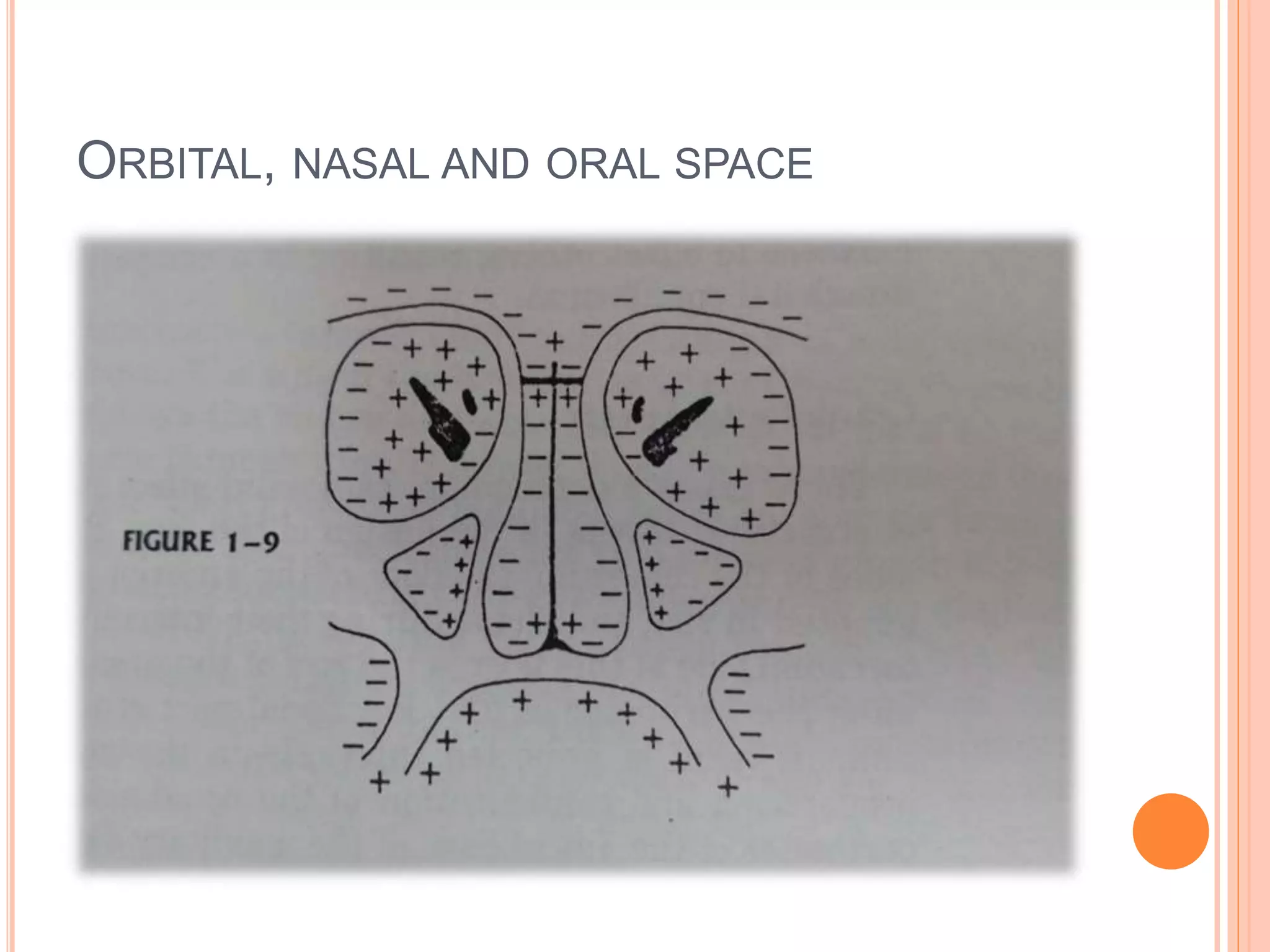
FUNCTIONAL CRANIAL ANALYSIS OF MAXILLA
o Head is a composite structure, operationally
consisting a no.of independent functions :
Olfaction, Respiration, Vision, Digestion, Speech,
etc.
o The facial bones are passively carried outwards by
the primary expansion of the enclosed matrices.this
causes adaptive fill in response.
( e.g. : orbital, nasal, oral matrices ) .
ORBITAL, NASAL AND ORAL SPACE
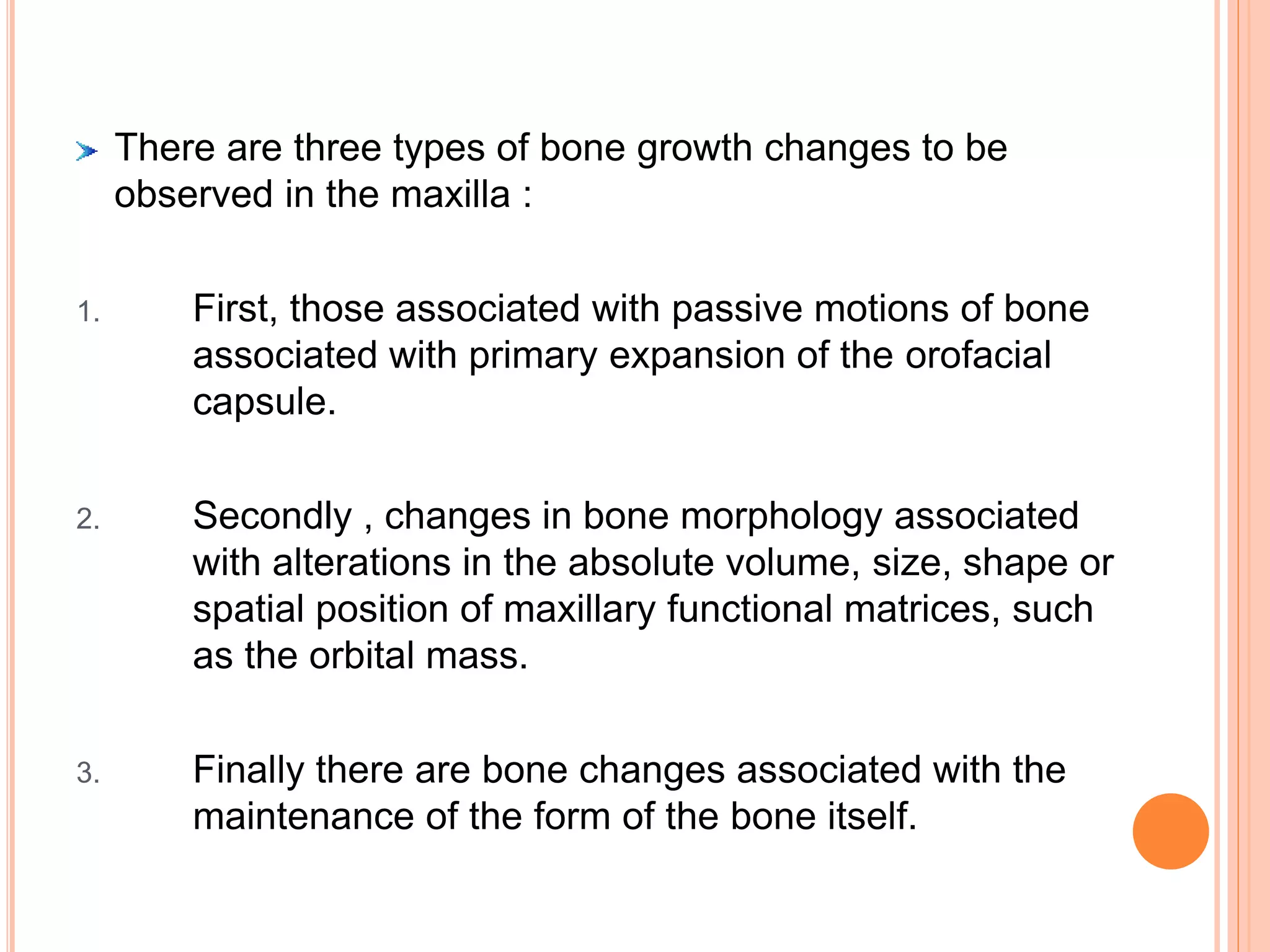
There are three types of bone growth changes to be
observed in the maxilla :
1. First, those associated with passive motions of bone
associated with primary expansion of the orofacial
capsule.
2. Secondly , changes in bone morphology associated
with alterations in the absolute volume, size, shape or
spatial position of maxillary functional matrices, such
as the orbital mass.
3. Finally there are bone changes associated with the
maintenance of the form of the bone itself.
FUNCTIONALCRANIAL ANALYSIS OF MANDIBLE
 The mandible is not a unitary biological object, but
rather a composite of several unitary & relatively
independent functional cranial components. The
skeletal units corresponding to these mandibular
functional components include :
1. Alveolar process
2. Coronoid process
3. Condylar process
4. Angular process
5. Body
6. Chin
 The mandibular cranial components arise & exist
completely embedded within the capsule, they all
are passively & secondarily translated in space to a
new position as the capsule expands.
 Such passive translations of mandibular functional
cranial components as a whole, also alters the
individual periosteal matrices.
 This causes direct changes in the size &/or shape
of their various skeletal units.
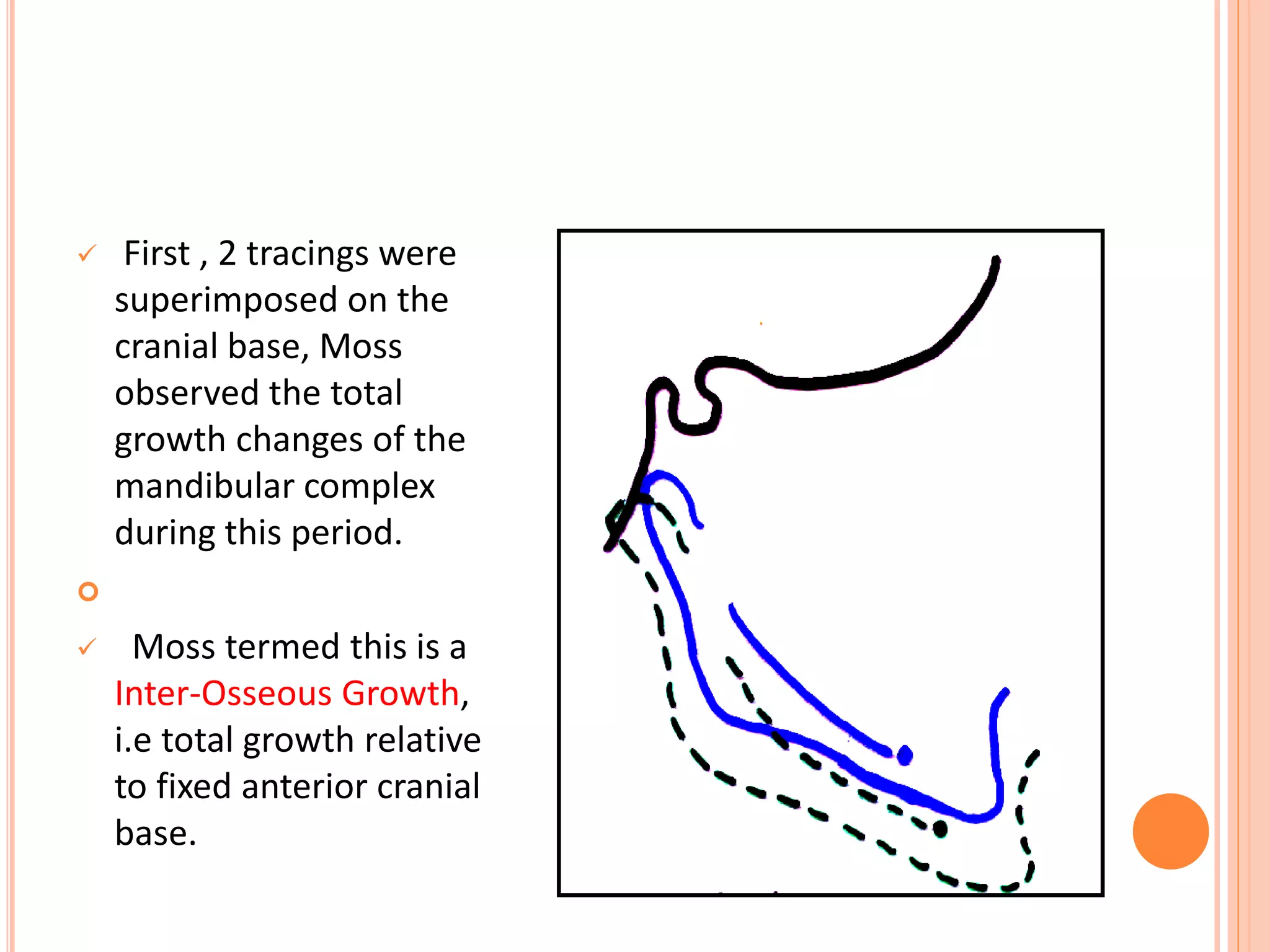
 A longitudinal series of cephalometric radiographs
were taken by Moss & the following structures were
traced:
1. Anterior cranial base
2. External surface of mandible
3. Mental foramina
 First , 2 tracings were
superimposed on the
cranial base, Moss
observed the total
growth changes of the
mandibular complex
during this period.

 Moss termed this is a
Inter-Osseous Growth,
i.e total growth relative
to fixed anterior cranial
base.
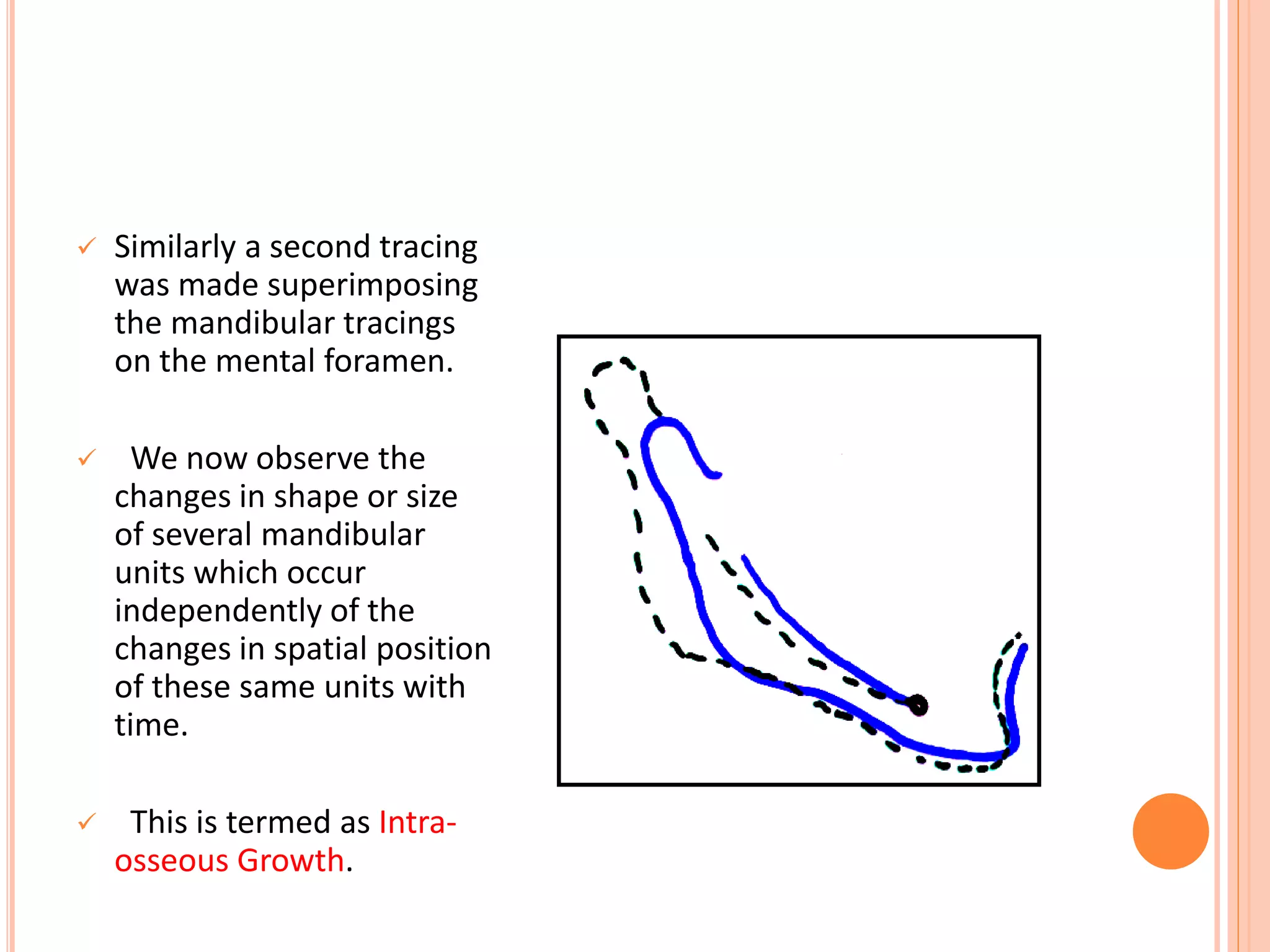
 Similarly a second tracing
was made superimposing
the mandibular tracings
on the mental foramen.
 We now observe the
changes in shape or size
of several mandibular
units which occur
independently of the
changes in spatial position
of these same units with
time.
 This is termed as Intra-
osseous Growth.
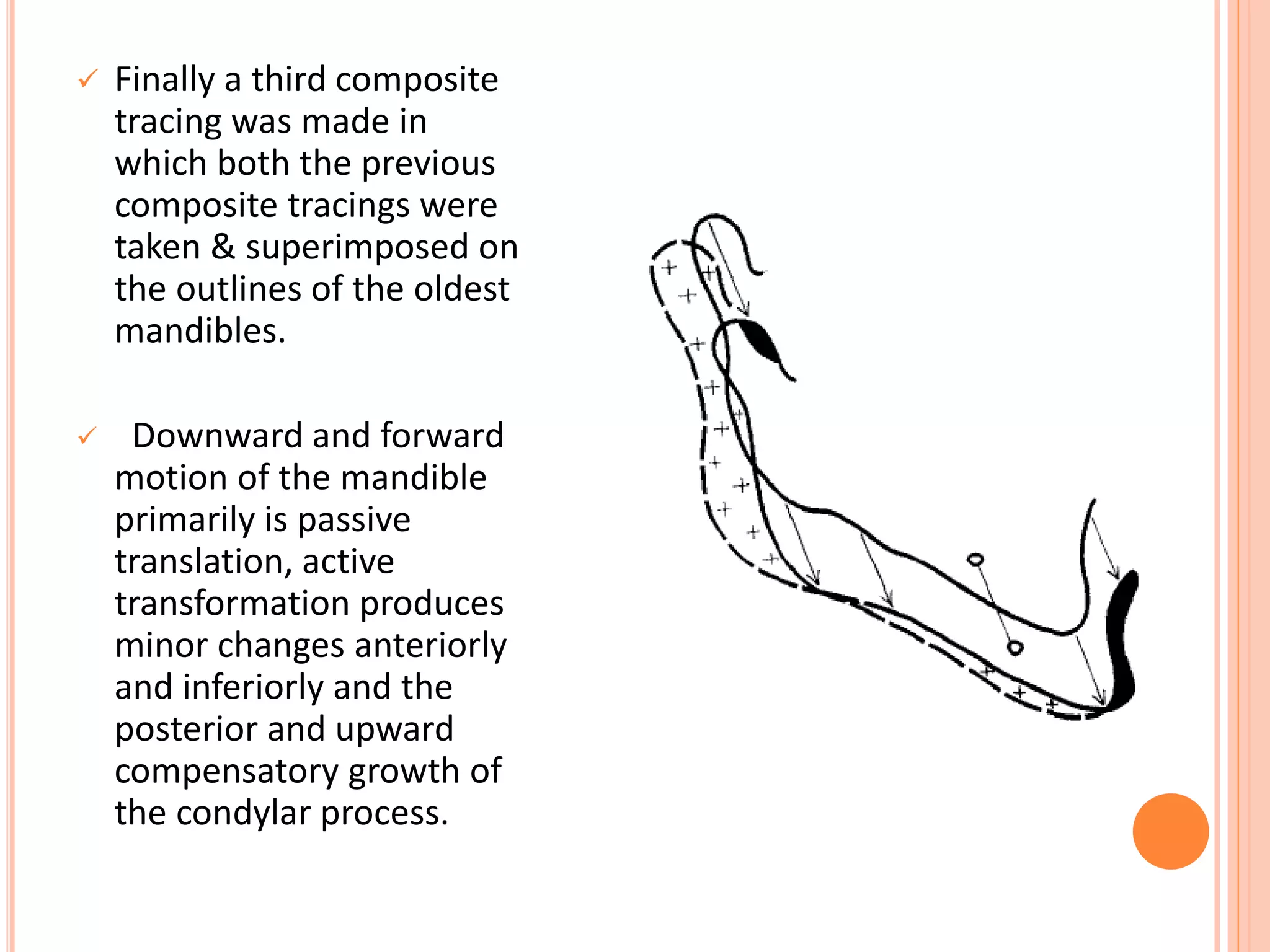
 Finally a third composite
tracing was made in
which both the previous
composite tracings were
taken & superimposed on
the outlines of the oldest
mandibles.
 Downward and forward
motion of the mandible
primarily is passive
translation, active
transformation produces
minor changes anteriorly
and inferiorly and the
posterior and upward
compensatory growth of
the condylar process.
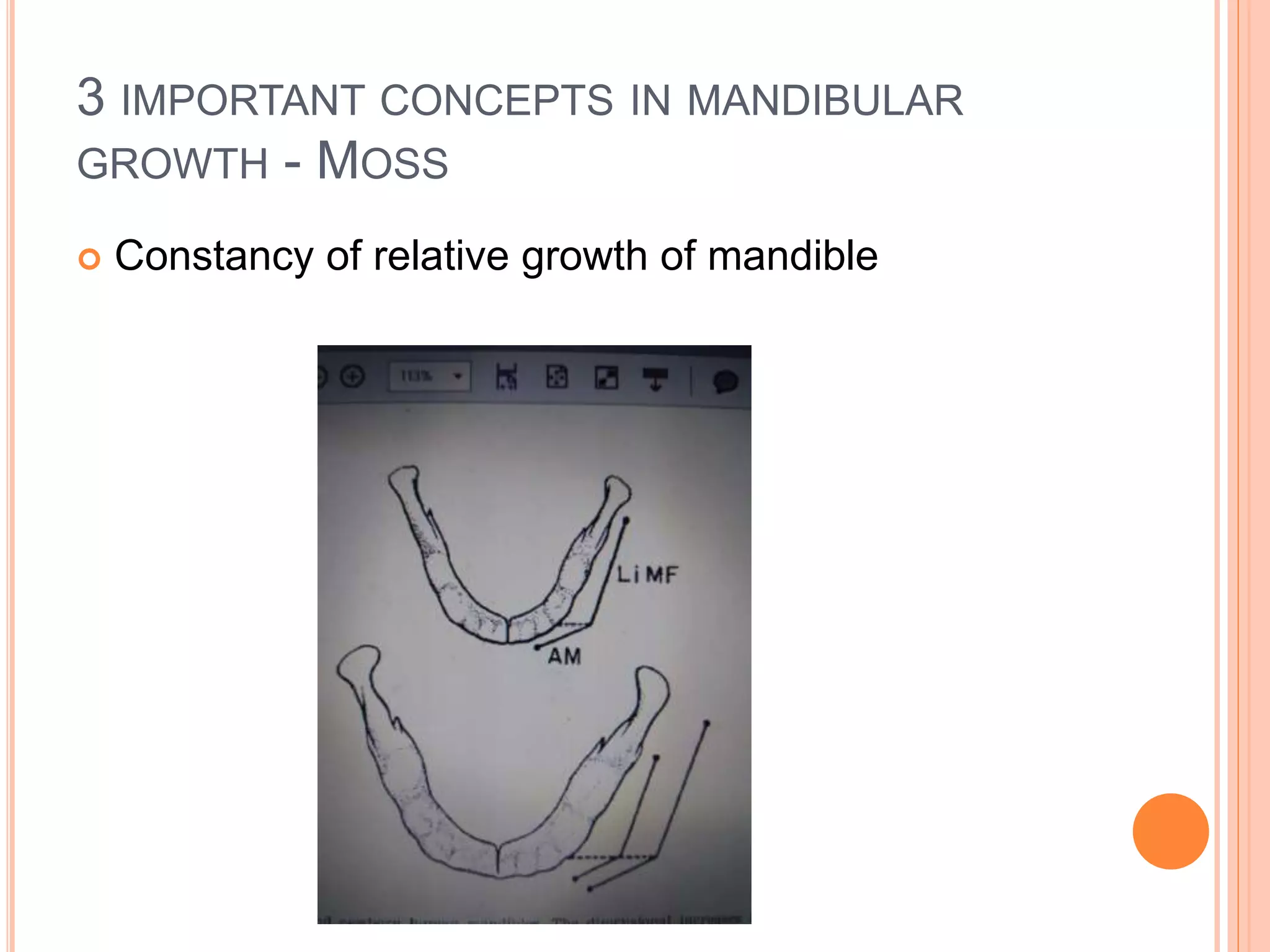
3 IMPORTANT CONCEPTS IN MANDIBULAR
GROWTH - MOSS
 Constancy of relative growth of mandible
 Absolute migration of dention through alveolar
bone- the migration is pronounced during eruption
of permanent dentition
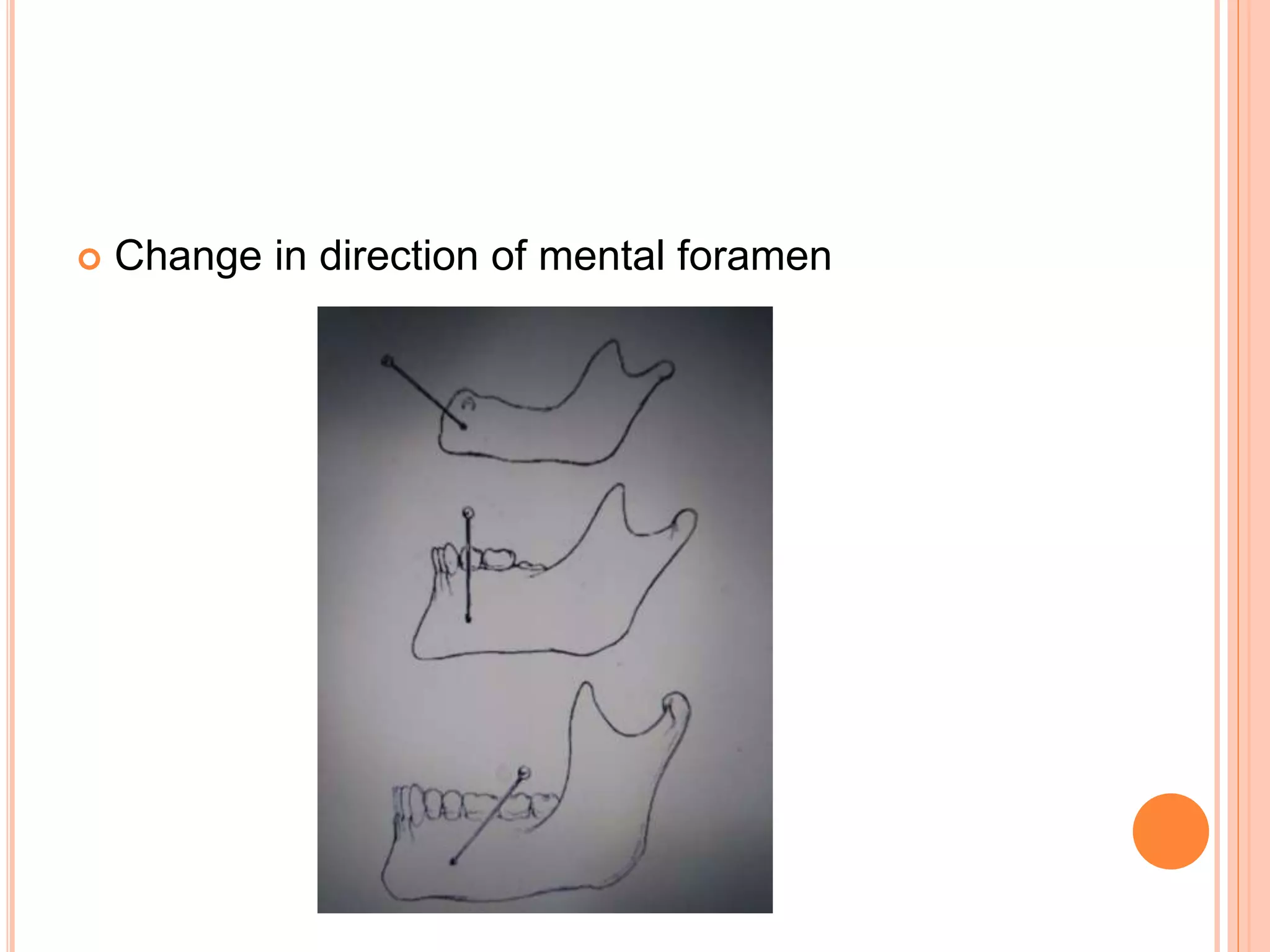
 Change in direction of mental foramen
Periosteal Matrix ------------> Skeletal Unit
[Teeth] [Alveolar Bone]
CLINICALIMPLICATIONS
Capsular Matrix -------------> Multiple Skeletal Units
[Functional Appliances] [Jaw Bones]
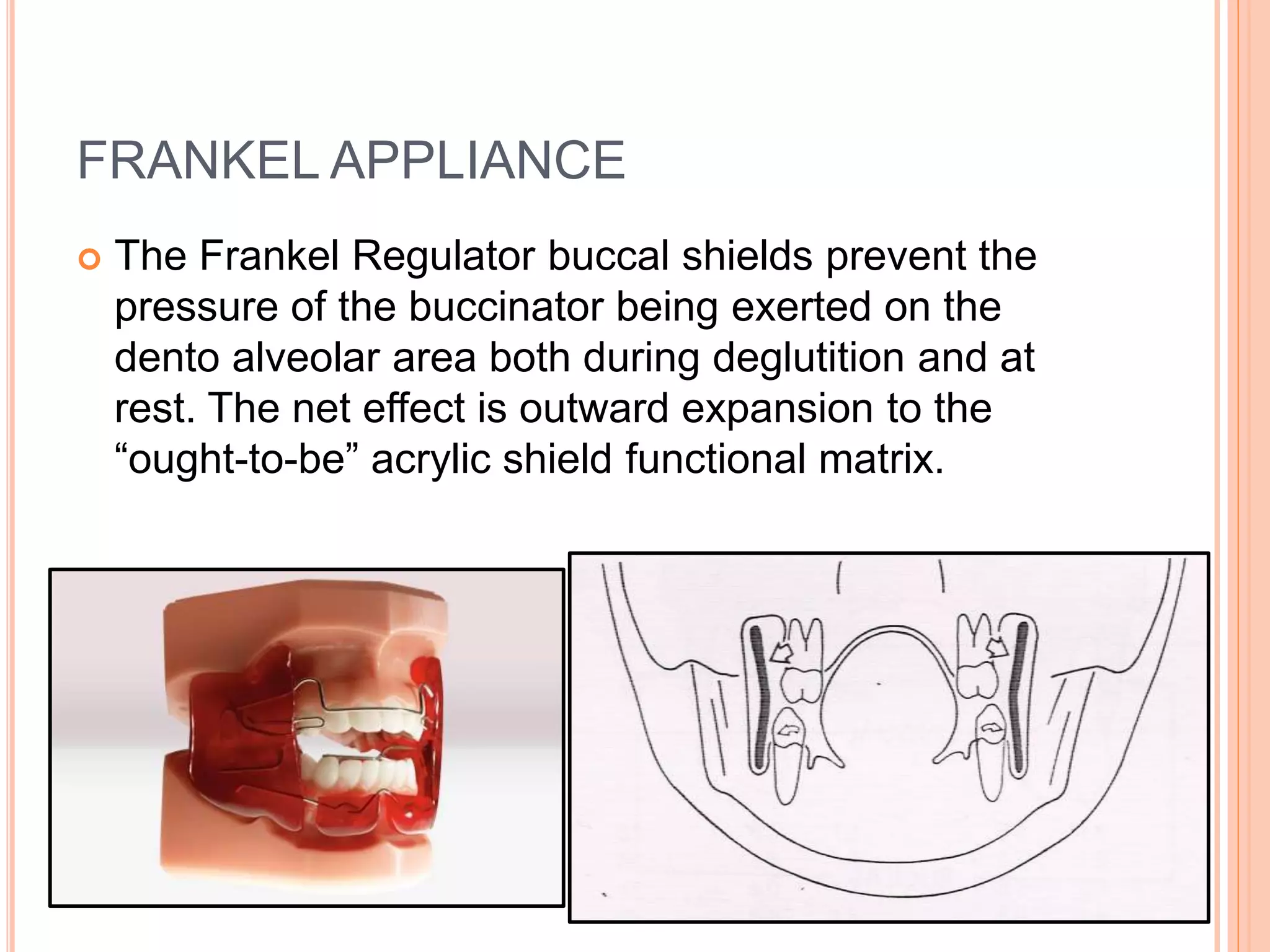
FRANKEL APPLIANCE
 The Frankel Regulator buccal shields prevent the
pressure of the buccinator being exerted on the
dento alveolar area both during deglutition and at
rest. The net effect is outward expansion to the
“ought-to-be” acrylic shield functional matrix.
DRAWBACKS.
 No clarification on as to how functional needs are
transmitted to tissues -PROFFITT
 In AJO-May 1972, Moss stated that investigations
are still going to find out various means and
process by which morphogenetic stimuli are
transmitted to their skeletal unit ,mode of
transmission, Its reception and translation.
 How the functional matrix is involved in its own
growth and development on how it is controlled.
That is, how much genome and how do the
provocative ideas of complexity and self-
organization play into this? –
• Donald Enlow
FUNCTIONAL MATRIX HYPOTHESIS -
REVISITED 1997
FMH 1- Role of Mechanotransduction
FMH 2 - Role of Osseous Connected Cellular
Network
FMH 3 - The Genomic Thesis
FMH 4 - The Epigenetic Antithesis and the
Resolving Synthesis
Am J Orthod Dentofac Orthop 1997;112
SUMMARY
 According to functional matrix hypothesis, apart
from initiating the process of development, heredity
and genetics play no active role in growth of
skeletal structures.
 Bones do not grow, bones are grown.
 Expansion of soft tissue matrix is the primary
response
REFERENCE
 Textbook of craniofacial growth- Sridhar
Premkumar
 Text book of orthodontics-T.M Graber
 The capslar matrix-melvin moss
 The functional cranial analysis of mandible
 The primary role of functional matrices in facial
growth- melvin moss
Thank You

Functional Matrix Theory

  • 1.
    FUNCTIONAL MATRIX THEORY PRESENTED BY:ZYNUL JOHN DEPARTMENT OF ORTHODONTICS AND DENTOFACIAL ORTHOPAEDICS
  • 2.
    LEARNING OBJECTIVES  Varioustheories of growth  Functional matrix theory  Clinical implications
  • 3.
    CONTENTS  Introduction  Varioustheories of growth  Functional matrix theory  Drawbacks  Clinical implications  Summary  reference
  • 4.
    INTRODUCTION  Growth isstrongly influenced by genetic factors, but it can also be significantly affected by the environment, in the form of nutritional status, degree of physical activity, health or illness and a no. of similar factors.  Since a major part of the need for the orthodontic treatment is created by disproportionate growth of the jaws, it is necessary to learn how skeletal growth is influenced and controlled to understand the etiologic processes of malocclusion and dentofacial deformity
  • 5.
    THEORIES OF BONEGROWTH  Bone remodelling theory(Brash)  Genetic theory(Brodie)  Sutural theory(Sicher and Weinnman)  Cartilaginous theory(James Scott )  Functional matrix theory(Melvin Moss)  Servo system theory(Alexandre Petrovic)  Neurotrophism( Behrents)  Enlows V principle of growth.
  • 6.
    FUNCTIONAL MATRIX HYPOTHESIS Van der Klaaw was a professor of descriptive zoology whose most important contribution is the introduction of new concept- functional cranial component.  Influenced by this work, Melvin Moss in 1960s put forward the Functional Matrix Theory. The origin, growth and maintenance of all skeletal tissues and organs are always secondary, compensatory and obligatory to temporally and operationally prior events or process that occur in specifically related non-skeletal tissues, organs or functional spaces (Functional matrices).”
  • 7.
     He theorizesthat growth of the face occurs as a response to functional needs and is mediated by soft tissues in which jaws are embedded.  In this conceptual view- the soft tissues grow and both bone and cartilage react.  Operationally, the head is a region within which certain functions occur. Every function is completely carried out by certain hard and soft tissues: SKELETAL UNIT FUNCTIONAL MATRIX TOTALITY OF SKELETAL, SOFT TISSUES AND FUNCTIONAL SPACES NECESSARY TO CARRY OUT A FUNCTION IS “ FUNCTIONAL CRANIAL COMPONENT
  • 8.
    FUNCTIONAL CRANIAL COMPONENT SKELETALUNITFUNCTIONAL MATRIX MICROSKELETAL EG: CORONOID PROCESS, ANGULAR. MACROSKELETAL EG: MANDIBLE MAXILLA PERIOSTEAL MATRIX EG: TEETH MUSCLES CAPSULAR MATRIX EG: OROFACIAL
  • 9.
    SKELETAL UNIT  Bonystructures that support functional matrix  Skeletal unit provides necessary biochemical role of providing protection and support to soft tissue matrix MICROSKELETAL UNIT MACROSKELETAL UNIT
  • 10.
    MICROSKELETAL UNIT  Asingle bone may be composed of number of skeletal units, termed as microskeletal unit.  Their growth is influenced by periosteal matrices. coronoid condyle ramus body alveolar
  • 11.
    MACROSKELETAL UNIT  Whenadjoining portion of number of bones are united to function as a single cranial component. MAXILLA MANDIBLE
  • 12.
    FUNCTIONAL MATRICES  Functionalmatrix refers to all the soft tissues and spaces that perform a given function. PERIOSTEAL MATRIX CAPSULAR MATRIX
  • 13.
    PERIOSTEAL MATRIX  Allnon skeletal functional unit adjacent to skeletal unit forms periosteal matrices.  They act actively by means of osseous deposition and resorption.  They act to alter the size and shape of the bones. The growth process is transformation.
  • 14.
    TEMPORALIS MUSCLE CORONOIDPROCESS LATERAL PTERYGOID CONDYLAR PROCESS MASSETER AND ANGULAR PROCESS MEDIAL PTERYGOID TEETH ALVEOLAR BONE INFERIOR ALVEOLAR NEUROMUSCULAR TRIAD BASAL BONE
  • 15.
    FUNCTIONAL CRANIAL ANALYSISOF CORONOID PROCESS IN RAT  63 Columbia-Sherman rats were used .  All were operated on the 11th postnatal day & sacrificed from 2 – 43 days, postoperatively at intervals from 1 - 3 days.  The middle & posterior fibers of left temporalis were removed. Source: Functional cranial analysis of coronoid process in rat: MELVIN MOSS AND MARY-ANN MEEHAN
  • 16.
    RESULTS  First fivepostoperative days - slight diminution in size, while form remained unchanged. - very slight reduction in trabeculae  The 6th post operative day - marked reduction in size - upper surface of process affected - trabeculae exposed  In all later stages coronoid was markedly reduced, now seen only as a slight bump
  • 17.
     In fewcases, middle portion of muscle was not completely removed . Though it showed reduction in size and shape but it was recognisable.
  • 18.
    The dependence ofthe coronoid process (skeletal unit) upon the demands of its functional matrix (temporalis muscle) is shown in these alterations in size and shape following unilateral muscle resection 14TH POST-OPERATIVE DAY 18TH POST-OPERATIVE DAY 23RD POSTOPERATIVE DAY
  • 19.
     So, thepoint is the coronoid process does NOT grow first and thus provide a "platform" upon which the temporalis muscle can then alter its functions.  The total growth changes in all aspects of coronoid process form (size and shape) are at all times a direct and compensatory response to the morphogenetically prior demands of the temporalis muscle function.
  • 20.
    CAPSULAR MATRIX  Organsand spaces that occupy a broader anatomic complex.  Each capsule is an envelope that contains series of functional cranial component, skeletal unit and their related functional matrices.  Capsular matrix do not act by process of active resorption and deposition.  They act passively on macroskeletal unit by producing its secondary translation in space. Eg: neurocranial space orofacial space
  • 21.
    OROFACIAL CAPSULE CORONOID CONDYLAR ALVEOLARPROCESS BASAL BONE ANGULAR LATERAL PTERYGOIDTEMPORALIS MEDIAL PTERYG OID MASSETOR TOOTH BUD ENLARGING CAPSULE
  • 22.
    NEUROCRANIAL CAPSULE  Asthe capsule enlarges, whole of included and enclosed periosteal matrices and microskeletal units are carried outward in a passive manner.
  • 23.
    OROFACIAL CAPSULE OROFACIAL CAPSULE GROWS PERIOSTEAL MATRIXRESPONDS TO THIS VOLUMETRIC EXPANSION THIS THEN ELICITS CHANGES IN MICROSKELETAL UNIT The growth of all orofacial skeletal units is a combination of the two types of growth process discussed above – periosteal and capsular, transformative and translative, changes in size and shape, and changes in spatial position. GROWTH IN RESPONSE TO FUNCTIONAL NEEDS
  • 24.
    FUNCTIONAL CRANIAL ANALYSISOF MAXILLA o Head is a composite structure, operationally consisting a no.of independent functions : Olfaction, Respiration, Vision, Digestion, Speech, etc. o The facial bones are passively carried outwards by the primary expansion of the enclosed matrices.this causes adaptive fill in response. ( e.g. : orbital, nasal, oral matrices ) .
  • 25.
  • 26.
    There are threetypes of bone growth changes to be observed in the maxilla : 1. First, those associated with passive motions of bone associated with primary expansion of the orofacial capsule. 2. Secondly , changes in bone morphology associated with alterations in the absolute volume, size, shape or spatial position of maxillary functional matrices, such as the orbital mass. 3. Finally there are bone changes associated with the maintenance of the form of the bone itself.
  • 27.
    FUNCTIONALCRANIAL ANALYSIS OFMANDIBLE  The mandible is not a unitary biological object, but rather a composite of several unitary & relatively independent functional cranial components. The skeletal units corresponding to these mandibular functional components include : 1. Alveolar process 2. Coronoid process 3. Condylar process 4. Angular process 5. Body 6. Chin
  • 28.
     The mandibularcranial components arise & exist completely embedded within the capsule, they all are passively & secondarily translated in space to a new position as the capsule expands.  Such passive translations of mandibular functional cranial components as a whole, also alters the individual periosteal matrices.  This causes direct changes in the size &/or shape of their various skeletal units.  A longitudinal series of cephalometric radiographs were taken by Moss & the following structures were traced: 1. Anterior cranial base 2. External surface of mandible 3. Mental foramina
  • 29.
     First ,2 tracings were superimposed on the cranial base, Moss observed the total growth changes of the mandibular complex during this period.   Moss termed this is a Inter-Osseous Growth, i.e total growth relative to fixed anterior cranial base.
  • 30.
     Similarly asecond tracing was made superimposing the mandibular tracings on the mental foramen.  We now observe the changes in shape or size of several mandibular units which occur independently of the changes in spatial position of these same units with time.  This is termed as Intra- osseous Growth.
  • 31.
     Finally athird composite tracing was made in which both the previous composite tracings were taken & superimposed on the outlines of the oldest mandibles.  Downward and forward motion of the mandible primarily is passive translation, active transformation produces minor changes anteriorly and inferiorly and the posterior and upward compensatory growth of the condylar process.
  • 32.
    3 IMPORTANT CONCEPTSIN MANDIBULAR GROWTH - MOSS  Constancy of relative growth of mandible
  • 33.
     Absolute migrationof dention through alveolar bone- the migration is pronounced during eruption of permanent dentition
  • 34.
     Change indirection of mental foramen
  • 35.
    Periosteal Matrix ------------>Skeletal Unit [Teeth] [Alveolar Bone] CLINICALIMPLICATIONS Capsular Matrix -------------> Multiple Skeletal Units [Functional Appliances] [Jaw Bones]
  • 36.
    FRANKEL APPLIANCE  TheFrankel Regulator buccal shields prevent the pressure of the buccinator being exerted on the dento alveolar area both during deglutition and at rest. The net effect is outward expansion to the “ought-to-be” acrylic shield functional matrix.
  • 37.
    DRAWBACKS.  No clarificationon as to how functional needs are transmitted to tissues -PROFFITT  In AJO-May 1972, Moss stated that investigations are still going to find out various means and process by which morphogenetic stimuli are transmitted to their skeletal unit ,mode of transmission, Its reception and translation.
  • 38.
     How thefunctional matrix is involved in its own growth and development on how it is controlled. That is, how much genome and how do the provocative ideas of complexity and self- organization play into this? – • Donald Enlow
  • 39.
    FUNCTIONAL MATRIX HYPOTHESIS- REVISITED 1997 FMH 1- Role of Mechanotransduction FMH 2 - Role of Osseous Connected Cellular Network FMH 3 - The Genomic Thesis FMH 4 - The Epigenetic Antithesis and the Resolving Synthesis Am J Orthod Dentofac Orthop 1997;112
  • 40.
    SUMMARY  According tofunctional matrix hypothesis, apart from initiating the process of development, heredity and genetics play no active role in growth of skeletal structures.  Bones do not grow, bones are grown.  Expansion of soft tissue matrix is the primary response
  • 41.
    REFERENCE  Textbook ofcraniofacial growth- Sridhar Premkumar  Text book of orthodontics-T.M Graber  The capslar matrix-melvin moss  The functional cranial analysis of mandible  The primary role of functional matrices in facial growth- melvin moss
  • 42.

Editor's Notes

  • #5 Control of body size is an complicated affair govern by both
  • #6 Varoius attempts have been made Sutures are primary determinants Servosystem..based on feedback mechanism Neurotrphism – interact between neurons and innervated tissue which regulate the morphological changes.
  • #22 FCC Arise grows and are maintained in the f.c
  • #26 Maxilla is placed between various spaces that affects its grwoth