Col Zulfiquer Ahmed Amin
M Phil, MPH, PGD (Health Economics), MBBS
Armed Forces Medical Institute (AFMI)
DEPARTMENT
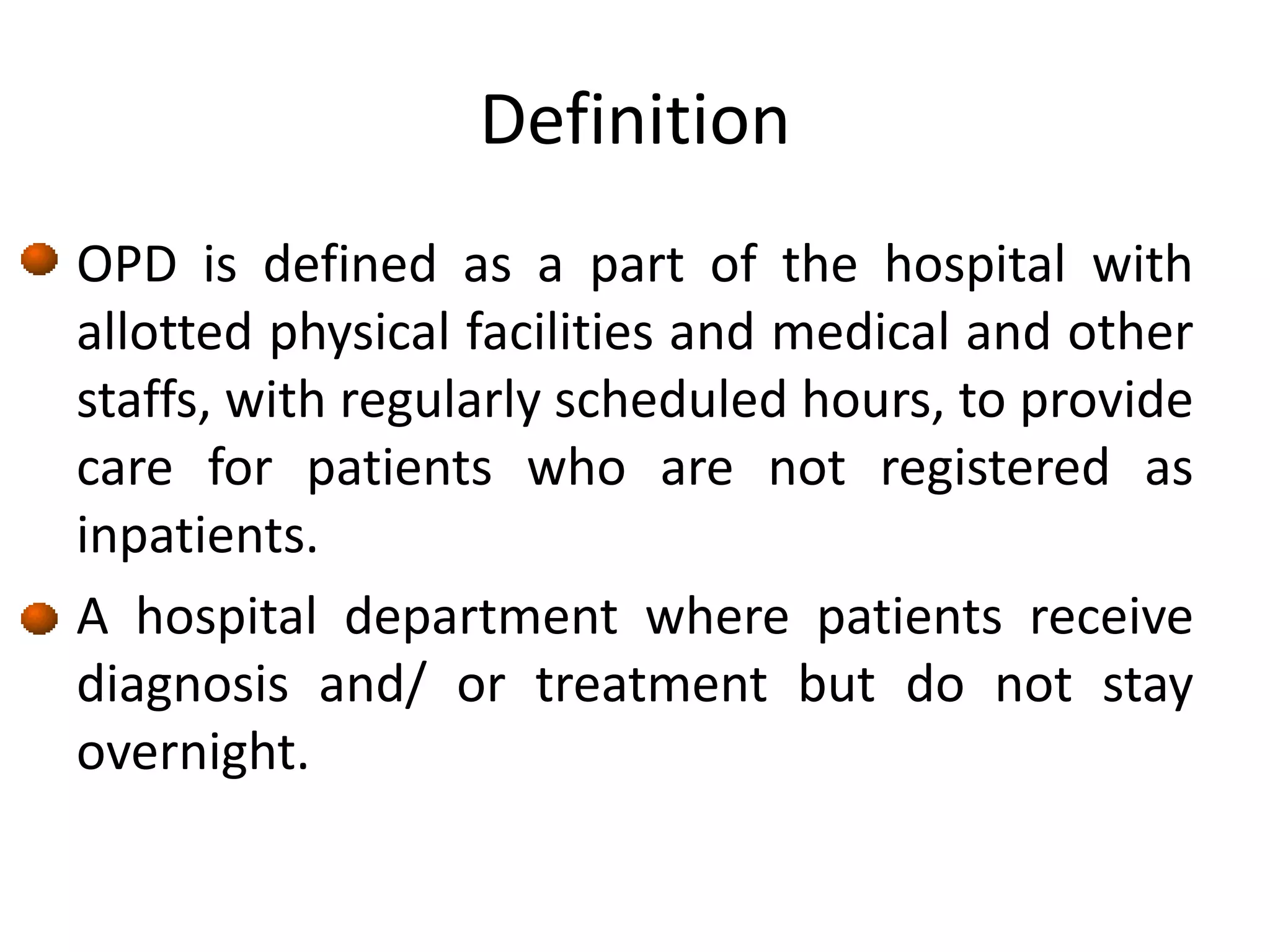
Definition
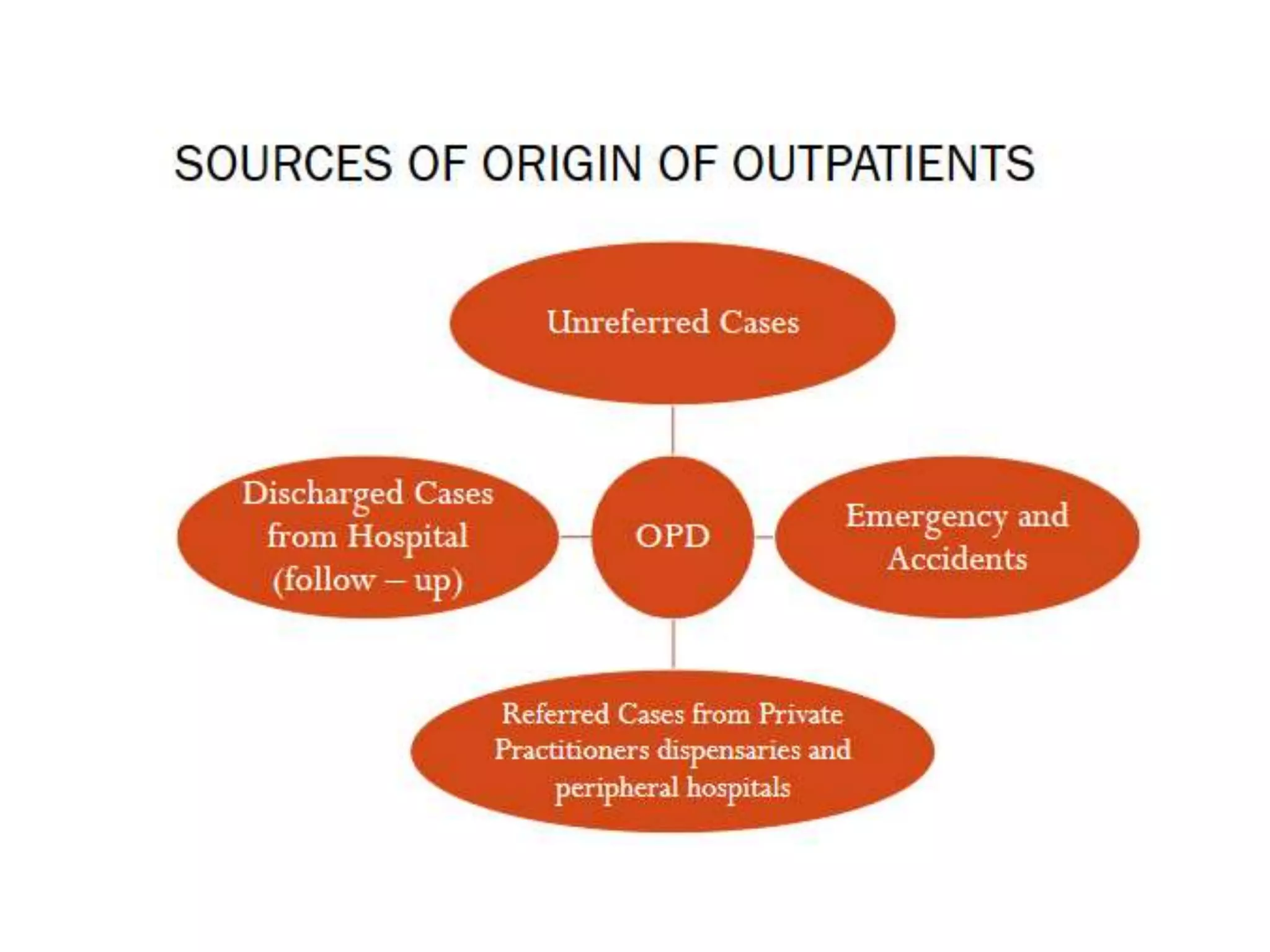
OPD is defined as a part of the hospital with
allotted physical facilities and medical and other
staffs, with regularly scheduled hours, to provide
care for patients who are not registered as
inpatients.
A hospital department where patients receive
diagnosis and/ or treatment but do not stay
overnight.
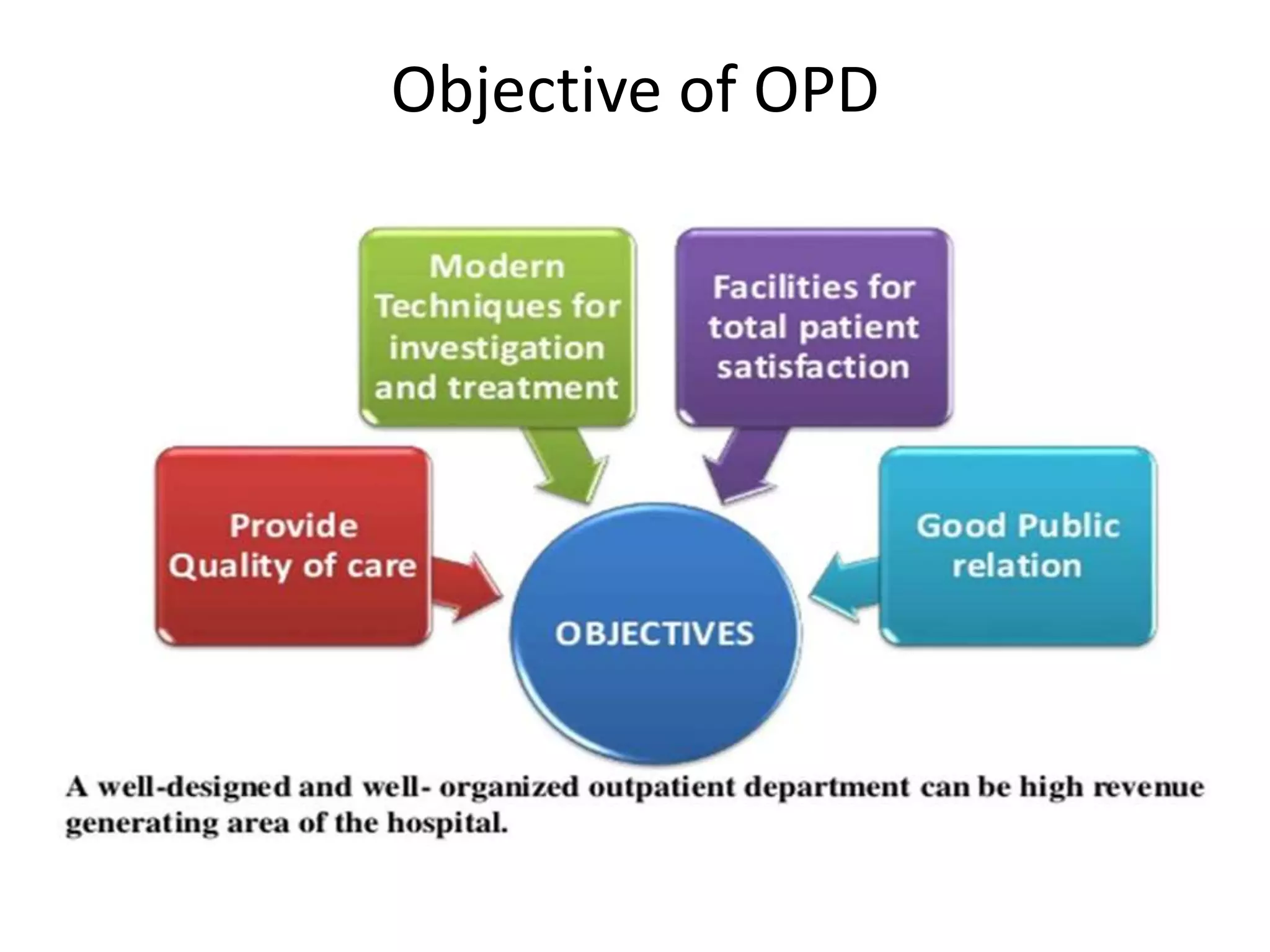
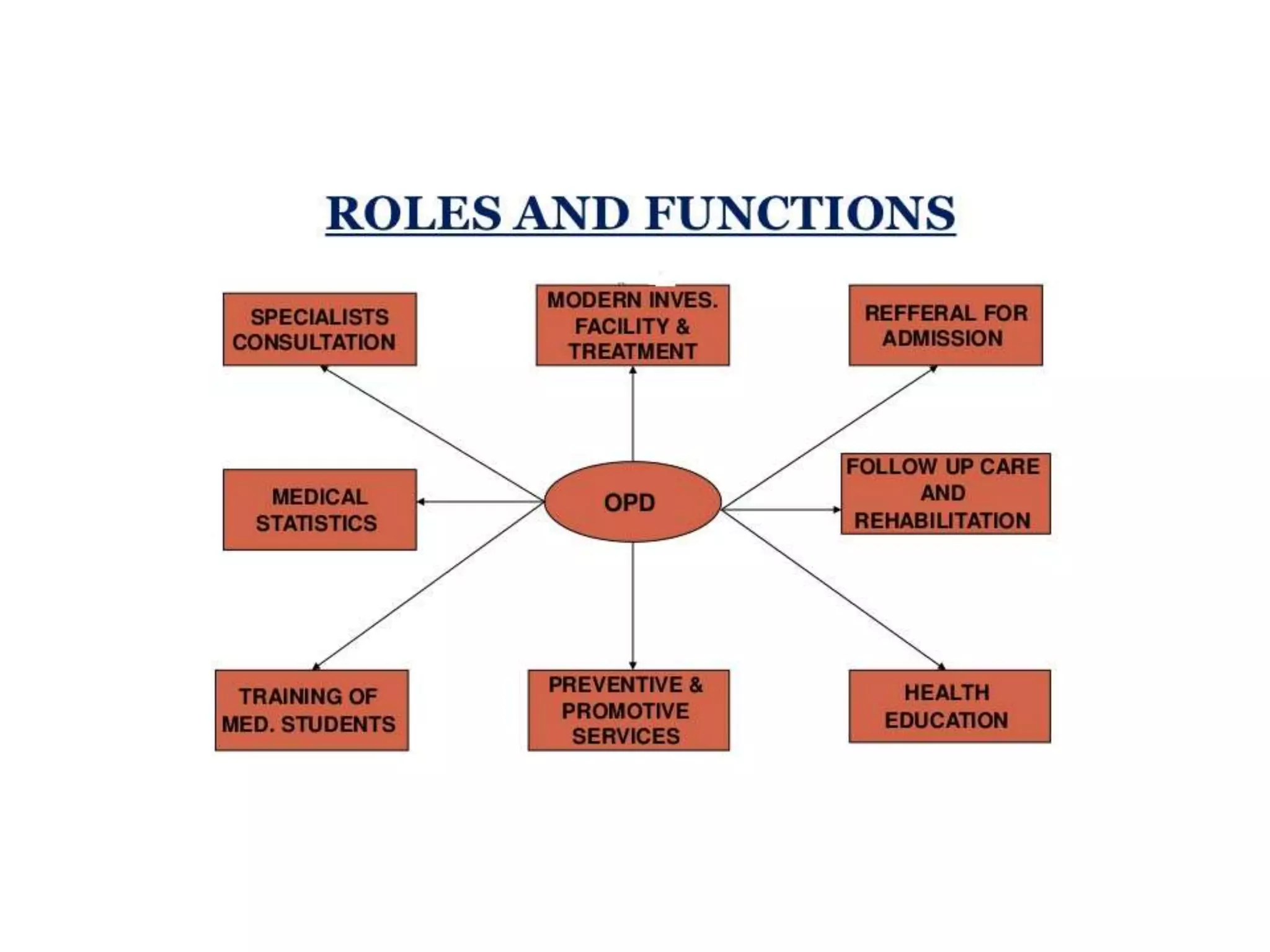
Objective of OPD
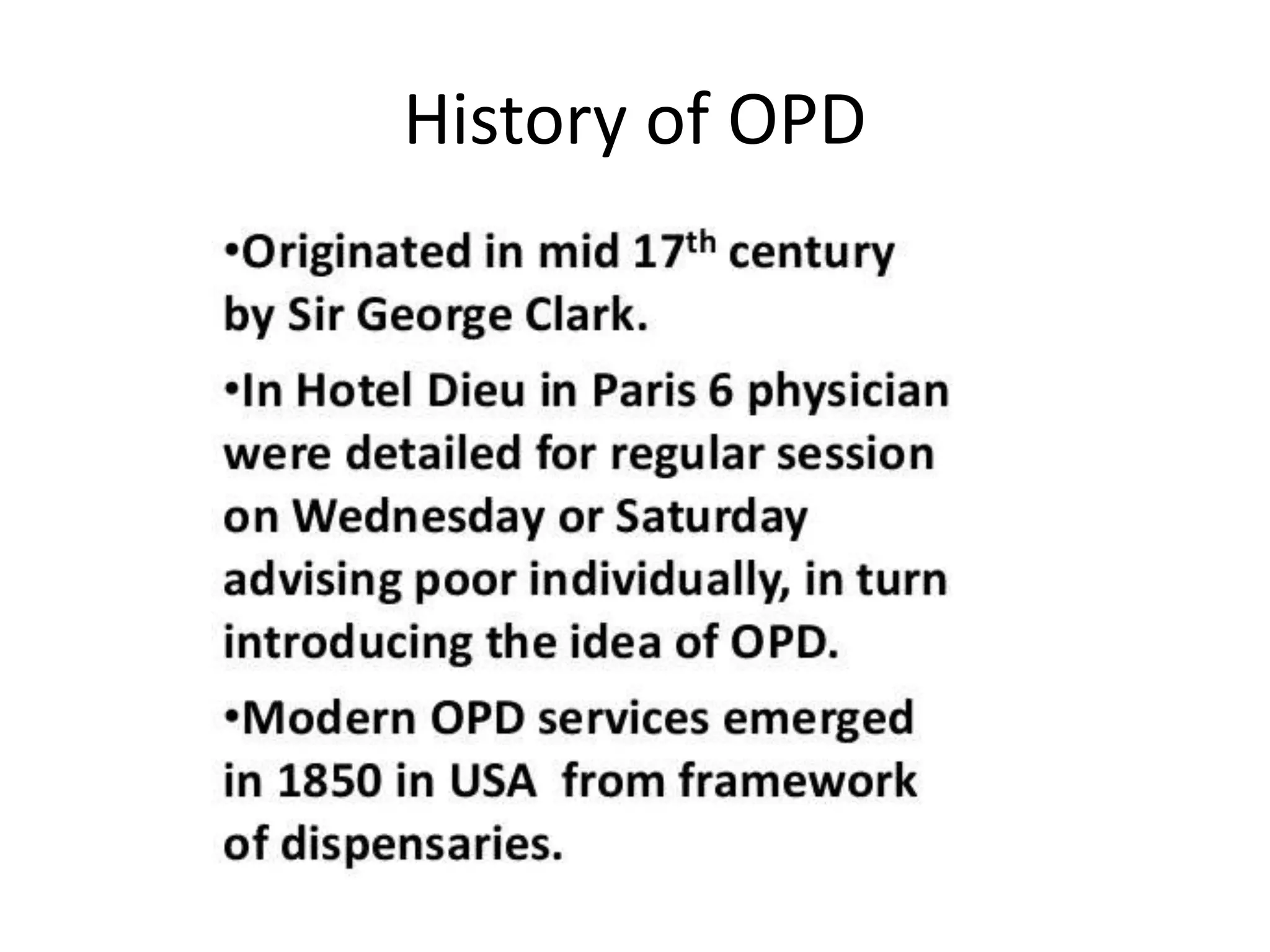
History of OPD
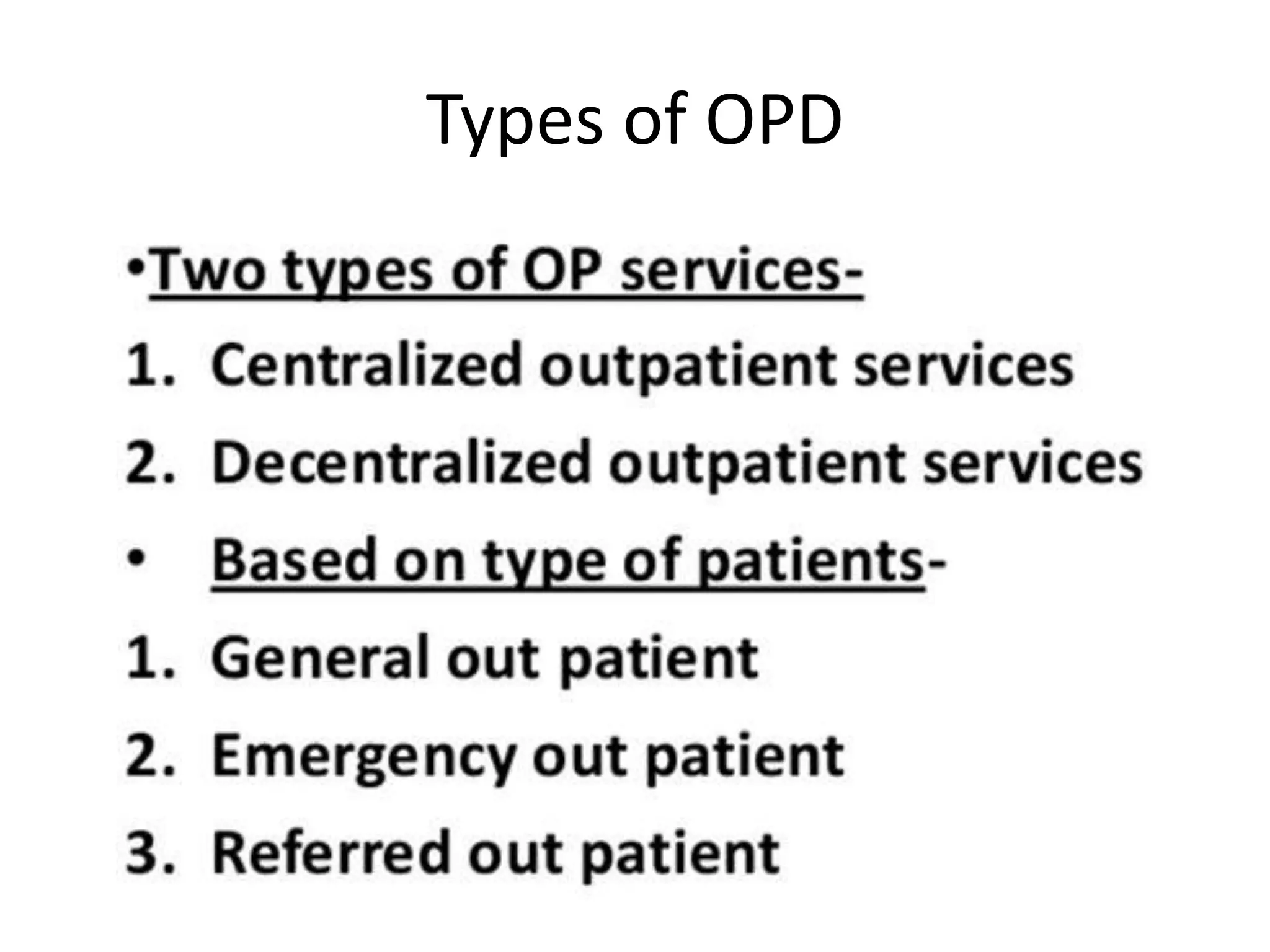
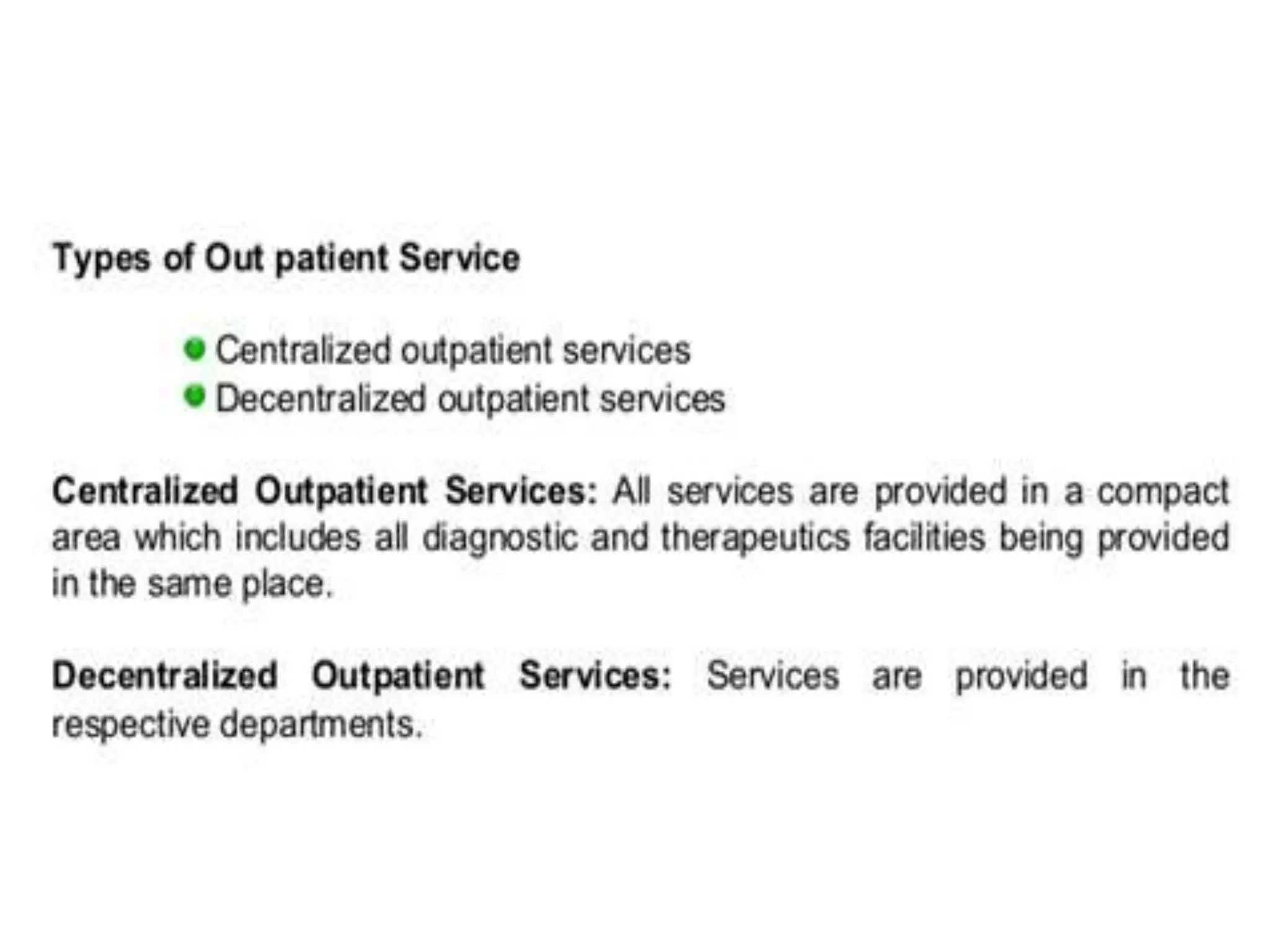
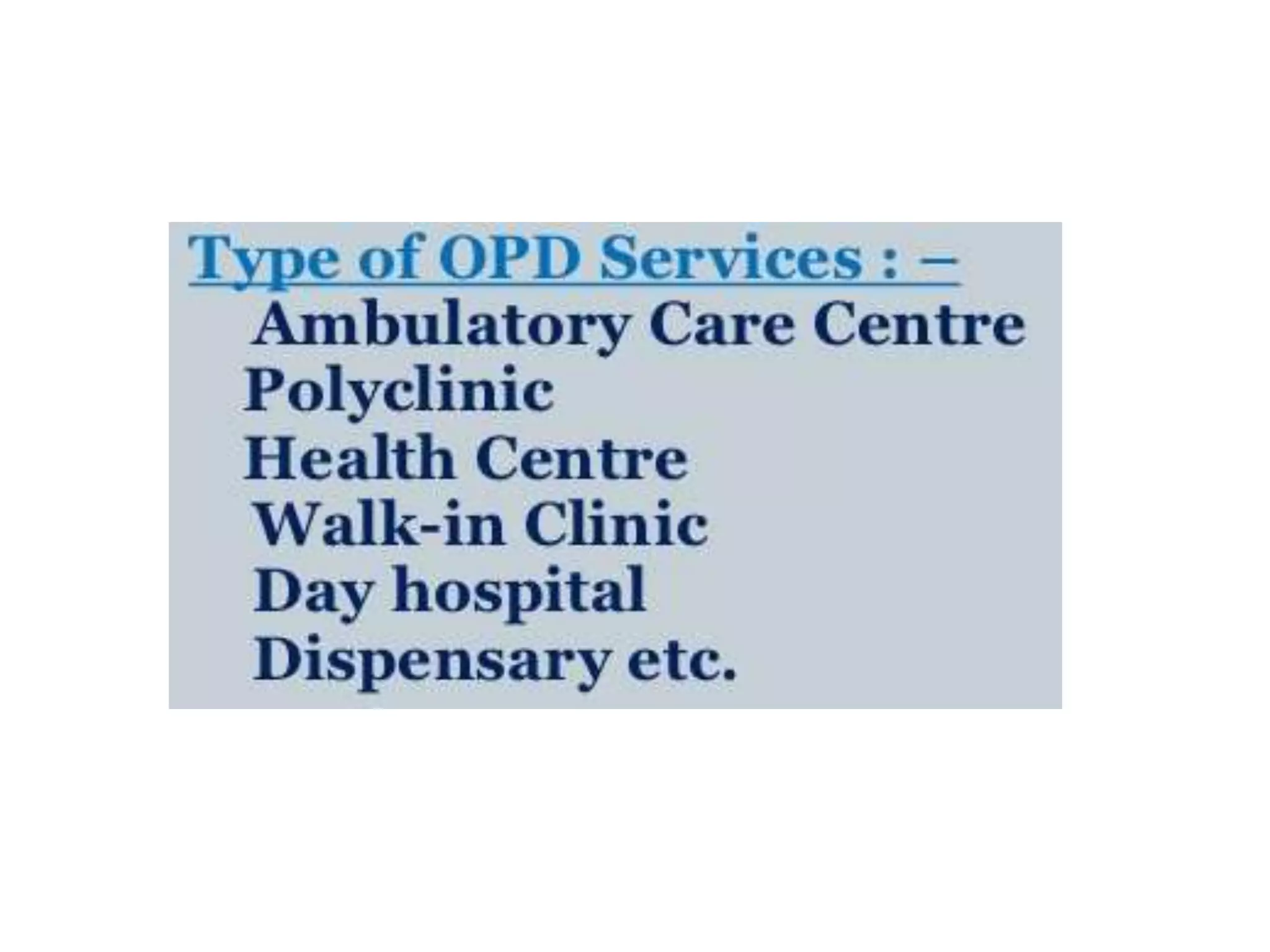
Types of OPD
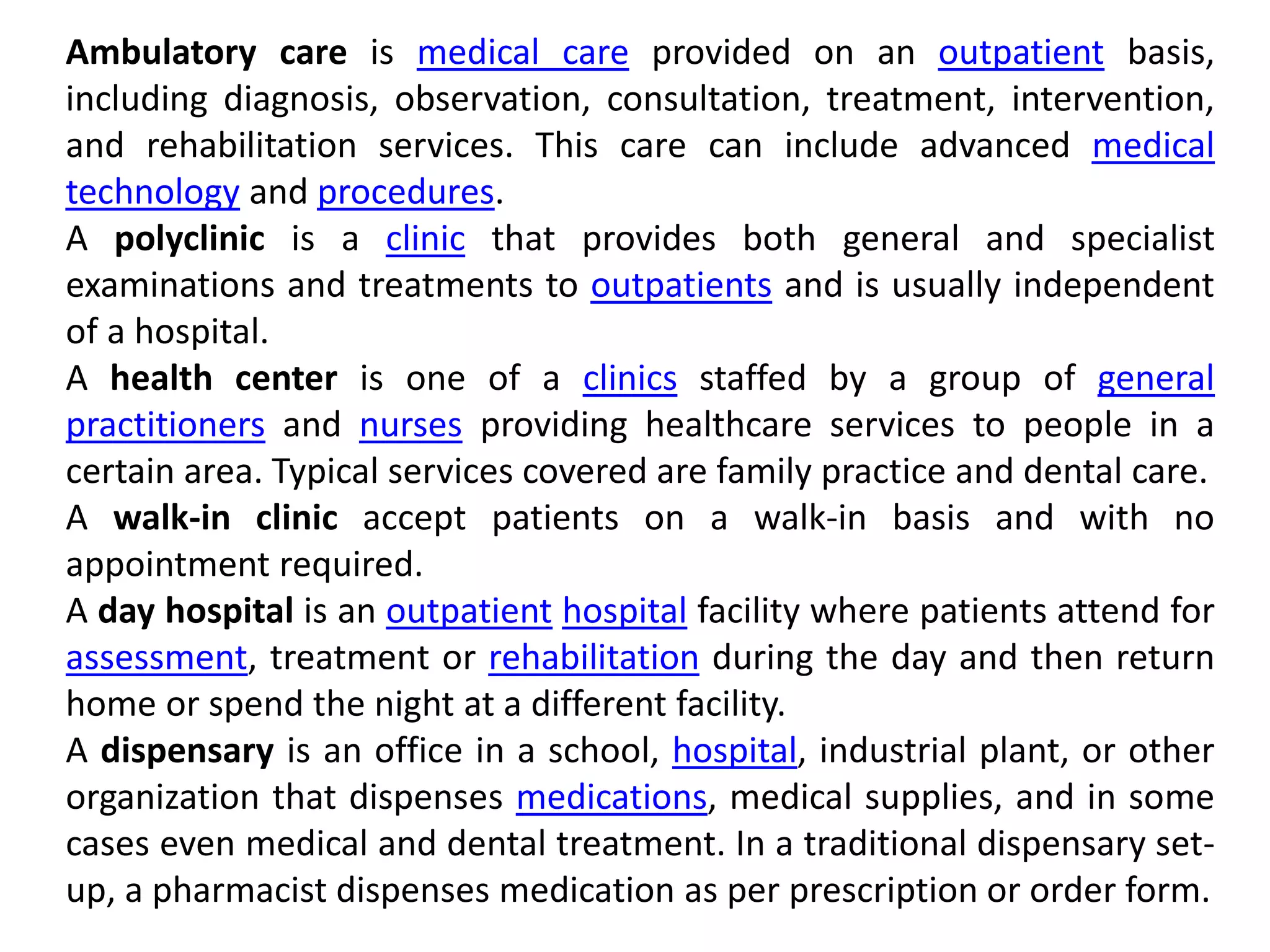
Ambulatory care is medical care provided on an outpatient basis,
including diagnosis, observation, consultation, treatment, intervention,
and rehabilitation services. This care can include advanced medical
technology and procedures.
A polyclinic is a clinic that provides both general and specialist
examinations and treatments to outpatients and is usually independent
of a hospital.
A health center is one of a clinics staffed by a group of general
practitioners and nurses providing healthcare services to people in a
certain area. Typical services covered are family practice and dental care.
A walk-in clinic accept patients on a walk-in basis and with no
appointment required.
A day hospital is an outpatient hospital facility where patients attend for
assessment, treatment or rehabilitation during the day and then return
home or spend the night at a different facility.
A dispensary is an office in a school, hospital, industrial plant, or other
organization that dispenses medications, medical supplies, and in some
cases even medical and dental treatment. In a traditional dispensary set-
up, a pharmacist dispenses medication as per prescription or order form.
Facilities of OPD
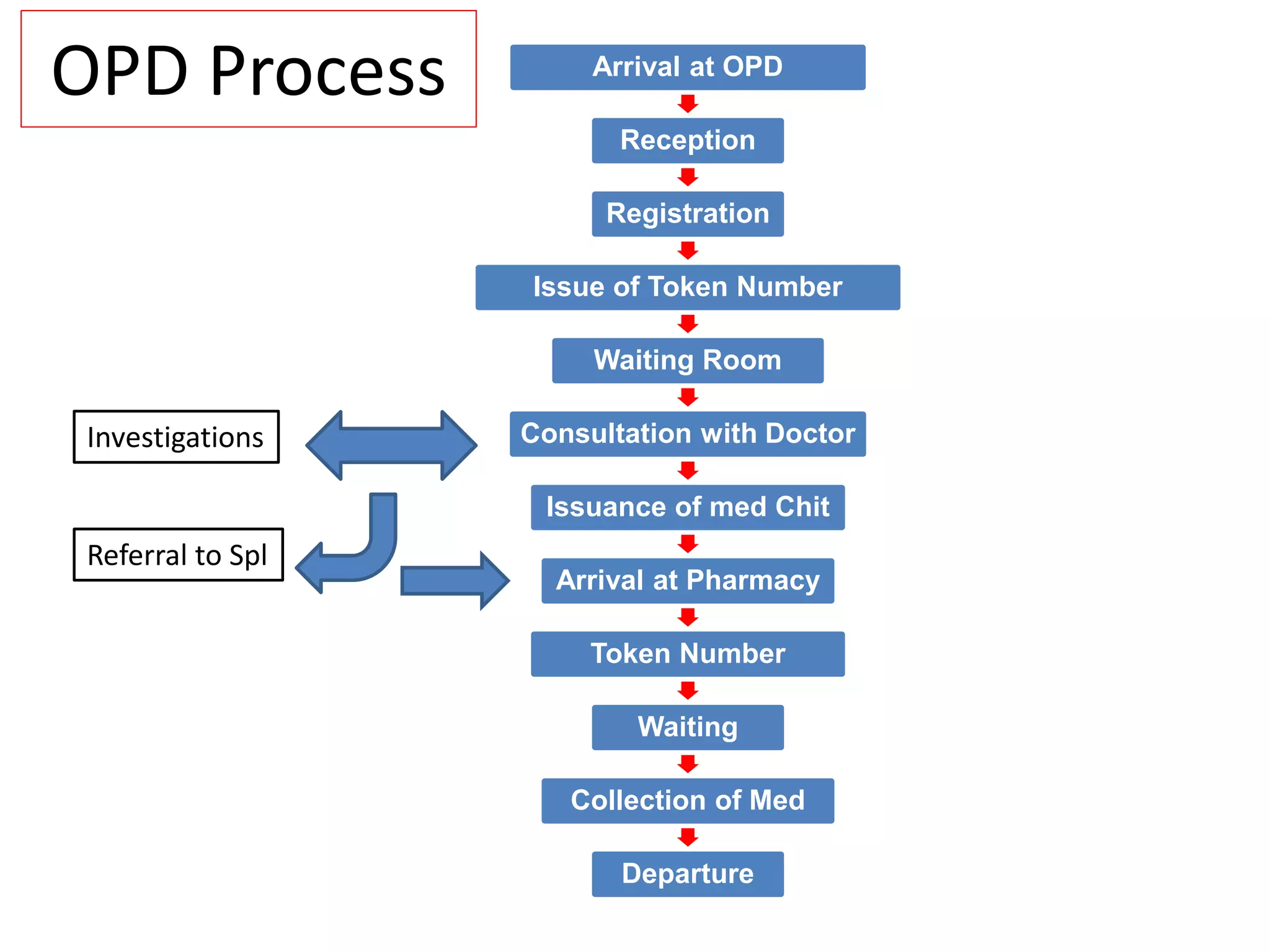
OPD Process Arrival at OPD
Reception
Registration
Issue of Token Number
Waiting Room
Consultation with Doctor
Issuance of med Chit
Arrival at Pharmacy
Token Number
Waiting
Collection of Med
Departure
Investigations
Referral to Spl
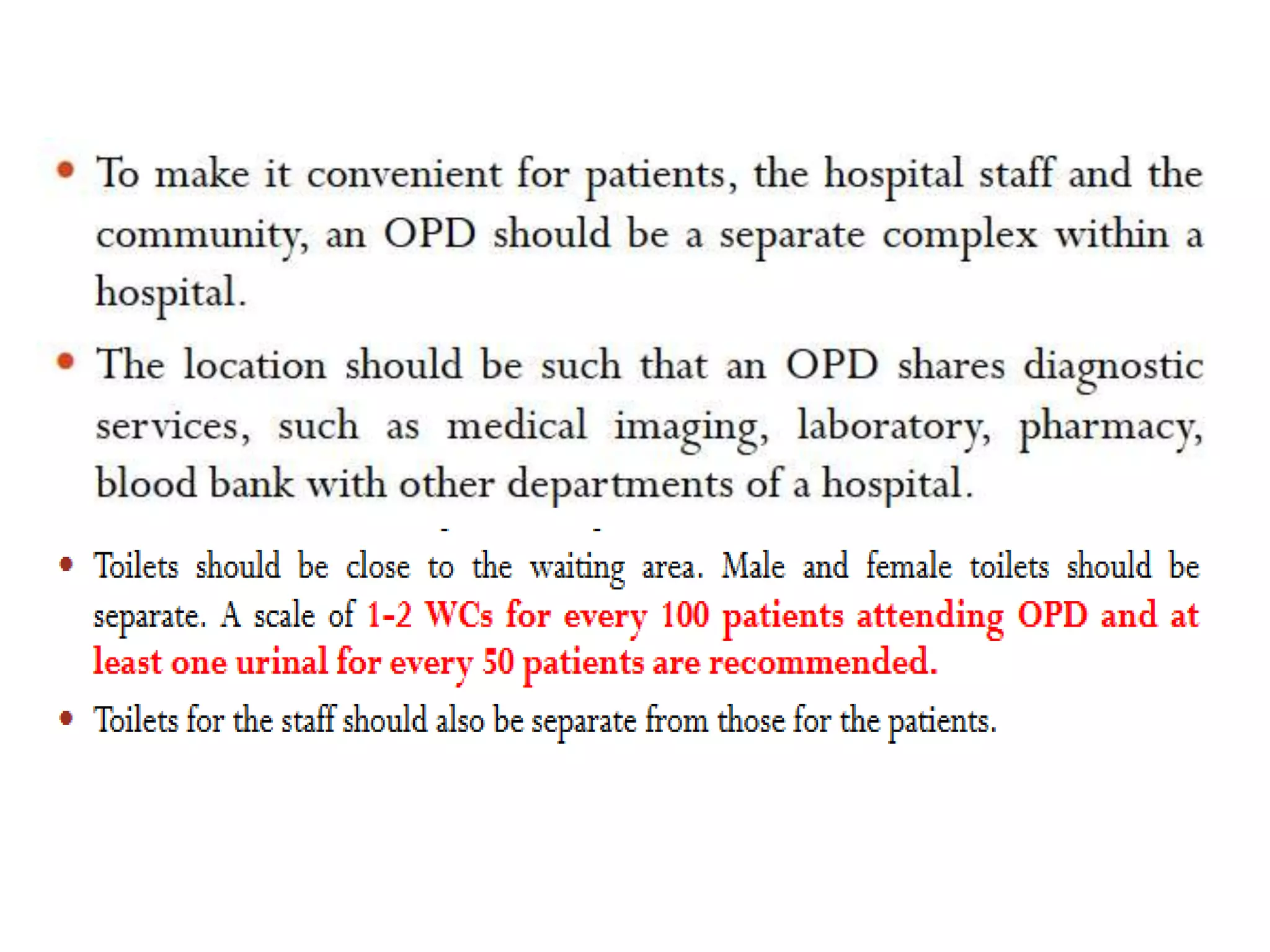
• OPD has functional and administrative links with
the hospital of which it is a part.
• It may also be linked with Health Centers,
Satellite Clinics and Dispensaries dependent on it.
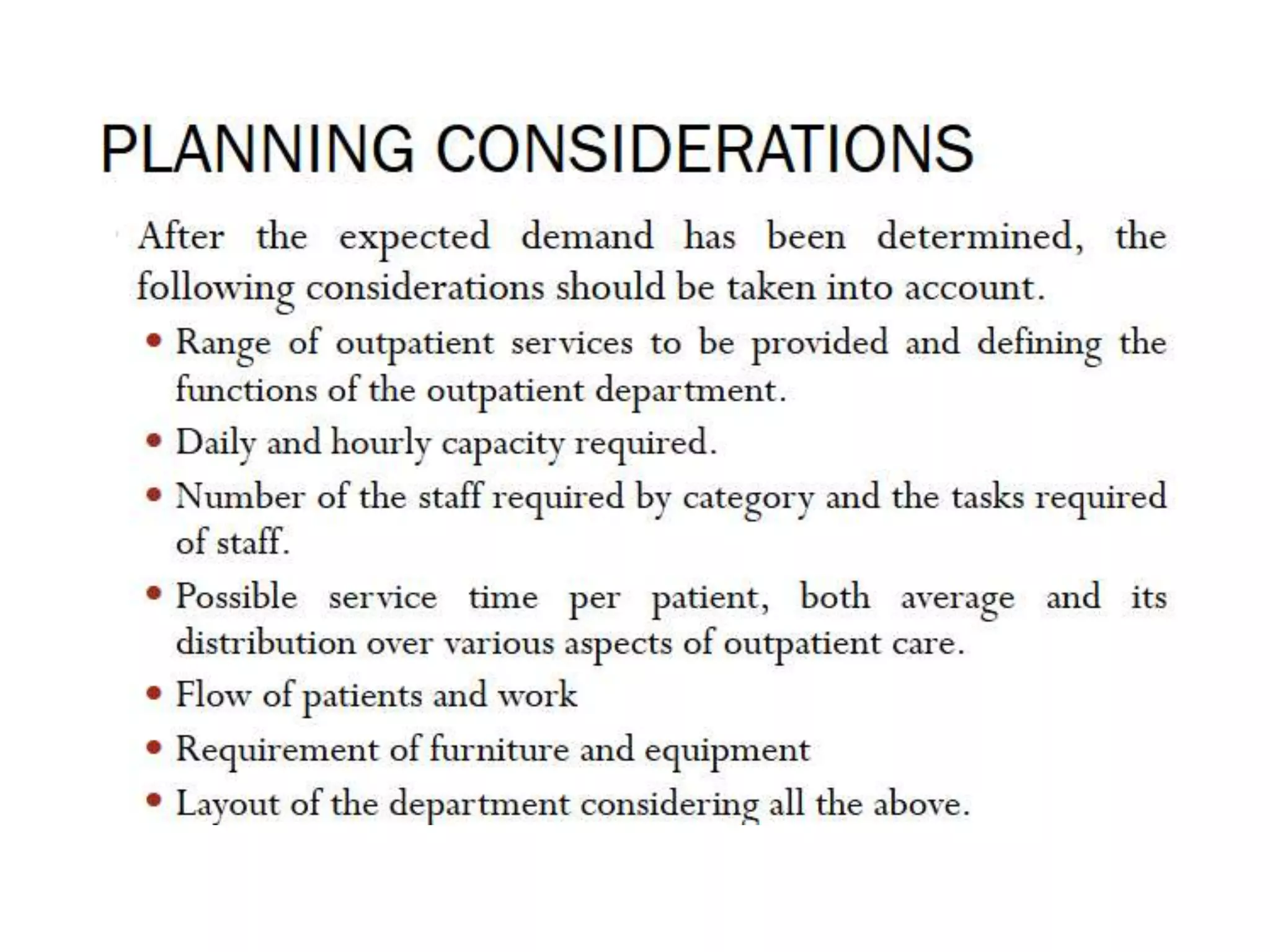
• Expected demand should be determined basing
on catchment area and population to be served.
• Should include curative, preventive and
promotive health services
OPD Planning
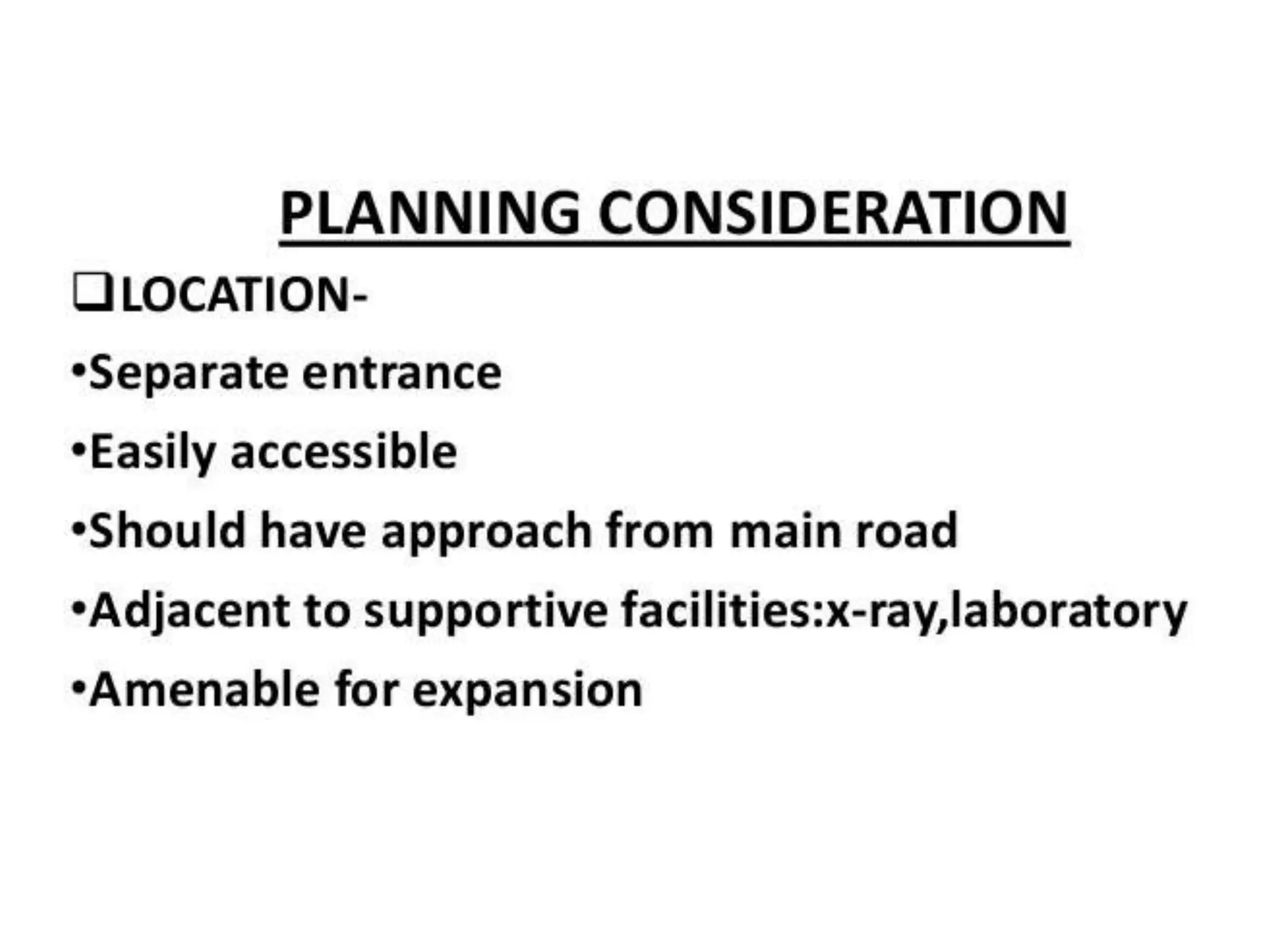
Design Consideration
Requirements for OPD
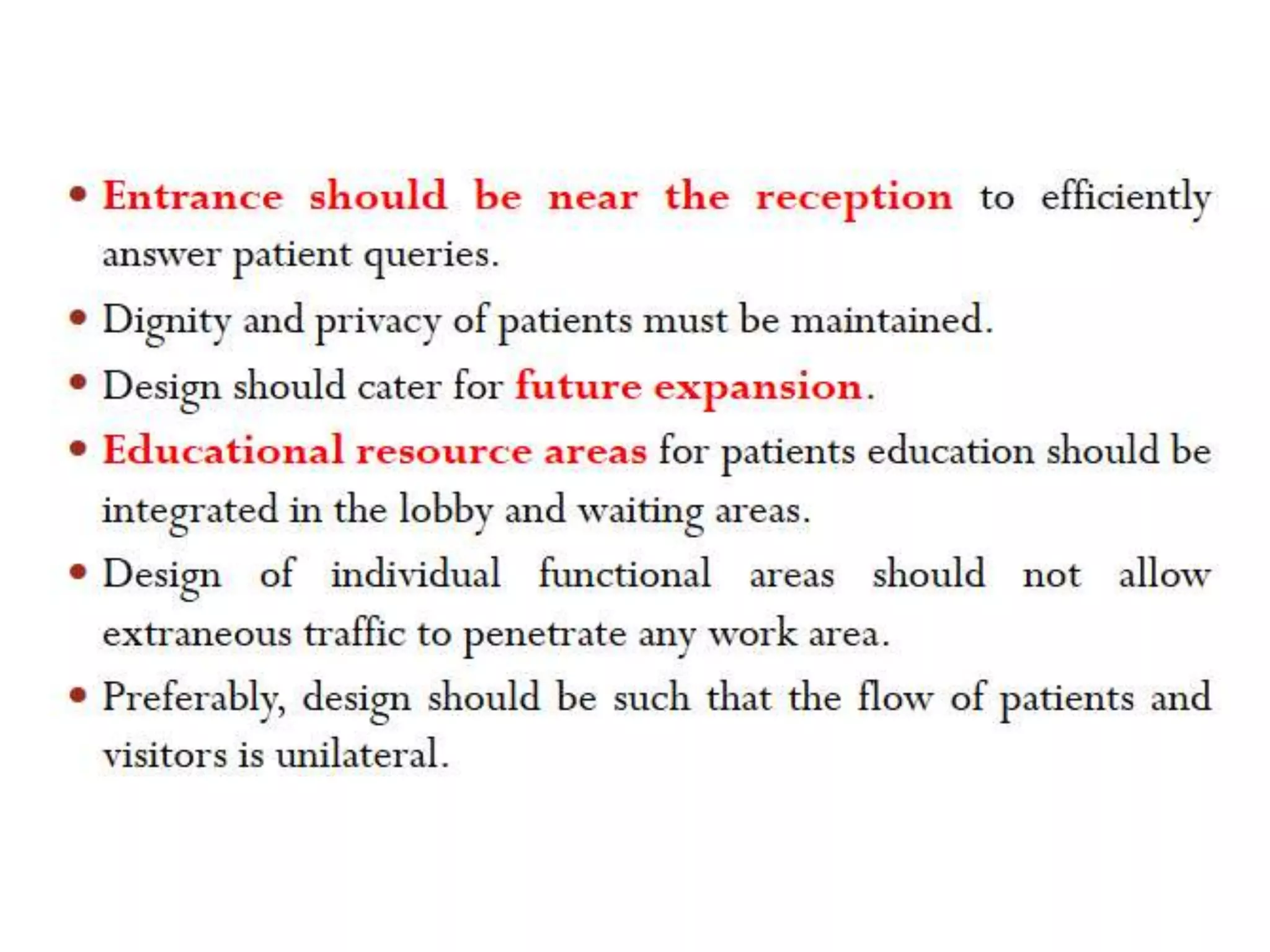
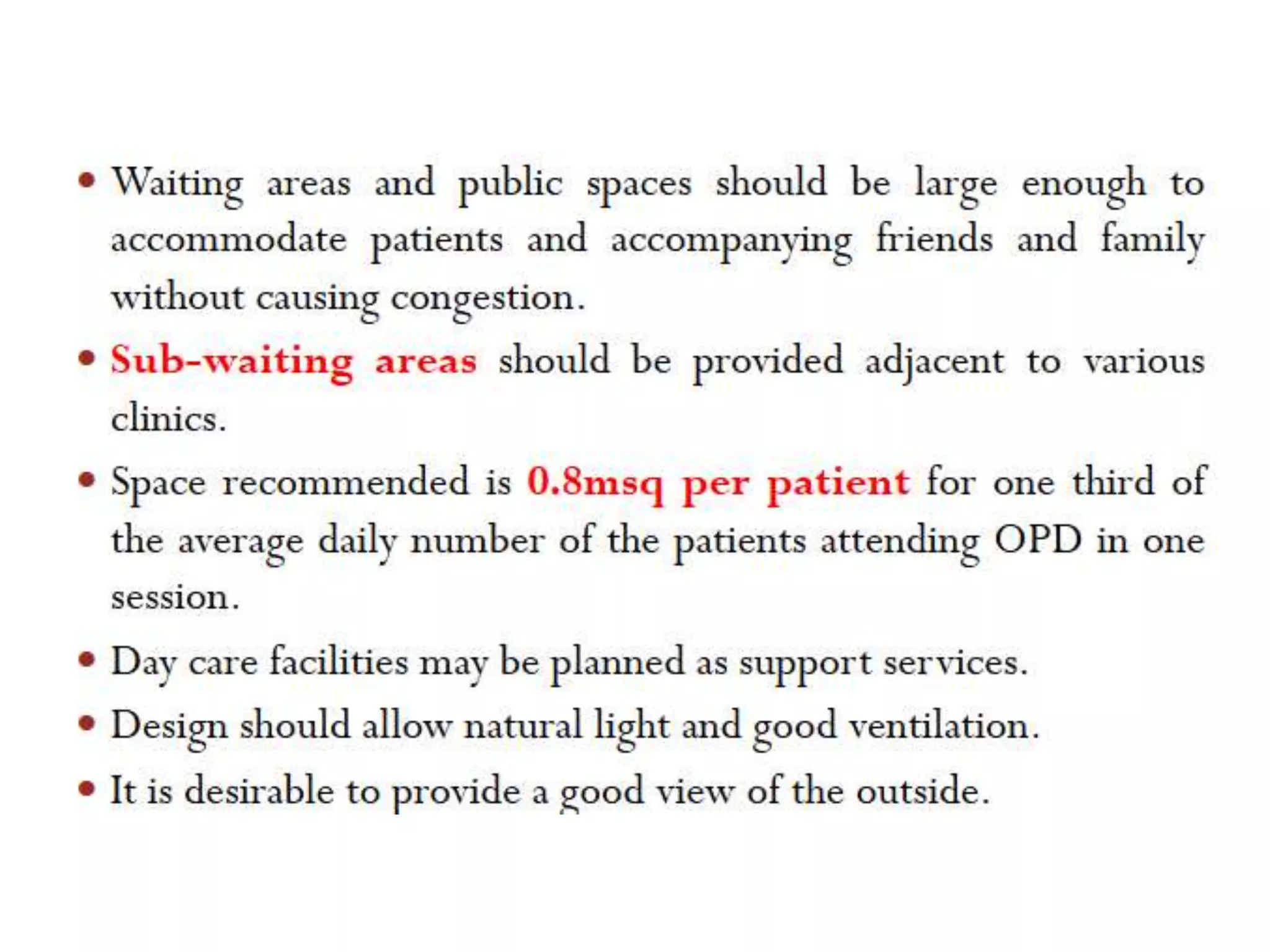
• 60% of area should be for waiting and corridors.
• Seats for 1/3 of daily attendance @ 8 sq ft/pt.
• Consultation room – 150 sq ft
• Attached examination room – 80 sq ft
Projection of Out-Patient Load
• For every hospital bed, 1.5 to 3 patients attend OPD
• 1-10 visits per capita per year of the dependent population
basis
Organogram of OPD
/CO
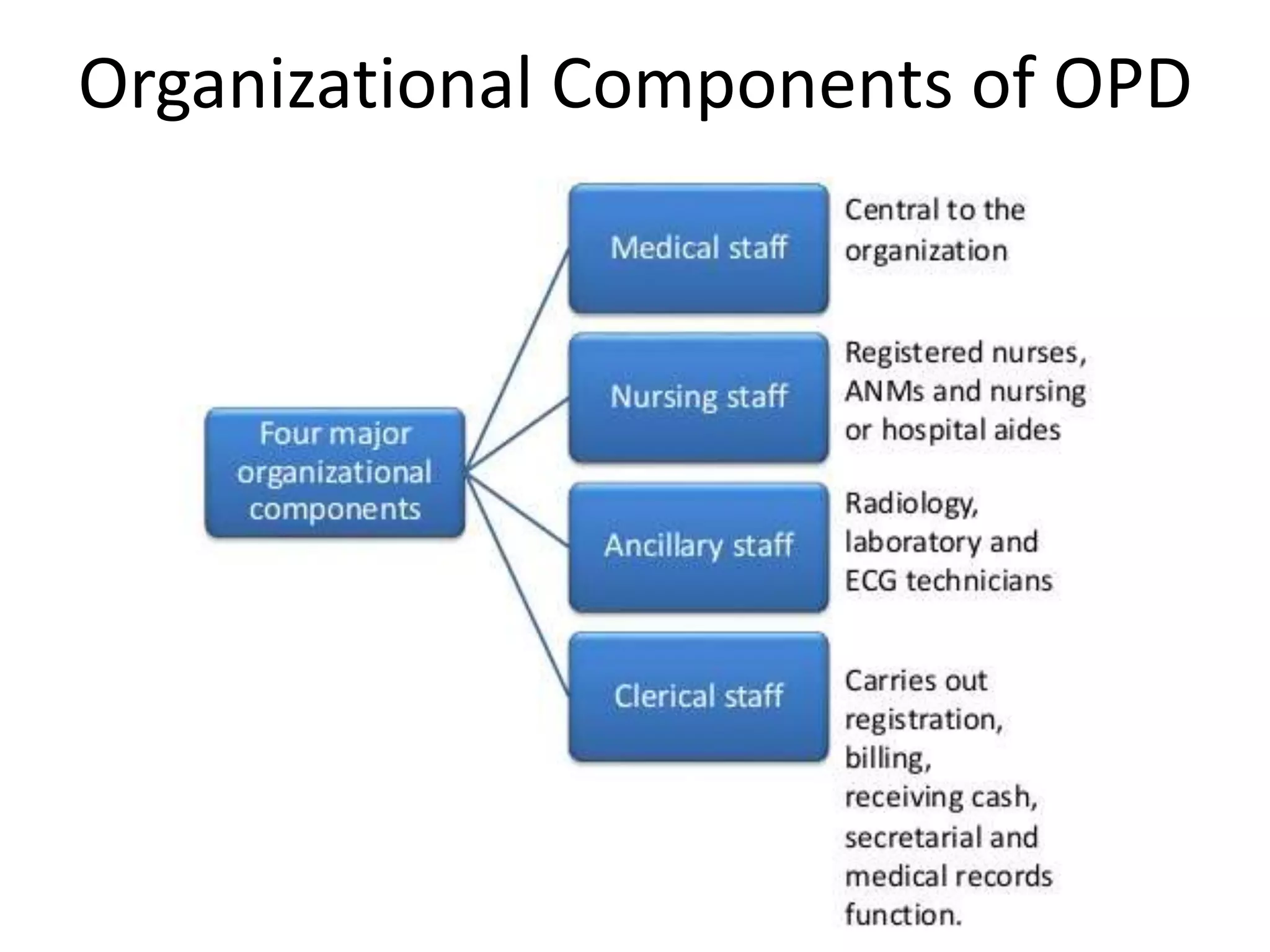
Organizational Components of OPD
Administrative Areas:
Admin Office
Business Office
House Keeping
Storage Facility
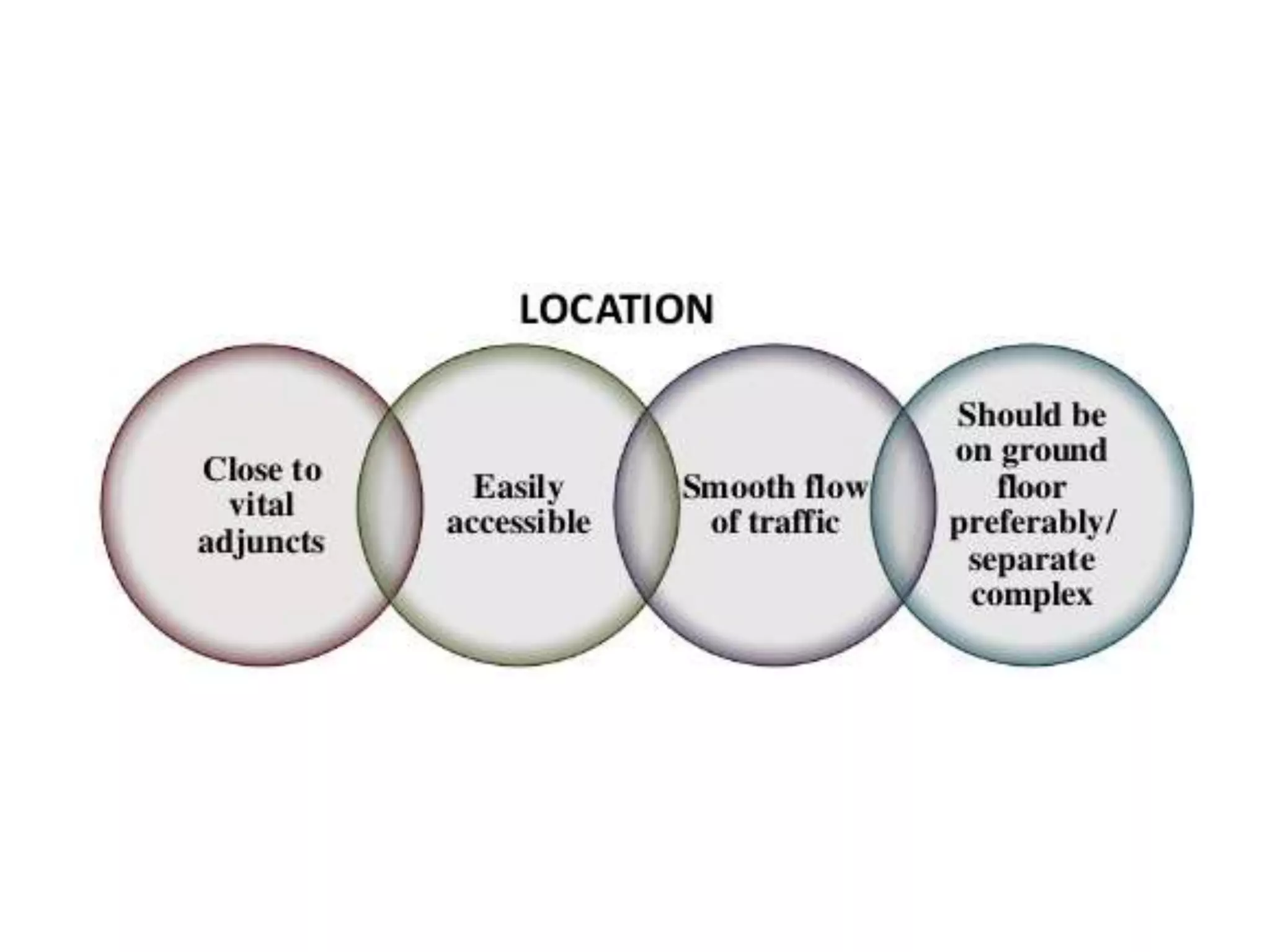
Circulation Areas (30% of all
area):
Corridors, Stairs, Lifts
Easy Accessibility of elevator
Corridor- 1.8 m wide
Security Point
ATM Card Booth
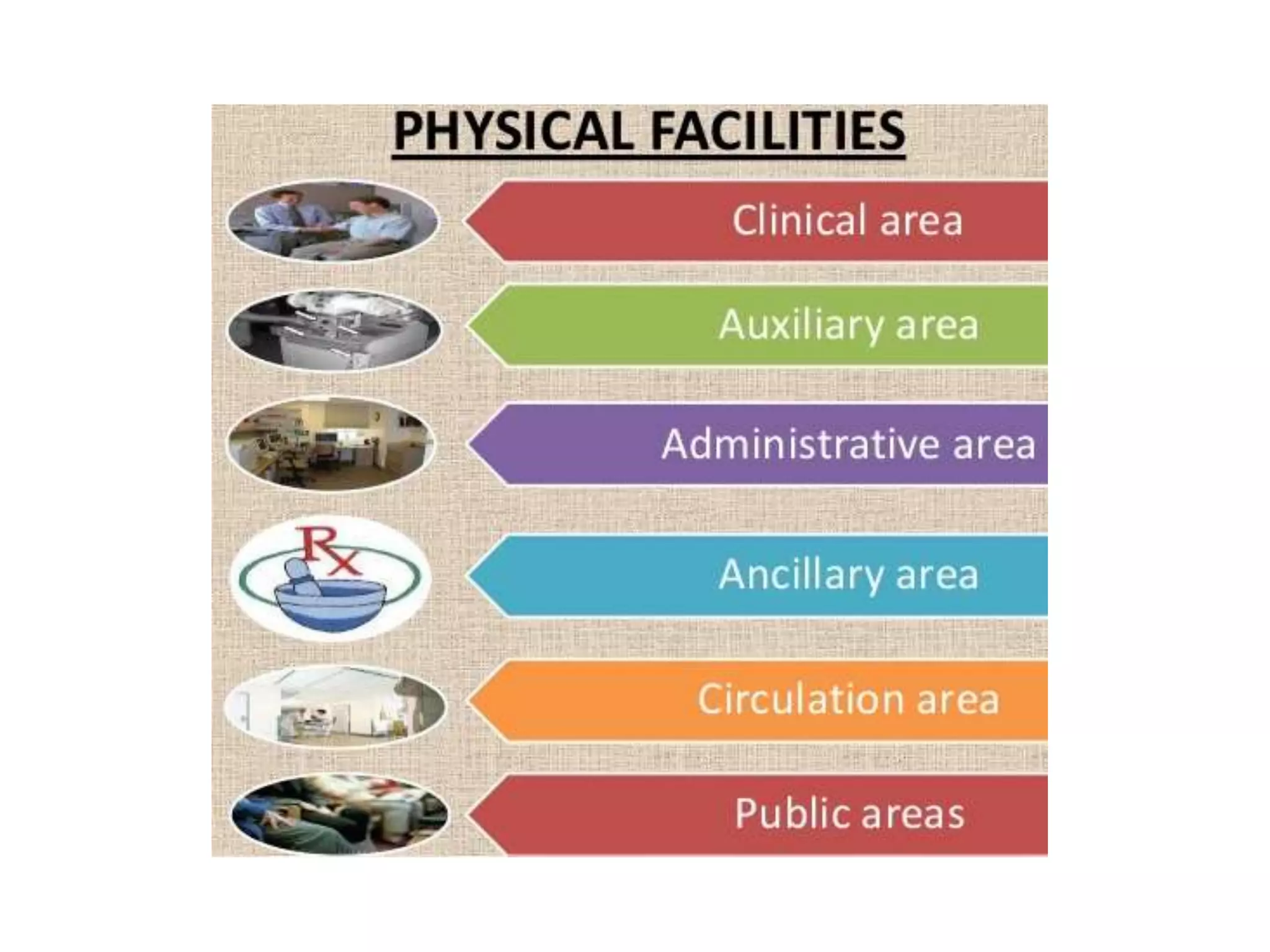
Physical Facilities
(Post Acute Care)
Functional Zones
(Treadmill Test)
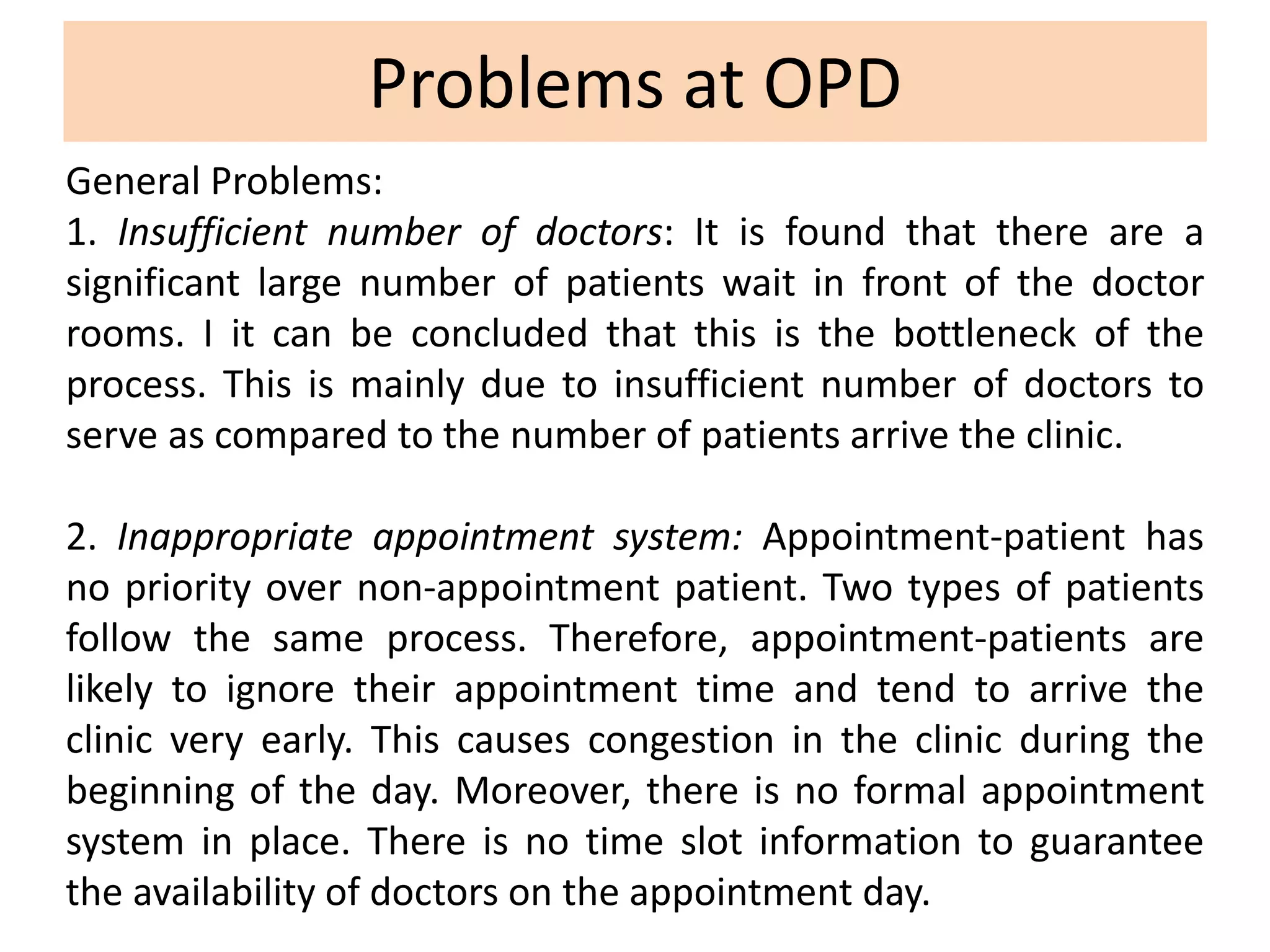
Problems at OPD
General Problems:
1. Insufficient number of doctors: It is found that there are a
significant large number of patients wait in front of the doctor
rooms. I it can be concluded that this is the bottleneck of the
process. This is mainly due to insufficient number of doctors to
serve as compared to the number of patients arrive the clinic.
2. Inappropriate appointment system: Appointment-patient has
no priority over non-appointment patient. Two types of patients
follow the same process. Therefore, appointment-patients are
likely to ignore their appointment time and tend to arrive the
clinic very early. This causes congestion in the clinic during the
beginning of the day. Moreover, there is no formal appointment
system in place. There is no time slot information to guarantee
the availability of doctors on the appointment day.
3. Long waiting time at Medicine room: After patients receive the
prescription from the clinic counter, patients are directed to
medicine room to pay for the fee and receive the medicines.
According to our observation, patients currently spend significant
amount of time at the medicine room counter. Most of which is
waiting for medicine.
4. Shortage of facilities.
5. Insufficient training of medical personnel concerning
ambulatory care.
6. Fragmentation of care, poor communication and inadequate
understanding of their demands.
7. An organizational structure geared to traditional preferences
and needs of the providers.
8. Resistance to change.
Specific Problems:
9. Duties undertaken by the auxiliaries are carried out hurriedly in
order to keep pace with consultation of doctors. This creates
inappropriate documentation.
10. Auxiliary staffs sometimes misbehave with the patients.
11. In absence of appointment system, patients start accumulating
even before office time starts; creating a long queue of patients
even before arrival of doctors.
12. Absence of visible serial number of appointment.
13. Interruption of consultation or investigation.
14. Lack of privacy.
15. Advices are not clearly spelled out.
16. Illegible hand-writing of the doctors.
17. Poly-pharmacy.
18. Prescription of too much antibiotics.
19. Queues are not properly maintained.
20. Prescribed medicines are not always available at pharmacy.
21. Use of trade-name of medicines by the doctors, create
confusion to patients, when different-named medicines of same
genera is supplied to the patients.
22. No clear advice about when, how and how long to take the
medicines.
23. Sometimes, wrong medicines are given by the pharmacists.
24. Insufficient and un-cleaned toilets.
25. Undue influence of local political leaders.
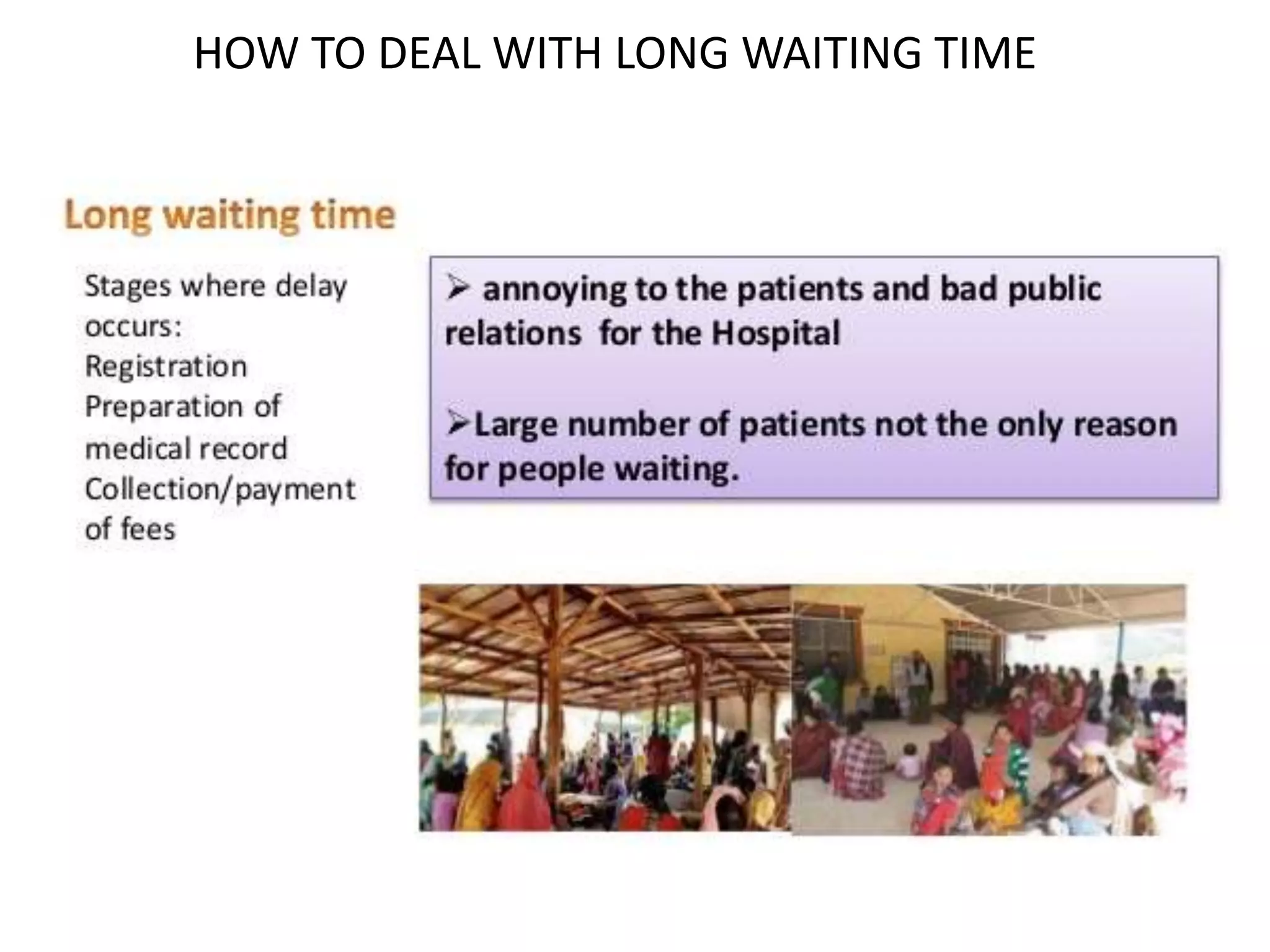
HOW TO DEAL WITH LONG WAITING TIME
Normal Queue System
• Make queue attractive.
• Make waiting-lines bent, so that they don’t see a
long line of queue always ahead of them. Give
them hope.
• Keep provision of visible token-number; so that
one can predict his turn of appointment.
• People always remember the last part of service.
So provide a satisfying consultation.
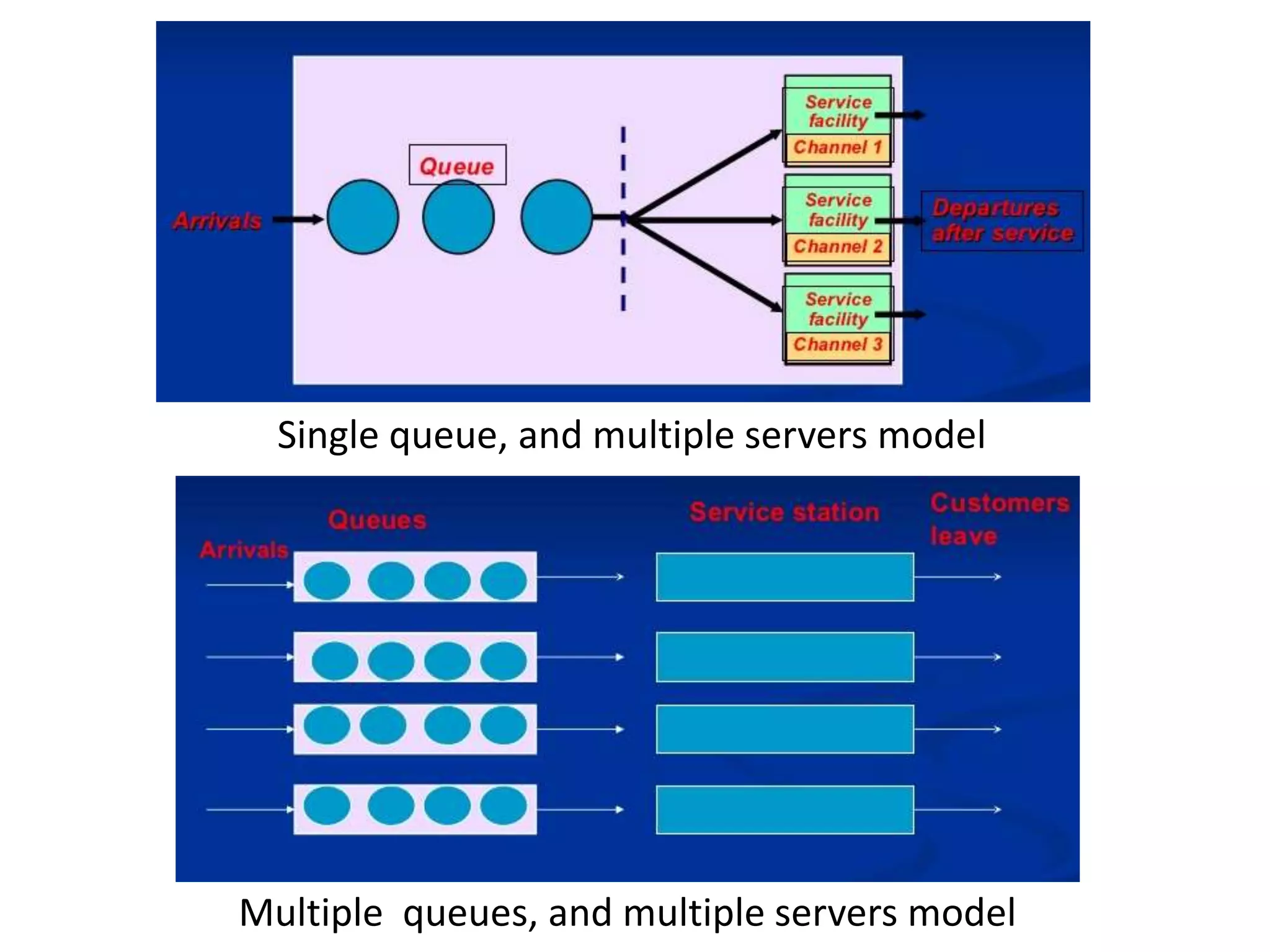
Single queue, and multiple servers model
Multiple queues, and multiple servers model
Suggestions for managing queues
• Determine an acceptable waiting time for customer.
• Try divert customer’s attention when waiting.
• Inform customers of what to expect.
• Keep employees not serving the customers out-of-sight.
• Train servers to be friendly.
• Encourage customers to come during slack period.
• Identify the bottle-neck in the service delivery and take
remedial measures.
Records at OPD
Outpatient Department (OPD)

Outpatient Department (OPD)

  • 1.
    Col Zulfiquer AhmedAmin M Phil, MPH, PGD (Health Economics), MBBS Armed Forces Medical Institute (AFMI) DEPARTMENT
  • 2.
    Definition OPD is definedas a part of the hospital with allotted physical facilities and medical and other staffs, with regularly scheduled hours, to provide care for patients who are not registered as inpatients. A hospital department where patients receive diagnosis and/ or treatment but do not stay overnight.
  • 7.
  • 8.
  • 12.
  • 16.
    Ambulatory care ismedical care provided on an outpatient basis, including diagnosis, observation, consultation, treatment, intervention, and rehabilitation services. This care can include advanced medical technology and procedures. A polyclinic is a clinic that provides both general and specialist examinations and treatments to outpatients and is usually independent of a hospital. A health center is one of a clinics staffed by a group of general practitioners and nurses providing healthcare services to people in a certain area. Typical services covered are family practice and dental care. A walk-in clinic accept patients on a walk-in basis and with no appointment required. A day hospital is an outpatient hospital facility where patients attend for assessment, treatment or rehabilitation during the day and then return home or spend the night at a different facility. A dispensary is an office in a school, hospital, industrial plant, or other organization that dispenses medications, medical supplies, and in some cases even medical and dental treatment. In a traditional dispensary set- up, a pharmacist dispenses medication as per prescription or order form.
  • 17.
  • 18.
    OPD Process Arrivalat OPD Reception Registration Issue of Token Number Waiting Room Consultation with Doctor Issuance of med Chit Arrival at Pharmacy Token Number Waiting Collection of Med Departure Investigations Referral to Spl
  • 20.
    • OPD hasfunctional and administrative links with the hospital of which it is a part. • It may also be linked with Health Centers, Satellite Clinics and Dispensaries dependent on it. • Expected demand should be determined basing on catchment area and population to be served. • Should include curative, preventive and promotive health services OPD Planning
  • 26.
  • 27.
    Requirements for OPD •60% of area should be for waiting and corridors. • Seats for 1/3 of daily attendance @ 8 sq ft/pt. • Consultation room – 150 sq ft • Attached examination room – 80 sq ft
  • 28.
    Projection of Out-PatientLoad • For every hospital bed, 1.5 to 3 patients attend OPD • 1-10 visits per capita per year of the dependent population basis
  • 29.
  • 30.
  • 37.
    Administrative Areas: Admin Office BusinessOffice House Keeping Storage Facility Circulation Areas (30% of all area): Corridors, Stairs, Lifts Easy Accessibility of elevator Corridor- 1.8 m wide Security Point ATM Card Booth Physical Facilities
  • 41.
  • 45.
  • 51.
  • 52.
    Problems at OPD GeneralProblems: 1. Insufficient number of doctors: It is found that there are a significant large number of patients wait in front of the doctor rooms. I it can be concluded that this is the bottleneck of the process. This is mainly due to insufficient number of doctors to serve as compared to the number of patients arrive the clinic. 2. Inappropriate appointment system: Appointment-patient has no priority over non-appointment patient. Two types of patients follow the same process. Therefore, appointment-patients are likely to ignore their appointment time and tend to arrive the clinic very early. This causes congestion in the clinic during the beginning of the day. Moreover, there is no formal appointment system in place. There is no time slot information to guarantee the availability of doctors on the appointment day.
  • 53.
    3. Long waitingtime at Medicine room: After patients receive the prescription from the clinic counter, patients are directed to medicine room to pay for the fee and receive the medicines. According to our observation, patients currently spend significant amount of time at the medicine room counter. Most of which is waiting for medicine. 4. Shortage of facilities. 5. Insufficient training of medical personnel concerning ambulatory care. 6. Fragmentation of care, poor communication and inadequate understanding of their demands. 7. An organizational structure geared to traditional preferences and needs of the providers. 8. Resistance to change.
  • 54.
    Specific Problems: 9. Dutiesundertaken by the auxiliaries are carried out hurriedly in order to keep pace with consultation of doctors. This creates inappropriate documentation. 10. Auxiliary staffs sometimes misbehave with the patients. 11. In absence of appointment system, patients start accumulating even before office time starts; creating a long queue of patients even before arrival of doctors. 12. Absence of visible serial number of appointment. 13. Interruption of consultation or investigation. 14. Lack of privacy. 15. Advices are not clearly spelled out. 16. Illegible hand-writing of the doctors. 17. Poly-pharmacy. 18. Prescription of too much antibiotics. 19. Queues are not properly maintained.
  • 55.
    20. Prescribed medicinesare not always available at pharmacy. 21. Use of trade-name of medicines by the doctors, create confusion to patients, when different-named medicines of same genera is supplied to the patients. 22. No clear advice about when, how and how long to take the medicines. 23. Sometimes, wrong medicines are given by the pharmacists. 24. Insufficient and un-cleaned toilets. 25. Undue influence of local political leaders.
  • 57.
    HOW TO DEALWITH LONG WAITING TIME
  • 59.
    Normal Queue System •Make queue attractive. • Make waiting-lines bent, so that they don’t see a long line of queue always ahead of them. Give them hope. • Keep provision of visible token-number; so that one can predict his turn of appointment. • People always remember the last part of service. So provide a satisfying consultation.
  • 60.
    Single queue, andmultiple servers model Multiple queues, and multiple servers model
  • 61.
    Suggestions for managingqueues • Determine an acceptable waiting time for customer. • Try divert customer’s attention when waiting. • Inform customers of what to expect. • Keep employees not serving the customers out-of-sight. • Train servers to be friendly. • Encourage customers to come during slack period. • Identify the bottle-neck in the service delivery and take remedial measures.
  • 62.