Calcium Hydroxide
Contents
 Introduction
 Mechanism of action
 Preparations Of calcium hydroxide
 Mechanical properties
 Biological effects on pulp and dentin
 Applications
 Advantages
 Disadvantages
 conclusion
 Introduced by , -Hermann in 1921 and
 “Gold standard” for direct pulp capping agents.
 Is a white odorless powder.
 Strong base with pH 12.5
Mechanism of
action
Antimicrobial activity:
 Calcium hydroxide for pulp protection is available
.
Aqueous suspension.
Cement or liner
Filled resins
Preparations of calcium hydroxide
Aqueous suspensions
The solvent evaporates, leaving a layer of calcium
hydroxide.
 Eg: Pulpdent (Pulpdent, Brookline, MA, USA)
Calcium hydroxide liners:
A combination of calcium hydroxide with a varnish
to modify the viscosity and to improve handling
Eg: Hydroxline (George Taub, Jersey City, NJ,
USA).
 Calcium hydroxide cements are paste /paste
systems
 One paste Ca(OH)2
 Second paste –salicylate which is weak acid.
 Acid –Base reaction :They reacts with each other
to form amorphous calcium disalicylate.
 Eg : Dycal (Dentsply, Milford, DE, USA) & Life
(Kerr, Portland, OR, USA).
visible light-cured (VLC) calcium hydroxide
liner
 Consists of calcium hydroxide & barium sulfate
dispersed in a urethane dimethacrylate resin
containing initiators and accelerators activated by
visible light.
 Eg :Calcimol (Voco GmbH, Cuxhaven, Germany)
& Lime-lite (Pulpdent Corporation, Watertown,
MA, USA).
 They have less antibacterial activity.
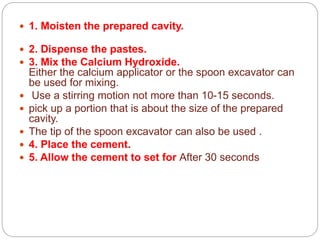
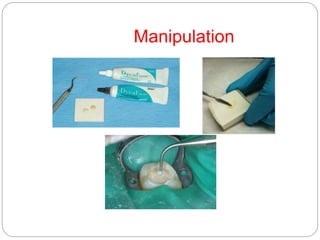
 1. Moisten the prepared cavity.
 2. Dispense the pastes.
 3. Mix the Calcium Hydroxide.
Either the calcium applicator or the spoon excavator can
be used for mixing.
 Use a stirring motion not more than 10-15 seconds.
 pick up a portion that is about the size of the prepared
cavity.
 The tip of the spoon excavator can also be used .
 4. Place the cement.
 5. Allow the cement to set for After 30 seconds
Manipulation
Mechanical properties
 They have low elastic modulous .
 They have low compressive strength
 Low thermal conduction.
 High water solubility and water sorption
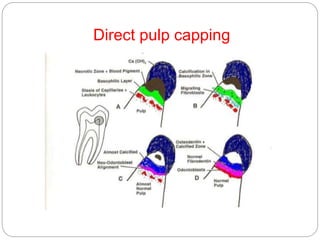
 Biological effects on pulp:
This property is helpful tertiary dentinogenesis.
In conventional liners .
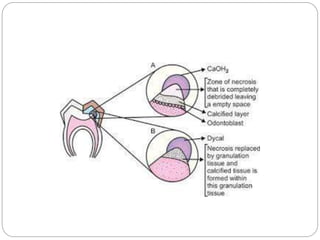
Zone of necrosis 2mm thick .
Superficial granulation zone
Deep granulation zone
Proliferation rich zone
Normal pulp
 Effects on dentin :
 When placed on residual dentin it releases bound
non collagenous proteins like
 Transforming growth factor beta and glycosamino
glycans.
 They act as signal molecules which recruits
undifferentiated stem cells to the site of
inflammation.
 Then stem cells differentiate into odontoblasts
and lay down calcified bridge
Application
s
 Direct and Indirect pulp capping.
 Pulpotomy.
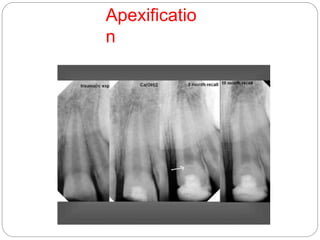
 Apexification.
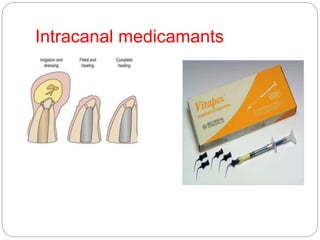
 Intracanal medicamant
 Weeping canals.
Direct pulp capping
Apexificatio
n
Intracanal medicamants
Advantage
s
 Bactericidal
 Promotes healing and Repair of Pulp Dentin
Complex.
 Stops Internal Resorption.
 Neutralizes low ph of acids .
Disadvantage
s
• Associated with primary tooth resorption.
• May dissolve after one year with cavosurface
dissolution.
• May degrade during acid etching.
• Degrades upon tooth flexure.
• Marginal failure with amalgam condensation.
• Does not adhere to dentin or resin restoration.

Calcium hydroxide

  • 1.
  • 2.
    Contents  Introduction  Mechanismof action  Preparations Of calcium hydroxide  Mechanical properties  Biological effects on pulp and dentin  Applications  Advantages  Disadvantages  conclusion
  • 3.
     Introduced by, -Hermann in 1921 and  “Gold standard” for direct pulp capping agents.  Is a white odorless powder.  Strong base with pH 12.5
  • 4.
  • 6.
     Calcium hydroxidefor pulp protection is available . Aqueous suspension. Cement or liner Filled resins Preparations of calcium hydroxide
  • 7.
    Aqueous suspensions The solventevaporates, leaving a layer of calcium hydroxide.  Eg: Pulpdent (Pulpdent, Brookline, MA, USA) Calcium hydroxide liners: A combination of calcium hydroxide with a varnish to modify the viscosity and to improve handling Eg: Hydroxline (George Taub, Jersey City, NJ, USA).
  • 8.
     Calcium hydroxidecements are paste /paste systems  One paste Ca(OH)2  Second paste –salicylate which is weak acid.  Acid –Base reaction :They reacts with each other to form amorphous calcium disalicylate.  Eg : Dycal (Dentsply, Milford, DE, USA) & Life (Kerr, Portland, OR, USA).
  • 9.
    visible light-cured (VLC)calcium hydroxide liner  Consists of calcium hydroxide & barium sulfate dispersed in a urethane dimethacrylate resin containing initiators and accelerators activated by visible light.  Eg :Calcimol (Voco GmbH, Cuxhaven, Germany) & Lime-lite (Pulpdent Corporation, Watertown, MA, USA).  They have less antibacterial activity.
  • 10.
     1. Moistenthe prepared cavity.  2. Dispense the pastes.  3. Mix the Calcium Hydroxide. Either the calcium applicator or the spoon excavator can be used for mixing.  Use a stirring motion not more than 10-15 seconds.  pick up a portion that is about the size of the prepared cavity.  The tip of the spoon excavator can also be used .  4. Place the cement.  5. Allow the cement to set for After 30 seconds
  • 11.
  • 12.
    Mechanical properties  Theyhave low elastic modulous .  They have low compressive strength  Low thermal conduction.  High water solubility and water sorption
  • 13.
     Biological effectson pulp: This property is helpful tertiary dentinogenesis. In conventional liners . Zone of necrosis 2mm thick . Superficial granulation zone Deep granulation zone Proliferation rich zone Normal pulp
  • 14.
     Effects ondentin :  When placed on residual dentin it releases bound non collagenous proteins like  Transforming growth factor beta and glycosamino glycans.  They act as signal molecules which recruits undifferentiated stem cells to the site of inflammation.  Then stem cells differentiate into odontoblasts and lay down calcified bridge
  • 15.
    Application s  Direct andIndirect pulp capping.  Pulpotomy.  Apexification.  Intracanal medicamant  Weeping canals.
  • 16.
  • 17.
  • 19.
  • 20.
    Advantage s  Bactericidal  Promoteshealing and Repair of Pulp Dentin Complex.  Stops Internal Resorption.  Neutralizes low ph of acids .
  • 21.
    Disadvantage s • Associated withprimary tooth resorption. • May dissolve after one year with cavosurface dissolution. • May degrade during acid etching. • Degrades upon tooth flexure. • Marginal failure with amalgam condensation. • Does not adhere to dentin or resin restoration.