TOTAL
PHYSICAL
RESPONSE
METHOD
Students:
-COLCAS CONTRERAS Andrea
-CRIBILLERO CORRO Lucero
-ESPINOZA IZAGUIRRE Angie
-GUERRERO MORALES Sandra
-TITO VEGA Yazmin
What is Total Physical
Response Method?
● A language teaching method built
around the coordination of speech
and action. Students respond using
physical movements to the orders
given by the teacher.
● Learning is much more efficient and
active participation is more
complete.
● This method was
introduced by James
Asher. He focused on
a concept that
“babies don’t learn
comprehension by
memorizing list but they
learn by listening and then
try to speak the words which
they listen”
● Understanding the spoken language before
developing the skills of speaking.
● Imperatives are the main structures to
transfer or communicate information.
● The student is not forced to speak, but
allowed to spontaneously begin to speak
when the student feels comfortable and
confident in understanding and producing
the expressions.
What are the basic principles?
Teaching ORAL
PROFICIENCY
at a beginning
level.
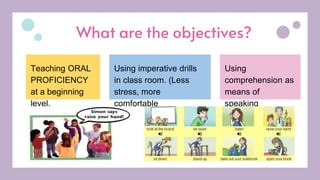
Using imperative drills
in class room. (Less
stress, more
comfortable
What are the objectives?
Using
comprehension as
means of
speaking
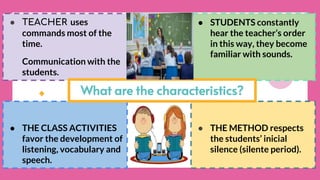
● TEACHER uses
commands most of the
time.
Communication with the
students.
● THE CLASS ACTIVITIES
favor the development of
listening, vocabulary and
speech.
● STUDENTS constantly
hear the teacher’s order
in this way, they become
familiar with sounds.
● THE METHOD respects
the students’ inicial
silence (silente period).
What are the characteristics?
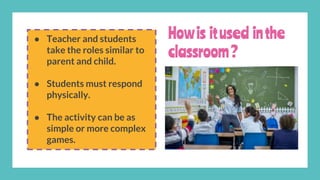
Howis itused inthe
classroom?
● Teacher and students
take the roles similar to
parent and child.
● Students must respond
physically.
● The activity can be as
simple or more complex
games.
● It’s difficult to teach the abstract
content.
● Teachers have to do obvious
actions carefully.
● TPR has been an experimental
model with volunteer students.
● TPR is especially effective in the
beginning levels of language.
● Students enjoy spending
time.
● TPR activities are simple.
● TPR requires no skills and
works well in classes.
● It‘s good for kinesthetic
students.
What are?
ADVANTAGES LIMITS
The syllabus
● The criterion for including a vocabulary item or grammatical
feature at a particular point in training is the ease of
assimilation by students.
● Asher also suggests that a fixed number of items be
introduced at a time, to facilitate ease of differentiation and
assimilation.
● The movement of the body seems to be a powerful mediator
for the understanding, organization, and storage of macro-
details of linguistic input.
What are learner
roles?
● Have the primary roles of listener and
performer.
● They listen attentively and respond
physically to commands given by the
teacher
● Learners are also expected to recognize
and respond to novel combinations of
previously taught items.
What are teacher
roles?
● "The instructor is the director of a
stage play in which the students are
the actors"
● Is the teacher who decides what to
teach, who models and presents the
new materials, and who selects
supporting materials for classroom
use.
● Teacher usually initiates the
interaction between learners.
What is the role of
instructional materials?
● For absolute beginners, lessons may not
require the use of materials.
● Later the teacher may use common classroom
objects
● As the course develops, the teacher will need
to make or collect supporting materials to
support teaching points
Procedure
● The majority of class time in TPR lessons is spent doing drills in which the instructor gives
commands using the imperative mood. Students respond to these commands with physical
actions.
● Initially, students learn the meaning of the commands they hear by direct observation. After
they learn the meaning of the words in these commands, the teacher issues commands that
use novel combinations of the words the students have learned.
● Instructors limit the number of new vocabulary items given to students at any one time. This is
to help students differentiate the new words from those previously learned, and to facilitate
integration with their existing language knowledge
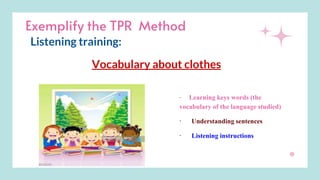
Exemplify the TPR Method
Vocabulary about clothes
· Learning keys words (the
vocabulary of the language studied)
· Understanding sentences
· Listening instructions
Listening training:
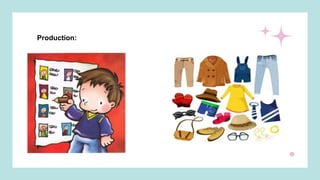
Production:
Product: Reading and writing
I am wearing a pink polo shirt
My favorite sneakers are blue
I have blue pants and a brown sweater

TOTAL PHYSICAL RESPONSE METHOD FOR TEACHING ENGLISH.pptx

  • 1.
    TOTAL PHYSICAL RESPONSE METHOD Students: -COLCAS CONTRERAS Andrea -CRIBILLEROCORRO Lucero -ESPINOZA IZAGUIRRE Angie -GUERRERO MORALES Sandra -TITO VEGA Yazmin
  • 2.
    What is TotalPhysical Response Method? ● A language teaching method built around the coordination of speech and action. Students respond using physical movements to the orders given by the teacher. ● Learning is much more efficient and active participation is more complete.
  • 3.
    ● This methodwas introduced by James Asher. He focused on a concept that “babies don’t learn comprehension by memorizing list but they learn by listening and then try to speak the words which they listen”
  • 4.
    ● Understanding thespoken language before developing the skills of speaking. ● Imperatives are the main structures to transfer or communicate information. ● The student is not forced to speak, but allowed to spontaneously begin to speak when the student feels comfortable and confident in understanding and producing the expressions. What are the basic principles?
  • 5.
    Teaching ORAL PROFICIENCY at abeginning level. Using imperative drills in class room. (Less stress, more comfortable What are the objectives? Using comprehension as means of speaking
  • 6.
    ● TEACHER uses commandsmost of the time. Communication with the students. ● THE CLASS ACTIVITIES favor the development of listening, vocabulary and speech. ● STUDENTS constantly hear the teacher’s order in this way, they become familiar with sounds. ● THE METHOD respects the students’ inicial silence (silente period). What are the characteristics?
  • 7.
    Howis itused inthe classroom? ●Teacher and students take the roles similar to parent and child. ● Students must respond physically. ● The activity can be as simple or more complex games.
  • 8.
    ● It’s difficultto teach the abstract content. ● Teachers have to do obvious actions carefully. ● TPR has been an experimental model with volunteer students. ● TPR is especially effective in the beginning levels of language. ● Students enjoy spending time. ● TPR activities are simple. ● TPR requires no skills and works well in classes. ● It‘s good for kinesthetic students. What are? ADVANTAGES LIMITS
  • 9.
    The syllabus ● Thecriterion for including a vocabulary item or grammatical feature at a particular point in training is the ease of assimilation by students. ● Asher also suggests that a fixed number of items be introduced at a time, to facilitate ease of differentiation and assimilation. ● The movement of the body seems to be a powerful mediator for the understanding, organization, and storage of macro- details of linguistic input.
  • 10.
    What are learner roles? ●Have the primary roles of listener and performer. ● They listen attentively and respond physically to commands given by the teacher ● Learners are also expected to recognize and respond to novel combinations of previously taught items.
  • 11.
    What are teacher roles? ●"The instructor is the director of a stage play in which the students are the actors" ● Is the teacher who decides what to teach, who models and presents the new materials, and who selects supporting materials for classroom use. ● Teacher usually initiates the interaction between learners.
  • 12.
    What is therole of instructional materials? ● For absolute beginners, lessons may not require the use of materials. ● Later the teacher may use common classroom objects ● As the course develops, the teacher will need to make or collect supporting materials to support teaching points
  • 13.
    Procedure ● The majorityof class time in TPR lessons is spent doing drills in which the instructor gives commands using the imperative mood. Students respond to these commands with physical actions. ● Initially, students learn the meaning of the commands they hear by direct observation. After they learn the meaning of the words in these commands, the teacher issues commands that use novel combinations of the words the students have learned. ● Instructors limit the number of new vocabulary items given to students at any one time. This is to help students differentiate the new words from those previously learned, and to facilitate integration with their existing language knowledge
  • 14.
    Exemplify the TPRMethod Vocabulary about clothes · Learning keys words (the vocabulary of the language studied) · Understanding sentences · Listening instructions Listening training:
  • 15.
  • 16.
    Product: Reading andwriting I am wearing a pink polo shirt My favorite sneakers are blue I have blue pants and a brown sweater