








Introduction to Learning
Analytics
Role, benefits, and challenges
School of Education | Research Days 2018
Srecko Joksimovic, Vitomir Kovanovic
School of Education and Teaching Innovation Unit
University of South Australia
Srecko.Joksimovic@unisa.edu.au Vitomir.Kovanovic@unisa.edu.au
#s_joksimovic #vkovanovic
Outline
History and Definition
Key Dimensions of Learning Analytics
Data Sources and Methods
2
Learning Analytics Research
Learning Analytics Tools
Challenges and Way Forward
Hands-on Session
History & Definition
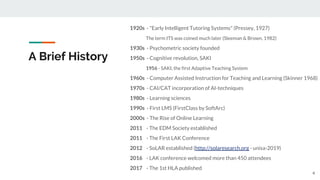
A Brief History
1920s - "Early Intelligent Tutoring Systems" (Pressey, 1927)
The term ITS was coined much later (Sleeman & Brown, 1982)
1930s - Psychometric society founded
1950s - Cognitive revolution, SAKI
1956 - SAKI, the first Adaptive Teaching System
1960s - Computer Assisted Instruction for Teaching and Learning (Skinner 1968)
1970s - CAI/CAT incorporation of AI-techniques
1980s - Learning sciences
1990s - First LMS (FirstClass by SoftArc)
2000s - The Rise of Online Learning
2011 - The EDM Society established
2011 - The First LAK Conference
2012 - SoLAR established (http://solaresearch.org - unisa-2019)
2016 - LAK conference welcomed more than 450 attendees
2017 - The 1st HLA published
4
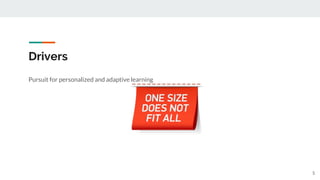
Drivers
Pursuit for personalized and adaptive learning
5
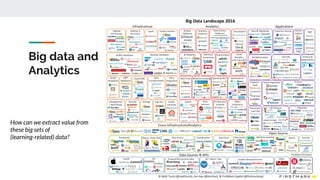
Big data and
Analytics
6
How can we extract value from
these big sets of
(learning-related) data?
Education is no different
Huge investments in analytics
Ease of access to learner data
Increased adoption of personal technologies
7
Political (Economic) concerns
Increasing demand for educational institutions to measure, demonstrate, and improve performance.
Ferguson, R. (2012). Learning analytics: drivers, developments and challenges. International Journal
of Technology Enhanced Learning, 4(5/6), 304. https://doi.org/10.1504/IJTEL.2012.051816)
8
Stakeholders
Governments,
Educational institutions, and
Teachers/Learners
9
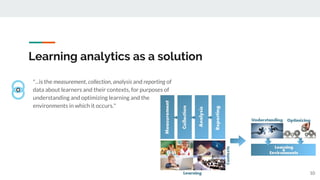
Learning analytics as a solution
"...is the measurement, collection, analysis and reporting of
data about learners and their contexts, for purposes of
understanding and optimizing learning and the
environments in which it occurs."
10
Learning Sciences
"What do the learning sciences have to do with learning analytics?"
- "Just about everything!"
Paul Kirschner, LAK'16 keynote. Available at
https://www.youtube.com/watch?v=8OjmnOiMIKI&index=2&list=PLOF7tBP24lAf2uyB6SEZ3_foM51rULkSR
11
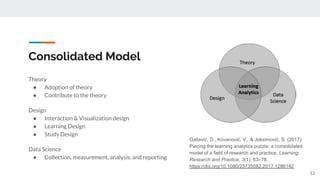
Consolidated Model
Theory
● Adoption of theory
● Contribute to the theory
Design
● Interaction & Visualization design
● Learning Design
● Study Design
Data Science
● Collection, measurement, analysis, and reporting
12
Gašević, D., Kovanović, V., & Joksimović, S. (2017).
Piecing the learning analytics puzzle: a consolidated
model of a field of research and practice. Learning:
Research and Practice, 3(1), 63–78.
https://doi.org/10.1080/23735082.2017.1286142
Driving Impact
Increase retention
Proactively drive success
Improve content & course quality
Cost efficient allocation
13
Key Dimensions
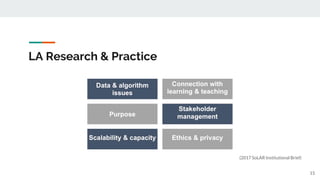
LA Research & Practice
15
(2017 SoLAR Institutional Brief)
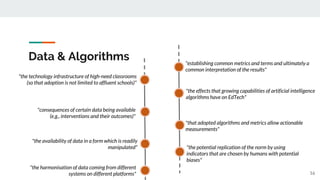
Data & Algorithms
16
"the effects that growing capabilities of artificial intelligence
algorithms have on EdTech"
"that adopted algorithms and metrics allow actionable
measurements"
"the technology infrastructure of high-need classrooms
(so that adoption is not limited to affluent schools)"
"the availability of data in a form which is readily
manipulated"
"the harmonisation of data coming from different
systems on different platforms"
"the potential replication of the norm by using
indicators that are chosen by humans with potential
biases"
"consequences of certain data being available
(e.g., interventions and their outcomes)"
"establishing common metrics and terms and ultimately a
common interpretation of the results"
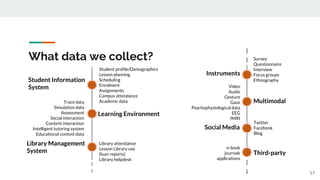
What data we collect?
17
Student Information
System
Learning Environment
Library Management
System
Instruments
Multimodal
Student profile/Demographics
Lesson planning
Scheduling
Enrolment
Assignments
Campus attendance
Academic dataTrace data
Simulation data
Assessment
Social interaction
Content interaction
Intelligent tutoring system
Educational context data
Library attendance
Lesson Library use
(loan reports)
Library helpdesk
Survey
Questionnaire
Interview
Focus groups
Ethnography
Video
Audio
Gesture
Gaze
Psychophysiological data
EEG
fMRI
Social Media
Twitter
Facebook
Blog
Third-party
e-book
journals
applications
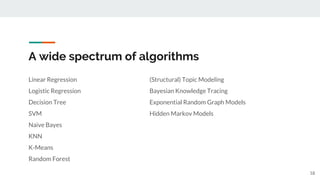
A wide spectrum of algorithms
Linear Regression
Logistic Regression
Decision Tree
SVM
Naive Bayes
KNN
K-Means
Random Forest
18
(Structural) Topic Modeling
Bayesian Knowledge Tracing
Exponential Random Graph Models
Hidden Markov Models
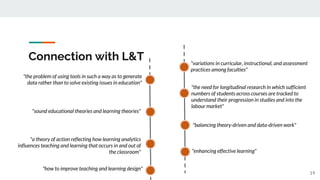
Connection with L&T
19
"the need for longitudinal research in which sufficient
numbers of students across courses are tracked to
understand their progression in studies and into the
labour market"
"a theory of action reflecting how learning analytics
influences teaching and learning that occurs in and out of
the classroom"
"how to improve teaching and learning design"
"the problem of using tools in such a way as to generate
data rather than to solve existing issues in education"
"balancing theory-driven and data-driven work"
"enhancing effective learning"
"sound educational theories and learning theories"
"variations in curricular, instructional, and assessment
practices among faculties"
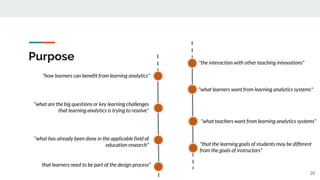
Purpose
20
"what learners want from learning analytics systems"
"what has already been done in the applicable field of
education research"
that learners need to be part of the design process"
"how learners can benefit from learning analytics"
"what teachers want from learning analytics systems"
"that the learning goals of students may be different
from the goals of instructors"
"what are the big questions or key learning challenges
that learning analytics is trying to resolve"
"the interaction with other teaching innovations"
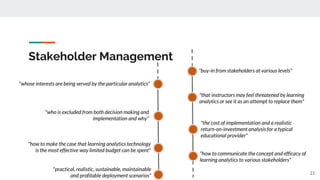
Stakeholder Management
21
"that instructors may feel threatened by learning
analytics or see it as an attempt to replace them"
"how to make the case that learning analytics technology
is the most effective way limited budget can be spent"
"practical, realistic, sustainable, maintainable
and profitable deployment scenarios"
"whose interests are being served by the particular analytics"
"the cost of implementation and a realistic
return-on-investment analysis for a typical
educational provider"
"how to communicate the concept and efficacy of
learning analytics to various stakeholders"
"who is excluded from both decision making and
implementation and why"
"buy-in from stakeholders at various levels"
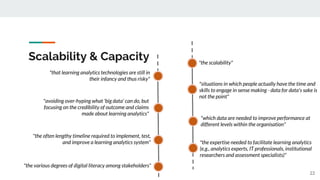
Scalability & Capacity
22
"situations in which people actually have the time and
skills to engage in sense making - data for data's sake is
not the point"
"the often lengthy timeline required to implement, test,
and improve a learning analytics system"
"the various degrees of digital literacy among stakeholders"
"that learning analytics technologies are still in
their infancy and thus risky"
"which data are needed to improve performance at
different levels within the organisation"
"the expertise needed to facilitate learning analytics
(e.g., analytics experts, IT professionals, institutional
researchers and assessment specialists)"
"avoiding over-hyping what 'big data' can do, but
focusing on the credibility of outcome and claims
made about learning analytics"
"the scalability"
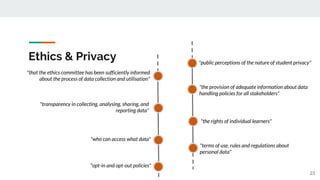
Ethics & Privacy
23
"the provision of adequate information about data
handling policies for all stakeholders"
"who can access what data"
"opt-in and opt-out policies"
"that the ethics committee has been sufficiently informed
about the process of data collection and utilisation"
"the rights of individual learners"
"terms of use, rules and regulations about
personal data"
"transparency in collecting, analysing, sharing, and
reporting data"
"public perceptions of the nature of student privacy"
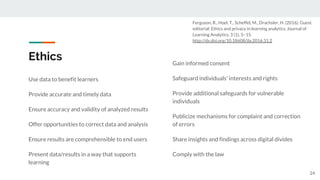
Ethics
Use data to benefit learners
Provide accurate and timely data
Ensure accuracy and validity of analyzed results
Offer opportunities to correct data and analysis
Ensure results are comprehensible to end users
Present data/results in a way that supports
learning
24
Gain informed consent
Safeguard individuals' interests and rights
Provide additional safeguards for vulnerable
individuals
Publicize mechanisms for complaint and correction
of errors
Share insights and findings across digital divides
Comply with the law
Ferguson, R., Hoel, T., Scheffel, M., Drachsler, H. (2016). Guest
editorial: Ethics and privacy in learning analytics. Journal of
Learning Analytics, 3 (1), 5–15.
http://dx.doi.org/10.18608/jla.2016.31.2
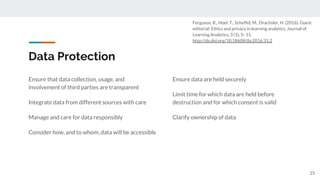
Data Protection
Ensure that data collection, usage, and
involvement of third parties are transparent
Integrate data from different sources with care
Manage and care for data responsibly
Consider how, and to whom, data will be accessible
25
Ensure data are held securely
Limit time for which data are held before
destruction and for which consent is valid
Clarify ownership of data
Ferguson, R., Hoel, T., Scheffel, M., Drachsler, H. (2016). Guest
editorial: Ethics and privacy in learning analytics. Journal of
Learning Analytics, 3 (1), 5–15.
http://dx.doi.org/10.18608/jla.2016.31.2
Privacy
Anonymize and de-identify individuals
Provide additional safeguards for sensitive data
26
Ferguson, R., Hoel, T., Scheffel, M., Drachsler, H. (2016). Guest
editorial: Ethics and privacy in learning analytics. Journal of
Learning Analytics, 3 (1), 5–15.
http://dx.doi.org/10.18608/jla.2016.31.2
27
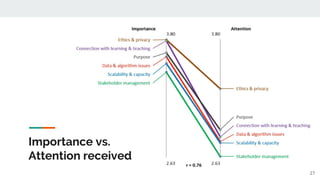
Importance vs.
Attention received
Data sources and methods of
Learning Analytics
28
LA data sources
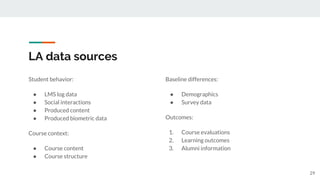
29
Student behavior:
● LMS log data
● Social interactions
● Produced content
● Produced biometric data
Course context:
● Course content
● Course structure
Baseline differences:
● Demographics
● Survey data
Outcomes:
1. Course evaluations
2. Learning outcomes
3. Alumni information
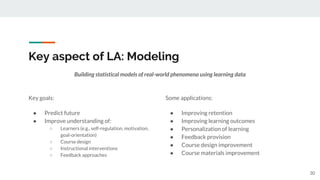
Key aspect of LA: Modeling
Key goals:
● Predict future
● Improve understanding of:
○ Learners (e.g., self-regulation, motivation,
goal-orientation)
○ Course design
○ Instructional interventions
○ Feedback approaches
30
Some applications:
● Improving retention
● Improving learning outcomes
● Personalization of learning
● Feedback provision
● Course design improvement
● Course materials improvement
Building statistical models of real-world phenomena using learning data
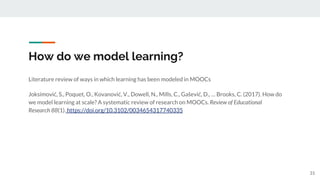
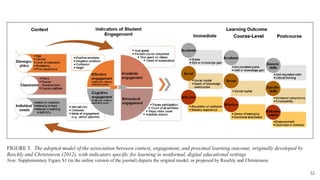
How do we model learning?
Literature review of ways in which learning has been modeled in MOOCs
Joksimović, S., Poquet, O., Kovanović, V., Dowell, N., Mills, C., Gašević, D., … Brooks, C. (2017). How do
we model learning at scale? A systematic review of research on MOOCs. Review of Educational
Research 88(1). https://doi.org/10.3102/0034654317740335
31
32
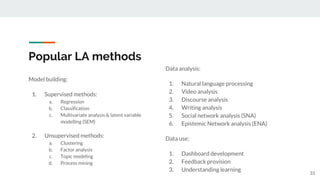
Popular LA methods
33
Model building:
1. Supervised methods:
a. Regression
b. Classification
c. Multivariate analysis & latent variable
modelling (SEM)
2. Unsupervised methods:
a. Clustering
b. Factor analysis
c. Topic modeling
d. Process mining
Data analysis:
1. Natural language processing
2. Video analysis
3. Discourse analysis
4. Writing analysis
5. Social network analysis (SNA)
6. Epistemic Network analysis (ENA)
Data use:
1. Dashboard development
2. Feedback provision
3. Understanding learning
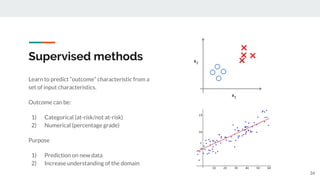
Supervised methods
34
Learn to predict “outcome” characteristic from a
set of input characteristics.
Outcome can be:
1) Categorical (at-risk/not at-risk)
2) Numerical (percentage grade)
Purpose
1) Prediction on new data
2) Increase understanding of the domain
Unsupervised methods
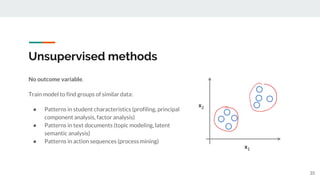
No outcome variable.
Train model to find groups of similar data:
● Patterns in student characteristics (profiling, principal
component analysis, factor analysis)
● Patterns in text documents (topic modeling, latent
semantic analysis)
● Patterns in action sequences (process mining)
35
LA research examples
36
Classifying student video reflections
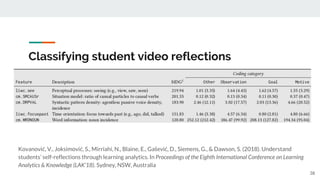
● Data: 4,430 utterances coded as either observations, reflections, or motive statements
● Input: 503 different linguistic features
● Output: type of utterance (observation, reflection, or motive)
● Result: classifier with 75% classification accuracy (Cohen’s kappa .51)
37
Kovanović, V., Joksimović, S., Mirriahi, N., Blaine, E., Gašević, D., Siemens, G., & Dawson, S. (2018). Understand
students’ self-reflections through learning analytics. In Proceedings of the Eighth International Conference on Learning
Analytics & Knowledge (LAK’18). Sydney, NSW, Australia
Classifying student video reflections
38
Kovanović, V., Joksimović, S., Mirriahi, N., Blaine, E., Gašević, D., Siemens, G., & Dawson, S. (2018). Understand
students’ self-reflections through learning analytics. In Proceedings of the Eighth International Conference on Learning
Analytics & Knowledge (LAK’18). Sydney, NSW, Australia
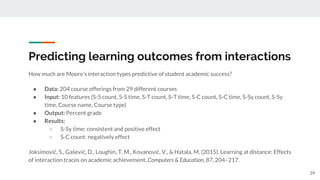
Predicting learning outcomes from interactions
How much are Moore’s interaction types predictive of student academic success?
● Data: 204 course offerings from 29 different courses
● Input: 10 features (S-S count, S-S time, S-T count, S-T time, S-C count, S-C time, S-Sy count, S-Sy
time, Course name, Course type)
● Output: Percent grade
● Results:
○ S-Sy time: consistent and positive effect
○ S-C count: negatively effect
Joksimović, S., Gašević, D., Loughin, T. M., Kovanović, V., & Hatala, M. (2015). Learning at distance: Effects
of interaction traces on academic achievement. Computers & Education, 87, 204–217.
39
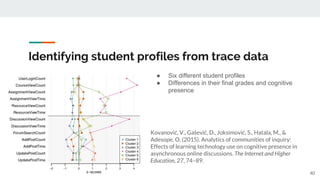
Identifying student profiles from trace data
Kovanović, V., Gašević, D., Joksimović, S., Hatala, M., &
Adesope, O. (2015). Analytics of communities of inquiry:
Effects of learning technology use on cognitive presence in
asynchronous online discussions. The Internet and Higher
Education, 27, 74–89.
40
● Six different student profiles
● Differences in their final grades and cognitive
presence
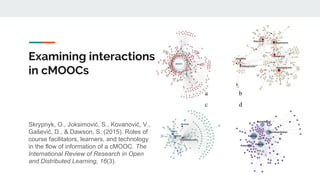
Examining interactions
in cMOOCs
41
Skrypnyk, O., Joksimović, S., Kovanović, V.,
Gašević, D., & Dawson, S. (2015). Roles of
course facilitators, learners, and technology
in the flow of information of a cMOOC. The
International Review of Research in Open
and Distributed Learning, 16(3).
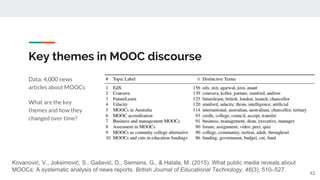
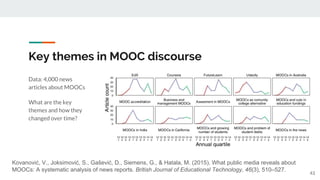
Key themes in MOOC discourse
Data: 4,000 news
articles about MOOCs
What are the key
themes and how they
changed over time?
42
Kovanović, V., Joksimović, S., Gašević, D., Siemens, G., & Hatala, M. (2015). What public media reveals about
MOOCs: A systematic analysis of news reports. British Journal of Educational Technology, 46(3), 510–527.
Key themes in MOOC discourse
Data: 4,000 news
articles about MOOCs
What are the key
themes and how they
changed over time?
43
Kovanović, V., Joksimović, S., Gašević, D., Siemens, G., & Hatala, M. (2015). What public media reveals about
MOOCs: A systematic analysis of news reports. British Journal of Educational Technology, 46(3), 510–527.
LA tool examples
44
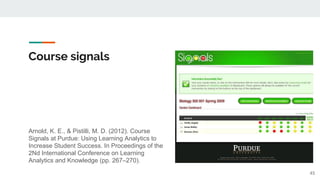
Course signals
45
Arnold, K. E., & Pistilli, M. D. (2012). Course
Signals at Purdue: Using Learning Analytics to
Increase Student Success. In Proceedings of the
2Nd International Conference on Learning
Analytics and Knowledge (pp. 267–270).
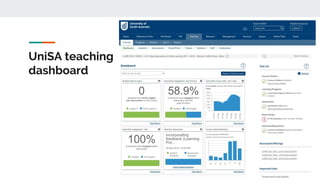
UniSA teaching
dashboard
46
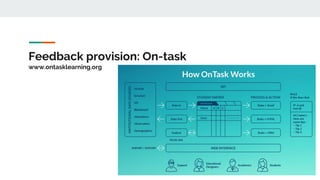
Feedback provision: On-task
www.ontasklearning.org
47
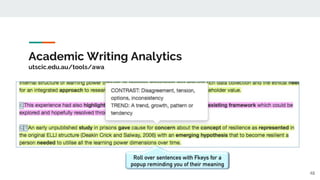
Academic Writing Analytics
utscic.edu.au/tools/awa
48
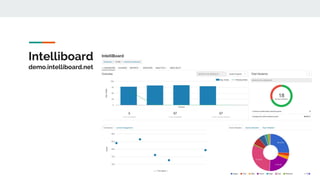
Intelliboard
demo.intelliboard.net
49
LA Challenges & Way forward
50
Some important challenges
51
Provision of the data is not enough. Instructors need to know how to use displayed data.
Role of study (course) context is hard to capture -> generalizability of study findings is low
Implementation of learning analytics is a complex adventure that requires more than installing software
Better linking with theory
● Pedagogy
● Assessment
● Visualisation
● Psychology
Ways forward
● More replication studies
● Better reporting of studies to enable reproducible research
● Making data publically available to enable model comparison and improvement
● Pre-registration of LA studies
● Development of techniques and methods for educational data analysis to enable more LA research
● Make LA implementations more actionable
52
Hands-on Session
53
DEMO
54
https://demo.intelliboard.net
● Login as a teacher

Introduction to Learning Analytics

  • 1.
    Introduction to Learning Analytics Role,benefits, and challenges School of Education | Research Days 2018 Srecko Joksimovic, Vitomir Kovanovic School of Education and Teaching Innovation Unit University of South Australia Srecko.Joksimovic@unisa.edu.au Vitomir.Kovanovic@unisa.edu.au #s_joksimovic #vkovanovic
  • 2.
    Outline History and Definition KeyDimensions of Learning Analytics Data Sources and Methods 2 Learning Analytics Research Learning Analytics Tools Challenges and Way Forward Hands-on Session
  • 3.
  • 4.
    A Brief History 1920s- "Early Intelligent Tutoring Systems" (Pressey, 1927) The term ITS was coined much later (Sleeman & Brown, 1982) 1930s - Psychometric society founded 1950s - Cognitive revolution, SAKI 1956 - SAKI, the first Adaptive Teaching System 1960s - Computer Assisted Instruction for Teaching and Learning (Skinner 1968) 1970s - CAI/CAT incorporation of AI-techniques 1980s - Learning sciences 1990s - First LMS (FirstClass by SoftArc) 2000s - The Rise of Online Learning 2011 - The EDM Society established 2011 - The First LAK Conference 2012 - SoLAR established (http://solaresearch.org - unisa-2019) 2016 - LAK conference welcomed more than 450 attendees 2017 - The 1st HLA published 4
  • 5.
    Drivers Pursuit for personalizedand adaptive learning 5
  • 6.
    Big data and Analytics 6 Howcan we extract value from these big sets of (learning-related) data?
  • 7.
    Education is nodifferent Huge investments in analytics Ease of access to learner data Increased adoption of personal technologies 7
  • 8.
    Political (Economic) concerns Increasingdemand for educational institutions to measure, demonstrate, and improve performance. Ferguson, R. (2012). Learning analytics: drivers, developments and challenges. International Journal of Technology Enhanced Learning, 4(5/6), 304. https://doi.org/10.1504/IJTEL.2012.051816) 8
  • 9.
  • 10.
    Learning analytics asa solution "...is the measurement, collection, analysis and reporting of data about learners and their contexts, for purposes of understanding and optimizing learning and the environments in which it occurs." 10
  • 11.
    Learning Sciences "What dothe learning sciences have to do with learning analytics?" - "Just about everything!" Paul Kirschner, LAK'16 keynote. Available at https://www.youtube.com/watch?v=8OjmnOiMIKI&index=2&list=PLOF7tBP24lAf2uyB6SEZ3_foM51rULkSR 11
  • 12.
    Consolidated Model Theory ● Adoptionof theory ● Contribute to the theory Design ● Interaction & Visualization design ● Learning Design ● Study Design Data Science ● Collection, measurement, analysis, and reporting 12 Gašević, D., Kovanović, V., & Joksimović, S. (2017). Piecing the learning analytics puzzle: a consolidated model of a field of research and practice. Learning: Research and Practice, 3(1), 63–78. https://doi.org/10.1080/23735082.2017.1286142
  • 13.
    Driving Impact Increase retention Proactivelydrive success Improve content & course quality Cost efficient allocation 13
  • 14.
  • 15.
    LA Research &Practice 15 (2017 SoLAR Institutional Brief)
  • 16.
    Data & Algorithms 16 "theeffects that growing capabilities of artificial intelligence algorithms have on EdTech" "that adopted algorithms and metrics allow actionable measurements" "the technology infrastructure of high-need classrooms (so that adoption is not limited to affluent schools)" "the availability of data in a form which is readily manipulated" "the harmonisation of data coming from different systems on different platforms" "the potential replication of the norm by using indicators that are chosen by humans with potential biases" "consequences of certain data being available (e.g., interventions and their outcomes)" "establishing common metrics and terms and ultimately a common interpretation of the results"
  • 17.
    What data wecollect? 17 Student Information System Learning Environment Library Management System Instruments Multimodal Student profile/Demographics Lesson planning Scheduling Enrolment Assignments Campus attendance Academic dataTrace data Simulation data Assessment Social interaction Content interaction Intelligent tutoring system Educational context data Library attendance Lesson Library use (loan reports) Library helpdesk Survey Questionnaire Interview Focus groups Ethnography Video Audio Gesture Gaze Psychophysiological data EEG fMRI Social Media Twitter Facebook Blog Third-party e-book journals applications
  • 18.
    A wide spectrumof algorithms Linear Regression Logistic Regression Decision Tree SVM Naive Bayes KNN K-Means Random Forest 18 (Structural) Topic Modeling Bayesian Knowledge Tracing Exponential Random Graph Models Hidden Markov Models
  • 19.
    Connection with L&T 19 "theneed for longitudinal research in which sufficient numbers of students across courses are tracked to understand their progression in studies and into the labour market" "a theory of action reflecting how learning analytics influences teaching and learning that occurs in and out of the classroom" "how to improve teaching and learning design" "the problem of using tools in such a way as to generate data rather than to solve existing issues in education" "balancing theory-driven and data-driven work" "enhancing effective learning" "sound educational theories and learning theories" "variations in curricular, instructional, and assessment practices among faculties"
  • 20.
    Purpose 20 "what learners wantfrom learning analytics systems" "what has already been done in the applicable field of education research" that learners need to be part of the design process" "how learners can benefit from learning analytics" "what teachers want from learning analytics systems" "that the learning goals of students may be different from the goals of instructors" "what are the big questions or key learning challenges that learning analytics is trying to resolve" "the interaction with other teaching innovations"
  • 21.
    Stakeholder Management 21 "that instructorsmay feel threatened by learning analytics or see it as an attempt to replace them" "how to make the case that learning analytics technology is the most effective way limited budget can be spent" "practical, realistic, sustainable, maintainable and profitable deployment scenarios" "whose interests are being served by the particular analytics" "the cost of implementation and a realistic return-on-investment analysis for a typical educational provider" "how to communicate the concept and efficacy of learning analytics to various stakeholders" "who is excluded from both decision making and implementation and why" "buy-in from stakeholders at various levels"
  • 22.
    Scalability & Capacity 22 "situationsin which people actually have the time and skills to engage in sense making - data for data's sake is not the point" "the often lengthy timeline required to implement, test, and improve a learning analytics system" "the various degrees of digital literacy among stakeholders" "that learning analytics technologies are still in their infancy and thus risky" "which data are needed to improve performance at different levels within the organisation" "the expertise needed to facilitate learning analytics (e.g., analytics experts, IT professionals, institutional researchers and assessment specialists)" "avoiding over-hyping what 'big data' can do, but focusing on the credibility of outcome and claims made about learning analytics" "the scalability"
  • 23.
    Ethics & Privacy 23 "theprovision of adequate information about data handling policies for all stakeholders" "who can access what data" "opt-in and opt-out policies" "that the ethics committee has been sufficiently informed about the process of data collection and utilisation" "the rights of individual learners" "terms of use, rules and regulations about personal data" "transparency in collecting, analysing, sharing, and reporting data" "public perceptions of the nature of student privacy"
  • 24.
    Ethics Use data tobenefit learners Provide accurate and timely data Ensure accuracy and validity of analyzed results Offer opportunities to correct data and analysis Ensure results are comprehensible to end users Present data/results in a way that supports learning 24 Gain informed consent Safeguard individuals' interests and rights Provide additional safeguards for vulnerable individuals Publicize mechanisms for complaint and correction of errors Share insights and findings across digital divides Comply with the law Ferguson, R., Hoel, T., Scheffel, M., Drachsler, H. (2016). Guest editorial: Ethics and privacy in learning analytics. Journal of Learning Analytics, 3 (1), 5–15. http://dx.doi.org/10.18608/jla.2016.31.2
  • 25.
    Data Protection Ensure thatdata collection, usage, and involvement of third parties are transparent Integrate data from different sources with care Manage and care for data responsibly Consider how, and to whom, data will be accessible 25 Ensure data are held securely Limit time for which data are held before destruction and for which consent is valid Clarify ownership of data Ferguson, R., Hoel, T., Scheffel, M., Drachsler, H. (2016). Guest editorial: Ethics and privacy in learning analytics. Journal of Learning Analytics, 3 (1), 5–15. http://dx.doi.org/10.18608/jla.2016.31.2
  • 26.
    Privacy Anonymize and de-identifyindividuals Provide additional safeguards for sensitive data 26 Ferguson, R., Hoel, T., Scheffel, M., Drachsler, H. (2016). Guest editorial: Ethics and privacy in learning analytics. Journal of Learning Analytics, 3 (1), 5–15. http://dx.doi.org/10.18608/jla.2016.31.2
  • 27.
  • 28.
    Data sources andmethods of Learning Analytics 28
  • 29.
    LA data sources 29 Studentbehavior: ● LMS log data ● Social interactions ● Produced content ● Produced biometric data Course context: ● Course content ● Course structure Baseline differences: ● Demographics ● Survey data Outcomes: 1. Course evaluations 2. Learning outcomes 3. Alumni information
  • 30.
    Key aspect ofLA: Modeling Key goals: ● Predict future ● Improve understanding of: ○ Learners (e.g., self-regulation, motivation, goal-orientation) ○ Course design ○ Instructional interventions ○ Feedback approaches 30 Some applications: ● Improving retention ● Improving learning outcomes ● Personalization of learning ● Feedback provision ● Course design improvement ● Course materials improvement Building statistical models of real-world phenomena using learning data
  • 31.
    How do wemodel learning? Literature review of ways in which learning has been modeled in MOOCs Joksimović, S., Poquet, O., Kovanović, V., Dowell, N., Mills, C., Gašević, D., … Brooks, C. (2017). How do we model learning at scale? A systematic review of research on MOOCs. Review of Educational Research 88(1). https://doi.org/10.3102/0034654317740335 31
  • 32.
  • 33.
    Popular LA methods 33 Modelbuilding: 1. Supervised methods: a. Regression b. Classification c. Multivariate analysis & latent variable modelling (SEM) 2. Unsupervised methods: a. Clustering b. Factor analysis c. Topic modeling d. Process mining Data analysis: 1. Natural language processing 2. Video analysis 3. Discourse analysis 4. Writing analysis 5. Social network analysis (SNA) 6. Epistemic Network analysis (ENA) Data use: 1. Dashboard development 2. Feedback provision 3. Understanding learning
  • 34.
    Supervised methods 34 Learn topredict “outcome” characteristic from a set of input characteristics. Outcome can be: 1) Categorical (at-risk/not at-risk) 2) Numerical (percentage grade) Purpose 1) Prediction on new data 2) Increase understanding of the domain
  • 35.
    Unsupervised methods No outcomevariable. Train model to find groups of similar data: ● Patterns in student characteristics (profiling, principal component analysis, factor analysis) ● Patterns in text documents (topic modeling, latent semantic analysis) ● Patterns in action sequences (process mining) 35
  • 36.
  • 37.
    Classifying student videoreflections ● Data: 4,430 utterances coded as either observations, reflections, or motive statements ● Input: 503 different linguistic features ● Output: type of utterance (observation, reflection, or motive) ● Result: classifier with 75% classification accuracy (Cohen’s kappa .51) 37 Kovanović, V., Joksimović, S., Mirriahi, N., Blaine, E., Gašević, D., Siemens, G., & Dawson, S. (2018). Understand students’ self-reflections through learning analytics. In Proceedings of the Eighth International Conference on Learning Analytics & Knowledge (LAK’18). Sydney, NSW, Australia
  • 38.
    Classifying student videoreflections 38 Kovanović, V., Joksimović, S., Mirriahi, N., Blaine, E., Gašević, D., Siemens, G., & Dawson, S. (2018). Understand students’ self-reflections through learning analytics. In Proceedings of the Eighth International Conference on Learning Analytics & Knowledge (LAK’18). Sydney, NSW, Australia
  • 39.
    Predicting learning outcomesfrom interactions How much are Moore’s interaction types predictive of student academic success? ● Data: 204 course offerings from 29 different courses ● Input: 10 features (S-S count, S-S time, S-T count, S-T time, S-C count, S-C time, S-Sy count, S-Sy time, Course name, Course type) ● Output: Percent grade ● Results: ○ S-Sy time: consistent and positive effect ○ S-C count: negatively effect Joksimović, S., Gašević, D., Loughin, T. M., Kovanović, V., & Hatala, M. (2015). Learning at distance: Effects of interaction traces on academic achievement. Computers & Education, 87, 204–217. 39
  • 40.
    Identifying student profilesfrom trace data Kovanović, V., Gašević, D., Joksimović, S., Hatala, M., & Adesope, O. (2015). Analytics of communities of inquiry: Effects of learning technology use on cognitive presence in asynchronous online discussions. The Internet and Higher Education, 27, 74–89. 40 ● Six different student profiles ● Differences in their final grades and cognitive presence
  • 41.
    Examining interactions in cMOOCs 41 Skrypnyk,O., Joksimović, S., Kovanović, V., Gašević, D., & Dawson, S. (2015). Roles of course facilitators, learners, and technology in the flow of information of a cMOOC. The International Review of Research in Open and Distributed Learning, 16(3).
  • 42.
    Key themes inMOOC discourse Data: 4,000 news articles about MOOCs What are the key themes and how they changed over time? 42 Kovanović, V., Joksimović, S., Gašević, D., Siemens, G., & Hatala, M. (2015). What public media reveals about MOOCs: A systematic analysis of news reports. British Journal of Educational Technology, 46(3), 510–527.
  • 43.
    Key themes inMOOC discourse Data: 4,000 news articles about MOOCs What are the key themes and how they changed over time? 43 Kovanović, V., Joksimović, S., Gašević, D., Siemens, G., & Hatala, M. (2015). What public media reveals about MOOCs: A systematic analysis of news reports. British Journal of Educational Technology, 46(3), 510–527.
  • 44.
  • 45.
    Course signals 45 Arnold, K.E., & Pistilli, M. D. (2012). Course Signals at Purdue: Using Learning Analytics to Increase Student Success. In Proceedings of the 2Nd International Conference on Learning Analytics and Knowledge (pp. 267–270).
  • 46.
  • 47.
  • 48.
  • 49.
  • 50.
    LA Challenges &Way forward 50
  • 51.
    Some important challenges 51 Provisionof the data is not enough. Instructors need to know how to use displayed data. Role of study (course) context is hard to capture -> generalizability of study findings is low Implementation of learning analytics is a complex adventure that requires more than installing software Better linking with theory ● Pedagogy ● Assessment ● Visualisation ● Psychology
  • 52.
    Ways forward ● Morereplication studies ● Better reporting of studies to enable reproducible research ● Making data publically available to enable model comparison and improvement ● Pre-registration of LA studies ● Development of techniques and methods for educational data analysis to enable more LA research ● Make LA implementations more actionable 52
  • 53.
  • 54.