1
BCI System using a Novel Processing
Technique Based on Electrodes Selection
for Hand Prosthesis Control
Alisson Constantine, Victor Asanza, Francis R. Loayza, Enrique Peláez,
Diego Peluffo-Ordóñez
Escuela Superior Politécnica del Litoral, ESPOL, Guayaquil, Ecuador
Facultad de Ingeniería en Electricidad y Computación, FIEC
BCI System using a Novel Processing Technique Based on Electrodes
Selection for Hand Prosthesis Control
Published in: https://doi.org/10.1016/j.ifacol.2021.10.283
BCI System using a Novel Processing Technique Based on Electrodes
Selection for Hand Prosthesis Control
Introduction
EEG Dataset
Hardware Implementation
BCI System Structure
Results
Conclusions
1.
2.
3.
4.
5.
6.
Introduction EEG Dataset Hardware Implementation BCI System Results Conclusions
EEG Acquisition
• Millions of people suffer from limb loss due to amputations,
which causes a significant effect on their life (McDonald et al.,
2020).
• For active prosthesis control, electromyography (EMG) sensors
are used to detect motor intentions. However, these sensors
require residual motor activity from the subject (Cedeño et al.,
2019).
• Electroencephalography (EEG) has a great impact on the
development of assistive rehabilitation devices and prostheses
(Asanza et al., 2020, 2018).
Introduction EEG Dataset Hardware Implementation BCI System Results Conclusions
EEG Acquisition
Introduction EEG Dataset Hardware Implementation BCI System Results Conclusions
64 electrodes: International 10-10 system
Frequency 160Hz
4.1 seconds (656 samples) = 90 Repetitions
2 Movements
M1: Imagines open and close both fists
M2: Imagines flexing and extending both ankles.
Target
https://physionet.org/content/eegmmidb/1.0.0/
Introduction EEG Dataset Hardware Implementation BCI System Results Conclusions
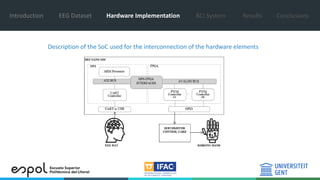
Description of the SoC used for the interconnection of the hardware elements
Introduction EEG Dataset Hardware Implementation BCI System Results Conclusions
Structure of the online approach BCI system
Introduction EEG Dataset Hardware Implementation BCI System Results Conclusions
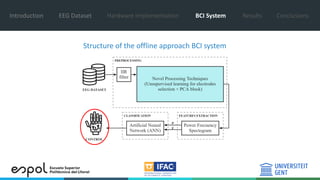
Structure of the offline approach BCI system
Introduction EEG Dataset Hardware Implementation BCI System Results Conclusions
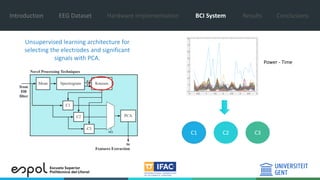
Unsupervised learning architecture for
selecting the electrodes and significant
signals with PCA.
Introduction EEG Dataset Hardware Implementation BCI System Results Conclusions
Spectrogram
Power - Time
Unsupervised learning architecture for
selecting the electrodes and significant
signals with PCA.
Introduction EEG Dataset Hardware Implementation BCI System Results Conclusions
Unsupervised learning architecture for
selecting the electrodes and significant
signals with PCA.
Power - Time
C1 C2 C3
Introduction EEG Dataset Hardware Implementation BCI System Results Conclusions
Unsupervised learning architecture for
selecting the electrodes and significant
signals with PCA.
Introduction EEG Dataset Hardware Implementation BCI System Results Conclusions
PC1 PC2 PC3 PC4 i
4097
Spectrogram
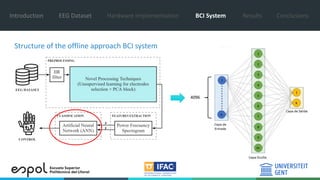
Structure of the offline approach BCI system
Introduction EEG Dataset Hardware Implementation BCI System Results Conclusions
Structure of the offline approach BCI system
4096
Introduction EEG Dataset Hardware Implementation BCI System Results Conclusions
Structure of the offline approach BCI system
Introduction EEG Dataset Hardware Implementation BCI System Results Conclusions
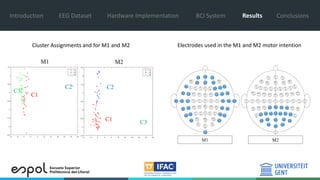
C2
C1
C3
M1
C2
C3
C1
M2
M1 M2
Electrodes used in the M1 and M2 motor intention
Cluster Assignments and for M1 and M2
Introduction EEG Dataset Hardware Implementation BCI System Results Conclusions
Classification Stage
• The dataset was fragmented as follow: 70% training, 15% Validation, 15 Testing.
• We obtained better results for groups C3 for M1 and C2 of M2.
Neurons in the HL Accuracy
5 94.8%
10 96.4%
15 94.3%
20 92.4%
30 90.5%
• Validation Accuracy: 93,7%
• Using 60 new datapoints: 95,1%
Introduction EEG Dataset Hardware Implementation BCI System Results Conclusions
• Resources Used by the FPGA
• The processing time and the total amount of resources used in the FPGA are optimal enough to
execute the MLP neural network and classify the data in about 8.8µs.
Introduction EEG Dataset Hardware Implementation BCI System Results Conclusions
• The location of the electrodes for each task concur with the location of the extremities in the Penfield
Homunculus: for M1, the electrodes are concentrated at the end of the motor and somatosensory
cortex; for M2, in the central part of the brain.
• Using the electrode selection and reduction technique with K-means + PCA, allows reducing processing
costs and using an off the shelf FPGA, which allows us to process the data in real time.
Conclusions
http://mib.espol.edu.ec
For more information
Alisson Constantine Macías
Mail: alascons@espol.edu.ec
Facultad de Ingeniería en Electricidad y Computación, FIEC
Escuela Superior Politécnica del Litoral, ESPOL
Campus Gustavo Galindo Km 30.5 Vía Perimetral, P.O. Box 09-01-5863
090150 Guayaquil, Ecuador
Víctor Asanza
Mail: vasanza@espol.edu.ec
Facultad de Ingeniería en Electricidad y Computación, FIEC
Escuela Superior Politécnica del Litoral, ESPOL
Campus Gustavo Galindo Km 30.5 Vía Perimetral, P.O. Box 09-01-5863
090150 Guayaquil, Ecuador
BCI System using a Novel Processing Technique Based on Electrodes
Selection for Hand Prosthesis Control
Thank you!

⭐⭐⭐⭐⭐ #BCI System using a Novel Processing Technique Based on Electrodes Selection for Hand #Prosthesis Control

  • 1.
    1 BCI System usinga Novel Processing Technique Based on Electrodes Selection for Hand Prosthesis Control Alisson Constantine, Victor Asanza, Francis R. Loayza, Enrique Peláez, Diego Peluffo-Ordóñez Escuela Superior Politécnica del Litoral, ESPOL, Guayaquil, Ecuador Facultad de Ingeniería en Electricidad y Computación, FIEC
  • 2.
    BCI System usinga Novel Processing Technique Based on Electrodes Selection for Hand Prosthesis Control Published in: https://doi.org/10.1016/j.ifacol.2021.10.283
  • 3.
    BCI System usinga Novel Processing Technique Based on Electrodes Selection for Hand Prosthesis Control Introduction EEG Dataset Hardware Implementation BCI System Structure Results Conclusions 1. 2. 3. 4. 5. 6.
  • 4.
    Introduction EEG DatasetHardware Implementation BCI System Results Conclusions EEG Acquisition • Millions of people suffer from limb loss due to amputations, which causes a significant effect on their life (McDonald et al., 2020). • For active prosthesis control, electromyography (EMG) sensors are used to detect motor intentions. However, these sensors require residual motor activity from the subject (Cedeño et al., 2019). • Electroencephalography (EEG) has a great impact on the development of assistive rehabilitation devices and prostheses (Asanza et al., 2020, 2018).
  • 5.
    Introduction EEG DatasetHardware Implementation BCI System Results Conclusions EEG Acquisition
  • 6.
    Introduction EEG DatasetHardware Implementation BCI System Results Conclusions 64 electrodes: International 10-10 system Frequency 160Hz 4.1 seconds (656 samples) = 90 Repetitions 2 Movements M1: Imagines open and close both fists M2: Imagines flexing and extending both ankles. Target https://physionet.org/content/eegmmidb/1.0.0/
  • 7.
    Introduction EEG DatasetHardware Implementation BCI System Results Conclusions Description of the SoC used for the interconnection of the hardware elements
  • 8.
    Introduction EEG DatasetHardware Implementation BCI System Results Conclusions Structure of the online approach BCI system
  • 9.
    Introduction EEG DatasetHardware Implementation BCI System Results Conclusions Structure of the offline approach BCI system
  • 10.
    Introduction EEG DatasetHardware Implementation BCI System Results Conclusions Unsupervised learning architecture for selecting the electrodes and significant signals with PCA.
  • 11.
    Introduction EEG DatasetHardware Implementation BCI System Results Conclusions Spectrogram Power - Time Unsupervised learning architecture for selecting the electrodes and significant signals with PCA.
  • 12.
    Introduction EEG DatasetHardware Implementation BCI System Results Conclusions Unsupervised learning architecture for selecting the electrodes and significant signals with PCA. Power - Time C1 C2 C3
  • 13.
    Introduction EEG DatasetHardware Implementation BCI System Results Conclusions Unsupervised learning architecture for selecting the electrodes and significant signals with PCA.
  • 14.
    Introduction EEG DatasetHardware Implementation BCI System Results Conclusions PC1 PC2 PC3 PC4 i 4097 Spectrogram Structure of the offline approach BCI system
  • 15.
    Introduction EEG DatasetHardware Implementation BCI System Results Conclusions Structure of the offline approach BCI system 4096
  • 16.
    Introduction EEG DatasetHardware Implementation BCI System Results Conclusions Structure of the offline approach BCI system
  • 17.
    Introduction EEG DatasetHardware Implementation BCI System Results Conclusions C2 C1 C3 M1 C2 C3 C1 M2 M1 M2 Electrodes used in the M1 and M2 motor intention Cluster Assignments and for M1 and M2
  • 18.
    Introduction EEG DatasetHardware Implementation BCI System Results Conclusions Classification Stage • The dataset was fragmented as follow: 70% training, 15% Validation, 15 Testing. • We obtained better results for groups C3 for M1 and C2 of M2. Neurons in the HL Accuracy 5 94.8% 10 96.4% 15 94.3% 20 92.4% 30 90.5% • Validation Accuracy: 93,7% • Using 60 new datapoints: 95,1%
  • 19.
    Introduction EEG DatasetHardware Implementation BCI System Results Conclusions • Resources Used by the FPGA • The processing time and the total amount of resources used in the FPGA are optimal enough to execute the MLP neural network and classify the data in about 8.8µs.
  • 20.
    Introduction EEG DatasetHardware Implementation BCI System Results Conclusions • The location of the electrodes for each task concur with the location of the extremities in the Penfield Homunculus: for M1, the electrodes are concentrated at the end of the motor and somatosensory cortex; for M2, in the central part of the brain. • Using the electrode selection and reduction technique with K-means + PCA, allows reducing processing costs and using an off the shelf FPGA, which allows us to process the data in real time. Conclusions
  • 21.
  • 22.
    For more information AlissonConstantine Macías Mail: alascons@espol.edu.ec Facultad de Ingeniería en Electricidad y Computación, FIEC Escuela Superior Politécnica del Litoral, ESPOL Campus Gustavo Galindo Km 30.5 Vía Perimetral, P.O. Box 09-01-5863 090150 Guayaquil, Ecuador Víctor Asanza Mail: vasanza@espol.edu.ec Facultad de Ingeniería en Electricidad y Computación, FIEC Escuela Superior Politécnica del Litoral, ESPOL Campus Gustavo Galindo Km 30.5 Vía Perimetral, P.O. Box 09-01-5863 090150 Guayaquil, Ecuador
  • 23.
    BCI System usinga Novel Processing Technique Based on Electrodes Selection for Hand Prosthesis Control Thank you!