Learning-based Energy
Consumption Prediction
Presenter by: Víctor Asanza, Ph.D
Escuela Superior Politécnica del Litoral, ESPOL, Guayaquil, Ecuador
Centro de Tecnologías de Información, CTI
Facultad de Ingeniería en Electricidad y Computación, FIEC
Rebeca Estrada Pico , Víctor Asanza , Adrián Bazurto , Irving Valeriano , Danny Torres
Published in:
https://doi.org/10.1016/j.procs.2022.07.035
Learning-based Energy Consumption Prediction
OUTLINE
• Objetive
• Related Work
• System Model
• Methodology
• Numerical results
• Conclusion
OBJECTIVE
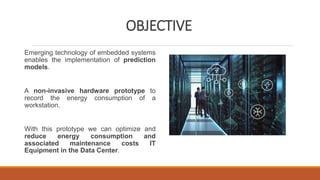
Emerging technology of embedded systems
enables the implementation of prediction
models.
A non-invasive hardware prototype to
record the energy consumption of a
workstation.
With this prototype we can optimize and
reduce energy consumption and
associated maintenance costs IT
Equipment in the Data Center.
RELATED WORK
Energy
Prediction
Methods
INPUT
VARIABLES
OUTPUT
VARIABLES
A.I
ALGOROITHM
• CPU Workload, Memory disk workload, I/O Unit Workload [9].
• Quantity Data to process [10].
• Number of file downloads on Servers [12].
• Speed of energy consumption from a server [13].
• Energy consumption [8].
• Relative and absolute average of workloads [9].
• CPU frequency [10].
• Number of abstract views on the servers [12].
• Energy consumption from data center servers [13].
• Linear prediction weighted [8]. Tests were done on 5, 10 and
20minute interval.
• Neuronal Network BP, Elman and LSTM TIME lapses in seconds [9].
• Support vector regression data was collected for 1 year [13].
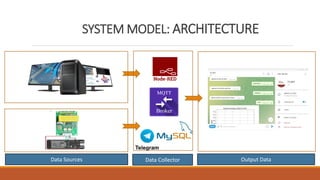
SYSTEM MODEL: ARCHITECTURE
CTI (https://www.cti.espol.edu.ec/)
SYSTEM MODEL: ARCHITECTURE
Data Sources Data Collector Output Data
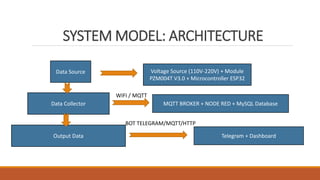
SYSTEM MODEL: ARCHITECTURE
Data Source
Data Collector
Output Data
Voltage Source (110V-220V) + Module
PZM004T V3.0 + Microcontroller ESP32
MQTT BROKER + NODE RED + MySQL Database
Telegram + Dashboard
WIFI / MQTT
BOT TELEGRAM/MQTT/HTTP
SYSTEM MODEL: HARDWARE DESIGN
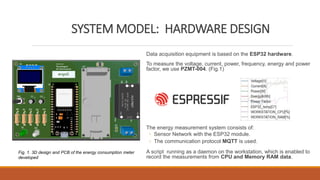
Data acquisition equipment is based on the ESP32 hardware.
To measure the voltage, current, power, frequency, energy and power
factor, we use PZMT-004. (Fig.1)
The energy measurement system consists of:
◦ Sensor Network with the ESP32 module.
◦ The communication protocol MQTT is used.
A script running as a daemon on the workstation, which is enabled to
record the measurements from CPU and Memory RAM data.
Fig. 1. 3D design and PCB of the energy consumption meter
developed
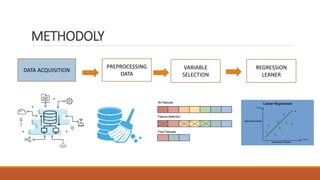
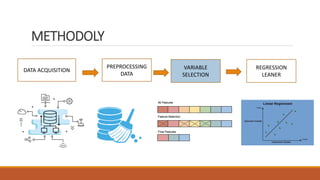
METHODOLY
DATA ACQUISITION
PREPROCESSING
DATA
VARIABLE
SELECTION
REGRESSION
LEANER
DATA ACQUISITION
2. Data Acquisition
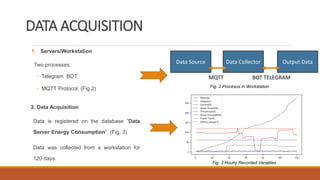
Data is registered on the database ”Data
Server Energy Consumption”. (Fig. 3)
Data was collected from a workstation for
120 days.
Fig. 3 Hourly Recorded Variables
Fig. 2 Procesos in Workstation
Data Collector
Data Source Output Data
BOT TELEGRAM
MQTT
1. Servers/Workstation
Two processes:
◦ Telegram BOT
◦ MQTT Protocol. (Fig.2)
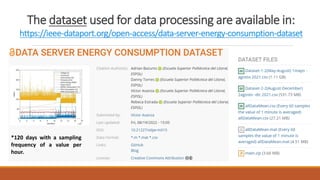
The dataset used for data processing are available in:
https://ieee-dataport.org/open-access/data-server-energy-consumption-dataset
*120 days with a sampling
frequency of a value per
hour.
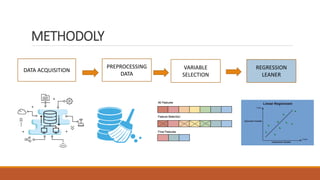
METHODOLY
DATA ACQUISITION
PREPROCESSING
DATA
VARIABLE
SELECTION
REGRESSION
LEANER
PREPROCESSING DATA
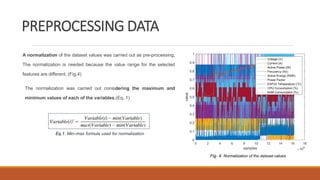
A normalization of the dataset values was carried out as pre-processing.
The normalization is needed because the value range for the selected
features are different. (Fig.4)
The normalization was carried out considering the maximum and
minimum values of each of the variables.(Eq. 1)
Fig. 4. Normalization of the dataset values
Eq.1. Min–max formula used for normalization
METHODOLY
DATA ACQUISITION
PREPROCESSING
DATA
VARIABLE
SELECTION
REGRESSION
LEANER
VARIABLE SELECTION
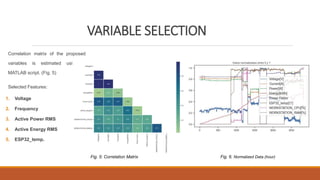
Correlation matrix of the proposed
variables is estimated using a
MATLAB script. (Fig. 5)
Selected Features:
1. Voltage
2. Frequency
3. Active Power RMS
4. Active Energy RMS
5. ESP32_temp.
Fig. 5: Correlation Matrix Fig. 6. Normalized Data (hour)
METHODOLY
DATA ACQUISITION
PREPROCESSING
DATA
VARIABLE
SELECTION
REGRESSION
LEANER
REGRESSION LEARNER
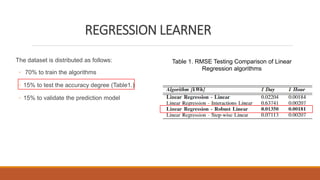
The dataset is distributed as follows:
◦ 70% to train the algorithms
◦ 15% to test the accuracy degree (Table1.)
◦ 15% to validate the prediction model
Table 1. RMSE Testing Comparison of Linear
Regression algorithms
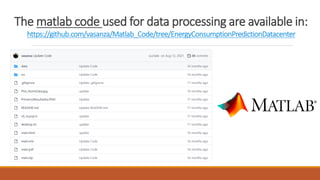
The matlab code used for data processing are available in:
https://github.com/vasanza/Matlab_Code/tree/EnergyConsumptionPredictionDatacenter
RESULTS
During the validation process:
◦ Hourly predicted values are similar to real
energy consumption with a MAE value of
0.0885 [kWh] and a RMSE of 0.025712
[kWh] .
◦ Daily prediction values showed that the
model is an underfitted model because of its
MAE of 3.2255 [kWh] and a RMSE of
3.25029 [kWh],
CONCLUSION
1. Energy consumption in days, presents an RMSE of 3.25029 [kWh], which is an
indicator that the model is underfitting in this time window.
2. Energy consumption in One-Hours, presents an RMSE of 0.025712 [kWh], which is
an indicator that the model is not over-fitted in this time window.
3. Robust Linear Regression Model, was selected based on the RMSE of the energy
consumption predicted value.
For more information
Mail: {restrada, vasanza,abazurto, ivaleria, daaltorr}@espol.edu.ec
Centro de Tecnologías de Información, CTI
Escuela Superior Politécnica del Litoral, ESPOL
Campus Gustavo Galindo Km 30.5 Vía Perimetral, P.O. Box 09-01-5863
090150 Guayaquil, Ecuador
Rebeca Estrada Pico , Víctor Asanza , Adrián Bazurto , Irving Valeriano , Danny Torres
Thank you!

⭐⭐⭐⭐⭐ Learning-based Energy Consumption Prediction

  • 2.
    Learning-based Energy Consumption Prediction Presenterby: Víctor Asanza, Ph.D Escuela Superior Politécnica del Litoral, ESPOL, Guayaquil, Ecuador Centro de Tecnologías de Información, CTI Facultad de Ingeniería en Electricidad y Computación, FIEC Rebeca Estrada Pico , Víctor Asanza , Adrián Bazurto , Irving Valeriano , Danny Torres
  • 3.
  • 4.
    Learning-based Energy ConsumptionPrediction OUTLINE • Objetive • Related Work • System Model • Methodology • Numerical results • Conclusion
  • 5.
    OBJECTIVE Emerging technology ofembedded systems enables the implementation of prediction models. A non-invasive hardware prototype to record the energy consumption of a workstation. With this prototype we can optimize and reduce energy consumption and associated maintenance costs IT Equipment in the Data Center.
  • 6.
    RELATED WORK Energy Prediction Methods INPUT VARIABLES OUTPUT VARIABLES A.I ALGOROITHM • CPUWorkload, Memory disk workload, I/O Unit Workload [9]. • Quantity Data to process [10]. • Number of file downloads on Servers [12]. • Speed of energy consumption from a server [13]. • Energy consumption [8]. • Relative and absolute average of workloads [9]. • CPU frequency [10]. • Number of abstract views on the servers [12]. • Energy consumption from data center servers [13]. • Linear prediction weighted [8]. Tests were done on 5, 10 and 20minute interval. • Neuronal Network BP, Elman and LSTM TIME lapses in seconds [9]. • Support vector regression data was collected for 1 year [13].
  • 7.
    SYSTEM MODEL: ARCHITECTURE CTI(https://www.cti.espol.edu.ec/)
  • 8.
    SYSTEM MODEL: ARCHITECTURE DataSources Data Collector Output Data
  • 9.
    SYSTEM MODEL: ARCHITECTURE DataSource Data Collector Output Data Voltage Source (110V-220V) + Module PZM004T V3.0 + Microcontroller ESP32 MQTT BROKER + NODE RED + MySQL Database Telegram + Dashboard WIFI / MQTT BOT TELEGRAM/MQTT/HTTP
  • 10.
    SYSTEM MODEL: HARDWAREDESIGN Data acquisition equipment is based on the ESP32 hardware. To measure the voltage, current, power, frequency, energy and power factor, we use PZMT-004. (Fig.1) The energy measurement system consists of: ◦ Sensor Network with the ESP32 module. ◦ The communication protocol MQTT is used. A script running as a daemon on the workstation, which is enabled to record the measurements from CPU and Memory RAM data. Fig. 1. 3D design and PCB of the energy consumption meter developed
  • 11.
  • 12.
    DATA ACQUISITION 2. DataAcquisition Data is registered on the database ”Data Server Energy Consumption”. (Fig. 3) Data was collected from a workstation for 120 days. Fig. 3 Hourly Recorded Variables Fig. 2 Procesos in Workstation Data Collector Data Source Output Data BOT TELEGRAM MQTT 1. Servers/Workstation Two processes: ◦ Telegram BOT ◦ MQTT Protocol. (Fig.2)
  • 13.
    The dataset usedfor data processing are available in: https://ieee-dataport.org/open-access/data-server-energy-consumption-dataset *120 days with a sampling frequency of a value per hour.
  • 14.
  • 15.
    PREPROCESSING DATA A normalizationof the dataset values was carried out as pre-processing. The normalization is needed because the value range for the selected features are different. (Fig.4) The normalization was carried out considering the maximum and minimum values of each of the variables.(Eq. 1) Fig. 4. Normalization of the dataset values Eq.1. Min–max formula used for normalization
  • 16.
  • 17.
    VARIABLE SELECTION Correlation matrixof the proposed variables is estimated using a MATLAB script. (Fig. 5) Selected Features: 1. Voltage 2. Frequency 3. Active Power RMS 4. Active Energy RMS 5. ESP32_temp. Fig. 5: Correlation Matrix Fig. 6. Normalized Data (hour)
  • 18.
  • 19.
    REGRESSION LEARNER The datasetis distributed as follows: ◦ 70% to train the algorithms ◦ 15% to test the accuracy degree (Table1.) ◦ 15% to validate the prediction model Table 1. RMSE Testing Comparison of Linear Regression algorithms
  • 20.
    The matlab codeused for data processing are available in: https://github.com/vasanza/Matlab_Code/tree/EnergyConsumptionPredictionDatacenter
  • 21.
    RESULTS During the validationprocess: ◦ Hourly predicted values are similar to real energy consumption with a MAE value of 0.0885 [kWh] and a RMSE of 0.025712 [kWh] . ◦ Daily prediction values showed that the model is an underfitted model because of its MAE of 3.2255 [kWh] and a RMSE of 3.25029 [kWh],
  • 22.
    CONCLUSION 1. Energy consumptionin days, presents an RMSE of 3.25029 [kWh], which is an indicator that the model is underfitting in this time window. 2. Energy consumption in One-Hours, presents an RMSE of 0.025712 [kWh], which is an indicator that the model is not over-fitted in this time window. 3. Robust Linear Regression Model, was selected based on the RMSE of the energy consumption predicted value.
  • 23.
    For more information Mail:{restrada, vasanza,abazurto, ivaleria, daaltorr}@espol.edu.ec Centro de Tecnologías de Información, CTI Escuela Superior Politécnica del Litoral, ESPOL Campus Gustavo Galindo Km 30.5 Vía Perimetral, P.O. Box 09-01-5863 090150 Guayaquil, Ecuador Rebeca Estrada Pico , Víctor Asanza , Adrián Bazurto , Irving Valeriano , Danny Torres
  • 24.