Uncommon
Service

Presented by
Varun Nigam
Uncommon Service

Authors

Frances Frei
Anne Morriss
Uncommon Service

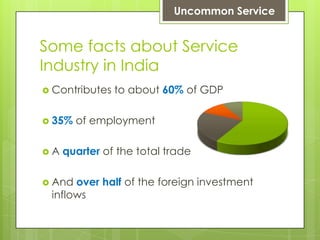
Some facts about Service
Industry in India
 Contributes
 35%
A

to about 60% of GDP

of employment

quarter of the total trade

 And

over half of the foreign investment
inflows
Uncommon Service

Some facts about Service
Industry in India
 One

of the largest and fastest growing
sectors in the global market

 Received

FDI equity inflows worth ₹
179,150.49 crores in the period April 2000 –
August 2013
Uncommon Service

What do we need a service
for?
 To

get help with the problems we face
while using a product

 To

make a product meaningful
Uncommon Service

Helping is in Human Nature
and yet good services are still
rare
 It

is not that employees and owners want
to deliver bad service
 It is not that we need a bad service
 We still get a bad service
 What’s going wrong?
Uncommon Service

Channel human impulse to
serve into
Uncommon Service

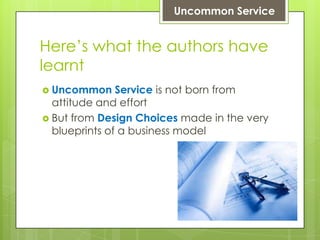
Here’s what the authors have
learnt
 Uncommon

Service is not born from
attitude and effort
 But from Design Choices made in the very
blueprints of a business model
Uncommon Service

It easy to say that we provide
services
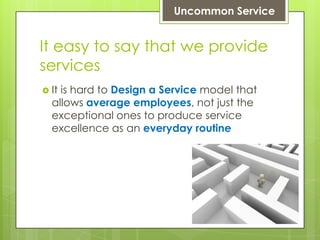
 It

is hard to Design a Service model that
allows average employees, not just the
exceptional ones to produce service
excellence as an everyday routine
Uncommon Service

Outstanding Service
Organizations create
Offerings

Funding
Strategies

Systems

Cultures
Uncommon Service

How to deliver Uncommon
Service by Design
Uncommon Service

The Four Service Truths
 You

can’t be good at everything
 Someone has to pay for it
 It’s not your employees’ fault
 You must manage your customers
Uncommon Service

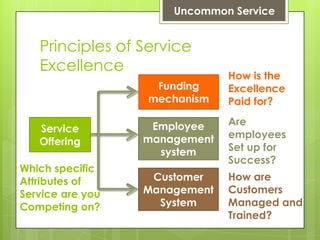
Principles of Service
Excellence
Funding
mechanism

How is the
Excellence
Paid for?

Service
Offering

Employee
management
system

Which specific
Attributes of
Service are you
Competing on?

Are
employees
Set up for
Success?

Customer
Management
System

How are
Customers
Managed and
Trained?
Uncommon Service

You can’t be good at
everything
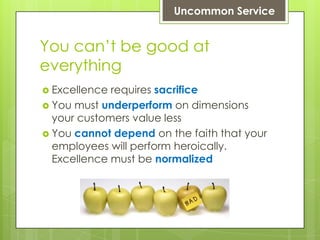
 Excellence

requires sacrifice
 You must underperform on dimensions
your customers value less
 You cannot depend on the faith that your
employees will perform heroically.
Excellence must be normalized
Uncommon Service

Example: Commerce Bank
 Offers

the worst interest rates in the
industry
 But open from 7:30 am to 8:00 pm from
Monday to Friday
 Full banking services would be available
on Saturdays and Sundays
Uncommon Service

Where to be Good and where
to be Bad?
 Find

what your customers value most
 Service is more about best in class
customer interactions
 Employees best-of-the-best in both
Attitude and Aptitude are expensive
Uncommon Service

Where to be Good and where
to be Bad?
 People

with good attitude are desired in
service industry
 Simplify your products to deal with any
problem arising from less aptitude of the
employees
Uncommon Service

The Attribute Map
Most
Convenience
Important
To target
Customer
market
interactions
---

Least
Important
To target
market

Product
Range
Price
Relative performance
of the firm
Uncommon Service

Putting it into practice
 Create

an internal attribute map
 Create an external attribute map
 Analyze your performance
 React
Uncommon Service

Attribute map for analyzing
performance
Most
important
To target
market

Least
important
To target
market

Quality of
installation

Need a
Wedge

Low price
---

Responsiveness
--Courteous and
professional

Your company
Competitor

Proactive
Follow-up

Relative performance
of the firm
Uncommon Service

Wasted Wedge
Most
important
To target
market

Quality of
installation

Wasted
Wedge

Low price
---

Responsiveness

Least
important
To target
market

--Courteous and
professional

Your company
Competitor

Proactive
Follow-up

Relative performance
of the firm
Uncommon Service

Wasted Profit
Most
important
To target
market

Quality of
installation
Low price
---

Responsiveness

Least
important
To target
market

Wasted
Profit

--Courteous and
professional

Your company
Competitor

Proactive
Follow-up

Relative performance
of the firm
Uncommon Service

Someone has to pay for it
 The

most successful service models
incorporate a mechanism for reliably
funding an exceptional experience
 4 funding mechanisms which can be used
to sustain your premium offering.
Uncommon Service

4 ways to pay for excellence
 Charge

customers extra for it – in a
palatable way
 Make cost reductions that also improve
service
 Make service improvements that also
reduce costs
 Get customers to do the work for you
Uncommon Service

Examples
 Commerce

Bank – did not charge
customers for better service but offered
lower interest rates on deposits
 Loyalty programs, if designed
correctly, are a great way to get paid for
your premium service
Uncommon Service

Examples
 Classrooms

reduced costs and offered
more benefits than private tutors
 Intuit asked its product development
team to take customer calls for support
 Big Bazaar uses the customers serve
themselves model
Uncommon Service

It’s not your Employees’ fault
 It

may not be that you have hired an
entire company of people who just don’t
get it
 You might have built a service model for
phantom employees which you wish you
had, but you actually don’t
Uncommon Service

The successful Employee
Management System
Selection

Training
Job Design
Performance Management
Uncommon Service

Selection – Cost of hiring Stars
High

Aptitude

Low
Low

High

Attitude
Uncommon Service

The competence-complexity
gap
Operational
Complexity

Level
Employee
Sophistication

Time

Gap
Experienced
By front line
Uncommon Service

Start attacking system-wide
complexity
Start here

Don’t start here

High

Operational
complexity
Low
Low

High

Direct value-add to customers
Uncommon Service

You must Manage your
Customers
 Customers

play a special role in service
encounters. This phenomenon is called
customer-operator
 Customers don’t just consume
service, they also participate in creating it
Uncommon Service

You must Manage your
Customers
 Customers

can increase the cost and
reduce the quality of your service
 Sometimes they can help on both
fronts, but that is too rare
 How do you get your customer-operators
to behave?
Uncommon Service

Managing the Chaos of
Customers
Variability of customers can take the following
different forms
Arrival
Request
Capability
Effort
Preference

Will come at any time
Ask for anything they want
Difference in knowledge
Effort levels will vary
Different definitions of quality
Uncommon Service

Successful Customer
Management System
Customer Selection
Customer Training

Service only to selected
customers
Customers need training to
Perform their roles

Customer Job Design

Give your customers less
work

Managing customer performance

Customers shouldn’t be
Left entirely on their own

The Values Lever

Give a great value to your
Customers
Uncommon Service

We’ve Designed. Now Multiply
it by Culture

Service Excellence = Design x Culture
Uncommon Service

What after you develop your
Culture?

Get Bigger
Uncommon Service

An Uncommon

Uncommon Service

  • 1.
  • 2.
  • 3.
    Uncommon Service Some factsabout Service Industry in India  Contributes  35% A to about 60% of GDP of employment quarter of the total trade  And over half of the foreign investment inflows
  • 4.
    Uncommon Service Some factsabout Service Industry in India  One of the largest and fastest growing sectors in the global market  Received FDI equity inflows worth ₹ 179,150.49 crores in the period April 2000 – August 2013
  • 5.
    Uncommon Service What dowe need a service for?  To get help with the problems we face while using a product  To make a product meaningful
  • 6.
    Uncommon Service Helping isin Human Nature and yet good services are still rare  It is not that employees and owners want to deliver bad service  It is not that we need a bad service  We still get a bad service  What’s going wrong?
  • 7.
    Uncommon Service Channel humanimpulse to serve into
  • 8.
    Uncommon Service Here’s whatthe authors have learnt  Uncommon Service is not born from attitude and effort  But from Design Choices made in the very blueprints of a business model
  • 9.
    Uncommon Service It easyto say that we provide services  It is hard to Design a Service model that allows average employees, not just the exceptional ones to produce service excellence as an everyday routine
  • 10.
    Uncommon Service Outstanding Service Organizationscreate Offerings Funding Strategies Systems Cultures
  • 11.
    Uncommon Service How todeliver Uncommon Service by Design
  • 12.
    Uncommon Service The FourService Truths  You can’t be good at everything  Someone has to pay for it  It’s not your employees’ fault  You must manage your customers
  • 13.
    Uncommon Service Principles ofService Excellence Funding mechanism How is the Excellence Paid for? Service Offering Employee management system Which specific Attributes of Service are you Competing on? Are employees Set up for Success? Customer Management System How are Customers Managed and Trained?
  • 14.
    Uncommon Service You can’tbe good at everything  Excellence requires sacrifice  You must underperform on dimensions your customers value less  You cannot depend on the faith that your employees will perform heroically. Excellence must be normalized
  • 15.
    Uncommon Service Example: CommerceBank  Offers the worst interest rates in the industry  But open from 7:30 am to 8:00 pm from Monday to Friday  Full banking services would be available on Saturdays and Sundays
  • 16.
    Uncommon Service Where tobe Good and where to be Bad?  Find what your customers value most  Service is more about best in class customer interactions  Employees best-of-the-best in both Attitude and Aptitude are expensive
  • 17.
    Uncommon Service Where tobe Good and where to be Bad?  People with good attitude are desired in service industry  Simplify your products to deal with any problem arising from less aptitude of the employees
  • 18.
    Uncommon Service The AttributeMap Most Convenience Important To target Customer market interactions --- Least Important To target market Product Range Price Relative performance of the firm
  • 19.
    Uncommon Service Putting itinto practice  Create an internal attribute map  Create an external attribute map  Analyze your performance  React
  • 20.
    Uncommon Service Attribute mapfor analyzing performance Most important To target market Least important To target market Quality of installation Need a Wedge Low price --- Responsiveness --Courteous and professional Your company Competitor Proactive Follow-up Relative performance of the firm
  • 21.
    Uncommon Service Wasted Wedge Most important Totarget market Quality of installation Wasted Wedge Low price --- Responsiveness Least important To target market --Courteous and professional Your company Competitor Proactive Follow-up Relative performance of the firm
  • 22.
    Uncommon Service Wasted Profit Most important Totarget market Quality of installation Low price --- Responsiveness Least important To target market Wasted Profit --Courteous and professional Your company Competitor Proactive Follow-up Relative performance of the firm
  • 23.
    Uncommon Service Someone hasto pay for it  The most successful service models incorporate a mechanism for reliably funding an exceptional experience  4 funding mechanisms which can be used to sustain your premium offering.
  • 24.
    Uncommon Service 4 waysto pay for excellence  Charge customers extra for it – in a palatable way  Make cost reductions that also improve service  Make service improvements that also reduce costs  Get customers to do the work for you
  • 25.
    Uncommon Service Examples  Commerce Bank– did not charge customers for better service but offered lower interest rates on deposits  Loyalty programs, if designed correctly, are a great way to get paid for your premium service
  • 26.
    Uncommon Service Examples  Classrooms reducedcosts and offered more benefits than private tutors  Intuit asked its product development team to take customer calls for support  Big Bazaar uses the customers serve themselves model
  • 27.
    Uncommon Service It’s notyour Employees’ fault  It may not be that you have hired an entire company of people who just don’t get it  You might have built a service model for phantom employees which you wish you had, but you actually don’t
  • 28.
    Uncommon Service The successfulEmployee Management System Selection Training Job Design Performance Management
  • 29.
    Uncommon Service Selection –Cost of hiring Stars High Aptitude Low Low High Attitude
  • 30.
  • 31.
    Uncommon Service Start attackingsystem-wide complexity Start here Don’t start here High Operational complexity Low Low High Direct value-add to customers
  • 32.
    Uncommon Service You mustManage your Customers  Customers play a special role in service encounters. This phenomenon is called customer-operator  Customers don’t just consume service, they also participate in creating it
  • 33.
    Uncommon Service You mustManage your Customers  Customers can increase the cost and reduce the quality of your service  Sometimes they can help on both fronts, but that is too rare  How do you get your customer-operators to behave?
  • 34.
    Uncommon Service Managing theChaos of Customers Variability of customers can take the following different forms Arrival Request Capability Effort Preference Will come at any time Ask for anything they want Difference in knowledge Effort levels will vary Different definitions of quality
  • 35.
    Uncommon Service Successful Customer ManagementSystem Customer Selection Customer Training Service only to selected customers Customers need training to Perform their roles Customer Job Design Give your customers less work Managing customer performance Customers shouldn’t be Left entirely on their own The Values Lever Give a great value to your Customers

  • 36.
    Uncommon Service We’ve Designed.Now Multiply it by Culture Service Excellence = Design x Culture
  • 37.
    Uncommon Service What afteryou develop your Culture? Get Bigger
  • 38.