ELECTRODYNAMIC
TETHER
Presented by:-
P.VANDANA KRISHNA
CONTENTS
 Introduction
 Principle
 Working
 Stabilization of electrodynamic tethers
 EDT application
 Advantages
 Future scope
 Conclusion
INTRODUCTION
 Satellites have a major part to play in the present
communication system.
 There are over eight thousand satellites and other
large objects in orbit around the Earth, and there are
countless smaller pieces of debris generated by
spacecraft explosions between satellites.
 One method of removing a waste satellite from orbit
would be to carry extra propellant so that the satellite
can bring itself down out of orbit.
INTRODUCTION
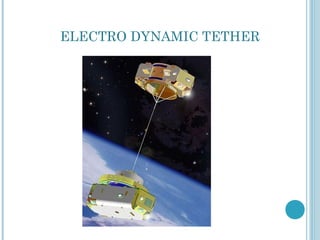
 An ELECTRODYNAMIC tether provides a
simple and reliable alternative to the
conventional rocket thrusters.
 EDTs are basically made of aluminium alloy.
 When direct current is sent through it, it
exerts a force and the tether accelerates the
spacecraft.
 By reversing the direction of current in it, the
same tether can be used to de-orbit old
satellites.
ELECTRO DYNAMIC TETHER
PRINCIPLE
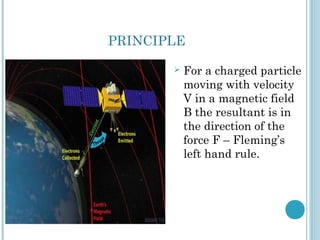
 The basic principle of
an electrodynamic
tether is Lorentz
force.
 It is the force that a
magnetic field exerts
on a current carrying
wire in a direction
perpendicular to both
the direction of
current flow and
magnetic field .
PRINCIPLE
 For a charged particle
moving with velocity
V in a magnetic field
B the resultant is in
the direction of the
force F – Fleming’s
left hand rule.
WORKING
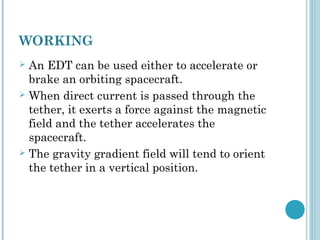
 An EDT can be used either to accelerate or
brake an orbiting spacecraft.
 When direct current is passed through the
tether, it exerts a force against the magnetic
field and the tether accelerates the
spacecraft.
 The gravity gradient field will tend to orient
the tether in a vertical position.
WORKING
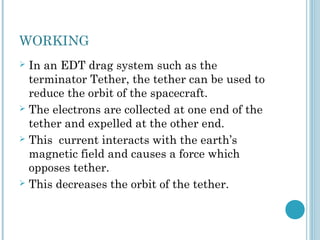
 In an EDT drag system such as the
terminator Tether, the tether can be used to
reduce the orbit of the spacecraft.
 The electrons are collected at one end of the
tether and expelled at the other end.
 This current interacts with the earth’s
magnetic field and causes a force which
opposes tether.
 This decreases the orbit of the tether.
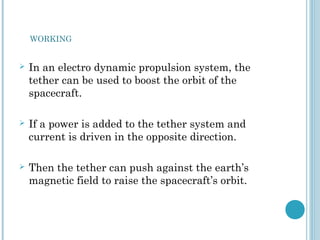
 In an electro dynamic propulsion system, the
tether can be used to boost the orbit of the
spacecraft.
 If a power is added to the tether system and
current is driven in the opposite direction.
 Then the tether can push against the earth’s
magnetic field to raise the spacecraft’s orbit.
WORKING
 The lorentz force acts on the electrons in
tether.
 A hallow cathode causes the tube to heatup
and produce xenon gas.
 Electrons Electrons interact with heat gas to
create a plasma.
 Due to this effect electrons are discharged
rapidly.
WORKING
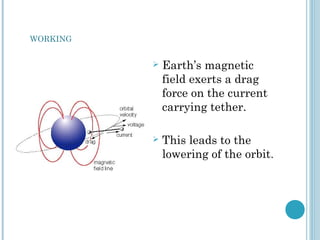
 Earth’s magnetic
field exerts a drag
force on the current
carrying tether.
 This leads to the
lowering of the orbit.
WORKING
EDT PROPULSION
TETHER STABILIZATION
 Electrodynmic tethers are inherently unstable.
 The electrodynamic forces also vary and so a
pendulum motion is developed.
 Further this motion turns in to complex
librations in both the in-plane and out-of-plane
direction.
 The “Tether configuration” feedback algorithm
calculates a gain factor based upon the network
that the electrodynamic forces will perform on
the tether dynamics.
TETHER STABILIZATION
 The second algorithm requires only periodic
measurements of the acceleration of the
tether end mass called “End mass
acceleration” feedback method.
 These enable EDTs to provide long term
propellant less propulsion while maintaining
tether stability and efficiency.
EDT APPLICATIONS
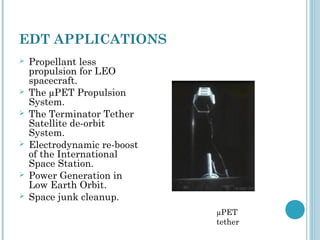
 Propellant less
propulsion for LEO
spacecraft.
 The µPET Propulsion
System.
 The Terminator Tether
Satellite de-orbit
System.
 Electrodynamic re-boost
of the International
Space Station.
 Power Generation in
Low Earth Orbit.
 Space junk cleanup.
µPET
tether
EDT APPLICATIONS
Terminator tether LEO spacecraft
APPLICATIONS
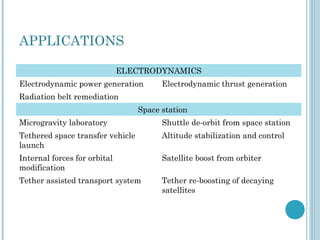
ELECTRODYNAMICS
Electrodynamic power generation Electrodynamic thrust generation
Radiation belt remediation
Space station
Microgravity laboratory Shuttle de-orbit from space station
Tethered space transfer vehicle
launch
Altitude stabilization and control
Internal forces for orbital
modification
Satellite boost from orbiter
Tether assisted transport system Tether re-boosting of decaying
satellites
ADVANTAGES
 The major advantage of tethers compared to
other propulsion systems is it does not require
any propellant.
 Reduces the de-orbit times.
 High efficiency and good adaptability to varying
plasma conditions.
 Boosting tethers of moderate length. (5-20 km)
 Substantially reduce the weight of the spacecraft.
 A cost effective method of re-boosting spacecraft.
 It is reusable .
Advantages
FUTURE SCOPE
 Satellite Tugboat:
Another idea is for the ED tether to be attached
to an unmanned space tugboat that would ferry
satellites to higher orbits.
 Exploring the outer planets:
The most exotic use if ED tether technology
would be to propel and power spacecraft
exploring the outer planets.
CONCLUSION
 As electrodynamic tethers can provide long term
propellant- less propulsion capability for orbital
maneuvering and station keeping of small
satellites in low earth orbit, these are preferable
compared with the existing rocket propulsion
system.
 Also EDTs may provide an economical means of
electrical power in orbit.
 Hence electro dynamic tethers play a key role for
satellite communication system.
Thank you

ELECTRODYNAMIC TETHER

  • 1.
  • 2.
    CONTENTS  Introduction  Principle Working  Stabilization of electrodynamic tethers  EDT application  Advantages  Future scope  Conclusion
  • 3.
    INTRODUCTION  Satellites havea major part to play in the present communication system.  There are over eight thousand satellites and other large objects in orbit around the Earth, and there are countless smaller pieces of debris generated by spacecraft explosions between satellites.  One method of removing a waste satellite from orbit would be to carry extra propellant so that the satellite can bring itself down out of orbit.
  • 4.
    INTRODUCTION  An ELECTRODYNAMICtether provides a simple and reliable alternative to the conventional rocket thrusters.  EDTs are basically made of aluminium alloy.  When direct current is sent through it, it exerts a force and the tether accelerates the spacecraft.  By reversing the direction of current in it, the same tether can be used to de-orbit old satellites.
  • 5.
  • 6.
    PRINCIPLE  The basicprinciple of an electrodynamic tether is Lorentz force.  It is the force that a magnetic field exerts on a current carrying wire in a direction perpendicular to both the direction of current flow and magnetic field .
  • 7.
    PRINCIPLE  For acharged particle moving with velocity V in a magnetic field B the resultant is in the direction of the force F – Fleming’s left hand rule.
  • 8.
    WORKING  An EDTcan be used either to accelerate or brake an orbiting spacecraft.  When direct current is passed through the tether, it exerts a force against the magnetic field and the tether accelerates the spacecraft.  The gravity gradient field will tend to orient the tether in a vertical position.
  • 9.
    WORKING  In anEDT drag system such as the terminator Tether, the tether can be used to reduce the orbit of the spacecraft.  The electrons are collected at one end of the tether and expelled at the other end.  This current interacts with the earth’s magnetic field and causes a force which opposes tether.  This decreases the orbit of the tether.
  • 10.
     In anelectro dynamic propulsion system, the tether can be used to boost the orbit of the spacecraft.  If a power is added to the tether system and current is driven in the opposite direction.  Then the tether can push against the earth’s magnetic field to raise the spacecraft’s orbit. WORKING
  • 11.
     The lorentzforce acts on the electrons in tether.  A hallow cathode causes the tube to heatup and produce xenon gas.  Electrons Electrons interact with heat gas to create a plasma.  Due to this effect electrons are discharged rapidly. WORKING
  • 12.
     Earth’s magnetic fieldexerts a drag force on the current carrying tether.  This leads to the lowering of the orbit. WORKING
  • 13.
  • 14.
    TETHER STABILIZATION  Electrodynmictethers are inherently unstable.  The electrodynamic forces also vary and so a pendulum motion is developed.  Further this motion turns in to complex librations in both the in-plane and out-of-plane direction.  The “Tether configuration” feedback algorithm calculates a gain factor based upon the network that the electrodynamic forces will perform on the tether dynamics.
  • 15.
    TETHER STABILIZATION  Thesecond algorithm requires only periodic measurements of the acceleration of the tether end mass called “End mass acceleration” feedback method.  These enable EDTs to provide long term propellant less propulsion while maintaining tether stability and efficiency.
  • 16.
    EDT APPLICATIONS  Propellantless propulsion for LEO spacecraft.  The µPET Propulsion System.  The Terminator Tether Satellite de-orbit System.  Electrodynamic re-boost of the International Space Station.  Power Generation in Low Earth Orbit.  Space junk cleanup. µPET tether
  • 17.
  • 18.
    APPLICATIONS ELECTRODYNAMICS Electrodynamic power generationElectrodynamic thrust generation Radiation belt remediation Space station Microgravity laboratory Shuttle de-orbit from space station Tethered space transfer vehicle launch Altitude stabilization and control Internal forces for orbital modification Satellite boost from orbiter Tether assisted transport system Tether re-boosting of decaying satellites
  • 19.
    ADVANTAGES  The majoradvantage of tethers compared to other propulsion systems is it does not require any propellant.  Reduces the de-orbit times.  High efficiency and good adaptability to varying plasma conditions.  Boosting tethers of moderate length. (5-20 km)  Substantially reduce the weight of the spacecraft.  A cost effective method of re-boosting spacecraft.  It is reusable . Advantages
  • 20.
    FUTURE SCOPE  SatelliteTugboat: Another idea is for the ED tether to be attached to an unmanned space tugboat that would ferry satellites to higher orbits.  Exploring the outer planets: The most exotic use if ED tether technology would be to propel and power spacecraft exploring the outer planets.
  • 21.
    CONCLUSION  As electrodynamictethers can provide long term propellant- less propulsion capability for orbital maneuvering and station keeping of small satellites in low earth orbit, these are preferable compared with the existing rocket propulsion system.  Also EDTs may provide an economical means of electrical power in orbit.  Hence electro dynamic tethers play a key role for satellite communication system.
  • 22.