SECULARISM
Submitted by:
Kunika Kanodia- 04551103815
Kritika Sabharwal04451103815
BA LLB 1-A
Submitted to:
Ms. Shruti Ahuja
TABLE OF CONTENTS
 Introduction
 Notions of Secularism
 Notions of Equality
 Secularization
 Difference between ‘SECULARISM’ and ‘SECULARISATION’
 Constitution 42nd Amendment
 Reasons to boost Secularism
 Conclusion
INTRODUCTION
The word secular derived from the “ saecularies” Latin word, (worldly or
temporal) which means that it is the state of being separate from religion or of
not being exclusively allied with or against any particular religion .
IN CONTEXT OF SOCIOLOGY…
Growth of modernization and modern civilization has affected religion adversely .
development in the field of science and technology and education has also
adversely affected religion .secularism is a system of social and political
philosophy that reject all forms of religious faith.
According to IAN ROBERTSON,
Secularization is the process by which traditional religious beliefs, and institutions
lose their influence in society . Secular is basically the establishment of religion
as a separate and distinct institution with the limited role in society.
Or, it can be said that it is a system of social organization that does not allow
religion to influence the government , or the belief that religion should not
influence a government .
NOTIONS OF SECULARISM
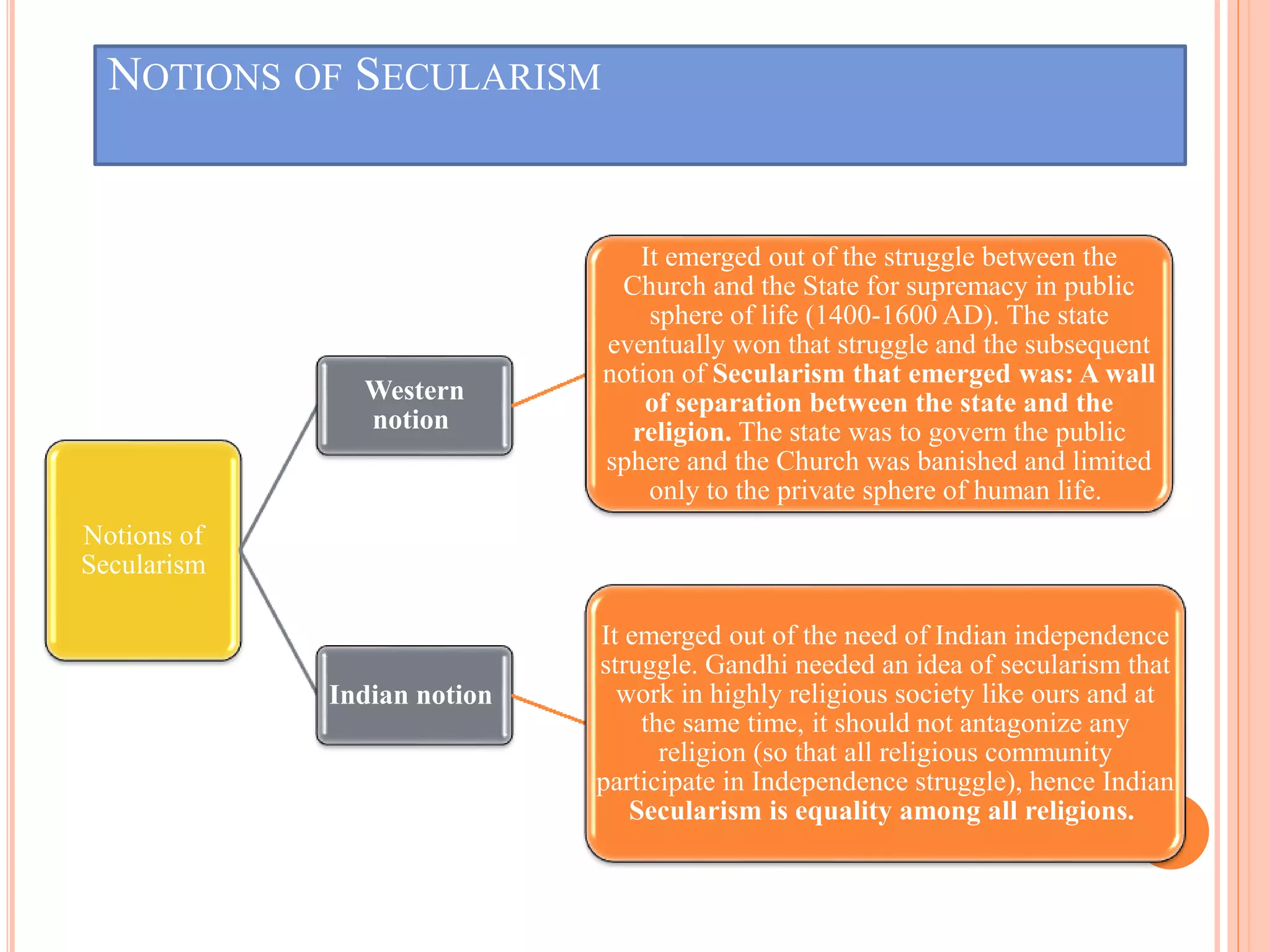
Notions of
Secularism
Western
notion
It emerged out of the struggle between the
Church and the State for supremacy in public
sphere of life (1400-1600 AD). The state
eventually won that struggle and the subsequent
notion of Secularism that emerged was: A wall
of separation between the state and the
religion. The state was to govern the public
sphere and the Church was banished and limited
only to the private sphere of human life.
Indian notion
It emerged out of the need of Indian independence
struggle. Gandhi needed an idea of secularism that
work in highly religious society like ours and at
the same time, it should not antagonize any
religion (so that all religious community
participate in Independence struggle), hence Indian
Secularism is equality among all religions.
NOTIONS OF EQUALITY
Substantive
Here, not only I make sure the
winner is the one who runs fastest
100m but also, I will provide the
poor with bare minimum quality
of shoes so that he stands a
chance against the rich, now this
is equality in broad sense.
Procedural
Here the background inequality
is not considered. For example:
We make a procedure that he
who covers 100m fastest would
win the race. But a poor is
running barefoot and the rich in
world-class sports shoes, here
my procedure of winning the
race treat everyone equally but
does the poor has the same
chance of winning as the rich?
Same applies to religion. Indian Secularism is Equality(Substantive)
among various religion. Hence government is empowered and obliged to
give special privilege to religious community which has been historically
and socially weak. Hence the privileges to the minority.
SECULARIZATION
 It refers to the historical process in which religious loses,
social and cultural significance , as a of secularization
the role of religious in modern societies became
restricted . in secularized society faith lacks cultural
authority and religious organizations have little social
power.
DIFFERENCE BETWEEN
‘SECULARISM’AND ‘SECULARISATION’
A position that religious
belief should not influence
public and governmental
decisions. The related
political belief in the
separation of church and
state.
The transformation of a
society from close
identification with religious
values and institutions
toward non-religious (or
"irreligious") values and
secular institutions.
SECULARISM SECULARISATION
CONSTITUTION
 The unity and fraternity of the people of India,
professing numerous faiths, has been sought to be
achieved by enshrining the ideal of a secular state, which
means that the state protects all religions equally and
does not itself uphold any religion as the State religion.
The question of secularism is not one of the sentiments,
but one of law. The secular objective of the state has
been specifically expressed by inserting the word
“SECULAR” in the Preamble by the Constitution (42nd
amendment) act, 1976.
 Secularism is a part of basic structure of the Constitution. The
liberty of ‘belief, faith and worship’ promised in the Preamble
is implemented by incorporating the fundamental rights of all
citizens relating to “Freedom of Religion” in Articles 25-28
which guarantee to each individual freedom to profess, practice
and propagate religion, assure strict impartiality on the part of
the state and the institutions towards all religions.
 This itself is one of the glowing achievements of Indian
democracy when her neighbours, such as Pakistan, Bangladesh,
Sri Lanka and Burma uphold particular religions as state
religions.
Right to
Freedom of
Religion in
India
Article 25. Freedom
of conscience and
free profession,
practice and
propagation of
religion.
Article 26. Freedom
to manage religious
affairs.
Article 27. Freedom
as to payment of
taxes for promotion
of any particular
religion.
Article 28. Freedom
as to attendance at
religious instruction
or religious worship
in certain education
institutions.
REASONS TO BOOST SECULARISM
Helps in the
development
of liberal
attitudes and
values
Wider-vision
Develops an attitude
of appreciation and
understanding of
others point of view
Develops
democratic
values
Scientific
temper of
mind
Develops a
moral outlook
Develops
humanistic outlook
Synthesizes
materialism and
spiritualism
CONCLUSION
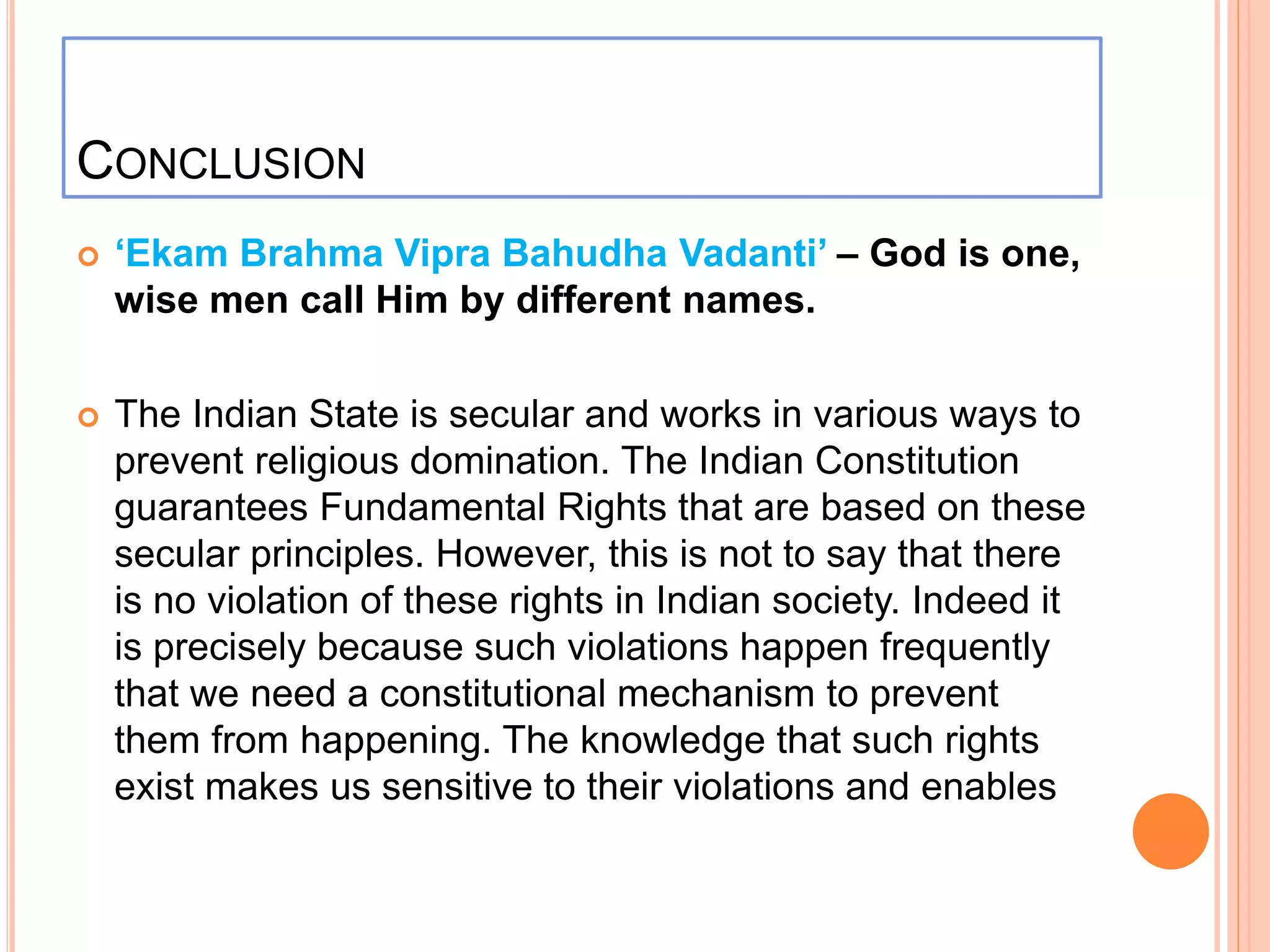
 ‘Ekam Brahma Vipra Bahudha Vadanti’ – God is one,
wise men call Him by different names.
 The Indian State is secular and works in various ways to
prevent religious domination. The Indian Constitution
guarantees Fundamental Rights that are based on these
secular principles. However, this is not to say that there
is no violation of these rights in Indian society. Indeed it
is precisely because such violations happen frequently
that we need a constitutional mechanism to prevent
them from happening. The knowledge that such rights
exist makes us sensitive to their violations and enables

Secularism

  • 1.
    SECULARISM Submitted by: Kunika Kanodia-04551103815 Kritika Sabharwal04451103815 BA LLB 1-A Submitted to: Ms. Shruti Ahuja
  • 2.
    TABLE OF CONTENTS Introduction  Notions of Secularism  Notions of Equality  Secularization  Difference between ‘SECULARISM’ and ‘SECULARISATION’  Constitution 42nd Amendment  Reasons to boost Secularism  Conclusion
  • 3.
    INTRODUCTION The word secularderived from the “ saecularies” Latin word, (worldly or temporal) which means that it is the state of being separate from religion or of not being exclusively allied with or against any particular religion . IN CONTEXT OF SOCIOLOGY… Growth of modernization and modern civilization has affected religion adversely . development in the field of science and technology and education has also adversely affected religion .secularism is a system of social and political philosophy that reject all forms of religious faith. According to IAN ROBERTSON, Secularization is the process by which traditional religious beliefs, and institutions lose their influence in society . Secular is basically the establishment of religion as a separate and distinct institution with the limited role in society. Or, it can be said that it is a system of social organization that does not allow religion to influence the government , or the belief that religion should not influence a government .
  • 4.
    NOTIONS OF SECULARISM Notionsof Secularism Western notion It emerged out of the struggle between the Church and the State for supremacy in public sphere of life (1400-1600 AD). The state eventually won that struggle and the subsequent notion of Secularism that emerged was: A wall of separation between the state and the religion. The state was to govern the public sphere and the Church was banished and limited only to the private sphere of human life. Indian notion It emerged out of the need of Indian independence struggle. Gandhi needed an idea of secularism that work in highly religious society like ours and at the same time, it should not antagonize any religion (so that all religious community participate in Independence struggle), hence Indian Secularism is equality among all religions.
  • 5.
    NOTIONS OF EQUALITY Substantive Here,not only I make sure the winner is the one who runs fastest 100m but also, I will provide the poor with bare minimum quality of shoes so that he stands a chance against the rich, now this is equality in broad sense. Procedural Here the background inequality is not considered. For example: We make a procedure that he who covers 100m fastest would win the race. But a poor is running barefoot and the rich in world-class sports shoes, here my procedure of winning the race treat everyone equally but does the poor has the same chance of winning as the rich? Same applies to religion. Indian Secularism is Equality(Substantive) among various religion. Hence government is empowered and obliged to give special privilege to religious community which has been historically and socially weak. Hence the privileges to the minority.
  • 6.
    SECULARIZATION  It refersto the historical process in which religious loses, social and cultural significance , as a of secularization the role of religious in modern societies became restricted . in secularized society faith lacks cultural authority and religious organizations have little social power.
  • 7.
    DIFFERENCE BETWEEN ‘SECULARISM’AND ‘SECULARISATION’ Aposition that religious belief should not influence public and governmental decisions. The related political belief in the separation of church and state. The transformation of a society from close identification with religious values and institutions toward non-religious (or "irreligious") values and secular institutions. SECULARISM SECULARISATION
  • 8.
    CONSTITUTION  The unityand fraternity of the people of India, professing numerous faiths, has been sought to be achieved by enshrining the ideal of a secular state, which means that the state protects all religions equally and does not itself uphold any religion as the State religion. The question of secularism is not one of the sentiments, but one of law. The secular objective of the state has been specifically expressed by inserting the word “SECULAR” in the Preamble by the Constitution (42nd amendment) act, 1976.
  • 9.
     Secularism isa part of basic structure of the Constitution. The liberty of ‘belief, faith and worship’ promised in the Preamble is implemented by incorporating the fundamental rights of all citizens relating to “Freedom of Religion” in Articles 25-28 which guarantee to each individual freedom to profess, practice and propagate religion, assure strict impartiality on the part of the state and the institutions towards all religions.  This itself is one of the glowing achievements of Indian democracy when her neighbours, such as Pakistan, Bangladesh, Sri Lanka and Burma uphold particular religions as state religions.
  • 10.
    Right to Freedom of Religionin India Article 25. Freedom of conscience and free profession, practice and propagation of religion. Article 26. Freedom to manage religious affairs. Article 27. Freedom as to payment of taxes for promotion of any particular religion. Article 28. Freedom as to attendance at religious instruction or religious worship in certain education institutions.
  • 11.
    REASONS TO BOOSTSECULARISM Helps in the development of liberal attitudes and values Wider-vision Develops an attitude of appreciation and understanding of others point of view Develops democratic values Scientific temper of mind Develops a moral outlook Develops humanistic outlook Synthesizes materialism and spiritualism
  • 12.
    CONCLUSION  ‘Ekam BrahmaVipra Bahudha Vadanti’ – God is one, wise men call Him by different names.  The Indian State is secular and works in various ways to prevent religious domination. The Indian Constitution guarantees Fundamental Rights that are based on these secular principles. However, this is not to say that there is no violation of these rights in Indian society. Indeed it is precisely because such violations happen frequently that we need a constitutional mechanism to prevent them from happening. The knowledge that such rights exist makes us sensitive to their violations and enables