INTRODUCING INDIAN
SOCIETY
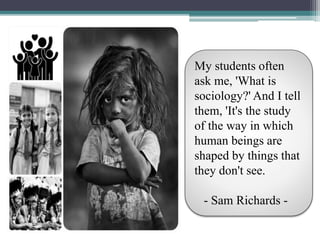
My students often
ask me, 'What is
sociology?' And I tell
them, 'It's the study
of the way in which
human beings are
shaped by things that
they don't see.
- Sam Richards -
SCIOLOGY – THE INTRODUCTION
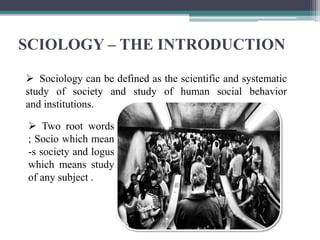
 Sociology can be defined as the scientific and systematic
study of society and study of human social behavior
and institutions.
 Two root words
; Socio which mean
-s society and logus
which means study
of any subject .
PRIOR KNOWLEDGE
Prior knowledge is defined as all the knowledge one
has before learning about a particular topic.
 The disadvantage is that this prior knowledge can be a
problem in order to learn Sociology, we need to
“unlearn” what we already know about society. In fact,
the initial stage of learning Sociology consists mainly
of such unlearning .
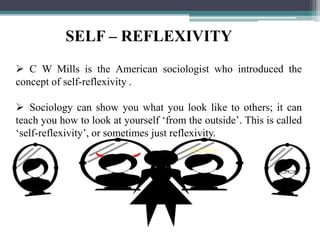
SELF – REFLEXIVITY
 C W Mills is the American sociologist who introduced the
concept of self-reflexivity .
 Sociology can show you what you look like to others; it can
teach you how to look at yourself ‘from the outside’. This is called
‘self-reflexivity’, or sometimes just reflexivity.
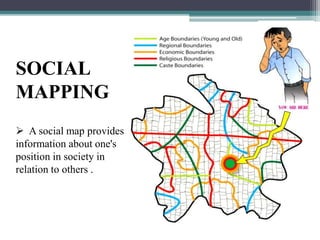
SOCIAL
MAPPING
 A social map provides
information about one's
position in society in
relation to others .
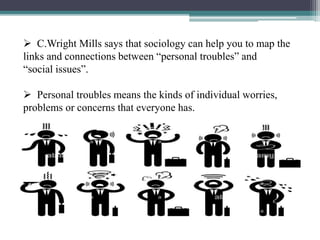
 C.Wright Mills says that sociology can help you to map the
links and connections between “personal troubles” and
“social issues”.
 Personal troubles means the kinds of individual worries,
problems or concerns that everyone has.
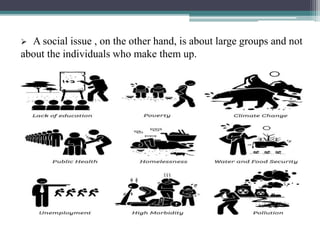
 A social issue , on the other hand, is about large groups and not
about the individuals who make them up.
INDIAN SOCIETY
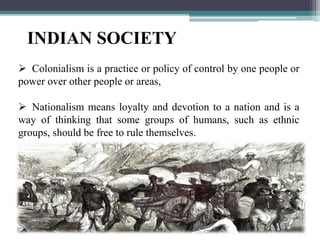
 Colonialism is a practice or policy of control by one people or
power over other people or areas,
 Nationalism means loyalty and devotion to a nation and is a
way of thinking that some groups of humans, such as ethnic
groups, should be free to rule themselves.
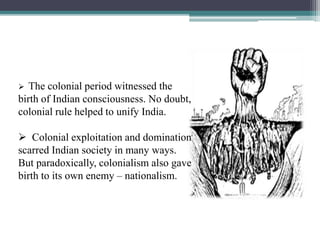
 The colonial period witnessed the
birth of Indian consciousness. No doubt,
colonial rule helped to unify India.
 Colonial exploitation and domination
scarred Indian society in many ways.
But paradoxically, colonialism also gave
birth to its own enemy – nationalism.
 Colonialism created new classes and communities which came
to play significant roles in subsequent history.
 The middle class Indian armed with western education
challenged colonialism .
 The urban middle classes were the main carriers of nationalism
and they led the campaign for freedom.
I. The word ‘Sociology’ is made up of two words. These are-
(a) Societies and Logy
(b) Societia and Logistia
(c) Socio and Logos
(d) Socia & Logos
II. C.Wright Mills was a ……………..sociologist.
(a) American
(b) British
(c) Russian
(d) French
QUESTIONS
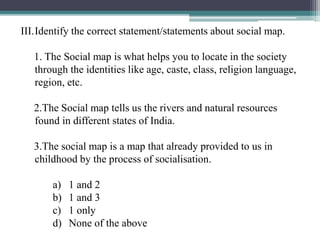
III.Identify the correct statement/statements about social map.
1. The Social map is what helps you to locate in the society
through the identities like age, caste, class, religion language,
region, etc.
2.The Social map tells us the rivers and natural resources
found in different states of India.
3.The social map is a map that already provided to us in
childhood by the process of socialisation.
a) 1 and 2
b) 1 and 3
c) 1 only
d) None of the above
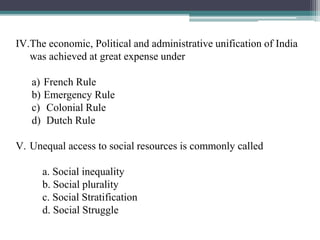
IV.The economic, Political and administrative unification of India
was achieved at great expense under
a) French Rule
b) Emergency Rule
c) Colonial Rule
d) Dutch Rule
V. Unequal access to social resources is commonly called
a. Social inequality
b. Social plurality
c. Social Stratification
d. Social Struggle
VI.The process of subjugation of power by one powerful country
over a weak country is called
a. Nationalism
b. Communalism
c. Colonialism
d. None of these
VII.Which theory analyzes the concepts like personal troubles and
public issues
a. Sociological Imagination
b. Chicago School
c. Synthetic School
d. Formalistic School
VII. Previous knowledge about society is Partial. It has two
meaning. What are they?
A. Biased and Incomplete
B. Unbiased and Complete
C. Unbiased and Incomplete
D. Subjective and biased
IX.The ability to reflect upon yourself through the eyes of others
is called ..................
A. Objectivity
C. Impartiality
B. Subjectivity
D. Self Reflexivity
X. During which Period Indian consciousness took shape?
a. Colonial Period
b. French Period
c. Persian Period
d. Mughal Period
XI. "Sociology can help you to map" the links and connections
between 'Personal troubles' and 'social Issues!" Who has
written this statement ?
a. Aristotle
b. C. Wright Mills
c. Adam Smith
d. None of these
XII.Following is the list of problems that a person face in a society.
You have to classify these into two categories depending on its
impact whether an Social Issue or a Individual Issue.
Treatment
a. Social Issue: Unemployment, Unmarried, III Individual
Issue: Jobs, Price Rise, Gender Equality
b. Social Issue: Social exclusion, Confidence, Gender
EqualityIndividual Issue: Price Rise, Jobs, Gender Equality
c. Social Issue: Price Rise, Unemployment, JobsIndividual
Issue: Tension, Unmarried, III Treatment
d. None of these
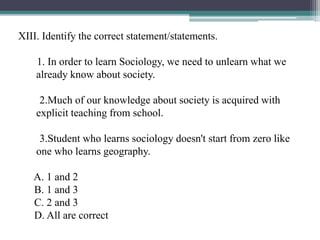
XIII. Identify the correct statement/statements.
1. In order to learn Sociology, we need to unlearn what we
already know about society.
2.Much of our knowledge about society is acquired with
explicit teaching from school.
3.Student who learns sociology doesn't start from zero like
one who learns geography.
A. 1 and 2
B. 1 and 3
C. 2 and 3
D. All are correct
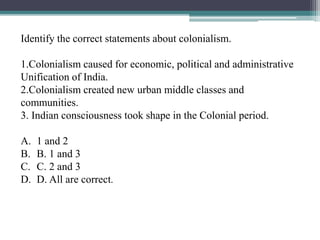
Identify the correct statements about colonialism.
1.Colonialism caused for economic, political and administrative
Unification of India.
2.Colonialism created new urban middle classes and
communities.
3. Indian consciousness took shape in the Colonial period.
A. 1 and 2
B. B. 1 and 3
C. C. 2 and 3
D. D. All are correct.
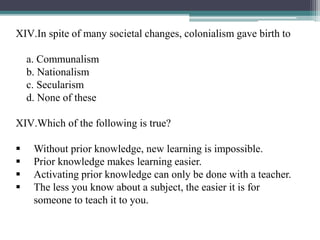
XIV.In spite of many societal changes, colonialism gave birth to
a. Communalism
b. Nationalism
c. Secularism
d. None of these
XIV.Which of the following is true?
 Without prior knowledge, new learning is impossible.
 Prior knowledge makes learning easier.
 Activating prior knowledge can only be done with a teacher.
 The less you know about a subject, the easier it is for
someone to teach it to you.

INTRODUCING INDIAN SOCIETY.pptx

  • 1.
  • 2.
    My students often askme, 'What is sociology?' And I tell them, 'It's the study of the way in which human beings are shaped by things that they don't see. - Sam Richards -
  • 3.
    SCIOLOGY – THEINTRODUCTION  Sociology can be defined as the scientific and systematic study of society and study of human social behavior and institutions.  Two root words ; Socio which mean -s society and logus which means study of any subject .
  • 4.
    PRIOR KNOWLEDGE Prior knowledgeis defined as all the knowledge one has before learning about a particular topic.  The disadvantage is that this prior knowledge can be a problem in order to learn Sociology, we need to “unlearn” what we already know about society. In fact, the initial stage of learning Sociology consists mainly of such unlearning .
  • 5.
    SELF – REFLEXIVITY C W Mills is the American sociologist who introduced the concept of self-reflexivity .  Sociology can show you what you look like to others; it can teach you how to look at yourself ‘from the outside’. This is called ‘self-reflexivity’, or sometimes just reflexivity.
  • 6.
    SOCIAL MAPPING  A socialmap provides information about one's position in society in relation to others .
  • 7.
     C.Wright Millssays that sociology can help you to map the links and connections between “personal troubles” and “social issues”.  Personal troubles means the kinds of individual worries, problems or concerns that everyone has.
  • 8.
     A socialissue , on the other hand, is about large groups and not about the individuals who make them up.
  • 9.
    INDIAN SOCIETY  Colonialismis a practice or policy of control by one people or power over other people or areas,  Nationalism means loyalty and devotion to a nation and is a way of thinking that some groups of humans, such as ethnic groups, should be free to rule themselves.
  • 10.
     The colonialperiod witnessed the birth of Indian consciousness. No doubt, colonial rule helped to unify India.  Colonial exploitation and domination scarred Indian society in many ways. But paradoxically, colonialism also gave birth to its own enemy – nationalism.
  • 11.
     Colonialism creatednew classes and communities which came to play significant roles in subsequent history.  The middle class Indian armed with western education challenged colonialism .  The urban middle classes were the main carriers of nationalism and they led the campaign for freedom.
  • 12.
    I. The word‘Sociology’ is made up of two words. These are- (a) Societies and Logy (b) Societia and Logistia (c) Socio and Logos (d) Socia & Logos II. C.Wright Mills was a ……………..sociologist. (a) American (b) British (c) Russian (d) French QUESTIONS
  • 13.
    III.Identify the correctstatement/statements about social map. 1. The Social map is what helps you to locate in the society through the identities like age, caste, class, religion language, region, etc. 2.The Social map tells us the rivers and natural resources found in different states of India. 3.The social map is a map that already provided to us in childhood by the process of socialisation. a) 1 and 2 b) 1 and 3 c) 1 only d) None of the above
  • 14.
    IV.The economic, Politicaland administrative unification of India was achieved at great expense under a) French Rule b) Emergency Rule c) Colonial Rule d) Dutch Rule V. Unequal access to social resources is commonly called a. Social inequality b. Social plurality c. Social Stratification d. Social Struggle
  • 15.
    VI.The process ofsubjugation of power by one powerful country over a weak country is called a. Nationalism b. Communalism c. Colonialism d. None of these VII.Which theory analyzes the concepts like personal troubles and public issues a. Sociological Imagination b. Chicago School c. Synthetic School d. Formalistic School
  • 16.
    VII. Previous knowledgeabout society is Partial. It has two meaning. What are they? A. Biased and Incomplete B. Unbiased and Complete C. Unbiased and Incomplete D. Subjective and biased IX.The ability to reflect upon yourself through the eyes of others is called .................. A. Objectivity C. Impartiality B. Subjectivity D. Self Reflexivity
  • 17.
    X. During whichPeriod Indian consciousness took shape? a. Colonial Period b. French Period c. Persian Period d. Mughal Period XI. "Sociology can help you to map" the links and connections between 'Personal troubles' and 'social Issues!" Who has written this statement ? a. Aristotle b. C. Wright Mills c. Adam Smith d. None of these
  • 18.
    XII.Following is thelist of problems that a person face in a society. You have to classify these into two categories depending on its impact whether an Social Issue or a Individual Issue. Treatment a. Social Issue: Unemployment, Unmarried, III Individual Issue: Jobs, Price Rise, Gender Equality b. Social Issue: Social exclusion, Confidence, Gender EqualityIndividual Issue: Price Rise, Jobs, Gender Equality c. Social Issue: Price Rise, Unemployment, JobsIndividual Issue: Tension, Unmarried, III Treatment d. None of these
  • 19.
    XIII. Identify thecorrect statement/statements. 1. In order to learn Sociology, we need to unlearn what we already know about society. 2.Much of our knowledge about society is acquired with explicit teaching from school. 3.Student who learns sociology doesn't start from zero like one who learns geography. A. 1 and 2 B. 1 and 3 C. 2 and 3 D. All are correct
  • 20.
    Identify the correctstatements about colonialism. 1.Colonialism caused for economic, political and administrative Unification of India. 2.Colonialism created new urban middle classes and communities. 3. Indian consciousness took shape in the Colonial period. A. 1 and 2 B. B. 1 and 3 C. C. 2 and 3 D. D. All are correct.
  • 21.
    XIV.In spite ofmany societal changes, colonialism gave birth to a. Communalism b. Nationalism c. Secularism d. None of these XIV.Which of the following is true?  Without prior knowledge, new learning is impossible.  Prior knowledge makes learning easier.  Activating prior knowledge can only be done with a teacher.  The less you know about a subject, the easier it is for someone to teach it to you.