The Impact of the Disconnected Workforce Mauro Lollo Co-Founder, CTO
Agenda On the mind of Business Leaders / Knowledge Workers Productivity Forces acting on the enterprise Modes of communication Confusion & Change Unified Communications Overview
What’s on the mind of Business Leaders?   1,100 Business Leaders 40 countries  32 industries
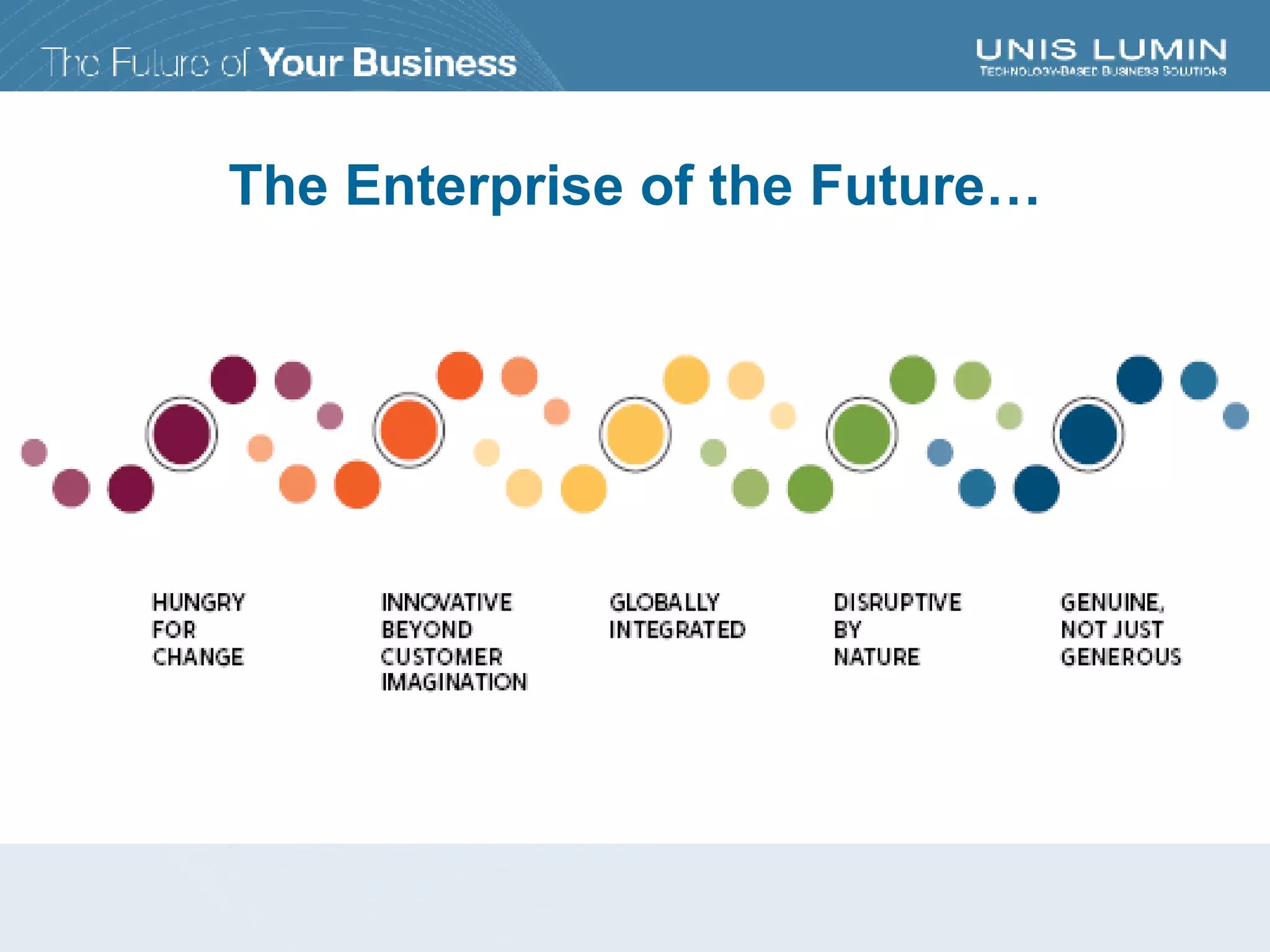
The Enterprise of the Future…
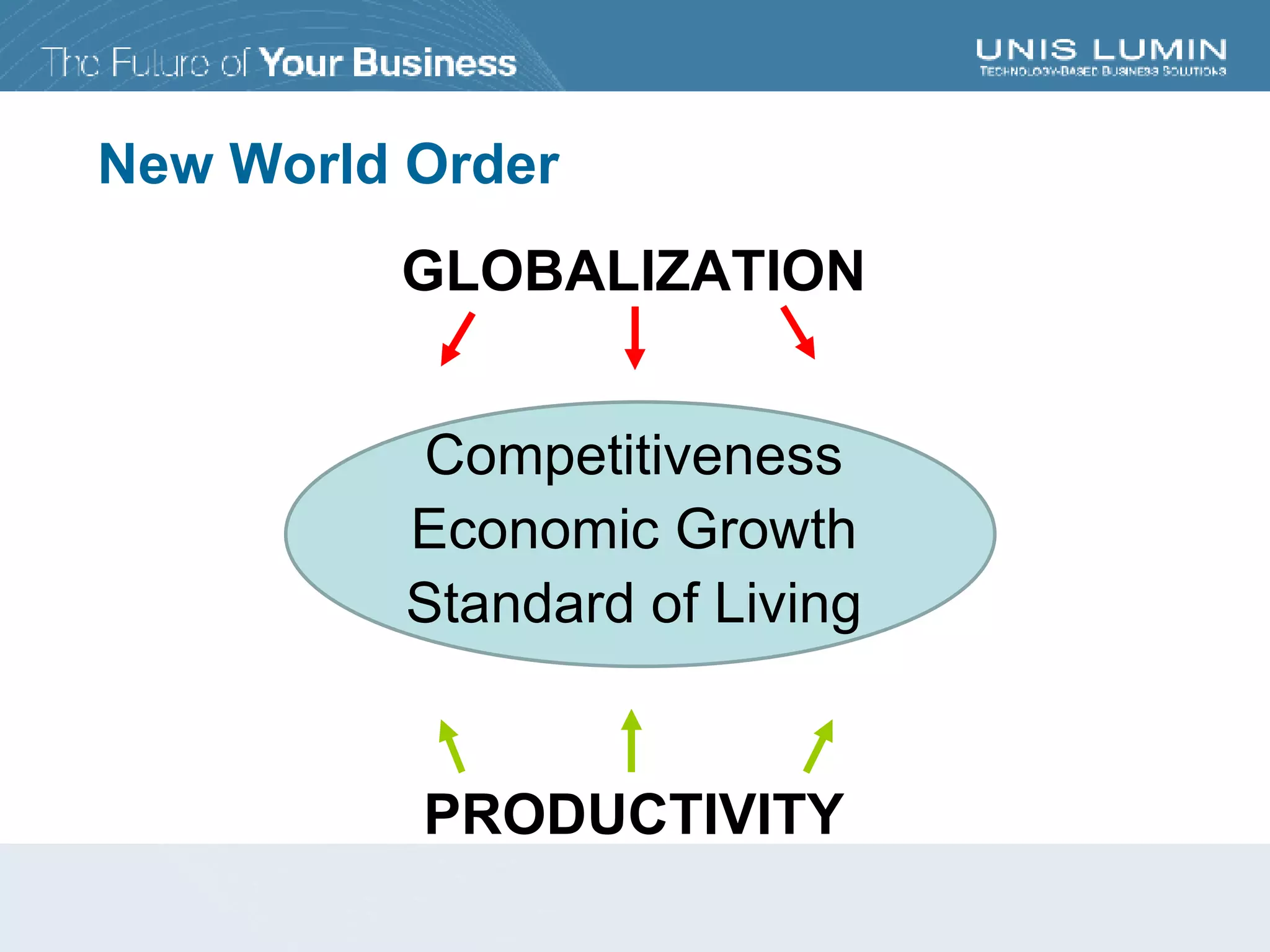
New World Order Competitiveness Economic Growth Standard of Living PRODUCTIVITY GLOBALIZATION
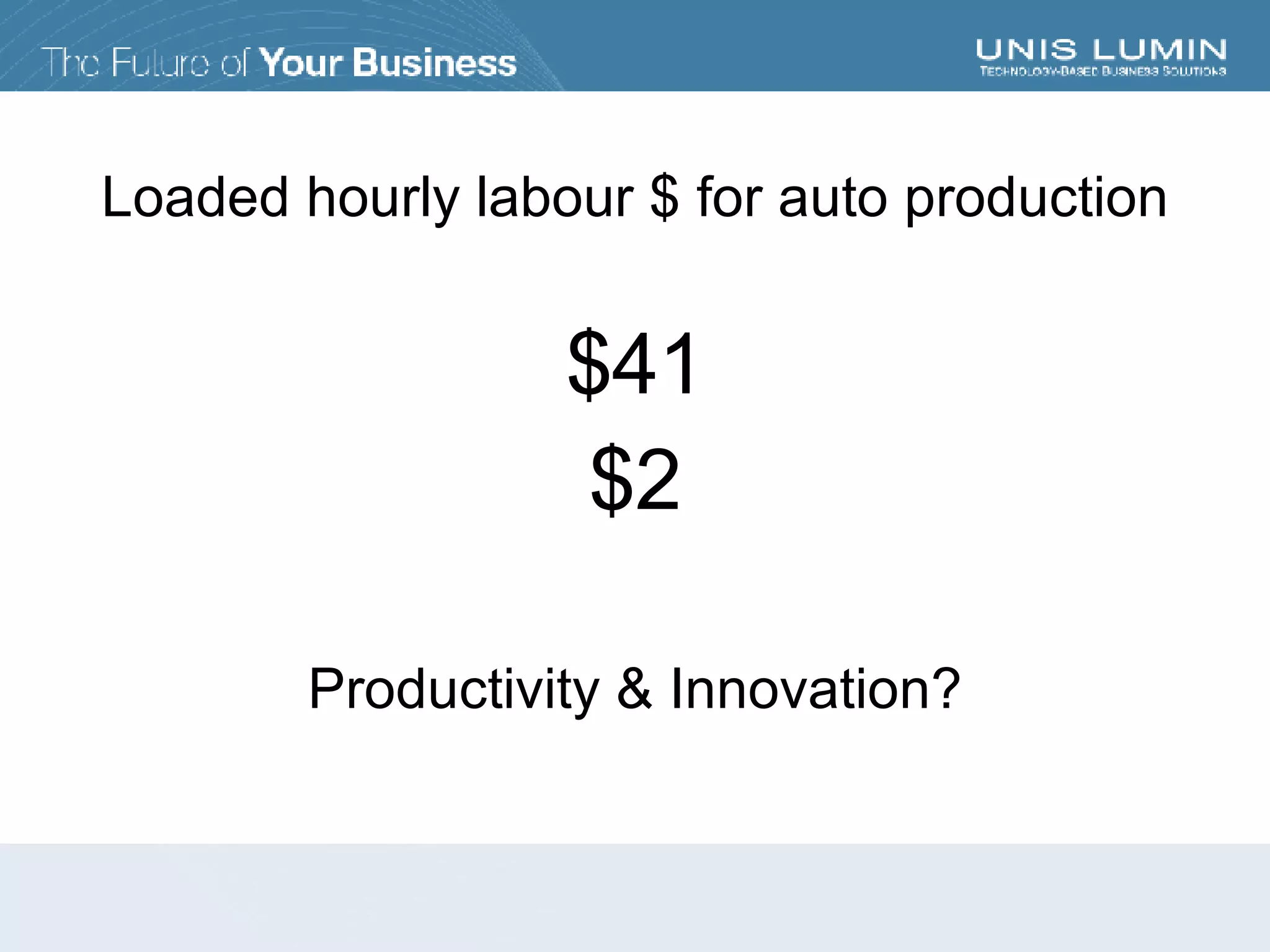
Loaded hourly labour $ for auto production $41 $2 Productivity & Innovation?
 
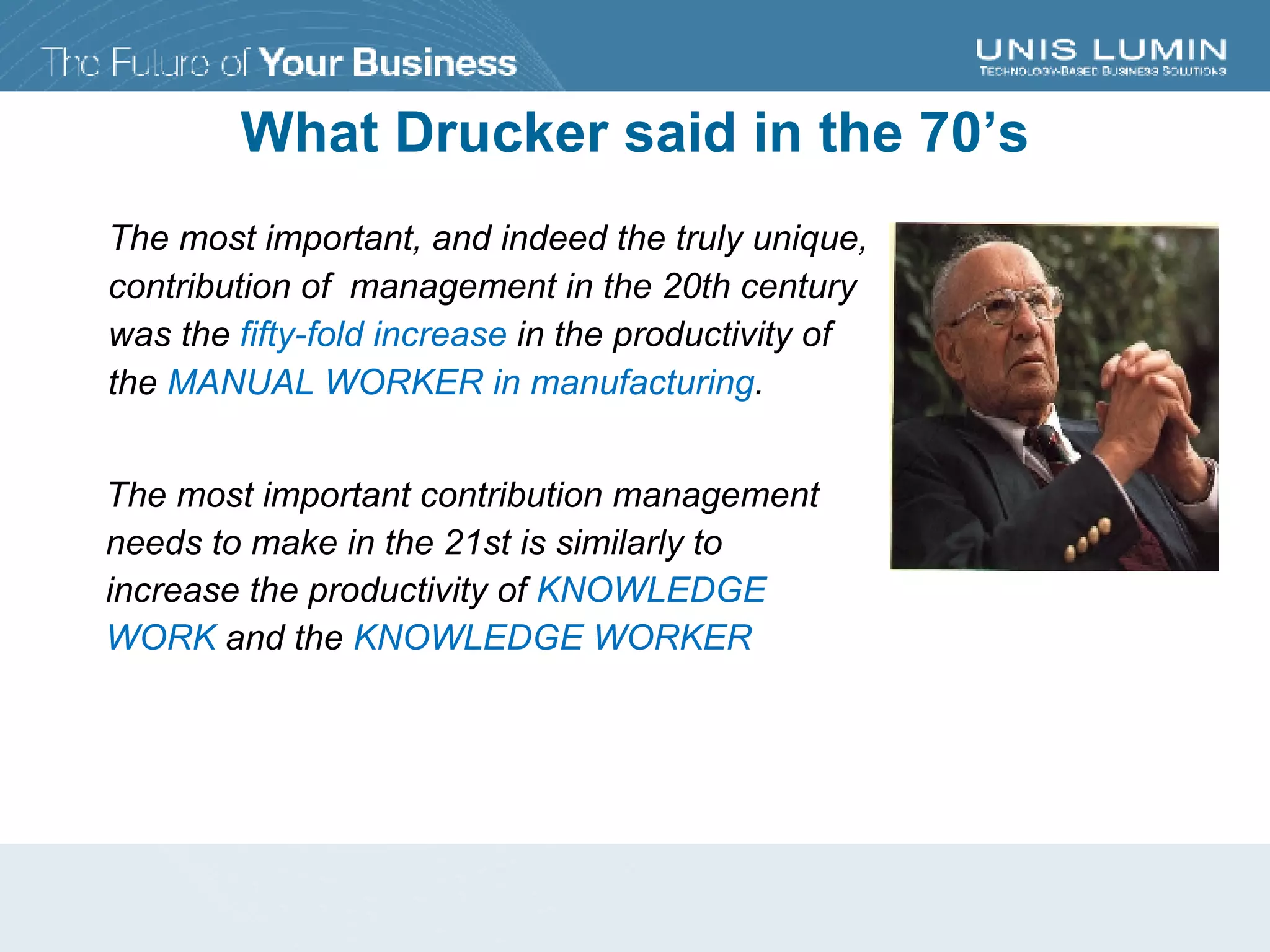
What Drucker said in the 70’s The most important, and indeed the truly unique, contribution of  management in the 20th century  was the  fifty-fold increase  in the productivity of  the  MANUAL WORKER in manufacturing . The most important contribution management needs to make in the 21st is similarly to increase the productivity of  KNOWLEDGE WORK  and the  KNOWLEDGE WORKER
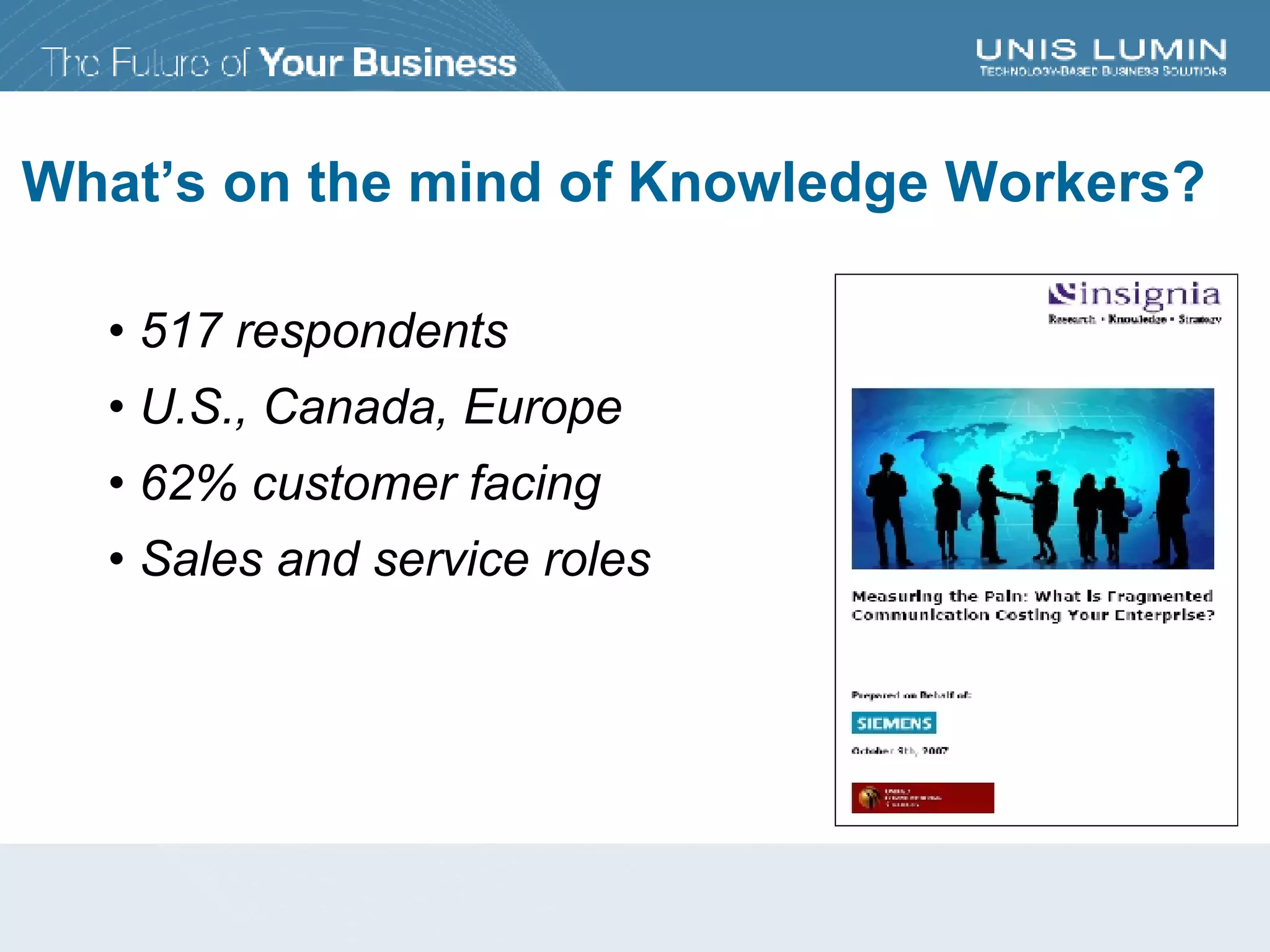
What’s on the mind of Knowledge Workers?   517 respondents  U.S., Canada, Europe 62% customer facing Sales and service roles
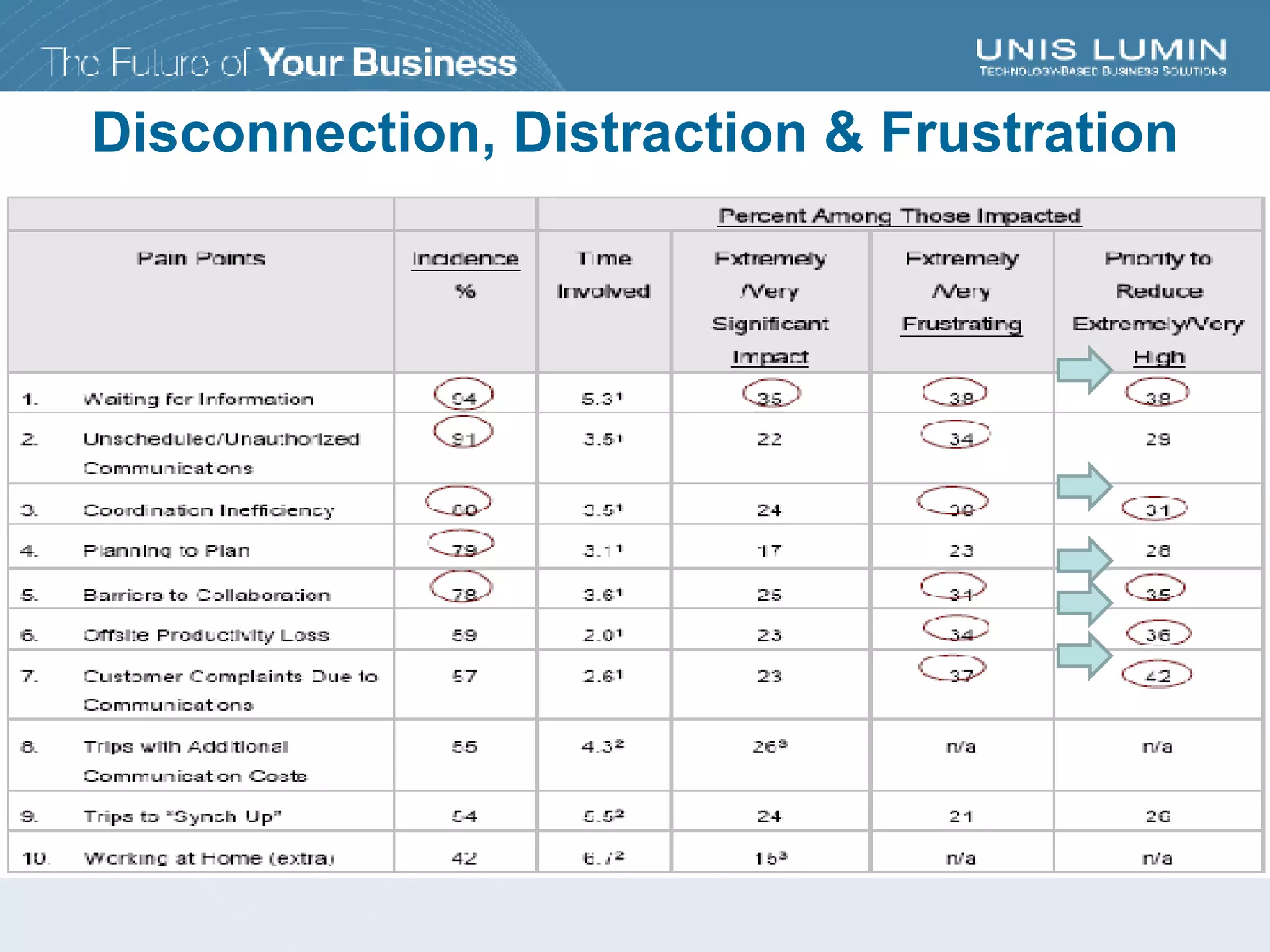
Disconnection, Distraction & Frustration
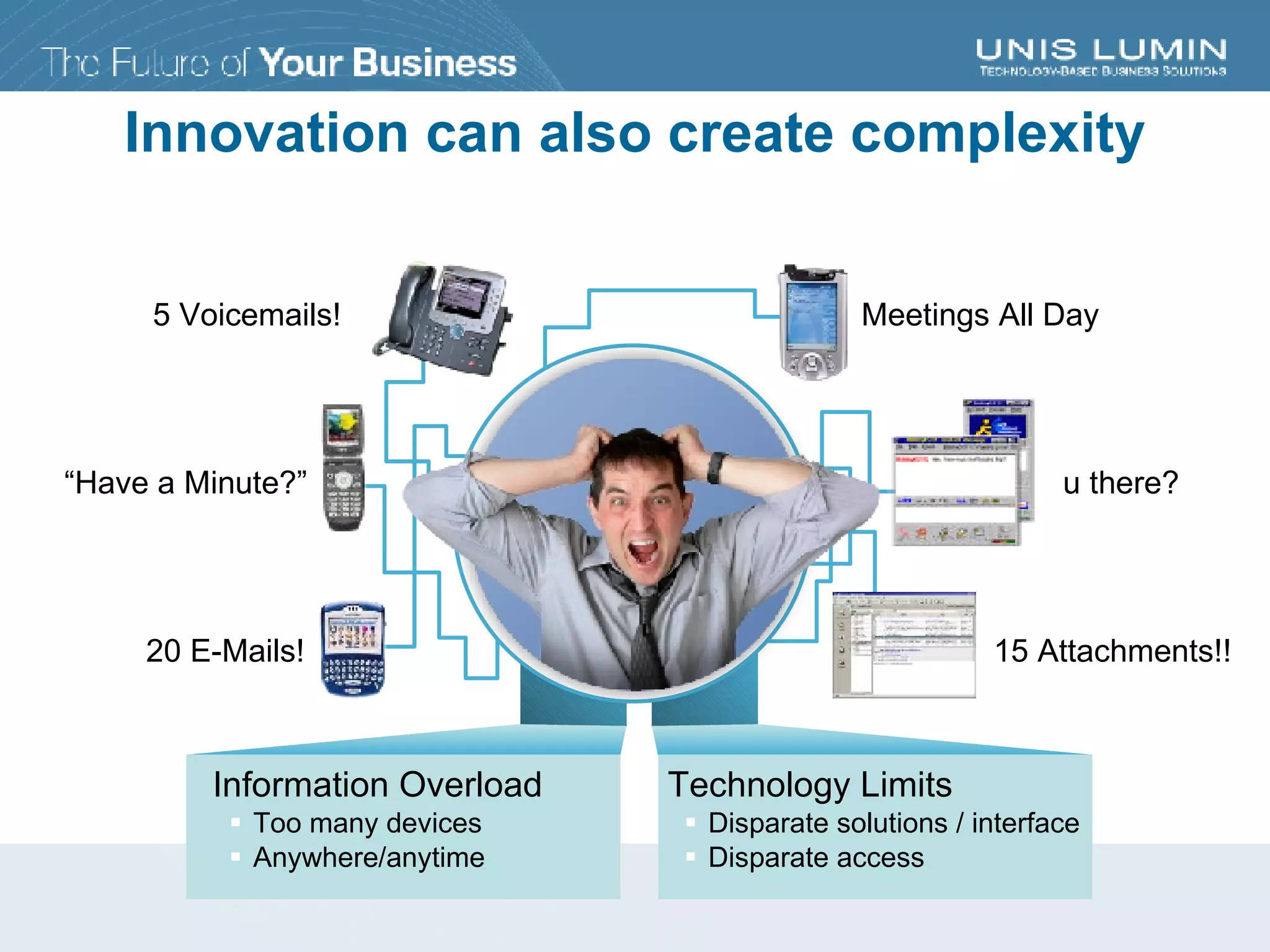
Innovation can also create complexity Information Overload Too many devices Anywhere/anytime Technology Limits Disparate solutions / interface Disparate access 15 Attachments!! u there? Meetings All Day 20 E-Mails! “ Have a Minute?” 5 Voicemails!
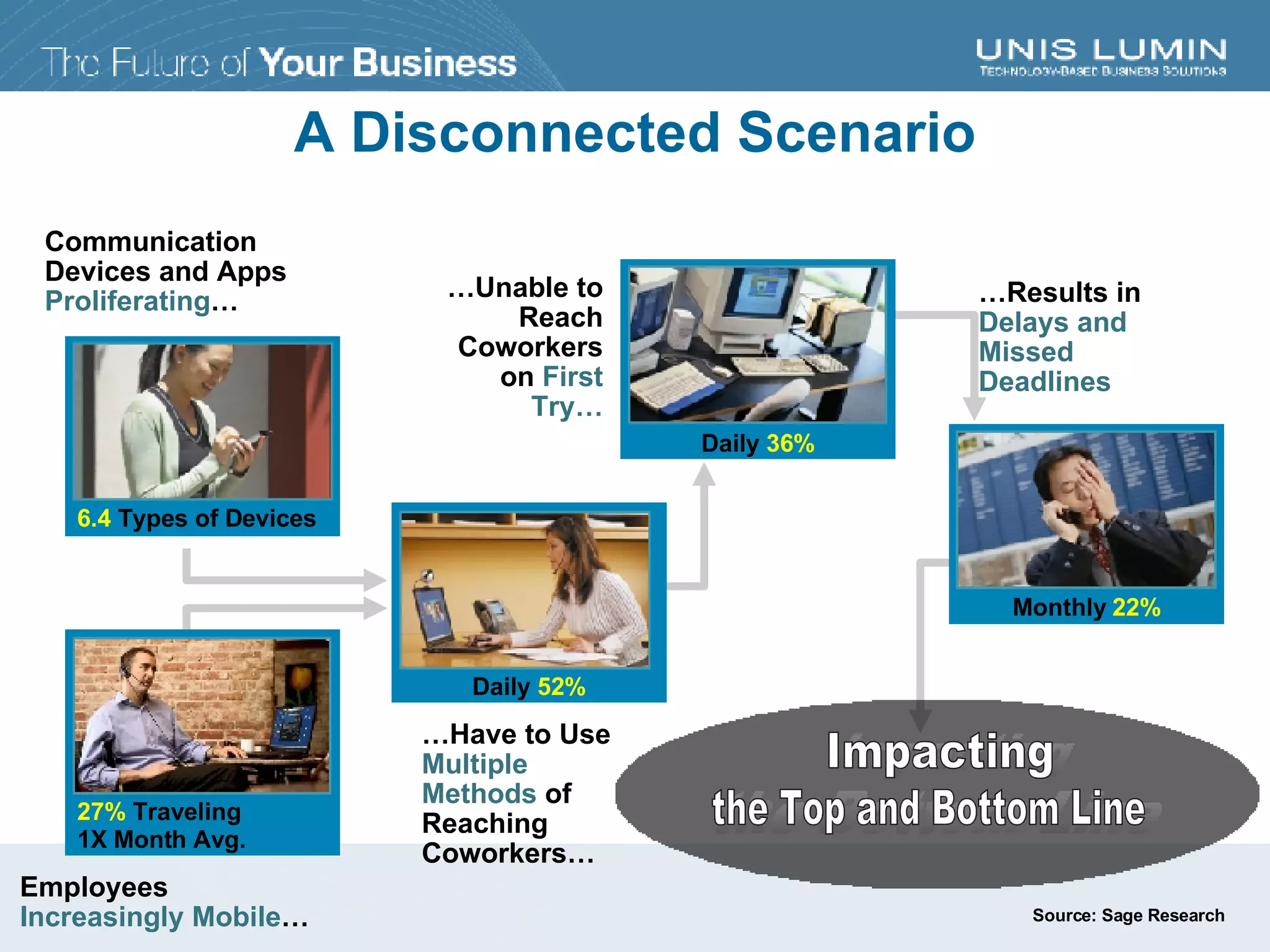
… Results in   Delays and  Missed Deadlines … Unable to Reach Coworkers on   First Try… … Have to Use   Multiple Methods   of Reaching Coworkers… Communication Devices and Apps   Proliferating … Employees Increasingly Mobile … Source: Sage Research A Disconnected Scenario Impacting Impacting the Bottom Line the Top and Bottom Line Daily  52% Daily  36% Monthly  22% 6.4  Types of Devices 27%  Traveling  1X Month Avg.
“ The cognitive limit to the number of individuals with whom any one person can maintain stable relationships" Dunbar’s Number 150
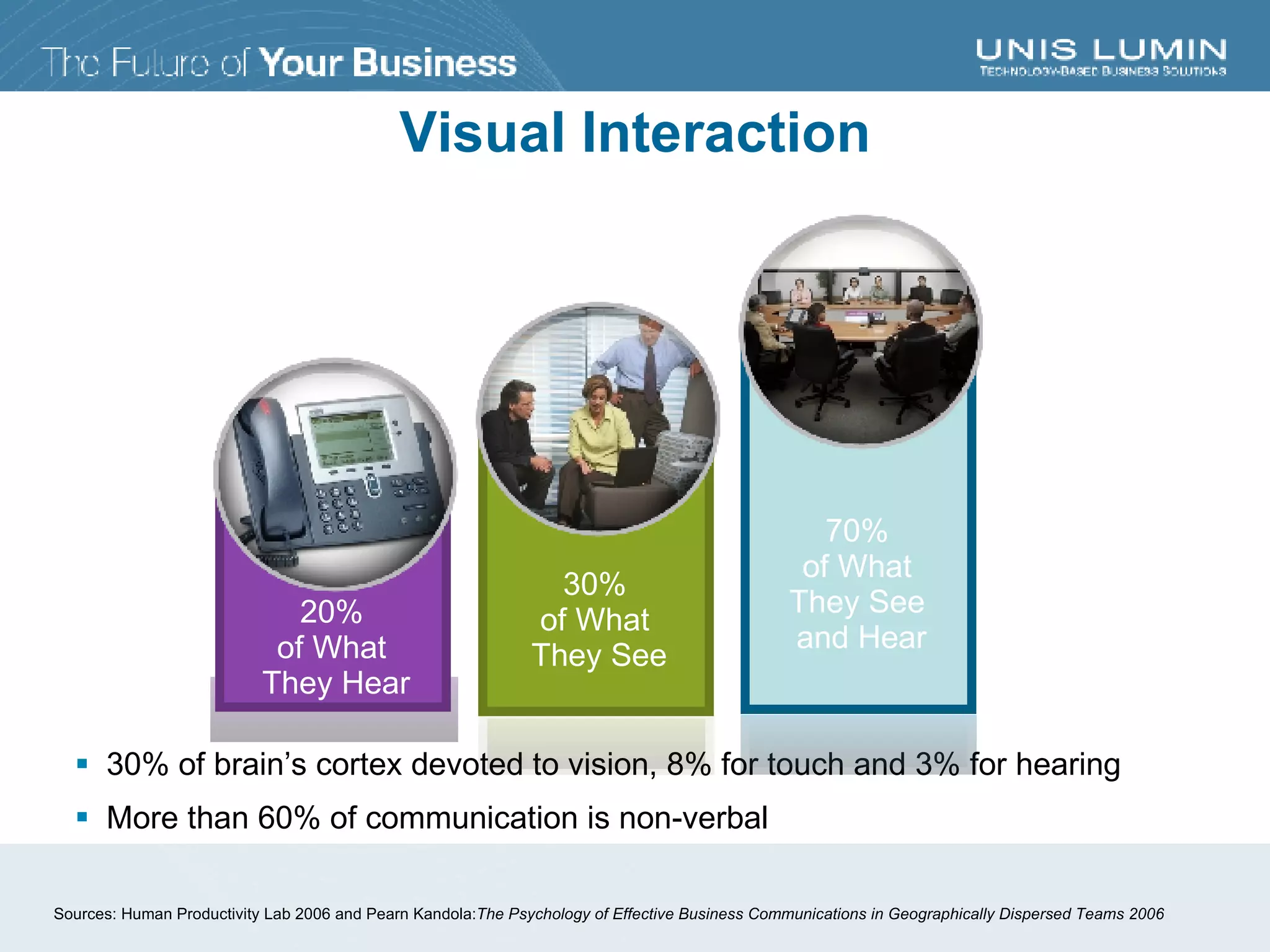
30% of brain’s cortex devoted to vision, 8% for touch and 3% for hearing More than 60% of communication is non-verbal Sources: Human Productivity Lab 2006 and Pearn Kandola: The Psychology of Effective Business Communications in Geographically Dispersed Teams 2006   Visual Interaction 30%  of What  They See 70%  of What  They See  and Hear 20%  of What  They Hear
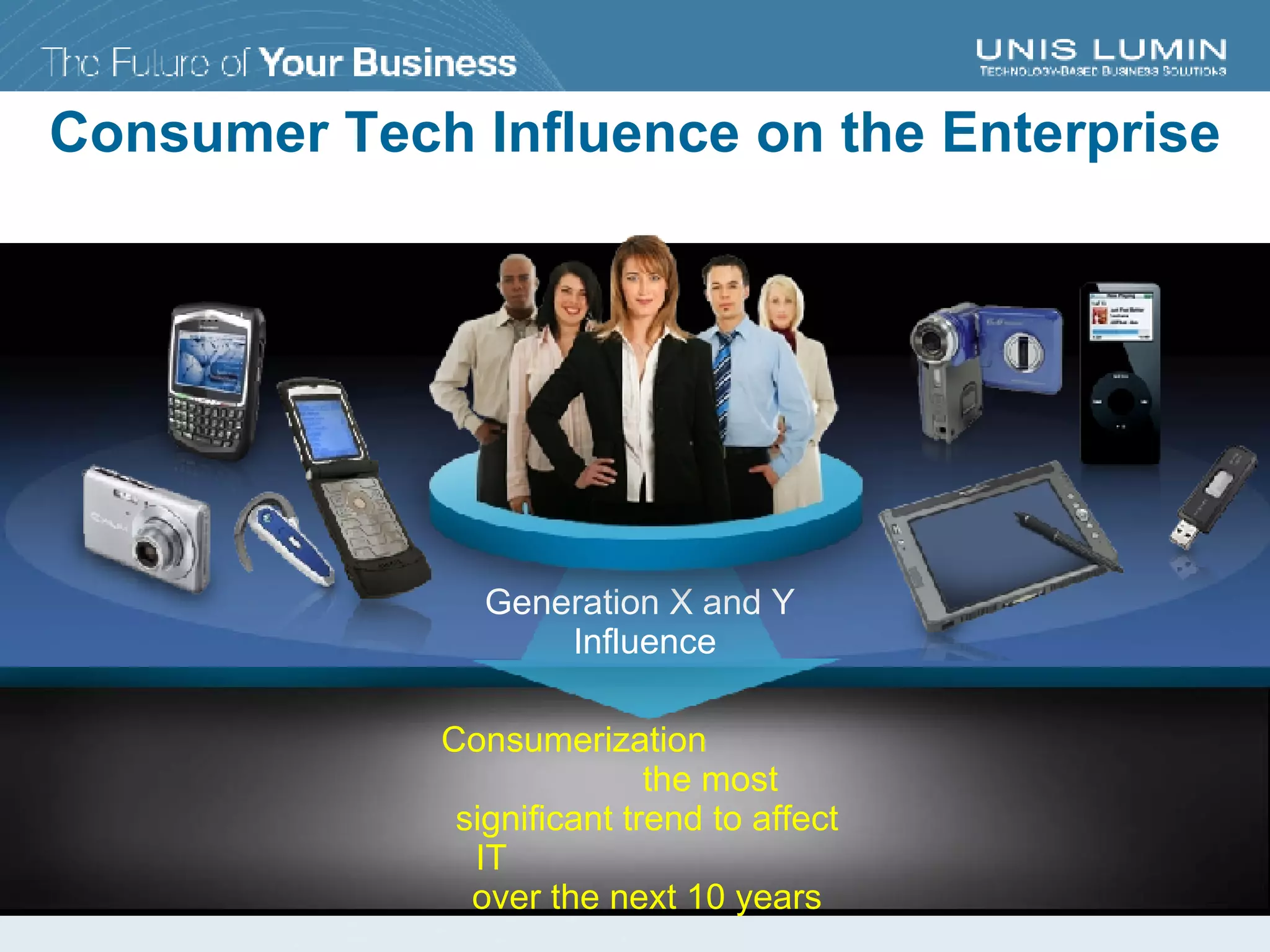
Consumer Tech Influence on the Enterprise Consumerization  the most significant trend to affect IT  over the next 10 years Generation X and Y  Influence
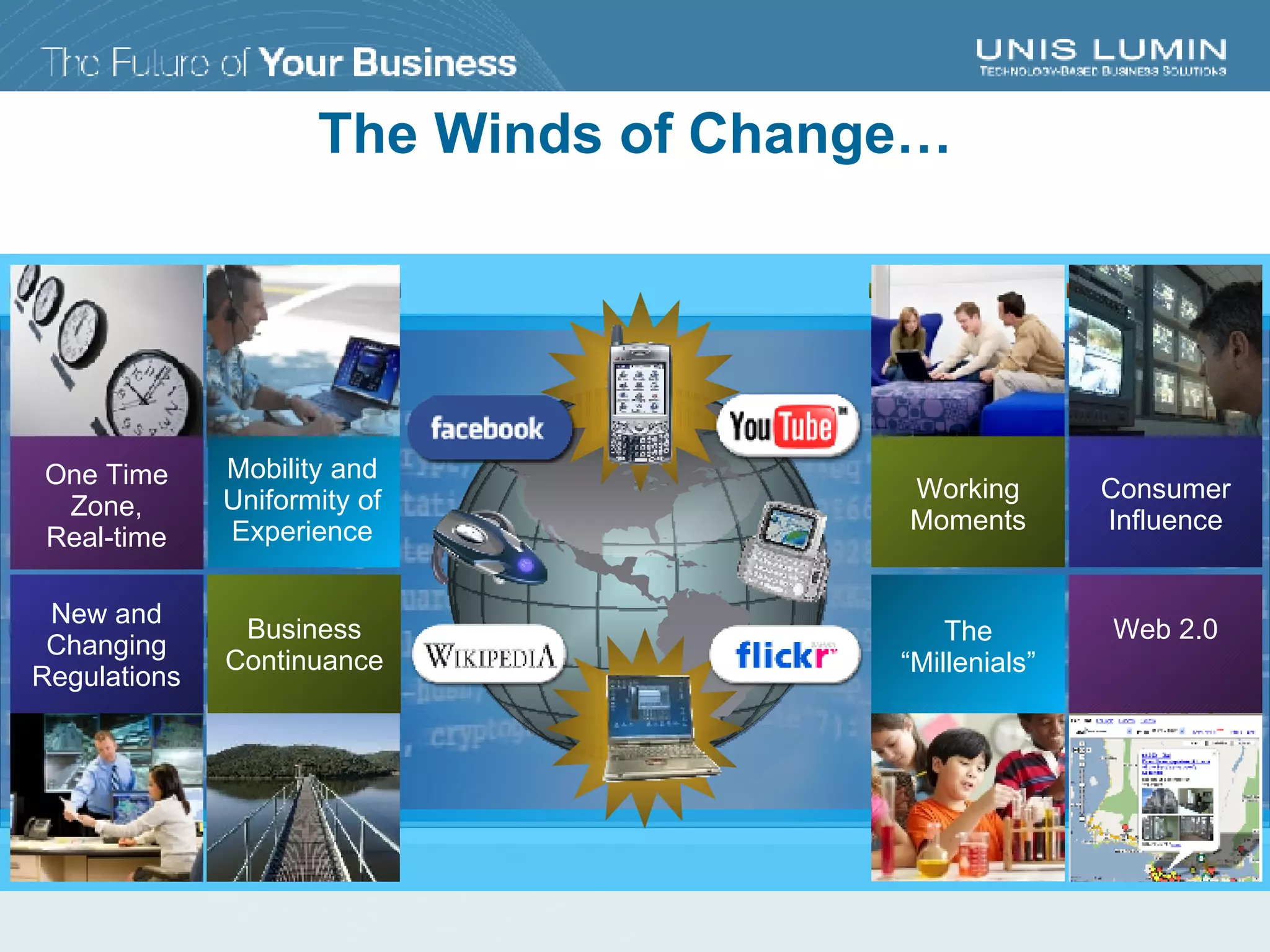
The Winds of Change… One Time Zone, Real-time New and Changing Regulations Business Continuance Working Moments Consumer Influence Mobility and Uniformity of Experience The “Millenials” Web 2.0
“ If I had asked people what they wanted, they would have said faster horses” Henry Ford
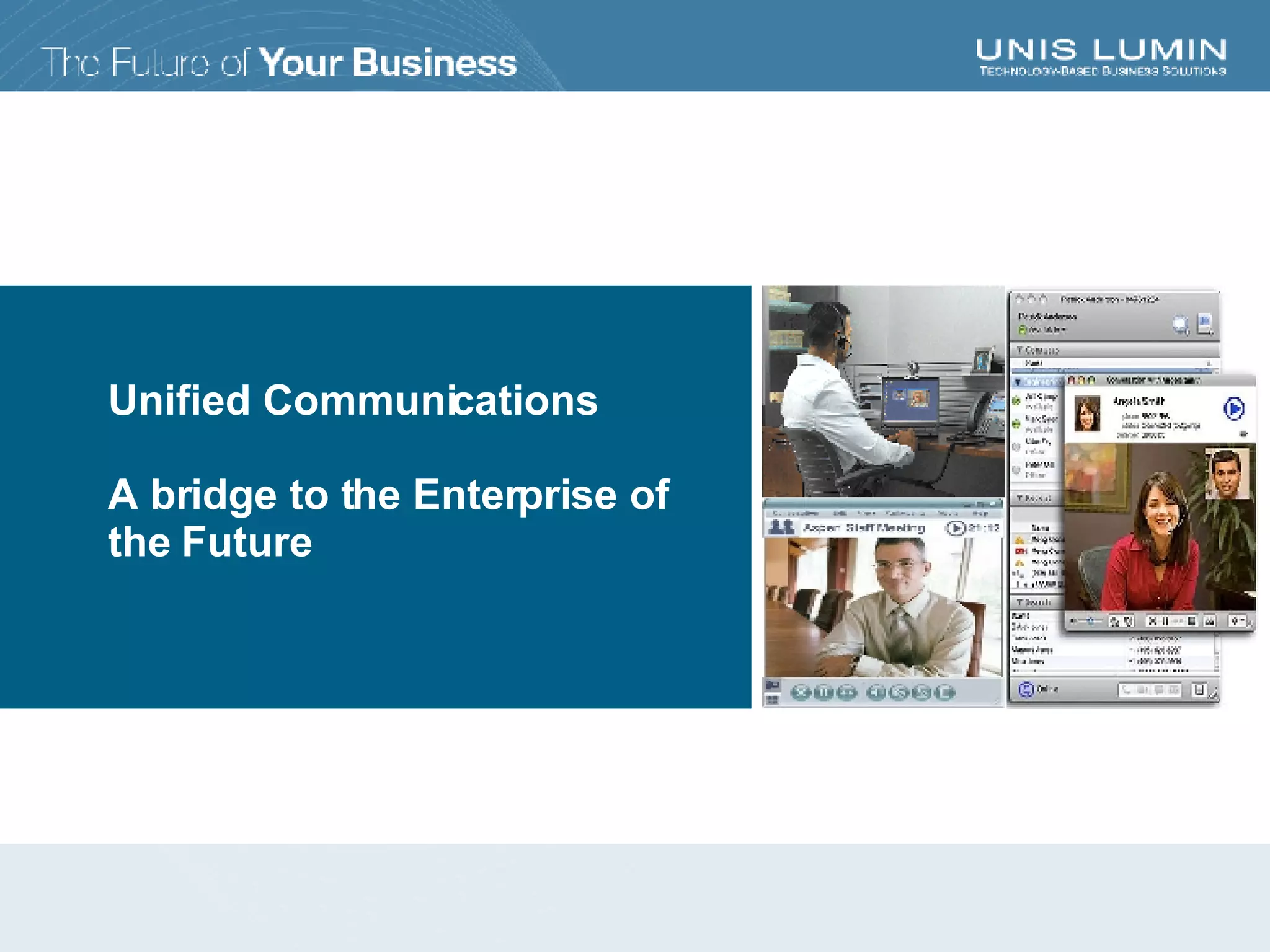
Unified Communications A bridge to the Enterprise of the Future
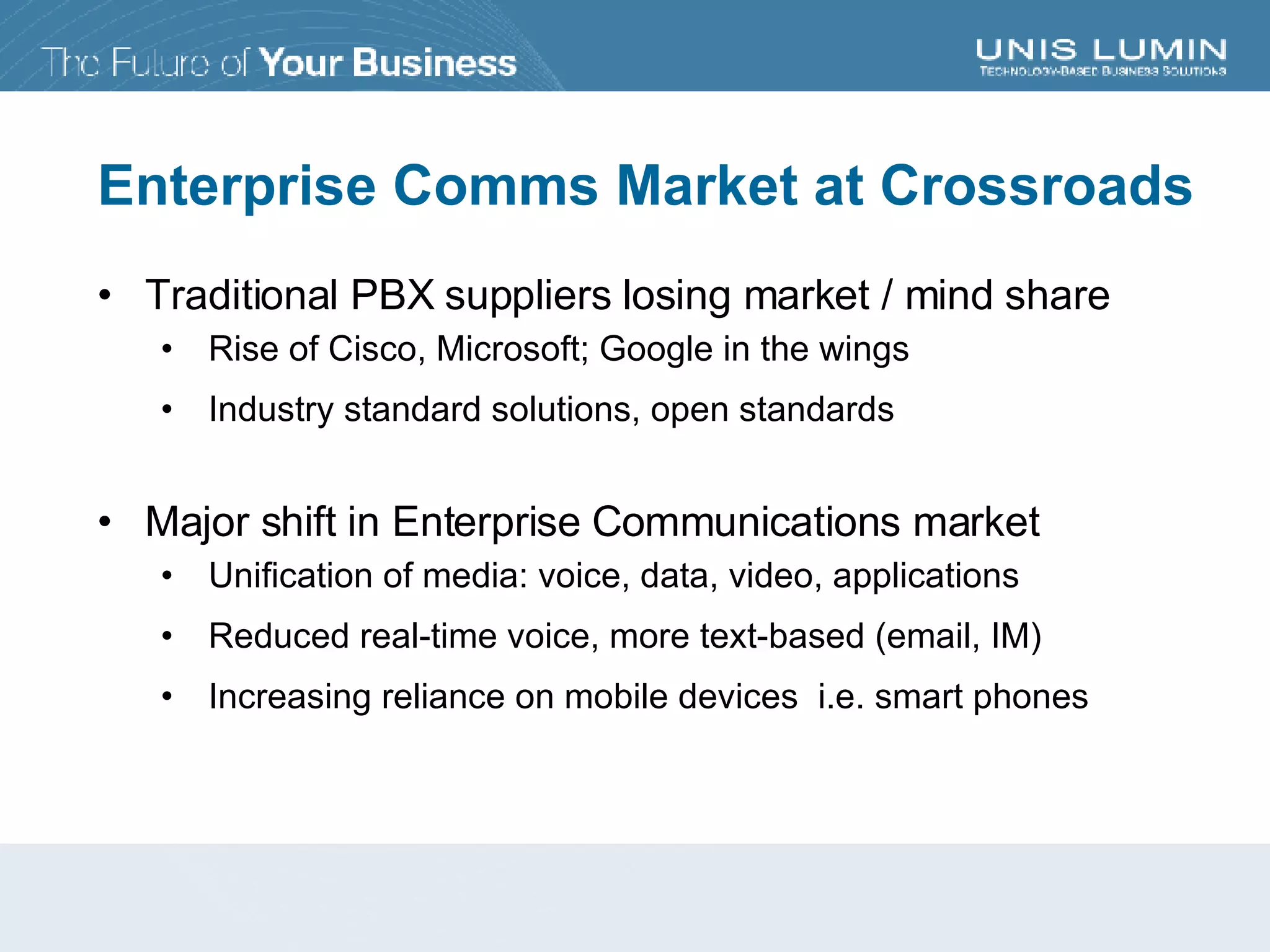
Enterprise Comms Market at Crossroads Traditional PBX suppliers losing market / mind share Rise of Cisco, Microsoft; Google in the wings Industry standard solutions, open standards Major shift in Enterprise Communications market Unification of media: voice, data, video, applications Reduced real-time voice, more text-based (email, IM) Increasing reliance on mobile devices  i.e. smart phones
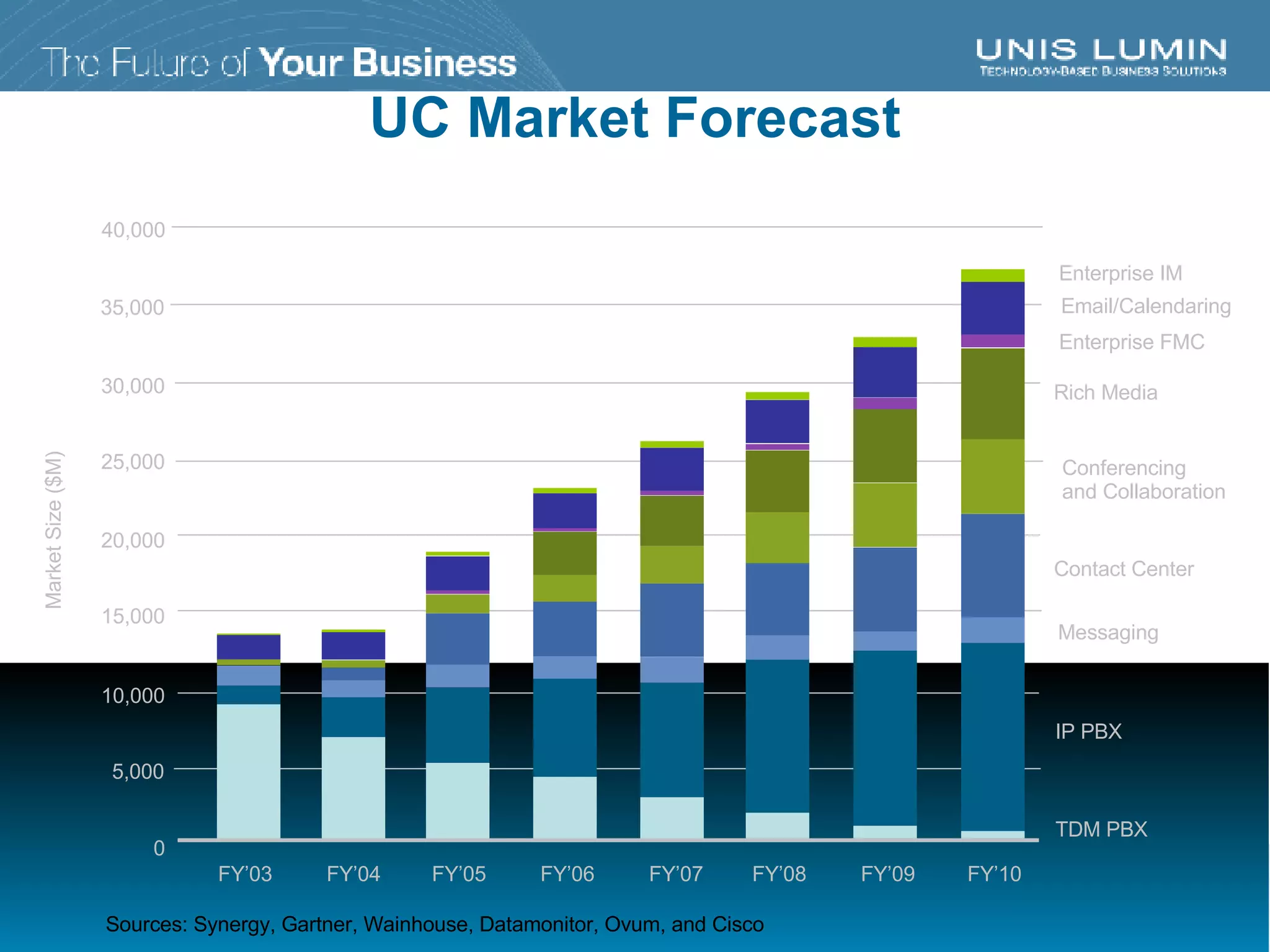
UC Market Forecast 5,000 0 10,000 Market Size ($M) 25,000 FY’03 FY’04 FY’05 FY’06 FY’07 FY’08 FY’09 FY’10 30,000 35,000 20,000 15,000 Sources: Synergy, Gartner, Wainhouse, Datamonitor, Ovum, and Cisco 40,000 TDM PBX IP PBX Messaging Contact Center Conferencing and Collaboration Enterprise FMC Rich Media Email/Calendaring Enterprise IM
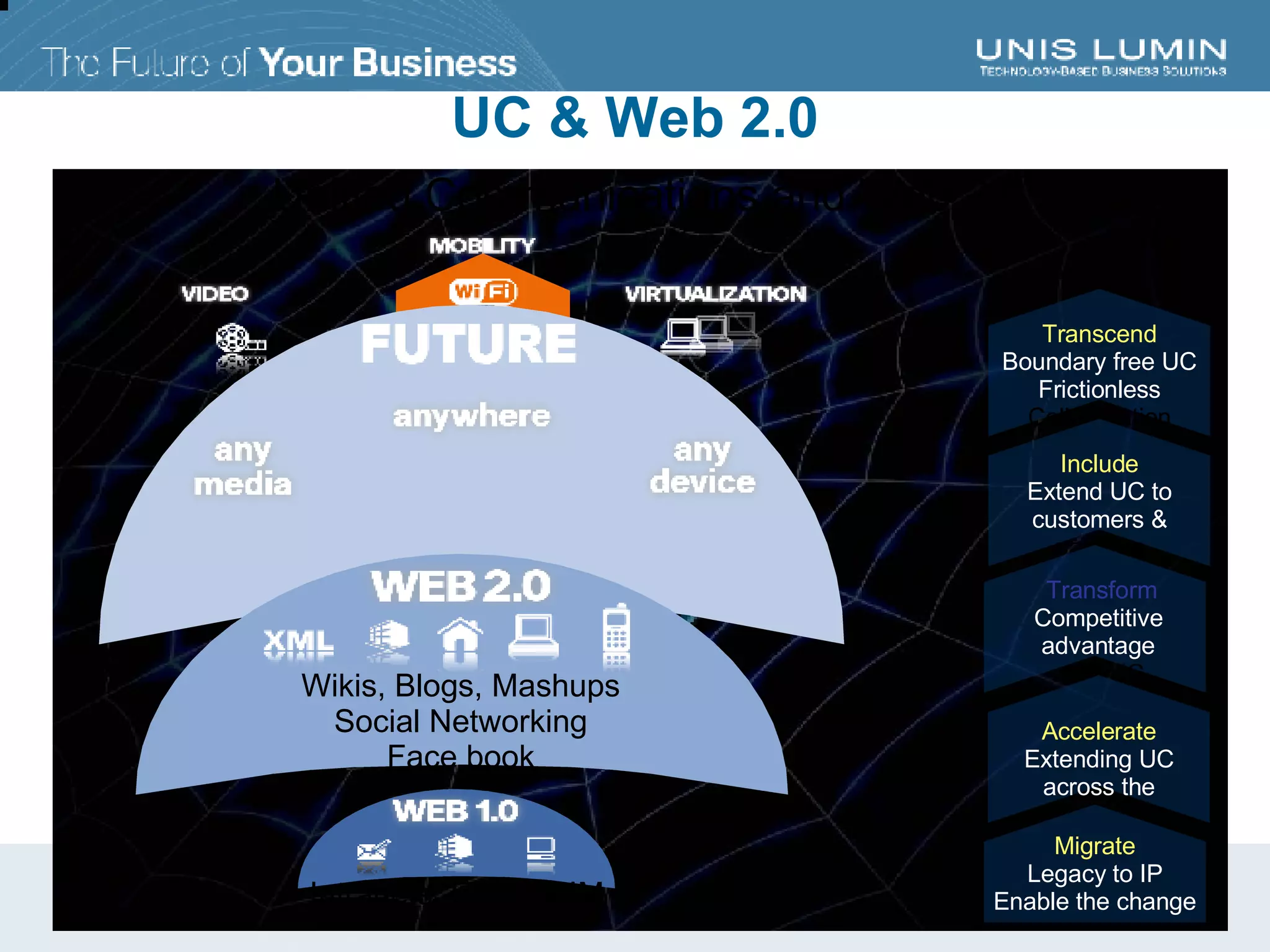
UC & Web 2.0 Transcend Boundary free UC Frictionless  Collaboration Include Extend UC to customers & partners Transform Competitive  advantage  with UC Wikis, Blogs, Mashups Social Networking Face book Accelerate Extending UC across the  business Intranets, Email & IM Migrate Legacy to IP Enable the change Unified Communications and Web 2.0
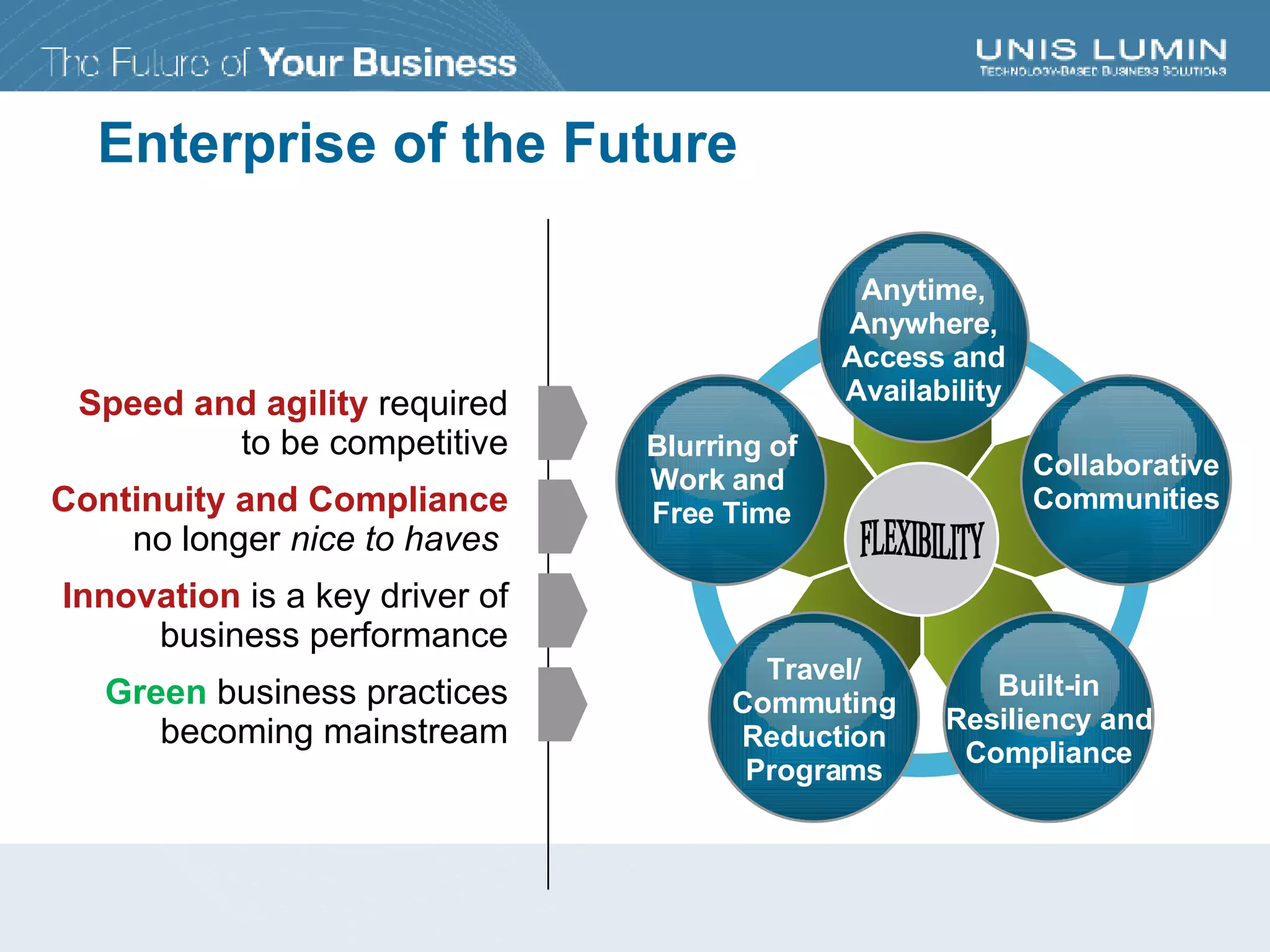
Anytime, Anywhere, Access and Availability Blurring of Work and  Free Time Collaborative Communities Travel/ Commuting Reduction Programs Built-in Resiliency and Compliance Speed and agility  required to be competitive Continuity and Compliance  no longer  nice to haves   Innovation  is a key driver of business performance Green  business practices becoming mainstream Enterprise of the Future FLEXIBILITY
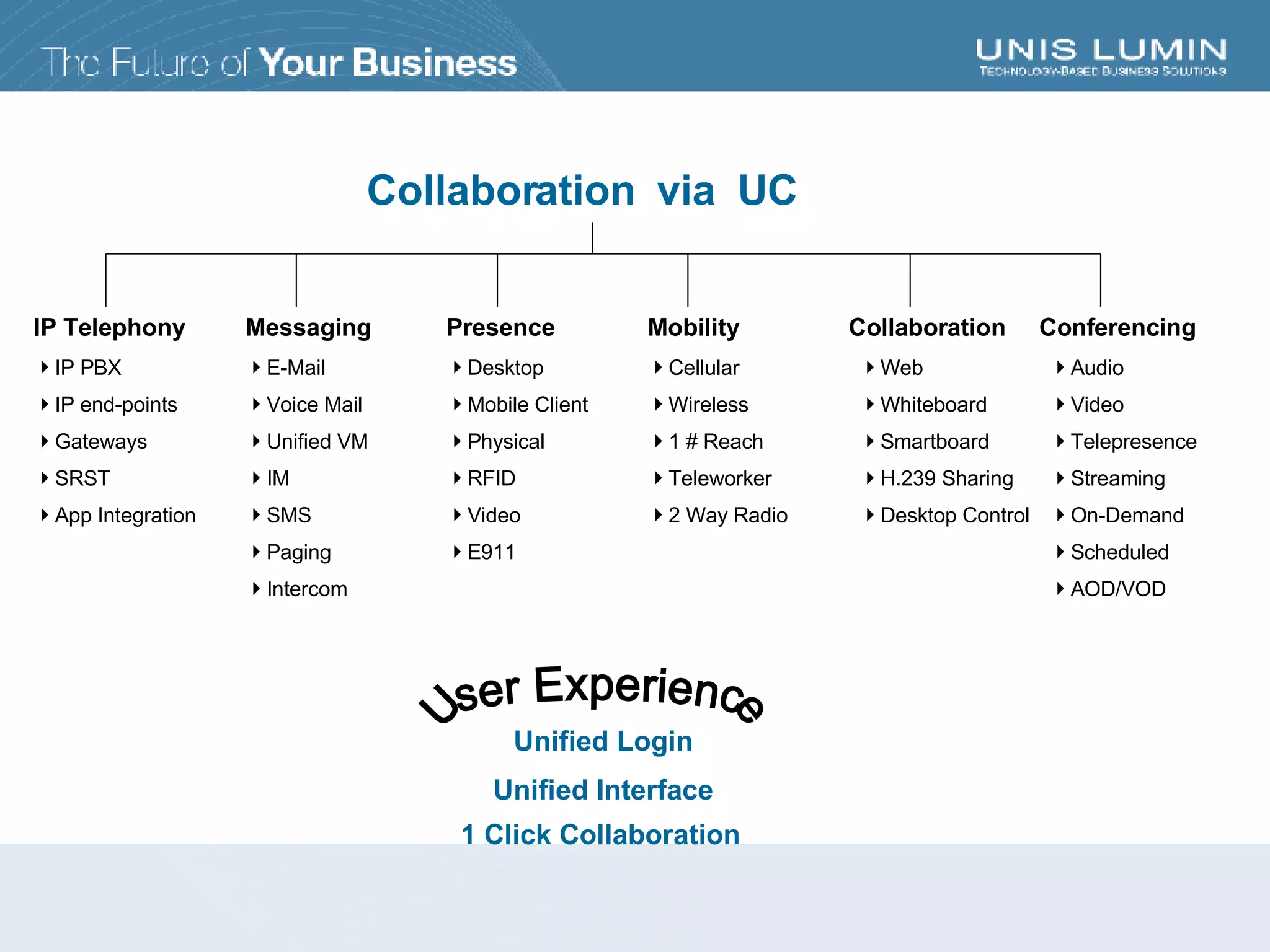
IP Telephony Presence Collaboration Conferencing Mobility Messaging IP PBX IP end-points Gateways SRST App Integration E-Mail Voice Mail Unified VM IM SMS Paging Intercom Desktop Mobile Client Physical RFID Video E911 Cellular Wireless 1 # Reach Teleworker 2 Way Radio Web Whiteboard Smartboard H.239 Sharing Desktop Control Audio Video Telepresence Streaming On-Demand Scheduled AOD/VOD Unified Login Unified Interface 1 Click Collaboration   Collaboration  via  UC User Experience
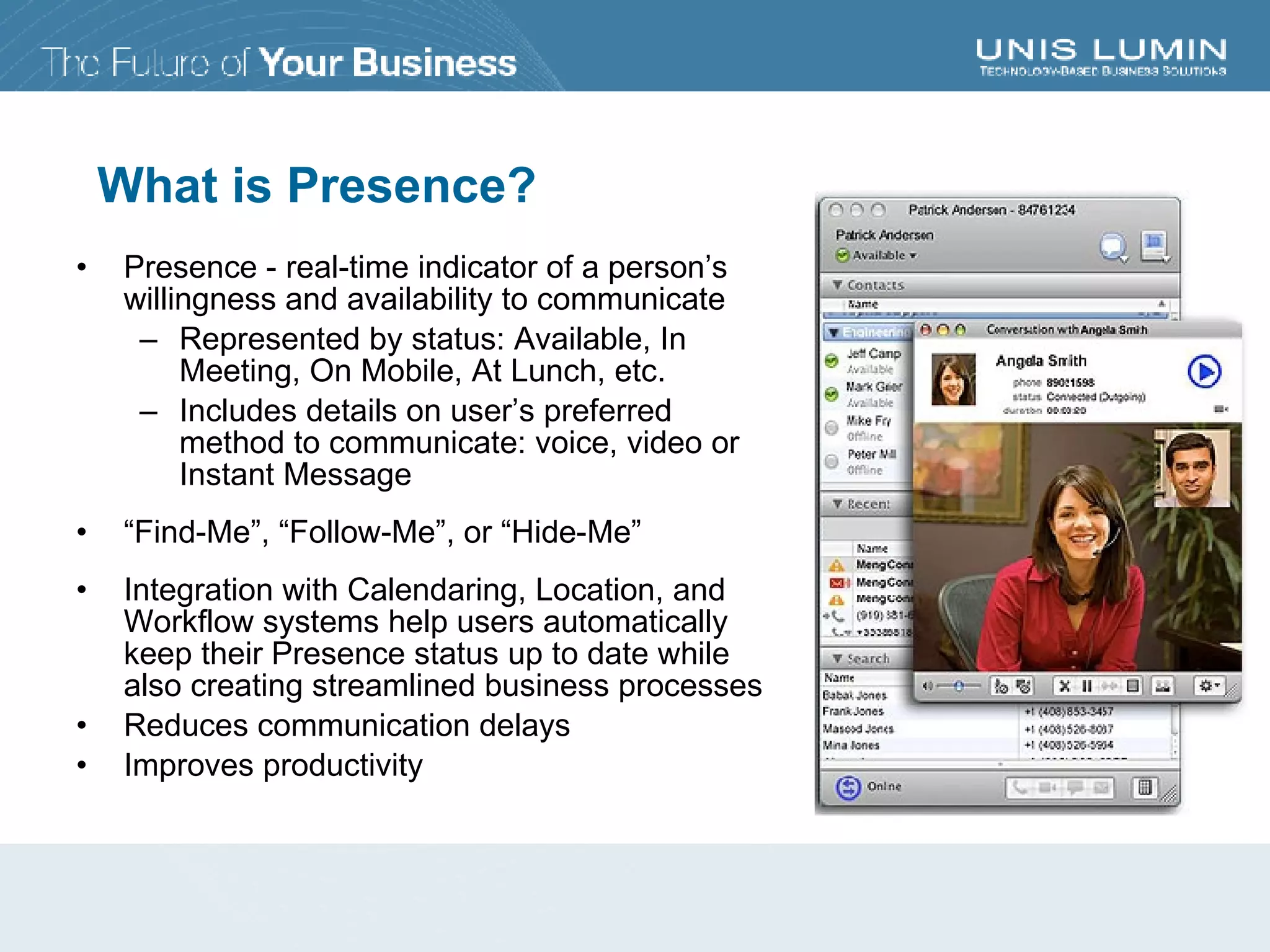
What is Presence? Presence - real-time indicator of a person’s willingness and availability to communicate Represented by status: Available, In Meeting, On Mobile, At Lunch, etc. Includes details on user’s preferred method to communicate: voice, video or Instant Message “ Find-Me”, “Follow-Me”, or “Hide-Me” Integration with Calendaring, Location, and Workflow systems help users automatically keep their Presence status up to date while also creating streamlined business processes Reduces communication delays Improves productivity
UC Continuum Telephony Model
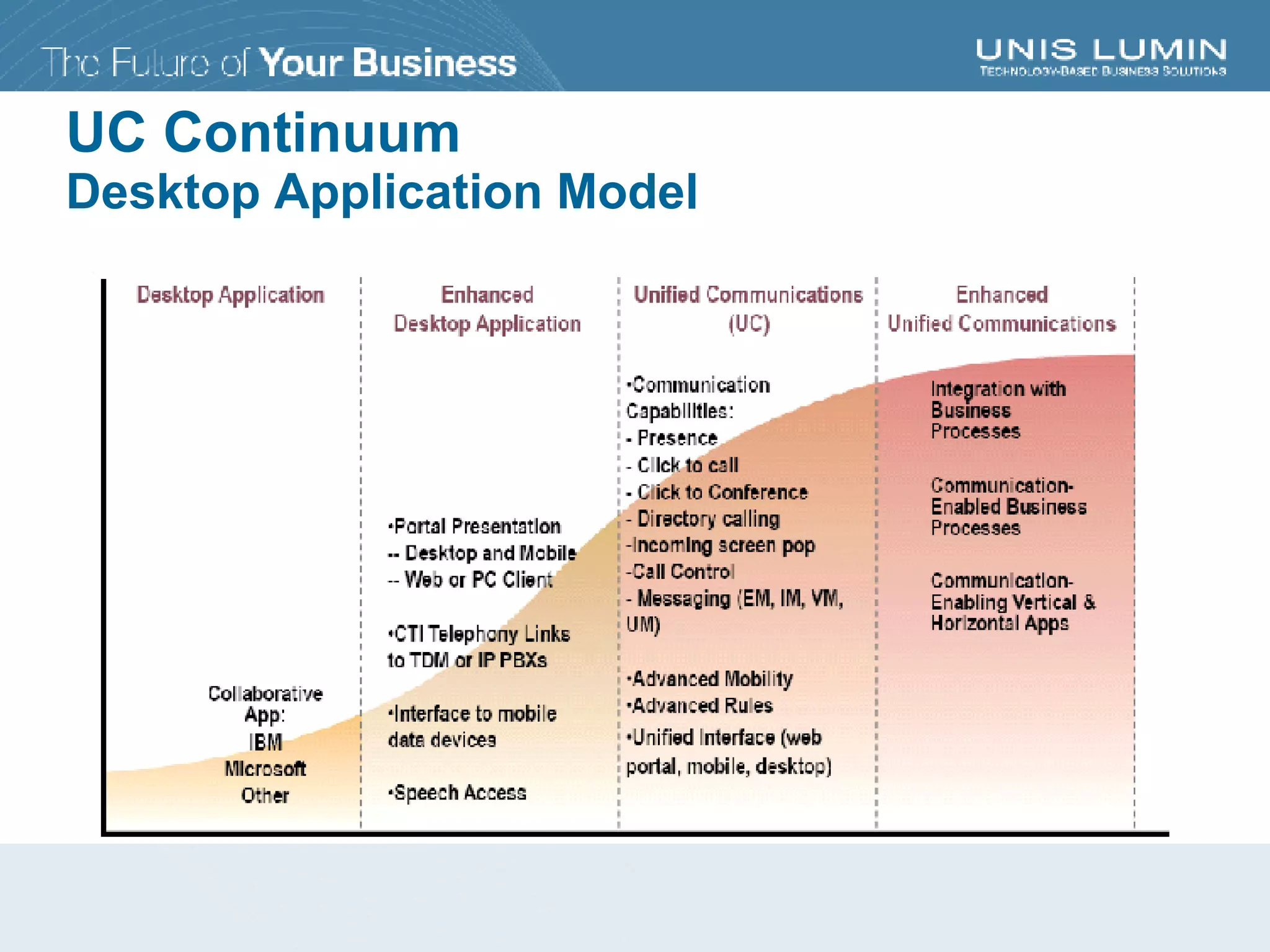
UC Continuum Desktop Application Model
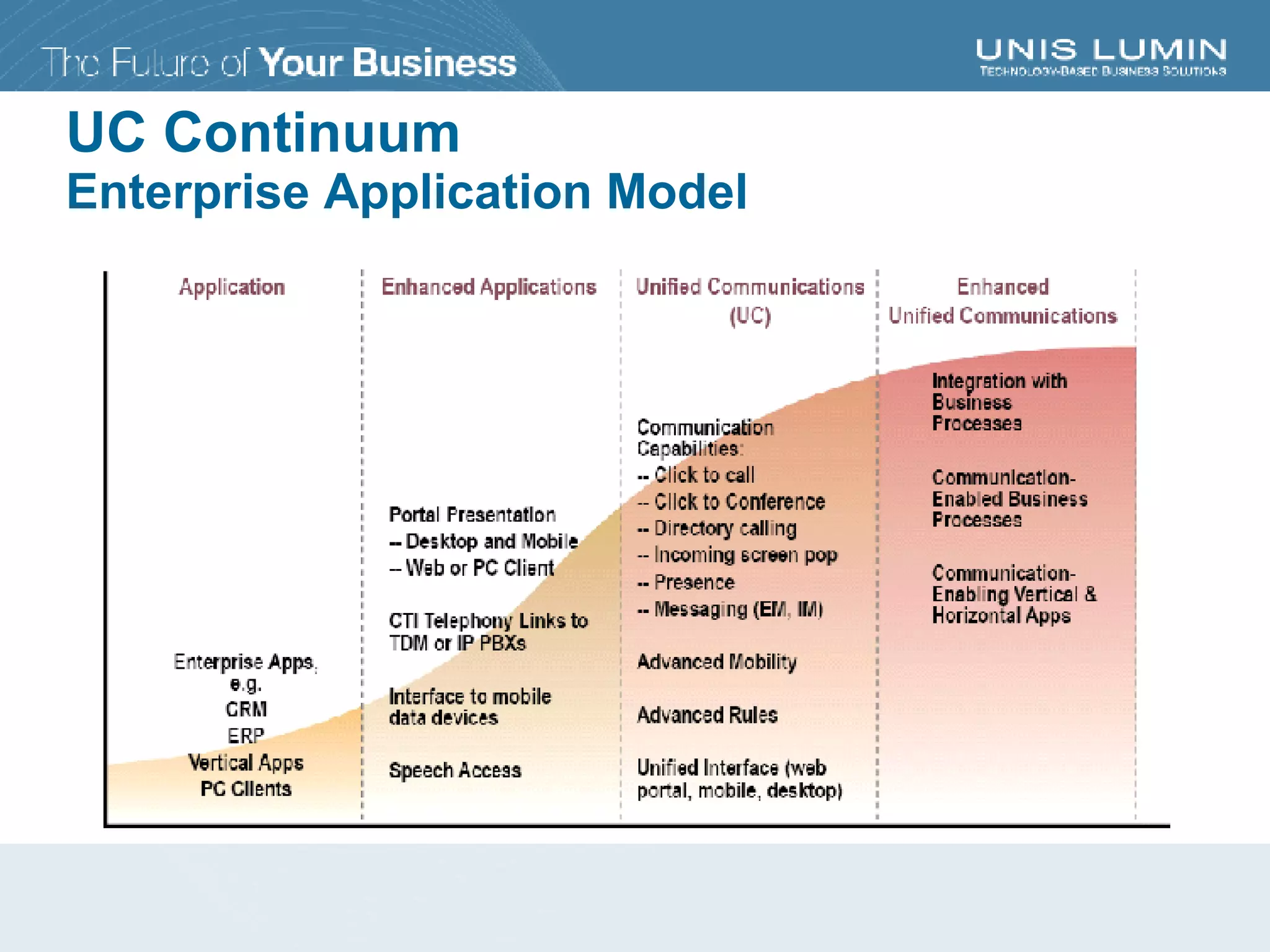
UC Continuum Enterprise Application Model
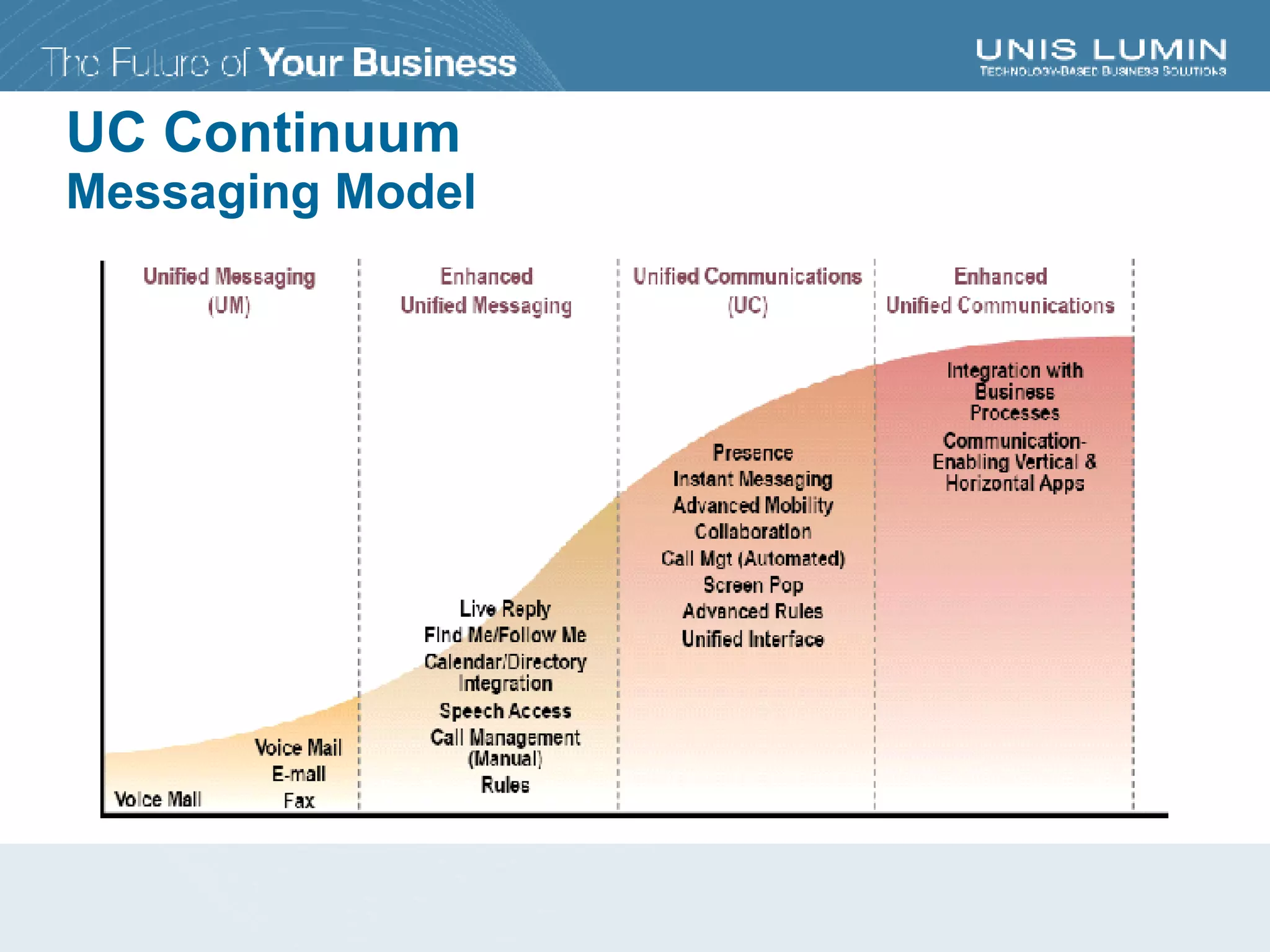
UC Continuum Messaging Model
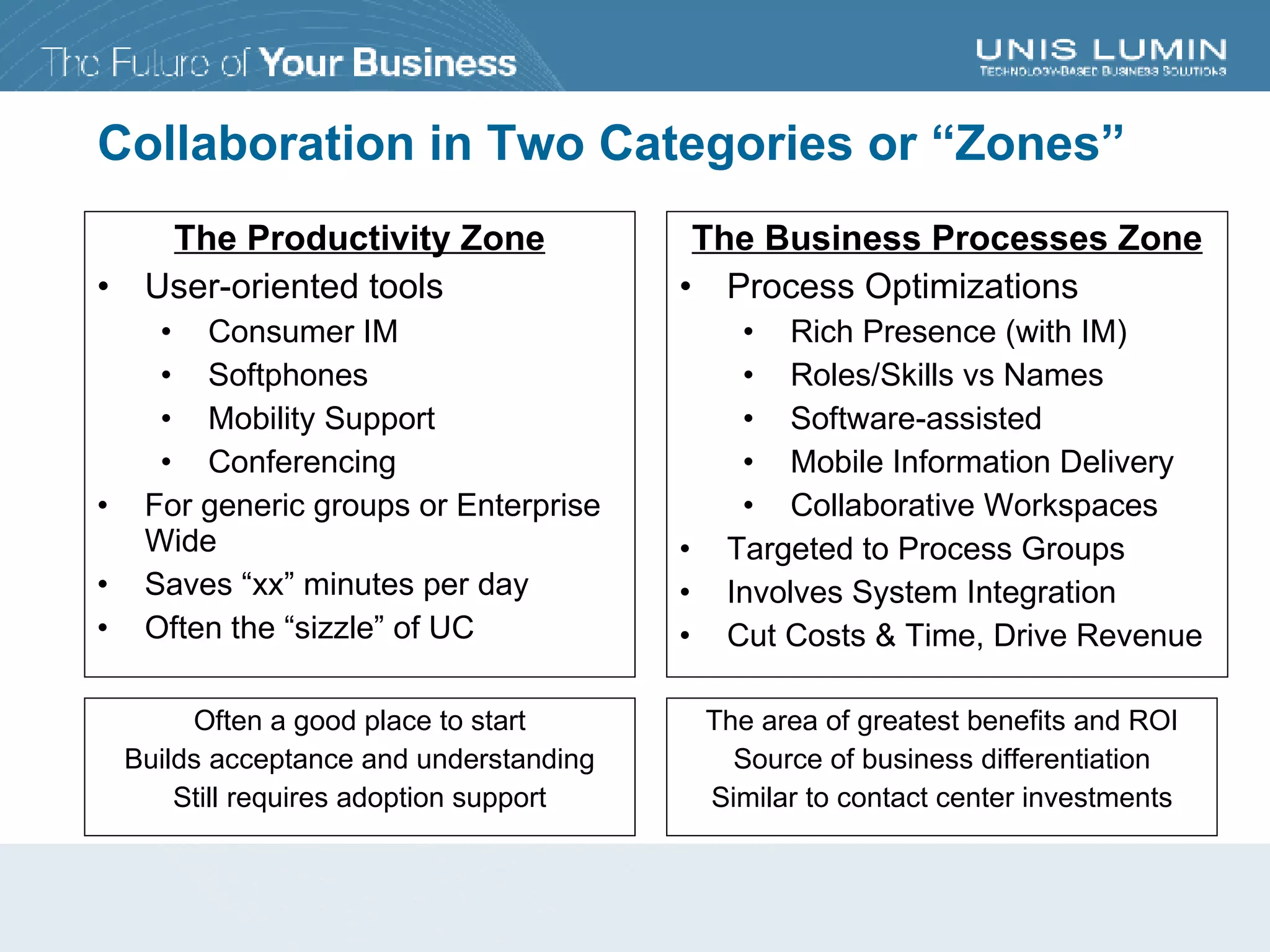
Collaboration in Two Categories or “Zones” The Productivity Zone User-oriented tools Consumer IM Softphones Mobility Support Conferencing For generic groups or Enterprise Wide Saves “xx” minutes per day Often the “sizzle” of UC The Business Processes Zone Process Optimizations Rich Presence (with IM) Roles/Skills vs Names Software-assisted Mobile Information Delivery Collaborative Workspaces Targeted to Process Groups Involves System Integration Cut Costs & Time, Drive Revenue Often a good place to start Builds acceptance and understanding Still requires adoption support The area of greatest benefits and ROI Source of business differentiation Similar to contact center investments
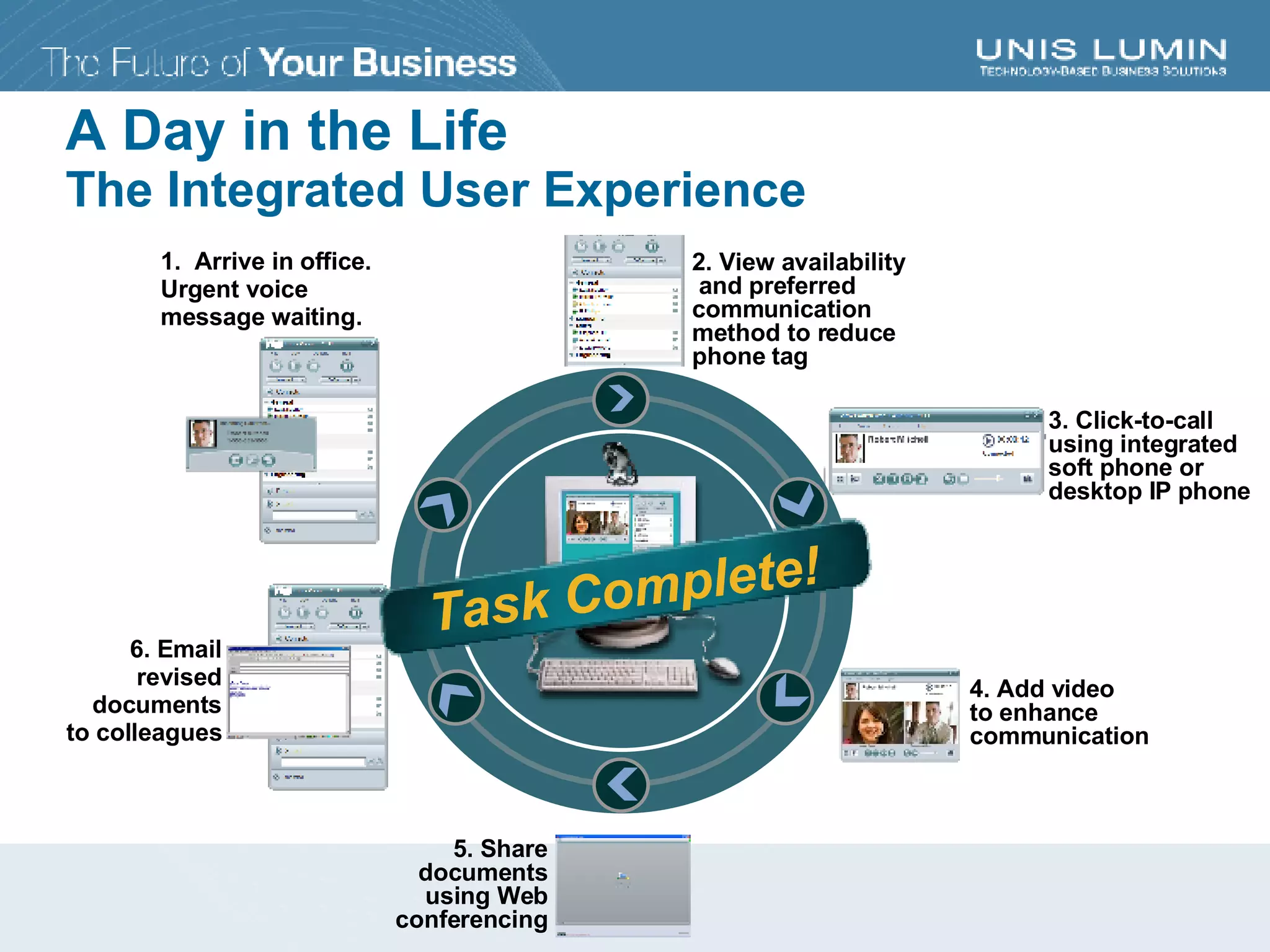
A Day in the Life The Integrated User Experience 6. Email revised documents to colleagues 1.  Arrive in office. Urgent voice message waiting. 2. View availability  and preferred communication method to reduce phone tag 3. Click-to-call using integrated soft phone or desktop IP phone 4. Add video  to enhance communication Task Complete! 5. Share documents using Web conferencing
 
The Major Questions on the Table How are you currently leveraging communications? Where does UC fit into my Enterprise? Personal Productivity Enhancement Business Processes Optimization How much can be built on our current infrastructure? How would this influence a new IT infrastructure investments? How much should be provided through interoperability? What elements do we need to invest in? What are the costs, risks and success factors?
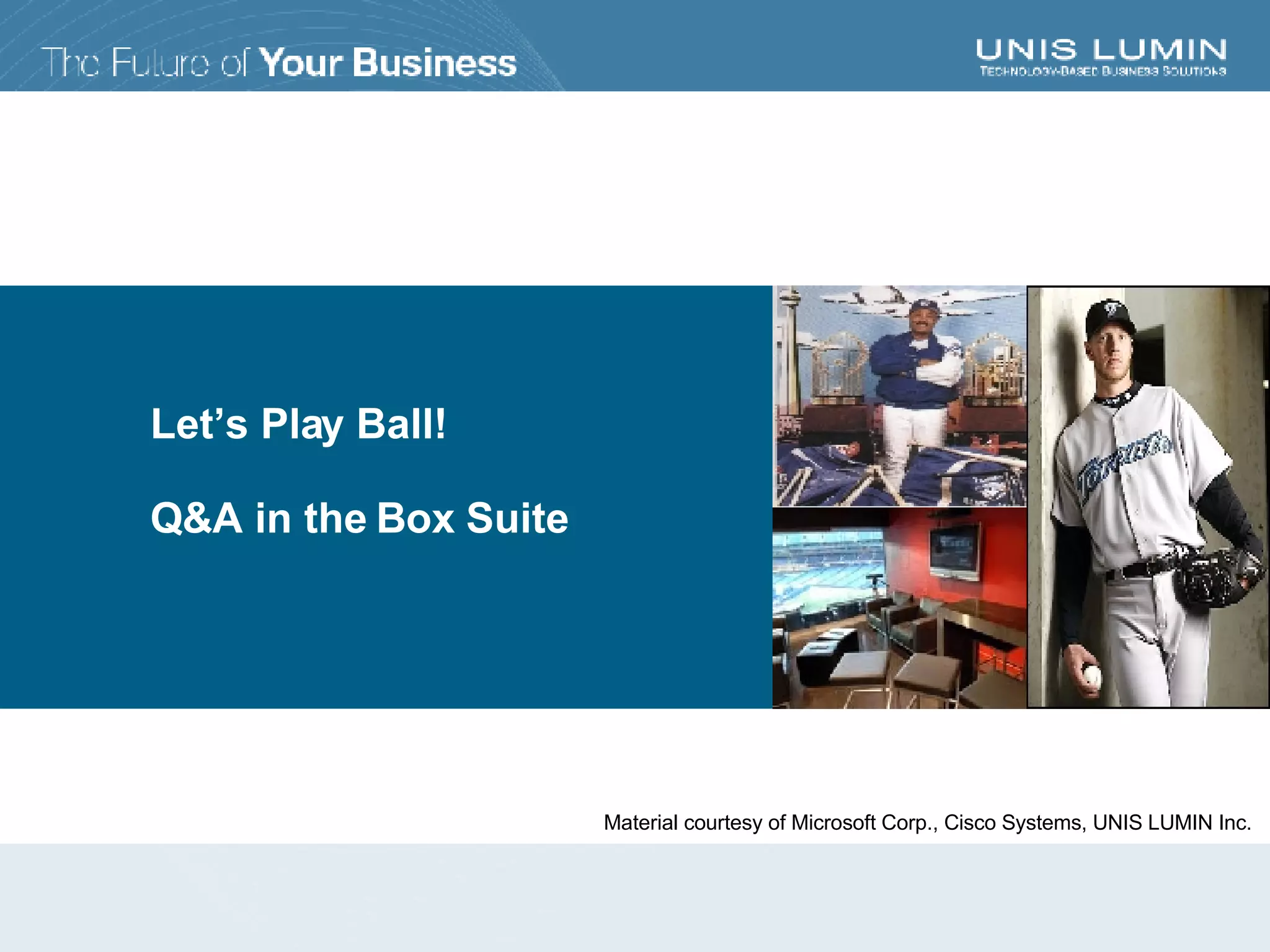
Let’s Play Ball! Q&A in the Box Suite Material courtesy of Microsoft Corp., Cisco Systems, UNIS LUMIN Inc.

The Impact Of The Disconnected Workforce, Unified Communications,2008

  • 1.
    The Impact ofthe Disconnected Workforce Mauro Lollo Co-Founder, CTO
  • 2.
    Agenda On themind of Business Leaders / Knowledge Workers Productivity Forces acting on the enterprise Modes of communication Confusion & Change Unified Communications Overview
  • 3.
    What’s on themind of Business Leaders? 1,100 Business Leaders 40 countries 32 industries
  • 4.
    The Enterprise ofthe Future…
  • 5.
    New World OrderCompetitiveness Economic Growth Standard of Living PRODUCTIVITY GLOBALIZATION
  • 6.
    Loaded hourly labour$ for auto production $41 $2 Productivity & Innovation?
  • 7.
  • 8.
    What Drucker saidin the 70’s The most important, and indeed the truly unique, contribution of management in the 20th century was the fifty-fold increase in the productivity of the MANUAL WORKER in manufacturing . The most important contribution management needs to make in the 21st is similarly to increase the productivity of KNOWLEDGE WORK and the KNOWLEDGE WORKER
  • 9.
    What’s on themind of Knowledge Workers? 517 respondents U.S., Canada, Europe 62% customer facing Sales and service roles
  • 10.
  • 11.
    Innovation can alsocreate complexity Information Overload Too many devices Anywhere/anytime Technology Limits Disparate solutions / interface Disparate access 15 Attachments!! u there? Meetings All Day 20 E-Mails! “ Have a Minute?” 5 Voicemails!
  • 12.
    … Results in Delays and Missed Deadlines … Unable to Reach Coworkers on First Try… … Have to Use Multiple Methods of Reaching Coworkers… Communication Devices and Apps Proliferating … Employees Increasingly Mobile … Source: Sage Research A Disconnected Scenario Impacting Impacting the Bottom Line the Top and Bottom Line Daily 52% Daily 36% Monthly 22% 6.4 Types of Devices 27% Traveling 1X Month Avg.
  • 13.
    “ The cognitivelimit to the number of individuals with whom any one person can maintain stable relationships" Dunbar’s Number 150
  • 14.
    30% of brain’scortex devoted to vision, 8% for touch and 3% for hearing More than 60% of communication is non-verbal Sources: Human Productivity Lab 2006 and Pearn Kandola: The Psychology of Effective Business Communications in Geographically Dispersed Teams 2006 Visual Interaction 30% of What They See 70% of What They See and Hear 20% of What They Hear
  • 15.
    Consumer Tech Influenceon the Enterprise Consumerization the most significant trend to affect IT over the next 10 years Generation X and Y Influence
  • 16.
    The Winds ofChange… One Time Zone, Real-time New and Changing Regulations Business Continuance Working Moments Consumer Influence Mobility and Uniformity of Experience The “Millenials” Web 2.0
  • 17.
    “ If Ihad asked people what they wanted, they would have said faster horses” Henry Ford
  • 18.
    Unified Communications Abridge to the Enterprise of the Future
  • 19.
    Enterprise Comms Marketat Crossroads Traditional PBX suppliers losing market / mind share Rise of Cisco, Microsoft; Google in the wings Industry standard solutions, open standards Major shift in Enterprise Communications market Unification of media: voice, data, video, applications Reduced real-time voice, more text-based (email, IM) Increasing reliance on mobile devices i.e. smart phones
  • 20.
    UC Market Forecast5,000 0 10,000 Market Size ($M) 25,000 FY’03 FY’04 FY’05 FY’06 FY’07 FY’08 FY’09 FY’10 30,000 35,000 20,000 15,000 Sources: Synergy, Gartner, Wainhouse, Datamonitor, Ovum, and Cisco 40,000 TDM PBX IP PBX Messaging Contact Center Conferencing and Collaboration Enterprise FMC Rich Media Email/Calendaring Enterprise IM
  • 21.
    UC & Web2.0 Transcend Boundary free UC Frictionless Collaboration Include Extend UC to customers & partners Transform Competitive advantage with UC Wikis, Blogs, Mashups Social Networking Face book Accelerate Extending UC across the business Intranets, Email & IM Migrate Legacy to IP Enable the change Unified Communications and Web 2.0
  • 22.
    Anytime, Anywhere, Accessand Availability Blurring of Work and Free Time Collaborative Communities Travel/ Commuting Reduction Programs Built-in Resiliency and Compliance Speed and agility required to be competitive Continuity and Compliance no longer nice to haves Innovation is a key driver of business performance Green business practices becoming mainstream Enterprise of the Future FLEXIBILITY
  • 23.
    IP Telephony PresenceCollaboration Conferencing Mobility Messaging IP PBX IP end-points Gateways SRST App Integration E-Mail Voice Mail Unified VM IM SMS Paging Intercom Desktop Mobile Client Physical RFID Video E911 Cellular Wireless 1 # Reach Teleworker 2 Way Radio Web Whiteboard Smartboard H.239 Sharing Desktop Control Audio Video Telepresence Streaming On-Demand Scheduled AOD/VOD Unified Login Unified Interface 1 Click Collaboration Collaboration via UC User Experience
  • 24.
    What is Presence?Presence - real-time indicator of a person’s willingness and availability to communicate Represented by status: Available, In Meeting, On Mobile, At Lunch, etc. Includes details on user’s preferred method to communicate: voice, video or Instant Message “ Find-Me”, “Follow-Me”, or “Hide-Me” Integration with Calendaring, Location, and Workflow systems help users automatically keep their Presence status up to date while also creating streamlined business processes Reduces communication delays Improves productivity
  • 25.
  • 26.
    UC Continuum DesktopApplication Model
  • 27.
    UC Continuum EnterpriseApplication Model
  • 28.
  • 29.
    Collaboration in TwoCategories or “Zones” The Productivity Zone User-oriented tools Consumer IM Softphones Mobility Support Conferencing For generic groups or Enterprise Wide Saves “xx” minutes per day Often the “sizzle” of UC The Business Processes Zone Process Optimizations Rich Presence (with IM) Roles/Skills vs Names Software-assisted Mobile Information Delivery Collaborative Workspaces Targeted to Process Groups Involves System Integration Cut Costs & Time, Drive Revenue Often a good place to start Builds acceptance and understanding Still requires adoption support The area of greatest benefits and ROI Source of business differentiation Similar to contact center investments
  • 30.
    A Day inthe Life The Integrated User Experience 6. Email revised documents to colleagues 1. Arrive in office. Urgent voice message waiting. 2. View availability and preferred communication method to reduce phone tag 3. Click-to-call using integrated soft phone or desktop IP phone 4. Add video to enhance communication Task Complete! 5. Share documents using Web conferencing
  • 31.
  • 32.
    The Major Questionson the Table How are you currently leveraging communications? Where does UC fit into my Enterprise? Personal Productivity Enhancement Business Processes Optimization How much can be built on our current infrastructure? How would this influence a new IT infrastructure investments? How much should be provided through interoperability? What elements do we need to invest in? What are the costs, risks and success factors?
  • 33.
    Let’s Play Ball!Q&A in the Box Suite Material courtesy of Microsoft Corp., Cisco Systems, UNIS LUMIN Inc.