D E P A R TME N T O F O R T H O P E D I C S A N D P H Y S I C A L R E H A B I L I TAT I O N 
D I V I S I O N O F A R T H R I T I S A N D J O I N T R E P L A C EME N T S U R G E R Y 
Preparing for 
your hip 
replacement 
surgery
Dear Patient: 
Thank you for considering UMass Memorial Medical Center for your joint replacement 
surgery. Our team has received national and regional recognition 
for its expertise in joint replacement surgery. These awards are based on the exceptional 
outcomes of our patients. We have the region’s most extensive team of orthopedic 
specialists with a depth of experience that places us in the top ten percent of orthopedic 
programs in the nation. Blue Cross Blue Shield has designated our Arthritis and Joint 
Replacement Center as a “Blue Distinction Center,” a quality award given to the few 
hospitals that continually meet and exceed outcomes for joint replacement procedures. 
Our most important measure of the quality of orthopedic care given here is the amount of improvement in a patient’s 
activity and physical function after treatment. According to the federal Agency for Healthcare Research and Quality, 
the UMass Memorial Health Care Musculoskeletal Center of Excellence is a model program that is nationally 
recognized for the quality of our care and the exceptional functional results of our patient. 
At our Arthritis and Joint Replacement Center, we are committed to helping people lead active lives. If joint pain, a 
sports- or work-related injury or other orthopedic problem prevents you from enjoying your regular activities, we are 
here to help — from initial consultation to diagnosis through treatment and recovery. When you turn to us for 
orthopedic care, you can feel confident that you will receive the highest-quality care from a respected team of 
experienced orthopedics experts. 
This booklet explains the outstanding program that you will take part in if you have knee or hip replacement surgery 
at UMass Memorial. I encourage you to ask questions of any member of your Arthritis and Joint Replacement Center 
care team throughout the process. We are always available to answer your questions and help your recovery. 
Sincerely, 
David Ayers, MD 
The Arthur Pappas Professor and Chair 
Department of Orthopedics and Physical Rehabilitation 
UMass Memorial Medical Center 
UMass Medical School 
2
3 
About This Booklet 
The information provided in this booklet is intended to be your guide as you plan for your upcoming 
total hip replacement surgery. This guide was written by your Arthritis and Joint Replacement Center 
care team at UMass Memorial Medical Center in order to help answer many of the questions you may 
have regarding your surgery and recovery. We hope you find the information in this booklet helpful. We 
also encourage you to speak with your doctor or member of your health care team if you have any 
additional questions. 
__________________________________________________________________________ 
__________________________________________________________________________ 
__________________________________________________________________________ 
__________________________________________________________________________ 
__________________________________________________________________________ 
__________________________________________________________________________ 
__________________________________________________________________________ 
__________________________________________________________________________ 
__________________________________________________________________________ 
__________________________________________________________________________ 
__________________________________________________________________________ 
__________________________________________________________________________ 
__________________________________________________________________________ 
__________________________________________________________________________ 
__________________________________________________________________________ 
__________________________________________________________________________ 
__________________________________________________________________________ 
__________________________________________________________________________ 
__________________________________________________________________________ 
__________________________________________________________________________ 
__________________________________________________________________________ 
__________________________________________________________________________
4 
Contents 
Our Team . . . . . . . . . . . . . . . . . . . . . . . . . . . . . . . . . . . . . . . . . . . . . . . . . . . . . . . . . . . . . . . . . . . . .5 
Your Visits to the Arthritis and Joint Replacement Center . . . . . . . . . . . . . . . . . . . . . . . . . . . . . . . . .5 
Research Studies . . . . . . . . . . . . . . . . . . . . . . . . . . . . . . . . . . . . . . . . . . . . . . . . . . . . . . . . . . . . . . .6 
Anatomy of the Hip . . . . . . . . . . . . . . . . . . . . . . . . . . . . . . . . . . . . . . . . . . . . . . . . . . . . . . . . . . . . .6 
Preparing for Surgery . . . . . . . . . . . . . . . . . . . . . . . . . . . . . . . . . . . . . . . . . . . . . . . . . . . . . . . . . . . .8 
Classes for the Patient and Family . . . . . . . . . . . . . . . . . . . . . . . . . . . . . . . . . . . . . . . . . . . . . . .8 
Presurgical Evaluation Appointment . . . . . . . . . . . . . . . . . . . . . . . . . . . . . . . . . . . . . . . . . . . . .8 
Other Appointments You May Need . . . . . . . . . . . . . . . . . . . . . . . . . . . . . . . . . . . . . . . . . . . . . . . . .9 
Blood Transfusions . . . . . . . . . . . . . . . . . . . . . . . . . . . . . . . . . . . . . . . . . . . . . . . . . . . . . . . . . . .9 
Home Preparation . . . . . . . . . . . . . . . . . . . . . . . . . . . . . . . . . . . . . . . . . . . . . . . . . . . . . . . . . .10 
What to Bring to the Hospital . . . . . . . . . . . . . . . . . . . . . . . . . . . . . . . . . . . . . . . . . . . . . . . . .11 
Evening before Surgery . . . . . . . . . . . . . . . . . . . . . . . . . . . . . . . . . . . . . . . . . . . . . . . . . . . . . .11 
Day of Surgery . . . . . . . . . . . . . . . . . . . . . . . . . . . . . . . . . . . . . . . . . . . . . . . . . . . . . . . . . . . . . . . .12 
Surgical Admissions Unit . . . . . . . . . . . . . . . . . . . . . . . . . . . . . . . . . . . . . . . . . . . . . . . . . . . . .12 
Holding Area . . . . . . . . . . . . . . . . . . . . . . . . . . . . . . . . . . . . . . . . . . . . . . . . . . . . . . . . . . . . .12 
Recovery Room . . . . . . . . . . . . . . . . . . . . . . . . . . . . . . . . . . . . . . . . . . . . . . . . . . . . . . . . . . . .12 
Your Room . . . . . . . . . . . . . . . . . . . . . . . . . . . . . . . . . . . . . . . . . . . . . . . . . . . . . . . . . . . . . . .12 
Your Hospital Stay . . . . . . . . . . . . . . . . . . . . . . . . . . . . . . . . . . . . . . . . . . . . . . . . . . . . . . . . . . . . .13 
First Day and Beyond . . . . . . . . . . . . . . . . . . . . . . . . . . . . . . . . . . . . . . . . . . . . . . . . . . . . . . . .13 
Pain Management . . . . . . . . . . . . . . . . . . . . . . . . . . . . . . . . . . . . . . . . . . . . . . . . . . . . . . . . . .14 
Bowel and Bladder Function . . . . . . . . . . . . . . . . . . . . . . . . . . . . . . . . . . . . . . . . . . . . . . . . . .14 
Blood Clots . . . . . . . . . . . . . . . . . . . . . . . . . . . . . . . . . . . . . . . . . . . . . . . . . . . . . . . . . . . . . . .15 
Physical Therapy . . . . . . . . . . . . . . . . . . . . . . . . . . . . . . . . . . . . . . . . . . . . . . . . . . . . . . . . . . . . . . .15 
Hip Dislocation Precautions . . . . . . . . . . . . . . . . . . . . . . . . . . . . . . . . . . . . . . . . . . . . . . . . . . .15 
After Hospital Care . . . . . . . . . . . . . . . . . . . . . . . . . . . . . . . . . . . . . . . . . . . . . . . . . . . . . . . . . . . . .16 
Discharge Planning . . . . . . . . . . . . . . . . . . . . . . . . . . . . . . . . . . . . . . . . . . . . . . . . . . . . . . . . .16 
Reasons to Call Your Physician . . . . . . . . . . . . . . . . . . . . . . . . . . . . . . . . . . . . . . . . . . . . . . . . .16 
Wound Care . . . . . . . . . . . . . . . . . . . . . . . . . . . . . . . . . . . . . . . . . . . . . . . . . . . . . . . . . . . . . .17 
Antibiotics . . . . . . . . . . . . . . . . . . . . . . . . . . . . . . . . . . . . . . . . . . . . . . . . . . . . . . . . . . . . . . . .17 
Exercise Program after Surgery . . . . . . . . . . . . . . . . . . . . . . . . . . . . . . . . . . . . . . . . . . . . . . . . . . . .18 
Directions . . . . . . . . . . . . . . . . . . . . . . . . . . . . . . . . . . . . . . . . . . . . . . . . . . . . . . . . . . . . . . . . . . . .22 
Internet Resources . . . . . . . . . . . . . . . . . . . . . . . . . . . . . . . . . . . . . . . . . . . . . . . . . . . . . . . . . . . . .23
5 
Our Team 
Our team consists of board-certified surgeons who have advanced training in hip replacement surgery. 
Our surgeons have performed hundreds of procedures using state-of-the-art techniques. Our academic 
partnership with the University of Massachusetts Medical School means our surgeons are engaged in 
ongoing clinical research efforts to advance surgical and nonsurgical methods for diagnosing and 
treating patients. Our nursing, physical therapy, and administrative staffs have combined their expert 
knowledge of patient care and recovery to supply you with information that is important for you to be 
successful. 
Your Visits to the Arthritis and Joint Replacement Center 
You will be asked to fill out a computer or paper survey about yourself and how you have been feeling. 
This survey is an extremely important part of your visit as it gives us important information to help plan 
your treatment. 
Your surgeon will look at your survey in addition to any x-rays, MRIs or lab tests you have had to help 
determine the best time for your surgery. Your answers also help us understand how well you will 
recover after your surgery. 
There are no right or wrong answers to these questions. We want you to be honest about how you feel, 
and your level of pain or joint stiffness. If pain is limiting everyday activities, then your doctor needs to 
know. Your survey answers can be used to help make important decisions about your care. 
You may be asked to fill out the survey at each visit including before surgery, as well as three months, six 
months, one year and perhaps up to two years after surgery.
Research Studies 
Hip replacement surgery offers successful outcomes for patients, and most patients experience 
significant pain relief and greater mobility following the surgery. One of the reasons hip replacement 
surgery has been so successful is because patients like you have given their consent to participate in 
clinical research studies. 
Orthopedic surgeons at UMass Memorial Medical Center are always looking for ways to improve hip 
replacement surgery. Research helps improve the surgical techniques, the hardware that makes up your 
new hip, the medicines that are prescribed and your postsurgery care. 
Some research studies ask you to fill out a questionnaire while others may invite you to participate in 
receiving the latest joint technology and/or medications. If you are asked to participate in a study, please 
read all of the information provided to you in order to decide if the study is right for you. Participation in 
research is completely voluntary. If you do not wish to participate in a research study it will not affect the 
excellent care you will receive at UMass Memorial Medical Center. 
If you have any questions regarding a research study that you are in, or one you would like to participate 
in, or if you do not wish to continue your participation in a study, please speak to our orthopedic 
research coordinator. Any one of our staff will be happy to provide you with the correct telephone 
number. Our research coordinator is always happy to answer any questions you may have. 
6 
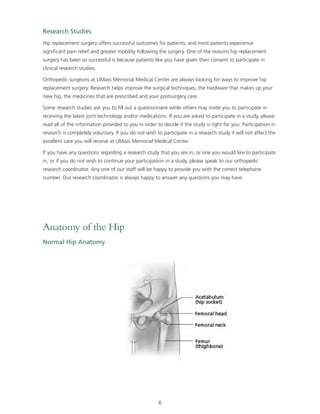
Anatomy of the Hip 
Normal Hip Anatomy
7 
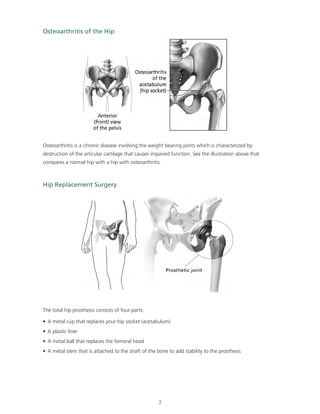
Osteoarthritis of the Hip 
Osteoarthritis is a chronic disease involving the weight bearing joints which is characterized by 
destruction of the articular cartilage that causes impaired function. See the illustration above that 
compares a normal hip with a hip with osteoarthritis. 
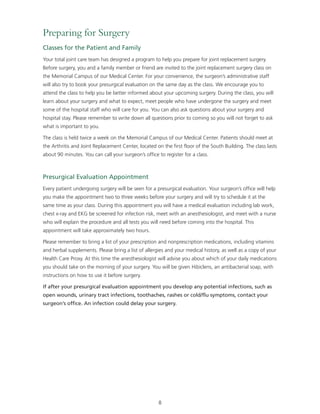
Hip Replacement Surgery 
The total hip prosthesis consists of four parts: 
• A metal cup that replaces your hip socket (acetabulum) 
• A plastic liner 
• A metal ball that replaces the femoral head 
• A metal stem that is attached to the shaft of the bone to add stability to the prosthesis
Preparing for Surgery 
Classes for the Patient and Family 
Your total joint care team has designed a program to help you prepare for joint replacement surgery. 
Before surgery, you and a family member or friend are invited to the joint replacement surgery class on 
the Memorial Campus of our Medical Center. For your convenience, the surgeon’s administrative staff 
will also try to book your presurgical evaluation on the same day as the class. We encourage you to 
attend the class to help you be better informed about your upcoming surgery. During the class, you will 
learn about your surgery and what to expect, meet people who have undergone the surgery and meet 
some of the hospital staff who will care for you. You can also ask questions about your surgery and 
hospital stay. Please remember to write down all questions prior to coming so you will not forget to ask 
what is important to you. 
The class is held twice a week on the Memorial Campus of our Medical Center. Patients should meet at 
the Arthritis and Joint Replacement Center, located on the first floor of the South Building. The class lasts 
about 90 minutes. You can call your surgeon’s office to register for a class. 
Presurgical Evaluation Appointment 
Every patient undergoing surgery will be seen for a presurgical evaluation. Your surgeon’s office will help 
you make the appointment two to three weeks before your surgery and will try to schedule it at the 
same time as your class. During this appointment you will have a medical evaluation including lab work, 
chest x-ray and EKG be screened for infection risk, meet with an anesthesiologist, and meet with a nurse 
who will explain the procedure and all tests you will need before coming into the hospital. This 
appointment will take approximately two hours. 
Please remember to bring a list of your prescription and nonprescription medications, including vitamins 
and herbal supplements. Please bring a list of allergies and your medical history, as well as a copy of your 
Health Care Proxy. At this time the anesthesiologist will advise you about which of your daily medications 
you should take on the morning of your surgery. You will be given Hibiclens, an antibacterial soap, with 
instructions on how to use it before surgery. 
If after your presurgical evaluation appointment you develop any potential infections, such as 
open wounds, urinary tract infections, toothaches, rashes or cold/flu symptoms, contact your 
surgeon’s office. An infection could delay your surgery. 
8
Other Appointments You May Need 
Dental Evaluation – Please have any dental work (cleaning, tooth extractions, etc.) done at least one 
month before your surgery if possible. The dentist should evaluate you for any infections or potential 
complications. 
Medical Appointment – You should notify your primary care physician that you are planning to have 
surgery. He/she may want to see you before the surgery. 
Urinary Evaluation – During your pretesting appointment, you will have a urine test done to make sure 
you do not have an infection. Any urinary tract infection will be treated. If necessary your surgeon may 
want a further urologic evaluation. 
Weight Loss – If you are overweight, your surgeon may request that you lose weight prior to your 
surgery. This will help decrease complications after surgery. 
Blood Transfusions 
Patients having total joint replacement surgery may require a blood transfusion. Your surgeon may 
recommend you donate blood prior to surgery. If you have discussed this with your surgeon and you are 
a candidate to donate your own blood, please call: 
The Blood Donor Center 
Elevator “D” to Level A 
UMass Memorial Medical Center – University Campus 
55 Lake Avenue North, Worcester, MA 
Telephone: 508-421-1950 or 508-421-1951 
You can donate one unit at a time with a week off between donations. It is preferable that you call the 
Blood Donor Center to set up your appointments four to six weeks prior to your surgery because you are 
only able to donate one unit at a time. Remember that the blood you donate is only good for 42 days. 
9
Home Preparation 
Adapting your home will make your return safer and enhance your recovery. Use this as a check list to 
review your home prior to surgery. 
 Take up all throw rugs. Use only nonskid rugs in good condition. 
 Secure the edge of area rugs with double-faced tape or tack them down. 
 Avoid highly polished floors. Clean floors to remove any substance which may catch your foot or 
crutches and cause you to fall. Powder makes the floor slippery. Hairspray makes the floor sticky. 
 Move most commonly used pots and pans to waist-high level to avoid excessive reaching or 
10 
bending. 
 Arrange furniture so pathways are wide enough (at least 36 inches) to accommodate a 
walker/crutches/wheelchair. 
 Remove household clutter and consider getting a trash can with wheels for trash removal. 
 Brightly colored tape on each step or threshold is advised for people who have vision problems to 
increase safety while walking. 
 Be aware of surface changes, such as rug to floor or linoleum. 
 Remove extension cords and telephone cords across walkways. If the cords are necessary across 
walkways, secure them with duct tape. 
 Avoid soft sofas or chairs which are difficult to get up from and opt for sturdy chairs with arm rests. 
 Install nightlights throughout the house, especially in the bedroom, bathroom and hallways. 
 Modify pet feeding areas by placing food dishes on a low bench or stool for easy access to refill. 
Avoid placing these items in areas where you will be walking frequently. 
 Arrange a sleeping area and a bathroom on the living level of your home. Use a bed or couch with 
the proper support and height. Your bed should not be low to the floor, which puts added stress on 
your knees, or so high that your feet cannot touch the floor. 
 Consider a bedside commode and/or urinal for nighttime use. 
 Place toilet paper at a convenient location to reach. 
 Place soap/shampoo at a comfortable height. 
 If you are using a shower to bathe we suggest that you remove glass shower doors. These are 
unsafe to use as support when getting in or out of the shower or tub. Do not use a towel rack, soap 
dish or windowsill for support when getting in and out of the shower or tub. Request a trained 
professional (plumber, carpenter) to install grab bars in the tub. 
 Place gripping tub strips on the bottom of the tub to prevent your feet from slipping. 
 Consider an emergency call system if you are home alone for long periods of time. 
 Keep a portable telephone and emergency numbers with you at all times.
What to Bring to the Hospital 
UMass Memorial Medical Center will provide you with the essentials needed for your stay in the hospital. 
When you arrive in your room after surgery, you will receive toothpaste, toothbrush, soap, lotion, comb, 
mouthwash, shaving cream, disposable razor and a denture cup. You are welcome to bring any personal 
toiletries that would make your stay more comfortable. 
The hospital also supplies you with a gown to wear throughout your stay. This is much more convenient 
for you as you are trying to get out of bed and perform activities. We highly recommend that you leave 
all valuables (jewelry, large sums of money, credit cards) at home, as the hospital cannot be responsible 
for them. 
Bring the following things with you to the hospital: 
• Copy of your Health Care Proxy 
• Written list of prescription and nonprescription medications, vitamins and herbal supplements that you 
take, including those you have stopped prior to surgery 
• Written list of any allergies to medications, food or latex 
• Eyeglasses and eye case, instead of contact lenses, as they are more easily cared for and are easier to 
use 
• Loose, comfortable clothing to wear home 
• Footwear with a rubber nonskid bottom with good support, like a sneaker or walking shoe (not clogs) 
• Telephone numbers of family and friends (Please note: Your hospital room is equipped with a 
telephone and you are allowed to make local calls only. Please make arrangements for 
long distance calling.) 
• Books, magazines, music devices or a hobby to help you relax; all rooms are equipped with televisions 
Evening before Surgery 
You can expect a telephone call from the Surgical Admissions Unit letting you know what time to come 
to the hospital. 
You should not eat or drink after midnight before your surgery. You may take your medications with sips 
of water as instructed. 
11
Day of Surgery 
Surgical Admissions Unit 
On the day of your hip surgery you should report to the Surgical Admissions Unit, second floor, East 
Building, Memorial Campus. Enter through the main entrance of the hospital and take elevator E. 
When you arrive, you will change into a hospital gown. Your belongings can be labeled and sent to the 
inpatient unit, but we suggest that family members take your belongings and bring them to your room 
to avoid them being misplaced. The nursing staff will take your vital signs and review your final 
preparations for surgery. When your family members are asked to leave, they may go to the surgical 
waiting area just outside the unit. 
Your surgeon will come and speak to your family in the waiting room or call your family after your 
surgery is finished. Please leave a cell phone or other contact number with the surgical admissions staff. 
For your family’s convenience, there is a cafeteria on the first floor of the South building and a coffee 
shop in the atrium/main lobby. The cafeteria is open every day from 6:15 to 10:30 am and 11 am to 
9:30 pm. 
Holding Area 
When it is time for your surgery, you will be transported via stretcher to a holding room. An IV line will 
be placed for routine fluids, antibiotics and a blood transfusion if necessary. Your anesthesiologist and 
surgeon meet with you to discuss any last-minute questions or concerns. For safety purposes, you will be 
asked to sign your initials with a surgical pen at the location of your surgery. Once you are fully prepared 
and the surgical team is ready, you will be taken into the operating room. 
Recovery Room 
Once the surgery is complete, you will be taken to the Post Anesthesia Care Unit (PACU) where you will 
stay until you are awake and alert, your vital signs are stable, and your pain is under control. 
As soon as these occur and your room is ready, you will be taken to your room on the floor. In some 
instances, patients stay in the PACU overnight. 
Your Room 
Upon arriving in your room, you will meet your nurse and your personal care assistant who will orient 
you to your surroundings. Your vital signs will be taken and your medical condition will be assessed. You 
will still have an IV but can drink if you are able. 
The staff will assist you out of bed on the evening of surgery. The nurses will assess your pain to make 
sure it is under control. You will be checked frequently for safety and comfort. Do not hesitate to report 
any concerns or ask any questions. 
12
You may be wearing special white stockings and/or compression boots to promote circulation and to 
help prevent blood clots. 
You will be taught how to cough and take deep breaths to prevent congestion in your lungs while you 
are not moving around. 
Your Hospital Stay 
First Day and Beyond 
Your first day after surgery will be the beginning of your recovery: 
• You will get out of bed with the help of a caregiver. Do not get out of bed without first calling for 
assistance. 
• Your IV will be stopped, and you will be allowed to eat and drink your normal diet. 
We encourage you to ask questions and communicate concerns to the nursing staff as well as the entire 
orthopedic team. 
The average length of stay in the hospital for a total joint replacement patient is three to four days. Each 
day you will increase your activity level and strength. You can expect the following to occur: 
• Lab staff will draw your blood daily. These results will be evaluated by the orthopedic team and if 
necessary you may receive a blood transfusion based on these results. 
• Physical therapy treatments will help you get back on your feet and ready for discharge. 
• You will be visited daily by our discharge coordinator who will help you with your discharge plan. 
• While you are in the hospital you should receive any medication you normally take at home. If you do 
not receive your medications, please tell your nurse. If you have any questions do not hesitate to ask. 
You may also receive additional medications as prescribed by your surgeon such as a multivitamin, 
vitamin C, iron, laxatives to prevent constipation and blood thinning medicine to prevent blood clots. 
Pain Management 
Our body uses several different chemicals to transmit pain messages to the brain. Each of these 
chemicals is part of a pain-signaling pathway. Recent studies have shown that a more effective way of 
treating pain is to treat multiple pathways with medications for each pathway. Using a number of 
different medications enables us to treat pain more effectively, while minimizing side effects. Since we 
are trying to treat multiple pathways, you will find that we will be using a number of different pain 
medications, beginning the morning of surgery and extending through your hospital stay and at home. 
13
Some of the pain modalities used are: 
• Nerve blocks – local anesthesia injected around a nerve 
• Long acting medication by mouth 
• Short acting medication by mouth 
• An anti-inflammatory medication 
• Tylenol® 
• Medication for nerve pain 
• Patient-controlled analgesia (PCA: a pump controlled by the patient to deliver intravenous pain 
medication) 
Pain control begins on admission and continues throughout your hospital stay. The pain modality to be 
used will be decided upon by your surgeon and anesthesiologist. This decision is based on your medical 
history. 
Pain management is an important aspect of care for a total joint patient. The nursing staff will frequently 
ask you to rate your pain on a scale of zero to 10, zero being no pain and 10 being severe pain. It is 
important to all members of your care team that you are as comfortable as possible. If at any time you 
do not feel your pain is under control, please do not hesitate to inform them. 
Bowel and Bladder Function 
In some instances you will have a catheter placed during or after surgery. A catheter is a thin, flexible 
tube inserted in the body to withdraw fluids. If you have a catheter, it will be removed in one to two 
days. 
Normal bowel movement following surgery is very important. Pain medication can and often does cause 
constipation. While you are in the hospital, you will receive stool softeners and/or laxatives in order to 
prevent constipation. It is important for you to continue to manage your bowel movements at home. 
There are many remedies that can be bought at your local pharmacy including: 
• Docusate sodium (Colace®): 100 milligrams twice daily 
• Milk of Magnesia: Follow directions on the label 
• Senokot®: Two tablets at bedtime 
• Glycerine suppositories and small enemas: Follow directions on the label 
Drinking plenty of fluids and eating high-fiber foods such as vegetables, oranges, apricots and prunes 
can help ease constipation. 
14
Blood Clots 
Blood clots can develop after surgery. Your surgeon will prescribe a blood-thinning medication called an 
anticoagulant to help prevent blood clot formation. 
You may wear special white stockings and/or compression boots to promote circulation and prevent 
blood clots. 
If you are given white compression stockings you should continue to wear them after you leave the 
hospital until your first visit with your surgeon. Wear them during the day and remove them at night. 
Getting out of bed and moving also helps prevent blood clots. 
15 
Physical Therapy 
While you are in the hospital you will receive physical therapy. 
Physical therapy focuses on teaching the proper techniques for getting in and out of bed, up and down 
from a chair, and walking with an assistive device (a walker or crutches). Your therapist will also review a 
therapeutic exercise program that is designed to increase your range of motion and strength (see page 
18). 
Hip Dislocation Precautions 
Certain precautions need to be taken after surgery to protect your new joint and prevent dislocation. 
Your therapist will review these precautions with you and teach you how to do your daily activities.
After Hospital Care 
Discharge Planning 
All patients having total joint replacement surgery will require further therapy after discharge from the 
hospital. 
The discharge coordinator, along with other members of the orthopedic team, will coordinate your 
discharge to home with therapy/nursing services. Your discharge plan will depend on your medical 
needs, your progress with therapy, your home arrangement and your insurance. You should arrange to 
have help with meals and other needs at home, such as cleaning and shopping. 
Below are some options available for continued care: 
Rehabilitation Center – You may need additional rehabilitation because you require continued 
monitoring of your medical condition. The length of your stay will depend on your progress with therapy. 
Outpatient Physical Therapy – You may require additional therapy after you are discharged from rehab 
or from home physical therapy. This option should be discussed with your surgeon at your first visit after 
surgery. 
Reasons to Call Your Surgeon 
Please notify your surgeon if you develop: 
• Redness or drainage from your incision 
• Separation or opening of incision 
• Calf discomfort 
• Fever (temperature greater than 101 degrees) or chills 
• Rash 
• Increased pain 
• Leg swelling 
• Decreased motion or increased stiffness 
• Any other concerns you may have 
16
Wound Care 
Please keep the incision clean and dry. 
It is best to leave the incision uncovered if there is no drainage. You may cover it with a dry, sterile 
dressing for your comfort and change it every day. 
If you suspect that you are developing an infection in the wound area or you develop redness around the 
sutures, contact your surgeon immediately. 
Antibiotics 
You now have an artificial hip. To decrease the chance of infection of this joint, your primary care 
physician or dentist will need to prescribe antibiotics before any dental, surgical or invasive procedures. 
17
Exercise Program after Surgery 
To make your recovery from surgery easier you should familiarize yourself with these exercises before 
coming to the hospital. Your therapist will show you which ones are best and how often you should do 
each. The therapist will introduce additional exercises as you progress in your recovery. 
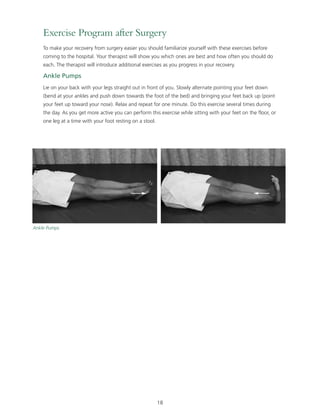
Ankle Pumps 
Lie on your back with your legs straight out in front of you. Slowly alternate pointing your feet down 
(bend at your ankles and push down towards the foot of the bed) and bringing your feet back up (point 
your feet up toward your nose). Relax and repeat for one minute. Do this exercise several times during 
the day. As you get more active you can perform this exercise while sitting with your feet on the floor, or 
one leg at a time with your foot resting on a stool. 
18 
Ankle Pumps
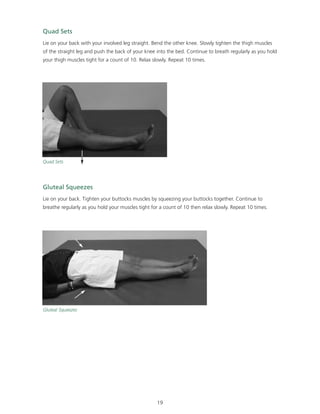
Quad Sets 
Lie on your back with your involved leg straight. Bend the other knee. Slowly tighten the thigh muscles 
of the straight leg and push the back of your knee into the bed. Continue to breath regularly as you hold 
your thigh muscles tight for a count of 10. Relax slowly. Repeat 10 times. 
Gluteal Squeezes 
Lie on your back. Tighten your buttocks muscles by squeezing your buttocks together. Continue to 
breathe regularly as you hold your muscles tight for a count of 10 then relax slowly. Repeat 10 times. 
19 
Quad Sets 
Gluteal Squeezes
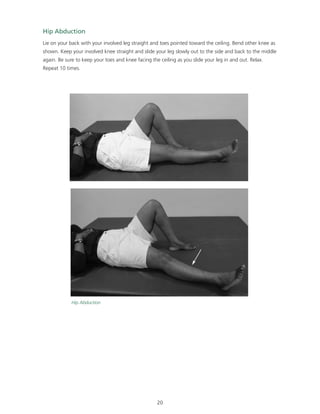
Hip Abduction 
Lie on your back with your involved leg straight and toes pointed toward the ceiling. Bend other knee as 
shown. Keep your involved knee straight and slide your leg slowly out to the side and back to the middle 
again. Be sure to keep your toes and knee facing the ceiling as you slide your leg in and out. Relax. 
Repeat 10 times. 
20 
Hip Abduction
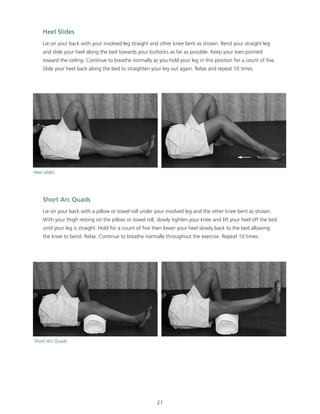
Heel Slides 
Lie on your back with your involved leg straight and other knee bent as shown. Bend your straight leg 
and slide your heel along the bed towards your buttocks as far as possible. Keep your toes pointed 
toward the ceiling. Continue to breathe normally as you hold your leg in this position for a count of five. 
Slide your heel back along the bed to straighten your leg out again. Relax and repeat 10 times. 
Short Arc Quads 
Lie on your back with a pillow or towel roll under your involved leg and the other knee bent as shown. 
With your thigh resting on the pillow or towel roll, slowly tighten your knee and lift your heel off the bed 
until your leg is straight. Hold for a count of five then lower your heel slowly back to the bed allowing 
the knee to bend. Relax. Continue to breathe normally throughout the exercise. Repeat 10 times. 
21 
Heel slides 
Short Arc Quads
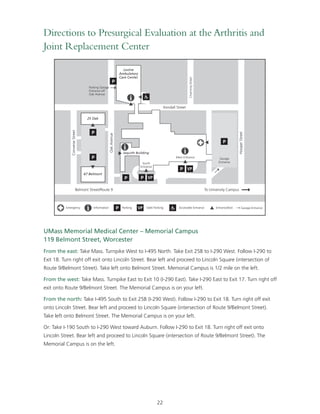
Directions to Presurgical Evaluation at the Arthritis and 
Joint Replacement Center 
Converse Street 
Oak Avenue 
UMass Memorial Medical Center – Memorial Campus 
119 Belmont Street, Worcester 
From the east: Take Mass. Turnpike West to I-495 North. Take Exit 25B to I-290 West. Follow I-290 to 
Exit 18. Turn right off exit onto Lincoln Street. Bear left and proceed to Lincoln Square (intersection of 
Route 9/Belmont Street). Take left onto Belmont Street. Memorial Campus is 1/2 mile on the left. 
From the west: Take Mass. Turnpike East to Exit 10 (I-290 East). Take I-290 East to Exit 17. Turn right off 
exit onto Route 9/Belmont Street. The Memorial Campus is on your left. 
From the north: Take I-495 South to Exit 25B (I-290 West). Follow I-290 to Exit 18. Turn right off exit 
onto Lincoln Street. Bear left and proceed to Lincoln Square (intersection of Route 9/Belmont Street). 
Take left onto Belmont Street. The Memorial Campus is on your left. 
Or: Take I-190 South to I-290 West toward Auburn. Follow I-290 to Exit 18. Turn right off exit onto 
Lincoln Street. Bear left and proceed to Lincoln Square (intersection of Route 9/Belmont Street). The 
Memorial Campus is on the left. 
22 
Levine 
Ambulatory 
Care Center 
25 Oak 
67 Belmont 
Jaquith Building 
Belmont Street/Route 9 
Hooper Street 
Channing Street 
Kendall Street 
To University Campus 
Parking Garage 
Entrance off 
Oak Avenue 
South 
Entrance 
Main Entrance Garage 
Entrance 
Emergency Information Parking Valet Parking Accessible Entrance Entrance/Exit Garage Entrance
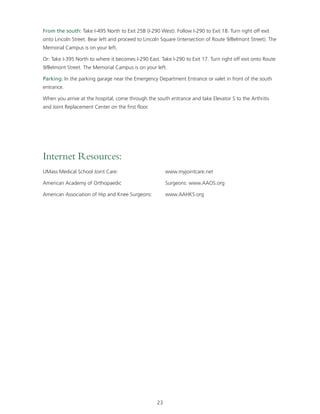
From the south: Take I-495 North to Exit 25B (I-290 West). Follow I-290 to Exit 18. Turn right off exit 
onto Lincoln Street. Bear left and proceed to Lincoln Square (intersection of Route 9/Belmont Street). The 
Memorial Campus is on your left. 
Or: Take I-395 North to where it becomes I-290 East. Take I-290 to Exit 17. Turn right off exit onto Route 
9/Belmont Street. The Memorial Campus is on your left. 
Parking: In the parking garage near the Emergency Department Entrance or valet in front of the south 
entrance. 
When you arrive at the hospital, come through the south entrance and take Elevator S to the Arthritis 
and Joint Replacement Center on the first floor. 
23 
Internet Resources: 
UMass Medical School Joint Care: www.myjointcare.net 
American Academy of Orthopaedic Surgeons: www.AAOS.org 
American Association of Hip and Knee Surgeons: www.AAHKS.org
UMassMemorial 
Medical Center 
A Member of UMass Memorial Health Care 
Patients and families trust UMass Memorial Medical Center as the 
region’s leading academic medical center, committed to 
improving the health of our communities in Central New England. 
With our partner, the University of Massachusetts Medical School, 
we are committed to excellence in primary and specialty care, 
community service, teaching and research. The Medical Center 
offers advanced technology and support services for patients and 
families, providing the region with specialists renowned for their 
expertise in caring for adults and children. 
Contributions to UMass Memorial Medical Center are deeply 
appreciated. Call 508-856-5520 or email giving@umassmed.edu. 
UMassMemorial 
Health Care 
UMass Memorial Health Care is the largest not-for-profit health 
care system in Central New England with more than 13,000 
employees and nearly 2,000 physicians, many of whom are 
members of UMass Memorial Medical Group. Our member 
hospitals and entities include Clinton Hospital, HealthAlliance 
Hospital, Marlborough Hospital, UMass Memorial Medical Center, 
Wing Memorial Hospital and Medical Centers and Community 
Healthlink, our behavioral health agency. With our teaching and 
research partner, the University of Massachusetts Medical School, 
our extensive primary care network and our Cancer, Diabetes, 
Heart and Vascular, and Musculoskeletal Centers of Excellence we 
deliver seamless programs of quality and compassionate care for 
patients across our health care system. 
Follow umassmemorial on: 
Department of Orthopedics and Physical Rehabilitation 
Division of Arthritis and Joint Replacement Surgery 
UMass Memorial Medical Center – University Campus 
55 Lake Avenue North, Worcester, MA 01655 
www.umassmemorial.org/ortho NS ORTHO 0042 Rev 11/22/13

Preparing for Hip Replacement

  • 1.
    D E PA R TME N T O F O R T H O P E D I C S A N D P H Y S I C A L R E H A B I L I TAT I O N D I V I S I O N O F A R T H R I T I S A N D J O I N T R E P L A C EME N T S U R G E R Y Preparing for your hip replacement surgery
  • 2.
    Dear Patient: Thankyou for considering UMass Memorial Medical Center for your joint replacement surgery. Our team has received national and regional recognition for its expertise in joint replacement surgery. These awards are based on the exceptional outcomes of our patients. We have the region’s most extensive team of orthopedic specialists with a depth of experience that places us in the top ten percent of orthopedic programs in the nation. Blue Cross Blue Shield has designated our Arthritis and Joint Replacement Center as a “Blue Distinction Center,” a quality award given to the few hospitals that continually meet and exceed outcomes for joint replacement procedures. Our most important measure of the quality of orthopedic care given here is the amount of improvement in a patient’s activity and physical function after treatment. According to the federal Agency for Healthcare Research and Quality, the UMass Memorial Health Care Musculoskeletal Center of Excellence is a model program that is nationally recognized for the quality of our care and the exceptional functional results of our patient. At our Arthritis and Joint Replacement Center, we are committed to helping people lead active lives. If joint pain, a sports- or work-related injury or other orthopedic problem prevents you from enjoying your regular activities, we are here to help — from initial consultation to diagnosis through treatment and recovery. When you turn to us for orthopedic care, you can feel confident that you will receive the highest-quality care from a respected team of experienced orthopedics experts. This booklet explains the outstanding program that you will take part in if you have knee or hip replacement surgery at UMass Memorial. I encourage you to ask questions of any member of your Arthritis and Joint Replacement Center care team throughout the process. We are always available to answer your questions and help your recovery. Sincerely, David Ayers, MD The Arthur Pappas Professor and Chair Department of Orthopedics and Physical Rehabilitation UMass Memorial Medical Center UMass Medical School 2
  • 3.
    3 About ThisBooklet The information provided in this booklet is intended to be your guide as you plan for your upcoming total hip replacement surgery. This guide was written by your Arthritis and Joint Replacement Center care team at UMass Memorial Medical Center in order to help answer many of the questions you may have regarding your surgery and recovery. We hope you find the information in this booklet helpful. We also encourage you to speak with your doctor or member of your health care team if you have any additional questions. __________________________________________________________________________ __________________________________________________________________________ __________________________________________________________________________ __________________________________________________________________________ __________________________________________________________________________ __________________________________________________________________________ __________________________________________________________________________ __________________________________________________________________________ __________________________________________________________________________ __________________________________________________________________________ __________________________________________________________________________ __________________________________________________________________________ __________________________________________________________________________ __________________________________________________________________________ __________________________________________________________________________ __________________________________________________________________________ __________________________________________________________________________ __________________________________________________________________________ __________________________________________________________________________ __________________________________________________________________________ __________________________________________________________________________ __________________________________________________________________________
  • 4.
    4 Contents OurTeam . . . . . . . . . . . . . . . . . . . . . . . . . . . . . . . . . . . . . . . . . . . . . . . . . . . . . . . . . . . . . . . . . . . . .5 Your Visits to the Arthritis and Joint Replacement Center . . . . . . . . . . . . . . . . . . . . . . . . . . . . . . . . .5 Research Studies . . . . . . . . . . . . . . . . . . . . . . . . . . . . . . . . . . . . . . . . . . . . . . . . . . . . . . . . . . . . . . .6 Anatomy of the Hip . . . . . . . . . . . . . . . . . . . . . . . . . . . . . . . . . . . . . . . . . . . . . . . . . . . . . . . . . . . . .6 Preparing for Surgery . . . . . . . . . . . . . . . . . . . . . . . . . . . . . . . . . . . . . . . . . . . . . . . . . . . . . . . . . . . .8 Classes for the Patient and Family . . . . . . . . . . . . . . . . . . . . . . . . . . . . . . . . . . . . . . . . . . . . . . .8 Presurgical Evaluation Appointment . . . . . . . . . . . . . . . . . . . . . . . . . . . . . . . . . . . . . . . . . . . . .8 Other Appointments You May Need . . . . . . . . . . . . . . . . . . . . . . . . . . . . . . . . . . . . . . . . . . . . . . . . .9 Blood Transfusions . . . . . . . . . . . . . . . . . . . . . . . . . . . . . . . . . . . . . . . . . . . . . . . . . . . . . . . . . . .9 Home Preparation . . . . . . . . . . . . . . . . . . . . . . . . . . . . . . . . . . . . . . . . . . . . . . . . . . . . . . . . . .10 What to Bring to the Hospital . . . . . . . . . . . . . . . . . . . . . . . . . . . . . . . . . . . . . . . . . . . . . . . . .11 Evening before Surgery . . . . . . . . . . . . . . . . . . . . . . . . . . . . . . . . . . . . . . . . . . . . . . . . . . . . . .11 Day of Surgery . . . . . . . . . . . . . . . . . . . . . . . . . . . . . . . . . . . . . . . . . . . . . . . . . . . . . . . . . . . . . . . .12 Surgical Admissions Unit . . . . . . . . . . . . . . . . . . . . . . . . . . . . . . . . . . . . . . . . . . . . . . . . . . . . .12 Holding Area . . . . . . . . . . . . . . . . . . . . . . . . . . . . . . . . . . . . . . . . . . . . . . . . . . . . . . . . . . . . .12 Recovery Room . . . . . . . . . . . . . . . . . . . . . . . . . . . . . . . . . . . . . . . . . . . . . . . . . . . . . . . . . . . .12 Your Room . . . . . . . . . . . . . . . . . . . . . . . . . . . . . . . . . . . . . . . . . . . . . . . . . . . . . . . . . . . . . . .12 Your Hospital Stay . . . . . . . . . . . . . . . . . . . . . . . . . . . . . . . . . . . . . . . . . . . . . . . . . . . . . . . . . . . . .13 First Day and Beyond . . . . . . . . . . . . . . . . . . . . . . . . . . . . . . . . . . . . . . . . . . . . . . . . . . . . . . . .13 Pain Management . . . . . . . . . . . . . . . . . . . . . . . . . . . . . . . . . . . . . . . . . . . . . . . . . . . . . . . . . .14 Bowel and Bladder Function . . . . . . . . . . . . . . . . . . . . . . . . . . . . . . . . . . . . . . . . . . . . . . . . . .14 Blood Clots . . . . . . . . . . . . . . . . . . . . . . . . . . . . . . . . . . . . . . . . . . . . . . . . . . . . . . . . . . . . . . .15 Physical Therapy . . . . . . . . . . . . . . . . . . . . . . . . . . . . . . . . . . . . . . . . . . . . . . . . . . . . . . . . . . . . . . .15 Hip Dislocation Precautions . . . . . . . . . . . . . . . . . . . . . . . . . . . . . . . . . . . . . . . . . . . . . . . . . . .15 After Hospital Care . . . . . . . . . . . . . . . . . . . . . . . . . . . . . . . . . . . . . . . . . . . . . . . . . . . . . . . . . . . . .16 Discharge Planning . . . . . . . . . . . . . . . . . . . . . . . . . . . . . . . . . . . . . . . . . . . . . . . . . . . . . . . . .16 Reasons to Call Your Physician . . . . . . . . . . . . . . . . . . . . . . . . . . . . . . . . . . . . . . . . . . . . . . . . .16 Wound Care . . . . . . . . . . . . . . . . . . . . . . . . . . . . . . . . . . . . . . . . . . . . . . . . . . . . . . . . . . . . . .17 Antibiotics . . . . . . . . . . . . . . . . . . . . . . . . . . . . . . . . . . . . . . . . . . . . . . . . . . . . . . . . . . . . . . . .17 Exercise Program after Surgery . . . . . . . . . . . . . . . . . . . . . . . . . . . . . . . . . . . . . . . . . . . . . . . . . . . .18 Directions . . . . . . . . . . . . . . . . . . . . . . . . . . . . . . . . . . . . . . . . . . . . . . . . . . . . . . . . . . . . . . . . . . . .22 Internet Resources . . . . . . . . . . . . . . . . . . . . . . . . . . . . . . . . . . . . . . . . . . . . . . . . . . . . . . . . . . . . .23
  • 5.
    5 Our Team Our team consists of board-certified surgeons who have advanced training in hip replacement surgery. Our surgeons have performed hundreds of procedures using state-of-the-art techniques. Our academic partnership with the University of Massachusetts Medical School means our surgeons are engaged in ongoing clinical research efforts to advance surgical and nonsurgical methods for diagnosing and treating patients. Our nursing, physical therapy, and administrative staffs have combined their expert knowledge of patient care and recovery to supply you with information that is important for you to be successful. Your Visits to the Arthritis and Joint Replacement Center You will be asked to fill out a computer or paper survey about yourself and how you have been feeling. This survey is an extremely important part of your visit as it gives us important information to help plan your treatment. Your surgeon will look at your survey in addition to any x-rays, MRIs or lab tests you have had to help determine the best time for your surgery. Your answers also help us understand how well you will recover after your surgery. There are no right or wrong answers to these questions. We want you to be honest about how you feel, and your level of pain or joint stiffness. If pain is limiting everyday activities, then your doctor needs to know. Your survey answers can be used to help make important decisions about your care. You may be asked to fill out the survey at each visit including before surgery, as well as three months, six months, one year and perhaps up to two years after surgery.
  • 6.
    Research Studies Hipreplacement surgery offers successful outcomes for patients, and most patients experience significant pain relief and greater mobility following the surgery. One of the reasons hip replacement surgery has been so successful is because patients like you have given their consent to participate in clinical research studies. Orthopedic surgeons at UMass Memorial Medical Center are always looking for ways to improve hip replacement surgery. Research helps improve the surgical techniques, the hardware that makes up your new hip, the medicines that are prescribed and your postsurgery care. Some research studies ask you to fill out a questionnaire while others may invite you to participate in receiving the latest joint technology and/or medications. If you are asked to participate in a study, please read all of the information provided to you in order to decide if the study is right for you. Participation in research is completely voluntary. If you do not wish to participate in a research study it will not affect the excellent care you will receive at UMass Memorial Medical Center. If you have any questions regarding a research study that you are in, or one you would like to participate in, or if you do not wish to continue your participation in a study, please speak to our orthopedic research coordinator. Any one of our staff will be happy to provide you with the correct telephone number. Our research coordinator is always happy to answer any questions you may have. 6 Anatomy of the Hip Normal Hip Anatomy
  • 7.
    7 Osteoarthritis ofthe Hip Osteoarthritis is a chronic disease involving the weight bearing joints which is characterized by destruction of the articular cartilage that causes impaired function. See the illustration above that compares a normal hip with a hip with osteoarthritis. Hip Replacement Surgery The total hip prosthesis consists of four parts: • A metal cup that replaces your hip socket (acetabulum) • A plastic liner • A metal ball that replaces the femoral head • A metal stem that is attached to the shaft of the bone to add stability to the prosthesis
  • 8.
    Preparing for Surgery Classes for the Patient and Family Your total joint care team has designed a program to help you prepare for joint replacement surgery. Before surgery, you and a family member or friend are invited to the joint replacement surgery class on the Memorial Campus of our Medical Center. For your convenience, the surgeon’s administrative staff will also try to book your presurgical evaluation on the same day as the class. We encourage you to attend the class to help you be better informed about your upcoming surgery. During the class, you will learn about your surgery and what to expect, meet people who have undergone the surgery and meet some of the hospital staff who will care for you. You can also ask questions about your surgery and hospital stay. Please remember to write down all questions prior to coming so you will not forget to ask what is important to you. The class is held twice a week on the Memorial Campus of our Medical Center. Patients should meet at the Arthritis and Joint Replacement Center, located on the first floor of the South Building. The class lasts about 90 minutes. You can call your surgeon’s office to register for a class. Presurgical Evaluation Appointment Every patient undergoing surgery will be seen for a presurgical evaluation. Your surgeon’s office will help you make the appointment two to three weeks before your surgery and will try to schedule it at the same time as your class. During this appointment you will have a medical evaluation including lab work, chest x-ray and EKG be screened for infection risk, meet with an anesthesiologist, and meet with a nurse who will explain the procedure and all tests you will need before coming into the hospital. This appointment will take approximately two hours. Please remember to bring a list of your prescription and nonprescription medications, including vitamins and herbal supplements. Please bring a list of allergies and your medical history, as well as a copy of your Health Care Proxy. At this time the anesthesiologist will advise you about which of your daily medications you should take on the morning of your surgery. You will be given Hibiclens, an antibacterial soap, with instructions on how to use it before surgery. If after your presurgical evaluation appointment you develop any potential infections, such as open wounds, urinary tract infections, toothaches, rashes or cold/flu symptoms, contact your surgeon’s office. An infection could delay your surgery. 8
  • 9.
    Other Appointments YouMay Need Dental Evaluation – Please have any dental work (cleaning, tooth extractions, etc.) done at least one month before your surgery if possible. The dentist should evaluate you for any infections or potential complications. Medical Appointment – You should notify your primary care physician that you are planning to have surgery. He/she may want to see you before the surgery. Urinary Evaluation – During your pretesting appointment, you will have a urine test done to make sure you do not have an infection. Any urinary tract infection will be treated. If necessary your surgeon may want a further urologic evaluation. Weight Loss – If you are overweight, your surgeon may request that you lose weight prior to your surgery. This will help decrease complications after surgery. Blood Transfusions Patients having total joint replacement surgery may require a blood transfusion. Your surgeon may recommend you donate blood prior to surgery. If you have discussed this with your surgeon and you are a candidate to donate your own blood, please call: The Blood Donor Center Elevator “D” to Level A UMass Memorial Medical Center – University Campus 55 Lake Avenue North, Worcester, MA Telephone: 508-421-1950 or 508-421-1951 You can donate one unit at a time with a week off between donations. It is preferable that you call the Blood Donor Center to set up your appointments four to six weeks prior to your surgery because you are only able to donate one unit at a time. Remember that the blood you donate is only good for 42 days. 9
  • 10.
    Home Preparation Adaptingyour home will make your return safer and enhance your recovery. Use this as a check list to review your home prior to surgery. Take up all throw rugs. Use only nonskid rugs in good condition. Secure the edge of area rugs with double-faced tape or tack them down. Avoid highly polished floors. Clean floors to remove any substance which may catch your foot or crutches and cause you to fall. Powder makes the floor slippery. Hairspray makes the floor sticky. Move most commonly used pots and pans to waist-high level to avoid excessive reaching or 10 bending. Arrange furniture so pathways are wide enough (at least 36 inches) to accommodate a walker/crutches/wheelchair. Remove household clutter and consider getting a trash can with wheels for trash removal. Brightly colored tape on each step or threshold is advised for people who have vision problems to increase safety while walking. Be aware of surface changes, such as rug to floor or linoleum. Remove extension cords and telephone cords across walkways. If the cords are necessary across walkways, secure them with duct tape. Avoid soft sofas or chairs which are difficult to get up from and opt for sturdy chairs with arm rests. Install nightlights throughout the house, especially in the bedroom, bathroom and hallways. Modify pet feeding areas by placing food dishes on a low bench or stool for easy access to refill. Avoid placing these items in areas where you will be walking frequently. Arrange a sleeping area and a bathroom on the living level of your home. Use a bed or couch with the proper support and height. Your bed should not be low to the floor, which puts added stress on your knees, or so high that your feet cannot touch the floor. Consider a bedside commode and/or urinal for nighttime use. Place toilet paper at a convenient location to reach. Place soap/shampoo at a comfortable height. If you are using a shower to bathe we suggest that you remove glass shower doors. These are unsafe to use as support when getting in or out of the shower or tub. Do not use a towel rack, soap dish or windowsill for support when getting in and out of the shower or tub. Request a trained professional (plumber, carpenter) to install grab bars in the tub. Place gripping tub strips on the bottom of the tub to prevent your feet from slipping. Consider an emergency call system if you are home alone for long periods of time. Keep a portable telephone and emergency numbers with you at all times.
  • 11.
    What to Bringto the Hospital UMass Memorial Medical Center will provide you with the essentials needed for your stay in the hospital. When you arrive in your room after surgery, you will receive toothpaste, toothbrush, soap, lotion, comb, mouthwash, shaving cream, disposable razor and a denture cup. You are welcome to bring any personal toiletries that would make your stay more comfortable. The hospital also supplies you with a gown to wear throughout your stay. This is much more convenient for you as you are trying to get out of bed and perform activities. We highly recommend that you leave all valuables (jewelry, large sums of money, credit cards) at home, as the hospital cannot be responsible for them. Bring the following things with you to the hospital: • Copy of your Health Care Proxy • Written list of prescription and nonprescription medications, vitamins and herbal supplements that you take, including those you have stopped prior to surgery • Written list of any allergies to medications, food or latex • Eyeglasses and eye case, instead of contact lenses, as they are more easily cared for and are easier to use • Loose, comfortable clothing to wear home • Footwear with a rubber nonskid bottom with good support, like a sneaker or walking shoe (not clogs) • Telephone numbers of family and friends (Please note: Your hospital room is equipped with a telephone and you are allowed to make local calls only. Please make arrangements for long distance calling.) • Books, magazines, music devices or a hobby to help you relax; all rooms are equipped with televisions Evening before Surgery You can expect a telephone call from the Surgical Admissions Unit letting you know what time to come to the hospital. You should not eat or drink after midnight before your surgery. You may take your medications with sips of water as instructed. 11
  • 12.
    Day of Surgery Surgical Admissions Unit On the day of your hip surgery you should report to the Surgical Admissions Unit, second floor, East Building, Memorial Campus. Enter through the main entrance of the hospital and take elevator E. When you arrive, you will change into a hospital gown. Your belongings can be labeled and sent to the inpatient unit, but we suggest that family members take your belongings and bring them to your room to avoid them being misplaced. The nursing staff will take your vital signs and review your final preparations for surgery. When your family members are asked to leave, they may go to the surgical waiting area just outside the unit. Your surgeon will come and speak to your family in the waiting room or call your family after your surgery is finished. Please leave a cell phone or other contact number with the surgical admissions staff. For your family’s convenience, there is a cafeteria on the first floor of the South building and a coffee shop in the atrium/main lobby. The cafeteria is open every day from 6:15 to 10:30 am and 11 am to 9:30 pm. Holding Area When it is time for your surgery, you will be transported via stretcher to a holding room. An IV line will be placed for routine fluids, antibiotics and a blood transfusion if necessary. Your anesthesiologist and surgeon meet with you to discuss any last-minute questions or concerns. For safety purposes, you will be asked to sign your initials with a surgical pen at the location of your surgery. Once you are fully prepared and the surgical team is ready, you will be taken into the operating room. Recovery Room Once the surgery is complete, you will be taken to the Post Anesthesia Care Unit (PACU) where you will stay until you are awake and alert, your vital signs are stable, and your pain is under control. As soon as these occur and your room is ready, you will be taken to your room on the floor. In some instances, patients stay in the PACU overnight. Your Room Upon arriving in your room, you will meet your nurse and your personal care assistant who will orient you to your surroundings. Your vital signs will be taken and your medical condition will be assessed. You will still have an IV but can drink if you are able. The staff will assist you out of bed on the evening of surgery. The nurses will assess your pain to make sure it is under control. You will be checked frequently for safety and comfort. Do not hesitate to report any concerns or ask any questions. 12
  • 13.
    You may bewearing special white stockings and/or compression boots to promote circulation and to help prevent blood clots. You will be taught how to cough and take deep breaths to prevent congestion in your lungs while you are not moving around. Your Hospital Stay First Day and Beyond Your first day after surgery will be the beginning of your recovery: • You will get out of bed with the help of a caregiver. Do not get out of bed without first calling for assistance. • Your IV will be stopped, and you will be allowed to eat and drink your normal diet. We encourage you to ask questions and communicate concerns to the nursing staff as well as the entire orthopedic team. The average length of stay in the hospital for a total joint replacement patient is three to four days. Each day you will increase your activity level and strength. You can expect the following to occur: • Lab staff will draw your blood daily. These results will be evaluated by the orthopedic team and if necessary you may receive a blood transfusion based on these results. • Physical therapy treatments will help you get back on your feet and ready for discharge. • You will be visited daily by our discharge coordinator who will help you with your discharge plan. • While you are in the hospital you should receive any medication you normally take at home. If you do not receive your medications, please tell your nurse. If you have any questions do not hesitate to ask. You may also receive additional medications as prescribed by your surgeon such as a multivitamin, vitamin C, iron, laxatives to prevent constipation and blood thinning medicine to prevent blood clots. Pain Management Our body uses several different chemicals to transmit pain messages to the brain. Each of these chemicals is part of a pain-signaling pathway. Recent studies have shown that a more effective way of treating pain is to treat multiple pathways with medications for each pathway. Using a number of different medications enables us to treat pain more effectively, while minimizing side effects. Since we are trying to treat multiple pathways, you will find that we will be using a number of different pain medications, beginning the morning of surgery and extending through your hospital stay and at home. 13
  • 14.
    Some of thepain modalities used are: • Nerve blocks – local anesthesia injected around a nerve • Long acting medication by mouth • Short acting medication by mouth • An anti-inflammatory medication • Tylenol® • Medication for nerve pain • Patient-controlled analgesia (PCA: a pump controlled by the patient to deliver intravenous pain medication) Pain control begins on admission and continues throughout your hospital stay. The pain modality to be used will be decided upon by your surgeon and anesthesiologist. This decision is based on your medical history. Pain management is an important aspect of care for a total joint patient. The nursing staff will frequently ask you to rate your pain on a scale of zero to 10, zero being no pain and 10 being severe pain. It is important to all members of your care team that you are as comfortable as possible. If at any time you do not feel your pain is under control, please do not hesitate to inform them. Bowel and Bladder Function In some instances you will have a catheter placed during or after surgery. A catheter is a thin, flexible tube inserted in the body to withdraw fluids. If you have a catheter, it will be removed in one to two days. Normal bowel movement following surgery is very important. Pain medication can and often does cause constipation. While you are in the hospital, you will receive stool softeners and/or laxatives in order to prevent constipation. It is important for you to continue to manage your bowel movements at home. There are many remedies that can be bought at your local pharmacy including: • Docusate sodium (Colace®): 100 milligrams twice daily • Milk of Magnesia: Follow directions on the label • Senokot®: Two tablets at bedtime • Glycerine suppositories and small enemas: Follow directions on the label Drinking plenty of fluids and eating high-fiber foods such as vegetables, oranges, apricots and prunes can help ease constipation. 14
  • 15.
    Blood Clots Bloodclots can develop after surgery. Your surgeon will prescribe a blood-thinning medication called an anticoagulant to help prevent blood clot formation. You may wear special white stockings and/or compression boots to promote circulation and prevent blood clots. If you are given white compression stockings you should continue to wear them after you leave the hospital until your first visit with your surgeon. Wear them during the day and remove them at night. Getting out of bed and moving also helps prevent blood clots. 15 Physical Therapy While you are in the hospital you will receive physical therapy. Physical therapy focuses on teaching the proper techniques for getting in and out of bed, up and down from a chair, and walking with an assistive device (a walker or crutches). Your therapist will also review a therapeutic exercise program that is designed to increase your range of motion and strength (see page 18). Hip Dislocation Precautions Certain precautions need to be taken after surgery to protect your new joint and prevent dislocation. Your therapist will review these precautions with you and teach you how to do your daily activities.
  • 16.
    After Hospital Care Discharge Planning All patients having total joint replacement surgery will require further therapy after discharge from the hospital. The discharge coordinator, along with other members of the orthopedic team, will coordinate your discharge to home with therapy/nursing services. Your discharge plan will depend on your medical needs, your progress with therapy, your home arrangement and your insurance. You should arrange to have help with meals and other needs at home, such as cleaning and shopping. Below are some options available for continued care: Rehabilitation Center – You may need additional rehabilitation because you require continued monitoring of your medical condition. The length of your stay will depend on your progress with therapy. Outpatient Physical Therapy – You may require additional therapy after you are discharged from rehab or from home physical therapy. This option should be discussed with your surgeon at your first visit after surgery. Reasons to Call Your Surgeon Please notify your surgeon if you develop: • Redness or drainage from your incision • Separation or opening of incision • Calf discomfort • Fever (temperature greater than 101 degrees) or chills • Rash • Increased pain • Leg swelling • Decreased motion or increased stiffness • Any other concerns you may have 16
  • 17.
    Wound Care Pleasekeep the incision clean and dry. It is best to leave the incision uncovered if there is no drainage. You may cover it with a dry, sterile dressing for your comfort and change it every day. If you suspect that you are developing an infection in the wound area or you develop redness around the sutures, contact your surgeon immediately. Antibiotics You now have an artificial hip. To decrease the chance of infection of this joint, your primary care physician or dentist will need to prescribe antibiotics before any dental, surgical or invasive procedures. 17
  • 18.
    Exercise Program afterSurgery To make your recovery from surgery easier you should familiarize yourself with these exercises before coming to the hospital. Your therapist will show you which ones are best and how often you should do each. The therapist will introduce additional exercises as you progress in your recovery. Ankle Pumps Lie on your back with your legs straight out in front of you. Slowly alternate pointing your feet down (bend at your ankles and push down towards the foot of the bed) and bringing your feet back up (point your feet up toward your nose). Relax and repeat for one minute. Do this exercise several times during the day. As you get more active you can perform this exercise while sitting with your feet on the floor, or one leg at a time with your foot resting on a stool. 18 Ankle Pumps
  • 19.
    Quad Sets Lieon your back with your involved leg straight. Bend the other knee. Slowly tighten the thigh muscles of the straight leg and push the back of your knee into the bed. Continue to breath regularly as you hold your thigh muscles tight for a count of 10. Relax slowly. Repeat 10 times. Gluteal Squeezes Lie on your back. Tighten your buttocks muscles by squeezing your buttocks together. Continue to breathe regularly as you hold your muscles tight for a count of 10 then relax slowly. Repeat 10 times. 19 Quad Sets Gluteal Squeezes
  • 20.
    Hip Abduction Lieon your back with your involved leg straight and toes pointed toward the ceiling. Bend other knee as shown. Keep your involved knee straight and slide your leg slowly out to the side and back to the middle again. Be sure to keep your toes and knee facing the ceiling as you slide your leg in and out. Relax. Repeat 10 times. 20 Hip Abduction
  • 21.
    Heel Slides Lieon your back with your involved leg straight and other knee bent as shown. Bend your straight leg and slide your heel along the bed towards your buttocks as far as possible. Keep your toes pointed toward the ceiling. Continue to breathe normally as you hold your leg in this position for a count of five. Slide your heel back along the bed to straighten your leg out again. Relax and repeat 10 times. Short Arc Quads Lie on your back with a pillow or towel roll under your involved leg and the other knee bent as shown. With your thigh resting on the pillow or towel roll, slowly tighten your knee and lift your heel off the bed until your leg is straight. Hold for a count of five then lower your heel slowly back to the bed allowing the knee to bend. Relax. Continue to breathe normally throughout the exercise. Repeat 10 times. 21 Heel slides Short Arc Quads
  • 22.
    Directions to PresurgicalEvaluation at the Arthritis and Joint Replacement Center Converse Street Oak Avenue UMass Memorial Medical Center – Memorial Campus 119 Belmont Street, Worcester From the east: Take Mass. Turnpike West to I-495 North. Take Exit 25B to I-290 West. Follow I-290 to Exit 18. Turn right off exit onto Lincoln Street. Bear left and proceed to Lincoln Square (intersection of Route 9/Belmont Street). Take left onto Belmont Street. Memorial Campus is 1/2 mile on the left. From the west: Take Mass. Turnpike East to Exit 10 (I-290 East). Take I-290 East to Exit 17. Turn right off exit onto Route 9/Belmont Street. The Memorial Campus is on your left. From the north: Take I-495 South to Exit 25B (I-290 West). Follow I-290 to Exit 18. Turn right off exit onto Lincoln Street. Bear left and proceed to Lincoln Square (intersection of Route 9/Belmont Street). Take left onto Belmont Street. The Memorial Campus is on your left. Or: Take I-190 South to I-290 West toward Auburn. Follow I-290 to Exit 18. Turn right off exit onto Lincoln Street. Bear left and proceed to Lincoln Square (intersection of Route 9/Belmont Street). The Memorial Campus is on the left. 22 Levine Ambulatory Care Center 25 Oak 67 Belmont Jaquith Building Belmont Street/Route 9 Hooper Street Channing Street Kendall Street To University Campus Parking Garage Entrance off Oak Avenue South Entrance Main Entrance Garage Entrance Emergency Information Parking Valet Parking Accessible Entrance Entrance/Exit Garage Entrance
  • 23.
    From the south:Take I-495 North to Exit 25B (I-290 West). Follow I-290 to Exit 18. Turn right off exit onto Lincoln Street. Bear left and proceed to Lincoln Square (intersection of Route 9/Belmont Street). The Memorial Campus is on your left. Or: Take I-395 North to where it becomes I-290 East. Take I-290 to Exit 17. Turn right off exit onto Route 9/Belmont Street. The Memorial Campus is on your left. Parking: In the parking garage near the Emergency Department Entrance or valet in front of the south entrance. When you arrive at the hospital, come through the south entrance and take Elevator S to the Arthritis and Joint Replacement Center on the first floor. 23 Internet Resources: UMass Medical School Joint Care: www.myjointcare.net American Academy of Orthopaedic Surgeons: www.AAOS.org American Association of Hip and Knee Surgeons: www.AAHKS.org
  • 24.
    UMassMemorial Medical Center A Member of UMass Memorial Health Care Patients and families trust UMass Memorial Medical Center as the region’s leading academic medical center, committed to improving the health of our communities in Central New England. With our partner, the University of Massachusetts Medical School, we are committed to excellence in primary and specialty care, community service, teaching and research. The Medical Center offers advanced technology and support services for patients and families, providing the region with specialists renowned for their expertise in caring for adults and children. Contributions to UMass Memorial Medical Center are deeply appreciated. Call 508-856-5520 or email giving@umassmed.edu. UMassMemorial Health Care UMass Memorial Health Care is the largest not-for-profit health care system in Central New England with more than 13,000 employees and nearly 2,000 physicians, many of whom are members of UMass Memorial Medical Group. Our member hospitals and entities include Clinton Hospital, HealthAlliance Hospital, Marlborough Hospital, UMass Memorial Medical Center, Wing Memorial Hospital and Medical Centers and Community Healthlink, our behavioral health agency. With our teaching and research partner, the University of Massachusetts Medical School, our extensive primary care network and our Cancer, Diabetes, Heart and Vascular, and Musculoskeletal Centers of Excellence we deliver seamless programs of quality and compassionate care for patients across our health care system. Follow umassmemorial on: Department of Orthopedics and Physical Rehabilitation Division of Arthritis and Joint Replacement Surgery UMass Memorial Medical Center – University Campus 55 Lake Avenue North, Worcester, MA 01655 www.umassmemorial.org/ortho NS ORTHO 0042 Rev 11/22/13