Name : Umaba Gohil B
Semester :4
Roll No: 16
Class: M.A. Part 2
Paper No : 15 mass communication and
media studies
Topic : Mass media and it’s importance
Email ID : umabagohil123@gmail.com
Submitted By : Smt S.B. Gardi,
Maharaja krishnakumarsinhji Bhavnagar
University,
Department Of English.
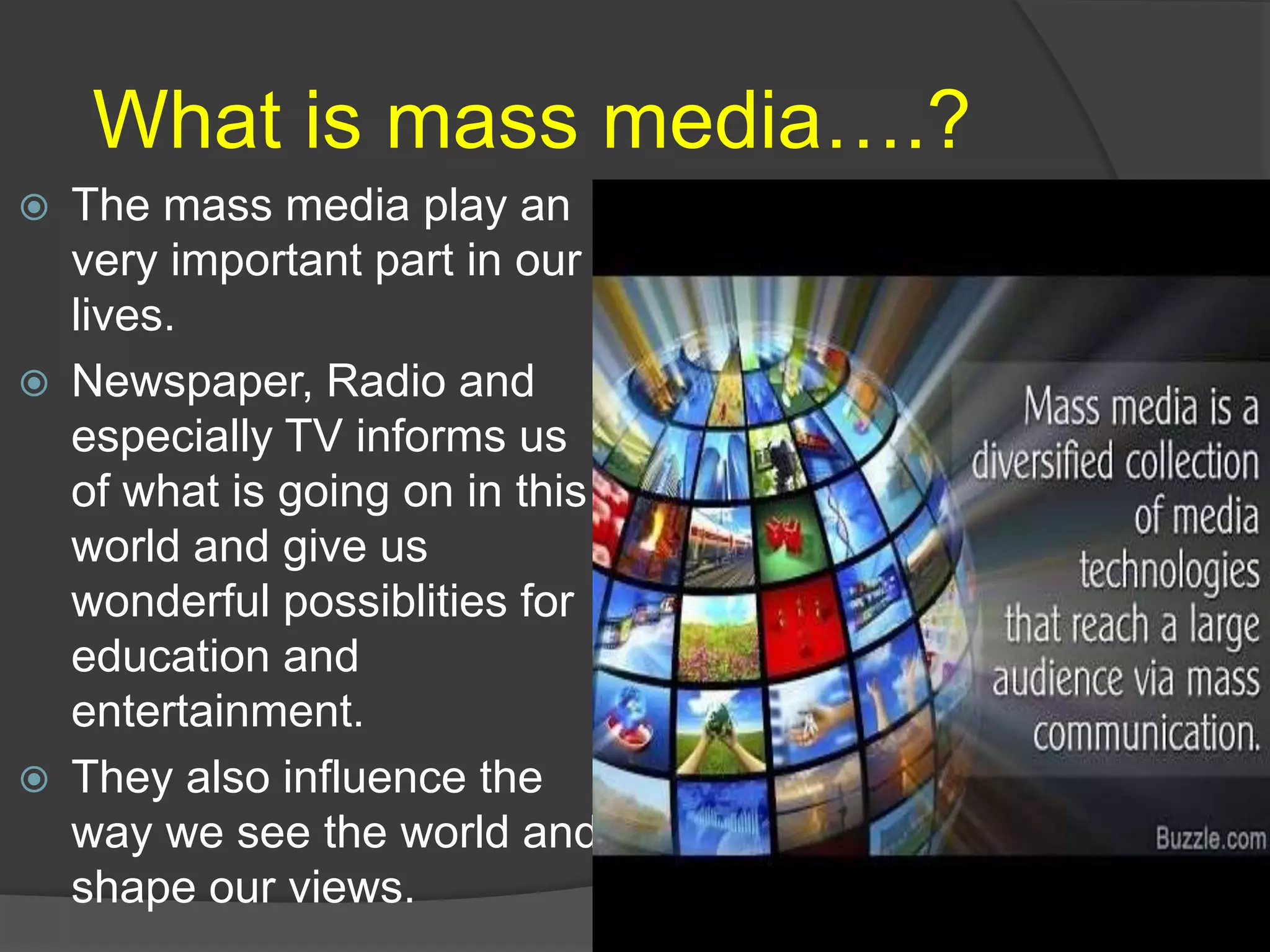
What is mass media….?
 The mass media play an
very important part in our
lives.
 Newspaper, Radio and
especially TV informs us
of what is going on in this
world and give us
wonderful possiblities for
education and
entertainment.
 They also influence the
way we see the world and
shape our views.
 Types Of Mass Media 1. Print media 2. Electronic
media 3.Interactive media.
 Types of Mass media… Radio, TV, Newspapers
and large circulation magazines, Billboards,
Internet.
 . IN INDIA 78.8 Million number of newspaper are
sold Daily. 41,66,438 number of magazines are
sold on weekly & monthly basis. 850 Television
Channels are there. 65 Million active internet
users are there.
 This is everyday Media is integral part of Modern
Society.
 Functions of Mass Media: The Three basic functions
of mass media are 1. To inform 2. To educate 3. To
entertain
 To inform: People read newspaper to know about
what, when, where, who, why & How the things are
happening pertaining to personalities or institutions. It
brings about greater awareness among the masses
about men and materials.
 To educate: The mass media educates people by
giving information about food, health, housing,
sanitation, employment, agriculture, industry,
environment, science, technology, modernization etc.
 To entertain: Mass media also entertains people.
Film, television, radio are increasingly subjected to
commercialization via entertainment.
 Advantages of mass media Reaches many
people quickly Low cost per person reached Can
be used to: Tell people about new ideas and
services Agenda-setting and advocacy Create a
favorable climate of opinion
 The main role and responsibility of the media is
transmit messages to receiver. Mass media not
only inform but persuade.
Positive Impacts: A Watchdog on
Government. Voice of poor is heard through media
. Show people what they actually do and what
they must do. A window to the World . A hub of
Information Can teach much effectively. Social
Networking.
Television
 TV attracts the largest number of
viewers; its audience is greater in size
than any of the other media audience.
This is because television is able to focus
on audience of all age groups, whether
literate or illiterate.
 Television has been used for education
and information purposes than for
entertainment.
 India has various cultures, religions and
traditions. Therefore, medium like TV can
play a vital role in developing common
understanding with the people and bring
them closer, like movies, TV reinforces
ideas, beliefs. For example- TV
represents the messages on importance
of girl’s education, marriage age,
environment protection, energy
conservation etc. Thus, it serves
believable function. Television has more
flexibility and mobility in its coverage due
to audio-visual presentation
Radio
 Radio is generally used as mass
communication medium and has a great
potentiality is spreading of information as
radio signals cover almost entire population.
Radio being a handy form of entertainment
caters to a large audience.
 Radio reaches the common man in urban and
rural areas of India, though the use of radio is
more among rural cities. It has advantages
over the use of other mass media like
television and newspaper in terms of being
handy and easily available. It is the most
transportable of the broadcast media,
 Kapoor, Director General of AIR (1995) said-
 “Radio is far more interactive and stimulating
medium than TV where the viewer is spoon-
fed. Radio allows you to think, to use your
imagination. That is why nobody ever called it
the idiot box”.
 . Now days, people are
living in a world by media
sounds and images.
People cannot live a day
without mobile and
computer. Cultural values
and lifestyle have
changed over time by use
of television and internet.
So in one way, it may
change people’s opinions
for the better, but in
another, it may impact the
social system of a whole
population.
Conclusion
Thus, media is attractive even more important in
life of adults as well as of children. We get great
deals of information from the different forms of
media such as newspapers, films and
documentaries, journals, radio, motion pictures
and more. Mass media plays a vital role in forming
and reflecting public opinion, connecting the world
to individuals and reproducing the self image of
society.
The mass media still plays a vital role in the social
learning process and have power on how
individuals acquire now ideas, attitudes and
changes direction in society.
Mass Media and it's importance P-15

Mass Media and it's importance P-15

  • 1.
    Name : UmabaGohil B Semester :4 Roll No: 16 Class: M.A. Part 2 Paper No : 15 mass communication and media studies Topic : Mass media and it’s importance Email ID : umabagohil123@gmail.com Submitted By : Smt S.B. Gardi, Maharaja krishnakumarsinhji Bhavnagar University, Department Of English.
  • 2.
    What is massmedia….?  The mass media play an very important part in our lives.  Newspaper, Radio and especially TV informs us of what is going on in this world and give us wonderful possiblities for education and entertainment.  They also influence the way we see the world and shape our views.
  • 3.
     Types OfMass Media 1. Print media 2. Electronic media 3.Interactive media.  Types of Mass media… Radio, TV, Newspapers and large circulation magazines, Billboards, Internet.  . IN INDIA 78.8 Million number of newspaper are sold Daily. 41,66,438 number of magazines are sold on weekly & monthly basis. 850 Television Channels are there. 65 Million active internet users are there.  This is everyday Media is integral part of Modern Society.
  • 4.
     Functions ofMass Media: The Three basic functions of mass media are 1. To inform 2. To educate 3. To entertain  To inform: People read newspaper to know about what, when, where, who, why & How the things are happening pertaining to personalities or institutions. It brings about greater awareness among the masses about men and materials.  To educate: The mass media educates people by giving information about food, health, housing, sanitation, employment, agriculture, industry, environment, science, technology, modernization etc.  To entertain: Mass media also entertains people. Film, television, radio are increasingly subjected to commercialization via entertainment.
  • 5.
     Advantages ofmass media Reaches many people quickly Low cost per person reached Can be used to: Tell people about new ideas and services Agenda-setting and advocacy Create a favorable climate of opinion  The main role and responsibility of the media is transmit messages to receiver. Mass media not only inform but persuade. Positive Impacts: A Watchdog on Government. Voice of poor is heard through media . Show people what they actually do and what they must do. A window to the World . A hub of Information Can teach much effectively. Social Networking.
  • 7.
    Television  TV attractsthe largest number of viewers; its audience is greater in size than any of the other media audience. This is because television is able to focus on audience of all age groups, whether literate or illiterate.  Television has been used for education and information purposes than for entertainment.  India has various cultures, religions and traditions. Therefore, medium like TV can play a vital role in developing common understanding with the people and bring them closer, like movies, TV reinforces ideas, beliefs. For example- TV represents the messages on importance of girl’s education, marriage age, environment protection, energy conservation etc. Thus, it serves believable function. Television has more flexibility and mobility in its coverage due to audio-visual presentation
  • 8.
    Radio  Radio isgenerally used as mass communication medium and has a great potentiality is spreading of information as radio signals cover almost entire population. Radio being a handy form of entertainment caters to a large audience.  Radio reaches the common man in urban and rural areas of India, though the use of radio is more among rural cities. It has advantages over the use of other mass media like television and newspaper in terms of being handy and easily available. It is the most transportable of the broadcast media,  Kapoor, Director General of AIR (1995) said-  “Radio is far more interactive and stimulating medium than TV where the viewer is spoon- fed. Radio allows you to think, to use your imagination. That is why nobody ever called it the idiot box”.
  • 9.
     . Nowdays, people are living in a world by media sounds and images. People cannot live a day without mobile and computer. Cultural values and lifestyle have changed over time by use of television and internet. So in one way, it may change people’s opinions for the better, but in another, it may impact the social system of a whole population.
  • 10.
    Conclusion Thus, media isattractive even more important in life of adults as well as of children. We get great deals of information from the different forms of media such as newspapers, films and documentaries, journals, radio, motion pictures and more. Mass media plays a vital role in forming and reflecting public opinion, connecting the world to individuals and reproducing the self image of society. The mass media still plays a vital role in the social learning process and have power on how individuals acquire now ideas, attitudes and changes direction in society.