Legal Implications in  Nursing Practice MOHAMMED ALHABSI INDANAN Clinical Instructor King Abdul Aziz Specialist Hospital- Taif Kingdom of Saudi Arabia
Legal Implications in Nursing Sources of law Civil & Common law in Nursing practice Licensure Risk Management
Law “ The sum total of rules & regulations by which a society is governed.  As such, law is created by people & exists to regulate all persons” GUIDO, 2001
Functions of the Law in Nursing It provides a framework for establishing which nursing actions in the care of clients are legal. It differentiates the nurse’s responsibilities from those of other health professionals. It helps establish the boundaries of independent nursing action. It assist in maintaining a standard of nursing practice by making nurses accountable under the law.
Sources of Law Constitutional law Legislation law (Statutory law) Administrative law Common law
Constitutional Law The supreme law of a country. Creates legal rights & responsibilities and a foundation of a system of justice.
Legislation law (Statutory law) Enacted by any legislative body The regulation of nursing is a function of state law
Administrative law It creates rules & regulations to enforce the statutory laws.
Common Law Laws evolving from court decisions. Interpreting & applying the constitutional or statutory law.
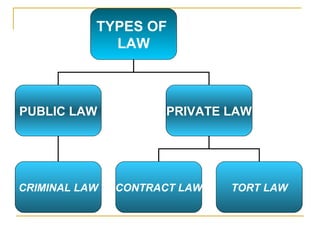
TYPES OF  LAW PUBLIC LAW PRIVATE LAW CRIMINAL LAW CONTRACT LAW TORT LAW
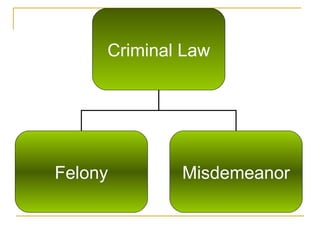
Criminal Law Felony Misdemeanor
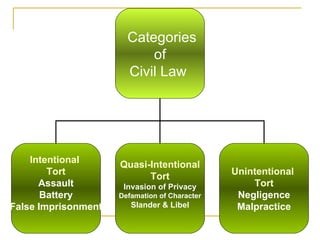
Categories  of Civil Law Intentional  Tort Assault Battery False Imprisonment Quasi-Intentional Tort Invasion of Privacy Defamation of Character Slander & Libel Unintentional  Tort Negligence Malpractice
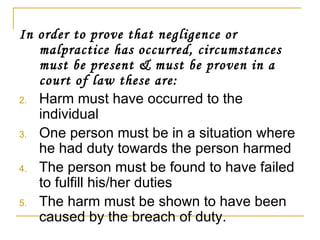
In order to prove that negligence or malpractice has occurred, circumstances must be present & must be proven in a court of law these are: Harm must have occurred to the individual One person must be in a situation where he had duty towards the person harmed The person must be found to have failed to fulfill his/her duties The harm must be shown to have been caused by the breach of duty.
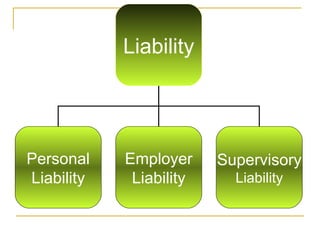
Liability Personal Liability Employer Liability Supervisory Liability
Licensure
Licensure Is a legal permit that a government agency grants to individuals to engage in the practice of a profession & to use a particular title. Nursing Licensure is mandatory
For a profession or occupation to obtain the right to license its members, it generally must meet  3 criteria: There is a need to protect the public’s safety or welfare The occupation is clearly delineated as a separate, distinct area of work. There is a proper authority to assume the obligations of the licensing process e.g. board of nursing
Grounds for Revocation of license Incompetent nursing practice Professional misconduct Conviction to a crime
Risk Management
Patient Safety in Health Care “ The degree to which the risk of an intervention & risk in the care  environment are reduced for a patient & other persons, including health care practitioners” JCAHO 2003
Purposes of Risk Management The department focuses on identification & prevention of risk exposures within the organisation that could: Cause injury to patient, visitors, & employees Jeopardize the safety & security of the environment Result in costly claims & lawsuits with subsequent financial loss to the organisation
2 main Areas of Risk Management Clinical Risk Management e.g. medical error, sentinel event Environmental Risk Management e.g. safety, security & preventive    maintenance
Patient Safety Goals: Improve the process of Patient Identification Eliminate wrong-site, Wrong Patient & Wrong Procedure Surgery Improve the effectiveness of Communication among Caregiver Improve the Safety of High Alert Medications
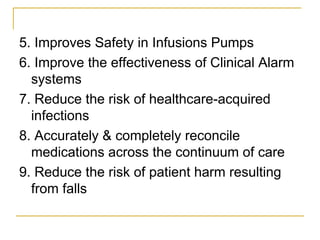
5. Improves Safety in Infusions Pumps 6. Improve the effectiveness of Clinical Alarm systems 7. Reduce the risk of healthcare-acquired infections 8. Accurately & completely reconcile medications across the continuum of care 9. Reduce the risk of patient harm resulting from falls
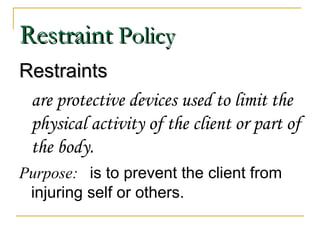
Restraint  Policy Restraints are protective devices used to limit the physical activity of the client or part of the body. Purpose:  is to prevent the client from injuring self or others.
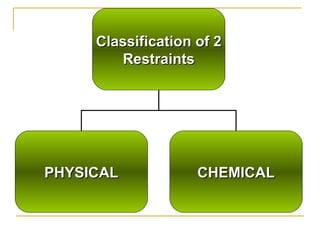
2 Classification of Restraints PHYSICAL CHEMICAL
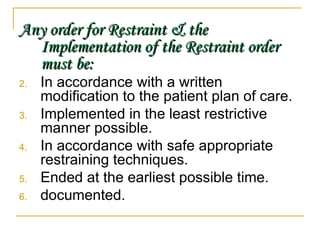
Any order for Restraint & the Implementation of the Restraint order must be: In accordance with a written modification to the patient plan of care. Implemented in the least restrictive manner possible. In accordance with safe appropriate restraining techniques. Ended at the earliest possible time. documented.
Practice Guidelines for Restraint Application Obtain a consent  Ensure the order is provided  Assess the restraint every 30 minutes Release restraint at least 8 hours Never leave patient unattended if restraint is removed Provide emotional support
5 Criteria before Selecting Restraint It restricts the client’s movement as little as possible It doesn’t interfere with the client’s treatment or health problems It is readily changeable It is safe for the particular client It the least obvious to others
Kinds of Restraints Jacket restraint Belt restraint Mitt or hand restraint Mummy restraint Elbow restraint Crib nets
OVR
Occurrence Variance Any event which happens or may happen which is not consistent with normal standard, usually in clinical practice or routine patient care, or threatens the health or life of a patient, a visitor, an employee or a student, or which involves loss or damage to personal or Hospital property.
Occurrence Variance Report Utilized as a quality tool for Continuous Quality Improvement ONLY NON-Punitive Not be placed in the pt’s record Should be reported as soon as possible or within 24 hours Handled & maintained in a confidential manner
Criteria of OVR Should be completed for any  UNUSUAL,   UNEXPECTED or UNANTICIPATED  Occurrences and for any event which has or may have an adverse patient outcome.. Patient falls Medication Error Loss of Valuables, belongings Equipment malfunction Property damage
Magsukul…….

Legal Implications In Nursing Practice

  • 1.
    Legal Implications in Nursing Practice MOHAMMED ALHABSI INDANAN Clinical Instructor King Abdul Aziz Specialist Hospital- Taif Kingdom of Saudi Arabia
  • 2.
    Legal Implications inNursing Sources of law Civil & Common law in Nursing practice Licensure Risk Management
  • 3.
    Law “ Thesum total of rules & regulations by which a society is governed. As such, law is created by people & exists to regulate all persons” GUIDO, 2001
  • 4.
    Functions of theLaw in Nursing It provides a framework for establishing which nursing actions in the care of clients are legal. It differentiates the nurse’s responsibilities from those of other health professionals. It helps establish the boundaries of independent nursing action. It assist in maintaining a standard of nursing practice by making nurses accountable under the law.
  • 5.
    Sources of LawConstitutional law Legislation law (Statutory law) Administrative law Common law
  • 6.
    Constitutional Law Thesupreme law of a country. Creates legal rights & responsibilities and a foundation of a system of justice.
  • 7.
    Legislation law (Statutorylaw) Enacted by any legislative body The regulation of nursing is a function of state law
  • 8.
    Administrative law Itcreates rules & regulations to enforce the statutory laws.
  • 9.
    Common Law Lawsevolving from court decisions. Interpreting & applying the constitutional or statutory law.
  • 10.
    TYPES OF LAW PUBLIC LAW PRIVATE LAW CRIMINAL LAW CONTRACT LAW TORT LAW
  • 11.
  • 12.
    Categories ofCivil Law Intentional Tort Assault Battery False Imprisonment Quasi-Intentional Tort Invasion of Privacy Defamation of Character Slander & Libel Unintentional Tort Negligence Malpractice
  • 13.
    In order toprove that negligence or malpractice has occurred, circumstances must be present & must be proven in a court of law these are: Harm must have occurred to the individual One person must be in a situation where he had duty towards the person harmed The person must be found to have failed to fulfill his/her duties The harm must be shown to have been caused by the breach of duty.
  • 14.
    Liability Personal LiabilityEmployer Liability Supervisory Liability
  • 15.
  • 16.
    Licensure Is alegal permit that a government agency grants to individuals to engage in the practice of a profession & to use a particular title. Nursing Licensure is mandatory
  • 17.
    For a professionor occupation to obtain the right to license its members, it generally must meet 3 criteria: There is a need to protect the public’s safety or welfare The occupation is clearly delineated as a separate, distinct area of work. There is a proper authority to assume the obligations of the licensing process e.g. board of nursing
  • 18.
    Grounds for Revocationof license Incompetent nursing practice Professional misconduct Conviction to a crime
  • 19.
  • 20.
    Patient Safety inHealth Care “ The degree to which the risk of an intervention & risk in the care environment are reduced for a patient & other persons, including health care practitioners” JCAHO 2003
  • 21.
    Purposes of RiskManagement The department focuses on identification & prevention of risk exposures within the organisation that could: Cause injury to patient, visitors, & employees Jeopardize the safety & security of the environment Result in costly claims & lawsuits with subsequent financial loss to the organisation
  • 22.
    2 main Areasof Risk Management Clinical Risk Management e.g. medical error, sentinel event Environmental Risk Management e.g. safety, security & preventive maintenance
  • 23.
    Patient Safety Goals:Improve the process of Patient Identification Eliminate wrong-site, Wrong Patient & Wrong Procedure Surgery Improve the effectiveness of Communication among Caregiver Improve the Safety of High Alert Medications
  • 24.
    5. Improves Safetyin Infusions Pumps 6. Improve the effectiveness of Clinical Alarm systems 7. Reduce the risk of healthcare-acquired infections 8. Accurately & completely reconcile medications across the continuum of care 9. Reduce the risk of patient harm resulting from falls
  • 25.
    Restraint PolicyRestraints are protective devices used to limit the physical activity of the client or part of the body. Purpose: is to prevent the client from injuring self or others.
  • 26.
    2 Classification ofRestraints PHYSICAL CHEMICAL
  • 27.
    Any order forRestraint & the Implementation of the Restraint order must be: In accordance with a written modification to the patient plan of care. Implemented in the least restrictive manner possible. In accordance with safe appropriate restraining techniques. Ended at the earliest possible time. documented.
  • 28.
    Practice Guidelines forRestraint Application Obtain a consent Ensure the order is provided Assess the restraint every 30 minutes Release restraint at least 8 hours Never leave patient unattended if restraint is removed Provide emotional support
  • 29.
    5 Criteria beforeSelecting Restraint It restricts the client’s movement as little as possible It doesn’t interfere with the client’s treatment or health problems It is readily changeable It is safe for the particular client It the least obvious to others
  • 30.
    Kinds of RestraintsJacket restraint Belt restraint Mitt or hand restraint Mummy restraint Elbow restraint Crib nets
  • 31.
  • 32.
    Occurrence Variance Anyevent which happens or may happen which is not consistent with normal standard, usually in clinical practice or routine patient care, or threatens the health or life of a patient, a visitor, an employee or a student, or which involves loss or damage to personal or Hospital property.
  • 33.
    Occurrence Variance ReportUtilized as a quality tool for Continuous Quality Improvement ONLY NON-Punitive Not be placed in the pt’s record Should be reported as soon as possible or within 24 hours Handled & maintained in a confidential manner
  • 34.
    Criteria of OVRShould be completed for any UNUSUAL, UNEXPECTED or UNANTICIPATED Occurrences and for any event which has or may have an adverse patient outcome.. Patient falls Medication Error Loss of Valuables, belongings Equipment malfunction Property damage
  • 35.