This work is supported by the National Science Foundation’s
Directorate for Education and Human Resources TUES-1245025, IUSE-
1612248, IUSE-1725347, and IUSE-1914915. Questions, contact education-AT-unavco.org
HYDRAULIC MODELING AND FLOOD
INUNDATION MAPPING USING HEC-RAS
Dr. Venkatesh Merwade, Lyles School of
Civil Engineering, Purdue University
Version: 10/08/2018 by V. Merwade
• Hydraulic model: A hydraulic model is a mathematical representation of a
water/sewer/storm system and is used to analyze the system’s hydraulic
behavior.
• Hydraulic modeling is frequently used to understand a hydraulic system’s
behavior under different scenarios at different spatial and temporal scales.
2
Lab experiment Modeling
Cost
Time
WHAT IS A HYDRAULIC MODEL?
DIFFERENT TYPES OF HYDRAULIC MODELS
Hydraulic models can be categorized by its dimensionality
3
1D 2D
3D
1D/2D
Flow is considered one dimensional
(1D) both in channel and floodplain
Flow is considered two dimensional
(1D) in both channel and floodplain
Combined 1D-2D. 1D in channel
and 2D in floodplain
Flow is considered three dimensional
(3D) in both channel and floodplain
ONE DIMENSIONAL (1D) HYDRAULIC MODEL
A 1D model assume flow in one direction – generally along the river.
4
1D
Flow along
longitudinal
direction
Flow along lateral
direction is neglected
EXAMPLES
•HEC-RAS 1D (Hydraulic Engineering Center-River Analysis Service 1D Model)
• MIKE 11
• SWMM (Storm and water management model)
•HY8
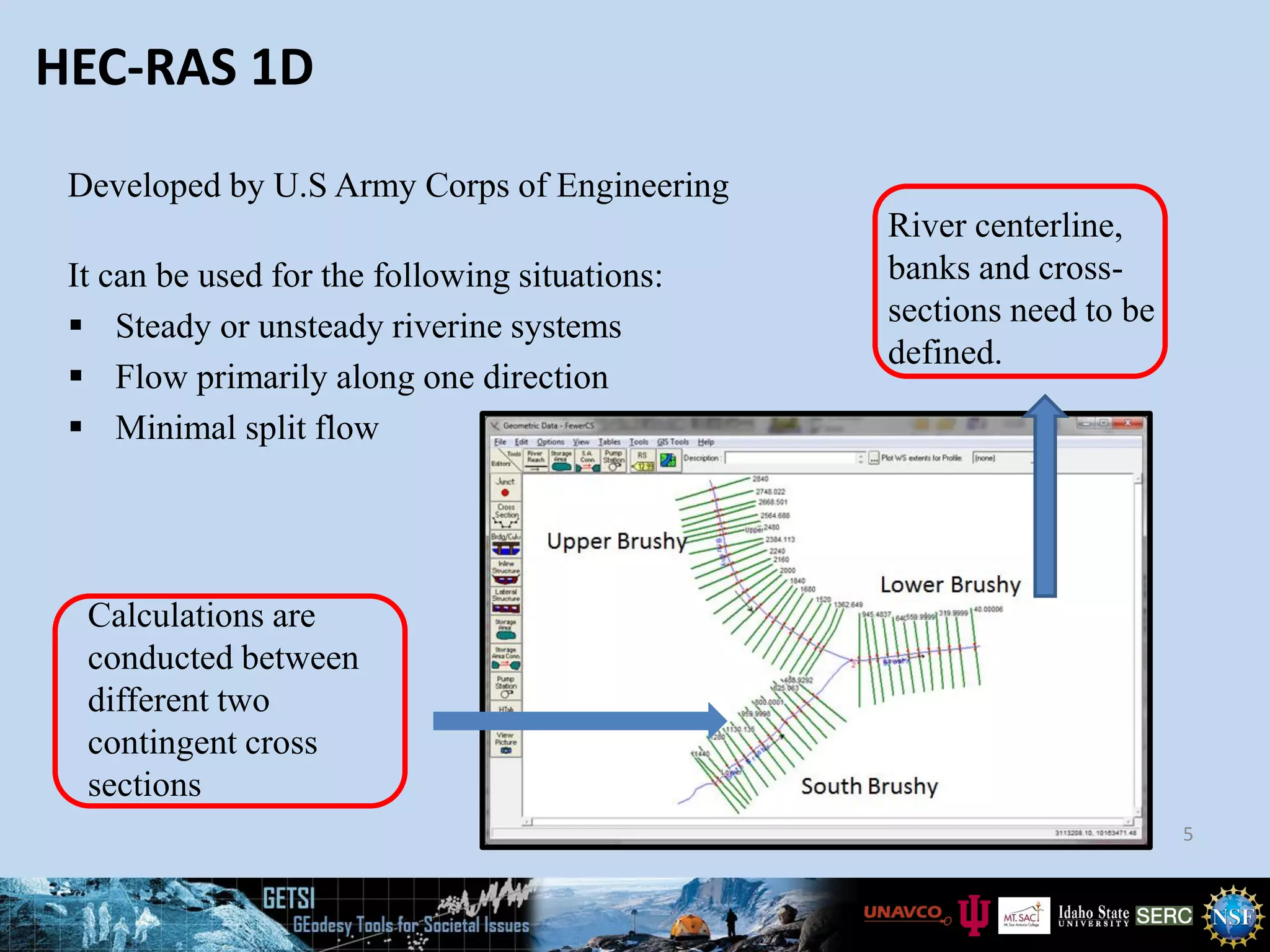
HEC-RAS 1D
It can be used for the following situations:
▪ Steady or unsteady riverine systems
▪ Flow primarily along one direction
▪ Minimal split flow
5
Developed by U.S Army Corps of Engineering
River centerline,
banks and cross-
sections need to be
defined.
Calculations are
conducted between
different two
contingent cross
sections
GOVERNING EQUATIONS
6
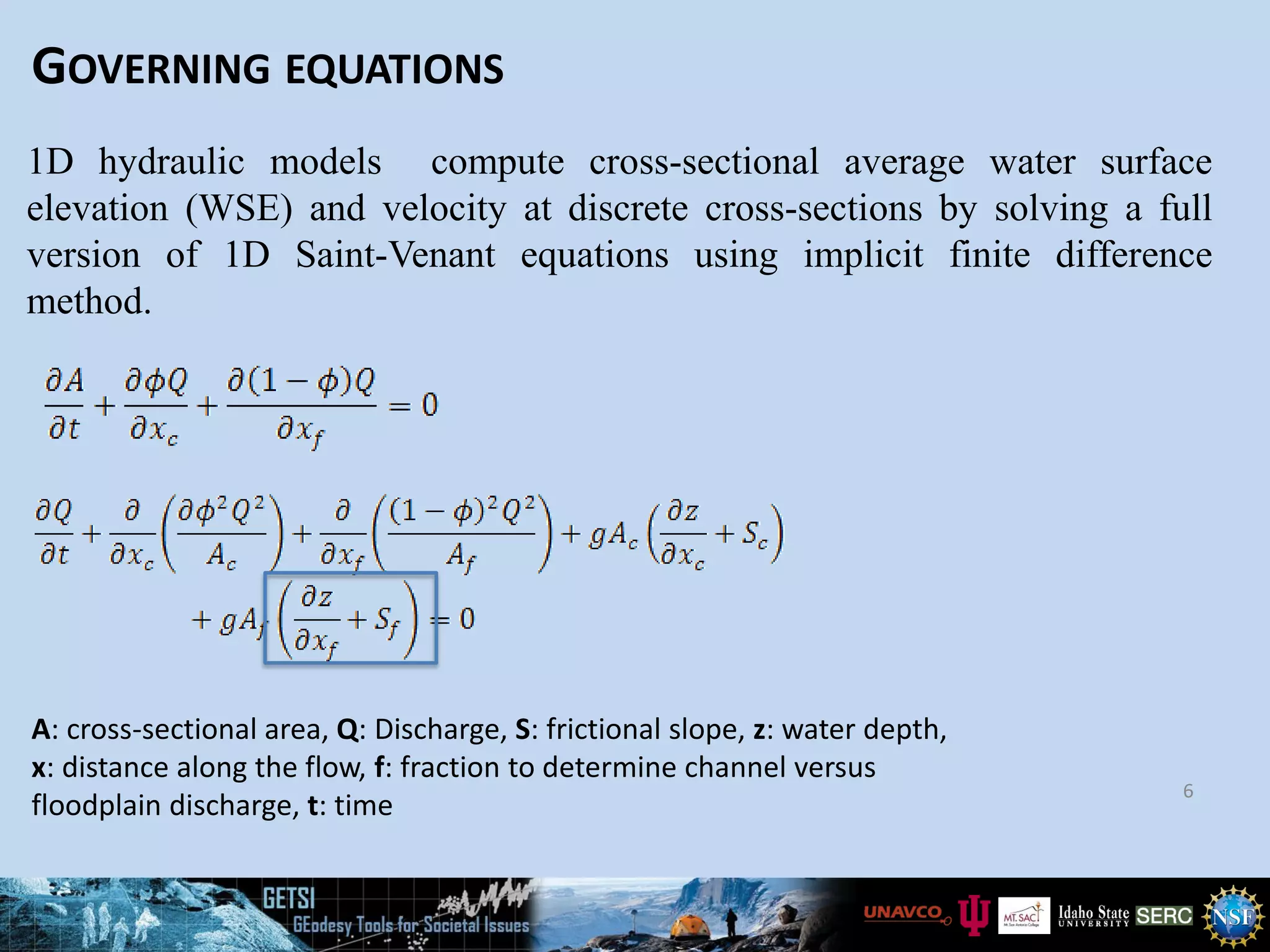
1D hydraulic models compute cross-sectional average water surface
elevation (WSE) and velocity at discrete cross-sections by solving a full
version of 1D Saint-Venant equations using implicit finite difference
method.
A: cross-sectional area, Q: Discharge, S: frictional slope, z: water depth,
x: distance along the flow, f: fraction to determine channel versus
floodplain discharge, t: time
1D PROFILE CALCULATIONS
7
1
2
Plan View Longitudinal view
he: head loss, V: velocity, g:
gravitational acceleration, L:
reach length, a: velocity
coefficient
LOSS IN ENERGY HEAD
8
𝑉𝐿𝑂𝐵
2
2𝑔
𝑉𝑅𝑂𝐵
2
2𝑔
𝑉
𝑐
2
2𝑔
a𝑉2
2𝑔
LLOB LROB
LC
C: contraction/expansion coefficient.
Contraction occurs when downstream
velocity head is higher and vice versa.
Plan View
Cross-sectional View
FLOW CONVEYANCE AND FRICTIONAL SLOPE
9
Computation of flow conveyance (K) and frictional slope (Sf) is based on
Manning’s n values. Thus Manning’s n or roughness coefficient plays a critical
role in hydraulic modeling.
PUTTING IT ALL TOGETHER
10
• Y1 is given. Assume Y2
• Based on Y1 and Y2, compute conveyance (K) and friction slope (Sf), and then get he.
• Use he to compute Y2.
• If the error between computed Y2 and assumed Y2 is greater than a specified
tolerance (e.g., 0.01 ft), iterate Y2 until the error is within tolerance.
• If the difference between computed Y2 and assume Y2 is within the specified
tolerance, Y2 becomes Y1 and the computations move upstream.
DATA REQUIREMENTS
• River Channel description
– Length and slope the reach
– Channel and floodplain roughness
– Cross-section geometry
• Boundary Conditions
• Flow and/or stage data at upstream and downstream
locations
• Structure geometry
– Bridges
– Culverts
– Weirs
– Levees, etc
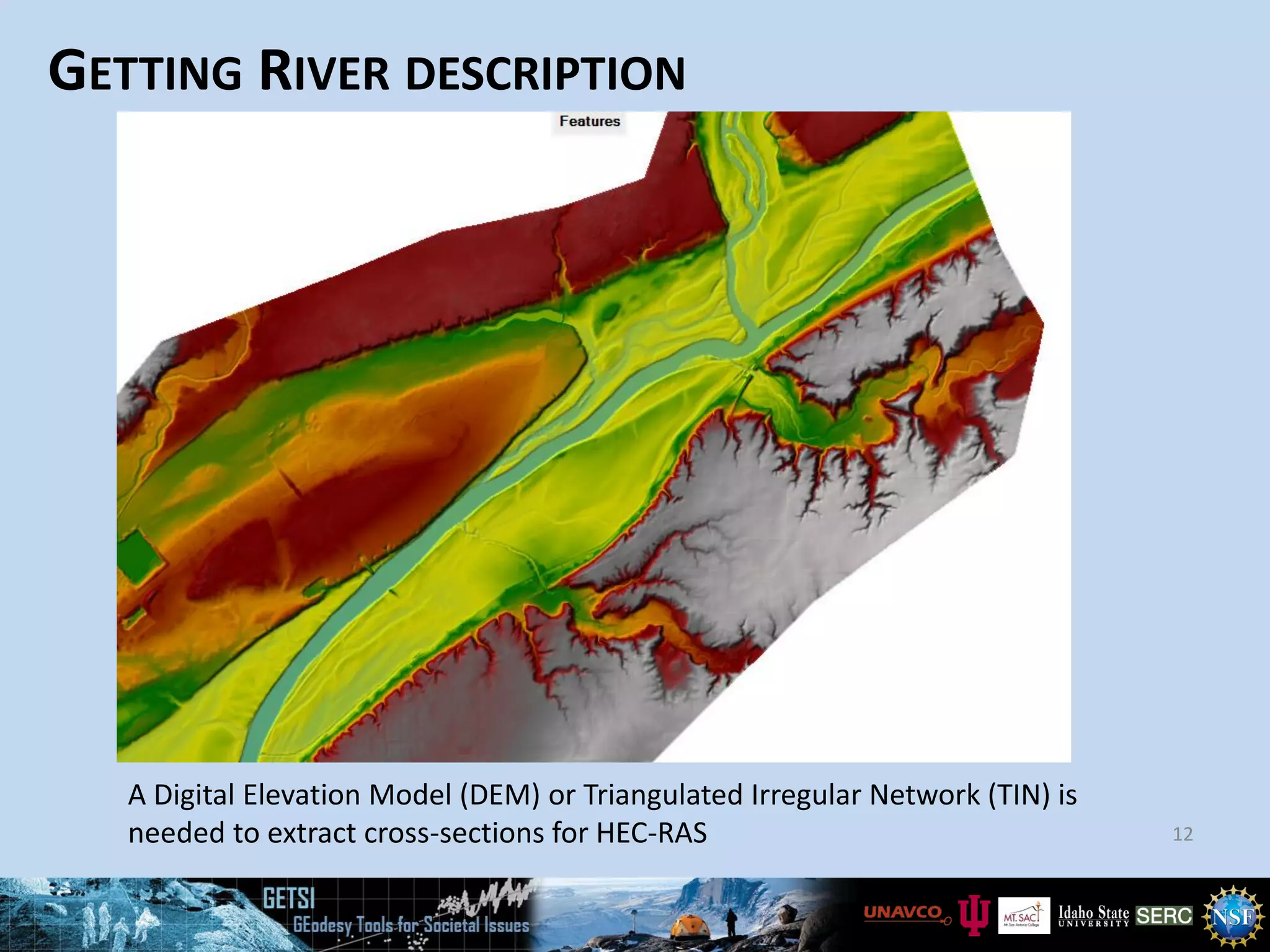
GETTING RIVER DESCRIPTION
12
A Digital Elevation Model (DEM) or Triangulated Irregular Network (TIN) is
needed to extract cross-sections for HEC-RAS
CREATING GEOMETRY IN RAS MAPPER
GEOMETRY DATA PLAN VIEW
River or stream
Station number
Junction
Bank locations
Cross-section
GEOMETRY DATA – CROSS SECTIONAL VIEW
Station or
distance
along XS
Elevation
values
along XS
STEADY FLOW DATA – UPSTREAM BOUNDARY
CONDITION
Flow value is specified at the upstream of
each reach. Multiple values can be
specified to create multiple profiles.
STEADY FLOW DATA – DOWNSTREAM BOUNDARY
CONDITION
Water depth (known water surface
elevation, critical depth or normal depth)
can be provided as downstream boundary
for each reach
RUNNING SIMULATION AND VIEWING RESULTS
Steady flow analysis editor Profile view of results
Cross-sectional view XYZ view
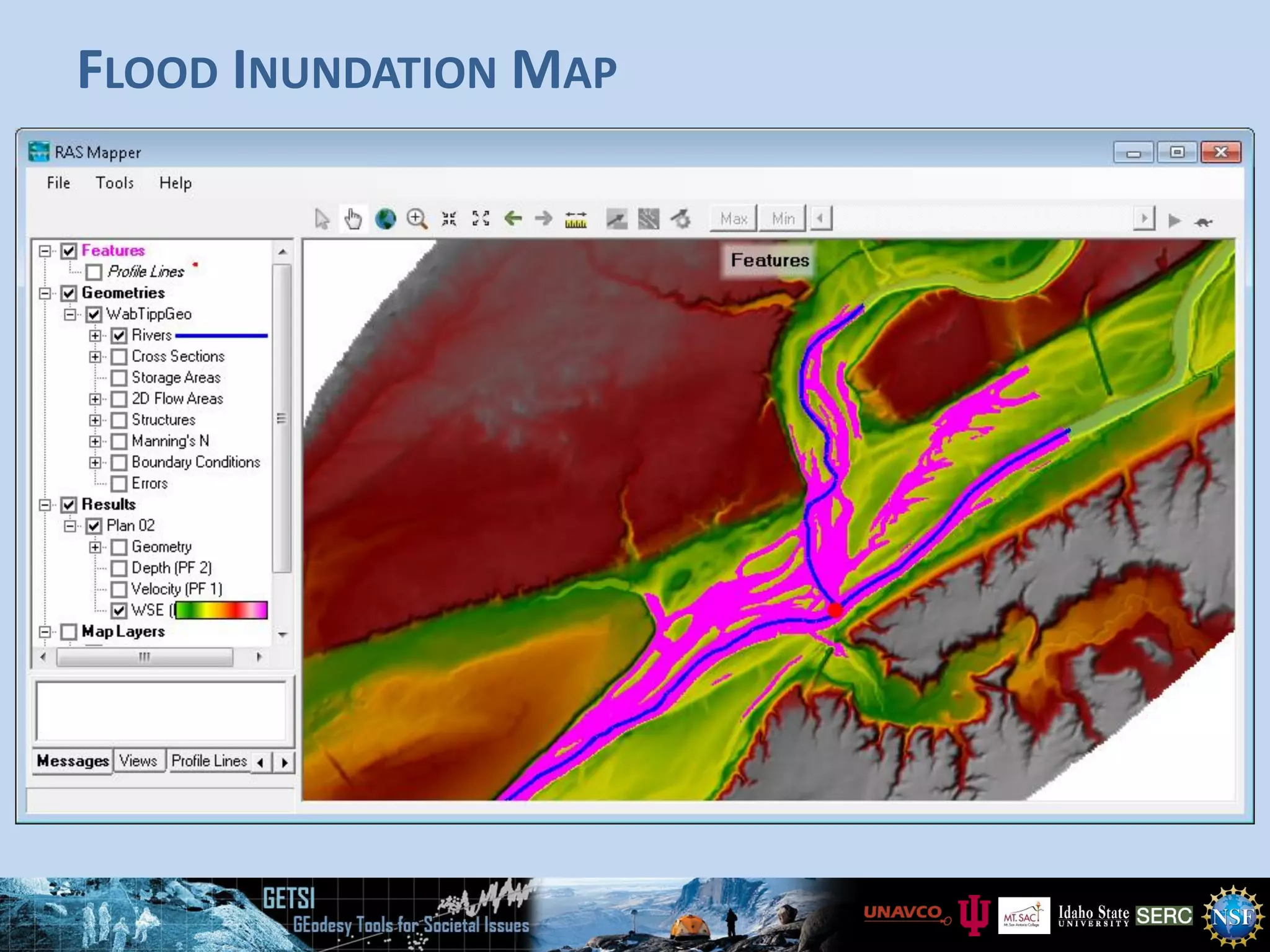
FLOOD INUNDATION MAP
HEC-RAS LAB
• You are provided with a HEC-RAS model for
Wabash-Tippecanoe confluence in West
Lafayette, IN
• Run the model for different return periods
ranging from 2 to 500-year and create flood
inundation maps using RAS Mapper
• All instructions are provided in the handout

HYDRAULIC MODELING AND FLOOD.pdf

  • 1.
    This work issupported by the National Science Foundation’s Directorate for Education and Human Resources TUES-1245025, IUSE- 1612248, IUSE-1725347, and IUSE-1914915. Questions, contact education-AT-unavco.org HYDRAULIC MODELING AND FLOOD INUNDATION MAPPING USING HEC-RAS Dr. Venkatesh Merwade, Lyles School of Civil Engineering, Purdue University Version: 10/08/2018 by V. Merwade
  • 2.
    • Hydraulic model:A hydraulic model is a mathematical representation of a water/sewer/storm system and is used to analyze the system’s hydraulic behavior. • Hydraulic modeling is frequently used to understand a hydraulic system’s behavior under different scenarios at different spatial and temporal scales. 2 Lab experiment Modeling Cost Time WHAT IS A HYDRAULIC MODEL?
  • 3.
    DIFFERENT TYPES OFHYDRAULIC MODELS Hydraulic models can be categorized by its dimensionality 3 1D 2D 3D 1D/2D Flow is considered one dimensional (1D) both in channel and floodplain Flow is considered two dimensional (1D) in both channel and floodplain Combined 1D-2D. 1D in channel and 2D in floodplain Flow is considered three dimensional (3D) in both channel and floodplain
  • 4.
    ONE DIMENSIONAL (1D)HYDRAULIC MODEL A 1D model assume flow in one direction – generally along the river. 4 1D Flow along longitudinal direction Flow along lateral direction is neglected EXAMPLES •HEC-RAS 1D (Hydraulic Engineering Center-River Analysis Service 1D Model) • MIKE 11 • SWMM (Storm and water management model) •HY8
  • 5.
    HEC-RAS 1D It canbe used for the following situations: ▪ Steady or unsteady riverine systems ▪ Flow primarily along one direction ▪ Minimal split flow 5 Developed by U.S Army Corps of Engineering River centerline, banks and cross- sections need to be defined. Calculations are conducted between different two contingent cross sections
  • 6.
    GOVERNING EQUATIONS 6 1D hydraulicmodels compute cross-sectional average water surface elevation (WSE) and velocity at discrete cross-sections by solving a full version of 1D Saint-Venant equations using implicit finite difference method. A: cross-sectional area, Q: Discharge, S: frictional slope, z: water depth, x: distance along the flow, f: fraction to determine channel versus floodplain discharge, t: time
  • 7.
    1D PROFILE CALCULATIONS 7 1 2 PlanView Longitudinal view he: head loss, V: velocity, g: gravitational acceleration, L: reach length, a: velocity coefficient
  • 8.
    LOSS IN ENERGYHEAD 8 𝑉𝐿𝑂𝐵 2 2𝑔 𝑉𝑅𝑂𝐵 2 2𝑔 𝑉 𝑐 2 2𝑔 a𝑉2 2𝑔 LLOB LROB LC C: contraction/expansion coefficient. Contraction occurs when downstream velocity head is higher and vice versa. Plan View Cross-sectional View
  • 9.
    FLOW CONVEYANCE ANDFRICTIONAL SLOPE 9 Computation of flow conveyance (K) and frictional slope (Sf) is based on Manning’s n values. Thus Manning’s n or roughness coefficient plays a critical role in hydraulic modeling.
  • 10.
    PUTTING IT ALLTOGETHER 10 • Y1 is given. Assume Y2 • Based on Y1 and Y2, compute conveyance (K) and friction slope (Sf), and then get he. • Use he to compute Y2. • If the error between computed Y2 and assumed Y2 is greater than a specified tolerance (e.g., 0.01 ft), iterate Y2 until the error is within tolerance. • If the difference between computed Y2 and assume Y2 is within the specified tolerance, Y2 becomes Y1 and the computations move upstream.
  • 11.
    DATA REQUIREMENTS • RiverChannel description – Length and slope the reach – Channel and floodplain roughness – Cross-section geometry • Boundary Conditions • Flow and/or stage data at upstream and downstream locations • Structure geometry – Bridges – Culverts – Weirs – Levees, etc
  • 12.
    GETTING RIVER DESCRIPTION 12 ADigital Elevation Model (DEM) or Triangulated Irregular Network (TIN) is needed to extract cross-sections for HEC-RAS
  • 13.
  • 14.
    GEOMETRY DATA PLANVIEW River or stream Station number Junction Bank locations Cross-section
  • 15.
    GEOMETRY DATA –CROSS SECTIONAL VIEW Station or distance along XS Elevation values along XS
  • 16.
    STEADY FLOW DATA– UPSTREAM BOUNDARY CONDITION Flow value is specified at the upstream of each reach. Multiple values can be specified to create multiple profiles.
  • 17.
    STEADY FLOW DATA– DOWNSTREAM BOUNDARY CONDITION Water depth (known water surface elevation, critical depth or normal depth) can be provided as downstream boundary for each reach
  • 18.
    RUNNING SIMULATION ANDVIEWING RESULTS Steady flow analysis editor Profile view of results Cross-sectional view XYZ view
  • 19.
  • 20.
    HEC-RAS LAB • Youare provided with a HEC-RAS model for Wabash-Tippecanoe confluence in West Lafayette, IN • Run the model for different return periods ranging from 2 to 500-year and create flood inundation maps using RAS Mapper • All instructions are provided in the handout