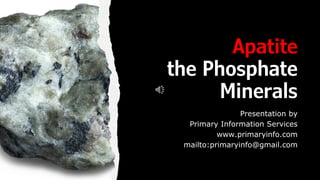
Apatite
the Phosphate
Minerals
Presentation by
Primary Information Services
www.primaryinfo.com
mailto:primaryinfo@gmail.com
What is Apatite?
• Apatite is identified by the chemical formula Ca5(PO4). It
forms in hexagonal crystals and is a rock phosphate
mineral. Apatite can exist in many different forms, along
with other minerals, as long as the base of apatite
calcium (Ca5) and phosphorous (PO4) exist together.
• Apatite is the name of a group of phosphate minerals
with similar chemical compositions and physical
properties. They are an important constituent of
phosphorite, a rock mined for its phosphorus content
and used to make fertilizers, acids, and chemicals.
• It is usually green in color, but can be yellow, brown,
blue, purple, pink, or colorless. These colors are often
so vivid that apatite has frequently been cut as a
gemstone. Apatite is a brittle material.
• The primary use of apatite is in the manufacture of
fertilizer – it is a source of phosphorus. It is
occasionally used as a gemstone. Green and blue
varieties, in finely divided form, are pigments with
excellent covering power.
What is hydroxyapatite ?
Hydroxyapatite (HA) is a naturally occurring
mineral form of calcium apatite and is a principle
inorganic component of human hard tissues such
as teeth and bones. Many modern body implants
including dental implants, hip replacements, and
bone conduction implants are being coated by HA.
Nano-hydroxyapatite (nano-HAp) is attracting
interest as a biomaterial for use in prosthetic
applications due to its similarity in size,
crystallography and chemical composition with
human hard tissue. Bone and teeth enamel are
largely composed of a form of this mineral.
Apatite usually sells for ₹ 500 to ₹ 20,000 per carat and above. The price of
Apatite is typically determined by the combination of its color, clarity, cut and
carat weight.
How do you polish apatite?
Cutting: Apatite is brittle, so roughing in should be done with care. Polishing:
Can be difficult to polish. Use wax or tin/lead lap with alumina or cerium oxide;
or chrome or tin oxide Ultralaps. Vinegar may ease polishing difficulties.
Uses of Apatite Crystals
Medical Uses
Titanium and stainless steel implants are often covered with
hydroxyapatite coatings to trick the body and reduce the implant
rejection rate. Hydroxyapatite can also be used in instances
where there are bone voids or defects. This process is carried out
through powders, blocks or beads of the material being placed in
the affected areas of bone.
Due to its bioactivity, it encourages the bone to grow and restores
the defect. This process can be an alternative to allogenic and
xenogenic bone grafts. It typically results in healing times shorter
than those observed if hydroxyapatite was not used.
Synthetic nano-hydroxyapatite mimics the size of natural dentinal
hydroxyapatite or enamel apatite. Experimental results demonstrate
the advantages of nano-hydroxyapatite in enamel repair9-10, which
has led to its incorporation in toothpastes and mouth-rinsing solutions
to promote the restoration of demineralized enamel or dentin surfaces
by depositing hydroxyapatite nanoparticles in the defects
https://www.fluidinova.com/hydroxyapatite-
properties-uses-and-applications
We find the inside information
and get inside the information
make it knowledgeable !
Questions?
mailto:primaryinfo@gmail.com

Apatite

  • 1.
    Apatite the Phosphate Minerals Presentation by PrimaryInformation Services www.primaryinfo.com mailto:primaryinfo@gmail.com
  • 2.
    What is Apatite? •Apatite is identified by the chemical formula Ca5(PO4). It forms in hexagonal crystals and is a rock phosphate mineral. Apatite can exist in many different forms, along with other minerals, as long as the base of apatite calcium (Ca5) and phosphorous (PO4) exist together. • Apatite is the name of a group of phosphate minerals with similar chemical compositions and physical properties. They are an important constituent of phosphorite, a rock mined for its phosphorus content and used to make fertilizers, acids, and chemicals. • It is usually green in color, but can be yellow, brown, blue, purple, pink, or colorless. These colors are often so vivid that apatite has frequently been cut as a gemstone. Apatite is a brittle material. • The primary use of apatite is in the manufacture of fertilizer – it is a source of phosphorus. It is occasionally used as a gemstone. Green and blue varieties, in finely divided form, are pigments with excellent covering power.
  • 6.
    What is hydroxyapatite? Hydroxyapatite (HA) is a naturally occurring mineral form of calcium apatite and is a principle inorganic component of human hard tissues such as teeth and bones. Many modern body implants including dental implants, hip replacements, and bone conduction implants are being coated by HA. Nano-hydroxyapatite (nano-HAp) is attracting interest as a biomaterial for use in prosthetic applications due to its similarity in size, crystallography and chemical composition with human hard tissue. Bone and teeth enamel are largely composed of a form of this mineral.
  • 8.
    Apatite usually sellsfor ₹ 500 to ₹ 20,000 per carat and above. The price of Apatite is typically determined by the combination of its color, clarity, cut and carat weight.
  • 9.
    How do youpolish apatite? Cutting: Apatite is brittle, so roughing in should be done with care. Polishing: Can be difficult to polish. Use wax or tin/lead lap with alumina or cerium oxide; or chrome or tin oxide Ultralaps. Vinegar may ease polishing difficulties.
  • 10.
  • 11.
    Medical Uses Titanium andstainless steel implants are often covered with hydroxyapatite coatings to trick the body and reduce the implant rejection rate. Hydroxyapatite can also be used in instances where there are bone voids or defects. This process is carried out through powders, blocks or beads of the material being placed in the affected areas of bone. Due to its bioactivity, it encourages the bone to grow and restores the defect. This process can be an alternative to allogenic and xenogenic bone grafts. It typically results in healing times shorter than those observed if hydroxyapatite was not used. Synthetic nano-hydroxyapatite mimics the size of natural dentinal hydroxyapatite or enamel apatite. Experimental results demonstrate the advantages of nano-hydroxyapatite in enamel repair9-10, which has led to its incorporation in toothpastes and mouth-rinsing solutions to promote the restoration of demineralized enamel or dentin surfaces by depositing hydroxyapatite nanoparticles in the defects https://www.fluidinova.com/hydroxyapatite- properties-uses-and-applications
  • 12.
    We find theinside information and get inside the information make it knowledgeable ! Questions? mailto:primaryinfo@gmail.com