BTEC ExtendedDiplomainCreativeMediaProduction
Unit 7: Understanding the Creative
Media Sector
Learning outcome 4:
Know about employment opportunities
and job roles in the media sector
Name: _ _ _ _ _ _ _ _ _ _ _ _ _ _ _ _ _ _ _ _ _ _ _ _ _ _ _ _ _ _ _ _ _ _ _
BTEC ExtendedDiplomainCreativeMediaProduction
Employment opportunities and job roles in the media sector
The purpose of this workbook is to get you to understand different job roles, different
ways of working and opportunities for professional development. You will have to
explain different terms, give opinions and source relevant additional information in
order to help you comprehensively explain employment opportunities and job roles in
the media sector with reference to elucidated examples.
This first section considers different ways of working. You should use information from
the lecture, your own experiences and further research to help you answer each
question. Wherever possible, you should use specific and detailed examples. This will
help you achieve a higher grade and also give you a deeper understanding of the
subject.
Describe the following different types of employment and some of their advantages and
disadvantages:
Full time; 40 hours per week in the UK. Permanent work and your guaranteed a monthly
payment. Disadvantages would be your unable to care for over people as your always
working/lack of free time.
Part time; Working at least 1 hour per week. You get a small payment and you gain
some experience and if you’re not good at advertising you may not get a job.
Freelance; working on an as and when basis timetable. A disadvantage would be that
you could have fussy clients.
Voluntary; This is when people work for free for experience of for a good cause. A
disadvantage would be that you don’t get paid.
Describe shift work. What does it entail and what types of media job might require it?
Shift work happens in many industries and is usually in places that run up to 24 hours a
day. Shifts are broken up into 8 or 12 blocks with 2 or 3 shifts every day. This is done to
ensure that someone is always there working.
BTEC ExtendedDiplomainCreativeMediaProduction
A permanent contract is one where: A permanent contract usually involves working for a
single company. It is not a guaranteed job for life but the job is seen as always available.
What are some of the advantages and disadvantages of such a contract?
An advantage would be that you would always have a job available to you. A
disadvantage would be that you would have no flexibility.
A temporary contract is one where: A temporary job contract lacks the job security of the
permanent contract but does offer some flexibility. The contract can have a fixed length.
What are some of the advantages and disadvantages of such a contract?
A disadvantage would be that you couldn’t guarantee a source of income. An advantage
could be that the hour and its usually good pay you.
What is multiskilling and which skills could you combine together?
Multiskilling is the training of a single employee in multiple skill sets. This will increase
productivity and cuts the bottom line for a company, as they don’t have to employ
someone for every job.
What is casual work? Who does it benefit the most? What are some of the arguments
against casual work?
Casual Work is used when employers have variable demands for staff. Under a casual
work contract, the Employer has no obligation to offer work to an individual and the
individual is not required to accept the work when it is offered.
Explain hourly paid work. Find a job which pays by the hour to help you with your
explanation.
Instead of having a yearly salary, employees receive an hourly rate instead. This type of
payment is often associated with casual work, temporary and short term contracts.
What is Piecework? What do employers need to be careful about when employing
someone this way?
Workers are paid per task they perform or piece of work they do. They must be paid
either at least the minimum wage for every hour worked or on the basis of a ‘fair rate’ for
each task or piece of work they do.
BTEC ExtendedDiplomainCreativeMediaProduction
This section is concerned with finding work. You will have an idea of the sort of job you
might like to do in the future. Keeping a specific job role or industry in mind when
completing these questions will help you provide more detailed and focussed answers.
Starting to think about a specific area of employment at this stage will help you in later
sections of the workbook.
Why would you use careers guidance? Provide the names of at least 2 organisations
which can help people plan their careers.
There are lots of places to get careers advice from. You can access it through college.
You could use prospects.ac.uk, the UK’s official graduate website. The National Careers
Service provides information, advice and guidance and is run by government. Creative
Skill set is the media industries sector skills council and can provide you with lots of
information about different media jobs.
What is a trade fair?
A trade show or fair is where people in a given industry get together to showcase and
show their latest products. It’s also a good time to look at the work of other companies.
They can be useful for getting business.
Which trade fairs could you attend to help you with your career? How could they help
you? Be specific here to help you comprehensively explain.
What could some advantages and disadvantages be to using the national press to look
for work?
National press often carry job adverts. The Guardian Newspaper has a strong focus on
media jobs, both in the paper and online. The disadvantages would be that there is a lot
of competition.
What trade press publications could you use to help you find work? Would this be a
better option than using the national press? Explain your answer using detailed
examples.
Trade press would be better because it would allow you to view work from a first
person’s point of views. This would allow for more of a personal experience.
What would be a good way of keeping track of and in touch with your personal contacts?
How could this help you when looking for work?
BTEC ExtendedDiplomainCreativeMediaProduction
You could use many different ways to keep in touch with workmates, friends, boss and
clients. This will help to keep you in the work placement.
What is networking and how could it be useful to you?
Networking is where people get together to discuss opportunities. It’s good to build up a
network of contacts as they might get work they are too busy to do and pass it your way
or you might be able give jobs outside your specialism to others.
Explain word of mouth as a way of getting work. Is this a reliable method for obtaining
work?
Finding out about jobs can happen by word of mouth. Talking to others in the industry or
past clients can be a good way of finding opportunities.
This next section requires you to do further research in to your chosen career.
Creativeskillset.org is a fantastic resource which will help you learn about the
qualifications, skills and experience you need to gain to work in industry. It also gives
detailed overviews and case studies, to help you understand what each job really
involves.
It will help you find other useful sources of information from details on unions, trade
websites and publications to job adverts. You should investigate your chosen job role
or sector and sum up the skills and qualifications you need to do that job as well as
fully investigating what it involves.
What job role would you like? Explain your reasons? What kind of job is it (creative,
technical, editorial etc.)?
(http://www.creativeskillset.org is a great place to start)
Graphic designer because it’s interesting and provides with a lot of work. A graphic
designer is a person who designs a visual message for a product using words and
images for a client. From an outside perspective, it just looks like moving things around
in Photoshop, but a graphic designer’s job is so much more than that. The job involves
being creative.
BTEC ExtendedDiplomainCreativeMediaProduction
What skills will you need for that job?
For this role, you will need to:
 Have a natural artistic ability
 Be fully fluent in image editing and design software
 Create graphics that communicate an idea or promote a brand
 Know how to compose an image to a professional standard
 Be comfortable accepting client briefs
 Be able to meet deadlines
 Market yourself to potential clients
Summarise what is involved when doing this job.
Graphic design is something that’s taken over the world. Every product, magazine or advert has
a graphic designer working out where the title should go, how prominent the background image
should be, what formatting the body text should be, and a lot more design decisions that go into
the creative process.
What qualifications are required for that job?
A great portfolio can get you far, but having a degree in Graphic Design or other art-based
courses shows you know the core basics of communicating via design, and will get you further.
Find at least 2 courses you could do to help you get in to the industry. You should state
the name of the course, the level of qualification (level 2, level 3, Degree etc.), the
institution that you would attend and their entry requirements)
Creative media level 3 and Graphic design extended diploma level 3.
Where could you find out more information? (Investigate at least 2 other sources of
information and give a brief summary of why this resource is useful)
BTEC ExtendedDiplomainCreativeMediaProduction
Creative skill set provides a range of information on different job roles. Reed also
provides information on jobs within your area.
This section requires you to do some job hunting, so you can see what is required
from the perspective of employers in the industry. You should think about the
different places you could look for work. It is good to see what jobs are available,
what they pay, and what you need to do to get them.
Use at least 2 different sources to find a job that you would like to do.
Job: Graphic designer
Source: http://www.reed.co.uk/jobs/graphic-designer/29605344#/jobs/graphic-designer
Summarise the skills required:
For this role, you will need to:
 Have a natural artistic ability
 Be fully fluent in image editing and design software
 Create graphics that communicate an idea or promote a brand
 Know how to compose an image to a professional standard
 Be comfortable accepting client briefs
 Be able to meet deadlines
 Market yourself to potential clients
Is this job full time/part time/freelance?
Full time
What do you need to do to apply?
Previous work in graphic, art, print or design.
Job: Digital fashion designer.
BTEC ExtendedDiplomainCreativeMediaProduction
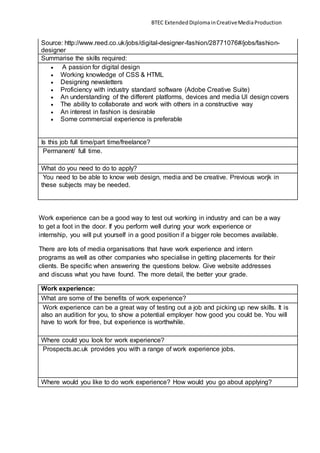
Source: http://www.reed.co.uk/jobs/digital-designer-fashion/28771076#/jobs/fashion-
designer
Summarise the skills required:
 A passion for digital design
 Working knowledge of CSS & HTML
 Designing newsletters
 Proficiency with industry standard software (Adobe Creative Suite)
 An understanding of the different platforms, devices and media UI design covers
 The ability to collaborate and work with others in a constructive way
 An interest in fashion is desirable
 Some commercial experience is preferable
Is this job full time/part time/freelance?
Permanent/ full time.
What do you need to do to apply?
You need to be able to know web design, media and be creative. Previous worjk in
these subjects may be needed.
Work experience can be a good way to test out working in industry and can be a way
to get a foot in the door. If you perform well during your work experience or
internship, you will put yourself in a good position if a bigger role becomes available.
There are lots of media organisations that have work experience and intern
programs as well as other companies who specialise in getting placements for their
clients. Be specific when answering the questions below. Give website addresses
and discuss what you have found. The more detail, the better your grade.
Work experience:
What are some of the benefits of work experience?
Work experience can be a great way of testing out a job and picking up new skills. It is
also an audition for you, to show a potential employer how good you could be. You will
have to work for free, but experience is worthwhile.
Where could you look for work experience?
Prospects.ac.uk provides you with a range of work experience jobs.
Where would you like to do work experience? How would you go about applying?
BTEC ExtendedDiplomainCreativeMediaProduction
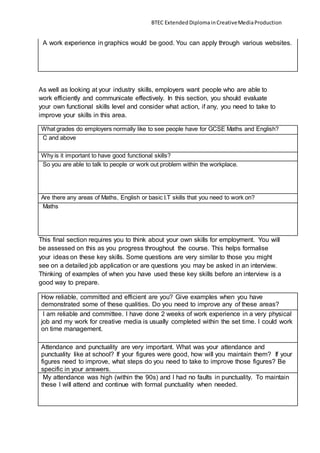
A work experience in graphics would be good. You can apply through various websites.
As well as looking at your industry skills, employers want people who are able to
work efficiently and communicate effectively. In this section, you should evaluate
your own functional skills level and consider what action, if any, you need to take to
improve your skills in this area.
What grades do employers normally like to see people have for GCSE Maths and English?
C and above
Why is it important to have good functional skills?
So you are able to talk to people or work out problem within the workplace.
Are there any areas of Maths, English or basic I.T skills that you need to work on?
Maths
This final section requires you to think about your own skills for employment. You will
be assessed on this as you progress throughout the course. This helps formalise
your ideas on these key skills. Some questions are very similar to those you might
see on a detailed job application or are questions you may be asked in an interview.
Thinking of examples of when you have used these key skills before an interview is a
good way to prepare.
How reliable, committed and efficient are you? Give examples when you have
demonstrated some of these qualities. Do you need to improve any of these areas?
I am reliable and committee. I have done 2 weeks of work experience in a very physical
job and my work for creative media is usually completed within the set time. I could work
on time management.
Attendance and punctuality are very important. What was your attendance and
punctuality like at school? If your figures were good, how will you maintain them? If your
figures need to improve, what steps do you need to take to improve those figures? Be
specific in your answers.
My attendance was high (within the 90s) and I had no faults in punctuality. To maintain
these I will attend and continue with formal punctuality when needed.
BTEC ExtendedDiplomainCreativeMediaProduction
How important do you think self presentation is during an interview?
Self presentation is very important ion proving a good first impression to people.
Can you think of a time when you contributed to a group project? What was the project?
What role did you take and how successful do you think you were?
I have worked in a group project on creating a music video for a set song. This worked
well ands was produced on time.
Give an example of when you have had to manage your time carefully and how you
went about it?
For a set work had to be handed in within a set time, I had to plan out everything I would
do each day to be able to achieve this work in the certain time set.
Give an example of when you had to take personal responsibility for something. What
was the scenario and what was the outcome?
I had to create a selection of set work for a subject. I had to ensure the work was to the
best of my standards and was given in at the time set. The work was delivered on time .

Lo4 workbook

  • 1.
    BTEC ExtendedDiplomainCreativeMediaProduction Unit 7:Understanding the Creative Media Sector Learning outcome 4: Know about employment opportunities and job roles in the media sector Name: _ _ _ _ _ _ _ _ _ _ _ _ _ _ _ _ _ _ _ _ _ _ _ _ _ _ _ _ _ _ _ _ _ _ _
  • 2.
    BTEC ExtendedDiplomainCreativeMediaProduction Employment opportunitiesand job roles in the media sector The purpose of this workbook is to get you to understand different job roles, different ways of working and opportunities for professional development. You will have to explain different terms, give opinions and source relevant additional information in order to help you comprehensively explain employment opportunities and job roles in the media sector with reference to elucidated examples. This first section considers different ways of working. You should use information from the lecture, your own experiences and further research to help you answer each question. Wherever possible, you should use specific and detailed examples. This will help you achieve a higher grade and also give you a deeper understanding of the subject. Describe the following different types of employment and some of their advantages and disadvantages: Full time; 40 hours per week in the UK. Permanent work and your guaranteed a monthly payment. Disadvantages would be your unable to care for over people as your always working/lack of free time. Part time; Working at least 1 hour per week. You get a small payment and you gain some experience and if you’re not good at advertising you may not get a job. Freelance; working on an as and when basis timetable. A disadvantage would be that you could have fussy clients. Voluntary; This is when people work for free for experience of for a good cause. A disadvantage would be that you don’t get paid. Describe shift work. What does it entail and what types of media job might require it? Shift work happens in many industries and is usually in places that run up to 24 hours a day. Shifts are broken up into 8 or 12 blocks with 2 or 3 shifts every day. This is done to ensure that someone is always there working.
  • 3.
    BTEC ExtendedDiplomainCreativeMediaProduction A permanentcontract is one where: A permanent contract usually involves working for a single company. It is not a guaranteed job for life but the job is seen as always available. What are some of the advantages and disadvantages of such a contract? An advantage would be that you would always have a job available to you. A disadvantage would be that you would have no flexibility. A temporary contract is one where: A temporary job contract lacks the job security of the permanent contract but does offer some flexibility. The contract can have a fixed length. What are some of the advantages and disadvantages of such a contract? A disadvantage would be that you couldn’t guarantee a source of income. An advantage could be that the hour and its usually good pay you. What is multiskilling and which skills could you combine together? Multiskilling is the training of a single employee in multiple skill sets. This will increase productivity and cuts the bottom line for a company, as they don’t have to employ someone for every job. What is casual work? Who does it benefit the most? What are some of the arguments against casual work? Casual Work is used when employers have variable demands for staff. Under a casual work contract, the Employer has no obligation to offer work to an individual and the individual is not required to accept the work when it is offered. Explain hourly paid work. Find a job which pays by the hour to help you with your explanation. Instead of having a yearly salary, employees receive an hourly rate instead. This type of payment is often associated with casual work, temporary and short term contracts. What is Piecework? What do employers need to be careful about when employing someone this way? Workers are paid per task they perform or piece of work they do. They must be paid either at least the minimum wage for every hour worked or on the basis of a ‘fair rate’ for each task or piece of work they do.
  • 4.
    BTEC ExtendedDiplomainCreativeMediaProduction This sectionis concerned with finding work. You will have an idea of the sort of job you might like to do in the future. Keeping a specific job role or industry in mind when completing these questions will help you provide more detailed and focussed answers. Starting to think about a specific area of employment at this stage will help you in later sections of the workbook. Why would you use careers guidance? Provide the names of at least 2 organisations which can help people plan their careers. There are lots of places to get careers advice from. You can access it through college. You could use prospects.ac.uk, the UK’s official graduate website. The National Careers Service provides information, advice and guidance and is run by government. Creative Skill set is the media industries sector skills council and can provide you with lots of information about different media jobs. What is a trade fair? A trade show or fair is where people in a given industry get together to showcase and show their latest products. It’s also a good time to look at the work of other companies. They can be useful for getting business. Which trade fairs could you attend to help you with your career? How could they help you? Be specific here to help you comprehensively explain. What could some advantages and disadvantages be to using the national press to look for work? National press often carry job adverts. The Guardian Newspaper has a strong focus on media jobs, both in the paper and online. The disadvantages would be that there is a lot of competition. What trade press publications could you use to help you find work? Would this be a better option than using the national press? Explain your answer using detailed examples. Trade press would be better because it would allow you to view work from a first person’s point of views. This would allow for more of a personal experience. What would be a good way of keeping track of and in touch with your personal contacts? How could this help you when looking for work?
  • 5.
    BTEC ExtendedDiplomainCreativeMediaProduction You coulduse many different ways to keep in touch with workmates, friends, boss and clients. This will help to keep you in the work placement. What is networking and how could it be useful to you? Networking is where people get together to discuss opportunities. It’s good to build up a network of contacts as they might get work they are too busy to do and pass it your way or you might be able give jobs outside your specialism to others. Explain word of mouth as a way of getting work. Is this a reliable method for obtaining work? Finding out about jobs can happen by word of mouth. Talking to others in the industry or past clients can be a good way of finding opportunities. This next section requires you to do further research in to your chosen career. Creativeskillset.org is a fantastic resource which will help you learn about the qualifications, skills and experience you need to gain to work in industry. It also gives detailed overviews and case studies, to help you understand what each job really involves. It will help you find other useful sources of information from details on unions, trade websites and publications to job adverts. You should investigate your chosen job role or sector and sum up the skills and qualifications you need to do that job as well as fully investigating what it involves. What job role would you like? Explain your reasons? What kind of job is it (creative, technical, editorial etc.)? (http://www.creativeskillset.org is a great place to start) Graphic designer because it’s interesting and provides with a lot of work. A graphic designer is a person who designs a visual message for a product using words and images for a client. From an outside perspective, it just looks like moving things around in Photoshop, but a graphic designer’s job is so much more than that. The job involves being creative.
  • 6.
    BTEC ExtendedDiplomainCreativeMediaProduction What skillswill you need for that job? For this role, you will need to:  Have a natural artistic ability  Be fully fluent in image editing and design software  Create graphics that communicate an idea or promote a brand  Know how to compose an image to a professional standard  Be comfortable accepting client briefs  Be able to meet deadlines  Market yourself to potential clients Summarise what is involved when doing this job. Graphic design is something that’s taken over the world. Every product, magazine or advert has a graphic designer working out where the title should go, how prominent the background image should be, what formatting the body text should be, and a lot more design decisions that go into the creative process. What qualifications are required for that job? A great portfolio can get you far, but having a degree in Graphic Design or other art-based courses shows you know the core basics of communicating via design, and will get you further. Find at least 2 courses you could do to help you get in to the industry. You should state the name of the course, the level of qualification (level 2, level 3, Degree etc.), the institution that you would attend and their entry requirements) Creative media level 3 and Graphic design extended diploma level 3. Where could you find out more information? (Investigate at least 2 other sources of information and give a brief summary of why this resource is useful)
  • 7.
    BTEC ExtendedDiplomainCreativeMediaProduction Creative skillset provides a range of information on different job roles. Reed also provides information on jobs within your area. This section requires you to do some job hunting, so you can see what is required from the perspective of employers in the industry. You should think about the different places you could look for work. It is good to see what jobs are available, what they pay, and what you need to do to get them. Use at least 2 different sources to find a job that you would like to do. Job: Graphic designer Source: http://www.reed.co.uk/jobs/graphic-designer/29605344#/jobs/graphic-designer Summarise the skills required: For this role, you will need to:  Have a natural artistic ability  Be fully fluent in image editing and design software  Create graphics that communicate an idea or promote a brand  Know how to compose an image to a professional standard  Be comfortable accepting client briefs  Be able to meet deadlines  Market yourself to potential clients Is this job full time/part time/freelance? Full time What do you need to do to apply? Previous work in graphic, art, print or design. Job: Digital fashion designer.
  • 8.
    BTEC ExtendedDiplomainCreativeMediaProduction Source: http://www.reed.co.uk/jobs/digital-designer-fashion/28771076#/jobs/fashion- designer Summarisethe skills required:  A passion for digital design  Working knowledge of CSS & HTML  Designing newsletters  Proficiency with industry standard software (Adobe Creative Suite)  An understanding of the different platforms, devices and media UI design covers  The ability to collaborate and work with others in a constructive way  An interest in fashion is desirable  Some commercial experience is preferable Is this job full time/part time/freelance? Permanent/ full time. What do you need to do to apply? You need to be able to know web design, media and be creative. Previous worjk in these subjects may be needed. Work experience can be a good way to test out working in industry and can be a way to get a foot in the door. If you perform well during your work experience or internship, you will put yourself in a good position if a bigger role becomes available. There are lots of media organisations that have work experience and intern programs as well as other companies who specialise in getting placements for their clients. Be specific when answering the questions below. Give website addresses and discuss what you have found. The more detail, the better your grade. Work experience: What are some of the benefits of work experience? Work experience can be a great way of testing out a job and picking up new skills. It is also an audition for you, to show a potential employer how good you could be. You will have to work for free, but experience is worthwhile. Where could you look for work experience? Prospects.ac.uk provides you with a range of work experience jobs. Where would you like to do work experience? How would you go about applying?
  • 9.
    BTEC ExtendedDiplomainCreativeMediaProduction A workexperience in graphics would be good. You can apply through various websites. As well as looking at your industry skills, employers want people who are able to work efficiently and communicate effectively. In this section, you should evaluate your own functional skills level and consider what action, if any, you need to take to improve your skills in this area. What grades do employers normally like to see people have for GCSE Maths and English? C and above Why is it important to have good functional skills? So you are able to talk to people or work out problem within the workplace. Are there any areas of Maths, English or basic I.T skills that you need to work on? Maths This final section requires you to think about your own skills for employment. You will be assessed on this as you progress throughout the course. This helps formalise your ideas on these key skills. Some questions are very similar to those you might see on a detailed job application or are questions you may be asked in an interview. Thinking of examples of when you have used these key skills before an interview is a good way to prepare. How reliable, committed and efficient are you? Give examples when you have demonstrated some of these qualities. Do you need to improve any of these areas? I am reliable and committee. I have done 2 weeks of work experience in a very physical job and my work for creative media is usually completed within the set time. I could work on time management. Attendance and punctuality are very important. What was your attendance and punctuality like at school? If your figures were good, how will you maintain them? If your figures need to improve, what steps do you need to take to improve those figures? Be specific in your answers. My attendance was high (within the 90s) and I had no faults in punctuality. To maintain these I will attend and continue with formal punctuality when needed.
  • 10.
    BTEC ExtendedDiplomainCreativeMediaProduction How importantdo you think self presentation is during an interview? Self presentation is very important ion proving a good first impression to people. Can you think of a time when you contributed to a group project? What was the project? What role did you take and how successful do you think you were? I have worked in a group project on creating a music video for a set song. This worked well ands was produced on time. Give an example of when you have had to manage your time carefully and how you went about it? For a set work had to be handed in within a set time, I had to plan out everything I would do each day to be able to achieve this work in the certain time set. Give an example of when you had to take personal responsibility for something. What was the scenario and what was the outcome? I had to create a selection of set work for a subject. I had to ensure the work was to the best of my standards and was given in at the time set. The work was delivered on time .