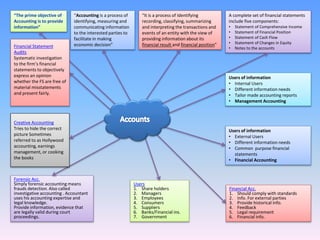
“Accounting is a process of
identifying, measuring and
communicating information
to the interested parties to
facilitate in making
economic decision”
“The prime objective of
Accounting is to provide
information”
“It is a process of Identifying
recording, classifying, summarizing
and interpreting the transactions and
events of an entity with the view of
providing information about its
financial result and financial position”
A complete set of financial statements
include five components:
• Statement of Comprehensive Income
• Statement of Financial Position
• Statement of Cash Flow
• Statement of Changes in Equity
• Notes to the accounts
Forensic Acc.
Simply forensic accounting means
frauds detection. Also called
investigative accounting . Accountant
uses his accounting expertise and
legal knowledge.
Provide information, evidence that
are legally valid during court
proceedings.
Users
1. Share holders
2. Managers
3. Employees
4. Consumers
5. Suppliers
6. Banks/Financial ins.
7. Government
Financial Acc.
1. Should comply with standards
2. Info. For external parties
3. Provide historical info.
4. Feedback
5. Legal requirement
6. Financial info.
Users of information
• External Users
• Different information needs
• Common purpose financial
statements
• Financial Accounting
Financial Statement
Audits
Systematic investigation
to the firm’s financial
statements to objectively
express an opinion
whether the FS are free of
material misstatements
and present fairly.
Users of information
• Internal Users
• Different information needs
• Tailor made accounting reports
• Management Accounting
Creative Accounting
Tries to hide the correct
picture Sometimes
referred to as Hollywood
accounting, earnings
management, or cooking
the books
Sri Lanka Accounting and
Auditing Standards Act
No.15 of 1995
• Institute of chartered
Accountants of Sri
Lanka is empowered to
make SLAS
• SBEs to comply with
SLAS and SLAuS
• SLAASMB to monitor
the SBE’s compliance
with SLAS & SLAuS
• SBEs’
• Listed companies
• Unit Trusts
• Banks
• Leasing companies
• Insurance companies
• Stock Markets
• Sock Dealers
• Public Corporations
• All other companies which satisfy
certain criteria
Duties of SBEs
• Prepare its accounts in compliance with the SLAS and take all
necessary measures to ensure that its accounts are audited in
accordance with SLAuS
• Accounts of every SBE shall be audited by professionally qualified
auditors who shall be members of the ICASL holding a certificate to
practice.
• Submit a copy of the annual financial statements of the enterprise to
the SLAASMB, to enable the Board to determine whether the financial
statements have been prepared in compliance with Sri Lanka
Accounting Standards
• To furnish to the Board or to any person authorized by the Board any
information pertaining to its financial statements as may be required
by the Board
The Key Role of SLAASMB
Is to monitor the compliance with the Sri Lanka
Accounting and Auditing Standards by the Specified
Business Enterprises
Offences
• fails to Prepare its Accounts
• fails to submit information
• non producing of documents
• non compliance with Sec. 6 & 7
• knowingly furnishes any false information
• fails to appear before the SLAASMB
• refuses to answer any question
Fine
not Exceeding Rs. 500,000
Court decide intension of misleading
shareholders
Imprisonment Not exceeding Five Years
Contravenes to the Act that are not Serious Nature
1. Direct such SBEs to have their accounts re-prepared or where such
accounts have been published, to republish them or to include suitable
corrections in its accounts for the following year.
2. public company direct it to send notification in writing to all its
shareholders explaining the reason
3. public company listed in the Colombo Stock Exchange to send in
addition a copy of notification to such Commission and such Stock
Exchange.
Where any accountant of any SBE
violates any provision of this Act, it
shall be the duty of the board to bring
such violation to the notice of any
professional body of which such
accountant is a member for the
purpose of enabling such body to take
appropriate action against such
accountant
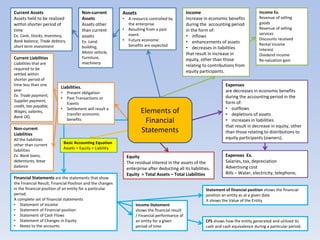
Assets
• A resource controlled by
the enterprise
• Resulting from a past
event
• Future economic
benefits are expected
Current Assets
Assets held to be realized
within shorter period of
time
Ex. Cash, Stocks, Inventory,
Bank balance, Trade debtors,
short term investment
Non-current
Assets
Assets other
than current
assets
Ex. Land,
building,
Motor vehicle,
Furniture,
machinery
Non-current
Liabilities
All the liabilities
other than current
liabilities
Ex. Bank loans,
debentures, lease
balance
Income
Increase in economic benefits
during the accounting period
in the form of:
• inflows
• enhancements of assets
• decreases in liabilities
that result in increase in
equity, other than those
relating to contributions from
equity participants.
Income Ex.
Revenue of selling
goods
Revenue of selling
services
Discounts received
Rental income
Interest
Dividend income
Re-valuation gain
Expenses
are decreases in economic benefits
during the accounting period in the
form of:
• outflows
• depletions of assets
• increases in liabilities
that result in decrease in equity, other
than those relating to distributions to
equity participants (owners).
Expenses Ex.
Salaries, tax, depreciation
Advertising cost
Bills – Water, electricity, telephone,
Financial Statements are the statements that show
the Financial Result, Financial Position and the changes
in the financial position of an entity for a particular
period.
A complete set of financial statements
• Statement of Income
• Statement of Financial position
• Statement of Cash Flows
• Statement of Changes in Equity
• Notes to the accounts
Current Liabilities
Liabilities that are
required to be
settled within
shorter period of
time less than one
year
Ex. Trade payment,
Supplier payment,
credit, tax-payable,
Wages, salaries,
Bank OD,
Equity
The residual interest in the assets of the
enterprise after deducting all its liabilities.
Equity = Total Assets – Total Liabilities
Elements of
Financial
Statements
Statement of financial position shows the financial
position an entity as at a given date
It shows the Value of the Entity
Basic Accounting Equation
Assets = Equity + Liability
CFS shows how the entity generated and utilized its
cash and cash equivalence during a particular period.
Income Statement
shows the financial result
/ Financial performance of
an entity for a given
period of time
Liabilities.
• Present obligation
• Past Transactions or
Events
• Settlement will result a
transfer economic
benefits

Accounts - Financial

  • 1.
    “Accounting is aprocess of identifying, measuring and communicating information to the interested parties to facilitate in making economic decision” “The prime objective of Accounting is to provide information” “It is a process of Identifying recording, classifying, summarizing and interpreting the transactions and events of an entity with the view of providing information about its financial result and financial position” A complete set of financial statements include five components: • Statement of Comprehensive Income • Statement of Financial Position • Statement of Cash Flow • Statement of Changes in Equity • Notes to the accounts Forensic Acc. Simply forensic accounting means frauds detection. Also called investigative accounting . Accountant uses his accounting expertise and legal knowledge. Provide information, evidence that are legally valid during court proceedings. Users 1. Share holders 2. Managers 3. Employees 4. Consumers 5. Suppliers 6. Banks/Financial ins. 7. Government Financial Acc. 1. Should comply with standards 2. Info. For external parties 3. Provide historical info. 4. Feedback 5. Legal requirement 6. Financial info. Users of information • External Users • Different information needs • Common purpose financial statements • Financial Accounting Financial Statement Audits Systematic investigation to the firm’s financial statements to objectively express an opinion whether the FS are free of material misstatements and present fairly. Users of information • Internal Users • Different information needs • Tailor made accounting reports • Management Accounting Creative Accounting Tries to hide the correct picture Sometimes referred to as Hollywood accounting, earnings management, or cooking the books
  • 2.
    Sri Lanka Accountingand Auditing Standards Act No.15 of 1995 • Institute of chartered Accountants of Sri Lanka is empowered to make SLAS • SBEs to comply with SLAS and SLAuS • SLAASMB to monitor the SBE’s compliance with SLAS & SLAuS • SBEs’ • Listed companies • Unit Trusts • Banks • Leasing companies • Insurance companies • Stock Markets • Sock Dealers • Public Corporations • All other companies which satisfy certain criteria Duties of SBEs • Prepare its accounts in compliance with the SLAS and take all necessary measures to ensure that its accounts are audited in accordance with SLAuS • Accounts of every SBE shall be audited by professionally qualified auditors who shall be members of the ICASL holding a certificate to practice. • Submit a copy of the annual financial statements of the enterprise to the SLAASMB, to enable the Board to determine whether the financial statements have been prepared in compliance with Sri Lanka Accounting Standards • To furnish to the Board or to any person authorized by the Board any information pertaining to its financial statements as may be required by the Board The Key Role of SLAASMB Is to monitor the compliance with the Sri Lanka Accounting and Auditing Standards by the Specified Business Enterprises Offences • fails to Prepare its Accounts • fails to submit information • non producing of documents • non compliance with Sec. 6 & 7 • knowingly furnishes any false information • fails to appear before the SLAASMB • refuses to answer any question Fine not Exceeding Rs. 500,000 Court decide intension of misleading shareholders Imprisonment Not exceeding Five Years Contravenes to the Act that are not Serious Nature 1. Direct such SBEs to have their accounts re-prepared or where such accounts have been published, to republish them or to include suitable corrections in its accounts for the following year. 2. public company direct it to send notification in writing to all its shareholders explaining the reason 3. public company listed in the Colombo Stock Exchange to send in addition a copy of notification to such Commission and such Stock Exchange. Where any accountant of any SBE violates any provision of this Act, it shall be the duty of the board to bring such violation to the notice of any professional body of which such accountant is a member for the purpose of enabling such body to take appropriate action against such accountant
  • 3.
    Assets • A resourcecontrolled by the enterprise • Resulting from a past event • Future economic benefits are expected Current Assets Assets held to be realized within shorter period of time Ex. Cash, Stocks, Inventory, Bank balance, Trade debtors, short term investment Non-current Assets Assets other than current assets Ex. Land, building, Motor vehicle, Furniture, machinery Non-current Liabilities All the liabilities other than current liabilities Ex. Bank loans, debentures, lease balance Income Increase in economic benefits during the accounting period in the form of: • inflows • enhancements of assets • decreases in liabilities that result in increase in equity, other than those relating to contributions from equity participants. Income Ex. Revenue of selling goods Revenue of selling services Discounts received Rental income Interest Dividend income Re-valuation gain Expenses are decreases in economic benefits during the accounting period in the form of: • outflows • depletions of assets • increases in liabilities that result in decrease in equity, other than those relating to distributions to equity participants (owners). Expenses Ex. Salaries, tax, depreciation Advertising cost Bills – Water, electricity, telephone, Financial Statements are the statements that show the Financial Result, Financial Position and the changes in the financial position of an entity for a particular period. A complete set of financial statements • Statement of Income • Statement of Financial position • Statement of Cash Flows • Statement of Changes in Equity • Notes to the accounts Current Liabilities Liabilities that are required to be settled within shorter period of time less than one year Ex. Trade payment, Supplier payment, credit, tax-payable, Wages, salaries, Bank OD, Equity The residual interest in the assets of the enterprise after deducting all its liabilities. Equity = Total Assets – Total Liabilities Elements of Financial Statements Statement of financial position shows the financial position an entity as at a given date It shows the Value of the Entity Basic Accounting Equation Assets = Equity + Liability CFS shows how the entity generated and utilized its cash and cash equivalence during a particular period. Income Statement shows the financial result / Financial performance of an entity for a given period of time Liabilities. • Present obligation • Past Transactions or Events • Settlement will result a transfer economic benefits