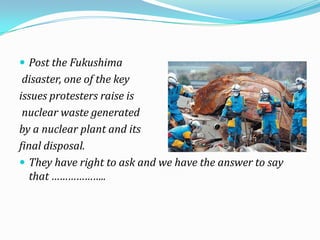
 Post the Fukushima
 disaster, one of the key
issues protesters raise is
 nuclear waste generated
by a nuclear plant and its
final disposal.
 They have right to ask and we have the answer to say
  that ………………..
The nuclear energy programme
will move in parallel paths. One
is to produce power. Since we generate power there
will be some waste. And this waste is only two to three
per cent of the total fuel we put into the reactor. Entire
spent fuel is not waste; plutonium and uranium are
recycled which contribute to about 97-98 per cent of
the spent fuel. So only the remaining two to three per
cent of spent fuel is waste.
 Now the problem with nuclear power waste is that it
 will remain radioactive for a few hundreds of years and
 even more. Now again you see, this waste can be
 divided into two parts — one where within 300 years,
 99 per cent of the waste becomes non-radioactive and
 the rest is going to remain radioactive for a longer
 time.
 Baba Atomic Research Centre working
towards the development of a process
where we can separate waste that becomes
non-radioactive within 300 years.
 A pilot plant will become operational in Tarapur, Mumbai. [to separate
  the two types of waste] next year. Process development in the lab was
  completed some time back. The pilot plant will be followed by a
  demonstration plant, and then by commercial plants.
 After the pilot plant is fully operational, we will come up with a
  demonstration-scale plant at Tarapur. It is at a design stage and will be
  integrated to the nuclear recycle plant at Tarapur. This will be a large-
  sized plant. The plant will be designed for reprocessing 600 tonnes of
  spent fuel.-shekar basu ,Director of BARC
Taking care of the waste that will become non-
radioactive within 300 years
 Step1:VITRIFICATION OF NUCLEAR WASTE
 The waste is first vitrified in the vitrification plant
  operational in India.( Vitrification   is the transformation of a
  substance into a glass)
 STEP2:STEEL CANISTERIZING OF VITRIFIED WASTE
 Vitrified waste will be put in steel canisters, which in
  turn will be put in steel over-packs. Over-packs will
  again be put in another steel casing. So there will be
  three to four layers of steel casing in addition to
  vitrification
 Step3:REST IN PEACE……………………..
 It will finally be kept in concrete structures/buildings.
  Concrete buildings are used for structural, shielding
  and ventilation purposes OR even in defunct
  underground mines(like the kolar gold mines)
Taking care of the waste that will be radio active for more than
300 years
                               We can bombard the waste with
                              high-energy neutrons to kill or
                              burn radioactive elements. This is
                              called transmutation.
                              Transmutation is the way of
                              handling actinides that have long
                              half-lives. It can be done either in
                              faster spectrum reactors where
                              neutrons of higher energy are
                              used or accelerator-driven system
                              (ADS).
 And that’s how it goes……..
 And effective utilization of modern technology like
  the ADS can be a answer to our problems ,
 Given the fact that, 800 milllion indians don’t have
  access to electricity and we as a whole community
  has a larger role to play.Our primr aim is to dispel
  the fear factor among the anti-nuke protestors and
  and every indians has the right to get electricity that
  can be achieved,only we put the nation on the path of
  cultivating massive electricityfrom sustainable
  energy.adieu.jaihindand thank you……
Nuclear energy reprocessing

Nuclear energy reprocessing

  • 2.
     Post theFukushima disaster, one of the key issues protesters raise is nuclear waste generated by a nuclear plant and its final disposal.  They have right to ask and we have the answer to say that ………………..
  • 3.
    The nuclear energyprogramme will move in parallel paths. One is to produce power. Since we generate power there will be some waste. And this waste is only two to three per cent of the total fuel we put into the reactor. Entire spent fuel is not waste; plutonium and uranium are recycled which contribute to about 97-98 per cent of the spent fuel. So only the remaining two to three per cent of spent fuel is waste.
  • 4.
     Now theproblem with nuclear power waste is that it will remain radioactive for a few hundreds of years and even more. Now again you see, this waste can be divided into two parts — one where within 300 years, 99 per cent of the waste becomes non-radioactive and the rest is going to remain radioactive for a longer time.
  • 5.
     Baba AtomicResearch Centre working towards the development of a process where we can separate waste that becomes non-radioactive within 300 years.  A pilot plant will become operational in Tarapur, Mumbai. [to separate the two types of waste] next year. Process development in the lab was completed some time back. The pilot plant will be followed by a demonstration plant, and then by commercial plants.  After the pilot plant is fully operational, we will come up with a demonstration-scale plant at Tarapur. It is at a design stage and will be integrated to the nuclear recycle plant at Tarapur. This will be a large- sized plant. The plant will be designed for reprocessing 600 tonnes of spent fuel.-shekar basu ,Director of BARC
  • 6.
    Taking care ofthe waste that will become non- radioactive within 300 years  Step1:VITRIFICATION OF NUCLEAR WASTE  The waste is first vitrified in the vitrification plant operational in India.( Vitrification is the transformation of a substance into a glass)
  • 7.
     STEP2:STEEL CANISTERIZINGOF VITRIFIED WASTE  Vitrified waste will be put in steel canisters, which in turn will be put in steel over-packs. Over-packs will again be put in another steel casing. So there will be three to four layers of steel casing in addition to vitrification
  • 8.
     Step3:REST INPEACE……………………..  It will finally be kept in concrete structures/buildings. Concrete buildings are used for structural, shielding and ventilation purposes OR even in defunct underground mines(like the kolar gold mines)
  • 9.
    Taking care ofthe waste that will be radio active for more than 300 years  We can bombard the waste with high-energy neutrons to kill or burn radioactive elements. This is called transmutation. Transmutation is the way of handling actinides that have long half-lives. It can be done either in faster spectrum reactors where neutrons of higher energy are used or accelerator-driven system (ADS).
  • 10.
     And that’show it goes……..  And effective utilization of modern technology like the ADS can be a answer to our problems ,  Given the fact that, 800 milllion indians don’t have access to electricity and we as a whole community has a larger role to play.Our primr aim is to dispel the fear factor among the anti-nuke protestors and and every indians has the right to get electricity that can be achieved,only we put the nation on the path of cultivating massive electricityfrom sustainable energy.adieu.jaihindand thank you……