The digital transformation of
research support
Alison McNab & Andy Tattersall
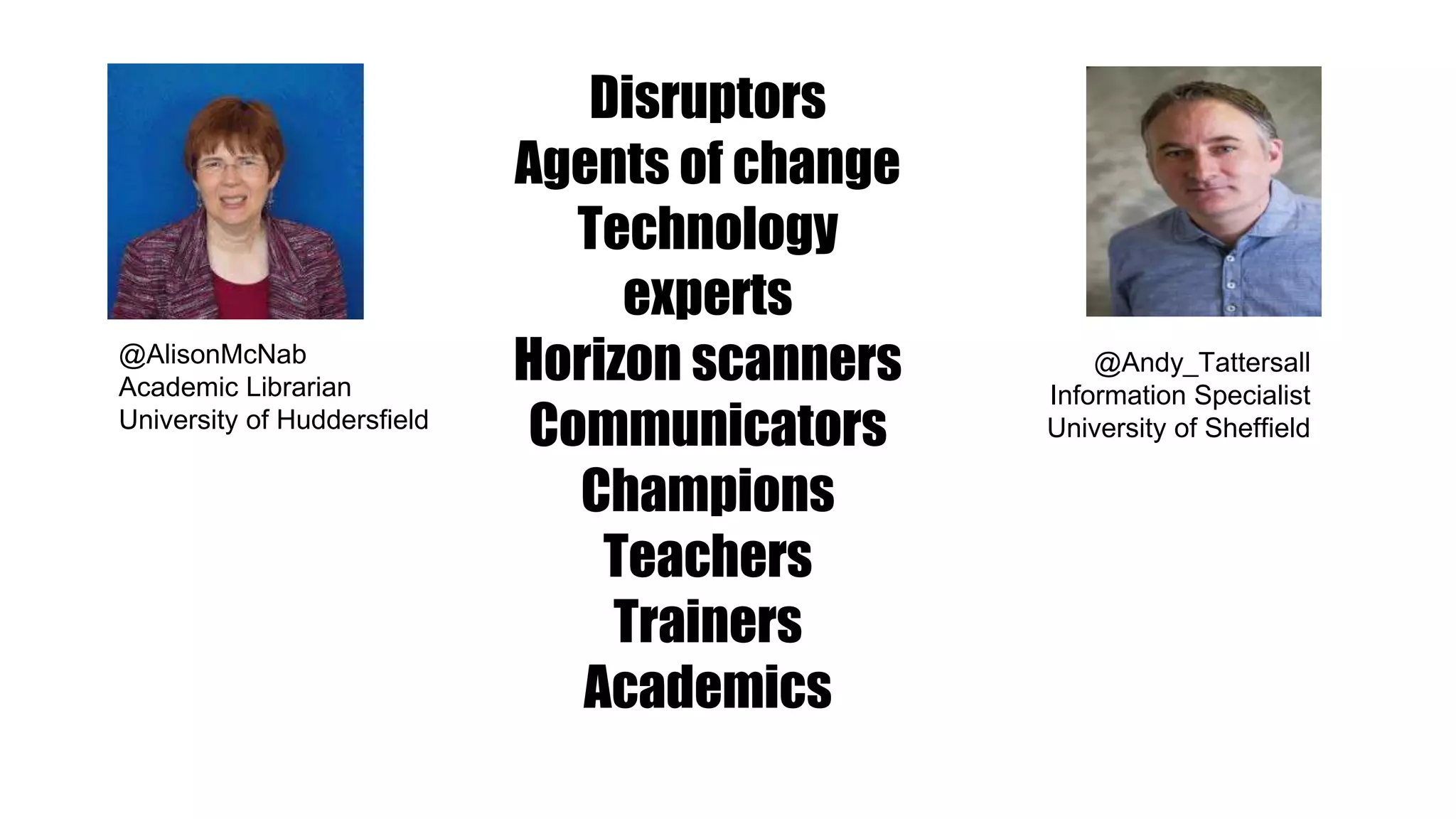
@AlisonMcNab
Academic Librarian
University of Huddersfield
@Andy_Tattersall
Information Specialist
University of Sheffield
Disruptors
Agents of change
Technology
experts
Horizon scanners
Communicators
Champions
Teachers
Trainers
Academics
Outline
•Researchers in a digital landscape
• The digital transformation of the research lifecycle
• The digital transformation of research support
•Meeting the challenge:
•The research technologist manifesto
•Key competencies
•Resources
The digital
transformation of
research support
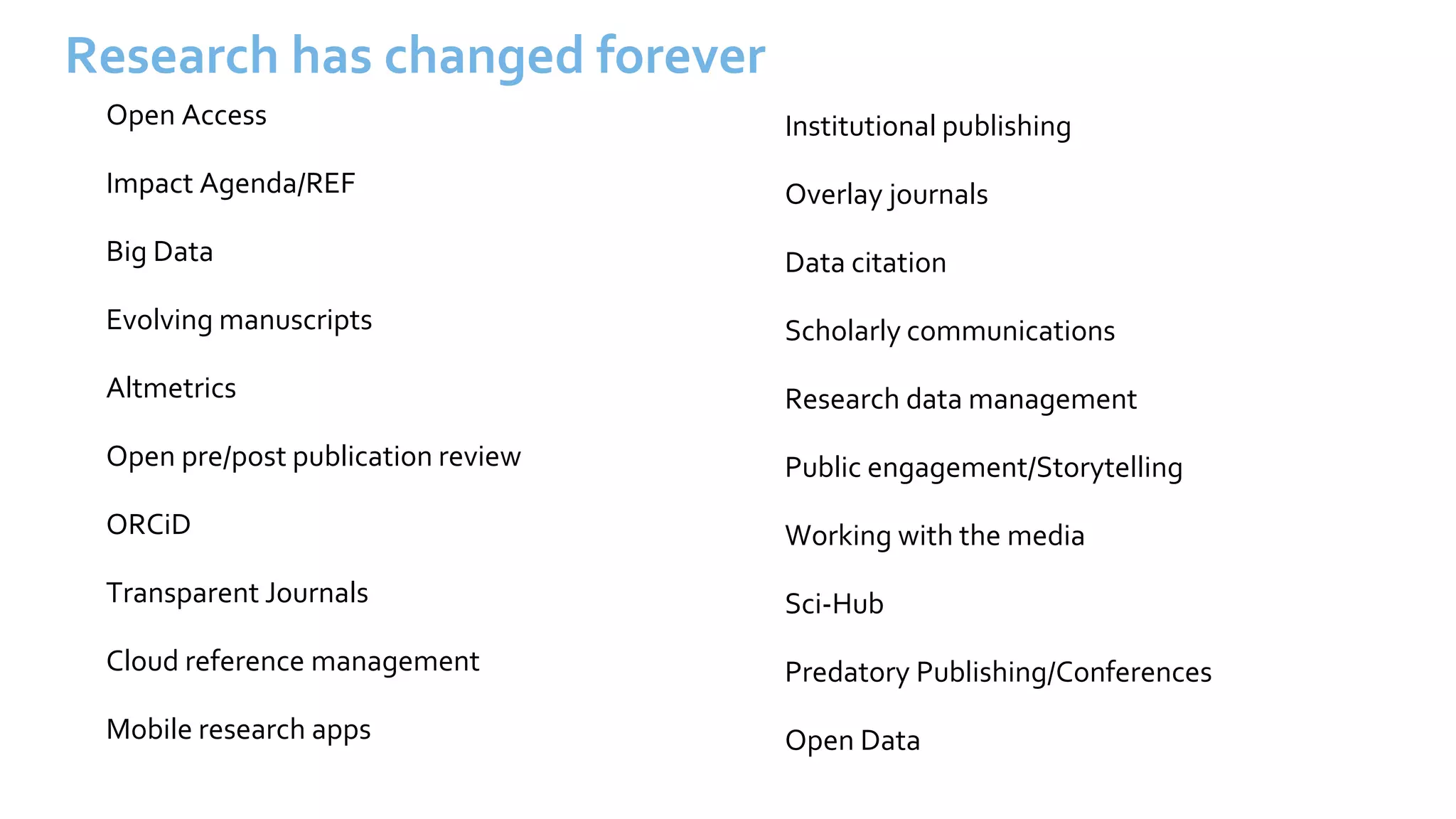
Research has changed forever
Open Access
Impact Agenda/REF
Big Data
Evolving manuscripts
Altmetrics
Open pre/post publication review
ORCiD
Transparent Journals
Cloud reference management
Mobile research apps
Institutional publishing
Overlay journals
Data citation
Scholarly communications
Research data management
Public engagement/Storytelling
Working with the media
Sci-Hub
Predatory Publishing/Conferences
Open Data
What matters to academics
• The REF
• Winning funding bids
• Getting cited
• Publishing papers
• Getting promoted
• Gaining esteem
• Showing Impact
• Retaining tenure
• Getting enough sleep
(and TEF)
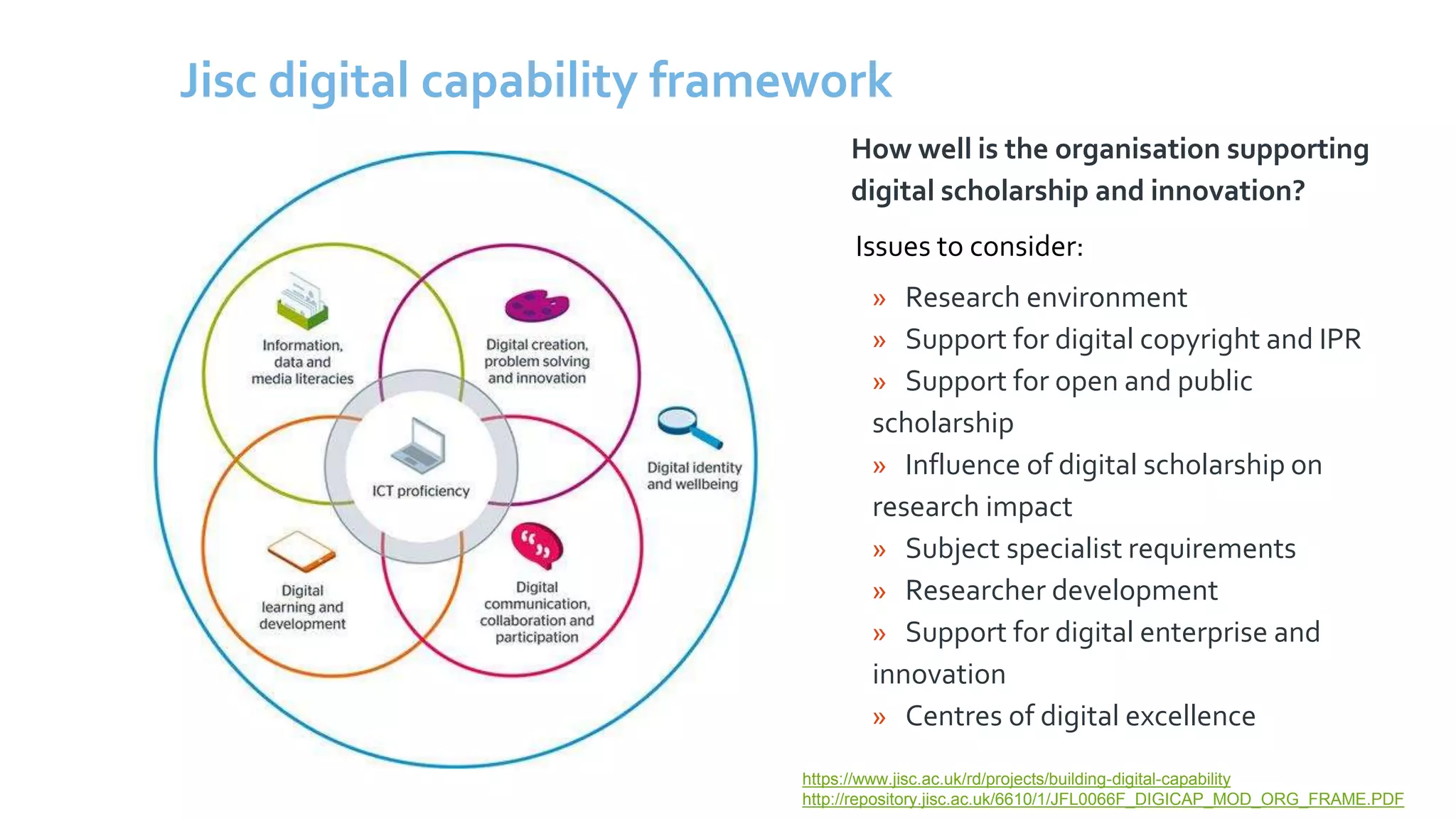
Jisc digital capability framework
https://www.jisc.ac.uk/rd/projects/building-digital-capability
http://repository.jisc.ac.uk/6610/1/JFL0066F_DIGICAP_MOD_ORG_FRAME.PDF
How well is the organisation supporting
digital scholarship and innovation?
Issues to consider:
» Research environment
» Support for digital copyright and IPR
» Support for open and public
scholarship
» Influence of digital scholarship on
research impact
» Subject specialist requirements
» Researcher development
» Support for digital enterprise and
innovation
» Centres of digital excellence
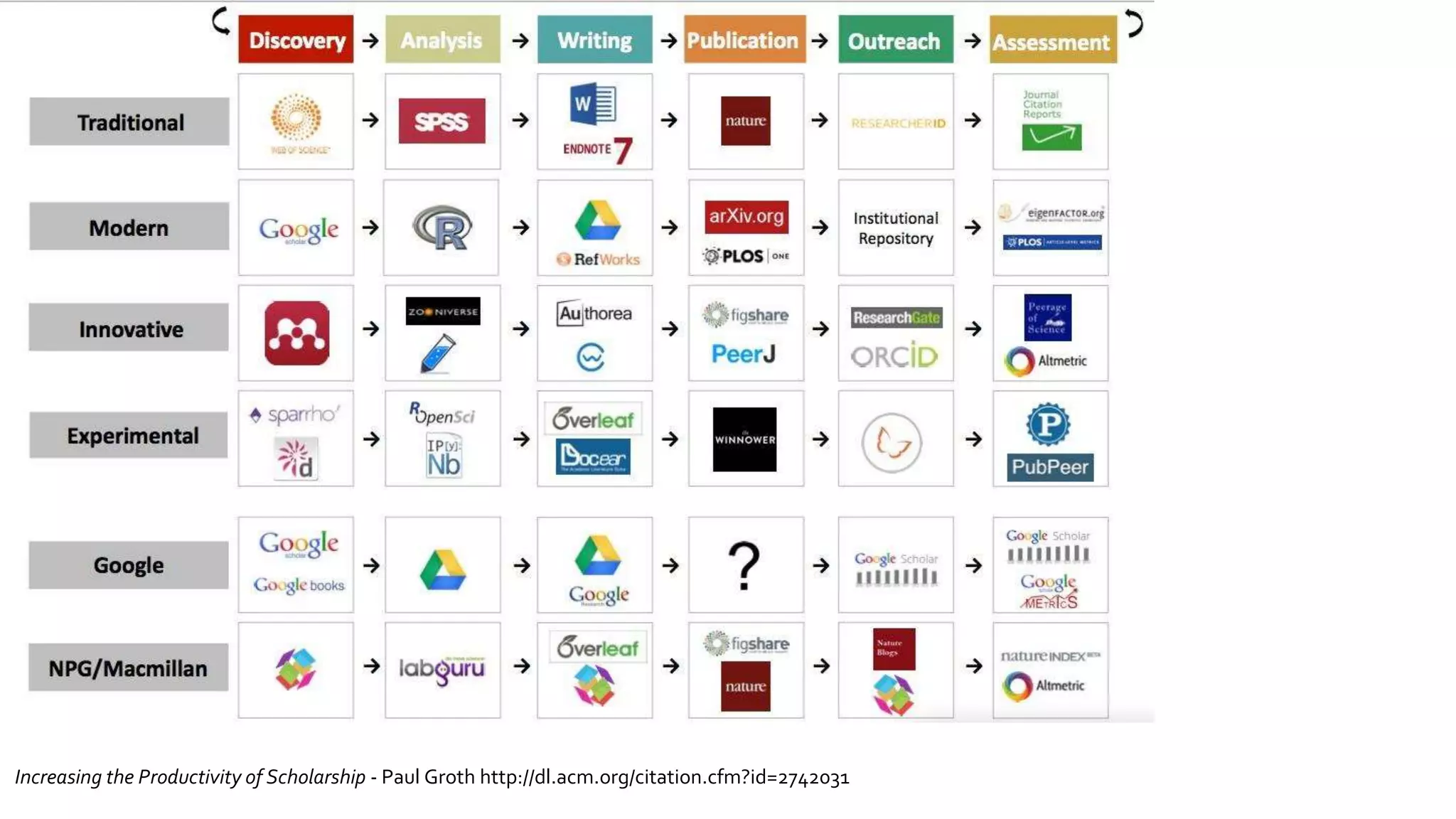
Increasing the Productivity of Scholarship - Paul Groth http://dl.acm.org/citation.cfm?id=2742031
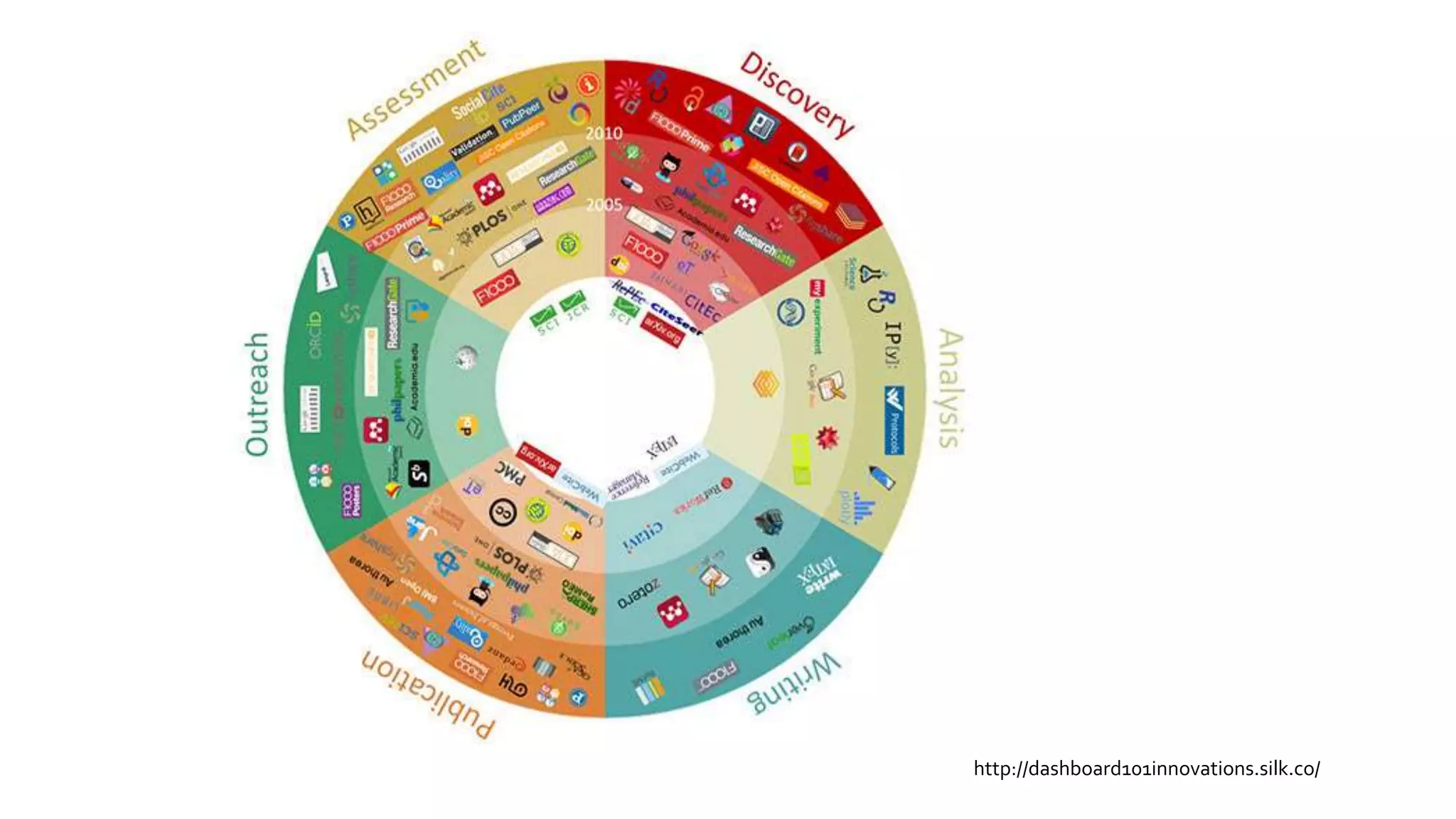
Where today’s library and information professional may
support the new research life cycle
● Preparation
● Discovery
● Analysis
● Writing
● Publication
● Outreach
● Assessment
Framework based on 101 Innovations in Scholarly Communication
https://figshare.com/articles/101_Innovations_in_Scholarly_Communication_the_Changing_Research_Workflow/1286826
Across entire workflow
http://dashboard101innovations.silk.co/
Meeting the challenge
• What skills are needed?
• Where can these be obtained?
• Recent discussions around academic library skill sets and
future roles (see Further Resources)
• Where should we be located? (Does it matter?)
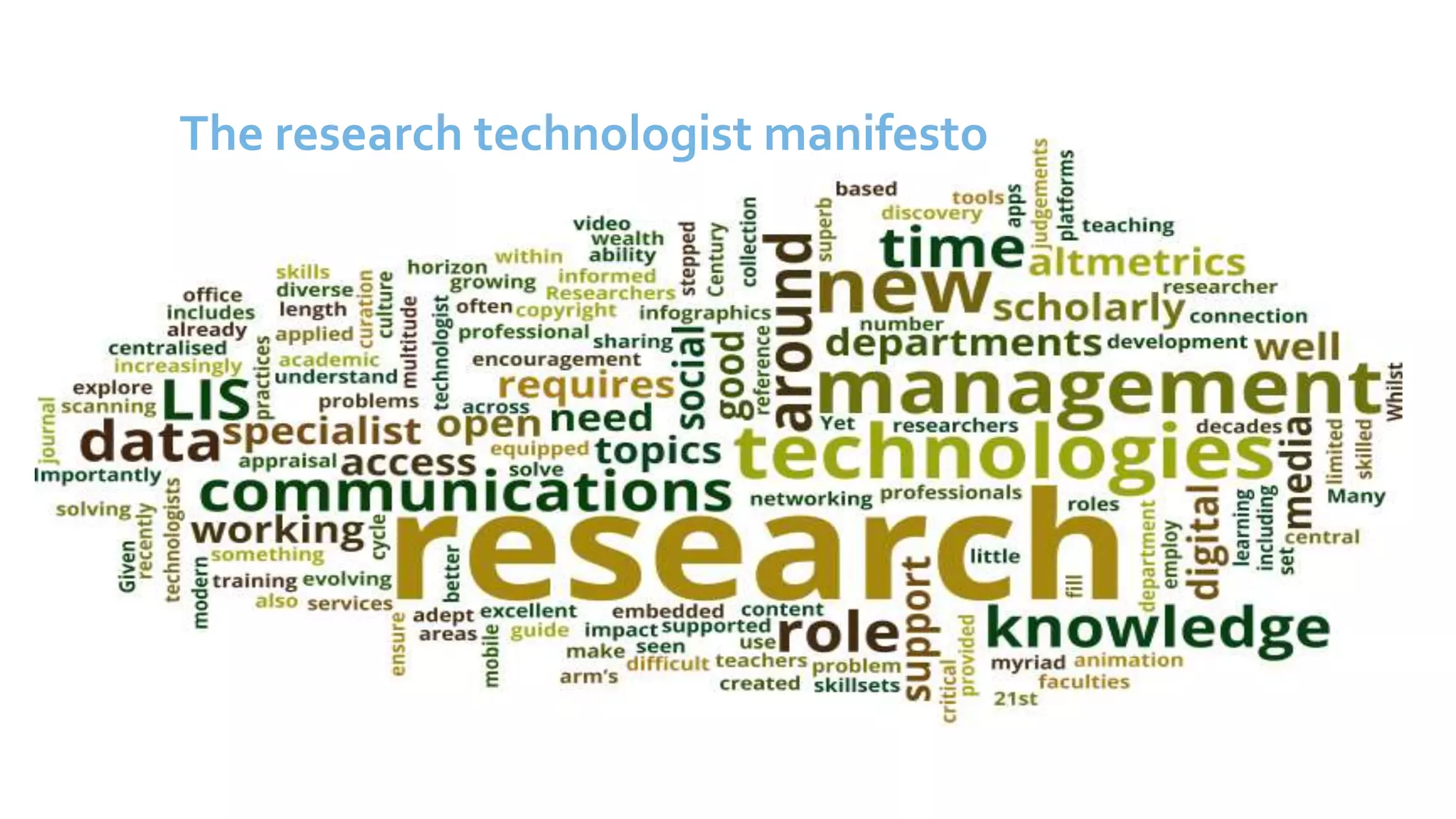
The research technologist manifesto
For decades skilled LIS professionals have provided researchers with excellent services around collection management,
content curation and discovery, critical appraisal and reference management. More recently they have stepped into new
areas of support and applied their wealth of knowledge around social media, altmetrics, scholarly communications and
research data management. All of this requires a good working knowledge of research practices and technologies.
Importantly it also requires knowledge of research office culture - something which can be difficult if based at arm’s
length in a centralised department.
Researchers increasingly need to understand a multitude of topics including digital copyright, impact, altmetrics,
communications, social media, research data management and sharing, open access, infographics, video, animation
and mobile apps. Yet all too often they have little time, support or encouragement to explore these topics within their
own departments. With what limited time they do have they need to make informed judgements on the growing
number of technologies and tools to employ. As we have seen with the development of learning technologists to guide
teachers through the myriad of new technologies, is it not time that a new role was created - that of the research
technologist or digital academic specialist?
Given that the modern research LIS professional is adept of working across platforms, good at problem solving and the
use of new technologies that they are well equipped to fill such a role. Many already have the skillsets for such a role that
includes superb networking, horizon scanning, teaching and training skills as well as the ability to solve a diverse set of
evolving problems. Whilst embedded into faculties and departments, all of this can then be supported by the central LIS
specialist roles around journal, research data, open access, scholarly communications to ensure a better connection
between researcher and the 21st Century research cycle.
The research technologist manifesto
Key competencies
Image via https://www.canva.com/
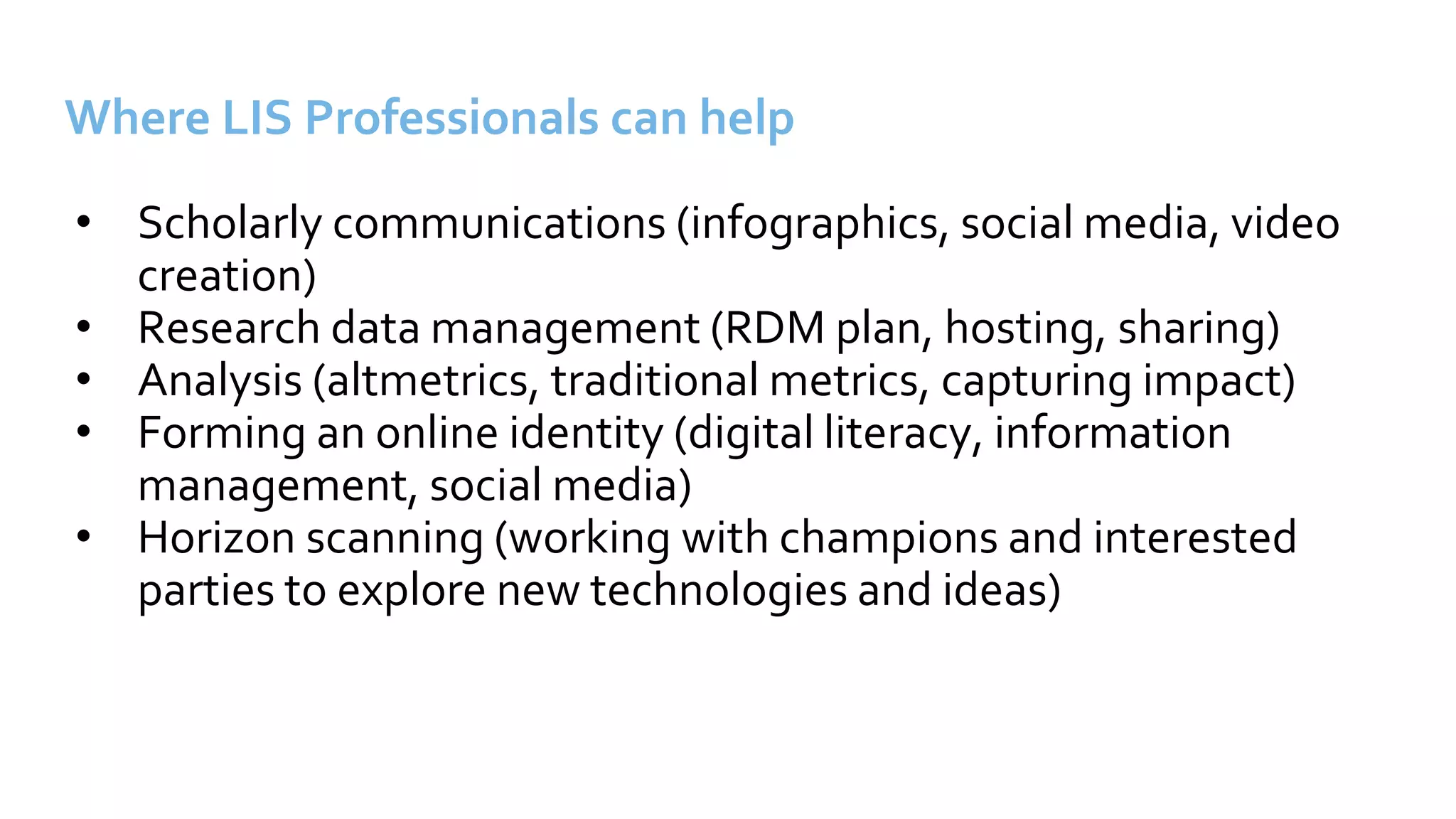
Where LIS Professionals can help
• Scholarly communications (infographics, social media, video
creation)
• Research data management (RDM plan, hosting, sharing)
• Analysis (altmetrics, traditional metrics, capturing impact)
• Forming an online identity (digital literacy, information
management, social media)
• Horizon scanning (working with champions and interested
parties to explore new technologies and ideas)
Prescribing a Digital Technology
• You need to understand why you are taking it
• You need to understand the benefits
• You need to understand the side-effects
• You need to understand that the benefits may take time
• You may need two courses
• You may need a different intervention
• Do not feel pressured to use it - as it won’t work
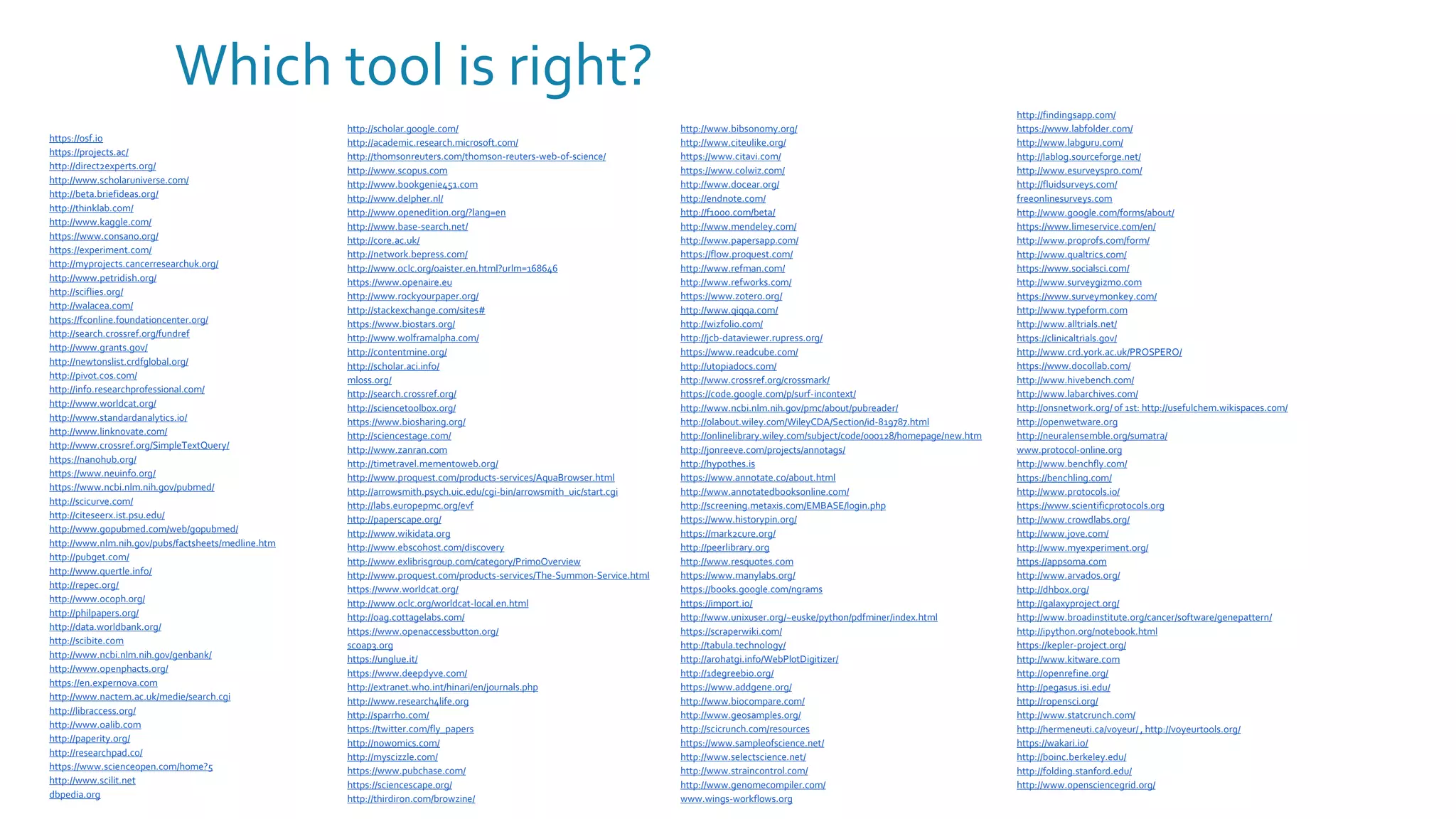
Which tool is right?
https://osf.io
https://projects.ac/
http://direct2experts.org/
http://www.scholaruniverse.com/
http://beta.briefideas.org/
http://thinklab.com/
http://www.kaggle.com/
https://www.consano.org/
https://experiment.com/
http://myprojects.cancerresearchuk.org/
http://www.petridish.org/
http://sciflies.org/
http://walacea.com/
https://fconline.foundationcenter.org/
http://search.crossref.org/fundref
http://www.grants.gov/
http://newtonslist.crdfglobal.org/
http://pivot.cos.com/
http://info.researchprofessional.com/
http://www.worldcat.org/
http://www.standardanalytics.io/
http://www.linknovate.com/
http://www.crossref.org/SimpleTextQuery/
https://nanohub.org/
https://www.neuinfo.org/
https://www.ncbi.nlm.nih.gov/pubmed/
http://scicurve.com/
http://citeseerx.ist.psu.edu/
http://www.gopubmed.com/web/gopubmed/
http://www.nlm.nih.gov/pubs/factsheets/medline.htm
http://pubget.com/
http://www.quertle.info/
http://repec.org/
http://www.ocoph.org/
http://philpapers.org/
http://data.worldbank.org/
http://scibite.com
http://www.ncbi.nlm.nih.gov/genbank/
http://www.openphacts.org/
https://en.expernova.com
http://www.nactem.ac.uk/medie/search.cgi
http://libraccess.org/
http://www.oalib.com
http://paperity.org/
http://researchpad.co/
https://www.scienceopen.com/home?5
http://www.scilit.net
dbpedia.org
http://scholar.google.com/
http://academic.research.microsoft.com/
http://thomsonreuters.com/thomson-reuters-web-of-science/
http://www.scopus.com
http://www.bookgenie451.com
http://www.delpher.nl/
http://www.openedition.org/?lang=en
http://www.base-search.net/
http://core.ac.uk/
http://network.bepress.com/
http://www.oclc.org/oaister.en.html?urlm=168646
https://www.openaire.eu
http://www.rockyourpaper.org/
http://stackexchange.com/sites#
https://www.biostars.org/
http://www.wolframalpha.com/
http://contentmine.org/
http://scholar.aci.info/
mloss.org/
http://search.crossref.org/
http://sciencetoolbox.org/
https://www.biosharing.org/
http://sciencestage.com/
http://www.zanran.com
http://timetravel.mementoweb.org/
http://www.proquest.com/products-services/AquaBrowser.html
http://arrowsmith.psych.uic.edu/cgi-bin/arrowsmith_uic/start.cgi
http://labs.europepmc.org/evf
http://paperscape.org/
http://www.wikidata.org
http://www.ebscohost.com/discovery
http://www.exlibrisgroup.com/category/PrimoOverview
http://www.proquest.com/products-services/The-Summon-Service.html
https://www.worldcat.org/
http://www.oclc.org/worldcat-local.en.html
http://oag.cottagelabs.com/
https://www.openaccessbutton.org/
scoap3.org
https://unglue.it/
https://www.deepdyve.com/
http://extranet.who.int/hinari/en/journals.php
http://www.research4life.org
http://sparrho.com/
https://twitter.com/fly_papers
http://nowomics.com/
http://myscizzle.com/
https://www.pubchase.com/
https://sciencescape.org/
http://thirdiron.com/browzine/
http://www.bibsonomy.org/
http://www.citeulike.org/
https://www.citavi.com/
https://www.colwiz.com/
http://www.docear.org/
http://endnote.com/
http://f1000.com/beta/
http://www.mendeley.com/
http://www.papersapp.com/
https://flow.proquest.com/
http://www.refman.com/
http://www.refworks.com/
https://www.zotero.org/
http://www.qiqqa.com/
http://wizfolio.com/
http://jcb-dataviewer.rupress.org/
https://www.readcube.com/
http://utopiadocs.com/
http://www.crossref.org/crossmark/
https://code.google.com/p/surf-incontext/
http://www.ncbi.nlm.nih.gov/pmc/about/pubreader/
http://olabout.wiley.com/WileyCDA/Section/id-819787.html
http://onlinelibrary.wiley.com/subject/code/000128/homepage/new.htm
http://jonreeve.com/projects/annotags/
http://hypothes.is
https://www.annotate.co/about.html
http://www.annotatedbooksonline.com/
http://screening.metaxis.com/EMBASE/login.php
https://www.historypin.org/
https://mark2cure.org/
http://peerlibrary.org
http://www.resquotes.com
https://www.manylabs.org/
https://books.google.com/ngrams
https://import.io/
http://www.unixuser.org/~euske/python/pdfminer/index.html
https://scraperwiki.com/
http://tabula.technology/
http://arohatgi.info/WebPlotDigitizer/
http://1degreebio.org/
https://www.addgene.org/
http://www.biocompare.com/
http://www.geosamples.org/
http://scicrunch.com/resources
https://www.sampleofscience.net/
http://www.selectscience.net/
http://www.straincontrol.com/
http://www.genomecompiler.com/
www.wings-workflows.org
http://findingsapp.com/
https://www.labfolder.com/
http://www.labguru.com/
http://lablog.sourceforge.net/
http://www.esurveyspro.com/
http://fluidsurveys.com/
freeonlinesurveys.com
http://www.google.com/forms/about/
https://www.limeservice.com/en/
http://www.proprofs.com/form/
http://www.qualtrics.com/
https://www.socialsci.com/
http://www.surveygizmo.com
https://www.surveymonkey.com/
http://www.typeform.com
http://www.alltrials.net/
https://clinicaltrials.gov/
http://www.crd.york.ac.uk/PROSPERO/
https://www.docollab.com/
http://www.hivebench.com/
http://www.labarchives.com/
http://onsnetwork.org/ of 1st: http://usefulchem.wikispaces.com/
http://openwetware.org
http://neuralensemble.org/sumatra/
www.protocol-online.org
http://www.benchfly.com/
https://benchling.com/
http://www.protocols.io/
https://www.scientificprotocols.org
http://www.crowdlabs.org/
http://www.jove.com/
http://www.myexperiment.org/
https://appsoma.com
http://www.arvados.org/
http://dhbox.org/
http://galaxyproject.org/
http://www.broadinstitute.org/cancer/software/genepattern/
http://ipython.org/notebook.html
https://kepler-project.org/
http://www.kitware.com
http://openrefine.org/
http://pegasus.isi.edu/
http://ropensci.org/
http://www.statcrunch.com/
http://hermeneuti.ca/voyeur/ , http://voyeurtools.org/
https://wakari.io/
http://boinc.berkeley.edu/
http://folding.stanford.edu/
http://www.opensciencegrid.org/
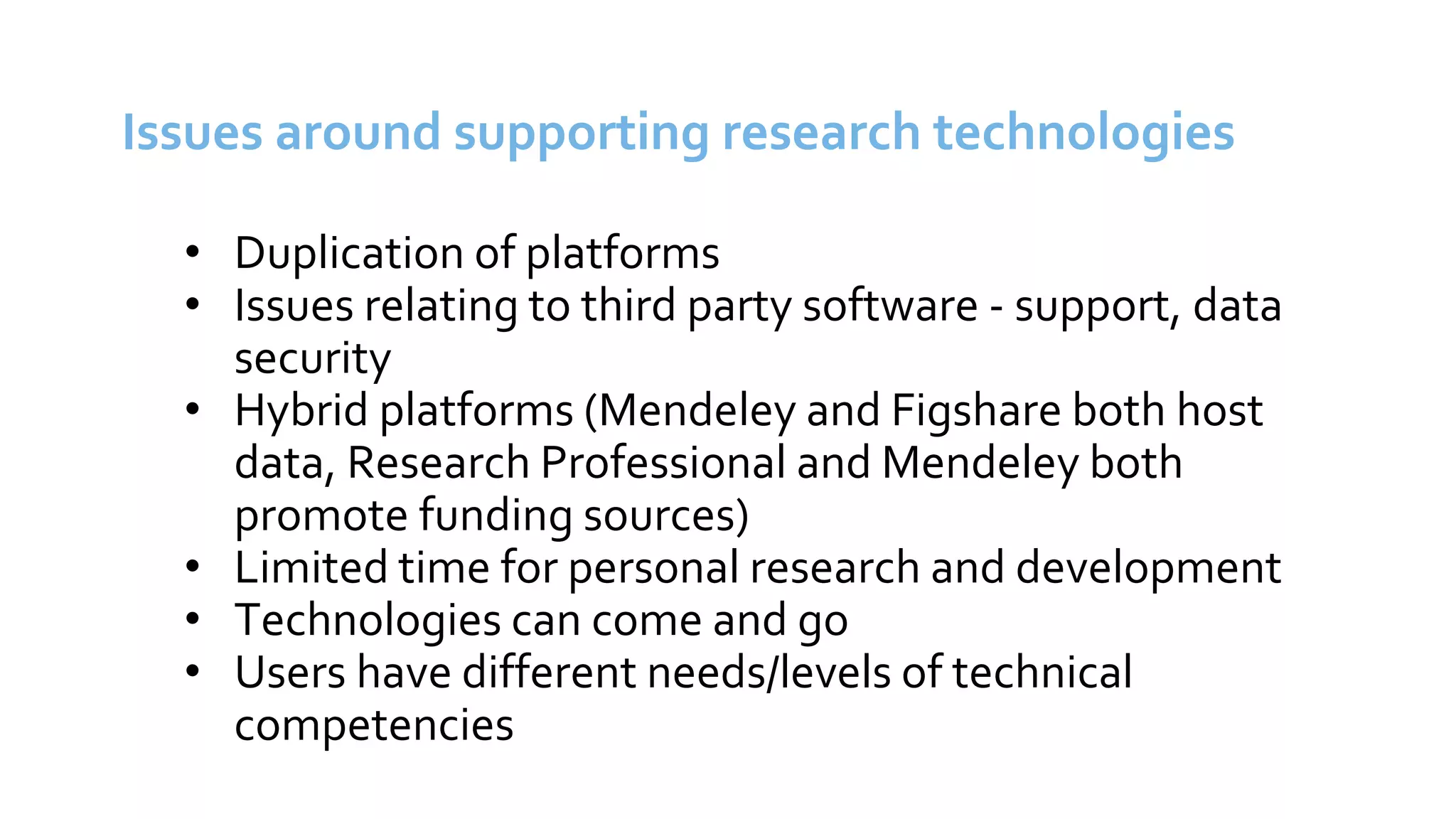
Issues around supporting research technologies
• Duplication of platforms
• Issues relating to third party software - support, data
security
• Hybrid platforms (Mendeley and Figshare both host
data, Research Professional and Mendeley both
promote funding sources)
• Limited time for personal research and development
• Technologies can come and go
• Users have different needs/levels of technical
competencies
Taming the research treadmill
Image CC BY 2.0 normanack http://bit.ly/2vFh0UP
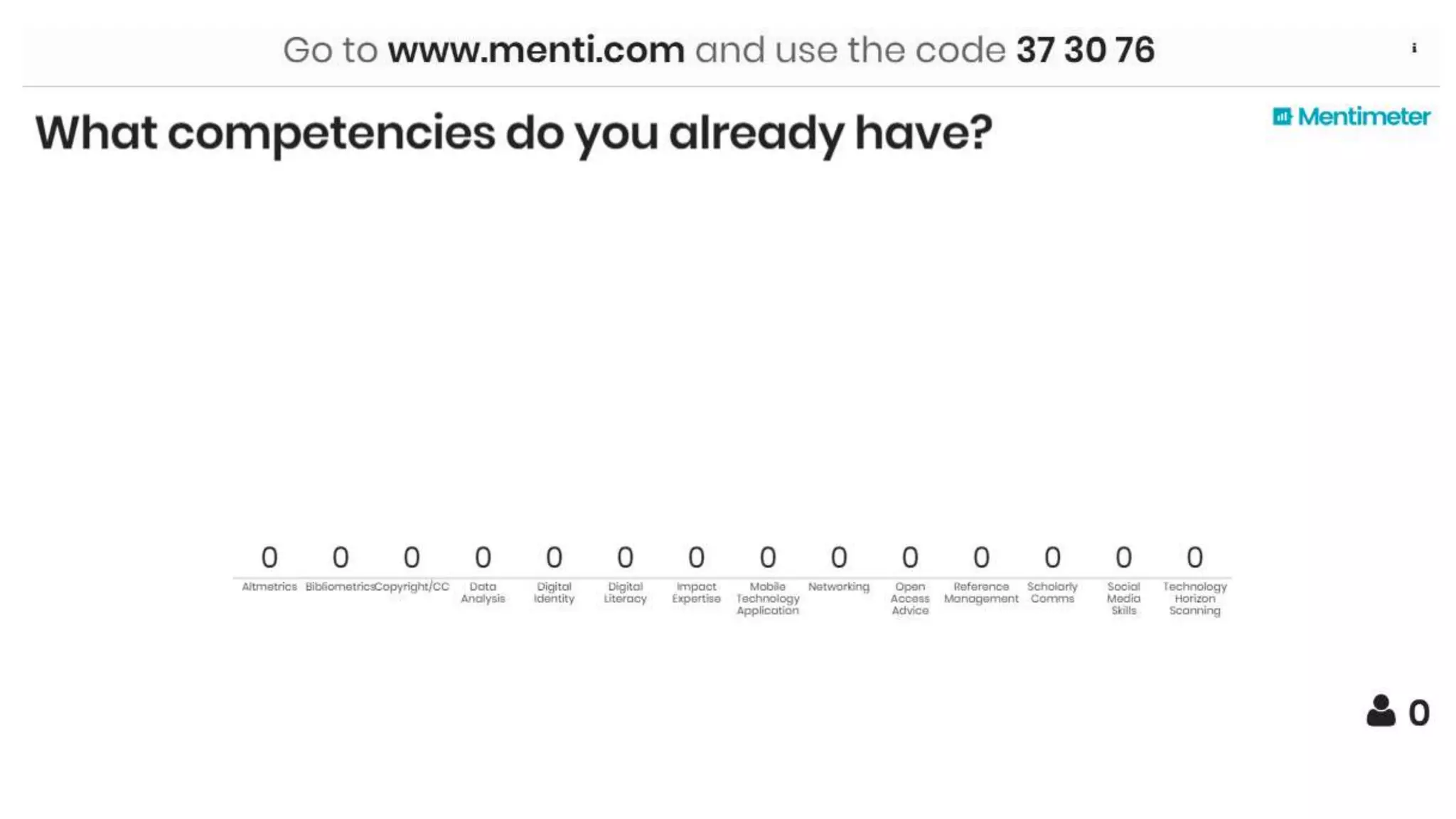
Which three competencies do you feel you most
need to develop?
Further resources
Books
• Bastow, S., Tinkler, J., & Dunleavey, P. (2014). The impact of the social sciences: how
academics and their research make a difference. London: Sage.
• Carrigan, M. (2016) Social media for academics. London: Sage.
• Mollett, A. et al (2017) Communicating your research with social media: a practical guide to
using blogs, podcasts, data visualisations and video. London: Sage
• Hall, M., Harrow, M., & Estelle, L. (Eds.) (2015). Digital futures: expert briefings on digital
technologies for education and research London: Chandos Publishing
• Lupton, D., Mewburn, I., & Thomson, P. (Eds.) (2018). The Digital Academic: critical
perspectives on digital technologies in higher education. London: Routledge.
• Lyons, R. E., & Rayner, S. J. (2015;2016;). The academic book of the future. Basingstoke:
Palgrave Macmillan UK. doi:10.1057/9781137595775 (OA)
• Tattersall, A. (2016). Altmetrics: a practical guide for librarians, researchers and academics.
London: Facet Publishing.
• Veletsianos, G. (2016). Social media in academia: networked scholars. Abingdon: Routledge.
• Weller, M. (2011). The digital scholar: how technology is transforming scholarly practice.
London: Bloomsbury Academic. dx.doi.org/10.5040/9781849666275 (OA)
Meeting the challenge: readings
• Ekstrøm, J., Elbaek, M., Erdmann, C., & Grigorov, I. (2016). The research librarian of the future: data
scientist and co-investigator [Blog post]. Retrieved from
http://blogs.lse.ac.uk/impactofsocialsciences/2016/12/14/the-research-librarian-of-the-future-
data-scientist-and-co-investigator/
• Kingsley, D. (2016), Changing roles and changing needs for academic librarians [Blog post].
Retrieved from https://unlockingresearch.blog.lib.cam.ac.uk/?p=1189
• Kingsley, D. (2017). Shifting sands – changing academic library skill sets (UKSG Conference 2017
Breakout). [PowerPoint slides]. Retrieved from https://www.slideshare.net/UKSG/uksg-
conference-2017-breakout-shifting-sands-changing-academic-library-skill-sets-danny-kingsley
• Tattersall, A. (2017), Following the success of the learning technologist, is it time for a research
equivalent? [Blog post]. Retrieved from
http://blogs.lse.ac.uk/impactofsocialsciences/2017/03/27/following-the-success-of-the-learning-
technologist-is-it-time-for-a-research-equivalent/
Aspects of research support
• Research Data Management
• RDMRose http://rdmrose.group.shef.ac.uk/?page_id=1061
• MANTRA http://mantra.edina.ac.uk/
• Audiovisual research data https://www.jisc.ac.uk/guides/audiovisual-research-data
• Scholarly Communications
• Unlocking Research blog https://unlockingresearch.blog.lib.cam.ac.uk/
• Planning scholarly communication training in the UK https://unlockingresearch.blog.lib.cam.ac.uk/?p=1517
• Handbook for Open Access good practice http://repository.jisc.ac.uk/6565/1/JISC_OAGP_OUTPUTS_HANDBOOK_FINAL.PDF
• Metrics
• The Bibliomagician blog (see Resource Hub) https://thebibliomagician.wordpress.com/
• Research Impact Metrics Quick Guide (Elsevier) https://libraryconnect.elsevier.com/articles/librarian-quick-reference-cards-research-impact-
metrics
• Impact and visibility
• Living Bibliography for The Impact of the Social Sciences: How academics and their work make a difference. Retrieved from
http://blogs.lse.ac.uk/impactofsocialsciences/living-bibliography-impact-of-social-sciences-research-book/
Rapple, C. (2016) Broadening the visibility of your research: ideas from a workshop at the 2016 ARMA conference. Retrieved from
https://blog.growkudos.com/2016/06/14/broadening-the-visibility-of-your-research/
• Digital communication
• Social media https://www.timeshighereducation.com/a-z-social-media
• jobs.ac.uk. (2017). The Digital Academic Resources and information to help you enhance your research. Retrieved from
http://www.jobs.ac.uk/media/pdf/careers/resources/the-digital-academic.pdf
• Images and infographics:
•12 common types of infographics https://infogram.com/blog/12-types-of-infographics/
•Information is Beautiful (sample visualizations) http://www.informationisbeautiful.net/
The Digital Transformation of Research Support

The Digital Transformation of Research Support

  • 1.
    The digital transformationof research support Alison McNab & Andy Tattersall
  • 2.
    @AlisonMcNab Academic Librarian University ofHuddersfield @Andy_Tattersall Information Specialist University of Sheffield Disruptors Agents of change Technology experts Horizon scanners Communicators Champions Teachers Trainers Academics
  • 3.
    Outline •Researchers in adigital landscape • The digital transformation of the research lifecycle • The digital transformation of research support •Meeting the challenge: •The research technologist manifesto •Key competencies •Resources
  • 6.
  • 7.
    Research has changedforever Open Access Impact Agenda/REF Big Data Evolving manuscripts Altmetrics Open pre/post publication review ORCiD Transparent Journals Cloud reference management Mobile research apps Institutional publishing Overlay journals Data citation Scholarly communications Research data management Public engagement/Storytelling Working with the media Sci-Hub Predatory Publishing/Conferences Open Data
  • 9.
    What matters toacademics • The REF • Winning funding bids • Getting cited • Publishing papers • Getting promoted • Gaining esteem • Showing Impact • Retaining tenure • Getting enough sleep (and TEF)
  • 11.
    Jisc digital capabilityframework https://www.jisc.ac.uk/rd/projects/building-digital-capability http://repository.jisc.ac.uk/6610/1/JFL0066F_DIGICAP_MOD_ORG_FRAME.PDF How well is the organisation supporting digital scholarship and innovation? Issues to consider: » Research environment » Support for digital copyright and IPR » Support for open and public scholarship » Influence of digital scholarship on research impact » Subject specialist requirements » Researcher development » Support for digital enterprise and innovation » Centres of digital excellence
  • 12.
    Increasing the Productivityof Scholarship - Paul Groth http://dl.acm.org/citation.cfm?id=2742031
  • 13.
    Where today’s libraryand information professional may support the new research life cycle ● Preparation ● Discovery ● Analysis ● Writing ● Publication ● Outreach ● Assessment Framework based on 101 Innovations in Scholarly Communication https://figshare.com/articles/101_Innovations_in_Scholarly_Communication_the_Changing_Research_Workflow/1286826 Across entire workflow
  • 14.
  • 15.
    Meeting the challenge •What skills are needed? • Where can these be obtained? • Recent discussions around academic library skill sets and future roles (see Further Resources) • Where should we be located? (Does it matter?)
  • 16.
    The research technologistmanifesto For decades skilled LIS professionals have provided researchers with excellent services around collection management, content curation and discovery, critical appraisal and reference management. More recently they have stepped into new areas of support and applied their wealth of knowledge around social media, altmetrics, scholarly communications and research data management. All of this requires a good working knowledge of research practices and technologies. Importantly it also requires knowledge of research office culture - something which can be difficult if based at arm’s length in a centralised department. Researchers increasingly need to understand a multitude of topics including digital copyright, impact, altmetrics, communications, social media, research data management and sharing, open access, infographics, video, animation and mobile apps. Yet all too often they have little time, support or encouragement to explore these topics within their own departments. With what limited time they do have they need to make informed judgements on the growing number of technologies and tools to employ. As we have seen with the development of learning technologists to guide teachers through the myriad of new technologies, is it not time that a new role was created - that of the research technologist or digital academic specialist? Given that the modern research LIS professional is adept of working across platforms, good at problem solving and the use of new technologies that they are well equipped to fill such a role. Many already have the skillsets for such a role that includes superb networking, horizon scanning, teaching and training skills as well as the ability to solve a diverse set of evolving problems. Whilst embedded into faculties and departments, all of this can then be supported by the central LIS specialist roles around journal, research data, open access, scholarly communications to ensure a better connection between researcher and the 21st Century research cycle.
  • 17.
  • 18.
    Key competencies Image viahttps://www.canva.com/
  • 19.
    Where LIS Professionalscan help • Scholarly communications (infographics, social media, video creation) • Research data management (RDM plan, hosting, sharing) • Analysis (altmetrics, traditional metrics, capturing impact) • Forming an online identity (digital literacy, information management, social media) • Horizon scanning (working with champions and interested parties to explore new technologies and ideas)
  • 20.
    Prescribing a DigitalTechnology • You need to understand why you are taking it • You need to understand the benefits • You need to understand the side-effects • You need to understand that the benefits may take time • You may need two courses • You may need a different intervention • Do not feel pressured to use it - as it won’t work
  • 21.
    Which tool isright? https://osf.io https://projects.ac/ http://direct2experts.org/ http://www.scholaruniverse.com/ http://beta.briefideas.org/ http://thinklab.com/ http://www.kaggle.com/ https://www.consano.org/ https://experiment.com/ http://myprojects.cancerresearchuk.org/ http://www.petridish.org/ http://sciflies.org/ http://walacea.com/ https://fconline.foundationcenter.org/ http://search.crossref.org/fundref http://www.grants.gov/ http://newtonslist.crdfglobal.org/ http://pivot.cos.com/ http://info.researchprofessional.com/ http://www.worldcat.org/ http://www.standardanalytics.io/ http://www.linknovate.com/ http://www.crossref.org/SimpleTextQuery/ https://nanohub.org/ https://www.neuinfo.org/ https://www.ncbi.nlm.nih.gov/pubmed/ http://scicurve.com/ http://citeseerx.ist.psu.edu/ http://www.gopubmed.com/web/gopubmed/ http://www.nlm.nih.gov/pubs/factsheets/medline.htm http://pubget.com/ http://www.quertle.info/ http://repec.org/ http://www.ocoph.org/ http://philpapers.org/ http://data.worldbank.org/ http://scibite.com http://www.ncbi.nlm.nih.gov/genbank/ http://www.openphacts.org/ https://en.expernova.com http://www.nactem.ac.uk/medie/search.cgi http://libraccess.org/ http://www.oalib.com http://paperity.org/ http://researchpad.co/ https://www.scienceopen.com/home?5 http://www.scilit.net dbpedia.org http://scholar.google.com/ http://academic.research.microsoft.com/ http://thomsonreuters.com/thomson-reuters-web-of-science/ http://www.scopus.com http://www.bookgenie451.com http://www.delpher.nl/ http://www.openedition.org/?lang=en http://www.base-search.net/ http://core.ac.uk/ http://network.bepress.com/ http://www.oclc.org/oaister.en.html?urlm=168646 https://www.openaire.eu http://www.rockyourpaper.org/ http://stackexchange.com/sites# https://www.biostars.org/ http://www.wolframalpha.com/ http://contentmine.org/ http://scholar.aci.info/ mloss.org/ http://search.crossref.org/ http://sciencetoolbox.org/ https://www.biosharing.org/ http://sciencestage.com/ http://www.zanran.com http://timetravel.mementoweb.org/ http://www.proquest.com/products-services/AquaBrowser.html http://arrowsmith.psych.uic.edu/cgi-bin/arrowsmith_uic/start.cgi http://labs.europepmc.org/evf http://paperscape.org/ http://www.wikidata.org http://www.ebscohost.com/discovery http://www.exlibrisgroup.com/category/PrimoOverview http://www.proquest.com/products-services/The-Summon-Service.html https://www.worldcat.org/ http://www.oclc.org/worldcat-local.en.html http://oag.cottagelabs.com/ https://www.openaccessbutton.org/ scoap3.org https://unglue.it/ https://www.deepdyve.com/ http://extranet.who.int/hinari/en/journals.php http://www.research4life.org http://sparrho.com/ https://twitter.com/fly_papers http://nowomics.com/ http://myscizzle.com/ https://www.pubchase.com/ https://sciencescape.org/ http://thirdiron.com/browzine/ http://www.bibsonomy.org/ http://www.citeulike.org/ https://www.citavi.com/ https://www.colwiz.com/ http://www.docear.org/ http://endnote.com/ http://f1000.com/beta/ http://www.mendeley.com/ http://www.papersapp.com/ https://flow.proquest.com/ http://www.refman.com/ http://www.refworks.com/ https://www.zotero.org/ http://www.qiqqa.com/ http://wizfolio.com/ http://jcb-dataviewer.rupress.org/ https://www.readcube.com/ http://utopiadocs.com/ http://www.crossref.org/crossmark/ https://code.google.com/p/surf-incontext/ http://www.ncbi.nlm.nih.gov/pmc/about/pubreader/ http://olabout.wiley.com/WileyCDA/Section/id-819787.html http://onlinelibrary.wiley.com/subject/code/000128/homepage/new.htm http://jonreeve.com/projects/annotags/ http://hypothes.is https://www.annotate.co/about.html http://www.annotatedbooksonline.com/ http://screening.metaxis.com/EMBASE/login.php https://www.historypin.org/ https://mark2cure.org/ http://peerlibrary.org http://www.resquotes.com https://www.manylabs.org/ https://books.google.com/ngrams https://import.io/ http://www.unixuser.org/~euske/python/pdfminer/index.html https://scraperwiki.com/ http://tabula.technology/ http://arohatgi.info/WebPlotDigitizer/ http://1degreebio.org/ https://www.addgene.org/ http://www.biocompare.com/ http://www.geosamples.org/ http://scicrunch.com/resources https://www.sampleofscience.net/ http://www.selectscience.net/ http://www.straincontrol.com/ http://www.genomecompiler.com/ www.wings-workflows.org http://findingsapp.com/ https://www.labfolder.com/ http://www.labguru.com/ http://lablog.sourceforge.net/ http://www.esurveyspro.com/ http://fluidsurveys.com/ freeonlinesurveys.com http://www.google.com/forms/about/ https://www.limeservice.com/en/ http://www.proprofs.com/form/ http://www.qualtrics.com/ https://www.socialsci.com/ http://www.surveygizmo.com https://www.surveymonkey.com/ http://www.typeform.com http://www.alltrials.net/ https://clinicaltrials.gov/ http://www.crd.york.ac.uk/PROSPERO/ https://www.docollab.com/ http://www.hivebench.com/ http://www.labarchives.com/ http://onsnetwork.org/ of 1st: http://usefulchem.wikispaces.com/ http://openwetware.org http://neuralensemble.org/sumatra/ www.protocol-online.org http://www.benchfly.com/ https://benchling.com/ http://www.protocols.io/ https://www.scientificprotocols.org http://www.crowdlabs.org/ http://www.jove.com/ http://www.myexperiment.org/ https://appsoma.com http://www.arvados.org/ http://dhbox.org/ http://galaxyproject.org/ http://www.broadinstitute.org/cancer/software/genepattern/ http://ipython.org/notebook.html https://kepler-project.org/ http://www.kitware.com http://openrefine.org/ http://pegasus.isi.edu/ http://ropensci.org/ http://www.statcrunch.com/ http://hermeneuti.ca/voyeur/ , http://voyeurtools.org/ https://wakari.io/ http://boinc.berkeley.edu/ http://folding.stanford.edu/ http://www.opensciencegrid.org/
  • 22.
    Issues around supportingresearch technologies • Duplication of platforms • Issues relating to third party software - support, data security • Hybrid platforms (Mendeley and Figshare both host data, Research Professional and Mendeley both promote funding sources) • Limited time for personal research and development • Technologies can come and go • Users have different needs/levels of technical competencies
  • 23.
    Taming the researchtreadmill Image CC BY 2.0 normanack http://bit.ly/2vFh0UP
  • 25.
    Which three competenciesdo you feel you most need to develop?
  • 26.
  • 27.
    Books • Bastow, S.,Tinkler, J., & Dunleavey, P. (2014). The impact of the social sciences: how academics and their research make a difference. London: Sage. • Carrigan, M. (2016) Social media for academics. London: Sage. • Mollett, A. et al (2017) Communicating your research with social media: a practical guide to using blogs, podcasts, data visualisations and video. London: Sage • Hall, M., Harrow, M., & Estelle, L. (Eds.) (2015). Digital futures: expert briefings on digital technologies for education and research London: Chandos Publishing • Lupton, D., Mewburn, I., & Thomson, P. (Eds.) (2018). The Digital Academic: critical perspectives on digital technologies in higher education. London: Routledge. • Lyons, R. E., & Rayner, S. J. (2015;2016;). The academic book of the future. Basingstoke: Palgrave Macmillan UK. doi:10.1057/9781137595775 (OA) • Tattersall, A. (2016). Altmetrics: a practical guide for librarians, researchers and academics. London: Facet Publishing. • Veletsianos, G. (2016). Social media in academia: networked scholars. Abingdon: Routledge. • Weller, M. (2011). The digital scholar: how technology is transforming scholarly practice. London: Bloomsbury Academic. dx.doi.org/10.5040/9781849666275 (OA)
  • 28.
    Meeting the challenge:readings • Ekstrøm, J., Elbaek, M., Erdmann, C., & Grigorov, I. (2016). The research librarian of the future: data scientist and co-investigator [Blog post]. Retrieved from http://blogs.lse.ac.uk/impactofsocialsciences/2016/12/14/the-research-librarian-of-the-future- data-scientist-and-co-investigator/ • Kingsley, D. (2016), Changing roles and changing needs for academic librarians [Blog post]. Retrieved from https://unlockingresearch.blog.lib.cam.ac.uk/?p=1189 • Kingsley, D. (2017). Shifting sands – changing academic library skill sets (UKSG Conference 2017 Breakout). [PowerPoint slides]. Retrieved from https://www.slideshare.net/UKSG/uksg- conference-2017-breakout-shifting-sands-changing-academic-library-skill-sets-danny-kingsley • Tattersall, A. (2017), Following the success of the learning technologist, is it time for a research equivalent? [Blog post]. Retrieved from http://blogs.lse.ac.uk/impactofsocialsciences/2017/03/27/following-the-success-of-the-learning- technologist-is-it-time-for-a-research-equivalent/
  • 29.
    Aspects of researchsupport • Research Data Management • RDMRose http://rdmrose.group.shef.ac.uk/?page_id=1061 • MANTRA http://mantra.edina.ac.uk/ • Audiovisual research data https://www.jisc.ac.uk/guides/audiovisual-research-data • Scholarly Communications • Unlocking Research blog https://unlockingresearch.blog.lib.cam.ac.uk/ • Planning scholarly communication training in the UK https://unlockingresearch.blog.lib.cam.ac.uk/?p=1517 • Handbook for Open Access good practice http://repository.jisc.ac.uk/6565/1/JISC_OAGP_OUTPUTS_HANDBOOK_FINAL.PDF • Metrics • The Bibliomagician blog (see Resource Hub) https://thebibliomagician.wordpress.com/ • Research Impact Metrics Quick Guide (Elsevier) https://libraryconnect.elsevier.com/articles/librarian-quick-reference-cards-research-impact- metrics • Impact and visibility • Living Bibliography for The Impact of the Social Sciences: How academics and their work make a difference. Retrieved from http://blogs.lse.ac.uk/impactofsocialsciences/living-bibliography-impact-of-social-sciences-research-book/ Rapple, C. (2016) Broadening the visibility of your research: ideas from a workshop at the 2016 ARMA conference. Retrieved from https://blog.growkudos.com/2016/06/14/broadening-the-visibility-of-your-research/ • Digital communication • Social media https://www.timeshighereducation.com/a-z-social-media • jobs.ac.uk. (2017). The Digital Academic Resources and information to help you enhance your research. Retrieved from http://www.jobs.ac.uk/media/pdf/careers/resources/the-digital-academic.pdf • Images and infographics: •12 common types of infographics https://infogram.com/blog/12-types-of-infographics/ •Information is Beautiful (sample visualizations) http://www.informationisbeautiful.net/