19/12/2014
Insights into Researcher Development - Innovations. Vitae Connections slide 1
Tomorrow's Researchers
Matthew Dovey
Jisc Technologies
matthew.dovey@jisc.ac.uk
Skills Needed to Adapt to the Future Demands of Digital Research
Digital Roles of the Future Researcher
Insights into Researcher Development - Innovations. Vitae Connections slide 2
19/12/2014
Information
Manager
Data
Manager
Technologist
PR
Manager
Project
Manager
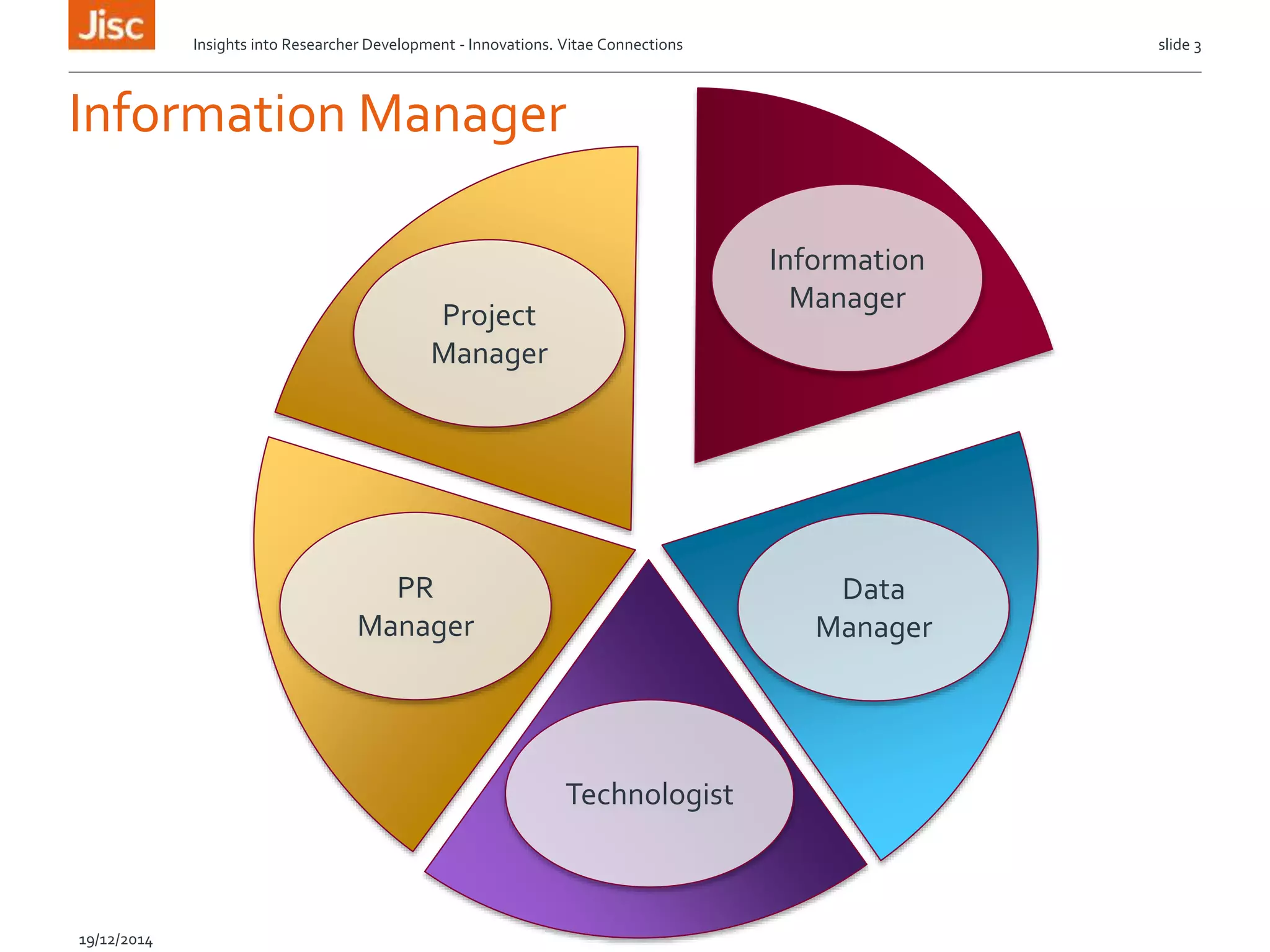
Information Manager
Insights into Researcher Development - Innovations. Vitae Connections slide 3
19/12/2014
Information
Manager
Data
Manager
Technologist
PR
Manager
Project
Manager
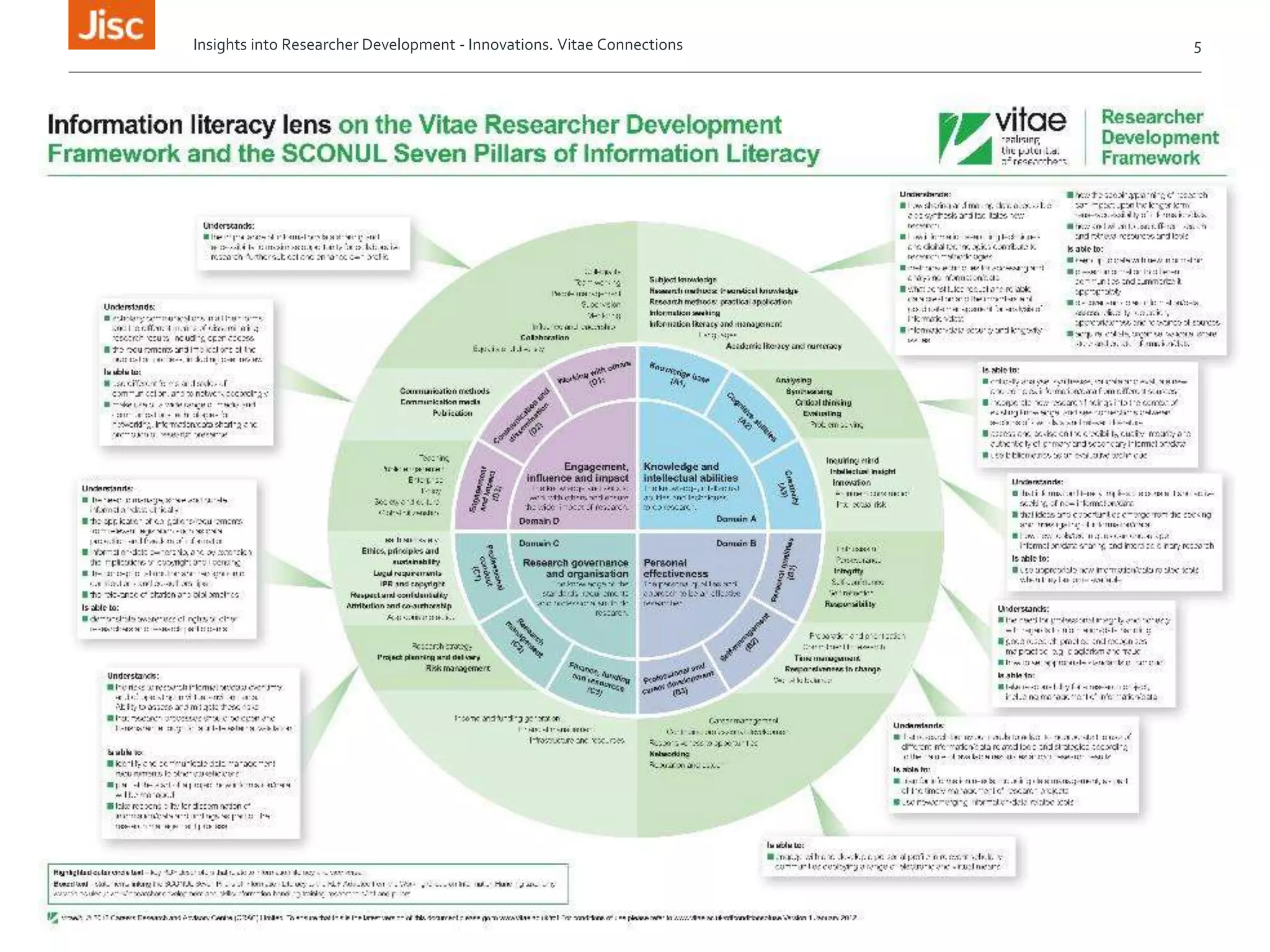
SCONUL Seven Pillars of Literacy
Insights into Researcher Development - Innovations. Vitae Connections 4
Insights into Researcher Development - Innovations. Vitae Connections 5
Researchers ofTomorrow Study
Education for Change, together with The
Research Partnership, was commissioned
by the British Library and JISC to undertake
a ground-breaking study on the research
behaviour of the 'GenerationY' scholar
The study spent three years tracking the
information-seeking behaviour of doctoral
students born between 1982 - 1994;
analysed their habits in online and physical
research environments and assessed how
they used library and information sources,
both on and off line
Over 17,000 doctoral students from more
than 70 higher education institutions
participated in the three annual surveys,
which were complemented by a
longitudinal student cohort study.
Insights into Researcher Development - Innovations. Vitae Connections slide 6
19/12/2014
http://explorationforchange.net/index.php/rot-home.html
Key Findings
Doctoral students are increasingly reliant on secondary research resources (e.g. journal articles, books),
moving away from primary materials (e.g. primary archival material and large datasets).
Access to relevant resources is a major constraint for doctoral students’ progress. Authentication access
and licence limitations to subscription-based resources, such as e-journals, are particularly problematic.
Open access and copyright appear to be a source of confusion for GenerationY doctoral students, rather
than encouraging innovation and collaborative research.
This generation of doctoral students operate in an environment where their research behaviour does
not use the full potential of innovative technology.
Doctoral students are insufficiently trained or informed to be able to fully embrace the latest
opportunities in the digital information environment.
Key Barriers
»Time Constraints - finding electronic research and getting hold of relevant
resources
»Doctoral students believe that they are insufficiently trained or informed to
enable them to embrace the latest opportunities
»Low awareness and understanding of intellectual property and copyright and
open access
Insights into Researcher Development - Innovations. Vitae Connections slide 7
19/12/2014
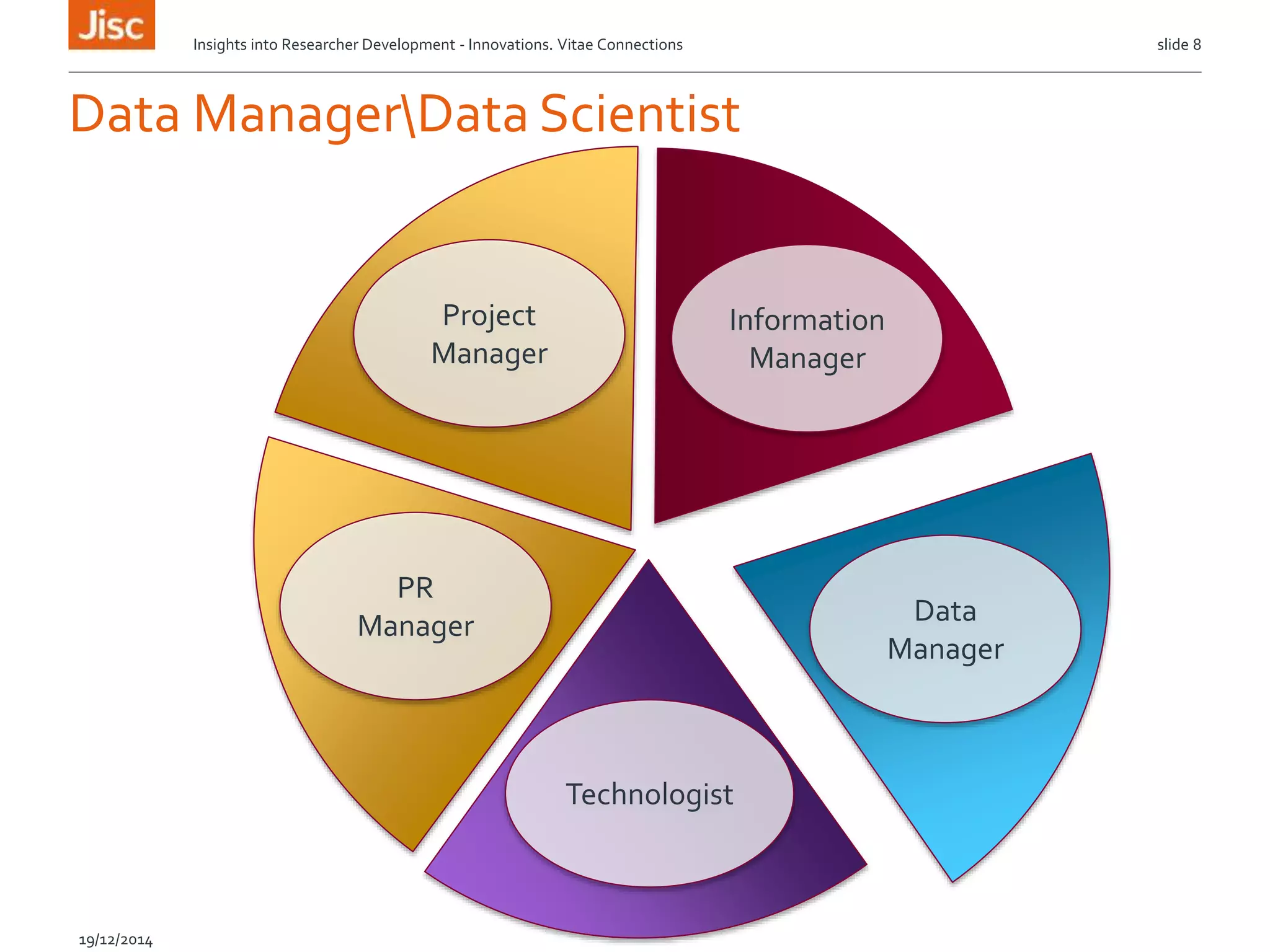
Data ManagerData Scientist
Insights into Researcher Development - Innovations. Vitae Connections slide 8
19/12/2014
Information
Manager
Data
Manager
Technologist
PR
Manager
Project
Manager
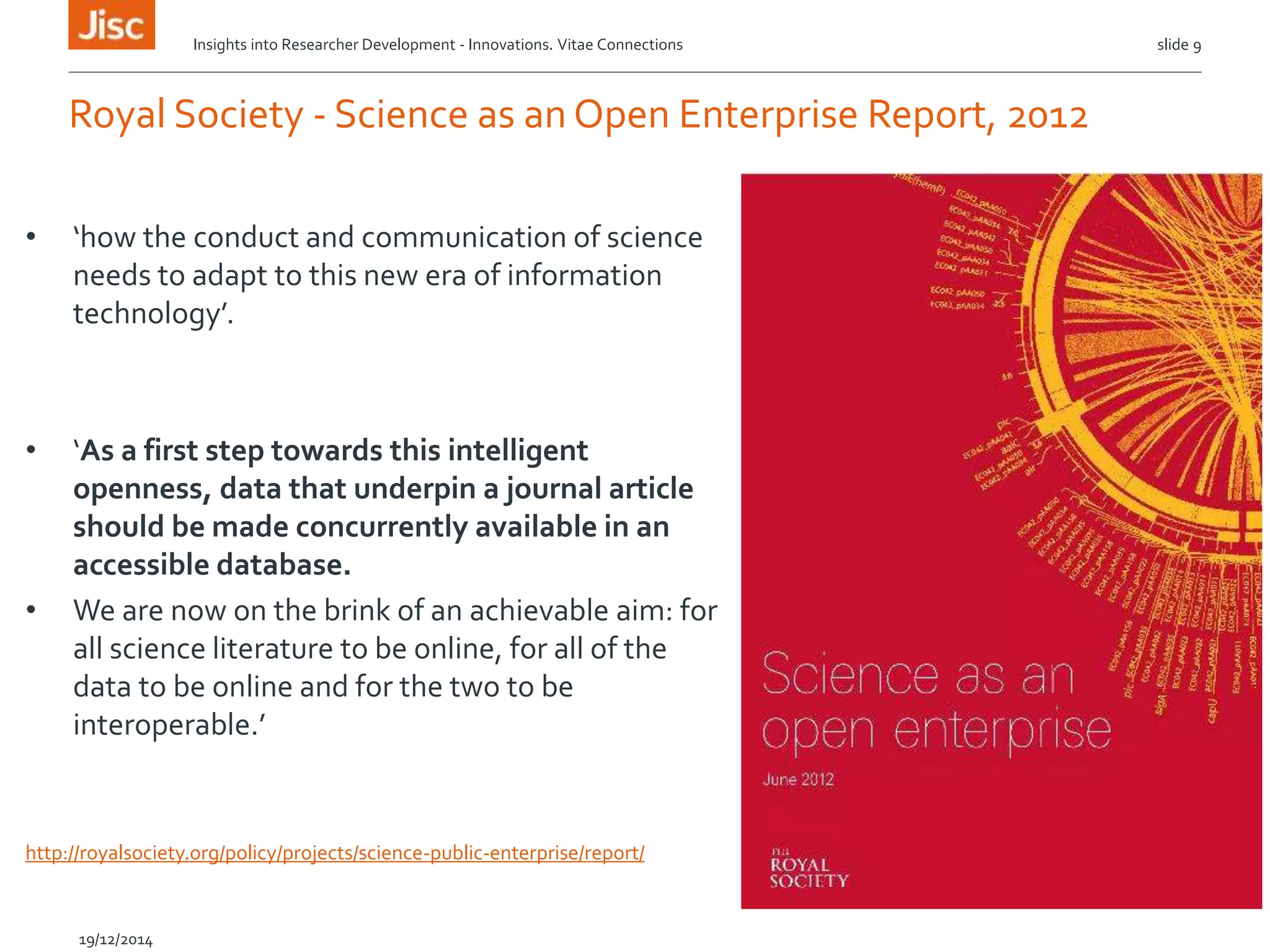
Royal Society - Science as an Open Enterprise Report, 2012
Insights into Researcher Development - Innovations. Vitae Connections slide 9
19/12/2014
• ‘how the conduct and communication of science
needs to adapt to this new era of information
technology’.
• ‘As a first step towards this intelligent
openness, data that underpin a journal article
should be made concurrently available in an
accessible database.
• We are now on the brink of an achievable aim: for
all science literature to be online, for all of the
data to be online and for the two to be
interoperable.’
http://royalsociety.org/policy/projects/science-public-enterprise/report/
G8 Science Ministers Statement London UK, 12 June 2013
»To the greatest extent and with the fewest constraints possible publicly funded
scientific research data should be open, while at the same time respecting
concerns in relation to privacy, safety, security and commercial interests, whilst
acknowledging the legitimate concerns of private partners.
»Open scientific research data should be easily discoverable, accessible,
assessable, intelligible, useable, and wherever possible interoperable to specific
quality standards.
»To maximise the value that can be realised from data, the mechanisms for
delivering open scientific research data should be efficient and cost effective, and
consistent with the potential benefits.
»To ensure successful adoption by scientific communities, open scientific research
data principles will need to be underpinned by an appropriate policy
environment, including recognition of researchers fulfilling these principles, and
appropriate digital infrastructure.
Insights into Researcher Development - Innovations. Vitae Connections slide 10
Open Scientific Research Data
19/12/2014
EU Digital ERA
Optimal circulation, access to and transfer of scientific knowledge
COMMUNICATION FROMTHE COMMISSIONTOTHE EUROPEAN PARLIAMENT,THE COUNCIL,THE
EUROPEAN ECONOMIC AND SOCIAL COMMITTEE ANDTHE COMMITTEE OFTHE REGIONS - A
Reinforced European Research Area Partnership for Excellence and Growth. 17July 2012.
Pilot on Open Research Data in H2020
» Areas of the 2014-2015 Work Programme participating in the Open Research Data Pilot are:
› Future and Emerging Technologies
› Research infrastructures – part e-Infrastructures
› Leadership in enabling and industrial technologies – Information and Communication
Technologies
› Societal Challenge: Secure, Clean and Efficient Energy – part Smart cities and communities
› Societal Challenge: Climate Action, Environment, Resource Efficiency and Raw materials –
except raw materials
› Societal Challenge: Europe in a changing world – inclusive, innovative and reflective Societies
› Science with and for Society
› Projects in other areas can participate on a voluntary basis.
Insights into Researcher Development - Innovations. Vitae Connections slide 11
19/12/2014
Data as New Output of Research
‘technology has enabled data to become the prevalent material and currency of
research. Data, not information, not publications, is rapidly becoming the
accepted deliverable of research.’
Graham Pryor, Observations on the RLUK Reskilling for Research Report
http://www.dpconline.org/newsroom/whats-new/842-whats-new-issue-44-april-
2012
slide 12
19/12/2014
Insights into Researcher Development - Innovations. Vitae Connections
Why Research Data Management?
•Research Excellence & Impact – data will be cited; used by others
including peers, other disciplines, the public, industry, in learning –
ability to meet global challenges; innovate & create new research
areas.
•Research integrity - replication, verification of research,
improvement of methods & results.
•Efficiency - save duplication of research effort, data creation &
therefore costs; ease of access & re-use.
•Managing risks – ability to meet FOI requests; protect reputation.
Insights into Researcher Development - Innovations. Vitae Connections slide 13
19/12/2014
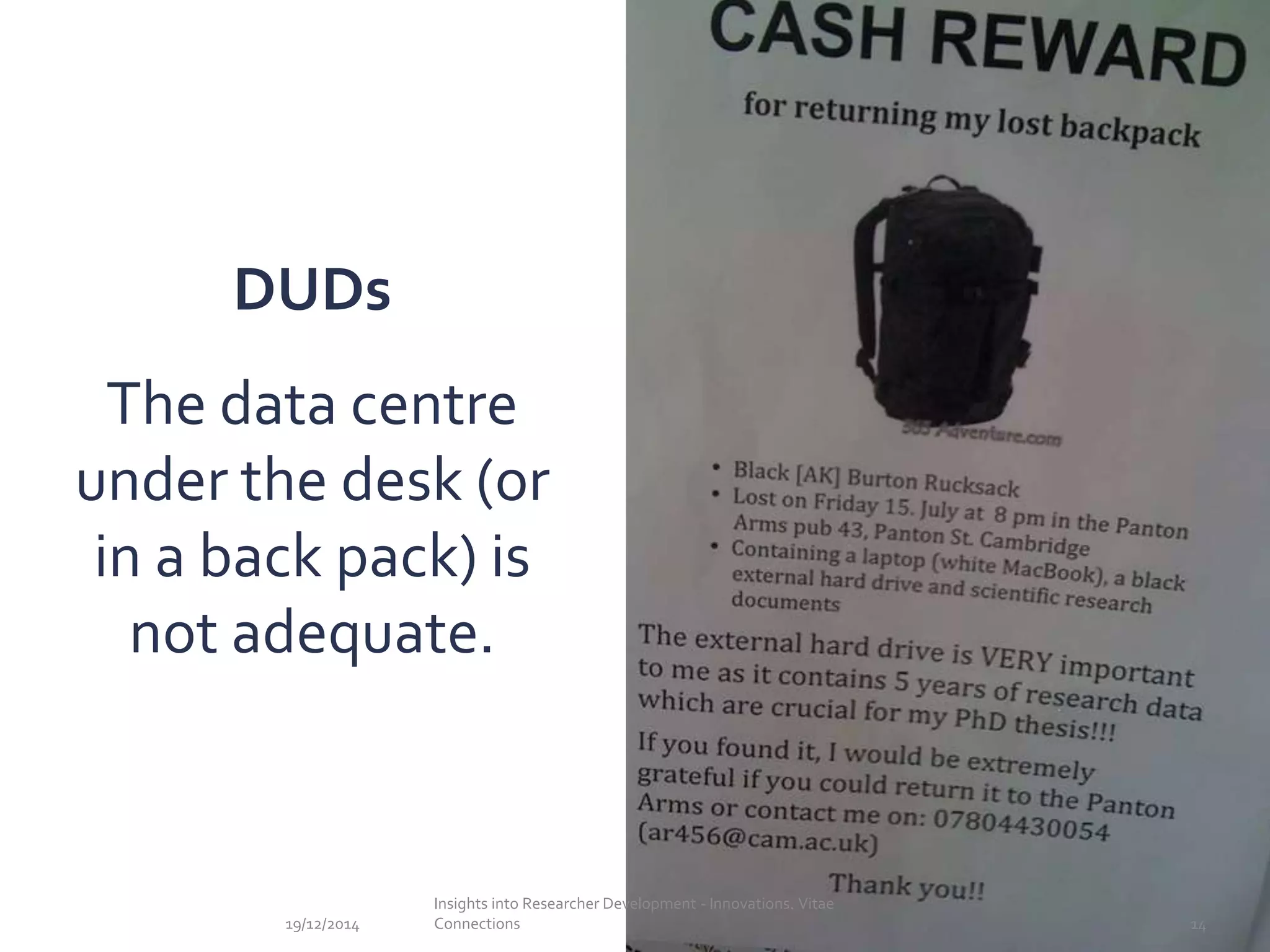
DUDs
The data centre
under the desk (or
in a back pack) is
not adequate.
1419/12/2014
Insights into Researcher Development - Innovations. Vitae
Connections
Access and
ID management
Standards;
policies;
coordination &
cooperation.
EASY
ACCESS
Data
identifiers
Access &
security
Researcher/
organisational
identifiers
Funders
policies
Deposit
protocols and
infrastructure
Advice &
guidance/good
practice
R@R:
Support
take up of
citation
R@R:UK
Research
Data
Discovery
metadata
R@R: metrics
& usage data
service
DMP
OnLine
R@R:
DMP
registry
Cardio
planning
tool
R@R:
RD Spring
prototypes
UKDS
/Institutional
repositories
R@R: shared
Preservation
Repositories
(metadata)
Digital Curation
Centre
Open
Training
Materials
in Jorum
Shared data
centre
R@R:
comprehensive
tool-kit;
case studies
Sherpa Juliet
Funder policies
R@R:
Journal
Policy
registry
R@R:
EPSRC
support
R@R:
busines
s case
& costs
R@R:
RD Spring
Prototypes, &
BRISSkit
Janet networkCloud and
HPC brokerage
Insights into Researcher Development - Innovations. Vitae Connections 15
Jisc Research Data Infrastructure
19/12/2014
Need forTraining in RDM and Data Skills
‘data skills should be made a core academic competency’
‘data handling [should be] embedded in the curriculum’
‘There is a need to go beyond the workshop and the short
training course, and embed preparation for a professional
(and personal) lifetime of digital data curation within the
academic curriculum.’
Graham Pryor and Martin Donnelly (2009), ‘Skilling up to do data: whose role, whose
responsibility, whose career? IJDC, Issue 2,Volume 4, pp.158-170.
slide 16
19/12/2014
Insights into Researcher Development - Innovations. Vitae Connections
“When you go and look at what scientists are doing, day in and day out, in terms of
data analysis, it is truly dreadful.We are embarrassed by our data!”
Jim Gray, Microsoft
»So what are the priorities?
› 1. Ensuring scientifically valid processing
› 2. Innovative manipulation to create new information
› 3. Effective management of research data
“There is a serious issue of education, training and support at undergraduate,
doctoral and post-doctoral levels”
Geoffrey Boulton (University of Edinburgh)
slide 17
“Its not just curation, retrieving and
integrating data – its also what we do with it!”
19/12/2014
Insights into Researcher Development - Innovations. Vitae Connections
Big Data
Insights into Researcher Development - Innovations. Vitae Connections slide 18
19/12/2014
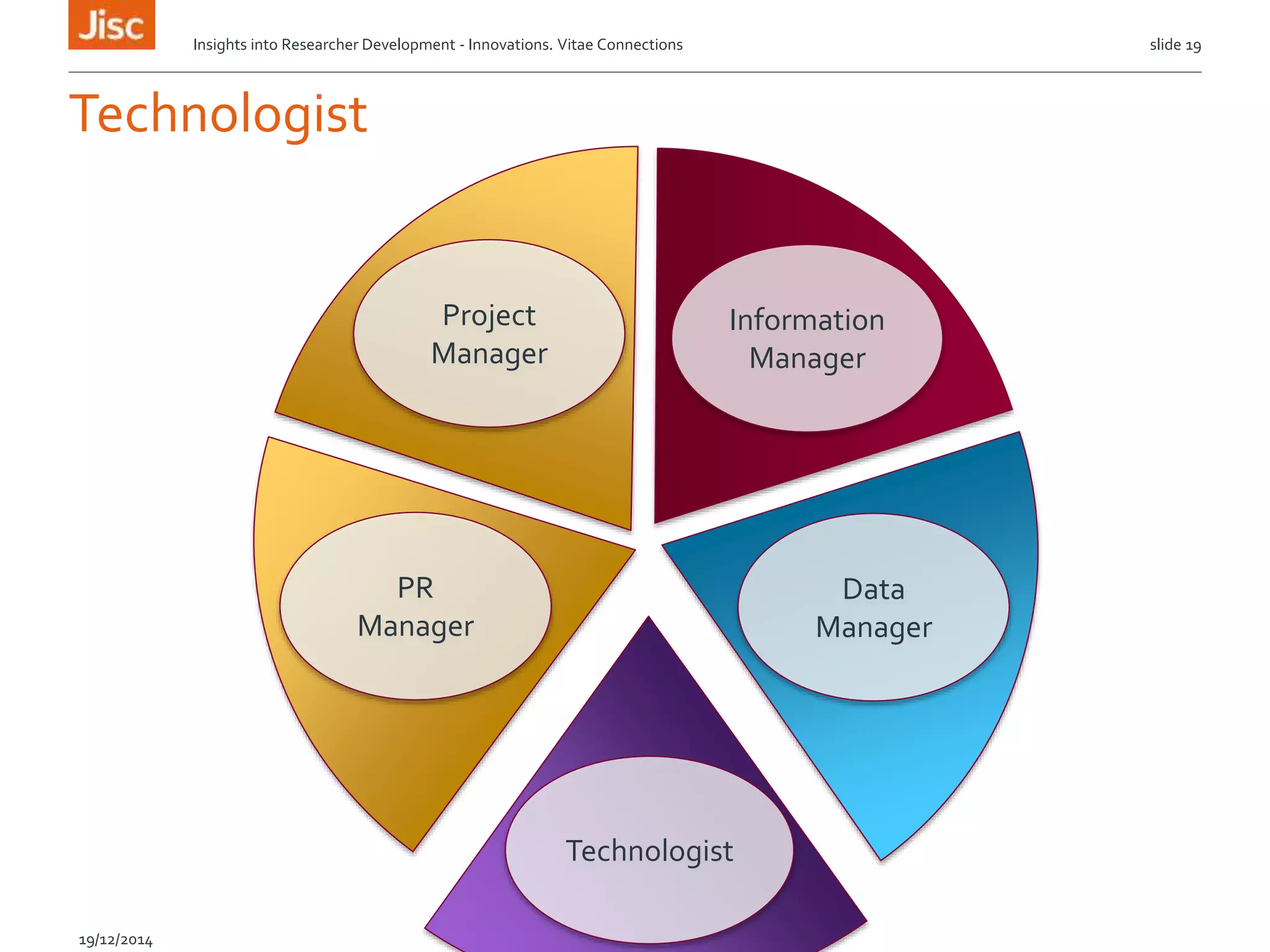
Technologist
Insights into Researcher Development - Innovations. Vitae Connections slide 19
19/12/2014
Information
Manager
Data
Manager
Technologist
PR
Manager
Project
Manager
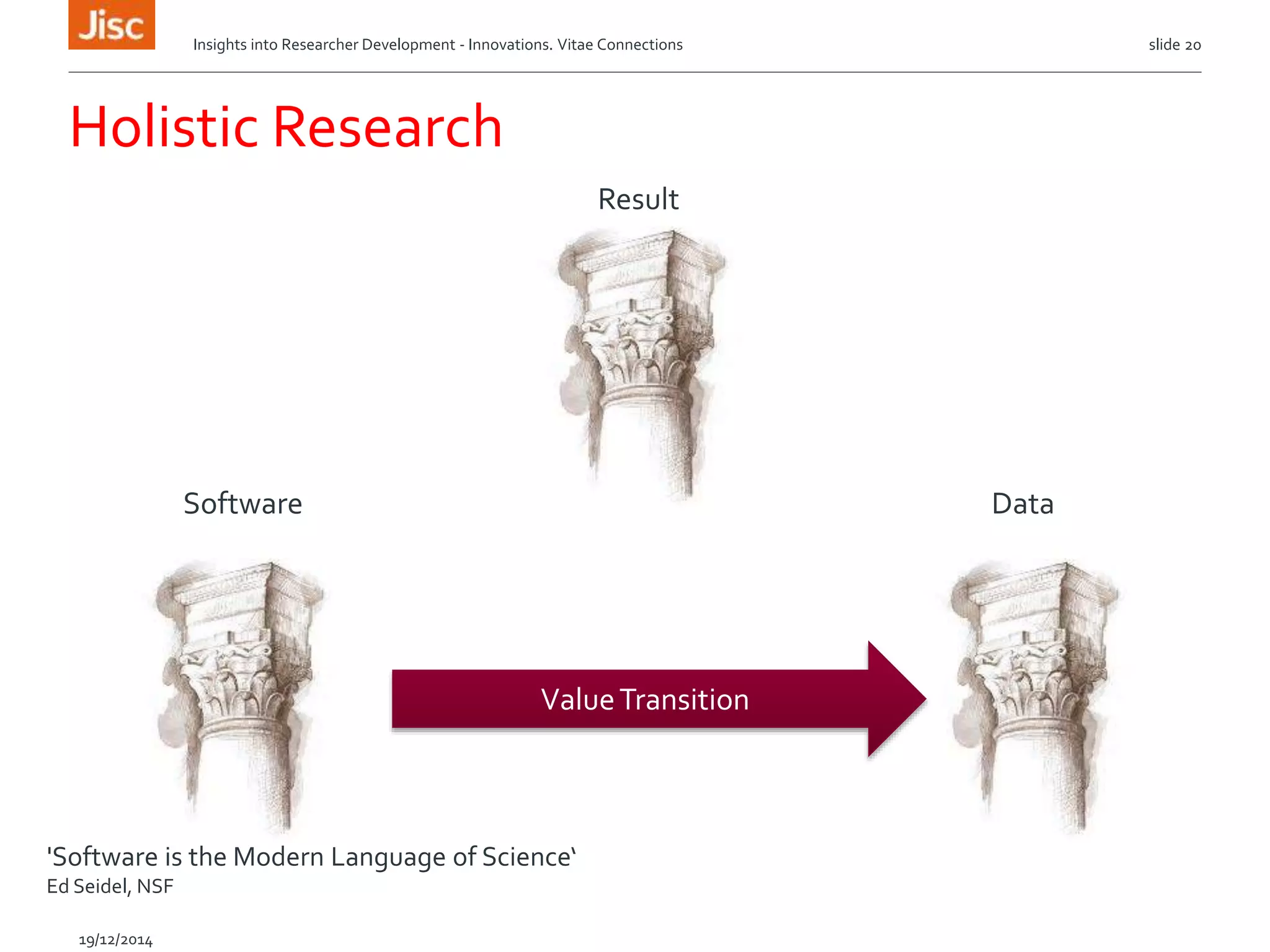
Holistic Research
Insights into Researcher Development - Innovations. Vitae Connections slide 20
19/12/2014
Result
DataSoftware
ValueTransition
'Software is the Modern Language of Science‘
Ed Seidel, NSF
“It is important to place a higher value upon the position of
“scientific programmer” and also “data scientist” in the
academic environment and to offer more career opportunities to
these staff. Scientific programmers combine the knowledge of
the …discipline with implementation, optimisation and
parallelisation for high end systems: they are important in
obtaining highly efficient application implementations.
Scientists outside the domains of engineering and the physical
sciences are particularly unlikely to have been exposed to the
necessary skills, and will need special mentoring if they are to
make the most of the opportunities offered by e-Science.”
e-Infrastructure vision for the UK, DBIS, 2012
Insights into Researcher Development - Innovations. Vitae Connections slide 21
19/12/2014
http://www.jisc.ac.uk/publications/briefingpapers/2011/bpsupportingresearchers.aspx 22
23http://www.jisc.ac.uk/publications/briefingpapers/2011/bpsupportingresearchers.aspx
24http://www.jisc.ac.uk/publications/briefingpapers/2011/bpsupportingresearchers.aspx
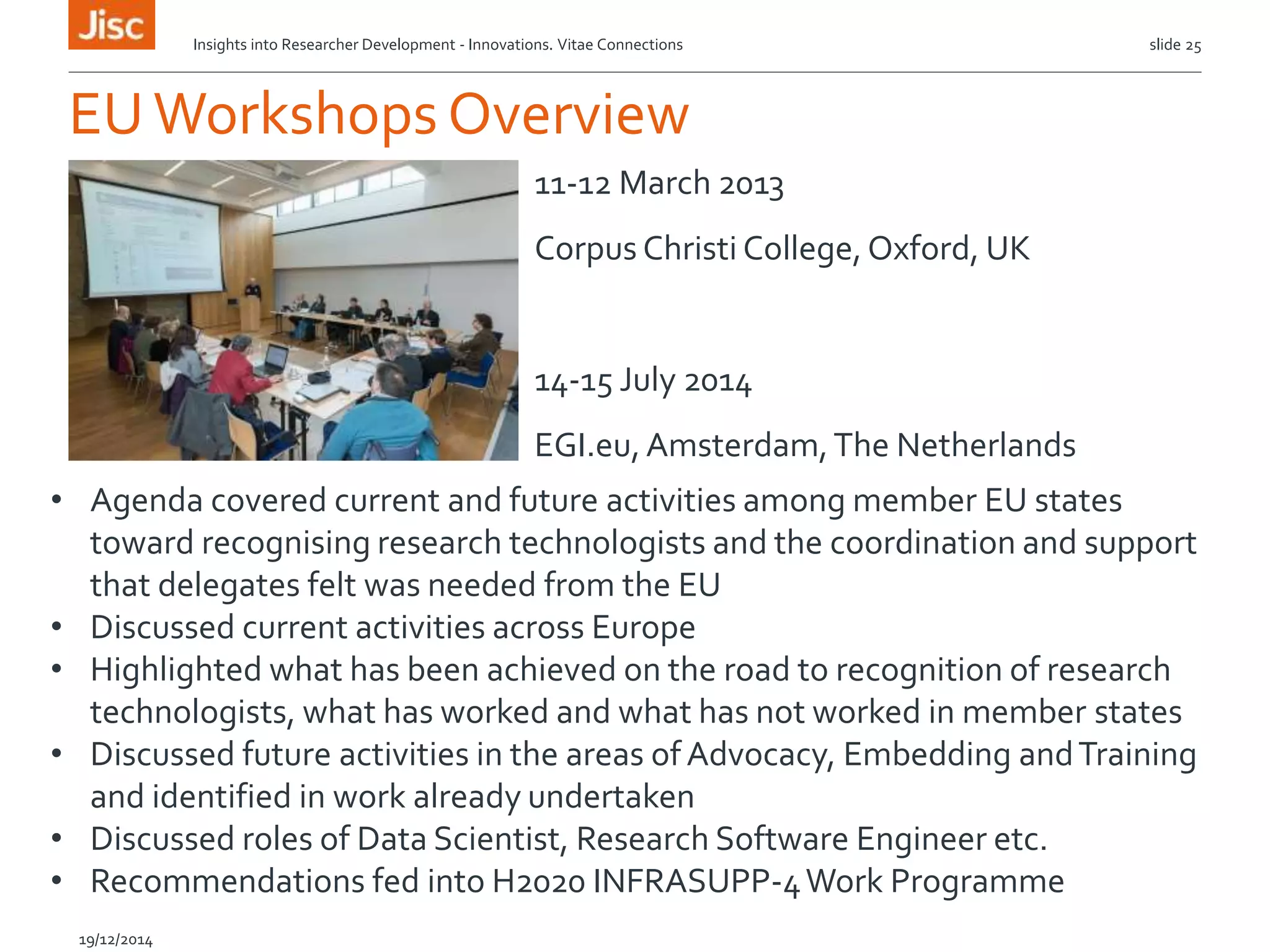
EUWorkshops Overview
Insights into Researcher Development - Innovations. Vitae Connections slide 25
19/12/2014
11-12 March 2013
Corpus Christi College,Oxford, UK
14-15 July 2014
EGI.eu,Amsterdam,The Netherlands
.
• Agenda covered current and future activities among member EU states
toward recognising research technologists and the coordination and support
that delegates felt was needed from the EU
• Discussed current activities across Europe
• Highlighted what has been achieved on the road to recognition of research
technologists, what has worked and what has not worked in member states
• Discussed future activities in the areas of Advocacy, Embedding andTraining
and identified in work already undertaken
• Discussed roles of Data Scientist, Research Software Engineer etc.
• Recommendations fed into H2020 INFRASUPP-4Work Programme
Institutional
and funding
council
structures and
policies
ICT facilities
and associated
support
Training
researchers
Transforming
or making
available
research
outputs
Creating
technology
Creating
innovation
Developing
software
Using tools and
e-infrastructure
Data curation
and
management
Services and
solutions
RESEARCH
“SkillsWheel”
Insights into Researcher Development - Innovations. Vitae Connections 26
19/12/2014
Institutional
and funding
council
structures and
policies
ICT facilities
and associated
support
Training
researchers
Transforming
or making
available
research
outputs
Creating
technology
Creating
innovation
Developing
software
Using tools and
e-infrastructure
Data curation
and
management
Services and
solutions
RESEARCH
Researcher
“Researcher”
Insights into Researcher Development - Innovations. Vitae Connections 27
19/12/2014
Institutional
and funding
council
structures and
policies
ICT facilities
and associated
support
Training
researchers
Transforming
or making
available
research
outputs
Creating
technology
Creating
innovation
Developing
software
Using tools and
e-infrastructure
Data curation
and
management
Services and
solutions
RESEARCH
ICT Capable
Researcher
“ICT-skilled
Researcher”
Insights into Researcher Development - Innovations. Vitae Connections 28
19/12/2014
Institutional
and funding
council
structures and
policies
ICT facilities
and associated
support
Training
researchers
Transforming
or making
available
research
outputs
Creating
technology
Creating
innovation
Developing
software
Using tools and
e-infrastructure
Data curation
and
management
Services and
solutions
RESEARCH
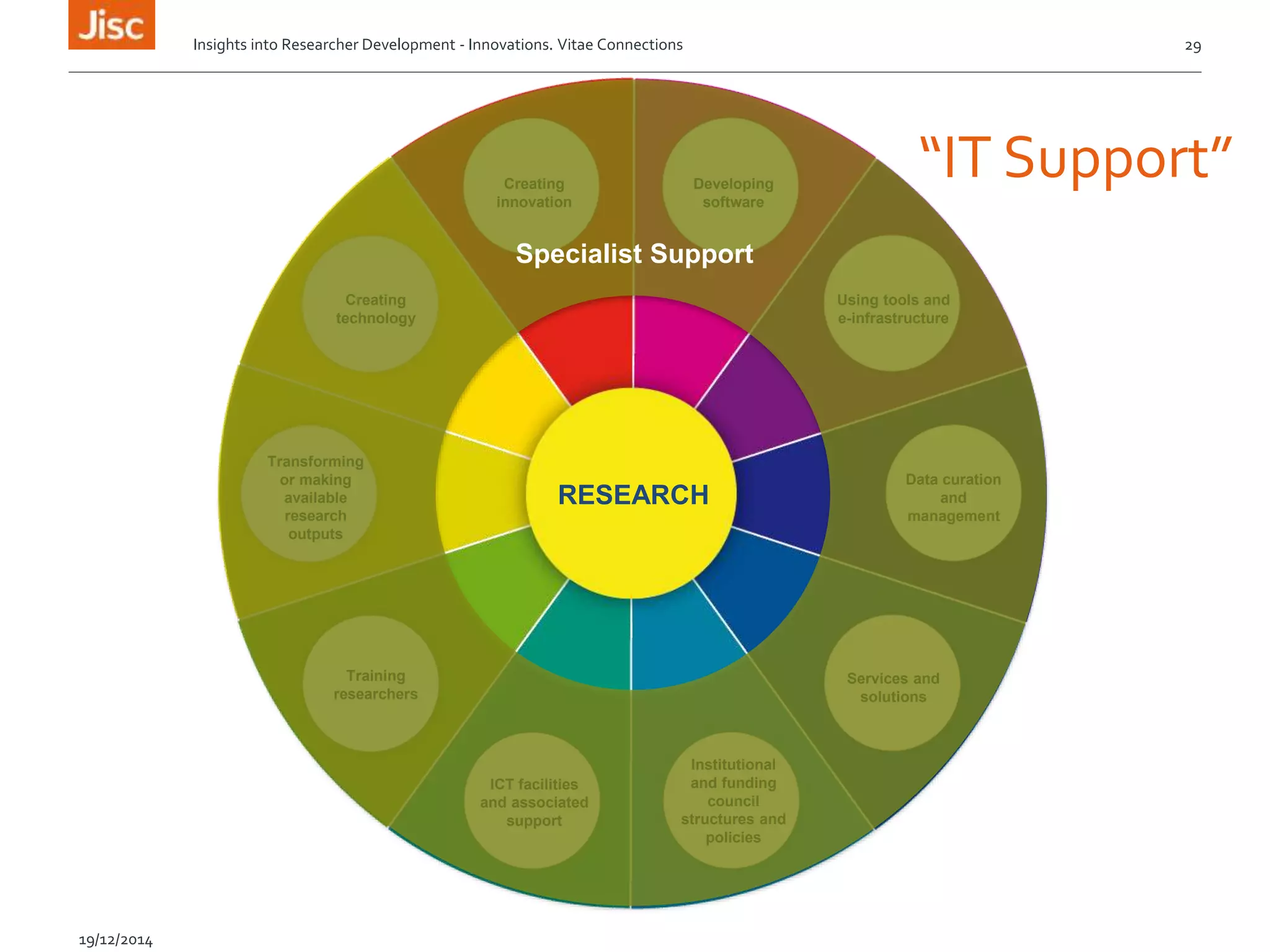
Specialist Support
“IT Support”
Insights into Researcher Development - Innovations. Vitae Connections 29
19/12/2014
Institutional
and funding
council
structures and
policies
ICT facilities
and associated
support
Training
researchers
Transforming
or making
available
research
outputs
Creating
technology
Creating
innovation
Developing
software
Using tools and
e-infrastructure
Data curation
and
management
Services and
solutions
RESEARCH
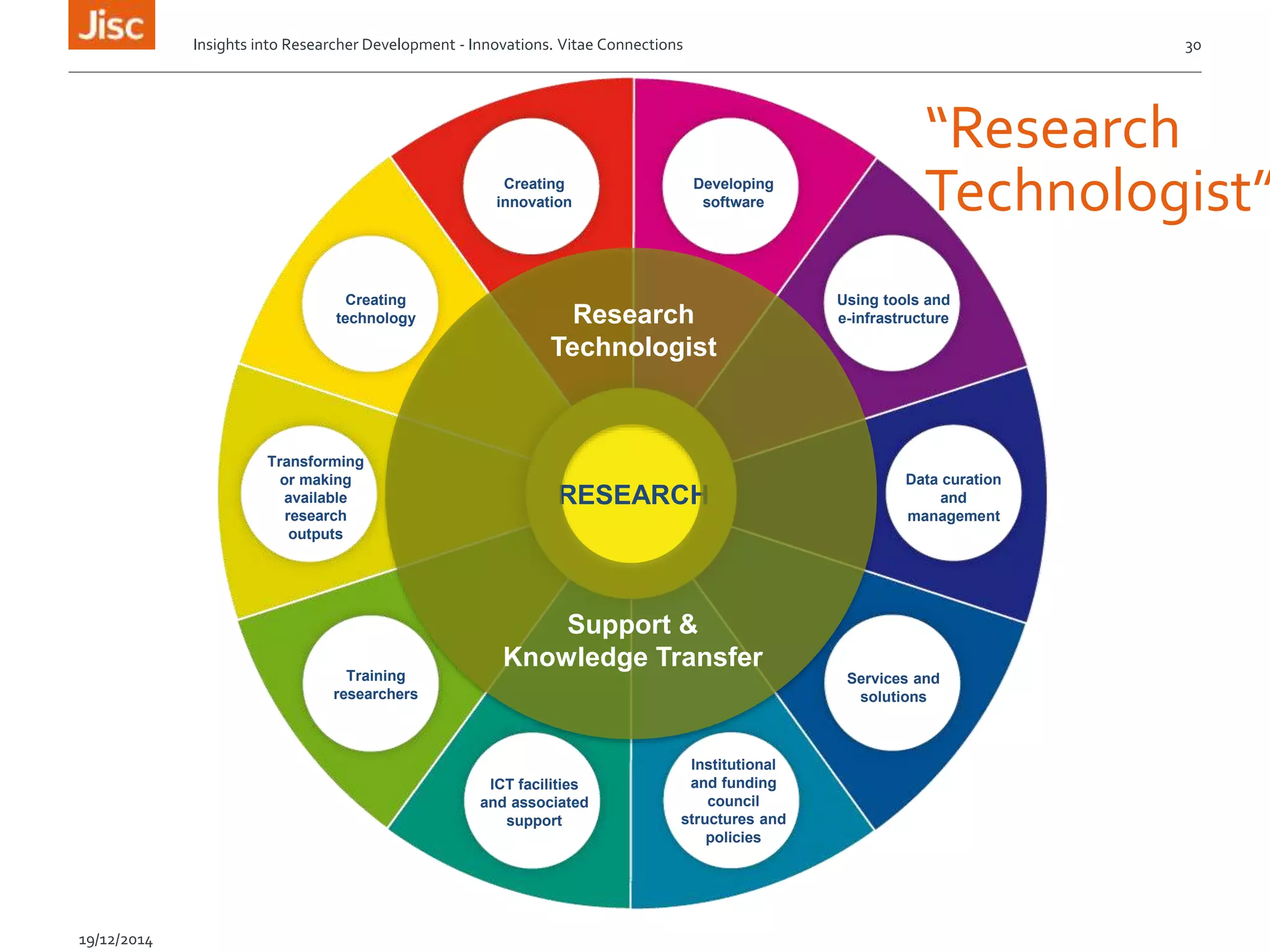
Research
Technologist
Support &
Knowledge Transfer
“Research
Technologist”
Insights into Researcher Development - Innovations. Vitae Connections 30
19/12/2014
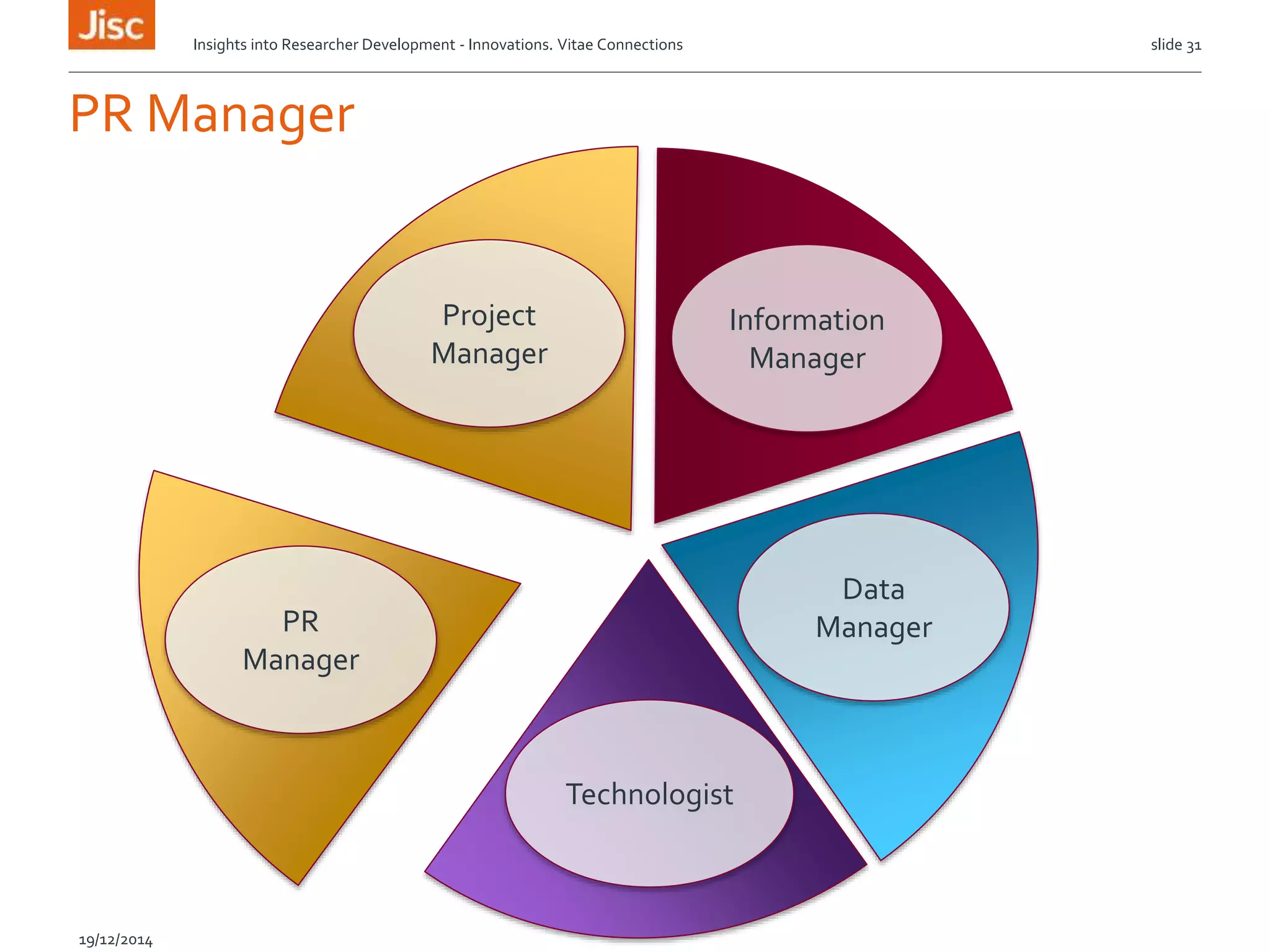
PR Manager
Insights into Researcher Development - Innovations. Vitae Connections slide 31
19/12/2014
Information
Manager
Data
Manager
Technologist
PR
Manager
Project
Manager
Research has a cast list
slide 32
19/12/2014
Career of the Future: Data Scientist Study Results Infographic
EMC2 : http://www.emc.com/microsites/bigdata/infographic.htm
Insights into Researcher Development - Innovations. Vitae Connections
“Scientific fraud is rife: it's time to stand up for good science”
“Science is broken” Examples:
psychology academics making up data,
anaesthesiologistYoshitaka Fujii with 172 faked articles
Nature - rise in biomedical retraction rates overtakes rise in published
papers
This week,
slide 33
19/12/2014
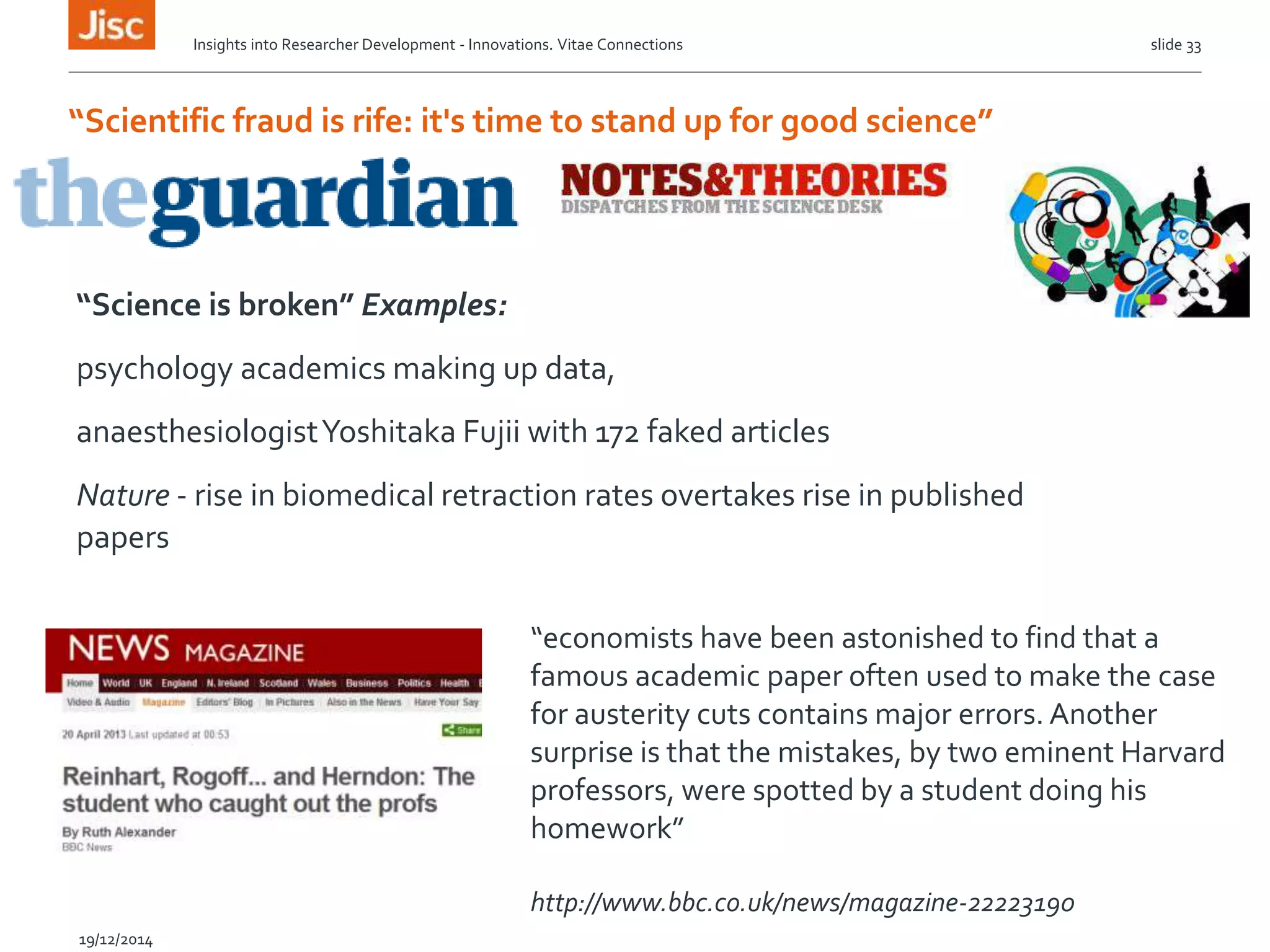
“economists have been astonished to find that a
famous academic paper often used to make the case
for austerity cuts contains major errors. Another
surprise is that the mistakes, by two eminent Harvard
professors, were spotted by a student doing his
homework”
http://www.bbc.co.uk/news/magazine-22223190
Insights into Researcher Development - Innovations. Vitae Connections
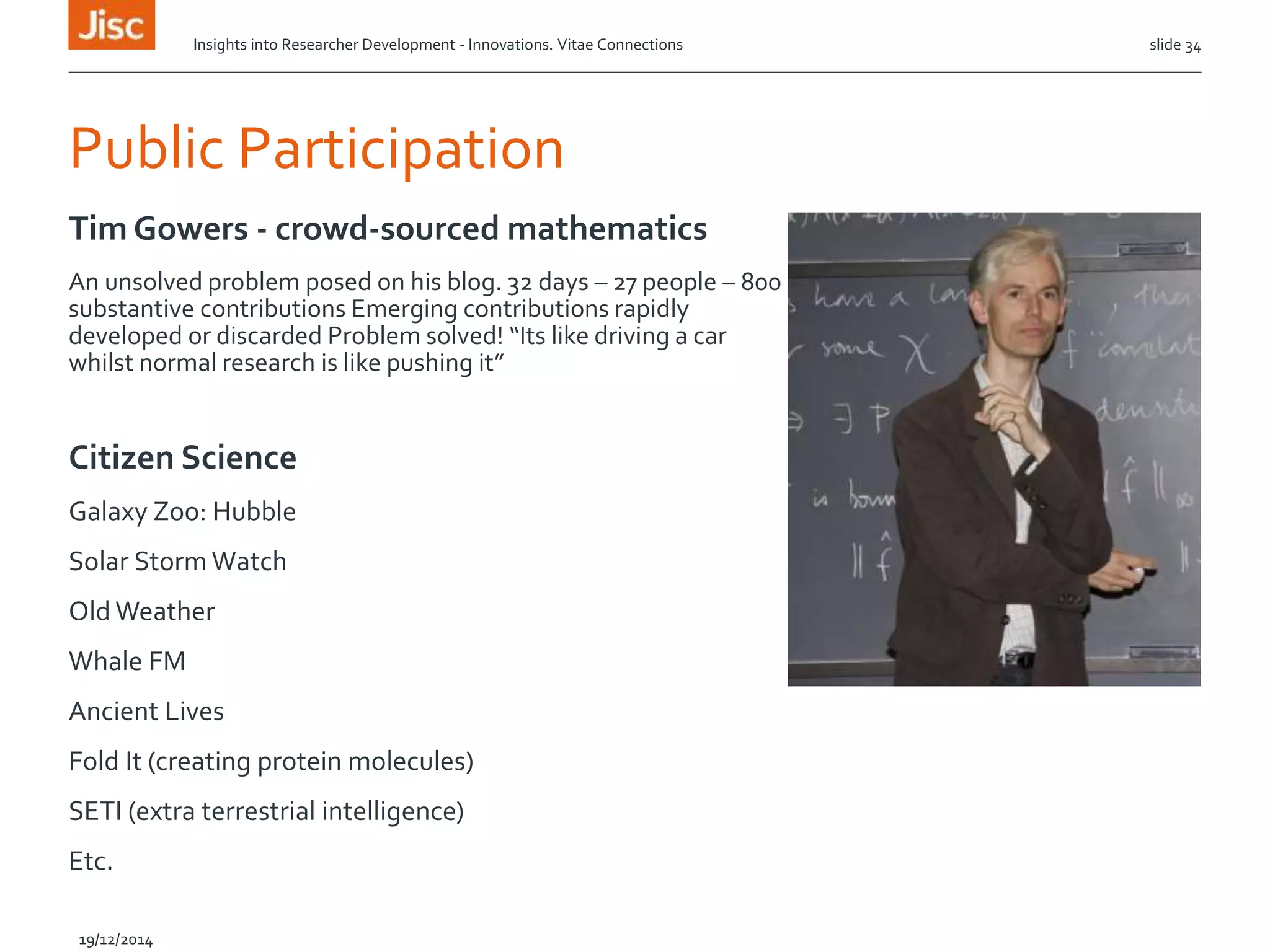
Public Participation
Tim Gowers - crowd-sourced mathematics
An unsolved problem posed on his blog. 32 days – 27 people – 800
substantive contributions Emerging contributions rapidly
developed or discarded Problem solved! “Its like driving a car
whilst normal research is like pushing it”
Citizen Science
Galaxy Zoo: Hubble
Solar Storm Watch
Old Weather
Whale FM
Ancient Lives
Fold It (creating protein molecules)
SETI (extra terrestrial intelligence)
Etc.
slide 34
19/12/2014
Insights into Researcher Development - Innovations. Vitae Connections
The Open DigitalWorld is HighlyVisible
Public Engagement with Science
»Citizen Science
»Public Critique
› “Climate-gate”
› Tree rings data
»Scrutiny of public funding
Persistence of Digital Footprint
»Social network embarrassments
»Working in the public eye
»Digital information cannot easily be revoked
Need for skills for conduct and communication with the general public not
just peers
slide 35
19/12/2014
Insights into Researcher Development - Innovations. Vitae Connections
Digital Roles of the Future Researcher
Insights into Researcher Development - Innovations. Vitae Connections slide 36
19/12/2014
Information
Manager
Data
Manager
Technologist
PR
Manager
Project
Manager
Gateway for Higher Education
The G4HE project aims to engage with the BIS-funded RCUK Gateway to Research
(GtR) initiative to improve the information exchange between HEIs and the
Research Councils.The project will develop tools and interfaces to allow both
human and machine access to data held on GtR, and elsewhere where that is
required.The tools and interfaces will be based on validated use-cases shown to
have specific and demonstrable value to HEIs, and will be subject to robust
assurance on both quality and sustainability criteria.The use cases will be used to
prioritise which data improvements should be addressed and what value this
delivers for universities.
Insights into Researcher Development - Innovations. Vitae Connections 37
19/12/2014
Jisc Futures Co-design
»In 2010 we defined digital literacies as: those
capabilities which fit someone for living, learning and
working in a digital society
»It’s a much-disputed term, but the concept struck a
chord in the sector, especially from 2012-13 onwards
»Now in 2014 we’re being asked to address ‘digital
capability’ in the HE and FE sectors as a priority
challenge
Insights into Researcher Development - Innovations. Vitae Connections 38
Building Digital Capability
Building digital capability
»Need emerged from sector consultation
»Running mid-2014 to end 2015
»Covers a wide range of roles, including researchers
»Building on the work of the Jisc developing digital literacies programme,
whichVitae participated in
»Digital capability framework will be pulled together in collaboration with
bodies likeVitae, building on existing frameworks such as the RDF and
others in the research space
»Diagnostic tools will include those for researcher skills – simple example at
http://bit.ly/researcherquiz
»Staff-student partnerships can be particularly effective with research
students
»Find out more at http://digitalcapability.jiscinvolve.org/
Insights into Researcher Development - Innovations. Vitae Connections 39
19/12/2014
Building digital capability
Insights into Researcher Development - Innovations. Vitae Connections 40
19/12/2014
Digital
capability
framework
Diagnostic
tools
Leadership
development
MOOC
Staff-student
partnerships
Underpinning
layer
Models and
examples of
impact
assessment
Stakeholder
engagement
Presentation layer
(toolkit, resources
and guidance)
© Jisc 2014
Jisc permits reuse of this presentation and its contents under the terms of the
Creative Commons Attribution-Non-Commercial-No Derivative Works 2.0 UK
England &Wales Licence.
http://creativecommons.org/licenses/by-nc-nd/2.0/uk
Insights into Researcher Development - Innovations. Vitae Connections slide 41
19/12/2014

Vitae tomorrows-researchers

  • 1.
    19/12/2014 Insights into ResearcherDevelopment - Innovations. Vitae Connections slide 1 Tomorrow's Researchers Matthew Dovey Jisc Technologies matthew.dovey@jisc.ac.uk Skills Needed to Adapt to the Future Demands of Digital Research
  • 2.
    Digital Roles ofthe Future Researcher Insights into Researcher Development - Innovations. Vitae Connections slide 2 19/12/2014 Information Manager Data Manager Technologist PR Manager Project Manager
  • 3.
    Information Manager Insights intoResearcher Development - Innovations. Vitae Connections slide 3 19/12/2014 Information Manager Data Manager Technologist PR Manager Project Manager
  • 4.
    SCONUL Seven Pillarsof Literacy Insights into Researcher Development - Innovations. Vitae Connections 4
  • 5.
    Insights into ResearcherDevelopment - Innovations. Vitae Connections 5
  • 6.
    Researchers ofTomorrow Study Educationfor Change, together with The Research Partnership, was commissioned by the British Library and JISC to undertake a ground-breaking study on the research behaviour of the 'GenerationY' scholar The study spent three years tracking the information-seeking behaviour of doctoral students born between 1982 - 1994; analysed their habits in online and physical research environments and assessed how they used library and information sources, both on and off line Over 17,000 doctoral students from more than 70 higher education institutions participated in the three annual surveys, which were complemented by a longitudinal student cohort study. Insights into Researcher Development - Innovations. Vitae Connections slide 6 19/12/2014 http://explorationforchange.net/index.php/rot-home.html
  • 7.
    Key Findings Doctoral studentsare increasingly reliant on secondary research resources (e.g. journal articles, books), moving away from primary materials (e.g. primary archival material and large datasets). Access to relevant resources is a major constraint for doctoral students’ progress. Authentication access and licence limitations to subscription-based resources, such as e-journals, are particularly problematic. Open access and copyright appear to be a source of confusion for GenerationY doctoral students, rather than encouraging innovation and collaborative research. This generation of doctoral students operate in an environment where their research behaviour does not use the full potential of innovative technology. Doctoral students are insufficiently trained or informed to be able to fully embrace the latest opportunities in the digital information environment. Key Barriers »Time Constraints - finding electronic research and getting hold of relevant resources »Doctoral students believe that they are insufficiently trained or informed to enable them to embrace the latest opportunities »Low awareness and understanding of intellectual property and copyright and open access Insights into Researcher Development - Innovations. Vitae Connections slide 7 19/12/2014
  • 8.
    Data ManagerData Scientist Insightsinto Researcher Development - Innovations. Vitae Connections slide 8 19/12/2014 Information Manager Data Manager Technologist PR Manager Project Manager
  • 9.
    Royal Society -Science as an Open Enterprise Report, 2012 Insights into Researcher Development - Innovations. Vitae Connections slide 9 19/12/2014 • ‘how the conduct and communication of science needs to adapt to this new era of information technology’. • ‘As a first step towards this intelligent openness, data that underpin a journal article should be made concurrently available in an accessible database. • We are now on the brink of an achievable aim: for all science literature to be online, for all of the data to be online and for the two to be interoperable.’ http://royalsociety.org/policy/projects/science-public-enterprise/report/
  • 10.
    G8 Science MinistersStatement London UK, 12 June 2013 »To the greatest extent and with the fewest constraints possible publicly funded scientific research data should be open, while at the same time respecting concerns in relation to privacy, safety, security and commercial interests, whilst acknowledging the legitimate concerns of private partners. »Open scientific research data should be easily discoverable, accessible, assessable, intelligible, useable, and wherever possible interoperable to specific quality standards. »To maximise the value that can be realised from data, the mechanisms for delivering open scientific research data should be efficient and cost effective, and consistent with the potential benefits. »To ensure successful adoption by scientific communities, open scientific research data principles will need to be underpinned by an appropriate policy environment, including recognition of researchers fulfilling these principles, and appropriate digital infrastructure. Insights into Researcher Development - Innovations. Vitae Connections slide 10 Open Scientific Research Data 19/12/2014
  • 11.
    EU Digital ERA Optimalcirculation, access to and transfer of scientific knowledge COMMUNICATION FROMTHE COMMISSIONTOTHE EUROPEAN PARLIAMENT,THE COUNCIL,THE EUROPEAN ECONOMIC AND SOCIAL COMMITTEE ANDTHE COMMITTEE OFTHE REGIONS - A Reinforced European Research Area Partnership for Excellence and Growth. 17July 2012. Pilot on Open Research Data in H2020 » Areas of the 2014-2015 Work Programme participating in the Open Research Data Pilot are: › Future and Emerging Technologies › Research infrastructures – part e-Infrastructures › Leadership in enabling and industrial technologies – Information and Communication Technologies › Societal Challenge: Secure, Clean and Efficient Energy – part Smart cities and communities › Societal Challenge: Climate Action, Environment, Resource Efficiency and Raw materials – except raw materials › Societal Challenge: Europe in a changing world – inclusive, innovative and reflective Societies › Science with and for Society › Projects in other areas can participate on a voluntary basis. Insights into Researcher Development - Innovations. Vitae Connections slide 11 19/12/2014
  • 12.
    Data as NewOutput of Research ‘technology has enabled data to become the prevalent material and currency of research. Data, not information, not publications, is rapidly becoming the accepted deliverable of research.’ Graham Pryor, Observations on the RLUK Reskilling for Research Report http://www.dpconline.org/newsroom/whats-new/842-whats-new-issue-44-april- 2012 slide 12 19/12/2014 Insights into Researcher Development - Innovations. Vitae Connections
  • 13.
    Why Research DataManagement? •Research Excellence & Impact – data will be cited; used by others including peers, other disciplines, the public, industry, in learning – ability to meet global challenges; innovate & create new research areas. •Research integrity - replication, verification of research, improvement of methods & results. •Efficiency - save duplication of research effort, data creation & therefore costs; ease of access & re-use. •Managing risks – ability to meet FOI requests; protect reputation. Insights into Researcher Development - Innovations. Vitae Connections slide 13 19/12/2014
  • 14.
    DUDs The data centre underthe desk (or in a back pack) is not adequate. 1419/12/2014 Insights into Researcher Development - Innovations. Vitae Connections
  • 15.
    Access and ID management Standards; policies; coordination& cooperation. EASY ACCESS Data identifiers Access & security Researcher/ organisational identifiers Funders policies Deposit protocols and infrastructure Advice & guidance/good practice R@R: Support take up of citation R@R:UK Research Data Discovery metadata R@R: metrics & usage data service DMP OnLine R@R: DMP registry Cardio planning tool R@R: RD Spring prototypes UKDS /Institutional repositories R@R: shared Preservation Repositories (metadata) Digital Curation Centre Open Training Materials in Jorum Shared data centre R@R: comprehensive tool-kit; case studies Sherpa Juliet Funder policies R@R: Journal Policy registry R@R: EPSRC support R@R: busines s case & costs R@R: RD Spring Prototypes, & BRISSkit Janet networkCloud and HPC brokerage Insights into Researcher Development - Innovations. Vitae Connections 15 Jisc Research Data Infrastructure 19/12/2014
  • 16.
    Need forTraining inRDM and Data Skills ‘data skills should be made a core academic competency’ ‘data handling [should be] embedded in the curriculum’ ‘There is a need to go beyond the workshop and the short training course, and embed preparation for a professional (and personal) lifetime of digital data curation within the academic curriculum.’ Graham Pryor and Martin Donnelly (2009), ‘Skilling up to do data: whose role, whose responsibility, whose career? IJDC, Issue 2,Volume 4, pp.158-170. slide 16 19/12/2014 Insights into Researcher Development - Innovations. Vitae Connections
  • 17.
    “When you goand look at what scientists are doing, day in and day out, in terms of data analysis, it is truly dreadful.We are embarrassed by our data!” Jim Gray, Microsoft »So what are the priorities? › 1. Ensuring scientifically valid processing › 2. Innovative manipulation to create new information › 3. Effective management of research data “There is a serious issue of education, training and support at undergraduate, doctoral and post-doctoral levels” Geoffrey Boulton (University of Edinburgh) slide 17 “Its not just curation, retrieving and integrating data – its also what we do with it!” 19/12/2014 Insights into Researcher Development - Innovations. Vitae Connections
  • 18.
    Big Data Insights intoResearcher Development - Innovations. Vitae Connections slide 18 19/12/2014
  • 19.
    Technologist Insights into ResearcherDevelopment - Innovations. Vitae Connections slide 19 19/12/2014 Information Manager Data Manager Technologist PR Manager Project Manager
  • 20.
    Holistic Research Insights intoResearcher Development - Innovations. Vitae Connections slide 20 19/12/2014 Result DataSoftware ValueTransition 'Software is the Modern Language of Science‘ Ed Seidel, NSF
  • 21.
    “It is importantto place a higher value upon the position of “scientific programmer” and also “data scientist” in the academic environment and to offer more career opportunities to these staff. Scientific programmers combine the knowledge of the …discipline with implementation, optimisation and parallelisation for high end systems: they are important in obtaining highly efficient application implementations. Scientists outside the domains of engineering and the physical sciences are particularly unlikely to have been exposed to the necessary skills, and will need special mentoring if they are to make the most of the opportunities offered by e-Science.” e-Infrastructure vision for the UK, DBIS, 2012 Insights into Researcher Development - Innovations. Vitae Connections slide 21 19/12/2014
  • 22.
  • 23.
  • 24.
  • 25.
    EUWorkshops Overview Insights intoResearcher Development - Innovations. Vitae Connections slide 25 19/12/2014 11-12 March 2013 Corpus Christi College,Oxford, UK 14-15 July 2014 EGI.eu,Amsterdam,The Netherlands . • Agenda covered current and future activities among member EU states toward recognising research technologists and the coordination and support that delegates felt was needed from the EU • Discussed current activities across Europe • Highlighted what has been achieved on the road to recognition of research technologists, what has worked and what has not worked in member states • Discussed future activities in the areas of Advocacy, Embedding andTraining and identified in work already undertaken • Discussed roles of Data Scientist, Research Software Engineer etc. • Recommendations fed into H2020 INFRASUPP-4Work Programme
  • 26.
    Institutional and funding council structures and policies ICTfacilities and associated support Training researchers Transforming or making available research outputs Creating technology Creating innovation Developing software Using tools and e-infrastructure Data curation and management Services and solutions RESEARCH “SkillsWheel” Insights into Researcher Development - Innovations. Vitae Connections 26 19/12/2014
  • 27.
    Institutional and funding council structures and policies ICTfacilities and associated support Training researchers Transforming or making available research outputs Creating technology Creating innovation Developing software Using tools and e-infrastructure Data curation and management Services and solutions RESEARCH Researcher “Researcher” Insights into Researcher Development - Innovations. Vitae Connections 27 19/12/2014
  • 28.
    Institutional and funding council structures and policies ICTfacilities and associated support Training researchers Transforming or making available research outputs Creating technology Creating innovation Developing software Using tools and e-infrastructure Data curation and management Services and solutions RESEARCH ICT Capable Researcher “ICT-skilled Researcher” Insights into Researcher Development - Innovations. Vitae Connections 28 19/12/2014
  • 29.
    Institutional and funding council structures and policies ICTfacilities and associated support Training researchers Transforming or making available research outputs Creating technology Creating innovation Developing software Using tools and e-infrastructure Data curation and management Services and solutions RESEARCH Specialist Support “IT Support” Insights into Researcher Development - Innovations. Vitae Connections 29 19/12/2014
  • 30.
    Institutional and funding council structures and policies ICTfacilities and associated support Training researchers Transforming or making available research outputs Creating technology Creating innovation Developing software Using tools and e-infrastructure Data curation and management Services and solutions RESEARCH Research Technologist Support & Knowledge Transfer “Research Technologist” Insights into Researcher Development - Innovations. Vitae Connections 30 19/12/2014
  • 31.
    PR Manager Insights intoResearcher Development - Innovations. Vitae Connections slide 31 19/12/2014 Information Manager Data Manager Technologist PR Manager Project Manager
  • 32.
    Research has acast list slide 32 19/12/2014 Career of the Future: Data Scientist Study Results Infographic EMC2 : http://www.emc.com/microsites/bigdata/infographic.htm Insights into Researcher Development - Innovations. Vitae Connections
  • 33.
    “Scientific fraud isrife: it's time to stand up for good science” “Science is broken” Examples: psychology academics making up data, anaesthesiologistYoshitaka Fujii with 172 faked articles Nature - rise in biomedical retraction rates overtakes rise in published papers This week, slide 33 19/12/2014 “economists have been astonished to find that a famous academic paper often used to make the case for austerity cuts contains major errors. Another surprise is that the mistakes, by two eminent Harvard professors, were spotted by a student doing his homework” http://www.bbc.co.uk/news/magazine-22223190 Insights into Researcher Development - Innovations. Vitae Connections
  • 34.
    Public Participation Tim Gowers- crowd-sourced mathematics An unsolved problem posed on his blog. 32 days – 27 people – 800 substantive contributions Emerging contributions rapidly developed or discarded Problem solved! “Its like driving a car whilst normal research is like pushing it” Citizen Science Galaxy Zoo: Hubble Solar Storm Watch Old Weather Whale FM Ancient Lives Fold It (creating protein molecules) SETI (extra terrestrial intelligence) Etc. slide 34 19/12/2014 Insights into Researcher Development - Innovations. Vitae Connections
  • 35.
    The Open DigitalWorldis HighlyVisible Public Engagement with Science »Citizen Science »Public Critique › “Climate-gate” › Tree rings data »Scrutiny of public funding Persistence of Digital Footprint »Social network embarrassments »Working in the public eye »Digital information cannot easily be revoked Need for skills for conduct and communication with the general public not just peers slide 35 19/12/2014 Insights into Researcher Development - Innovations. Vitae Connections
  • 36.
    Digital Roles ofthe Future Researcher Insights into Researcher Development - Innovations. Vitae Connections slide 36 19/12/2014 Information Manager Data Manager Technologist PR Manager Project Manager
  • 37.
    Gateway for HigherEducation The G4HE project aims to engage with the BIS-funded RCUK Gateway to Research (GtR) initiative to improve the information exchange between HEIs and the Research Councils.The project will develop tools and interfaces to allow both human and machine access to data held on GtR, and elsewhere where that is required.The tools and interfaces will be based on validated use-cases shown to have specific and demonstrable value to HEIs, and will be subject to robust assurance on both quality and sustainability criteria.The use cases will be used to prioritise which data improvements should be addressed and what value this delivers for universities. Insights into Researcher Development - Innovations. Vitae Connections 37 19/12/2014
  • 38.
    Jisc Futures Co-design »In2010 we defined digital literacies as: those capabilities which fit someone for living, learning and working in a digital society »It’s a much-disputed term, but the concept struck a chord in the sector, especially from 2012-13 onwards »Now in 2014 we’re being asked to address ‘digital capability’ in the HE and FE sectors as a priority challenge Insights into Researcher Development - Innovations. Vitae Connections 38 Building Digital Capability
  • 39.
    Building digital capability »Needemerged from sector consultation »Running mid-2014 to end 2015 »Covers a wide range of roles, including researchers »Building on the work of the Jisc developing digital literacies programme, whichVitae participated in »Digital capability framework will be pulled together in collaboration with bodies likeVitae, building on existing frameworks such as the RDF and others in the research space »Diagnostic tools will include those for researcher skills – simple example at http://bit.ly/researcherquiz »Staff-student partnerships can be particularly effective with research students »Find out more at http://digitalcapability.jiscinvolve.org/ Insights into Researcher Development - Innovations. Vitae Connections 39 19/12/2014
  • 40.
    Building digital capability Insightsinto Researcher Development - Innovations. Vitae Connections 40 19/12/2014 Digital capability framework Diagnostic tools Leadership development MOOC Staff-student partnerships Underpinning layer Models and examples of impact assessment Stakeholder engagement Presentation layer (toolkit, resources and guidance)
  • 41.
    © Jisc 2014 Jiscpermits reuse of this presentation and its contents under the terms of the Creative Commons Attribution-Non-Commercial-No Derivative Works 2.0 UK England &Wales Licence. http://creativecommons.org/licenses/by-nc-nd/2.0/uk Insights into Researcher Development - Innovations. Vitae Connections slide 41 19/12/2014

Editor's Notes

  • #16 … fitting into a wider eco-system of RDM activity – just shows how one single strand of Jisc activity becomes extremely complex… Pick out DCC ~90% Jisc-funded