Dental Terminology Dr. Syed Sadatullah College of Dentistry King Khalid University
Contents 1. Surfaces of teeth 2. Line angles and point angles 3. Depressions and Elevations on teeth 4. Division in thirds Objectives The prime objective of this lecture is to introduce the dental terminology  and its application
Learning nomenclature is the first and very important step in understanding dental anatomy.  Crown is covered with enamel and root is covered with cementum. The crown and root join at the cemento-enamel junction (CEJ) which is also called the cervical line. The junction of cementum and dentine is called cemento-dentinal junction. The junction of dentine and enamel is called dentinoenamel junction (DEJ). To study and facilitate communication various surfaces of teeth are recognized and given names.
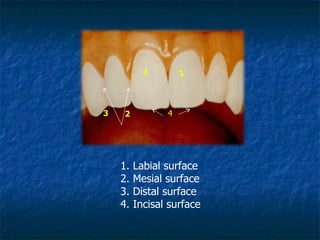
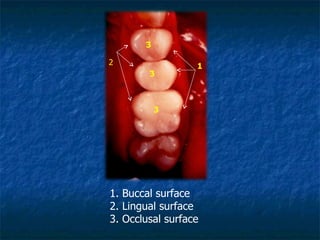
Surfaces of teeth Crowns of all teeth have five surfaces. 1. Facial Surface Facial surface can be labial surface or buccal surface. a. Labial surface.  The surfaces of incisors and canines that are towards the lip. b. Buccal surface.  The surfaces of premolars and molars that face the cheek.
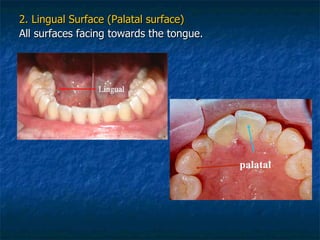
2. Lingual Surface (Palatal surface) All surfaces facing towards the tongue. palatal
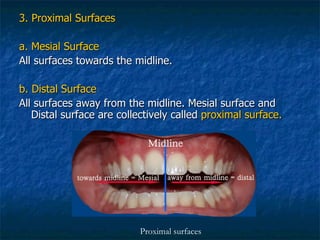
3. Proximal Surfaces a. Mesial Surface All surfaces towards the midline. b. Distal Surface All surfaces away from the midline. Mesial surface and Distal surface are collectively called  proximal surface. Proximal surfaces
4. Incisal or Occlusal surface a. Incisal surface.  The surface of incisors and canines that come in contact with those in the opposite jaws during the act of closure are called incisal surfaces b. Occlusal surface.  The surface of premolars and molars that come in contact with those in the opposite jaws during the act of closure are called occlusal surfaces.
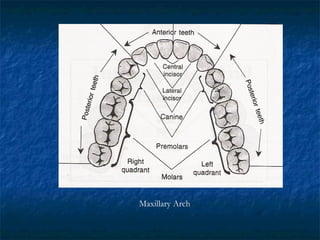
Maxillary Arch
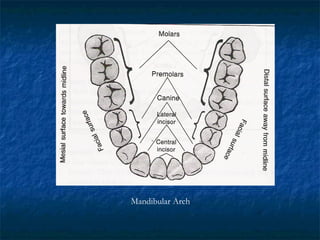
Mandibular Arch
4 3 2 1 1 1. Labial surface 2. Mesial surface 3. Distal surface 4. Incisal surface
3 3 3 2 1 1. Buccal surface 2. Lingual surface 3. Occlusal surface
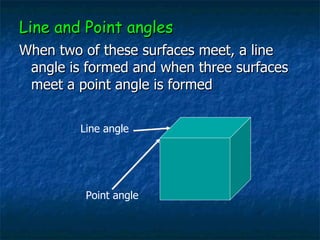
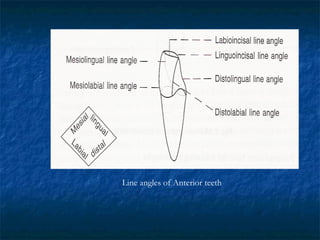
Line and Point angles When two of these surfaces meet, a line angle is formed and when three surfaces meet a point angle is formed Line angle Point angle
Line angles of anterior teeth 1. Mesio labial 2. Disto labial 3. Mesiolingual 4. Distolingual 5. Labioincisal 6. Linguoincisal
Line angles of Anterior teeth
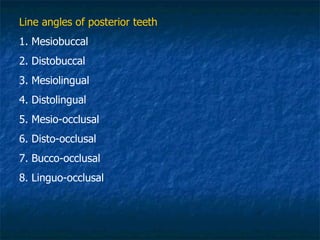
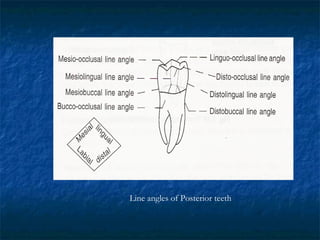
Line angles of posterior teeth 1. Mesiobuccal 2. Distobuccal 3. Mesiolingual 4. Distolingual 5. Mesio-occlusal 6. Disto-occlusal 7. Bucco-occlusal 8. Linguo-occlusal
Line angles of Posterior teeth
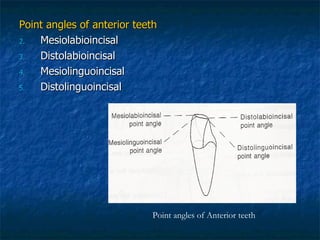
Point angles of anterior teeth Mesiolabioincisal Distolabioincisal Mesiolinguoincisal Distolinguoincisal Point angles of Anterior teeth
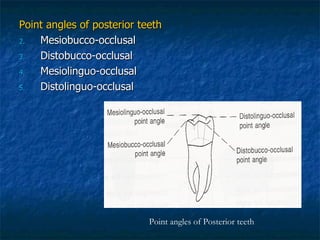
Point angles of posterior teeth Mesiobucco-occlusal Distobucco-occlusal Mesiolinguo-occlusal Distolinguo-occlusal Point angles of Posterior teeth
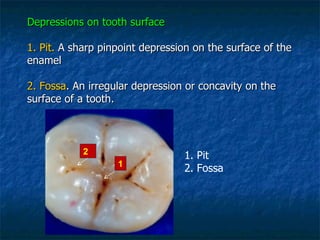
Depressions on tooth surface 1. Pit.  A sharp pinpoint depression on the surface of the enamel 2. Fossa . An irregular depression or concavity on the surface of a tooth. 2 1 1. Pit 2. Fossa
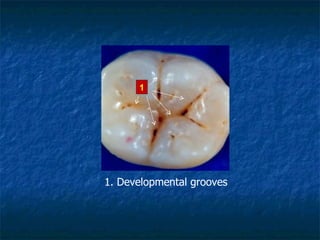
3. Sulcus . A long depression on the surface of a tooth. 4. Groove  is a shallow linear depression on the surface of a tooth.  A  developmental groove  is a shallow groove or line between the primary parts of the crown or root.  A  supplemental groove  is less distinct and does not mark the junction of primary parts.
1 1. Developmental grooves
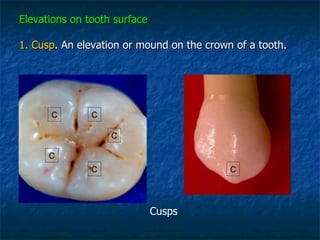
Elevations on tooth surface 1. Cusp . An elevation or mound on the crown of a tooth. C C C C C Cusps C
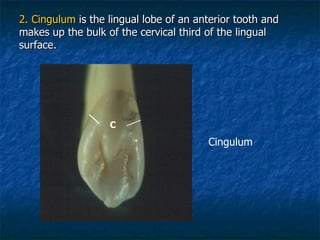
2. Cingulum  is the lingual lobe of an anterior tooth and makes up the bulk of the cervical third of the lingual surface. Cingulum C
3. Lobe  is one of the primary sections of formation in the development of the crown. Cusps and mamelons are representative of lobes. 4. Mamelons  are three rounded protuberances found on the incisal ridges of newly erupted incisor teeth.
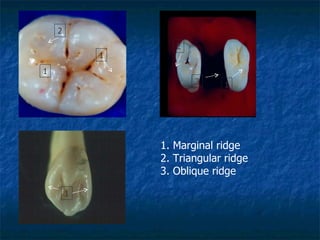
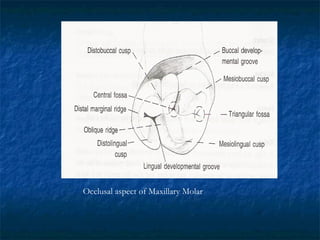
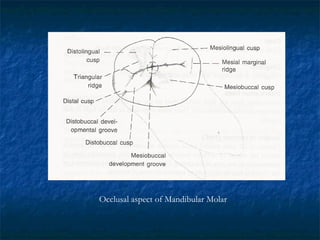
Ridge . A linear elevation on the surface of a tooth Marginal ridges  are rounded borders of enamel that form the mesial and distal margins of the occlusal surfaces of posterior teeth and the mesial and distal margins of the lingual surfaces of anterior teeth. Triangular ridge  is a ridge that descends from the tips of the cusps of molars and premolars towards the centre part of the occlusal surface. Transverse ridge  is formed by the union of buccal and lingual triangular ridges. Oblique ridge  is a ridge obliquely crossing the occlusal surfaces of maxillary molars. Dr.Syed Sadatullah Ibnsina National Medical College
1. Marginal ridge 2. Triangular ridge 3. Oblique ridge 1 1 2 2 3 1 1
Occlusal aspect of Maxillary Molar
Occlusal aspect of Mandibular Molar
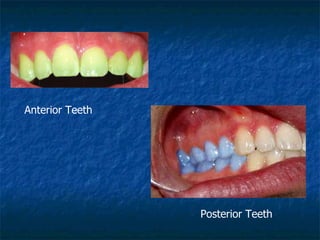
Other important terms Mid line.  An imaginary line dividing the upper and lower arches into two equal halves. Anterior.  Pertaining to or towards the front plane of the body. Posterior.   Pertaining to or towards the back plane of the body. Superior.  Situated above another or towards the head. Inferior.  Situated beneath another or towards the feet.
Anterior Teeth Posterior Teeth
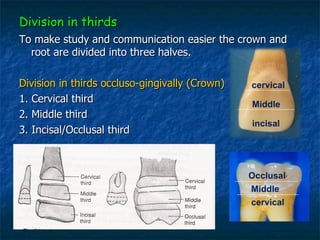
Division in thirds To make study and communication easier the crown and root are divided into three halves. Division in thirds occluso-gingivally (Crown) 1. Cervical third 2. Middle third 3. Incisal/Occlusal third incisal Middle cervical cervical Occlusal Middle
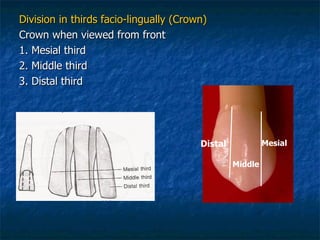
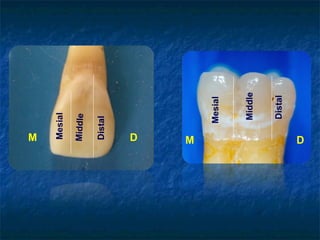
Division in thirds facio-lingually (Crown) Crown when viewed from front 1. Mesial third 2. Middle third 3. Distal third Distal Middle Mesial
Mesial Middle Distal M D Mesial Middle Distal M D
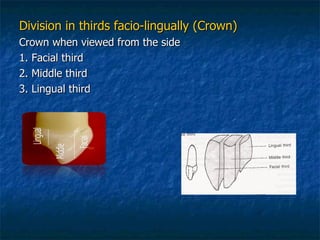
Division in thirds facio-lingually (Crown) Crown when viewed from the side 1. Facial third 2. Middle third 3. Lingual third
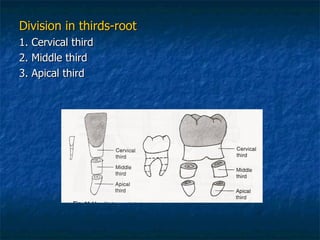
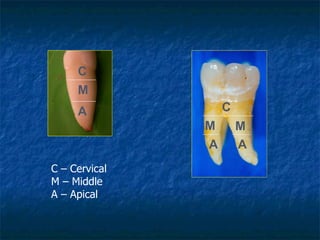
Division in thirds-root 1. Cervical third 2. Middle third 3. Apical third
A M C A A M M C C – Cervical M – Middle A – Apical

Dental Terminology

  • 1.
    Dental Terminology Dr.Syed Sadatullah College of Dentistry King Khalid University
  • 2.
    Contents 1. Surfacesof teeth 2. Line angles and point angles 3. Depressions and Elevations on teeth 4. Division in thirds Objectives The prime objective of this lecture is to introduce the dental terminology and its application
  • 3.
    Learning nomenclature isthe first and very important step in understanding dental anatomy. Crown is covered with enamel and root is covered with cementum. The crown and root join at the cemento-enamel junction (CEJ) which is also called the cervical line. The junction of cementum and dentine is called cemento-dentinal junction. The junction of dentine and enamel is called dentinoenamel junction (DEJ). To study and facilitate communication various surfaces of teeth are recognized and given names.
  • 4.
    Surfaces of teethCrowns of all teeth have five surfaces. 1. Facial Surface Facial surface can be labial surface or buccal surface. a. Labial surface. The surfaces of incisors and canines that are towards the lip. b. Buccal surface. The surfaces of premolars and molars that face the cheek.
  • 5.
    2. Lingual Surface(Palatal surface) All surfaces facing towards the tongue. palatal
  • 6.
    3. Proximal Surfacesa. Mesial Surface All surfaces towards the midline. b. Distal Surface All surfaces away from the midline. Mesial surface and Distal surface are collectively called proximal surface. Proximal surfaces
  • 7.
    4. Incisal orOcclusal surface a. Incisal surface. The surface of incisors and canines that come in contact with those in the opposite jaws during the act of closure are called incisal surfaces b. Occlusal surface. The surface of premolars and molars that come in contact with those in the opposite jaws during the act of closure are called occlusal surfaces.
  • 8.
  • 9.
  • 10.
    4 3 21 1 1. Labial surface 2. Mesial surface 3. Distal surface 4. Incisal surface
  • 11.
    3 3 32 1 1. Buccal surface 2. Lingual surface 3. Occlusal surface
  • 12.
    Line and Pointangles When two of these surfaces meet, a line angle is formed and when three surfaces meet a point angle is formed Line angle Point angle
  • 13.
    Line angles ofanterior teeth 1. Mesio labial 2. Disto labial 3. Mesiolingual 4. Distolingual 5. Labioincisal 6. Linguoincisal
  • 14.
    Line angles ofAnterior teeth
  • 15.
    Line angles ofposterior teeth 1. Mesiobuccal 2. Distobuccal 3. Mesiolingual 4. Distolingual 5. Mesio-occlusal 6. Disto-occlusal 7. Bucco-occlusal 8. Linguo-occlusal
  • 16.
    Line angles ofPosterior teeth
  • 17.
    Point angles ofanterior teeth Mesiolabioincisal Distolabioincisal Mesiolinguoincisal Distolinguoincisal Point angles of Anterior teeth
  • 18.
    Point angles ofposterior teeth Mesiobucco-occlusal Distobucco-occlusal Mesiolinguo-occlusal Distolinguo-occlusal Point angles of Posterior teeth
  • 19.
    Depressions on toothsurface 1. Pit. A sharp pinpoint depression on the surface of the enamel 2. Fossa . An irregular depression or concavity on the surface of a tooth. 2 1 1. Pit 2. Fossa
  • 20.
    3. Sulcus .A long depression on the surface of a tooth. 4. Groove is a shallow linear depression on the surface of a tooth. A developmental groove is a shallow groove or line between the primary parts of the crown or root. A supplemental groove is less distinct and does not mark the junction of primary parts.
  • 21.
  • 22.
    Elevations on toothsurface 1. Cusp . An elevation or mound on the crown of a tooth. C C C C C Cusps C
  • 23.
    2. Cingulum is the lingual lobe of an anterior tooth and makes up the bulk of the cervical third of the lingual surface. Cingulum C
  • 24.
    3. Lobe is one of the primary sections of formation in the development of the crown. Cusps and mamelons are representative of lobes. 4. Mamelons are three rounded protuberances found on the incisal ridges of newly erupted incisor teeth.
  • 25.
    Ridge . Alinear elevation on the surface of a tooth Marginal ridges are rounded borders of enamel that form the mesial and distal margins of the occlusal surfaces of posterior teeth and the mesial and distal margins of the lingual surfaces of anterior teeth. Triangular ridge is a ridge that descends from the tips of the cusps of molars and premolars towards the centre part of the occlusal surface. Transverse ridge is formed by the union of buccal and lingual triangular ridges. Oblique ridge is a ridge obliquely crossing the occlusal surfaces of maxillary molars. Dr.Syed Sadatullah Ibnsina National Medical College
  • 26.
    1. Marginal ridge2. Triangular ridge 3. Oblique ridge 1 1 2 2 3 1 1
  • 27.
    Occlusal aspect ofMaxillary Molar
  • 28.
    Occlusal aspect ofMandibular Molar
  • 29.
    Other important termsMid line. An imaginary line dividing the upper and lower arches into two equal halves. Anterior. Pertaining to or towards the front plane of the body. Posterior. Pertaining to or towards the back plane of the body. Superior. Situated above another or towards the head. Inferior. Situated beneath another or towards the feet.
  • 30.
  • 31.
    Division in thirdsTo make study and communication easier the crown and root are divided into three halves. Division in thirds occluso-gingivally (Crown) 1. Cervical third 2. Middle third 3. Incisal/Occlusal third incisal Middle cervical cervical Occlusal Middle
  • 32.
    Division in thirdsfacio-lingually (Crown) Crown when viewed from front 1. Mesial third 2. Middle third 3. Distal third Distal Middle Mesial
  • 33.
    Mesial Middle DistalM D Mesial Middle Distal M D
  • 34.
    Division in thirdsfacio-lingually (Crown) Crown when viewed from the side 1. Facial third 2. Middle third 3. Lingual third
  • 35.
    Division in thirds-root1. Cervical third 2. Middle third 3. Apical third
  • 36.
    A M CA A M M C C – Cervical M – Middle A – Apical