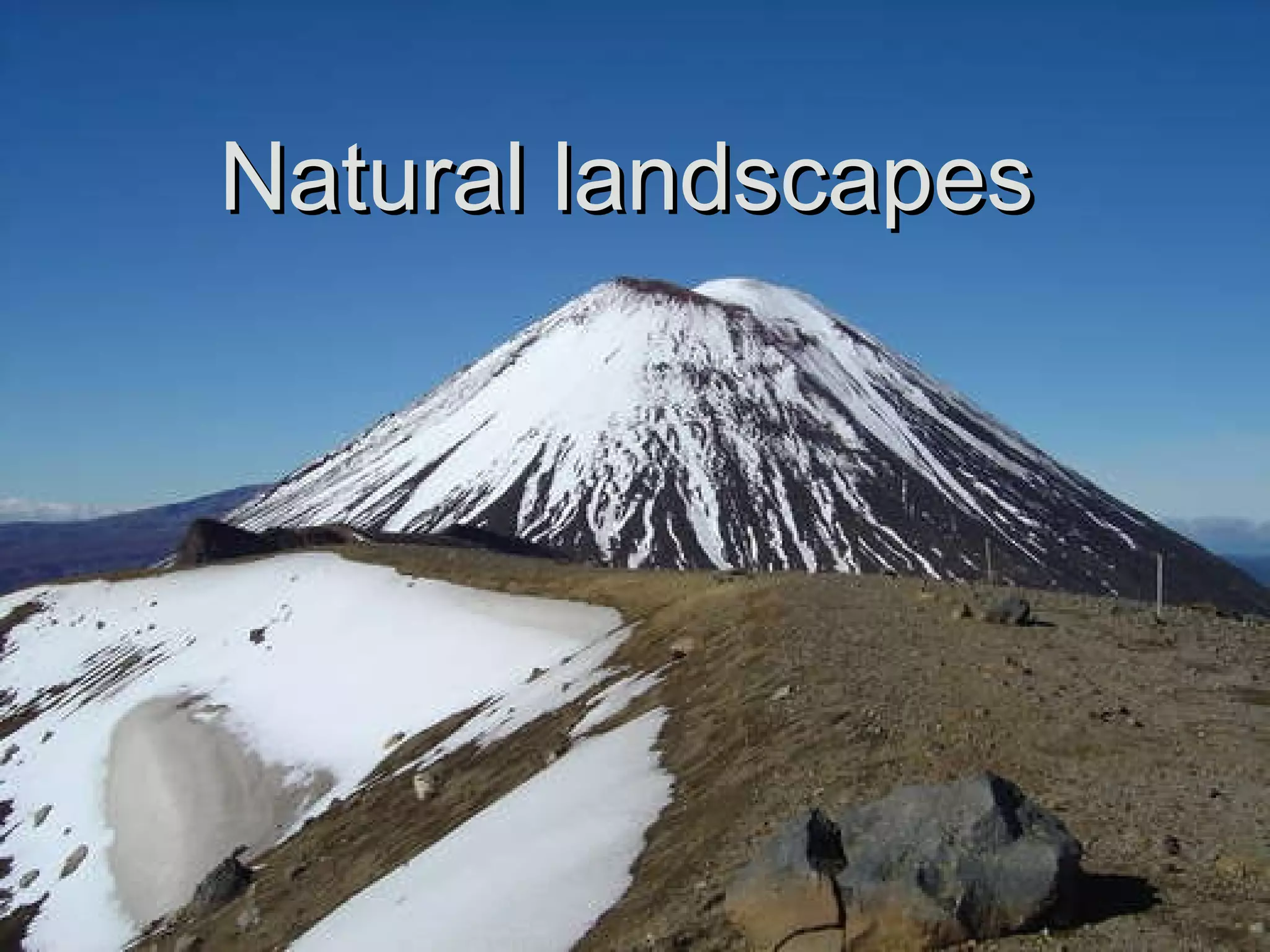
Natural landscapes
Natural landscape Refers to the Visible features of the environment Varies from place to place and form patterns which can be described/mapped Includes interacting components or  elements,  including Relief Leave 2 lines Climate Leave 2 lines Soils Leave 2 lines Vegetation  Leave 2 lines
Relief Height and shape of the land Processes that have formed the land over geological time
Climate Average atmospheric conditions over a long period of time Rainfall, temperature, sunshine hours, humidity, wind etc
Soils Weathered or eroded materials from rocks Of interest is soil type, fertility, drainage
Vegetation Plant cover of an area Vegetation  types and  their distribution
Interaction Elements of the landscape affect one another in different ways As a consequence of  interaction  the natural landscape of an area can be seen as a  system Climate Relief Vegetation Soils Interactions in the  natural landscape Direct interaction Indirect interaction
Activity Define ‘natural landscapes’ Define ‘interaction’ Study photo and answer the following Describe two relief features of the area Describe one feature of the climate Describe one vegetation feature Describe one soil feature Describe how relief is interacting with climate in the area Describe how climate is interacting with relief in the area Head of Lake Wakatipu, Dart River
Cultural landscapes
Cultural landscapes The activities and ways which people have influenced the landscape are known as it’s  cultural landscape  Cultural features are established by people as they modify the natural landscape In order to  use  it The main cultural features are  (leave two lines between each) Land use  Transport features Population and settlement Natural features in the area will affect the cultural features Very few people live in the hottest or coldest climates Cultural factors can influence features of the environment as people and the environment interact An opencast mine changes the relief features of the environment
Land use Patterns made by people as they use the land for mining, farming, forestry etc For example Altering the vegetation by clearing forests to make pasture
Transport features Networks of roads, railways, canals, shipping lanes, airports etc Known as  infrastructure
Population and settlement Patterns of population, its distribution and the location of settlements Such as Farmsteads Villages Towns Cities
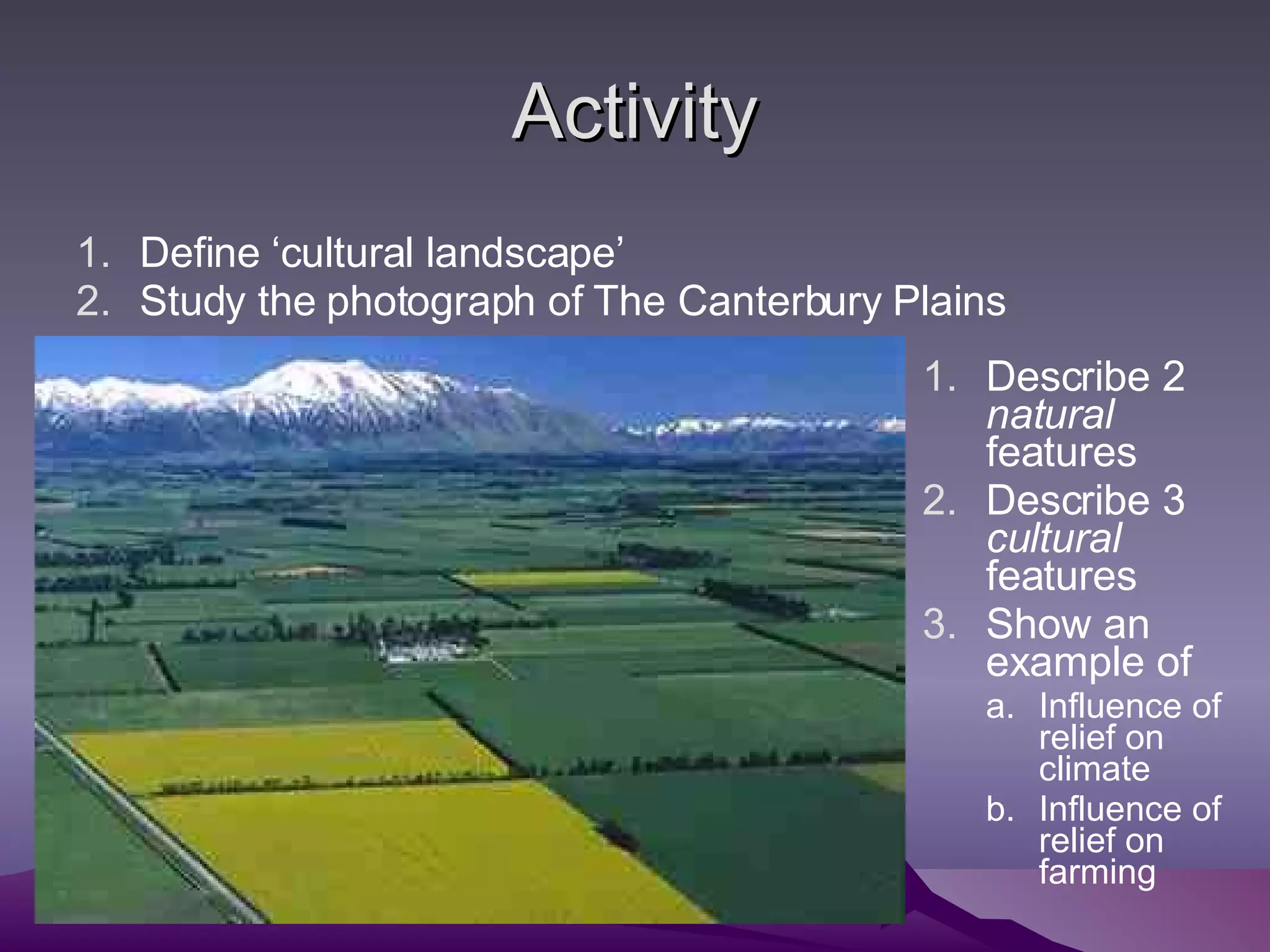
Activity Define ‘cultural landscape’ Study the photograph of The Canterbury Plains Describe 2  natural  features Describe 3  cultural  features Show an example of  Influence of relief on climate Influence of relief on farming

Natural & Cultural Landscape

  • 1.
  • 2.
    Natural landscape Refersto the Visible features of the environment Varies from place to place and form patterns which can be described/mapped Includes interacting components or elements, including Relief Leave 2 lines Climate Leave 2 lines Soils Leave 2 lines Vegetation Leave 2 lines
  • 3.
    Relief Height andshape of the land Processes that have formed the land over geological time
  • 4.
    Climate Average atmosphericconditions over a long period of time Rainfall, temperature, sunshine hours, humidity, wind etc
  • 5.
    Soils Weathered oreroded materials from rocks Of interest is soil type, fertility, drainage
  • 6.
    Vegetation Plant coverof an area Vegetation types and their distribution
  • 7.
    Interaction Elements ofthe landscape affect one another in different ways As a consequence of interaction the natural landscape of an area can be seen as a system Climate Relief Vegetation Soils Interactions in the natural landscape Direct interaction Indirect interaction
  • 8.
    Activity Define ‘naturallandscapes’ Define ‘interaction’ Study photo and answer the following Describe two relief features of the area Describe one feature of the climate Describe one vegetation feature Describe one soil feature Describe how relief is interacting with climate in the area Describe how climate is interacting with relief in the area Head of Lake Wakatipu, Dart River
  • 9.
  • 10.
    Cultural landscapes Theactivities and ways which people have influenced the landscape are known as it’s cultural landscape Cultural features are established by people as they modify the natural landscape In order to use it The main cultural features are (leave two lines between each) Land use Transport features Population and settlement Natural features in the area will affect the cultural features Very few people live in the hottest or coldest climates Cultural factors can influence features of the environment as people and the environment interact An opencast mine changes the relief features of the environment
  • 11.
    Land use Patternsmade by people as they use the land for mining, farming, forestry etc For example Altering the vegetation by clearing forests to make pasture
  • 12.
    Transport features Networksof roads, railways, canals, shipping lanes, airports etc Known as infrastructure
  • 13.
    Population and settlementPatterns of population, its distribution and the location of settlements Such as Farmsteads Villages Towns Cities
  • 14.
    Activity Define ‘culturallandscape’ Study the photograph of The Canterbury Plains Describe 2 natural features Describe 3 cultural features Show an example of Influence of relief on climate Influence of relief on farming