TRIAGE
Dr SUBHANKAR PAUL
Emergency Medicine & Critical Care,
GAUHATI MEDICAL COLLEGE & HOSPITAL
INTRODUCTION
• Triage is the process of prioritising patient
treatment during mass casualty events (ATLS)
• patients are classified according to the type and
urgency of their conditions to get the
Right patient to the
Right place at the
Right time with the
Right care provider
Triage : Origin
• From the French verb, t r i e r , “to sort”
• Napoleon’s time, world war-1, to assign
treatment priorities with limited resources
• Attention given first to most salvageable with
most urgent conditions
Key Concepts
• Resources are limited
– Supplies
– Personnel
• Time for evacuation /help unknown or
prolonged
– Only austere field interventions are available
– Basic principle :
“DO THE MOST GOODS FOR MOST PATIENTS USING
AVAILABLE RESOURCES”
Aims
• To ensure that patients are treated in the order of
their clinical urgency
• To ensure that treatment is appropriately and
timely.
• To allocate the patient to the most appropriate
assessment and treatment area (AVOID
CONGESTION)
• To provide ongoing assessment of patients
• To provide information to patients and families
regarding services expected care and waiting
times.
• To contribute information that helps to define
departmental acuity.
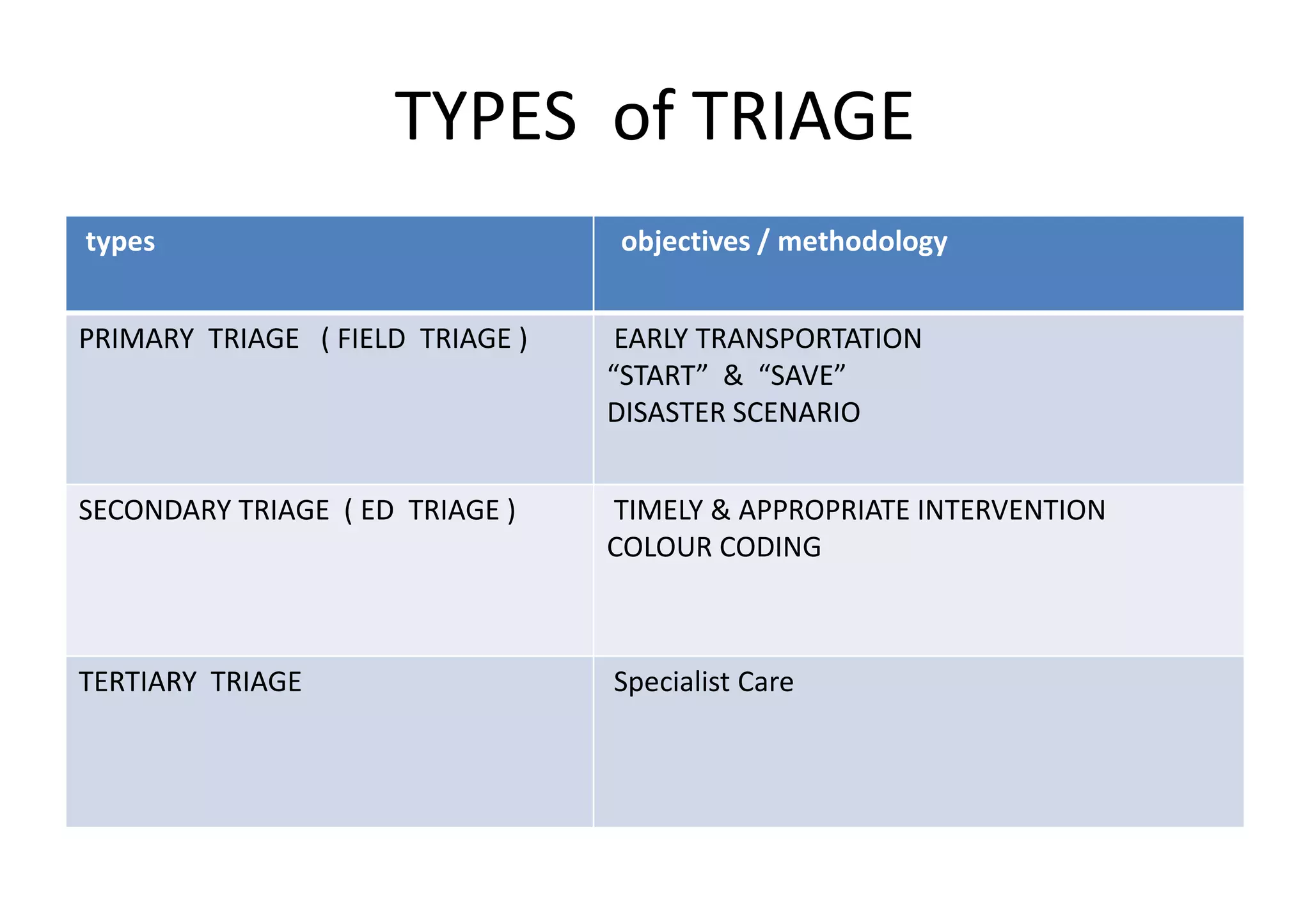
TYPES of TRIAGE
types objectives / methodology
PRIMARY TRIAGE ( FIELD TRIAGE ) EARLY TRANSPORTATION
“START” & “SAVE”
DISASTER SCENARIO
SECONDARY TRIAGE ( ED TRIAGE ) TIMELY & APPROPRIATE INTERVENTION
COLOUR CODING
TERTIARY TRIAGE Specialist Care
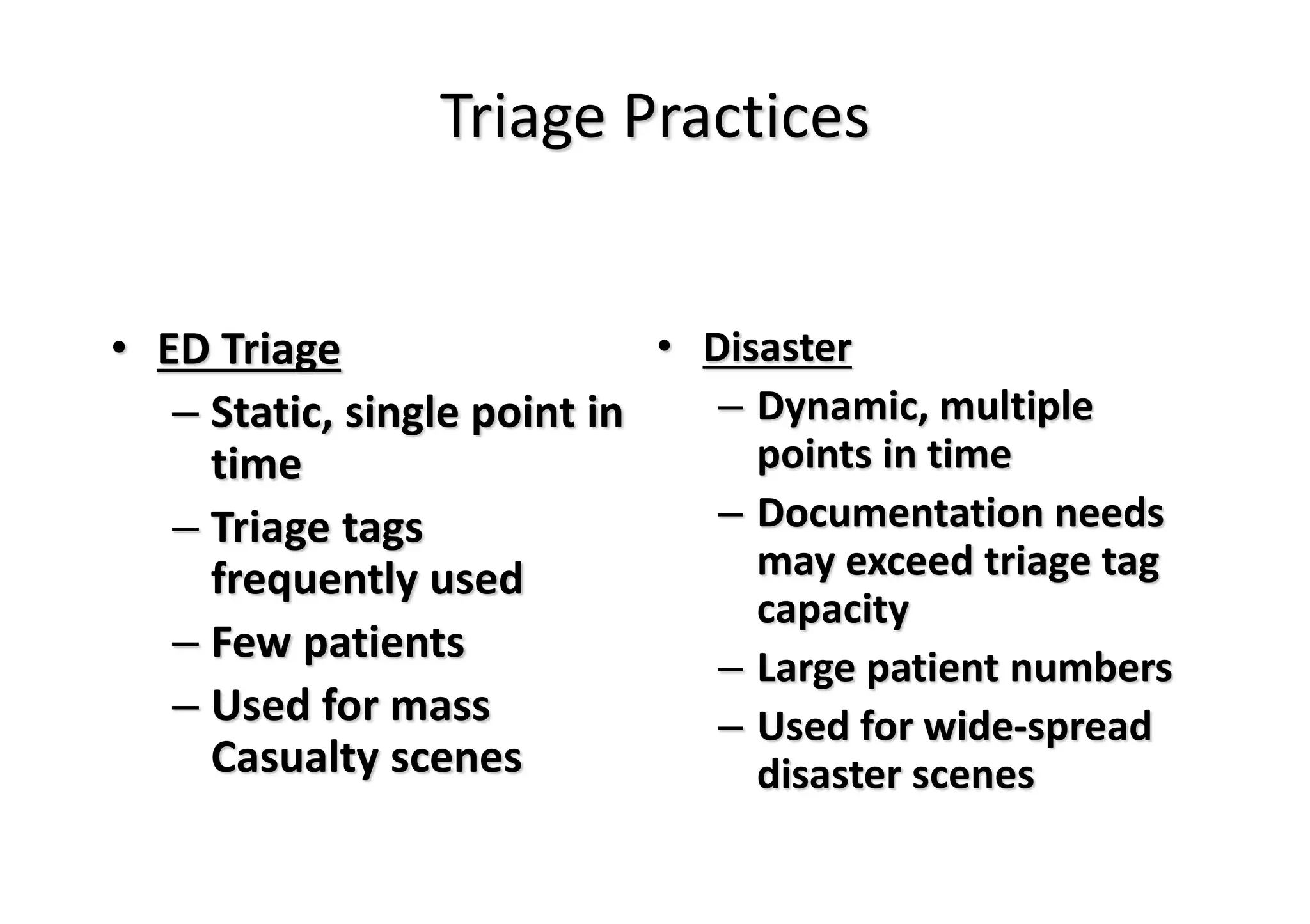
Triage Practices
• ED Triage
– Static, single point in
time
– Triage tags
frequently used
– Few patients
– Used for mass
Casualty scenes
• Disaster
– Dynamic, multiple
points in time
– Documentation needs
may exceed triage tag
capacity
– Large patient numbers
– Used for wide-spread
disaster scenes
Patient Categories
1. Those who will die no matter what
2. Those who will do well no matter what we do
3. Those who will derive long-term benefit from
acute intervention
• Early identification of #3 important
– Others benefit from comfort care
Disaster triage: START, then SAVE
Goal of Disaster Triage
• Do the greatest good
for the greatest
number of PATIENTS
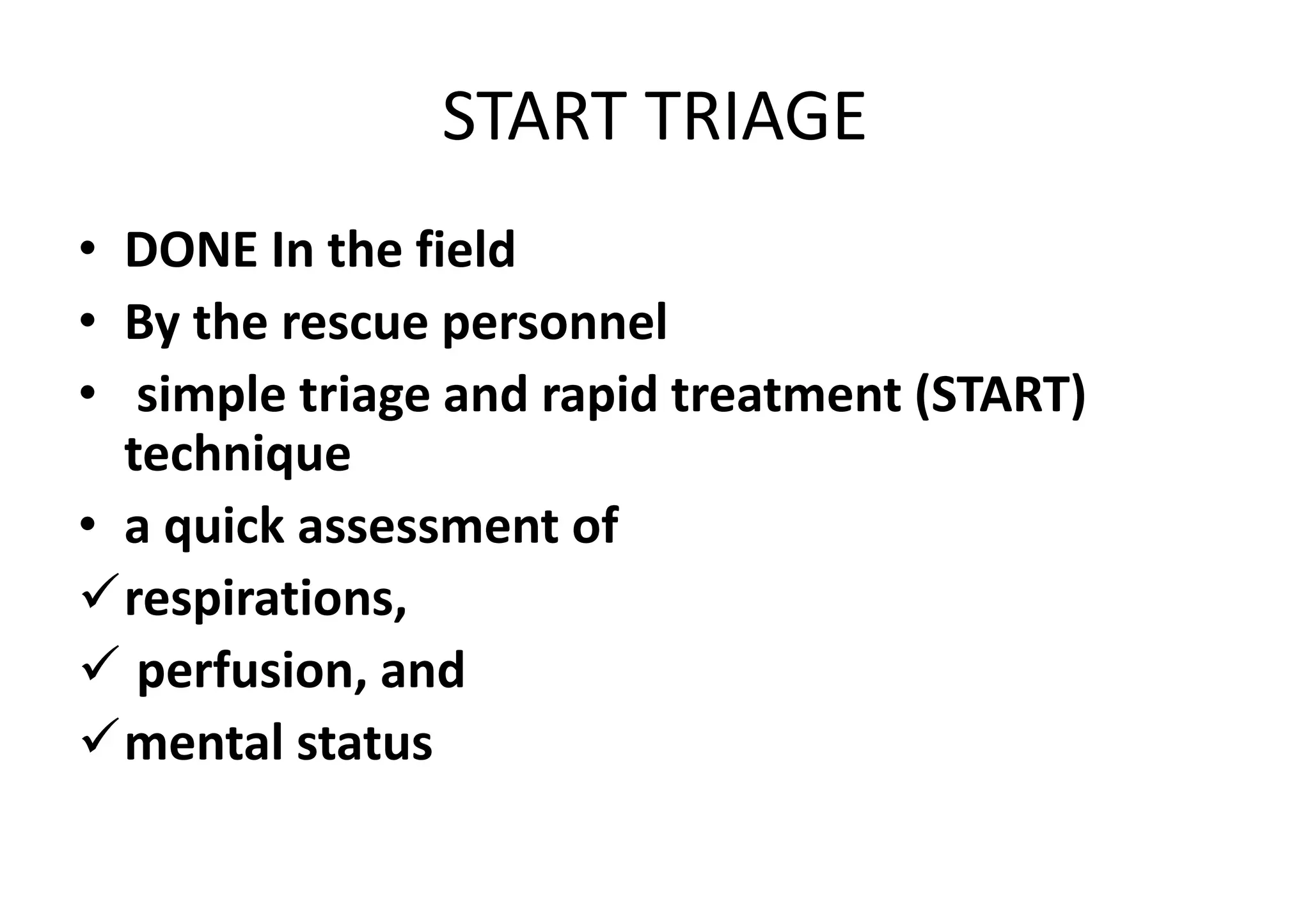
START TRIAGE
• DONE In the field
• By the rescue personnel
• simple triage and rapid treatment (START)
technique
• a quick assessment of
respirations,
 perfusion, and
mental status
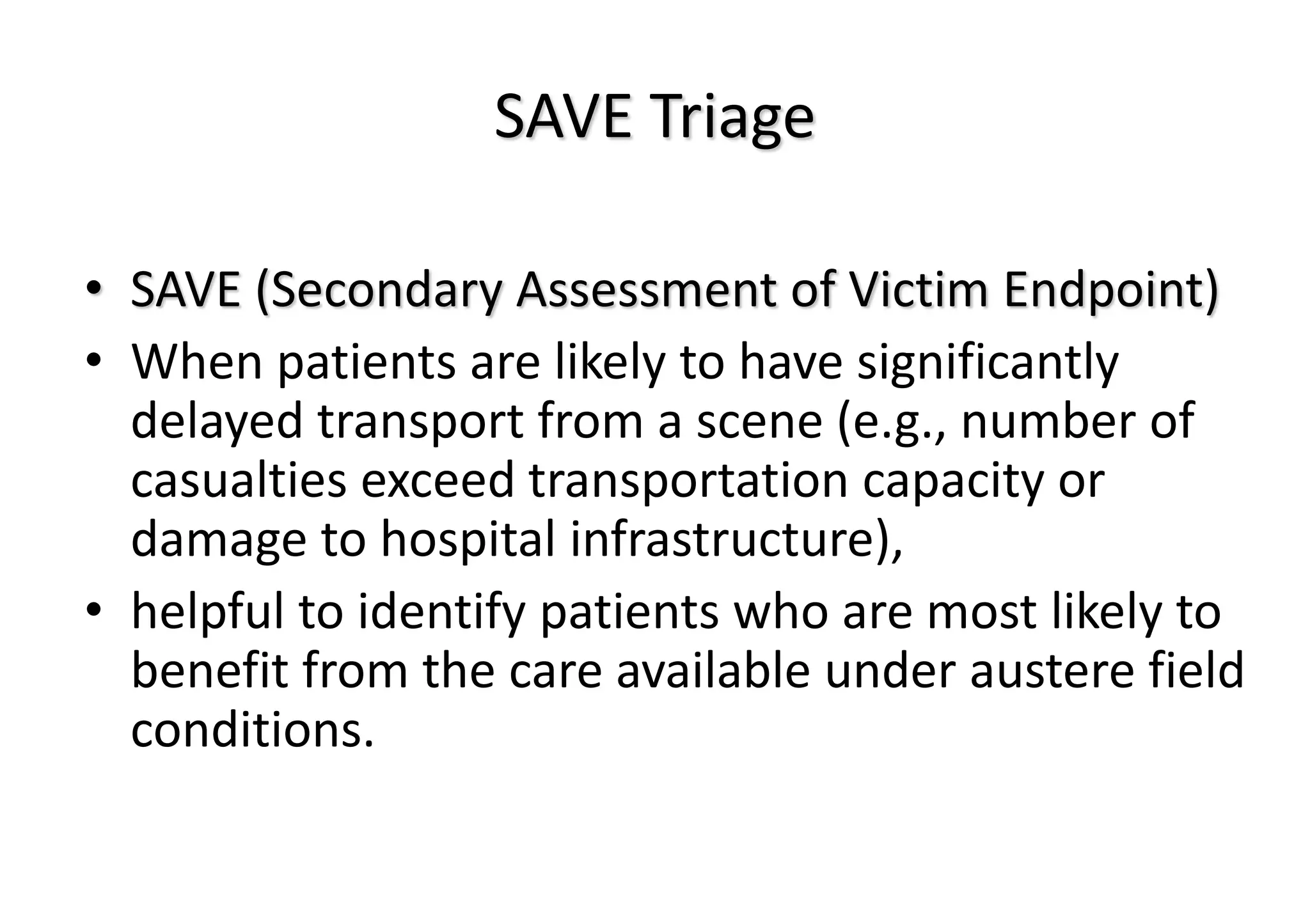
SAVE Triage
• SAVE (Secondary Assessment of Victim Endpoint)
• When patients are likely to have significantly
delayed transport from a scene (e.g., number of
casualties exceed transportation capacity or
damage to hospital infrastructure),
• helpful to identify patients who are most likely to
benefit from the care available under austere field
conditions.
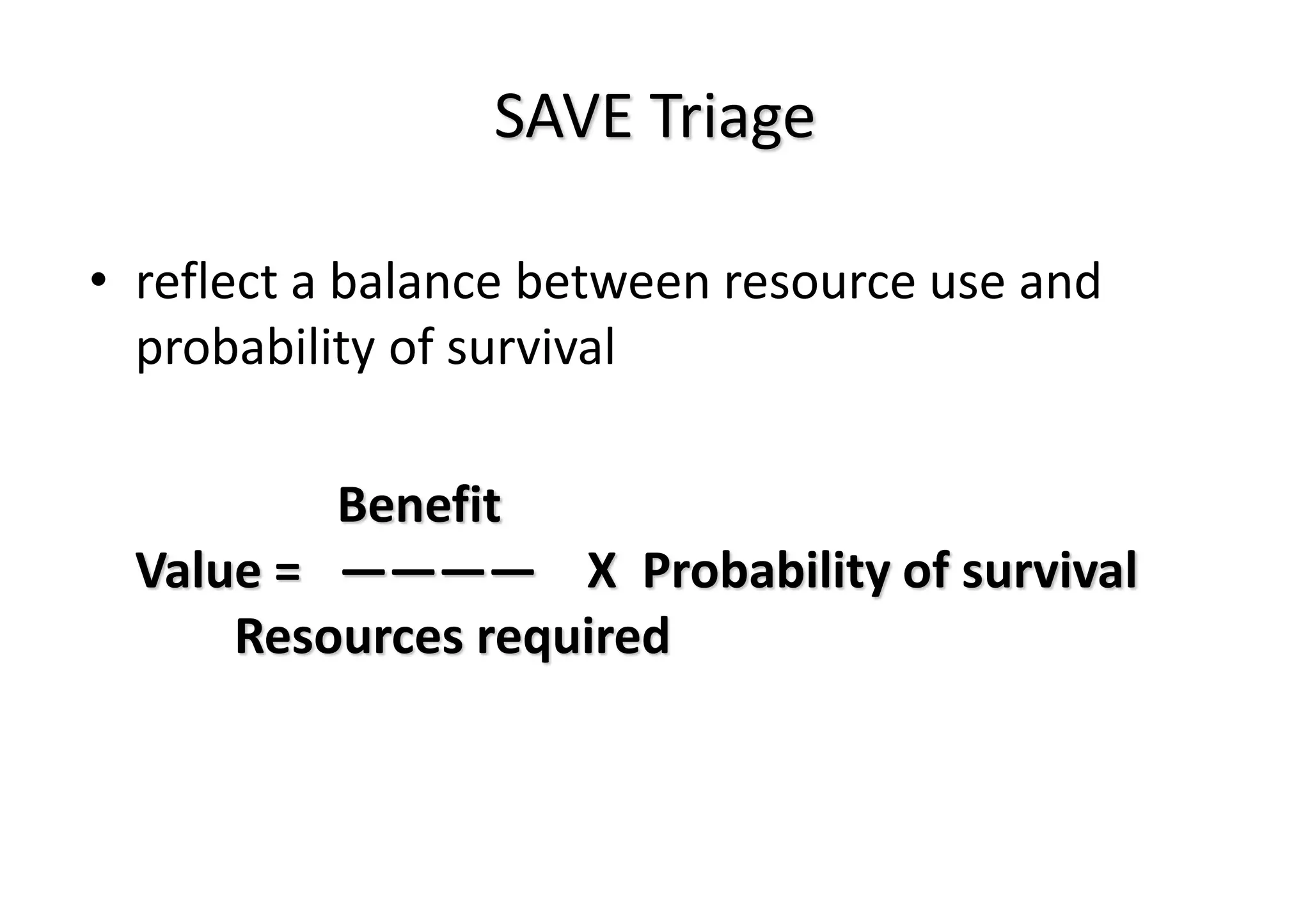
SAVE Triage
• reflect a balance between resource use and
probability of survival
Benefit
Value = ———— X Probability of survival
Resources required
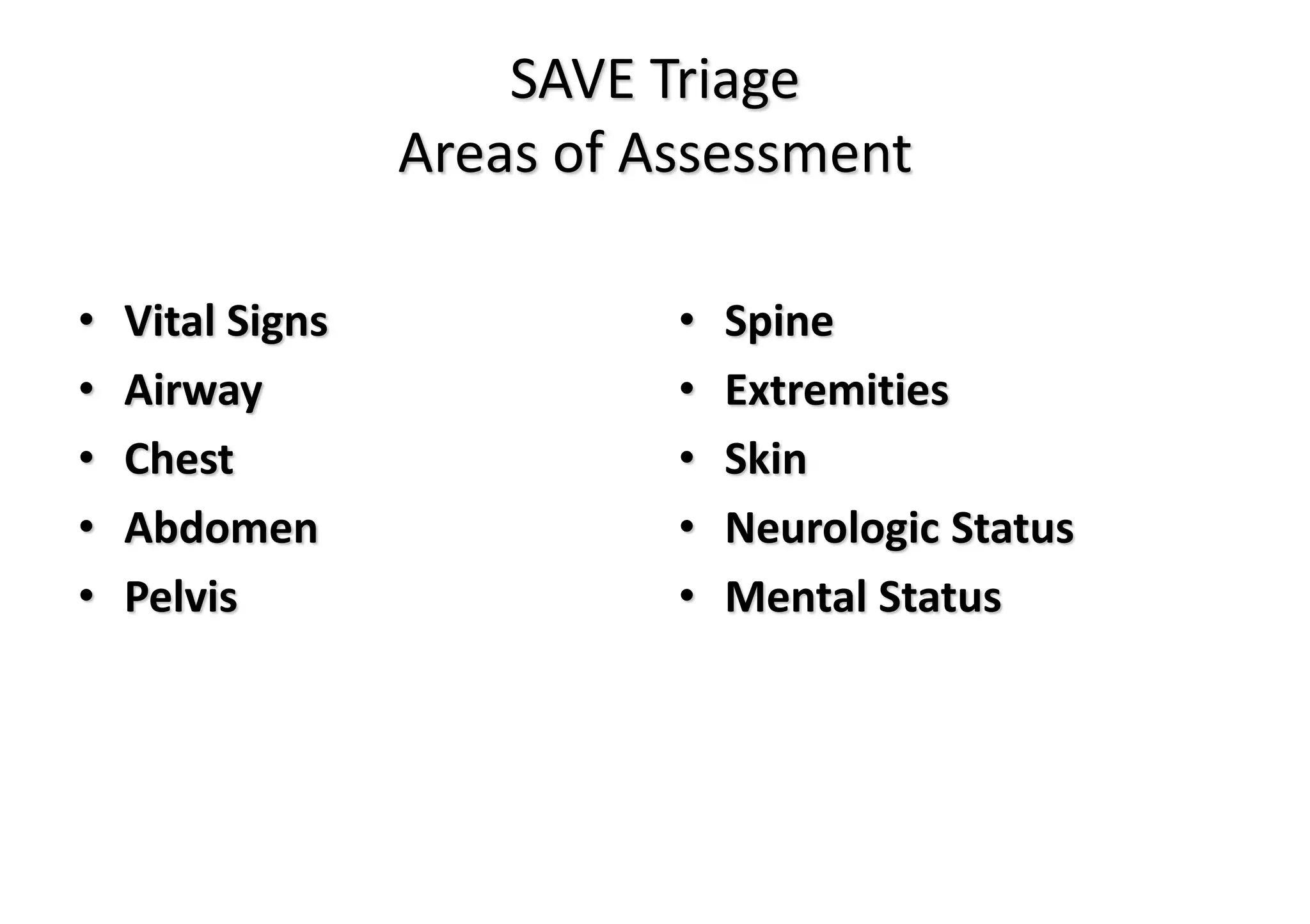
SAVE Triage
Areas of Assessment
• Vital Signs
• Airway
• Chest
• Abdomen
• Pelvis
• Spine
• Extremities
• Skin
• Neurologic Status
• Mental Status
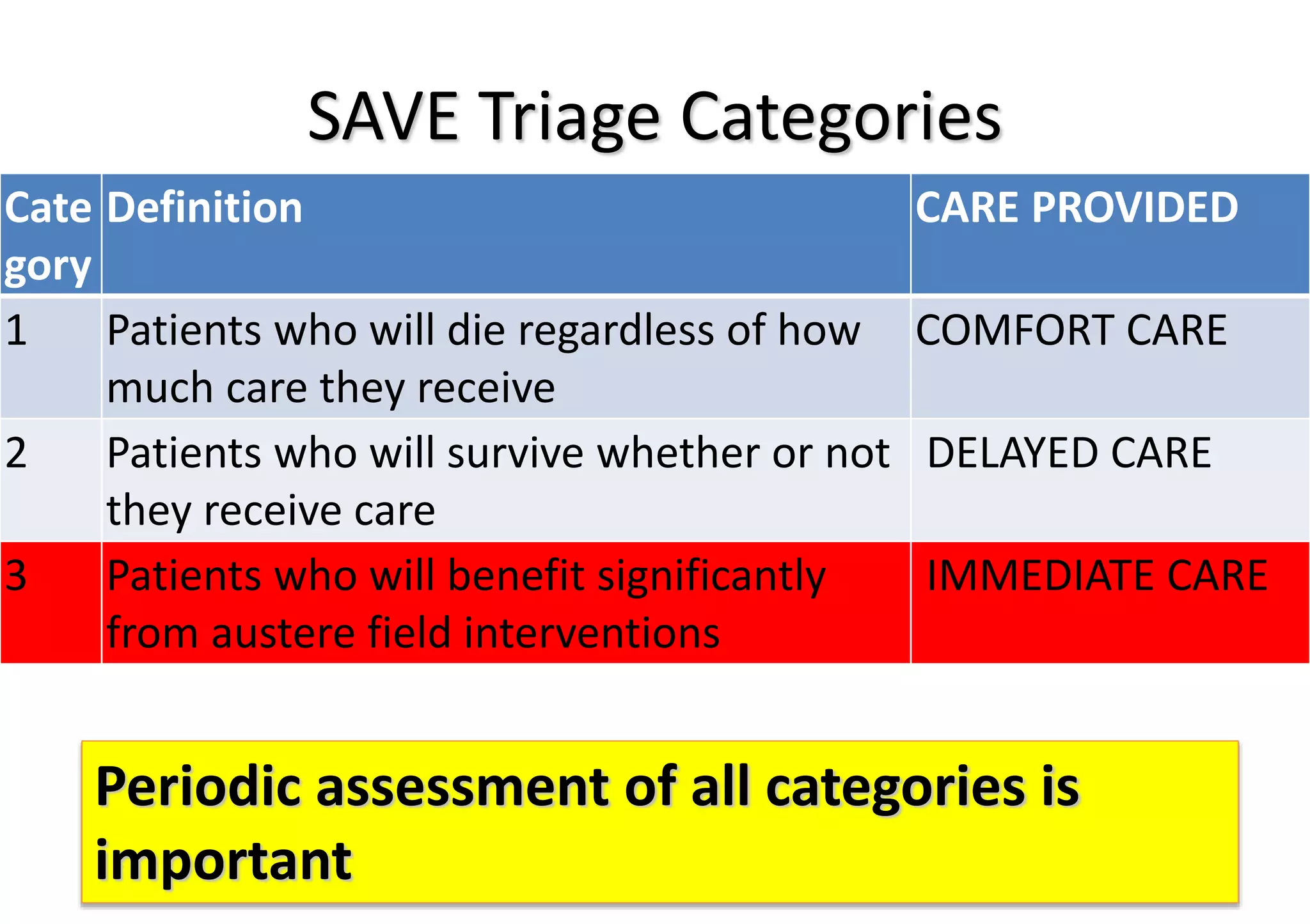
SAVE Triage Categories
Cate
gory
Definition CARE PROVIDED
1 Patients who will die regardless of how
much care they receive
COMFORT CARE
2 Patients who will survive whether or not
they receive care
DELAYED CARE
3 Patients who will benefit significantly
from austere field interventions
IMMEDIATE CARE
Periodic assessment of all categories is
important
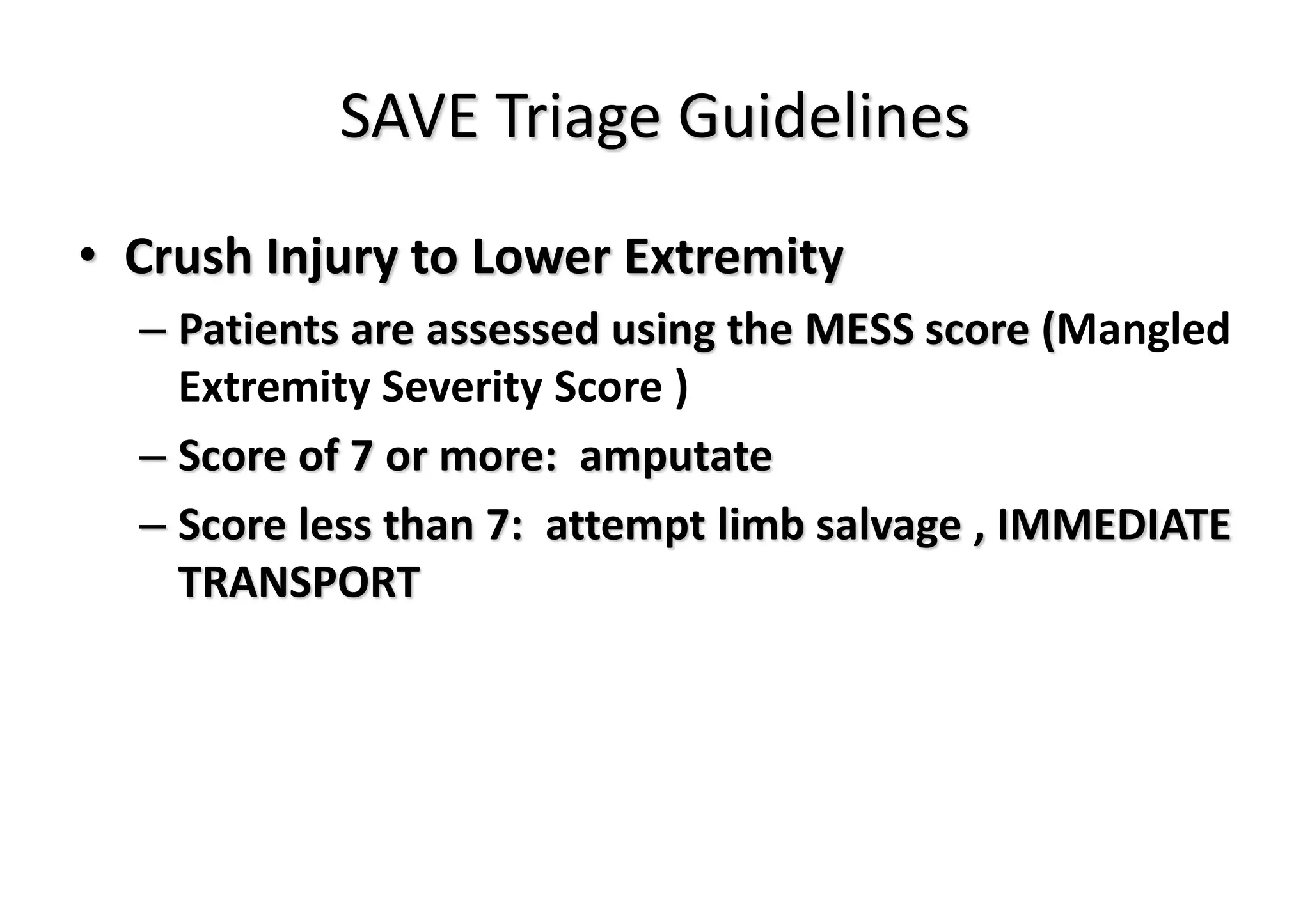
SAVE Triage Guidelines
• Crush Injury to Lower Extremity
– Patients are assessed using the MESS score (Mangled
Extremity Severity Score )
– Score of 7 or more: amputate
– Score less than 7: attempt limb salvage , IMMEDIATE
TRANSPORT
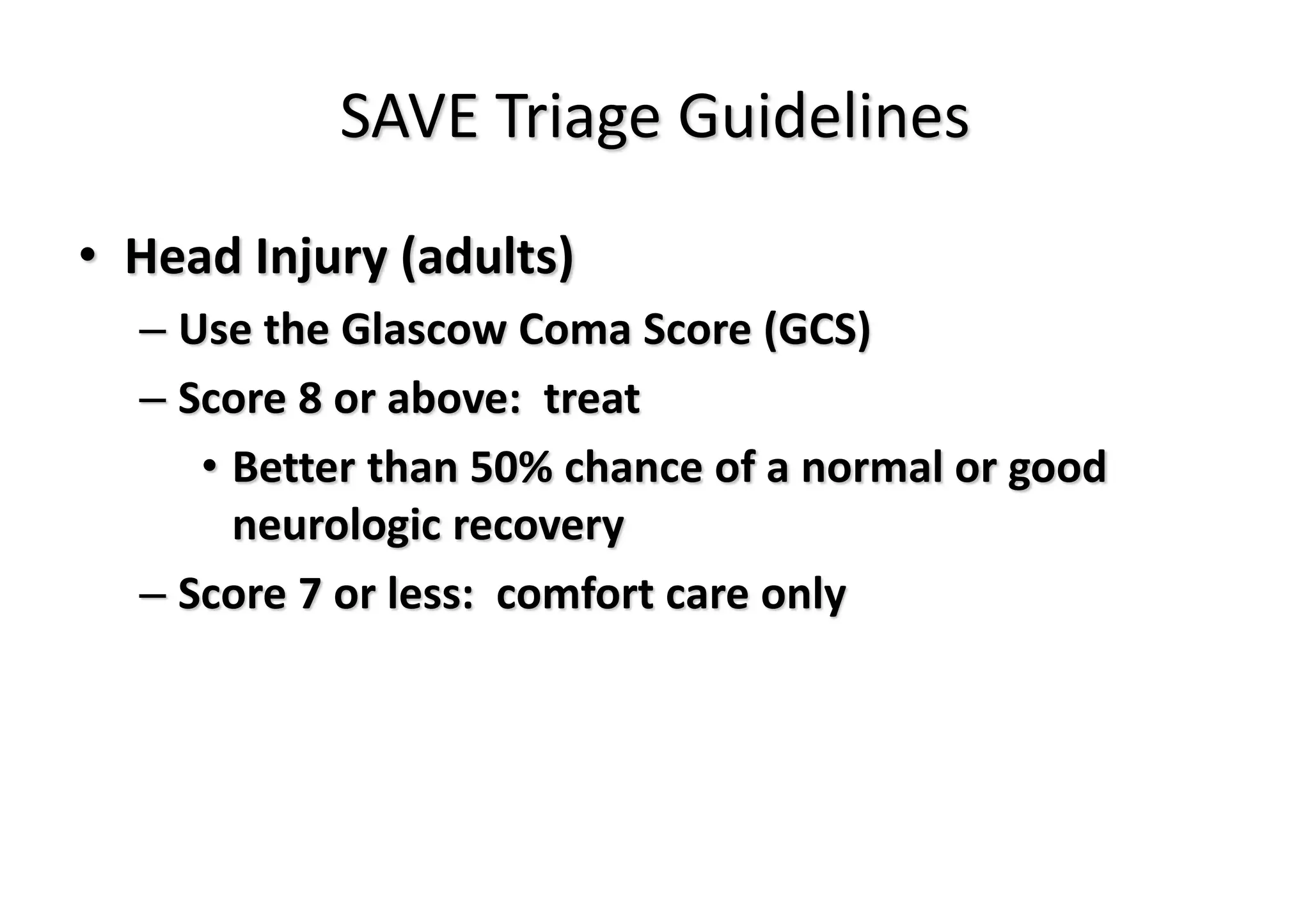
SAVE Triage Guidelines
• Head Injury (adults)
– Use the Glascow Coma Score (GCS)
– Score 8 or above: treat
• Better than 50% chance of a normal or good
neurologic recovery
– Score 7 or less: comfort care only
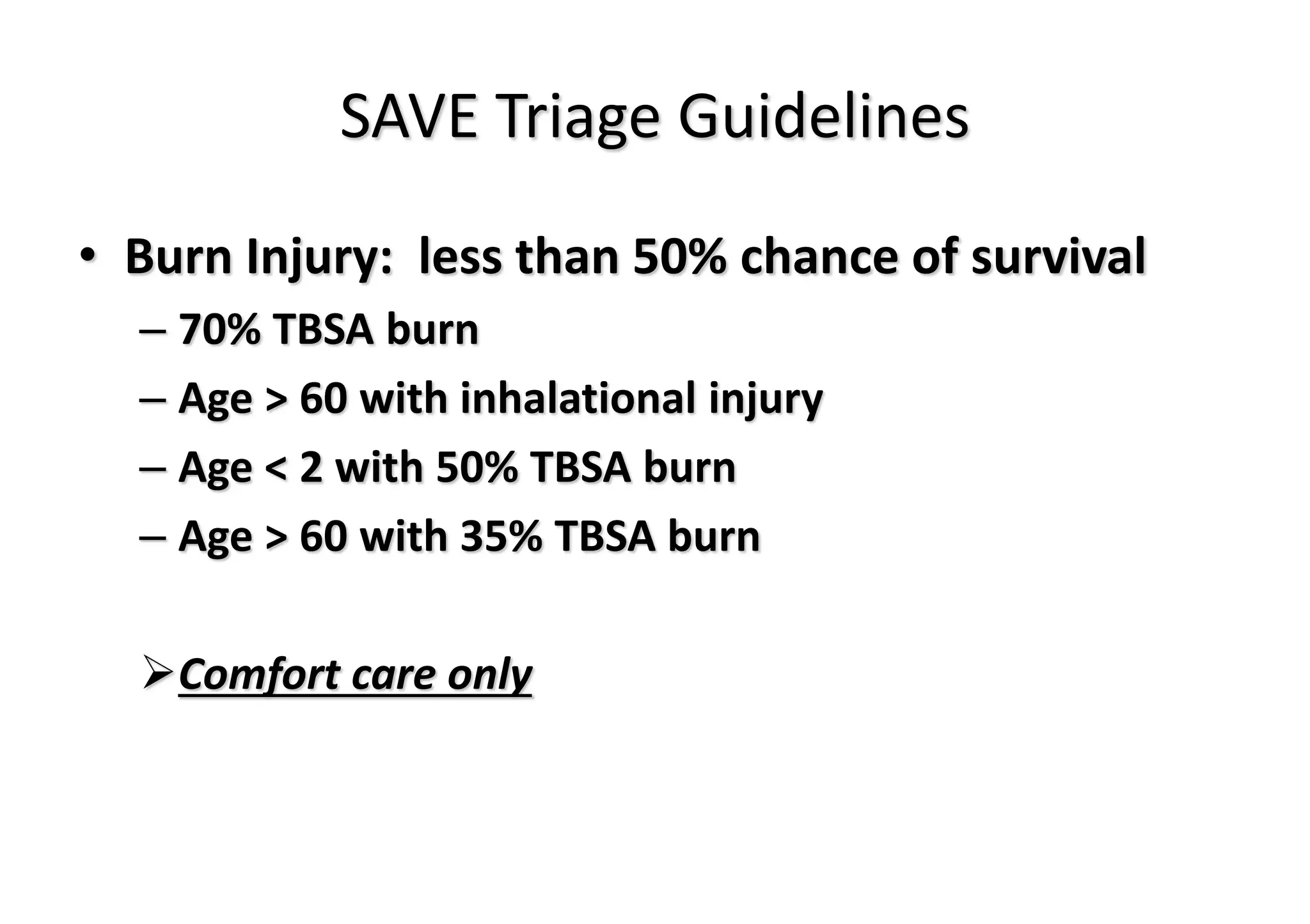
SAVE Triage Guidelines
• Burn Injury: less than 50% chance of survival
– 70% TBSA burn
– Age > 60 with inhalational injury
– Age < 2 with 50% TBSA burn
– Age > 60 with 35% TBSA burn
Comfort care only
SAVE Triage Guidelines
• Abdominal Injury
– No data to guide evaluation
– 4 ml/kg hypertonic saline X 2 IF HYPOTENSION
– If no response, comfort care only
Initial Assessment: START
Case #1
• 61 year old male pulled from smoking building.
Complaining of shortness of breath.
• RR =28
• Wrist Pulse: palpable
• Mental Status: follows commands
START Category: delayed
Treatment: nothing
Initial Assessment: START
Case #2
• 30 year old male found with bleeding head
wound
• RR =22
• Wrist Pulse: palpable
• Mental Status: unresponsive
START Category: (immediate)
Treatment: apply pressure to stop bleeding & transport
Initial Assessment: START
Case #3
• 20 year old female complaining of crushed lower
extremity
• RR =20
• Wrist Pulse: palpable
• Mental Status: follows commands
START Category: delayed
Treatment: nothing
Initial Assessment: START
Case #4
• 3 year old female found not breathing
• RR =agonal
• Wrist Pulse: palpable
• Mental Status: unresponsive
Open airway and give 15 seconds of ventilation. If
No change in respirations.
START Category: dead , LEAVE HER
Secondary Assessment: SAVE
Case #2
• 30 year old male found with bleeding head
wound
• START Category: red (immediate)
• EXAM: neurologic status
– Does not open eyes, does not speak, and
withdraws to pain
– GCS = 6
SAVE Category: CAT 1 (unsalvageable)
Secondary Assessment: SAVE
Case #1
• 61 year old male pulled from smoking
building. Complaining of shortness of
breath.
• START Category: delayed care
• EXAM: airway
– Singed nasal hairs and eyebrows. Coughing up
carbonaceous material. Wheezing. No skin
burns
SAVE Category: cat 1(unsalvageable)
Secondary Assessment: SAVE
Case #3
• 20 year old female complaining of crushed
lower extremity
• START Category: delayed
• EXAM: extremities
– Crushed left leg. Massive tissue avulsion and
hemorrhage. Limb numb. Patient is pale.
– MESS = 8 or 9
SAVE Category: cat 3(immediate)
TRIAGE IN THE EMERGENCY
DEPARTMENT
EMERGENCY DEPARTMENT TRIAGE
• Triage establishes priorities for care and
determines the clinical area of treatment
• Even if triage has been done at the scene, triage
is needed at the ED entrance.
• To accomplish the most good for the most
number of patients, the triage team should
evaluate all patients arriving at the ED and
classify their conditions with regard to severity of
injury and need for treatment
Key points
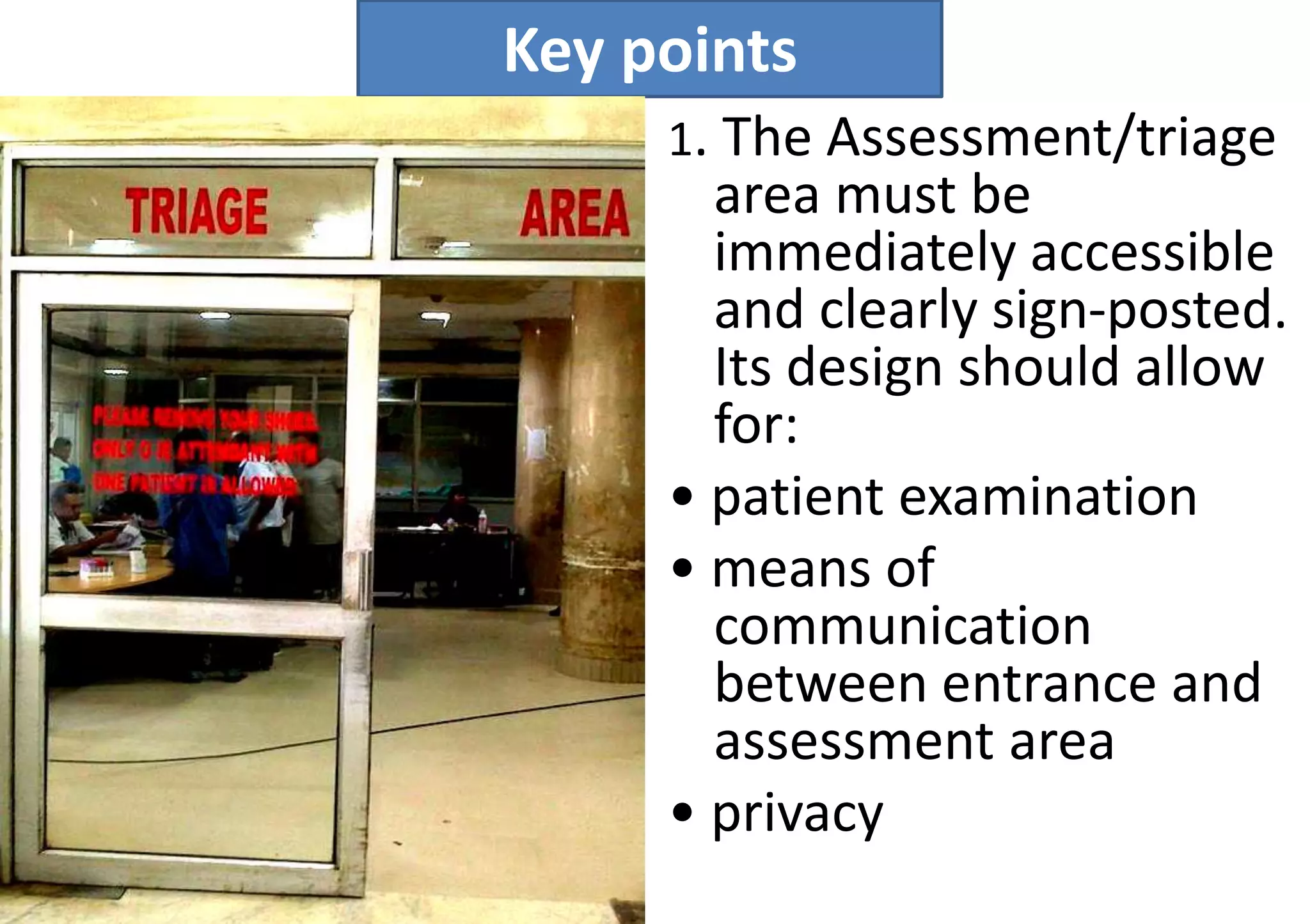
1. The Assessment/triage
area must be
immediately accessible
and clearly sign-posted.
Its design should allow
for:
• patient examination
• means of
communication
between entrance and
assessment area
• privacy
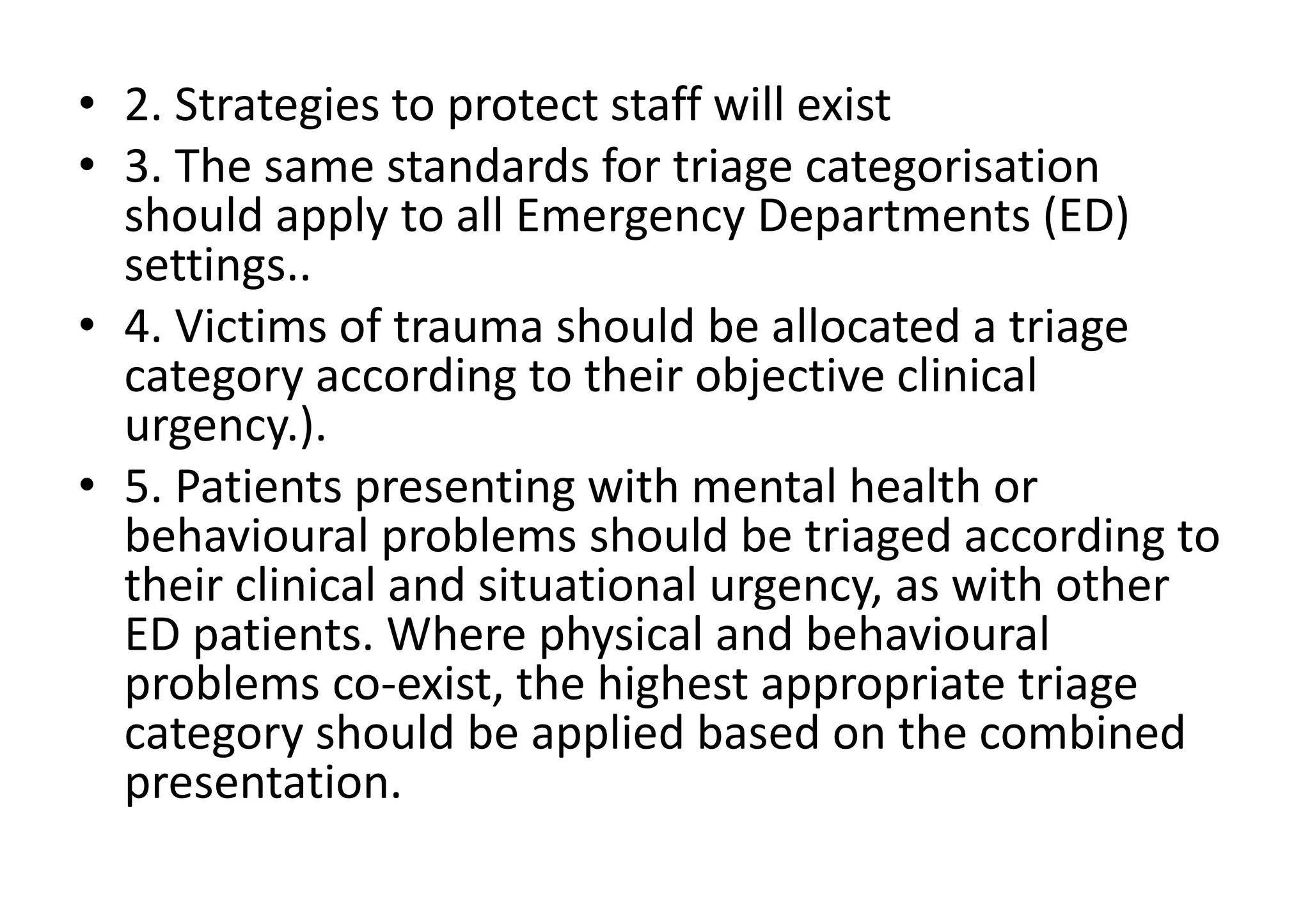
• 2. Strategies to protect staff will exist
• 3. The same standards for triage categorisation
should apply to all Emergency Departments (ED)
settings..
• 4. Victims of trauma should be allocated a triage
category according to their objective clinical
urgency.).
• 5. Patients presenting with mental health or
behavioural problems should be triaged according to
their clinical and situational urgency, as with other
ED patients. Where physical and behavioural
problems co-exist, the highest appropriate triage
category should be applied based on the combined
presentation.
Equipment Requirements
• Emergency equipment
• Facilities for using standard precautions (hand-
washing facilities, gloves)
• Adequate communications devices (telephone
and/or intercom etc)
• Facilities for recording triage information
Triage Team
• an emergency physician, an ED nurse, and
medical records or admitting clerks should
receive every patient
• The physician performing hospital triage should
be acknowledged as being in command of the
triage area, should be clearly identified by a
specially colored vest or other garment, and must
understand all triage options
• One member of the triage team (admitting or
medical records clerk) should be assigned the job of
recording the victim's name on the disaster tag along
with the triaged destination within the hospital.
• If identification of the patient is not available,
ethnicity, gender, and approximate age should be
noted on the tag.
• An initial diagnostic impression should also be
registered on the tag.
• This information is entered into a department log
and is also placed in a triage logbook
• Security personnel, media centre, official person’s
involvement is equally important to successfully
triage all the patients
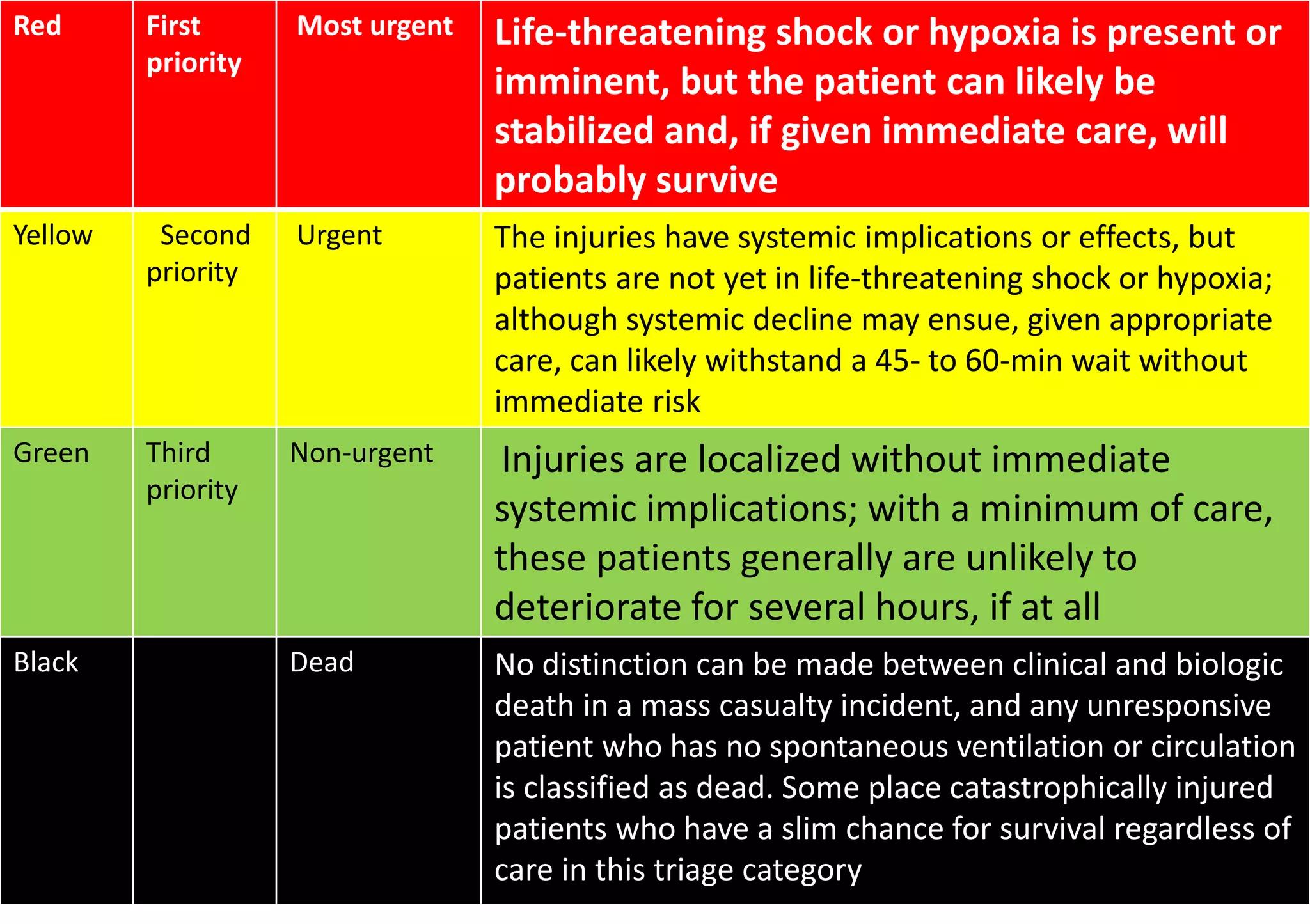
Triage category
• four color-coded categories (red, yellow, green,
or black), depending on injury severity and
prognosis
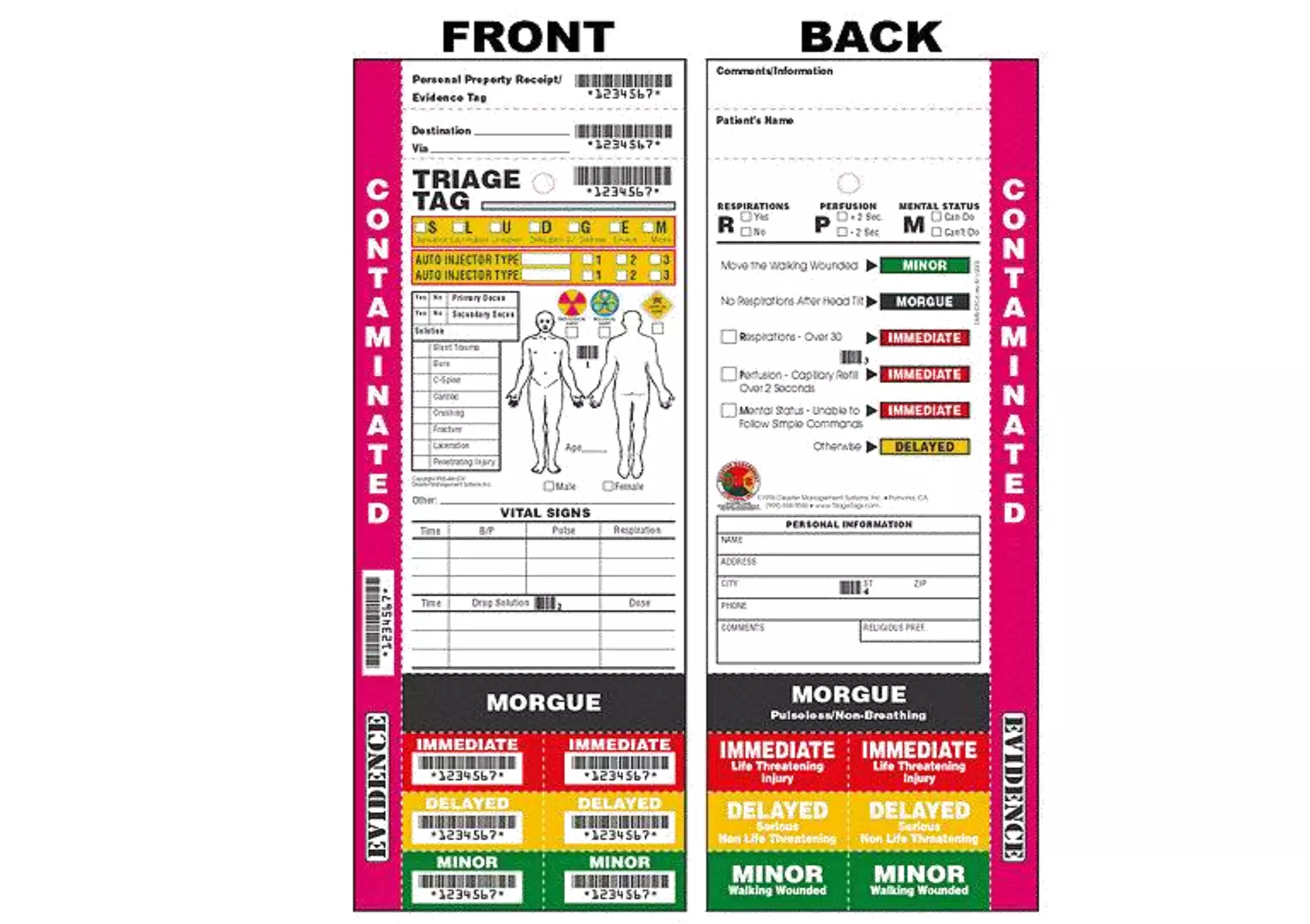
• Triage category is identified by use of a colored
band or trauma/disaster tag that is placed on the
patient to document that triage has been done.
Red First
priority
Most urgent Life-threatening shock or hypoxia is present or
imminent, but the patient can likely be
stabilized and, if given immediate care, will
probably survive
Yellow Second
priority
Urgent The injuries have systemic implications or effects, but
patients are not yet in life-threatening shock or hypoxia;
although systemic decline may ensue, given appropriate
care, can likely withstand a 45- to 60-min wait without
immediate risk
Green Third
priority
Non-urgent Injuries are localized without immediate
systemic implications; with a minimum of care,
these patients generally are unlikely to
deteriorate for several hours, if at all
Black Dead No distinction can be made between clinical and biologic
death in a mass casualty incident, and any unresponsive
patient who has no spontaneous ventilation or circulation
is classified as dead. Some place catastrophically injured
patients who have a slim chance for survival regardless of
care in this triage category
TRIAGE TAGS
Recognition of the Critically Ill Child
Useful signs
• Alertness drowsiness
hypotonic on examination
• Breathing moderate/severe
recession cyanosis wheeze
• Circulation: pallor signs of
dehydration
• Temperature > 38.5C
• Signs of dehydration
• Tender abdomen
Specific signs
• Resp grunt, crepitations,
stridor, apnoea tachypnoea
>80
• Abdo mass, hernia, distension
• CNS weak cry, abnormal
posture
• Skin cold periphery, mottling,
bruise, rash
• Pulse > 200
• Urine output < 4 wet nappies
Documentation
• Date and time of assessment
• Name of the DOCTOR / triage nurse
• Chief presenting problem(s)
• Limited, relevant history
• Relevant assessment findings
• Initial triage category allocated
• Any diagnostic, first aid or treatment measures
initiated
Re-triage
• his/her condition changes while they are waiting
for treatment
• additional relevant information becomes
available that impacts on the patient's urgency
 Both the initial triage and any subsequent
categorisations should be recorded, and the
reason for the re-triage documented
TERTIARY TRIAGE
• Done AFTER INITIAL RESUSCITATION &
STABILISATION following ED Triage
• By the Specialists(NOT by the Emergency Physicians )
• To Assess & allocate
 Which patient Requires emergency Surgery
 Requires Admission into Intensive Care Unit/
Specific Ward
 Can be Discharged from their side
Take Home Messages
• Each & every EMERGENCY DEPARTMENT should
have their well-organised triage plan to tackle
mass-casualty/ disaster scenario in the hospital
• Pre-designated triage team, along with training of
all the staffs (doctor, nurse, & other health-care
providers ) to be pursued in every hospital
REFERENCES
• ATLS, 10TH EDITION
• TINTINALLI, 7TH EDITION
• AUSTRALIAN TRIAGE SCORE
• CANADIAN TRIAGE SCORE
THANK YOU

TRIAGE

  • 1.
    TRIAGE Dr SUBHANKAR PAUL EmergencyMedicine & Critical Care, GAUHATI MEDICAL COLLEGE & HOSPITAL
  • 2.
    INTRODUCTION • Triage isthe process of prioritising patient treatment during mass casualty events (ATLS) • patients are classified according to the type and urgency of their conditions to get the Right patient to the Right place at the Right time with the Right care provider
  • 3.
    Triage : Origin •From the French verb, t r i e r , “to sort” • Napoleon’s time, world war-1, to assign treatment priorities with limited resources • Attention given first to most salvageable with most urgent conditions
  • 4.
    Key Concepts • Resourcesare limited – Supplies – Personnel • Time for evacuation /help unknown or prolonged – Only austere field interventions are available – Basic principle : “DO THE MOST GOODS FOR MOST PATIENTS USING AVAILABLE RESOURCES”
  • 5.
    Aims • To ensurethat patients are treated in the order of their clinical urgency • To ensure that treatment is appropriately and timely. • To allocate the patient to the most appropriate assessment and treatment area (AVOID CONGESTION)
  • 6.
    • To provideongoing assessment of patients • To provide information to patients and families regarding services expected care and waiting times. • To contribute information that helps to define departmental acuity.
  • 7.
    TYPES of TRIAGE typesobjectives / methodology PRIMARY TRIAGE ( FIELD TRIAGE ) EARLY TRANSPORTATION “START” & “SAVE” DISASTER SCENARIO SECONDARY TRIAGE ( ED TRIAGE ) TIMELY & APPROPRIATE INTERVENTION COLOUR CODING TERTIARY TRIAGE Specialist Care
  • 8.
    Triage Practices • EDTriage – Static, single point in time – Triage tags frequently used – Few patients – Used for mass Casualty scenes • Disaster – Dynamic, multiple points in time – Documentation needs may exceed triage tag capacity – Large patient numbers – Used for wide-spread disaster scenes
  • 9.
    Patient Categories 1. Thosewho will die no matter what 2. Those who will do well no matter what we do 3. Those who will derive long-term benefit from acute intervention • Early identification of #3 important – Others benefit from comfort care
  • 10.
  • 11.
    Goal of DisasterTriage • Do the greatest good for the greatest number of PATIENTS
  • 12.
    START TRIAGE • DONEIn the field • By the rescue personnel • simple triage and rapid treatment (START) technique • a quick assessment of respirations,  perfusion, and mental status
  • 14.
    SAVE Triage • SAVE(Secondary Assessment of Victim Endpoint) • When patients are likely to have significantly delayed transport from a scene (e.g., number of casualties exceed transportation capacity or damage to hospital infrastructure), • helpful to identify patients who are most likely to benefit from the care available under austere field conditions.
  • 15.
    SAVE Triage • reflecta balance between resource use and probability of survival Benefit Value = ———— X Probability of survival Resources required
  • 17.
    SAVE Triage Areas ofAssessment • Vital Signs • Airway • Chest • Abdomen • Pelvis • Spine • Extremities • Skin • Neurologic Status • Mental Status
  • 18.
    SAVE Triage Categories Cate gory DefinitionCARE PROVIDED 1 Patients who will die regardless of how much care they receive COMFORT CARE 2 Patients who will survive whether or not they receive care DELAYED CARE 3 Patients who will benefit significantly from austere field interventions IMMEDIATE CARE Periodic assessment of all categories is important
  • 19.
    SAVE Triage Guidelines •Crush Injury to Lower Extremity – Patients are assessed using the MESS score (Mangled Extremity Severity Score ) – Score of 7 or more: amputate – Score less than 7: attempt limb salvage , IMMEDIATE TRANSPORT
  • 20.
    SAVE Triage Guidelines •Head Injury (adults) – Use the Glascow Coma Score (GCS) – Score 8 or above: treat • Better than 50% chance of a normal or good neurologic recovery – Score 7 or less: comfort care only
  • 21.
    SAVE Triage Guidelines •Burn Injury: less than 50% chance of survival – 70% TBSA burn – Age > 60 with inhalational injury – Age < 2 with 50% TBSA burn – Age > 60 with 35% TBSA burn Comfort care only
  • 22.
    SAVE Triage Guidelines •Abdominal Injury – No data to guide evaluation – 4 ml/kg hypertonic saline X 2 IF HYPOTENSION – If no response, comfort care only
  • 23.
    Initial Assessment: START Case#1 • 61 year old male pulled from smoking building. Complaining of shortness of breath. • RR =28 • Wrist Pulse: palpable • Mental Status: follows commands START Category: delayed Treatment: nothing
  • 24.
    Initial Assessment: START Case#2 • 30 year old male found with bleeding head wound • RR =22 • Wrist Pulse: palpable • Mental Status: unresponsive START Category: (immediate) Treatment: apply pressure to stop bleeding & transport
  • 25.
    Initial Assessment: START Case#3 • 20 year old female complaining of crushed lower extremity • RR =20 • Wrist Pulse: palpable • Mental Status: follows commands START Category: delayed Treatment: nothing
  • 26.
    Initial Assessment: START Case#4 • 3 year old female found not breathing • RR =agonal • Wrist Pulse: palpable • Mental Status: unresponsive Open airway and give 15 seconds of ventilation. If No change in respirations. START Category: dead , LEAVE HER
  • 27.
    Secondary Assessment: SAVE Case#2 • 30 year old male found with bleeding head wound • START Category: red (immediate) • EXAM: neurologic status – Does not open eyes, does not speak, and withdraws to pain – GCS = 6 SAVE Category: CAT 1 (unsalvageable)
  • 28.
    Secondary Assessment: SAVE Case#1 • 61 year old male pulled from smoking building. Complaining of shortness of breath. • START Category: delayed care • EXAM: airway – Singed nasal hairs and eyebrows. Coughing up carbonaceous material. Wheezing. No skin burns SAVE Category: cat 1(unsalvageable)
  • 29.
    Secondary Assessment: SAVE Case#3 • 20 year old female complaining of crushed lower extremity • START Category: delayed • EXAM: extremities – Crushed left leg. Massive tissue avulsion and hemorrhage. Limb numb. Patient is pale. – MESS = 8 or 9 SAVE Category: cat 3(immediate)
  • 30.
    TRIAGE IN THEEMERGENCY DEPARTMENT
  • 31.
    EMERGENCY DEPARTMENT TRIAGE •Triage establishes priorities for care and determines the clinical area of treatment • Even if triage has been done at the scene, triage is needed at the ED entrance. • To accomplish the most good for the most number of patients, the triage team should evaluate all patients arriving at the ED and classify their conditions with regard to severity of injury and need for treatment
  • 32.
    Key points 1. TheAssessment/triage area must be immediately accessible and clearly sign-posted. Its design should allow for: • patient examination • means of communication between entrance and assessment area • privacy
  • 33.
    • 2. Strategiesto protect staff will exist • 3. The same standards for triage categorisation should apply to all Emergency Departments (ED) settings.. • 4. Victims of trauma should be allocated a triage category according to their objective clinical urgency.). • 5. Patients presenting with mental health or behavioural problems should be triaged according to their clinical and situational urgency, as with other ED patients. Where physical and behavioural problems co-exist, the highest appropriate triage category should be applied based on the combined presentation.
  • 34.
    Equipment Requirements • Emergencyequipment • Facilities for using standard precautions (hand- washing facilities, gloves) • Adequate communications devices (telephone and/or intercom etc) • Facilities for recording triage information
  • 35.
    Triage Team • anemergency physician, an ED nurse, and medical records or admitting clerks should receive every patient • The physician performing hospital triage should be acknowledged as being in command of the triage area, should be clearly identified by a specially colored vest or other garment, and must understand all triage options
  • 36.
    • One memberof the triage team (admitting or medical records clerk) should be assigned the job of recording the victim's name on the disaster tag along with the triaged destination within the hospital. • If identification of the patient is not available, ethnicity, gender, and approximate age should be noted on the tag. • An initial diagnostic impression should also be registered on the tag. • This information is entered into a department log and is also placed in a triage logbook • Security personnel, media centre, official person’s involvement is equally important to successfully triage all the patients
  • 37.
    Triage category • fourcolor-coded categories (red, yellow, green, or black), depending on injury severity and prognosis • Triage category is identified by use of a colored band or trauma/disaster tag that is placed on the patient to document that triage has been done.
  • 38.
    Red First priority Most urgentLife-threatening shock or hypoxia is present or imminent, but the patient can likely be stabilized and, if given immediate care, will probably survive Yellow Second priority Urgent The injuries have systemic implications or effects, but patients are not yet in life-threatening shock or hypoxia; although systemic decline may ensue, given appropriate care, can likely withstand a 45- to 60-min wait without immediate risk Green Third priority Non-urgent Injuries are localized without immediate systemic implications; with a minimum of care, these patients generally are unlikely to deteriorate for several hours, if at all Black Dead No distinction can be made between clinical and biologic death in a mass casualty incident, and any unresponsive patient who has no spontaneous ventilation or circulation is classified as dead. Some place catastrophically injured patients who have a slim chance for survival regardless of care in this triage category
  • 39.
  • 40.
    Recognition of theCritically Ill Child Useful signs • Alertness drowsiness hypotonic on examination • Breathing moderate/severe recession cyanosis wheeze • Circulation: pallor signs of dehydration • Temperature > 38.5C • Signs of dehydration • Tender abdomen Specific signs • Resp grunt, crepitations, stridor, apnoea tachypnoea >80 • Abdo mass, hernia, distension • CNS weak cry, abnormal posture • Skin cold periphery, mottling, bruise, rash • Pulse > 200 • Urine output < 4 wet nappies
  • 41.
    Documentation • Date andtime of assessment • Name of the DOCTOR / triage nurse • Chief presenting problem(s) • Limited, relevant history • Relevant assessment findings • Initial triage category allocated • Any diagnostic, first aid or treatment measures initiated
  • 43.
    Re-triage • his/her conditionchanges while they are waiting for treatment • additional relevant information becomes available that impacts on the patient's urgency  Both the initial triage and any subsequent categorisations should be recorded, and the reason for the re-triage documented
  • 44.
    TERTIARY TRIAGE • DoneAFTER INITIAL RESUSCITATION & STABILISATION following ED Triage • By the Specialists(NOT by the Emergency Physicians ) • To Assess & allocate  Which patient Requires emergency Surgery  Requires Admission into Intensive Care Unit/ Specific Ward  Can be Discharged from their side
  • 45.
    Take Home Messages •Each & every EMERGENCY DEPARTMENT should have their well-organised triage plan to tackle mass-casualty/ disaster scenario in the hospital • Pre-designated triage team, along with training of all the staffs (doctor, nurse, & other health-care providers ) to be pursued in every hospital
  • 46.
    REFERENCES • ATLS, 10THEDITION • TINTINALLI, 7TH EDITION • AUSTRALIAN TRIAGE SCORE • CANADIAN TRIAGE SCORE
  • 47.

Editor's Notes

  • #3 Urgency refers to the need for time-critical intervention - it is not synonymous with severity. Patients triaged to lower acuity categories may be safe to wait longer for assessment and treatment but may still require hospital admission
  • #13 In the field, rescue personnel often use a simple triage and rapid treatment (START) technique that depends on a quick assessment of respirations, perfusion, and mental status
  • #15 All patients with at least a 50% chance of survival using available resources get care Patient assessed by SAVE methodology in order of priority determined by START
  • #16 When patients are likely to have significantly delayed transport from a scene (e.g., number of casualties exceed transportation capacity or damage to hospital infrastructure), the "Secondary Assessment of Victim Endpoint" triage system may be helpful to identify patients who are most likely to benefit from the care available under austere field conditions. The Secondary Assessment of Victim Endpoint triage system is intended to triage patients into categories that reflect a balance between resource use and probability of survival
  • #39 Catastrophically injured patients who have a minimal chance for survival despite optimal medical care should be classified as "expectant" ("black": to include burns involving 95% body surface area, patients in full cardiac arrest, patients in septic shock). Devoting time and resources to patients who are not likely to live jeopardizes other patients who are truly salvageable. The goal with these "expectant" patients should be adequate pain control and the opportunity to be with friends and family.
  • #41 Background information Serious illness in a child may not be recognised . This is because children: • are poor historians • may manifest non specific symptoms • may be uncooperative during examination • may not show significant indicators - but rather may present as subtle signs • may be presumed to have age specific diseases