







Effective Delegation
a.k.a., Managing the Monkeys
inYour Workplace
Presented by:
Steve Urquhart
Orange County Clerk of Courts
It’s a jungle
out there!
If your last status meeting looked
anything like this …
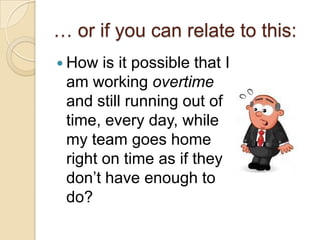
… or if you can relate to this:
 How is it possible that I
am working overtime and
still running out of time,
every day, while my team
goes home right on time
as if they don’t have
enough to do?
… then this session is for you!
Do you ever find yourself asking
Who’s actually in
charge around
this place?
Are you controlling events …
… or are events controlling you?
No matter how much I do …
 Why is it that I’ve increased my efficiency,
but now I have more to do?
 Wherever I go, hallway, elevator, parking
lot … even the restroom … my team
needs something from me!
 I’m working overtime on things my team
needs from me before they can proceed
with their assigned tasks …
You need to be asking yourself …
Who’s got the monkey?
William Oncken, Jr.
… the tale of an
overburdened manager who
allows his employees to
delegate upward.
Be on the lookout for monkeys!
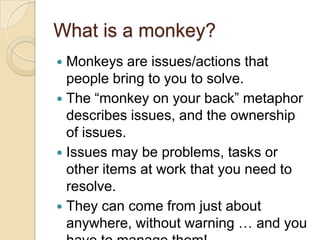
What is a monkey?
 Monkeys are issues/actions that people
bring to you to solve.
 The “monkey on your back” metaphor
describes issues, and the ownership of
issues.
 Issues may be problems, tasks or other
items at work that you need to resolve.
 They can come from just about anywhere,
without warning … and you have to
manage them!
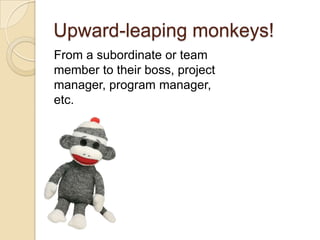
Upward-leaping monkeys!
From a subordinate or team
member to their boss, project
manager, program manager, etc.
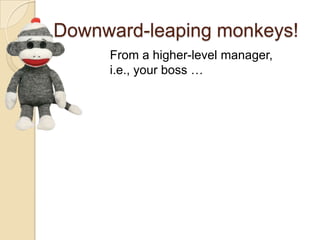
Downward-leaping monkeys!
From a higher-level manager, i.e.,
your boss …
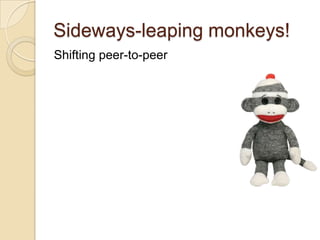
Sideways-leaping monkeys!
Shifting peer-to-peer
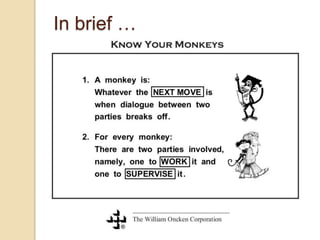
In brief …
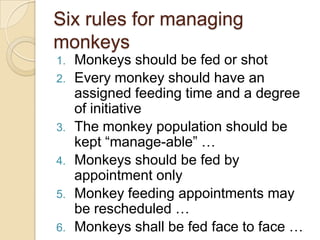
Six rules for managing monkeys
1. Monkeys should be fed or shot
2. Every monkey should have an assigned
feeding time and a degree of initiative
3. The monkey population should be kept
“manage-able” …
4. Monkeys should be fed by appointment
only
5. Monkey feeding appointments may be
rescheduled …
6. Monkeys shall be fed face to face …
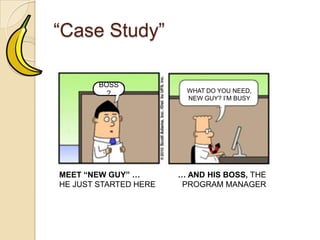
“Case Study”
WHAT DOYOU NEED,
NEW GUY? I’M BUSY …
MEET “NEW GUY” …
HE JUST STARTED HERE
… AND HIS BOSS, THE
PROGRAM MANAGER
BOSS?
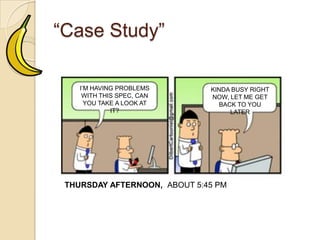
“Case Study”
I’M HAVING PROBLEMS
WITH THIS SPEC, CAN
YOUTAKE A LOOK AT IT?
KINDA BUSY RIGHT
NOW, LET ME GET
BACKTOYOU LATER
THURSDAY AFTERNOON, ABOUT 5:45 PM
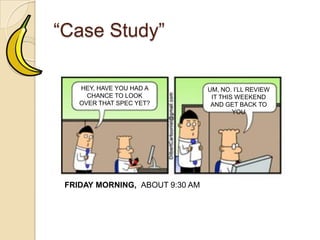
“Case Study”
HEY, HAVEYOU HAD A
CHANCETO LOOK OVER
THAT SPECYET?
UM, NO. I’LL REVIEW IT
THISWEEKENDAND
GET BACKTOYOU
FRIDAY MORNING, ABOUT 9:30 AM
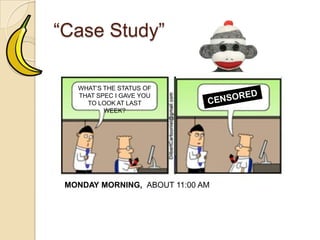
“Case Study”
WHAT’STHE STATUS OF
THAT SPEC I GAVEYOU
TO LOOK AT LASTWEEK?
MONDAY MORNING, ABOUT 11:00 AM
KINDA BUSY RIGHT
NOW, LET ME GET
Do you ever find yourself asking
Who’s actually in
charge around
this place?
New mantra:
At no time while I am helping you will your
problem become my problem.The instant
your problem becomes mine, you will no
longer have a problem. I cannot help someone
who hasn't got a problem.
You may ask my help at any appointed time,
and we will make a joint determination of
what the next move will be and who will
make it.
Some common symptoms of
ineffective monkey management …
 You’re tempted to change your LinkedIn
headline to Firefighter because you spend
your day in “management by crisis” mode.
 At the end of the work day, you’ve crossed
nothing off on your To-Do list but you’ve
hardly had a minute to spare.
 Your briefcase, cell phone, or planner has to
be surgically removed from your hand.
 You find yourself heading straight for the
produce section of your local supermarket
because of a craving for bananas!
Monkeys should be fed or shot
 No one likes a starving monkey.They tend
to be very disagreeable and squeal and
raise a ruckus. Monkeys must be fed
periodically.
 The problem (the monkey) must be dealt
with between the manager and the
employee with the problem on a regular
basis. If the monkey can be shot (the
problem solved quickly), then feeding
times are not necessary.
Every monkey should have an
assigned feeding time …
 After a feeding session, the manager
should select an appropriate time for the
next feeding and should have a number of
action steps for the employee to take.
… and a degree of initiative
5. Act on their own; routine reporting
4. Act, but advise at once
3. Recommend, then take resulting action
2. Ask what to do
1. Wait until told
Levels 1 and 2 are
the biggest sources
of monkeys!
The monkey population should be
kept “manage-able” …
 It should take 15 minutes (or less) to feed
a monkey
 Managers should keep the list of
problems that are in various stages of
solution at a manageable number.
Monkeys should be fed by
appointment only
 Allowing employees to bring problems to
you on their timetable increases the
chances that the monkey will move from
the employee to the manager.
 By setting specific times for addressing
the problem, managers empower
employees to make interim decisions
about the problem, and still report back.
Monkey feeding appointments may
be rescheduled …
 Either party, the manager or the team
member (subordinate), may reschedule a
feeding appointment for any reason, but it
must be scheduled to a specific time to
avoid losing track of the monkey.
Monkeys shall be fed face to face …
 Holding feeding sessions via e-mail or
memo transfers the monkey to the
manager.
 An employee can “pass the monkey” to
the manager by simply requesting a
response.
 Feedings that take place in person or on
the phone require the monkey to remain
with the employee unless the manager
takes an affirmative step to take it.
(or by telephone, but not in writing)
Rules that apply for all monkeys
1. Define the monkey: It must be fully
described.That is, the next move must be
known.
2. Assign the monkey: It must be fully owned.
Whose monkey is it?
3. “Insure” the monkey: It must be insured,
based on risk.What if you give an important
project to someone who is not ready? How can
you balance the personal growth of your people
with acceptable risk to your own reputation and
career.
4. Put the monkey on a schedule: It must be
placed on a care and feeding schedule.When,
where, and how do you follow up?
Some typical reasons not to
delegate? (a.k.a., excuses)
 "Delegating would mean giving up power
and control."
 "Delegating makes me nonessential."
 "Delegating is not worth the time -- I can
do the job myself faster and better."
 "I can't count on my team to handle this."
The Four Cs of getting comfortable
with delegating
 Confidence. Be convinced that this person can
do it. If not, use insurance policy: recommend,
then act; or work with them not for them.
 Clarify expectations and be reasonably sure your
team members know what is to be done.Verify
understanding by having them
 Be Certain the person has sufficient resources--
time, information, money, people, assistance, and
authority--to do the work.
 Don’t turn over Control until your are confident
that the cost and timing and quantity and quality
of the project will be acceptable. Have them get
back to you with their work plan.
Delegation vs. abdication …
There are a few things that you should not
delegate:
 Performance feedback
 Disciplinary actions
 Politically sensitive tasks
 Confrontations arising from interpersonal
conflict
In Brief: Oncken’s Rules of
Monkey Management
1. Descriptions: The next moves are
specified.
2. Owners: The monkey is assigned to a
person.
3. Insurance: The risk is covered.
4. Care & Feeding: The time and place
for check-up/follow-up is specified.
Just don’t let this be you …
THANKYOU!
@workforce101
/in/steveurquhart
steveurquhart@gmail.com

Effective delegation and monkey management

  • 1.
    Effective Delegation a.k.a., Managingthe Monkeys inYour Workplace Presented by: Steve Urquhart Orange County Clerk of Courts It’s a jungle out there!
  • 2.
    If your laststatus meeting looked anything like this …
  • 3.
    … or ifyou can relate to this:  How is it possible that I am working overtime and still running out of time, every day, while my team goes home right on time as if they don’t have enough to do?
  • 4.
    … then thissession is for you!
  • 5.
    Do you everfind yourself asking Who’s actually in charge around this place?
  • 6.
    Are you controllingevents … … or are events controlling you?
  • 7.
    No matter howmuch I do …  Why is it that I’ve increased my efficiency, but now I have more to do?  Wherever I go, hallway, elevator, parking lot … even the restroom … my team needs something from me!  I’m working overtime on things my team needs from me before they can proceed with their assigned tasks … You need to be asking yourself …
  • 8.
    Who’s got themonkey? William Oncken, Jr. … the tale of an overburdened manager who allows his employees to delegate upward.
  • 9.
    Be on thelookout for monkeys!
  • 10.
    What is amonkey?  Monkeys are issues/actions that people bring to you to solve.  The “monkey on your back” metaphor describes issues, and the ownership of issues.  Issues may be problems, tasks or other items at work that you need to resolve.  They can come from just about anywhere, without warning … and you have to manage them!
  • 11.
    Upward-leaping monkeys! From asubordinate or team member to their boss, project manager, program manager, etc.
  • 12.
    Downward-leaping monkeys! From ahigher-level manager, i.e., your boss …
  • 13.
  • 14.
  • 15.
    Six rules formanaging monkeys 1. Monkeys should be fed or shot 2. Every monkey should have an assigned feeding time and a degree of initiative 3. The monkey population should be kept “manage-able” … 4. Monkeys should be fed by appointment only 5. Monkey feeding appointments may be rescheduled … 6. Monkeys shall be fed face to face …
  • 16.
    “Case Study” WHAT DOYOUNEED, NEW GUY? I’M BUSY … MEET “NEW GUY” … HE JUST STARTED HERE … AND HIS BOSS, THE PROGRAM MANAGER BOSS?
  • 17.
    “Case Study” I’M HAVINGPROBLEMS WITH THIS SPEC, CAN YOUTAKE A LOOK AT IT? KINDA BUSY RIGHT NOW, LET ME GET BACKTOYOU LATER THURSDAY AFTERNOON, ABOUT 5:45 PM
  • 18.
    “Case Study” HEY, HAVEYOUHAD A CHANCETO LOOK OVER THAT SPECYET? UM, NO. I’LL REVIEW IT THISWEEKENDAND GET BACKTOYOU FRIDAY MORNING, ABOUT 9:30 AM
  • 19.
    “Case Study” WHAT’STHE STATUSOF THAT SPEC I GAVEYOU TO LOOK AT LASTWEEK? MONDAY MORNING, ABOUT 11:00 AM KINDA BUSY RIGHT NOW, LET ME GET
  • 20.
    Do you everfind yourself asking Who’s actually in charge around this place?
  • 21.
    New mantra: At notime while I am helping you will your problem become my problem.The instant your problem becomes mine, you will no longer have a problem. I cannot help someone who hasn't got a problem. You may ask my help at any appointed time, and we will make a joint determination of what the next move will be and who will make it.
  • 22.
    Some common symptomsof ineffective monkey management …  You’re tempted to change your LinkedIn headline to Firefighter because you spend your day in “management by crisis” mode.  At the end of the work day, you’ve crossed nothing off on your To-Do list but you’ve hardly had a minute to spare.  Your briefcase, cell phone, or planner has to be surgically removed from your hand.  You find yourself heading straight for the produce section of your local supermarket because of a craving for bananas!
  • 23.
    Monkeys should befed or shot  No one likes a starving monkey.They tend to be very disagreeable and squeal and raise a ruckus. Monkeys must be fed periodically.  The problem (the monkey) must be dealt with between the manager and the employee with the problem on a regular basis. If the monkey can be shot (the problem solved quickly), then feeding times are not necessary.
  • 24.
    Every monkey shouldhave an assigned feeding time …  After a feeding session, the manager should select an appropriate time for the next feeding and should have a number of action steps for the employee to take.
  • 25.
    … and adegree of initiative 5. Act on their own; routine reporting 4. Act, but advise at once 3. Recommend, then take resulting action 2. Ask what to do 1. Wait until told Levels 1 and 2 are the biggest sources of monkeys!
  • 26.
    The monkey populationshould be kept “manage-able” …  It should take 15 minutes (or less) to feed a monkey  Managers should keep the list of problems that are in various stages of solution at a manageable number.
  • 27.
    Monkeys should befed by appointment only  Allowing employees to bring problems to you on their timetable increases the chances that the monkey will move from the employee to the manager.  By setting specific times for addressing the problem, managers empower employees to make interim decisions about the problem, and still report back.
  • 28.
    Monkey feeding appointmentsmay be rescheduled …  Either party, the manager or the team member (subordinate), may reschedule a feeding appointment for any reason, but it must be scheduled to a specific time to avoid losing track of the monkey.
  • 29.
    Monkeys shall befed face to face …  Holding feeding sessions via e-mail or memo transfers the monkey to the manager.  An employee can “pass the monkey” to the manager by simply requesting a response.  Feedings that take place in person or on the phone require the monkey to remain with the employee unless the manager takes an affirmative step to take it. (or by telephone, but not in writing)
  • 30.
    Rules that applyfor all monkeys 1. Define the monkey: It must be fully described.That is, the next move must be known. 2. Assign the monkey: It must be fully owned. Whose monkey is it? 3. “Insure” the monkey: It must be insured, based on risk.What if you give an important project to someone who is not ready? How can you balance the personal growth of your people with acceptable risk to your own reputation and career. 4. Put the monkey on a schedule: It must be placed on a care and feeding schedule.When, where, and how do you follow up?
  • 31.
    Some typical reasonsnot to delegate? (a.k.a., excuses)  "Delegating would mean giving up power and control."  "Delegating makes me nonessential."  "Delegating is not worth the time -- I can do the job myself faster and better."  "I can't count on my team to handle this."
  • 32.
    The Four Csof getting comfortable with delegating  Confidence. Be convinced that this person can do it. If not, use insurance policy: recommend, then act; or work with them not for them.  Clarify expectations and be reasonably sure your team members know what is to be done.Verify understanding by having them  Be Certain the person has sufficient resources-- time, information, money, people, assistance, and authority--to do the work.  Don’t turn over Control until your are confident that the cost and timing and quantity and quality of the project will be acceptable. Have them get back to you with their work plan.
  • 33.
    Delegation vs. abdication… There are a few things that you should not delegate:  Performance feedback  Disciplinary actions  Politically sensitive tasks  Confrontations arising from interpersonal conflict
  • 34.
    In Brief: Oncken’sRules of Monkey Management 1. Descriptions: The next moves are specified. 2. Owners: The monkey is assigned to a person. 3. Insurance: The risk is covered. 4. Care & Feeding: The time and place for check-up/follow-up is specified.
  • 35.
    Just don’t letthis be you …
  • 36.