A New Perspective on
Metabolic alkalosis
Taipei Veterans General Hospital, Hsin-Chu branch
Director of Nephrology
Steve Chen
HCO3-
Analysis of Acid-Base Disorders
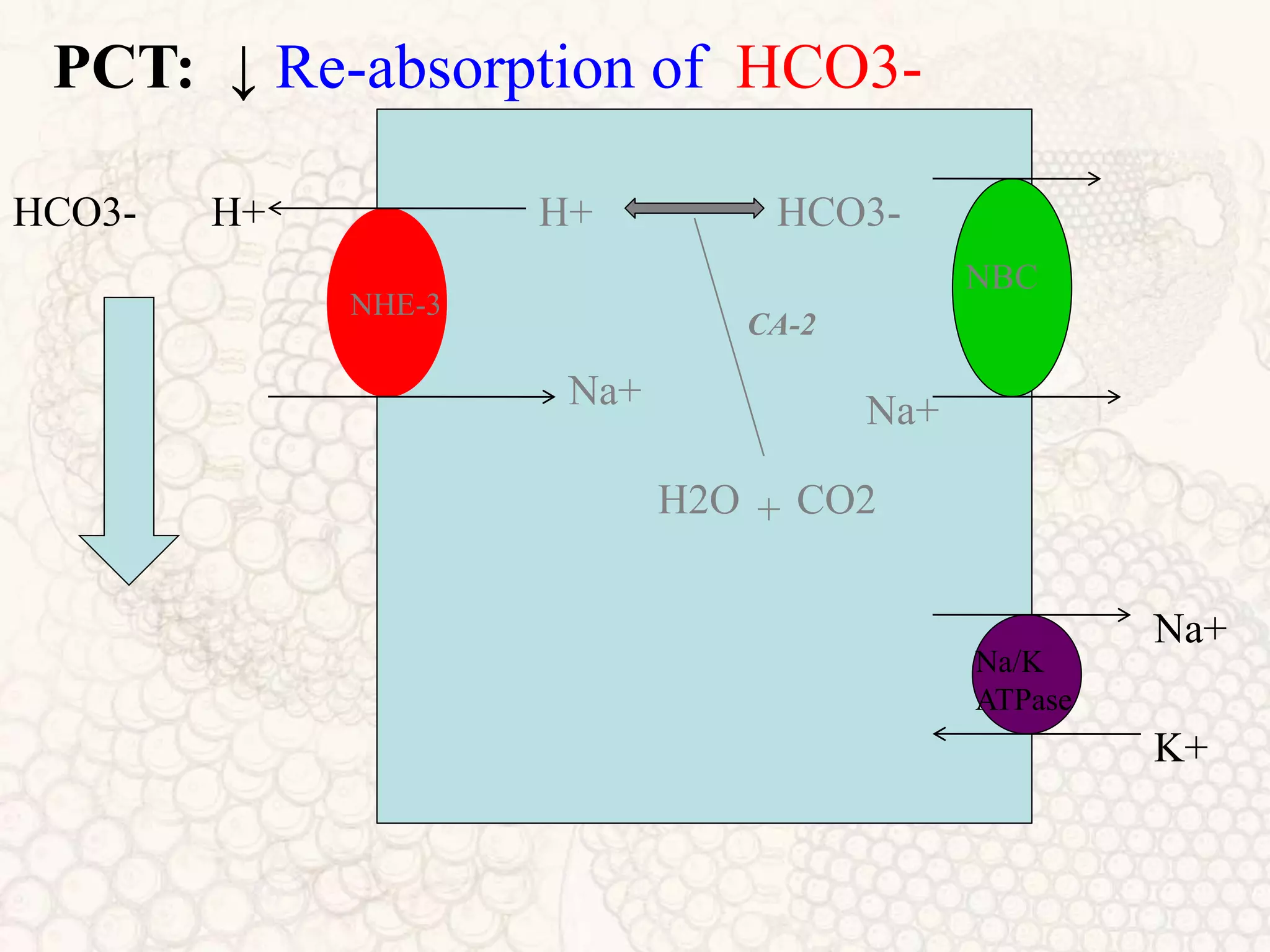
Na+
NHE-3
H+ HCO3-
Na+
NBC
H2O CO2+
CA-2
Na+
K+
Na/K
ATPase
PCT: ↓ Re-absorption of HCO3-
H+HCO3-
H+
ATP
ase
H+
H2O
OH- CO2
HCO3-
+
Cl-
CA
CCD: ↓ H+ secretion
AE-1
α - intercalated cell
CCD: ↑ HCO3- secretion  generation
Pendrin
β intercalated cell
TYPES OF ACID-BASE DISTURBANCES
Depression of the central
nervous system, as evidenced
by disorientation followed by
coma
Excitability of the nervous
system; muscles may go
into a state of tetany and
convulsions
Shift of hydrogen ions into the intracellular space
Hypokalemia
Na+
NHE-3
H+ HCO3-
Na+
NBC
H2O CO2+
CA-2
Na+
K+
Na/K
ATPase
Intracellular acidosis ► ↑ Re-absorption of
HCO3- in PCT
H+HCO3-
H+
ATP
ase
H+
H2O
OH- CO2
HCO3-
+
Cl-
CA
Hypokalemia ► ↑H+ ATPase
in CCD
AE-1
Hypokalemia ►↓ Cl re-absorption
in DCN
TSCNa
Cl
V2R
Inactive
TSC dimer TSC
monomer
AT1R
MR
SPAK
TSC: Thiazide Sensitive Co-transporter
Hypokalemia  Metabolic alkalosis
• Hypokalemia results in the shift of hydrogen ions
intracellularly. The resulting intracellular acidosis enhances
bicarbonate re-absorption in the collecting duct
• Hypokalemia stimulates the apical H+/K+ ATPase in the
collecting duct
• Hypokalemia stimulates renal ammonia genesis and alpha-
ketoglutarate is produced, the metabolism of which
generates bicarbonate that is returned to the systemic
circulation
• It leads to impaired chloride ion re-absorption in the distal
nephron. This results in an increase in luminal electro-
negativity, with subsequent enhancement of hydrogen ion
secretion
Cortisone excess
Cushing syndrome
Aldosterone ►Hypokalemia in CCD
E Na C
ROMK
Na K ATP ase
Depolarize
+
Aldosterone
+
Na
K
H
Principal cell
Competitive affinity for MR
Cortisol >> Aldosterone > cortisone
E Na C
ROMK
Na K ATP ase
Depolarize
Na
K
H
Aldosterone
MR: Mineralocorticoid receptor
Gastrointestinal H+ loss
Vomiting or NG suction
Antacids in advanced renal failure
Renal H+ loss
Primary mineralocorticoid excess
Post-hypercapnic alkalosis
Hypercalcemia (milk-alkali syndrome)
Intracellular shift of H+
Hypokalemia / Hypomagnesemia
Alkali administration
Excess CPR (Ringer lactate)
Excess transfusion(citrate blood)
Contraction alkalosis (Loss of bicarbonate-poor, chloride-rich extracellular fluid)
Loop or thiazide diuretics
Bartter or Gitelman syndrome
Sweat loss in cystic fibrosis
Villous adenoma(Chronic chloride diarrhea )or factitious diarrhea(Laxative abuse)
∆HCO3- < 2~4 meq/L
ROMK - intracellular magnesium
Huang et al: JASN 2007 (University of Texas Medical Center)
• CCT
E Na C
ROMK
Na K ATP ase
UK 5mM CK 143mM
Na
K
Mg
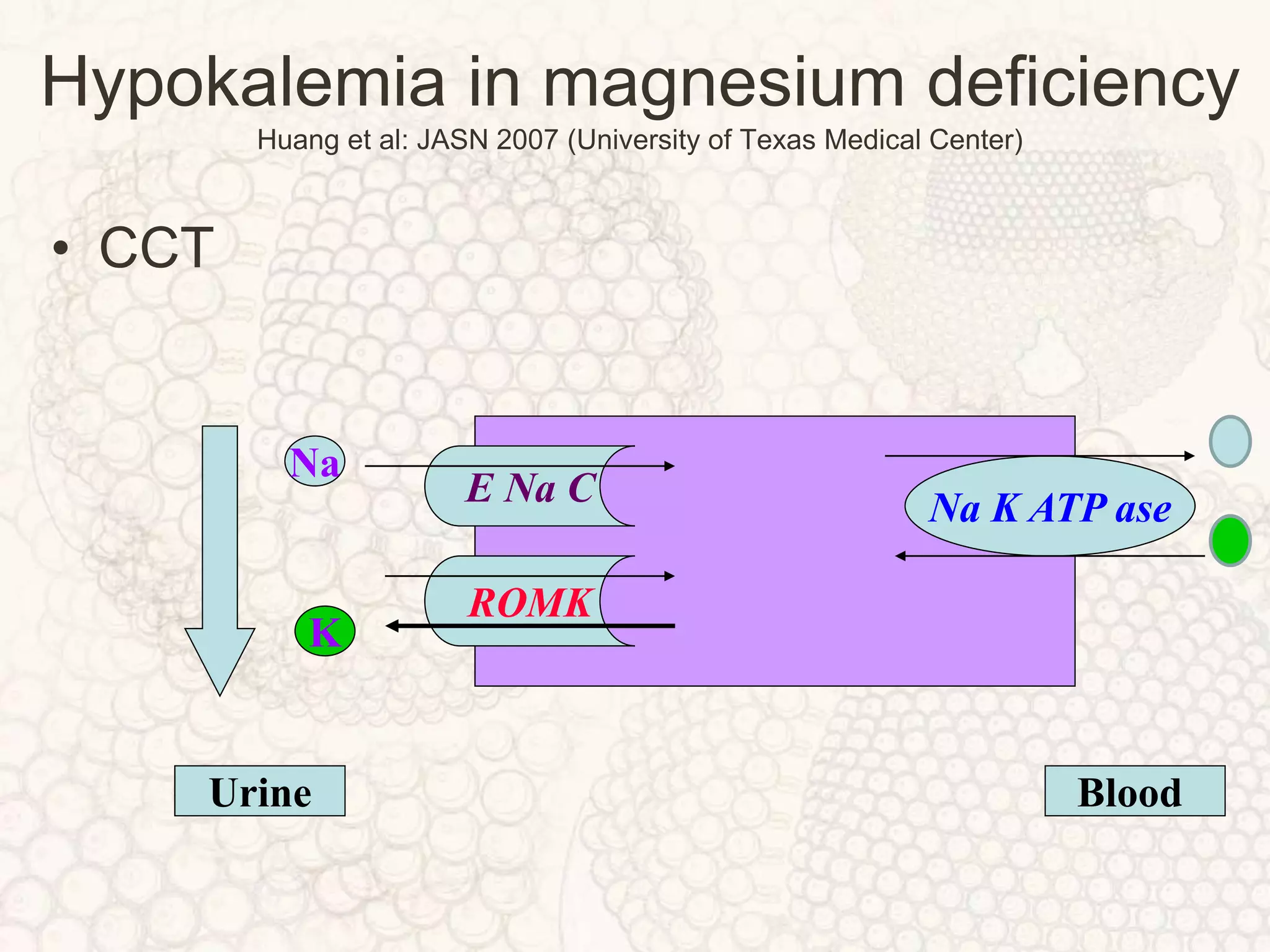
Hypokalemia in magnesium deficiency
Huang et al: JASN 2007 (University of Texas Medical Center)
• CCT
E Na C
ROMK
Na K ATP ase
Urine Blood
Na
K
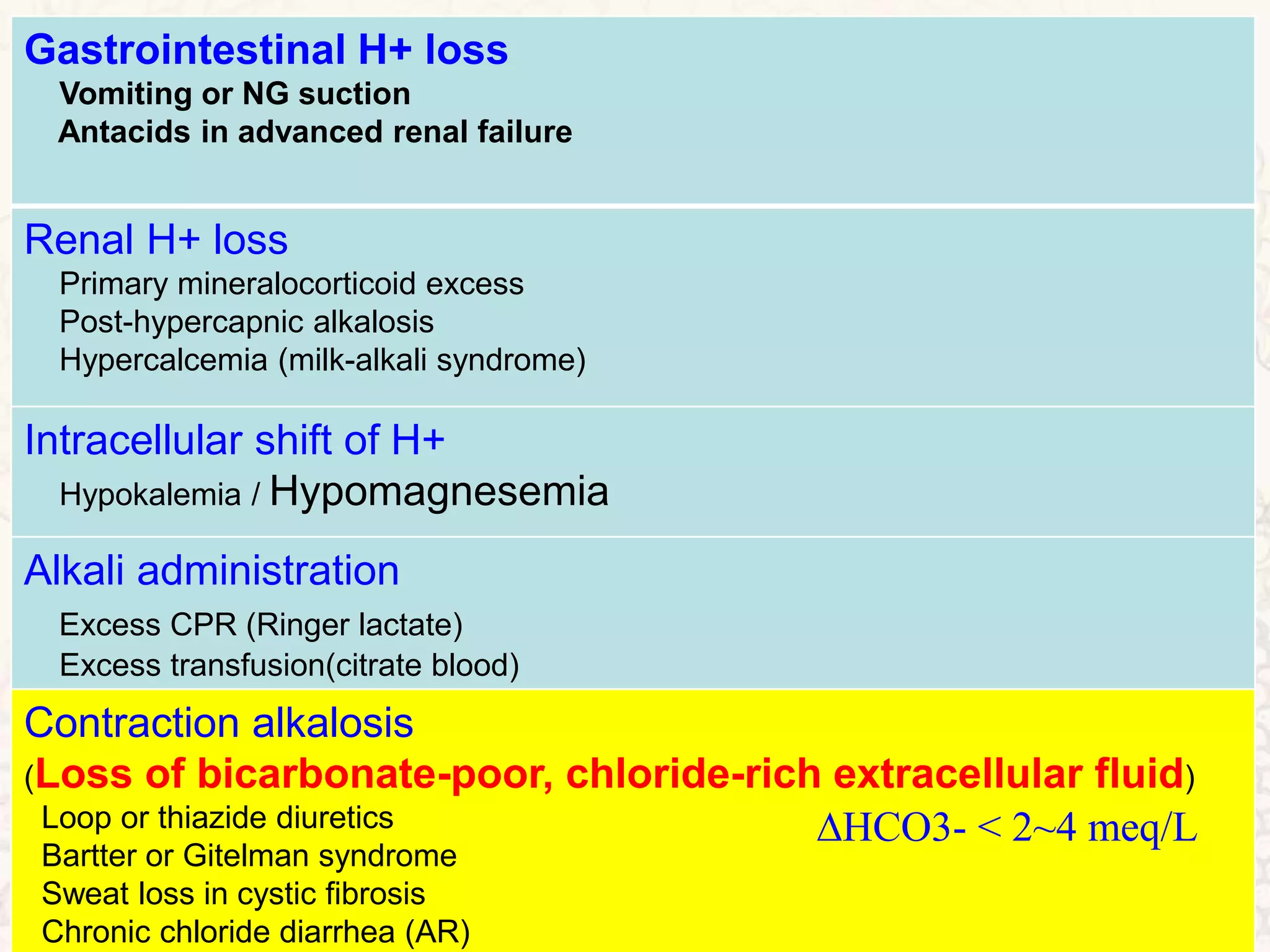
Gastrointestinal H+ loss
Vomiting or NG suction
Antacids in advanced renal failure
Renal H+ loss
Primary mineralocorticoid excess
Post-hypercapnic alkalosis
Hypercalcemia (milk-alkali syndrome)
Intracellular shift of H+
Hypokalemia / Hypomagnesemia
Alkali administration
Excess CPR (Ringer lactate)
Excess transfusion(citrate blood)
Contraction alkalosis
(Loss of bicarbonate-poor, chloride-rich extracellular fluid)
Loop or thiazide diuretics
Bartter or Gitelman syndrome
Sweat loss in cystic fibrosis
Chronic chloride diarrhea (AR)
∆HCO3- < 2~4 meq/L
Chloride depletion, even without volume
depletion, enhances bicarbonate re-absorption
• In the late thick ascending limb (THAL) and early
distal tubule, specialized cells called the macula
densa are present
• Na+/K+/2Cl- cotransporter in the apical membrane,
which is mainly regulated by chloride ions
• When fewer chloride ions reach this transporter
(eg, chloride depletion), the macula densa signals
the juxtaglomerular apparatus (ie, specialized
cells in the wall of the adjacent afferent arteriole) to
secrete renin, which increases aldosterone
secretion via angiotensin II ( ↑RAA ).
Chloride sensor
in macula densa
Renin ↑
Bartter’s syndrome in THAL
NKCC
ROMK
Na K ATP ase
Na/K
K
2Cl
CaSR
Negative
Positive
ClC-Kb
ClC-KB
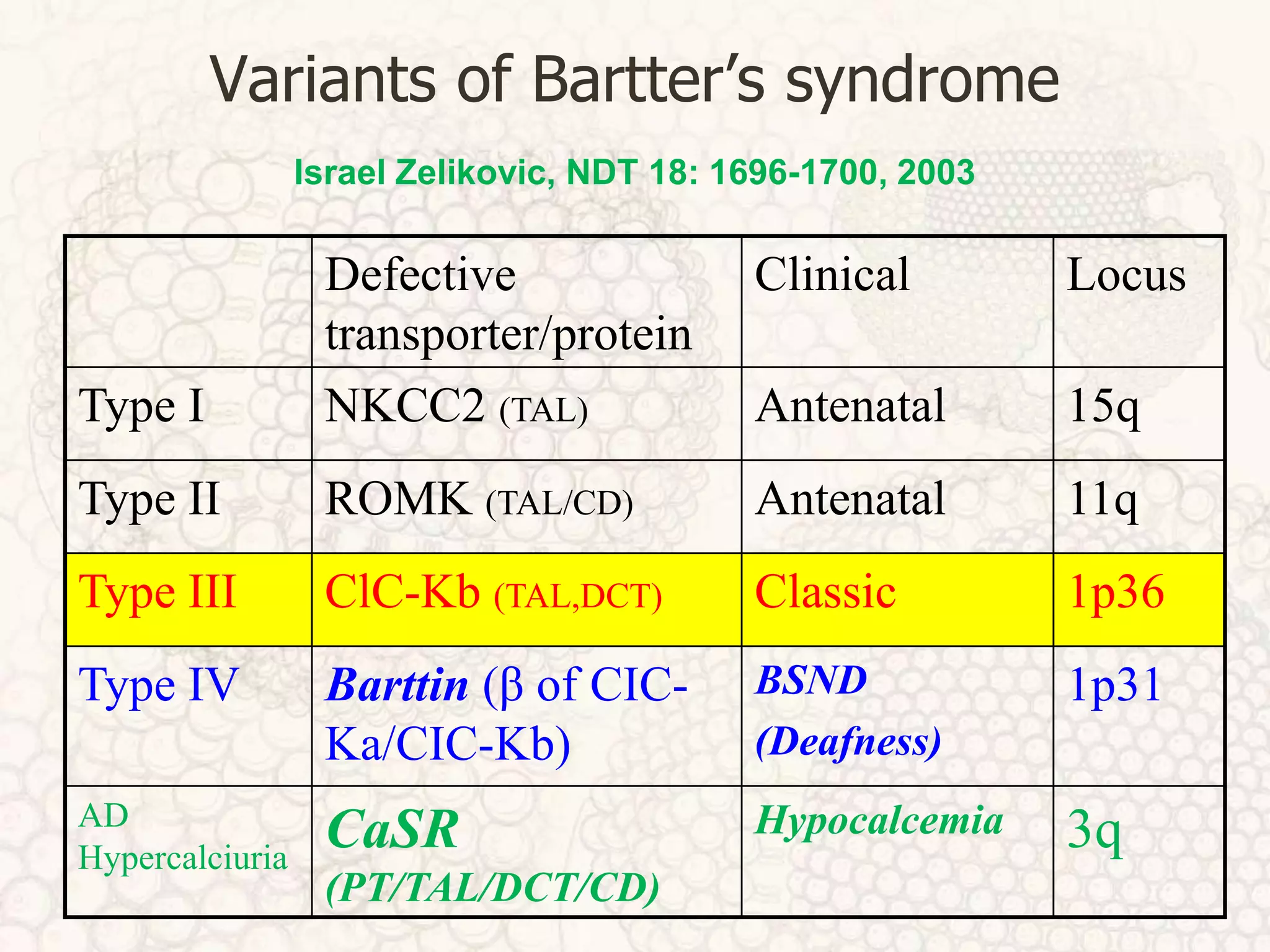
Variants of Bartter’s syndrome
Israel Zelikovic, NDT 18: 1696-1700, 2003
Defective
transporter/protein
Clinical Locus
Type I NKCC2 (TAL) Antenatal 15q
Type II ROMK (TAL/CD) Antenatal 11q
Type III ClC-Kb (TAL,DCT) Classic 1p36
Type IV Barttin (β of CIC-
Ka/CIC-Kb)
BSND
(Deafness)
1p31
AD
Hypercalciuria
CaSR
(PT/TAL/DCT/CD)
Hypocalcemia 3q
Gitelman’s syndrome in DCT
TSC
Na
Cl
V2R
Inactive
TSC dimer TSC
monomer
AT1R
MR
SPAK
FE-Cl > 0.5%
Hypocalciuria:
Ca/Cr < 0.07
(mg/mg)
Gitelman’s / Bartter’s syndrome
Gitelman’s Bartter’s
Molecular level ↓TSC in DCT ↓NKCC, ROMK, or
Cl
Age at onset Teenage Children
Clinical Tetany Failure to thrive
Mimicked by Thiazides Loop diuretics
Plasma Mg ↓ ↓
D.D. Hypocalciuria Hypercalciuria
Uosm ↓
Check urine
Cl-
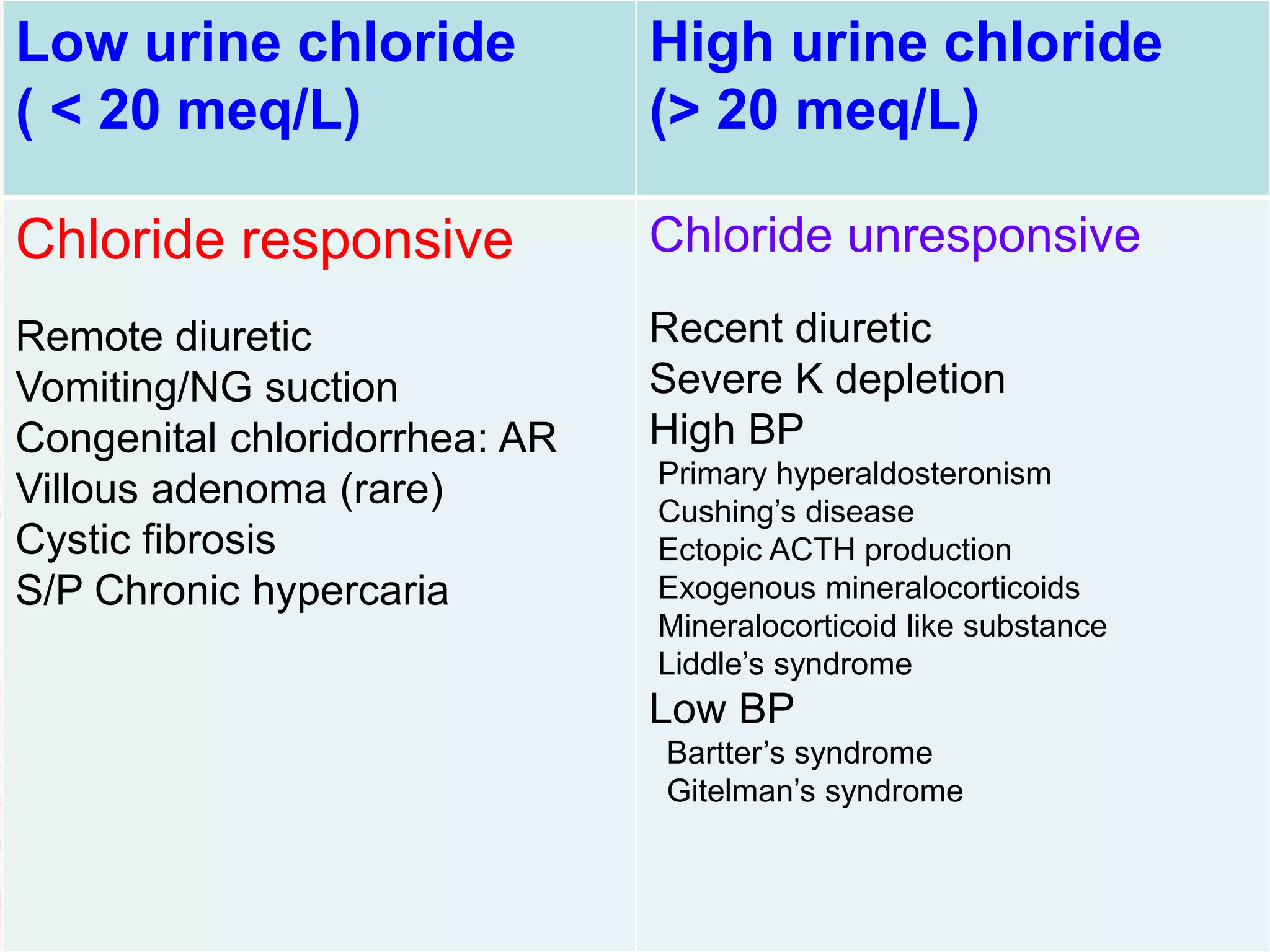
Low urine chloride
( < 20 meq/L)
High urine chloride
(> 20 meq/L)
Chloride responsive
Remote diuretic
Vomiting/NG suction
Congenital chloridorrhea: AR
Villous adenoma (rare)
Cystic fibrosis
S/P Chronic hypercaria
Chloride unresponsive
Recent diuretic
Severe K depletion
High BP
Primary hyperaldosteronism
Cushing’s disease
Ectopic ACTH production
Exogenous mineralocorticoids
Mineralocorticoid like substance
Liddle’s syndrome
Low BP
Bartter’s syndrome
Gitelman’s syndrome
HTN
11β-
HSD2D
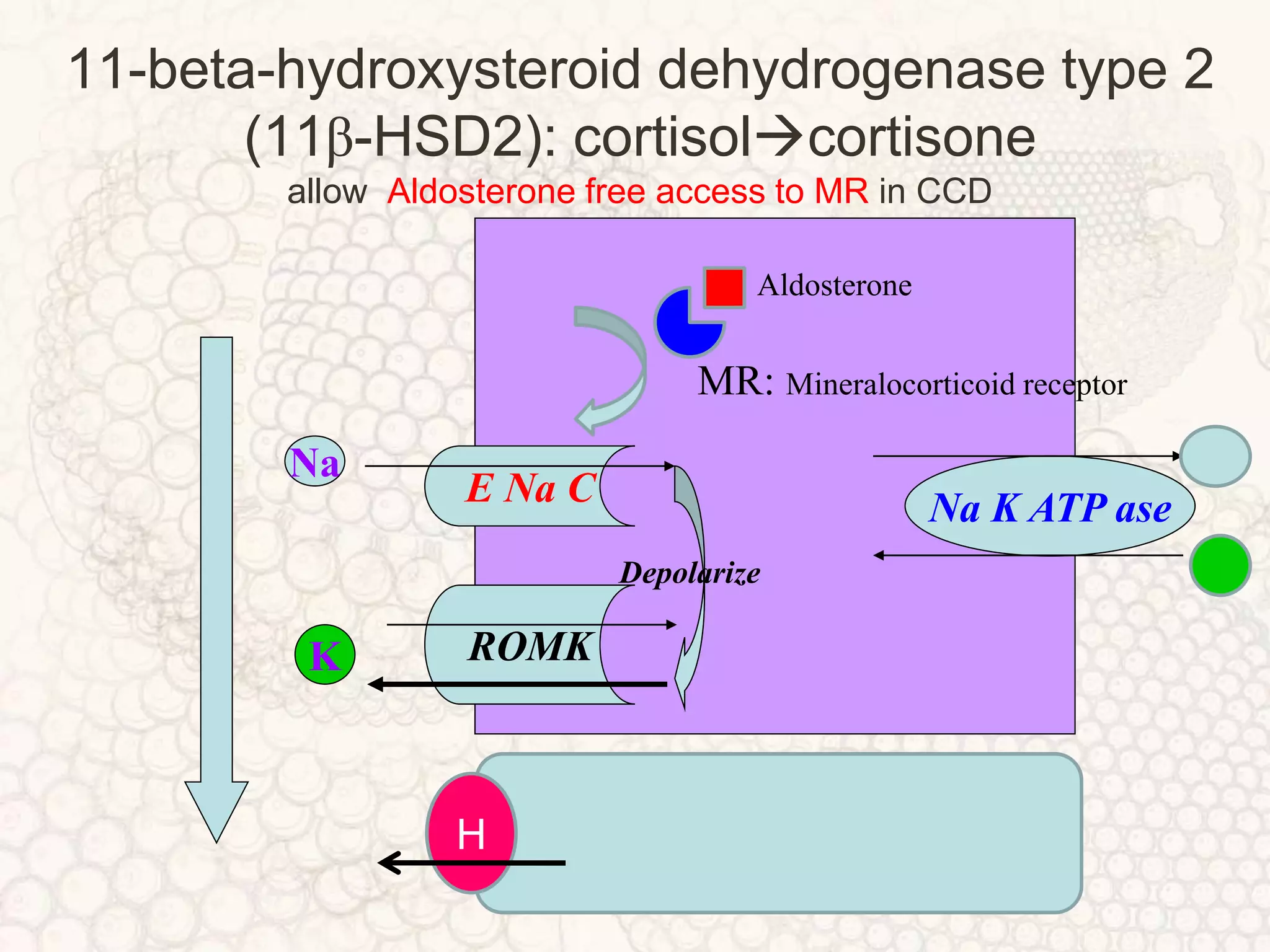
11-beta-hydroxysteroid dehydrogenase type 2
(11β-HSD2): cortisolcortisone
allow Aldosterone free access to MR in CCD
E Na C
ROMK
Na K ATP ase
Depolarize
Na
K
H
Aldosterone
MR: Mineralocorticoid receptor
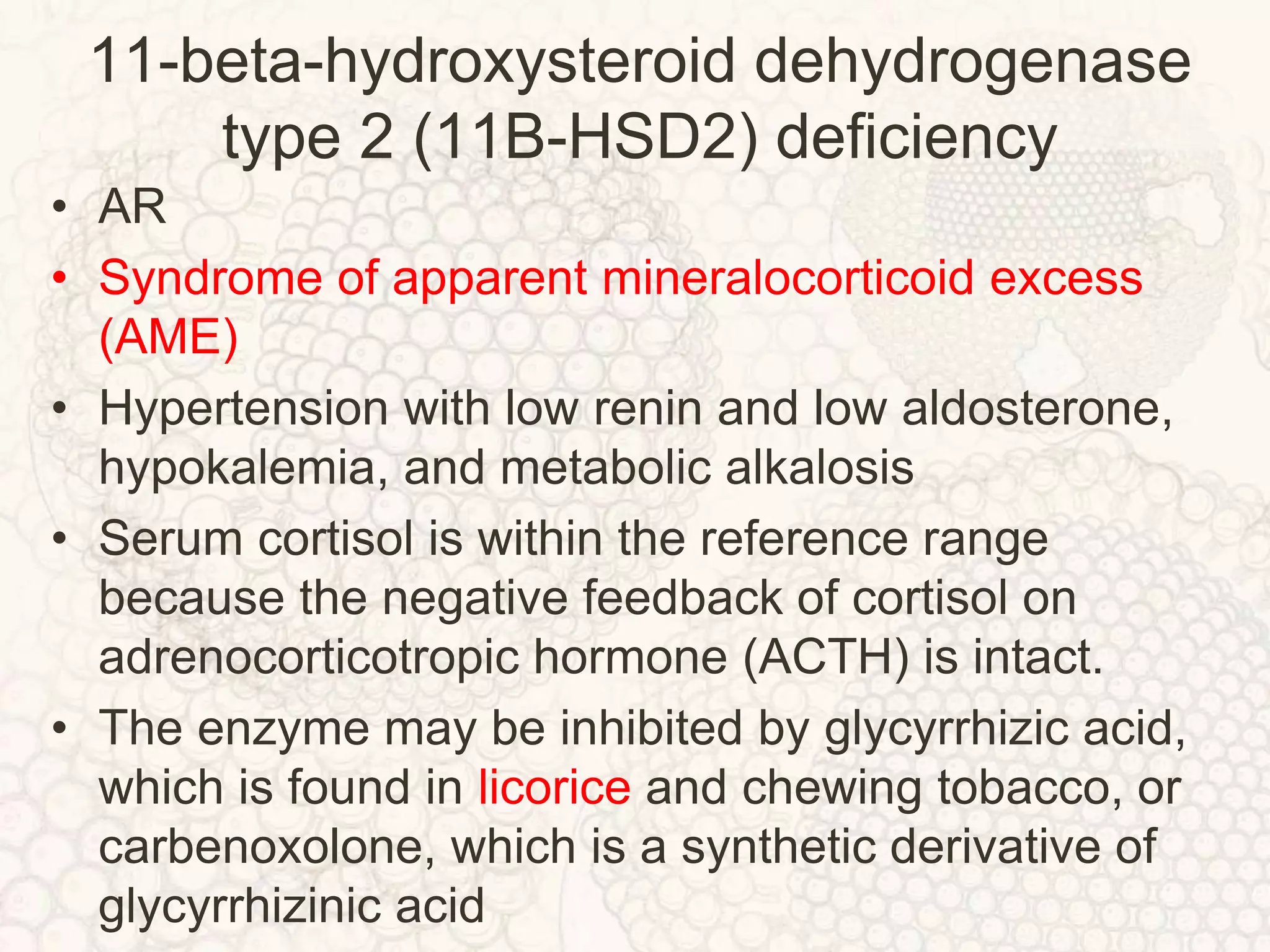
11-beta-hydroxysteroid dehydrogenase
type 2 (11B-HSD2) deficiency
• AR
• Syndrome of apparent mineralocorticoid excess
(AME)
• Hypertension with low renin and low aldosterone,
hypokalemia, and metabolic alkalosis
• Serum cortisol is within the reference range
because the negative feedback of cortisol on
adrenocorticotropic hormone (ACTH) is intact.
• The enzyme may be inhibited by glycyrrhizic acid,
which is found in licorice and chewing tobacco, or
carbenoxolone, which is a synthetic derivative of
glycyrrhizinic acid
HTN
GRH
Glucocorticoid-remediable aldosteronism
an autosomal dominant disorder, in which ectopic production of aldosterone in the
zona fasciculata of the adrenal cortex occurs
Simple or mixed ?
Conditions Primary event Secondary response
Metabolic acidosis
(30 minutes onset,
12-24H completion)
HCO3 ↓ 1 meq/L pCO2 ↓ 1.2 mmHg
Metabolic alkalosis
(30 minutes onset,
12-24H completion)
HCO3 ↑ 1 meq/L pCO2 ↑ 0.7 mmHg
Respiratory acidosis
Acute
Chronic > 3-5days
pCO2 ↑ 10 mmHg HCO3
↑ 1 meq/L
↑ 3.5-4 meq/L
Respiratory alkalosis
Acute
Chronic >3-5 days
pCO2 ↓ 10 mmHg HCO3
↓ 2 meq/L
↓ 4-5 meq/L
General Principles of Treatment
 ↑ Renal bicarbonate excretion ( urine pH>7 )
A reduced effective arterial blood volume (EABV)
Chloride depletion (hypochloremia)
Potassium depletion (hypokalemia)  K supply
 All exogenous sources of alkali should be
discontinued: Citrate/Ketones/Lactate
 Drugs that reduce gastric HCl secretion.
H2 blockers
PPI
NS
General Principles of Treatment
 Acetazolamide(250-500mg/D) is a carbonic
anhydrase inhibitor that preferentially
inhibits proximal sodium bicarbonate
reabsorption
 Potassium-sparing diuretics
 NH4Cl ( 100 meq/L/ 20 mL vial)
1-2 vials in 1000 mL of NS
A new perspective on metabolic alkalosis

A new perspective on metabolic alkalosis

  • 1.
    A New Perspectiveon Metabolic alkalosis Taipei Veterans General Hospital, Hsin-Chu branch Director of Nephrology Steve Chen HCO3-
  • 3.
  • 5.
  • 6.
    H+ ATP ase H+ H2O OH- CO2 HCO3- + Cl- CA CCD: ↓H+ secretion AE-1 α - intercalated cell
  • 7.
    CCD: ↑ HCO3-secretion  generation Pendrin β intercalated cell
  • 9.
    TYPES OF ACID-BASEDISTURBANCES Depression of the central nervous system, as evidenced by disorientation followed by coma Excitability of the nervous system; muscles may go into a state of tetany and convulsions
  • 13.
    Shift of hydrogenions into the intracellular space Hypokalemia
  • 14.
    Na+ NHE-3 H+ HCO3- Na+ NBC H2O CO2+ CA-2 Na+ K+ Na/K ATPase Intracellularacidosis ► ↑ Re-absorption of HCO3- in PCT H+HCO3-
  • 15.
  • 16.
    Hypokalemia ►↓ Clre-absorption in DCN TSCNa Cl V2R Inactive TSC dimer TSC monomer AT1R MR SPAK TSC: Thiazide Sensitive Co-transporter
  • 17.
    Hypokalemia  Metabolicalkalosis • Hypokalemia results in the shift of hydrogen ions intracellularly. The resulting intracellular acidosis enhances bicarbonate re-absorption in the collecting duct • Hypokalemia stimulates the apical H+/K+ ATPase in the collecting duct • Hypokalemia stimulates renal ammonia genesis and alpha- ketoglutarate is produced, the metabolism of which generates bicarbonate that is returned to the systemic circulation • It leads to impaired chloride ion re-absorption in the distal nephron. This results in an increase in luminal electro- negativity, with subsequent enhancement of hydrogen ion secretion
  • 18.
  • 19.
    Aldosterone ►Hypokalemia inCCD E Na C ROMK Na K ATP ase Depolarize + Aldosterone + Na K H Principal cell
  • 20.
    Competitive affinity forMR Cortisol >> Aldosterone > cortisone E Na C ROMK Na K ATP ase Depolarize Na K H Aldosterone MR: Mineralocorticoid receptor
  • 22.
    Gastrointestinal H+ loss Vomitingor NG suction Antacids in advanced renal failure Renal H+ loss Primary mineralocorticoid excess Post-hypercapnic alkalosis Hypercalcemia (milk-alkali syndrome) Intracellular shift of H+ Hypokalemia / Hypomagnesemia Alkali administration Excess CPR (Ringer lactate) Excess transfusion(citrate blood) Contraction alkalosis (Loss of bicarbonate-poor, chloride-rich extracellular fluid) Loop or thiazide diuretics Bartter or Gitelman syndrome Sweat loss in cystic fibrosis Villous adenoma(Chronic chloride diarrhea )or factitious diarrhea(Laxative abuse) ∆HCO3- < 2~4 meq/L
  • 23.
    ROMK - intracellularmagnesium Huang et al: JASN 2007 (University of Texas Medical Center) • CCT E Na C ROMK Na K ATP ase UK 5mM CK 143mM Na K Mg
  • 24.
    Hypokalemia in magnesiumdeficiency Huang et al: JASN 2007 (University of Texas Medical Center) • CCT E Na C ROMK Na K ATP ase Urine Blood Na K
  • 25.
    Gastrointestinal H+ loss Vomitingor NG suction Antacids in advanced renal failure Renal H+ loss Primary mineralocorticoid excess Post-hypercapnic alkalosis Hypercalcemia (milk-alkali syndrome) Intracellular shift of H+ Hypokalemia / Hypomagnesemia Alkali administration Excess CPR (Ringer lactate) Excess transfusion(citrate blood) Contraction alkalosis (Loss of bicarbonate-poor, chloride-rich extracellular fluid) Loop or thiazide diuretics Bartter or Gitelman syndrome Sweat loss in cystic fibrosis Chronic chloride diarrhea (AR) ∆HCO3- < 2~4 meq/L
  • 26.
    Chloride depletion, evenwithout volume depletion, enhances bicarbonate re-absorption • In the late thick ascending limb (THAL) and early distal tubule, specialized cells called the macula densa are present • Na+/K+/2Cl- cotransporter in the apical membrane, which is mainly regulated by chloride ions • When fewer chloride ions reach this transporter (eg, chloride depletion), the macula densa signals the juxtaglomerular apparatus (ie, specialized cells in the wall of the adjacent afferent arteriole) to secrete renin, which increases aldosterone secretion via angiotensin II ( ↑RAA ).
  • 27.
  • 29.
    Bartter’s syndrome inTHAL NKCC ROMK Na K ATP ase Na/K K 2Cl CaSR Negative Positive ClC-Kb ClC-KB
  • 30.
    Variants of Bartter’ssyndrome Israel Zelikovic, NDT 18: 1696-1700, 2003 Defective transporter/protein Clinical Locus Type I NKCC2 (TAL) Antenatal 15q Type II ROMK (TAL/CD) Antenatal 11q Type III ClC-Kb (TAL,DCT) Classic 1p36 Type IV Barttin (β of CIC- Ka/CIC-Kb) BSND (Deafness) 1p31 AD Hypercalciuria CaSR (PT/TAL/DCT/CD) Hypocalcemia 3q
  • 31.
    Gitelman’s syndrome inDCT TSC Na Cl V2R Inactive TSC dimer TSC monomer AT1R MR SPAK FE-Cl > 0.5% Hypocalciuria: Ca/Cr < 0.07 (mg/mg)
  • 32.
    Gitelman’s / Bartter’ssyndrome Gitelman’s Bartter’s Molecular level ↓TSC in DCT ↓NKCC, ROMK, or Cl Age at onset Teenage Children Clinical Tetany Failure to thrive Mimicked by Thiazides Loop diuretics Plasma Mg ↓ ↓ D.D. Hypocalciuria Hypercalciuria Uosm ↓
  • 34.
  • 35.
    Low urine chloride (< 20 meq/L) High urine chloride (> 20 meq/L) Chloride responsive Remote diuretic Vomiting/NG suction Congenital chloridorrhea: AR Villous adenoma (rare) Cystic fibrosis S/P Chronic hypercaria Chloride unresponsive Recent diuretic Severe K depletion High BP Primary hyperaldosteronism Cushing’s disease Ectopic ACTH production Exogenous mineralocorticoids Mineralocorticoid like substance Liddle’s syndrome Low BP Bartter’s syndrome Gitelman’s syndrome
  • 36.
  • 37.
    11-beta-hydroxysteroid dehydrogenase type2 (11β-HSD2): cortisolcortisone allow Aldosterone free access to MR in CCD E Na C ROMK Na K ATP ase Depolarize Na K H Aldosterone MR: Mineralocorticoid receptor
  • 38.
    11-beta-hydroxysteroid dehydrogenase type 2(11B-HSD2) deficiency • AR • Syndrome of apparent mineralocorticoid excess (AME) • Hypertension with low renin and low aldosterone, hypokalemia, and metabolic alkalosis • Serum cortisol is within the reference range because the negative feedback of cortisol on adrenocorticotropic hormone (ACTH) is intact. • The enzyme may be inhibited by glycyrrhizic acid, which is found in licorice and chewing tobacco, or carbenoxolone, which is a synthetic derivative of glycyrrhizinic acid
  • 39.
  • 40.
    Glucocorticoid-remediable aldosteronism an autosomaldominant disorder, in which ectopic production of aldosterone in the zona fasciculata of the adrenal cortex occurs
  • 42.
    Simple or mixed? Conditions Primary event Secondary response Metabolic acidosis (30 minutes onset, 12-24H completion) HCO3 ↓ 1 meq/L pCO2 ↓ 1.2 mmHg Metabolic alkalosis (30 minutes onset, 12-24H completion) HCO3 ↑ 1 meq/L pCO2 ↑ 0.7 mmHg Respiratory acidosis Acute Chronic > 3-5days pCO2 ↑ 10 mmHg HCO3 ↑ 1 meq/L ↑ 3.5-4 meq/L Respiratory alkalosis Acute Chronic >3-5 days pCO2 ↓ 10 mmHg HCO3 ↓ 2 meq/L ↓ 4-5 meq/L
  • 44.
    General Principles ofTreatment  ↑ Renal bicarbonate excretion ( urine pH>7 ) A reduced effective arterial blood volume (EABV) Chloride depletion (hypochloremia) Potassium depletion (hypokalemia)  K supply  All exogenous sources of alkali should be discontinued: Citrate/Ketones/Lactate  Drugs that reduce gastric HCl secretion. H2 blockers PPI NS
  • 45.
    General Principles ofTreatment  Acetazolamide(250-500mg/D) is a carbonic anhydrase inhibitor that preferentially inhibits proximal sodium bicarbonate reabsorption  Potassium-sparing diuretics  NH4Cl ( 100 meq/L/ 20 mL vial) 1-2 vials in 1000 mL of NS